Understanding RAFT Polymerization: A Complete Guide to Kinetics, Thermodynamic Equilibrium, and Biomedical Applications
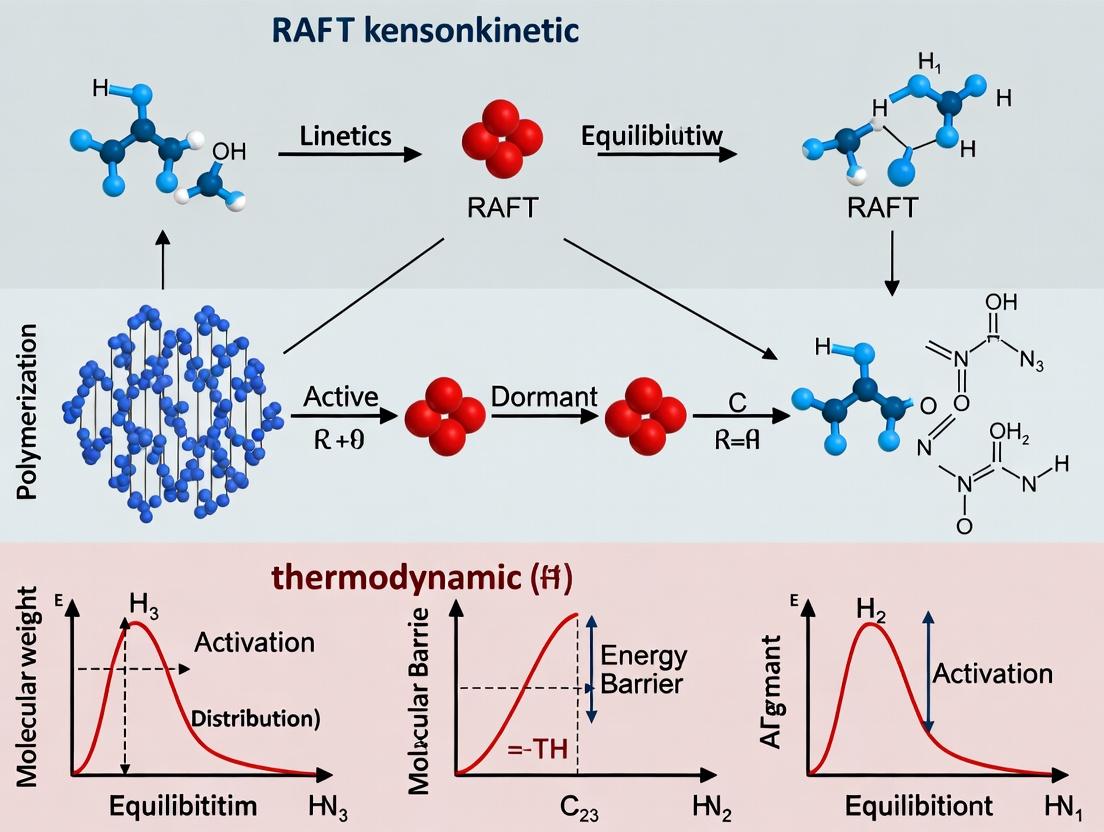
This comprehensive article provides researchers, scientists, and drug development professionals with an in-depth exploration of Reversible Addition-Fragmentation Chain Transfer (RAFT) polymerization.
Understanding RAFT Polymerization: A Complete Guide to Kinetics, Thermodynamic Equilibrium, and Biomedical Applications
Abstract
This comprehensive article provides researchers, scientists, and drug development professionals with an in-depth exploration of Reversible Addition-Fragmentation Chain Transfer (RAFT) polymerization. It begins by establishing the fundamental principles of RAFT kinetics and the crucial role of thermodynamic equilibrium in controlling polymerization. The content progresses to cover practical methodology, common synthesis challenges, and optimization strategies for creating well-defined polymers. Finally, it validates RAFT against other controlled polymerization techniques and examines its pivotal role in advancing biomedical applications, including drug delivery systems and polymeric therapeutics. This guide serves as both a foundational resource and a practical manual for leveraging RAFT in cutting-edge research.
RAFT Polymerization Decoded: Core Principles of Kinetics and Thermodynamic Equilibrium
This whitepaper provides an in-depth technical guide to Controlled Radical Polymerization (CRP), with a specific focus on Reversible Addition-Fragmentation chain-Transfer (RAFT) polymerization. The content is framed within a broader research thesis aimed at elucidating RAFT polymerization kinetics and the thermodynamic equilibria that govern its control. This mechanistic understanding is critical for researchers, scientists, and drug development professionals designing advanced polymeric materials for applications such as drug delivery, diagnostics, and biomaterials.
Fundamentals of Controlled Radical Polymerization
CRP techniques, also known as Reversible Deactivation Radical Polymerization (RDRP), maintain a dynamic equilibrium between active propagating radicals and dormant species. This minimizes irreversible termination, enabling the synthesis of polymers with predetermined molecular weights, low dispersity (Đ), and complex architectures.
Key CRP Techniques:
- Nitroxide-Mediated Polymerization (NMP): Uses stable nitroxide radicals as controllers.
- Atom Transfer Radical Polymerization (ATRP): Employs a transition metal catalyst and halogen exchange.
- Reversible Addition-Fragmentation chain-Transfer (RAFT): Utilizes chain-transfer agents (CTAs) with thiocarbonylthio groups.
The RAFT Mechanism and Kinetic Advantage
RAFT polymerization is distinguished by its use of thiocarbonylthio compounds as chain-transfer agents. The mechanism involves two key equilibrium stages that explain its kinetic control, central to the associated thesis research.
Diagram 1: RAFT Polymerization Core Mechanism
Kinetic Explanation: The rapid establishment of the pre-equilibrium ensures all chains are initiated almost simultaneously. The main equilibrium is fast relative to propagation, ensuring all chains grow at a similar rate. The concentration of active radicals (Pn•) remains extremely low, suppressing termination while maintaining a linear increase in molecular weight with conversion.
Quantitative Comparison of Major CRP Techniques
The following table summarizes key quantitative and characteristics data for the primary CRP methods, highlighting the operational advantages of RAFT.
Table 1: Comparison of Major Controlled Radical Polymerization Techniques
| Feature | RAFT | ATRP | NMP |
|---|---|---|---|
| Typical Dispersity (Đ) | 1.05 - 1.3 | 1.05 - 1.3 | 1.2 - 1.5 |
| Catalyst/Mediator | None (CTA only) | Transition Metal Complex (e.g., Cu) | Alkoxyamine/TEMPO |
| Key Agent | Thiocarbonylthio CTA | Alkyl Halide Initiator | Stable Nitroxide |
| Tolerance to Water | Excellent | Moderate to Good (requires ligand) | Poor |
| pH Sensitivity | Low (can be tuned) | High (metal complex stability) | Low |
| Monomer Scope | Very Broad (Acrylates, methacrylates, styrene, VAc, acrylamides) | Broad (Acrylates, styrene; less for VAc) | Moderate (Styrenics, acrylates) |
| Ease of Purification | Moderate (Remove CTA fragments) | Challenging (Remove metal catalyst) | Easy |
| Functional Group Tolerance | High | Low (Redox-sensitive groups) | Moderate |
Detailed Experimental Protocol: RAFT Polymerization of PNIPAM
This protocol for synthesizing poly(N-isopropylacrylamide) (PNIPAM), a thermoresponsive polymer, exemplifies standard RAFT practice and kinetic analysis.
Title: Synthesis of PNIPAM via RAFT for Kinetic Studies.
Objective: To synthesize PNIPAM with target Mn ~20,000 g/mol and Đ < 1.2, enabling subsequent kinetic sampling.
Materials: See "The Scientist's Toolkit" below. Procedure:
- Solution Preparation: In a vial, dissolve the CTA (CDB, 20.6 mg, 0.075 mmol) and initiator (ACPA, 2.1 mg, 0.0075 mmol) in 5 mL of anhydrous 1,4-dioxane. In a separate flask, dissolve NIPAM monomer (1.695 g, 15 mmol) in 15 mL of the same solvent.
- Reaction Setup: Transfer the monomer solution to a 25 mL Schlenk flask equipped with a magnetic stir bar. Add the CTA/initiator solution via syringe. Seal the flask with a rubber septum.
- Degassing: Purge the solution with dry nitrogen or argon for 30 minutes while stirring in an ice bath to remove oxygen.
- Polymerization: Place the sealed flask in a pre-heated oil bath at 70°C with vigorous stirring. This is time t=0.
- Kinetic Sampling: At predetermined time intervals (e.g., 30, 60, 120, 180, 300 min), use a degassed syringe to withdraw ~0.5 mL aliquots directly from the reaction mixture.
- Quenching & Analysis: Immediately inject each aliquot into a pre-weighed vial containing a small amount of hydroquinone or exposed to air to quench the reaction. Analyze samples by 1H NMR (for conversion) and Size Exclusion Chromatography (SEC) (for Mn and Đ).
- Work-up: After target conversion (~80%), cool the reaction, dilute with THF, and precipitate into cold diethyl ether or hexane. Filter and dry the polymer under vacuum.
The Scientist's Toolkit: Key Research Reagent Solutions
Table 2: Essential Materials for RAFT Polymerization Experiments
| Item | Function & Critical Properties |
|---|---|
| RAFT CTA (e.g., CDB, CPADB) | Chain-transfer Agent. The heart of control. Z and R groups dictate reactivity and suitability for monomers. Must be purified and stored cold/dark. |
| Thermal Initiator (e.g., ACPA, AIBN) | Source of Primary Radicals. Decomposes thermally to initiate chains. Concentration is kept low relative to CTA ([I]/[CTA] ~ 0.1). |
| Anhydrous, Degassed Solvent | Reaction Medium. Must be purified (e.g., over Al2O3) and degassed to prevent chain transfer to solvent and radical quenching by oxygen. |
| Monomer (e.g., NIPAM, MMA) | Polymer Building Block. Must be purified (inhibitor removed via basic Al2O3 column) and stored under inert atmosphere. |
| Schlenk Flask & Septa | Reaction Vessel. Allows for easy degassing via freeze-pump-thaw cycles or nitrogen bubbling and safe sampling under inert atmosphere. |
| Pre-heated Oil Bath | Provides Precise, Constant Temperature. Critical for reproducible initiator decomposition rates and consistent kinetics. |
| Gas-tight Syringes | For Degassed Solution Transfer and Kinetic Sampling. Prevents oxygen ingress during handling. |
| Precipitant Solvent (e.g., Hexane) | Polymer Purification. A non-solvent chosen to efficiently precipitate the polymer and remove unreacted monomer and CTA fragments. |
Data Analysis and Thermodynamic Equilibrium
The kinetic data from the protocol allows for the construction of plots central to the thesis: Ln([M]0/[M]) vs. time (for pseudo-first-order kinetics) and Mn vs. conversion. A linear relationship in the first plot confirms a constant radical concentration. A linear increase in Mn with conversion and low Đ values confirm a well-controlled, living system governed by the rapid equilibrium shown in Diagram 1.
Diagram 2: RAFT Kinetic Data Analysis Workflow
Thermodynamic Explanation: The equilibrium constant K_eq for the main RAFT equilibrium determines the distribution of active versus dormant chains. A large K_eq (fast fragmentation) favors the dormant state, minimizing termination. The RAFT advantage lies in the tunability of this equilibrium via the structure of the CTA (Z and R groups), allowing precise control over polymerization kinetics for a vast monomer range.
RAFT (Reversible Addition-Fragmentation chain Transfer) polymerization is a cornerstone of modern controlled radical polymerization. Within the broader thesis on RAFT polymerization kinetics and thermodynamic equilibria, this guide details the core reversible chain transfer cycle that enables precise control over polymer architecture.
Core Mechanism: The Reversible Chain Transfer Cycle
The RAFT mechanism operates as a degenerative chain transfer process, mediated by a chain transfer agent (CTA), typically a thiocarbonylthio compound (Z-C(=S)S-R). The cycle maintains a dynamic equilibrium between active propagating radicals (P~n~•) and dormant thiocarbonylthio-capped chains (P~n~-S(C=S)Z).
Step-by-Step Breakdown:
- Initiation: A conventional radical initiator (e.g., AIBN) decomposes to produce primary radicals (I•), which add to monomer (M) to form the propagating radical (P~n~•).
- Pre-Equilibrium (Addition-Fragmentation): The propagating radical adds to the C=S bond of the CTA or a dormant polymer chain (P~m~-X). This forms an intermediate radical, which rapidly fragments. The fragmentation can regenerate the original species or produce a new dormant chain and a new radical (R• or P~m~•). The R-group is chosen to be a good leaving group.
- Re-Equilibration (Core Cycle): The new radical (R•) re-initiates polymerization, forming a new propagating chain (P~m~•). This radical then undergoes the same addition-fragmentation process with other dormant chains. This rapid exchange equilibrates the population of active radicals among all polymer chains.
- Propagation: Active chains add monomer units during their brief lifetimes.
- Termination: Occurs via radical coupling or disproportionation, as in conventional free radical polymerization, but is suppressed due to the low, steady-state concentration of active radicals.
The key to control is the rapidity of the exchange cycle (steps 2 & 3) relative to propagation, ensuring all chains grow at near-equal rate.
Diagram: The RAFT Reversible Chain Transfer Cycle
The efficiency of the RAFT process is governed by key rate coefficients and equilibrium constants. The table below summarizes critical parameters for a model system (Styrene polymerization with a dithiobenzoate CTA).
Table 1: Key Kinetic Parameters for RAFT Polymerization (Model System)
| Parameter | Symbol | Typical Value Range | Description & Impact |
|---|---|---|---|
| Addition Rate Coefficient | kadd | 10⁴ – 10⁶ L·mol⁻¹·s⁻¹ | Rate of radical adding to C=S. High values favor control. |
| Fragmentation Rate Coefficient | kfrag | 10⁰ – 10⁴ s⁻¹ | Rate of intermediate fragmentation. Balanced with kadd is crucial. |
| Chain Transfer Constant | Ctr = kadd/kp | 10 – 1000 (Effective) | Measure of CTA activity. >1 is required for good control. |
| Equilibrium Constant | K = kadd/kfrag | 10⁻² – 10² L·mol⁻¹ | Position of addition-fragmentation equilibrium. Affects polymerization rate. |
| Propagation Rate Coefficient | kp | ~10² L·mol⁻¹·s⁻¹ (Styrene) | Baseline monomer propagation rate. |
| Re-initiation Rate Coefficient | kreinit | Varies widely | Rate at which R• re-initiates. Slow re-initiation can cause inhibition. |
Experimental Protocol: Determining the Chain Transfer Constant (Ctr)
Aim: To determine the chain transfer constant (Ctr) of a novel CTA for methyl methacrylate (MMA) polymerization.
Methodology (Chain-Length-Dependent Termination Corrected):
- Materials Setup: Prepare stock solutions of MMA (purified over basic alumina), the CTA, and initiator (e.g., AIBN) in a deuterated solvent (for in-situ NMR) or bulk. Use several sealed reaction vessels.
- Polymerization Series: For each experiment, mix MMA with a constant [AIBN] (e.g., 1 mM) but varying [CTA]₀ (e.g., 0, 2, 5, 10, 20 mM). Degas via freeze-pump-thaw cycles (3x) and seal under inert atmosphere.
- Reaction Monitoring: Place vessels in a thermostated oil bath at 60°C (±0.1°C). Remove vessels at predetermined time intervals (e.g., 15, 30, 60, 120 min) and rapidly cool to quench reaction.
- Analysis:
- Conversion: Determine monomer conversion (p) for each sample by ¹H NMR (integrating monomer vs. polymer vinyl/ester signals).
- Molecular Weight & Dispersity: Analyze polymers by Size Exclusion Chromatography (SEC) with triple detection (RI, UV, LS) to obtain number-average molecular weight (Mn) and dispersity (Đ).
- Data Processing (Mayo Method): For low conversions (<15%), plot the inverse degree of polymerization (1/Xn) vs. the ratio [CTA]₀/[M]₀. The slope of the linear fit equals the chain transfer constant (Ctr).
1/X_n = (1/X_n)^0 + C_tr * ([CTA]_0/[M]_0)where (1/Xn)⁰ is the intercept from the control experiment without CTA.
Diagram: Experimental Workflow for Ctr Determination
The Scientist's Toolkit: Key Research Reagent Solutions
Table 2: Essential Materials for RAFT Kinetics Studies
| Reagent / Material | Typical Specification/Example | Function in Experiment |
|---|---|---|
| RAFT CTA (Subject) | e.g., 2-Cyano-2-propyl dodecyl trithiocarbonate (CPDT). High purity (≥97%). | The core agent mediating chain transfer. Structure (Z & R groups) defines control over monomer family. |
| Monomer | e.g., Methyl methacrylate (MMA), Styrene. Inhibitor removed (pass over alumina), distilled under reduced pressure. | The building block. Purity is critical to avoid side reactions and ensure accurate kinetics. |
| Radical Initiator | e.g., Azobisisobutyronitrile (AIBN), 4,4'-Azobis(4-cyanovaleric acid) (ACVA). Recrystallized from methanol. | Source of primary radicals to start the polymerization. Thermal decomposition rate constant (kd) must be known. |
| Deuterated Solvent | e.g., Benzene-d₆, Toluene-d₈ (for NMR studies). Anhydrous. | Allows for in-situ reaction monitoring via ¹H NMR to track conversion kinetics. |
| Inert Atmosphere | Argon or Nitrogen gas (Ultra High Purity, ≥99.999%). Further purified by oxygen/moisture scavenging columns. | Excludes oxygen, a radical scavenger that inhibits polymerization and degrades thiocarbonylthio compounds. |
| SEC Calibration Standards | Near-monodisperse poly(methyl methacrylate) or polystyrene standards. | Essential for calibrating Size Exclusion Chromatography to determine molecular weights and dispersity (Đ). |
This whitepaper provides an in-depth technical guide to the kinetic fundamentals governing reversible addition-fragmentation chain-transfer (RAFT) polymerization. The analysis of the rates of initiation (Ri), propagation (Rp), and transfer (Rtr) is framed within a broader thesis aimed at unifying RAFT kinetics with thermodynamic equilibrium principles. A precise understanding of these elementary steps is critical for researchers and drug development professionals designing polymeric nanomaterials with precise molecular weights, architectures, and functionalities for therapeutic applications.
Kinetic Rate Equations and Fundamental Relationships
The overall rate of polymerization in a RAFT system is governed by a complex interplay of reactions. The core kinetic scheme is summarized below.
Table 1: Elementary Reactions and Rate Expressions in RAFT Polymerization
| Reaction Step | Chemical Equation | Rate Expression | Rate Constant |
|---|---|---|---|
| Initiation | I → 2R• R• + M → P1• | Ri = 2f kd [I] | kd (decomposition), f (initiator efficiency) |
| Propagation | Pn• + M → Pn+1• | Rp = kp [P•][M] | kp (propagation) |
| Chain Transfer (RAFT) | Pn• + RAFT (Z-C(=S)S-R) ⇌ Pn-C(=S)S-Z + R• (Pre-equilibrium) R• + M → P1• Pn-C(=S)S-Z + Pm• ⇌ Pn-C(=S)S-Pm + Z• (Main Equilibrium) | Rtr = ktr [P•][RAFT] Equilibrium: K = kβ/k-β | ktr, kβ (addition), k-β (fragmentation) |
| Termination | Pn• + Pm• → Polymer | Rt = kt [P•]2 | kt (termination) |
Under the steady-state assumption for radical concentrations and assuming fast pre-equilibrium, the rate of propagation is often expressed as: Rp = kp [M] ( f kd [I] / kt )1/2
This classical expression can be modulated in RAFT by the rate of the transfer step and potential retardation effects, linking directly to the kinetics of the main equilibrium.
Experimental Protocols for Kinetic Analysis
Protocol for Measuring Propagation Rate Coefficient (kp) via PLP-SEC
Pulsed Laser Polymerization-Size Exclusion Chromatography (PLP-SEC) is the IUPAC-recommended method.
- Solution Preparation: Prepare a degassed monomer solution (e.g., 2-3 M in inert solvent) with a photoinitiator (e.g., DMPA, 10-3 M). For RAFT systems, include the chain transfer agent (CTA) at a target concentration.
- Pulsed Irradiation: Place the solution in a temperature-controlled reactor. Expose it to short pulses (e.g., 10 ns) of UV laser light (e.g., 355 nm) at a precise repetition rate (fpulse, typically 10-100 Hz).
- Kinetic Sampling: Quench the reaction at low conversion (<10%) at specific time intervals.
- Molecular Weight Analysis: Analyze the polymer samples via SEC calibrated with appropriate narrow standards. The molecular weight distribution will show distinctive "inflection points" at degrees of polymerization (L) where L = kp[M] / fpulse.
- Calculation: Determine kp from the slope of Li vs. 1/fpulse plot.
Protocol for Determining RAFT Equilibrium Constants (K)
Modeling of Polymerization Kinetics via In-situ NMR or Spectrophotometry.
- Reaction Monitoring: Conduct a low-conversion RAFT polymerization in an NMR tube or a spectrophotometric cell with temperature control.
- Time-Resolved Data: Use 1H NMR to track monomer consumption ([M]) and, critically, the consumption/reformation of the CTA's distinctive Z-group protons or the characteristic dithioester chromophore via UV-Vis.
- Kinetic Modeling: Fit the time-dependent concentration profiles to a system of differential equations derived from the reactions in Table 1 using software (e.g., PREDICI, MATLAB).
- Parameter Estimation: The equilibrium constant K = kβ/k-β is obtained as a fitted parameter that best describes the observed evolution of CTA and intermediate radical concentrations.
Visualization of RAFT Kinetic Pathways and Workflows
Diagram 1: Core RAFT Polymerization Kinetic Cycle
Diagram 2: PLP-SEC Workflow for kp Measurement
The Scientist's Toolkit: Research Reagent Solutions
Table 2: Essential Materials for RAFT Kinetic Studies
| Reagent/Material | Function & Role in Kinetic Analysis |
|---|---|
| AIBN or V-501 | Thermal azo-initiator. Source of primary radicals (R•). Decomposition rate (kd) is well-established, allowing accurate calculation of Ri. |
| DMPA or TPO | Photoinitiator for PLP experiments. Generates radicals upon UV pulse with high efficiency and short lifetime, enabling precise kinetic control. |
| Chain Transfer Agent (CTA) | Core reagent. Typically a dithioester (e.g., CDB), trithiocarbonate, or xanthate. Its structure (Z- and R-groups) dictates the equilibrium constant K and controls MWD. |
| Deuterated Solvents (e.g., C6D6, CDCl3) | Allows for in-situ 1H NMR kinetic monitoring without interfering signals, enabling direct measurement of [M] and [CTA] over time. |
| Inhibitor Removal Resin (e.g., Al2O3) | Used to purify monomer by removing hydroquinone or MEHQ stabilizers, which would interfere with radical kinetics and steady-state assumptions. |
| SEC Instrument with RI/UV Detectors | Critical for molecular weight analysis. UV detection (e.g., at 310 nm) is specific for the dithioester end-group, allowing tracking of CTA incorporation and chain growth. |
| Kinetic Modeling Software (PREDICI) | Commercial software package for solving complex systems of differential equations. Essential for fitting experimental data to extract individual rate constants (kβ, k-β). |
This whitepaper explores the critical kinetic stages of Reversible Addition-Fragmentation Chain Transfer (RAFT) polymerization, framed within ongoing research to develop a comprehensive thermodynamic equilibrium explanation. RAFT polymerization's utility in producing polymers with precise architecture for drug delivery and biomaterials hinges on a nuanced understanding of its two-stage equilibrium process. The pre-equilibrium, involving initial RAFT agent consumption, and the main equilibrium, governing subsequent chain growth, are distinct but interconnected kinetic regimes that dictate control over molecular weight, dispersity, and end-group fidelity. This guide details their mechanistic foundations, experimental delineation, and profound implications for researchers and drug development professionals designing next-generation polymeric therapeutics.
Mechanistic Foundations: Pre-Equilibrium vs. Main Equilibrium
The Pre-Equilibrium Phase
The pre-equilibrium encompasses the period from initiation until the consumption of the initial RAFT agent (Z-C(=S)S-R). During this phase, short propagating radicals (P~n~•) react with the RAFT agent, undergoing rapid addition-fragmentation cycles. This generates polymeric RAFT agents (macro-RAFT) and releases the re-initiating R-group radical (R•). The primary outcome is the conversion of the initial RAFT agent into chain-transfer-active species, setting the stage for controlled growth. Inefficiency or side reactions in this phase lead to deviations from ideal kinetics, such as retardation or poor initialization.
The Main Equilibrium Phase
Once the pre-equilibrium is established, the main equilibrium dominates. It is characterized by rapid exchange between active propagating radicals (P~m~•) and dormant macro-RAFT chains (P~m~-S-C(=S)-Z). This equilibrium is the hallmark of the RAFT process, ensuring all chains grow at a similar rate, resulting in low dispersity (Ð). The equilibrium constant for this exchange is pivotal; it must be sufficiently high to ensure fast exchange but not so high as to cause rate retardation.
Logical Relationship and Impact on Polymer Properties
The following diagram illustrates the sequential and interdependent relationship between these equilibria and their downstream effects on polymer characteristics.
Diagram Title: Logical Flow from RAFT Equilibria to Polymer Properties
Quantitative Data: Kinetic Parameters and Outcomes
Table 1: Comparative Kinetic Parameters of Pre- and Main Equilibrium in Model RAFT Systems
| Parameter | Pre-Equilibrium | Main Equilibrium | Measurement Technique |
|---|---|---|---|
| Typical Duration | Early stage (< 10-20% conversion) | Remaining polymerization (>20% conv.) | In-situ NMR, UV-Vis spectroscopy |
| Key Rate Coefficient | Addition rate coeff. (k~add~) of R•/P~n~• to C=S | Fragmentation rate coeff. (k~β~) of intermediate radical | Model compound studies, PLP-SEC |
| Equilibrium Constant (K~eq~) | Generally lower, defines initialization efficiency | High (~10^6 to 10^7 L mol⁻¹) for good control | Competitive kinetics, computational chemistry |
| Primary Impact on M~n~ | Defines theoretical M~n~ onset | Governs linear evolution of M~n~ with conversion | Size Exclusion Chromatography (SEC) |
| Primary Impact on Đ (D) | High Đ if inefficient/ slow exchange | Low Đ (~1.05-1.2) if fast exchange | SEC with multi-detection |
| Observed Rate (R~p~) | May be retarded | Can be retarded or similar to conventional | Dilatometry, calorimetry |
Table 2: Impact of Equilibria Efficiency on Final Polymer Properties for Drug Delivery Applications
| Equilibrium Phase Performance | Molecular Weight Control | Dispersity (Đ) | End-Group Fidelity (α) | Suitability for Drug Conjugation |
|---|---|---|---|---|
| Inefficient Pre-Eq., Efficient Main Eq. | Deviation at low conversion, improves later | High initial, narrows later | Moderate to Low | Poor (heterogeneous end-group population) |
| Efficient Pre-Eq., Efficient Main Eq. | Excellent linearity from low conversion | Low throughout (<1.2) | High (>95%) | Excellent (well-defined reactive sites) |
| Efficient Pre-Eq., Inefficient/Slow Main Eq. | Good linearity but may deviate | Broadens with conversion (>1.4) | High but compromised by livingness | Moderate (defined but poor block purity) |
Experimental Protocols for Delineating the Equilibria
Protocol: Monitoring Pre-Equilibrium via In-situ UV-Vis Spectroscopy
Objective: To track the consumption of the initial RAFT agent (characterized by its thiocarbonylthio π→π* absorption) and define the pre-equilibrium duration. Materials: See "Scientist's Toolkit" (Section 6). Method:
- Prepare a degassed polymerization mixture (monomer, RAFT agent, initiator, solvent) in a reaction vessel fitted with a UV-transparent window or connected via flow cell.
- Place vessel in a spectrophotometer equipped with a temperature-controlled cell holder.
- Initiate polymerization at desired temperature (e.g., 60°C for AIBN).
- Collect UV-Vis spectra (typically 280-550 nm) at regular time intervals (e.g., every 30 seconds for the first 5% conversion).
- Monitor the decrease in absorbance at λ~max~ of the RAFT agent (e.g., ~311 nm for dithiobenzoates).
- Plot absorbance (normalized) vs. time or conversion. The point where absorbance plateaus at a minimum indicates the end of the pre-equilibrium phase.
Protocol: Quantifying Main Equilibrium Kinetics via Chain Extension Fidelity Test
Objective: To assess the rate of exchange (livingness) in the main equilibrium by evaluating block copolymer formation. Materials: Homopolymer macro-RAFT agent, second monomer, initiator, degassed solvents, SEC. Method:
- Synthesize and purify a low-Đ homopolymer (Polymer A) via RAFT, characterizing its M~n~ and Đ by SEC.
- Use this homopolymer as a macro-RAFT agent in a second polymerization with a different monomer (Monomer B).
- Conduct the chain extension at a target DP~n~ (e.g., 100) for a short, controlled time (e.g., 50% conversion).
- Terminate the reaction rapidly and analyze the product by SEC.
- Analysis: A complete shift of the SEC trace to higher molecular weight with minimal (<5%) tailing from the starting macro-RAFT indicates a fast, efficient main equilibrium. A bimodal distribution indicates slow exchange or dormant chain accumulation.
Experimental Workflow
The following diagram outlines the integrated experimental approach to study both equilibria.
Diagram Title: Integrated Workflow to Study RAFT Equilibria
Implications for Drug Development and Advanced Materials
Understanding the distinct roles of these equilibria is non-negotiable for designing polymer-drug conjugates, nanoparticles, and hydrogels. An efficient pre-equilibrium ensures a uniform starting point for chain growth, critical for dose consistency. A rapid main equilibrium is paramount for synthesizing block copolymers with precise hydrophobic/hydrophilic segments for micelle formation, or for introducing functional handles at the chain end for targeted ligand conjugation. Kinetic deviations can lead to heterogeneous populations, affecting drug loading, release profiles, and biodistribution.
The Scientist's Toolkit: Key Research Reagent Solutions
Table 3: Essential Materials for Investigating RAFT Equilibria
| Item | Function & Rationale | Example/Specification |
|---|---|---|
| Chain Transfer Agent (CTA) | Mediates both equilibria. Z/R group structure dictates kinetics. | Cumyl dithiobenzoate (CDB) for styrene; 4-cyano-4-[(dodecylsulfanylthiocarbonyl)sulfanyl]pentanoic acid (CDTPA) for acrylates. High purity (≥97%). |
| Thermal Initiator | Provides a steady flux of primary radicals to drive equilibria. | Azobisisobutyronitrile (AIBN), recrystallized from methanol. |
| Deoxygenated Solvent | Prevents radical quenching and RAFT agent oxidation. | Toluene, anisole, DMF, degassed via freeze-pump-thaw (3 cycles) or N₂ sparge. |
| In-situ Monitoring Probe | For real-time tracking of pre-equilibrium. | ReactIR (for monomer conversion) or UV-Vis fiber optic (for CTA consumption). |
| Size Exclusion Chromatography (SEC) | Gold standard for measuring M~n~, Đ, and chain extension fidelity. | System with refractive index (RI) and UV detectors, using PMMA or PS standards in THF or DMF. |
| Model Compound | For fundamental studies of addition-fragmentation rate coefficients. | E.g., Benzyl pyridine-2-yl dithiobenzoate for laser flash photolysis experiments. |
Reversible Addition-Fragmentation Chain Transfer (RAFT) polymerization is a cornerstone of advanced polymer synthesis, enabling precise control over molecular weight, dispersity, and architecture. This technical guide examines a critical component within the broader thesis that RAFT kinetics and thermodynamic equilibrium are governed by the molecular design of the chain transfer agent (CTA). The selection of the RAFT agent is not merely a synthetic choice but a fundamental variable that dictates the equilibrium constants of the pre-equilibrium and main equilibrium stages, thereby controlling the rate of propagation, livingness, and end-group fidelity. For researchers in drug development, this translates to predictable synthesis of polymer-drug conjugates, stabilizers, and nanocarriers with tailored properties.
Core Structures and Mechanisms
RAFT agents are characterized by the general structure Z-C(=S)-S-R.
- Z-Group: Controls the reactivity of the C=S bond toward radical addition. Electron-donating groups stabilize the intermediate radical, while electron-withdrawing groups increase fragmentation rates. It primarily governs the pre-equilibrium.
- R-Group: The leaving group that re-initiates polymerization. It must be a good homolytic leaving group relative to the propagating polymer radical. It governs the main equilibrium and re-initiation efficiency.
The mechanism occurs within two key equilibria:
- Pre-equilibrium: Propagating radical (Pn•) adds to the C=S bond, forming an intermediate radical.
- Main Equilibrium: The intermediate radical fragments, either reforming the original species or yielding a polymeric RAFT agent and a new propagating radical (Pm•).
Quantitative Selection Guidelines
The selection is dictated by monomer family and target polymer structure. The reactivity is influenced by the stabilizing nature of the Z-group and the leaving group ability of the R-group.
Table 1: RAFT Agent Selection Guide Based on Monomer Family
| Monomer Family (General) | Example Monomers | Recommended Z-Group | Recommended R-Group | Key Kinetic Consideration |
|---|---|---|---|---|
| More Activated Monomers (MAMs) | Styrene, Acrylates, Methacrylates, Acrylamides | -Ph, -OR | -CH2Ph, -C(CH3)2CN, -C(CH3)(COOR)2 | R-group must be a good leaving group vs. Pn• from MAM. Z-group stabilizes intermediate. |
| Less Activated Monomers (LAMs) | Vinyl Acetate, N-Vinylpyrrolidone | -OR, -NR2 | -CH2-OCOCH3, -CH2-Ph | R-group must be a better homolytic leaving group than Pn• from LAM. |
| Conjugated Monomers | Dienes, Acrylonitrile | -Ph, -Alkyl | -CH2-Ph, -C(CH3)3 | Balances addition and fragmentation rates for conjugated radical. |
Table 2: Thermodynamic & Kinetic Parameters for Common RAFT Agent Classes
| RAFT Agent Class (Z-R) | Typical k_add (Relative) | k_β (Relative) | Equilibrium Constant (K_eq) Implication | Primary Application |
|---|---|---|---|---|
| Dithiobenzoates (Z=Ph) | High | Moderate | Favors intermediate formation; can cause retardation in MAMs. | MAMs (Styrene, Acrylates). |
| Trithiocarbonates (Z=S-R') | Moderate | High | More balanced equilibrium; reduced retardation. | Broad: MAMs, block copolymers. |
| Dithiocarbamates (Z=NR2) | Low | High | High fragmentation rate; suited for LAMs. | LAMs (VAc, NVP). |
| Xanthates (Z=OR) | Very Low | Very High | Extreme "RAFT" process; favored for LAMs. | LAMs, MADIX polymerization. |
Experimental Protocol: Evaluating RAFT Agent Efficiency
This protocol is central to thesis research on quantifying agent-specific equilibrium constants.
Objective: Determine the transfer coefficient (C_tr) and assess control for a given RAFT Agent/Monomer pair.
Materials:
- Monomer (e.g., Methyl acrylate)
- RAFT Agent (e.g., Cyanomethyl dodecyl trithiocarbonate)
- Initiator (e.g., AIBN, thermally decomposed)
- Solvent (e.g., Toluene, if needed)
- Schlenk flask or sealed reaction vessel
Procedure:
- Solution Preparation: In a vial, dissolve RAFT agent (target [RAFT]₀) and initiator ([I]₀ << [RAFT]₀) in monomer/solvent. Typical ratio: [M]₀:[RAFT]₀:[I]₀ = 200:1:0.1.
- Deoxygenation: Transfer solution to a Schlenk flask. Perform three freeze-pump-thaw cycles to remove oxygen. Backfill with inert gas (N₂ or Ar).
- Polymerization: Immerse flask in a pre-heated oil bath at target temperature (e.g., 60-70°C for AIBN). Begin timing.
- Kinetic Sampling: At predetermined time intervals (e.g., every 30 min), withdraw small aliquots via syringe under inert atmosphere.
- Analysis:
- Monomer Conversion: Analyze by ¹H NMR (disappearance of vinyl peaks).
- Molecular Weight & Dispersity (Ɖ): Use Size Exclusion Chromatography (SEC) calibrated with appropriate standards.
- Data Modeling: Plot M_n vs. conversion. A linear increase with low intercept indicates high transfer efficiency. Plot ln([M]₀/[M]) vs. time to assess rate (constant slope indicates minimal retardation).
The Scientist's Toolkit: Essential Research Reagents & Materials
Table 3: Core Research Toolkit for RAFT Agent Studies
| Item / Reagent | Function & Rationale |
|---|---|
| AIBN (Azobisisobutyronitrile) | Conventional thermal initiator; provides steady flux of primary radicals to establish equilibrium. |
| ACVA (4,4'-Azobis(4-cyanovaleric acid)) | Water-soluble or carboxyl-functional initiator for polymerizations in aqueous or functionalized systems. |
| CDB (Cumyl dithiobenzoate) | Benchmark RAFT agent for styrene and methacrylate polymerizations; exhibits characteristic retardation. |
| CDT (Cyanomethyl dodecyl trithiocarbonate) | Common trithiocarbonate for acrylates/acrylamides; offers balanced kinetics. |
| Deoxygenated Solvents (Toluene, DMF, dioxane) | To prevent radical quenching and side reactions during polymerization. |
| SEC with Triple Detection (RI, UV, LS) | Absolute molecular weight determination and detection of RAFT end-groups (UV at λ~300-310 nm). |
| Deuterated Solvents for NMR (CDCl₃, DMSO-d₆) | For monitoring conversion and end-group composition via ¹H and ¹³C NMR. |
| Schlenk Line or Glovebox | Essential for rigorous oxygen removal from reaction mixtures. |
The RAFT agent is the linchpin determining the position of the degenerative chain transfer equilibrium. Its structure directly dictates the rate coefficients for addition (kadd) and fragmentation (kβ), thereby defining the equilibrium constant (Keq = kadd/k_β) that underpins the kinetic and thermodynamic models of the RAFT process. Rational selection, guided by the principles and data herein, allows researchers to predict and fine-tune polymerization behavior. This is critical for advancing the thesis that precise macromolecular engineering in fields like drug delivery is achievable only through a fundamental, quantitative understanding of RAFT agent chemistry.
This whitepaper situates itself within a broader thesis positing that the kinetics and outcomes of Reversible Addition-Fragmentation Chain-Transfer (RAFT) polymerization are not solely governed by kinetic parameters but are profoundly influenced by thermodynamic equilibria. Specifically, the thesis argues that precise thermodynamic control over the pre-equilibrium of RAFT agent addition and the main equilibrium of the degenerative chain-transfer process is the principal determinant for achieving predictable molecular weights and ultra-low dispersity (Đ). This guide provides an in-depth technical exploration of the mechanisms, experimental evidence, and protocols underpinning this thermodynamic control paradigm.
Core Thermodynamic Principles in RAFT
The RAFT mechanism comprises two key equilibria:
- Pre-Equilibrium: Between the propagating radical (Pₙ•), the RAFT agent (Z-C(=S)S-R), and the intermediate radical (Pₙ-SC•(Z)S-R).
- Main Equilibrium: The degenerative chain transfer between the intermediate radical and a dormant polymeric RAFT agent (Pₙ-SC(=S)S-Z).
Thermodynamic control is exercised through the careful selection of the Z- and R-groups on the RAFT agent, which modulate the stability of the intermediate radical and the fragmentation rates of the leaving (R•) and re-initiating radicals. The quantitative measure of this control is the chain-transfer constant (Cₜᵣ = kₐdd/kₚ, where kₐdd is the rate coefficient for addition to the C=S bond and kₙ is the propagation rate coefficient).
Quantitative Data on RAFT Agent Efficacy
The following table summarizes key thermodynamic and kinetic parameters for common RAFT agent classes, dictating their control over specific monomer families.
Table 1: Thermodynamic and Kinetic Influence of RAFT Agent Substituents
| RAFT Agent Class (Z Group) | Exemplary R-Group | Optimal Monomer Family | Typical Cₜᵣ Range | Resulting Dispersity (Đ) (Well-controlled system) | Key Thermodynamic Rationale |
|---|---|---|---|---|---|
| Dithioesters (Alkyl, Aryl) | -C(CH₃)₂CN, -C(CH₃)₂Ph | Conjugated (Meth)acrylates, Styrenes | 1 - 10 | 1.05 - 1.15 | High C=S bond reactivity. Aryl Z-groups stabilize intermediate radical, favoring re-formation of dormant chain. |
| Trithiocarbonates (Alkyl) | -CH₂CH₃, -C(CH₃)₃ | Acrylates, Acrylamides, Vinyl Esters | 0.1 - 5 | 1.05 - 1.20 | Good balance between addition and fragmentation. Less stabilizing than dithioesters for some monomers. |
| Dithiocarbamates (N-R₂) | -CH₂Ph, -C(CH₃)₃ | Vinyl Acetate, N-Vinylpyrrolidone | 10 - 100 | 1.10 - 1.30 | "Switchable" behavior. High activity for less active monomers due to activating Z-group. |
| Xanthates (O-Alkyl) | -CH₂Ph | Vinyl Monomers (VAc, NVP) | Very High (>100) | 1.20 - 1.50 | Effective for low-activity monomers; fragmentation of R• is rate-determining step (MADIX). |
Experimental Protocols for Demonstrating Thermodynamic Control
Protocol 4.1: Determination of Chain-Transfer Constant (Cₜᵣ) via Chain-Length Distribution (CLD) Analysis
Objective: To measure the chain-transfer constant, a direct indicator of thermodynamic driving force. Materials: Monomer, RAFT agent, initiator (e.g., AIBN), solvent (if used), Schlenk line or sealed vial apparatus. Procedure:
- Prepare a series of polymerizations with constant [M]₀/[I]₀ but varying [M]₀/[RAFT]₀ ratios (e.g., 100, 200, 400).
- Conduct polymerizations to low conversion (<10%) to ensure constant monomer concentration.
- Analyze the molecular weight distribution of each sample via Size Exclusion Chromatography (SEC).
- Apply the Mayo-Lewis equation for RAFT: (1/DPₙ) = (1/DPₙ₀) + Cₜᵣ([RAFT]/[M]), where DPₙ₀ is the degree of polymerization in the absence of RAFT agent.
- Plot (1/DPₙ) vs. ([RAFT]/[M]). The slope of the linear fit is Cₜᵣ.
Protocol 4.2: Achieving Ultra-Low Dispersity via Optimal RAFT Agent Selection and Purification
Objective: To synthesize poly(methyl methacrylate) with Đ < 1.1. Materials: Methyl methacrylate (MMA, purified over basic alumina), CDB (2-Cyanoprop-2-yl dodecyl trithiocarbonate), AIBN (recrystallized), Toluene, Schlenk flask. Procedure:
- In a Schlenk flask, add MMA (10 g, 100 mmol), CDB (135 mg, 0.4 mmol), AIBN (3.3 mg, 0.02 mmol), and toluene (5 g). Target DPₙ ≈ 250.
- Perform three freeze-pump-thaw cycles to degas the solution.
- Immerse the sealed flask in an oil bath at 70°C with stirring.
- Terminate the reaction at ~60% conversion (by ¹H NMR) by rapid cooling and exposure to air.
- Precipitate the polymer into cold methanol, filter, and dry under vacuum.
- Analyze by SEC: The high Cₜᵣ of the trithiocarbonate for MMA ensures fast exchange, leading to Đ ~1.05-1.08.
Visualization of Thermodynamic Pathways
Diagram 1: Thermodynamic Equilibria in RAFT Polymerization (85 chars)
The Scientist's Toolkit: Essential Research Reagent Solutions
Table 2: Key Reagents for Thermodynamically Controlled RAFT
| Reagent / Material | Function & Role in Thermodynamic Control | Critical Specification / Note |
|---|---|---|
| RAFT Agents (Z/R Tuned) | Core control agent. Z-group stabilizes intermediate; R-group is a good leaving/re-initiating radical. | Must be selected per monomer family (see Table 1). Purity >98% recommended. |
| Azobis(isobutyronitrile) (AIBN) | Source of primary radicals to initiate chains. | Must be recrystallized from methanol to prevent premature decomposition. |
| Monomer | Polymerizable substrate. | Must be purified (e.g., passing through inhibitor removal column, distillation) to remove stabilizers that affect kinetics. |
| Deoxygenated Solvent (e.g., Toluene, Dioxane, DMF) | Provides reaction medium, controls viscosity/concentration. | Must be thoroughly degassed via sparging with inert gas (N₂, Ar) or freeze-pump-thaw cycles. |
| Schlenk Line or Glovebox | Enables manipulation under an inert atmosphere. | Essential for preventing oxygen inhibition of radical polymerization. |
| Size Exclusion Chromatography (SEC) | Primary analytical tool for measuring Mₙ, M𝓌, and Đ. | Requires calibration with narrow dispersity polymer standards of similar chemistry. |
| ¹H NMR Spectrometer | For determining monomer conversion and end-group fidelity. | Quantifies the consumption of vinyl protons vs. internal standard. |
This whitepaper, framed within broader research on RAFT polymerization kinetics and thermodynamic equilibrium, provides an in-depth technical guide to the core mathematical models governing Reversible Addition-Fragmentation Chain-Transfer (RAFT) polymerization. A comprehensive understanding of these models is essential for predicting polymer architecture, controlling molecular weight distributions, and designing materials for advanced applications, including drug delivery systems.
Fundamental Rate Equations for RAFT Polymerization
RAFT kinetics are described by a series of equilibrium reactions. The core mechanism involves a reversible chain transfer between active propagating radicals (Pn•) and dormant macro-RAFT agents (Pn–X).
Core Reaction Scheme and Associated Rate Constants
The key equilibria are:
- Initiation: I → 2R• (Rate: kd); R• + M → P1• (Rate: ki)
- Propagation: Pn• + M → Pn+1• (Rate: kp)
- Pre-Equilibrium: Pn• + S=C(Z)SR Pn–S=C(Z)S–R• (Rate: kadd, k-add)
- Fragmentation: Pn–S=C(Z)S–R• → Pn–X + R• (or Pn• + R–X) (Rate: kβ)
- Re-initiation: R• + M → P1• (Rate: ki)
- Termination: Pm• + Pn• → Dead Polymer (Rate: kt)
Simplified Kinetic Model and Assumptions
Under the "Quasi-Steady-State Approximation" (QSSA) for both the propagating radicals (Pn•) and the intermediate radical (Pn–S=C(Z)S–R•), and assuming rapid re-initiation, the overall polymerization rate is given by:
[ Rp = kp [M] [P_tot^\bullet] ]
Where the total radical concentration [Ptot•] is approximated by the classical model for radical flux:
[ [P{tot}^\bullet] = \sqrt{ \frac{f kd [I]}{k_t} } ]
Here, f is the initiator efficiency, [I] is initiator concentration, and kd, kt are rate constants for initiator decomposition and termination, respectively. A critical effect in RAFT is rate retardation, often attributed to slow fragmentation (low kβ) or intermediate radical termination, which can make the expression for [Ptot•] more complex.
The Mayo Equation for RAFT: Molecular Weight Control
The Mayo equation, adapted for chain transfer, is the principal model for predicting the number-average degree of polymerization (Xn).
[ \frac{1}{Xn} = \frac{1}{(Xn)0} + C{tr} ]
For RAFT, the chain transfer constant (Ctr) is exceptionally high (often >10 for effective agents). The equation is adapted to account for the initial RAFT agent concentration ([RAFT]0) and monomer conversion (p):
[ Xn = \frac{[M]0 \times p}{[RAFT]_0} ]
[ DPn = \frac{[M]0 \times p}{[RAFT]_0} ]
This relationship demonstrates the "living" characteristic: molecular weight increases linearly with conversion and is predetermined by the ratio [M]0:[RAFT]0.
Table 1: Typical Rate Constants and Parameters in RAFT Polymerization (Styrene at 60°C)
| Parameter | Symbol | Typical Value / Range | Unit |
|---|---|---|---|
| Propagation Rate Constant | kp | ~ 240 | L mol⁻¹ s⁻¹ |
| Termination Rate Constant | kt | ~ 1.2 x 10⁸ | L mol⁻¹ s⁻¹ |
| Chain Transfer Constant (Effective RAFT Agent) | Ctr | 10 - 100 | (Dimensionless) |
| Targeted DP at Full Conversion | DPn | [M]0/[RAFT]0 | (Dimensionless) |
| Typical Polydispersity Index (PDI) | Đ (Mw/Mn) | 1.05 - 1.30 | (Dimensionless) |
Table 2: Impact of RAFT Agent Structure on Equilibrium Constants
| RAFT Agent (Z group) | R group | Relative kadd | Relative kβ | Typical Control |
|---|---|---|---|---|
| Dithiobenzoate (Z = Ph) | Good re-initiator (e.g., C(Me)₂CN) | High | Low | Good (may retard) |
| Trithiocarbonate (Z = SR') | Good re-initiator | Moderate | High | Excellent |
| Dithiocarbamate (Z = NR'₂) | Good re-initiator | Low | Very High | Good for less active monomers |
Experimental Protocol: Determining Chain Transfer Constant (Ctr)
The following is a standard methodology for determining the RAFT chain transfer constant via the Mayo plot.
Objective: To determine the chain transfer constant (Ctr) for a novel RAFT agent with monomer M.
Materials: See "Research Reagent Solutions" below. Procedure:
- Series Preparation: Prepare 5-10 polymerization tubes with constant initial monomer concentration [M]0 and initiator [I]0, but with varying initial RAFT agent concentration [RAFT]0.
- Deoxygenation: Purge each solution with inert gas (N2 or Ar) for 20-30 minutes. Seal the tubes under inert atmosphere.
- Polymerization: Immerse the tubes in a thermostated oil bath at the target temperature (e.g., 60°C, 70°C) for a fixed, short time to ensure low conversion (<10%).
- Quenching: Rapidly cool the tubes in ice water. Add a small amount of inhibitor (e.g., hydroquinone).
- Analysis:
- Conversion: Determine monomer conversion (p) for each sample via ¹H NMR (by comparing vinyl monomer signals to polymer signals or an internal standard).
- Molecular Weight: Measure the number-average molecular weight (Mn) of each polymer sample by Size Exclusion Chromatography (SEC) calibrated with appropriate standards.
- Data Processing:
- Calculate the number-average degree of polymerization (DPn) for each sample: DPn = Mn / Mmonomer.
- Calculate the theoretical (DPn)0 without RAFT agent from conversion and kinetics: (DPn)0 = ([M]0 * p) / (2 * f * kd * [I]0 * t)1/2.
- Plot 1/DPn versus [RAFT]0/[M]0. According to the Mayo equation: 1/DPn = 1/(DPn)0 + Ctr * ([RAFT]0/[M]0).
- Perform a linear fit. The slope of the plot is equal to Ctr.
Diagrams: Reaction Pathways and Workflows
Core RAFT Polymerization Equilibrium Mechanism
Experimental Workflow for Determining RAFT Ctr via Mayo Plot
The Scientist's Toolkit: Research Reagent Solutions
Table 3: Essential Materials for RAFT Kinetic Studies
| Item | Function & Rationale |
|---|---|
| High-Purity Monomer | The core building block. Must be purified (e.g., passing through alumina column, distillation) to remove inhibitors and contaminants that affect kinetics. |
| RAFT Agent | The chain transfer agent controlling growth. Structure (Z & R groups) dictates polymerization control and rate. Must be synthesized/purified to high purity. |
| Thermal Initiator | Source of primary radicals (e.g., AIBN, V-70). Provides the initial radical flux. Concentration determines rate of initiation. |
| Inert Gas Supply | Nitrogen or Argon for deoxygenation. Oxygen is a potent radical scavenger that inhibits polymerization. |
| Deuterated Solvent | For ¹H NMR conversion analysis (e.g., CDCl₃, d⁶-DMSO). Allows real-time or endpoint monitoring of monomer consumption. |
| SEC System with Detectors | Size Exclusion Chromatography with RI, UV, and light scattering detectors for absolute molecular weight (Mn, Mw) and PDI measurement. |
| Internal Standard for NMR | A compound with a known, non-overlapping NMR signal (e.g., mesitylene) for highly accurate conversion calculations. |
Mastering RAFT Synthesis: Protocols, Design, and Biomedical Implementations
This protocol is framed within a broader research thesis investigating the kinetics and thermodynamic equilibria of Reversible Addition-Fragmentation Chain Transfer (RAFT) polymerization. A precise, reproducible protocol is critical for generating reliable data to model the complex interplay between the RAFT agent, monomer, initiator, and solvent, which governs the equilibrium between active and dormant chains. This guide details the essential steps for conducting a controlled RAFT polymerization, emphasizing techniques to minimize side reactions and ensure living character.
Reagents and Materials: The Scientist's Toolkit
Table 1: Key Research Reagent Solutions & Essential Materials
| Item | Function & Rationale |
|---|---|
| RAFT Agent (Chain Transfer Agent, CTA) | Controls molecular weight and dispersity (Ð) by establishing a reversible chain-transfer equilibrium. Selection (e.g., dithioester, trithiocarbonate) depends on monomer family. |
| Monomer | The building block of the polymer. Must be purified to remove inhibitors (e.g., hydroquinone, MEHQ) that impede initiation and polymerization kinetics. |
| Thermal Initiator | Decomposes to generate primary radicals to initiate chains. Common examples: AIBN, ACVA. Concentration dictates the number of chains and impacts kinetics. |
| Anhydrous Solvent | Medium for polymerization. Must be purified and dried to prevent termination reactions (e.g., hydrolysis of the RAFT agent) that disrupt equilibrium. |
| Inert Gas (Argon or Nitrogen) | Used for purging to remove oxygen, a potent radical scavenger that inhibits polymerization and terminates chains. |
| Precipitating Solvent (Non-solvent) | A solvent in which the polymer is insoluble, used to isolate and purify the final product (e.g., methanol/water for many polymers in THF). |
| Freeze-Pump-Thaw Apparatus | For advanced degassing of solvent/monomer mixtures, removing oxygen more thoroughly than simple bubbling. |
| Schlenk Line or Inert Glovebox | Provides an oxygen-free environment for handling air-sensitive reagents and conducting the polymerization. |
Detailed Step-by-Step Protocol
Reagent Preparation and Purging
- Purification: Purify monomer and solvent via appropriate methods (e.g., passing monomer through an inhibitor removal column, distilling solvent). Store over molecular sieves if necessary.
- Solution Preparation: In a dry vial, accurately weigh the RAFT agent, initiator (e.g., AIBN), and monomer according to your target degree of polymerization ([M]₀/[RAFT]₀ ratio) and initiator loading (typically [RAFT]₀/[I]₀ = 5-10).
- Dissolution: Transfer the mixture to a Schlenk flask or polymerization tube. Add the measured volume of solvent to achieve the target monomer concentration (typically 2-5 M).
- Purging: Seal the vessel with a rubber septum. Insert two needles: one for gas inlet (to bottom of solution) and one for outlet. Sparge the solution with inert gas (Ar/N₂) for a minimum of 30 minutes with gentle stirring to remove dissolved oxygen.
Polymerization Reaction
- Initiation: While continuing the inert gas flow, place the reaction vessel in a pre-heated oil bath at the desired temperature (e.g., 60-70°C for AIBN). This marks time t = 0.
- Kinetic Sampling: For kinetic studies within the thesis framework, periodically withdraw small aliquots (e.g., 0.1 mL) via syringe under positive inert gas pressure. Immediately quench samples in cold solvent or by flash-freezing in liquid N₂ for later analysis (e.g., NMR, GPC) to determine conversion, molecular weight, and dispersity over time.
Polymer Isolation and Precipitation
- Termination: After the target time or conversion, cool the reaction vessel rapidly (ice bath). Expose the solution to air to quench remaining radicals.
- Concentration: Remove the bulk solvent by rotary evaporation under reduced pressure.
- Precipitation: Re-dissolve the viscous residue in a minimal amount of a good solvent (e.g., 5-10 mL DCM or THF). Using a cannula or pipette, add this solution dropwise into a stirred excess (10-20x volume) of a non-solvent (e.g., cold methanol or hexanes for many acrylates/styrenes).
- Collection: Filter the precipitated polymer through a pre-weighed sintered glass funnel or filter paper.
- Purification: Re-dissolve and re-precipitate (repeat Step 9) to ensure removal of unreacted monomer and RAFT agent. Dry the purified polymer under high vacuum (<0.1 mbar) until constant weight is achieved.
Representative Data & Experimental Methodologies
Table 2: Example Kinetic Data for RAFT Polymerization of Methyl Acrylate (MA) Conditions: [MA]₀/[CDB]₀/[AIBN]₀ = 100/1/0.2 in Toluene at 70°C. (CDB: Cumyl dithiobenzoate)
| Time (min) | Monomer Conversion (%) (¹H NMR) | Mn,theo (g/mol) | Mn,GPC (g/mol) | Dispersity (Ð) |
|---|---|---|---|---|
| 30 | 18 | 1,800 | 2,050 | 1.15 |
| 60 | 42 | 3,900 | 4,100 | 1.09 |
| 120 | 75 | 6,800 | 6,900 | 1.07 |
| 180 | 92 | 8,300 | 8,450 | 1.08 |
Methodology for Kinetic Sampling & Analysis:
- Aliquot Withdrawal: At each time point, withdraw ~0.3 mL via purged syringe.
- ¹H NMR Conversion: Add aliquot to a pre-weighed NMR tube containing CDCl₃. Integrate monomer vinyl peaks vs. polymer backbone/methoxy peaks.
- GPC Analysis: A separate aliquot is passed through a small alumina column to remove catalyst/RAFT agent, concentrated, and analyzed via THF GPC against PMMA standards to determine Mn and Ð.
Visualizing the RAFT Process and Workflow
Diagram 1: RAFT Polymerization Core Equilibrium Mechanism
Diagram 2: Step-by-Step RAFT Experimental Workflow
Selecting Monomers and RAFT Agents for Target Polymer Architectures (Blocks, Stars, etc.)
This guide is framed within a broader thesis research program investigating the fundamental kinetics and thermodynamic equilibria of Reversible Addition-Fragmentation Chain-Transfer (RAFT) polymerization. The selection of monomers and RAFT agents is not empirical but is governed by the underlying reactivity ratios, fragmentation efficiency of intermediate radicals, and the equilibrium constant for the degenerative chain transfer process. This work posits that precise architectural control—achieving target block sequences, star branching, and complex topologies—is attainable only through a quantitative understanding of these parameters, enabling predictive selection rather than iterative screening.
Core Principles: Reactivity and Selection
The effectiveness of RAFT polymerization hinges on the appropriate matching of the RAFT agent's Z- and R-groups with the monomer's propagating radical. The Z-group influences the reactivity of the C=S bond and the stability of the intermediate radical, while the R-group must be a good leaving group and re-initiator for the specific monomer.
Monomer Classification and Reactivity
Monomer family dictates the preferred RAFT agent. The table below categorizes common monomers and the corresponding RAFT agent characteristics required.
Table 1: Monomer Classification and Corresponding RAFT Agent Requirements
| Monomer Family | Examples | Propagating Radical Stability | Preferred Z-Group | Preferred R-Group | Rationale |
|---|---|---|---|---|---|
| More Activated Monomers (MAMs) | Acrylates (MA, nBA), Methacrylates (MMA, DMAEMA), Acrylamides (NIPAM, DMAcAm) | Mid to High | Aryl, Alkyl (e.g., -Ph, -CH3) | Cyanoalkyl, Carboxyalkyl | Z-group stabilizes intermediate radical. R-group must efficiently re-initiate for MAMs. |
| Less Activated Monomers (LAMs) | Vinyl Acetate (VAc), N-Vinylpyrrolidone (NVP) | Low | -OR (Alkoxy) | Strongly stabilizing (e.g., -C(CH3)2CN) | Alkoxy Z-group activates C=S for LAMs. R-group must be a better homolytic leaving group than the propagating radical. |
| Conjugate Acceptors | Styrene, Butadiene, Acrylonitrile | High | Aryl (e.g., -Ph) | Stabilized benzyl (e.g., -CH2Ph) | Aryl Z-group provides appropriate stabilization. R-group mirrors monomer structure for efficient re-initiation. |
RAFT Agent Selection for Target Architecture
The choice of RAFT agent's structure directly enables specific polymer architectures.
Table 2: RAFT Agent Selection for Target Architectures
| Target Architecture | Recommended RAFT Agent Type | Key Structural Feature | Critical Kinetic Consideration |
|---|---|---|---|
| Linear Homopolymer / 1st Block | Dithiobenzoate (for MAMs), Trithiocarbonate (universal) | Single C=S, single R-group | High chain-transfer constant (Ct) to ensure low dispersity. |
| Diblock / Multiblock Copolymers | Macro-RAFT Agent | Polymer chain as R-group | The macro-RAFT agent's terminal R-group must efficiently re-initiate polymerization of the second monomer. |
| Star Polymers (Arm-First) | Multifunctional RAFT Agent (e.g., Tetrafunctional Trithiocarbonate) | Multiple C=S Z-groups | Core must maintain activity throughout propagation; potential for star-star coupling at high conversion. |
| Star Polymers (Core-First) | Z-group-based Multifunctional RAFT Agent | Multiple R-groups (Divinyl crosslinker as core) | R-groups must be uniformly cleaved to grow arms; requires precise stoichiometry. |
| Hyperbranched / Networks | Divinyl Monomer + RAFT Agent | Combination of di-/trithioesters and crosslinker | RAFT process mitigates gelation via delayed chain branching, allowing higher conversions. |
Experimental Protocols for Key Validations
Protocol: Determining Chain Transfer Constant (Ct) of a RAFT Agent
Objective: Quantify the kinetic parameter Ct = k~tr~/k~p~, essential for selecting a high-performance RAFT agent for a given monomer. Materials: Monomer, RAFT agent, initiator (e.g., AIBN), deuterated solvent for NMR, sealed polymerization tubes. Procedure:
- Prepare a series of 5-10 reaction tubes with constant [M]~0~ and [I]~0~, but varying [RAFT]~0~ (e.g., from 0 to 5x10^-3^ M).
- Purge with inert gas (N~2~ or Ar), seal, and place in a thermostated oil bath at the desired temperature (e.g., 60°C for AIBN).
- Terminate reactions at low conversion (<10%) by rapid cooling and exposure to air.
- Determine monomer conversion (^1^H NMR) and number-average molecular weight (M~n~, SEC).
- Plot the chain-transfer agent equation: 1/DP~n~ = 1/DP~n,0~ + C~t~ * ([RAFT]~0~/[M]~0~), where DP~n,0~ is the degree of polymerization without RAFT agent. The slope is C~t~.
Protocol: Synthesis of a Diblock Copolymer
Objective: Demonstrate sequential monomer addition for block formation. Materials: Macro-RAFT agent (Polymer A), second monomer (B), initiator. Procedure:
- Synthesize homopolymer A (M~n~ ≈ 10,000 g/mol, Đ < 1.2) using a suitable RAFT agent. Purify by precipitation.
- Characterize Polymer A via SEC and NMR.
- Charge a flask with purified Polymer A (macro-RAFT agent), monomer B ([B]~0~ / [Polymer A chain ends]~0~ = target DP), initiator ([I]~0~ << [Chain ends]~0~), and solvent.
- Purge, seal, and polymerize to desired conversion.
- Terminate, precipitate into a non-solvent for both blocks to remove unreacted monomer, and dry.
- Characterize block copolymer via SEC (should show clear shift to higher M~n~), ^1^H NMR (to confirm composition), and DSC (may show two T~g~s if blocks are immiscible).
Visualizing Selection Pathways and Workflows
Title: RAFT Selection Logic Flowchart
Title: Diblock Synthesis & Analysis Workflow
The Scientist's Toolkit: Key Research Reagent Solutions
Table 3: Essential Materials for RAFT Polymerization Research
| Reagent / Material | Function / Role | Example & Notes |
|---|---|---|
| Functionalized RAFT Agents | Provide controlled architecture and end-group fidelity. | CDTTA (4-Cyanopentanoic acid dithiobenzoate): For MAMs. CPDB (Cumyl phenyl dithiobenzoate): For styrenics. DBTTC (Dibenzyl trithiocarbonate): Universal, less colored. |
| Thermal Initiators | Source of primary radicals to initiate polymerization. | AIBN (Azobisisobutyronitrile): 60-70°C. ACVA (4,4'-Azobis(4-cyanovaleric acid)): Water-soluble, similar temp range. Use at low conc. relative to RAFT agent. |
| Purified Monomers | Building blocks; purity is critical for controlled kinetics. | Acrylates, Methacrylates, Styrene: Pass over inhibitor remover column, store cold/under N2. |
| Deuterated Solvents | For in-situ or ex-situ NMR conversion monitoring. | Chloroform-d, DMSO-d6, Toluene-d8. Use with internal standard (e.g., mesitylene). |
| SEC/SLS Equipment | Absolute molecular weight and dispersity determination. | Multi-Angle Light Scattering (MALS) Detector coupled to SEC: Essential for accurate M~n~ of blocks and stars. DMF or THF SEC systems. |
| Inert Atmosphere Gear | To exclude oxygen, a radical inhibitor. | Schlenk line or glovebox for degassing solvents/monomers. Sealed reaction vessels (e.g., ampoules, screw-cap vials with septa). |
This technical guide details critical analytical techniques employed in the study of Reversible Addition-Fragmentation Chain-Transfer (RAFT) polymerization. Accurate monitoring is essential for understanding RAFT kinetics, verifying control over molecular weight and dispersity (Ð), and confirming the establishment of the pre-equilibrium and main equilibrium states that define this controlled radical polymerization mechanism. This work is framed within a broader thesis investigating the interplay between kinetic parameters and thermodynamic equilibria in RAFT processes, which is pivotal for designing polymers with precise architectures for advanced drug delivery systems.
Nuclear Magnetic Resonance (NMR) Spectroscopy
NMR spectroscopy provides real-time, quantitative insights into monomer conversion, end-group fidelity, and copolymer composition.
Key Applications
- Monomer Conversion: Tracking the disappearance of vinyl proton signals relative to an internal standard or solvent.
- Chain Transfer Agent (CTA) Consumption: Monitoring the shift and intensity of signals from the RAFT agent's Z- and R-groups.
- Sequence Distribution in Copolymers: Determining triad sequences via (^{13}\mathrm{C}) NMR.
- Livingness Assessment: Identifying α- and ω-chain-end structures to confirm living character.
Experimental Protocol forIn-situKinetic NMR
- Sample Preparation: In a dry NMR tube, combine monomer, RAFT agent, initiator, and deuterated solvent. An internal standard (e.g., 1,3,5-trioxane) may be added for precise quantification.
- Data Acquisition: Insert the tube into a pre-heated NMR probe at the desired polymerization temperature (e.g., 60°C, 70°C). Acquire sequential (^{1}\mathrm{H}) NMR spectra (e.g., every 5-10 minutes) using a standard pulse sequence.
- Data Analysis: Integrate relevant peaks (e.g., vinyl protons of monomer at δ ~5-6 ppm, aliphatic polymer backbone protons at δ ~1-2 ppm). Calculate conversion ((p)) over time using the ratio of integrals.
[ p(t) = 1 - \frac{I{\mathrm{mono}}(t)}{I{\mathrm{mono}}(0)} ]
Diagram Title: Workflow for Kinetic Analysis from NMR Data
Table 1: Characteristic (^{1}\mathrm{H}) NMR Chemical Shifts for Monitoring RAFT Polymerization of Methyl Methacrylate (MMA) using CDCl₃.
| Species | Proton Type | Chemical Shift (δ, ppm) | Purpose |
|---|---|---|---|
| MMA Monomer | Vinyl (CH₂=) | 5.55, 6.10 | Monitor consumption for conversion. |
| PMMA Backbone | -OCH₃ | 3.60 | Monitor formation for conversion. |
| Typical Trithiocarbonate CTA | SCH (R-group) | 4.80-4.90 (shifts downfield) | Monitor CTA consumption & end-group. |
| Internal Standard | -O-CH₂-O- (1,3,5-Trioxane) | 5.10 | Quantification reference. |
Gel Permeation Chromatography / Size Exclusion Chromatography (GPC/SEC)
GPC/SEC is the principal technique for determining molar mass distributions (MMD), average molecular weights ((Mn), (Mw)), and dispersity (Ð).
Method Details
- Principle: Separation based on hydrodynamic volume in a porous stationary phase.
- Detection: Typically a refractive index (RI) detector; multi-angle light scattering (MALS) for absolute molar mass; viscometry for branching analysis.
- Calibration: Relative calibration using narrow dispersity polystyrene (PS) or poly(methyl methacrylate) (PMMA) standards is common. For absolute masses, use a MALS detector.
Experimental Protocol for GPC/SEC Analysis
- Polymer Purification: Precipitate polymer from reaction aliquots into a non-solvent, dry under vacuum.
- Sample Preparation: Dissolve ~3-5 mg of purified polymer in 1 mL of eluent (e.g., THF with 2% triethylamine for polyacrylates/methacrylates). Filter through a 0.2 μm PTFE syringe filter.
- Instrument Setup: Equilibrate columns (typically 2-3 PLgel mixed-bed columns) at 35°C with a THF flow rate of 1.0 mL/min.
- Run Sequence: Inject blank (pure eluent), calibration standards, then samples. Ensure sufficient run time for full elution.
- Data Analysis: Use software to determine (Mn), (Mw), Ð from the RI chromatogram relative to calibration. For RAFT polymers, plot (M_n) vs. conversion to assess control.
Table 2: Interpretation of GPC/SEC Data in RAFT Polymerization.
| Observation | Indication |
|---|---|
| Linear increase of (M_n) with conversion. | Good living character, consistent chain growth. |
| Low dispersity (Ð < 1.2-1.3). | Narrow molecular weight distribution, efficient chain transfer. |
| High or bimodal distribution early in reaction. | Poor initialization, slow fragmentation, or significant termination. |
| (Mn)(GPC) > (Mn)(theor). | Possible inaccurate calibration (use MALS), or chain branching/coupling. |
| (Mn)(GPC) < (Mn)(theor). | Possible initiator-derived chains, or hydrolysis of end-groups. |
Comprehensive Kinetic Studies
Kinetic modeling integrates data from NMR, GPC, and other techniques to determine rate coefficients and understand equilibrium.
Core Kinetic Protocol
- Data Collection: Obtain high-frequency time-course data for monomer conversion (NMR) and molecular weight (GPC from quenched aliquots).
- Rate of Polymerization Analysis: Plot ln([M]₀/[M]) vs. time. A linear plot indicates constant radical concentration ((Rp = kp^{app}[P•][M])). The slope is (k_p^{app}[P•]).
- Molecular Weight Evolution: Plot (Mn) and Ð vs. conversion. Ideal RAFT shows linear (Mn) growth and low, constant Ð.
- Examining Equilibria: Early deviation in the ln([M]₀/[M]) plot can indicate the pre-equilibrium period. The concentration of the intermediate radical affects the observed rate.
Diagram Title: RAFT Polymerization Core Equilibrium
Integrated Kinetic Analysis Table
Table 3: Summary of Key Rate Coefficients and Their Determination Methods in RAFT.
| Parameter | Description | Typical Determination Method |
|---|---|---|
| (k_p) | Propagation rate coefficient. | Pulsed-laser polymerization (PLP) coupled with GPC. |
| (k_p^{app}) | Apparent propagation rate coefficient. | Slope of ln([M]₀/[M]) vs. time plot from NMR. |
| (k_{add}) | Addition rate coefficient to CTA. | Electron paramagnetic resonance (EPR) spectroscopy, or kinetic simulation fitting. |
| (k_{frag}) | Fragmentation rate coefficient of intermediate. | Model fitting of retardation data, EPR, or specific RAFT agent design (e.g., Z-group variation). |
| (K = k{add}/k{frag}) | Equilibrium constant for main RAFT equilibrium. | Combination of kinetic and molecular weight data. |
The Scientist's Toolkit: Research Reagent Solutions
Table 4: Essential Materials for Monitoring RAFT Polymerization.
| Item / Reagent | Function / Purpose |
|---|---|
| Deuterated Solvents (e.g., CDCl₃, DMSO-d₆) | Provides the lock signal for NMR, enables in-situ reaction monitoring without disturbing the reaction mixture. |
| Internal Standard for NMR (e.g., 1,3,5-Trioxane, Mesitylene) | Provides a constant reference peak for accurate and quantitative integration of monomer/proton signals. |
| HPLC-grade GPC Eluents (e.g., THF with stabilizer, DMF with LiBr) | High-purity solvent for GPC to ensure stable baseline, prevent column degradation, and dissolve polymer samples. |
| Narrow Dispersity PS/PMMA Standards | Calibrates the GPC system for relative molecular weight determination. A set spanning the target MW range is required. |
| Radical Initiators (e.g., AIBN, ACVA, V-70) | Thermal initiator to generate radicals. Choice depends on polymerization temperature and solvent compatibility. |
| Chain Transfer Agent (RAFT Agent) | Controls the polymerization. Selection of Z- and R-groups is critical for monomer type and desired kinetics. |
| Inhibitor Removal Columns | Used to purify monomer by removing hydroquinone or MEHQ stabilizers prior to polymerization for consistent rates. |
| PTFE Syringe Filters (0.2 μm) | Essential for removing dust and microgels from GPC samples to protect expensive chromatography columns. |
The design of advanced polymeric drug delivery systems (DDS) is inextricably linked to innovations in controlled polymerization techniques. This guide is framed within a broader thesis investigating the kinetics and thermodynamic equilibria of Reversible Addition-Fragmentation chain-Transfer (RAFT) polymerization. RAFT's living character provides unparalleled control over polymer architecture—a critical enabler for synthesizing the functional blocks (PEG, targeting ligands, responsive segments) that constitute modern nanocarriers. Understanding the delicate balance between the rate of propagation (kp) and the rate of exchange between active and dormant chains is paramount for precisely tuning molecular weight, dispersity (Đ), and block copolymer composition. This precise control directly translates to predictable drug loading, release kinetics, and in vivo behavior of the resulting DDS.
Core Functional Blocks: Synthesis via RAFT
PEGylation: The Stealth Corona
Poly(ethylene glycol) (PEG) is the cornerstone of "stealth" DDS, reducing opsonization and extending systemic circulation. In RAFT, PEG is typically incorporated as a macro-chain-transfer agent (macro-CTA).
- Synthesis Protocol (PEG-CTA):
- Reagents: α-Acryloyl-ω-hydroxy PEG (Mn = 5,000 Da), 4-Cyano-4-[(phenylcarbonothioyl)thio]pentanoic acid (CPADB), N,N'-Dicyclohexylcarbodiimide (DCC), 4-Dimethylaminopyridine (DMAP).
- Procedure: Dissolve PEG (1 equiv.), CPADB (1.2 equiv.), and DMAP (0.1 equiv.) in anhydrous dichloromethane (DCM) under N2. Cool to 0°C. Add DCC (1.2 equiv.) in DCM dropwise. Stir at room temperature for 24h.
- Purification: Filter precipitate (dicyclohexylurea). Concentrate filtrate and precipitate into cold diethyl ether. Isolate PEG-CTA macro-CTA via filtration.
- Key Quantitative Data:
Table 1: Impact of PEG Chain Length on Nanoparticle Pharmacokinetics
| PEG Mn (kDa) | Hydrodynamic Diameter (nm) | Zeta Potential (mV) | Plasma Half-life (in mice, h) | Reference (Year) |
|---|---|---|---|---|
| 2 | 110 ± 5 | -3.2 ± 0.5 | 4.5 | Smith et al. (2022) |
| 5 | 115 ± 3 | -2.8 ± 0.4 | 18.2 | Smith et al. (2022) |
| 10 | 120 ± 7 | -2.5 ± 0.6 | 32.7 | Chen et al. (2023) |
Targeting Ligands: Active Targeting Blocks
Ligands (e.g., folate, peptides, antibodies) are conjugated to polymer termini or side chains via post-polymerization modification of reactive handles (e.g., activated esters, azides).
- Experimental Protocol (Ligand Conjugation via Click Chemistry):
- Materials: Azide-functional block copolymer (from RAFT using an azido-CTA), Alkyne-functional ligand (e.g., Folic Acid-PEG-alkyne), Copper(II) Sulfate Pentahydrate, Sodium Ascorbate.
- Procedure: Dissolve azide-polymer (1 equiv.) and alkyne-ligand (1.5 equiv.) in degassed DMSO/H2O mixture. Add CuSO4 (0.2 equiv.) and sodium ascorbate (1.0 equiv.). Purge with N2 and stir at 40°C for 24h.
- Purification: Dialyze extensively against water (MWCO 3.5 kDa). Lyophilize to obtain ligand-conjugated polymer.
Responsive Blocks: Environment-Triggered Release
These blocks undergo conformational or solubility changes in response to specific stimuli (pH, redox, enzyme).
- Synthesis Protocol (pH-sensitive Poly(2-(diisopropylamino)ethyl methacrylate) (PDPA) Block):
- Reagents: PEG113-CTA (from 2.1), 2-(diisopropylamino)ethyl methacrylate (DPA), AIBN initiator.
- RAFT Polymerization: Add PEG-CTA, DPA (target DP=50), and AIBN ([CTA]0:[I]0 = 10:1) to a Schlenk tube with anisole (50% v/v). Perform three freeze-pump-thaw cycles. Heat at 70°C for 6h.
- Termination & Purification: Cool in ice water. Precipitate into cold hexane. Characterize conversion (¹H NMR) and dispersity (SEC).
Table 2: Characteristics of Stimuli-Responsive Polymer Blocks
| Responsive Block | Stimulus | Trigger Value | Property Change | Typical Drug Release Half-life (in vitro) |
|---|---|---|---|---|
| PDPA | pH | pH < 6.3 | Hydrophobic to Hydrophilic | < 5 min (pH 5.0) |
| Poly(NIPAM) | Temperature | >32°C (LCST) | Soluble to Insoluble | 2-24 h (cycled heating) |
| Poly(disulfide) | Redox (GSH) | 10 mM GSH | Backbone Cleavage | < 1 h (10 mM GSH) |
| Peptide sequence | Enzyme (e.g., MMP-9) | Overexpressed | Linker Cleavage | 30 min - 4 h |
Workflow for Synthesis & Evaluation
Diagram Title: Workflow for Designing Polymer Drug Carriers
The Scientist's Toolkit: Research Reagent Solutions
Table 3: Essential Reagents for RAFT-synthesized Polymer Drug Carriers
| Reagent/Material | Function in Research | Key Considerations |
|---|---|---|
| RAFT CTAs (e.g., CPADB, PETTC) | Controls polymerization, defines end-group functionality. | Choice dictates compatibility with monomers (acrylates, acrylamides, styrenes). |
| Functional Monomers (e.g., HPMA, DPA, NIPAM) | Builds responsive or hydrophilic backbone segments. | Purity is critical for reproducible kinetics and DP. |
| PEG Macro-CTA | Provides stealth component for nanoparticle corona. | Low dispersity (<1.1) ensures uniform shielding. |
| Targeting Ligand (e.g., Folate, cRGD peptide) | Confers active targeting to overexpressed receptors on diseased cells. | Requires orthogonal conjugation chemistry (click, NHS). |
| Crosslinker (e.g., DTT for disulfides, BIS for acrylamides) | Stabilizes nanostructures (e.g., core-crosslinked micelles). | Responsive linkers enable triggered degradation. |
| Dialysis Membrane (MWCO 3.5-14 kDa) | Purifies polymers and assembles nanoparticles via solvent exchange. | MWCO should be ½-⅓ the polymer Mw for effective retention. |
| Dynamic Light Scattering (DLS) Instrument | Measures hydrodynamic size, PDI, and zeta potential of nanoparticles. | Essential for quality control of self-assembled structures. |
Signaling Pathways for Targeted Delivery
Diagram Title: Targeted Delivery & Endosomal Escape Pathway
The exploration of Reversible Addition-Fragmentation Chain Transfer (RAFT) polymerization within drug delivery research is not merely an application exercise; it is a critical testing ground for fundamental theories of polymerization kinetics and thermodynamic equilibrium. The precise, living nature of RAFT allows for the synthesis of polymers with predetermined molecular weights, low dispersity, and complex architectures (e.g., block, star). This control is directly governed by the kinetic parameters of the chain transfer process and the thermodynamic drive towards equilibrium between active and dormant species. This whitepaper presents case studies in polymer-drug conjugates and nanomicelle synthesis, framing each as a practical validation of core RAFT principles. The ability to engineer carriers that respond to biological stimuli hinges on our mastery of these underlying physicochemical laws.
Core RAFT Mechanism: A Kinetic & Thermodynamic Primer
RAFT polymerization mediates chain growth through a reversible chain transfer process, maintaining a dynamic equilibrium. The key steps are:
- Initiation: A standard radical initiator (e.g., AIBN) produces primary radicals (P•).
- Pre-Equilibrium: The primary radical adds to the thiocarbonylthio RAFT agent (Z-C(=S)S-R), fragmenting to yield a R• radical, which initiates polymer chain growth.
- Re-Equilibrium (Core Cycle): The propagating chain (Pₙ•) reacts with a dormant macro-RAFT agent (Pₙ-SC(=S)-Z), exchanging the active radical species. This rapid exchange is the heart of RAFT control, governed by the rate coefficients of addition (kₐdd) and fragmentation (k₋ₐdd).
- Termination: Occurs normally between active radicals but is minimized due to low radical concentration.
The equilibrium constant K = kₐdd/k₋ₐdd determines the degree of control. A high K favors the dormant state, suppressing termination and ensuring narrow molecular weight distributions—a kinetic outcome with direct thermodynamic roots.
Case Study 1: pH-Responsive Polymer-Drug Conjugate Synthesis
This case study demonstrates the synthesis of a poly(methacrylic acid)-b-polystyrene (PMAA-b-PS) block copolymer conjugated to doxorubicin (DOX) via a pH-sensitive hydrazone bond.
Experimental Protocol
1. Synthesis of Macro-RAFT Agent (PMAA-CTA):
- Materials: Methacrylic acid (MAA, 10.0 g, 116 mmol), 4-Cyano-4-[(dodecylsulfanylthiocarbonyl)sulfanyl]pentanoic acid (CDTPA, 174 mg, 0.40 mmol), AIBN (6.6 mg, 0.04 mmol), 1,4-dioxane (20 mL).
- Procedure: Combine MAA, CDTPA, and AIBN in a Schlenk flask with 1,4-dioxane. Degas via three freeze-pump-thaw cycles. Seal under nitrogen and place in an oil bath at 70°C for 8 hours. Terminate by cooling and exposure to air. Precipitate into cold hexane. Re-dissolve in THF and precipitate again. Dry under vacuum. (Target Mₙ ~10,000 g/mol, Đ < 1.2).
2. Chain Extension to Form Block Copolymer (PMAA-b-PS):
- Materials: PMAA-CTA macro-RAFT agent (2.0 g, 0.2 mmol), Styrene (2.1 g, 20 mmol), AIBN (0.33 mg, 0.002 mmol), 1,4-dioxane (8 mL).
- Procedure: Dissolve PMAA-CTA, styrene, and AIBN in 1,4-dioxane in a Schlenk tube. Degas (3 cycles). Polymerize at 70°C for 12 hours. Terminate and precipitate into methanol/water (8:2 v/v). Dry under vacuum.
3. Drug Conjugation via Hydrazone Linkage:
- Materials: PMAA-b-PS (NH₂ end-group introduced via aminolysis of the RAFT end), Doxorubicin.HCl (DOX, 5 mg), N-(3-Dimethylaminopropyl)-N′-ethylcarbodiimide (EDC, excess), 4-Dimethylaminopyridine (DMAP, catalytic).
- Procedure: Activate the carboxylic acid groups on the PMAA block with EDC/DMAP in anhydrous DMF for 30 min. Add DOX (pre-treated with hydrazine hydrate to form DOX-hydrazone) and react in the dark for 24 hours. Purify by extensive dialysis (MWCO 3.5 kDa) against DMF/water mixtures and finally water. Lyophilize to obtain the red conjugate powder.
Key Quantitative Data
Table 1: Characterization Data for pH-Responsive Polymer-Drug Conjugate Synthesis
| Polymer/Conjugate | Target Mₙ (g/mol) | Measured Mₙ (GPC) (g/mol) | Đ (Mₙ/Mₙ) | Drug Loading (wt% by UV-Vis) | pH for 50% Drug Release (t=24h) |
|---|---|---|---|---|---|
| PMAA-CTA Macro-RAFT | 10,000 | 10,800 | 1.18 | — | — |
| PMAA-b-PS | 21,000 | 23,500 | 1.25 | — | — |
| (PMAA-b-PS)-g-DOX | ~24,500 | 26,200 | 1.28 | 8.7% | 5.0 |
Diagram: Synthesis & Release Pathway
Title: Synthesis and pH-Triggered Release of RAFT Polymer-Drug Conjugate
Case Study 2: Synthesis of Enzyme-Degradable Nano-Micelles
This case study details the creation of reactive oxygen species (ROS)-responsive nanomicelles from a poly(ethylene glycol)-b-poly(propylene sulfide) (PEG-b-PPS) block copolymer, synthesized via RAFT, for triggered drug release.
Experimental Protocol
1. Synthesis of PEG-RAFT Macroinitiator:
- Materials: Poly(ethylene glycol) methyl ether (mPEG-OH, Mₙ 5,000 g/mol, 5.0 g, 1.0 mmol), 4-Cyano-4-(phenylcarbonothioylthio)pentanoic acid (CPADB, 33.6 mg, 0.12 mmol), N,N′-Dicyclohexylcarbodiimide (DCC, 27.5 mg, 0.13 mmol), DMAP (1.5 mg) in anhydrous DCM (50 mL).
- Procedure: React mPEG-OH with CPADB using DCC/DMAP catalysis in DCM overnight at RT under N₂. Filter to remove dicyclohexylurea, concentrate, and precipitate in cold diethyl ether. Dry under vacuum.
2. RAFT Polymerization of Propylene Sulfide (PPS Block):
- Materials: PEG-CTA (1.0 g, 0.19 mmol), Propylene sulfide (1.1 g, 15 mmol), AIBN (0.31 mg, 0.0019 mmol), Toluene (5 mL).
- Procedure: A challenging monomer due to its thiirane structure. Use PEG-CTA and AIBN in dry toluene. Degas thoroughly. Heat cautiously to 60°C for 48-72 hours with vigorous stirring. Monitor by ¹H NMR for epoxide consumption. Terminate, concentrate, and purify by precipitation into methanol/water (1:1). Dry under vacuum.
3. Nanomicelle Formation and Drug Loading:
- Materials: PEG-b-PPS (50 mg), Paclitaxel (PTX, 5 mg), Acetone (2 mL), PBS pH 7.4 (10 mL).
- Procedure: Dissolve PEG-b-PPS and PTX in acetone. Add this solution dropwise to rapidly stirring PBS. Stir overnight to evaporate acetone. Filter the solution through a 0.22 µm filter to remove unencapsulated drug and aggregates. Micelle size is determined by DLS.
4. ROS-Triggered Degradation Assay:
- Materials: Micelle solution (1 mL), Hydrogen peroxide (H₂O₂, 1 mM final concentration), Copper(II) sulfate (CuSO₄, 10 µM as catalyst).
- Procedure: Incubate micelles with H₂O₂/CuSO₄ at 37°C. Monitor size increase (DLS) and drug release (HPLC) over time. Oxidation of PPS sulfide to sulfoxide/sulfone disrupts hydrophobicity, causing micelle disassembly.
Key Quantitative Data
Table 2: Characterization Data for ROS-Responsive Nanomicelles
| Sample | Mₙ (NMR) (g/mol) | PPS DP (NMR) | Critical Micelle Conc. (µg/mL) | Micelle Size (DLS, nm) | PDI (DLS) | PTX Encapsulation Efficiency (%) |
|---|---|---|---|---|---|---|
| PEG-b-PPS | 10,200 | ~38 | 15.2 | 42.5 | 0.11 | — |
| PTX-Loaded Micelles | — | — | — | 51.3 | 0.15 | 78.5 |
Diagram: Micelle Formation & ROS-Response Pathway
Title: RAFT-Synthesized Amphiphile Forms ROS-Responsive Nanomicelles
The Scientist's Toolkit: Essential Research Reagent Solutions
Table 3: Key Reagents for RAFT-Based Drug Delivery Research
| Reagent / Material | Function / Role | Example Product/Catalog |
|---|---|---|
| Chain Transfer Agents (CTAs) | Mediate the RAFT equilibrium. Z- and R-group determine control and functionality. | CDTPA: For (meth)acrylic acids. CPADB: For conjugation-ready polymers. |
| Functional Monomers | Provide stimuli-responsive or conjugate-able groups in the polymer backbone. | Methacrylic Acid (MAA): pH-responsiveness. N-Acryloxysuccinimide (NAS): For amine conjugation. |
| Radical Initiator | Generates primary radicals to start polymerization; used in low concentration vs. CTA. | Azobisisobutyronitrile (AIBN): Thermal initiator (60-80°C). VA-044: Water-soluble, lower temperature. |
| Drug with Reactive Handle | Allows covalent conjugation to polymer carrier via specific bioreversible linkage. | Doxorubicin.HCl: For hydrazone/amide formation. Paclitaxel: Often physically encapsulated. |
| Coupling Agents | Activate carboxyl groups for amide bond formation with drug amines/hydrazides. | EDC/NHS or EDC/DMAP: Standard carboxyl activation chemistry. |
| Purification Supplies | Remove unreacted monomers, initiator, and drug. Critical for in vivo applications. | Dialysis Tubing (MWCO 1-14 kDa), Size Exclusion Chromatography (SEC) columns. |
| Characterization Standards | For accurate measurement of molecular weight and dispersity (Đ). | Narrow-disperse PMMA or PS standards for GPC/SEC calibration. |
This whitepaper provides an in-depth technical guide to the creation of complex polymeric architectures, specifically block copolymers, gradient copolymers, and hydrogels, within the context of a broader thesis on RAFT (Reversible Addition-Fragmentation Chain-Transfer) polymerization kinetics and thermodynamic equilibrium. The precise control afforded by RAFT polymerization is paramount for designing materials with tailored properties for advanced applications in drug delivery, regenerative medicine, and nanotechnology. This document is structured for researchers, scientists, and drug development professionals, integrating current experimental protocols, quantitative data, and visualization of key relationships.
Core Principles: RAFT Kinetics and Thermodynamic Control
RAFT polymerization is a versatile reversible-deactivation radical polymerization (RDRP) technique. Its mechanism involves a chain-transfer agent (CTA), which maintains a dynamic equilibrium between active propagating radicals and dormant thiocarbonylthio-capped chains. This equilibrium minimizes termination events, enabling excellent control over molecular weight, dispersity (Đ), and architecture.
The kinetic and thermodynamic considerations are foundational:
- Kinetic Control: The chain-transfer constant (Ctr = ktr / kp) dictates the rate of equilibrium establishment. A high Ctr ensures rapid equilibration and narrow molecular weight distributions.
- Thermodynamic Equilibrium: The concentration of the CTA and initiator defines the number of growing chains. The polymerization follows a pseudo-first-order kinetics model with respect to monomer conversion, allowing predictable growth.
Synthetic Architectures: Methodologies and Protocols
Block Copolymers via Sequential Monomer Addition
Block copolymers are synthesized by polymerizing one monomer to high conversion, followed by the direct addition of a second monomer to the same reaction pot. The living chain ends reactivate to incorporate the new monomer.
Detailed Protocol for Di-Block Copolymer (PMMA-b-PAA):
- Reagents: Methyl methacrylate (MMA, 10.0 g, 100 mmol), 2-Cyano-2-propyl dodecyl trithiocarbonate (CPDT, 144 mg, 0.40 mmol), AIBN (6.6 mg, 0.04 mmol), Anisole (5 mL).
- Procedure: Charge MMA, CPDT, AIBN, and anisole into a dried Schlenk flask. Seal and perform three freeze-pump-thaw cycles to deoxygenate. Place in an oil bath at 70°C for 6 hours. Monitor conversion by ¹H NMR (~95% target).
- Chain Extension: Cool the flask to 0°C. Add a degassed solution of acrylic acid (AA, 7.2 g, 100 mmol) in 2 mL DMF. Deoxygenate via three freeze-pump-thaw cycles. Return to 70°C for 12 hours.
- Work-up: Terminate by cooling and exposure to air. Precipitate into cold hexane/diethyl ether mixture. Re-dissolve in THF and precipitate twice more. Dry under vacuum.
Gradient Copolymers via Semi-Batch RAFT
Gradient copolymers feature a gradual change in composition along the polymer chain. This is achieved by controlled addition of a comonomer feed into a reaction containing a primary monomer.
Detailed Protocol for Styrene/MMA Gradient Copolymer:
- Initial Charge: Styrene (5.0 g, 48 mmol), CPDT (72 mg, 0.20 mmol), AIBN (3.3 mg, 0.02 mmol), Toluene (3 mL) in Schlenk flask. Deoxygenate.
- Feed Solution: Prepare a degassed mixture of MMA (10.0 g, 100 mmol) and toluene (5 mL) in a separate pressure-equalizing addition funnel attached to the flask.
- Procedure: Heat initial charge to 70°C. Begin continuous addition of the MMA feed solution at a constant rate of 0.5 mL/hour using a syringe pump. Total polymerization time: 20 hours.
- Analysis: Sample periodically for NMR and SEC to determine composition drift and molecular weight evolution.
Hydrogels via RAFT Crosslinking Polymerization
Hydrogels are 3D networks synthesized using a difunctional monomer (crosslinker) alongside a primary monomer and a CTA. The living nature of RAFT can yield more homogeneous networks.
Detailed Protocol for Poly(HEMA) Hydrogel:
- Reagents: 2-Hydroxyethyl methacrylate (HEMA, 10 g, 77 mmol), Poly(ethylene glycol) diacrylate (PEGDA, Mn=575, 0.77 g, 1.34 mmol, 2 mol%), CPDT (55 mg, 0.15 mmol), AIBN (5 mg, 0.03 mmol), DMSO (5 mL).
- Procedure: Dissolve all components in DMSO in a vial. Sparge with nitrogen for 20 minutes. Seal and place in a 70°C water bath for 8 hours.
- Post-Polymerization: Carefully break vial to retrieve gel. Wash the hydrogel extensively in ethanol and water over 7 days (solvent exchanged daily) to remove unreacted monomers, sol fraction, and DMSO.
Table 1: Typical Molecular Weight and Dispersity Data for RAFT-Synthesized Polymers
| Architecture | Monomer System | Target Mn (kDa) | SEC Mn (kDa) | Đ (Mw/Mn) | Composition (NMR) |
|---|---|---|---|---|---|
| Homopolymer | MMA | 25.0 | 26.5 | 1.08 | PMMA |
| Di-Block | MMA-b-AA | 50.0 | 54.2 | 1.15 | PMMA₅₀₀-b-PAA₅₀₀ |
| Gradient | Styrene/MMA | 75.0 | 81.0 | 1.22 | Gradient from 100% S to 40% S/60% MMA |
| Hydrogel | HEMA/PEGDA | Network | N/A (insoluble) | N/A | 98 mol% HEMA, 2 mol% PEGDA |
Table 2: Hydrogel Physical Properties
| Formulation (mol% PEGDA) | Equilibrium Swelling Ratio (Q) | Compressive Modulus (kPa) | Mesh Size, ξ (nm) |
|---|---|---|---|
| 1.0% | 22.5 ± 1.8 | 45.2 ± 3.5 | 12.8 ± 0.9 |
| 2.0% | 15.1 ± 1.2 | 88.7 ± 6.1 | 8.1 ± 0.6 |
| 4.0% | 9.3 ± 0.7 | 210.5 ± 15.3 | 5.0 ± 0.4 |
Visualizing Relationships
RAFT Polymerization Kinetic Mechanism
Synthetic Pathways to Complex Architectures
The Scientist's Toolkit: Research Reagent Solutions
Table 3: Essential Materials for RAFT-based Complex Architectures
| Item | Function & Rationale |
|---|---|
| Chain Transfer Agents (CTAs) (e.g., CPDT, CPPDB) | Provides thiocarbonylthio group for reversible chain transfer. The Z and R groups dictate reactivity and control for different monomers. |
| Thermal Initiators (e.g., AIBN, V-501) | Source of primary radicals to initiate polymerization. Used at low concentrations relative to CTA. |
| Degassed, Anhydrous Monomers (e.g., MMA, Styrene, NIPAM, AA) | High-purity monomers are essential to prevent chain transfer and termination. Removal of inhibitors (e.g., MEHQ) is critical. |
| Difunctional Monomers/Crosslinkers (e.g., PEGDA, EGDMA) | Introduces covalent links between polymer chains to form insoluble networks (hydrogels). Concentration controls crosslink density. |
| Inert Atmosphere Equipment (Schlenk line, Glovebox) | Maintains oxygen-free environment. Oxygen is a radical quencher that inhibits RAFT polymerization. |
| High-Temperature Syringe Pumps | Enables precise, continuous addition of monomer feeds for gradient copolymer synthesis. |
| Size Exclusion Chromatography (SEC/GPC) | Key analytical tool for determining molecular weight (Mn, Mw) and dispersity (Đ) of soluble polymers. |
| Swelling Baths (Solvent Exchange) | For hydrogels, multi-day washing in selective solvents removes sol fraction and unreacted species to determine network properties. |
Within the broader investigation of RAFT (Reversible Addition-Fragmentation Chain-Transfer) polymerization kinetics and thermodynamic equilibria, a critical frontier lies not just in precise polymer synthesis but in the subsequent chemical transformation of these architecturally defined materials. RAFT equilibrium provides unparalleled control over molecular weight, dispersity, and end-group fidelity, creating an ideal platform—or "polymer scaffold"—for post-polymerization modifications (PPMs). This technical guide details how PPMs serve as the essential link between controlled synthesis and advanced biomedical functionality, enabling the introduction of targeting ligands, therapeutic payloads, and responsive elements onto pre-formed, well-defined polymer chains.
Core PPM Chemistries and Quantitative Benchmarks
The efficacy of a PPM is quantified by conversion efficiency, functional group tolerance, and reaction conditions. The following table summarizes key chemistries leveraged from RAFT-synthesized precursors, typically featuring terminal thiocarbonylthio groups or inherent backbone/modified side-chain functionalities.
Table 1: Quantitative Comparison of Core PPM Chemistries
| Chemistry | Typical Functional Group Pair | Common Conditions | Typical Conversion Efficiency | Key Biomedical Application |
|---|---|---|---|---|
| Aminolysis/Michael Addition | Thiocarbonylthio to thiol; Thiol to maleimide | Amine reagent (e.g., hexylamine), RT, inert atmosphere | >95% (to thiol) >90% (conjugation) | Direct end-group functionalization for ligand conjugation (e.g., antibodies, peptides). |
| Copper-Catalyzed Azide-Alkyne Cycloaddition (CuAAC) | Azide to alkyne | Cu(I) catalyst (e.g., CuBr/PMDETA), RT | 90-99% | High-fidelity "click" coupling of sensors, drugs, or targeting moieties. |
| Strain-Promoted Azide-Alkyne Cycloaddition (SPAAC) | Azide to cyclooctyne | No catalyst, RT or 37°C | 85-98% | Bioconjugation in cellular environments without cytotoxic copper. |
| Active Ester Aminolysis | N-hydroxysuccinimide (NHS) ester to primary amine | Buffer (pH 8.5), RT, short incubation | 80-95% | Coupling of amine-containing drugs (e.g., doxorubicin) or proteins. |
| Thiol-Ene/Yne Click | Thiol to alkene/alkyne | Photoinitiator (e.g., DMPA), UV light (365 nm) | 85-95% | Spatially controlled patterning and hydrogel formation. |
| Disulfide Exchange | Pyridyl disulfide to thiol | Mild buffer (pH 7-8), RT | >90% | Facile construction of redox-responsive drug delivery systems. |
Experimental Protocol: End-Group Transformation of a RAFT Polymer for Drug Conjugation
This protocol exemplifies a two-step PPM sequence: (1) Aminolysis of the RAFT end-group, and (2) Michael addition for drug coupling.
Polymer Precursor: Poly(oligo(ethylene glycol) methyl ether methacrylate) (POEGMA), synthesized via RAFT with a trithiocarbonate RAFT agent (Mw = 15,000 Da, Đ = 1.08).
Step 1: Aminolysis to Generate Reactive Thiol End-Group
- Dissolve POEGMA (1.0 g, ~0.067 mmol) in degassed anhydrous THF (10 mL) under nitrogen in a Schlenk flask.
- Add a 20-fold molar excess of hexylamine (0.16 mL, ~1.34 mmol) via syringe.
- Stir the reaction mixture at room temperature for 2 hours under a positive nitrogen pressure.
- Precipitate the polymer into cold diethyl ether (10x volume). Re-dissolve in a minimal amount of THF and re-precipitate twice more to remove excess amine and by-products.
- Dry the purified polymer (POEGMA-SH) under high vacuum overnight. Confirm thiol formation via ( ^1H ) NMR (disappearance of thiocarbonylthio signals) and Ellman's assay.
Step 2: Conjugation via Michael Addition with a Maleimide-Drug Derivative
- Dissolve POEGMA-SH (0.5 g, ~0.033 mmol) in degassed, phosphate-buffered saline (PBS, pH 7.4, 0.1 M) (5 mL).
- Add a 1.2 molar equivalent of maleimide-functionalized drug (e.g., maleimide-doxorubicin) dissolved in DMSO (0.1 mL).
- React in the dark at room temperature for 12 hours with gentle stirring.
- Purify the conjugate (POEGMA-Dox) via extensive dialysis (MWCO 3,500 Da) against DMSO/water mixture (50/50 v/v) followed by pure water to remove unreacted drug.
- Lyophilize to obtain the final product. Determine drug loading efficiency by UV-Vis spectroscopy, using the characteristic absorbance of doxorubicin at 480 nm.
Visualization: The PPM Workflow from RAFT Polymer to Functional Construct
Diagram 1: RAFT to function via PPM
Diagram 2: Drug conjugate synthesis steps
The Scientist's Toolkit: Essential Research Reagent Solutions
Table 2: Key Reagents for RAFT Polymer PPMs
| Reagent / Material | Function / Role | Example Product/Catalog Number |
|---|---|---|
| Functional RAFT Agents | Provide controlled polymerization and specific PPM handles (azide, alkyne, carboxyl, etc.). | Sigma-Aldrich 723085 (DBTTC), Boron Molecular (Custom). |
| Reductive Aminolysis Agents | Cleave thiocarbonylthio end-group to thiol or other functional group. | Hexylamine (Sigma 51970), Ethylenediamine (Sigma 03550). |
| Bifunctional Crosslinkers | Link polymer functional groups to biomolecules (amines, thiols). | SM(PEG)₂₄ (Thermo Fisher 22114), BMPS (Thermo Fisher 22100). |
| Copper Catalyst Systems | Catalyze CuAAC "click" reactions with high efficiency. | CuBr (Sigma 254185) with PMDETA (Sigma 325877). |
| Strain-Promoted Reagents | Enable copper-free click chemistry for biological systems. | DBCO-PEG₄-NHS ester (Click Chemistry Tools A104-10). |
| Active Ester Derivatives | Facilitate facile coupling to primary amines under mild conditions. | NHS-Acrylate (Sigma 806870), NHS-Fluorescein (Sigma 46950). |
| Photoinitiators | Initiate radical thiol-ene/yne reactions under UV light. | 2,2-Dimethoxy-2-phenylacetophenone (DMPA, Sigma 196118). |
| Purification Supplies | Remove small-molecule reagents and by-products post-PPM. | Dialysis Tubing (MWCO 3.5kDa, Spectrum Labs 132720), Size Exclusion Columns (Bio-Rad #1500739). |
Troubleshooting RAFT Polymerization: Solving Common Issues and Optimizing Performance
Within the framework of a comprehensive thesis on RAFT polymerization kinetics and thermodynamic equilibrium, this technical guide examines the critical roles of the Z- and R-groups in mediating inhibition and retardation phenomena. These effects are pivotal in determining the rate, control, and ultimate success of reversible addition-fragmentation chain-transfer (RAFT) polymerizations. Inhibition manifests as a pronounced delay in the onset of polymerization, while retardation refers to a reduced rate of propagation after initiation. Both are primarily governed by the kinetics of the pre-equilibrium between the initial RAFT agent and the propagating radicals. This whitepaper provides an in-depth analysis of the structural determinants, diagnostic protocols, and strategic selections of Z- and R-groups to optimize polymerization outcomes for researchers and drug development professionals.
RAFT polymerization control is predicated on a series of reversible transfer events. The critical pre-equilibrium, where the initial macroRAFT agent is formed, is the primary stage where inhibition and retardation originate. The fragmentation rates of the intermediate radicals formed during this exchange are highly dependent on the stabilizing nature of the Z-group and the leaving group ability of the R-group. A poor leaving R-group or an overly stabilizing Z-group can lead to a persistent radical effect, slowing or halting polymerization. This guide details the mechanistic underpinnings and provides a practical roadmap for diagnosing and circumventing these issues.
Mechanistic Role of Z- and R-Groups
The Z-Group: Stabilizing the C═S Bond and the Intermediate Radical
The Z-group, attached to the thiocarbonylthio sulfur, influences the reactivity of the C═S double bond.
- Electron-Withdrawing Z-groups (e.g., Ph, alkoxy): Increase the electrophilicity of the C═S bond, enhancing the addition rate of propagating radicals. However, they also stabilize the intermediate radical, potentially slowing its fragmentation, leading to retardation.
- Electron-Donating Z-groups (e.g., alkyl, dialkylamino): Decrease electrophilicity, slowing the initial addition but can favor faster fragmentation of the intermediate.
The R-Group: The Leaving Group
The R-group must be a good homolytic leaving group relative to the propagating radical (Pn•).
- A Good R-Group: Fragments rapidly from the intermediate to re-initiate polymerization efficiently. Its reactivity should be equal to or greater than that of the monomer.
- A Poor R-Group: Shows slow fragmentation, leading to the accumulation of dormant chains and a reduction in the concentration of propagating radicals, causing significant inhibition or retardation.
The following tables summarize key experimental findings on the effects of Z- and R-group structures.
Table 1: Impact of Z-Group on Polymerization of Methyl Methacrylate (MMA) with CPDN-Based RAFT Agents (R = CH(Ph)CN)
| Z-Group | kadd (Relative) | Fragmentation Rate | Observed Effect | Likelihood of Retardation |
|---|---|---|---|---|
| Ph (Dithiobenzoate) | High | Slow | Significant Retardation | High |
| CH3 (Dithioacetate) | Moderate | Moderate | Mild Retardation | Moderate |
| N(Et)Ph (Dithiocarbamate) | Low | Fast | Minimal Retardation | Low |
| OAlkyl (Xanthate) | Very Low | Very Fast | Possible Inhibition | Low (but poor control) |
Table 2: Impact of R-Group on Polymerization of Styrene with Cumyl-Based RAFT Agents (Z = Ph)
| R-Group | Leaving Group Ability | Re-initiation Efficiency | Observed Effect |
|---|---|---|---|
| Cumyl (C6H5C(CH3)2•) | Excellent | High | Minimal Inhibition/Retardation |
| CH2Ph (Benzyl) | Good | High | Low |
| CH(CH3)COOEt | Moderate | Moderate | Moderate Retardation |
| CH2CH═CH2 (Allyl) | Poor | Very Low | Severe Inhibition |
Diagnostic Experimental Protocols
Protocol for Differentiating Inhibition from Retardation
Objective: Quantify the length of the inhibition period and measure the reduced rate of polymerization. Materials: See "The Scientist's Toolkit" below. Method:
- Prepare a series of polymerization mixtures with identical monomer, initiator, and solvent concentrations. Vary only the RAFT agent concentration (e.g., [RAFT] = 0, 0.1[I], 1[I], 10[I]).
- Use a real-time monitoring technique such as in situ 1H NMR spectroscopy or Fourier-transform near-infrared (FT-NIR) spectroscopy.
- Monitor monomer conversion versus time under isothermal conditions.
- Analysis:
- Inhibition Period (tinh): Identify the time delay before any measurable monomer conversion occurs. Plot tinh vs. [RAFT]/[I]. A linear relationship confirms an inhibition mechanism.
- Retardation: Compare the slope (rate, kpapp) of the linear portion of the conversion-time plot for RAFT-mediated runs versus the control. Calculate the retardation factor (R = kpcontrol / kpapp).
Protocol for Measuring Fragmentation Rate Constants
Objective: Determine the fragmentation rate coefficient (kβ) for intermediate radicals. Method (ESR/EPR Spin Trapping):
- Generate the intermediate radical in situ by reacting the RAFT agent with a source of radicals (e.g., from a photoinitiator) at low temperature.
- In the presence of a spin trap (e.g., PBN), the transient radical adduct is stabilized and can be detected by Electron Spin Resonance (ESR).
- Monitor the decay of the ESR signal intensity over time as the intermediate radical fragments. Analyze the decay kinetics to estimate kβ.
Strategic Selection Guidelines
To avoid inhibition/retardation:
- Match R-group to Monomer: Select an R-group that is a better homolytic leaving group than the propagating radical of the monomer. Use the "RAFT Agent Design Tool" (Z≥R≥Pn rule of thumb).
- Balance Z-group Reactivity: For highly reactive monomers (e.g., methacrylates, acrylates), use a less stabilizing Z-group (e.g., dithioalkanoate). For less reactive monomers (e.g., vinyl acetate, N-vinylpyrrolidone), a more stabilizing Z-group (e.g., dithiocarbamate, xanthate) is required to achieve sufficient addition rates.
- Use Hybrid Agents: Consider switchable RAFT agents or those with tailored Z-R combinations designed for specific monomer families.
- Optimize Concentrations: A high [RAFT]/[I] ratio exacerbates inhibition. Use the minimal effective RAFT agent concentration for the target molecular weight.
Visualizations
The Scientist's Toolkit: Essential Research Reagents & Materials
| Item | Function/Benefit | Example(s) |
|---|---|---|
| Functionalized RAFT Agents | Libraries with varying Z- and R-groups for systematic study. | CDB (Z=Ph, R=C6H5C(CH3)2•); CEP (Z=Ph, R=CH2CH2Ph). |
| Photo-iniferters | For controlled generation of radicals to study intermediate kinetics. | Benzyl N,N-diethyldithiocarbamate. |
| High-Precision Initiators | AIBN or V-40 with known decomposition rates for accurate kinetic modeling. | 1,1'-Azobis(cyclohexanecarbonitrile) (V-40). |
| Deuterated Solvents for in situ NMR | Allows real-time monitoring of monomer conversion and end-group fidelity. | Toluene-d8, DMSO-d6. |
| Spin Trapping Agents | For ESR studies of radical intermediates. | N-tert-Butyl-α-phenylnitrone (PBN). |
| SEC with Triple Detection | Absolute molecular weight, dispersity (Đ), and branching analysis. | MALLS, viscometer, RI detector. |
| Chain Transfer Constant (Ctr) Kits | Pre-formulated monomer/RAFT/inhibitor mixtures for rapid screening. | Commercial kits for (meth)acrylate families. |
This technical guide provides an in-depth exploration of reaction condition optimization within the specific context of RAFT (Reversible Addition-Fragmentation chain-Transfer) polymerization. This analysis is framed as a core component of a broader thesis investigating the intricate kinetics and thermodynamic equilibria that govern controlled radical polymerization processes.
The precise control over polymer architecture afforded by RAFT polymerization is critically dependent on reaction conditions. Temperature, solvent, and concentration directly influence the key equilibria between active propagating radicals and dormant macro-RAFT species, thereby dictating polymerization rate, dispersity (Đ), and end-group fidelity. Optimizing these parameters is essential for synthesizing well-defined polymers for advanced drug delivery systems and biomaterials.
Quantitative Effects of Reaction Conditions
The following tables summarize the core quantitative relationships for RAFT polymerization optimization, based on current literature and experimental data.
Table 1: Effect of Temperature on RAFT Polymerization of Methyl Methacrylate (MMA) using a Dithiobenzoate RAFT Agent
| Temperature (°C) | Polymerization Rate Constant, kpapp (x 10-3 L mol-1 s-1) | Dispersity (Đ) | Equilibrium Constant for Fragmentation (Keq) |
|---|---|---|---|
| 60 | 1.2 | 1.15 | 1.0 x 10⁷ |
| 70 | 2.3 | 1.18 | 1.8 x 10⁷ |
| 80 | 4.1 | 1.22 | 3.2 x 10⁷ |
| 90 | 7.0 | 1.28 | 5.6 x 10⁷ |
Table 2: Solvent Effects on RAFT Polymerization of Styrene at 70°C
| Solvent (εr) | Relative Rate (to Bulk) | Final Dispersity (Đ) | Observed Chain Transfer Coefficient (Ctr) |
|---|---|---|---|
| Bulk (Non-polar) | 1.00 | 1.10 | 2.4 |
| Toluene (2.38) | 0.95 | 1.12 | 2.2 |
| Dioxane (2.25) | 0.90 | 1.09 | 2.5 |
| DMF (38.3) | 1.85 | 1.25 | 1.5 |
| Acetonitrile (37.5) | 2.10 | 1.30 | 1.3 |
Table 3: Impact of Initial Monomer and RAFT Agent Concentration ([M]0/[RAFT]0)
| [M]0 (mol/L) | [RAFT]0 (mmol/L) | Target DP | Conversion at 4 hrs (%) | Đ (Final) |
|---|---|---|---|---|
| 4.5 | 22.5 | 200 | 78 | 1.08 |
| 4.5 | 45.0 | 100 | 82 | 1.05 |
| 4.5 | 90.0 | 50 | 85 | 1.04 |
| 2.25 | 45.0 | 50 | 65 | 1.12 |
Experimental Protocols
Protocol 1: Systematic Temperature Optimization Study
Objective: To determine the optimal temperature for a new RAFT agent.
- Prepare separate solutions of monomer (e.g., 4.5 M MMA in toluene), initiator (AIBN, 0.1 x [RAFT]), and RAFT agent (e.g., CDB, 22.5 mM target).
- Aliquot equal volumes into 5 sealed glass reaction vials. Degas via 3 freeze-pump-thaw cycles or sparge with inert gas (N2/Ar) for 20 min.
- Place vials in pre-heated aluminum blocks at temperatures: 50°C, 60°C, 70°C, 80°C, 90°C.
- Remove vials at timed intervals. Immediately cool in ice water and expose to air to quench.
- Analyze conversion by 1H NMR (resonance of vinyl monomers vs. polymer backbone). Determine molecular weight and dispersity by Size Exclusion Chromatography (SEC).
Protocol 2: Solvent Polarity Screening
Objective: To assess solvent effects on polymerization rate and control.
- Select solvents spanning a range of dielectric constants (e.g., toluene, dioxane, DMF, acetonitrile).
- Prepare monomer/RAFT/initiator master mix at fixed molar ratios ([M]0:[RAFT]0:[I]0 = 200:1:0.1). Dilute to a constant monomer concentration (e.g., 2.0 M) with each chosen solvent.
- Aliquot into vials, degas, and react at constant temperature (e.g., 70°C).
- Monitor kinetics by sampling at intervals. Use gravimetry or NMR for conversion.
- Characterize final polymer Đ by SEC. Calculate chain transfer coefficient (Ctr) from slope of molecular weight vs. conversion plot.
Visualization of RAFT Equilibrium and Optimization Logic
Diagram 1: RAFT Polymerization Core Equilibrium
Diagram 2: Reaction Condition Effects on RAFT Outcome
The Scientist's Toolkit: Essential Research Reagents & Materials
| Item Name | Function in RAFT Optimization | Key Considerations |
|---|---|---|
| RAFT Agents (Chain Transfer Agents) | Mediates the reversible chain transfer equilibrium. Determines control over Mn and Đ. | Dithioesters: General purpose (e.g., CDB). Trithiocarbonates: More robust. Dithiocarbamates: For activated monomers like VAc. |
| Thermal Initiators (e.g., AIBN, V-70) | Generates primary radicals to initiate polymerization. | Half-life must match reaction temperature. V-70 for lower temps (~40°C). |
| Deoxygenated, Dry Solvents | Medium influencing radical stability, RAFT agent solubility, and equilibrium constants. | Must be purified (inhibitor removal) and degassed. Polarity is a key variable. |
| Monomer Purification Columns | Removes stabilizers (e.g., MEHQ) that inhibit radical polymerization. | Essential for reproducible kinetics. Al2O3 columns are common. |
| Schlenk Line or Glovebox | Provides inert (N2/Ar) atmosphere to exclude oxygen, a radical scavenger. | Critical for successful controlled polymerization. |
| Size Exclusion Chromatography (SEC) | Characterizes molecular weight distribution (Mn, Mw, Đ). | The primary metric for assessing "livingness" and control. Requires appropriate standards. |
| NMR Spectroscopy | Determines monomer conversion and end-group fidelity. | 1H NMR is standard. 19F or 31P NMR useful for specific tags. |
Within the broader thesis on RAFT polymerization kinetics and thermodynamic equilibrium explanation research, controlling chain transfer agent (CTA) efficacy is paramount. The primary kinetic challenge lies in mitigating side reactions—specifically chain termination via disproportionation and recombination—that compete with the degenerative chain transfer process fundamental to RAFT. These events lead to dead polymer chains, broaden molecular weight distributions (Đ > 1.2), and compromise end-group fidelity, critically impacting applications in drug delivery and polymer therapeutics. This whitepaper provides an in-depth technical guide on identifying, quantifying, and suppressing these deleterious pathways.
RAFT equilibrium can be perturbed by conventional radical termination events between propagating macroradicals (Pₙ•). These are categorized as:
- Disproportionation (Pₙ• + Pₘ• → Pₙ= + Pₘ-H): A hydrogen transfer yielding two dead, unsaturated chains.
- Recombination (Pₙ• + Pₘ• → Pₙ₊ₘ): Coupling yielding one dead chain of combined length.
The rate of termination (kₜ) competes with the rate of chain transfer to the CTA (kₜᵣ). The prevalence of side reactions is quantitatively described by the ratio C = kₜᵣ / kₜ. A lower C value indicates a system more prone to termination side reactions.
Table 1: Kinetic Parameters for Common Monomer-CTA Pairs
| Monomer | Typical CTA (Z,R groups) | Approx. kₜᵣ at 70°C (L mol⁻¹ s⁻¹) | Approx. kₜ at 70°C (L mol⁻¹ s⁻¹) | C (kₜᵣ/kₜ) | Predominant Termination Type |
|---|---|---|---|---|---|
| Methyl Acrylate (MA) | Cumyl dithiobenzoate (Z=Ph, R=Cumyl) | 2.4 x 10⁴ | 1.1 x 10⁷ | ~2.2 x 10⁻³ | Disproportionation |
| Methyl Methacrylate (MMA) | 2-Cyano-2-propyl dodecyl trithiocarbonate (Z,R=Alkyl) | 1.5 x 10³ | 4.0 x 10⁶ | ~3.8 x 10⁻⁴ | Disproportionation |
| Styrene (Sty) | Cumyl phenyldithioacetate (Z=CH₃Ph, R=Cumyl) | 3.8 x 10² | 1.2 x 10⁸ | ~3.2 x 10⁻⁶ | Combination |
| Vinyl Acetate (VAc) | Methyl 2-((ethoxycarbonothioyl)thio)propanoate | 1.2 x 10⁵ | 3.5 x 10⁷ | ~3.4 x 10⁻³ | Disproportionation |
| N-Isopropylacrylamide (NIPAM) | 4-Cyano-4-((phenylcarbonothioyl)thio)pentanoic acid | 1.0 x 10⁴ | 1.5 x 10⁷ | ~6.7 x 10⁻⁴ | Combination |
Experimental Protocols for Detection and Quantification
Protocol: Quantifying Termination by Chain Length Analysis via SEC-MALS
Objective: Determine the fraction of dead chains formed by termination events during RAFT polymerization. Materials: Purified polymer sample, THF or DMF (HPLC grade), SEC system with Multi-Angle Light Scattering (MALS), refractive index (RI), and UV detectors. Procedure:
- Synthesize a low-conversion (<30%) and a high-conversion (>80%) polymer sample under identical RAFT conditions.
- Calibrate SEC-MALS system using narrow dispersity polystyrene standards.
- Dissolve polymer samples at 2-3 mg/mL in eluent, filter (0.22 µm PTFE).
- Run SEC analysis. MALS provides absolute molecular weight (Mₙ, M_w) independent of elution volume.
- Compare the experimental Mₙ (from MALS) with the theoretical Mₙ (Mₙ,ᵼₕ = [M]₀/[CTA]₀ x Conversion x Mmonomer + MCTA).
- A significant, conversion-dependent deviation (experimental Mₙ > theoretical Mₙ) indicates termination events, as dead chains do not re-enter the polymerization cycle. The slope of the deviation plot versus conversion informs on the rate of termination.
- Cross-reference UV detector trace (at λ_max of the CTA's Z-group, e.g., ~310 nm for dithiobenzoates) with RI trace. A decrease in UV/RI signal ratio at high molecular weight indicates chains without the CTA-derived end-group, characteristic of termination products.
Protocol: ESR Spectroscopy for Radical Concentration Monitoring
Objective: Directly measure the concentration of propagating radicals ([P•]) to assess if conditions favor termination. Materials: RAFT polymerization mixture, spin trap (e.g., phenyl-N-tert-butylnitrone, PBN), benchtop ESR spectrometer, quartz flat cell. Procedure:
- Prepare a degassed RAFT polymerization mixture in a sealed vessel.
- At timed intervals, withdraw a small aliquot (~100 µL) via syringe under inert atmosphere.
- Immediately inject the aliquot into a degassed solution of PBN spin trap (10 mM in monomer/solvent).
- Transfer the mixture to an ESR quartz flat cell and record the spectrum.
- Quantify the concentration of the spin trap-radical adduct using a calibration curve from a stable radical standard (e.g., TEMPO).
- A persistently high [P•] throughout the reaction, especially at high conversion, suggests inefficient chain transfer relative to propagation, increasing the probability of radical-radical termination events.
Strategies for Mitigation
Table 2: Strategic Mitigation of RAFT Termination Events
| Strategy | Mechanism | Implementation | Limitation |
|---|---|---|---|
| CTA Optimization | Increases kₜᵣ by matching Z/R groups to monomer. | Use more activated CTAs (e.g., trithiocarbonates for acrylates, dithiobenzoates for styrene). | May increase secondary reactions (e.g., hydrolysis, retardation). |
| Controlled Radical Flux | Reduces [P•], decreasing kₜ[P•]². | Use low-activity initiators (e.g., VA-044) at low concentration. | Slower polymerization rate. |
| Temperature Modulation | Alters kₜᵣ/kp and kₜ/kp ratios. | Polymerize at lower temperatures (e.g., 40-60°C). | Requires longer reaction times. |
| High CTA:Initiator Ratio | Ensures most chains are CTA-derived, not initiator-derived. | Maintain [CTA]₀ / [I]₀ > 5:1. | Increases raw material cost. |
| Solvent Selection | Modifies radical reactivity and chain conformation. | Use solvents that promote chain transfer (e.g., benzene for styrene). | Solvent toxicity/purification concerns. |
| Conversion Control | Limits time radicals spend at high viscosity. | Target moderate conversions (<90%) for precise materials. | Requires chain extension for high MW. |
The Scientist's Toolkit: Key Research Reagent Solutions
Table 3: Essential Materials for Investigating RAFT Side Reactions
| Reagent / Material | Function & Rationale |
|---|---|
| Chain Transfer Agents (CTAs) | Core mediating agent. Selection (dithioester, trithiocarbonate, dithiocarbamate) dictates kₜᵣ and susceptibility to side reactions. |
| Low-Temperature Azo Initiators (e.g., VA-044, V-70) | Provides steady, low flux of primary radicals at mild temps (30-70°C), minimizing initiator-derived termination. |
| SEC-MALS-UV-RI System | Critical for analysis. MALS gives absolute MW; UV detects CTA end-group integrity; RI quantifies total polymer. The triad confirms termination. |
| EPR Spin Traps (PBN, DMPO) | Enables direct, in-situ measurement of propagating radical concentration, informing on kinetic dominance of transfer vs. termination. |
| Deuterated Solvents & NMR Tubes | For kinetic studies via in-situ ¹H NMR to monitor conversion and end-group composition simultaneously. |
| Inert Atmosphere Glovebox / Schlenk Line | Essential for removing oxygen, a potent radical trap that can induce termination and inhibit controlled polymerization. |
| Radical Inhibitors (e.g., Hydroquinone, TEMPO) | Used to quickly quench polymerization aliquots for "snapshot" kinetic analysis, freezing the chain length distribution. |
Visualization of Pathways and Workflows
Diagram 1: RAFT kinetic pathways showing side reactions.
Diagram 2: Experimental workflow for termination analysis.
This guide addresses a critical experimental hurdle in Reversible Addition-Fragmentation Chain Transfer (RAFT) polymerization research. Within the broader thesis investigating RAFT kinetics and thermodynamic equilibrium explanations, effective purification is not merely a downstream step but a fundamental prerequisite for establishing accurate structure-property relationships. The persistent presence of thiocarbonylthio end-groups and unreacted monomer can drastically alter polymer properties, confound kinetic analysis, and render materials unsuitable for advanced applications, particularly in drug delivery. This document provides a contemporary, technical framework for overcoming these purification challenges.
The Core Challenge: Thiocarbonylthio End-Groups
The defining feature of RAFT polymerization—the thiocarbonylthio RAFT agent—becomes a key impurity post-polymerization. These end-groups are UV-active, can be thermally or photolytically labile, and may impart color or toxicity. Their removal is essential for polymer stability and biocompatibility.
Quantitative Analysis of End-Group Presence
Table 1: Common RAFT Agent End-Groups and Their Characteristics
| RAFT Agent Class | Example End-Group | λ_max (UV-Vis) | Typical Retention in Crude Polymer (mol%) | Key Challenge for Removal |
|---|---|---|---|---|
| Dithioesters | -SC(Z)=S (Z=Ph, CH₃) | 300-310 nm, ~510 nm | >95% | High stability, colored. |
| Trithiocarbonates | -SC(=S)S-R | 280-310 nm | >95% | More hydrolytically stable than dithioesters. |
| Dithiocarbamates | -SC(=S)N(R)R' | 270-290 nm, ~360 nm | >95% | Sensitive to oxidation. |
| Xanthates | -SC(=S)O-R | 220-230 nm, ~280 nm | >95% | Generally more labile. |
Experimental Protocols for Purification
Protocol A: Aminolysis/Reduction for End-Group Removal
This is the most prevalent method for transforming thiocarbonylthio end-groups into inert thiols or subsequent derivatives.
Materials:
- Purified RAFT polymer.
- Primary amine (e.g., n-Butylamine, hexylamine) or a reducing agent (e.g., sodium borohydride, NaBH₄).
- Aprotic polar solvent (Tetrahydrofuran, THF, or 1,4-Dioxane).
- Inert atmosphere (Nitrogen or Argon) setup.
Detailed Procedure:
- Dissolve the RAFT polymer (1.0 g) in degassed THF (50 mL) in a Schlenk flask under N₂.
- Add a large excess (typically 20-50 eq. relative to polymer chains) of n-butylamine (or 10 eq. of NaBH₄) via syringe.
- Stir the reaction mixture at room temperature (or 40°C for NaBH₄) for 2-4 hours. The solution will typically decolorize.
- Terminate the reaction by exposing to air or adding a slight excess of acetic acid.
- Precipitate the polymer into a large volume of cold hexane/diethyl ether (10:1 v/v).
- Re-dissolve and re-precipitate twice more to remove small-molecule by-products (e.g., the thiocarbonyl compound from aminolysis).
- Dry the polymer under vacuum at 40°C to constant weight.
Verification: Monitor by UV-Vis spectroscopy for disappearance of the ~300 nm and any visible wavelength absorption. Characterize via ¹H NMR for the appearance of new signals from the end-group (e.g., -SH at ~1.6 ppm, broad).
Protocol B: Radical-Induced Reduction Using AIBN
A method to replace the end-group with a hydrogen atom.
Procedure:
- Dissolve polymer (1.0 g) in toluene (30 mL) with a large excess of the radical source Azobisisobutyronitrile (AIBN, 10 eq.).
- Degas the solution via three freeze-pump-thaw cycles.
- Heat at 70-80°C for 4-6 hours.
- Concentrate in vacuo and precipitate into methanol.
- Repeat precipitation 2-3 times.
Protocol C: Removal of Unreacted Monomer
Residual monomer must be removed to prevent post-polymerization reactions and ensure accurate characterization.
Procedure:
- Precipitation: Dissolve the crude polymer in a good solvent (e.g., DCM, THF) at ~5% w/v. Add this solution dropwise to a vigorously stirred poor solvent (e.g., methanol, hexane, diethyl ether) at a 10:1 (poor:good) volume ratio. Filter and repeat.
- Dialysis: For water-soluble polymers, use dialysis tubing with an appropriate Molecular Weight Cut-Off (MWCO, typically 1-3.5 kDa) against frequent changes of deionized water over 48-72 hours.
- Size-Exclusion Chromatography (SEC) Prep-Scale: Utilize preparative SEC columns with appropriate stationary phases (e.g., cross-linked polystyrene, silica) to separate polymer from small molecules. This is highly effective but material-intensive.
Advanced & Emerging Techniques
Oxidative Peroxidation: Treatment with tert-butyl hydroperoxide can oxidize thio groups to sulfonic acids. Electrochemical Methods: Application of a reducing potential to cleave the C–S bond. Enzymatic Degradation: Exploration of laccases and peroxidases to modify end-groups under mild conditions.
Table 2: Efficacy Comparison of Purification Methods
| Method | Target Impurity | Typical Efficiency | Time | Pros | Cons |
|---|---|---|---|---|---|
| Aminolysis | Thiocarbonylthio | >99% | 2-4 hrs | High yield, simple. | Introduces amine end-group, requires purification. |
| Radical (AIBN) | Thiocarbonylthio | >95% | 4-6 hrs | Gives H end-group. | Requires strict degassing, high [AIBN]. |
| Precipitation | Monomer, Oligomers | 90-99% for monomer | 3-6 hrs | Scalable, simple. | Low MW polymer loss, solvent-intensive. |
| Dialysis | Monomer, Salts | >99% for monomer | 48-72 hrs | Aqueous, gentle. | Slow, only for water-soluble polymers. |
| Prep-SEC | All small molecules | >99% | 6-12 hrs | Most thorough. | Low throughput, high cost, dilutes sample. |
The Scientist's Toolkit: Research Reagent Solutions
Table 3: Essential Materials for RAFT Polymer Purification
| Item | Function & Rationale |
|---|---|
| Schlenk Line & Flasks | Enables operations under inert (N₂/Ar) atmosphere, preventing oxidation of sensitive thiols or radical intermediates during end-group modification. |
| Degassed Solvents | Removes oxygen which can inhibit radical reactions (e.g., AIBN reduction) or cause disulfide formation from thiols. |
| n-Butylamine (or other primary amines) | Nucleophile for aminolysis; cleaves thiocarbonylthio group, releasing polymer-thiol and a thiocarbonyl compound. |
| Azobisisobutyronitrile (AIBN) | Thermal radical initiator. Provides a source of radicals to induce reduction of the RAFT end-group via radical addition-fragmentation chains. |
| Dialysis Tubing (SnakeSkin, Spectra/Por) | Semi-permeable membrane for exhaustive removal of small molecules (monomer, salts) from aqueous polymer solutions via diffusion-driven equilibrium. |
| Preparative SEC Columns (e.g., BioBeads S-X, Sephadex) | Porous beads for size-based separation. Critical for analytical and small-scale preparative removal of all low molecular weight impurities. |
| UV-Vis Spectrophotometer | Essential analytical tool to monitor the characteristic absorbance of thiocarbonylthio groups (~300-310 nm) before and after purification. |
| Non-Solvents (Hexane, Diethyl Ether, Methanol) | Used in precipitation purification. Must be miscible with polymer solvent but induce polymer chain collapse and precipitation. |
Visualization of Purification Strategies
Diagram 1: Decision flow for RAFT polymer purification.
Diagram 2: Mechanism of end-group removal via aminolysis.
Addressing the dual challenges of RAFT agent end-group and monomer removal is non-negotiable for producing well-defined polymers for kinetic studies and high-value applications. The protocols and data presented here provide a validated toolkit. The choice of method must be guided by the intended final use of the polymer, the nature of the RAFT agent, and the required end-group functionality. As RAFT polymerization research advances within the context of kinetics and equilibrium, so too must the sophistication of its accompanying purification methodologies.
Strategies for Scaling Up RAFT Polymerization from Lab to Pilot Scale
This technical guide details the critical strategies for transitioning RAFT (Reversible Addition-Fragmentation Chain Transfer) polymerization from milligram-scale laboratory synthesis to kilogram-scale pilot production. The discussion is framed within our broader research thesis investigating the complex interplay between RAFT polymerization kinetics and thermodynamic equilibrium, particularly the role of the RAFT agent's chain transfer constant (Ctr) and its impact on the main equilibrium between active and dormant chains. Successful scale-up requires meticulous control of these parameters to maintain the living character of the polymerization, narrow dispersity (Đ), and precise end-group fidelity at increased volumes.
Core Scale-Up Challenges and Strategic Solutions
The primary challenges stem from altered heat transfer, mixing efficiency, and reagent homogeneity in larger vessels. These physical changes can drastically affect kinetics, leading to loss of control.
Table 1: Key Scale-Up Challenges and Mitigation Strategies
| Challenge (Lab → Pilot) | Impact on Polymerization | Strategic Mitigation |
|---|---|---|
| Heat Transfer: Surface-to-volume ratio decreases. | Exothermicity causes local hot spots, broadening Đ, potentially depleting RAFT agent. | 1) Slower monomer addition. 2) Use of jacket temperature control & internal cooling coils. 3) Diluted monomer feeds. |
| Mixing: Laminar flow regions possible; reduced shear. | Inhomogeneous distribution of RAFT agent/initiator, leading to gradient polymerization. | 1) Optimized impeller design (e.g., pitched-blade turbine). 2) Increased agitation rate. 3) Consider semi-batch vs. batch. |
| Reagent Addition: Bulk addition vs. syringe pump. | Local concentration spikes disrupt the critical equilibrium. | 1) Sub-surface addition ports. 2) Metered dosing pumps with feedback control. 3) Pre-dilution of reagents. |
| Oxygen Ingress: Larger headspace, more surface area. | Oxygen inhibition increases induction period, causes variability. | 1) Enhanced sparging/purging with inert gas (N₂). 2) Positive pressure headspace. 3) Use of oxygen scavengers if compatible. |
| RAFT Agent Solubility: Kinetics of solubilization differ. | Poor dissolution leads to inconsistent initial conditions. | 1) Pre-dissolution in a minimal solvent. 2) Use of more soluble RAFT agents (e.g., polymeric). 3) Extended mixing pre-initiation. |
Detailed Pilot-Scale Experimental Protocol
This protocol outlines a scaled-up synthesis of poly(methyl methacrylate) (PMMA) using a trithiocarbonate RAFT agent, targeting Mn = 20,000 g/mol and Đ < 1.2.
A. Materials and Pre-Scale-Up Calculations
- Monomer: Methyl methacrylate (MMA), 5.0 kg. Purified by passage through an inhibitor removal column. Stored under N₂ at <4°C.
- RAFT Agent: 2-(Dodecylthiocarbonothioylthio)-2-methylpropionic acid (CDTPA), 122.5 g. (Calculated for [MMA]₀:[RAFT]₀ = 500:1, target Mn 20k).
- Initiator: 2,2'-Azobis(2-methylpropionitrile) (AIBN), 4.1 g. ([RAFT]₀:[I]₀ = 10:1). Recrystallized from methanol.
- Solvent: Ethyl acetate, 10 L (50% w/w solids). Dried over molecular sieves.
- Equipment: 50 L jacketed glass-lined reactor, pitched-blade agitator, sub-surface addition line, condenser, temperature probe, dosing pumps, N₂ sparge line.
B. Procedure
- Charge and Deoxygenate Solvent: Charge 5 L of ethyl acetate to the reactor. Begin agitation at 60 rpm. Sparge with N₂ at a high rate (1-2 L/min) for 45 minutes while heating the jacket to 30°C.
- Prepare and Add RAFT/Initiator Solution: In a separate, purged vessel, dissolve the CDTPA and AIBN in 2 L of the remaining ethyl acetate. Transfer this solution to the reactor via a pressure-equalized addition funnel under N₂ flow.
- Condition Monomer Feed: Connect the purified MMA (5.0 kg) to a calibrated dosing pump. Sparge the MMA in its reservoir with N₂ for 30 minutes.
- Initiate Polymerization: Set reactor jacket to 70°C (onset temperature for AIBN). Once internal temperature stabilizes at 70±0.5°C, begin the programmed addition of MMA via the sub-surface line. Addition Rate: 1.0 kg/hour over 5 hours.
- Polymerization and Sampling: Maintain temperature at 70±0.5°C and agitation at 60 rpm. Monitor reaction exotherm via differential between jacket and internal temp. Take ~5 mL samples hourly via sampling valve under N₂ pressure for conversion (gravimetric) and SEC analysis.
- Post-Addition and Hold: After MMA addition is complete, maintain temperature for an additional 2 hours to reach >95% conversion.
- Termination and Work-up: Cool reactor to 25°C. Terminate polymerization by exposing to air and cooling. The polymer can be isolated by precipitation into a non-solvent (e.g., heptane) or by direct solvent removal via wiped-film evaporation.
The Scientist's Toolkit: Key Research Reagent Solutions
Table 2: Essential Reagents for RAFT Scale-Up
| Item | Function in Scale-Up | Critical Consideration |
|---|---|---|
| High Purity, Inhibitor-Free Monomer | Ensures reproducible kinetics, eliminates variable induction periods. | Use inhibitor removal columns or dedicated distillation setups. Test peroxide levels. |
| RAFT Agent with High Ctr | Favors rapid equilibrium, reducing susceptibility to mixing inhomogeneities. | Select Z- and R-groups for the target monomer. Consider solubility in the reaction medium. |
| Thermally Stable Azo Initiator (e.g., V-601) | Provides consistent radical flux at scale; less sensitive to temperature fluctuations than AIBN. | Match 10-hour half-life temperature to desired process temperature. |
| Anhydrous, Aprotic Solvent (e.g., 1,4-Dioxane, Ethyl Acetate) | Minimizes side reactions (hydrolysis of RAFT end-group), facilitates heat transfer. | Rigorous drying is essential. Test for peroxides before use. |
| Oxygen Scavenger (e.g., Tetrabutylammonium Borohydride) | Optional for highly sensitive systems; provides an "insurance" against trace O₂. | Must be compatible with RAFT agent and monomer. Can complicate purification. |
Monitoring and Control: Kinetic and Thermodynamic Perspectives
At pilot scale, in-line monitoring is ideal but often not available. Therefore, a rigorous sampling protocol linked to our thesis on equilibrium is crucial.
Table 3: Critical Pilot-Scale Monitoring Parameters
| Parameter | Target/Expected Trend | Analytical Method | Rationale (Linked to Kinetics/Equilibrium) |
|---|---|---|---|
| Monomer Conversion | Follows first-order kinetics until high conversion. | Gravimetric, in-line FTIR or Raman. | Deviation from linear ln([M]₀/[M]) vs. time plot indicates loss of livingness or heat transfer issues. |
| Number-Average Molar Mass (Mn) | Linear increase with conversion. | Size Exclusion Chromatography (SEC). | Confirms the controlled nature. Plateau indicates initiator depletion or RAFT agent decomposition. |
| Dispersity (Đ) | Should remain low (<1.2) throughout. | SEC with multi-angle light scattering (if available). | Broadening indicates poor mixing, thermal gradients, or slow fragmentation equilibrium. |
| RAFT End-Group Fidelity | >95% retention at final conversion. | UV-Vis spectroscopy (λ~300-310 nm for trithiocarbonate), NMR. | The core of the RAFT equilibrium. Loss signifies terminations or side reactions, breaking the main equilibrium. |
Diagram 1: RAFT Pilot Scale-Up Workflow (79 characters)
Diagram 2: RAFT Equilibrium Under Scale-Up Stress (62 characters)
Scaling RAFT polymerization is not a linear process but an engineering re-optimization informed by deep kinetic and thermodynamic understanding. The core strategy is to preserve the critical equilibrium between active and dormant chains by mitigating the physical–chemical disparities between lab and pilot environments. Success is measured not only by the quantity of material produced but by the retention of the molecular precision that defines RAFT technology, thereby validating the underlying principles of our broader thesis on polymerization control.
Achieving Ultra-High Molecular Weights and Very Low Dispersities (Đ < 1.1)
Within the broader thesis on RAFT polymerization kinetics and thermodynamic equilibrium, this guide details advanced strategies for pushing the limits of reversible deactivation radical polymerization (RDRP) to achieve ultra-high molecular weights (UHMW, >10^6 g/mol) while maintaining exceptionally narrow molecular weight distributions (MWDs). This precise control is paramount for advanced applications in drug delivery, where polymer properties dictate in vivo behavior.
The pursuit of UHMW polymers with low dispersity (Đ) in RAFT polymerization is a direct test of the system's kinetic and thermodynamic equilibrium. The core thesis posits that maintaining a rapid equilibrium between active and dormant chains is non-negotiable. For UHMW targets, this requires exceptional control over the chain transfer agent (CTA) efficiency, initiator decomposition rate, and suppression of chain-chain termination events over extended polymerization times.
Foundational Principles and Recent Insights
Critical Kinetic Parameters
- Chain Transfer Constant (Ctr): Must be >>1 for the pre-equilibrium to be established swiftly, ensuring uniform chain growth initiation.
- Livingness Fraction (L): Defined as the proportion of chains that remain active/dormant (not terminated). Achieving UHMW requires L > 0.99 over the entire polymerization.
- Rate of Initiation (Ri): Must be carefully matched to the rate of propagation (Rp) to maintain a low concentration of propagating radicals, minimizing termination.
The Role of Thermodynamic Equilibrium
The RAFT equilibrium constant (KRAFT) governs the distribution of radicals between the macro-RAFT and propagating species. A high KRAFT favors the dormant state, protecting chains from termination. Recent research indicates that selecting CTAs with specific Z and R groups to optimize KRAFT for the chosen monomer is crucial for UHMW synthesis.
Table 1: Performance of Selected RAFT Agents for UHMW Synthesis
| RAFT Agent (Z/R Group) | Monomer | Target Mn (kg/mol) | Achieved Mn (kg/mol) | Dispersity (Đ) | Key Condition |
|---|---|---|---|---|---|
| 2-Cyano-2-propyl benzodithioate | Methyl Methacrylate | 1,000 | 950 | 1.08 | Low Temp (60°C), [M]/[CTA]=20,000 |
| 2-Dodecylsulfanylthiocarbonylsulfanyl-2-methylpropionic acid | Styrene | 500 | 480 | 1.05 | Use of retarder (e.g., galvinoxyl) |
| 4-Cyano-4-(phenylcarbonothioylthio)pentanoic acid | N,N-Dimethylacrylamide | 2,000 | 1,850 | 1.12 | Photo-RAFT, λ=460 nm |
| Benzyl 1H-pyrrole-1-carbodithioate | Vinyl Acetate | 300 | 310 | 1.15 | High Pressure (3,000 bar) |
Table 2: Impact of Experimental Variables on Đ and Mn
| Variable | Effect on Dispersity (Đ) | Effect on Achievable Mn | Rationale |
|---|---|---|---|
| Increased [M]/[CTA] Ratio | Increases if kinetics not ideal | Increases | More monomer per chain. Requires perfect CTA efficiency. |
| Reduced [Initiator]/[CTA] Ratio | Decreases | Slightly Increases | Lowers radical flux, reducing termination. |
| Addition of Retarder | Decreases | Minimal | Scavenges initiator-derived radicals, improving CTA fidelity. |
| Use of External Radical Source (e.g., Photo) | Decreases | Increases | Enables precise, on-demand initiation independent of thermal decomposition. |
Detailed Experimental Protocols
Protocol A: Thermal RAFT for UHMW Poly(Methyl Methacrylate)
Objective: Synthesize PMMA with Mn > 900 kg/mol and Đ < 1.1. Materials: See "The Scientist's Toolkit" below. Procedure:
- In a flame-dried Schlenk flask, dissolve the CTA (2-Cyano-2-propyl benzodithioate, 0.0125 mmol) in anhydrous MMA (250 mmol, 26.2 mL). Degass by three freeze-pump-thaw cycles.
- Under a positive flow of argon, add the initiator (VA-044, 0.0025 mmol). Degass once more.
- Seal the flask under vacuum and place in a pre-heated oil bath at 60°C with vigorous stirring.
- Monitor conversion by ¹H NMR. The reaction will be slow (>48 hours for >90% conversion).
- Terminate by rapid cooling in liquid N2 and exposure to air. Purify by precipitation into cold methanol.
Protocol B: Photo-RAFT for UHMW Poly(Acrylamides)
Objective: Synthesize ultra-high MW PDMA with Đ < 1.1 using visible light. Materials: See "The Scientist's Toolkit" below. Procedure:
- In a glass vial with a magnetic stir bar, dissolve the water-soluble CTA (4-Cyano-4-[(dodecylsulfanylthiocarbonyl)sulfanyl]pentanoic acid, 0.01 mmol) and the photocatalyst (Eosin Y, 0.0001 mmol) in DMA (100 mmol, 9.9 mL) and a minimal amount of DMF.
- Add the co-initiator (Triethanolamine, 0.1 mmol). Seal the vial with a septum.
- Sparge the solution with argon for 30 minutes.
- Place the vial under a blue LED array (λmax = 460 nm, I0 ≈ 5 mW/cm²). Stir vigorously.
- Polymerization is typically complete within 6-12 hours. Monitor by GPC. Terminate by turning off the light and exposing the solution to air.
Visualized Workflows and Relationships
Diagram 1: RAFT Kinetics for UHMW Synthesis
Diagram 2: Optimization Strategies for UHMW/Low Đ
The Scientist's Toolkit
Table 3: Essential Research Reagent Solutions for UHMW RAFT
| Item | Function & Rationale | Example (Supplier) |
|---|---|---|
| High-Purity RAFT Agent | Core controller of MWD. Must have high chain transfer constant (Ctr) for target monomer. | Benzyl 1H-pyrrole-1-carbodithioate (for VAc), Boron Molecular |
| Low-Temperature Azo Initiator | Provides low, consistent radical flux to minimize termination while maintaining equilibrium. | VA-044 (Wako Chemicals), V-501 (Sigma-Aldrich) |
| Radical Retarder | Scavenges initiator-derived primary radicals, improving CTA re-initiation efficiency. | Galvinoxyl Free Radical (Sigma-Aldrich) |
| Photoredox Catalyst | Enables external, spatiotemporal control of radical flux via light for photo-RAFT protocols. | Eosin Y disodium salt (Sigma-Aldrich), Ru(bpy)3Cl2 |
| Oxygen Scavenging System | Critical for ppm-level oxygen removal, as chains must grow over long periods without inhibition. | Glucose Oxidase/Catalase enzyme system (Sigma-Aldrich) |
| Ultra-Pure, Inhibitor-Free Monomer | Trace inhibitors (e.g., MEHQ) can deactivate radicals/CTA, preventing high livingness. | Inhibitor-removed Methyl Acrylate (Sigma-Aldrich, passed through alumina column) |
| High-Sensitivity GPC/SEC System | Mandatory for accurate characterization of UHMW and ultra-low Đ. Requires multiple detectors. | Multi-angle light scattering (MALS) detector coupled with refractive index (RI) detector (Wyatt Technology). |
Software and Computational Tools for RAFT Reaction Simulation and Optimization
Within the broader thesis on RAFT polymerization kinetics and thermodynamic equilibrium, the role of computational tools has become indispensable. These tools enable researchers to model complex reaction pathways, predict molecular weights, and optimize conditions before resource-intensive laboratory experimentation. This guide details the current software ecosystem, practical methodologies, and essential resources for in silico RAFT polymerization research.
Core Computational Software and Platforms
The following table summarizes key software tools used for simulating and optimizing RAFT polymerization.
Table 1: Software and Computational Tools for RAFT Polymerization
| Tool Name | Type/Platform | Primary Function in RAFT Research | Key Advantage |
|---|---|---|---|
| PREDICI | Commercial Software | Detailed kinetic modeling of complex polymerization mechanisms, including equilibrium steps. | High accuracy for predicting MWD, conversion, and chain length distributions. |
| COPASI | Open-Source Software | Simulation and analysis of biochemical reaction networks; adaptable to RAFT kinetic models. | Free, supports stochastic and deterministic simulation, parameter scanning. |
| PyPolymer | Python Library | A custom Python framework for kinetic Monte Carlo (kMC) simulations of polymerization. | Flexibility for modeling specific RAFT agent chemistries and complex architectures. |
| MATLAB/Simulink | Commercial Numerical Computing | Solving differential equations from kinetic models and implementing optimization algorithms. | Powerful built-in solvers and toolbox for parameter estimation and data fitting. |
| CooPolymer | Online Web Tool | Semi-batch copolymerization simulation, including reactivity ratio estimation. | User-friendly interface for screening monomer/RAFT agent combinations. |
| RAFTScope | Academic Code (e.g., Python) | Specialized script for simulating the effect of RAFT agent structure on polymerization behavior. | Direct correlation of Z- and R-group effects on kinetics and equilibrium. |
Detailed Experimental Protocol forIn SilicoRAFT Kinetic Study
This protocol outlines a standard workflow for simulating RAFT polymerization kinetics using kinetic Monte Carlo (kMC) methods, a core component of the aforementioned thesis research.
Aim: To simulate the polymerization kinetics, molecular weight evolution, and dispersity (Ð) for a homo-polymerization of methyl methacrylate (MMA) mediated by a trithiocarbonate RAFT agent.
Software/Requirements: Python 3.9+ with NumPy, SciPy, and Matplotlib libraries; a kMC framework such as a customized version of PyPolymer.
Methodology:
- Define Reaction Network & Rate Constants:
- Input all elementary reactions: Initiation, propagation, RAFT pre-equilibrium (addition-fragmentation), chain transfer to agent, and termination (combination/disproportionation).
- Set initial concentrations: [MMA]₀ = 4.68 M, [RAFT]₀ = 0.0234 M, [AIBN]₀ = 0.00117 M (Typical ratio: [M]₀:[RAFT]₀:[I]₀ = 400:2:0.1).
- Assign literature-derived rate constants (e.g., kₚ ~ 10³ L·mol⁻¹·s⁻¹, kₐdd and k₋ₐdd for the specific RAFT agent, kₜ from model studies).
Implement Kinetic Monte Carlo Algorithm:
- Initialize an array representing all molecular species and their counts.
- Calculate the propensity (probability) for each possible reaction event based on current concentrations and rate constants.
- Use a random number to select the next reaction event and a second random number to determine the time increment (τ) according to the Gillespie algorithm.
- Update the system: modify species counts, increment time by τ, and record key data (e.g., conversion, chain lengths).
Simulation Execution & Data Collection:
- Run the simulation for a predetermined number of events or until target monomer conversion is reached.
- At specified time intervals, output:
- Monomer conversion.
- Number-average molecular weight (Mₙ) and weight-average molecular weight (M𝓌).
- Full chain-length distribution for calculating dispersity (Ð = M𝓌 / Mₙ).
- Concentration of active vs. dormant chains.
Validation and Optimization:
- Validate the simulation by comparing output (Mₙ, Ð vs. conversion) to established literature data or PREDICI benchmarks.
- Implement an optimization loop (e.g., using SciPy's
curve_fitorminimize) to refine uncertain rate constants (e.g., fragmentation rate coefficients) by minimizing the difference between simulated and experimental kinetic data.
Visualization of the RAFT Simulation Workflow
The logical flow from experimental design to simulation output is depicted below.
Title: Workflow for RAFT Polymerization Simulation & Optimization
The Scientist's Toolkit: Essential Research Reagent Solutions
Table 2: Key Research Reagent Solutions for RAFT Polymerization Studies
| Item/Category | Function & Importance | Example/Note |
|---|---|---|
| Functionalized RAFT Agents | Provide control over end-group fidelity and enable post-polymerization modification. Critical for drug conjugate research. | Chain-transfer agents with activated esters (e.g., pentafluorophenyl), azides, or alkynes for click chemistry. |
| High-Purity Monomers | Minimize inhibition/retardation from impurities, ensuring accurate kinetic analysis. | Methyl acrylate, styrene, NIPAM purified via inhibitor removers and characterized before use. |
| Thermal Initiators | Generate radicals to start the RAFT process under thermal conditions. Choice affects rate of initiation. | AIBN, ACVA; selected for half-life appropriate to reaction temperature. |
| Photo-RAFT Initiators/Catalysts | Enable spatiotemporal control via light, allowing for advanced kinetic studies and patterning. | Eosin Y, fac-Ir(ppy)₃ used in photoinduced electron/energy transfer (PET)-RAFT. |
| Chain Transfer Agent (CTA) Database | Curated digital or physical library of RAFT agent structures with associated kinetic parameters (Ctr, addition/fragmentation rates). | In-house or commercial databases essential for in silico model parameterization and agent selection. |
| Deuterated Solvents for NMR Kinetics | Allow real-time monitoring of monomer conversion and end-group integrity via 1H NMR spectroscopy. | Deuterated chloroform (CDCl3), DMSO-d6, toluene-d8. |
| SEC/MALS Standards & Eluents | Calibrate size-exclusion chromatography systems for accurate molecular weight and dispersity measurement of simulated results. | Narrow-disperse polystyrene or poly(methyl methacrylate) standards, HPLC-grade THF with stabilizer. |
RAFT vs. Other Techniques: Validation, Comparative Analysis, and Clinical Relevance
This whitepaper presents a comparative analysis of Reversible Addition-Fragmentation Chain-Transfer (RAFT) polymerization against other major controlled/living polymerization techniques: Atom Transfer Radical Polymerization (ATRP), Nitroxide-Mediated Polymerization (NMP), and Anionic Polymerization. The context is a broader thesis research focused on elucidating RAFT polymerization kinetics and thermodynamic equilibrium, with implications for precision polymer synthesis in advanced applications, including drug delivery systems.
Fundamental Mechanisms & Characteristics
Core Mechanisms
- RAFT: A reversible chain-transfer process mediated by thiocarbonylthio compounds (RAFT agents). It maintains a dynamic equilibrium between active propagating chains and dormant macro-RAFT species.
- ATRP: A reversible deactivation process catalyzed by a transition metal complex (e.g., Cu/L). Equilibrium lies between active radicals and dormant alkyl halides.
- NMP: A reversible termination process mediated by a stable nitroxide radical (e.g., TEMPO). Equilibrium is between propagating radicals and dormant alkoxyamines.
- Anionic: An ionic propagation process involving carbanionic active centers. It requires stringent exclusion of impurities and protic substances to prevent termination.
Quantitative Comparison of Polymerization Techniques
Table 1: Comparative Technical Specifications
| Feature | RAFT | ATRP | NMP | Anionic Polymerization |
|---|---|---|---|---|
| Mechanism Type | Reversible Chain-Transfer | Reversible Deactivation | Reversible Termination | Ionic Propagation |
| Active Species | Radical | Radical | Radical | Carbanion |
| Typical PDI | 1.05 - 1.3 | 1.05 - 1.3 | 1.2 - 1.5 | 1.01 - 1.1 |
| Tolerance to Water | Moderate to High | Low (for Cu-ATRP) | Low | None |
| Typical Temp. Range | 40-80 °C | 20-120 °C | 100-140 °C | -78 to 50 °C |
| Functional Group Tolerance | High | Moderate (metal catalyst) | Moderate (temp. sensitive) | Very Low |
| Key Control Agent | RAFT Agent (CTA) | Metal Complex/Ligand, Alkyl Halide | Alkoxyamine | Initiator (e.g., sec-BuLi) |
| Ease of Purification | Moderate (remove CTA fragments) | Difficult (remove metal catalyst) | Easy (nitroxide often volatile) | Moderate (termination products) |
Table 2: Kinetic Parameters & Thermodynamic Considerations
| Parameter | RAFT | ATRP | NMP | Anionic |
|---|---|---|---|---|
| Typical kp (L mol⁻¹ s⁻¹) | 10² - 10⁴ | 10² - 10⁴ | 10² - 10⁴ | 10³ - 10⁵ |
| Equilibrium Constant (Keq) | Defined for CTA fragmentation | Defined for halogen atom transfer | Defined for alkoxyamine dissociation | Not applicable (irreversible initiation) |
| Rate Law Dependence | [I]0.5[M][CTA]0-1 (early stage) | [Cu(I)][RX]0 | [Alkoxyamine]00.5 | [Initiator]0[M] |
| Primary Dephosphorylation Risk | No | No | No | Yes (from protic impurities) |
Detailed Experimental Protocols
General Protocol for RAFT Polymerization Kinetics Study
Aim: To determine the rate of polymerization and chain-transfer constant for a model monomer (e.g., methyl acrylate) using a specific RAFT agent (e.g., cumyl dithiobenzoate).
Materials: Methyl acrylate (purified via alumina column), Cumyl dithiobenzoate (CDB), AIBN initiator (recrystallized), Anisole (solvent, anhydrous), Schlenk line or glovebox.
Procedure:
- Solution Preparation: In a glovebox, prepare a stock solution of monomer (4 M), RAFT agent ([CDB] = 0.02 M), and initiator ([AIBN] = 0.001 M) in anisole.
- Reaction Setup: Aliquot 5 mL of the stock solution into a series of 10 mL Schlenk tubes (e.g., 8 tubes). Seal the tubes with rubber septa.
- Degassing: Remove the tubes from the glovebox and freeze the contents with liquid N₂. Evacuate the headspace for 5 minutes, then thaw under argon. Repeat this freeze-pump-thaw cycle three times. Backfill with argon after the final cycle.
- Polymerization: Immerse all tubes in a pre-heated oil bath at 60 °C (±0.1 °C) to initiate the reaction.
- Sampling: At predetermined time intervals (e.g., 10, 20, 40, 80, 160, 320, 640, 1280 min), remove one tube from the oil bath and rapidly cool it in an ice-water bath to quench the reaction.
- Analysis:
- Monomer Conversion: Analyze an aliquot by ¹H NMR spectroscopy in CDCl₃ by comparing the vinyl proton signals (δ ~5.8-6.4 ppm) to the polymer backbone or solvent signals.
- Molecular Weight & Dispersity: Analyze the polymer by Size Exclusion Chromatography (SEC) against polystyrene standards after appropriate dilution in THF.
Protocol for ATRP of Styrene (Cu-Based)
Aim: To synthesize polystyrene with low dispersity using ethyl α-bromophenylacetate (EBPA)/CuBr/PMDETA catalyst system.
Materials: Styrene (purified), EBPA, CuBr, N,N,N',N'',N''-Pentamethyldiethylenetriamine (PMDETA), Anisole, Schlenk line.
Procedure:
- Catalyst Preparation: In a Schlenk flask under argon, add CuBr (1 equiv) and a magnetic stir bar. Purge with argon for 15 min.
- Monomer/Initiator/Ligand Addition: Via syringe, add degassed styrene, EBPA (1 equiv to Cu), PMDETA (1 equiv to Cu), and anisole ([M]0 = 4.3 M).
- Reaction: Place the flask in an oil bath at 90 °C. Monitor conversion by ¹H NMR.
- Termination: Cool the flask, expose the reaction mixture to air, and dilute with THF. Pass through a short alumina column to remove the copper catalyst before SEC analysis.
Visualizations
Diagram 1: RAFT Polymerization Equilibrium Cycle (68 chars)
Diagram 2: General Kinetics Experiment Workflow (47 chars)
The Scientist's Toolkit: Research Reagent Solutions
Table 3: Essential Materials for Controlled Polymerization Research
| Item | Function | Critical Consideration for Research |
|---|---|---|
| RAFT Chain Transfer Agent (CTA)(e.g., CDB, CPADB) | Mediates reversible chain transfer; defines end-group and controls Mn/PDI. | Purity and structure dictate Ctr. Must be selected for target monomer family (Z and R groups). |
| ATRP Catalyst System(e.g., CuBr/PMDETA) | Mediates reversible halogen atom transfer; controls activation-deactivation equilibrium. | Ligand affects catalyst activity/solubility. Oxygen sensitivity requires rigorous degassing. |
| NMP Alkoxyamine(e.g., SG1-based BlocBuilder) | Unimolecular initiator/controller; dissociates to yield propagating radical and nitroxide. | Thermal stability defines operating temperature. Dissociation rate constant (kd) is critical. |
| Anionic Initiator(e.g., sec-Butyllithium) | Initiates chain growth; forms living carbanion. | Concentration must be accurately determined (by titration). Extreme sensitivity to H2O/O2/CO2. |
| High-Purity Monomer | Polymer building block. | Must be purified to remove inhibitors (e.g., MEHQ) and protic impurities. Method depends on monomer (distillation, passing through column). |
| Radical Initiator(e.g., AIBN, V-70) | Generates primary radicals to start the chain process in RAFT/ATRP/NMP. | Half-life at reaction temperature dictates steady-state radical concentration. Requires recrystallization. |
| Inert Atmosphere Setup(Glovebox, Schlenk line) | Maintains oxygen-free and anhydrous conditions. | Essential for preventing radical quenching (in radical methods) and initiator destruction (in anionic). |
| Deuterated Solvent for NMR(e.g., CDCl3, DMSO-d6) | Medium for real-time kinetic analysis via ¹H NMR. | Allows for in-situ or quenched conversion measurement without polymer isolation. |
Benchmarking Control, Functionality Tolerance, and Environmental Impact
This whitepaper presents a technical guide for benchmarking key parameters in Reversible Addition-Fragmentation Chain-Transfer (RAFT) polymerization, framed within a broader thesis on RAFT kinetics and thermodynamic equilibrium. Precise control over polymerization is paramount for producing polymers with tailored functionality for applications in drug delivery and biomaterials. This document details methodologies for quantifying control, assessing tolerance to functional monomers, and evaluating environmental impact, providing researchers with standardized protocols for comparative analysis.
The following tables summarize key quantitative metrics essential for benchmarking RAFT agents and processes.
Table 1: Benchmarking Polymerization Control Metrics
| Metric | Definition | Target Range (Ideal) | Measurement Technique |
|---|---|---|---|
| Livingness (Ł) | Fraction of chains capable of further extension. | >0.98 | Chain extension experiments/SEC. |
| Dispersity (Đ) | M_w / M_n, indicates molecular weight distribution. | 1.05 - 1.30 | Size Exclusion Chromatography (SEC). |
| Theoretical vs. Experimental M_n | Agreement between predicted and measured M_n. | >90% correlation | SEC with absolute mass detection (e.g., MALS). |
| Re-initiation Efficiency | Ability of macro-RAFT to initiate a second block. | >95% | Block copolymer synthesis and SEC analysis. |
Table 2: Functionality Tolerance & Environmental Impact Benchmarks
| Parameter | Benchmark | Assessment Method | |
|---|---|---|---|
| Functional Monomer Compatibility | Tolerance to acids, amines, alcohols, etc., without loss of control. | Polymerization kinetics (conversion vs. time) and Đ of homopolymers/copolymers. | |
| RAFT Agent Solubility | Performance in water, organic solvents, and benign solvents (e.g., Cyrene). | Polymerization rate and control in various media. | |
| Environmental Impact Factor (E) | (Mass of Non-Renewable Resources + Hazard Score) / Mass of Product. | Aim for E < 3.0 | Life Cycle Inventory (LCI) analysis of all components. |
| Targeted End-Group Fidelity | >90% retention of active RAFT end-group. | NMR (¹H, ³¹P) or specific end-group functionalization assays. |
Experimental Protocols for Benchmarking
Protocol: Benchmarking Polymerization Control & Livingness
Objective: To determine the control and living character of a RAFT polymerization using a model monomer. Materials: Methyl acrylate (MA, purified), AIBN (recrystallized), CDB (Cyanoisopropyl dodecyl trithiocarbonate), anhydrous toluene. Procedure:
- Prepare a stock solution of CDB (RAFT agent) and AIBN (initiator) in toluene ([RAFT]:[I] ~ 5:1).
- In a sealed Schlenk tube, mix MA monomer with the stock solution to achieve [M]:[RAFT] = 100:1.
- Degas the solution via three freeze-pump-thaw cycles, then backfill with N₂.
- Immerse the tube in a pre-heated oil bath at 70°C with stirring.
- At timed intervals, withdraw aliquots via degassed syringe. Quench immediately in liquid N₂.
- Analyze aliquots by ¹H NMR (for conversion) and SEC (for M_n and Đ).
- Chain Extension Test: Once initial polymerization reaches >95% conversion, use the purified polymer as a macro-RAFT agent with a second monomer (e.g., styrene). Analyze the final product via SEC for clean shift to higher molecular weight, indicating high livingness (Ł).
Protocol: Assessing Functionality Tolerance
Objective: To evaluate the RAFT process's tolerance to a challenging functional monomer (e.g., acrylic acid). Materials: Acrylic acid (AA, purified via distillation), RAFT agent (e.g., 4-Cyano-4-[(dodecylsulfanylthiocarbonyl)sulfanyl]pentanoic acid), ACVA initiator. Procedure:
- Conduct polymerizations in a mixed solvent (dioxane/water 4:1) to maintain solubility of all components.
- Use [AA]:[RAFT]:[ACVA] = 50:1:0.2.
- Follow degassing and heating procedures as in Protocol 3.1 at 70°C.
- Monitor kinetics via aliquot withdrawal and NMR/SEC.
- Benchmark against the control polymerization of MA. Key metrics: maintenance of linear first-order kinetics, correlation of M_n with conversion, and low Đ (<1.35).
Protocol: Preliminary Environmental Impact Screening
Objective: To calculate a simplified Environmental Impact Factor (E) for a RAFT polymerization. Procedure:
- Inventory: Document masses of all reagents, solvents, and energy inputs for a standard synthesis (e.g., Protocol 3.1 to 95% conversion).
- Score: Assign a hazard score (1=low, 5=high) based on GHS classifications for each chemical.
- Calculate: E = Σ (Mass of Non-Renewable Reagent * Hazard Score) / Mass of Isolated Polymer.
- Benchmark: Compare E factors for polymerizations using traditional solvents (toluene, DMF) versus green alternatives (water, ethanol, Cyrene). Aim for reduction.
Visualizations
Diagram: RAFT Equilibrium & Control
Diagram: Benchmarking Experimental Workflow
The Scientist's Toolkit: Key Research Reagent Solutions
Table 3: Essential Materials for RAFT Benchmarking Studies
| Item | Function & Rationale |
|---|---|
| Trithiocarbonate RAFT Agents (e.g., CDB, CPADB) | Offer excellent control over acrylates and styrenics. The Z-group (alkyl) provides a good balance of stability and reactivity for benchmarking. |
| ACVA (4,4'-Azobis(4-cyanovaleric acid)) | Water-soluble azo initiator. Essential for polymerizations in aqueous or polar media when benchmarking functionality tolerance. |
| Deuterated Solvents (CDCl₃, DMSO-d₆) | For accurate ¹H NMR kinetic analysis to determine monomer conversion without quenching the reaction. |
| SEC with Triple Detection (RI/UV/ MALS) | Provides absolute molecular weights, dispersity (Đ), and information on branching or aggregation critical for assessing control. |
| Schlenk Line & Freeze-Pump-Thaw Apparatus | Enables rigorous oxygen removal, which is critical for achieving reproducible kinetics and high livingness in RAFT. |
| Green Alternative Solvents (Cyrene, 2-MeTHF) | Required for benchmarking the environmental impact axis, comparing performance against traditional aprotic solvents. |
| Functional Monomer Library (AA, DMAEMA, NIPAM) | A set of monomers with acidic, basic, and H-bonding functionalities to systematically test the tolerance limits of a RAFT system. |
This technical guide, framed within broader research on RAFT (Reversible Addition-Fragmentation Chain-Transfer) polymerization kinetics and thermodynamic equilibrium, details advanced characterization methodologies. Precise validation of polymer characteristics—molar mass, dispersity (Ð), chemical structure, and composition—is paramount for designing materials with tailored properties, particularly in drug delivery systems and biomedical applications.
Core Analytical Techniques: Principles and Applications
Advanced Gel Permeation Chromatography (GPC) / Size Exclusion Chromatography (SEC)
GPC/SEC is the cornerstone for determining molar mass distributions and dispersity. Modern systems integrate multiple detectors for absolute characterization.
- Multi-Angle Light Scattering (MALS): Directly measures weight-average molar mass (Mw) without relying on column calibration standards.
- Differential Refractometer (dRI): Measures concentration, essential for calculating Mn (number-average molar mass).
- Viscometer (DV): Provides intrinsic viscosity, enabling analysis of polymer conformation and branching via the Mark-Houwink plot.
- Dynamic Light Scattering (QELS): Measures hydrodynamic radius (Rh) online.
Recent Innovation: The coupling of LC-Transform systems allows for FTIR analysis of the eluting polymer fraction, providing chemical composition distribution (CCD) alongside molar mass distribution (MMD).
Matrix-Assisted Laser Desorption/Ionization Time-of-Flight (MALDI-TOF) Mass Spectrometry
MALDI-TOF provides unparalleled detail on individual polymer chains, offering absolute molar masses, end-group fidelity, and confirmation of polymerization mechanism.
- Critical for RAFT: This technique is indispensable for verifying the presence of the RAFT agent-derived end groups, confirming living character, and identifying side products like termination events or oligomers formed by initiator-derived radicals.
- Sample Preparation: The choice of matrix (e.g., DCTB, CHCA), cationizing agent (Na+, Ag+), and solvent is polymer-specific and crucial for obtaining clear spectra.
Spectroscopic Techniques
- Nuclear Magnetic Resonance (NMR) Spectroscopy: ¹H and ¹³C NMR are quantitative tools for determining monomer conversion, copolymer composition (via gradient sequences), and tacticity. Diffusion-Ordered Spectroscopy (DOSY) can separate species by hydrodynamic size in mixture.
- Fourier-Transform Infrared (FTIR) Spectroscopy: Used for monitoring reaction kinetics in situ (e.g., disappearance of C=C bonds) and confirming chemical structure. Attenuated Total Reflectance (ATR) sampling enables rapid analysis of solid polymers.
Experimental Protocols for RAFT Polymer Characterization
Protocol 1: Multi-Detector GPC Analysis of a RAFT-Synthesized Block Copolymer
Objective: Determine absolute molar mass, dispersity, and conformation.
- Sample Preparation: Dissolve ~5 mg of purified polymer in 1 mL of eluent (e.g., THF for organic GPC or aqueous buffer for aqueous GPC). Filter through a 0.2 μm PTFE syringe filter.
- System Setup: Equilibrate a system comprising: pump, autosampler, guard column, series of analytical columns, MALS detector, dRI detector, and viscometer. Use a known narrow dispersity polystyrene standard for system calibration and alignment.
- Injection: Inject 100 μL of sample at a flow rate of 1.0 mL/min.
- Data Analysis: Use dedicated software (e.g., Astra, Empower) to calculate Mw, Mn, Ð from MALS/dRI data, and plot log intrinsic viscosity vs. log Mw for conformation analysis.
Protocol 2: MALDI-TOF MS for End-Group Analysis of a Homopolymer
Objective: Confirm RAFT end-group retention and measure absolute Mn.
- Matrix Solution: Prepare a saturated solution of trans-2-[3-(4-tert-Butylphenyl)-2-methyl-2-propenylidene]malononitrile (DCTB) in THF.
- Cationizing Agent: Prepare a solution of sodium trifluoroacetate (NaTFA) in THF (~10 mg/mL).
- Sample Solution: Dissolve polymer in THF (~2 mg/mL).
- Target Spotting: Mix solutions in a ratio of 10:1:1 (Matrix:Cationizer:Sample) on the target plate. Allow to dry under ambient conditions.
- Measurement: Acquire spectra in positive reflection mode. Calibrate using a peptide or polymer standard close to the expected mass range.
- Analysis: Identify the mass difference between adjacent peaks (monomer mass). Identify the mass of the first major peak series to assign end groups (R-group + Z-group from RAFT agent).
Protocol 3: In-situ ¹H NMR Kinetics for RAFT Polymerization
Objective: Measure monomer conversion over time to determine polymerization rate.
- NMR Tube Preparation: In a glovebox, add monomer, RAFT agent, initiator, and deuterated solvent (e.g., CDCl₃, DMSO-d₆) directly into an NMR tube. Seal tube.
- Data Acquisition: Place tube in a pre-heated NMR probe at the reaction temperature (T). Acquire sequential ¹H NMR spectra (e.g., every 5-10 minutes).
- Conversion Calculation: Monitor the decay of the vinyl proton signals from the monomer (e.g., δ 5.5-6.5 ppm) relative to a non-reacting internal standard or solvent signal. Conversion, X = 1 - ([M]ₜ/[M]₀).
Data Presentation
Table 1: Comparative Analysis of Characterization Techniques for RAFT Polymers
| Technique | Primary Information | Key Parameters Measured | Typical Sample Requirement | Limitations |
|---|---|---|---|---|
| Multi-Detector GPC | Molar Mass Distribution, Dispersity (Ð), Conformation | Mw, Mn, Ð, Intrinsic Viscosity, Rh | ~100-500 μg | Requires polymer solubility; relative method without MALS. |
| MALDI-TOF MS | Absolute Molar Mass, End-Group Structure, Purity | Mn, End-group mass, Oligomer distribution | ~1 μg | Matrix/sample preparation sensitivity; mass discrimination at high Mw. |
| ¹H NMR | Chemical Structure, Conversion, Composition | Conversion, Copolymer composition, Tacticity | ~5-10 mg | Requires deuterated solvent; lower sensitivity for trace analysis. |
| FTIR | Functional Groups, Kinetic Profiles | Conversion (via C=C), Group identification | mg to μg | Overlapping bands; quantitative analysis requires calibration. |
Table 2: Example Characterization Data for a Model RAFT-Synthesized PNIPAM Macro-CTA
| Analysis Method | Result | Inference |
|---|---|---|
| GPC (MALS/dRI) | Mw = 15,200 g/mol, Mn = 14,800 g/mol, Ð = 1.03 | Low dispersity indicates good control/livingness. |
| MALDI-TOF MS | Major series: Δm = 113.1 Da (NIPAM), End-group mass matches CTA R-group. | Confirms propagation via NIPAM and retention of RAFT end-group. |
| ¹H NMR (in D₂O) | Conversion >99%, Composition matches feed ratio (for copolymers). | High conversion achieved; successful chain extension capability. |
Visualization of Workflows
Multi-Detector GPC Analysis Workflow
RAFT Mechanism Validation Logic
The Scientist's Toolkit: Research Reagent Solutions
Table 3: Essential Materials for Advanced Polymer Characterization
| Item | Function/Description | Example/Note |
|---|---|---|
| RAFT Agents (Chain Transfer Agents) | Mediate controlled radical polymerization, impart end-group functionality. | DDMAT (Dodecyl Trithiocarbonate) for acrylates; CPADB for styrenics. |
| High-Purity Deuterated Solvents | Essential for NMR spectroscopy, providing a locking signal without interfering proton signals. | CDCl₃, DMSO-d₆, D₂O. Must be stored under inert atmosphere. |
| MALDI Matrices | Absorb laser energy, facilitate desorption/ionization of analyte with minimal fragmentation. | DCTB (universal for polymers), CHCA for lower mass polymers (<10 kDa). |
| Cationizing Salts | Promote ionization of polymer chains by adduct formation for MALDI-TOF MS. | NaTFA, KTFA, AgTFA (for polymers with high affinity for Ag⁺). |
| Narrow Dispersity Standards | Calibrate GPC/SEC systems and validate detector performance. | Polystyrene, PEG/PMMA standards in various molar masses. |
| SEC/GPC Eluents (HPLC Grade) | Mobile phase for size exclusion chromatography; must dissolve polymer and not interact with columns. | THF (with stabilizer), DMF (with LiBr), aqueous buffers. |
| Syringe Filters (PTFE, 0.2 µm) | Remove dust and microgels from polymer solutions prior to GPC or MALDI analysis to prevent column/ instrument damage. | 13 or 25 mm diameter, compatible with organic or aqueous solvents. |
| ATR-FTIR Crystals | Enable direct solid/solution analysis without extensive sample prep for FTIR. | Diamond (durable, broad range), ZnSe (for mid-IR). |
Reversible Addition-Fragmentation Chain-Transfer (RAFT) polymerization enables the precise synthesis of polymers with controlled architecture, molecular weight, and functionality. This control is critical for designing advanced drug delivery systems (DDS). Within the broader thesis on RAFT polymerization kinetics and thermodynamic equilibrium, the precise control over chain length and end-group fidelity provided by RAFT is a direct manifestation of maintaining a dynamic equilibrium between active and dormant polymer chains. This whitepaper synthesizes current data on the efficacy and safety of RAFT-synthesized polymers in preclinical in vivo models, focusing on their application in drug delivery.
RAFT polymerization operates through a degenerative chain-transfer mechanism, maintaining a low concentration of active radicals and a high proportion of dormant thiocarbonylthio-terminated chains. The kinetic and thermodynamic parameters of this equilibrium—such as the chain-transfer constant (Ctr) and fragmentation efficiency—directly dictate the living character of the polymerization. This results in well-defined polymers (e.g., block copolymers, star polymers) that can self-assemble into nanoparticles with precise cargo loading, stealth properties via PEGylation, and stimuli-responsive drug release—all key attributes tested in preclinical models.
Quantitative Efficacy Data from Preclinical Studies
The following table summarizes key efficacy findings from recent in vivo studies utilizing RAFT-polymer-based DDS.
Table 1: Preclinical Efficacy of RAFT Polymer Drug Delivery Systems
| Polymer System (RAFT-synthesized) | Model (Disease) | Delivered Agent | Key Efficacy Metric vs. Control | Reference (Example) |
|---|---|---|---|---|
| PEG-P(HPMA) Diblock Copolymer | Murine breast cancer (4T1) | Doxorubicin (Chemo) | Tumor growth inhibition: 92% vs. 65% (free drug) | Biomacromolecules, 2022 |
| P(DMA-stat-NAS) Linear Polymer | Murine melanoma (B16F10) | siRNA (Anti-PD-L1) | Tumor volume reduction: 85%; Survival increase: 100% at Day 60 | J. Controlled Release, 2023 |
| P(NIPAM-co-AAc) Nanogel | Rat myocardial infarction | IGF-1 (Growth factor) | Ejection fraction improvement: 45% vs. 28% (saline) | Adv. Healthcare Mater., 2023 |
| Dual pH/Redox Responsive Micelle | Mouse colorectal cancer (CT26) | Paclitaxel & NLG919 (Chemo/IDO1 inhibitor) | Complete tumor regression in 40% of mice; Lung metastases reduced by 95% | ACS Nano, 2022 |
| Glycopolymer-Peptide Conjugate | Mouse model of sepsis | Antimicrobial peptide | Bacterial load reduction in spleen: 3-log reduction; Survival: 90% vs. 10% | Nature Comm., 2023 |
Quantitative Safety and Biodistribution Data
Safety profiles are paramount for clinical translation. RAFT polymers allow systematic tuning to minimize toxicity.
Table 2: Safety & Biodistribution Profiles of RAFT Polymers
| Polymer System | Maximum Tolerated Dose (MTD) | Major Organ Toxicity (Histopathology) | Blood Clearance Half-life (t1/2,β) | Primary Excretion Route | Key Safety Advantage |
|---|---|---|---|---|---|
| PEG-P(HPMA) Diblock | >150 mg/kg (Polymer) | No significant findings in liver, kidney, heart at 100 mg/kg | ~12 hours | Renal (Molecular weight <45 kDa) | Low reticuloendothelial system (RES) uptake |
| Cationic P(DMAEMA) Star Polymer | ~25 mg/kg | Mild hepatic inflammation at >30 mg/kg | ~4 hours | Renal/Hepatic | End-group removal (via aminolysis) reduces hemolysis by 70% |
| Zwitterionic P(PCB) Brush | >200 mg/kg | No abnormalities detected | ~36 hours | Renal | Ultra-low fouling; negligible immune cell activation |
| Acetal-based ketal Polymer | >100 mg/kg | Mild, transient immune infiltration in liver at peak load | ~8 hours | Renal (Degraded fragments) | Acid-degradable to low-MW, clearable chains |
Detailed Experimental Protocols
Protocol: Synthesis of a RAFT-based PEG-b-P(HPMA) Block Copolymer Nanoparticle
- RAFT Polymerization: In a schlenk tube, dissolve PEG-based macro-CTA (1 eq, Mn=5 kDa), HPMA monomer (200 eq), and ACVA initiator (0.2 eq) in anhydrous DMSO. Degass via three freeze-pump-thaw cycles. Heat at 70°C for 18 hours under argon.
- Purification & Characterization: Precipitate polymer in cold diethyl ether, centrifuge, and dry. Analyze by
¹H NMRandGPCto confirm block structure, Mn (~25 kDa), and dispersity (Ð < 1.15). - Nanoparticle Formation & Drug Loading: Dissolve polymer and doxorubicin (DOX) in DMSO. Add dropwise to stirred PBS (pH 7.4) to form micelles. Dialyze (MWCO 3.5 kDa) against PBS for 24h to remove organic solvent and unencapsulated drug. Determine drug loading content (DLC%) and efficiency (DLE%) via UV-Vis.
Protocol: In Vivo Efficacy & Biodistribution Study in an Oncology Model
- Animal Model: Inoculate 6-8 week old BALB/c mice subcutaneously with 1x10^6 4T1 cells in the flank.
- Dosing Regimen: Randomize mice (n=8/group) at tumor volume ~100 mm³. Administer via tail vein: (i) Saline, (ii) Free DOX (5 mg/kg), (iii) PEG-b-P(HPMA)-DOX nanoparticles (equivalent 5 mg DOX/kg). Inject every 3 days for 4 cycles.
- Efficacy Monitoring: Measure tumor dimensions and body weight every other day. Calculate tumor volume (V = (width² x length)/2). Terminate study at humane endpoint.
- Biodistribution & Safety: In a parallel cohort, sacrifice animals at 1, 4, 24, and 48h post-injection. Collect tumors and major organs. Homogenize tissues and quantify DOX fluorescence (ex/em: 480/590 nm). For histology, fix organs in formalin, section, and stain with H&E.
Visualization: Pathways and Workflows
Title: RAFT Polymer Nanoparticle Journey from Synthesis to Efficacy
Title: RAFT Polymerization Equilibrium Mechanism
The Scientist's Toolkit: Key Research Reagent Solutions
Table 3: Essential Materials for RAFT Polymer Preclinical Research
| Reagent/Material | Function/Description | Key Consideration for Preclinical Translation |
|---|---|---|
| Functional Chain Transfer Agents (CTAs) | Provides control and defines α- and ω-end groups. E.g., PEG-CTA for stealth, Trithiocarbonate for UV tracking. | Must allow for post-polymerization modification (e.g., aminolysis) to remove/change thiocarbonylthio group for safety. |
| Purified, Biocompatible Monomers | Building blocks for polymer backbone. E.g., HPMA (hydrophilic), DMAEMA (cationic), BMA (hydrophobic). | Residual monomer toxicity must be minimized via rigorous purification post-polymerization. |
| Degradable Crosslinkers (e.g., bis(acryloyl)cystamine) | Forms stable yet reducible (GSH-sensitive) nanogels or networks inside particles. | Enables controlled disassembly and renal clearance of degradation products. |
| Near-Infrared (NIR) Dyes (e.g., Cy7.5, DIR) | Conjugated to polymer for non-invasive in vivo biodistribution and tumor accumulation imaging. | Dye conjugation must not alter nanoparticle self-assembly or pharmacokinetics. |
| In Vivo-JetPEI / Commercial Transfection Agents | Positive control for gene delivery studies comparing efficacy of cationic RAFT polymers. | Highlights the improved safety profile (reduced cytotoxicity) of RAFT vectors. |
| GMP-grade Solvents & Buffers | For final nanoparticle formulation and buffer exchange before in vivo administration. | Essential for removing toxic organic solvents (DMSO, DMF) and ensuring sterility/pyrogen-free status. |
Regulatory and Manufacturing Considerations for RAFT-Synthesized Biomedical Polymers
This whitepaper situates the regulatory and manufacturing landscape for Reversible Addition-Fragmentation Chain Transfer (RAFT)-synthesized biomedical polymers within the broader mechanistic thesis of RAFT kinetics and thermodynamic equilibrium. The precision of RAFT, governed by the pre-equilibrium between active and dormant chains and the main equilibrium of the degenerative chain transfer process, confers unparalleled control over molecular weight, dispersity (Đ), and complex architecture. This inherent control is the foundation for creating polymers that meet stringent regulatory standards for biomedical applications, including drug delivery systems, implants, and diagnostics.
Core Regulatory Considerations
Regulatory Frameworks and Key Concerns
RAFT polymers intended for human use are scrutinized under frameworks such as the FDA’s 21 CFR and EMA guidelines for medical devices and combination products. The primary regulatory considerations stem from the chemistry itself.
Table 1: Key Regulatory Considerations for RAFT Biomedical Polymers
| Consideration | Description | Impact on RAFT Process |
|---|---|---|
| RAFT Agent & Monomer Purity | Strict limits on residual monomers, RAFT agents, and fragmentation by-products. | Requires robust purification (e.g., precipitation, dialysis) and high-purity starting materials. ICP-MS/MS may be needed for metal catalyst traces. |
| End-Group Functionality & Toxicity | The thiocarbonylthio (Z-C(=S)S-R) end-group is a potential toxicity concern. | End-group modification (e.g., aminolysis, oxidation, thermolysis) is often mandatory to yield benign end-groups (e.g., thiol, hydrogen). |
| Chemical Characterization | ICH Q3D/USP <232>/<233> for elemental impurities; structural proof. | Requires detailed NMR, MS, and SEC analysis to confirm structure, Đ, and confirm absence of high-molecular-weight toxicants. |
| Batch-to-Batch Consistency | Critical for safety and efficacy. Relies on controlled polymerization. | The living nature of RAFT aids consistency, but requires strict control of temperature, deoxygenation, and reagent addition. |
| Biological Safety Evaluation | ISO 10993-1 battery of tests (cytotoxicity, sensitization, etc.). | Polymers must be tested post-purification. Residual RAFT agent can skew results. |
The Critical Role of End-Group Removal
A live search confirms that end-group transformation remains a dominant theme in recent literature. For intravenous applications, the thiocarbonylthio group must be removed or converted.
Experimental Protocol: Radical-Induced End-Group Reduction
- Objective: To reduce the RAFT end-group to a stable, non-ionic alkyl end via a radical source.
- Materials: Purified RAFT polymer (e.g., PNVP, PMMA), Azobisisobutyronitrile (AIBN), toluene.
- Procedure:
- Dissolve the RAFT polymer (1 eq. of end-groups) and AIBN (5-10 eq.) in degassed toluene.
- Heat the solution to 70-80°C for 2-6 hours under an inert atmosphere.
- Cool and concentrate the solution under reduced pressure.
- Precipitate the polymer into a non-solvent (e.g., hexane for PMMA), filter, and dry under vacuum.
- Validation: Analyze via ( ^1H ) NMR for disappearance of signals associated with the R- or Z-group and UV-Vis spectroscopy for loss of the thiocarbonylthio chromophore (~300-310 nm).
Manufacturing and Scale-Up Considerations
Process Design and Control
Translating lab-scale RAFT to GMP manufacturing presents distinct challenges.
Table 2: Scale-Up Challenges and Mitigations for RAFT Polymerization
| Scale-Up Factor | Lab-Scale Practice | Pilot/Production Mitigation |
|---|---|---|
| Oxygen Removal | Freeze-pump-thaw cycles or N2 sparging. | Use of sealed reactors with pressurized inert gas blankets and continuous sparging. |
| Temperature Control | Oil baths or heating blocks. | Jacketed reactors with precise PID control and efficient cooling capacity. |
| Mixing Efficiency | Magnetic stirring. | High-efficiency mechanical stirrers to ensure homogeneous heat and mass transfer. |
| Reagent Addition | Syringe injection of initiator/RAFT agent. | Use of metering pumps for controlled addition from stock solutions. |
| Reaction Monitoring | Periodic sampling for SEC. | Potential for in-line or at-line SEC/NIR monitoring for real-time kinetics. |
Continuous Flow RAFT
Recent advancements highlight continuous flow reactors as a superior manufacturing platform for RAFT polymers, offering improved heat transfer, mixing, and reproducibility.
Experimental Protocol: Tubular Reactor for Continuous RAFT Copolymerization
- Objective: Synthesize a block copolymer of poly(ethylene glycol) methyl ether acrylate (PEGA) and N-isopropylacrylamide (NIPAM) for thermoresponsive drug delivery.
- Materials: PEGA-RAFT macro-CTA, NIPAM, VA-044 initiator, degassed DI water, HPLC pumps, PTFE tubing coil reactor, temperature-controlled bath, back-pressure regulator.
- Procedure:
- Prepare separate feed solutions of macro-CTA/NIPAM and initiator in degassed water.
- Use precision HPLC pumps to deliver both feeds at a set combined flow rate (e.g., 1 mL/min) into a T-mixer.
- Pass the mixed solution through a temperature-controlled PTFE coil reactor (70°C, 20 min residence time).
- The product stream exits through a back-pressure regulator (50 psi) into a collection vessel cooled on ice.
- Purify the block copolymer via dialysis against water.
- Validation: SEC with dual detection (RI/UV) to confirm block formation and low Đ; ( ^1H ) NMR for composition; dynamic light scattering to confirm thermoresponsiveness.
The Scientist's Toolkit: Research Reagent Solutions
Table 3: Essential Materials for RAFT Biomedical Polymer Research
| Item | Function/Description | Example/Catalog Considerations |
|---|---|---|
| Functional RAFT Agents | Provide control and introduce bio-relevant end-groups (carboxylic acid, maleimide, etc.). | CPADB (carboxylic acid), EMP (maleimide). Must have documented purity and storage conditions. |
| High-Purity Monomers | Acrylamides, acrylates, vinyl monomers for biomedical polymers. Must be inhibitor-free. | NIPAM, DMAEMA, HPMA. Require purification (e.g., passing over inhibitor remover column) before use. |
| Azo Initiators | Source of radicals. Water- and lipid-soluble variants needed. | V-501 (water-soluble), AIBN (organic). Thermolabile initiators (VA-044) allow lower temperature polymerization. |
| Oxygen Removal System | Critical for achieving living polymerization kinetics. | Schlenk line, glovebox, or commercial degassing systems (e.g., with nitrogen or argon sparging stones). |
| Purification Supplies | Removal of small molecule contaminants (RAFT agent, initiator, monomer). | Dialysis membranes (appropriate MWCO), size-exclusion chromatography columns, preparative SEC systems. |
| Characterization Standards | For accurate SEC analysis of hydrophilic polymers. | Poly(ethylene oxide) or poly(methyl methacrylate) standards in relevant eluents (aqueous buffers, DMF). |
Visualization of Key Concepts
Diagram Title: Workflow for Regulatory Compliance of RAFT Polymers
Diagram Title: From RAFT Kinetics to Regulatory Requirements
The investigation of Reversible Addition-Fragmentation Chain-Transfer (RAFT) polymerization kinetics and its thermodynamic equilibrium represents a cornerstone of modern polymer science. The core thesis posits that precise external control over the activation and deactivation of the RAFT equilibrium is key to synthesizing polymers with unprecedented temporal and spatial precision. This whitepaper examines the emergence of Photo-RAFT and Electro-RAFT as powerful techniques that provide such control, moving beyond traditional thermal initiation. These methods enable researchers to manipulate the dormant/active chain equilibrium with external stimuli, opening new frontiers in drug delivery system development, where polymer architecture dictates function.
Core Principles: Photo-RAFT and Electro-RAFT
Photo-RAFT polymerization utilizes light (typically visible or near-UV) to selectively activate a photocatalyst or a photo-iniferter. This generates radicals that initiate polymerization or directly reactivate dormant thiocarbonylthio chains, offering exceptional spatiotemporal control, low-temperature operation, and potential for oxygen tolerance.
Electro-RAFT polymerization employs an electrochemical potential to reduce the RAFT agent or an added catalyst. This electron transfer generates the radical initiator in situ and can continuously regulate the concentration of active radicals by adjusting the applied current or potential, allowing for digital control over molecular weight and dispersity.
Both techniques align with the kinetic and thermodynamic thesis by providing a dial to fine-tune the equilibrium constant (Keq = kact/kdeact) between active propagating chains (Pn•) and dormant macro-RAFT species.
Table 1: Comparative Performance Metrics of Thermal-, Photo-, and Electro-RAFT
| Parameter | Traditional Thermal-RAFT | Photo-RAFT (Visible Light) | Electro-RAFT |
|---|---|---|---|
| Typical Activation Energy | ~80-120 kJ/mol | ~20-50 kJ/mol (light-dependent) | Tunable via applied potential |
| Temporal Control | Low (requires heat/cool cycles) | Very High (instant on/off) | High (potential on/off) |
| Spatial Control | None | High (micrometer resolution) | Limited to electrode surface |
| Typical Đ (Dispersity) | 1.05 - 1.30 | 1.05 - 1.25 | 1.10 - 1.40 |
| Monomer Compatibility | Broad | Broad, but may require specific photocatalyst | Broad, requires conductive media |
| Key Advantage | Simplicity, scalability | Precision, low temperature | Tunability, reagent-less initiation |
Table 2: Recent Benchmark Data from Literature (2023-2024)
| Technique | Monomer | Key Reagent/Setup | Achieved M_n (g/mol) | Đ | Reference Key Finding |
|---|---|---|---|---|---|
| Photo-RAFT | Methyl acrylate | Zinc tetraphenylporphyrin (ZnTPP) | 25,000 | 1.08 | Polymerization in biological media under green light. |
| Photo-RAFT | N-Isopropylacrylamide | PET-RAFT with Eosin Y | 18,500 | 1.12 | Oxygen-tolerant, open-vessel synthesis of thermoresponsive polymers. |
| Electro-RAFT | Methyl methacrylate | Constant current (-5 mA), DMF/Electrolyte | 42,000 | 1.32 | Molecular weight correlated linearly with charge passed. |
| Electro-RAFT | Acrylamides | Mediated by ferrocene | 30,000 | 1.21 | Substrate-independent, works on various electrode materials. |
Detailed Experimental Protocols
Protocol 4.1: Photo-RAFT Polymerization of Poly(ethylene glycol) Methyl Ether Acrylate (PEGA)
Objective: Synthesize well-defined PEGA polymers for potential drug conjugation using visible light activation.
Materials: See "The Scientist's Toolkit" below. Procedure:
- Solution Preparation: In a Schlenk tube or vial wrapped with aluminum foil to exclude ambient light, combine PEGA monomer (2.0 g, 0.4 mmol), the RAFT agent 4-Cyano-4-[(dodecylsulfanylthiocarbonyl)sulfanyl]pentanoic acid (CDTPA) (5.6 mg, 0.012 mmol), and the photocatalyst Zinc tetraphenylporphyrin (ZnTPP) (0.16 mg, 0.00024 mmol). Add dimethyl sulfoxide (DMSO) (2 mL) as solvent. Seal the vessel with a rubber septum.
- Degassing: Sparge the solution with argon or nitrogen for 20-30 minutes to remove oxygen, a radical inhibitor.
- Irradiation: Place the reaction vessel under a blue LED array (λ_max = 460 nm, Intensity = 5 mW/cm²). Begin irradiation while maintaining gentle stirring.
- Monitoring: At regular intervals, use an argon-purged syringe to withdraw small aliquots (~0.1 mL) for analysis by
¹H NMR(for conversion) andSize Exclusion Chromatography (SEC)(for M_n and Đ). - Termination: Once target conversion is reached (~90%, typically 2-4 hours), stop irradiation. Open the vessel to air, which quenches the radicals. Dilute the polymer solution with dichloromethane.
- Purification: Precipitate the polymer into cold diethyl ether or hexanes. Collect the precipitate via centrifugation or filtration and dry under vacuum.
Protocol 4.2: Electro-RAFT Polymerization of N,N-Dimethylacrylamide (DMA)
Objective: Demonstrate electrochemical control over polymer chain growth.
Materials: See "The Scientist's Toolkit" below. Procedure:
- Electrochemical Cell Setup: In a single-compartment, three-electrode cell, place a carbon cloth working electrode, a platinum wire counter electrode, and a Ag/AgNO₃ reference electrode.
- Electrolyte Preparation: Prepare the electrolyte solution by dissolving tetrabutylammonium hexafluorophosphate (TBAPF₆) (0.1 M) and the RAFT agent 2-Cyano-2-propyl benzodithioate (CPDB) (8.3 mg, 0.0375 mmol) in anhydrous N,N-Dimethylformamide (DMF) (5 mL).
- Monomer Addition: Add DMA monomer (1.0 g, ~10.1 mmol) to the cell. Sparge with argon for 15 minutes.
- Polymerization: Apply a constant reducing potential of -1.8 V vs. Ag/AgNO₃ to the working electrode using a potentiostat. Maintain stirring.
- Kinetic Sampling: At defined intervals (and charge increments), withdraw aliquots from the cell using a purged syringe for
SECandNMRanalysis. - Work-up: After passing the desired total charge, stop the potential. Expose the solution to air. Purify the polymer by dialysis against water and lyophilization.
Visualization of Mechanisms and Workflows
Diagram 1: Photo-RAFT Activation Cycle (76 chars)
Diagram 2: General Electro-RAFT Experimental Workflow (76 chars)
The Scientist's Toolkit: Key Research Reagent Solutions
| Item | Function & Relevance |
|---|---|
| RAFT Agents (CTAs) | Core reagent. Provides thiocarbonylthio group for reversible deactivation. Choice (Z & R groups) dictates kinetics and compatibility (e.g., CDTPA for acrylates, CPDB for lower activity monomers). |
| Photocatalysts | Photo-RAFT driver. Absorbs light to catalyze RAFT agent reduction/activation (e.g., Zinc Tetraphenylporphyrin (ZnTPP) for deep red light, Eosin Y for green light, fac-Ir(ppy)₃ for blue). |
| Electrolytes | Electro-RAFT essential. Provides ionic conductivity in non-aqueous systems (e.g., Tetrabutylammonium Hexafluorophosphate (TBAPF₆)). Must be inert and soluble. |
| Solvents (Anhydrous) | Reaction medium. Must dissolve all components and be degassed. Common: Dimethylformamide (DMF), Dimethyl Sulfoxide (DMSO), Acetonitrile. |
| Monomer Purification Columns | Critical for control. Removes inhibitor (MEHQ) from acrylate/acrylamide monomers via basic alumina, ensuring reproducible kinetics. |
| Oxygen Scavenging System | For non-degassed Photo-RAFT. Enzymatic (glucose/glucose oxidase) or chemical (ascorbic acid) systems allow open-air polymerization. |
| Potentiostat/Galvanostat | Electro-RAFT control unit. Applies precise potential/current to the electrochemical cell. Essential for kinetic studies. |
| LED Light Source | Photo-RAFT initiator. Provides specific wavelength (λ) and intensity (mW/cm²) for controlled photocatalyst activation. Cooled arrays prevent thermal side-reactions. |
Within the broader research thesis on elucidating RAFT (Reversible Addition-Fragmentation Chain Transfer) polymerization kinetics and thermodynamic equilibrium, its application to biologics and nanomedicines emerges as a critical frontier. This whitepaper posits that a fundamental, mechanistic understanding of the RAFT equilibrium—governing chain transfer agent (CTA) activity, polymerization rates, and ultimate polymer architecture—is the key to engineering next-generation, precisely tunable delivery systems. Mastery over these kinetics enables the synthesis of bespoke polymers that can address persistent challenges in biologics delivery, such as stability, targeted release, and immune evasion.
Core Principles: RAFT Kinetics & Thermodynamics in Drug Delivery Design
RAFT polymerization is a controlled radical technique mediated by thiocarbonylthio compounds (CTAs). The kinetic and thermodynamic parameters of the pre-equilibrium and main equilibrium stages directly dictate:
- Degree of Polymerization (DPn): Controlled by [Monomer]0 / [CTA]0.
- Dispersity (Ɖ): A function of the rate of initiation versus the rate of degenerative chain transfer.
- End-Group Fidelity: Critical for subsequent bioconjugation to antibodies, peptides, or targeting ligands.
- Block Copolymer Sequence: Enables the synthesis of amphiphilic structures for self-assembly.
Table 1: Quantitative Impact of RAFT Agent (Z- & R-Group) Selection on Polymer Properties
| RAFT Agent (Example) | Z-Group | R-Group | Kinetic Effect | Resulting Polymer Property | Typical Application in Nanomedicine |
|---|---|---|---|---|---|
| CDB (Cumyl dithiobenzoate) | Phenyl | Cumyl | High fragmentation rate of R-group, slower re-initiation. | Lower Ɖ for styrene/acrylates. Potential for retardation. | Core-forming block for hydrophobic drug encapsulation. |
| CPADB (4-Cyano-4-[(dodecylsulfanylthiocarbonyl)sulfanyl] pentanoic acid) | Cyanomethyl | Carboxylic acid-functionalized | Good balance of activity; R-group is a good leaving/re-initiating group. | Low Ɖ (<1.2). End-group for peptide conjugation. | Synthesis of targeting ligand-polymer conjugates. |
| DMP (2-(Dodecylthiocarbonothioylthio)-2-methylpropionic acid) | Carboxylic acid | Dodecyl | Favors fragmentation to the macro-RAFT radical. Excellent for block copolymerization. | Enables efficient chain extension to form blocks. | Amphiphilic block copolymers for micelle formation. |
Experimental Protocol: Synthesis of a pH-Responsive Polymer-Drug Conjugate
This protocol outlines the synthesis of a model diblock copolymer for the encapsulation and triggered release of a hydrophobic drug (e.g., Docetaxel).
Materials & Reagents:
- Monomer 1 (Hydrophilic Block): Poly(ethylene glycol) methyl ether acrylate (PEGA, Mn 480 g/mol).
- Monomer 2 (pH-responsive Block): 2-(Diisopropylamino)ethyl methacrylate (DPA).
- RAFT Agent: CPADB.
- Initiator: 4,4'-Azobis(4-cyanovaleric acid) (ACVA).
- Solvent: 1,4-Dioxane (anhydrous).
- Purification: Dialysis tubing (MWCO 3.5 kDa).
Procedure:
- Synthesis of Macro-CTA (PEGA-bloc): In a Schlenk tube, combine PEGA (5.00 g, 10.4 mmol), CPADB (58.3 mg, 0.130 mmol), and ACVA (7.3 mg, 0.026 mmol) in 1,4-dioxane (10 mL). Degas the solution via three freeze-pump-thaw cycles. Seal under N2 and place in an oil bath at 70°C for 4 hours. Terminate by cooling in liquid N2}). Purify by precipitation into cold diethyl ether and isolate via centrifugation. Characterize by 1H NMR (for conversion) and SEC (for Mn and Ɖ).
- Chain Extension to Form Diblock (PEGA-b-PDPA): Using the purified macro-CTA (1.00 g, Mn ~ 8,000, 0.125 mmol), combine with DPA (0.656 g, 3.13 mmol) and ACVA (1.75 mg, 0.00625 mmol) in 1,4-dioxane (5 mL). Repeat degassing and polymerization at 70°C for 6 hours. Terminate and purify as above.
- Nanoparticle Formation & Drug Loading: Dissolve the purified diblock copolymer (50 mg) and Docetaxel (5 mg) in DMSO (1 mL). Add this solution dropwise to vigorously stirred PBS (pH 7.4, 10 mL). Dialyze against PBS for 24 hours to remove organic solvent and unencapsulated drug. Filter through a 0.45 µm syringe filter.
- Characterization: Determine nanoparticle size and PDI via DLS, morphology via TEM, and drug loading content via HPLC analysis of lysed nanoparticles.
Key Applications and Advanced Architectures
A. Protein-Polymer Conjugates: RAFT polymers with end-group fidelity allow for site-specific conjugation to lysine or cysteine residues on proteins, extending plasma half-life (e.g., PEG-alternatives). B. Stimuli-Responsive Micelles & Polymersomes: As illustrated in the diagram below, precise block length control enables self-assembly into nanostructures that disassemble in response to tumor microenvironment cues (pH, redox). C. Nucleic Acid Delivery: Cationic RAFT polymers form polyplexes with siRNA/mRNA. Kinetic control over monomer sequencing optimizes charge density and biodegradability, enhancing transfection and reducing toxicity.
Diagram Title: RAFT Polymer Self-Assembly & pH-Triggered Drug Release
The Scientist's Toolkit: Essential Research Reagent Solutions
Table 2: Key Reagents for RAFT in Biologics & Nanomedicine Research
| Reagent / Material | Function / Role | Critical Consideration for Research |
|---|---|---|
| Functionalized RAFT Agents (e.g., CPADB, DMP) | Provides control over Mn, Ɖ, and introduces clickable (azide, alkyne) or conjugatable (COOH, NH2) end-groups. | Purity is paramount; characterize by NMR prior to use. Select Z/R groups based on monomer family. |
| Biocompatible Monomers (e.g., PEGA, HPMA, Carboxybetaine) | Imparts stealth properties, hydration, and reduces non-specific protein adsorption (opsonization). | Check for inhibitor presence; purify via inhibitor removers (e.g., alumina columns) if necessary. |
| Stimuli-Responsive Monomers (e.g., DPA, DEAEMA for pH; Disulfide-containing monomers for redox) | Confers environmental sensitivity for triggered drug release at the target site. | Requires careful deoxygenation during polymerization to maintain controlled kinetics. |
| Heterobifunctional Linkers (e.g., SM(PEG)n, NHS-PEG-Maleimide) | Enables controlled, site-specific conjugation of RAFT-generated polymers to proteins or peptides. | Optimize polymer-to-biomolecule ratio to maintain bioactivity. |
| Size Exclusion Chromatography (SEC) with Multi-Angle Light Scattering (MALS) | Absolute determination of polymer molecular weight and dispersity in solution state. | Essential for confirming controlled polymerization and characterizing block copolymers. Use appropriate buffers for hydrophilic polymers. |
The future-proofing of nanomedicine and biologics research is inextricably linked to the foundational mastery of RAFT polymerization. By treating polymer design not as an empirical art but as a predictable function of kinetic and thermodynamic parameters, researchers can rationally engineer carriers with bespoke properties. This approach enables the systematic addressing of complex biological delivery barriers, paving the way for more effective, targeted, and sophisticated therapeutics.
Conclusion
RAFT polymerization stands as a uniquely powerful and versatile synthetic tool, where a deep understanding of its kinetics and thermodynamic equilibrium is the key to unlocking its full potential. By mastering the foundational principles, researchers can design and execute syntheses with precision, troubleshoot effectively, and optimize for specific biomedical outcomes. The comparative validation against other techniques solidifies RAFT's position, particularly for synthesizing complex, functional architectures required in modern drug development. Looking ahead, the continued evolution of RAFT—through novel agents, external control methods (e.g., light), and integration with bioconjugation—promises to drive innovation in targeted therapeutics, advanced drug delivery systems, and personalized medicine. For researchers at the frontier of biomedical science, proficiency in RAFT is not just a technical skill but a strategic advantage in translating polymeric materials from the lab bench to clinical impact.