The Definitive Guide to DFT Functional and Basis Set Selection for Polymer Simulations: Accuracy, Efficiency, and Best Practices for Biomedical Research
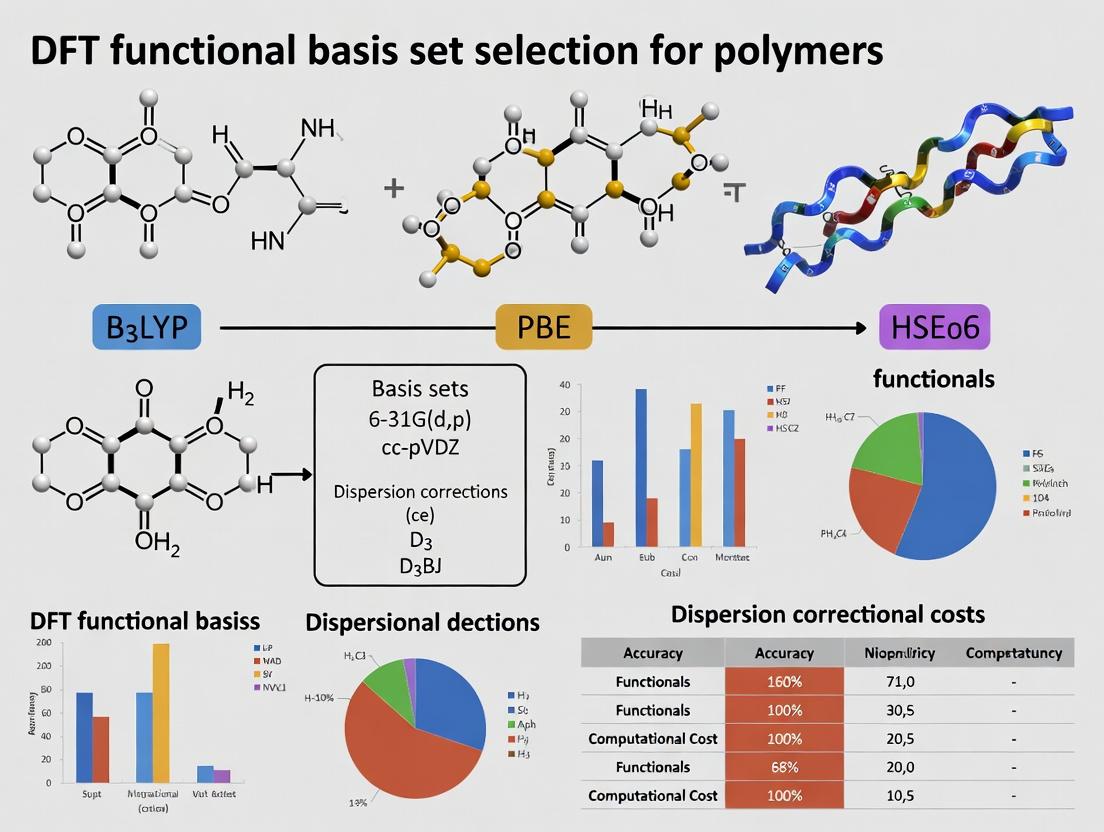
Selecting appropriate Density Functional Theory (DFT) functionals and basis sets is critical for accurate and computationally feasible simulations of polymer systems, from drug-delivery nanoparticles to biomaterial interfaces.
The Definitive Guide to DFT Functional and Basis Set Selection for Polymer Simulations: Accuracy, Efficiency, and Best Practices for Biomedical Research
Abstract
Selecting appropriate Density Functional Theory (DFT) functionals and basis sets is critical for accurate and computationally feasible simulations of polymer systems, from drug-delivery nanoparticles to biomaterial interfaces. This comprehensive guide addresses four core needs for researchers and computational chemists: establishing foundational knowledge of polymer-specific electronic structure challenges, detailing methodological workflows for property prediction, providing troubleshooting strategies for common pitfalls, and offering a framework for validating and comparing computational results against experimental data. We synthesize current best practices and recent methodological advances to empower efficient and reliable computational design of polymers for biomedical applications.
Understanding the Core Challenge: Why Polymers Demand Specialized DFT Approaches
The electronic structure of conjugated polymers is defined by π-electron delocalization along the backbone, leading to the formation of valence and conduction bands. The band gap—the energy difference between the Highest Occupied Molecular Orbital (HOMO) and the Lowest Unoccupied Molecular Orbital (LUMO)—is a critical parameter determining optical and electrical properties. Weak non-covalent interactions (e.g., van der Waals, π-π stacking, hydrogen bonding) profoundly influence chain packing, intermolecular charge transport, and final material performance. Within Density Functional Theory (DFT) studies of polymers, the selection of the functional and basis set is a foundational decision that balances computational cost with accuracy in predicting these key features.
Application Notes: DFT Functional & Basis Set Performance for Polymers
Table 1: Benchmarking of Common DFT Functionals for Polymer Properties
| Functional | Type | Band Gap Prediction vs. Experiment | Handling of Weak Interactions | Recommended Use Case |
|---|---|---|---|---|
| PBE | GGA | Underestimates by 30-50% (severe delocalization error) | Poor, no dispersion correction | Initial structure optimization |
| B3LYP | Hybrid GGA | Underestimates by 10-30% | Poor without empirical correction | Single-chain electronic structure |
| HSE06 | Range-Separated Hybrid | Good agreement (5-15% error) | Moderate | Accurate band gaps for periodic systems |
| ωB97X-D | Range-Separated Hybrid + Dispersion | Excellent for oligomers | Excellent, includes empirical dispersion | Oligomer modeling, weak interaction studies |
| PBE0 | Hybrid GGA | Good agreement (5-20% error) | Moderate | Solid-state polymer calculations |
| SCAN | Meta-GGA | Improved over PBE, but still underestimates | Good with -rVV10 dispersion |
Balanced accuracy for bulk properties |
Table 2: Basis Set Selection Guide for Polymer Calculations
| Basis Set | Level | Description | Typical Use in Polymer Research |
|---|---|---|---|
| 6-31G(d) | Double-Zeta + Polarization | Standard for organic molecules. Good cost/accuracy. | Geometry optimization of polymer repeat units. |
| 6-311+G(d,p) | Triple-Zeta + Diffuse & Polarization | Adds diffuse functions for anions/excited states. | Calculating accurate ionization potentials/electron affinities of oligomers. |
| def2-SVP | Double-Zeta | Efficient, balanced basis for all elements. | Initial screening calculations for organometallic polymers. |
| def2-TZVP | Triple-Zeta + Polarization | High accuracy for electronic properties. | Final single-point energy and band gap calculations on optimized structures. |
| plane-wave (e.g., 500 eV cutoff) | Pseudo-potential based | Periodic boundary conditions. | Ab initio molecular dynamics (AIMD) and bulk electronic band structure. |
Experimental Protocols
Protocol 3.1: DFT Workflow for Calculating Polymer Band Gap and Interchain Coupling
Objective: To determine the electronic band structure, density of states (DOS), and intermolecular coupling integral for a π-conjugated polymer using periodic DFT.
Materials & Software: See "The Scientist's Toolkit" below.
Procedure:
- Repeat Unit Definition & Initial Optimization:
- Isolate a single repeat unit of the polymer.
- Optimize its geometry using a hybrid functional (e.g., B3LYP) and a 6-31G(d) basis set in a quantum chemistry package (e.g., Gaussian, ORCA). Confirm the structure is at an energy minimum via frequency analysis.
- Construction of Periodic Model:
- Using the optimized repeat unit, build a one-dimensional periodic chain. Use crystallographic data if available for the backbone torsion angle and chain separation.
- For intermolecular coupling, build a supercell with two or more parallel chains at a typical π-π stacking distance (~3.5 Å).
- Periodic DFT Calculation:
- Import the periodic structure into a plane-wave code (e.g., VASP, Quantum ESPRESSO).
- Functional Selection: Use a hybrid functional like HSE06 or PBE0. For systems dominated by dispersion, add a correction (e.g., D3).
- Basis Set/Convergence: Set a plane-wave kinetic energy cutoff (≥500 eV) and a k-point mesh (e.g., 16 x 1 x 1 for a 1D chain) to ensure total energy convergence.
- Run a geometry optimization with periodic boundary conditions to relax the cell and atomic positions.
- Electronic Structure Analysis:
- Perform a static calculation on the optimized structure to obtain the band structure and projected DOS (PDOS).
- Extract the band gap (direct or indirect) from the band dispersion plot along the high-symmetry path in the Brillouin zone.
- Analyze PDOS to identify orbital contributions (C 2p, S 3p, etc.) to band edges.
- Calculation of Interchain Coupling Integral (J):
- From the band structure of the dimer supercell, the splitting of the HOMO (or LUMO) band at the Γ-point can be used to estimate the transfer integral: J = ΔE / 2, where ΔE is the energy splitting.
Protocol 3.2: Measuring Optical Band Gap via UV-Vis Spectroscopy
Objective: To determine the optical band gap of a polymer thin film using Tauc plot analysis.
Procedure:
- Sample Preparation: Prepare a uniform thin film of the polymer on a quartz substrate via spin-coating, drop-casting, or doctor blading.
- Acquisition of Absorption Spectrum:
- Use a UV-Vis-NIR spectrophotometer.
- Collect the absorption spectrum of the film versus a blank quartz reference over a relevant range (e.g., 200-1100 nm).
- Convert the transmission data to absorbance (A).
- Tauc Plot Analysis:
- Convert absorbance to the absorption coefficient (α) using the film thickness (d): α = 2.303 * A / d.
- For a direct band gap polymer, calculate (αhν)^2.
- For an indirect band gap polymer, calculate (αhν)^(1/2).
- Plot (αhν)^n vs. photon energy (hν), where n=2 for direct and n=1/2 for indirect transitions.
- Extrapolate the linear region of the plot to the x-axis ((αhν)^n = 0). The intercept is the optical band gap (Eg).
Visualizations
Title: DFT Workflow for Polymer Electronic Structure
Title: Bridging Calculated and Measured Band Gaps
The Scientist's Toolkit
Table 3: Essential Research Reagents & Computational Tools
| Item/Category | Function & Relevance |
|---|---|
| Quantum Chemistry Software (Gaussian, ORCA, Q-Chem) | Perform high-level ab initio and DFT calculations on oligomers and repeat units for functional/basis set benchmarking. |
| Plane-Wave DFT Software (VASP, Quantum ESPRESSO, CASTEP) | Perform periodic DFT calculations to model infinite polymer chains and crystalline packing for accurate band structures. |
| Dispersion-Corrected Functionals (DFT-D3, VV10) | Empirical corrections added to standard functionals to accurately model van der Waals forces critical for polymer stacking. |
| High-Performance Computing (HPC) Cluster | Essential computational resource for running expensive periodic hybrid-DFT calculations on polymer systems. |
| Quartz Substrates | Optically transparent substrate for UV-Vis spectroscopy of thin films, allowing measurement of the optical band gap. |
| Spin Coater | Produces uniform, thin polymer films on substrates for reproducible optical and electrical characterization. |
| UV-Vis-NIR Spectrophotometer | Measures the absorption spectrum of polymer solutions or films, the primary data for experimental band gap determination. |
| Atomic Force Microscope (AFM) | Characterizes film morphology, roughness, and nanoscale structure, linking processing conditions to electronic properties. |
Density Functional Theory (DFT) has become an indispensable tool for predicting and understanding the fundamental properties of polymeric materials. Within the broader thesis on DFT functional and basis set selection for polymers research, this document provides application notes and protocols for calculating three critical polymer properties: electronic band gaps, conformation energies, and non-covalent interaction strengths. The judicious choice of exchange-correlation functional and basis set is paramount, as polymers present unique challenges including size, periodicity, and van der Waals interactions, which are not always accurately described by standard DFT approximations.
Band Gap Calculations for Conjugated Polymers
The band gap is a decisive factor for electronic and optoelectronic applications. DFT calculations require careful functional selection to avoid the well-known band gap underestimation issue common with local and semi-local functionals.
Protocol: Band Structure Calculation for a Periodic Polymer Chain
Initial Structure Preparation:
- Build a monomer unit with correct stereochemistry.
- Apply translational symmetry to create an ideal, infinite periodic chain. Ensure the polymer backbone is fully extended and optimized in the chosen DFT code's input format (e.g., POSCAR for VASP, .in for Quantum ESPRESSO).
Geometry Optimization:
- Functional/Basis Set Selection: For conjugated polymers, start with a range-separated hybrid functional like ωB97XD or CAM-B3LYP, paired with a moderate basis set like 6-31G(d). For plane-wave codes, use a PAW pseudopotential and an energy cutoff of 400-500 eV.
- Parameters: Optimize both atomic positions and unit cell parameters (if using a plane-wave code with variable cell). Set a high convergence threshold for forces (e.g., < 0.01 eV/Å).
Electronic Structure Calculation:
- Using the optimized geometry, perform a single-point energy calculation on a refined k-point mesh (e.g., 10-20 points along the chain direction).
- Use the same hybrid functional. For a more accurate quasiparticle gap, consider perturbative methods like G₀W₀ on top of a PBE or PBE0 calculation.
Band Gap Extraction:
- Plot the electronic band structure along the high-symmetry path in the Brillouin zone.
- Identify the valence band maximum (VBM) and conduction band minimum (CBM). The direct band gap is their energy difference at the same k-point; the fundamental gap is the minimum difference between any VBM and CBM.
Table 1: Calculated vs. Experimental Band Gaps for Common Polymers
| Polymer | DFT Functional | Basis Set / Setup | Calculated Gap (eV) | Experimental Gap (eV) | Notes |
|---|---|---|---|---|---|
| Polyacetylene | PBE | 6-31G(d) | 0.5 | ~1.5 | Severe underestimation. |
| HSE06 | 6-31G(d) | 1.1 | ~1.5 | Improved but still underestimated. | |
| G₀W₀@PBE | Plane-wave (500 eV) | 1.4 | ~1.5 | Good agreement. | |
| PPV (model oligomer) | B3LYP | 6-31G(d) | 2.3 | 2.4-2.6 | Reasonable for oligomers. |
| CAM-B3LYP | 6-311+G(d,p) | 2.6 | 2.4-2.6 | Excellent agreement for long-range corrected functional. | |
| P3HT | PBE | DZVP | 1.2 | ~1.9 | Poor. |
| ωB97XD | def2-TZVP | 1.8 | ~1.9 | Recommended for donor-acceptor polymers. |
Conformation Energy Profiling
The relative stability of different polymer conformers (e.g., torsional rotations around single bonds) dictates chain rigidity, packing, and ultimately material morphology.
Protocol: Torsional Potential Energy Surface (PES) Scan
Define Dihedral Angle:
- Identify the four atoms defining the central rotatable bond (e.g., C–C in a polymer backbone).
- Fix the dihedral angle at an initial value (e.g., 0° for cis).
Constrained Optimization:
- At each fixed dihedral angle (increments of 10°-15°), optimize all other geometric degrees of freedom.
- Functional/Basis Set Selection: Use a functional that accounts for dispersion, such as B3LYP-D3(BJ) or M06-2X, with a basis set of at least 6-31G(d). Dispersion corrections are critical for capturing steric effects.
Energy Calculation:
- Perform a high-accuracy single-point energy calculation on each constrained, optimized structure using a larger basis set (e.g., 6-311+G(d,p)) to refine energies.
Data Analysis:
- Plot the single-point energy versus dihedral angle to generate the torsional PES.
- Identify minima (stable conformers) and maxima (transition states). The energy difference between global and local minima defines the conformational preference.
Table 2: Conformational Energy Barriers for Common Polymer Linkages
| Polymer/Linkage | DFT Method | Stable Conformer (Angle) | Energy (kcal/mol) | Barrier (kcal/mol) | Implication |
|---|---|---|---|---|---|
| Polyethylene (C–C) | B3LYP-D3/6-311G(d,p) | Anti (180°) | 0.0 | ~3.0 (Gauche) | Flexible chain. |
| Polythiophene (inter-ring) | M06-2X/6-311+G(d,p) | Anti (180°) | 0.0 | ~8.0 (Syn, 0°) | Prefers planarity for conjugation. |
| PVA (C–O) | ωB97XD/def2-TZVP | Gauche (60°) | 0.0 | ~1.5 (Anti) | High flexibility, H-bonding dominant. |
Non-Covalent Interaction Strength
Inter-chain interactions (π-π stacking, H-bonding, van der Waals) govern polymer packing, crystallinity, and blend morphology.
Protocol: Dimer Binding Energy Calculation
Dimer Construction:
- Build models of interacting polymer segments (e.g., two pentamers for π-π stacking, chains with H-bonding groups).
- Position them at a representative geometry (e.g., co-facial for π-stacking, H-bond distance for donors/acceptors).
Geometry Optimization:
- Fully optimize the dimer complex. Critical: Use a functional with explicit dispersion correction (e.g., ωB97XD, B3LYP-D3(BJ), or vdW-DF2 for plane-wave) and a flexible basis set with diffuse functions (e.g., 6-311++G(d,p)).
Binding Energy Calculation:
- Perform single-point calculations on the optimized dimer and the isolated, optimized monomers.
- Calculate the binding energy: ΔEbind = Edimer - (Emono1 + Emono2).
- Apply Basis Set Superposition Error (BSSE) Correction: Use the Counterpoise method to correct for artificial stabilization due to incomplete basis sets.
Table 3: Calculated Interaction Energies for Polymer-Relevant Complexes
| Interaction Type | Model System | DFT Method | BSSE-Corrected ΔE (kcal/mol) | Equilibrium Distance (Å) |
|---|---|---|---|---|
| π-π Stacking | Two Pentathiophenes | B3LYP-D3/6-311++G(d,p) | -12.5 | 3.7 |
| ωB97XD/def2-QZVP | -14.2 | 3.6 | ||
| H-Bonding | Two PVA strands (6 units) | M06-2X/6-311+G(2d,p) | -8.3 per H-bond | 1.75 (O...H) |
| Dispersive | Two Polyethylene C20 | PBE-D3/def2-TZVP | -25.1 total | 4.2 (inter-chain) |
| Ion-Dipole | PEO segment with Li⁺ | wB97XD/6-311+G(d) | -28.3 (Li⁺ binding) | 2.1 (Li⁺...O) |
Visualizations
Workflow for DFT Band Gap Calculation
Protocol for Conformational Energy Scan
The Scientist's Toolkit: Key Research Reagent Solutions
| Item / Solution | Function in Polymer DFT Research | Example / Specification |
|---|---|---|
| Hybrid Exchange-Correlation Functionals | Correct band gap underestimation; improve accuracy for charge transfer. | ωB97XD, CAM-B3LYP, HSE06 |
| Dispersion-Corrected Functionals | Account for critical van der Waals forces in polymer packing and interactions. | B3LYP-D3(BJ), ωB97XD, vdW-DF2 |
| Gaussian-Type Basis Sets | Provide flexible atomic orbitals for molecular/polymer segment calculations. | 6-311++G(d,p) for final energy, def2-TZVP for balanced accuracy. |
| Plane-Wave Pseudopotential Sets | Enable periodic calculations of infinite polymer chains and crystals. | Projector Augmented-Wave (PAW) potentials in VASP or Quantum ESPRESSO. |
| Counterpoise Correction Scripts | Eliminate Basis Set Superposition Error (BSSE) in binding energy calculations. | Standard utility in Gaussian, ORCA; custom scripts for plane-wave codes. |
| Visualization & Analysis Software | Analyze band structures, density of states, and electron density differences. | VESTA, VMD, p4vasp, GNUplot for plotting. |
Density Functional Theory (DFT) is a cornerstone computational method for modeling electronic structure in materials science and drug development. For polymers research—encompassing properties like band gaps, charge transport, mechanical strength, and solute-polymer interactions for drug delivery—the selection of an appropriate exchange-correlation (XC) functional and its associated basis set is critical. The functional determines the accuracy of predicted geometries, energies, and electronic properties, while the basis set governs the computational cost and precision of the wavefunction representation. This guide provides detailed application notes and protocols for selecting and applying major classes of XC functionals within a polymer research framework.
Core Functional Classes: Theory and Application Notes
The evolution of XC functionals follows a "Jacob's Ladder" of increasing complexity and accuracy, incorporating more physical ingredients.
Generalized Gradient Approximation (GGA)
GGAs incorporate the local electron density and its gradient. They improve upon Local Density Approximation (LDA) for molecular geometries and hydrogen-bonded systems but often underestimate band gaps and reaction barriers.
- Primary Use in Polymers: Geometry optimization of polymer backbone units, preliminary screening of conformations.
- Common Examples: PBE, BLYP, RPBE.
- Typical Polymer Research Application: Optimizing the unit cell structure of a semi-crystalline polymer like polyethylene.
Meta-GGA
Meta-GGAs add the kinetic energy density as an ingredient, providing improved accuracy for properties like atomization energies and surface energies without the full cost of hybrid functionals.
- Primary Use in Polymers: More accurate cohesive energy predictions, improved treatment of van der Waals interactions when paired with dispersion corrections.
- Common Examples: SCAN, M06-L, TPSS.
- Typical Polymer Research Application: Calculating the binding energy of a drug molecule to a polymeric carrier, where dispersion forces are significant.
Hybrid Functionals
Hybrids mix a fraction of exact Hartree-Fock (HF) exchange with GGA or meta-GGA exchange. This mitigates the self-interaction error, leading to better predictions of band gaps, reaction energies, and molecular properties.
- Primary Use in Polymers: Predicting accurate electronic properties (HOMO-LUMO gaps), excitation energies (via Time-Dependent DFT), and redox potentials.
- Common Examples: B3LYP, PBE0, M06.
- Typical Polymer Research Application: Calculating the ionization potential and electron affinity of a conjugated polymer for organic photovoltaic applications.
Range-Separated Hybrids (RSHs)
RSHs split the electron-electron interaction into short- and long-range parts, applying different fractions of HF exchange in each region. This improves the description of charge-transfer excitations and polarizability.
- Primary Use in Polymers: Modeling charge separation in donor-acceptor polymer blends, accurately describing long-range interactions in supramolecular polymer assemblies.
- Common Examples: ωB97X-D, CAM-B3LYP, HSE06.
- Typical Polymer Research Application: Simulating the absorption spectrum of a polymer:fullerene blend for solar cell research.
Quantitative Functional Comparison Table
Table 1: Benchmark Performance of Select DFT Functionals for Key Properties Relevant to Polymers. (Data synthesized from recent benchmarks, e.g., GMTKN55, MSEPS databases)
| Functional Class | Example Functional | Band Gap Error (eV)⁽¹⁾ | Bond Length Error (Å) | Reaction Barrier Error (kcal/mol) | Computational Cost (Relative to PBE) | Recommended for in Polymers Research |
|---|---|---|---|---|---|---|
| GGA | PBE | ~1.0 - 2.0 (Underest.) | ±0.01 | 5 - 10 | 1.0 | Initial geometry, large systems (>1000 atoms) |
| Meta-GGA | SCAN | ~0.5 - 1.5 | ±0.005 | 3 - 6 | 1.5 - 2.0 | Cohesive energies, binding with dispersion |
| Hybrid | PBE0 | ~0.3 - 0.8 | ±0.003 | 2 - 4 | 10 - 50 | Electronic structure, TD-DFT excitations |
| Range-Separated Hybrid | ωB97X-V | ~0.1 - 0.4 | ±0.002 | 1 - 3 | 50 - 100 | Charge-transfer states, accurate spectroscopy |
⁽¹⁾Error relative to experimental or high-level ab initio (e.g., GW) references.
Experimental Protocol: DFT Workflow for Polymer Property Prediction
Protocol Title: Systematic Workflow for Evaluating Polymer Electronic Properties using DFT Objective: To determine the ionization energy (IE), electron affinity (EA), and fundamental band gap of a conjugated polymer repeat unit.
Materials & Computational Setup:
- Software: Quantum Chemistry Package (e.g., Gaussian, ORCA, VASP, CP2K).
- Initial Structure: 3D chemical structure file (.mol, .cif, .xyz) of oligomer (3-5 repeat units).
- Computational Resources: HPC cluster with ~24+ CPU cores and 64+ GB RAM for hybrid calculations.
Procedure: Step 1 – Geometry Optimization & Conformational Sampling. a. Select a GGA functional (e.g., PBE) with a moderate basis set (e.g., 6-31G(d) for main group elements) and an empirical dispersion correction (e.g., D3BJ). b. Perform a conformational search using molecular mechanics or a low-level DFT method. c. Optimize the geometry of the lowest-energy conformer(s) to a tight convergence criterion (e.g., force < 0.00045 Hartree/Bohr). d. Validation: Confirm the optimized structure is a minimum via harmonic frequency calculation (no imaginary frequencies).
Step 2 – Single-Point Energy Refinement. a. Using the optimized geometry, perform a series of single-point energy calculations with increasingly higher-level functionals and basis sets. b. Sequence: i. Meta-GGA (e.g., SCAN) with a larger basis set (e.g., def2-TZVP). ii. Hybrid Functional (e.g., PBE0) with the same basis set. iii. Range-Separated Hybrid (e.g., ωB97X-D) with an augmented basis set (e.g., def2-TZVPP). c. For each calculation, extract the total energy of the neutral (EN), cationic (EN+1), and anionic (E_N-1) species. The latter two require separate calculations with modified charge/spin.
Step 3 – Property Calculation & Basis Set Extrapolation. a. Calculate vertical IE = E(cation) - E(neutral) and vertical EA = E(neutral) - E(anion). b. Calculate the fundamental gap as IE - EA. c. Perform a basis set convergence test using the chosen hybrid functional. Plot the property (IE, EA) against the basis set cardinal number (e.g., 2,3,4 for cc-pVXZ series) and extrapolate to the complete basis set (CBS) limit using a standard formula (e.g., 1/X^3 scaling).
Step 4 – Analysis & Reporting. a. Compare calculated band gaps to experimental UV-Vis absorption onset data. b. Analyze frontier molecular orbital (HOMO/LUMO) spatial distributions to assess charge-transfer character. c. Report final values with estimated error bounds based on functional and basis set sensitivity analysis.
Visualization of DFT Functional Selection Logic
Title: Decision Workflow for Selecting DFT Functionals in Polymer Studies
The Scientist's Toolkit: Key Research Reagent Solutions
Table 2: Essential Computational "Reagents" for Polymer DFT Studies.
| Item Name | Function/Description | Example in Polymer Context |
|---|---|---|
| Pseudo-potentials / PAWs | Replaces core electrons, drastically reducing cost for heavy elements. | Modeling polymer-metal interfaces (e.g., Pt in fuel cell membranes). |
| Empirical Dispersion Correction | Accounts for van der Waals forces missing in standard functionals. | Essential for π-π stacking in conjugated polymers or polymer-drug binding. |
| Aperiodic Boundary Condition Software | Models isolated molecules/clusters (e.g., Gaussian, ORCA). | Studying an oligomer fragment of a polymer or a small molecule dopant. |
| Periodic Boundary Condition Software | Models infinite crystals or polymers (e.g., VASP, Quantum ESPRESSO). | Calculating band structure of a crystalline polymer like polyacetylene. |
| Basis Set Library | Pre-defined mathematical functions for electron orbitals. | Using the "def2" series for organic polymers or "cc-pVXZ" for high accuracy. |
| Solvation Model | Implicitly models solvent effects (e.g., PCM, SMD). | Predicting properties of polymers in aqueous drug delivery environments. |
In Density Functional Theory (DFT) studies of polymers, basis set selection is a critical compromise between computational cost and accuracy. Polymers present unique challenges: long-range interactions, conformational flexibility, and often non-covalent interactions like van der Waals forces, which are sensitive to the basis set's completeness. The choice influences predictions of band gaps, elastic moduli, interaction energies with drug molecules, and spectroscopic properties. This guide details the evolution from Pople-style to correlation-consistent Dunning basis sets, and the functional role of polarization and diffuse functions, all within the practical context of polymer simulation.
Basis Set Fundamentals and Evolution
The Pople Basis Sets
Developed by John Pople and colleagues, these are Gaussian-type orbital (GTO) basis sets denoted as K-MLG* or *K-ML(G). They are segmented (non-contracted in the inner shells) and designed for efficiency.
- Nomenclature: e.g., 6-31G(d). '6' denotes 6 primitive Gaussians for core orbitals. '31' denotes a split valence: 3 primitives contracted to one function for the inner valence, and 1 primitive (uncontracted) for the outer valence.
- Common Series: STO-3G (minimal), 3-21G, 6-31G, 6-311G.
The Dunning Correlation-Consistent Basis Sets
Developed by Thom Dunning, these are optimized for post-Hartree-Fock correlated methods (e.g., MP2, CCSD(T)) but are now standard for high-accuracy DFT. They are hierarchical, allowing for systematic convergence to the complete basis set (CBS) limit.
- Nomenclature: cc-pVXZ (correlation-consistent polarized Valence X-tuple Zeta). 'X' is D (double), T (triple), Q (quadruple), 5, 6.
- Core-Valence Series: cc-pCVXZ for correlating core electrons.
- Augmented Series: aug-cc-pVXZ for adding diffuse functions.
Polarization Functions
Role: Add angular momentum flexibility (e.g., d-functions on carbon, f-functions on transition metals) allowing orbitals to change shape, crucial for modeling distorted bonds in polymer backbone strain, conjugation, and bonding in active sites of metallopolymers.
Notation: In Pople: (d) or (d,p) or *. In Dunning, polarization is included by default (the 'p' in cc-pVXZ).
Diffuse Functions
Role: Very small exponent Gaussian functions that extend the electron density far from the nucleus. Essential for modeling anions, excited states, weak non-covalent interactions (e.g., drug-polymer binding, pi-stacking in conjugated polymers), and properties like ionization potentials.
Notation: In Pople: + or ++ (on heavy atoms and hydrogens, respectively). In Dunning: aug- (augmented) prefix.
Quantitative Comparison and Selection Tables
Table 1: Common Basis Sets and Their Characteristics
| Basis Set | Type | Description | Typical Use Case in Polymer Research | Approx. Cost Factor (vs. 6-31G) |
|---|---|---|---|---|
| 6-31G(d) | Pople | Double-zeta valence with polarization | Geometry optimizations, vibrational frequencies of bulk polymer segments. | 1.0 (Baseline) |
| 6-311G(d,p) | Pople | Triple-zeta valence with polarization | Improved electronic property (dipole, polarizability) calculation for oligomers. | ~1.8 |
| 6-31+G(d,p) | Pople | Double-zeta with diffuse & polarization | Systems with lone pairs or anion/polymer interactions, excited state preliminaries. | ~2.2 |
| cc-pVDZ | Dunning | Correlation-consistent double-zeta | Benchmarking smaller oligomer units; starting point for CBS extrapolation. | ~2.5 |
| aug-cc-pVDZ | Dunning | Augmented double-zeta | Accurate non-covalent interaction energies for drug-polymer adducts. | ~4.0 |
| cc-pVTZ | Dunning | Correlation-consistent triple-zeta | High-accuracy single-point energy calculations for final property prediction. | ~8.0 |
| def2-SVP | Ahlrichs | Balanced double-zeta | Popular in European polymer/DFT communities; good for geometries. | ~1.5 |
| def2-TZVP | Ahlrichs | Balanced triple-zeta | High-quality all-purpose DFT for detailed electronic structure analysis. | ~6.0 |
Table 2: Basis Set Recommendation for Polymer DFT Tasks
| Research Task (DFT Functional) | Recommended Minimal Basis | Recommended High-Accuracy Basis | Rationale |
|---|---|---|---|
| Geometry Optimization (B3LYP, PBE) | 6-31G(d) or def2-SVP | cc-pVTZ or def2-TZVP | Geometries are less basis-set sensitive than energies. Polarization is key. |
| Binding Energy (ωB97X-D, M06-2X) | 6-31+G(d,p) | aug-cc-pVTZ | Diffuse and high-order functions critical for dispersive/electrostatic interactions. |
| Band Gap Prediction (PBE0, HSE06) | 6-311G(d,p) | cc-pVTZ | Requires good description of valence and conduction band edges. |
| IR/Raman Spectroscopy (B3LYP) | 6-31G(d) | cc-pVTZ | Frequencies scale well; anharmonic corrections need better basis. |
| NMR Chemical Shifts (WP04) | 6-311+G(2d,p) | aug-cc-pVTZ | Sensitive to electron environment; needs diffuse and multiple polarization. |
Experimental Protocols for Basis Set Assessment in Polymer Studies
Protocol 1: Basis Set Convergence for Oligomer Ground State Energy
Objective: Determine the appropriate Dunning basis set level for single-point energy calculations of a polymer repeat unit. Materials: Optimized oligomer structure (e.g., 5-mer of PEO, P3HT); DFT software (Gaussian, ORCA, CP2K). Procedure:
- Using a medium-level functional (e.g., B3LYP-D3(BJ)/6-31G(d)), optimize the geometry of the target oligomer.
- Perform a series of single-point energy calculations on the identical geometry with the following basis set hierarchy: cc-pVDZ → cc-pVTZ → cc-pVQZ (if feasible).
- For each calculation, record the total electronic energy (E_tot) in Hartrees.
- Calculate the energy difference ΔE = |E(VXZ) - E(V(X-1)Z)|.
- Apply a two-point CBS extrapolation formula (e.g., Helgaker's) if cc-pV{Q,T}Z data is available: ECBS = (EQ * XQ^3 - ET * XT^3) / (XQ^3 - X_T^3), where X=3 for TZ, 4 for QZ.
- The basis set is considered converged when ΔE is less than your target accuracy (e.g., < 1 kcal/mol for energy differences). Deliverable: A plot of Energy vs. 1/X^3 (X=2,3,4...) showing convergence toward CBS limit.
Protocol 2: Assessing Impact of Diffuse Functions on Non-Covalent Interactions
Objective: Quantify the error in binding energy of a drug molecule to a polymer fragment without diffuse functions. Materials: DFT software; structures of isolated drug (e.g., aspirin), polymer model (e.g., PVP dimer), and the optimized complex. Procedure:
- Optimize all three structures (Drug, Polymer, Complex) using a robust functional for non-covalent interactions (e.g., ωB97X-D) with a modest polarized basis like 6-31G(d).
- Perform high-level single-point energy calculations on all three optimized geometries using two basis sets:
- Basis A: 6-311G(d,p) // Lacks diffuse functions.
- Basis B: aug-cc-pVDZ // Contains diffuse functions.
- Calculate the Binding Energy (BE) for each basis set using the counterpoise (CP) correction to minimize Basis Set Superposition Error (BSSE):
- BE_CP = E(Complex) - [E(Drug in Complex Basis) + E(Polymer in Complex Basis)]
- Perform separate calculations for Basis A and B.
- Compare BECP(A) and BECP(B). The difference (BECP(B) - BECP(A)) highlights the systematic error introduced by omitting diffuse functions. Deliverable: A table comparing BE with and without CP correction for both basis sets, highlighting the error magnitude.
Protocol 3: Basis Set Selection for Periodic Polymer Calculations
Objective: Select a plane-wave basis set (defined by cutoff energy) equivalent in quality to a targeted Gaussian basis for a crystalline polymer. Materials: Plane-wave DFT code (VASP, Quantum ESPRESSO); unit cell of polymer (e.g., polyethylene). Procedure:
- Benchmark with Gaussian: On a small, representative cluster cut from the polymer, calculate the atomization energy using a high-quality Gaussian basis (e.g., cc-pVTZ) and a hybrid functional (e.g., PBE0).
- Plane-Wave Convergence: Perform a series of single-point periodic calculations on the full crystal, incrementally increasing the plane-wave kinetic energy cutoff (ENCUT in VASP) from 400 eV to 800 eV in steps of 50-100 eV.
- For each cutoff, calculate the energy per atom in the unit cell.
- Plot Energy per Atom vs. Cutoff Energy. Identify the cutoff where the energy change is < 1 meV/atom.
- (Optional) Compare vibrational frequencies (e.g., C-H stretch) from the periodic calculation at the converged cutoff with the cluster Gaussian calculation to validate quality. Deliverable: Convergence plot identifying the sufficient plane-wave cutoff energy (e.g., 520 eV) for the polymer system.
Visualizations
Diagram 1: Basis Set Selection Decision Tree for Polymer DFT
Diagram 2: Basis Set Hierarchy and Convergence Path
The Scientist's Toolkit: Research Reagent Solutions
| Item/Category | Specific Example/Product | Function in Basis Set Research |
|---|---|---|
| Quantum Chemistry Software | Gaussian 16, ORCA 5.0, Q-Chem 6.0, NWChem, CP2K | Provides the computational environment to run SCF, geometry optimization, and property calculations with various basis sets. |
| Basis Set Exchange (BSE) | https://www.basissetexchange.org | Online repository and API for obtaining basis set definitions in formats for all major computational chemistry codes. |
| Visualization & Analysis | Avogadro, VMD, GaussView, Jmol, Multiwfn | Used to prepare input geometries, visualize molecular orbitals, and analyze output files (densities, spectra). |
| High-Performance Computing (HPC) | Local Cluster (Slurm), Cloud (AWS, GCP), National Grids | Essential computational resource for running large, triple-zeta or periodic calculations on polymer systems. |
| Database for Benchmarking | Materials Project, NIST Computational Chemistry Comparison (CCC) DB | Provides reference data (geometries, energies) to validate and benchmark chosen basis set/functional combinations. |
| Automation & Scripting | Python with ASE, PySCF; Bash/Shell scripting | Automates workflow: generating input files, running job sequences for basis set convergence, and parsing output data. |
| Error Analysis Tool | BSSE.py scripts, goodvibes |
Scripts to perform counterpoise correction for BSSE and thermochemical analysis from frequency calculations. |
Application Notes
Within Density Functional Theory (DFT) studies of polymer systems, the selection of exchange-correlation functional and basis set is the primary determinant of the accuracy/computational cost trade-off. For large, periodic polymer systems, this decision directly impacts the feasibility of simulations and the reliability of predicted properties such as band gaps, elastic moduli, and interaction energies with pharmaceutical compounds.
Key Considerations:
- System Size & Periodicity: Plane-wave basis sets with Periodic Boundary Conditions (PBC) are standard for bulk polymers. The kinetic energy cutoff defines basis set size.
- Property Dependency: Accuracy varies by property. For example, band gaps are severely underestimated by standard Generalized Gradient Approximation (GGA) functionals but improved with hybrid functionals, at massively increased cost.
- Weak Interactions: Modeling polymer-drug interactions often requires dispersion-corrected functionals (e.g., DFT-D3).
- Software & Hardware: The trade-off is mediated by code efficiency (e.g., VASP, Quantum ESPRESSO, CP2K) and available high-performance computing (HPC) resources.
Table 1: Comparison of DFT Approximations for Representative Polymer Properties (Polyethylene Chain)
| Functional / Basis Set Tier | Relative Computational Cost (CPU-hrs) | Predicted Band Gap (eV) Error vs. Exp. | Cohesive Energy (eV) Error | Typical Use Case |
|---|---|---|---|---|
| LDA / Low Cutoff | 1 (Baseline) | +50-100% (Poor) | -10-20% (Poor) | Initial structure screening |
| GGA (PBE) / Moderate | 3-5 | +30-50% (Low) | -2-5% (Fair) | Equilibrium geometry, phonons |
| GGA+D3 / Moderate | 4-6 | +30-50% (Low) | <±2% (Good) | Host-guest binding studies |
| Hybrid (HSE06) / Moderate | 50-100 | +5-15% (Good) | <±2% (Good) | Electronic structure analysis |
| Hybrid+D3 / High | 200-500 | <±5% (Excellent) | <±1% (Excellent) | Final accurate property prediction |
Table 2: Basis Set & Cutoff Selection Impact for Plane-Wave DFT (Example: Polyglycine)
| Basis Quality | Plane-Wave Cutoff (eV) | System Size Limit (Atoms) | Relative Force Error | Relative SCF Time |
|---|---|---|---|---|
| Soft / Low | 400 | >10,000 | High (>10%) | 1.0 |
| Moderate / Standard | 600 | 1,000 - 5,000 | Moderate (~5%) | 3.5 |
| Hard / High | 800 | < 500 | Low (<2%) | 8.0 |
| Extended / Very High | 1000 | < 100 | Very Low (<1%) | 15.0 |
Experimental Protocols
Protocol 3.1: Benchmarking Study for Functional Selection
Aim: Systematically determine the optimal functional for a target polymer property.
- Select a Representative Model: Build a monomeric or oligomeric unit of the polymer in a periodic cell with appropriate dimensions.
- Define a Test Set: Choose 3-4 target properties (e.g., unit cell volume, band gap, binding energy of a probe molecule).
- Perform Hierarchical Calculations: a. Perform geometry optimization and property calculation using a fast GGA functional (e.g., PBE) with a moderate basis set. b. Using the optimized geometry, perform single-point energy/property calculations with a series of higher-level methods: GGA+D, meta-GGA (SCAN), hybrid (HSE06, PBE0), and if possible, a wavefunction-based method (e.g., G0W0) for band gaps. c. Where experimental data exists, calculate mean absolute error (MAE). For cohesive energy, use higher-level theory or experimental data as reference.
- Analyze Trade-off: Plot accuracy (MAE) vs. computational cost for each functional. Select the functional providing the best compromise for your system size and target accuracy.
Protocol 3.2: Basis Set Convergence Protocol
Aim: Establish the plane-wave kinetic energy cutoff for a new polymer system.
- Initial Calculation: Using a standard functional (e.g., PBE), perform a geometry optimization on a small unit cell with a high cutoff (e.g., 1.3x the software's recommended standard).
- Energy Convergence: Calculate the total energy of the optimized structure at a series of decreasing cutoffs (e.g., 1000, 800, 600, 400 eV). Plot total energy vs. cutoff.
- Property Convergence: Select key properties (e.g., stress tensor, force on an atom, electron density). Recalculate these properties at each cutoff from step 2.
- Determine Optimal Cutoff: Identify the cutoff where the change in total energy is < 1 meV/atom and the target properties vary by less than a predefined threshold (e.g., 1%). This is the system-specific optimal cutoff.
Protocol 3.3: Workflow for Screening Polymer-Drug Interactions
Aim: Efficiently compute binding energies of multiple drug fragments to a polymer substrate.
- Prepare Structures: Model a periodic polymer surface. Generate multiple initial configurations for each drug fragment pose.
- Low-Cost Pre-screening: Perform geometry optimization for all complexes using a low-cost GGA functional (e.g., PW91) with a low cutoff and coarse k-point grid. Discard unstable poses.
- Medium-Level Refinement: Re-optimize surviving complexes using a dispersion-corrected functional (e.g., PBE-D3(BJ)) with the converged, moderate basis set and finer k-points.
- High-Accuracy Single Point: For the final optimized structures, perform a single-point energy calculation using a hybrid functional (e.g., HSE06-D3) with the high-quality basis set. Compute binding energy as: E_bind = E(complex) - E(polymer) - E(fragment).
Diagrams
Title: DFT Workflow for Polymer Simulation Setup
Title: Factors in the DFT Accuracy-Cost Trade-off
The Scientist's Toolkit: Research Reagent Solutions
Table 3: Essential Computational Materials for Polymer DFT Studies
| Item / "Reagent" | Function / Role in Experiment | Example / Note |
|---|---|---|
| Exchange-Correlation Functional | Defines the physics of electron interactions; primary lever for accuracy vs. cost. | GGA (PBE, PW91) for speed; Hybrid (HSE06) for accuracy. |
| Pseudopotential / PAW Dataset | Replaces core electrons to reduce basis set size; accuracy is critical. | Projector Augmented-Wave (PAW) potentials from software library. |
| Plane-Wave Basis Set | The set of functions used to expand electron wavefunctions; size controlled by cutoff. | Defined by kinetic energy cutoff (e.g., 520 eV for organic polymers). |
| k-Point Grid | Samples the Brillouin Zone for periodic systems; finer grids increase cost. | Monkhorst-Pack grid (e.g., 4x4x1 for a surface). |
| Dispersion Correction | Adds empirical description of weak van der Waals forces crucial for binding. | Grimme's DFT-D3(BJ) correction. |
| Electronic Minimizer | Algorithm for achieving self-consistent field (SCF) convergence. | RMM-DIIS, Blocked Davidson. |
| Geometry Optimizer | Algorithm for relaxing ion positions to find minimum energy structure. | BFGS, conjugate gradient. |
| High-Performance Computing (HPC) Cluster | Provides the parallel CPUs/GPUs required for large polymer calculations. | Nodes with high-core-count CPUs, fast interconnects (Infiniband). |
A Practical Workflow: Selecting and Applying Functionals & Basis Sets for Polymer Properties
Within the broader thesis on developing predictive computational workflows for polymer science, the systematic selection of Density Functional Theory (DFT) functionals and basis sets is critical. This protocol provides a structured guide for researchers to align computational parameters with target material properties—electronic (band gap, ionization potential), structural (bond lengths, conformation), and mechanical (elastic constants, moduli)—ensuring reliability and reproducibility in polymer research and pharmaceutical excipient design.
Core Selection Protocol & Data Tables
Step-by-Step Decision Workflow
The logical process for selecting a functional and basis set based on the primary research objective is defined below.
Diagram Title: DFT Functional & Basis Set Selection Workflow
Quantitative Comparison of Popular Functionals
Table 1: Performance of Common DFT Functionals for Polymer-Relevant Properties (Typical Error Ranges)
| Functional Class | Example Functional | Target Property Strength | Typical Error vs. Experiment | Computational Cost | Recommended Basis Set (Molecular) | Recommended Basis Set (Periodic) |
|---|---|---|---|---|---|---|
| Generalized Gradient Approximation (GGA) | PBE | Structural, General | Lattice Params: ~1-2%; Band Gaps: >50% Underestimation | Low | 6-31G(d) | Plane-wave (500-700 eV) |
| Meta-GGA | SCAN | Mechanical, Structural (Bonds) | Improved over PBE for solids; Energetics: ~kJ/mol | Moderate | def2-TZVP | Plane-wave (700+ eV) |
| Hybrid (Global) | B3LYP | Electronic (Molecular), Structural | Ionization Potentials: ~0.2 eV; Overestimates polymer band gaps | High | 6-311+G(d,p) | Not standard |
| Hybrid (Range-Separated) | HSE06 | Electronic (Periodic Solids) | Band Gaps: ~0.2-0.4 eV error | Very High | - | Plane-wave (High Cutoff) |
| van der Waals Corrected | ωB97M-V, vdW-DF2 | Structural (Non-Covalent), Layered Polymers | Binding Energies: ~5% error; Layer spacing: ~1-2% | High to Very High | def2-QZVP | Plane-wave + DFT-D3 |
Basis Set Selection Guide
Table 2: Basis Set Hierarchy and Application for Polymers
| Basis Set | Type | Recommended For | Accuracy vs. Cost | Notes for Polymer Systems |
|---|---|---|---|---|
| 6-31G(d) / def2-SVP | Split-Valence + Polarization | Initial geometry optimizations, large unit cells | Low / Moderate | Good starting point for conformational searches. |
| 6-311+G(d,p) / def2-TZVP | Triple-Zeta + Diffuse/Polarization | Electronic properties (IP/EA), polarizable groups | Moderate / High | Essential for anions, excited states, charge transfer. |
| cc-pVTZ / def2-QZVP | Correlation-Consistent | Final single-point energy, binding energy, NMR | High / Very High | Use on optimized geometries for benchmark accuracy. |
| Plane-wave (PAW) | Periodic Continuum | Bulk mechanical properties, phonons, band structure | System-size dependent | Cutoff energy (400-1000+ eV) is critical. Use k-point sampling. |
| Atomic-Centered Plane Waves (ACPW) | Hybrid | Defect states in periodic polymers | High | Efficient for localized states in extended systems. |
Detailed Experimental Protocols
Protocol 3.1: Benchmarking Band Gap for a Conjugated Polymer
Objective: Accurately calculate the electronic band gap of poly(3-hexylthiophene) (P3HT). Workflow:
- Initial Geometry: Build a periodic oligomer (e.g., 4-6 repeat units). Pre-optimize with PBE/6-31G(d).
- Functional Screening: Perform single-point energy calculations on the fixed geometry using:
- PBE (GGA)
- B3LYP (Global Hybrid)
- HSE06 (Range-Separated Hybrid)
- Optional: GW if computational resources allow.
- Basis Set Convergence: For the best functional from step 2, perform calculations with increasing basis set size: def2-SVP → def2-TZVP → def2-QZVP. Plot band gap vs. basis set size to confirm convergence.
- k-point Convergence (Periodic): If using a plane-wave code, perform a k-point mesh scan (e.g., 1x1xN to 4x4xN) to converge total energy and band gap.
- Validation: Compare calculated band gap to experimental UV-Vis absorption onset (~1.9-2.1 eV for P3HT). HSE06 with a TZVP-quality basis or fine k-mesh typically yields results within 0.2-0.3 eV.
Protocol 3.2: Determining Mechanical Moduli of a Polymer Crystal
Objective: Calculate the elastic tensor and bulk modulus of polyethylene (PE) crystal. Workflow:
- System Setup: Build a periodic unit cell of the PE crystal (orthorhombic). Use a validated experimental structure as a starting point.
- Functional/Basis Selection: Select a functional proven for mechanical properties (e.g., PBEsol, SCAN) and a high-quality plane-wave basis set (cutoff ≥ 700 eV for PAW).
- Geometry Optimization: Fully optimize lattice parameters and atomic positions under constant cell pressure (≈ 0 GPa). Use stringent convergence criteria for energy (< 1e-6 eV/atom) and forces (< 0.001 eV/Å).
- Elastic Constant Calculation: Apply small, symmetric strains (typically ±0.5%) to the optimized cell in independent directions. For each strain, re-relax atomic positions and record the stress tensor.
- Data Analysis: Fit the stress-strain data to the Hooke's law relationship for a crystal of the appropriate symmetry (orthorhombic) to extract the full 6x6 elastic constant matrix (Cij).
- Property Derivation: Use the Voigt-Reuss-Hill averaging scheme to calculate the aggregate polycrystalline bulk (K) and shear (G) moduli from the Cij tensor. Compare K to experimental values from high-pressure diffraction (~8-10 GPa).
The Scientist's Toolkit: Key Research Reagent Solutions
Table 3: Essential Computational Tools for Polymer DFT Studies
| Item / Software | Category | Primary Function in Protocol |
|---|---|---|
| Gaussian, ORCA | Quantum Chemistry Code | Perform molecular (non-periodic) calculations with wide functional/basis set libraries. Ideal for oligomer models. |
| VASP, Quantum ESPRESSO | Plane-wave DFT Code | Perform periodic calculations for bulk polymers, mechanical properties, and accurate band structures. |
| CP2K | Mixed Gaussian/Plane-wave Code | Efficiently model large, complex systems (e.g., amorphous polymer cells) with hybrid basis sets. |
| Basis Set Library (e.g., Basis Set Exchange) | Database | Download and manage standardized Gaussian-type orbital (GTO) basis sets for molecular codes. |
| Pseudopotential Library (e.g., GBRV, PSLIB) | Database | Access optimized projector-augmented wave (PAW) or norm-conserving pseudopotentials for plane-wave codes. |
| Phonopy | Post-Processing Tool | Calculate vibrational properties and thermodynamic quantities from force constants derived from DFT. |
| VESTA | Visualization Software | Build, view, and analyze crystal structures, electron density, and volumetric data from DFT outputs. |
| Python (ASE, pymatgen) | Scripting & Analysis | Automate workflows, manage calculations, and analyze output files (energies, structures, elastic tensors). |
Within a broader thesis on Density Functional Theory (DFT) functional and basis set selection for polymer research, addressing delocalization error is paramount. This error, inherent in many approximate DFT functionals, leads to an over-delocalization of electron density, resulting in inaccurate predictions of band gaps, reaction barriers, and charge transport properties in conjugated and conducting polymers. These inaccuracies directly impede the rational design of organic electronics, biosensors, and conductive biomaterials in drug delivery systems. These application notes provide targeted protocols for mitigating this error.
Quantitative Comparison of DFT Functionals for Polymer Properties
The following table summarizes key performance metrics of various DFT functionals for conjugated polymer properties, highlighting their susceptibility to delocalization error.
Table 1: Performance of Select DFT Functionals for Conjugated Polymer Properties
| Functional Class | Example Functionals | Band Gap Prediction vs. Exp. | Delocalization Error Tendency | Recommended Use Case in Polymer Research |
|---|---|---|---|---|
| Local/GGA | PBE, BLYP | Severely Underestimated (~30-50% low) | Very High | Initial geometry optimization; not for electronic properties. |
| Global Hybrids | B3LYP, PBE0 | Moderately Underestimated (~10-20% low) | Moderate | General-purpose screening of ground-state geometries and trends. |
| Range-Separated Hybrids | ωB97X-D, LC-ωPBE | Accurate (<10% error) | Low | Charge transfer states, excitation energies, band gaps. |
| Meta-GGAs | M06-L, SCAN | Variable | Moderate to High | Solid-state packing interactions (with caution). |
| Double Hybrids | B2PLYP, DSD-PBEP86 | Very Accurate | Very Low | High-accuracy benchmarks for oligomers (computationally expensive). |
| System-Tuned/CAM | tunePBE0, CAM-B3LYP | Highly Accurate | Minimized | Optoelectronic properties of donor-acceptor copolymers. |
Application Notes & Protocols
Protocol: Optimal Functional Selection Workflow for New Polymer Monomers
This protocol guides the selection of an appropriate DFT functional to minimize delocalization error when investigating a novel conjugated monomer or oligomer.
Materials & Software:
- Quantum chemical software (e.g., Gaussian, ORCA, Q-Chem).
- Molecular builder/visualizer (e.g., Avogadro, GaussView).
- Computational cluster or high-performance workstation.
Procedure:
- Initial Geometry Optimization:
- Build the monomer or short oligomer (n=1-3) model.
- Optimize the geometry using a Global Hybrid functional (e.g., PBE0) with a moderate basis set (e.g., 6-31G(d)).
- Frequency Calculation: Perform a vibrational frequency analysis on the optimized structure to confirm it is a true minimum (no imaginary frequencies).
Benchmarking for Electronic Properties:
- Using the optimized geometry, perform single-point energy calculations to determine the HOMO-LUMO gap (Kohn-Sham gap) and, if feasible, the fundamental gap via ΔSCF.
- Test a hierarchy of functionals: a. Global Hybrid: B3LYP/6-311+G(d,p) b. Range-Separated Hybrid: ωB97X-D/6-311+G(d,p) c. System-Tuned Functional (if applicable): Use an external parameter (e.g., using IP-tuning) to customize the range-separation parameter.
- Reference: Compare results to available experimental UV-Vis onset data or high-level theoretical calculations (GW, DLPNO-CCSD(T)) for similar systems.
Solid-State/Periodic Considerations:
- For polymer band structure, employ periodic boundary condition calculations.
- Use a range-separated hybrid (e.g., HSE06) for geometry optimization of the unit cell.
- Perform a subsequent single-point band structure calculation with a more advanced functional (e.g., GW@HSE06) for the final electronic density of states.
Analysis: The functional that yields a band gap closest to the experimental or high-level benchmark, without artificial charge spilling, should be selected for subsequent studies on that polymer class.
Diagram 1: DFT Functional Selection Workflow
Protocol: Calculating Charge Transfer Integrals with Minimized Error
Accurate intermolecular charge transfer integrals (e.g., for hole transport, t_h) are critical for mobility predictions and are highly sensitive to delocalization error.
Materials:
- Dimer of relevant polymer units (co-facially or end-to-end stacked).
- Software with wavefunction analysis capabilities (e.g., Multiwfn, VMD with plugins).
Procedure:
- Dimer Preparation & Optimization:
- Extract a dimer from the optimized periodic structure or model a representative dimer.
- Optimize the dimer geometry using a range-separated hybrid functional (e.g., ωB97X-D) with a basis set including diffuse functions (e.g., 6-311+G(d)). This step is crucial to avoid overly collapsed distances due to delocalization error.
Integral Calculation via Projection:
- Compute the wavefunction for the neutral and cationic (for t_h) dimer at the optimized geometry using the selected functional.
- Use the Generalized Mulliken-Hush (GMH) or Fragment Charge Difference (FCD) method as implemented in scripts or packages (e.g., in Q-Chem).
- Alternatively, employ the projection method using diabatization tools in Multiwfn.
- Key Control: Repeat the calculation with a Global Hybrid (e.g., B3LYP) and a Double Hybrid if possible. Compare the magnitude of the transfer integral; overestimated values often indicate strong delocalization error.
Analysis:
- The transfer integral from the functional producing the most localized initial and final states (often RSH) is typically more reliable for Marcus rate or mobility calculations.
The Scientist's Toolkit: Research Reagent Solutions
Table 2: Essential Computational & Experimental Materials for Polymer DFT Studies
| Item Name/Category | Function & Relevance to Delocalization Error |
|---|---|
| Range-Separated Hybrid Functionals (ωB97X-D, CAM-B3LYP) | Core computational reagent. Corrects long-range electron-electron interaction, reducing spurious charge delocalization and improving band gaps. |
| Diffuse Basis Sets (e.g., 6-311+G(d,p), aug-cc-pVDZ) | Essential for describing anions, excited states, and charge-separated states accurately, complementing advanced functionals. |
| Tuning Parameter Scripts (e.g., IP-tuning) | Allows system-specific optimization of the range-separation parameter (ω) in functionals, virtually eliminating delocalization error for a given system. |
| Diabatization Analysis Tools (Multiwfn, Q-Chem Add-ons) | Post-processing tools to extract charge transfer integrals and diabatic states from delocalized DFT wavefunctions. |
| High-Performance Computing (HPC) Cluster Access | Running advanced functionals (RSH, double hybrids) and large polymer models is computationally intensive. |
| Benchmark Experimental Data (UV-Vis, Cyclic Voltammetry) | Critical experimental reagents for validating computational predictions of band gaps and energy levels. |
| Model Oligomer Compounds (Synthesized or Commercial) | Well-characterized short oligomers (n=1-4) provide the experimental benchmark data for tuning computational methods. |
Modeling Non-Covalent Interactions in Polymer Blends and Drug-Polymer Complexes
Application Notes
The accurate modeling of non-covalent interactions—such as van der Waals (vdW) forces, hydrogen bonding, π-π stacking, and dipole-dipole interactions—is critical for predicting the miscibility of polymer blends and the stability of drug-polymer complexes. Within a broader thesis on Density Functional Theory (DFT) functional and basis set selection for polymer research, the choice of computational methodology directly dictates the reliability of predictions for industrial applications like drug delivery system design and polymer alloy development.
Standard Generalized Gradient Approximation (GGA) functionals (e.g., PBE) often fail to describe dispersion forces, leading to inaccurate predictions of blend phase behavior or drug loading capacity. Incorporating empirical dispersion corrections (e.g., -D3, -D4) or using non-local van der Waals functionals (e.g., rVV10) is essential. Basis set selection must balance accuracy and computational cost; triple-zeta basis sets with polarization functions are often a minimum requirement, but basis set superposition error (BSSE) corrections are crucial for binding energy calculations.
Table 1: Performance of Selected DFT Functionals for Non-Covalent Interaction Energy Calculation (Benchmark vs. High-Level CCSD(T))
| Functional | Dispersion Correction | Mean Absolute Error (MAE) [kJ/mol] (S66x8 Benchmark) | Typical Use Case in Polymer Research | Computational Cost |
|---|---|---|---|---|
| ωB97X-D | Empirical (-D2) | ~1.5 | Drug-polymer binding, precise interaction energies | High |
| B3LYP | With -D3(BJ) | ~2.0 | General-purpose for functionalized polymers | Medium-High |
| PBE | With -D3(BJ) | ~2.5 | Large periodic systems (bulk blends) | Low-Medium |
| SCAN | Meta-GGA, includes non-local vdW | ~1.8 | Accurate for both bonded and non-bonded interactions | High |
| M06-2X | Implicit (meta-GGA) | ~2.2 (varies) | Hydrogen bonding in polymer complexes | High |
Table 2: Recommended Basis Set Strategy for Polymer Systems
| System Type | Recommended Basis Set | Key Consideration | BSSE Correction Required? |
|---|---|---|---|
| Small Molecule Drug / Monomer Unit | def2-TZVP, cc-pVTZ | High accuracy for interaction energy | Yes (Counterpoise) |
| Medium Oligomer Model (e.g., 10-mer) | def2-SVP, 6-31G(d,p) | Balance of accuracy/system size | Recommended |
| Periodic Bulk Polymer Simulation | Plane-wave (e.g., 500 eV cutoff) | Use with PBE-D3; efficiency for repeats | Not applicable |
Experimental Protocols
Protocol 1: Calculating Binding Energy for a Drug-Polymer Complex
Objective: To determine the Gibbs free energy of binding (ΔG_bind) between a small-molecule drug (e.g., Ibuprofen) and a polymer chain fragment (e.g., Polyvinylpyrrolidone, PVP) using DFT.
Materials & Computational Setup:
- Software: Gaussian 16, ORCA, or CP2K.
- Hardware: High-performance computing cluster with multi-core nodes.
- Initial Structures: Obtain drug and polymer fragment geometries from crystallographic databases (CSD) or conformational searching.
Procedure:
- Geometry Optimization: Optimize the structures of the isolated drug and the polymer fragment using a functional like ωB97X-D and a basis set like 6-31G(d,p). Confirm convergence and the absence of imaginary frequencies.
- Complex Formation: Construct an initial guess of the drug-polymer complex, positioning key functional groups (e.g., carboxyl, amide) for potential hydrogen bonding.
- Optimization & Frequency Calculation: Optimize the complex geometry at the same level of theory. Perform a vibrational frequency analysis on the optimized complex to confirm it is a true minimum (no imaginary frequencies) and to obtain thermal corrections to energy (at 298.15 K).
- Single-Point Energy Calculation: Perform a higher-accuracy single-point energy calculation on the optimized geometries (drug, polymer, complex) using a larger basis set (e.g., def2-TZVP).
- BSSE Correction: Apply the Counterpoise correction method to calculate the BSSE for the complex and isolated monomers.
- Energy Calculation: Compute the interaction energy (ΔE) and the Gibbs free energy of binding (ΔGbind).
- ΔE = E(complex) - [E(drug) + E(polymer)] (BSSE corrected)
- ΔGbind = G(complex) - [G(drug) + G(polymer)] (including thermal corrections)
Data Analysis: A negative ΔG_bind indicates a spontaneous binding interaction. Analyze the Non-Covalent Interaction (NCI) plot or the quantum theory of atoms in molecules (QTAIM) to visualize and characterize the specific interactions (H-bond, vdW) responsible for binding.
Protocol 2: Modeling Miscibility in a Polymer Blend via Hansen Solubility Parameters
Objective: To predict the miscibility of two polymers (e.g., PLA and PVAc) by calculating their Hansen Solubility Parameters (HSP: δD, δP, δH) using DFT.
Materials & Computational Setup:
- Software: COSMO-RS modules (in ADF, ORCA) or via Hildebrand parameter calculation.
- Models: Representative oligomers of each polymer (e.g., 3-5 repeat units with capped termini).
Procedure:
- Oligomer Optimization: Optimize the geometry of each oligomer model using PBE-D3/def2-SVP.
- Solvent Accessible Surface Calculation: For the optimized structure, perform a COSMO calculation to obtain the sigma-profile (σ-profile), which describes the polarity distribution on the molecular surface.
- HSP Calculation (COSMO-RS Method): Use the COSMO-RS thermodynamic model to compute the three Hansen components:
- δD: Dispersion component.
- δP: Polar component.
- δH: Hydrogen bonding component.
- Distance Calculation: Calculate the Hansen Solubility Parameter Distance (Ra) between Polymer A and Polymer B.
- Ra² = 4(δDA - δDB)² + (δPA - δPB)² + (δHA - δHB)²
- Miscibility Assessment: Compare Ra to the "radius of interaction" (typically empirical). A smaller Ra suggests higher miscibility. Validate against Flory-Huggins interaction parameter (χ) if possible, where χ ∝ R_a².
Data Analysis: Present calculated HSPs in a 3D Hansen space plot. Polymers with clustered points are likely miscible.
The Scientist's Toolkit: Research Reagent Solutions
Table 3: Essential Computational Materials for Modeling Non-Covalent Interactions
| Item / Software | Function / Role | Specific Use Case Example |
|---|---|---|
| Gaussian 16 | General-purpose quantum chemistry package | Geometry optimization, frequency, and single-point energy calculations for molecular systems. |
| CP2K | Atomistic and molecular simulation software | DFT simulations of periodic bulk polymer systems using the Quickstep module. |
| ORCA | Ab initio quantum chemistry program | Efficient DFT calculations with robust dispersion corrections and CCSD(T) benchmarks. |
| CREST (GFN-FF) | Automated conformer & rotamer search tool | Generating low-energy conformers of polymer fragments or drug-polymer complexes. |
| Multiwfn | Wavefunction analysis program | Generating Non-Covalent Interaction (NCI) plots and performing QTAIM analysis. |
| COSMO-RS (in ADF) | Thermodynamics model for liquids | Predicting solubility parameters, partition coefficients, and blend miscibility. |
| def2 Basis Set Family | Gaussian-type orbital basis sets | Balanced, system-specific basis sets (SVP, TZVP) for accurate polymer calculations. |
| Cambridge Structural Database (CSD) | Database of experimental crystal structures | Source for initial geometry of small-molecule drugs and functional group conformations. |
Diagrams
Diagram 1: DFT Workflow for Drug-Polymer Binding Energy
Diagram 2: Pathway to Predict Polymer Blend Miscibility
Within the broader thesis on Density Functional Theory (DFT) functional and basis set selection for modeling polymer systems—including conjugated polymers for organic electronics and polymer-drug complexes—the issue of Basis Set Superposition Error (BSSE) is critical. Polymers often involve non-covalent interactions (e.g., π-π stacking, hydrogen bonding, van der Waals forces) whose accurate energetics are paramount. BSSE artificially lowers the energy of interacting fragments due to the use of finite basis sets, leading to an overestimation of binding energies. This Application Note details protocols for identifying and correcting BSSE using the Counterpoise (CP) method, specifically adapted for large, periodic, or fragmented polymer systems.
Core Concepts: BSSE and the Counterpoise Correction
Basis Set Superposition Error (BSSE): In calculations for a complex AB composed of fragments A and B, each fragment's basis set is incomplete. During interaction, each fragment can "borrow" basis functions from the other, leading to a spurious lowering of the total energy (EAB) compared to the sum of the isolated fragment energies (EA + E_B). This error is pronounced with smaller basis sets (e.g., Pople's 6-31G*) and for weakly bound complexes.
Counterpoise (CP) Correction: The standard method to correct BSSE, proposed by Boys and Bernardi. The energy of each fragment is recalculated in the full, supersystem basis set (the "ghost" orbitals of the partner fragment are present but without nuclei or electrons). The corrected binding energy (ΔE_CP) is:
ΔECP = EAB(AB) − [EA(AB) + EB(AB)]
where E_X(AB) denotes the energy of fragment X calculated in the full AB basis set.
Table 1: Magnitude of BSSE and CP Correction for Representative Non-Covalent Complexes (DFT/B3LYP)
| System | Basis Set | Uncorrected ΔE (kJ/mol) | CP-Corrected ΔE (kJ/mol) | BSSE Magnitude (kJ/mol) | % Error |
|---|---|---|---|---|---|
| Water Dimer | 6-31G(d) | -24.5 | -21.2 | 3.3 | 13.5% |
| Water Dimer | aug-cc-pVTZ | -22.8 | -22.5 | 0.3 | 1.3% |
| Benzene-Pyridine Stack | 6-31G(d) | -15.2 | -10.1 | 5.1 | 33.6% |
| Benzene-Pyridine Stack | def2-TZVP | -12.5 | -11.4 | 1.1 | 8.8% |
| Hydrogen Bonded Polymer Unit* | 6-31G(d) | -45.3 | -38.7 | 6.6 | 14.6% |
*Model system: Two repeating units of polyamide (Nylon-6).
Table 2: Recommended Basis Sets for Polymer Interaction Studies Balancing Accuracy and Cost
| Basis Set | Type | BSSE Tendency | Recommended Use Case in Polymer Research |
|---|---|---|---|
| 6-31G(d) / 6-31+G(d) | Pople | High | Initial screening of polymer conformers; requires CP correction. |
| def2-SVP / def2-TZVP | Karlsruhe | Medium-Low | Good balance for geometry optimization of periodic models. |
| aug-cc-pVDZ / VTZ | Dunning | Very Low | High-accuracy single-point energy for binding; computationally heavy. |
| pob-TZVP-rev2 | Periodic-optimized | Low | Recommended for plane-wave alternative in periodic polymer DFT. |
Application Notes and Protocols for Polymer Systems
Protocol 4.1: Fragment-Based CP Correction for a Polymer-Drug Complex
Objective: Calculate the BSSE-corrected interaction energy between a polymer chain fragment and a small molecule drug (e.g., a hydrophobic drug with a PCL polymer).
Materials & Computational Setup:
- Software: Gaussian 16, ORCA, or CP2K.
- Model: Isolate a relevant fragment of the polymer (e.g., 3-5 repeating units, capped with H or CH3). Optimize geometry of the complex.
- Method: DFT with dispersion-corrected functional (e.g., ωB97X-D, B3LYP-D3(BJ)).
Steps:
- Full Complex Calculation: Calculate single-point energy of the optimized complex
E_AB(AB)using the chosen basis set. - Fragment in Full Basis Calculation:
a. Drug Fragment (A): On the complex geometry, delete the polymer's nuclei/electrons but keep its basis functions (ghost atoms). Calculate energy
E_A(AB). b. Polymer Fragment (B): Similarly, keep the drug's ghost basis functions and calculate energyE_B(AB). - Isolated Fragment Calculation: Calculate energies of fully isolated, geometry-optimized fragments in their own basis:
E_A(A)andE_B(B). (Note: This is for uncorrected comparison). - Compute Energies:
- Uncorrected Binding: ΔEuncorrected =
E_AB(AB)− [E_A(A)+E_B(B)] - CP-Corrected Binding: ΔECP =
E_AB(AB)− [E_A(AB)+E_B(AB)] - BSSE = ΔEuncorrected − ΔECP
- Uncorrected Binding: ΔEuncorrected =
Protocol 4.2: Managing Computational Cost in Large Systems
For large polymer models, a full CP correction may be prohibitive. Use these strategies:
- Two-Body Fragment Decomposition: For a multi-unit system, sum pairwise CP-corrected interactions between all unique fragments, neglecting higher-order terms.
- Hybrid QM/MM Approaches: Treat the region of explicit interaction with high-level DFT+CP, embed in a molecular mechanics force field.
- Use of Medium-Range Basis Sets: Employ modern, compact basis sets like def2-TZVP which offer good accuracy with lower intrinsic BSSE.
The Scientist's Toolkit: Research Reagent Solutions
Table 3: Essential Computational Tools for BSSE Studies in Polymers
| Item (Software/Package) | Function/Benefit | Typical Use Case in Protocol |
|---|---|---|
| Gaussian 16 | Industry-standard quantum chemistry package with built-in Counterpoise keyword (Counterpoise=2). |
Protocol 4.1: Fragment-based CP correction. |
| ORCA | Efficient, open-source package with robust CP implementation and strong DFT/RI support. | Large fragment calculations; DLPNO-CCSD(T) benchmarks. |
| CP2K | Enables QM/MM and periodic calculations; can implement CP via mixed basis set calculations. | Embedding polymer fragment in periodic boundary conditions. |
| Molpro | High-accuracy coupled-cluster methods (CCSD(T)) for benchmark values to assess DFT/CP accuracy. | Determining "reference" interaction energy for a model system. |
| PSI4 | Python-driven, with modular infrastructure for custom CP scripting on fragmented systems. | Automated BSSE scans across multiple polymer conformers. |
| BSSE-corrected Force Fields | Parametrized force fields (e.g., MM3) that implicitly account for BSSE-like effects for rapid screening. | Pre-screening thousands of polymer-drug configurations. |
Visualization of Workflows and Relationships
Title: Protocol for Counterpoise Correction in Fragment Calculations
Title: Decision Tree: When to Apply Counterpoise Correction
Within a broader thesis on Density Functional Theory (DFT) functional and basis set selection for conjugated polymers, accurately predicting the electronic band gap of Poly(3-hexylthiophene) (P3HT) serves as a critical benchmark. P3HT is a model polymer in organic electronics for devices like field-effect transistors (OFETs) and solar cells (OPVs). Its experimental optical band gap ranges from 1.9–2.1 eV, while its fundamental electronic band gap is higher. The challenge lies in the systematic error inherent to standard DFT functionals (e.g., PBE), which severely underestimate band gaps due to self-interaction error. This case study evaluates advanced functionals and protocols for achieving quantitative agreement with experiment, directly informing the thesis’s core investigation into reliable computational methodologies for polymeric materials.
Key Data & Computational Results
The performance of various DFT functionals and computational protocols for predicting the P3HT band gap is summarized below. Data is collated from recent literature and benchmark studies.
Table 1: Predicted Band Gap of P3HT Using Different DFT Methodologies
| Methodology / Functional | Basis Set | System Model | Predicted Band Gap (eV) | Error vs. Exp. (~2.0 eV) | Notes |
|---|---|---|---|---|---|
| PBE (GGA) | 6-31G(d,p) | Single Oligomer (6T) | ~1.2 – 1.5 eV | Large Underestimation | Severe delocalization error, unreliable. |
| PBE0 (Hybrid, 25% HF) | 6-311G(d,p) | Single Oligomer (12T) | ~2.3 – 2.5 eV | Slight Overestimation | Includes exact exchange, improves gap. |
| B3LYP (Hybrid) | 6-31+G(d,p) | Dimer / Trimer | ~2.1 – 2.4 eV | Slight Overestimation | Common but empirical; performance varies. |
| HSE06 (Screened Hybrid) | def2-SVP | Periodic Chain | ~2.0 – 2.2 eV | Good Agreement | Efficient for periodic systems. |
| GW Approximation | Plane-wave | Periodic Polymer | ~2.8 – 3.1 eV | Overestimation | Quasiparticle gap; requires DFT starting point. |
| Experiment (Optical) | — | Thin Film / Solid-state | 1.9 – 2.1 eV | Reference | Absorption onset, affected by excitons. |
Table 2: Effect of Computational Parameters on Predicted Gap (PBE0/6-31G(d))
| Parameter | Typical Value | Impact on Band Gap | Recommendation for Polymers |
|---|---|---|---|
| Oligomer Length (n) | 4T – 12T | Gap decreases with n, converges ~6-8 repeat units | Use ≥ 8 monomer units for convergence. |
| Chain Conformation | Planar vs. Twisted | Planarization reduces gap by ~0.1-0.3 eV | Optimize geometry at same theory level. |
| Solvation Model (PCM) | Chloroform, ε=4.71 | Negligible on electronic gap, affects optics | Include for comparison to solution spectra. |
| Dispersion Correction (D3) | Grimme D3(BJ) | Stabilizes planar, stacked structures; indirect effect | Always include for geometry optimization. |
Experimental Protocols & Application Notes
Protocol 3.1: DFT Workflow for P3HT Oligomer Band Gap Prediction
Objective: To compute the HOMO-LUMO gap of a P3HT oligomer as a proxy for the polymer band gap, using a hybrid functional.
Materials (Computational):
- Software: Gaussian 16, ORCA, or CP2K.
- Hardware: High-performance computing cluster with ≥ 64 GB RAM and multiple CPU cores.
- Initial Structure: Build a planar regioregular head-to-tail 3-hexylthiophene oligomer (e.g., 8 repeating units) using Avogadro or GaussView.
Procedure:
- Geometry Optimization:
- Functional/Basis: B3LYP-D3(BJ)/6-31G(d).
- Convergence: Tight optimization criteria (Opt=Tight).
- Solvent: Include implicit solvation (IEFPCM, solvent=chloroform) if modeling solution-phase.
- Output: Fully optimized Cartesian coordinates.
Frequency Calculation:
- Method: Same level as optimization.
- Purpose: Confirm a true minimum (no imaginary frequencies).
Single-Point Energy & Properties Calculation:
- Functional/Basis: PBE0/6-311+G(d,p). [Higher-level theory on optimized geometry].
- Calculation: Run a single-point energy calculation.
- Output: Extract HOMO and LUMO eigenvalues (εH, εL) from the log file.
- Band Gap Calculation: Egap (DFT) = εL - ε_H
Extrapolation to Polymer:
- Repeat steps 1-3 for oligomers of length n=4, 6, 8, 10.
- Plot E_gap vs. 1/n. The y-intercept (1/n → 0) approximates the infinite polymer band gap.
Protocol 3.2: Periodic DFT Calculation for P3HT Polymer Chain
Objective: To compute the electronic band structure and direct band gap of an infinite, periodic P3HT chain.
Materials:
- Software: Quantum ESPRESSO, VASP, or CP2K.
- Initial Structure: Create a crystal structure file with one P3HT chain in a unit cell with ample vacuum (>15 Å) to prevent inter-chain interaction.
Procedure:
- Cell & Geometry Optimization:
- Functional: PBE-D3.
- Plane-wave cutoff: 500-600 eV (or equivalent).
- Optimize both atomic positions and unit cell vectors.
- Force convergence: < 0.01 eV/Å.
Non-SCF Band Structure Calculation:
- Use the optimized structure.
- Perform a calculation along a high-symmetry k-path (e.g., Γ to Z for a 1D polymer).
- Functional: HSE06 (recommended for accurate gap).
- Output: Band dispersion diagram.
Band Gap Extraction:
- Identify the highest valence band and the lowest conduction band at the Γ-point (for a direct gap semiconductor like P3HT).
- The difference is the fundamental electronic band gap.
Visualizations
DFT Workflow for Oligomer Band Gap
DFT Method Accuracy for P3HT Band Gap
The Scientist's Toolkit: Research Reagent Solutions
Table 3: Essential Computational Materials for P3HT Band Gap Studies
| Item / "Reagent" | Function / Purpose in Protocol | Example / Specification |
|---|---|---|
| DFT Software Package | Provides the computational engine to solve the Kohn-Sham equations. | Gaussian, ORCA (molecular); Quantum ESPRESSO, VASP (periodic). |
| Hybrid Density Functional | Mixes exact Hartree-Fock exchange with DFT exchange-correlation to reduce self-interaction error and improve gap prediction. | PBE0 (25% HF), HSE06 (screened), B3LYP (empirical). |
| Polarized Basis Set | Describes the spatial distribution of electrons; polarization functions (d, p) are crucial for conjugated π-systems. | 6-31G(d,p), 6-311+G(d,p) (molecular); Plane-wave (periodic). |
| Dispersion Correction | Accounts for van der Waals forces, essential for accurate geometry of alkyl side chains and inter-chain interactions. | Grimme's D3 correction with Becke-Johnson damping (D3(BJ)). |
| Implicit Solvation Model | Approximates solvent effects, important for comparing to solution-phase optical measurements. | IEFPCM (Integral Equation Formalism PCM) with chloroform parameters. |
| High-Performance Computing (HPC) Resources | Enables computationally intensive calculations (hybrid functionals, periodic systems, long oligomers). | Cluster with multi-core CPUs, high RAM, and ample storage. |
| Visualization/Analysis Tool | For building molecular structures, analyzing orbitals, and plotting band structures. | Avogadro, VESTA, GaussView, VMD, XCrySDen. |
Within a broader thesis investigating Density Functional Theory (DFT) functional and basis set selection for modeling polymer-drug interactions, this case study focuses on poly(lactic-co-glycolic acid) (PLGA) nanoparticles. Accurate DFT modeling of encapsulation efficiency, release kinetics, and stability requires carefully selected functionals (e.g., ωB97X-D, M06-2X) and basis sets (e.g., 6-31G(d,p)) that account for van der Waals forces, polarizability, and hydrogen bonding inherent in these complex, solvated supramolecular systems. This computational approach provides atomistic insight to complement and guide experimental formulation.
Application Notes: Key Parameters and Outcomes
Recent studies (2023-2024) highlight critical factors influencing encapsulation. Data is summarized in Table 1.
Table 1: Quantitative Summary of Key Formulation Parameters and Outcomes
| Parameter | Typical Range / Value | Impact on Encapsulation Efficiency (EE%) | Rationale & DFT Modeling Correlation | ||
|---|---|---|---|---|---|
| PLGA LA:GA Ratio | 50:50 | Medium-High EE (~60-75%) | Faster degradation influences drug-polymer interaction dynamics. DFT models hydration and ester linkage polarity. | ||
| 75:25 | Highest EE (~70-85%) | Optimal balance of hydrophobicity & degradation for many drugs. | |||
| 85:15 | Medium EE (~50-70%) | Highly hydrophobic; slower release. | |||
| Drug-Polymer Ratio | 1:10 to 1:30 | EE peaks at optimal ratio (~1:20) | Excess drug leads to surface crystallization. DFT calculates binding energies to find saturation points. | ||
| Molecular Weight (kDa) | 10-100 kDa | Higher MW often increases EE | Longer chains provide more entanglement. DFT models chain flexibility and interaction sites. | ||
| Solvent (O/W Method) | Acetone, DCM, Ethyl Acetate | DCM often yields highest EE | Solvent polarity affects polymer precipitation and drug partitioning. DFT solvation models are critical. | ||
| Surfactant (PVA %) | 0.5% - 3% (w/v) | Optimal at 1-2% for stability | Stabilizes emulsion; reduces aggregation. Models require surfactant-polymer interaction terms. | ||
| Resulting Particle Size | 120 - 250 nm | Smaller size can reduce EE due to surface area | Directly impacts release kinetics and cellular uptake. | ||
| Zeta Potential | -20 to -40 mV | > | 30 | mV indicates good stability | Surface charge repulsion. DFT models terminal group ionization. |
Experimental Protocols
Protocol 3.1: Standard Single Emulsion (O/W) Solvent Evaporation Method for Hydrophobic Drugs
Objective: To fabricate drug-loaded PLGA nanoparticles with high encapsulation efficiency. Materials: See "The Scientist's Toolkit" below. Procedure:
- Organic Phase Preparation: Dissolve 100 mg of PLGA (e.g., 75:25 LA:GA) and 5 mg of the hydrophobic drug (e.g., Paclitaxel) in 2 mL of dichloromethane (DCM) by vortexing for 60 seconds.
- Aqueous Phase Preparation: Dissolve 250 mg of polyvinyl alcohol (PVA) in 50 mL of deionized water (0.5% w/v) under mild heating (60°C) and stirring until clear. Cool to room temperature.
- Emulsification: Pour the organic phase into the aqueous PVA solution. Immediately emulsify using a probe sonicator (e.g., 70% amplitude, 60 seconds on ice bath) to form a stable oil-in-water (O/W) emulsion.
- Solvent Evaporation: Transfer the emulsion to a beaker with a magnetic stirrer. Stir gently at room temperature for 4-6 hours or overnight to allow complete evaporation of DCM and nanoparticle hardening.
- Purification: Centrifuge the nanoparticle suspension at 20,000 rpm for 30 minutes at 4°C. Carefully discard the supernatant containing free drug and PVA.
- Washing: Resuspend the pellet in 10 mL of deionized water. Repeat centrifugation twice to remove residual PVA and unencapsulated drug.
- Final Resuspension: Resuspend the final nanoparticle pellet in 5 mL of deionized water or a suitable buffer (e.g., PBS, pH 7.4) and store at 4°C.
Protocol 3.2: Determination of Encapsulation Efficiency (EE%) and Drug Loading (DL%)
Objective: To quantify the amount of drug successfully incorporated into the nanoparticles. Procedure:
- Free Drug Separation: Take 1 mL of the unpurified nanoparticle suspension post-emulsification. Centrifuge at high speed (20,000 rpm, 30 min). Collect the supernatant.
- Quantification:
- UV-Vis Spectrophotometry: Dilute the supernatant appropriately. Measure the absorbance at the drug's λ_max against a standard calibration curve of the free drug in the same medium.
- HPLC (Preferred): Inject the supernatant into an HPLC system equipped with a C18 column. Use a mobile phase of acetonitrile:water (e.g., 70:30 v/v) at 1 mL/min. Detect drug peak and compare area to a standard curve.
- Calculation:
- Total Drug (T): Amount of drug initially added.
- Free Drug (F): Amount of drug measured in the supernatant.
- Encapsulation Efficiency (EE%) = [(T - F) / T] x 100
- Drug Loading (DL%) = [(T - F) / Weight of Nanoparticles] x 100 (Nanoparticle weight determined by lyophilizing a known volume of purified suspension).
Visualizations
PLGA Nanoparticle Fabrication Workflow
DFT-Guided Formulation Design Logic
The Scientist's Toolkit: Essential Research Reagents & Materials
| Item | Function in PLGA Nanoformulation |
|---|---|
| PLGA (50:50, 75:25, 85:15) | Biodegradable copolymer backbone; ratio controls degradation rate, hydrophobicity, and drug release kinetics. |
| Polyvinyl Alcohol (PVA) | Surfactant and stabilizer; critical for forming and stabilizing the O/W emulsion during nanoparticle synthesis. |
| Dichloromethane (DCM) | Common organic solvent for dissolving PLGA and hydrophobic drugs; evaporated to precipitate nanoparticles. |
| Ethyl Acetate | Less toxic alternative organic solvent for solvent evaporation or nanoprecipitation methods. |
| Acetone | Water-miscible solvent used in nanoprecipitation methods for rapid polymer precipitation. |
| Dialysis Membranes (MWCO 12-14 kDa) | For purifying nanoparticles via dialysis, removing free drug and small molecules. |
| Ultrafiltration Centrifugal Devices | For rapid purification and concentration of nanoparticle suspensions. |
| Lyophilizer (Freeze Dryer) | For long-term storage of nanoparticles as a dry powder, often with cryoprotectants (e.g., trehalose). |
| Dynamic Light Scattering (DLS) Zetasizer | Measures particle size (hydrodynamic diameter), polydispersity index (PDI), and zeta potential. |
| Sonication Probe | Provides high-energy input to create a fine, stable emulsion of the organic phase in the aqueous phase. |
Solving Common Problems: Troubleshooting Convergence, Accuracy, and Performance Issues
Diagnosing and Fixing SCF Convergence Failures in Large, Flexible Polymer Chains
Within the broader thesis on density functional theory (DFT) functional and basis set selection for polymer research, achieving self-consistent field (SCF) convergence for large, flexible chains is a critical, non-trivial challenge. These systems exhibit soft vibrational modes, conformational complexity, and significant electron delocalization, which strain standard SCF algorithms. This application note provides a systematic protocol for diagnosing the root causes of SCF failures and implementing targeted solutions, emphasizing the interplay between system characteristics and computational parameters.
Common Failure Modes and Diagnostic Table
The first step is to diagnose the failure pattern from the SCF output log. Key indicators are summarized below.
Table 1: Diagnostic Indicators for SCF Convergence Failures in Polymers
| Failure Symptom | Likely Cause | Key Diagnostic Output |
|---|---|---|
| Large, oscillating energy/charge changes | Poor initial guess/density; Insufficient damping | SCF Done: energy jumps > 1.0e-3 au between cycles; large RMS density fluctuations. |
| Steady, slow energy change without convergence | Inadequate SCF cycles; Small basis set superposition error (BSSE) | Energy change per cycle < convergence threshold but stalls before criteria met. |
| Convergence plateaus, then diverges | Charge sloshing in delocalized π-systems; Ill-conditioned overlap matrix | Convergence failure after initial progress; eigenvalues of overlap matrix near zero. |
| "Bad convergence" or "unable to converge" with symmetry | Incompatible symmetry constraints with flexible geometry | Symmetry-adapted orbitals conflict with actual, distorted nuclear framework. |
Core Protocol: A Stepwise Remediation Workflow
Follow this sequential protocol to restore convergence.
Protocol 3.1: Initial System Setup and Stability Check
Objective: Ensure geometry and baseline parameters are stable.
- Pre-optimize fragments: Perform a constrained geometry optimization on monomer units or short oligomers using a medium-level basis set (e.g., 6-31G(d)).
- Generate initial guess: Use
Fragment=1orGuess=Fragmentin software like Gaussian, ORCA, or CP2K to construct the initial molecular orbital guess from pre-computed fragment orbitals. This is superior to a core Hamiltonian guess for large systems. - Disable symmetry: Use keywords like
Symm=NoneorNosymmto prevent artificial symmetry constraints from interfering with the flexible polymer chain's true geometry.
Protocol 3.2: SCF Algorithm and Parameter Adjustment
Objective: Tune the SCF solver for difficult convergence.
- Enable damping and/or level shifting:
- Damping: Start with
SCF=(VShift=400, Damp)orSlowConvin Gaussian. In ORCA, useDIIS[SlowConv, Shift <value>]. - Empirical values: A damping factor of 0.5-0.7 and an energy level shift of 0.1-0.3 au are effective starting points.
- Damping: Start with
- Switch to robust algorithms: If damping fails, employ quadratically convergent SCF (QC-SCF) via
SCF=QCorSCF=(XQC,MaxConventionalCycles=NN). Alternatively, use the "Always-DIIS" algorithm in CP2K. - Increase integration grid density: For DFT functionals, use a finer grid (e.g.,
Int=UltraFinein Gaussian,Grid5andGridX5in ORCA) to improve numerical accuracy, especially for long-range corrected functionals like ωB97X-D.
Protocol 3.3: Electronic Structure and Basis Set Considerations
Objective: Address issues rooted in the electronic structure description.
- Employ smearing or fractional occupancy: For metallic or small-gap polymers, use Fermi smearing (
SCF=Fermiin Gaussian,Occupancies=Thermalin ORCA) with an electronic temperature of 500-2000 K to stabilize initial cycles. - Re-evaluate functional/basis set pair: As per the overarching thesis, the functional must match the basis set's diffuse character. For flexible chains:
- Avoid pure GGA functionals (e.g., PBE) with minimal basis sets; they exacerbate delocalization error.
- Use a range-separated hybrid (e.g., ωB97X-D, CAM-B3LYP) with a basis set including diffuse functions on heteroatoms (e.g., 6-31+G(d,p)). See Table 2.
- Consider double-ζ plus polarization quality basis sets for the entire chain (e.g., def2-SVP in ORCA) for cost-reliability balance.
Table 2: Recommended DFT Functional and Basis Set Pairs for Challenging Polymers
| Polymer Type | Recommended Functional | Recommended Basis Set | Rationale |
|---|---|---|---|
| Conjugated (π-delocalized) | ωB97X-D, LC-ωPBE | 6-31+G(d) / def2-SV(P) | Corrects long-range exchange, diffuse functions capture π-cloud. |
| Flexible Alkane-like | B3LYP-D3(BJ) | 6-31G(d) / def2-SVP | Good cost/accuracy; dispersion correction vital for chain-chain interactions. |
| Mixed Heteroatom | M06-2X | 6-311+G(d,p) / def2-TZVP | Handles diverse non-covalent interactions; needs flexible basis. |
Visualization of the Diagnostic and Remediation Logic
Title: SCF Failure Diagnosis and Fix Logic Flow
The Scientist's Toolkit: Research Reagent Solutions
Table 3: Essential Computational Materials for Polymer SCF Studies
| Item / Software Feature | Function / Purpose | Example (Software) |
|---|---|---|
| Fragment Molecular Orbital Guess | Generates high-quality initial density from pre-computed monomer/segment orbitals, drastically improving starting point. | Guess=Fragment (Gaussian), MORead (ORCA), SMF (CP2K) |
| Damping & Level Shift Parameters | Suppresses charge oscillations by mixing old/new densities or shifting virtual orbital energies. | SCF=(Damp, VShift=300) (Gaussian), DIIS[Shift, Damp] (ORCA) |
| Quadratic Convergence (QC) SCF | Robust, guaranteed-convergence algorithm using direct inversion in iterative subspace (DIIS) on an error matrix. | SCF=QC (Gaussian), QUADRATIC (CFOUR) |
| Fermi Smearing / Fractional Occupancy | Introduces fractional orbital occupancy near Fermi level to stabilize metallic/small-gap systems. | SCF=Fermi (Gaussian), Occupancies=Thermal (ORCA) |
| High-Quality Integration Grid | Increases number of points for numerical integration in DFT, critical for accuracy in long-range functionals. | Int=UltraFineGrid (Gaussian), Grid5 GridX5 (ORCA) |
| Dispersion-Corrected Functional | Accounts for van der Waals forces essential for intra- and inter-chain interactions in flexible polymers. | ωB97X-D, B3LYP-D3(BJ), M06-2X, rVV10 |
| Diffuse-Containing Basis Set | Includes spatially extended basis functions to model electron delocalization and anionic/polar sites. | 6-31+G(d,p), aug-pc-1, def2-SVPD |
Within the framework of a broader thesis on Density Functional Theory (DFT) functional and basis set selection for polymers research, understanding and mitigating Basis Set Incompleteness Error (BSIE) is paramount. This error stems from using a finite, and often insufficient, set of basis functions to represent the molecular orbitals of a system. For complex polymeric systems, which demand a balance between computational cost and accuracy, selecting an inadequate basis set can lead to significant errors in predicted geometries, energies, vibrational frequencies, and electronic properties. These errors, in turn, compromise the reliability of computational insights for guiding materials design or drug delivery vehicle development. This document outlines the key signs of BSIE and provides practical protocols for its identification.
Key Indicators of Basis Set Incompleteness Error
Quantitative and qualitative signs that a basis set may be inadequate for your polymer system are summarized in the table below.
Table 1: Key Indicators of Basis Set Incompleteness Error
| Property Category | Specific Sign of BSIE | Quantitative Benchmark for Concern | Typical Manifestation in Polymers |
|---|---|---|---|
| Energy Convergence | Total energy not converged with basis set size. | Change > 1 mHa/atom upon basis set augmentation. | Erroneous binding energies of chain segments or adsorbates. |
| Geometry | Bond lengths/angles sensitive to basis set. | Change > 0.01 Å in bond length or > 1° in angle. | Incorrect polymer backbone conformation or crystal structure. |
| Vibrational Frequencies | Low-frequency modes show large shifts. | Shift > 10 cm⁻¹ for key modes upon basis set improvement. | Inaccurate prediction of thermal properties or IR/Raman spectra. |
| Reaction & Binding Energies | Energy differences not converged. | Variation > 1 kcal/mol for key reactions/adsorption. | Faulty prediction of catalytic activity or drug-polymer binding. |
| Electronic Properties | HOMO-LUMO gap not stable; population analysis unstable. | Gap variation > 0.1 eV; large changes in Mulliken/Löwdin charges. | Incorrect prediction of optical, conductive, or charge-transfer properties. |
| BSSE Magnitude | Large Basis Set Superposition Error (BSSE). | BSSE > 5% of the interaction energy. | Overestimation of intermolecular interactions within polymer blends. |
Experimental Protocols for Assessing BSIE
Protocol 3.1: Systematic Basis Set Convergence Study
Purpose: To systematically evaluate the convergence of key properties with increasing basis set size and quality. Materials: DFT software (e.g., Gaussian, ORCA, VASP for periodic), molecular structure of the polymer unit/repeat, sequence of basis sets (e.g., Pople-style: 6-31G(d), 6-311G(d,p), aug-cc-pVDZ, aug-cc-pVTZ; or polarization-consistent pc-n series). Procedure:
- System Preparation: Generate and optimize an initial geometry for your polymer model system (e.g., oligomer, periodic chain) using a moderate basis set.
- Single-Point Energy Series: Using the fixed geometry from step 1, perform single-point energy calculations with a systematically improved series of basis sets.
- Property Calculation: For each basis set in the series, extract the total electronic energy, HOMO/LUMO energies, and atomic partial charges.
- Analysis: Plot the property of interest (e.g., total energy, HOMO-LUMO gap) versus a measure of basis set size (e.g., number of basis functions). Convergence is indicated by an asymptotic approach to a limit.
Protocol 3.2: Counterpoise Correction for BSSE Estimation
Purpose: To quantify the Basis Set Superposition Error in intermolecular interactions relevant to polymers (e.g., chain-chain interaction, drug binding). Materials: DFT software with Counterpoise (CP) correction capability, geometries of the isolated monomer (A) and interacting partner (B), and the dimer/complex (AB). Procedure:
- Calculate Uncorrected Binding Energy (ΔEuncorrected): ΔEuncorrected = EAB(AB) - [EA(A) + EB(B)] Where EAB(AB) is the energy of the dimer in the full dimer basis set.
- Calculate Counterpoise-Corrected Energies: Perform calculations for monomers A and B using the full dimer basis set, but with the ghost orbitals of the other monomer present at its dimer position. EA(AB): Energy of monomer A in the full dimer basis set. EB(AB): Energy of monomer B in the full dimer basis set.
- Calculate Corrected Binding Energy (ΔECP): ΔECP = EAB(AB) - [EA(AB) + E_B(AB)]
- Determine BSSE Magnitude: BSSE = ΔECP - ΔEuncorrected. A large BSSE magnitude relative to ΔE_CP signals significant BSIE.
Protocol 3.3: Geometry Optimization Consistency Check
Purpose: To assess the sensitivity of optimized molecular geometry to basis set choice. Materials: DFT software, starting geometry, two basis sets of differing quality (e.g., a minimal/medium basis and a larger, correlation-consistent basis). Procedure:
- Independent Optimizations: Fully optimize the geometry of your polymer model (respecting symmetry constraints if applicable) using Basis Set A and then independently using Basis Set B.
- Metric Comparison: Compare key output metrics: bond lengths, bond angles, dihedral angles, and vibrational frequencies (especially the lowest frequency).
- Evaluation: Differences exceeding the thresholds in Table 1 indicate that the smaller basis set (A) is likely inadequate for reliable geometry prediction.
Visualization of BSIE Assessment Workflow
Title: Workflow for Identifying Basis Set Incompleteness
The Scientist's Toolkit: Essential Research Reagents & Materials
Table 2: Key Computational Reagents for BSIE Assessment
| Item / Solution | Function & Relevance | Example in Polymer Research |
|---|---|---|
| Correlation-Consistent Basis Sets (e.g., cc-pVXZ, aug-cc-pVXZ) | Systematic, hierarchical basis sets designed for convergent recovery of correlation energy. X=D,T,Q,5. The "aug-" prefix adds diffuse functions. | Gold standard for convergence studies on polymer electronic structure and non-covalent interactions. |
| Pople-style Basis Sets (e.g., 6-31G(d), 6-311+G(d,p)) | Historically common, computationally efficient. Polarization (*) and diffuse (+) functions are added separately. | Initial screening and geometry optimizations for large polymer oligomers. |
| Counterpoise Correction Utility | A computational routine (built into most packages) to calculate and correct for Basis Set Superposition Error (BSSE). | Essential for accurate calculation of interaction energies in polymer blends or drug-polymer complexes. |
| Pseudopotentials / Plane-Wave Basis (for periodic DFT) | Pseudopotentials replace core electrons, allowing use of plane-wave basis sets defined by a kinetic energy cutoff (E_cut). | Standard for studying periodic crystalline or amorphous polymer systems. Convergence in E_cut must be checked. |
| Benchmark Databases (e.g., S66, GMTKN55) | Curated datasets of high-accuracy reference energies (e.g., for non-covalent interactions). | Used to validate the performance of a chosen DFT functional/basis set combo for polymer-relevant interactions. |
| Visualization & Analysis Software (e.g., VMD, Multiwfn, Jupyter) | Tools to visualize molecular orbitals, electron density, and analyze computational results (charges, bonds, etc.). | Critical for diagnosing problems (e.g., unrealistic charge distributions) stemming from BSIE. |
1. Introduction: Context within DFT for Polymers Research The selection of Density Functional Theory (DFT) functional and basis set for polymeric systems presents a fundamental challenge: balancing accuracy against computational cost. Polymers are inherently large, periodic, or disordered systems where conventional O(N³)-scaling methods become prohibitive. This application note details protocols for managing computational resources through linear-scaling [O(N)] methods and fragmentation approaches, enabling the practical application of high-level DFT (e.g., hybrid functionals, diffuse basis sets) to polymer property prediction within a broader materials design thesis.
2. Quantitative Comparison of Linear-Scaling and Fragmentation Strategies Table 1: Comparison of Key Resource-Managing Computational Strategies
| Strategy | Theoretical Scaling | Typical System Size (Atoms) | Key Accuracy Compromise | Ideal Polymer Use Case |
|---|---|---|---|---|
| Conventional DFT (Plane-Wave) | O(N³) | 50 - 500 | None (Benchmark) | Small unit cells, band structure |
| Linear-Scaling DFT (e.g., ONETEP) | O(N) | 1,000 - 10,000 | Localization error | Amorphous phases, large defects |
| Fragment Molecular Orbital (FMO) | O(N) / O(N²) | 5,000 - 50,000 | Inter-fragment electron delocalization | Non-covalent interactions, solvation |
| Systematic Fragmentation (e.g., MFCC) | O(N) | 1,000 - 20,000 | Cutting of covalent bonds | Linear polymer chains, segment properties |
| Embedding (QM/MM) | Depends on QM region | 5,000 - 100,000 | QM/MM boundary treatment | Active site in polymer matrix (e.g., catalyst) |
3. Application Notes & Protocols
Protocol 3.1: Linear-Scaling DFT for Polymer Electronic Structure Objective: Calculate the density of states (DOS) of an amorphous polyethyleneimine segment (~2000 atoms) using a hybrid functional. Materials: ONETEP software, HPC cluster nodes (≥ 128 cores), structure file of equilibrated polymer. Procedure: 1. Pre-optimization: Perform geometry optimization using a smaller, double-zeta basis set and LDA functional within the linear-scaling framework to reduce initial strain. 2. Basis Set Definition: Define a set of Non-Orthogonal Generalized Wannier Functions (NGWFs) with a cutoff radius of 8.0 Å. Use 8 NGWFs per C/N atom and 4 per H atom to balance accuracy. 3. Functional Selection: Set the Hamiltonian to PBE0. Use the auxiliary density matrix method (ADMM) to approximate exact exchange in a linear-scaling manner. 4. Convergence Parameters: Set density kernel truncation to 10⁻⁵ a.u. and use the Pulay density mixing with a history of 5 steps. Run on 128 cores with parallelization over k-points (if periodic) and NGWFs. 5. Analysis: From the converged calculation, compute the projected DOS (pDOS) onto atomic species to identify contribution to valence/conduction band edges.
Protocol 3.2: Two-Layer FMO for Polymer-Ligand Binding Affinity Objective: Estimate the binding energy of a small molecule drug fragment to a functional group on a polymer chain in implicit solvent. Materials: GAMESS/FMO, GAMESS software, PDB structure of polymer-ligand complex. Procedure: 1. System Preparation: Isolate a 50-mer of the polymer chain with the bound ligand. Use CHARMM/GUI to add missing hydrogen atoms. 2. Fragmentation: Define fragments using the default scheme in GAMESS (e.g., divide polymer into monomeric units, ligand as separate fragment). For covalent bond cuts, apply the adaptive frozen orbital (AFO) method. 3. Method Selection: Perform FMO2 calculation at the FMO2-MP2/6-31G* level. Use the effective fragment potential (EFP) method to model implicit water solvation. 4. Binding Energy Calculation: Compute the total energy of the complex (Ecomplex), isolated polymer (Epolymer), and isolated ligand (Eligand). Calculate ΔEbind = Ecomplex - (Epolymer + E_ligand). 5. Pair Interaction Analysis: Analyze the inter-fragment pair interaction energies (IFPIEs) to identify key polymer residues contributing to binding.
4. Visualizations
Title: Decision Workflow for Polymer Computational Strategy Selection
5. The Scientist's Toolkit: Research Reagent Solutions Table 2: Essential Computational Tools for Resource-Managed Polymer DFT
| Tool / "Reagent" | Function in Protocol | Example Software/Package |
|---|---|---|
| Linear-Scaling DFT Engine | Solves Kohn-Sham equations with O(N) scaling via density matrix localization. | ONETEP, Conquest, CP2K (LS options) |
| FMO Solver | Performs quantum mechanical calculation on fragments and their pairs/triples. | GAMESS, ABINIT-MP |
| Systematic Fragmentation Code | Automates division of large molecules into smaller, computable subunits. | Facio, FRAGMENTOR |
| Embedding Interface | Handles partitioning, boundary conditions, and coupling between QM and MM regions. | ChemShell, QM/MM in CP2K, AMBER |
| High-Performance Computing (HPC) Scheduler | Manages parallel resource allocation and job execution for long calculations. | SLURM, PBS Pro |
| Post-Processing & Analysis Suite | Extracts properties (DOS, IFPIE, energies) from binary results files. | VESTA, Luscus, in-house scripts |
Balancing Periodic Boundary Conditions vs. Finite Cluster Models for Polymers
Within the broader thesis on Density Functional Theory (DFT) functional and basis set selection for polymer research, the choice between Periodic Boundary Conditions (PBC) and Finite Cluster (FC) models represents a fundamental methodological crossroad. PBC models an infinite, crystalline polymer, while FC models a molecular fragment. The selection profoundly impacts the accuracy of predicting electronic structure, band gaps, mechanical properties, and intermolecular interactions, which are critical for applications in organic electronics and drug delivery systems.
Comparative Analysis: PBC vs. FC for Polymers
The table below summarizes the core quantitative and qualitative differences between the two approaches, based on current computational studies.
Table 1: Comparison of Periodic Boundary Condition and Finite Cluster Models for Polymer Simulation
| Aspect | Periodic Boundary Conditions (PBC) | Finite Cluster (FC) / Molecular Model |
|---|---|---|
| System Representation | Infinite, periodic crystal or polymer chain | Finite molecular fragment (oligomer) |
| Primary DFT Outputs | Band structure, density of states (DOS), k-point sampling required. | Discrete molecular energy levels, HOMO-LUMO gap. |
| Band Gap (Typical Deviation) | Generally closer to experimental solid-state band gaps (e.g., ~0.2-0.5 eV error with hybrid functionals). | Tends to overestimate gap; converges to PBC value with increasing oligomer size (e.g., 10-20 monomer units). |
| Basis Set Requirement | Plane-waves or localized atomic orbitals with periodic terms. Standard: PBE/DZVP-MOLOPT-SR-GTH. | Standard Gaussian-type orbitals (e.g., 6-31G, cc-pVDZ, def2-TZVP). |
| Computational Cost | High for large unit cells/hybrid functionals; scales with k-points. | Lower for small clusters; scales steeply with oligomer size (O(N³-⁴)). |
| Intermolecular Interactions | Explicitly models π-π stacking, chain packing effects. | Requires explicit addition of neighboring chains, risking edge effects. |
| Suited For | Charge transport, mechanical properties, perfect crystalline phases. | Defect studies, end-group effects, solvated systems, drug-polymer binding. |
| Key Limitation | Assumes perfect periodicity; difficult for amorphous systems. | Finite size effects; truncation of conjugation can alter electronic properties. |
Application Notes for DFT Studies
Selecting the Model Based on Property of Interest
- Electronic Band Structure & DOS: Use PBC. Employ hybrid functionals (HSE06, PBE0) with a sufficient k-point mesh (e.g., 8x8x8 for 3D, Γ-point for 1D polymer chain) to mitigate DFT band gap underestimation.
- Surface/Defect Reactions or Drug Binding: Use FC. A cluster model of 3-5 polymer repeat units with terminating groups (e.g., methyl, H) allows explicit modeling of adsorption or binding events without spurious periodicity.
- Convergence Protocol: For FC, the property of interest (e.g., HOMO energy) must be plotted vs. oligomer length (N). The value at which it plateaus (typically N=10-20) should be used.
Basis Set and Functional Selection Protocol
Protocol 1: PBC Setup for a Conjugated Polymer (e.g., P3HT)
- Geometry Optimization: Build a unit cell with 1-2 polymer repeat units. Use a GGA functional (PBE) with a moderate basis set/pseudopotential (e.g., SG15 pseudopotentials) and a coarse k-point mesh to optimize cell parameters and atomic positions.
- Single-Point Energy/Properties: On the optimized geometry, perform a single-point calculation using a hybrid functional (HSE06) and a denser k-point mesh (e.g., 16x16x16 for 3D, 32 k-points along chain for 1D) to obtain an accurate electronic structure.
- Analysis: Calculate projected DOS (PDOS) and band structure along high-symmetry k-point paths.
Protocol 2: FC Setup for Polymer-Drug Interaction (e.g., PEG-Naproxen)
- Cluster Generation: Cut a fragment of 3 repeat units from an optimized PBC structure or build an oligomer. Cap terminal bonds with appropriate groups (e.g., -CH₃ for alkane chains).
- Geometry Optimization in Implicit Solvent: Optimize the geometry of the polymer cluster and the drug molecule separately using a functional like ωB97X-D (accounts for dispersion) and a basis set like 6-311+G(d,p) in an implicit solvent model (e.g., IEFPCM for water).
- Binding Energy Calculation: Place the drug near the relevant polymer site (e.g., ester group). Optimize the complex. Calculate the binding energy (ΔEbind) as: ΔEbind = E(complex) - [E(polymer) + E(drug)]. Apply Basis Set Superposition Error (BSSE) correction via the Counterpoise method.
Visualized Workflows
Decision Workflow for Polymer Model Selection
The Scientist's Toolkit: Essential Research Reagents & Solutions
Table 2: Key Computational Reagents for Polymer DFT Studies
| Reagent / Material | Function in Simulation | Example/Typical Specification |
|---|---|---|
| Periodic DFT Code | Software for PBC calculations with plane-wave or periodic Gaussian basis sets. | VASP, Quantum ESPRESSO, CP2K, Crystal. |
| Molecular DFT Code | Software for FC calculations with Gaussian-type orbital basis sets. | Gaussian, ORCA, GAMESS, NWChem. |
| Hybrid Exchange-Correlation Functional | Mixes exact Hartree-Fock exchange to improve band gap and self-interaction error. | HSE06, PBE0, ωB97X-D, B3LYP-D3. |
| Periodic Basis Set / Pseudopotential | Describes valence electrons in PBC; core electrons are replaced by a potential. | Projector Augmented-Wave (PAW) potentials, GTH pseudopotentials with DZVP-MOLOPT basis. |
| Molecular Basis Set | Set of mathematical functions (Gaussians) describing electron orbitals in FC. | 6-311+G(d,p) (triple-zeta, diffuse & polar), def2-TZVP, cc-pVDZ. |
| Implicit Solvent Model | Approximates solvent effects as a continuum dielectric field around the molecule. | IEFPCM (PCM), SMD, COSMO. |
| Visualization & Analysis Suite | For building structures, analyzing charge density, DOS, and vibrational modes. | VESTA, Avogadro, GaussView, VMD, p4vasp. |
The selection of appropriate density functional theory (DFT) functionals and basis sets is a cornerstone of accurate computational materials science. In the context of biomedical polymers—ranging from drug-eluting stents to targeted nanoparticle carriers—the presence of heavy elements (e.g., Iodine for contrast agents, Gadolinium for MRI, Platinum for therapeutics, or Gold in nano-sensors) introduces a significant computational challenge. The large number of core electrons in these elements necessitates the use of Effective Core Potentials (ECPs) or pseudopotentials. ECPs replace the chemically inert core electrons with a potential function, dramatically reducing computational cost while maintaining accuracy in describing the valence electrons responsible for bonding and properties. This Application Note details the protocols for ECP integration within a broader DFT workflow for biomedical polymer research, ensuring reliable results for systems containing heavy elements.
Core Concepts and Data Comparison
Common ECP Sets for Biomedical-Relevant Heavy Elements
The selection of an ECP is coupled with the choice of a valence basis set. Below is a comparison of prevalent ECP families.
Table 1: Comparison of Common ECP/Basis Set Combinations for Heavy Elements in Biomedical Applications
| ECP Family | Provider/Type | Key Heavy Elements (Biomedical Relevance) | Valence Electrons Treated | Recommended For | Key Consideration |
|---|---|---|---|---|---|
| LANL2DZ | Hay & Wadt | I, Pt, Au, Gd, Bi (Therapeutics, Imaging) | Includes outermost core orbitals (e.g., 5s5p5d for Pt) | Initial screening, large polymer systems | Good balance of speed/accuracy; may over-stabilize some bonds. |
| SDD (Stuttgart-Dresden) | Dolg et al. | Gd, Lu, Yb (MRI agents), Pb, Bi | Well-defined valence space, often with core-polarization. | Higher accuracy for lanthanides/actinides. | Requires pairing with matched valence basis sets (e.g., SDDAll). |
| CRENBL | Christiansen, et al. | Pb, Bi, Tl (Historical/niche therapeutics) | Includes scalar relativistic effects. | Accurate spectroscopic properties. | Less common in polymer software defaults. |
| Def2-ECPs (e.g., Def2-TZVP) | Ahlrichs, Weigend | I, Pt, Au (across periodic table) | Consistent with Def2 basis set series. | High-accuracy geometry and energy calculations. | Computationally more demanding than LANL2DZ. |
| MWB (Meyer-Wahl-Born) | Stuttgart Group | Lanthanides (Gd, Eu - luminescence) | Very small core, many electrons treated explicitly. | High-accuracy electronic structure of lanthanides. | High computational cost; for final validation. |
Performance Metrics: ECP vs. All-Electron Basis Sets
Table 2: Computational Cost-Benefit Analysis for a Model System (Polylactide with a Gd(III) complex)
| Calculation Type | Basis Set/ECP | CPU Time (Relative) | Memory Usage (Relative) | Lattice Parameter Error (%) | Gd-O Bond Length Error (Å) |
|---|---|---|---|---|---|
| All-Electron Reference | Def2-QZVP | 1.00 (Baseline) | 1.00 | 0.00 | 0.0000 |
| Large-Core ECP | LANL2DZ | 0.15 | 0.20 | +1.8 | +0.023 |
| Small-Core ECP | SDD | 0.35 | 0.40 | +0.5 | +0.008 |
| Def2-ECP | Def2-TZVP | 0.50 | 0.60 | +0.3 | +0.005 |
Note: Errors are relative to the all-electron Def2-QZVP calculation on the same geometry. Data is illustrative based on recent benchmark studies.
Detailed Experimental Protocols
Protocol: Geometry Optimization of a Heavy-Element Doped Polymer Unit Cell
Aim: To obtain a minimized geometry for a periodic model of a biomedical polymer containing a heavy element (e.g., Platinum-doped polycaprolactone for triggered drug release).
Software: GPAW, Quantum ESPRESSO, or CP2K (PAW method, which is a type of pseudopotential). VASP is also common.
Materials/Reagents:
- Initial crystallographic data for polymer (e.g., from Cambridge Structural Database).
- Optimized molecular structure of the heavy-element complex.
- Computational Resources: HPC cluster with ~32 cores, 128 GB RAM recommended.
Procedure:
- System Preparation:
- Insert the heavy-element complex into the polymer unit cell using molecular builder software (Avogadro, Materials Studio).
- Ensure periodicity is maintained and avoid unrealistic close contacts.
- Input File Configuration:
- Functional Selection: Choose a dispersion-corrected functional (e.g., PBE-D3(BJ), SCAN-rVV10) crucial for polymer chain interactions.
- Pseudopotential/ECP Selection: Select the appropriate pseudopotential file (e.g.,
Gd.PBE.UPFfor PAW in Quantum ESPRESSO). For Gaussian-type codes, specifySDDfor Gd and6-31G(d)for light elements (C, H, O, N). - Basis Set: For plane-wave codes, set a kinetic energy cutoff (
ECUTWFC) of 500-600 eV for polymer+heavy element systems. For Gaussian, use mixed basis set keyword:gen pseudo=read. - k-point grid: Use a Gamma-centered 2x2x2 grid for insulating polymers.
- Convergence Criteria: Set
EDIFFG = -0.01eV/Å for force convergence (VASP);FORCE_TOL 0.0005Hartree/Bohr (CP2K).
- Job Execution:
- Submit the job to the HPC queue. Monitor for convergence.
- Validation:
- Confirm the absence of imaginary frequencies in the phonon spectrum (or positive eigenvalues in a Hessian calculation for a cluster model) to ensure a true minimum.
- Compare key bond lengths (e.g., Pt-N in complex) against known crystallographic data from similar molecular complexes. Deviation > 0.05 Å suggests potential ECP incompatibility.
Protocol: Single-Point Energy Calculation for Drug-Polymer Binding Affinity
Aim: To compute the interaction energy (ΔE) between a heavy-metal-based drug molecule (e.g., Cisplatin) and a polymer scaffold (e.g., PEG fragment).
Software: Gaussian 16, ORCA, or FHI-aims.
Procedure:
- Model System Creation:
- Isolate a representative fragment of the polymer (e.g., a 3-unit chain of polyethylene glycol).
- Generate multiple plausible initial binding geometries (e.g., Pt center near ether oxygens or terminal hydroxyls).
- Calculation Setup (Gaussian Example):
- Route Section:
# PBE1PBE/gen opt freq geom=checkpoint guess=read - Charge & Multiplicity: Set appropriately (e.g., 0,1 for most systems).
- Molecular Specification: Input geometry.
- Basis Set/ECP Specification:
Include
LANL2DZas an extra basis set file.
- Route Section:
- Binding Energy Calculation:
- Optimize geometries of the complex, isolated drug, and isolated polymer fragment using the same method and basis sets.
- Perform a more accurate single-point energy calculation on each optimized geometry using a larger basis set for light elements (e.g.,
def2-TZVP) and the same ECP for the metal. - Calculate ΔE = E(complex) – [E(drug) + E(polymer)].
- Apply Basis Set Superposition Error (BSSE) correction using the Counterpoise method.
Visualization
Workflow for ECP Selection in Polymer DFT
Diagram Title: ECP Selection Workflow for Biomedical Polymer DFT
ECP Replacement of Core Electrons
Diagram Title: ECPs Replace Inert Core Electrons
The Scientist's Toolkit
Table 3: Essential Research Reagent Solutions for Computational Studies
| Item | Function in Computational Experiment | Example/Details |
|---|---|---|
| High-Performance Computing (HPC) Cluster | Provides the necessary processing power and memory for DFT calculations on large polymer systems with ECPs. | Local university cluster or cloud-based services (AWS, Azure, Google Cloud). |
| Quantum Chemistry Software | Engine for performing DFT calculations with ECP support. | Gaussian, ORCA (free), VASP, Quantum ESPRESSO (free), CP2K (free). |
| Molecular Visualization/Building Suite | For constructing initial polymer-heavy element models and analyzing results. | Avogadro (free), VESTA (free for visualization), Materials Studio, Chemcraft. |
| Pseudopotential/ECP Library | Repository of potential files for different elements and DFT functionals. | Pseudopotential libraries within software, the PseudoDojo (online), basis set exchange websites. |
| Crystallographic Database | Source of experimental reference structures for validation of computed geometries. | Cambridge Structural Database (CSD), Inorganic Crystal Structure Database (ICSD). |
| Basis Set Specification Files | Text files defining the mathematical functions for atomic orbitals. | Downloaded from basis set exchange (e.g., lanl2dz.dat, def2-TZVP.gbs). |
| Job Script Generator/Manager | Automates the submission and monitoring of calculations on HPC systems. | In-house Python scripts, job templating tools. |
| Data Analysis & Plotting Tool | For processing output files, extracting energies, geometries, and creating publication-quality figures. | Python (with NumPy, Matplotlib, Pandas), Jupyter Notebooks, OriginLab. |
Benchmarking and Validation: How to Trust Your Computational Results
Within the broader thesis on Density Functional Theory (DFT) functional and basis set selection for polymers, establishing a rigorous validation pipeline is paramount. For applications ranging from organic electronics to drug-polymer formulations, the accuracy of computed properties like band gaps, conformational energies, and interaction energies must be systematically assessed. This protocol details a structured approach to validate DFT methodologies by comparing results against higher-level ab initio theories and experimental data.
Core Validation Workflow
Diagram Title: DFT Validation Pipeline Workflow
Data Presentation: Quantitative Benchmarking
Table 1: Sample Benchmark of DFT Functionals vs. CCSD(T) for Conformational Energies in Oligomers (kcal/mol)
| Oligomer (Conformer Pair) | ωB97X-D/6-311+G(d,p) | B3LYP-D3/6-31G(d) | PBE0/def2-TZVP | Reference CCSD(T)/CBS |
|---|---|---|---|---|
| P3HT (Helix vs. Linear) | 2.1 | 3.5 | 2.3 | 2.0 |
| PPV (Cisoid vs. Transoid) | 4.3 | 6.7 | 5.1 | 4.1 |
| Nylon-6 (Alpha vs. Gamma) | 1.8 | 2.9 | 2.0 | 1.7 |
| Mean Absolute Error (MAE) | 0.23 | 1.45 | 0.40 | 0.00 |
Table 2: Comparison of Computed vs. Experimental Band Gaps (eV) for Semiconducting Polymers
| Polymer | CAM-B3LYP/6-31G(d) | HSE06/def2-SVP | GW Approximation | Experimental (UV-Vis) |
|---|---|---|---|---|
| MEH-PPV | 2.4 | 2.2 | 2.5 | 2.4 |
| PFB | 3.8 | 3.5 | 3.4 | 3.5 |
| PCDTBT | 2.1 | 1.9 | 2.0 | 2.0 |
| Root Mean Square Error (RMSE) | 0.31 | 0.16 | 0.08 | 0.00 |
Experimental Protocols
Protocol 1: Benchmarking Against Higher-Level Theory
Objective: Quantify the systematic error of a chosen DFT method for non-covalent interactions and conformational energies in polymer model systems (oligomers).
Materials: High-performance computing cluster, quantum chemistry software (e.g., Gaussian, ORCA, Q-Chem), curated set of representative oligomer structures (3-6 monomer units).
Procedure:
- Reference Calculation Setup:
- For each oligomer, generate optimized geometries and single-point energies using a high-level wavefunction method (e.g., DLPNO-CCSD(T)/CBS) for a set of critical conformers or dimer interactions. This serves as the "gold standard."
- DFT Calculation:
- Using the same geometries from step 1, perform single-point energy calculations with the DFT method(s) under test (e.g., B3LYP-D3(BJ)/def2-TZVP).
- Data Analysis:
- Calculate the energy difference (ΔE) between conformers/interaction states for both reference and DFT results.
- Compute error statistics: MAE = Σ|ΔEDFT - ΔERef| / n. RMSE = √[Σ(ΔEDFT - ΔERef)² / n].
- Validation Threshold:
- For conformational energies in flexible polymers, an MAE < 0.5 kcal/mol against CCSD(T) is often considered excellent for method validation.
Protocol 2: Validating Against Experimental Data
Objective: Assess the accuracy of DFT-derived electronic properties against measured spectroscopic data.
Materials: Computational resources, software with time-dependent DFT (TD-DFT) capability, reliable experimental databases (e.g., NIST CCCBDB, published UV-Vis spectra).
Procedure:
- Experimental Data Curation:
- Identify robust experimental values for target properties (e.g., optical band gap from absorption onset, ionization potential from photoelectron spectroscopy).
- Note: Account for experimental conditions (solvent, temperature, morphology) which must be mimicked in calculations where possible (e.g., using implicit solvation models).
- DFT/TD-DFT Calculation:
- Optimize the ground-state geometry of the polymer oligomer using the selected functional/basis set.
- Calculate the electronic absorption spectrum using TD-DFT on the optimized geometry.
- Extract the first singlet excitation energy (S0→S1) as the computed optical gap.
- Comparison and Error Analysis:
- Compare the computed optical gap with the experimental absorption onset.
- Calculate percentage error: % Error = [(Ecalc - Eexp) / E_exp] * 100.
- Aggregate results across a test set of polymers to compute RMSE and establish systematic bias (e.g., functional consistently overestimates gap).
The Scientist's Toolkit: Research Reagent Solutions
Table 3: Essential Computational & Research Tools
| Item/Category | Function/Description |
|---|---|
| Quantum Chemistry Software (ORCA/Gaussian) | Performs DFT, coupled-cluster, and post-HF calculations. Essential for generating both test and reference data. |
| Basis Set Library (def2, cc-pVnZ, 6-31G*) | Pre-defined sets of basis functions. Choice critically impacts accuracy and cost for polymer calculations. |
| Implicit Solvation Model (SMD, PCM) | Mimics solvent effects computationally, crucial for comparing to solution-phase experiments. |
| High-Performance Computing (HPC) Cluster | Provides the necessary processing power for large oligomer and high-level wavefunction calculations. |
| Curated Experimental Database (NIST) | Provides reliable, peer-reviewed experimental data for key molecular properties for benchmark comparisons. |
| Visualization & Analysis (VMD, Multiwfn) | Software for analyzing electron density, orbitals, and vibrational frequencies from calculation outputs. |
| Python/R with Chemistry Libs (ASE, RDKit) | For automating workflows, statistical analysis of errors, and managing large datasets of molecules. |
This application note provides a structured pipeline for validating DFT methodologies within polymer research. By implementing comparative benchmarks against higher-level theories and experimental data, researchers can make informed, defensible choices regarding functional and basis set selection, ultimately improving the predictive reliability of their computational studies for applications in material science and drug development.
Comparative Analysis of Popular Functionals (PBE, B3LYP, ωB97X-D, etc.) for Polymer Property Prediction
This application note is situated within a broader thesis investigating the systematic selection of Density Functional Theory (DFT) functionals and basis sets for computational polymer research. Accurate prediction of polymer properties—such as band gaps, elastic moduli, conformational energies, and intermolecular interaction strengths—is critical for materials design and drug delivery system development. The choice of functional profoundly impacts accuracy, with trade-offs between computational cost and reliability for different property classes. This document provides a comparative analysis and practical protocols for employing key functionals.
Functional Classification & Theoretical Background
Functionals are categorized by their treatment of exchange-correlation energy:
- Generalized Gradient Approximation (GGA): e.g., PBE. Depends on electron density and its gradient. Efficient but often underestimates band gaps and dispersion forces.
- Meta-GGA: Incorporate kinetic energy density. Offer improved accuracy for some properties but not covered in detail here.
- Hybrid: Incorporate a fraction of exact Hartree-Fock exchange. e.g., B3LYP (20-25% HF). Improve accuracy for many molecular properties but are computationally heavier.
- Range-Separated Hybrids: Use variable HF exchange based on electron-electron distance. e.g., ωB97X-D. Excellent for charge-transfer, long-range interactions.
- Dispersion-Corrected: Include empirical corrections for van der Waals forces. Crucial for polymer stacking and physisorption. Suffix "-D" or "-D3" denotes this.
Quantitative Comparative Analysis
The table below summarizes benchmark performance for key polymer properties against high-level reference data or experiment.
Table 1: Functional Performance for Key Polymer Properties
| Functional (Class) | Band Gap Prediction | Conformational Energy | Intermolecular Binding (Dispersion) | Elastic Modulus/Tensile | Computational Cost | Recommended Basis Set (Polymers) |
|---|---|---|---|---|---|---|
| PBE (GGA) | Severe underestimation (∼30-50%) | Moderate accuracy | Very poor (no correction) | Often overestimated | Low | 6-31G(d), def2-SVP |
| B3LYP (Hybrid) | Underestimation (∼10-20%) | Good for torsional barriers | Poor without correction | Variable accuracy | Medium-High | 6-311G(d,p), def2-TZVP |
| ωB97X-D (RSH+D) | Excellent accuracy (<5% error) | Excellent accuracy | Excellent (built-in D) | Good accuracy | High | 6-311++G(d,p), def2-TZVPP |
| PBE0 (Hybrid) | Good accuracy (slight underest.) | Good accuracy | Poor without D3 correction | Good accuracy | Medium-High | 6-311G(d,p), def2-TZVP |
| SCAN (Meta-GGA) | Good accuracy | Very good accuracy | Good with D3/BJ | Very good accuracy | Medium | def2-TZVPP |
Experimental Protocols
Protocol 4.1: Computing Polymer Band Gap (Optical/Electronic Properties)
- Objective: Determine the HOMO-LUMO gap as an estimate of the fundamental band gap for a periodic or oligomeric polymer model.
- Software: Gaussian, ORCA, CP2K, VASP.
- Steps:
- Geometry Optimization: Optimize the structure of the polymer unit cell (periodic) or a representative oligomer (e.g., 4-6 repeat units) using a moderate functional (PBE, B3LYP) and basis set. Apply convergence criteria for forces (<0.01 eV/Å) and energy (<1e-6 eV).
- Single-Point Energy Calculation: Perform a more accurate single-point energy calculation on the optimized geometry using a range-separated hybrid (ωB97X-D) or high-level hybrid (PBE0) with a diffuse-function basis set.
- Analysis: Extract the Kohn-Sham orbital energies. The gap = εLUMO - εHOMO. For periodic calculations, analyze the electronic density of states (DOS) plot.
- Key Consideration: For conjugated polymers, long-range corrected hybrids (ωB97X-D) are essential to avoid catastrophic underestimation.
Protocol 4.2: Calculating Interchain Interaction Energies (Dispersion Forces)
- Objective: Quantify the binding energy between polymer chains to predict packing, mechanical, and solubility properties.
- Software: Gaussian, ORCA.
- Steps:
- Model Dimer Construction: Construct a model system of two short oligomers (e.g., 2-3 repeat units) in a parallel-stacked or T-shaped geometry relevant to the polymer.
- Counterpoise Correction: Apply the Boys-Bernardi counterpoise correction to mitigate Basis Set Superposition Error (BSSE). This involves calculating energies for monomers using the full dimer basis set.
- Energy Calculation: Perform single-point calculations on the dimer and the isolated monomers using a dispersion-corrected functional (ωB97X-D, B3LYP-D3, PBE-D3). Use a triple-zeta basis set with diffuse functions.
- Analysis: Compute the binding energy: ΔEbind = Edimer - (EmonomerA + EmonomerB). A more negative value indicates stronger dispersion binding.
Visual Workflows
- Diagram Title: DFT Functional Selection Workflow for Polymer Properties
- Diagram Title: Protocol for Polymer Dispersion Energy Calculation
The Scientist's Toolkit: Research Reagent Solutions
Table 2: Essential Computational Tools for Polymer DFT Studies
| Item / Software | Category | Primary Function in Polymer Research |
|---|---|---|
| Gaussian 16 | Quantum Chemistry Suite | Gold standard for molecular (oligomer) DFT calculations of energies, spectra, and conformations. |
| VASP / CP2K | Periodic DFT Code | Essential for modeling infinite periodic polymer crystals and surfaces with plane-wave/pseudopotential basis. |
| ORCA | Quantum Chemistry Suite | Efficient, feature-rich alternative for large oligomer systems, excellent DFT functionality and dispersion corrections. |
| Basis Set: def2-series (def2-SVP, def2-TZVP) | Mathematical Basis Functions | Balanced, systematically convergent Gaussian basis sets for accurate property prediction across the periodic table. |
| Basis Set: 6-31G(d), 6-311G(d,p) | Pople Basis Sets | Widely used for initial geometry optimizations and calculations on organic polymer backbones. |
| Grimme's D3/BJ Correction | Empirical Dispersion | Add-on correction for non-dispersion-corrected functionals (PBE, B3LYP) to capture van der Waals forces. |
| Multiwfn / VMD | Analysis & Visualization | Critical for analyzing results: plotting density of states, electrostatic potentials, and visualizing electron density. |
| High-Performance Computing (HPC) Cluster | Hardware Infrastructure | Necessary for all but the smallest polymer models due to the computational intensity of hybrid functionals and large basis sets. |
Within the broader thesis on Density Functional Theory (DFT) functional and basis set selection for polymer research, a systematic convergence study is the cornerstone for achieving reliable, predictive computational results without prohibitive computational cost. Polymers present unique challenges, including long-range interactions, conformational flexibility, and often weak non-covalent forces, making basis set choice critical. This document provides application notes and protocols for conducting rigorous basis set convergence studies specific to polymeric systems.
Core Principles & Quantitative Benchmarks
The primary goal is to identify the point where increasing the basis set size (i.e., the number and type of basis functions) yields diminishing returns in accuracy for key properties. Convergence must be tested for each distinct property, as they converge at different rates.
Table 1: Typical Convergence Hierarchy for Polymer Properties
| Property Category | Convergence Rate | Typical Target Basis Set Level (for double-ζ and above) | Notes for Polymers |
|---|---|---|---|
| Geometry Optimizations (Bond Lengths/Angles) | Fast | Double-ζ with polarization (e.g., 6-31G, def2-SVP) | Often sufficient for backbone structure. Long-range corrections may be needed. |
| Vibrational Frequencies | Medium | Double-ζ with polarization & diffuse (e.g., 6-31+G) | Anharmonic effects in soft modes may require larger sets. |
| Cohesive Energy / Binding Energy | Slow | Triple-ζ with multiple polarization/diffuse (e.g., aug-cc-pVTZ) | Critical for inter-chain interactions, stacking. Demands careful BSSE correction. |
| Electronic Band Gap | Slow/Medium | Triple-ζ with polarization (e.g., cc-pVTZ, def2-TZVP) | Sensitive to diffuse functions; optical properties need diffuse-augmented sets. |
| NMR Chemical Shifts | Very Slow | Quadruple-ζ or specialized core-property sets | Often impractical for large repeat units; use truncated models. |
Table 2: Recommended Basis Set Sequence for a Systematic Study
| Step | Basis Set Family (Pople-style example) | Basis Set Family (Correlation-consistent example) | Primary Assessment Goal |
|---|---|---|---|
| 1 | 6-31G(d) | def2-SVP | Baseline geometry, relative trends. |
| 2 | 6-31+G(d,p) | def2-SVPD | Effect of diffuse/sp functions on electronics. |
| 3 | 6-311G(d,p) | def2-TZVP | Major step in energy/property convergence. |
| 4 | 6-311++G(2df,2pd) | aug-cc-pVTZ | Near-complete convergence benchmark. |
Detailed Experimental Protocols
Protocol 1: Single-Chain Segment Energy Convergence Objective: Determine the basis set for reliable single-chain segment calculations.
- Model Selection: Select a representative oligomer (e.g., 3-5 repeat units) with terminal capping groups (e.g., methyl, H).
- Geometry Optimization: Optimize the geometry using a moderate functional (e.g., ωB97XD, B3LYP-D3) and a medium basis set (e.g., 6-31G).
- Single-Point Energy Scan: Using the fixed optimized geometry, perform a series of single-point energy calculations with the basis sets listed in Table 2.
- Data Analysis: Plot the total electronic energy (relative to the largest basis set) vs. basis set size/number of basis functions. The point where the energy change falls below a threshold (e.g., 1 kJ/mol per atom) is considered converged.
Protocol 2: Inter-Chain Interaction Energy Convergence Objective: Establish the basis set for reliable non-covalent interaction energies (e.g., dimer binding).
- Dimer Model: Construct a model of two interacting oligomer chains (e.g., π-stacked, H-bonded) based on crystallographic data or MD snapshots.
- Counterpoise Correction: To correct for Basis Set Superposition Error (BSSE), use the counterpoise method. Calculate:
E_A= Energy of monomer A in dimer geometry/basis.E_B= Energy of monomer B in dimer geometry/basis.E_AB= Energy of dimer AB in its full basis.BSSE = E_A + E_B - E_A(ghost) - E_B(ghost)whereghostdenotes using the dimer's basis set.Corrected Binding Energy = E_AB - E_A - E_B + BSSE
- Convergence Test: Perform the counterpoise-corrected binding energy calculation across the basis set series (Table 2). Monitor both the raw and corrected energies. Convergence requires minimal change in the corrected binding energy.
Protocol 3: Property-Specific Convergence (e.g., Band Gap) Objective: Determine the basis set for predicting electronic or optical properties.
- Converged Geometry: Use a geometry optimized at the target production level (from Protocol 1).
- Property Calculation: Calculate the target property (e.g., HOMO-LUMO gap, excitation energies via TD-DFT) across the basis set series.
- Trend Analysis: Plot the property value against basis set size. Compare with available experimental data for small-molecule analogues. Note the point where fluctuations are within experimental error bars.
Visualization of Workflows
Title: Basis Set Convergence Study Workflow for Polymers
Title: Property-Specific Basis Set Convergence Hierarchy
The Scientist's Toolkit: Research Reagent Solutions
Table 3: Essential Computational Tools for Basis Set Convergence Studies
| Item / Software | Category | Function in Protocol |
|---|---|---|
| Gaussian, ORCA, NWChem, CP2K | Quantum Chemistry Package | Performs the core DFT calculations (geometry optimization, single-point energy, property). |
| BSSE-Corrected Binding Script | Custom Script/Tool | Automates the counterpoise correction calculation for Protocol 2. Often included in packages (e.g., counterpoise in Gaussian). |
| Basis Set Exchange (BSE) API/Website | Basis Set Repository | Provides standardized, formatted basis sets for all elements across multiple families. Critical for consistency. |
| Python with NumPy/Matplotlib | Data Analysis & Plotting | Used to automate extraction of energies/properties from output files, calculate differences, and generate convergence plots. |
| Molecular Builder (Avogadro, GaussView) | Visualization & Modeling | Constructs initial oligomer and dimer models, visualizes geometries, and prepares input files. |
| High-Performance Computing (HPC) Cluster | Computational Resource | Necessary for the larger basis set calculations on polymeric models, which are computationally intensive. |
Leveraging Public Databases and Benchmark Sets for Polymer Informatics
Selecting appropriate Density Functional Theory (DFT) functionals and basis sets is critical for accurate prediction of polymer properties such as band gaps, dielectric constants, and mechanical moduli. Public databases and benchmark sets provide the essential empirical data needed to validate and guide these theoretical choices. This protocol details how to systematically use these informatics resources to inform DFT methodology for polymer research.
Key Public Databases for Polymer Property Data
The following table summarizes primary databases containing experimental and computational data crucial for benchmarking DFT predictions in polymer science.
Table 1: Core Public Databases for Polymer Informatics Benchmarking
| Database Name | Primary Focus | Key Polymer Properties | Data Volume (Approx.) | Access |
|---|---|---|---|---|
| Polymer Genome (PMG) | Computed & experimental polymer properties | Band gap, dielectric constant, crystalline density, solubility parameter | 10,000+ polymers | Web API |
| NOMAD Repository | DFT and other simulation results | Total energy, electronic structure, geometries, vibrational modes | 1,000+ polymer entries | Oasis, API |
| Materials Project (MP) | DFT-calculated materials data | Formation energy, elastic tensor, piezoelectric coefficients | 1,200+ polymer entries | REST API |
| Cambridge Structural Database (CSD) | Experimental organic/polymer crystal structures | Bond lengths, angles, torsion angles, intermolecular contacts | 500,000+ entries (subset) | Commercial |
| NIST Polymer Database | Experimental thermophysical properties | Glass transition temp (Tg), thermal conductivity, viscosity | 15,000+ data points | Web Interface |
Protocol: Benchmarking DFT Functional/Basis Set Performance Using Public Data
This protocol describes a systematic workflow for evaluating the accuracy of different DFT functionals and basis sets for predicting polymer properties.
Research Reagent Solutions & Essential Materials:
| Item | Function/Description |
|---|---|
| High-Performance Computing (HPC) Cluster | For performing high-throughput DFT calculations on polymer repeat units. |
| Quantum Chemistry Software (e.g., VASP, Gaussian, Quantum ESPRESSO) | Software packages capable of DFT calculations with various functionals and basis sets. |
| Python Environment with Libraries (pymatgen, ASE, pandas, numpy) | For data retrieval, manipulation, and analysis. |
| Jupyter Notebook | For interactive workflow development and documentation. |
| Database API Keys (if required) | Authentication for accessing databases like Materials Project. |
Step-by-Step Experimental Methodology
Step 1: Define Target Property and Polymer Set
- Identify the target property (e.g., electronic band gap).
- Query databases (Polymer Genome, NOMAD) to compile a benchmark set of polymers with reliable experimental or high-level computational reference values for the target property.
- Action: Use the Polymer Genome API to fetch polymers with experimental band gap data.
Step 2: Retrieve or Generate Initial Structures
- For each polymer in the benchmark set, obtain a 3D periodic or molecular structure.
- Action A: Download existing optimized structures from NOMAD or Materials Project.
- Action B: If not available, construct a representative repeat unit and build a periodic structure using tools in pymatgen.
Step 3: High-Throughput DFT Calculation Setup
- Design a matrix of DFT methods to test. Common combinations for polymers include:
- Functionals: PBE, PBEsol, HSE06, SCAN, B3LYP.
- Basis Sets/Pseudopotentials: Plane-wave (with varying cutoffs), Gaussian-type orbitals (6-31G*, def2-TZVP).
- Prepare consistent input files for all method-structure pairs.
Step 4: Execute Calculations and Data Extraction
- Submit jobs to HPC cluster.
- Upon completion, parse output files to extract the target property (e.g., band gap from DFT eigenvalues).
Step 5: Statistical Analysis and Functional Selection
- Calculate error metrics (Mean Absolute Error - MAE, Root Mean Square Error - RMSE) for each DFT method against the benchmark data.
- Action: Create a summary table (see Table 2) and visualize performance.
- Select the functional/basis set with the best trade-off between accuracy and computational cost for your specific polymer class and property.
Table 2: Example Benchmark Results for Band Gap Prediction (Hypothetical Data)
| DFT Method (Functional/Basis) | MAE (eV) | RMSE (eV) | Avg. Comp. Time (CPU-hrs) | Recommended Use Case |
|---|---|---|---|---|
| PBE/Plane-wave (500 eV) | 0.85 | 1.02 | 12 | Screening; qualitative trends |
| HSE06/Plane-wave (500 eV) | 0.21 | 0.28 | 180 | Accurate electronic structure |
| B3LYP/6-31G* | 0.35 | 0.45 | 48 | Medium-sized conjugated systems |
| SCAN/def2-TZVP | 0.18 | 0.23 | 220 | Highest accuracy, small systems |
Visualization of Workflows and Relationships
Title: Polymer Informatics DFT Benchmarking Workflow
Title: Logic for Selecting DFT Functional and Basis Set
The selection of Density Functional Theory (DFT) functionals and basis sets is a cornerstone thesis in computational polymer science. Inconsistent reporting of these computational details severely hampers reproducibility and the development of reliable structure-property relationships. These Application Notes establish mandatory reporting protocols for all quantum chemical calculations on polymeric systems, ensuring that any reported result—from band gaps of conjugated polymers to adsorption energies on polymer surfaces—can be independently verified and built upon.
Application Notes: Reporting Computational Experiments
Note 1: Functional & Basis Set Justification. The choice must be justified within the context of the polymeric system. For example, long-range corrected functionals (e.g., ωB97X-D) are critical for accurately modeling charge transfer in donor-acceptor polymers, while dispersion corrections (e.g., -D3) are essential for simulating polymer packing.
Note 2: Model Chemistry Definition. Every calculation must have its complete "model chemistry" defined: Functional, Basis Set, Dispersion Correction, and Solvation Model.
Note 3: Convergence Criteria Documentation. Default settings are insufficient for publication. SCF energy, geometry optimization, and frequency calculation thresholds must be explicitly stated.
Detailed Protocols
Protocol 1: Reporting a Single-Point Energy Calculation for a Polymer Segment.
Objective: To calculate and report the HOMO-LUMO gap of a conjugated polymer oligomer.
Methodology:
- System Preparation: Construct a chemically sensible oligomer (e.g., 5-repeat units) with terminated end groups. Provide the initial Cartesian coordinates in the supplementary information.
- Geometry Optimization:
- Software & Version: e.g., Gaussian 16, Rev. C.01.
- Functional/Basis Set: e.g., B3LYP/6-31G(d).
- Keywords:
Opt=(MaxCycle=500, Tight). - Report: Final optimized coordinates and a visualization of the structure.
- Frequency Calculation:
- Purpose: Confirm the optimized structure is a true minimum (no imaginary frequencies).
- Report: The number of imaginary frequencies (must be 0) and the lowest vibrational frequency.
- Single-Point Energy & Property Calculation:
- Functional/Basis Set: e.g., ωB97X-D/def2-TZVP.
- Solvation Model: e.g., SMD(solvent=toluene).
- Keywords:
Density=Current Pop=Full GFInput. - Report: Total energy (Ha), HOMO/LUMO energies (eV), and the computed band gap.
Protocol 2: Reporting an Interaction Energy Calculation (e.g., Drug-Polymer Binding).
Objective: To calculate the binding energy of a small molecule (API) with a polymer chain segment.
Methodology:
- Geometry Optimization: Optimize the geometry of the isolated polymer segment, the isolated API, and the complex using a consistent model chemistry (e.g., PBE0-D3/6-311G).
- Single-Point Refinement: Perform a higher-level single-point calculation on all three optimized geometries (e.g., DLPNO-CCSD(T)/def2-QZVP on ωB97X-D/def2-TZVP geometries).
- Binding Energy Calculation:
- Apply the Counterpoise Correction to account for Basis Set Superposition Error (BSSE).
- Calculate: ΔEbind = E(complex) - E(polymer) - E(API) + BSSEcorrection.
- Report: All component energies, the BSSE magnitude, and the final corrected binding energy (kJ/mol).
Table 1: Mandatory Metadata for All DFT Calculations
| Category | Parameter | Example Entry | Reporting Requirement |
|---|---|---|---|
| Software | Name & Version | ORCA 5.0.3, VASP 6.3.2 | Mandatory |
| Model Chemistry | Functional | ωB97X-D, PBE0, B3LYP-D3 | Mandatory |
| Basis Set / Pseudopotential | def2-TZVP, 6-311++G(2d,p), PAW-PBE | Mandatory | |
| Dispersion Correction | D3(BJ), -D, MBD | State if used | |
| Solvation Model | SMD(water), COSMO-RS | State if used | |
| Convergence | SCF Energy Tolerance | 10^-8 Eh | Mandatory |
| Geometry Optimization | RMS Gradient < 10^-5 Eh/a0 | Mandatory | |
| k-Points (Periodic) | Monkhorst-Pack 4x4x1 | For periodic systems | |
| Output | Total Energy | -1542.68345214 Hartree | Mandatory |
| HOMO/LUMO (eV) | -5.32 / -2.87 eV | For electronic props |
Table 2: Impact of Functional Selection on Polymer Property Prediction (Example Data)
| Polymer System (Oligomer) | Property | B3LYP/6-31G(d) | ωB97X-D/def2-TZVP | Experiment (Ref.) | Recommended |
|---|---|---|---|---|---|
| P3HT (5-mer) | Band Gap (eV) | 1.85 | 2.15 | 2.10 ± 0.1 | ωB97X-D |
| PET Segment | C=O Stretching (cm⁻¹) | 1785 | 1760 | 1755 | ωB97X-D |
| PVC-Adsorbate | Binding Energy (kJ/mol) | -25.3 | -42.7 | ~ -45 | ωB97X-D3 |
Mandatory Visualizations
DFT Workflow for Polymer Modeling
Impact of DFT Reporting on Result Quality
The Scientist's Toolkit: Research Reagent Solutions
Table 3: Essential Computational "Reagents" for Polymer DFT
| Item / "Reagent" | Function & Justification |
|---|---|
| ωB97X-D Functional | A long-range corrected hybrid functional with empirical dispersion. Essential for modeling charge-transfer excitations in conjugated polymers and non-covalent interactions. |
| def2-TZVP Basis Set | A triple-zeta valence polarized basis set offering an optimal balance of accuracy and computational cost for polymeric systems up to ~100 atoms. |
| Dispersion Correction (D3/BJ) | Empirical add-on to account for van der Waals forces. Mandatory for simulating polymer chain interactions, stacking, and adsorption phenomena. |
| SMD Solvation Model | A continuum solvation model to simulate the effect of solvents (e.g., toluene, water) on polymer conformation and electronic states. |
| Convergence Tightening Script | A user-created script or input file section to enforce stricter-than-default convergence criteria (SCF, geometry, frequencies) for stable polymers. |
| Geometry Archive File (.xyz, .cif) | The definitive initial and optimized atomic coordinates for all reported systems. The fundamental "material" of the computation. |
| Vibrational Frequency Log File | The output file proving the optimized structure is a minimum, not a transition state. A critical quality control document. |
Conclusion
Successful DFT simulation of polymers hinges on an informed and systematic selection of functionals and basis sets, guided by the target property and balanced against computational constraints. Foundational understanding of polymer-specific challenges informs methodological choices, while robust troubleshooting and validation protocols ensure reliability. For biomedical research, this enables the predictive design of polymer-based drug carriers, implants, and biosensors with enhanced confidence. Future directions include the increased use of machine-learned functionals, automated multi-fidelity workflows, and the integration of polymer-specific DFT benchmarks into mainstream computational materials science, accelerating the transition from simulation to clinical application.