Strategies for Reducing Agglomeration in Polymer Nanocomposites: Enhancing Properties for Biomedical and Clinical Applications
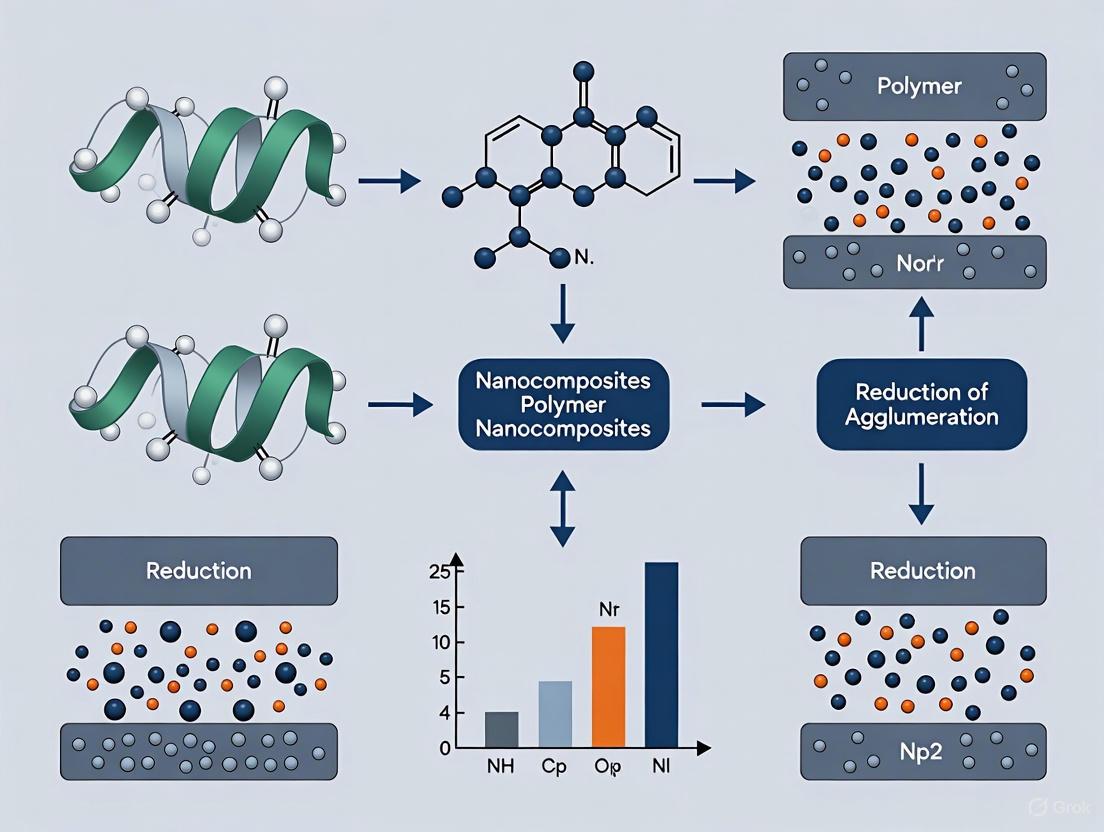
This article provides a comprehensive analysis of strategies to mitigate nanoparticle agglomeration in polymer nanocomposites, a critical challenge for researchers and drug development professionals.
Strategies for Reducing Agglomeration in Polymer Nanocomposites: Enhancing Properties for Biomedical and Clinical Applications
Abstract
This article provides a comprehensive analysis of strategies to mitigate nanoparticle agglomeration in polymer nanocomposites, a critical challenge for researchers and drug development professionals. It explores the fundamental causes and detrimental effects of agglomeration on mechanical, electrical, and biological properties. The content details advanced dispersion techniques, surface modification methods, and process optimization strategies to achieve uniform nanoparticle distribution. Furthermore, it covers characterization methods and predictive models for validating dispersion quality and performance. The insights are tailored to inform the design of next-generation nanocomposites for targeted drug delivery, implantable devices, and other advanced biomedical applications.
Understanding Agglomeration: The Fundamental Challenge in Polymer Nanocomposites
Defining Aggregation and Agglomeration in Nanocomposite Systems
Fundamental Definitions and Their Impact
What is the fundamental difference between aggregation and agglomeration?
In polymer nanocomposites, both aggregation and agglomeration describe the assembly of nanoparticles, but they differ significantly in the strength and nature of the bonds holding the particles together.
- Aggregation refers to the formation of strong and dense particle collectives, typically held together by direct mutual attraction via covalent or metallic bonds or through solid-state sintering. These structures are generally difficult to break apart [1].
- Agglomeration describes the assembly of loosely combined particles held together by weaker forces, such as van der Waals forces or electrostatic attractions. These assemblies can often be disrupted by mechanical forces applied during processing [1] [2].
This distinction is critical because the formation of aggregates or agglomerates diminishes the interfacial area between the polymer matrix and nanoparticles, leading to defects, stress concentrations, and ultimately, a deterioration of the nanocomposite's mechanical properties [1] [2].
How do aggregation and agglomeration negatively affect nanocomposite properties?
The presence of aggregates and agglomerates fundamentally undermines the key advantage of using nanoscale fillers: their high surface-to-volume ratio. The primary negative consequences are summarized in the table below.
Table 1: Detrimental Effects of Aggregation/Agglomeration on Nanocomposite Properties
| Affected Property | Impact and Consequence |
|---|---|
| Mechanical Performance | Significant reduction in Young's modulus, tensile strength, and toughness. Agglomerates act as stress concentration points, initiating failure [1] [2] [3]. |
| Reinforcement Efficiency | Drastic decrease in the stiffening effect of nanoparticles. The high modulus of nanoparticles becomes ineffective if they are not properly dispersed [2]. |
| Interfacial Area | Reduction of the available surface area for polymer-filler interaction, which is crucial for stress transfer and property enhancement [3]. |
Diagram 1: The Vicious Cycle of Aggregation and Its Consequences. This flowchart illustrates how the inherent properties of nanoparticles lead to attraction, resulting in aggregation/agglomeration and ultimately poor nanocomposite performance, which must be counteracted by mitigation strategies.
Troubleshooting and FAQs: Identifying and Quantifying the Problem
How can I experimentally detect and quantify aggregation in my samples?
A combination of characterization techniques is required to accurately assess the state of nanoparticle dispersion.
Table 2: Techniques for Characterizing Aggregation/Agglomeration
| Technique | What it Measures | Common Pitfalls to Avoid |
|---|---|---|
| Dynamic Light Scattering (DLS) | Hydrodynamic size distribution in a solution. A size larger than the primary particle indicates agglomeration [4]. | Always characterize materials yourself; do not rely solely on manufacturer specifications. Measurements are highly sensitive to the dispersing medium (e.g., size can double in plasma vs. PBS) [4]. |
| Electron Microscopy (SEM/TEM) | Direct visualization of particle size, morphology, and dispersion state at the nanoscale [4]. | Sample preparation can introduce artifacts or contamination. Use appropriate protocols and tools to minimize this [5]. |
| Analysis of Mechanical Properties | Using micromechanical models to determine the "A" parameter (aggregation level) or the effective volume fraction of agglomerated nanoparticles (φ_agg) from shear yield or tensile data [1]. | Requires accurate input data for the model. Assumes insignificant primary aggregation from nanoparticle synthesis. |
Why does my nanocomposite show poor mechanical properties even with a high nanofiller loading?
This is a classic symptom of extensive nanoparticle aggregation. When nanoparticles agglomerate, they behave as large, microscopic defects rather than as nanoscale reinforcements. This has several effects:
- Reduced Interfacial Area: The polymer matrix cannot interact with the surface of nanoparticles trapped inside an agglomerate, drastically reducing stress transfer efficiency [3].
- Stress Concentrations: The irregular shape and poor adhesion of agglomerates create points of high stress that initiate cracking and premature failure [1].
- Inefficient Load Bearing: The model of Dorigato et al., which suggests aggregates can reinforce, is an exception; most studies conclusively show that agglomeration severely damages the stiffening effect of nanoparticles [2].
The following experimental workflow outlines a methodology to systematically diagnose this issue.
Diagram 2: Diagnostic Workflow for Poor Mechanical Properties. This flowchart provides a step-by-step guide to determine if aggregation is the root cause of underperforming nanocomposites.
Experimental Protocols for Analysis
Protocol: Two-Step Micromechanical Modeling of Young's Modulus to Quantify Agglomeration
This methodology uses the measured Young's modulus to determine the extent of nanoparticle agglomeration [2].
1. Principle: The nanocomposite is modeled as a system containing two phases: (A) spherical regions of aggregated/agglomerated nanoparticles, and (B) an effective matrix phase containing well-dispersed nanoparticles.
2. Key Agglomeration Parameters:
z: The volume fraction of the nanocomposite occupied by the aggregation/agglomeration phase (V_agg / V).y: The volume fraction of the total nanofiller that is trapped inside the aggregates/agglomerates (V_f_agg / V_f).
3. Procedure:
- Step 1: Calculate the modulus of the aggregation/agglomeration phase (
E_agg) and the effective matrix phase (E_mat) using Paul's model. This model requires the Young's moduli of the polymer matrix and the nanofiller, and the parametersyandz. - Step 2: Calculate the overall nanocomposite modulus (
E) using the Maxwell model, which now treats the aggregation/agglomeration phase as spherical inclusions dispersed in the effective matrix phase. The volume fraction of these inclusions isz.
4. Output: By fitting the model predictions to your experimental modulus data, you can back-calculate the values of z and y that best describe your sample, providing a quantitative measure of the agglomeration state [2].
Protocol: Avoiding Endotoxin Contamination in Biocompatible Formulations
For nanocomposites intended for biomedical applications (e.g., drug delivery), endotoxin contamination is a critical concern that can mask true biocompatibility and cause immunostimulatory reactions [4].
1. Problem: Over one-third of samples submitted to the Nanotechnology Characterization Laboratory (NCL) have contamination requiring purification or re-manufacture.
2. Prevention Steps:
- Work Sterilely: Perform synthesis and purification in biological safety cabinets, not chemical fume hoods. Use depyrogenated glassware and sterile filters.
- Verify Reagents: Do not assume commercial reagents or purified water are endotoxin-free. Screen starting materials and equipment wash samples.
- Choose Filters Wisely: Avoid cellulose-based filters, as they contain beta-glucans that interfere with endotoxin assays.
3. Detection (LAL Assay):
- Always perform Inhibition and Enhancement Controls (IEC) to check for nanoparticle interference.
- If interference occurs (e.g., from colored or turbid formulations), use an alternative LAL method or a recombinant Factor C assay [4].
The Scientist's Toolkit: Essential Research Reagents and Materials
Table 3: Key Reagents and Materials for Mitigating Aggregation
| Reagent/Material | Function in Reducing Aggregation/Agglomeration |
|---|---|
| Coupling Agents / Compatibilizers | Improve the interfacial adhesion between the hydrophobic polymer matrix and hydrophilic nanofillers, promoting wetting and dispersion [1]. |
| Surface Capping Agents | Sterically hinder nanoparticles from approaching each other too closely, preventing the van der Waals forces from causing agglomeration [1]. |
| High-Shear Mixers (Twin-Screw Extruders) | Apply intense mechanical stress to break apart loosely bound agglomerates during melt compounding [1] [6]. |
| Pyrogen-Free Water & Solvents | Essential for preparing biocompatible nanocomposites to avoid endotoxin contamination that confounds biological testing [4]. |
Frequently Asked Questions (FAQs)
Q1: Why do nanoparticles tend to agglomerate in polymer matrices? The primary cause is van der Waals forces, which are attractive intermolecular forces that act between nanoparticles at close range [7]. These forces cause nanoparticles to attract one another, leading to clumping or agglomeration. This is particularly problematic because nanoparticles have a high surface-area-to-volume ratio, which magnifies the effect of these surface forces [8]. Agglomeration is often a sign of an unfavorable interfacial interaction between the nanoparticle surface and the polymer matrix.
Q2: How does surface energy relate to nanoparticle dispersion? Surface energy is a measure of the excess energy at a material's surface compared to its bulk [9]. Nanoparticles with high surface energy are thermodynamically driven to lower their energy, often by adhering to other particles, which promotes agglomeration. For good dispersion, the surface energy of the nanoparticle should be compatible with the surface energy of the polymer matrix. A significant mismatch can lead to poor wetting of the nanoparticles by the polymer, causing the nanoparticles to be expelled from the matrix and form agglomerates [9].
Q3: What are the practical consequences of agglomeration in my nanocomposite? Agglomeration is a critical defect that severely degrades the intended properties of polymer nanocomposites [10]. It creates weak points and inhomogeneities within the material. Key impacts include:
- Reduced Mechanical Enhancement: Agglomerates act as stress concentrators, diminishing mechanical properties like tensile strength and modulus [11] [10]. For instance, larger agglomerates (e.g., 60 nm radius) can reduce the modulus improvement from 205% to just 40% compared to smaller, well-dispersed agglomerates [11].
- Impaired Electrical Conductivity: In conductive composites, agglomeration can break conductive pathways, increasing electrical resistivity [10].
- Altered Porosity: Agglomeration can create unwanted voids and porosity, which negatively affects the mechanical integrity and other functional properties of the nanocomposite [10].
Q4: Can agglomeration ever be beneficial? In most applications, agglomeration is detrimental. However, controlled or reduced agglomeration can be beneficial. For example, the presence of smaller, controlled agglomerates (e.g., ~10 nm radius) can positively influence the effective volume fraction and interphase contribution, leading to a significant enhancement of the nanocomposite's modulus [11]. Furthermore, induced porosity from agglomeration can be desirable in specific applications like biomimetic scaffolds for tissue engineering, where porosity is needed for cell proliferation [10].
Troubleshooting Guides
Guide 1: Diagnosing the Root Cause of Agglomeration
| Observation | Possible Root Cause | Supporting Data / Quantitative Relationship |
|---|---|---|
| Severe agglomeration at low filler content | High nanoparticle surface energy leading to strong van der Waals attraction [9]. | A high surface energy solid (e.g., metals, ceramics) will cause poor wetting by a low surface tension polymer, leading to high contact angles and particle cohesion [9]. |
| Agglomeration increases with nanoparticle loading | Exceeding the percolation threshold; system thermodynamics favor particle-particle interactions over particle-polymer interactions [10]. | Studies on MWCNT/epoxy show agglomeration effects become significant at 2% volume fraction, degrading mechanical properties [10]. |
| Properties decline despite high filler loading | Formation of large agglomerates creating defects and reducing the effective reinforced volume [11] [10]. | Modelling shows an increase in agglomerate radius from 10 nm to 60 nm diminishes the modulus improvement from 205% to just 40% [11]. |
| Voids and porosity around agglomerates | Poor interfacial adhesion and incompatibility between the hydrophobic/hydrophilic character of the filler and matrix [10]. | A non-homogeneous mixture creates voids, lowering stiffness and strength; e.g., porosity in graphite-nanoflake/PDMS composites increases with nanoflake concentration [10]. |
Guide 2: Quantitative Effects of Agglomeration and Interphase Properties
This table summarizes key quantitative relationships from modelling and experimental studies to help set your experimental targets.
| Factor | Impact on Nanocomposite Modulus | Key Quantitative Data |
|---|---|---|
| Agglomerate Size (Radius) | Smaller agglomerates significantly enhance modulus; larger agglomerates diminish improvement. | Ragg = 10 nm: Enhancement up to 205% [11]. Ragg = 60 nm: Enhancement reduced to ~40% [11]. |
| Interphase Thickness (t) | A thicker, stiffer interphase region dramatically improves load transfer and modulus. | t = 20 nm, Ei = 40 GPa: Enhancement of 145% [11]. t < 5 nm: Enhancement of only ~50% [11]. |
| Filler Concentration | Low concentrations improve properties; high concentrations promote agglomeration and property decline. | Agglomeration in MWCNT/epoxy begins at ~2% vol. fraction, reducing mechanical strength [10]. |
Experimental Protocols
Protocol 1: Surface Modification of Nanoparticles to Reduce Van der Waals Forces
Objective: To lower the surface energy of nanoparticles and improve compatibility with the polymer matrix, thereby reducing agglomeration.
Materials:
- Nanoparticles (e.g., nanodiamond, graphene, metal oxides)
- Silane coupling agent
- Anhydrous solvent (e.g., toluene)
- Beaker, magnetic stirrer, ultrasonic bath
- Centrifuge
Methodology:
- Dispersion: Disperse the nanoparticles in the anhydrous solvent using ultrasonication for 30 minutes.
- Reaction: Transfer the dispersion to a beaker equipped with a stirrer. Add a calculated amount of silane coupling agent (e.g., 1-10 wt% relative to nanoparticles).
- Heating and Stirring: Heat the mixture to 60-80°C and stir continuously for 4-12 hours under an inert atmosphere to prevent hydrolysis.
- Washing and Centrifugation: Allow the mixture to cool. Separate the modified nanoparticles by centrifugation (e.g., 10,000 rpm for 10 minutes) and wash with fresh solvent 2-3 times to remove unreacted silane.
- Drying: Dry the purified, surface-modified nanoparticles in a vacuum oven at 60°C overnight.
Visual Workflow:
Protocol 2: Advanced Physical Dispersion via Twin-Screw Extrusion
Objective: To achieve a uniform distribution of nanoparticles within a polymer matrix using high shear and thermal energy.
Materials:
- Polymer resin (pellets or powder)
- Surface-modified nanoparticles
- Twin-screw extruder
- Pelletizer
Methodology:
- Pre-mixing: Pre-mix the polymer resin and nanoparticles to create a rough feedstock. This can be done using a tumbler mixer.
- Extrusion: Feed the pre-mixed material into the hopper of a co-rotating twin-screw extruder.
- Parameter Optimization: Set the temperature profile along the extruder barrels according to the polymer's melting point. Configure the screw speed (e.g., 100-500 rpm) to apply high shear forces that break apart agglomerates.
- Compounding: The material is melted, mixed, and conveyed through the intermeshing screws. The design of the screws (kneading blocks) promotes dispersive and distributive mixing.
- Pelletizing: The homogeneously mixed melt is extruded through a die, cooled in a water bath, and pelletized for further processing (e.g., injection molding).
Visual Workflow:
The Scientist's Toolkit: Research Reagent Solutions
| Reagent / Material | Function in Mitigating Agglomeration |
|---|---|
| Silane Coupling Agents | Form a covalent bridge between inorganic nanoparticles and the organic polymer matrix, reducing the energy mismatch and improving adhesion [8]. |
| Surfactants | Adsorb onto nanoparticle surfaces, creating a steric or electrostatic barrier that counteracts van der Waals attraction and prevents particles from coming close enough to agglomerate. |
| Halloysite Nanotubes (HNTs) | Act as a natural reinforcement agent; their tubular structure can help reduce chain mobility and improve the physical behavior of the biopolymer matrix, as demonstrated in chitosan/pectin films [12]. |
| Citric Acid (CA) | Serves as a natural crosslinking agent in biopolymer systems like chitosan and pectin. Crosslinking can strengthen the matrix and improve its resistance to degradation, which helps maintain integrity and potentially immobilizes fillers [12]. |
| Reduced Graphene Oxide (rGO) | A multifunctional nanofiller that can act as a compatibilizer in polymer blends (e.g., PLA/PDoF), promoting dispersion of the secondary phase and enhancing interfacial interaction, which reduces phase separation and agglomeration [12]. |
The Critical Link Between Agglomeration and Diminished Mechanical Properties
Quantitative Evidence: How Agglomeration Degrades Key Properties
Agglomeration negatively impacts mechanical performance by reducing the effective interfacial area between nanoparticles and the polymer matrix, creating stress concentration points and defects. The tables below summarize the quantitative evidence from research.
Table 1: Impact of Agglomeration Size on Nanocomposite Stiffness (Nanodiamond/Polymer System)
| Agglomerate Radius (Ragg) | Improvement in Young's Modulus | Experimental Conditions |
|---|---|---|
| 10 nm | Up to 205 % enhancement | Nanodiamond agglomeration model, considering interphase effects [11] |
| 60 nm | Only 40 % improvement | Nanodiamond agglomeration model, considering interphase effects [11] |
Table 2: Mechanical Property Degradation in CNT/Epoxy Nanocomposites
| CNT Weight Fraction | Observed Effect on Young's Modulus | Primary Identified Cause |
|---|---|---|
| 2% | Maximum modulus value achieved | Sufficient dispersion, percolation threshold reached [13] |
| 4% and 5% | Adverse effect, reduction in properties | Significant formation of CNT agglomerates and porosity [13] |
Table 3: The Interplay Between Interphase Properties and Agglomeration
| Interphase Characteristic | Impact on Composite Modulus | Notes |
|---|---|---|
| Thick interphase (t = 20 nm) & High modulus (Ei = 40 GPa) | 145 % enhancement | Dense and tough interphase compensates for some agglomeration effects [11] |
| Thin interphase (t < 5 nm) | Only 50 % improvement | Limited interphase cannot counter the negative impact of agglomeration [11] |
Experimental Protocols for Assessing Agglomeration
Two-Step Micromechanical Method for Quantifying Agglomeration
This methodology uses micromechanical models to determine the level of nanoparticle aggregation/agglomeration in polymer nanocomposites by matching theoretical predictions with experimental modulus values [2].
Step 1: Define Agglomeration Parameters Two key parameters are defined to quantify agglomeration [2]:
- ( z ): The volume fraction of the aggregation/agglomeration phase in the nanocomposite.
- ( y ): The fraction of total nanoparticles located within the agglomerated regions.
Step 2: Calculate Phase Moduli Using Paul's Model The modulus of the agglomerated phase (( E{agg} )) and the effective matrix phase (( E{mat} )) containing well-dispersed nanoparticles are calculated using Paul's model, substituting the respective nanoparticle volume fractions [2].
Step 3: Calculate Composite Modulus Using Maxwell's Model The modulus of the entire nanocomposite is calculated by modeling the agglomerated phases as spherical inclusions dispersed within the effective matrix phase, using Maxwell's model [2].
Step 4: Determine Agglomeration Parameters (z and y) The parameters ( z ) and ( y ) are iteratively adjusted until the predicted composite modulus from the two-step method matches the experimentally measured modulus. Higher values of ( z ) and ( y ) indicate more significant agglomeration [2].
Protocol for Analyzing Agglomeration via Tensile Strength
The Pukanszky model is a widely used empirical approach to quantify the effect of filler-matrix interface and agglomeration on tensile strength.
Procedure:
- Experimentally measure the tensile strength (( \sigma )) of the neat polymer matrix and the nanocomposite at a specific nanoparticle volume fraction (( \phi_f )) [14].
- Apply the Pukanszky model: ( \sigma = \sigmam \frac{1-\phif}{1+2.5\phif} \exp(B\phif) ) where ( B ) is an interfacial adhesion parameter [14].
- Calculate the ( B ) parameter from the experimental data. A lower ( B ) value indicates weaker interfacial adhesion, often resulting from nanoparticle agglomeration, which reduces the effective interfacial area and load transfer efficiency [14].
FAQs and Troubleshooting Guide
FAQ 1: Why does agglomeration lead to a decrease in the mechanical properties of my nanocomposites?
Agglomeration creates regions with high nanoparticle concentration and poor polymer infiltration, leading to [2] [10] [14]:
- Reduced Interfacial Area: The primary mechanism of reinforcement in nanocomposites is the large interfacial area for stress transfer. Agglomerates act as large, ineffective particles with low specific surface area.
- Defect Formation: Agglomerates become points of stress concentration, initiating failure like microcracks and voids under load.
- Diminished Interphase Contribution: The interphase, a polymer region with altered properties around well-dispersed nanoparticles, is a key reinforcing element. Agglomeration drastically reduces the volume of this effective interphase.
FAQ 2: My nanocomposite's modulus is much lower than theoretical predictions. Is agglomeration the cause?
Yes, this is a classic symptom. Theoretical models often assume perfect, homogeneous dispersion of nanoparticles. Agglomeration invalidates this assumption, leading to overestimation of properties. Calculations based on well-dispersed nanoparticles consistently overestimate the composite modulus, while models that account for agglomeration show strong agreement with experimental data [11] [2]. If your experimental results are far below theoretical values, agglomeration is the most probable cause.
FAQ 3: I am using high-modulus nanoparticles, but my composite's stiffness is not improving significantly. What is wrong?
A high modulus of the nanoparticles alone is not sufficient for composite enhancement. The critical factor is the efficient transfer of stress from the polymer matrix to the nanoparticles. Agglomeration severely limits this stress transfer. Without good dispersion and a strong interface, the stiffening potential of the nanoparticles cannot be realized [2] [14]. Surface chemistry must be adjusted to prevent agglomeration and ensure good dispersion.
Troubleshooting Guide:
| Problem | Potential Causes | Recommended Solutions |
|---|---|---|
| Low Stiffness/Strength | High degree of nanoparticle agglomeration; Weak polymer-particle interface [2] [13]. | - Implement surface modification of nanoparticles (e.g., silanization) [15]. - Optimize dispersion protocol (e.g., ultrasonication, high-shear mixing) [8]. - Use compatibilizers to improve interfacial adhesion. |
| Properties Degrade at High Filler Loading | Increased nanoparticle agglomeration at higher concentrations leading to porosity and defects [10] [13]. | - Identify the optimal filler content below the critical agglomeration threshold. - Employ more advanced dispersion techniques (e.g., twin-screw extrusion, solvent-assisted dispersion) [8]. |
| Inconsistent Results Between Batches | Uncontrolled agglomeration due to inconsistent dispersion protocols or material variations [16]. | - Standardize and strictly document the dispersion method (e.g., energy input, time, solvent). - Characterize nanoparticle dispersion state in every batch (e.g., via microscopy). |
Research Reagent Solutions for Mitigating Agglomeration
Table 4: Key Materials and Methods for Improved Dispersion
| Reagent/Method | Function/Purpose | Application Example |
|---|---|---|
| Surface Modifiers (e.g., (3-aminopropyl)triethoxysilane) | Reduces nanoparticle surface energy, weakens van der Waals forces causing agglomeration, and improves compatibility with the polymer matrix [15]. | Surface modification of silica nanoparticles in HDPE nanocomposites, leading to better dispersion and enhanced mechanical properties [15]. |
| Physical Dispersion: Ultrasonication | Applies high-frequency sound waves to create cavitation bubbles, generating intense local shear forces that break apart nanoparticle clusters [8]. | Effective for deagglomerating carbon nanotubes (CNTs) in epoxy resins prior to mixing [8] [13]. |
| Physical Dispersion: Twin-Screw Extrusion | Provides high shear and thermal energy in a continuous process, effectively dispersing nanoparticles in molten polymers during compounding [8]. | Standard industrial method for dispersing nanoclays or graphene in thermoplastics like polypropylene [8]. |
| Hybrid Filler Systems | Using a combination of different nanofillers can create synergistic effects that improve the overall dispersion state of each filler [16]. | Using a hybrid of multilayered graphene and carbon nanotubes to reduce the agglomeration of both fillers in the polymer [16]. |
Visualizing the Agglomeration Problem and Workflow
The following diagram illustrates the core concepts of how agglomeration impacts the microstructure and properties of polymer nanocomposites.
The diagram above illustrates the fundamental mechanism behind property degradation: agglomeration drastically reduces the interfacial area critical for stress transfer. The workflow below outlines a systematic experimental approach to diagnose and address this issue.
Impact on Electrical Conductivity and Percolation Threshold
Frequently Asked Questions (FAQs)
1. What are the primary factors that control the electrical conductivity of polymer nanocomposites? Several variables govern conductivity, including filler amount, filler conductivity, filler dimensions, nanoparticle dispersion, tunneling effect, and interfacial condition [17]. The formation of a continuous conductive network (percolation) is essential, and this network is highly sensitive to the quality of dispersion and the presence of an interphase layer around the nanoparticles [17] [18].
2. Why is agglomeration a critical problem in conductive nanocomposites? Agglomeration occurs due to strong van der Waals forces between nanomaterials like graphene and carbon nanotubes, causing them to clump together [19] [20]. These clumps prevent uniform dispersion, which increases the percolation threshold and hinders the formation of a continuous conductive network. This results in lower electrical conductivity, inconsistent properties, and reduced mechanical strength [19] [20].
3. How does the interphase region affect the percolation threshold? The interphase is a region surrounding nanoparticles with distinct properties, formed due to the high surface area of the nanofiller and its interaction with the polymer matrix [17] [18]. A well-formed interphase can significantly lower the percolation threshold because the interphase layers themselves can form a connected network even before the nanofillers make direct physical contact [17] [21] [18]. Furthermore, the interphase facilitates the tunneling effect, a key charge transfer mechanism [18].
4. What is electron tunneling and why is it important? Electron tunneling is a quantum mechanical phenomenon where electrons transfer between two nearby conductive nanoparticles separated by a thin insulating polymer layer [21] [22]. This effect is the primary mechanism for charge conduction in many nanocomposites, especially when fillers are not in direct physical contact. The tunneling distance is critical; typically, distances less than 10 nm are needed for effective tunneling, with shorter distances leading to significantly higher conductivity [21] [22].
5. What strategies can effectively reduce agglomeration? Several methods can mitigate agglomeration:
- Physical Methods: Using organic solvents, ultrasonication, and selecting suitable dispersion and production methods [19].
- Chemical Methods: Functionalizing the fillers to improve their compatibility with the polymer matrix [19].
- Hybrid Fillers: Using a combination of different fillers can create synergistic effects that improve the overall dispersion state [19].
- 3D Architectures: Creating three-dimensional foam structures of nanomaterials via processes like freeze-drying can prevent agglomeration and establish efficient conductive pathways [23].
Troubleshooting Guides
Problem: High Percolation Threshold
A high percolation threshold means you need to add a large amount of expensive nanofiller to make the composite conductive, which is inefficient and can worsen mechanical properties.
| Possible Cause | Diagnostic Steps | Recommended Solution |
|---|---|---|
| Filler Agglomeration | Use SEM to visualize filler dispersion. Look for clusters instead of isolated particles [19]. | Improve dispersion via prolonged sonication or solution mixing. Consider using surfactants or functionalized fillers [19]. |
| Low Filler Aspect Ratio | Check filler specifications from supplier. Model the percolation threshold using known dimensions [17] [24]. | Source fillers with a higher aspect ratio (longer length or larger diameter). For existing fillers, ensure processing doesn't break them [17]. |
| Poor or Non-existent Interphase | This is difficult to observe directly. Indirectly assess by modeling percolation and conductivity with interphase parameters [17] [21]. | Enhance polymer-filler interaction through chemical functionalization of the filler surface to promote a thicker, more effective interphase [17] [18]. |
| Large Tunneling Distance | Model the system's conductivity considering tunneling effects. Distances >1.8-3 nm drastically reduce tunneling [21] [22]. | Optimize processing to achieve a more uniform filler distribution, reducing the average gap between nanoparticles [21]. |
Problem: Low Electrical Conductivity
The composite's conductivity is lower than expected, even after exceeding the perceived percolation threshold.
| Possible Cause | Diagnostic Steps | Recommended Solution |
|---|---|---|
| Insufficient Filler Network | Check if filler concentration is just above the percolation threshold. Conductivity increases gradually after percolation [22]. | Increase filler loading to boost the fraction of networked filler. Alternatively, use hybrid fillers to create more robust networks [19] [23]. |
| High Filler Waviness | Analyze filler morphology using TEM imaging. Waviness reduces effective aspect ratio [18]. | If using CNTs, select straighter variants or adjust processing conditions (e.g., curing under alignment fields) to reduce waviness [17] [22]. |
| Large Tunneling Resistance | The polymer matrix itself creates a tunneling resistance. Thicker polymer layers between fillers increase resistance [21] [22]. | Focus on achieving a homogeneous dispersion with minimal inter-particle distances (preferably <1.8 nm) [21] [22]. |
| Imperfect Interphase | Model the system with a "conduction transfer parameter" (Y). A low Y indicates poor conduction transfer from filler to polymer [17]. | Improve interfacial adhesion and properties through filler functionalization to enhance the conduction transfer efficiency [17]. |
Quantitative Data for Material Selection
The following table summarizes key parameters from recent research that significantly impact percolation and conductivity. Use this as a guide for selecting materials and setting targets.
| Parameter | Impact on Percolation Threshold | Impact on Electrical Conductivity | Target Range / Optimal Value |
|---|---|---|---|
| Filler Aspect Ratio (Length/Diameter) | Higher aspect ratio drastically lowers percolation [17] [18] [24]. | Higher aspect ratio increases conductivity by forming networks more easily [17] [18]. | As high as possible (e.g., >1000). Note: rods with aspect ratio <1000 deviate from ideal scaling [24]. |
| Interphase Thickness | A thicker interphase lowers the percolation threshold [17] [21] [18]. | A thicker interphase increases conductivity by promoting tunneling and networked pathways [17] [21]. | Models show significant benefits up to ~40 nm [21]. |
| Tunneling Distance | A smaller tunneling distance lowers the percolation threshold [17]. | A smaller tunneling distance exponentially increases conductivity. The effect is dramatic below 1.8 nm [21] [22]. | Ideally ≤ 1.8 nm. Tunneling is negligible beyond ~10 nm [21] [22]. |
| Filler Waviness (u = straight length/actual length) | Higher waviness (u >> 1) increases the percolation threshold [18]. | Higher waviness decreases conductivity by reducing the effective aspect ratio [18]. | As close to 1 (perfectly straight) as possible [18]. |
Detailed Experimental Protocol: Solution Mixing and Ultrasonication
This is a common method for preparing polymer nanocomposites with a focus on achieving good dispersion.
1. Objective: To disperse conductive nanofillers (e.g., graphene, CNTs) uniformly within a polymer matrix using solvent-assisted ultrasonication to minimize agglomeration and achieve a low percolation threshold.
2. Materials and Equipment:
- Polymer matrix (e.g., Epoxy resin).
- Conductive nanofiller (e.g., Graphene nanosheets, Multi-walled Carbon Nanotubes).
- Suitable solvent (e.g., Acetone, Dimethylformamide) that can dissolve the polymer.
- Ultrasonic probe sonicator.
- Magnetic stirrer and hotplate.
- Vacuum oven for solvent removal.
3. Procedure:
- Step 1: Polymer Dissolution. Dissolve the polymer matrix in the solvent using magnetic stirring at moderate temperature (e.g., 40-50°C) until a clear solution is obtained.
- Step 2: Filler Dispersion. Gradually add the nanofiller to the polymer solution under continuous stirring to achieve preliminary wetting.
- Step 3: Ultrasonication. Subject the mixture to probe ultrasonication for a set duration (e.g., 30-60 minutes). Use an ice bath to prevent solvent evaporation and overheating, which can damage the filler or polymer.
Critical Step: Optimize sonication time and amplitude. Under-sonication leaves agglomerates, while over-sonication can break fillers, reducing their aspect ratio and compromising conductivity [17] [19].
- Step 4: Solvent Removal. Pour the dispersed mixture into a petri dish and place it in a vacuum oven to slowly evaporate the solvent. Controlled evaporation helps prevent re-agglomeration.
- Step 5: Post-Processing. The resulting solid composite can be further processed by hot-pressing or compression molding to form final specimens for testing.
The Scientist's Toolkit: Research Reagent Solutions
| Item | Function in Experiment |
|---|---|
| Graphene Nanosheets | A 2D conductive filler with extremely high aspect ratio and conductivity, excellent for lowering percolation threshold and enhancing conductivity [17] [23]. |
| Carbon Nanotubes (CNTs) | 1D tubular carbon structures (SWNTs or MWNTs) with high aspect ratio and conductivity, used to create conductive networks in polymers [19] [22]. |
| MXene Nanosheets | A class of 2D transition metal carbides/nitrides with high electrical conductivity and hydrophilic surfaces, making them promising for conductive composites [21]. |
| Hexagonal Boron Nitride (hBN) | A 2D electrical insulator with high thermal conductivity. Often used in hybrid filler systems or for applications requiring thermal conduction but electrical insulation [23]. |
| Functionalized Fillers | Fillers (e.g., COOH- or NH₂-modified CNT/Graphene) with surface chemical groups that improve compatibility with the polymer matrix, reduce agglomeration, and strengthen the interphase [19] [18]. |
| Surfactants / Dispersing Agents | Chemicals that adsorb onto filler surfaces, reducing their surface energy and van der Waals forces to prevent agglomeration during processing [19]. |
Relationship Between Key Factors and Conductivity
The diagram below illustrates the logical relationships between material properties, processing conditions, and the resulting macroscopic electrical properties of the nanocomposite.
Consequences for Interfacial/Interphase Properties and Composite Performance
Troubleshooting Guide: Common Experimental Issues
| Problem Phenomenon | Possible Root Cause | Recommended Solution | Supporting Literature |
|---|---|---|---|
| Poor mechanical reinforcement despite low nanofiller loading. | Nanoparticle agglomeration reducing effective interfacial area and stress transfer [25] [1]. | Implement surface functionalization of nanofillers or use compatibilizers to improve dispersion and polymer-filler bonding [26] [27]. | [1] [27] |
| Inconsistent property data between experimental batches. | Uneven dispersion of nanoparticles within the polymer matrix, leading to variable microstructure [28]. | Standardize the mixing protocol (e.g., sonication power/duration, screw speed in melt compounding) and use surfactants [26] [1]. | [26] [28] |
| Reduced glass transition temperature (Tg) or altered relaxation dynamics. | Poor interfacial adhesion and agglomeration restrict polymer chain mobility [25] [29]. | Enhance interfacial interactions via chemical bonding between nanofiller and matrix to increase the effective interphase volume [25] [26]. | [25] [29] |
| Electrical/thermal conductivity below theoretical predictions. | Formation of agglomerates preventing the formation of a continuous conductive network [26]. | Optimize filler loading and dispersion process to achieve a uniform percolation network; use hybrid filler systems [26]. | [26] |
Frequently Asked Questions (FAQs)
Q1: Why is the dispersion of nanoparticles so challenging, and what are the main types of aggregation?
The primary challenge stems from strong intermolecular van der Waals forces attracting nanoparticles to each other [25] [1]. This leads to two main types of particle assemblies:
- Aggregation: Dense, strongly bonded particle collectives that are difficult to break apart [1] [2].
- Agglomeration: Loosely combined particles that might be separated by mechanical forces [1] [2]. Both forms significantly reduce the specific surface area of the nanofiller, which is critical for creating a large interfacial region with the polymer matrix [27].
Q2: How does agglomeration directly weaken the mechanical properties of my nanocomposite?
Agglomeration negatively impacts properties through several mechanisms [1] [27]:
- Reduced Stress Transfer: The large, clustered particles have a lower surface-to-volume ratio, which minimizes the load-bearing interface and impedes efficient stress transfer from the polymer matrix to the reinforcing nanofiller.
- Stress Concentrations: Agglomerates act as microscopic defects or voids within the composite, creating points of high stress concentration that can initiate cracks and lead to premature failure.
- Lower Effective Filler Content: A portion of the nanofiller is trapped inside agglomerates and does not contribute to reinforcement, effectively lowering the volume fraction of nanoparticles that interact with the polymer chains.
Q3: What are the most effective strategies to minimize agglomeration in my experiments?
Several strategies have proven effective in promoting dispersion and reducing agglomeration [26] [1]:
- Surface Functionalization: Chemically modifying the surface of nanoparticles to improve their chemical compatibility with the polymer matrix and create repulsive forces between particles.
- Use of Compatibilizers/Coupling Agents: Adding these agents can act as a molecular bridge, enhancing adhesion between the filler and the matrix.
- Optimized Processing Parameters: In melt compounding, parameters like screw speed, shear rate, and temperature can be tuned to apply sufficient stress to break apart agglomerates [1].
- Sonication: High-power ultrasonication is a common and effective method for dispersing nanoparticles in solvents or low-viscosity polymers, though it is best for small batches [26].
Q4: Can I quantitatively assess the level of agglomeration in my samples?
Yes, agglomeration can be studied indirectly through mechanical property modeling. A two-step micromechanical methodology has been suggested to determine aggregation parameters (z and y), where z is the volume fraction of the aggregation phase in the composite, and y is the fraction of total nanofiller located within that phase [2]. By fitting theoretical models (e.g., Paul and Maxwell models) to experimental Young's modulus data, researchers can back-calculate the extent of agglomeration [2].
Quantitative Data on Agglomeration Impact
Table 1: Experimentally observed agglomeration parameters (z and y) in various polymer nanocomposite systems, as determined by a two-step micromechanical modeling method [2].
| Nanocomposite System | Filler Content (wt%) | Aggregation Phase Fraction (z) |
Filler in Aggregates (y) |
|---|---|---|---|
| PVC / CaCO₃ | 7.5% | 0.20 | 0.95 |
| PCL / Nanoclay | 10% | 0.30 | 0.75 |
| PLA / Nanoclay | 5% | 0.10 | 0.99 |
| PET / MWCNT | 1.5% | 0.35 | 0.70 |
| Polyimide / MWCNT | 1.5% | 0.15 | 0.90 |
Detailed Experimental Protocols
Protocol 1: Characterizing Agglomeration via Mechanical Modeling
This protocol uses a two-step micromechanical analysis to quantify nanoparticle agglomeration [2].
- Input Material Properties: Determine the Young's modulus of the neat polymer matrix ((Em)) and the nanofiller ((Ef)).
- Measure Composite Modulus: Experimentally measure the Young's modulus of the nanocomposite at various filler loadings.
- Apply the Two-Step Model:
- Step 1: Use the Paul model [2] to calculate the modulus of the hypothesized aggregated regions ((E{agg})) and the well-dispersed effective matrix regions ((E{mat})). This calculation requires assumed values for the agglomeration parameters
zandy. - Step 2: Use the Maxwell model [2] to calculate the overall composite modulus by treating the aggregated phase as spherical inclusions dispersed in the effective matrix.
- Step 1: Use the Paul model [2] to calculate the modulus of the hypothesized aggregated regions ((E{agg})) and the well-dispersed effective matrix regions ((E{mat})). This calculation requires assumed values for the agglomeration parameters
- Iterate to Fit Data: Adjust the parameters
zandyuntil the model's prediction matches the experimental modulus data. The best-fit values indicate the level of agglomeration.
Protocol 2: Assessing Interfacial/Interphase Strength via Yield Strength
This protocol evaluates the quality of the interface by analyzing the composite's shear yield strength ((\tau)) [1] [27].
- Measure Shear Properties: Obtain the shear yield strength of the neat polymer matrix ((\tau_m)) and the nanocomposite.
- Calculate Interparticle Distance: The distance between nanoparticles ((\lambda)) can be calculated from the filler volume fraction and the size of the nanoparticles or their agglomerates [27].
- Apply Model: Use the relationship (\tau = \taum + G bB / \lambda) [1] [27], where (G) is the shear modulus and (b_B) is the Burgers vector.
- Interpret Results: A lower experimental yield strength than predicted by the model for well-dispersed particles indicates poor stress transfer, often caused by agglomeration and a weak interphase [27].
Relationship Between Agglomeration and Properties
The following diagram illustrates the cascading negative effects of nanoparticle agglomeration on the interphase and final composite performance.
The Scientist's Toolkit: Research Reagent Solutions
Table 2: Essential materials and techniques for investigating and mitigating agglomeration.
| Item / Technique | Function / Purpose | Key Considerations |
|---|---|---|
| Surface Coupling Agents (e.g., silanes) | Improve interfacial adhesion by creating chemical bonds between nanofiller and polymer matrix [26]. | Select an agent with functional groups compatible with both the filler surface and the polymer. |
| Surfactants & Dispersants | Reduce surface tension and create steric/electrostatic repulsion between nanoparticles to prevent agglomeration in suspensions [26]. | Must be compatible with the polymer system to avoid plasticization or other side effects. |
| High-Shear Mixers & Ultrasonicators | Apply physical force to break apart agglomerates during composite processing [26]. | Optimize parameters (speed, time, power) to balance dispersion quality with potential damage to nanoparticles. |
| Micromechanical Models (Paul, Maxwell) | Quantify agglomeration levels and predict composite properties based on constituent properties and microstructure [2]. | Requires accurate input data for matrix and filler properties. |
| Characterization Techniques (TEM, XRD, DMA, TGA) | Analyze dispersion quality, crystal structure, thermal transitions, and filler content [30] [29]. | A combinatorial approach is often necessary for a complete picture of the morphology. |
Advanced Dispersion Techniques and Surface Functionalization Methods
Agglomeration is a fundamental challenge in polymer nanocomposites research, as it prevents the uniform dispersion of nanoparticles within the polymer matrix, ultimately limiting the enhancement of mechanical, electrical, and thermal properties. Physical dispersion methods are crucial for overcoming the strong interparticle forces, such as van der Waals attractions, that cause nanoparticles to form stubborn agglomerates. This technical support guide addresses common experimental issues and provides detailed protocols for three key physical dispersion techniques: ultrasonication, bead milling, and twin-screw extrusion, framed within the context of a thesis focused on reducing agglomeration.
Troubleshooting FAQs
1. My carbon nanotube (CNT) composites are not achieving electrical percolation even at loadings above the theoretical threshold. What is wrong?
- Problem: The dispersion process is likely insufficiently breaking up primary CNT agglomerates, or it is severely shortening the CNTs, reducing their aspect ratio and hindering network formation.
- Solutions:
- For Melt Mixing (Twin-Screw Extrusion): Monitor the Specific Mechanical Energy (SME) input. A higher SME (up to a certain point, e.g., ~0.4 kWh/kg) improves dispersion but can also shorten CNTs. If the state of dispersion is good but conductivity is poor, the CNTs may be too short. Try using a screw profile with more distributive mixing elements rather than dispersive ones to reduce shear-induced breaking [31].
- For Ultrasonication: Ensure you are using sufficient but not excessive power and time. Excessive ultrasonication can introduce defects and shorten CNTs, reducing their effectiveness for creating a conductive network [32] [33]. Characterize the CNT length after processing if possible.
- Consider a Hybrid Approach: Use a combination of chemical (surface modification) and physical (optimized ultrasonication or extrusion) methods to improve dispersion without excessive damage [34] [35].
2. How can I prevent the re-agglomeration of nanoparticles after I have successfully dispersed them?
- Problem: After dispersion, nanoparticles tend to re-agglomerate over time due to their high surface energy.
- Solutions:
- Surface Modification: This is the most effective long-term strategy. Modify the nanoparticle surface with surfactants, silanes, or polymer grafts to create steric hindrance or electrostatic repulsion between particles. For instance, coating magnetite nanoparticles with silica via a sol-gel process significantly improved their stability in suspension by changing the surface charge and providing a physical barrier [36].
- Optimize Matrix Compatibility: For melt processing, use compatibilizers (e.g., maleic anhydride grafted polymers) to improve the wetting and adhesion between the nanoparticle and the polymer matrix, "locking" them in place [34] [33].
- Process Control: In extrusion, ensure the melt is cooled rapidly after mixing to "freeze" the well-dispersed state before re-agglomeration can occur.
3. I am getting inconsistent results between different batches when using probe ultrasonication. How can I improve reproducibility?
- Problem: Inconsistent results often stem from unoptimized and unmonitored sonication parameters.
- Solutions:
- Systematic Optimization: Develop a protocol where you characterize the dispersion quality (e.g., by DLS for hydrodynamic diameter, TEM for morphology) at different time points during the sonication process to identify the optimal duration [32].
- Control Temperature: Use a water bath to control the temperature rise during sonication, as excessive heat can alter the dispersion medium and damage sensitive nanoparticles [32].
- Prevent Contamination: Be aware that probe sonication can cause tip erosion, contaminating the sample. For critical applications, consider using an indirect sonicator (e.g., with a vial tweeter) to eliminate this variable [32].
- Document Parameters Rigorously: Record all parameters including power (W), amplitude (%), pulse duration (on/off time), and sample volume for every experiment.
4. What is the most effective way to disperse two-dimensional nanofillers like graphene nanoplates (GNP) in a polymer melt?
- Problem: GNPs have strong interlayer bonding and a high aspect ratio, making them difficult to exfoliate and disperse without breaking them.
- Solutions:
- Combined Physical-Chemical Pretreatment: Prior to melt mixing, use techniques like ball milling or solid-state shear pulverization to break down large GNP agglomerates [34] [33].
- Use of Ultrasound-Assisted Extrusion: Studies have shown that applying ultrasonic waves directly in the melt during twin-screw extrusion can significantly improve the exfoliation and dispersion of layered nanofillers, though its effectiveness for GNP may be less than for CNTs or carbon black [34].
- Optimize Screw Profile: Use a screw profile that generates high shear stress to peel apart the layers but is balanced with distributive mixing to spread them throughout the matrix without excessive reduction in platelet size.
The following tables summarize critical operational parameters and their effects on dispersion quality for each method.
Table 1: Ultrasonication Parameters and Guidelines
| Parameter | Key Considerations | Typical Range/Effect |
|---|---|---|
| Sonication Type | Probe (direct) vs. Bath (indirect) | Probe: higher intensity, risk of contamination. Bath: gentler, more reproducible for toxicological studies [32]. |
| Power/Amplitude | Energy input into the system | Higher power accelerates deagglomeration but can damage particles (e.g., shorten CNTs) and increase temperature [32]. |
| Duration | Time of ultrasound application | Requires optimization; too short = poor dispersion, too long = particle damage and reduced stability [32]. |
| Pulsing | Intermittent cycles (e.g., 5s on/2s off) | Helps control temperature rise and allows particles to migrate back into sonication zones [32]. |
| Sample Volume | Volume of liquid to be processed | Critical for reproducibility. Must be kept constant for a given protocol [32]. |
Table 2: Twin-Screw Extrusion (TSE) Parameters and Their Impact
| Parameter | Key Considerations | Impact on Dispersion & Composite Properties |
|---|---|---|
| Screw Speed | Rotation speed (RPM) | Higher speed increases shear and SME, improving dispersion but can shorten nanofillers and degrade polymer [31]. |
| Screw Profile | Sequence of conveying, kneading, and mixing elements | Dispersive mixing (kneading blocks) breaks agglomerates. Distributive mixing (toothed elements) distributes them evenly [31]. |
| Specific Mechanical Energy (SME) | Total mechanical energy input per mass unit (kWh/kg) | Higher SME generally improves dispersion up to a plateau. Beyond this, filler shortening may dominate, harming properties like electrical conductivity [31]. |
| Feed Rate/Throughput | Mass flow rate of material | Affects residence time and fill factor in the extruder, influencing dispersion quality [31]. |
| Feeding Position | Hopper (main) vs. Side Feeder | Feeding fillers downstream via a side feeder can reduce filler breaking and polymer degradation, sometimes yielding better electrical and mechanical properties [31]. |
Table 3: Bead Milling Parameters and Guidelines
| Parameter | Key Considerations | Impact on Dispersion |
|---|---|---|
| Bead Size & Material | Diameter and density of milling media | Smaller, denser beads (e.g., zirconia) are more effective for breaking nano-agglomerates but generate more heat. |
| Bead Loading | Volume fraction of beads in chamber | Optimal loading (typically 50-80% of chamber volume) maximizes collision frequency for efficient milling. |
| Rotor Speed | Speed of the agitator | Higher speed increases collision energy, improving dispersion kinetics but also increasing heat and potential for contamination. |
| Processing Time | Duration of milling | Must be optimized; insufficient time leads to poor dispersion, while over-milling can damage particles and the polymer. |
| Suspension Viscosity | Rheology of the polymer/nanoparticle mix | Affects the transmission of shear forces. Optimal viscosity is required for efficient energy transfer. |
Detailed Experimental Protocols
Protocol 1: Optimizing Ultrasonication for Aqueous Nanomaterial Dispersions
This protocol, adapted from [32], provides a systematic, step-by-step approach to achieve stable, well-dispersed suspensions, which can be a precursor to solution-based composite preparation.
Workflow Overview:
Step-by-Step Procedure:
Preliminary Setup:
- Materials: Nanomaterial (e.g., CeO₂, ZnO, CNTs), deionized water, surfactant/dispersant (if required), ultrasonic bath, probe sonicator (or vial tweeter), ice bath.
- Prepare a stock suspension with a fixed nanomaterial concentration (e.g., 0.1-1 mg/mL) in a defined volume of dispersant. If needed, add a stabilizer like sodium citrate.
Systematic Parameter Sweep:
- Divide the stock suspension into multiple identical vials.
- Subject each vial to a different set of sonication conditions, systematically varying:
- Sonication Time: (e.g., 1, 5, 10, 20 minutes).
- Amplitude/Power: (e.g., 20%, 50%, 80% of maximum).
- Pulsing Mode: (e.g., continuous vs. 5 seconds on / 2 seconds off).
- Maintain a constant sample volume and control temperature using an ice bath to ensure comparisons are valid.
Real-Time Characterization:
- After each sonication condition, immediately analyze a small aliquot of the dispersion using:
- Dynamic Light Scattering (DLS): To measure the hydrodynamic diameter (Z-average) and Polydispersity Index (PdI). The goal is to find the point where the size is minimized and the PdI is lowest.
- Electrophoretic Light Scattering (ELS): To measure the Zeta Potential (ZP). A value above |25| mV typically indicates good electrostatic stability.
- After each sonication condition, immediately analyze a small aliquot of the dispersion using:
Identify Optimal Conditions:
- Plot the hydrodynamic diameter and zeta potential against sonication time and power.
- The optimal point is where you achieve the smallest hydrodynamic diameter with an acceptable PdI and a zeta potential indicating good stability, before any signs of re-agglomeration or particle degradation appear.
Final Quality Assessment:
- Prepare a final dispersion using the identified optimal parameters.
- Use Transmission Electron Microscopy (TEM) to visually confirm the state of dispersion, exfoliation, and absence of damage.
- Use UV-Vis spectroscopy to monitor the absorption over 24-48 hours to confirm dispersion stability. A stable dispersion will show minimal change in its characteristic absorption peak.
Protocol 2: Ultrasound-Assisted Twin-Screw Extrusion for Polymer/CNT Composites
This protocol details the use of high-power ultrasound integrated into a melt extruder to enhance the dispersion of carbon nanotubes in a thermoplastic matrix like Polyetherimide (PEI) or Polypropylene (PP) [37] [34].
Workflow Overview:
Step-by-Step Procedure:
Material Preparation:
- Materials: Polymer resin (e.g., PEI, PP), multi-walled carbon nanotubes (MWCNTs).
- Dry the polymer resin in a vacuum oven according to manufacturer specifications (e.g., 110°C for 24 hours for PEI).
- Pre-mix the dried polymer powder with the desired loading of MWCNTs (e.g., 1-5 wt%) using a tumbler mixer or ball milling to ensure a roughly homogeneous dry blend.
Baseline Compounding:
- Set up the twin-screw extruder with a standard screw configuration (containing both distributive and dispersive mixing elements).
- Process the pre-mixed material without activating the ultrasound system.
- Record process data: torque, melt pressure, and melt temperature. Collect the extruded strand.
Ultrasound-Assisted Compounding:
- Using the same screw configuration and processing temperature, re-process the pre-mixed material or a masterbatch.
- Activate the ultrasonic transducer attached to the extruder barrel. Start with a low amplitude (e.g., 3-5 µm) and gradually increase it in subsequent runs (e.g., up to 10 µm).
- Monitor and record the ultrasonic power consumption and the pressure at the die. A drop in pressure upon ultrasound application indicates a reduction in melt viscosity.
Sample Collection and Analysis:
- Collect the extruded strands from both the baseline and ultrasound-assisted runs.
- Rheology: Perform oscillatory rheology on the composite pellets. An increase in storage modulus and complex viscosity in the low-frequency region after ultrasonic treatment indicates better dispersion and formation of a network structure [37].
- Electrical Conductivity: Measure the volume resistivity. A significant drop (several orders of magnitude) in the percolation region confirms improved CNT networking due to better dispersion [34] [37].
- Morphology: Analyze cryo-fractured surfaces using High-Resolution Scanning Electron Microscopy (HRSEM) to visually confirm the reduction in CNT agglomerate size and improved distribution [37].
The Scientist's Toolkit: Research Reagent Solutions
Table 4: Essential Materials for Nanocomposite Dispersion Experiments
| Material / Reagent | Function / Application | Key Considerations |
|---|---|---|
| Sodium Citrate | Electrostatic stabilizer for aqueous nanoparticle dispersions (e.g., metal oxides) [36]. | Provides a negative surface charge, increasing zeta potential and preventing agglomeration via electrostatic repulsion. |
| Organosilanes (e.g., TEOS) | Coupling agent for surface modification of oxide nanoparticles (SiO₂, TiO₂) [33]. | Forms a silica-like shell via sol-gel processes, providing steric hindrance and improving compatibility with polymer matrices. |
| Quaternary Ammonium Salts | Modifier for layered silicates (clays) [33]. | Facilitates cation exchange, expanding the clay galleries and making the surface more organophilic for better polymer intercalation. |
| Polymer Grafts (e.g., PP-g-MA) | Compatibilizer for non-polar polymers like polypropylene [34]. | The maleic anhydride group interacts with filler surfaces, while the PP backbone entangles with the matrix, improving adhesion and dispersion. |
| Sodium Salt of 6-Aminohexanoic Acid | Modifier for carbon nanotubes in polar matrices like polyamide [34]. | Assists in debundling CNTs via 'cation-π' interactions, improving dispersion and significantly lowering electrical percolation thresholds. |
Troubleshooting Guides
FAQ 1: How can I prevent nanoparticle aggregation in my polymer nanocomposite?
Issue: Nanoparticles tend to form large aggregates and agglomerates when incorporated into a polymer matrix, creating defects and reducing mechanical properties.
Solutions:
- Surface Functionalization: Covalently attach organic functional groups (e.g., R-NH₂, R-COOH) to nanoparticle surfaces using homo- or hetero-bifunctional cross-linkers. This introduces electrostatic or steric repulsion between particles [38].
- Polymer Coating: Wrap nanoparticles with charged polymers like polyethyleneimine (PEI) or poly(acrylic acid) (PAA). These coatings provide electrosteric stabilization and prevent close contact via van der Waals forces [39].
- Optimize Processing: During melt compounding, use optimal screw speed and feeding rate in extruders to apply sufficient shear stress and disrupt particle aggregates [1].
Experimental Protocol: Silanization for Silica NPs
- Disperse silica nanoparticles in anhydrous toluene via sonication.
- Add (3-aminopropyl)triethoxysilane (APTES) at a 1:100 mass ratio (NPs:silane).
- React under reflux at 80°C for 6 hours with continuous stirring.
- Purify by repeated centrifugation and washing with ethanol.
- Characterize success by FTIR for amine groups and DLS for hydrodynamic size and ζ-potential [38] [39].
FAQ 2: Why is my surface functionalization not improving cellular uptake?
Issue: After surface modification, the nanoparticles still show poor uptake by target cells, reducing therapeutic efficacy.
Solutions:
- Check Ligand Orientation and Density: Ensure targeting ligands are correctly oriented for receptor binding. Use controlled bioconjugation (e.g., click chemistry) for site-specific attachment. Aim for optimal ligand density [40] [39].
- Reduce Protein Corona: Pre-coat with inert molecules like human serum albumin to minimize non-specific protein adsorption that masks targeting ligands [38].
- Verify Surface Charge: Use ζ-potential measurements. A slightly positive charge often improves cellular internalization, but avoid excessive charge to prevent non-specific binding [38] [41].
Experimental Protocol: Ligand Coupling via Click Chemistry
- Functionalize NPs with azide groups using azide-silane or azide-PEG crosslinkers.
- Prepare ligand (e.g., peptide) with a terminal alkyne group.
- React azide-NPs and alkyne-ligand in a 1:5 molar ratio using a Cu(I) catalyst.
- Incubate at room temperature for 24 hours with gentle shaking.
- Purify using gel filtration or dialysis.
- Validate conjugation yield with UV-Vis spectroscopy or HPLC and confirm bioactivity via cell-binding assay [40].
FAQ 3: How do I characterize the success and stability of surface modification?
Issue: It is challenging to confirm successful surface functionalization and its colloidal stability in physiological buffers.
Solutions and Characterization Techniques: Integrate multiple techniques for a comprehensive analysis [38] [39].
Table 1: Key Techniques for Characterizing Surface-Modified Nanoparticles
| Technique | Information Provided | Experimental Protocol Summary |
|---|---|---|
| Dynamic Light Scattering (DLS) | Hydrodynamic size, size distribution, aggregation state [38]. | Dilute NP sample in relevant buffer; measure intensity-based size distribution at 25°C; perform stability study over 48 hours. |
| ζ-Potential Analysis | Surface charge, confirmation of successful functionalization [38] [39]. | Measure electrophoretic mobility in a folded capillary cell; report value as mean ± SD from 3 runs. |
| Fourier Transform Infrared (FTIR) Spectroscopy | Chemical bonds, functional groups on surface [38]. | Prepare dried NP film on KBr plate; scan from 4000 to 500 cm⁻¹; identify characteristic peaks (e.g., 1640 cm⁻¹ for amide). |
| Transmission Electron Microscopy (TEM) | Core size, shape, and direct visualization of aggregation [38]. | Deposit NP suspension on carbon-coated grid; stain if necessary; image at appropriate magnification. |
| X-ray Photoelectron Spectroscopy (XPS) | Elemental and chemical state composition of the surface [42]. | Analyze dried NPs under ultra-high vacuum; survey scan for elements; high-resolution scan for specific bonds (e.g., C-N). |
FAQ 4: How does nanoparticle agglomeration affect mechanical properties?
Issue: The expected enhancement of Young's modulus in the polymer nanocomposite is not achieved.
Root Cause: Agglomeration creates stress concentration points, reduces the effective interfacial area between the polymer and nanoparticles, and diminishes the stiffening effect [1] [2].
Quantitative Analysis:
A two-step micromechanical model can quantify the effect. The model uses parameters z (volume fraction of agglomeration phase) and y (volume fraction of nanoparticles within the agglomeration phase) [2].
Table 2: Effect of Agglomeration on Young's Modulus (Sample Data)
| Nanocomposite System | Nanofiller Content (wt%) | Agglomeration Parameters (z, y) | Observed Modulus Improvement |
|---|---|---|---|
| PVC / CaCO₃ | 7.5% | (0.20, 0.95) | Low (1.13 GPa to 1.3 GPa) |
| PCL / Nanoclay | 10% | (0.30, 0.75) | Low |
| PLA / Nanoclay | 5% | (0.10, 0.99) | Moderate |
Solution: Improve dispersion by optimizing the surface chemistry of nanoparticles and processing parameters to reduce z and y values [2].
The Scientist's Toolkit: Research Reagent Solutions
Table 3: Essential Reagents for Nanoparticle Surface Functionalization
| Reagent / Material | Function / Application |
|---|---|
| (3-Aminopropyl)triethoxysilane (APTES) | Silanization agent; introduces primary amine (-NH₂) groups onto silica and metal oxide surfaces for further conjugation [38] [39]. |
| Polyethyleneimine (PEI) | Cationic polymer; provides a positive surface charge for electrostatic adsorption of DNA, RNA, or for enhancing cellular uptake [39]. |
| Poly(ethylene glycol) (PEG) Linkers | Provides a hydrophilic, steric barrier ("stealth" effect) to reduce protein corona formation and improve colloidal stability and circulation time [41]. |
| Click Chemistry Kits (e.g., Azide-Alkyne) | Enable efficient, site-specific, and bioorthogonal conjugation of targeting ligands (peptides, antibodies) to pre-functionalized nanoparticles [40] [39]. |
| Chitosan | Natural cationic polysaccharide; used as a biocompatible coating for mucoadhesion or controlled drug release [39]. |
Experimental Workflow and Strategy Selection
The following diagram outlines a logical workflow for selecting and implementing surface modification strategies to reduce agglomeration.
Surface Modification Strategy Selection
Characterization Workflow for Modified Nanoparticles
After surface modification, a multi-technique approach is essential for thorough characterization. The following diagram maps this process.
Nanoparticle Characterization Workflow
In-situ Polymerization and Sol-Gel Processes for Intrinsic Dispersion
Troubleshooting Common Experimental Challenges
Q1: My nanocomposite exhibits poor mechanical properties compared to literature values. What could be the cause?
This is frequently due to nanoparticle agglomeration, which creates stress concentration points and reduces the effective surface area for matrix interaction. Agglomeration negates the primary benefit of in-situ methods.
- Primary Cause: Inhomogeneous dispersion of nanoparticles within the polymer matrix, leading to weak interfaces and inefficient load transfer [43] [8].
- Solution:
- Verify Precursor Compatibility: Ensure your silica precursor (e.g., tetraethyl orthosilicate) is fully compatible with your monomer mixture (e.g., Bis-GMA/TEGDMA). Incompatibility can cause phase separation before gelation [43].
- Optimize Mixing Parameters: For sol-gel processes, control the hydrolysis and condensation rates by meticulously managing water content, catalyst concentration, and mixing speed. Ultrasonication during the initial mixing phase can help break up initial agglomerates [8].
- Characterize Dispersion: Use Transmission Electron Microscopy (TEM) to visually confirm nanoparticle dispersion, as demonstrated in studies achieving uniform composites [43].
Q2: I observe hazy gels or phase separation during the in-situ sol-gel process. How can I prevent this?
This indicates a lack of compatibility between the growing inorganic network and the organic polymer phase.
- Primary Cause: Rapid and uncontrolled condensation of silica, leading to macroscopic phase separation instead of a fine, interpenetrating network [43].
- Solution:
- Employ Coupling Agents: Use silane coupling agents (e.g., 3-methacryloxypropyl trimethoxysilane). These molecules possess alkoxy groups that co-condense with the silica precursor and organic methacrylate groups that can copolymerize with the matrix, creating a covalent link between phases [43].
- Control Reaction Kinetics: Slow down the condensation reaction by using milder catalysts or lower temperatures. This allows the organic and inorganic networks to form more harmoniously.
- Functionalize Monomers: In some cases, modifying the polymerizable monomers with groups that can interact with the silica precursor (e.g., via hydrogen bonding) can improve phase integration [43].
Q3: The volumetric shrinkage of my composite is unacceptably high. Can in-situ methods mitigate this?
Yes, a key advantage of well-executed in-situ sol-gel processes is significantly reduced volumetric shrinkage.
- Cause in Conventional Composites: Traditional composites using pre-formed fillers suffer from high shrinkage (often >2.2%) during the polymerization of the resin matrix alone [43].
- Solution with In-Situ Methods: The in-situ generation of silica creates an interpenetrating network (IPN) where the silica network forms concurrently with or prior to polymer matrix curing. This dual-network structure reduces overall shrinkage by occupying space before the organic polymerization. One study achieved a shrinkage as low as 0.5% compared to 2.2% for a commercial composite [43].
Q4: How does agglomerate size specifically affect the nanocomposite's modulus?
The size of nanoparticle agglomerates has a direct and pronounced impact on the final mechanical properties. Larger agglomerates drastically diminish reinforcement efficiency.
Table 1: Effect of Nanodiamond Agglomerate Size on Composite Modulus [11]
| Agglomerate Radius (Ragg) | Predicted Modulus Improvement |
|---|---|
| 10 nm | Up to 205% |
| 60 nm | Only 40% |
As shown in Table 1, smaller agglomerates are far more effective. Larger agglomerates act as defects and reduce the load-bearing cross-section of the matrix. Furthermore, a thick (t=20 nm) and tough (Ei=40 GPa) interphase zone around nanoparticles can enhance the composite modulus by 145%, while a thin interphase (t<5 nm) offers only a 50% improvement [11].
Frequently Asked Questions (FAQs)
Q: When should I choose an in-situ polymerization approach over a simple physical blending method?
A: In-situ polymerization is superior when you need to achieve a maximally homogeneous dispersion at the nanoscale and strong nanoparticle-matrix adhesion. It is particularly beneficial for:
- Preventing agglomeration of high-surface-energy nanoparticles [8].
- Creating a co-continuous or interpenetrating organic-inorganic network [43].
- Applications requiring low volumetric shrinkage and high mechanical performance, such as dental restoratives or high-precision coatings [43].
Q: What are the critical parameters to monitor during a sol-gel reaction in a polymer matrix?
A: The most critical parameters are:
- pH: Dictates the rates of hydrolysis and condensation (acidic for linear chains, basic for particulate structures).
- Water-to-Precursor Ratio: Stoichiometrically controls the extent of the reaction.
- Temperature: Influences reaction kinetics and the stability of the colloidal sol.
- Catalyst Type and Concentration: Drives the reaction mechanism and speed. Consistent monitoring and control of these parameters are essential for reproducible results.
Q: My composite viscosity increases too rapidly, making processing difficult. What can I do?
A: A rapid viscosity increase suggests the sol-gel condensation is proceeding too quickly.
- Adjust Catalysis: Reduce the catalyst concentration or switch to a milder catalyst.
- Dilute the System: Temporarily dilute the reaction mixture with a compatible solvent to slow down particle collisions and network formation. Remember to remove the solvent later.
- Control Temperature: Lowering the reaction temperature can significantly slow the condensation kinetics.
Experimental Protocol: In-Situ Sol-Gel Formulation of a Dental Nanocomposite
This protocol is adapted from a published procedure for creating Bis-GMA/TEGDMA/silica composites with optimized properties [43].
1. Objective: To synthesize a dental nanocomposite with homogeneously dispersed silica nanoparticles via in-situ sol-gel process, resulting in high mechanical strength and low volumetric shrinkage.
2. Materials (Researcher's Toolkit):
Table 2: Essential Reagents and Equipment
| Item | Function / Specification |
|---|---|
| Bisphenol A-glycidyl methacrylate (Bis-GMA) | Base monomer for the resin matrix. |
| Triethylene glycol dimethacrylate (TEGDMA) | Diluent monomer to adjust viscosity. |
| Tetraethyl orthosilicate (TEOS) | Precursor for in-situ silica generation. |
| 3-Methacryloxypropyl trimethoxysilane | Silane coupling agent for interfacial bonding. |
| Photo-initiator (e.g., Camphorquinine) | To initiate radical polymerization upon light exposure. |
| HCl or NH₄OH | Catalyst for sol-gel reactions. |
| Ethanol | Solvent for the sol-gel process. |
| Ultrasonicator | To ensure initial homogeneous mixing. |
| UV Light Curing Unit | For final photopolymerization. |
3. Methodology:
Monomer and Precursor Preparation:
- Prepare the organic resin matrix by mixing Bis-GMA and TEGDMA monomers in a 70:30 weight ratio.
- Add the photo-initiator system and mix until fully dissolved.
- Functionalize the monomer mixture by adding 1-2 wt% of the silane coupling agent.
In-Situ Sol-Gel Reaction:
- Add Tetraethyl orthosilicate (TEOS) to the monomer mixture. The typical filler loading target is 50 wt% in the final composite [43].
- Introduce a calculated amount of acidified water (using HCl as a catalyst) in a water:TEOS molar ratio of approximately 4:1 to initiate hydrolysis.
- Stir the mixture continuously at room temperature for 24 hours. This allows for the hydrolysis of TEOS and the initial condensation of silica nanoparticles within the organic medium.
Degassing and Casting:
- Place the resulting viscous sol under vacuum to remove any entrapped air and the ethanol by-product formed during hydrolysis.
- Pour the degassed mixture into appropriate molds (e.g., Teflon molds for mechanical test specimens).
Polymerization:
- Cure the composite using a UV light curing unit at a specific wavelength and intensity (e.g., 470 nm, 1000 mW/cm²) for 60 seconds per surface to photopolymerize the methacrylate matrix.
Post-curing and Characterization:
- Optional: Post-cure the samples in an oven at 60°C for 24 hours to ensure complete conversion.
- Characterize the final composite using FTIR to confirm network formation, TEM/SEM to analyze silica dispersion, and mechanical testing (e.g., three-point bending for flexural strength).
Performance Data and Workflow
Quantitative Performance Comparison
The following table summarizes key mechanical properties achievable with an optimized in-situ sol-gel composite compared to a commercial material, demonstrating the efficacy of the method [43].
Table 3: Mechanical Properties of In-Situ vs. Commercial Composite
| Property | In-Situ Composite (50 wt% Filler) | Commercial Composite (75 wt% Pre-formed Silica) |
|---|---|---|
| Hardness (HV) | 72 HV | 68 HV |
| Modulus of Elasticity | 10 GPa | 10 GPa |
| Compressive Strength | 240 MPa | 220 MPa |
| Flexural Strength | 110 MPa | 95 MPa |
| Volumetric Shrinkage | 0.5 % | > 2.2 % |
Experimental Workflow Visualization
The diagram below outlines the logical sequence and key decision points for the in-situ sol-gel process for creating polymer nanocomposites.
Agglomeration Mechanisms and Effects
The following diagram illustrates how nanoparticle dispersion and agglomeration impact the final composite's microstructure and properties.
Optimizing Polymer-Nanoparticle Compatibility to Reduce Inter-Particle Cohesion
Troubleshooting Common Agglomeration Issues
This section addresses frequently encountered problems in the fabrication of polymer nanocomposites, providing targeted solutions to achieve superior nanoparticle dispersion.
FAQ 1: Despite using surface modifiers, my nanoparticles still agglomerate in the polymer matrix. What could be going wrong?
- Problem: Ineffective dispersion, often due to incorrect modifier selection or processing conditions.
- Solutions:
- Verify Surface Modification Efficacy: The surface charge (zeta potential) of your nanoparticles should be sufficiently high (typically > |±30| mV) in the solvent used for processing to ensure strong electrostatic repulsion. Re-measure the zeta potential after surface modification [44].
- Optimize Physical Dispersion Techniques: Combine chemical modification with high-shear physical methods. Twin-screw extrusion is highly effective for applying both shear and thermal energy to break apart agglomerates. Alternatively, three-roll milling can be used for highly viscous systems, and ultrasonication is excellent for liquid dispersions, though care must be taken to avoid damaging certain nanoparticles like carbon nanotubes [8].
- Check for Processing Contamination: Ensure that solvents, polymers, or the environment are not introducing ions or impurities that screen the surface charge of the nanoparticles, leading to destabilization [45].
FAQ 2: My nanocomposite forms macroscopic aggregates after processing and storage. How can I improve its long-term stability?
- Problem: Instability leading to agglomeration over time.
- Solutions:
- Implement Steric Stabilization: Use polymers or surfactants that provide a steric barrier. Polyethylene glycol (PEG) is a classic "stealth" coating that prevents aggregation and protein adsorption. Dendrons with peripheral carboxylate groups have also been shown to significantly enhance colloidal and chemical stability against pH, temperature, and ionic strength changes [46] [47].
- Optimize the Interphase: Employ coupling agents or compatibilizers that chemically link the nanoparticle surface to the polymer matrix. This reduces the energy differential and prevents phase separation, creating a stable interphase region that inhibits agglomeration [1] [8].
- Control the Storage Environment: Store nanocomposites in conditions that minimize environmental triggers for agglomeration, such as low humidity and stable temperatures, especially for hydroscopic or thermally sensitive systems [48].
FAQ 3: I have achieved good initial dispersion, but the nanoparticles re-agglomerate during the curing/molding stage of polymer processing. How can I prevent this?
- Problem: Processing-induced agglomeration.
- Solutions:
- Adjust Polymer Viscosity: A higher polymer matrix viscosity during processing can exert greater shear forces on nanoparticle agglomerates, breaking them apart and preventing re-formation. Optimize your processing temperature and polymer molecular weight to control viscosity [1].
- Modify Curing Kinetics: For thermosetting polymers, a faster gelation time can "freeze" the nanoparticles in their well-dispersed state before they have time to migrate and agglomerate. Catalysts or elevated temperatures can be used to accelerate curing [8].
- Utilize In-Situ Techniques: Consider in-situ polymerization, where nanoparticles are dispersed in the monomer before polymerization begins. This allows the growing polymer chains to encapsulate the nanoparticles, resulting in a more homogeneous dispersion compared to blending nanoparticles with a pre-formed polymer [48] [8].
FAQ 4: How does the agglomeration state of nanoparticles impact their biological performance in drug delivery applications?
- Problem: Unpredictable cellular interaction and toxicity.
- Solutions:
- Characterize Agglomeration in Biological Media: The agglomeration state can change dramatically when nanoparticles are placed in cell culture medium or biological fluids due to interactions with proteins and salts. Always characterize the hydrodynamic size and zeta potential of your nanoparticles in the actual biological medium to be used (e.g., using DLS) [49].
- Understand Uptake Mechanisms: Be aware that the agglomeration state directly influences the cellular internalization pathway. Well-dispersed nanoparticles may enter via caveolae-mediated endocytosis, while agglomerates are often taken up through macropinocytosis. This can affect intracellular trafficking, fate, and ultimately, the efficacy and safety of the delivery system [49].
- Control Surface Charge: Positively charged nanoparticles (e.g., amine-modified) generally exhibit higher cellular uptake due to electrostatic attraction with negatively charged cell membranes but may also cause higher cytotoxicity. Neutral or negatively charged nanoparticles typically have longer circulation times but lower uptake. Choose a surface charge appropriate for your target [44] [47].
Quantitative Data for Formulation Optimization
The following tables consolidate key quantitative relationships to guide your experimental design for minimizing agglomeration.
Table 1: Impact of Nanoparticle and Processing Parameters on Agglomeration
| Parameter | Effect on Agglomeration | Quantitative Trend & Data Source |
|---|---|---|
| Nanofiller Content | Increases agglomeration extent | Agglomeration level increases with higher nanofiller content, reducing nanoparticle effectiveness [1]. |
| Nanoparticle Size | Smaller particles are more prone to agglomerate | Agglomeration extent increases with a reduction in nanofiller size [1]. |
| Surface Charge (Zeta Potential) | Determines electrostatic stability | A zeta potential > |±30 mV| typically indicates good stability. Positively charged PS-NPs showed 50% higher cellular uptake than negative ones [44]. |
| Ionic Strength | Can screen charge and cause destabilization | Higher ionic strength compresses the electrical double layer, reducing repulsion and leading to aggregation. The Critical Coagulation Concentration (CCC) is a key measure [45]. |
Table 2: Efficacy of Common Stabilization Strategies
| Strategy | Mechanism | Key Performance Metrics |
|---|---|---|
| Electrostatic Stabilization | Uses repulsive forces between charged particles. | Achieves >80% NP removal in water via charge neutralization; efficiency drops in saline or organic-rich waters [45] [50]. |
| Steric Stabilization (e.g., PEG, Dendrons) | Uses polymer chains to create a physical barrier. | PEGylation can increase drug bioavailability by 90-fold and prolong circulation half-life. Dendron-stabilized NPs show high stability across temperature and pH ranges [46] [47]. |
| Electrosteric Stabilization | Combines electrostatic and steric repulsion. | Most effective in complex media; natural organic matter (NOM) can stabilize NPs via electrosteric repulsion [45]. |
| Surface Modification (e.g., Silane Coupling Agents) | Improves interfacial adhesion between NP and polymer. | Directly linked to the "B" interfacial parameter in mechanical models; a minimum "B" of 3 is essential for composite strength to exceed matrix strength [1]. |
Detailed Experimental Protocols
Protocol 1: In-Situ Polymerization for Enhanced Dispersion
This method is highly effective for achieving a uniform distribution of nanoparticles in a polymer matrix, particularly for thermosetting plastics.
- Objective: To synthesize a polymer nanocomposite with minimal nanoparticle agglomeration by dispersing nanoparticles at the monomer stage.
- Materials:
- Monomer (e.g., methyl methacrylate, styrene, epoxy resin)
- Surface-modified nanoparticles (e.g., silane-functionalized silica, citrate-stabilized silver)
- Initiator (e.g., AIBN for free-radical polymerization, hardener for epoxy)
- Solvent (if required for the polymerization)
- Ultrasonic bath or probe sonicator
- Three-neck flask with mechanical stirrer
- Nitrogen/vacuum line for degassing
- Procedure:
- Primary Dispersion: Add the calculated amount of surface-modified nanoparticles to the liquid monomer. Use probe sonication (e.g., 200-400 W, 15-30 min, with pulse cycles to avoid overheating) to break up any initial agglomerates and create a homogeneous suspension [8].
- In-Situ Polymerization: Transfer the nanoparticle-monomer dispersion to a three-neck flask. Begin mechanical stirring and introduce the initiator or hardener under a controlled atmosphere (e.g., nitrogen) to prevent oxidation.
- Reaction Control: Maintain the reaction at the prescribed temperature and time for the specific polymerization chemistry. The growing polymer chains will form in the presence of dispersed nanoparticles.
- Post-Processing: After polymerization is complete, the resulting solid nanocomposite can be ground or molded as required for further testing and application [48] [8].
- Key Troubleshooting Tip: Monitor viscosity changes during polymerization. A sudden rapid increase can indicate unwanted agglomeration; adjusting stirrer speed or temperature may be necessary.
Protocol 2: Assessing Agglomeration State in Biological Media
This protocol is critical for researchers in drug development to ensure nanoparticle behavior in vitro correlates with their characterized state.
- Objective: To determine the hydrodynamic size and agglomeration state of nanoparticles under biologically relevant conditions.
- Materials:
- Nanoparticle stock solution
- Complete cell culture medium (e.g., DMEM with 10% FBS)
- Phosphate Buffered Saline (PBS)
- Dynamic Light Scattering (DLS) / Zeta Potential Analyzer
- 0.22 µm syringe filters
- Centrifugal filters (e.g., Amicon Ultra, 10K MWCO)
- Procedure:
- Sample Preparation: Dilute the nanoparticle stock solution in the complete cell culture medium to the typical concentration used in cell experiments (e.g., 100-200 µg/mL). Prepare a control in PBS for comparison.
- Incubation: Incubate the nanoparticle-medium suspension at 37°C for 24 hours to simulate pre-exposure conditions, as the agglomeration state can be time-dependent [49].
- Purification (Optional but Recommended): To remove interfering proteins and salts for accurate zeta potential measurement, purify a sample of the incubated NPs using centrifugal filters. Resuspend the pellet in a low-ionic-strength solution like purified water [49].
- DLS Measurement: Load the incubated (and purified) samples into the DLS instrument. Measure the hydrodynamic diameter (Z-average) and the Polydispersity Index (PDI). A PDI value below 0.2 indicates a monodisperse population, while a value above 0.3 suggests a broad size distribution due to agglomeration.
- Zeta Potential Measurement: Measure the zeta potential of the purified sample. This confirms the surface charge stability in the biological environment [44] [49].
- Key Troubleshooting Tip: If DLS results show multiple peaks or very high PDI, use complementary techniques like Transmission Electron Microscopy (TEM) to visually confirm the agglomeration state.
Signaling Pathways & Experimental Workflows
Diagram Title: Agglomeration Troubleshooting Logic
Diagram Title: Cellular Uptake Pathways
Research Reagent Solutions
Table 3: Essential Materials for Optimizing Polymer-Nanoparticle Compatibility
| Reagent / Material | Function in Reducing Agglomeration | Specific Examples |
|---|---|---|
| Polyethylene Glycol (PEG) | Steric stabilizer; creates a hydrophilic "stealth" corona that reduces protein adsorption and immune clearance, preventing aggregation in biological fluids. | PEGylated liposomes (Doxil); PEG-coated polymeric NPs [47]. |
| Dendrons | Multi-valent, highly structured stabilizers; provide strong anchoring to NP surface and dense functional groups (e.g., -COOH) for electrosteric stabilization. | Newkome-type dendrons with thiol/disulfide anchors and carboxylate termini [46]. |
| Silane Coupling Agents | Forms covalent bonds between inorganic nanoparticle surfaces and organic polymer matrices, improving interfacial adhesion and preventing phase separation. | (3-Aminopropyl)triethoxysilane (APTES), (3-Glycidyloxypropyl)trimethoxysilane [1] [8]. |
| Citrate & Fatty Acids | Electrostatic stabilizers for metallic NPs; adsorb onto NP surface, providing charge repulsion (e.g., negative for citrate). Common in initial synthesis. | Citrate-stabilized silver and gold nanoparticles [48] [45]. |
| Natural Organic Matter (NOM) Surrogates | Used in environmental fate studies; mimics natural coatings that can stabilize or destabilize NPs via electrosteric effects or bridging flocculation. | Humic acid, Fulvic acid [45]. |
| Cationic Polymers | Provides charge neutralization and bridge flocculation; can be used to intentionally destabilize and remove NPs from aqueous environments. | Chitosan, branched polyethyleneimine (BPEI) [45] [47]. |
Frequently Asked Questions (FAQs)
FAQ 1: What is the fundamental energy balance that controls de-agglomeration and mixing?
The fundamental concept is the Cohesive-Adhesive Balance (CAB). Efficient de-agglomeration and mixing occur when the work of adhesion (Wad) between the excipient (or filler) particles and the carrier (or polymer matrix) particles is greater than or equal to the work of cohesion (Wco) between the excipient/filler particles themselves (Wad ≥ Wco). When this condition is met, the adhesive forces pulling particles apart and onto the carrier are stronger than the cohesive forces holding agglomerates together, promoting homogeneous mixtures [51].
FAQ 2: Why does agglomeration persist even with high-shear mixing? Agglomeration persists because van der Waals forces between nanofillers like multilayered graphene (MLG) and carbon nanotubes (CNTs) are extremely strong. If the applied mixing energy is insufficient to overcome these inherent cohesive forces, the fillers will remain agglomerated. This is particularly challenging at high filler contents, where the probability of particle-particle interaction and agglomeration increases significantly [19] [52].
FAQ 3: How can surface energy be manipulated to reduce agglomeration? Surface energy, which directly influences cohesion and adhesion, can be manipulated through surface functionalization. For example, in dry granular systems, chemical silanization has been used to modify the surface properties of glass particles, allowing for precise control over cohesive forces. In polymer nanocomposites, functionalizing fillers with chemical groups can change their surface energy, improving compatibility with the polymer matrix and reducing agglomeration [53] [19].
FAQ 4: What is a hybrid filler strategy and how does it work? A hybrid filler strategy involves using two or more different types of fillers together. Research has shown that incorporating hexagonal Boron Nitride (hBN) with Graphene Oxide (GO) can suppress the agglomeration of GO flakes. The different fillers interact with each other in a way that disrupts their self-aggregation, leading to a higher level of dispersion within the polymer matrix than would be possible with a single filler type [52].
Troubleshooting Guide
Problem 1: Poor Dispersion and Agglomeration of Fillers
| Observation | Possible Cause | Recommended Solution |
|---|---|---|
| Visible agglomerates in composite; mechanical properties below theoretical expectations. | High cohesive forces (Wco) between filler particles outweigh adhesive forces (Wad) to polymer matrix [19] [52]. | Implement a hybrid filler system (e.g., GO with hBN) to physically disrupt agglomeration tendencies [52]. |
| Insufficient mixing energy to break apart agglomerates [51]. | Increase shear mixing intensity or duration. Consider using a high-shear mixer instead of a low-shear one [51]. | |
| Poor compatibility between the native filler surface and the polymer matrix [19]. | Functionalize the filler surface (e.g., silanization for glass, oxidation for carbon-based fillers) to increase Wad with the matrix [53] [19]. |
Problem 2: Segregation in Powder Mixtures
| Observation | Possible Cause | Recommended Solution |
|---|---|---|
| Components of a powder mixture separate over time or during processing. | Lack of interactive mixing; small particles are not sufficiently adhering to larger carrier particles [51]. | Select excipient/filler particles and carrier/API particles so that their surface energies yield Wad ≥ Wco [51]. |
| Excessive cohesion in one component of the mixture, leading to its self-agglomeration and separation [53]. | For dry systems, introduce a controlled, tunable cohesion (e.g., via silanization) to promote mixing instead of segregation [53]. |
Table 1: Influence of Cohesive-Adhesive Balance (CAB) on Mixture Properties [51]
| Condition | Interactive Mixing Behavior | Flow Performance | Compactibility (Tensile Strength) |
|---|---|---|---|
| Wad ≥ Wco | Homogeneous mixture; agglomerates less apparent. | Better flow at 10% (w/w) and higher excipient proportions. | Higher compactibility at 5% (w/w) excipient proportion. |
| Wco > Wad | Small excipient particles form apparent agglomerates. | Poorer flow performance. | Lower compactibility. |
Table 2: Mechanical Property Trade-offs at High Filler Content [52]
| Filler System | Filler Content | Tensile Strength | Young's Modulus | Primary Cause |
|---|---|---|---|---|
| GO/PVA | 80 wt% | 118 MPa | 11.4 GPa | - |
| GO/PVA | 95 wt% | 74.7 MPa | 5.8 GPa | Filler agglomeration |
| GO-hBN/PVA (Hybrid) | High content | Higher than single-filler composites | 787% enhancement over pure PVA | Suppressed agglomeration |
Experimental Protocols
Protocol 1: Determining Cohesive-Adhesive Balance (CAB) via Surface Energy
Objective: To predict the interactive mixing behavior of small excipient particles with an API (e.g., Paracetamol) by calculating the Work of Cohesion (Wco) and Work of Adhesion (Wad) from surface energy data [51].
Materials & Reagents:
- Inverse Gas Chromatography (IGC): For determining the surface energy of the pure components (excipient and API) [51].
- Spray-dried excipients: e.g., Polyvinylpyrrolidone (PVP) co-sprayed with l-leucine [51].
- Model API: e.g., Paracetamol [51].
Methodology:
- Surface Energy Measurement: Use IGC to determine the surface energy components (dispersive and acid-base) for both the excipient particles and the API particles [51].
- Calculate Work of Cohesion (Wco): This is the energy required to separate particles of the same material. It is calculated from the surface energy of the excipient (γ_excipient) using the formula:
Wco = 2 * γ_excipient[51]. - Calculate Work of Adhesion (Wad): This is the energy gained when particles of two different materials contact. It is calculated from the surface energies of the excipient (γexcipient) and the API (γAPI) using the formula:
Wad = 2 * √(γ_excipient * γ_API)(for dispersive components, with more complex formulas for acid-base interactions) [51]. - Apply CAB Model: Compare the calculated values. If
Wad ≥ Wco, the formation of a homogeneous interactive mixture is energetically favorable [51].
Visual Workflow:
Protocol 2: Hybrid Filler Strategy to Suppress Agglomeration
Objective: To prepare polymer nanocomposites with high filler content while suppressing agglomeration by using a hybrid of graphene oxide (GO) and hexagonal boron nitride (hBN) [52].
Materials & Reagents:
- Graphene Oxide (GO) & hexagonal Boron Nitride (hBN): The primary and secondary reinforcing fillers [52].
- Polymer Matrix: e.g., Polyvinyl Alcohol (PVA) powder [52].
- Solvent: Deionized (DI) Water [52].
Methodology:
- Synthesize GO: Prepare Graphene Oxide nanosheets via a modified Hummers' method [52].
- Prepare Hybrid Filler Suspension: Disperse calculated amounts of GO and hBN in DI water separately using probe sonication. Then mix the suspensions to obtain a homogeneous hybrid dispersion [52].
- Mix with Polymer: Dissolve PVA in DI water. Combine the hybrid filler suspension with the PVA solution under vigorous mechanical stirring [52].
- Cast and Evaporate: Pour the mixture into a petri dish and allow it to dry at room temperature to form a composite film mimicking a nacre-like layered structure [52].
- Characterize: Use X-ray Diffraction (XRD) to assess the dispersion state of the fillers. A higher dispersion factor indicates less agglomeration [52].
Visual Workflow:
The Scientist's Toolkit: Research Reagent Solutions
Table 3: Essential Materials for Reducing Agglomeration in Polymer Nanocomposites
| Item | Function | Example Application |
|---|---|---|
| Polyvinylpyrrolidone (PVP) | A model pharmaceutical binder that improves compactibility by increasing inter-particle forces [51]. | Used as a spray-dried excipient with l-leucine to study interactive mixtures with Paracetamol API [51]. |
| l-Leucine | An additive used in spray-drying to coat binder particles; reduces cohesiveness and improves flowability by lowering the work of cohesion (Wco) [51]. | Co-sprayed with PVP to modify the cohesive-adhesive balance with an API [51]. |
| Graphene Oxide (GO) | A two-dimensional nanofiller with exceptional mechanical properties used to reinforce polymers. Prone to agglomeration due to high surface energy [52] [19]. | Used as a primary filler in PVA nanocomposites. Its agglomeration at high contents is suppressed by adding hBN [52]. |
| Hexagonal Boron Nitride (hBN) | A two-dimensional filler used in hybrid strategies to suppress the agglomeration of other fillers like GO [52]. | Added to GO/PVA composites to physically separate GO flakes, leading to better dispersion and enhanced mechanical properties [52]. |
| Silanization Agents | Chemicals used to functionalize particle surfaces, modifying their surface energy and cohesive properties [53]. | Used to create dry, cohesive glass particles with tunable cohesive forces for studying mixing and segregation [53]. |
Overcoming Dispersion Challenges: Process Optimization and Parameter Control
Identifying and Quantifying Agglomerates via FE-SEM and Microscopy
Frequently Asked Questions (FAQs)
Q1: Why is quantifying agglomeration, not just identifying it, critical in polymer nanocomposites research? The degree of agglomeration directly dictates the final properties of your nanocomposite. Quantitative data moves beyond qualitative observation, enabling you to establish robust correlations between processing conditions, the resulting microstructure, and macroscopic performance. For instance, predictive models have shown that smaller agglomerates (e.g., Ragg = 10 nm) can enhance the nanocomposite modulus by up to 205%, while larger agglomerates (Ragg = 60 nm) only provide a 40% improvement [11]. Quantification allows you to set acceptable agglomeration limits and scientifically optimize your dispersion protocols.
Q2: My FE-SEM images show particles, but how do I systematically distinguish between well-dispersed particles, aggregates, and agglomerates? In FE-SEM analysis, the key differentiator is the strength of the bonds between primary particles.
- Aggregates: These are clusters of primary particles connected by strong solid bridges or covalent bonds, typically formed during synthesis or calcination. They are difficult to break apart through mechanical energy alone.
- Agglomerates: These are clusters held together by weaker forces, such as van der Waals forces or electrostatic interactions. They can often be disrupted with sufficient ultrasonic energy during sample preparation [54].
- Well-dispersed particles: These are individual, primary particles with clear spacing between them, indicating a lack of clustering.
Q3: What are the limitations of FE-SEM for agglomerate analysis, and what complementary techniques can I use? FE-SEM is powerful for high-resolution surface imaging but has limitations. It provides 2D projections, which can obscure the 3D structure of agglomerates and may not be representative of the entire bulk sample. Key complementary techniques include:
- Confocal Laser Scanning Microscopy (CLSM): Especially effective with fluorescence (CLSFM), this technique can make a powder compact transparent with an immersion liquid, allowing for 3D visualization of internal agglomerates and their distribution within a matrix. It is highly effective for detecting trace amounts of agglomerates [54].
- Darkfield-Confocal Laser Scanning Microscopy (DF-CLSM): This method detects nanoparticles based on their light-scattering properties and interfaces this with the optical sectioning power of confocal microscopy to provide 3D spatial localization of agglomerates within a matrix, such as polymer films or biological cells [55].
- Surface-Enhanced Raman Scattering (SERS): This technique combines chemical identification via Raman spectroscopy with significant signal enhancement from a plasmonic substrate. It is particularly useful for detecting and imaging non-fluorescent nanoscale particles and agglomerates, differentiating between single particles and agglomerates down to 100 nm in size [56].
Q4: How can I prevent agglomeration during the sample preparation for FE-SEM? Proper sample preparation is crucial to avoid artifacts. Key steps include:
- Optimal Dilution: Ensure your nanoparticle suspension is sufficiently diluted in a compatible solvent to minimize particle collisions during deposition.
- Controlled Deposition: Use drop-casting or spin-coating to deposit a thin, uniform layer. Allow the solvent to evaporate slowly at ambient temperature to prevent capillary forces from pulling particles together.
- Surface Functionalization: Covalently graft compatible surfactants or dispersing agents (e.g., PVA, PVP) to nanoparticles to create electrostatic or steric repulsion between them [57].
- Ultrasonic Dispersion: Subject your suspension to controlled bath or probe sonication to break apart weak agglomerates immediately before deposition. Caution: Over-sonication can damage some nanoparticle structures.
Troubleshooting Guides
Problem: Inconsistent agglomeration metrics between different image analysis sessions.
- Potential Cause 1: Non-uniform image sampling.
- Solution: Ensure you are analyzing a statistically significant number of images taken from different, random areas of your sample. Do not select images based on a perceived "representative" area, as this introduces bias.
- Potential Cause 2: Inconsistent image processing parameters.
- Solution: Create a standardized image analysis protocol. This includes fixed settings for:
- Thresholding: Use a consistent algorithm (e.g., Otsu's method) to convert grayscale images to binary.
- Particle Definition: Define a uniform minimum and maximum pixel size to exclude dust and image artifacts.
- Watershed Segmentation: Apply this step consistently to separate touching particles before analysis.
- Solution: Create a standardized image analysis protocol. This includes fixed settings for:
- Potential Cause 3: Poor image quality.
- Solution: Optimize FE-SEM parameters for high contrast and sharpness. Ensure the sample is properly coated to prevent charging, which can degrade image quality.
Problem: FE-SEM images suggest good dispersion, but composite mechanical properties are poor.
- Potential Cause: Sub-surface or nano-scale agglomeration not visible in 2D FE-SEM.
- Solution: Employ a technique that provides 3D or bulk analysis. Prepare a thin section of your composite and analyze it using Confocal Laser Scanning Fluorescence Microscopy (CLSFM) if your matrix is transparent. This can reveal agglomerates embedded within the bulk material that are not visible on the surface imaged by FE-SEM [54]. Alternatively, correlate your data with a bulk analysis method like dynamic light scattering (DLS) of the initial suspension.
Quantitative Data on Agglomeration Effects
Table 1: Impact of Agglomerate Size on Nanocomposite Modulus [11]
| Agglomerate Radius (Ragg) | Approximate Improvement in Composite Modulus |
|---|---|
| 10 nm | 205% |
| 60 nm | 40% |
Table 2: Effect of Interphase Properties on Nanocomposite Modulus [11]
| Interphase Thickness (t) | Interphase Modulus (Ei) | Approximate Improvement in Composite Modulus |
|---|---|---|
| 20 nm | 40 GPa | 145% |
| < 5 nm | Not Specified | 50% |
Experimental Protocols
Protocol 1: Quantifying Dispersion and Agglomeration from Micrographs This method quantifies dispersion (D) by free-path spacing and agglomeration (A) by particle size, providing two complementary percentages [57].
- Image Acquisition: Obtain high-contrast, high-resolution FE-SEM images of your composite material at a consistent magnification.
- Image Grid Overlay: Superimpose a parallel-line grid over the image in both horizontal and vertical directions. The number of gridlines should be determined by a convergence test to ensure statistical significance [57].
- Measure Free-Path Spacing (for Dispersion, D): For each gridline, measure the distance between the edges of adjacent particles or agglomerates (XD1, XD2, ..., X_DN).
- Measure Particle Size (for Agglomeration, A): Measure the size (e.g., diameter, Feret's diameter) of each individual particle and agglomerate in the image.
- Statistical Calculation:
- Calculate the mean (μD) and standard deviation of the free-path spacings.
- Calculate the mean (μA) and standard deviation of the particle/agglomerate sizes.
- The dispersion percentage, D, is the percentage of free-path spacings that fall within a defined range (e.g., μD ± one standard deviation). A higher D indicates a more uniform dispersion.
- The agglomeration percentage, A, is the percentage of measured particles whose size falls above a certain threshold (e.g., greater than μA + one standard deviation). A higher A indicates a greater degree of agglomeration.
Protocol 2: Sample Preparation for FE-SEM of Polymer Nanocomposites
- Sample Sectioning: Use an ultramicrotome equipped with a diamond knife to cut a smooth, clean cross-section of your polymer nanocomposite. This exposes the internal structure for analysis.
- Staining (if needed): To enhance contrast for organic matrices or specific nanofillers, stain the section with heavy metal vapors (e.g., ruthenium tetroxide, RuO₄).
- Mounting: Secure the sample onto an FE-SEM stub using a conductive carbon tape.
- Coating: Sputter-coat the sample with a thin layer (a few nanometers) of a conductive material like gold or platinum to prevent charging under the electron beam.
Experimental Workflow Diagram
The diagram below outlines the workflow for identifying and quantifying agglomerates from sample preparation to data analysis.
Research Reagent Solutions
Table 3: Essential Materials for Agglomerate Analysis
| Reagent / Material | Function in Experiment | Example from Literature |
|---|---|---|
| Ultrasonic Bath/Probe | Provides energy to break apart weak agglomerates in suspensions prior to FE-SEM sample preparation or composite fabrication. | Used to disperse CNTs/CNFs in aqueous solutions for quantitative analysis [57]. |
| Conductive Coatings (Gold, Platinum) | Applied via sputter-coating to non-conductive polymer samples to prevent charging and improve image quality during FE-SEM. | A standard procedure for imaging polymer composites to avoid beam damage and artifacts. |
| Immersion Liquid & Fluorescent Dye | Used in Confocal Laser Scanning Fluorescence Microscopy (CLSFM) to make powder compacts transparent and reveal internal agglomerates. | Used to detect trace aggregates and agglomerates in alumina granules [54]. |
| Surface Dispersants (e.g., PVA, Surfactants) | Act as stabilizers in nanoparticle suspensions by providing steric or electrostatic repulsion to prevent re-agglomeration after sonication. | Surface functionalization is a common method to mitigate particle agglomeration [57]. |
| Plasmonic SERS Substrate | A nano-patterned metal surface (e.g., gold nanowires) that enhances Raman signals, allowing detection of single nanoplastic particles and agglomerates. | A nano-patterned gold substrate was used to detect and image 100 nm polystyrene particles [56]. |
Troubleshooting Guide: Common Processing Issues and Solutions
This guide addresses frequent challenges encountered when processing polymer nanocomposites to minimize nanoparticle agglomeration.
Table 1: Troubleshooting Common Agglomeration Issues
| Problem | Potential Causes | Recommended Solutions | Key References |
|---|---|---|---|
| Persistent nanoparticle agglomeration | Insufficient shear force; incorrect processing temperature; low surface energy of nanoparticles. | Increase screw speed in extruder; use multi-pass mixing; employ surface modification/functionalization of nanoparticles [8]. | [8] [58] |
| Viscosity too high during processing | High nanoparticle loading; strong particle-particle interactions. | Optimize filler loading; use processing aids/dispersants; increase processing temperature within matrix's degradation limits [8]. | [8] |
| Re-agglomeration after processing | Thermodynamically driven particle attraction; inadequate matrix-nanoparticle compatibility. | Optimize cooling rate; employ in-situ polymerization to graft polymer chains onto nanoparticles; use compatibilizers [8] [58]. | [8] [58] |
| Degradation of polymer matrix | Excessive shear heating; temperature too high; prolonged processing time. | Reduce screw speed; optimize temperature profile; use stabilizers appropriate for the polymer matrix [8]. | [8] |
| Inconsistent dispersion between batches | Uncontrolled processing parameters; variable nanoparticle feedstock. | Implement strict process control (shear, temperature, time); standardize nanoparticle pre-dispersion protocols [58]. | [58] |
Frequently Asked Questions (FAQs)
Q1: What is the fundamental relationship between shear forces and nanoparticle agglomeration? Shear forces, generated during mixing, are crucial for breaking apart nanoparticle agglomerates. These forces must overcome the strong van der Waals attractions that hold nanoparticles together [58]. In industrial processes like melt-compounding, limited shear energy often results in inadequate dispersion and the formation of large agglomerates that act as stress concentrators, degrading mechanical properties [58]. The effectiveness of shear is also dependent on temperature, which influences matrix viscosity and the energy of particle interactions.
Q2: How does processing temperature influence dispersion quality beyond just viscosity? Temperature plays a dual role. Firstly, it controls the viscosity of the polymer matrix, which determines how effectively shear forces are transmitted to break up agglomerates. Secondly, temperature directly affects the mobility of nanoparticles and polymer chains. An optimal temperature facilitates the separation of particles and their wetting by the polymer, preventing re-agglomeration. However, excessive temperature can lead to polymer degradation or premature curing in thermosets, which can trap agglomerates [8].
Q3: Is there a quantitative method to assess the severity of nanoparticle clustering? Yes, recent advances have introduced quantitative metrics. One novel approach is the Clustering Propensity Index (CPI), which uses deep learning-based segmentation of SEM micrographs to automatically quantify nanoparticle clustering. A higher CPI indicates more severe agglomeration. Studies have shown that CPI is a highly influential factor for predicting mechanical properties like impact toughness, often more so than filler content alone [58].
Q4: What are some advanced dispersion techniques beyond simple melt mixing? Several advanced methods can achieve superior dispersion:
- Three-Roll Milling: A shear-intensive technique highly effective for dispersing nanoparticles (e.g., graphene, clay) in viscous polymer matrices [8].
- Freeze-Drying to Create 3D Architectures: This physical process involves freezing a nanoparticle slurry and subliming the solvent to create a porous foam structure. This foam is later infiltrated with a polymer resin, effectively preventing agglomeration by locking nanoparticles into an interconnected network [23].
- In-situ Polymerization: Polymerizing the monomer in the presence of nanoparticles can lead to better integration and reduced agglomeration [8].
Q5: How do parameters like interphase properties relate to processing? Processing parameters directly influence the interphase—the region between the nanoparticle and the polymer matrix. Effective dispersion (achieved via shear and temperature control) maximizes the interfacial area. A well-formed, tough interphase is critical for load transfer. For instance, a model with an interphase thickness of t = 20 nm and modulus of Ei = 40 GPa was shown to enhance the composite modulus by 145%, whereas a thinner interphase (t < 5 nm) led to only a 50% improvement [11]. Processing that promotes good interfacial adhesion is therefore essential.
Experimental Protocols for Key Methods
Protocol 1: Twin-Screw Extrusion for Melt Compounding
Objective: To achieve uniform dispersion of nanofillers in a thermoplastic polymer matrix through controlled shear and thermal energy.
Materials:
- Polymer matrix (e.g., pellets of Polyoxymethylene (POM), Nylon, etc.)
- Nanoparticles (e.g., Carbon Black (CB), Nanoclay, etc.)
- Twin-screw extruder
- Gravimetric feeders
- Water bath and pelletizer
Procedure:
- Pre-processing: Dry polymer pellets and nanoparticles as per supplier recommendations to remove moisture.
- Premixing: Manually pre-mix the polymer pellets with the target weight percentage of nanoparticles to ensure a roughly homogeneous feedstock.
- Extruder Setup: Configure the temperature profile along the barrel according to the polymer's melting point and thermal stability. Set a target screw speed (RPM).
- Feeding: Use gravimetric feeders to introduce the pre-mixed material into the extruder hopper at a constant rate.
- Processing: The material is conveyed, melted, and mixed by the intermeshing screws. The shear intensity is controlled by the screw speed and screw configuration (kneading blocks, etc.).
- Extrusion & Pelletizing: The molten composite is extruded through a die, cooled in a water bath, and pelletized for subsequent use (e.g., injection molding).
Key Parameters to Record:
- Barrel temperature zones (°C)
- Screw speed (RPM)
- Torque (Nm)
- Feed rate (kg/h)
Protocol 2: Freeze-Drying for 3D Nanostructured Foams
Objective: To create a three-dimensional interconnected network of nanomaterials to prevent agglomeration before polymer infiltration [23].
Materials:
- Nanoplatelets (e.g., Graphene (GNP), hexagonal Boron Nitride (hBN))
- Solvent (e.g., water)
- Freeze-dryer
- Polymer resin (e.g., high-temperature epoxy)
Procedure:
- Slurry Preparation: Disperse the nanoplatelets in a solvent to create a homogeneous slurry. Sonication may be used to break initial agglomerates.
- Freezing: Pour the slurry into a mold and rapidly freeze it. The direction and rate of cooling can influence the pore structure.
- Sublimation (Freeze-Drying): Place the frozen sample in a freeze-dryer. Under low pressure, the frozen solvent sublimates, leaving behind a porous, solid foam that maintains the 3D architecture of the nanoparticles.
- Infiltration: The resulting foam is infiltrated with a low-viscosity polymer resin. Vacuum or pressure may be applied to ensure complete infiltration and remove air bubbles.
- Curing: Cure the polymer resin according to its specific protocol.
Key Parameters to Record:
- Nanoparticle concentration in slurry (% wt/vol)
- Freezing rate and direction
- Freeze-dryer pressure and duration
- Polymer resin viscosity and infiltration method
Process Optimization Workflow
The following diagram illustrates a logical workflow for systematically optimizing processing parameters to reduce agglomeration, based on a "define-measure-analyze-improve" cycle.
The Scientist's Toolkit: Research Reagent Solutions
Table 2: Essential Materials for Optimizing Nanocomposite Processing
| Item | Function / Relevance | Example & Notes |
|---|---|---|
| Surface Modified Nanoparticles | Reduces intrinsic agglomeration tendency by lowering surface energy and improving matrix compatibility. | Fatty-acid modified nano-precipitated calcium carbonate [58]; Oleic acid-modified nano-bentonite [59]. |
| Compatibilizers / Coupling Agents | Acts as a molecular bridge between nanoparticle and polymer, enhancing interfacial adhesion and reducing de-bonding. | Silanes, Titanates; Functionalized polymers (e.g., maleic anhydride grafted polyolefins). |
| High-Performance Matrices | Provides thermal stability for high-temperature processing and good inherent properties for final application. | High-temperature epoxy (for 3D foam infiltration) [23]; Polyoxymethylene (POM) [58]. |
| Processing Aids / Dispersants | Lowers viscosity and creates steric hindrance to prevent re-agglomeration during and after mixing. | Surfactants; Plasticizers. Use with caution to avoid compromising final properties. |
| Quantitative Analysis Software | Enables objective, statistical evaluation of dispersion quality from micrographs, moving beyond subjective assessment. | YOLOv8 for deep learning-based particle segmentation [58]; Software for calculating Clustering Propensity Index (CPI) [58]. |
The Role of Hybrid Fillers and Synergistic Effects in Preventing Agglomeration
Frequently Asked Questions (FAQs)
1. What is the fundamental cause of nanofiller agglomeration in polymer nanocomposites? Nanofiller agglomeration is primarily caused by strong inter-particle forces, including van der Waals forces, ionic bonding, and π–π interactions, which are especially pronounced in nanomaterials due to their high surface energy and large surface-area-to-volume ratio. These forces cause nanoparticles to attract each other strongly, leading to the formation of clusters that are difficult to break apart and disperse uniformly within the polymer matrix [60] [8].
2. How do hybrid fillers prevent agglomeration compared to single fillers? Hybrid fillers prevent agglomeration through synergistic interactions where different fillers physically interfere with each other's tendency to cluster. For instance, one filler can act as a spacer or bridge, disrupting the strong forces that lead to the agglomeration of the other filler. This results in the formation of a more stable, well-dispersed three-dimensional network within the polymer, overcoming the limitations of single-filler systems [60] [61].
3. Can you give a concrete example of this synergistic anti-agglomeration effect? A documented example involves combining multilayer graphene (MGR) with copper nanoparticles (CuNPs) in a shape memory polyurethane matrix. The CuNPs effectively disrupted the π–π stacking between the MGR sheets, which is a primary driver of graphene agglomeration. This decoration of the graphene sheets with copper nanoparticles led to reduced stress sites and a more uniform filler distribution [61].
4. What are the key material properties to consider when selecting hybrid fillers to combat agglomeration? The most critical properties are the geometry and surface chemistry of the fillers. Combining fillers with different dimensions (e.g., 1D fibers with 2D sheets) is an effective strategy. Furthermore, surface modification of nanoparticles (e.g., with compatibilizers or specific chemical groups) is often essential to improve their compatibility with the polymer matrix and reduce interfacial energy, thereby promoting dispersion [60] [8].
5. Does better dispersion from hybrid fillers directly translate to improved composite performance? Yes, significantly. Improved dispersion directly enhances multiple functional properties. It creates superior pathway networks for electrons and phonons, boosting electrical and thermal conductivity. It also leads to more efficient load transfer within the matrix, improving mechanical properties such as tensile strength, fracture toughness, and elasticity. This makes the composite suitable for advanced applications in energy storage, sensors, and thermal management [60] [61].
Troubleshooting Guides
Problem: Persistent Agglomeration of Nanofillers
Possible Causes and Solutions:
Cause 1: Inadequate Shear Force During Mixing
- Solution: Employ high-shear dispersion techniques. For lab-scale experiments, consider using a three-roll mill, which is particularly effective for breaking apart agglomerates of 2D materials like graphene and clay in viscous polymer resins. For thermoplastic composites, twin-screw extrusion provides both high shear and thermal energy essential for achieving uniform dispersion [8].
Cause 2: Poor Compatibility Between Filler and Polymer Matrix
- Solution: Implement a surface modification strategy. Use a compatibilizing agent like polypropylene-grafted maleic anhydride (PP-g-MAH) when working with polypropylene and hydrophilic fillers. For advanced control, the introduction of bound polymer loops on nanoparticle surfaces has been shown to create a well-dispersed, low-density interfacial layer that enhances both dispersion and final composite toughness [62] [60].
Cause 3: Improper Selection of Hybrid Filler Components
- Solution: Strategically select filler pairs with complementary geometries. A classic combination is using 1D carbon nanotubes (CNTs) to separate 2D graphene sheets, preventing their restacking. The CNTs act as spacers, disrupting the strong van der Waals forces between the graphene layers and facilitating the formation of a conductive network at a lower percolation threshold [60].
Problem: Achieving a Low Electrical Percolation Threshold
Synergistic Solution: Utilize a hybrid filler system combining carbon nanotubes (CNTs) and carbon black (CB) in a poly(lactic acid) (PLA) matrix. The 1D CNTs form a primary conductive network, while the smaller CB particles fill the gaps and facilitate electron transport between CNTs, creating a highly efficient double-filler network structure [63] [64].
Experimental Protocol:
- Materials: PLA polymer, CNTs, CB.
- Procedure:
- Pre-dry the PLA pellets in a vacuum oven at 80°C for 12 hours.
- Manually pre-mix PLA with a high loading of CNTs (e.g., 1 part per hundred resin, phr) using a mechanical stirrer.
- Add CB (e.g., 1 phr) to the mixture and continue mechanical mixing.
- Compound the final mixture using a twin-screw extruder with a temperature profile suitable for PLA (e.g., 160-180°C) and a screw speed of 100-200 rpm to ensure high shear and uniform dispersion.
- Inject the compounded material into a mold to create test specimens.
- Expected Outcome: The resulting nanocomposite is reported to achieve an electrical conductivity of 98 × 10⁻² S/m, alongside enhanced tensile strength (70.1 MPa) and impact toughness (2.8 kJ/m²), demonstrating the successful creation of a conductive network with minimal filler content [63] [64].
The table below summarizes key experimental data demonstrating the performance enhancement from synergistic hybrid filler systems.
Table 1: Performance of Selected Hybrid Filler Composites
| Polymer Matrix | Hybrid Filler System | Key Synergistic Effect | Resulting Property Enhancement |
|---|---|---|---|
| Poly(lactic acid) (PLA) | 1D CNTs + Carbon Black (CB) [63] [64] | Formation of a double-filler conductive network. | Electrical conductivity: 98 × 10⁻² S/m; Tensile strength: 70.1 MPa; Impact toughness: 2.8 kJ/m². |
| Shape Memory Polyurethane (SMPU) | Multilayer Graphene (MGR) + Copper Nanoparticles (CuNPs) [61] | CuNPs disrupt π–π stacking between MGR sheets, reducing agglomeration. | Improved thermal and tribological properties; maintained flexibility; stable coefficient of friction: ~0.05–0.06. |
| Polypropylene (PP) | Graphene Nanoplatelets (GNP) + Magnesium Hydroxide (MH) [60] | Hybrid filler reinforcement and synergistic flame retardancy. | Improved flame retardancy, tensile strength, thermal stability, and Young's modulus. |
| Epoxy | Glass/Basalt Fibers + Graphene Nanoplatelets (GNPs) [63] | GNPs enhance the fiber-matrix interface and properties. | Improved mechanical, thermal, and viscoelastic properties of the textile-structured composite. |
The Scientist's Toolkit: Essential Research Reagents & Materials
Table 2: Key Materials for Hybrid Filler Experiments
| Material Category | Specific Examples | Function in Preventing Agglomeration |
|---|---|---|
| 1D Nanofillers | Carbon Nanotubes (CNTs), Carbon Nanofibers [60] | Act as spacers between 2D sheets (e.g., graphene) to prevent restacking; form long-range conductive pathways. |
| 2D Nanofillers | Graphene, Graphene Oxide (GO), MXenes (e.g., Ti₃C₂Tₓ) [65] [60] | Provide high surface area for interaction; can be bridged by 1D fillers to create a stable 3D network. |
| Nanoparticle Fillers | Copper Nanoparticles (CuNPs), Titanium Dioxide (TiO₂), Silica Nanoparticles [61] [62] [66] | Decorate the surface of carbon-based fillers to disrupt strong inter-particle forces (e.g., π–π stacking). |
| Compatibilizers | Polypropylene-grafted Maleic Anhydride (PP-g-MAH) [60] | Improve interfacial adhesion and compatibility between hydrophilic fillers and hydrophobic polymer matrices. |
| Surface Modifiers | Poly(styrene-ran-4-hydroxystyrene) [P(S-ran-HS)] [62] | Form bound polymer loops on filler surfaces, creating a low-density, free-relaxing interface that enhances dispersion and toughness. |
Experimental Workflow for Hybrid Filler Integration
The following diagram visualizes the strategic workflow for integrating hybrid fillers into a polymer matrix to mitigate agglomeration, incorporating key decision points and techniques from the troubleshooting guides.
Controlling Nanoparticle Concentration to Avoid Agglomeration at High Loadings
Troubleshooting Guides
Why is there a significant drop in my nanocomposite's mechanical properties at higher nanoparticle loadings?
This is a classic indicator of nanoparticle agglomeration. When nanoparticles are well-dispersed, they provide maximum surface area for interaction with the polymer matrix, significantly enhancing properties like tensile strength and modulus. However, at high loadings, nanoparticles tend to aggregate, forming larger clusters that act as stress concentration points and defects.
Primary Cause: Excessive nanoparticle concentration increases van der Waals attractions between particles, overcoming stabilization barriers. One study found that the total surface area of nanoparticles is inversely proportional to their radius
A = 3W/(dfR)where W is weight, df is density, and R is radius [14]. Higher loadings with agglomeration effectively increase R, drastically reducing the beneficial interfacial area.Quantitative Evidence: Research shows that smaller agglomerates (Ragg = 10 nm) can enhance nanocomposite modulus by up to 205%, but this improvement drops to only 40% with larger agglomerates (Ragg = 60 nm) [11]. Similarly, in CNT-epoxy nanocomposites, the elastic modulus reaches its maximum at 2% CNT content, then decreases at higher percentages due to agglomeration [13].
Solution: Implement a multi-faceted dispersion approach:
- Introduce polymeric stabilizers like poly(vinyl pyrrolidone) (PVP) during processing [67]
- Optimize processing parameters (screw speed in melt compounding) to apply appropriate shear forces [1]
- Consider step-wise addition of nanoparticles rather than single-batch incorporation
How can I accurately determine if agglomeration is occurring in my nanocomposite?
Several characterization techniques can confirm agglomeration:
Mechanical Property Modeling: Use the Pukanszky model to analyze tensile strength data:
σ = σm(1-φf)/(1+2.5φf)exp(Bφf)where B is an interfacial parameter. Lower B values indicate poor interfacial adhesion often caused by agglomeration [14]. Studies report B values ranging from 2.1 to 4.12 in various nanocomposite systems [14].Microscopy and Spectroscopy: SEM imaging can directly visualize agglomerates [13]. UV-Vis spectroscopy can track plasmon resonance shifts in metallic nanoparticles - for gold nanoparticles, a shift from 520 nm to 620 nm indicates increased particle size due to agglomeration [67].
Theoretical Calculations: Compare experimental modulus values with models predicting both well-dispersed and agglomerated states. Research shows predictions considering agglomerated nanoparticles exhibit strong agreement with experimental results, while well-dispersed models overestimate performance [11].
How does nanoparticle concentration specifically affect agglomeration?
The relationship between concentration and agglomeration can be quantified:
Table 1: Effect of Nanoparticle Concentration and Size on Agglomeration
| Nanoparticle Concentration | Nanoparticle Size | Agglomeration Level | Impact on Tensile Strength |
|---|---|---|---|
| Low (<2 wt%) | Small (10 nm) | Minimal | Significant improvement (up to 205% modulus increase) |
| Medium (2-4 wt%) | Small (10 nm) | Moderate | Improving but diminishing returns |
| High (>5 wt%) | Small (10 nm) | Significant | Sharp decline in properties |
| Any concentration | Large (>50 nm) | High (inherent) | Minimal improvement (<40% modulus increase) |
Higher nanoparticle content provides more particles for mutual attraction, while smaller particles have higher surface energy, driving agglomeration [1] [14]. Research confirms that "the aggregation/agglomeration extent increases by addition of nanofiller content and reduction of nanofiller size" [1].
Frequently Asked Questions (FAQs)
What is the fundamental difference between aggregation and agglomeration?
- Aggregation: Formation of strong, dense particle collectives with chemical bonds or strong van der Waals forces, creating difficult-to-break structures [1] [68].
- Agglomeration: Loosely combined particles held together by weak physical forces (van der Waals) that can be broken by mechanical stress [1] [68].
Understanding this distinction is crucial for selecting appropriate dispersion techniques.
Can some level of agglomeration ever be beneficial?
While typically detrimental, one study suggested "primary filler aggregation reinforces polymer nanocomposites" under specific conditions [14]. However, this is the exception rather than the rule. Most research indicates agglomeration "decreases the effectiveness of nanoparticles in polymer matrix, which lastly results in the poor properties of samples" [1].
What environmental factors can trigger agglomeration during processing?
Environmental conditions significantly impact agglomeration:
- Carbon dioxide: Surprisingly, CO₂ is a "powerful aggregation agent" that can cause rapid agglomeration of gold nanoparticles in solution [67].
- Solvent choice: Organic solvents like n-propanol initiate rapid aggregation, while diethanolamine and ethylene glycol provide better stability [67].
- Oxygen atmosphere: Can prevent aggregation but presents safety concerns with flammable materials [67].
How does agglomeration affect electrical versus mechanical properties differently?
Agglomeration has contrasting effects on these properties:
- Mechanical properties: Almost always negatively affected as agglomerates act as stress concentrators and defects [13].
- Electrical properties: May be enhanced as agglomerates can form conductive networks, facilitating electron transport through tunneling effects [13].
This explains why the percolation threshold for electrical conductivity often coincides with increased agglomeration at higher CNT percentages [13].
Experimental Protocols
Protocol 1: Assessing Agglomeration Through Mechanical Property Modeling
Objective: Quantify agglomeration level using tensile strength data [14].
Materials:
- Polymer nanocomposite samples with varying nanoparticle loadings
- Universal testing machine for tensile strength measurement
- Analytical software for data fitting
Procedure:
- Prepare nanocomposite samples with systematic variation in nanoparticle content (e.g., 0.5, 1, 2, 4, 5 wt%)
- Measure tensile strength (σ) for each composition
- Apply Pukanszky model:
σ = σm(1-φf)/(1+2.5φf)exp(Bφf) - Determine the interfacial parameter B for each composition
- Interpret results: Decreasing B values with increasing nanoparticle content indicate agglomeration
Expected Outcome: Well-dispersed systems maintain relatively constant B values across concentrations, while agglomerating systems show decreasing B values at higher loadings.
Protocol 2: Direct Visualization of Agglomerates in CNT-Polymer Nanocomposites
Objective: Characterize agglomeration and porosity formation using scanning electron microscopy [13].
Materials:
- CNT-polymer nanocomposite specimens (0.5, 1, 2, 4, 5 wt%)
- Scanning electron microscope
- Sputter coater for sample preparation
- Image analysis software
Procedure:
- Fracture nanocomposite samples in liquid nitrogen to create clean cross-sections
- Sputter-coat cross-sections with thin conductive layer (e.g., gold-palladium)
- Image multiple regions at various magnifications (1,000-50,000X)
- Quantify agglomerate size distribution and area percentage using image analysis
- Correlate agglomeration extent with nanoparticle concentration
Expected Outcome: Low CNT percentages (≤2%) show relatively uniform dispersion, while higher percentages (≥4%) exhibit significant agglomeration and increased porosity.
Research Reagent Solutions
Table 2: Essential Reagents for Controlling Nanoparticle Agglomeration
| Reagent | Function | Application Notes |
|---|---|---|
| Poly(vinyl pyrrolidone) (PVP) | Polymeric stabilizer preventing aggregation via steric hindrance | Effective for gold nanoparticles in silica aerogel composites; stable even with high CO₂ [67] |
| Citric acid | Provides electrostatic stabilization through surface charges | Creates negatively charged citrate ions on noble metal nanoparticles for electrostatic repulsion [68] |
| Poly(vinyl alcohol) (PVA) | Steric stabilizer for nanoparticles | Used to stabilize 2nm gold nanoparticles in composite formation [67] |
| Sodium polyphosphate | Inorganic electrolyte dispersant | Increases surface potential for strong electrostatic double-layer repulsion [68] |
| Polyacrylamide series | Organic polymer dispersant | Forms adsorption film producing steric repulsion; effective in aqueous and organic media [68] |
| Silica, PEG, PVP coatings | Core-shell structure formers | Create physical barriers preventing direct particle contact and agglomeration [68] |
Experimental Optimization Workflow
The following diagram outlines a systematic approach to optimizing nanoparticle dispersion in polymer composites:
Systematic Optimization Workflow: This flowchart illustrates the iterative process for achieving optimal nanoparticle dispersion, incorporating mechanical, chemical, and processing parameter adjustments based on characterization feedback.
Strategies for Mitigating Porosity and Defects During Nanocomposite Fabrication
Frequently Asked Questions (FAQs)
FAQ 1: Why does my nanocomposite become more brittle, and its mechanical properties decline at high nanoparticle loadings?
This is a classic sign of nanofiller agglomeration. At high contents, nanoparticles tend to clump together due to their high surface energy. These agglomerates act as stress concentration sites, initiating cracks and leading to premature failure. Furthermore, they weaken the interfacial adhesion between the filler and the polymer matrix, reducing effective stress transfer. Studies have shown that increasing the content of nanofillers like graphene oxide (GO) or boron nitride nanosheets (BNNS) beyond a certain point can lead to a significant drop in tensile strength and Young's modulus due to this effect [52].
FAQ 2: How can I achieve a uniform dispersion of nanoparticles without damaging them?
Achieving uniform dispersion is a balancing act between applying sufficient energy to break apart agglomerates and avoiding damage to the nanoparticles. The key is to use a combination of physical and chemical strategies:
- Physical Techniques: Methods like twin-screw extrusion and three-roll milling apply high shear forces to separate nanoparticles and are excellent for viscous polymer systems [8]. Ultrasonication uses sound waves to break apart clusters in liquid dispersions, but must be carefully optimized as excessive energy can shorten carbon nanotubes and introduce defects [8].
- Chemical Techniques: Surface modification of nanoparticles is crucial. Techniques like the "grafting to" or "grafting from" approaches attach polymer chains to the nanoparticle surface. These grafts improve compatibility with the polymer matrix and create steric repulsion that prevents re-agglomeration [69].
FAQ 3: What is a "hybrid filler" strategy, and how can it reduce agglomeration?
A hybrid filler strategy involves using two or more different types of nanomaterials as reinforcements. For instance, combining graphene oxide (GO) with hexagonal boron nitride (hBN) has been shown to synergistically suppress agglomeration. The different shapes and surface chemistries of the fillers can physically prevent them from stacking or clustering together. One study demonstrated that adding hBN suppressed the agglomeration of GO, leading to superior mechanical properties in polyvinyl alcohol (PVA) nanocomposites, especially at high filler contents approaching 80 wt% [52].
Troubleshooting Guide
Table: Common Defects, Causes, and Solutions in Nanocomposite Fabrication
| Observed Defect | Potential Causes | Recommended Solutions |
|---|---|---|
| High Porosity & Voids | - Trapped air during mixing.- Solvent evaporation during curing.- Poor wettability of fillers by the matrix. | - Use degassing (e.g., vacuum chamber) before curing [70].- Optimize solvent removal and curing cycle.- Apply surfactant or surface modification to improve filler-matrix compatibility [8]. |
| Filler Agglomeration | - High filler content.- Strong van der Waals forces between nanoparticles.- Incompatibility between filler and polymer. | - Employ a hybrid filler strategy [52].- Utilize high-shear mixing (e.g., twin-screw extrusion, three-roll milling) [8].- Functionalize nanoparticle surfaces with coupling agents or polymers [69]. |
| Weak Interfacial Adhesion | - Smooth/chemically inert filler surface.- Lack of chemical bonding or mechanical interlocking. | - Introduce functional groups (e.g., -COOH, -NH₂) on filler surface for covalent bonding.- Use polymers with functional groups that can interact with the filler (e.g., hydrogen bonding) [70]. |
| Inconsistent Properties | - Non-uniform filler dispersion between batches.- Fluctuations in processing parameters. | - Standardize dispersion protocols (e.g., fixed sonication time/energy, shear rate).- Implement in-situ polymerization to grow polymer from filler surface for uniform distribution [8]. |
Experimental Protocol: Hybrid Filler Strategy to Suppress Agglomeration
The following detailed methodology is based on a study that successfully fabricated high-filler-content nanocomposites by hybridizing graphene oxide (GO) and hexagonal boron nitride (hBN) in a polyvinyl alcohol (PVA) matrix [52].
1. Objective: To prepare nacre-mimetic nanocomposites with high filler content (up to ~80 wt%) and suppress GO agglomeration using hBN as a secondary filler, thereby enhancing mechanical properties.
2. Materials:
- Graphite powder (raw material for GO synthesis).
- hBN crystals (flake size ≤45 μm).
- PVA powder (MW ~85,000–124,000, 99+% hydrolyzed).
- Concentrated Sulfuric Acid (H₂SO₄), Potassium Permanganate (KMnO₄), Hydrogen Peroxide (H₂O₂) (for modified Hummers' method).
3. Methodology:
Step 1: Synthesis of GO Nanosheets
- Synthesize GO from graphite powder using the modified Hummers' method [52].
- This involves oxidation of graphite using a mixture of H₂SO₄, KMnO₄, and H₂O₂.
- Purify the resulting GO suspension through repeated washing and dialysis.
Step 2: Preparation of hBN Dispersion
- Disperse hBN crystals in deionized (DI) water.
- Subject the mixture to probe ultrasonication for several hours to exfoliate bulk hBN into thinner flakes.
- Centrifuge the dispersion to remove any unexfoliated, thick hBN particles.
Step 3: Fabrication of Hybrid Nanocomposites
- Mix the aqueous dispersions of GO and hBN in desired weight ratios (e.g., a high ratio of GO to a smaller amount of hBN).
- Add PVA powder to the hybrid filler dispersion and stir vigorously to ensure complete dissolution and mixing.
- Pour the homogeneous mixture into a petri dish and dry it in an oven at ~45°C for 24-48 hours to form a solid film.
- Finally, anneal the dried film at ~100°C for 1 hour to enhance its mechanical properties.
4. Characterization and Validation:
- Atomic Force Microscopy (AFM): Confirm the flake size and thickness of the synthesized GO and exfoliated hBN.
- X-ray Diffraction (XRD): Characterize the dispersion of fillers in the composite. A shift in the characteristic peak of GO indicates intercalation by polymer chains and a lack of restacking [52].
- Tensile Testing: Quantify the mechanical properties (Young's modulus, tensile strength, fracture strain) of the hybrid composites and compare them with single-filler composites.
The experimental workflow from synthesis to characterization is visualized below:
Quantitative Impact of Defects and Strategies
Table: Modeled Impact of Agglomeration and Interphase on Nanocomposite Modulus
This table summarizes data from a modeling study on nanodiamond (ND)/polymer composites, illustrating how agglomerate size and interphase properties critically influence the final composite's Young's modulus [11].
| Parameter & Variation | Change in Young's Modulus | Explanation & Context |
|---|---|---|
| Agglomerate Radius (Rₐgg) | ||
| • Rₐgg = 10 nm | +205 % | Small agglomerates act as well-dispersed, reinforcing units. |
| • Rₐgg = 60 nm | +40 % | Large agglomerates create stress concentrators and reduce effective reinforcement [11]. |
| Interphase Properties | ||
| • Thickness (t) = 20 nm, Modulus (Eᵢ) = 40 GPa | +145 % | A thick, stiff interphase zone significantly improves stress transfer from matrix to filler [11]. |
| • Thickness (t) < 5 nm | +50 % | A thin interphase is less effective at transferring load, limiting property enhancement [11]. |
The synergistic mechanism of a hybrid filler system in suppressing agglomeration can be understood as follows:
The Scientist's Toolkit: Research Reagent Solutions
Table: Essential Materials for Nanocomposite Fabrication
| Reagent / Material | Function in Fabrication | Key Consideration |
|---|---|---|
| Graphene Oxide (GO) | A primary 2D nanofiller that provides exceptional mechanical reinforcement and gas barrier properties [52]. | Prone to agglomeration at high loadings; requires dispersion strategies [52]. |
| Hexagonal Boron Nitride (hBN) | Used as a hybrid filler to suppress agglomeration of other fillers like GO; also improves thermal conductivity [52]. | Its geometry and surface properties are key to physically separating other nanofillers [52]. |
| Polyvinyl Alcohol (PVA) | A synthetic, water-soluble polymer used as the matrix; offers biocompatibility, good mechanical strength, and forms strong hydrogen bonds with fillers [52] [70]. | The degree of hydrolysis and molecular weight affect its solubility and final composite properties. |
| Magnetic Clay (Fe₃O₄/Clay/GO) | A complex additive for scaffolds; enhances compressive strength (via GO and clay) and can improve cell viability (via Fe₃O₄) in biomedical applications [70]. | Synthesis involves multiple steps including co-precipitation for magnetism and Hummers' method for GO [70]. |
| Surface Modifying Agents | Chemicals (e.g., silanes, polymers) used to functionalize nanoparticle surfaces, improving compatibility and dispersion in the polymer matrix [69] [8]. | Choice of agent depends on the chemical nature of both the nanoparticle and the polymer matrix. |
Validating Dispersion Quality: Characterization Techniques and Predictive Modeling
Micromechanical Models for Predicting Stiffness in Agglomerated Systems
Frequently Asked Questions
1. Why do conventional micromechanical models overestimate the stiffness of my nanocomposites? Conventional models like Halpin-Tsai or the rule of mixtures often assume perfect filler dispersion and perfect bonding between the filler and matrix. In reality, nanofillers tend to form agglomerates, especially at higher concentrations. These agglomerates act as stress concentration sites and result in inefficient load transfer, leading to experimental stiffness values that are lower than theoretical predictions [71] [72] [13]. Furthermore, the low modulus of the polymer matrix can itself limit load transfer to the much stiffer nanofillers, preventing them from realizing their full reinforcement potential [72].
2. How can I quantitatively account for agglomeration in my stiffness predictions?
You can use multi-step micromechanical models that explicitly incorporate agglomeration parameters. A two-step methodology is particularly effective [2]. This approach treats the nanocomposite as a system with two main phases: an "agglomeration phase" (spherical regions containing densely packed nanoparticles) and an "effective matrix phase" (the polymer with well-dispersed nanoparticles). The model uses parameters z (the volume fraction of the agglomeration phase in the composite) and y (the fraction of total nanoparticles located within the agglomeration phase) to deliver more accurate stiffness predictions that align with experimental data [2].
3. My model includes an "interphase." How does this region differ from an "agglomerate"? It is crucial to distinguish between these two concepts. An interphase is a region of the polymer matrix immediately surrounding a nanoparticle or an agglomerate whose properties have been altered, often modeled with a modulus that is graded between the filler and the bulk matrix [73] [74] [75]. An agglomerate, however, is a cluster of nanoparticles themselves, held together by forces like van der Waals interactions [71] [2]. An agglomerate can, and often does, have its own interphase region with the surrounding matrix [75].
4. What modeling approach is best for visualizing stress concentrations in agglomerates? Micromechanics-based Finite Element Analysis (FEA) is highly effective for this purpose. By creating a Representative Volume Element (RVE) of your composite that includes agglomerates, you can run simulations to visualize localized stress fields and strain distributions. This approach directly shows how agglomerates act as stress concentration sites, which helps explain the reduction in overall mechanical properties [73] [74] [13].
Troubleshooting Guides
Problem: Large Discrepancy Between Model Predictions and Experimental Stiffness Data
| Potential Cause | Diagnostic Steps | Recommended Solution |
|---|---|---|
| Unaccounted Agglomeration | Review TEM/SEM images of your composite. Are nanoparticle clusters visible? | Implement a model that includes agglomeration parameters, such as the two-step Paul/Maxwell model [2] or a three-phase Mori-Tanaka model [71]. |
| Overestimated Load Transfer | Calculate the critical aspect ratio of your nanofillers given your matrix's properties. | Use a model that incorporates an "effective fiber modulus" based on shear-lag analysis to better represent the actual load transfer efficiency [72]. |
| Neglected Interphase Properties | Review the literature for known interphase characteristics between your specific nanoparticle and polymer. | Use a three-phase model (filler, interphase, matrix) or an FEA-RVE that includes the interphase with graded or defined properties [73] [74]. |
Problem: How to Determine Agglomeration Parameters 'z' and 'y' for My System
| Step | Action | Tools & Methodologies |
|---|---|---|
| 1 | Imaging & Quantification | Obtain TEM or SEM images of your nanocomposite at multiple locations. Use image analysis software (e.g., ImageJ) to identify and measure agglomerated regions [71]. |
| 2 | Cluster Analysis | Apply a clustering algorithm (e.g., agglomerative hierarchical clustering in MATLAB/Python) to the nanoparticle positions from your images. Use a "critical distance" (e.g., 1.5 times the nanoparticle diameter) to define agglomerates [71]. |
| 3 | Parameter Calculation | Calculate z as the total area of the agglomerate phases divided by the total area of the image. Calculate y as the number of particles inside agglomerates divided by the total number of particles [2]. |
The table below summarizes key micromechanical models used for predicting stiffness in systems with agglomeration.
| Model Name | Key Features | How it Addresses Agglomeration | Best Used For |
|---|---|---|---|
| Two-Step Paul/Maxwell Model [2] | Two-step homogenization; uses Paul's model for agglomerate & matrix phases, then Maxwell's model to combine them. | Explicitly uses parameters z (vol. fraction of agglomeration phase) and y (fraction of filler in agglomerates). |
Particulate nanocomposites (e.g., CaCO₃, nanoclay); provides analytical solution. |
| Modified Mori-Tanaka with Statistical Approach [71] | Three-phase (filler, agglomerate, matrix); integrates Monte Carlo simulation for filler distribution. | Uses a "critical distance" and machine learning clustering to automatically detect agglomerates in a virtual RVE. | Systems with random filler dispersion; complex shapes like cellulose nanocrystals. |
| FEA with Representative Volume Element (RVE) [74] [13] | Numerical simulation on a 3D unit cell; can include interphases and specific agglomerate geometries. | Allows direct modeling of agglomerates as particle clusters within the RVE to study local stress fields. | Complex microstructures; visualizing stress concentrations; aligned or randomly oriented platelets. |
| Effective Fiber Modulus Model [72] | Integrates shear-lag theory with Mori-Tanaka; calculates an "effective modulus" of nanofibers. | Addresses the root cause of why agglomeration is detrimental—poor load transfer—rather than agglomeration itself. | Nanofiber/nanotube composites where the matrix modulus is low compared to the filler. |
Experimental Protocols for Model Validation
Protocol 1: Quantifying Agglomeration from Microscopy Images This methodology is adapted from the statistical approach used in the development of modified micromechanical models [71].
- Sample Preparation and Imaging: Prepare your nanocomposite sample using standard techniques (e.g., cryo-fracture, microtomy). Acquire high-resolution TEM or SEM images at multiple, random locations to ensure a representative sample of the microstructure.
- Image Pre-processing: Use image analysis software (e.g., ImageJ, MATLAB) to convert images to binary format. Perform thresholding to clearly distinguish nanoparticles from the matrix.
- Particle Location Identification: Identify and record the center coordinates (X, Y) of each nanoparticle in the image.
- Agglomerate Detection via Clustering: Input the particle coordinates into a clustering algorithm. The agglomerative hierarchical clustering method with a "single linkage" function is recommended.
- Define a critical distance parameter, γ[D]. This is the maximum surface-to-surface distance between two particles to be considered part of the same agglomerate (e.g., γ[D] = 1.5 means 1.5 times the particle diameter) [71].
- Use this critical distance as the
cut-offparameter in the clustering algorithm. Particles separated by less than this distance will be assigned to the same agglomerate.
- Parameter Extraction:
- Calculate
z(volume fraction of agglomeration phase) by summing the area of all convex hulls or circles drawn around detected agglomerates and dividing by the total image area. - Calculate
y(fraction of nanoparticles in agglomerates) by dividing the number of particles within agglomerates by the total number of particles in the image.
- Calculate
Protocol 2: Finite Element Analysis with a 3-Phase RVE This protocol is based on numerical micromechanics studies for evaluating mechanical properties [74].
- RVE Generation: Create a 3D Representative Volume Element (RVE) using software like Digimat-FE, ABAQUS, or a custom MATLAB/Python script. The RVE should contain:
- Matrix Phase: Represented by a cubic volume.
- Filler Phase: Represent nanoparticles as spheres, platelets, or fibers, positioned randomly or in a defined agglomerate cluster.
- Interphase Phase: Generate a distinct layer with a defined thickness surrounding each nanoparticle or agglomerate.
- Material Property Assignment:
- Assign linear elastic, isotropic properties to the matrix (Em, νm) and filler (Ef, νf).
- Assign properties to the interphase region. These can be assumed to be graded or constant (e.g., Ei = average of Em and E_f) [74].
- Apply Boundary Conditions: Mesh the RVE and apply Periodic Boundary Conditions (PBCs) on opposite faces to simulate the material's behavior within an infinite medium.
- Simulation and Post-Processing: Run a standard static analysis to apply a macroscopic strain. From the results, calculate the volume-averaged stress and then the effective Young's modulus of the RVE. Analyze the local stress and strain fields to identify concentrations within and around agglomerates.
Experimental Workflow: From Imaging to Model Validation
The diagram below illustrates the integrated workflow for using experimental data to develop and validate a micromechanical model.
The Scientist's Toolkit: Research Reagent Solutions
| Category | Item / Solution | Function in Research | Key Consideration |
|---|---|---|---|
| Computational Tools | MATLAB / Python with Statistics & ML Toolbox | For implementing statistical filler distribution, clustering algorithms, and running analytical micromechanical models [71]. | Custom scripting is required for advanced features like the Monte Carlo and clustering methods. |
| Finite Element Analysis Software (e.g., Digimat-FE, ABAQUS, COMSOL) | For constructing and simulating RVE models to visualize stress fields and predict effective properties [73] [74] [13]. | Computational cost increases with model complexity and RVE size. | |
| Material Parameters | Critical Distance (γ[D]) | A multiplier of nanoparticle diameter used in clustering algorithms to define agglomerates [71]. | Must be calibrated for different material systems; a common starting point is 1.5. |
| Interphase Thickness & Modulus | Defines the properties of the matrix region perturbed by the presence of the nanoparticle [73] [74]. | Often unknown; requires estimation from molecular dynamics or inverse analysis of experimental data. | |
| Agglomeration Parameters (z and y) | Quantify the volume fraction of agglomerates and the fraction of filler trapped within them [2]. | Determined experimentally from microscopy image analysis. |
Troubleshooting Guides
FAQ 1: Why does my nanocomposite's experimental tensile modulus fall significantly short of theoretical predictions?
Issue: A drastic discrepancy exists between the predicted and actual mechanical properties of polymer nanocomposites.
Explanation: This common problem typically stems from nanoparticle agglomeration. When nanoparticles are not properly dispersed, the resulting material behaves more like a traditional microcomposite rather than a true nanocomposite. The agglomerates act as stress concentration points and prevent the full nanoscale reinforcement effect [76].
Solutions:
- Optimize Mixing Techniques: Employ advanced dispersion techniques such as twin-screw extrusion, ultrasonication, or three-roll milling to break apart agglomerates [8].
- Surface Modification: Functionalize nanoparticles to improve interfacial compatibility with the polymer matrix and reduce thermodynamic driving forces for agglomeration [11] [77].
- Consider Alternative Manufacturing: Explore methods based on "creating rather than adding" the nanoreinforcement during composite manufacturing to bypass dispersion challenges entirely [76].
FAQ 2: How can I accurately measure the tensile modulus of a composite material when my specimen is small or has inherent non-uniformity?
Issue: Traditional strain gauges or extensometers provide an average strain value that can be affected by stress concentrations in small or imperfect specimens, leading to inaccurate modulus calculations [78].
Explanation: Standard methods assume a uniform stress field, which is often violated near clamps or in small samples. Distributed sensing technologies can map strain variation along the entire specimen.
Solutions:
- Use Distributed Fiber Sensing: Implement Optical Frequency Domain Reflectometry (OFDR) technology. This method uses an optical fiber bonded to the specimen to provide distributed strain measurements with high spatial resolution (e.g., 0.2 mm) and accuracy, allowing you to identify a uniform stress section for reliable modulus calculation [78].
- Adopt a Multi-layer Model: For complex specimens, a relationship model between the fiber strain and specimen parameters can be established to derive the stress-strain curve and elastic modulus of the material being tested [78].
FAQ 3: My tensile test results show high variability between samples. How can I improve the reliability of my data?
Issue: The tensile strength and modulus values obtained from repeated tests have a large standard deviation.
Explanation: High variability can be caused by inconsistent dispersion, poor specimen quality, or the testing method itself. Methods that pre-define a fracture plane (like the Brazilian disc test for rocks) may only measure the strength of a specific cross-section, which can vary significantly between samples [79].
Solutions:
- Standardize Dispersion: Ensure consistent nanoparticle dispersion by using controlled processing conditions and characterizing the dispersion state (e.g., via microscopy) for every batch [8].
- Review Specimen Geometry: Consider if your specimen design introduces stress concentrations. Optimize the shape, such as using dog-bone specimens, to promote failure in the gauge section [78].
- Validate with Alternative Methods: In some cases, alternative test methods like spherical specimen testing for tensile strength can yield results with lower standard deviation, as they allow the material to find its weakest rupture surface in a three-dimensional state [79].
Experimental Protocols & Data
Protocol 1: Tensile Modulus Measurement Using Distributed Optical Fiber Sensing
This protocol outlines a method for accurate tensile modulus measurement, especially for small or non-uniform specimens, using OFDR technology [78].
Workflow Diagram:
Materials and Equipment:
- Tensile Test Machine: A standard machine capable of applying controlled tensile loads.
- OFDR System: An Optical Frequency Domain Reflectometer system with a compatible optical fiber.
- Specimen: Multi-layer cylindrical or flat dog-bone composite specimen.
- Optical Fiber: A bare optical fiber (coating removed in the measurement zone) to be bonded onto the specimen.
- Environmental Chamber: (Optional) For testing under controlled temperature conditions [78].
Step-by-Step Procedure:
- Specimen Preparation: Fabricate the composite specimen according to requirements. For a multi-layer cylindrical specimen, this may involve coating a fiber with polymer and then a composite layer [78].
- Fiber Bonding: Bond the optical fiber along the longitudinal axis of the specimen using a suitable adhesive, ensuring good strain transfer.
- Mounting: Secure the specimen in the tensile test machine, ensuring proper alignment.
- Reference Measurement: Apply a small pre-load (e.g., 10 g) to the specimen. Use this state as the reference measurement for the OFDR system [78].
- Loading and Data Acquisition: Increase the load in increments (e.g., to 50 g, 100 g). At each load step, record the full distributed strain profile along the specimen using the OFDR system.
- Data Analysis: Analyze the strain distribution data to identify a section of the specimen where the strain is uniform. Plot the stress-strain curve specifically for this uniform section.
- Modulus Calculation: Calculate the tensile or elastic modulus as the slope of the linear portion of the stress-strain curve.
Protocol 2: Correlating Nanodiamond Agglomeration with Tensile Modulus
This protocol is based on a study that models how the size and concentration of nanodiamond agglomerates affect the composite's tensile modulus [11].
Key Parameters and Quantitative Data:
Table 1: Effect of Nanodiamond Agglomeration on Composite Modulus [11]
| Agglomerate Radius (Ragg) | Interphase Thickness (t) | Interphase Modulus (Ei) | Predicted Modulus Improvement |
|---|---|---|---|
| 10 nm | Not Specified | Not Specified | Up to 205% |
| 60 nm | Not Specified | Not Specified | ~40% |
| Not Specified | 20 nm | 40 GPa | 145% |
| Not Specified | < 5 nm | Not Specified | ~50% |
Table 2: Effect of Advanced Nanofillers on Green Polymer Nanocomposites [77]
| Nanofiller Type | Key Functionalization | Observed Mechanical Improvement |
|---|---|---|
| Nanoclays, CNCs, Nanofibers | Surface-functionalized | Increased modulus by 60-70%; Enhanced interfacial bonding |
| Hybrid Fillers | Combination of fillers | 200% increase in elongation at break; blends stiffness & flexibility |
Methodology Summary:
- Model Inputs: The predictive model incorporates parameters such as agglomerate radius (
Ragg), nanofiller concentration, interphase thickness (t), and interphase modulus (Ei) [11]. - Prediction: The model calculates the effective modulus of nanocomposites containing both well-dispersed and agglomerated nanoparticles.
- Validation: Model predictions are compared with experimentally measured values. Studies show that calculations assuming perfect dispersion overestimate the modulus, while predictions considering agglomeration show strong agreement with experimental results [11].
- Key Insight: Smaller agglomerates (e.g.,
Ragg = 10 nm) significantly enhance the effective volume fraction and interphase contribution, leading to a much greater modulus improvement compared to larger agglomerates (Ragg = 60 nm) [11].
The Scientist's Toolkit
Table 3: Essential Research Reagents and Materials for Dispersion and Tensile Validation
| Item Name | Function / Explanation |
|---|---|
| Polymer Matrices | Biodegradable (e.g., PLA, PHA): Used in green nanocomposites [77]. Conventional (e.g., Epoxy, PP): Standard matrices for various applications [8]. |
| Nanofillers | Nanodiamonds (NDs): Model system for studying agglomeration [11]. Cellulose Nanocrystals (CNCs): Bio-based filler for enhancing modulus [77]. Silver Nanoparticles (AgNPs): Provide antimicrobial properties alongside mechanical reinforcement [48]. MXene Nanosheets: Offer high aspect ratio and conductivity; used for modeling network effects [80]. |
| Surface Modifiers | Silane Coupling Agents: Improve interfacial adhesion between hydrophobic polymers and hydrophilic nanofillers, reducing agglomeration [11] [8]. |
| Dispersion Equipment | Twin-Screw Extruder: Provides high shear for distributive and dispersive mixing in melt compounding [8]. Ultrasonicator: Applies high-frequency sound waves to break apart agglomerates in liquid suspensions [8]. Three-Roll Mill: Exerts high shear forces ideal for dispersing nanoparticles in viscous polymers [8]. |
| Characterization Tools | OFDR System: Critically measures distributed strain on specimens for accurate modulus calculation, bypassing local stress concentrations [78]. Scanning Electron Microscope (SEM): Essential for visually characterizing the state of nanoparticle dispersion and identifying agglomerates. Tensile Testing Machine: Standard equipment for applying uniaxial tension and measuring force-displacement data. |
Finite Element Analysis (FEA) and Representative Volume Element (RVE) Modeling
Troubleshooting Common FEA and RVE Modeling Issues
Q1: My RVE model shows an unexpected decrease in the composite's elastic modulus at higher nanofiller volume fractions, despite the filler's high intrinsic stiffness. What is the cause?
A: This is a classic symptom of nanoparticle agglomeration. At low volume fractions (typically below 2%), well-dispersed particles can form percolation bands that enhance mechanical properties. However, at higher fractions, nanoparticles tend to cluster, forming agglomerates that behave like large, single particles. This neutralizes the beneficial nanoscale size effect and creates stress concentration points, leading to a reduction in the overall modulus [81] [13]. To confirm, compare your simulated results against the experimental data summarized in Table 1.
Q2: How can I accurately model the interphase region between the polymer matrix and nanofillers in my RVE?
A: The interphase is critical. Use a multiscale approach where molecular dynamics (MD) simulations are first employed to identify the gradient of elastoplastic properties in the interphase region. These identified properties should then be explicitly introduced into your continuum-based RVE. This MD-informed RVE enables a more realistic investigation of the transition from beneficial percolation to unfavorable agglomeration [81].
Q3: My computational model predicts a significant increase in electrical conductivity at a certain filler fraction, but the experimental increase is less dramatic. What key phenomenon is my model likely missing?
A: Your model may not fully account for the electron tunnelling effect. Electrical conductivity in nanocomposites is not solely dependent on direct filler contact. Electrons can "tunnel" across small gaps between adjacent particles. Use a Resistor Network Model (RNM) in conjunction with your FEA to simulate this effect. The formation of agglomerates, while mechanically detrimental, can form networks that facilitate electron transport via tunnelling, leading to an exponential increase in conductivity at the percolation threshold [13].
Q4: How does the size and density of CNT agglomerates influence the local stress state in the composite?
A: Higher density of agglomerates leads to a higher stress concentration. Numerical studies have shown that the topology and density of agglomerates significantly affect inter-fibre stresses. Models incorporating multiscale modeling and a random sequential adsorption (RSA) method to distribute CNTs can reveal that agglomerates act as stress concentrators, which can initiate failure [13] [82].
Key Experimental Protocols for Model Validation
Protocol for Mechanical Characterization via Dynamic Mechanical Analysis (DMA)
Objective: To obtain stress-strain curves and elastic modulus data for validating FEA/RVE models of nanocomposites.
Materials and Equipment:
- Polymer Matrix (e.g., Epoxy EPON 862).
- Nanofillers (e.g., Multi-Walled Carbon Nanotubes).
- Solvent for dispersion.
- Ultrasonic Bath and Mechanical Stirrer.
- Silicone Mould and Hot-press.
- Dynamic Mechanical Analyzer (DMA), e.g., TA Instruments Q800.
Methodology:
- Dispersion: Shear mix CNTs in a solvent using an ultrasonic bath for 1 hour.
- Mixing: Add the polymer resin to the CNT-solvent mixture under continuous mixing until the solvent is fully evaporated.
- Molding: Pour the mixture into a silicone mould.
- Curing: Hot-press the mould in a vacuum to form solid specimens.
- Testing: Perform uniaxial tension tests on the DMA equipment at a fixed temperature to derive stress-strain curves.
- Data Extraction: Fit the obtained stress-strain curves with a Voce-type elastoplasticity formulation to extract elastic and plastic material properties for model comparison [13].
Protocol for Microstructural Characterization via Scanning Electron Microscopy (SEM)
Objective: To characterize nanofiller dispersion, agglomeration, and porosity for informing RVE geometry.
Materials and Equipment:
- Nanocomposite specimen.
- Sputter coater.
- Scanning Electron Microscope (SEM).
Methodology:
- Sample Preparation: Fracture the nanocomposite specimen in bending to expose the internal structure.
- Coating: Sputter-coat the fracture surface with a thin layer (e.g., ~40 nm) of gold (Au) to ensure conductivity.
- Imaging: Obtain representative micrographs at various magnifications.
- Analysis: Identify and characterize:
Table 1: Experimental vs. Numerical Results for CNT-Polymer Nanocomposites
| CNT Fraction (wt.%) | Experimental Young's Modulus (GPa) | Simulated Young's Modulus (GPa) | Experimental Electrical Conductivity (S/m) | Simulated Electrical Conductivity (S/m) | Key Observation |
|---|---|---|---|---|---|
| 0% | ~2.6 (Neat Epoxy) | - | Very Low | - | Baseline properties of the polymer matrix. |
| 0.5% | Increase | Increase | Low | Low | Initial improvement in properties. |
| 1% | Increase | Increase | Increase | Increase | Continued enhancement. |
| 2% | Maximum Value | Maximum Value | Percolation Threshold Reached | Percolation Threshold Reached | Optimal filler fraction; percolation bands form. |
| 4% | Decrease | Decrease | Exponential Increase | Exponential Increase | Agglomeration adversely affects mechanics, benefits conductivity. |
| 5% | Decrease | Decrease | High | High | Agglomerates act as large particles and conductive networks. |
Table 2: Research Reagent Solutions for Nanocomposite Preparation
| Item | Function / Explanation | Example / Specification |
|---|---|---|
| Multi-Walled Carbon Nanotubes (MWCNTs) | Primary nanofiller for enhancing mechanical/electrical properties. | Outer diameter: 20-100 nm; Length: 30-100 µm; Purity: >95% [13]. |
| Polymer Matrix | Base material that forms the composite continuum. | Epoxy EPON 862 or Polymethyl Methacrylate (PMMA) [13] [82]. |
| Solvent | Medium for dispersing CNTs before integration with polymer. | Chloroform (98.8% purity) [82]. |
| Ultrasonic Bath | Equipment for deagglomerating and dispersing CNTs in the solvent. | Applied for 1 hour to break initial clusters [13]. |
Workflow and Relationship Diagrams
Multiscale Modeling & Validation Workflow
Dispersion vs. Agglomeration Effects
Quantitative Property Comparison: Well-Dispersed vs. Agglomerated Nanocomposites
The dispersion state of nanoparticles within a polymer matrix is a critical factor determining the final properties of a nanocomposite. The tables below summarize the quantitative differences in key properties.
Table 1: Mechanical and Physical Properties
| Property | Well-Dispersed Nanocomposites | Agglomerated Nanocomposites | Key Findings & Context |
|---|---|---|---|
| Young's Modulus | Significant improvement over matrix [2] | Low improvement; can be near matrix value [2] | Addition of 7.5 wt% CaCO₃ to PVC only increased modulus from 1.13 GPa to 1.3 GPa due to agglomeration [2]. |
| Reinforcement Efficiency | High; maximum utilization of nanoparticle properties [2] [83] | Low; poor stiffening effect [2] | The high modulus of nanoparticles alone is insufficient; dispersion is critical for property enhancement [2]. |
| Defect Formation | Minimal stress concentrations [2] | High defects and stress concentrations [2] [1] | Agglomerates act as stress-concentration points, initiating failure and deteriorating properties [2] [1]. |
| Interfacial Area | Large interfacial area for load transfer [2] [83] | Reduced interfacial area [2] [84] | Agglomeration reduces the effective polymer-nanofiller interface, diminishing mechanical involvement [2]. |
Table 2: Electrical, Rheological, and Functional Properties
| Property | Well-Dispersed Nanocomposites | Agglomerated Nanocomposites | Key Findings & Context |
|---|---|---|---|
| Electrical Conductivity | Higher conductivity; lower percolation threshold [85] | Lower conductivity; higher percolation threshold [85] | CNT clusters disrupt conductive pathways. Polymer/particle interphase positively impacts electricity flow [85]. |
| Melt Viscosity & Processability | Lower viscosity; enhanced flowability [62] | High viscosity; can become non-flowing [62] | At high loadings, agglomerated systems form a quasi-permanent particle network, halting flow [62]. |
| Toughness of Glassy Composites | Enhanced toughness and strength [62] | Reduced toughness and embrittlement [62] | Densely adsorbed polymers in agglomerated systems suppress energy-dissipating segmental motion [62]. |
Experimental Protocols for Characterizing Dispersion and Properties
Protocol: Two-Step Micromechanical Modeling for Agglomeration Analysis
This methodology uses mechanical property data to quantitatively assess the level of nanoparticle aggregation/agglomeration in a nanocomposite [2].
- Principle: The model assumes the nanocomposite comprises two distinct phases: an "aggregation/agglomeration phase" (spherical regions of concentrated nanoparticles) and an "effective matrix phase" (polymer with well-dispersed nanoparticles) [2].
- Required Parameters: Experimental data for Young's modulus of the nanocomposite at various filler loadings, Young's modulus of the neat polymer matrix (Em), and Young's modulus of the filler nanoparticles (Ef).
- Procedure:
- Define Agglomeration Parameters: Two key parameters,
zandy, are defined to model agglomeration [2].z= Vagg / V (Volume fraction of the aggregation/agglomeration phase in the composite)y= Vf_agg / Vf (Volume fraction of all nanoparticles that are located within the agglomerates)
- Calculate Phase Moduli using Paul's Model: The modulus of the aggregation phase (Eagg) and the effective matrix phase (Emat) are calculated separately using Paul's model, substituting the respective filler volume fractions for each phase [2].
- Calculate Composite Modulus using Maxwell's Model: The nanocomposite is now treated as a system with the aggregation phase (modulus Eagg) dispersed as spherical inclusions in the effective matrix (modulus Emat). The overall nanocomposite modulus is calculated using Maxwell's model [2].
- Parameter Fitting: The parameters
zandyare adjusted until the model's prediction matches the experimental modulus data. The obtained values quantify the agglomeration state. For example, a highyvalue (e.g., 0.95) indicates that most nanoparticles are aggregated, explaining a small improvement in modulus [2].
- Define Agglomeration Parameters: Two key parameters,
Protocol: Optical Coherence Tomography (OCT) for Multiscale Dispersion State Characterization
OCT is a non-destructive technique that requires no sample preparation and can characterize the dispersion state from nanoscale to microscale across large sample volumes, suitable for both laboratory and in-line production environments [86].
- Principle: OCT performs high-resolution, three-dimensional imaging of the sample's internal structure based on low-coherence interferometry. It detects backscattered light from nanoparticles and agglomerates [86].
- Equipment: A swept-source OCT (SS-OCT) system, typically with a central wavelength of 1315 nm, a scan rate of 1 kHz, and a depth resolution of ~11 μm [86].
- Procedure:
- Data Acquisition: The OCT system scans the nanocomposite sample, collecting a 3D dataset of backscattered signal (A-scans) [86].
- Multiscale Analysis:
- Imaging of Large Agglomerates: Agglomerates with sizes up to hundreds of micrometers can be directly visualized in the OCT images using dedicated image processing techniques [86].
- Detection of Dispersed Nanoparticles: Dispersed nanoparticles, which are too small to be resolved individually, are detected by applying a model-based analysis to the depth-dependent backscattering signal. This analysis can accurately determine the size of dispersed particles down to 140 nm [86].
- Validation: The technique has been validated using model systems (e.g., polystyrene nanoparticles in water) and real-world composites (e.g., epoxy/MWCNT), showing good correlation with material properties [86].
Protocol: Enhancing Mechanochromic Properties via Stress Concentration
This protocol uses nanoparticles to create stress concentrations that enhance the sensitivity of mechanochromic epoxy resins, enabling visual stress visualization and damage monitoring [87].
- Principle: Rigid SiO₂ nanoparticles are introduced into a rhodamine-modified epoxy system. Under mechanical stress, the stress concentrates around the rigid particle-polymer interfaces, efficiently activating the ring-opening reaction of the rhodamine mechanophore, leading to a vivid color change [87].
- Materials:
- Diglycidyl ether of bisphenol A (DGEBA) epoxy resin.
- Amine hardener (e.g., D230).
- Rhodamine-based mechanophore (Rh–NH₂).
- SiO₂ nanoparticles (various sizes, e.g., 15 nm, 50 nm, 200 nm).
- Coupling agent (e.g., APTES) for surface modification of SiO₂ [87].
- Procedure:
- Nanoparticle Surface Modification: SiO₂ nanoparticles are optionally modified with APTES to improve miscibility with the epoxy matrix [87].
- Nanocomposite Fabrication: The Rh–NH₂, DGEBA epoxy, hardener, and SiO₂ nanoparticles are mixed using a simple one-pot method and cured [87].
- Testing and Characterization: The cured nanocomposite is subjected to mechanical stimulation (e.g., compression or tension). The color change is quantified using optical microscopy and colorimetric analysis. Finite element analysis (FEA) can be used to correlate the observed activation with simulated stress fields around the particles [87].
- Key Parameters: Smaller particle sizes and higher nanoparticle content significantly improve the mechanochromic response by creating more stress-concentration sites [87].
Troubleshooting Guides and FAQs
Frequently Asked Questions (FAQs)
Q1: Why do my nanocomposites show poor mechanical reinforcement even with high-modulus nanoparticles? A: This is a classic symptom of nanoparticle agglomeration. Agglomerates create defects and stress concentration points, reducing the effective interfacial area for load transfer between the polymer matrix and the nanoparticles. Consequently, the stiffening potential of the nanoparticles is not realized [2] [1].
Q2: How can I reduce agglomeration during processing? A: Several strategies exist:
- Physical Dispersion: Employ high-shear techniques like twin-screw extrusion, ultrasonication (carefully controlled to avoid particle damage), or bead milling [8] [83].
- Surface Modification: Functionalize nanoparticles with coupling agents or compatibilizers to improve chemical affinity with the polymer matrix, reducing their tendency to stick together [8] [83].
- In-situ Polymerization: Polymerize the monomer in the presence of nanoparticles, which can help separate them during the early stages of matrix formation [8].
Q3: My high-loading nanocomposite melt has become too viscous and non-flowing. What is the cause? A: At high nanoparticle loadings, agglomerated particles can form a firm, polymer-bridged network throughout the matrix. This network behaves like a solid, preventing flow. This is often due to strong, sluggish interfacial polymer adsorption that connects the particles [62].
Q4: Are there any characterization techniques that can quantify dispersion without complex sample preparation? A: Yes, Optical Coherence Tomography (OCT) is an emerging tool that requires no sample preparation and can provide 3D dispersion state characterization from nanoscale to microscale directly from the bulk material. It is suitable for in-line process control [86].
Troubleshooting Guide: Common Problems and Solutions
| Problem | Potential Causes | Recommended Solutions |
|---|---|---|
| Low Mechanical Properties | High degree of nanoparticle aggregation/agglomeration acting as stress concentrators [2] [1]. | Optimize processing parameters (e.g., screw speed in extrusion) [1]. Use surface modifiers to enhance polymer-filler compatibility [8] [83]. |
| High Electrical Percolation Threshold | CNTs or conductive fillers are agglomerated, failing to form a continuous conductive network [85]. | Improve dispersion via techniques like ultrasonication and solvent-assisted mixing [8] [83]. Leverage the positive role of a well-formed polymer/particle interphase [85]. |
| Poor Processability & High Melt Viscosity | Formation of a firm, percolated nanoparticle network at high loadings, bridged by adsorbed polymer chains [62]. | Redesign the polymer-particle interface. Using nanoparticles with bound polymer loops (BLs) can create a dynamic, loose network that facilitates flow while maintaining properties [62]. |
| Inconsistent Batch-to-Batch Properties | Uncontrolled and variable dispersion state of nanoparticles [86]. | Implement robust in-line dispersion monitoring (e.g., OCT) [86]. Standardize dispersion protocols and raw material sources. |
The Scientist's Toolkit: Research Reagent Solutions
Table 3: Essential Materials for Nanocomposite Formulation and Characterization
| Reagent / Material | Function | Explanation |
|---|---|---|
| Surface Modifiers (e.g., APTES) | Improves nanoparticle dispersion and interfacial adhesion [87] [83]. | Organosilanes like APTES create a covalent bridge between inorganic nanoparticles (e.g., SiO₂) and the organic polymer matrix, reducing agglomeration [87]. |
| Bound Polymer Loops (BLs) | Enhances processability and mechanical performance of high-loading PNCs [62]. | Pre-attaching polymer loops (e.g., P(S-ran-HS)) to nanoparticle surfaces prevents formation of a rigid network, enabling fluid-like melt behavior and tough glassy composites [62]. |
| Mechanochromophores (e.g., Rhodamine) | Enables visual stress sensing and damage monitoring [87]. | These molecules change color upon mechanical activation. When incorporated into the polymer network, they allow for direct visualization of stress fields, especially around agglomerates [87]. |
| Carbon Nanotubes (CNTs) / Multilayered Graphene (MLG) | Provides reinforcement and electrical/thermal conductivity [85] [83]. | These high-aspect-ratio carbon nanomaterials are potent functional fillers but are prone to agglomeration via van der Waals forces, necessitating effective dispersion strategies [83]. |
Property-Dispersion Relationship Diagrams
Resistor Network Models for Predicting Electrical Conductivity with Agglomerates
Frequently Asked Questions (FAQs)
1. What is the fundamental principle behind using resistor network models for conductive nanocomposites? Resistor network models simulate the electrical conductivity of nanocomposites by representing the material as a 3D network of resistors. Conductive fillers like carbon nanotubes (CNTs) are modeled as resistive elements, and the electron tunneling effects between nearby (but non-contacting) fillers are represented as tunneling resistors. The overall conductivity is then calculated by solving this large-scale resistor network, which predicts how electrical current percolates through the composite material. [88] [89] [90]
2. Why are agglomerates a significant problem in both experimental and computational studies? Agglomerates—clusters of entangled nanoparticles—disrupt the uniform dispersion of conductive fillers within the polymer matrix. Computationally, this creates an uneven distribution where some regions have a high concentration of CNTs while others are sparse. This morphology often leads to an overestimation of electrical conductivity in models if not properly accounted for, and experimentally, it prevents the formation of a uniform conductive network, raising the percolation threshold and diminishing functional properties like piezoresistive sensitivity. [88] [19] [91]
3. How does the geometry of an agglomerate influence the effective electrical conductivity? The shape and internal structure of an agglomerate significantly impact conduction. Studies using synthetic microstructures have shown that different polygonal agglomerate geometries (e.g., circular, triangular) result in varying local current distributions and effective conductivity. For instance, a more elongated or interconnected agglomerate shape can create preferential pathways for current, enhancing conductivity more effectively than a compact, spherical agglomerate, even at the same volume fraction. [92]
4. What are the key parameters needed to accurately model tunneling resistance? Accurately modeling tunneling resistance is critical. The key parameters include:
- Tunneling Distance (
d): The gap between adjacent nanofillers, typically with a cutoff value of 1.0-1.5 nm. [90] - Barrier Height (
λ): The height of the energy barrier for electron tunneling, which is a property of the polymer matrix (e.g., 0.5 to 2.5 eV for epoxy). [90] - Cross-sectional Area (
A): The effective area through which tunneling occurs, often approximated by the contact area or the cross-section of the nanofiller. [90]
5. My experimental conductivity measurements are consistently lower than my model predicts. What could be the cause? This common discrepancy can arise from several factors:
- Unaccounted Agglomeration: Your model might assume a perfectly uniform CNT dispersion, while your real sample contains agglomerates that create localized regions with fewer conductive paths. [88] [91]
- Interface Resistance: The model may not fully capture the high contact resistance at the interfaces between CNTs or between CNTs and the polymer.
- Material Defects: The intrinsic conductivity of the CNTs in your experiment might be lower than the value used in the model due to defects or impurities. [88]
- Porosity: Air bubbles or voids introduced during sample fabrication act as insulators and are rarely included in simulations. [91]
Troubleshooting Guides
Issue 1: Model Fails to Predict the Correct Percolation Threshold
Problem: The simulated percolation threshold (the critical filler concentration where conductivity sharply increases) is significantly lower or higher than what is observed experimentally.
Solution:
- Check Filler Aspect Ratio: Ensure the aspect ratio (length/diameter) of the CNTs in your model matches that of your experimental materials. A higher aspect ratio lowers the percolation threshold. [88]
- Incorporate Agglomeration Parameters: Introduce agglomeration characteristics into your model. This includes the agglomeration radius and the percentage of CNTs that are in an agglomerated state. [88]
- Validate RVE Dimensions: Ensure your Representative Volume Element (RVE) is large enough to be statistically representative of the composite. A small RVE can lead to an inaccurate percolation threshold. Use periodic boundary conditions to improve accuracy. [89]
Experimental Protocol for Validation:
- Prepare nanocomposite samples with progressively increasing CNT volume fractions (e.g., 0.5%, 1%, 1.5%, 2%). [91]
- Measure DC electrical conductivity using a four-probe method to minimize contact resistance. [91]
- Use SEM imaging on fractured surfaces to qualitatively analyze the actual state of CNT dispersion and agglomeration in your samples. [91]
- Correlate the measured conductivity data with the SEM images to identify the experimental percolation threshold and the role of agglomerates.
Issue 2: Model Does Not Capture the Real Strain Response (Piezoresistivity)
Problem: The resistor network model cannot accurately replicate the change in electrical resistance under applied mechanical strain, which is crucial for strain sensor applications.
Solution:
- Update Network Geometry with Strain: The model must dynamically update the positions and orientations of CNTs as strain is applied. Implement a reorientation algorithm (e.g., a rigid-body fiber reorientation model) to simulate how the conductive network deforms. [88] [90]
- Prioritize Tunneling Effect Changes: The primary mechanism for piezoresistivity is often the change in tunneling distance between CNTs under strain. Ensure your model is highly sensitive to these nanoscale distance variations. [90]
- Calibrate with a Known System: Start by modeling a well-characterized CNT/polymer system from literature. Use their experimental strain-resistance data to calibrate your tunneling parameters before applying the model to your own system. [88]
Key Parameters Governing Piezoresistive Sensitivity [88]:
| Parameter | Effect on Piezoresistive Sensitivity |
|---|---|
| CNT Aspect Ratio | Lower aspect ratios can lead to higher sensitivity. |
| Agglomeration Size | Larger agglomerates diminish piezoresistive sensitivity. |
| Tunneling Barrier Height (λ) | Higher barrier height increases the strain sensitivity of tunneling resistance. |
| CNT Volume Fraction | Sensitivity is often highest near the percolation threshold. |
Issue 3: Achieving a Uniform Filler Dispersion in Experiments
Problem: CNTs agglomerate during nanocomposite fabrication, leading to poor and inconsistent electrical properties.
Solution:
- Employ Physical Dispersion Techniques:
- Ultrasonication: Use a probe ultrasonicator to break apart CNT bundles in a solvent before mixing with the polymer. Be cautious, as excessive energy can shorten CNTs and degrade their properties. [19] [8]
- Three-Roll Milling: This shear-intensive technique is highly effective for dispersing nanoparticles in viscous polymer resins, creating strong shear forces that break up agglomerates. [8]
- Consider Chemical Functionalization: Covalently functionalizing the surface of CNTs can improve their compatibility with the polymer matrix, reducing the van der Waals forces that cause agglomeration. [19]
- Use Surfactants or Compatibilizers: These agents can non-covalently coat the CNTs, preventing re-agglomeration and promoting a stable dispersion within the matrix. [19]
Standardized Protocol for Solvent-Assisted Dispersion:
- Weighing: Accurately weigh the CNTs and the polymer (or monomer).
- Solvent Mixing: Dissolve the polymer in a suitable solvent. In a separate container, disperse the CNTs in the same solvent using magnetic stirring.
- High-Energy Dispersion: Subject the CNT/solvent mixture to probe ultrasonication on ice (to prevent overheating) for a set duration (e.g., 30 minutes at 200-400 W).
- Combining: Mix the CNT dispersion with the polymer solution under vigorous mechanical stirring.
- Solvent Removal: Use a rotary evaporator and vacuum oven to completely remove the solvent, ensuring no residual solvent remains to create porosity. [91]
The Scientist's Toolkit: Essential Research Reagents & Materials
Table 1: Key materials and their functions in developing and modeling conductive nanocomposites.
| Reagent/Material | Function & Explanation |
|---|---|
| Multi-Walled Carbon Nanotubes (MWCNTs) | The most common conductive nanofiller. Their high aspect ratio and intrinsic conductivity enable percolation networks at low loadings. [19] [91] |
| Insulating Polymer Matrix (e.g., Epoxy) | Serves as the structural, insulating host. Its properties (e.g., barrier height, viscosity) dictate tunneling resistance and processability. [88] [90] |
| Solvents (e.g., Acetone, DMF) | Medium for initially dispersing CNTs and dissolving the polymer prior to composite fabrication. [19] |
| Surfactants (e.g., SDS, SDBS) | Aid dispersion by adsorbing onto CNT surfaces, reducing surface energy and preventing re-agglomeration through steric or electrostatic repulsion. [19] |
| Coupling Agents / Functionalizers | Chemicals that modify CNT surface chemistry to enhance interfacial adhesion with the polymer matrix, improving load transfer and dispersion stability. [19] [8] |
Workflow and Modeling Diagrams
Diagram 1: Resistor network model workflow with agglomeration.
Diagram 2: Integrated experimental and numerical framework.
Conclusion
The effective reduction of nanoparticle agglomeration is paramount for unlocking the full potential of polymer nanocomposites in biomedical and clinical research. Synthesizing the key insights, it is clear that a multi-faceted approach—combining optimized physical dispersion, strategic surface chemistry, and controlled processing—is essential for achieving uniform dispersion. The resultant enhancement in mechanical integrity, predictable electrical properties, and improved interfacial characteristics directly translates to more reliable performance in demanding applications such as drug delivery systems, load-bearing implants, and biosensors. Future research should focus on developing real-time dispersion monitoring techniques, creating multi-scale models that better predict long-term stability in biological environments, and designing novel nanoparticle surface chemistries tailored for specific biomedical interfaces. Embracing these directions will accelerate the clinical translation of high-performance nanocomposites, enabling groundbreaking advances in personalized medicine and regenerative therapies.
References
- 1. Study of nanoparticles aggregation/agglomeration in ... [https://www.sciencedirect.com/science/article/pii/S1359835X1600035X]
- 2. A Two-Step Methodology to Study the Influence of ... [https://pmc.ncbi.nlm.nih.gov/articles/PMC5732127/]
- 3. Effects of Size and Aggregation/Agglomeration ... [https://link.springer.com/article/10.1186/s11671-018-2624-0]
- 4. Common Pitfalls in Nanotechnology: Lessons Learned ... [https://pmc.ncbi.nlm.nih.gov/articles/PMC3499664/]
- 5. How to Avoid Common Errors in Nanomaterial ... [https://www.linkedin.com/advice/3/what-common-errors-should-you-avoid-microstructural-lknpe]
- 6. Polymer Nanocomposite Market Size, Growth Trends & ... [https://www.mordorintelligence.com/industry-reports/polymer-nanocomposite-market]
- 7. Van der Waals equation [https://en.wikipedia.org/wiki/Van_der_Waals_equation]
- 8. Polymer Nanocomposites with Optimized Nanoparticle ... [https://www.mdpi.com/2227-9717/13/4/994]
- 9. Surface Energy: Formula & Definition [https://www.ossila.com/pages/a-guide-to-surface-energy]
- 10. Effects of Defects on the Properties of Polymer ... [https://link.springer.com/article/10.1007/s10904-024-03179-0]
- 11. A practical model predicting the tensile modulus [https://www.sciencedirect.com/science/article/pii/S2238785425022896]
- 12. Special Issue “Investigation of Polymer Nanocomposites ... [https://pmc.ncbi.nlm.nih.gov/articles/PMC8876209/]
- 13. The Effect of Agglomeration on the Electrical and Mechanical ... [https://www.mdpi.com/2073-4360/14/9/1842]
- 14. Effects of Size and Aggregation/Agglomeration ... [https://pmc.ncbi.nlm.nih.gov/articles/PMC6049851/]
- 15. A study on the synergetic effects of self/induced crystallization and... [https://link.springer.com/article/10.1007/s13726-023-01144-1]
- 16. Reasons and remedies for the agglomeration of ... [https://www.sciencedirect.com/org/science/article/pii/S2190428616001118]
- 17. Assessment of electrical conductivity of polymer ... [https://www.nature.com/articles/s41598-024-59678-0]
- 18. Calculation of the Electrical Conductivity of Polymer ... [https://www.mdpi.com/2073-4360/12/2/404]
- 19. Reasons and remedies for the agglomeration of multilayered ... [https://pmc.ncbi.nlm.nih.gov/articles/PMC5082316/]
- 20. Is Agglomeration the Key Issue Preventing ... [https://premierdissertations.com/is-agglomeration-the-key-issue-preventing-nanocomposites-from-becoming-general-use/]
- 21. An innovative model for electrical conductivity of MXene ... [https://www.sciencedirect.com/science/article/pii/S1359835X24004196]
- 22. Electrical conductivity of random and aligned ... [https://www.sciencedirect.com/science/article/pii/S1359835X21002657]
- 23. Enhancing polymer composites: The impact of three- ... [https://www.sciencedirect.com/science/article/pii/S1359835X2500404X]
- 24. Percolation in suspensions of hard nanoparticles [https://ui.adsabs.harvard.edu/abs/2015EL....11156004S/abstract]
- 25. Understanding interfacial influence on properties of ... [https://www.sciencedirect.com/science/article/abs/pii/S2468023020308713]
- 26. A review of the interfacial characteristics of polymer ... [https://pmc.ncbi.nlm.nih.gov/articles/PMC9083916/]
- 27. Influences of nanoparticles aggregation/agglomeration on ... [https://www.sciencedirect.com/science/article/pii/S1359836817307461]
- 28. Polymer nanocomposites: Problems, preparation ... [https://aml.iaamonline.org/article_15205.html]
- 29. Challenges in Polymer Nanocomposites Characterization [https://lab-solutions.dksh.com/insights/challenges-in-polymer-nanocomposites-characterization/]
- 30. techniques for nanoparticles: comparison and... Characterization [https://pubs.rsc.org/en/content/articlehtml/2018/nr/c8nr02278j]
- 31. Influence of Twin Screw Extrusion Conditions on MWCNT ... [https://pmc.ncbi.nlm.nih.gov/articles/PMC11478397/]
- 32. Dispersion of Nanomaterials in Aqueous Media [https://pmc.ncbi.nlm.nih.gov/articles/PMC5908381/]
- 33. Ultrasound-Assisted Melt Extrusion of Polymer ... [https://www.intechopen.com/chapters/63406]
- 34. Ultrasonic twin screw compounding of polypropylene with ... [https://www.sciencedirect.com/science/article/abs/pii/S001430571630310X]
- 35. Polymeric nanocomposites: Recent advances, challenges, ... [https://www.sciencedirect.com/science/article/pii/S0003450925001051]
- 36. How to decrease the agglomeration of magnetite ... [https://www.sciencedirect.com/science/article/abs/pii/S0927775719303206]
- 37. Ultrasound assisted twin screw extrusion of polymer– ... [https://www.sciencedirect.com/science/article/abs/pii/S0032386108009488]
- 38. Nanoparticle Surface Functionalization: How to Improve ... [https://pmc.ncbi.nlm.nih.gov/articles/PMC7726445/]
- 39. Surface Functionalization of Nanoparticles for Enhanced ... [https://www.mdpi.com/1420-3049/30/15/3206]
- 40. Nanomaterial surface modification toolkit: Principles, ... [https://www.sciencedirect.com/science/article/pii/S0001868623002026]
- 41. Polymeric Nanoparticles in Targeted Drug Delivery: Unveiling ... [https://pmc.ncbi.nlm.nih.gov/articles/PMC11991310/]
- 42. Nanocomposites in focus: tailoring drug delivery for enhanced ... [https://fjps.springeropen.com/articles/10.1186/s43094-025-00789-4]
- 43. In-situ sol-gel process for the formulation of Bis-GMA/ ... [https://www.sciencedirect.com/science/article/pii/S003238612401067X]
- 44. The surface charge both influences the penetration and safety ... [https://pubs.rsc.org/en/content/articlehtml/2025/en/d4en00962b]
- 45. Review Fate of nanoparticles in aqueous environments [https://www.sciencedirect.com/science/article/abs/pii/S0048969725025227]
- 46. Newkome-Type Dendron-Stabilized Gold Nanoparticles [https://www.academia.edu/101617078/Newkome_Type_Dendron_Stabilized_Gold_Nanoparticles_Synthesis_Reactivity_and_Stability]
- 47. Recent advances in surface decoration of nanoparticles ... [https://www.frontiersin.org/journals/nanotechnology/articles/10.3389/fnano.2024.1456939/full]
- 48. Recent advances of silver nanoparticle-based polymer ... [https://pubs.rsc.org/en/content/articlehtml/2025/ra/d4ra08220f]
- 49. The agglomeration state of nanoparticles can influence ... [https://pmc.ncbi.nlm.nih.gov/articles/PMC5485545/]
- 50. Nanonet trapping for effective removal of nanoplastics by ... [https://www.nature.com/articles/s41467-025-60974-0]
- 51. Applying surface energy derived cohesive–adhesive ... [https://www.sciencedirect.com/science/article/abs/pii/S093964111630145X]
- 52. Agglomerative suppression and synergistic reinforcement ... [https://www.sciencedirect.com/science/article/abs/pii/S2452213925001421]
- 53. Cohesion-driven mixing and segregation of dry granular ... [https://www.nature.com/articles/s41598-019-49451-z]
- 54. Direct observation of aggregates and agglomerates in ... [https://www.sciencedirect.com/science/article/abs/pii/S0032591002002267]
- 55. Darkfield-Confocal Microscopy detection of nanoscale particle ... [https://pmc.ncbi.nlm.nih.gov/articles/PMC3033333/]
- 56. Imaging and identification of single nanoplastic particles ... [https://www.nature.com/articles/s41598-023-37290-y]
- 57. A quantitative method for analyzing the dispersion and ... [https://www.sciencedirect.com/science/article/pii/S1359836811002381]
- 58. A scalable, dispersion-aware framework for quantifying ... [https://www.sciencedirect.com/science/article/abs/pii/S0266353825003264]
- 59. Synergistic effects of terpolymer and its oleic modified nano ... [https://www.nature.com/articles/s41598-025-24090-9]
- 60. Development of energy-efficient polymers by using ... [https://link.springer.com/article/10.1007/s42114-025-01330-0]
- 61. unveiling the potential of hybrid fillers for enhanced ... [https://link.springer.com/article/10.1007/s42114-024-01059-2]
- 62. Relaxation-enhanced polymer nanocomposites induced by ... [https://www.nature.com/articles/s41467-025-64841-w]
- 63. Synergy of Hybrid Fillers for Emerging Composite and ... [https://www.mdpi.com/2073-4360/16/13/1907]
- 64. Synergy of Hybrid Fillers for Emerging Composite and ... [https://pmc.ncbi.nlm.nih.gov/articles/PMC11244371/]
- 65. Synergistic effects of polymer integration on the properties ... [https://pubs.rsc.org/en/content/articlehtml/2025/ta/d4ta08094g]
- 66. Synergistic Effects of Artichoke Stem Waste and TiO2 ... [https://www.mdpi.com/2073-4360/17/20/2740]
- 67. Prevention of the Aggregation of Nanoparticles during ... [https://pmc.ncbi.nlm.nih.gov/articles/PMC6209257/]
- 68. How To Effectively Control The Agglomeration Of ... [https://www.satnanomaterial.com/blog/how-to-effectively-control-the-agglomeration-of-nanoparticle-powders_b205]
- 69. Fabrication of Organic/Inorganic Nanocomposites [https://pmc.ncbi.nlm.nih.gov/articles/PMC12447040/]
- 70. Fabrication of biodegradable nanocomposite scaffolds with ... [https://pmc.ncbi.nlm.nih.gov/articles/PMC12216499/]
- 71. A predictive model towards understanding the effect of ... [https://pmc.ncbi.nlm.nih.gov/articles/PMC9016679/]
- 72. Stiffness prediction of nanofiber reinforced polymer ... [https://www.sciencedirect.com/science/article/abs/pii/S0266353825002064]
- 73. Micromechanics-based modelling of stiffness and yield ... [https://www.sciencedirect.com/science/article/pii/S0020768308005106]
- 74. Numerical micromechanics-based evaluation of ... [https://www.sciencedirect.com/science/article/abs/pii/S0927025625006329]
- 75. A micromechanical model for effective elastic properties of ... [https://www.sciencedirect.com/science/article/pii/S0020768304006687]
- 76. On the drastic discrepancy between the mechanical ... [https://www.sciencedirect.com/science/article/pii/S254250482500048X]
- 77. Green polymer nanocomposites: bridging material ... [https://www.frontiersin.org/articles/10.3389/fmats.2025.1701086]
- 78. Tensile modulus measurement of composite materials ... [https://www.sciencedirect.com/science/article/abs/pii/S0263224124011527]
- 79. Innovative tensile strength comparison of spherical and ... [https://www.nature.com/articles/s41598-025-09376-2]
- 80. Analysis of tunneling conductivity for MXene polymer ... [https://www.nature.com/articles/s41598-025-23304-4]
- 81. Revealing the percolation–agglomeration transition in ... [https://www.sciencedirect.com/science/article/pii/S1359836824002889]
- 82. Finite Element Analysis and Experimental Investigation on ... [https://www.mdpi.com/2073-4360/17/18/2441]
- 83. BJNANO - Reasons and remedies for the agglomeration of ... [https://www.beilstein-journals.org/bjnano/articles/7/109]
- 84. Effect of Agglomerations on Dielectric and Viscoelastic ... [https://brinsonlab.pratt.duke.edu/research/agglomeration-doe]
- 85. Impact of dispersion quality and polymer/particle interphase [https://www.sciencedirect.com/science/article/pii/S2238785425000614]
- 86. Multiscale dispersion-state characterization of ... [https://www.nature.com/articles/srep31733]
- 87. Highly sensitive mechanochromism and high-contrast ... [https://www.sciencedirect.com/science/article/abs/pii/S0266353825001526]
- 88. Simulation of the role of agglomerations in the tunneling ... [https://www.sciencedirect.com/science/article/abs/pii/S0266353823003366]
- 89. Evaluation and modelling of electrically conductive ... [https://www.sciencedirect.com/science/article/pii/S1359836815004771]
- 90. Multi-scale numerical simulations on piezoresistivity of CNT ... [https://pmc.ncbi.nlm.nih.gov/articles/PMC3441497/]
- 91. The Effect of Agglomeration on the Electrical and ... [https://pmc.ncbi.nlm.nih.gov/articles/PMC9100549/]
- 92. Effect of the Agglomerate Geometry on ... [https://www.mdpi.com/2077-0375/11/5/357]