RAFT Polymerization Explained: A Step-by-Step Guide to Controlled Radical Synthesis for Biomedical Research
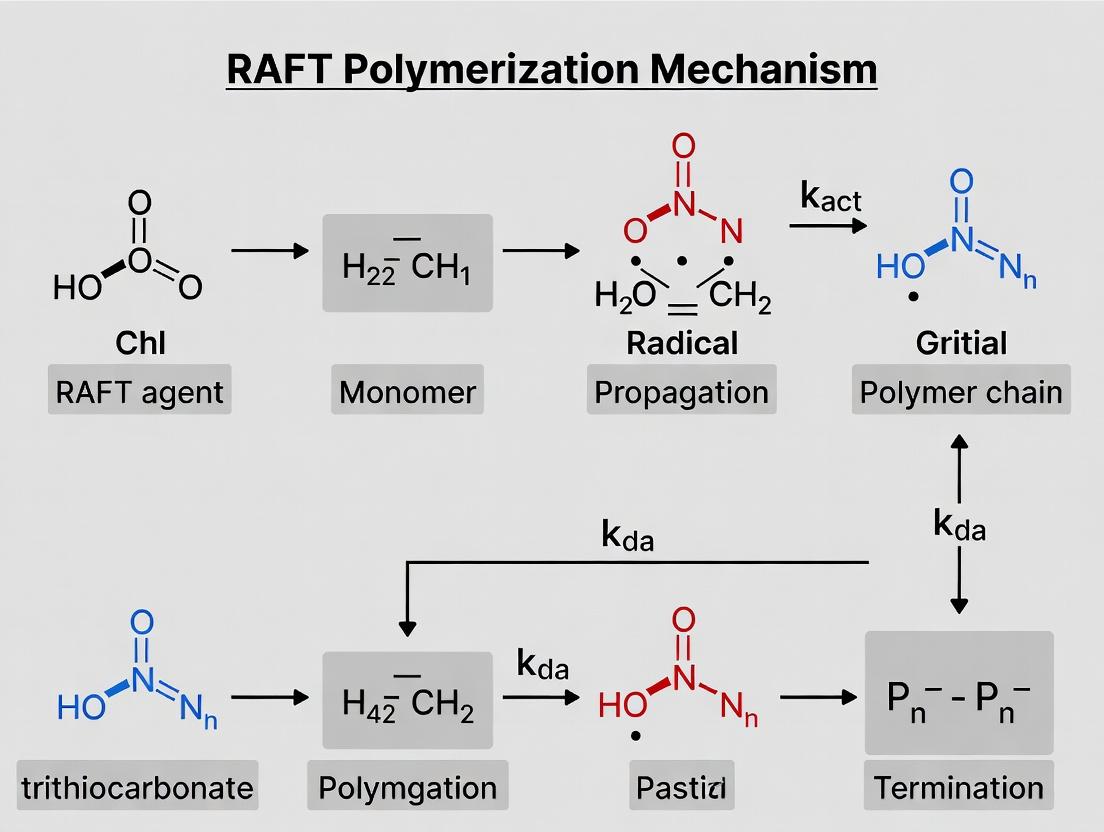
This comprehensive guide provides researchers, scientists, and drug development professionals with a detailed, step-by-step explanation of Reversible Addition-Fragmentation Chain Transfer (RAFT) polymerization.
RAFT Polymerization Explained: A Step-by-Step Guide to Controlled Radical Synthesis for Biomedical Research
Abstract
This comprehensive guide provides researchers, scientists, and drug development professionals with a detailed, step-by-step explanation of Reversible Addition-Fragmentation Chain Transfer (RAFT) polymerization. Covering foundational principles to advanced applications, the article explores the core mechanism, essential reagents and reaction setup, common experimental pitfalls and their solutions, and validation techniques compared to other controlled radical polymerization methods. The content is tailored to empower professionals in designing and synthesizing well-defined polymers for drug delivery, biomaterials, and therapeutic applications.
Understanding the RAFT Mechanism: Core Principles and Key Components
What is RAFT Polymerization? Defining Controlled/Living Radical Polymerization (CLRP)
Controlled/Living Radical Polymerization (CLRP), often termed Reversible Deactivation Radical Polymerization (RDRP), represents a class of radical polymerization techniques that impart a high degree of control over molecular weight, dispersity (Ð), composition, and architecture of the resulting polymers. Unlike conventional free-radical polymerization, CLRP mechanisms introduce a dynamic equilibrium between active propagating chains and dormant species, minimizing irreversible termination events. This control enables the synthesis of polymers with precise and complex structures, such as block, gradient, and star copolymers, which are invaluable in advanced materials science and pharmaceutical applications. Among the various CLRP techniques, Reversible Addition-Fragmentation chain-Transfer (RAFT) polymerization has emerged as one of the most versatile and widely adopted methods due to its compatibility with a broad range of monomers and reaction conditions.
The RAFT Polymerization Mechanism: A Step-by-Step Analysis
RAFT polymerization is a chain-transfer-mediated process. Its core mechanism involves a series of reversible addition-fragmentation steps mediated by a chain transfer agent (CTA), typically a thiocarbonylthio compound (e.g., dithioesters, trithiocarbonates, xanthates). The process can be broken down into distinct stages.
1. Initiation: A traditional radical initiator (e.g., AIBN, V-70) decomposes to form primary radicals (I•), which add to monomer units (M) to form the initial propagating radicals (Pₙ•).
2. Pre-Equilibrium: The propagating radical (Pₙ•) reacts with the dormant RAFT agent (S=C(Z)SR, or T). It adds to the thiocarbonyl group, forming an intermediate radical. This intermediate undergoes fragmentation, either to re-form the original species or to generate a new dormant polymer chain (Pₙ-T) and a new radical (R•). The R• group is specifically designed to be a good re-initiating fragment.
3. Re-initiation: The expelled R• radical rapidly adds to monomer, forming a new propagating radical (Pₘ•).
4. Main Equilibrium: The new propagating radical (Pₘ•) can now react with the dormant polymer chain (Pₙ-T). This continuous, reversible exchange between active (Pₓ•) and dormant (Pₓ-T) chains is the heart of the RAFT process. It ensures all chains grow at approximately the same rate, leading to low dispersity.
5. Termination: Termination occurs between two active propagating radicals, as in conventional radical polymerization, but its impact is minimized because the concentration of active radicals is kept very low, and the majority of chains are in the dormant state.
Diagram 1: Core RAFT Polymerization Cycle
Quantitative Comparison of Major CLRP Techniques
The field of CLRP is dominated by three primary techniques: RAFT, Atom Transfer Radical Polymerization (ATRP), and Nitroxide-Mediated Polymerization (NMP). Their key characteristics are compared below.
Table 1: Comparison of Major CLRP Techniques
| Feature | RAFT Polymerization | ATRP | NMP |
|---|---|---|---|
| Mediating Agent | Thiocarbonylthio CTA (e.g., Dithiobenzoate) | Alkyl Halide / Transition Metal Complex (e.g., CuBr/PMDETA) | Alkoxyamine (e.g., TEMPO) |
| Mechanism | Reversible Chain Transfer | Reversible Halogen Transfer | Reversible Coupling |
| Typical Dispersity (Ð) | 1.05 - 1.3 | 1.05 - 1.3 | 1.2 - 1.5 |
| Monomer Scope | Very Broad (Acrylates, Methacrylates, Styrene, VAc, AM) | Broad (Styrenes, (Meth)acrylates) | Moderate (Styrenes, Acrylates) |
| Tolerance to Protic Media | High | Moderate (requires modified systems) | Low |
| Typical Catalyst/Agent Loading | 0.001 - 0.1 equiv (CTA) | 0.001 - 0.1 equiv (Cu) | 0.1 - 1.0 equiv (Alkoxyamine) |
| Residual Metal | No | Yes (requires purification) | No |
| Key Challenge | CTA end-group removal, Odor | Metal contamination & removal | Limited monomer scope, High temps |
Experimental Protocol: Synthesis of a PMMA-b-PBA Block Copolymer via RAFT
This protocol details the synthesis of a poly(methyl methacrylate)-block-poly(n-butyl acrylate) (PMMA-b-PBA) thermoplastic elastomer using a trithiocarbonate RAFT agent.
Materials: See "The Scientist's Toolkit" below. Procedure:
- Synthesis of PMMA Macro-CTA: In a dried Schlenk flask, combine MMA (10.0 g, 100 mmol, 200 equiv), CPDB (108 mg, 0.50 mmol, 1.0 equiv), and AIBN (8.2 mg, 0.050 mmol, 0.1 equiv). Add anhydrous toluene (10 mL) to achieve ~50% w/w concentration. Seal the flask with a septum.
- Deoxygenation: Purge the reaction mixture with nitrogen or argon for 30 minutes while stirring in an ice bath.
- Polymerization: Place the flask in a pre-heated oil bath at 70°C with stirring. Monitor conversion by ¹H NMR spectroscopy (disappearance of vinyl peaks δ 5.5-6.1 ppm).
- Isolation: After reaching >95% conversion (~6-8 hours), cool the flask in ice water. Precipitate the polymer (PMMA Macro-CTA) into a 10-fold excess of vigorously stirred cold methanol. Filter and dry the white polymer in vacuo at 40°C. Determine molecular weight and dispersity by SEC.
- Chain Extension to Form Block Copolymer: In a new dried Schlenk flask, dissolve the PMMA Macro-CTA (2.0 g, theoretical Mₙ ~ 20,000 g/mol) in anhydrous toluene (2 mL). Add nBA (2.56 g, 20 mmol, 100 equiv relative to Macro-CTA) and ACVA (V-501, 1.1 mg, 0.004 mmol, 0.02 equiv). Deoxygenate as in step 2.
- Polymerization: Heat the mixture at 70°C for 12-18 hours.
- Isolation & Analysis: Cool and precipitate the final block copolymer into cold methanol. Dry in vacuo. Analyze by SEC (showing clean shift to higher molecular weight) and ¹H NMR to confirm block structure.
Diagram 2: RAFT Block Copolymer Synthesis Workflow
The Scientist's Toolkit: Key Reagent Solutions for RAFT
Table 2: Essential Materials for RAFT Polymerization
| Reagent / Material | Function & Critical Notes |
|---|---|
| Thiocarbonylthio RAFT Agent (e.g., CPDB, DBTTC) | The chain transfer agent (CTA). The Z and R groups dictate control and reactivity. Must be selected based on monomer. |
| Radical Initiator (e.g., AIBN, ACVA, V-70) | Source of primary radicals to start the polymerization. Used in substoichiometric amounts relative to CTA. |
| Purified Monomer | Must be purified (e.g., passing through basic alumina column) to remove inhibitors (e.g., MEHQ) and protic impurities. |
| Anhydrous, Deoxygenated Solvent (e.g., Toluene, Dioxane, DMF) | Provides reaction medium. Must be dry and oxygen-free to prevent interference with the radical equilibrium. |
| Schlenk Flask or Sealed Reactor | Allows for inert atmosphere operation via standard Schlenk techniques or use of sealed vials/tubes. |
| Inert Gas Source (N₂ or Ar) | For deoxygenation of the reaction mixture prior to and during polymerization. |
| Precipitation Solvent (e.g., Methanol, Hexane) | A non-solvent for the polymer used to isolate the product from the reaction mixture. |
| Size Exclusion Chromatography (SEC/GPC) | Essential analytical tool for determining molecular weight distribution (Mₙ, M𝁈) and dispersity (Ð). |
The Historical Context and Evolution of RAFT Technology
RAFT (Reversible Addition-Fragmentation Chain Transfer) polymerization is a cornerstone of modern polymer science, representing a pivotal advancement in controlled/living radical polymerization (CRP). This whiteprames its technical evolution within a broader thesis on the step-by-step mechanistic elucidation of RAFT polymerization, providing a critical resource for researchers and drug development professionals seeking to harness its precision for advanced material synthesis.
Historical Development and Key Milestones
The quest for controlled radical polymerization techniques culminated in the independent invention of RAFT polymerization in 1998 by researchers at the Commonwealth Scientific and Industrial Research Organisation (CSIRO) in Australia. The technology emerged from the need to overcome limitations of traditional free radical polymerization, such as poor control over molecular weight, dispersity, and chain architecture.
| Year | Milestone | Key Contributors/Institution | Impact |
|---|---|---|---|
| 1998 | First publication of RAFT polymerization | CSIRO (Rizzardo, Thang, Moad, et al.) | Established the core concept using dithioesters as RAFT agents. |
| 2000-2005 | Expansion of RAFT agent (CTA) scope | Multiple academic/industrial groups | Development of trithiocarbonates, xanthates, dithiocarbamates for broader monomer compatibility. |
| 2005-2010 | Mechanistic & kinetic deep-dive | Matyjaszewski, Barner-Kowollik, Perrier et al. | Detailed ESR/NMR studies confirmed the stepwise mechanism and rate constants. |
| 2010-Present | Biomedical & industrial translation | Numerous researchers | Application in drug delivery, hydrogels, advanced dispersants, and scale-up processes. |
Quantitative Evolution of RAFT Literature (Representative Data)
| Period (Cumulative) | Approx. Number of Publications | Primary Research Focus Shift |
|---|---|---|
| 1998-2003 | ~500 | Proof-of-concept, novel CTA synthesis, basic kinetics. |
| 2004-2010 | ~3,000 | Mechanistic studies, block copolymer synthesis, functional monomers. |
| 2011-2020 | ~12,000 | Hybrid materials, bioconjugation, high-throughput screening, nanotechnology. |
| 2021-Present | >16,000 | Machine learning for CTA design, in vivo applications, commercial scale-up. |
Core RAFT Mechanism: A Step-by-Step Explanation
The RAFT mechanism operates within a standard free-radical polymerization, mediated by a chain transfer agent (CTA), typically a thiocarbonylthio compound (Z-C(=S)S-R). Control is achieved through a series of reversible chain transfer steps.
Diagram 1: Core RAFT Equilibrium Cycle
Step-by-Step Breakdown:
- Initiation & Pre-Equilibrium: A conventional radical initiator (e.g., AIBN) decomposes to produce primary radicals, which add to monomer, forming propagating radicals (Pₙ•). These radicals add to the C=S bond of the RAFT agent, forming an intermediate radical.
- Main Equilibrium (Key to Control): The intermediate radical fragments, either reforming the original species or releasing a new radical (R•). The R• group re-initiates polymerization rapidly. A rapid equilibrium between active propagating chains (Pₙ•, Pₘ•) and dormant macro-RAFT chains (Pₙ–SC(=S)Z, Pₘ–SC(=S)Z) ensures all chains grow at a similar rate, yielding low dispersity (Đ).
- Propagation: Active chains (Pₙ•, Pₘ•) add monomer units during their brief active periods.
- Termination: Chains terminate via conventional radical coupling/disproportionation, but this is minimized because most chains exist in the dormant state.
Experimental Protocol: Standard RAFT Polymerization of Styrene
This protocol details the synthesis of polystyrene with target molecular weight of 10,000 g/mol and low dispersity using a trithiocarbonate RAFT agent.
Materials & Reagents:
- Styrene (monomer): 10.0 g (96.1 mmol)
- CPDB (2-Cyano-2-propyl dodecyl trithiocarbonate, RAFT agent): 0.276 g (0.961 mmol)
- AIBN (2,2'-Azobis(2-methylpropionitrile), initiator): 15.8 mg (0.0961 mmol)
- Toluene (anhydrous): 20 mL
- Dry Schlenk flask (50 mL) with stir bar
- Freeze-pump-thaw apparatus (or nitrogen/vacuum line)
Procedure:
- Charge: In a fume hood, add CPDB, AIBN, styrene, and toluene to the Schlenk flask. Attach the flask to the Schlenk line.
- Degas: Seal the flask and perform three cycles of freeze-pump-thaw to remove dissolved oxygen. Alternatively, sparge the solution with dry nitrogen for 30 minutes.
- Polymerize: After degassing, back-fill the flask with nitrogen and seal it under a positive pressure. Immerse the flask in an oil bath pre-heated to 70°C with stirring. Allow the reaction to proceed for 8 hours.
- Terminate: Cool the flask rapidly in an ice bath. Expose the solution to air to quench radicals.
- Purify: Precipitate the polymer into a large excess of rapidly stirring methanol (≈10x volume). Filter the polymer and dry under vacuum at 40°C until constant weight is achieved.
- Characterize: Analyze molecular weight and dispersity via Size Exclusion Chromatography (SEC/GPC) against polystyrene standards. Confirm structure via ¹H NMR.
Expected Outcomes:
- Theoretical Mₙ (assuming full conversion): ~10,400 g/mol.
- Measured Mₙ (SEC): ~9,500 - 11,000 g/mol.
- Dispersity (Đ): 1.05 - 1.15.
- Conversion (by ¹H NMR or gravimetry): >90%.
The Scientist's Toolkit: Key Research Reagent Solutions
| Item | Function & Rationale | Key Considerations for Selection |
|---|---|---|
| RAFT Agent (CTA) | Mediates the reversible chain transfer. The Z and R groups dictate control and compatibility. | Z Group: Influences C=S reactivity (e.g., phenyl for styrene/acrylates, alkoxy for VAc). R Group: Must be a good leaving group and re-initiate efficiently (e.g., cyanoalkyl, tertiary). |
| Radical Initiator | Provides primary radicals to start the polymerization chain. | Should have an appropriate half-life at reaction temperature (e.g., AIBN @ 60-70°C, V-501 @ 80-90°C). Molar ratio to CTA is critical (typically 1:5 to 1:10). |
| Purified Monomer | The building block of the polymer. Must be free of inhibitors. | Must be purified (e.g., passing through inhibitor removal column, distillation) to prevent inhibition/retardation. |
| Inert Atmosphere | Removes oxygen, a radical scavenger that inhibits polymerization. | Achieved via freeze-pump-thaw cycles or nitrogen sparging. Essential for reproducible kinetics. |
| Chain Transfer Agent Database | Computational/experimental libraries of CTA structures and their performance. | Used for rational selection (e.g., the RAFT Agent Database). Increasingly informed by machine learning models. |
| High-Throughput Screening Kit | Parallel reactors for rapid optimization of conditions (CTA, solvent, temp). | Accelerates discovery and optimization of RAFT processes for new monomers. |
Advanced Workflow: RAFT for Block Copolymer Synthesis
Diagram 2: Sequential RAFT for Block Copolymer
Experimental Protocol (Chain Extension):
- Synthesize and purify a macro-RAFT agent of Polymer A (e.g., PNIPAM, Mₙ = 5,000, Đ < 1.2) using the standard protocol.
- In a new Schlenk flask, dissolve the purified macro-RAFT agent (0.5 g, 0.1 mmol), a second monomer (e.g., DMAEMA, 1.57 g, 10 mmol), and a fresh, small amount of initiator (AIBN, 0.33 mg, 0.002 mmol) in dry solvent.
- Degas the mixture thoroughly via freeze-pump-thaw.
- Heat at 70°C for 12-18 hours under nitrogen.
- Terminate, precipitate into a selective non-solvent (e.g., hexane for P(NIPAM-b-DMAEMA)), and dry.
- Characterize via SEC (clear shift to higher molecular weight, maintaining low Đ) and ¹H NMR to confirm block composition.
Quantitative Kinetics: Key Parameters in RAFT
Typical Rate Constants & Parameters for Styrene at 70°C
| Parameter | Symbol | Approximate Value / Range | Determination Method |
|---|---|---|---|
| Equilibrium Constant | K = kₐdd/k₋ₐdd | 10² - 10⁴ L mol⁻¹ | Model fitting of kinetic data (PLP-SEC). |
| Addition Rate Constant | kₐdd | 10³ - 10⁵ L mol⁻¹ s⁻¹ | Pulsed-laser polymerization (PLP) with ESR. |
| Fragmentation Rate Constant | k₋ₐdd | 10 - 10³ s⁻¹ | Competitive kinetics, radical trapping. |
| Chain Transfer Coefficient | Ctr | 10 - 100 (for effective CTAs) | Mayo plot analysis of 1/DPₙ vs. [RAFT]/[M]. |
| Typical Dispersity (Đ) | Đ (Mw/Mn) | 1.05 - 1.30 | Size Exclusion Chromatography (SEC). |
This whitepaper presents a detailed, stepwise deconstruction of the Reversible Addition-Fragmentation Chain Transfer (RAFT) polymerization equilibrium. Framed within a broader thesis on elucidating the complete RAFT mechanism, this guide provides researchers and drug development professionals with a rigorous technical examination of the distinct kinetic and thermodynamic phases governing controlled radical polymerization. The RAFT process, critical for producing polymers with precise molecular weights and complex architectures, is characterized by three interconnected equilibria: pre-equilibrium, re-initiation, and the main equilibrium.
The Core RAFT Mechanism: A Three-Phase Process
The fundamental mechanism of RAFT polymerization involves a series of reversible transfer steps mediated by a chain transfer agent (CTA), typically a dithioester, trithiocarbonate, xanthate, or dithiocarbamate. The process is universally described by the following sequence.
Phase I: Pre-Equilibrium
In the initial phase, a propagating radical (Pn•) reacts with the RAFT agent (ZC(=S)SR, 1) to form an intermediate radical (Intermediate 2). This intermediate can fragment, either reverting to the starting materials or expelling a re-initiating radical (R•) to form a macro-RAFT agent (Pn–S(=C)Z–SR, 3). This phase is crucial for establishing a consistent pool of active chains.
Key Reaction: Pn• + S=C(Z)SR 1 ⇌ Pn–S–C•(Z)–SR 2 → Pn–S–C(=Z)–S–R 3 + R•
Phase II: Re-Initiation
The expelled radical (R•) must then efficiently re-initiate polymerization to form a new propagating radical (Pm•). The rate of re-initiation (kreinit) relative to propagation (kp) is critical to avoid rate retardation and ensure low dispersity (Ɖ). Slow re-initiation can lead to oligomer accumulation.
Key Reaction: R• + Monomer (M) → R–M• (Pm•)
Phase III: Main Equilibrium
Once formed, the macro-RAFT agent (3) participates in the main equilibrium. Propagating radicals (Pn• or Pm•) add to the thiocarbonylthio group of 3, forming a new intermediate radical (4). This intermediate undergoes reversible fragmentation, exchanging active and dormant chains. This rapid exchange is the heart of the control mechanism, ensuring all chains grow at a similar rate.
Key Reaction: Pn• + Pm–S–C(=Z)–S–R 3 ⇌ Pn–S–C•(Z)–S–Pm 4 ⇌ Pm• + Pn–S–C(=Z)–S–R 3
Quantitative Kinetic Data
The following table summarizes key rate coefficients and their impact on polymerization control, based on recent literature and modeling studies.
Table 1: Key Rate Coefficients and Their Roles in RAFT Equilibrium
| Parameter | Symbol | Typical Range/Value (for styrene with Dithiobenzoate) | Impact on Polymerization |
|---|---|---|---|
| Addition Rate Coefficient (Pre-Equilibrium) | kadd,1 | 104 to 106 L mol⁻¹ s⁻¹ | Governs initial CTA consumption. High value ensures quick pre-equilibrium. |
| Fragmentation Rate Coefficient (Pre-Equilibrium) | kβ,1 | 10-2 to 102 s⁻¹ | Must be sufficiently high to release R• for re-initiation. |
| Re-Initiation Rate Coefficient | kreinit | Varies widely by R-group (~103 L mol⁻¹ s⁻¹ for effective CTAs) | Critical for avoiding rate retardation and obtaining target Mn. |
| Addition Rate Coefficient (Main Equilibrium) | kadd | ~105 L mol⁻¹ s⁻¹ | High value promotes fast exchange. |
| Fragmentation Rate Coefficient (Main Equilibrium) | kβ | ~106 s⁻¹ | Very high value ensures short-lived intermediate 4, maintaining control. |
| Equilibrium Constant (Main) | K = kadd/kβ | ~0.1 L mol⁻¹ | Favors dormant chains, ensuring low radical concentration and minimal termination. |
| Chain Transfer Constant | Ctr = kadd,1/kp | >1 (Ideally 10-100) for good control | Indicates CTA is more reactive than propagation, ensuring rapid chain transfer. |
Experimental Protocols for Investigating RAFT Equilibria
Protocol: Measuring Chain Transfer Constant (Ctr) via the Mayo Method
Objective: Determine the effectiveness of a RAFT agent during the pre-equilibrium phase. Materials: Purified monomer, RAFT agent, initiator (e.g., AIBN), deuterated solvent for NMR, sealed polymerization tubes. Procedure:
- Prepare a series of reaction mixtures with constant [M]₀ and [I]₀, but varying [RAFT]₀.
- Degas mixtures via freeze-pump-thaw cycles (3x) and seal under vacuum.
- Conduct polymerizations at low conversion (<10%) in a thermostated oil bath.
- Quench reactions in ice water and analyze polymers by Size Exclusion Chromatography (SEC).
- Plot the number-average degree of polymerization (DPn) against [RAFT]₀/[M]₀. The slope equals Ctr. Analysis: A high Ctr confirms rapid and efficient chain transfer in the pre-equilibrium.
Protocol: Studying Re-Initiation Kinetics via Model Oligomer Approach
Objective: Directly measure kreinit for a given R-group. Materials: Pre-formed oligomeric RAFT agent (R–(M)n–S–C(=Z)–S–R), photoinitiator (for clean radical generation), laser flash photolysis setup, UV-Vis spectrometer. Procedure:
- Synthesize a well-defined oligomeric RAFT agent where R is the group under investigation.
- In a cuvette, prepare a solution of the RAFT agent and a photoinitiator in monomer.
- Use laser flash photolysis to generate a known concentration of radicals (R•) from the photoinitiator.
- Monitor the decay of R• (or growth of product) via time-resolved UV-Vis spectroscopy.
- Fit the kinetic data to obtain kreinit. Analysis: This protocol isolates Phase II kinetics, providing direct data on re-initiation efficiency.
Protocol: Probing the Main Equilibrium via Electron Paramagnetic Resonance (EPR) Spectroscopy
Objective: Detect and characterize the intermediate radical 4. Materials: RAFT agent, monomer, initiator, EPR tube, persistent radical (e.g., TEMPO) for calibration. Procedure:
- Prepare a polymerization mixture directly in an EPR tube.
- Degas and seal the tube.
- Insert the tube into the pre-heated cavity of the EPR spectrometer.
- Acquire in-situ EPR spectra during polymerization.
- Use simulation software to deconvolute signals from propagating (Pn•) and intermediate (4) radicals, estimating relative concentrations and lifetimes. Analysis: Direct observation of intermediate 4 confirms the main equilibrium. Its low steady-state concentration supports a high kβ.
Visualization of the RAFT Mechanism
Title: The Three-Phase RAFT Polymerization Equilibrium
The Scientist's Toolkit: Key Research Reagent Solutions
Table 2: Essential Materials for RAFT Mechanism Studies
| Item | Function & Rationale |
|---|---|
| Chain Transfer Agents (CTAs) | Core reagent. Dithiobenzoates (e.g., CPDB), trithiocarbonates (e.g., DBTC), or xanthates. The Z and R groups dictate reactivity, control, and re-initiation efficiency. |
| Thermal Initiators (e.g., AIBN, V-70) | Primary radical source. AIBN is standard; V-70 allows lower temperature studies. Must have known decomposition rate (kd) for kinetic modeling. |
| Photoinitiators (e.g., DMPA) | For controlled radical generation. Enables flash photolysis, pulsed-laser polymerization, and EPR studies to isolate specific kinetic steps. |
| Inhibitor Removal Columns | Critical for purity. Monomer must be free of stabilizers (e.g., MEHQ) which interfere with radical processes and kinetic measurements. |
| Deuterated Solvents (C6D6, CDCl3) | For in-situ NMR kinetics. Allows monitoring of monomer conversion and end-group integrity without quenching the reaction. |
| Spin Traps (e.g., DMPO, TEMPO) | For radical detection/quantification. Used in EPR studies to confirm radical presence and type, or to calibrate radical concentrations. |
| Calibrated SEC Columns & Standards | For molecular weight analysis. Multi-detector SEC (RI, UV, LS) is essential for determining Mn, Ɖ, and confirming end-group fidelity (via UV detection of the thiocarbonylthio group). |
| Stopped-Flow Reactor with Spectroscopic Detection | For high-resolution kinetics. Rapidly mixes reagents (e.g., radicals and RAFT agents) to measure fast addition/fragmentation rates on millisecond timescales. |
Reversible Addition-Fragmentation Chain Transfer (RAFT) polymerization is a cornerstone of controlled radical polymerization, enabling precise synthesis of polymers with complex architectures and narrow molecular weight distributions. The mechanism hinges on a degenerative chain transfer process mediated by thiocarbonylthio compounds—the RAFT agents. This whitepaper details the four crucial RAFT agent structures, framing their function within the stepwise RAFT mechanism: initiation, pre-equilibrium, re-initiation, main equilibrium, and termination.
Core RAFT Agent Classes: Structures, Characteristics, and Applications
The activity of a RAFT agent is governed by the substituents (R and Z) attached to the thiocarbonylthio (S=C-S) core. The R group must be a good leaving group and a re-initiating radical, while the Z group modulates the thiocarbonyl reactivity.
Table 1: Core RAFT Agent Classes, Characteristics, and Monomer Compatibility
| RAFT Agent Class | General Structure | Key Z-Group Effect | Typical Monomer Compatibility | Relative Activity (kadd) |
|---|---|---|---|---|
| Dithioesters | S=C(SR)Z where Z = Alkyl, Aryl | Electron-withdrawing Z group increases C=S reactivity. | "More activated" monomers (MAMs) e.g., Styrenes, Acrylates, Methacrylates, Acrylamides. | High |
| Trithiocarbonates | S=C(SR)Z where Z = SR' | Sulfur Z group offers balanced stability and activity. | MAMs and some "less activated" monomers (LAMs). | Medium-High |
| Xanthates | S=C(OR)Z where Z = OR' (O-alkyl) | Electron-donating alkoxy Z group decreases C=S reactivity. | "Less activated" monomers (LAMs) e.g., Vinyl Acetate, N-Vinylpyrrolidone. | Low |
| Dithiocarbamates | S=C(NR₂)Z where Z = NR'₂ | Strongly electron-donating amino Z group greatly reduces C=S reactivity. | LAMs and special cases (e.g., vinyl monomers with electron-withdrawing groups). | Very Low |
Table 2: Quantitative Performance Data for Common RAFT Agents
| RAFT Agent (Example) | CTA Constant (Ctr) @ 60°C | Typical PDI Achievable | Optimal Temp. Range (°C) | Solvent Compatibility Notes |
|---|---|---|---|---|
| CPDB (Dithioester) | ~20 (for MMA) | <1.2 | 50-80 | Toluene, DMF, Bulk |
| CDTPA (Trithiocarbonate) | ~15 (for Sty) | <1.2 | 60-90 | Toluene, Dioxane, Bulk |
| EPX (Xanthate) | ~2 (for VAc) | 1.1-1.4 | 40-70 | Toluene, MeOH, Bulk |
| MEDTC (Dithiocarbamate) | ~0.5 (for NVP) | 1.2-1.5 | 40-70 | Toluene, DCM |
Experimental Protocols for RAFT Agent Synthesis and Polymerization
Protocol 3.1: Synthesis of a Generic Dithioester (e.g., Cumyl Phenyldithioacetate)
Materials: Acetophenone, carbon disulfide (CS₂), sodium hydride (NaH), methyl iodide, cumyl mercaptan. Procedure:
- Under N₂, add NaH (1.1 eq) to dry THF at 0°C.
- Slowly add acetophenone (1.0 eq) in THF, stir 30 min.
- Add CS₂ (1.2 eq) dropwise, warm to RT, stir 2h.
- Add methyl iodide (1.1 eq), stir overnight.
- Quench with sat. NH₄Cl, extract with DCM, dry (MgSO₄), and purify via column chromatography (silica, hexane/EtOAc).
Protocol 3.2: Standard RAFT Polymerization of Methyl Acrylate using a Trithiocarbonate
Materials: Methyl acrylate (MA, 99%), 2-(Dodecylthiocarbonothioylthio)-2-methylpropionic acid (DDMAT), AIBN initiator, anhydrous toluene. Procedure:
- In a Schlenk tube, prepare a degassed solution of MA (100 eq), DDMAT (1 eq), and AIBN (0.2 eq) in toluene (50% v/v).
- Perform three freeze-pump-thaw cycles.
- Immerse in an oil bath at 70°C for 18 hours under inert atmosphere.
- Cool in ice water. Analyze conversion by ¹H NMR.
- Purify polymer by precipitation into cold hexane/methanol (10:1) three times. Dry in vacuo.
- Characterize via SEC (THF, PS standards) and NMR.
Visualizing RAFT Mechanism and Agent Selection
Diagram 1: Stepwise RAFT Polymerization Mechanism (63 chars)
Diagram 2: RAFT Agent Selection Logic (45 chars)
The Scientist's Toolkit: Essential Research Reagent Solutions
Table 3: Key Reagents and Materials for RAFT Polymerization Research
| Item / Reagent | Function & Importance | Example Product/Catalog Note |
|---|---|---|
| High-Purity Monomers | Minimize inhibitor content for controlled kinetics; require purification (e.g., passing through basic alumina) before use. | Methyl acrylate (stabilized with MEHQ), Styrene. |
| RAFT Agents (CTAs) | Chain Transfer Agents; the core controlling species. Must match Z/R groups to target monomer. | CPDB (for MAMs), EDBTC (for VAc, LAMs). |
| Thermal Initiators | Source of primary radicals (I•) to start the polymerization cycle. | AIBN, V-501 (water-soluble), requires recrystallization. |
| Inert Atmosphere Equipment | Essential to exclude oxygen, a radical scavenger. | Schlenk line, glovebox, or N₂/Ar balloon setup. |
| Degassing Solvents | Removes dissolved oxygen. | Freeze-pump-thaw apparatus or sparging with inert gas. |
| Purification Materials | For polymer isolation and removal of unreacted species. | Silica gel, aluminum oxide, dialysis tubing, precipitation solvents. |
| Analytical Standards | For accurate molecular weight determination via Size Exclusion Chromatography (SEC). | Narrow dispersity polystyrene or poly(methyl methacrylate). |
| Deuterated Solvents | For ¹H NMR kinetics and end-group analysis. | CDCl₃, DMSO-d₆, Toluene-d₈. |
| Radical Scavenger | To quench polymerization for kinetic sampling. | Hydroquinone, DPPH. |
1. Introduction Within the broader mechanistic framework of Reversible Addition-Fragmentation Chain-Transfer (RAFT) polymerization, the selection of the Z (activating) and R (reinitiating) groups on the RAFT agent (dithioester, trithiocarbonate, etc.) is the primary determinant of polymerization control and ultimate polymer architecture. This guide provides a technical deep dive into their function, grounded in the step-by-step mechanistic cycle of RAFT.
2. RAFT Mechanism: The Critical Role of Z and R The RAFT mechanism comprises initiation, pre-equilibrium, main equilibrium, and termination steps. The Z and R groups exert precise control at distinct stages.
- Pre-equilibrium: The Z group moderates the reactivity of the C=S bond. A more electron-withdrawing Z group increases the electrophilicity of the thiocarbonyl carbon, enhancing its reactivity towards the propagating radical (Pn•). This governs the rate of addition and the stability of the intermediate radical.
- Fragmentation: The R group is designed to be a good homolytic leaving group. It must fragment rapidly from the intermediate to re-initiate polymerization. The R• radical should be similar in reactivity to the propagating radical to ensure efficient re-initiation and minimize oligomer formation.
3. Quantitative Effects of Z and R Group Selection The choice of Z and R groups directly influences key polymerization metrics, as summarized in Table 1.
Table 1: Impact of Z and R Groups on RAFT Polymerization Metrics
| RAFT Agent Type | Example Z Group | Example R Group | Typical Monomer Compatibility | Effect on kadd | Primary Architectural Control |
|---|---|---|---|---|---|
| Dithiobenzoate | C6H5 | CH2CH3 | Styrene, Acrylates | High | Good control for more active monomers; can retard. |
| Trithiocarbonate | SCH3 | C(CH3)2CN | Acrylates, Methacrylates, Vinyl Acetates | Moderate | Broad monomer scope; lower retardation. |
| Dithiocarbamate | N(C2H5)2 | CH2CH3 | Vinyl Acetate, N-Vinylpyrrolidone | Low to Moderate | Essential for controlling less active monomers. |
| Xanthate | OC2H5 | CH2CH3 | Vinyl monomers with low activity (e.g., vinyl amides) | Low | Enables control of "less-activated" monomers (LAMs). |
4. Experimental Protocol: Evaluating Z/R Group Efficacy A standard protocol for assessing the performance of a novel RAFT agent involves kinetic and molecular characterization.
Title: Synthesis and Evaluation of a Novel Trithiocarbonate RAFT Agent for Methacrylate Polymerization. Objective: To determine the control, livingness, and initiation efficiency of a RAFT agent with Z = -SPh and R = -C(CH3)(CN)CH2CH3 in the polymerization of methyl methacrylate (MMA). Materials: See "The Scientist's Toolkit" below. Procedure:
- Solution Polymerization: In a Schlenk tube, combine MMA (10.0 g, 100 mmol), the RAFT agent (0.050 g, 0.10 mmol, target DPn ~ 1000), and AIBN (0.0016 g, 0.010 mmol, [RAFT]:[AIBN] ~ 10:1) in anhydrous toluene (5 mL, 50% w/w).
- Degassing: Subject the mixture to three freeze-pump-thaw cycles. Backfill with nitrogen or argon after the final cycle.
- Reaction: Immerse the sealed tube in a pre-heated oil bath at 70°C ± 0.5°C with magnetic stirring.
- Kinetic Sampling: At predetermined time intervals (e.g., 30, 60, 120, 240, 480 min), withdraw aliquots (~0.5 mL) via degassed syringe. Immediately quench in ice water and expose to air.
- Analysis:
- Conversion: Determine monomer conversion gravimetrically or by 1H NMR (ratio of vinyl to polymer backbone peaks).
- Molecular Weight & Dispersity (Ɖ): Analyze aliquots by Size Exclusion Chromatography (SEC) against poly(methyl methacrylate) standards. Plot Mn and Ɖ vs. conversion.
- Chain Extension: Isolate the purified polymer (precipitation into methanol). Use it as a macro-RAFT agent in a second polymerization with a different monomer (e.g., benzyl acrylate) to confirm living character and block copolymer formation.
5. Visualizing the Mechanistic Influence of Z and R
Diagram 1: RAFT Mechanism with Z/R Influence (97 chars)
6. The Scientist's Toolkit: Key Reagents for RAFT Agent Evaluation
| Reagent / Material | Function & Importance |
|---|---|
| Functionalized Dithiobenzoate (e.g., CPDB) | Benchmarked RAFT agent for styrenics and acrylates. Provides a reference for kinetic and control studies. |
| Chain Transfer Constant (Ctr) Reference Set | A series of well-characterized RAFT agents with known Ctr values. Used in competitive experiments to determine the relative reactivity of new agents. |
| Deuterated Solvents (e.g., CDCl3, d6-DMSO) | For 1H and 13C NMR analysis of RAFT agent purity, monomer conversion, and end-group fidelity. |
| Radical Initiator (e.g., AIBN, ACVA) | Thermal initiator to generate primary radicals. Source concentration is kept low relative to RAFT agent ([RAFT]:[I] > 5:1). |
| Inhibitor Remover Columns (e.g., Al2O3) | Essential for purifying monomers immediately prior to polymerization to remove hydroquinone/MEHQ inhibitors. |
| SEC/SEC-MALS System | Size Exclusion Chromatography with Multi-Angle Light Scattering detector. Provides absolute molecular weights and dispersity (Ɖ), critical for assessing control. |
| Schlenk Line or Glovebox | For rigorous oxygen removal from reaction mixtures, which is critical for achieving controlled radical polymerization kinetics. |
This whitepaper details the core kinetic mechanisms of Reversible Addition-Fragmentation Chain-Transfer (RAFT) polymerization, framed within a broader thesis research project. The central thesis posits that the unique kinetic magic of RAFT polymerization arises from a rapid, degenerative chain-transfer process that minimizes irreversible termination and chain-length-dependent partitioning, thereby ensuring the synthesis of polymers with exceptionally narrow molecular weight distributions (low dispersity, Ð). This guide provides a step-by-step mechanistic explanation, supported by current quantitative data and experimental protocols.
Core RAFT Mechanism: A Step-by-Step Kinetic Analysis
RAFT polymerization is a controlled/living radical polymerization technique mediated by a chain-transfer agent (CTA), typically a thiocarbonylthio compound (Z-C(=S)S-R). The key to its performance is the establishment of a dynamic equilibrium between active propagating radicals (P~n•) and dormant thiocarbonylthio-capped chains (P~n-SC(Z)=S).
Step 1: Initiation A conventional radical initiator (I~2, e.g., AIBN) decomposes to produce primary radicals (I•), which add to monomer (M) to form initiating propagating radicals (P~1•).
- I~2 → 2 I•
- I• + M → P~1•
Step 2: Pre-Equilibrium (Forward Reaction) The propagating radical (P~n•) adds to the thiocarbonylthio group of the CTA (RAFT agent), forming an intermediate radical. This step is characterized by the rate coefficient k~add.
- P~n• + S=C(Z)S-R ⇌ P~n-S-C*(Z)(S•)-R
Step 3: Intermediate Radical Fragmentation The intermediate radical can fragment in two ways. The critical fragmentation, which reforms the original CTA, is a reverse step with rate coefficient k~-add. The productive fragmentation, with rate coefficient k~β, releases a new radical (R•) and creates a new macromolecular dormant species (P~n-SC(Z)=S).
- P~n-S-C*(Z)(S•)-R → P~n• + S=C(Z)S-R (Reversion)
- P~n-S-C*(Z)(S•)-R → P~n-SC(Z)=S + R• (Productive)
Step 4: Re-initiation The expelled leaving group radical (R•) rapidly re-initiates polymerization by adding to monomer, forming a new propagating radical (P~m•). This step must be fast to avoid retardation.
- R• + M → P~m•
Step 5: Main Equilibrium (Chain Transfer) The new propagating radical (P~m•) can then react with a different dormant chain (P~n-SC(Z)=S), re-entering the equilibrium. This degenerative chain transfer is the heart of the RAFT process.
- P~m• + P~n-SC(Z)=S ⇌ P~m-SC(Z)=S + P~n•
Step 6: Suppression of Termination Because the concentration of dormant chains (~10^-2 to 10^-3 M) is vastly higher than that of active radicals (~10^-7 to 10^-9 M), the propagating radical (P~n•) spends most of its time "capped" in the dormant state. This drastically reduces the probability of two active radicals meeting and undergoing irreversible bimolecular termination (combination or disproportionation, rate coefficient k~t). The kinetic chain length is maintained, and dead chains are minimized.
Step 7: Achieving Narrow Dispersity (Ð) The rapid exchange (high k~exch = k~add ≈ k~-add) ensures all chains grow at an equal probability. The molecular weight distribution is governed by the number of activation-deactivation cycles a chain undergoes. A high frequency of exchange relative to the rate of propagation (k~exch >> k~p[M]) ensures minimal broadening beyond the Poisson limit (Ð → 1.0).
Table 1: Typical Rate Coefficients for Styrene RAFT Polymerization at 60°C using a Dithiobenzoate CTA
| Process | Rate Coefficient | Typical Value | Units | Notes |
|---|---|---|---|---|
| Propagation | k~p | ~ 200 | L mol⁻¹ s⁻¹ | Chain growth. |
| CTA Addition | k~add | 10^4 - 10^5 | L mol⁻¹ s⁻¹ | Fast addition to CTA. |
| Fragmentation (Rev.) | k~-add | 10^4 - 10^5 | s⁻¹ | Fast fragmentation, maintains equilibrium. |
| Exchange | k~exch | ~10^5 | L mol⁻¹ s⁻¹ | Effective rate of chain transfer. |
| Termination | k~t | 10^7 - 10^8 | L mol⁻¹ s⁻¹ | Suppressed due to low [P•]. |
| Initiation (AIBN) | k~d | ~ 1.0 x 10^-5 | s⁻¹ | Source of primary radicals. |
Table 2: Impact of Exchange Rate on Dispersity (Ð)
| Condition (k~exch / k~p[M]) | Exchange Frequency Relative to Growth | Expected Ð (Theoretical) | Outcome |
|---|---|---|---|
| > 10^3 | Very High | < 1.1 | Excellent control, narrow distribution. |
| ~ 10^2 | High | 1.1 - 1.2 | Good control. |
| ~ 10 | Moderate | 1.2 - 1.5 | Moderate control, potential broadening. |
| < 1 | Low (Slow Exchange) | > 1.5 | Poor control, broad distribution, possible retardation. |
Detailed Experimental Protocol: Kinetics via NMR Monitoring
This protocol measures monomer conversion and confirms the living character of a RAFT polymerization.
Objective: To synthesize poly(methyl methacrylate) (PMMA) with low dispersity using a trithiocarbonate RAFT agent and monitor kinetics in real-time.
Materials: See The Scientist's Toolkit below. Procedure:
- Solution Preparation: In a nitrogen glovebox, charge an oven-dried NMR tube with a magnetic stir bar. Add methyl methacrylate (MMA, 2.0 mL, 18.7 mmol), CDCl~3 (0.7 mL, deuterated solvent for NMR locking), and the trithiocarbonate CTA (2-(((butylthio)carbonothioyl)thio)propanoic acid, 17.6 mg, 0.0748 mmol). Seal the tube with a rubber septum.
- Initiator Addition: Prepare a stock solution of AIBN in toluene (0.1 M). Under a positive nitrogen flow, remove the septum and quickly add the AIBN solution (37.4 µL, 0.00374 mmol, [CTA]/[I] = 20/1) via microsyringe. Reseal immediately.
- In-situ NMR Kinetics: Place the sealed NMR tube in a pre-heated NMR spectrometer probe set to 70°C. Acquire sequential ^1H NMR spectra every 5-10 minutes.
- Data Analysis: Monitor the decrease in the vinyl proton peaks of MMA (δ ~5.5-6.1 ppm) relative to the inert solvent or a chosen polymer methoxy peak (δ ~3.6 ppm). Plot conversion (ln([M]~0/[M])) versus time. A linear plot indicates constant radical concentration, characteristic of a controlled polymerization.
- Post-Analysis: After high conversion (>80%), cool the tube. Analyze the final polymer by Size Exclusion Chromatography (SEC) to determine M~n and Ð. Compare M~n, SEC to M~n, theo = ([M]~0/[CTA]~0) x conversion x M~w(MMA) + M~w(CTA).
Visualization of the RAFT Mechanism
Diagram 1: RAFT Polymerization Kinetic Cycle
The Scientist's Toolkit: Key Research Reagent Solutions
Table 3: Essential Materials for RAFT Polymerization Research
| Item | Function & Critical Property | Example (PMMA Synthesis) |
|---|---|---|
| RAFT Chain Transfer Agent (CTA) | Mediates chain exchange. Z and R groups dictate control. | 2-Cyano-2-propyl dodecyl trithiocarbonate (CPDT). R group re-initiates MMA well. |
| Radical Initiator | Provides primary radicals to start chains. Should have appropriate half-life at reaction T. | Azobisisobutyronitrile (AIBN), 1,1'-Azobis(cyclohexanecarbonitrile) (ACVA). |
| Monomer | Polymer building block. Must be purified to remove inhibitors (e.g., hydroquinone). | Methyl methacrylate (MMA), passed through basic alumina column before use. |
| Deuterated Solvent | For in-situ NMR kinetics; allows reaction monitoring without quenching. | CDCl~3, Toluene-d~8. |
| Inert Atmosphere Equipment | Prevents oxygen inhibition. Essential for all radical polymerizations. | Nitrogen/vacuum manifold, Schlenk line, glovebox. |
| SEC/SLC Instrument | Measures molecular weight (M~n, M~w) and dispersity (Ð). Requires appropriate standards. | System with THF or DMF eluent, PMMA calibration standards. |
| Purification Supplies | Isolates polymer and removes unreacted monomer/CTA. | Dialysis tubing (MWCO), precipitation solvents (e.g., hexane for PMMA). |
Within the broader mechanistic study of Reversible Addition-Fragragmentation Chain Transfer (RAFT) polymerization, the selection of an appropriate conventional radical initiator is a critical, yet sometimes overlooked, determinant of success. RAFT polymerization, while controlled by the chain transfer agent (CTA), is fundamentally driven by the radicals generated from these initiators. This guide provides an in-depth technical analysis of conventional radical initiators used in RAFT, their selection criteria, and their role within the complete mechanistic cycle.
The Role of Initiators in the RAFT Mechanism
The RAFT mechanism proceeds through a series of equilibria. The conventional initiator (I) is solely responsible for generating the primary radicals (R•) that add to monomer to form the initial propagating chains (Pₙ•). These propagating radicals then interact with the RAFT agent (ZC(=S)S-R). The initiator does not interact directly with the CTA but governs the rate of radical flux, which directly impacts the kinetics, control, and end-group fidelity of the polymerization.
Diagram 1: Initiator's role in RAFT mechanism initiation.
Classes of Conventional Radical Initiators and Selection Criteria
Selection is based on decomposition rate, half-life, solubility, and end-group considerations. The optimal initiator has a half-life (t₁/₂) commensurate with the desired polymerization temperature and time.
Table 1: Common Conventional Initiators for RAFT Polymerization
| Initiator (Abbrev.) | Class | Typical Decomposition Temp. Range (°C) | t₁/₂ (10h) in Benzene (°C) | Key Solubility | Primary Use Case in RAFT |
|---|---|---|---|---|---|
| Azobisisobutyronitrile (AIBN) | Azo | 60-80 | 65 | Organic solvents | Standard for polymerizations in organic media. |
| 4,4'-Azobis(4-cyanovaleric acid) (ACVA) | Azo | 60-70 | 69 | Water, polar organics | Water-soluble or end-carboxylic acid functional polymers. |
| 1,1'-Azobis(cyclohexanecarbonitrile) (ACN) | Azo | 80-90 | 88 | Organic solvents | Higher temperature polymerizations. |
| Benzoyl Peroxide (BPO) | Peroxide | 70-90 | 72 | Organic solvents | Styrenic monomers; can induce side reactions. |
| Potassium Persulfate (KPS) | Peroxide | 50-70 | ~50 (in water) | Water | Aqueous RAFT (e.g., surfactant-free emulsion). |
Table 2: Initiator Selection Criteria for RAFT
| Criterion | Considerations & Impact | Optimal Guidance |
|---|---|---|
| Decomposition Rate (k_d) | Determines radical flux. Too high → poor control, high dispersity (Đ). Too low → slow polymerization. | Match t₁/₂ to reaction temp/time. Target t₁/₂ ~ reaction time/5. |
| Solubility | Must be soluble in reaction medium for efficient radical generation. | Match to solvent: organic (AIBN), aqueous (ACVA, KPS). |
| Radical Chemistry | Primary radical should efficiently re-initiate after fragmentation from the intermediate. | Avoid radicals prone to hydrogen abstraction or beta-scission. |
| Functional Groups | Can introduce desirable (e.g., ACVA for -COOH) or undesirable end-groups. | Consider if initiator-derived end-group is tolerable for application. |
| Purification | Unreacted initiator/by-products can contaminate final polymer. | Prefer initiators with volatile or easily removable decomposition products. |
Detailed Experimental Protocol: RAFT Polymerization of Styrene using AIBN
This protocol exemplifies a standard thermally-initiated RAFT polymerization in bulk/organic solvent.
Objective: To synthesize polystyrene with targeted molecular weight and low dispersity using a dithiobenzoate RAFT agent.
Materials (The Scientist's Toolkit):
| Reagent/Material | Function | Typical Specification |
|---|---|---|
| Styrene (Monomer) | Polymerizable vinyl monomer. | ≥99%, purified by passing through basic alumina column to remove inhibitor. |
| CPDB (RAFT Agent) | 2-Cyanopropyl-2-yl dithiobenzoate. Mediates the RAFT equilibrium, providing control. | >97%, stored cold and dark. |
| AIBN (Initiator) | Conventional radical source. Decomposes thermally to provide initial radicals. | Recrystallized from methanol. |
| Anisole (optional) | Internal solvent for homogeneity and sampling. | ≥99%, anhydrous. |
| Schlenk Flask | Reaction vessel for conducting air-sensitive chemistry. | 25-50 mL, with sidearm and septum. |
| Freeze-Pump-Thaw Cycler | Apparatus for degassing reagents to remove oxygen, a radical inhibitor. | Liquid N₂ dewar, vacuum line. |
Procedure:
- Charge: In a fume hood, add styrene (10.0 g, 96.1 mmol), CPDB (210 mg, 0.96 mmol, target DP~100), AIBN (7.9 mg, 0.048 mmol, [CTA]:[I] ~ 20:1), and anisole (2.0 g, internal standard) to a clean, dry Schlenk flask.
- Degas: Seal the flask with a rubber septum. Attach to a high-vacuum line and immerse the flask in liquid nitrogen until the contents are fully frozen. Evacuate the flask to <0.1 mbar. Close the vacuum valve and thaw the mixture in a cool water bath. Upon thawing, dissolved gases evolve. Re-freeze and repeat this freeze-pump-thaw cycle for a minimum of 3 cycles. On the final cycle, back-fill the flask with inert gas (N₂ or Ar).
- Polymerize: Place the sealed, degassed flask into a pre-heated oil bath at 70°C (±1°C) with stirring. Commence timing (t=0).
- Monitor: Periodically remove small aliquots (~0.1 mL) via syringe under inert gas flow for monomer conversion analysis (e.g., ¹H NMR) and molecular weight evolution (Size Exclusion Chromatography, SEC).
- Terminate: Once the target conversion is reached (e.g., 80-90%), remove the flask from the oil bath and cool rapidly in an ice bath. Expose the reaction mixture to air and dilute with THF.
- Purify: Precipitate the polymer into a large excess of vigorously stirred methanol (10:1 v/v). Isolate the polymer by filtration or centrifugation and dry in vacuo until constant weight.
Expected Analysis: SEC should show a progressive shift to lower elution volume (higher molecular weight) with conversion, maintaining a monomodal, narrow molecular weight distribution (Đ < 1.2).
Visualizing the Impact of Initiator Choice
The choice of initiator concentration relative to CTA is paramount for maintaining the integrity of the living polymerization.
Diagram 2: Impact of initiator concentration on RAFT outcome.
In the context of a detailed mechanistic study of RAFT, the conventional radical initiator is the engine that drives the process while the CTA steers it. Meticulous selection based on decomposition kinetics, solubility, and functional compatibility is non-negotiable for achieving predictable molecular weights, narrow dispersities, and high end-group fidelity—the hallmarks of a successful RAFT polymerization. This guide provides the foundational criteria and methodologies for researchers to make informed initiator choices in synthetic polymer chemistry and advanced drug delivery system development.
Executing RAFT Polymerization: Protocol Design and Biomedical Applications
Step-by-Step Laboratory Protocol for a Standard RAFT Polymerization
This protocol provides a detailed, reproducible procedure for conducting a Reversible Addition-Fragmentation Chain Transfer (RAFT) polymerization, a cornerstone of controlled radical polymerization. Framed within a broader thesis on the RAFT mechanism, this guide deconstructs the process step-by-step, emphasizing the critical role of the chain transfer agent (CTA) in mediating equilibrium between active and dormant chains to achieve low dispersity (Đ) polymers with precise molecular weights.
The Scientist's Toolkit: Essential Materials & Reagents
The following table details the key reagents and their specific functions in a standard RAFT polymerization.
Table 1: Key Research Reagent Solutions for RAFT Polymerization
| Reagent/Material | Function | Typical Example & Notes |
|---|---|---|
| Monomer | The primary building block of the polymer chain. | Methyl methacrylate (MMA), Styrene, N-Isopropylacrylamide (NIPAM). Must be purified to remove inhibitors. |
| RAFT Chain Transfer Agent (CTA) | Mediates the reversible chain transfer process, controlling molecular weight and dispersity. | Cyanomethyl methyl(pyridin-4-yl)carbamodithioate (for MMA), 2-Cyano-2-propyl benzodithioate. Selection is monomer-specific. |
| Initiator | Provides primary radicals to start the polymerization. | Azobisisobutyronitrile (AIBN), 4,4'-Azobis(4-cyanovaleric acid) (ACVA). Thermal decomposition rate dictates initiation rate. |
| Solvent | Medium for the reaction; can be omitted for bulk polymerization. | Toluene, Dioxane, DMF, or water (for aqueous RAFT). Must be degassed. |
| Deoxygenation Agent/System | Removes oxygen, a radical scavenger that inhibits polymerization. | Nitrogen or argon sparging. Freeze-pump-thaw cycles. |
| Termination/Analysis Reagents | Stops polymerization and prepares samples for characterization. | Hydroquinone (for quenching), THF or DMF (for GPC analysis). |
Detailed Laboratory Protocol
Pre-Polymerization: Monomer and Reagent Preparation
- Purification: Pass the monomer (e.g., 10.0 mL, 93.5 mmol of MMA) through a basic alumina column to remove the inhibitor (e.g., hydroquinone monomethyl ether). Use immediately or store under inert atmosphere at -20°C.
- Solution Preparation: In an amber vial, prepare a stock solution of the initiator AIBN (e.g., 10 mg/mL in toluene). Recrystallize AIBN from methanol if necessary.
- CTA Preparation: Weigh the appropriate RAFT CTA (e.g., 2-Cyano-2-propyl benzodithioate, 32.8 mg, 0.15 mmol for a target DP of 100) into a clean, dry reaction vessel.
Reaction Setup and Polymerization
- Charge the Reaction Vessel: To the vessel containing the CTA, add the purified monomer (MMA, 15.0 mL, 140 mmol) and solvent (toluene, 15.0 mL) if used. Using a micropipette, add the AIBN stock solution (0.15 mL of 10 mg/mL solution, 1.5 mg AIBN, 9.1 µmol) to achieve a typical [CTA]:[I] ratio of ~10:1.
- Degassing: Seal the vessel with a septum. Sparge the solution with dry nitrogen or argon for 20-30 minutes while stirring. Alternatively, perform three freeze-pump-thaw cycles.
- Polymerization: Place the sealed, degassed reaction vessel in a pre-heated oil bath at 70°C (± 1°C) with constant stirring. Record t=0.
- Kinetic Sampling: At predetermined time intervals (e.g., 0.5, 1, 2, 4, 8 hours), use a degassed syringe to withdraw a small aliquot (~0.2 mL) under positive inert gas pressure.
- Quenching: Immediately inject each aliquot into a pre-weighed vial containing a small amount of solid hydroquinone (~1 mg) and cool in an ice bath to terminate polymerization.
Post-Polymerization: Work-up and Analysis
- Macroscopic Termination: After the desired time (e.g., 8 hours), cool the main reaction vessel in ice water. Open and add hydroquinone.
- Purification: Remove solvent and unreacted monomer by evaporation under reduced pressure. Precipitate the polymer into a large excess of vigorously stirred non-solvent (e.g., pour PMMA/toluene solution into 10x volume methanol). Filter the polymer and dry in vacuo until constant weight.
- Analysis: Analyze conversion gravimetrically. Determine molecular weight (Mₙ) and dispersity (Đ) via Gel Permeation Chromatography (GPC) against appropriate standards.
Table 2: Example Quantitative Data from a MMA RAFT Polymerization
| Time (hr) | Conversion (%) | Theoretical Mₙ (g/mol) | GPC Mₙ (g/mol) | Dispersity (Đ) |
|---|---|---|---|---|
| 0.5 | 12 | 1,300 | 1,450 | 1.18 |
| 1 | 28 | 2,950 | 3,100 | 1.15 |
| 2 | 51 | 5,250 | 5,400 | 1.12 |
| 4 | 75 | 7,650 | 7,800 | 1.11 |
| 8 | 92 | 9,400 | 9,550 | 1.09 |
Conditions: [MMA]₀:[CTA]₀:[AIBN]₀ = 100:1:0.1, in toluene at 70°C.
Mechanism and Workflow Visualization
Diagram 1: The RAFT Polymerization Core Mechanism (100 chars)
Diagram 2: Step-by-Step RAFT Experimental Workflow (99 chars)
Within the broader research on the step-by-step mechanism of Reversible Addition-Fragmentation Chain-Transfer (RAFT) polymerization, the fidelity of every mechanistic study hinges on the purity and proper handling of reagents. Impurities—even at trace levels—can interfere with the critical equilibria between active and dormant chains, leading to erroneous kinetic data, poor molecular weight control, and dispersity deviations. This guide provides an in-depth technical framework for the purification and handling of the three cornerstone components in RAFT polymerization: monomers, RAFT agents (chain transfer agents, CTAs), and solvents, ensuring the integrity of mechanistic investigations.
Monomer Purification
Monomers are the most common source of impurities inhibiting radical polymerization. Protic impurities, oxygen, and polymerization inhibitors (e.g., hydroquinone, MEHQ) must be removed.
Standard Purification Protocol for Acrylate and Methacrylate Monomers
Objective: Remove stabilizer and water via basic alumina column chromatography. Materials:
- Monomer (e.g., methyl acrylate, butyl methacrylate).
- Basic Alumina (Brockmann Activity I, 50-200 µm).
- Glass column with coarse frit.
- Anhydrous Magnesium Sulfate (MgSO₄) or Calcium Hydride (CaH₂).
- Nitrogen or Argon Schlenk line for inert atmosphere work. Procedure:
- Prepare a chromatography column (diameter-to-height ratio ~1:10) with basic alumina under a positive flow of inert gas.
- Dissolve the monomer in a minimal amount of dry, inhibitor-free hexane or toluene.
- Pass the solution slowly through the alumina column. The monomer elutes, while the polar inhibitor is retained.
- Remove the solvent by rotary evaporation under reduced pressure at room temperature.
- Transfer the monomer to a Schlenk flask containing a small amount of MgSO₄ or CaH₂. Stir under inert atmosphere for 24 hours.
- Distill under reduced pressure and inert atmosphere directly into a calibrated ampule or storage flask. Store at ≤ -20 °C under argon.
Quantitative Data on Common Monomer Impurities
Table 1: Common Monomer Inhibitors and Purification Efficacy
| Monomer Class | Typical Inhibitor | Initial Conc. (ppm) | Purification Method | Final Conc. Target (ppm) | Key Analysis Method |
|---|---|---|---|---|---|
| Acrylates | MEHQ | 100-200 | Basic Alumina Column | < 5 | HPLC-UV |
| Methacrylates | Hydroquinone | 50-100 | Basic Alumina Column | < 5 | HPLC-UV |
| Styrenics | 4-tert-Butylcatechol | 10-50 | Washing with NaOH, then distillation | < 2 | GC-MS |
| Acrylamides | --- | --- | Recrystallization (Toluene/Hexane) | --- | NMR, Conductivity |
RAFT Agent Purification and Characterization
RAFT agent purity is non-negotiable. Impurities like disulfides, hydrolyzed products, or oxidized species can act as initiators or terminators, scrambling the controlled mechanism.
Purification Protocol for Trithiocarbonate RAFT Agents
Objective: Isolate pure RAFT agent via column chromatography. Materials:
- Crude RAFT agent (e.g., 2-Cyano-2-propyl benzodithioate, CPBD).
- Silica gel (60 Å, 40-63 µm).
- TLC plates (silica).
- Mixed eluent system (e.g., Hexane:Ethyl Acetate, 9:1 v/v). Procedure:
- Characterize the crude product by TLC and NMR to identify the target and major impurities.
- Pack a silica column using the chosen eluent system.
- Load the crude RAFT agent dissolved in a minimum of eluent.
- Collect fractions and monitor by TLC.
- Combine pure fractions, remove solvent by rotary evaporation, and dry under high vacuum.
- Store solid RAFT agents in a desiccator at -20 °C, protected from light. Store solutions under inert atmosphere.
Critical Characterization Data
Table 2: RAFT Agent Purity Assessment Methods
| Parameter | Target Specification | Analytical Method | Acceptable Threshold for Mechanistic Studies |
|---|---|---|---|
| Chemical Purity | > 99% | ¹H NMR (integration) | ≥ 98.5% |
| Chromophore Purity | Molar Abs. Coefficient (ε) | UV-Vis Spectroscopy (λ_max) | Deviation < 3% from literature |
| Water Content | Minimal | Karl Fischer Titration | < 1000 ppm |
| Peroxide Content | None detected | Test Strips / Iodometric Titration | 0 ppm |
Solvent Purification
Solvents must be dry and oxygen-free to prevent chain-transfer to solvent or radical quenching.
Standard Schlenk-Line Solvent Drying Protocol
Objective: Produce dry, degassed solvents for RAFT polymerizations. Materials:
- Technical grade solvent (e.g., Toluene, Dioxane, DMF).
- Appropriate drying agent (see Table 3).
- Schlenk flask, condenser.
- Nitrogen/Argon source. Procedure:
- Pre-dry over a preliminary drying agent (e.g., CaCl₂) for 24h.
- Reflux over an active drying agent (see Table 3) under N₂/Ar for >24h.
- Distill under inert atmosphere directly into a Schlenk storage flask.
- Store over molecular sieves (3Å or 4Å) under an inert atmosphere.
Table 3: Solvent Purification Specifications
| Solvent | Primary Drying Agent | Reflux Time (hr) | Storage Conditions | Residual Water (Karl Fischer) Target |
|---|---|---|---|---|
| Toluene | Sodium/ Benzophenone | >24 | Over Na⁰ or sieves, under Ar | < 20 ppm |
| THF | Sodium/ Benzophenone | >24 | Over Na⁰ or sieves, under Ar | < 30 ppm |
| DMF | CaH₂ | 48 | Distill, store over 3Å sieves | < 50 ppm |
| DMSO | CaH₂, then Vacuum Distill | 48 | Store over 4Å sieves | < 100 ppm |
| Chloroform-d | P₂O₅, then Distill | 24 | Store in dark over 3Å sieves | < 10 ppm |
The Scientist's Toolkit: Research Reagent Solutions
Table 4: Essential Reagents and Materials for RAFT Mechanistic Studies
| Item | Function | Critical Specification |
|---|---|---|
| Basic Alumina (Brockmann I) | Removes acidic inhibitors from monomers. | Activity grade I, 58 Å pore size. |
| Inhibitor-Free Solvents | Prevents interference with initiation/chain growth. | Specifically marketed as "for radical polymerization." |
| 3Å Molecular Sieves | Maintains solvent dryness during storage. | Activated at 300°C under vacuum prior to use. |
| CaH₂ / Na⁰ | Powerful drying agents for solvents. | Lumps stored under mineral oil (Na) or inert atmosphere. |
| Silica Gel (for Flash Chromatography) | Purification of RAFT agents and polymers. | 40-63 µm, 60 Å pore size. |
| Schlenk Line & Ampules | Enables inert atmosphere manipulation and storage. | High-vacuum compatible with Teflon stopcocks. |
| Septa & Syringes | For anaerobic transfer of liquids. | Butyl rubber septa, gas-tight syringes. |
| Initiator (e.g., AIBN, ACVA) | Source of primary radicals. | Must be recrystallized (e.g., from methanol) before use. |
Experimental Workflow: From Reagents to Mechanistic Insight
Diagram 1: RAFT Mechanistic Study Workflow
Diagram 2: Reagent Preparation for Kinetic Sampling
Within the framework of RAFT (Reversible Addition-Fragmentation Chain-Transfer) polymerization research, optimizing reaction conditions is paramount to achieving precise control over polymer architecture, molecular weight, and dispersity (Đ). This technical guide delves into the critical parameters of temperature, solvent selection (bulk vs. solution), and concentration, providing a detailed analysis of their impact on the RAFT mechanism and experimental outcomes for researchers and drug development professionals.
The Role of Temperature
Temperature governs the kinetics and thermodynamics of all steps in RAFT polymerization. It directly influences the decomposition rate of the initiator, the propagation rate constant (kp), and the rates of the addition-fragmentation equilibrium.
Key Effects:
- Initiator Decomposition: Higher temperatures increase the rate of radical flux.
- RAFT Equilibrium: The equilibrium constant for the RAFT process is temperature-dependent. Optimal temperature ensures a rapid exchange relative to propagation.
- Side Reactions: Excessive temperature can lead to degradation of the RAFT agent or unwanted chain-transfer reactions.
Quantitative Data Summary:
| Temperature (°C) | Effect on kp | Impact on Dispersity (Đ) | Typical Range for Common Monomers |
|---|---|---|---|
| 40-60 | Moderate | Low (1.05-1.15) | Styrene, Acrylates |
| 60-80 | High | Very Low (1.02-1.10) | Methacrylates, Acrylamides |
| >80 | Very High | Risk of Increase (>1.2) | Vinyl esters, Less activated monomers |
Experimental Protocol: Temperature Optimization Study
- Setup: Prepare six identical reaction vials with a standard recipe (e.g., methyl methacrylate (MMA), cyanoisopropyl dithiobenzoate (CPDB) as RAFT agent, AIBN initiator in toluene).
- Variable: Place vials in separate heating blocks set at 50, 60, 70, 80, 90, and 100°C.
- Procedure: Under inert atmosphere, allow polymerization to proceed for a fixed time (e.g., 4 hours). Quench each vial rapidly in ice water.
- Analysis: Determine conversion (e.g., by 1H NMR), molecular weight, and dispersity (by SEC/GPC) for each sample.
- Outcome: Plot Đ vs. Temperature to identify the optimal window for controlled polymerization.
Solvent Selection: Bulk vs. Solution Polymerization
The choice between bulk and solution polymerization, and the specific solvent used, affects chain mobility, radical stability, and the behavior of the intermediate RAFT adduct radical.
Bulk Polymerization:
- Advantages: High concentration, fast rates, no solvent removal needed.
- Disadvantages: High viscosity leading to gel effect, challenging heat dissipation, potential for inhomogeneity.
Solution Polymerization:
- Advantages: Better heat and viscosity control, homogeneity.
- Disadvantages: Lower overall rate, solvent removal required, potential for chain-transfer to solvent.
Quantitative Data Summary: Common Solvents in RAFT
| Solvent | Chain Transfer Constant (Ctr x 104) | Typical Use Case | Impact on RAFT Equilibrium |
|---|---|---|---|
| Toluene | ~2.0 (Styrene, 80°C) | Non-polar monomers (Sty, MA) | Minimal interference |
| Dioxane | ~0.5 (MMA, 80°C) | Polar monomers (MMA, AA) | Favors stabilization of adduct radical |
| DMF | ~0.3 (MMA, 80°C) | Hydrophilic polymers (PEGMA, DMAEMA) | Can solvate thiocarbonyl group |
| Water | Very Low | Aqueous RAFT, bio-conjugates | Requires water-soluble RAFT agent |
Experimental Protocol: Comparing Bulk vs. Solution Kinetics
- Formulation A (Bulk): Mix monomer (e.g., butyl acrylate), RAFT agent (e.g., 2-cyano-2-propyl dodecyl trithiocarbonate), and initiator (ACVA).
- Formulation B (Solution): Prepare identical molar ratios of reagents as in A, but dilute to 50% w/w with anhydrous dioxane.
- Procedure: Degas both mixtures via freeze-pump-thaw cycles. Conduct polymerizations in parallel at 70°C.
- Monitoring: Withdraw aliquots at timed intervals. Analyze conversion (NMR) and molecular weight evolution (SEC).
- Outcome: Compare kinetic plots (ln([M]0/[M]) vs. time) and molecular weight growth profiles to assess the effect of dilution and solvent.
Concentration Effects
Concentration parameters include monomer concentration ([M]), RAFT agent concentration ([RAFT]), and initiator concentration ([I]). These ratios define the target molecular weight and the rate of the main equilibrium versus side reactions.
Key Relationships:
- Target Degree of Polymerization (DPn): DPn ≈ Δ[M] / [RAFT]0 (for high RAFT agent efficiency).
- Radical Flux: Governed by [I]. Must be balanced to maintain a low concentration of propagating radicals.
Quantitative Data Summary: Concentration Guidelines for Low Đ
| Parameter | Typical Range | Rationale | Consequence of Deviation |
|---|---|---|---|
| [M]0 : [RAFT]0 | 50:1 to 500:1 | Sets target molecular weight | Incorrect MW, high Đ if too low |
| [RAFT]0 : [I]0 | 5:1 to 10:1 | Ensures RAFT agent dominates over initiator-derived chains | High Đ if [I] too high (loss of control) |
| Total Solid Content | 20-50% (Solution) | Balances rate, viscosity, and control | Too low: slow rate; Too high: viscosity issues |
Experimental Protocol: Determining the Optimal [RAFT]/[I] Ratio
- Design: Set up a series of polymerizations with fixed [M]0 and [RAFT]0 (targeting DPn=100). Vary [I]0 to achieve [RAFT]/[I] ratios of 2:1, 5:1, 10:1, and 20:1.
- Procedure: Carry out reactions under identical temperature and solvent conditions.
- Analysis: Stop reactions at low conversion (~30%). Analyze by SEC.
- Outcome: Identify the ratio that yields the lowest Đ while maintaining a linear relationship between Mn and conversion, indicating controlled behavior.
The Scientist's Toolkit: Key Research Reagent Solutions
| Item | Function in RAFT Polymerization |
|---|---|
| AIBN (Azobisisobutyronitrile) | Common thermal radical initiator. Source of primary radicals. |
| ACVA (4,4'-Azobis(4-cyanovaleric acid)) | Water-soluble or carboxylic acid-functional initiator. |
| CPDB (2-Cyano-2-propyl dodecyl trithiocarbonate) | A "universal" RAFT agent for less activated monomers (e.g., vinyl acetate). |
| CDB (Cumyl dithiobenzoate) | RAFT agent for more activated monomers (e.g., styrene, acrylates). |
| Anhydrous Toluene/Dioxane/DMF | Common anhydrous solvents for solution polymerization, free of protic impurities. |
| Inhibitor Removal Columns | For purifying monomers from hydroquinone/stabilizers prior to polymerization. |
| Sec-Butyllithium (sec-BuLi) | Used in titration for determining radical flux in advanced protocols. |
Visualizing the RAFT Mechanism and Experimental Workflow
RAFT Polymerization Core Mechanism
RAFT Condition Optimization Workflow
Interplay of Key RAFT Parameters
Within the research on RAFT (Reversible Addition-Fragmentation Chain-Transfer) polymerization, precise reaction monitoring is paramount for elucidating the complex, multi-step mechanism. This whitepaper provides an in-depth technical guide to three cornerstone techniques: Nuclear Magnetic Resonance (NMR) spectroscopy, Gel Permeation Chromatography/Size Exclusion Chromatography (GPC/SEC), and kinetic studies. When applied in concert, these methods enable researchers to track monomer conversion, molecular weight evolution, and chain-end fidelity, providing a comprehensive picture of the RAFT process.
NMR Spectroscopy for Real-Time Mechanistic Insight
NMR, particularly in situ or online NMR, is a powerful non-destructive technique for monitoring RAFT polymerization in real time. It directly quantifies monomer consumption and provides structural information on the growing polymer chains and the RAFT agent functionality.
Key Applications in RAFT
- Monomer Conversion: Tracking the decay of vinyl proton signals relative to an internal standard.
- Chain-End Analysis: Observing the shift and evolution of signals from the R- and Z-groups of the RAFT agent.
- Intermediate Detection: Identifying signals of the radical intermediate during the pre-equilibrium, offering direct evidence for the RAFT mechanism.
Experimental Protocol:In SituNMR Monitoring of a RAFT Polymerization
Objective: To monitor the kinetics of methyl methacrylate (MMA) polymerization mediated by a trithiocarbonate RAFT agent.
Materials:
- Monomer: Methyl methacrylate (MMA), purified by passing through a basic alumina column.
- RAFT Agent: 2-Cyano-2-propyl benzodithioate (CPDB).
- Initiator: 2,2'-Azobis(2-methylpropionitrile) (AIBN), recrystallized from methanol.
- Deuterated Solvent: Toluene-d₈, containing 0.03% v/v tetramethylsilane (TMS) as internal reference.
- NMR Tube: Wilmad 528-PP-7, 5 mm OD, with J. Young valve for anaerobic conditions.
Procedure:
- In a nitrogen-filled glovebox, prepare a stock solution of CPDB (0.01 M) and AIBN (0.0025 M) in toluene-d₈.
- Transfer 0.6 mL of this stock solution to the NMR tube.
- Add 0.1 mL of degassed MMA directly into the tube using a gas-tight syringe.
- Seal the J. Young valve and remove the tube from the glovebox.
- Insert the tube into a pre-heated NMR probe set to 70°C.
- Acquire sequential ¹H NMR spectra (e.g., every 5 minutes for 4 hours) using a standard pulse sequence with a relaxation delay >5×T₁.
- Process spectra. Integrate the vinyl proton signal of MMA (δ ~5.5-6.2 ppm) and the reference signal from TMS (δ 0.0 ppm) or solvent.
Quantitative Data Analysis: Conversion (X) is calculated using the integral of the monomer vinyl signal (I_m(t)) at time t relative to its initial integral (I_m(0)): X(t) = [1 - (I_m(t) / I_m(0))] × 100%
Table 1: Representative NMR Monitoring Data for MMA RAFT Polymerization
| Time (min) | MMA Vinyl Integral (a.u.) | TMS Reference Integral (a.u.) | Normalized MMA Integral | Conversion (%) |
|---|---|---|---|---|
| 0 | 1.000 | 1.000 | 1.000 | 0.0 |
| 30 | 0.752 | 1.002 | 0.750 | 25.0 |
| 60 | 0.503 | 0.999 | 0.504 | 49.6 |
| 120 | 0.201 | 1.001 | 0.201 | 79.9 |
| 180 | 0.075 | 0.998 | 0.075 | 92.5 |
GPC/SEC for Molecular Weight and Dispersity Tracking
GPC/SEC is the principal method for determining the molecular weight distribution (MWD), number-average molecular weight (M_n), and dispersity (Đ = M_w / M_n) of polymers produced via RAFT.
Key Applications in RAFT
- Molecular Weight Evolution: Confirming linear increase of M_n with conversion, a hallmark of controlled polymerization.
- Low Dispersity: Verifying Đ < 1.2, indicating efficient chain transfer and uniform chain growth.
- Chain Extension Tests: Demonstrating block copolymer formation by analyzing the shift in MWD after adding a second monomer.
Experimental Protocol: GPC/SEC Analysis of RAFT-Synthesized Polymer
Objective: To determine the M_n and Đ of poly(methyl methacrylate) (PMMA) samples taken at different time points during a RAFT polymerization.
Materials:
- GPC System: Agilent 1260 Infinity II with refractive index (RI) detector.
- Columns: Two Agilent PLgel 5 µm MIXED-C columns in series (300 x 7.5 mm).
- Eluent: HPLC-grade tetrahydrofuran (THF) with 0.025% BHT stabilizer, filtered (0.2 µm) and degassed.
- Flow Rate: 1.0 mL/min.
- Temperature: 35°C.
- Calibration Standards: Narrow dispersity PMMA standards (e.g., Agilent EasiVials, M_p from 500 to 1,000,000 g/mol).
- Sample Preparation: Polymer solution filtered through 0.2 µm PTFE syringe filter.
Procedure:
- Stabilize the GPC system with eluent flow for at least 1 hour.
- Inject calibration standards and construct a log(M_p) vs. retention time calibration curve.
- Quench polymerization aliquots (taken from the NMR tube experiment) by cooling and exposure to air.
- Precipitate each polymer sample into cold methanol, dry under vacuum, and weigh accurately.
- Dissolve each dried sample in THF at a known concentration (~2-3 mg/mL).
- Inject 100 µL of each filtered sample solution.
- Analyze chromatograms using GPC software (e.g., Agilent GPC/SEC).
Quantitative Data Analysis: M_n and M_w are calculated via the calibration curve. Dispersity is Đ = M_w / M_n.
Table 2: GPC/SEC Data for Time-Sampled PMMA from RAFT Polymerization
| Sample (Conversion %) | Retention Time (min) | M_n (g/mol) | M_w (g/mol) | Dispersity (Đ) |
|---|---|---|---|---|
| 25% | 18.5 | 12,500 | 13,800 | 1.10 |
| 50% | 17.8 | 25,100 | 27,300 | 1.09 |
| 80% | 17.1 | 39,800 | 42,900 | 1.08 |
| 92% | 16.9 | 45,500 | 49,200 | 1.08 |
Kinetic Studies for Rate Constant Determination
Kinetic studies integrate data from NMR and GPC/SEC to model the polymerization rate and determine key rate constants, such as the chain-transfer constant (C_tr = k_tr / k_p).
Key Applications in RAFT
- Pseudo-First-Order Kinetics: Plotting ln([M]_0/[M]) vs. time to confirm a constant radical concentration.
- Molecular Weight vs. Conversion: Plotting M_n and Đ against conversion to assess control.
- Chain-Transfer Constant (C_tr): Determined from the slope of the plot 1/DP_n vs. [RAFT]0/[M]0.
Experimental Protocol: DeterminingC_trfor a RAFT Agent
Objective: To determine the chain-transfer constant (C_tr) of CPDB in MMA polymerization at 70°C.
Procedure:
- Conduct a series of RAFT polymerizations at a fixed [M]0 and [I]0, but varying [RAFT]_0.
- Quench reactions at low conversion (<20%) to minimize the impact of chain-length-dependent termination.
- Determine M_n of each polymer sample by GPC/SEC (calibrated with appropriate standards).
- Calculate the number-average degree of polymerization (DP_n) for each sample: DP_n = M_n / M_monomer.
- Plot 1/DP_n vs. [RAFT]0/[M]0. The slope of the line is C_tr.
Table 3: Kinetic Data for Determining C_tr of CPDB in MMA
| [CPDB]0 / [MMA]0 | M_n (GPC) (g/mol) | DP_n | 1/DP_n |
|---|---|---|---|
| 0.0020 | 21,500 | 215 | 0.00465 |
| 0.0040 | 12,800 | 128 | 0.00781 |
| 0.0060 | 8,900 | 89 | 0.01124 |
| 0.0080 | 6,950 | 69.5 | 0.01439 |
From linear regression, slope (C_tr) = 1.8.
The Scientist's Toolkit: Research Reagent Solutions
Table 4: Essential Materials for RAFT Polymerization Monitoring
| Item | Function | Critical Consideration for Monitoring |
|---|---|---|
| Deuterated Solvent (e.g., Toluene-d₈) | Provides the locking signal for NMR, dissolves reaction mixture. | Must be dry and oxygen-free for kinetic studies; contains internal reference (TMS). |
| RAFT Agent (e.g., CPDB, CTA) | Mediates the controlled polymerization via reversible chain transfer. | High purity is essential. Structure defines R and Z groups, monitored via NMR. |
| Thermal Initiator (e.g., AIBN) | Generates free radicals to initiate polymerization at a known rate. | Must be purified (recrystallized) to accurately calculate radical flux in kinetics. |
| High-Purity Monomer | The building block of the polymer chain. | Must be purified (e.g., via alumina column) to remove inhibitors that skew kinetics. |
| NMR Tube with Valve | Allows for in situ reaction monitoring under controlled atmosphere. | J. Young valve tubes are standard for anaerobic, high-temperature studies. |
| GPC/SEC Calibration Standards | Provide the molecular weight calibration curve for the GPC system. | Must be chemically matched to the analyzed polymer (e.g., PMMA for PMMA). |
| HPLC-Grade Eluent (THF) | The mobile phase for GPC/SEC analysis. | Must be stabilized, filtered, and degassed to ensure stable baselines and column health. |
Visualizations
Integrated RAFT Monitoring Workflow
RAFT Equilibrium NMR Can Probe
Designing Block Copolymers via Sequential Monomer Addition
This technical guide details the synthesis of block copolymers via sequential monomer addition, a cornerstone technique enabled by Reversible Addition-Fragmentation Chain-Transfer (RAFT) polymerization. Within the broader mechanistic thesis of RAFT, this methodology exemplifies the precise, living control over polymer architecture that the mechanism affords. The core principle leverages the RAFT agent's ability to maintain a dormant, active chain end across multiple monomer addition cycles, allowing for the predictable synthesis of well-defined di-, tri-, and multi-block copolymers with tailored properties for advanced applications in drug delivery and nanotechnology.
Core Mechanism: Sequential Addition in RAFT
The RAFT mechanism proceeds through a series of equilibria. The critical step for block copolymer formation is the re-initiation capability of the macro-RAFT agent. After the consumption of the first monomer (Monomer A), the dormant polymer chains (Pn–S–C(Z)=S–R) retain the thiocarbonylthio end-group. Upon introduction of a second monomer (Monomer B), under thermal or radical initiation, the macro-RAFT agent re-enters the pre-equilibrium, fragmenting to yield a new propagating radical (Pn•) that adds to Monomer B, forming the subsequent block.
Diagram: RAFT Mechanism for Block Copolymer Synthesis
Quantitative Considerations & Data
Successful sequential addition requires careful consideration of kinetic and structural parameters to ensure efficient re-initiation and prevent contamination by homopolymer.
Table 1: Key Parameters for Effective Sequential Monomer Addition in RAFT
| Parameter | Ideal Condition | Rationale | Typical Target/Example |
|---|---|---|---|
| Monomer Order | More active monomer polymerized first. | Ensures macro-RAFT agent from first block efficiently re-initiates polymerization of second, less active monomer. | e.g., Poly(methyl methacrylate)-b-polystyrene (PMMA-b-PS). |
| RAFT Agent Selection | Z and R groups suited for both monomers. | The R group must be a good leaving group for both monomers; Z group must stabilize the intermediate radical for both. | CTA for acrylates & methacrylates: CPDB (Z=Ph, R=CH(Ph)COOR). |
| First Block Conversion | >95% (High). | Minimizes residual Monomer A during second stage, preventing gradient copolymers or homopolymer A contamination. | Achieved via extended reaction time or monomer starvation techniques. |
| Purification Step | Mandatory (Precipitation/ dialysis). | Removes unreacted monomer, initiator, and potential homopolymer from first block before adding second monomer. | Precipitate in non-solvent for polymer A, redissolve for next step. |
| DPn Control | Precise for both blocks. | Determines final block lengths, morphology, and physical properties (e.g., critical micelle concentration). | Target DPn: Block 1: 50, Block 2: 100. |
| Reinitiation Efficiency | >90%. | Percentage of first-block chains that initiate growth of the second block. Critical for narrow dispersity. | Measured via SEC with dual detection (RI & UV). |
Table 2: Example Synthesis Data for PMMA-b-PS Di-Block Copolymer
| Block | Target M_n (g/mol) | Monomer:CTA:AIBN Ratio | Time (h) | Temp (°C) | Conv. (%) (NMR) | Final M_n, SEC (g/mol) | Đ (M_w/M_n) |
|---|---|---|---|---|---|---|---|
| PMMA (First) | 10,000 | 100:1:0.2 | 6 | 70 | 98 | 10,500 | 1.12 |
| PMMA-b-PS (Second) | 30,000 (Total) | 200:1:0.1* | 12 | 70 | 95 | 29,800 | 1.18 |
Note: CTA refers to the macro-RAFT agent (PMMA-CTA). AIBN is the initiator azobisisobutyronitrile.
Experimental Protocols
Protocol 4.1: Standard Procedure for Di-Block Copolymer Synthesis
This protocol outlines the synthesis of a poly(acrylic acid)-b-poly(styrene) (PAA-b-PS) copolymer using a protected acrylic acid monomer (tert-butyl acrylate, tBA).
Step 1: Synthesis of First Block (PtBA)
- Charge: In a 25 mL Schlenk tube, add tert-butyl acrylate (tBA, 3.0 mL, 20.5 mmol), 2-Cyano-2-propyl dodecyl trithiocarbonate (CPDT, 28.0 mg, 0.082 mmol), AIBN (2.7 mg, 0.0164 mmol), and anhydrous 1,4-dioxane (4.0 mL).
- Degas: Seal the tube and degas the solution by performing three freeze-pump-thaw cycles. Backfill with nitrogen or argon on the final cycle.
- Polymerize: Immerse the sealed tube in a pre-heated oil bath at 70°C for 8 hours with magnetic stirring.
- Terminate & Recover: Cool the tube in ice water. Open and dilute the reaction mixture with THF (5 mL). Precipitate into a 10-fold excess of cold methanol/water (80/20 v/v). Filter the polymer and dry in vacuo at 40°C overnight. Analyze by ( ^1H )-NMR and SEC.
Step 2: Purification of Macro-RAFT Agent (PtBA-CTA)
- Dissolve: Dissolve the crude PtBA polymer in a minimal volume of THF (~5 mL).
- Precipitate: Slowly add this solution dropwise into vigorously stirred cold methanol (100 mL).
- Repeat: Filter, re-dissolve in THF, and repeat the precipitation step once more to ensure complete removal of any unreacted monomer and initiator derivatives.
- Dry: Dry the purified PtBA-CTA in vacuo.
Step 3: Chain Extension to Form PtBA-b-PS
- Charge: In a new 25 mL Schlenk tube, charge the purified PtBA-CTA (1.0 g, ~0.082 mmol based on initial CTA), styrene (4.3 mL, 37.7 mmol), AIBN (1.3 mg, 0.0082 mmol), and anhydrous 1,4-dioxane (5 mL).
- Degas: Perform three freeze-pump-thaw cycles as before.
- Polymerize: Place the tube in a 70°C oil bath for 18 hours.
- Recover: Terminate by cooling, dilute with THF, and precipitate into cold methanol. Filter and dry the diblock copolymer (PtBA-b-PS).
Step 4: Deprotection to PAA-b-PS
- Dissolve: Dissolve the PtBA-b-PS (1.0 g) in dichloromethane (10 mL).
- Cleave: Add trifluoroacetic acid (2.0 mL, 26 mmol) and stir at room temperature for 6 hours.
- Isolate: Remove volatiles in vacuo. Re-dissolve the residue in THF and precipitate into cold diethyl ether. Filter and dry to yield the final PAA-b-PS.
Workflow: Sequential Addition Synthesis & Characterization
The Scientist's Toolkit: Research Reagent Solutions
Table 3: Essential Materials for Sequential RAFT Polymerization
| Reagent/Material | Function & Critical Notes | Example (Supplier) |
|---|---|---|
| RAFT Chain Transfer Agent (CTA) | Mediates the living polymerization. Choice of Z/R groups is paramount for monomer compatibility and re-initiation efficiency. | 2-Cyano-2-propyl benzodithioate (CPDB) for acrylates/methacrylates. (Sigma-Aldrich, Boron Molecular) |
| Thermal Radical Initiator | Provides a steady flux of primary radicals to initiate chains. Used in sub-stoichiometric amounts relative to CTA. | Azobisisobutyronitrile (AIBN) (70-80°C). (TCI Chemicals, AkzoNobel) |
| Anhydrous, Degassed Solvent | Ensures radical lifetime and prevents chain termination. Solvent must dissolve monomer, polymer, and CTA. | Toluene, 1,4-dioxane, DMF, acetonitrile. (Sigma-Aldrich, Fisher Scientific) |
| Monomer (Purified) | Building block of polymer. Must be purified to remove inhibitors (e.g., hydroquinone) typically via basic alumina column or distillation. | Styrene, methyl methacrylate, N-isopropylacrylamide. (Sigma-Aldrich, Monomer-Polymer & Dajac Labs) |
| Non-Solvent for Purification | A solvent in which the polymer precipitates but monomers and oligomers remain soluble. Critical for isolating macro-RAFT agent. | Methanol, hexanes, diethyl ether; chosen based on polymer solubility. |
| Schlenk Line or Glovebox | Apparatus for creating an inert, oxygen-free atmosphere via vacuum/nitrogen cycles. Essential for successful RAFT. | Standard glassware setup with nitrogen/vacuum source. |
| Dual-Detection Size Exclusion Chromatography (SEC) | Key analytical tool. Measures molecular weight distribution, dispersity (Ð), and confirms successful chain extension via clear molecular weight shift. | System with Refractive Index (RI) and UV-Vis detectors. (Agilent, Waters, Malvern) |
This whitepaper is framed within a broader thesis investigating the step-by-step mechanism of Reversible Addition-Fragmentation Chain Transfer (RAFT) polymerization. RAFT is a versatile form of reversible deactivation radical polymerization (RDRP) that provides exceptional control over molecular weight, dispersity, and architecture. A core strength of RAFT is its compatibility with a vast range of functional monomers, enabling the precise incorporation of bioactive moieties and biorthogonal "click" chemistry handles during or after polymerization. This capability is pivotal for advancing applications in drug delivery, tissue engineering, and biosensing.
The RAFT process operates through a degenerative chain transfer mechanism, mediated by a thiocarbonylthio compound (the RAFT agent). The key steps are:
- Initiation: A traditional radical initiator (e.g., AIBN) decomposes to form primary radicals (I•).
- Pre-Equilibrium: Primary radicals (or propagating polymer radicals, Pₙ•) add to the thiocarbonylthio group of the RAFT agent (Z-C(=S)S-R), forming an intermediate radical. This intermediate fragments, yielding a new thiocarbonylthio compound (Z-C(=S)S-Pₙ) and a re-initiating fragment (R•).
- Re-initiation: The R• fragment, designed to be a good leaving group/initiating species, adds to monomer, re-initiating polymerization.
- Main Equilibrium: Propagating chains (Pₙ•) reversibly add to the macro-RAFT agent (Z-C(=S)S-Pₙ), establishing a rapid exchange between dormant (thiocarbonylthio-capped) and active (radical) chains. This equilibration confers control by ensuring all chains grow at a similar rate.
- Termination: Occurs as in conventional radical polymerization but is minimized due to the low concentration of active radicals.
Incorporating Functionality: Strategies and Protocols
Functionalization can be achieved via three primary strategies: 1) Polymerization of functional monomers, 2) Post-polymerization modification of reactive handles, and 3) Use of functional RAFT agents.
Strategy 1: Direct Polymerization of Functional Monomers
RAFT tolerates many monomers containing protected or directly polymerizable functional groups.
Protocol: RAFT Polymerization of N-acryloxysuccinimide (NAS) This monomer provides active ester handles for subsequent amidation with amines (e.g., drugs, peptides).
Materials:
- N-acryloxysuccinimide (NAS, 1.00 g, 5.88 mmol)
- CPADB (4-cyano-4-[(dodecylsulfanylthiocarbonyl)sulfanyl]pentanoic acid, RAFT agent, 24.5 mg, 0.059 mmol)
- AIBN (initiator, 1.93 mg, 0.012 mmol) [M:RAFT:I ≈ 100:1:0.2]
- Anisole (solvent, 2 mL)
- Schlenk flask or polymerization vial with stir bar.
Procedure:
- Solution Preparation: In a vial, dissolve NAS, CPADB, and AIBN in anisole.
- Degassing: Transfer the solution to a Schlenk flask. Seal and perform three freeze-pump-thaw cycles to remove oxygen.
- Polymerization: Back-fill the flask with nitrogen or argon and place it in a pre-heated oil bath at 70°C with stirring.
- Monitoring: Monitor conversion over time by ¹H NMR (disappearance of vinyl peaks δ ~5.5-6.5 ppm).
- Termination: After reaching desired conversion (e.g., 4-6 hours for ~80%), cool the flask in ice water. Expose to air to quench radicals.
- Purification: Precipitate the polymer (P(NAS)) into a large excess of cold diethyl ether or hexane. Collect by filtration and dry under vacuum.
Strategy 2: Post-Polymerization Modification via Click Chemistry
RAFT-synthesized polymers with "clickable" handles allow for efficient, high-yield conjugation under mild conditions. The most common biorthogonal reactions are outlined below.
Table 1: Common Click Chemistry Handles for RAFT Polymers
| Click Reaction | Polymer Handle | Complementary Handle | Reaction Conditions | Key Application |
|---|---|---|---|---|
| CuAAC (Copper-Catalyzed Azide-Alkyne Cycloaddition) | Alkyne or Azide | Azide or Alkyne | Cu(I) catalyst, ambient temp, aqueous/organic solvent | Conjugation of dyes, drugs, sugars. |
| SPAAC (Strain-Promoted Azide-Alkyne Cycloaddition) | Cyclooctyne (e.g., DBCO) | Azide | No catalyst, ambient temp, biocompatible | In vivo labeling, sensitive biomolecules. |
| Inverse Electron Demand Diels-Alder (IEDDA) | Tetrazine | trans-Cyclooctene (TCO) / Norbornene | No catalyst, extremely fast, aqueous | Rapid pretargeting, live-cell imaging. |
| Thiol-ene/yne | Alkene / Alkyne | Thiol | UV light & photoinitiator or radical initiator | Hydrogel formation, peptide coupling. |
Protocol: Conjugation of Azide-Functionalized Drug via CuAAC to an Alkyne-Functional Polymer
Materials:
- P(Alkyne) (e.g., from propargyl acrylate, 50 mg, ~0.025 mmol alkyne groups)
- Azide-functionalized drug (e.g., Azide-Doxorubicin, 1.2 eq per alkyne)
- Copper(II) sulfate pentahydrate (CuSO₄·5H₂O, 0.1 eq)
- Sodium ascorbate (0.5 eq)
- Degassed DMF/H₂O (4:1 v/v) mixture
- Nitrogen atmosphere
Procedure:
- Dissolve the polymer and azide-drug in the degassed solvent mixture in a round-bottom flask.
- Add CuSO₄·5H₂O and sodium ascorbate (ascorbate reduces Cu(II) to active Cu(I)).
- Seal the flask under nitrogen and stir at room temperature for 24-48 hours.
- Purify the conjugate by dialysis (against DMSO then water to remove copper, unreacted drug, and solvent) or size-exclusion chromatography.
- Lyophilize to obtain the final polymer-drug conjugate. Confirm conjugation via ¹H NMR (appearance of triazole proton ~7.5-7.8 ppm) and UV-Vis spectroscopy.
Strategy 3: Functional RAFT Agents
The R- or Z-group of the RAFT agent can carry functionality, embedding it at the α- or ω-chain end, respectively.
Protocol: Synthesis of a Bioactive R-Group RAFT Agent Example: Galactose-derived RAFT agent for targeted drug delivery.
Materials:
- Peracetylated galactose derivative with a leaving group (e.g., bromide).
- Potassium O-ethyl xanthate
- Anhydrous acetone
- Amine-functionalized RAFT agent core (e.g., 4-cyano-4-[(phenylcarbonothioyl)thio]pentanoic acid, CPADB) for subsequent amide coupling.
Procedure:
- Synthesis of Xanthate: React peracetylated galactosyl bromide with potassium O-ethyl xanthate in anhydrous acetone under reflux. Purify the galactose-xanthate intermediate.
- Aminolysis & Coupling: Aminolyze the xanthate with hexylamine to generate a galactose-containing thiol. Immediately react this thiol with the activated ester (e.g., NHS ester) of CPADB in the presence of a base like triethylamine.
- Deprotection: Remove the acetyl protecting groups on galactose via Zemplén deacetylation (catalytic sodium methoxide in methanol).
- Purification: Purify the final galactose-functionalized RAFT agent by column chromatography.
Table 2: Representative Data for RAFT-Synthesized Functional Polymers
| Target Polymer | RAFT Agent | Monomer(s) | Mn,theo (kDa) | Mn,exp (kDa) | Đ (Mw/Mn) | Functionalization Efficiency |
|---|---|---|---|---|---|---|
| P(NAS)100 | CPADB | NAS | 11.1 | 10.8 | 1.12 | NAS intact: >95% (¹H NMR) |
| P(HPMA)-b-P(NAS)50-50 | CPADB | HPMA, NAS | 18.0 | 17.5 | 1.18 | Block efficiency: >98% (SEC) |
| Alkyne-functional PEGA80 | DDMAT | PEGA, Propargyl A. | 24.0 | 25.1 | 1.09 | Alkyne incorporation: 92% (³¹P NMR post-assay) |
| Post-Modification Reaction | Polymer Substrate | Conjugation Target | Molar Ratio (Handle:Target) | Time (h) | Temp (°C) | Yield |
| CuAAC | P(Alkyne)100 | Azide-Fluor 488 | 1:1.2 | 24 | 25 | >95% (UV-Vis) |
| SPAAC | P(DIBAC)50 | Azide-RGD peptide | 1:5 | 4 | 37 | 88% (HPLC) |
| Amidation | P(NAS)100 | Doxorubicin (amine) | 1:1.5 | 48 | 25 | 85% (UV-Vis) |
Visualizations
Title: Step-by-Step RAFT Polymerization Mechanism
Title: Strategies for Functional Polymer Synthesis via RAFT
The Scientist's Toolkit: Research Reagent Solutions
Table 3: Essential Materials for RAFT Functionalization Experiments
| Item | Function / Role | Key Consideration / Example |
|---|---|---|
| Functional Monomers | Provide reactive handles directly in the polymer backbone/side chain. | N-Acryloxysuccinimide (NAS, for amidation), Glycidyl methacrylate (GMA, epoxy for ring-opening), Propargyl acrylate (for CuAAC/SPAAC). |
| Bioactive RAFT Agents | Introduce targeting, imaging, or therapeutic moieties at polymer chain-ends. | Sugar- or peptide-based RAFT agents for active targeting. Fluorescent (e.g., pyrene) RAFT agents for tracing. |
| Click Chemistry Reagents | Enable efficient, specific conjugation under mild conditions. | DBCO-NHS ester (for SPAAC), Tetrazine dyes (for IEDDA), Copper(II) sulfate/sodium ascorbate (for CuAAC catalysis). |
| Deoxygenation Setup | Critical for successful RAFT; removes oxygen, a radical inhibitor. | Freeze-pump-thaw apparatus or nitrogen/argon sparging system with septa. |
| Purification Systems | Isolate functional polymers from monomers, reagents, and catalysts. | Dialysis membranes (various MWCO), Size-Exclusion Chromatography (SEC) system, Preparative HPLC for peptides/drugs. |
| Characterization Suite | Confirm structure, molecular weight, dispersity, and functionality. | NMR (¹H, ³¹P for phosphine assays), SEC-MALS (absolute Mw), UV-Vis/FL Spectroscopy (quantify conjugation). |
This whitepaper details four key biomedical applications enabled by advanced polymer synthesis, specifically Reversible Addition-Fragmentation Chain-Transfer (RAFT) polymerization. RAFT provides exquisite control over polymer architecture, molecular weight, and functionality, which is critical for tailoring the performance of drug delivery systems and bioactive coatings. This content is framed within the context of an overarching thesis on the RAFT mechanism, a stepwise controlled radical polymerization process that utilizes a chain transfer agent (CTA) to mediate polymer growth, yielding well-defined polymers essential for these applications.
RAFT polymerization is a versatile controlled radical polymerization technique. The core mechanism involves a reversible chain transfer process mediated by a thiocarbonylthio compound (the RAFT agent). The stepwise cycle consists of:
- Initiation: A traditional initiator (e.g., AIBN) generates free radical species (R•).
- Pre-equilibrium: The R• radical adds to the thiocarbonylthio group of the RAFT agent, forming an intermediate radical that fragments to yield a polymeric thiocarbonylthio species (the dormant chain) and a new R'• radical.
- Re-initiation: The R'• radical initiates polymerization of monomer, forming an active propagating chain (Pn•).
- Main Equilibrium: The active propagating chain (Pn•) reversibly adds to the dormant polymeric RAFT agent, establishing a dynamic equilibrium between active and dormant chains. This rapid exchange ensures uniform chain growth and narrow molecular weight distribution (Đ).
- Termination: Occurs at a low probability via typical radical coupling/disproportionation, but its impact is minimized due to the dominant dormant state of chains.
Polymer-Drug Conjugates
Polymer-drug conjugates are prodrugs where a bioactive agent is covalently linked to a polymeric carrier via a biodegradable spacer. RAFT-synthesized polymers offer precise placement of drugs and targeting ligands.
Key Advantages: Enhanced drug solubility, prolonged plasma half-life, passive tumor targeting via the Enhanced Permeability and Retention (EPR) effect, and reduced systemic toxicity.
Quantitative Data Summary:
| Parameter | Typical Range/Value (RAFT-synthesized) | Impact/Note |
|---|---|---|
| Drug Loading Capacity | 5 - 20 wt% | Controlled by polymer DP and conjugation chemistry. |
| Polymer Carrier Mw | 20 - 100 kDa | Optimized for renal clearance threshold and EPR effect. |
| Plasma Half-life Increase | 2x to 50x vs. free drug | Depends on polymer hydrodynamic volume and stealth properties. |
| Tumor Accumulation (%ID/g) | 3-10 %ID/g | Via passive EPR targeting; can be higher with active targeting. |
| Critical Micelle Concentration (CMC) | 10^-6 to 10^-8 M | For amphiphilic conjugates; indicates high in vivo stability. |
Experimental Protocol: Synthesis of a Doxorubicin (DOX)-PGA Conjugate via RAFT and Conjugation
- Materials: γ-Benzyl-L-glutamate N-carboxyanhydride (BLG-NCA), S-1-Dodecyl-S′-(α,α′-dimethyl-α′′-acetic acid)trithiocarbonate (DDMAT) as RAFT agent, Azobisisobutyronitrile (AIBN), Doxorubicin.HCl, N-Hydroxysuccinimide (NHS), N-(3-Dimethylaminopropyl)-N′-ethylcarbodiimide (EDC), Dialysis tubing (MWCO 3.5 kDa).
- Method:
- RAFT Polymerization: Synthesize poly(γ-benzyl L-glutamate) (PBLG) macro-CTA. Dissolve BLG-NCA (monomer), DDMAT (CTA), and AIBN (initiator) in anhydrous DMF at a [M]:[CTA]:[I] ratio of 100:1:0.2. Purge with N2, seal, and polymerize at 70°C for 24h. Terminate by cooling and exposure to air. Precipitate in cold methanol/diethyl ether, dry.
- Deprotection: Hydrolyze PBLG benzyl ester groups using HBr/acetic acid solution (33 wt%) for 2h at RT. Precipitate poly(L-glutamic acid) (PGA) in cold diethyl ether, purify by dialysis (water), and lyophilize.
- Drug Conjugation: Activate PGA carboxylic acid groups using EDC/NHS in DMSO. Add DOX (1.2 equiv per target conjugation site) and a catalytic amount of DMAP. React for 24h in the dark under N2. Purify the conjugate by extensive dialysis (DMSO/water mixture, then water) and lyophilize. Characterize by ¹H NMR and GPC.
Polymeric Micelles
Polymeric micelles are self-assembled, core-shell nanoparticles (10-100 nm) from amphiphilic block copolymers. RAFT allows precise control over hydrophobic/hydrophilic block lengths, dictating micelle properties.
Key Advantages: High drug loading of hydrophobic drugs, thermodynamic and kinetic stability, prolonged circulation, and EPR-mediated tumor targeting.
Experimental Protocol: Preparation and Characterization of PTMC-b-P(OEGMA) Micelles
- Materials: 2-(Dodecylthiocarbonothioylthio)-2-methylpropionic acid (DDMAT), 2,2′-Azobis(2-methylpropionitrile) (AIBN), Trimethylene carbonate (TMC), Oligo(ethylene glycol) methyl ether methacrylate (OEGMA, Mn=500 g/mol), Dichloromethane (DCM), Phosphate Buffered Saline (PBS), Dialysis tubing (MWCO 3.5-14 kDa).
- Method:
- Block Copolymer Synthesis: Synthesize hydrophobic PTMC macro-CTA via RAFT polymerization of TMC using DDMAT/AIBN in toluene at 70°C. Isolate via precipitation in cold methanol.
- Chain Extension: Use PTMC-CTA to polymerize OEGMA in dioxane at 70°C (AIBN initiator) to yield PTMC-b-POEGMA amphiphile. Purify via precipitation in hexane/diethyl ether.
- Micelle Formation: Dissolve copolymer (10 mg) in DCM (1 mL) in a vial. Slowly add PBS (10 mL, pH 7.4) under vigorous stirring. Allow DCM to evaporate overnight. Filter solution through a 0.45 μm syringe filter. Micelles can be lyophilized with cryoprotectant.
- Characterization: Determine Critical Micelle Concentration (CMC) using pyrene fluorescence assay. Analyze size (dynamic light scattering, DLS) and morphology (transmission electron microscopy, TEM, negative stain).
Hydrogels
Hydrogels are 3D, hydrophilic polymer networks that swell in water. RAFT enables synthesis of telechelic polymers for crosslinking, or incorporation of functional groups for stimuli-responsive or injectable gel formation.
Key Advantages: High water content, biocompatibility, tunable mechanical properties, and responsiveness to stimuli (pH, temperature, enzymes).
Quantitative Data Summary:
| Parameter | Typical Range/Value (RAFT-synthesized) | Impact/Note |
|---|---|---|
| Swelling Ratio (Q) | 10 - 100 (g swollen/g dry) | Controlled by crosslink density and polymer hydrophilicity. |
| Mesh Size (ξ) | 5 - 100 nm | Determines diffusivity of encapsulated drugs/nutrients. |
| Elastic Modulus (G') | 100 Pa - 10 kPa | Matches target tissue (e.g., brain ~1 kPa, cartilage ~MPa). |
| Gelation Time | Seconds to minutes | Critical for injectable, in situ forming applications. |
| Drug Release Half-life | Hours to weeks | Modulated by crosslinking, degradation, and drug-polymer interactions. |
Experimental Protocol: Fabrication of an Injectable, Enzymatically Crosslinked Hyaluronic Acid (HA) Hydrogel
- Materials: Hyaluronic Acid (MW ~100 kDa), Tyramine, Horseradish Peroxidase (HRP), Hydrogen Peroxide (H2O2), N-(3-Dimethylaminopropyl)-N′-ethylcarbodiimide (EDC), N-Hydroxysuccinimide (NHS).
- Method:
- HA-Tyramine Synthesis: Dissolve HA in MES buffer (pH 5.5). Add EDC, NHS, and tyramine-HCl. React for 24h at RT. Dialyze extensively against NaCl solution, then water. Lyophilize to obtain HA-Tyramine conjugate. Confirm by ¹H NMR (aromatic proton signals).
- Hydrogel Formation: Prepare two precursor solutions in PBS: Solution A: HA-Tyramine (2-5% w/v). Solution B: HRP (0.1-1 U/mL) and H2O2 (0.01-0.1% w/v). Mix equal volumes of A and B rapidly. Gelation occurs via phenolic radical coupling catalyzed by HRP/H2O2. Gelation time is tuned by enzyme and H2O2 concentration.
- Characterization: Measure rheological properties (time sweep to monitor G' evolution, frequency sweep). Conduct in vitro degradation studies in hyaluronidase solution.
Surface Coatings
Polymer brushes and coatings modify material surfaces to control biointerfacial interactions. Surface-Initiated RAFT (SI-RAFT) grows polymers directly from substrates with high density and control.
Key Advantages: Confer anti-fouling properties, enable specific cell adhesion, provide lubricity, or create drug-releasing surfaces.
Experimental Protocol: SI-RAFT for Anti-fouling Zwitterionic Polymer Brushes
- Materials: Silicon wafer or gold substrate, (3-Aminopropyl)triethoxysilane (APTES) or thiol linkers, RAFT agent with anchoring group (e.g., carboxylic acid), Sulfobetaine methacrylate (SBMA), 4,4′-Azobis(4-cyanovaleric acid) (ACVA), Ethanol, Toluene.
- Method:
- Substrate Functionalization: Clean substrate (e.g., O2 plasma for Si). Incubate in APTES/toluene solution (2% v/v) for 2h to form an amine-terminated self-assembled monolayer (SAM). Rinse.
- RAFT Agent Immobilization: React amine surface with the carboxylic acid group of a RAFT agent (e.g., DDMAT derivative) using EDC/NHS coupling in MES buffer overnight. Rinse thoroughly.
- SI-RAFT Polymerization: Prepare degassed solution of SBMA monomer and ACVA initiator in ethanol/water (3:1). Submerge the RAFT-functionalized substrate. Seal and polymerize at 70°C for desired time (e.g., 4-24h). Rinse substrate extensively with water and ethanol.
- Characterization: Analyze brush thickness via ellipsometry or atomic force microscopy (AFM). Evaluate anti-fouling performance via protein adsorption assay (e.g., fluorescence-labeled fibrinogen) or bacterial adhesion tests.
The Scientist's Toolkit: Key Research Reagent Solutions
| Item | Function in RAFT Biomedical Applications |
|---|---|
| DDMAT (or similar CTA) | The RAFT chain transfer agent; defines polymer end-group and mediates controlled chain growth. Critical for block copolymer synthesis. |
| AIBN/ACVA | Thermal radical initiators; decompose to generate radicals to start the polymerization cycle. ACVA is water-soluble. |
| OEGMA / PEGMA | Monomers for hydrophilic, "stealth" polymer segments that confer anti-fouling properties and prolong circulation. |
| Lactide / Caprolactone / TMC | Monomers for biodegradable, hydrophobic polymer segments forming micelle cores or hydrogel networks. |
| NHS / EDC (EDAC) | Carbodiimide crosslinker chemistry; activates carboxylic acids for conjugation with amines (drugs, peptides, surface groups). |
| Horseradish Peroxidase (HRP) | Enzyme used in mild, cytocompatible crosslinking reactions for hydrogel formation (e.g., with phenolic groups). |
| Dialysis Tubing (various MWCO) | For purification of polymers, conjugates, and nanoparticles by removing small molecule impurities, unreacted monomers, etc. |
| Pyrene | Fluorescent probe used in the standard assay to determine the Critical Micelle Concentration (CMC) of amphiphiles. |
Visualizations
RAFT Polymerization Cycle Steps
Polymer Drug Conjugate Synthesis Workflow
Micelle Preparation via Direct Dissolution
Injectable Hydrogel Formation via Enzymatic Crosslinking
Surface Coating via Surface-Initiated RAFT
RAFT Polymerization Troubleshooting: Solving Common Problems and Optimizing Results
Reversible Addition-Fragmentation Chain-Transfer (RAFT) polymerization is a cornerstone of controlled/living radical polymerization, enabling precise synthesis of polymers with complex architectures. A core metric of control is the dispersity (Ð, D = M~w~/M~n~), where values ≤1.3 are typically desired. A Ð > 1.3 indicates a loss of control, compromising material properties and reproducibility. This guide, framed within a detailed mechanistic study of RAFT, systematically diagnoses the causes of high dispersity and provides experimentally validated corrections, ensuring robust polymer design for advanced applications in drug delivery and biomaterials.
Mechanistic Context: The RAFT Equilibrium and Its Disruption
The RAFT mechanism hinges on a rapid equilibrium between active propagating radicals (P~n~•) and dormant macro-RAFT agents (P~n~-S(C=S)Z). The chain-transfer agent (CTA), characterized by its Z- and R-group, governs this equilibrium. High dispersity arises when side reactions disrupt this equilibrium, leading to non-ideal kinetic behavior.
Primary Mechanistic Steps:
- Initiation: Formation of primary radicals (I•) from initiator decomposition.
- Pre-equilibrium: Reaction of a propagating radical with CTA, yielding an intermediate radical.
- Fragmentation: The intermediate fragments to yield a dormant chain and a new re-initiating radical (R•).
- Main Equilibrium: Fast exchange between active and dormant chains throughout polymerization.
A deviation from this idealized scheme introduces kinetic heterogeneity, broadening molecular weight distribution.
Diagnosing Causes of High Dispersity (Ð > 1.3)
High dispersity is symptomatic of kinetic inconsistencies. Diagnosis requires correlating experimental data with mechanistic steps.
Table 1: Root Causes and Diagnostic Signatures of High Dispersity
| Cause Category | Specific Cause | Diagnostic Signature (Experimental Data) | Impact on RAFT Mechanism |
|---|---|---|---|
| CTA Issues | Poor CTA Selection (k~tr~ too low) | Linear M~n~ vs. conv. but high Ð from early stage. Slow rate. | Inefficient chain transfer, prolonged propagation between exchange events. |
| Impure or Degraded CTA | Irregular M~n~ progression. Broad, multi-modal SEC trace. | Introduces multiple, inconsistent chain-transfer pathways. | |
| Initiator Issues | Excess Conventional Initiator | Ð increases with conversion, especially at high conv. Tail in SEC. | Increased radical concentration, termination events, loss of dormancy. |
| Inappropriate Initiator Half-life | Very high initial Ð or sudden Ð increase mid-polymerization. | Radical flux not constant, disrupting equilibrium. | |
| Side Reactions | Intermediate Radical Termination | Ð > 1.5, severe rate retardation. | Removes CTA from equilibrium, reduces living chain count. |
| Hydrolytic Degradation of CTA (for specific Z-groups) | Loss of control in aqueous media. Unpredictable M~n*. | Alters CTA structure, changing chain-transfer coefficient. | |
| Experimental Conditions | Inhomogeneous Mixing / High Viscosity | Ð spikes at medium-high conversion. | Limits diffusion, causing localized high radical concentration. |
| Incorrect Monomer/CTA/I ratios | Deviation from theoretical M~n*, high initial Ð. | Alters the [P•]/[Dormant] ratio. | |
| Inadequate Deoxygenation | Inhibition period, then very high, unpredictable Ð. | Non-polymerizing periods, then burst of radicals. |
Experimental Protocols for Diagnosis
Protocol 1: Time-Sample SEC Analysis for Kinetic Profiling
Purpose: To trace the evolution of M~n~ and Ð with conversion, identifying when control is lost. Materials: Standard RAFT polymerization setup (schlenk line or sealed vials), monomer, CTA, initiator, solvent. Procedure:
- Prepare a master mix of monomer, CTA, initiator, and solvent. Aliquot into 10-15 identical reaction vials.
- Degas all vials via freeze-pump-thaw (3 cycles) or nitrogen sparging.
- Place all vials in a thermostated oil bath at target temperature (e.g., 70°C).
- Remove vials at predetermined time intervals (e.g., 15 min, 30 min, 1, 2, 4, 8, 12, 24 h).
- Immediately quench each sample in ice and expose to air. Analyze conversion (e.g., via ¹H NMR) and SEC. Data Interpretation: Plot M~n~ and Ð vs. conversion. An initial low Ð that increases steadily points to termination events. A consistently high Ð indicates poor CTA performance.
Protocol 2: CTA Purity Assessment via ¹H NMR and UV-Vis
Purpose: Confirm structural integrity and purity of the CTA, particularly the thiocarbonylthio group. Materials: CTA sample, deuterated solvent (CDCl~3~, DMSO-d~6~), UV-Vis spectrometer. Procedure:
- ¹H NMR: Dissolve ~5 mg CTA in 0.6 mL deuterated solvent. Acquire spectrum. Key signals: S=C-S-CH~2~ (δ 3.0-3.5 ppm), aromatic Z-group protons. Look for extraneous peaks.
- UV-Vis: Prepare a dilute solution (~10^-5^ M) in a suitable solvent (e.g., acetonitrile). Scan from 800 to 300 nm. A pure trithiocarbonate (e.g., CTA) shows λ~max~ ~309 nm (π→π), ~510 nm (n→π). Dithiobenzoates show λ~max~ ~475-510 nm. Broadening or shifting indicates degradation.
Corrections and Optimized Protocols
Addressing the root causes identified in Table 1.
Table 2: Correction Strategies for High Dispersity
| Identified Cause | Correction Strategy | Rationale & Expected Outcome |
|---|---|---|
| Poor CTA Selection | Use CTA with higher chain-transfer constant (C~tr~). Match Z/R group to monomer. | Increases exchange rate, restoring fast equilibrium. Lowers Ð. |
| Excess Initiator | Reduce [Initiator]~0~. Target [CTA]~0~/[I]~0~ > 5. Use radical flux calculators. | Minimizes termination events, maintains low radical concentration. |
| Intermediate Radical Termination | Use low [CTA]~0~, high dilution, or CTA with Z-group favoring fragmentation (e.g., phenyl). | Reduces probability of two intermediate radicals colliding. |
| Hydrolytic Degradation | Use hydrolytically stable CTA (e.g., trithiocarbonates) for aqueous media. Buffer the solution. | Preserves CTA integrity throughout reaction. |
| High Viscosity / Mixing | Increase solvent volume, use better solvent, employ controlled stirring (e.g., magnetic stir-bar in vial). | Improves diffusion, ensures homogeneous radical distribution. |
| General Optimization | "RAFT Agent Dosing" (see Protocol 3) | Maintains optimal [CTA]/[Monomer] ratio, compensating for any CTA loss. |
Protocol 3: RAFT Agent Dosing for High Conversion with Low Ð
Purpose: To maintain a constant chain-transfer agent concentration relative to growing chains, mitigating dispersity increase at high conversion. Materials: Syringe pump, degassed CTA stock solution. Procedure:
- Set up a standard RAFT polymerization in a reactor with a septum port.
- Prepare a stock solution of CTA in the reaction solvent, degassed thoroughly.
- Calculate the dosing rate. To maintain a constant [CTA], the dosing rate should match the rate of CTA consumption/loss. A simplified approach: dose at a rate proportional to the initiator decomposition rate.
- Using a syringe pump, add the CTA stock solution continuously or semi-continuously over the reaction period.
- Monitor via time-sampling (Protocol 1). Expected outcome: M~n~ progression remains linear, and Ð stays < 1.3 even at >90% conversion.
The Scientist's Toolkit: Key Research Reagent Solutions
Table 3: Essential Materials for Controlled RAFT Polymerization
| Item | Function & Rationale | Example (Specific) |
|---|---|---|
| High-Purity CTA | Governs the chain-transfer equilibrium. Purity is critical for predictable kinetics. | 2-Cyano-2-propyl benzodithioate (CPDB) for methacrylates; 4-Cyano-4-[(dodecylsulfanylthiocarbonyl)sulfanyl]pentanoic acid (CDTPA) for acrylates. |
| Thermal Initiator with Matched t~1/2~ | Provides a steady, low flux of radicals to maintain the propagating radical concentration. | Azobisisobutyronitrile (AIBN, t~1/2~=2h @ 70°C) for standard temps; V-501 (water-soluble) for aqueous systems. |
| Inhibition Removal Resin | Removes hydroquinone/Monostabilizer from monomers without distillation. | Column of basic alumina. Passing monomer solution through it pre-polymerization. |
| Ultra-Pure, Dry Solvent | Prevents side reactions (hydrolysis, chain-transfer to solvent). | Anhydrous toluene, dioxane, DMF, purified via solvent columns or molecular sieves. |
| Chain Transfer Constant (C~tr~) Database | Guides rational CTA selection for a target monomer. | Reference texts or software containing published C~tr~ values (e.g., ZDB for methacrylates ~ C~tr~ 2-10). |
| SEC with Triple Detection | Absolute M~w~, M~n~, and Ð measurement, reveals branching or aggregation. | Multi-angle light scattering (MALS), refractive index (RI), and viscometer detection. |
Visualization of Diagnosis and Correction Workflow
Title: High Dispersity Diagnosis and Correction Workflow
Title: RAFT Mechanism: Ideal Equilibrium vs. Disruptive Termination
Overcoming Slow Polymerization Rates and Incomplete Conversion
This whitepaper addresses two persistent challenges in Reversible Addition-Fragmentation Chain-Transfer (RAFT) polymerization: slow polymerization rates and incomplete monomer conversion. These issues are critical bottlenecks in synthesizing well-defined polymers for advanced applications, including drug delivery systems and biomaterials. Within the broader thesis on the RAFT mechanism, this guide dissects the stepwise process, identifying the kinetic and thermodynamic factors at each stage that contribute to these limitations. The RAFT equilibrium, while providing excellent control, can inherently suppress the radical concentration and create kinetic barriers, leading to extended reaction times and residual monomer. This document provides a technical framework for diagnosing and overcoming these hurdles through reagent selection, process optimization, and advanced initiation strategies.
Core Mechanisms and Quantitative Analysis
The rate of RAFT polymerization (Rp) is governed by the standard radical polymerization equation: Rp = kp[M][P•], where kp is the propagation rate constant, [M] is monomer concentration, and [P•] is the concentration of propagating radicals. The RAFT equilibrium indirectly controls [P•]. Incomplete conversion arises when the polymerization rate slows to a practical halt before all monomer is consumed, often due to early termination events or a depressed equilibrium.
Table 1: Factors Affecting Polymerization Rate and Conversion in RAFT
| Factor | Impact on Rate | Impact on Final Conversion | Primary Mechanism |
|---|---|---|---|
| Low kp | Direct Reduction | May reduce | Inherent monomer reactivity (e.g., methacrylates vs. styrenes). |
| High Chain Transfer Agent (CTA) Loading | Reduction | Potentially higher | Increases radical segregation, reducing [P•]; improves livingness. |
| Low Initiator Efficiency (f) | Reduction | Reduction | Fewer primary radicals to drive the RAFT equilibrium forward. |
| High Degenerative Transfer Constant (Ctr) | Initial reduction, then variable | Typically higher | Fast fragmentation re-initiates chains but can initially slow rate. |
| Early Termination Events | Reduction | Significant Reduction | Irreversible loss of propagating chains, starving the equilibrium. |
| High Viscosity (at high conversion) | Severe Reduction | Limitation | Limits monomer diffusion, effectively reducing [M] at the active site. |
Table 2: Representative Data for Optimized vs. Problematic RAFT Systems
| Monomer | CTA Type | Temp (°C) | Time (h) | Conversion (%) | Mn, theor (kDa) | Mn, exp (kDa) | Đ |
|---|---|---|---|---|---|---|---|
| Methyl Acrylate | Dodecyl Trithiocarbonate | 70 | 8 | ~99 | 10.0 | 10.5 | 1.05 |
| Methyl Methacrylate | Cyanomethyl Dodecyl Trithiocarbonate | 70 | 24 | ~95 | 20.0 | 21.2 | 1.08 |
| Styrene | Poorly Matched CTA (e.g., Dithiobenzoate) | 70 | 48 | <60 | 15.0 | Broad/High | >1.5 |
| N-Vinylpyrrolidone | Standard Trithiocarbonate | 70 | 24 | <40 | 8.0 | N/A | N/A |
| N-Vinylpyrrolidone | Specific *S-Vinyl CTA* | 70 | 12 | >95 | 8.0 | 8.3 | 1.12 |
Detailed Experimental Protocols
Protocol 3.1: Screening for Optimal CTA and Conditions
Objective: To identify the CTA and initiator pair that maximizes the rate and conversion for a given monomer. Materials: See "The Scientist's Toolkit" below. Method:
- Prepare 5-8 sealed vials under inert atmosphere (N2 or Ar).
- In each, mix monomer (2.0 g, purified), a different candidate CTA (molar ratio [M]0:[CTA]0 = 100:1), and initiator (e.g., V-501, [I]0:[CTA]0 = 1:5) in solvent (e.g., dioxane, 50% w/w).
- Purge with inert gas for 15 minutes, seal, and place in a pre-heated thermostated oil bath at 70°C.
- Remove vials at predetermined time intervals (1, 2, 4, 8, 24 h).
- Immediately cool in ice water and open. Sample (~0.1 mL) is diluted in deuterated solvent for 1H-NMR analysis to determine conversion (residual vinyl peaks vs. polymer backbone/monomer peaks).
- Analyze final samples by Size Exclusion Chromatography (SEC) for Mn and Đ. Analysis: Plot conversion vs. time and Mn vs. conversion. The optimal system shows a linear increase in both, reaching >95% conversion with low Đ.
Protocol 3.2: Push-Pull RAFT for Stubborn Monomers
Objective: To overcome slow rates by simultaneously pushing the RAFT equilibrium forward and pulling radicals from the pre-equilibrium stage. Materials: Standard RAFT reagents plus a secondary, fast-decomposing initiator (e.g., V-70). Method:
- Set up a standard RAFT polymerization as in 3.1, with primary initiator (e.g., V-501) at standard ratio.
- After the reaction reaches ~30-50% conversion (confirmed by a preliminary aliquot), add a second initiator (V-70, 10 mol% relative to primary initiator) via syringe under inert atmosphere.
- The secondary initiator, decomposing at a lower temperature, provides a fresh flux of radicals to "pull" dormant chains into the active cycle, boosting the effective [P•].
- Continue reaction, monitoring conversion. This often breaks through a rate plateau.
Protocol 3.3: Photoiniferter-Enhanced RAFT
Objective: Use light to directly activate the CTA, creating a continuous source of radicals independent of thermal initiator decomposition, accelerating the rate. Materials: Photoactive CTA (e.g., trithiocarbonates), LED light source (λ = 370-405 nm). Method:
- Prepare reaction mixture with monomer, photo-CTA ([M]0:[CTA]0 = 100:1), and solvent in a transparent glass vial or reactor.
- Sparge with inert gas for 20 min.
- Place the reactor in a temperature-controlled chamber (e.g., 30°C) and irradiate with constant-intensity LED light.
- The light cleaves the CTA homolytically, generating radicals directly. This can be used alone (true photo-iniferter) or with a low concentration of thermal initiator for a "hybrid" system.
- Sample periodically for NMR and SEC analysis. Rates are often significantly faster than thermal systems.
Visualization of Concepts and Workflows
Title: RAFT Mechanism Steps with Kinetic Bottlenecks
Title: Diagnostic & Optimization Workflow for RAFT Issues
The Scientist's Toolkit: Research Reagent Solutions
Table 3: Essential Materials for Overcoming RAFT Challenges
| Item | Function & Rationale |
|---|---|
| Trithiocarbonate CTAs (e.g., Dodecyl Trithiocarbonate) | Universal CTA for acrylates, acrylamides, and styrenes. Offers balanced reactivity for screening. |
| Cyanomethyl Dodecyl Trithiocarbonate | Specifically designed for more activated monomers (MAMs) like methacrylates, improving rate and control. |
| S-Vinyl CTA (e.g., for N-Vinylpyrrolidone) | Specialty CTA designed for less activated monomers (LAMs). The Z-group is part of a vinyl ester, dramatically improving incorporation and rate. |
| Thermal Initiators (V-501, AIBN) | Source of primary radicals. V-501 (water-soluble) and AIBN (organic-soluble) are standards. Choice affects initial radical flux. |
| Hybrid Initiator V-70 | Low-temperature decomposing initiator (t1/2 = 10h @ 30°C). Used in "push-pull" protocols to inject radicals mid-reaction. |
| Photo-CTA (e.g., PETTC) | Phenyl ethyl trithiocarbonate derivative activated by UV/blue light. Enables photoiniferter-RAFT for spatiotemporal control and rate enhancement. |
| Deuterated Solvents (CDCl3, DMSO-d6) | For accurate 1H-NMR kinetic monitoring of conversion without quenching the reaction. |
| Inert Atmosphere Setup (Schlenk line/Glovebox) | Essential for removing oxygen, a radical scavenger that inhibits initiation and causes early termination. |
| Controlled Light Source (LED, 370-405 nm) | For photo-RAFT protocols. Provides consistent energy to cleave the CTA homolytically. |
| SEC with Triple Detection (RI, UV, LS) | For absolute molecular weight determination, critical for evaluating control and detecting premature termination. |
Reversible addition-fragmentation chain-transfer (RAFT) polymerization is a cornerstone of controlled radical polymerization, enabling precise synthesis of polymers with complex architectures. A comprehensive thesis on its step-by-step mechanism must rigorously address non-ideal behaviors that compromise control. This whitepaper examines three critical side reactions: inhibition, retardation, and degradative chain transfer. Their management is paramount for achieving predicted molecular weights, narrow dispersities (Đ), and high end-group fidelity, especially in sensitive applications like drug delivery systems and polymeric therapeutics.
Core Mechanisms and Quantitative Impact
Inhibition
Inhibition occurs when an impurity present at the start of polymerization reacts with initiator-derived radicals, preventing initiation of new chains. This results in a distinct delay before polymerization commences (inhibition period, tinh), during which the inhibitor is consumed.
Primary Inhibitors in RAFT:
- Molecular Oxygen: Forms peroxy radicals that are poor at initiating vinyl polymerization.
- Stable Radicals (e.g., TEMPO): Can terminate propagating radicals.
- Certain Phenolic Compounds: Act as radical scavengers.
Retardation
Retardation describes a reduction in the overall polymerization rate (Rp) compared to conventional free radical polymerization. In RAFT, the primary cause is the slow re-initiation of the RAFT-agent-derived radical (R•) or the intermediate radical (Pn-S•-S-Z). The radical is temporarily held in a dormant state, reducing the concentration of actively propagating chains.
Degradative Chain Transfer
This is a specific, detrimental form of chain transfer where the fragmentation of the RAFT intermediate radical (Pn-S•-S-Z) favors the formation of a low-reactivity radical. This radical either re-initiates slowly (causing retardation) or undergoes side reactions like termination, effectively "degrading" the chain transfer process. It is prevalent with certain monomer/RAFT agent combinations (e.g., some N-vinyl monomers with dithiobenzoates).
Table 1: Quantitative Signatures and Diagnostic Data for Side Reactions
| Side Reaction | Diagnostic Experimental Signature | Key Quantitative Measure | Typical Impact on Molecular Weight (Mn) vs. Theory | Typical Impact on Dispersity (Đ) |
|---|---|---|---|---|
| Inhibition | Lag phase in conversion-time plot. | Inhibition time (tinh). | Higher than theoretical until inhibitor consumed. | Often broader initially. |
| Retardation | Sloped but linear conversion-time plot; reduced Rp. | Rate retardation factor (Rp,conv/Rp,RAFT). | May be close to theoretical if transfer is efficient. | Can remain low (<1.2) if control is maintained. |
| Degradative Chain Transfer | Severe retardation, non-linear kinetics, poor control. | Apparent chain transfer constant (Ctr,app) << 1. | Much higher than theoretical; limited growth. | Broad (>1.5), loss of control. |
Experimental Protocols for Diagnosis and Analysis
Protocol 1: Measuring Inhibition Time (tinh)
Objective: Quantify the presence and concentration of inhibitors. Method: Conduct a polymerization in a sealed reaction vessel with frequent sampling.
- Setup: Charge monomer, RAFT agent, solvent, and initiator in an ampoule. Degas via freeze-pump-thaw cycles (3x).
- Kinetic Sampling: Immerse in a thermostated oil bath. Periodically withdraw samples via syringe or sacrifice individual ampoules.
- Analysis: Measure monomer conversion over time via 1H NMR or gravimetry.
- Data Processing: Plot conversion vs. time. Extrapolate the linear propagating phase back to the time axis. The intercept is tinh.
Protocol 2: Determining Rate Retardation
Objective: Isolate the effect of the RAFT process on polymerization rate. Method: Comparative kinetic study.
- Control Experiment: Perform a conventional free radical polymerization of the monomer under identical conditions (same [M], [I], T), but without RAFT agent.
- RAFT Experiment: Perform the RAFT polymerization.
- Analysis: Plot ln([M]0/[M]) vs. time for both experiments. The slopes are the apparent rate constants (kpapp). Calculate the retardation factor: RF = kp,convapp / kp,RAFTapp.
Protocol 3: Assessing Degradative Chain Transfer via Chain Transfer Constant (Ctr)
Objective: Evaluate the efficiency of the RAFT agent. Method: Use the Mayo plot method in low-conversion regime.
- Series Setup: Run a series of polymerizations at fixed [M] and [I] but varying [RAFT]0.
- Low-Conversion Sampling: Terminate each reaction at low conversion (<10%).
- Analysis: Determine Mn of the formed polymer (e.g., via SEC with appropriate calibration).
- Data Processing: Plot 1/DPn vs. [RAFT]/[M]. The slope is the chain transfer constant, Ctr. A low or negative slope deviation indicates degradative chain transfer.
Visualization of Mechanistic Pathways
Diagram Title: RAFT Mechanism with Key Side Reaction Pathways
Diagram Title: Diagnostic Workflow for RAFT Side Reactions
The Scientist's Toolkit: Research Reagent Solutions
Table 2: Essential Materials for Managing RAFT Side Reactions
| Item | Function & Rationale | Example/Specification |
|---|---|---|
| Inhibitor-Free Monomers | Monomers purified to remove stabilizers (e.g., hydroquinone, MEHQ) that cause inhibition. | Pass through basic alumina column prior to use, or purchase inhibitor-free grade. |
| High-Purity RAFT Agents | Well-characterized RAFT agents with known purity minimize side products from decomposition. | Use NMR/MS-certified purity >97%. Store under inert atmosphere at -20°C. |
| Radical Initiators with Known t1/2 | Initiators with defined decomposition kinetics allow accurate kinetic modeling. | AIBN, ACVA, etc. Recrystallize from methanol for purity. |
| Oxygen Scavengers / Sparging Gases | To remove dissolved oxygen, a potent inhibitor, from reaction mixtures. | High-purity nitrogen or argon gas with appropriate sparging/degas equipment. |
| Chain Transfer Constant Reference Agents | Standard RAFT agents with known high Ctr for benchmarking. | e.g., Cumyl dithiobenzoate for styrene. |
| Calibrated Size Exclusion Chromatography (SEC) | Essential for determining Mn and Đ to diagnose loss of control. | System with multi-angle light scattering (MALS) detector for absolute MW. |
| In-Situ Monitoring Tools | Enable real-time tracking of kinetics to identify inhibition/retardation. | ReactIR (FTIR), Raman spectroscopy, or automated sampling systems. |
| Spin Trap Agents | For Electron Spin Resonance (ESR) studies to detect and identify low-activity radicals causing retardation. | PBN (N-tert-butyl-α-phenylnitrone) or DMPO (5,5-dimethyl-1-pyrroline N-oxide). |
Within the broader thesis on the RAFT (Reversible Addition-Fragmentation chain Transfer) polymerization mechanism, the critical step for successful implementation is the rational selection of the chain transfer agent (CTA). This guide provides an in-depth framework for matching the CTA's Z and R groups to specific monomer families to achieve optimal control over molecular weight, dispersity (Ð), and end-group fidelity.
Fundamental RAFT Mechanism Context
The RAFT mechanism operates through a degenerative chain transfer process, maintaining a dynamic equilibrium between active propagating radicals and dormant thiocarbonylthio species. The core cycle consists of:
- Initiation: Generation of primary radicals from an initiator.
- Pre-equilibrium: The primary radical adds to the CTA (S=C(Z)SR), followed by fragmentation to yield a new R-group radical.
- Re-initiation: The R-group radical adds to monomer, initiating the polymer chain.
- Main Equilibrium: The propagating chain radical (P~n~•) adds to a macro-CTA, followed by fragmentation to regenerate a propagating radical (P~m~•). This rapid exchange confers control.
- Termination: Occurs at statistically low levels but is inevitable.
The selectivity and kinetics of the pre-equilibrium and main equilibrium are dictated by the structure of the Z and R groups on the CTA.
Rationale for Z/R Group Selection
The Z Group primarily influences the reactivity (C=S bond activity) and stability of the intermediate radical. It modulates the equilibrium constant for addition-fragmentation.
- Electron-withdrawing Z groups (e.g., -Ph, -CF~3~) increase the C=S bond reactivity, favoring addition.
- Electron-donating Z groups (e.g., -NR~2~, -OR) decrease reactivity, stabilizing the CTA.
The R Group must be a good homolytic leaving group relative to the propagating radical (P~n~•) and must efficiently re-initiate polymerization. It is the primary determinant of success in the pre-equilibrium step.
Matching CTA Families to Monomer Families
The following table synthesizes current empirical and theoretical guidelines for CTA selection based on monomer family and polymer chain reactivity.
Table 1: CTA Selection Guide for Common Monomer Families
| Monomer Family (General Reactivity) | Exemplar Monomers | Recommended Z Group | Recommended R Group (Leaving Group Ability) | Key Considerations & Common CTAs |
|---|---|---|---|---|
| More Activated Monomers (MAMs) (Conjugated, higher k~p~) | Acrylates Methyl acrylate, Butyl acrylate | -S-alkyl, -S-aryl, -Ph | Tertiary cyanoalkyl, Tertiary ester-functionalized | R must be a good leaving group for the stabilized propagating radical. e.g., Cyanoisopropyl (C≡N-C(CH~3~)~2~) as R. |
| Methacrylates Methyl methacrylate, Glycidyl methacrylate | -Ph, -S-alkyl, -CH~2~Ph | Tertiary cyanoalkyl, Cumyl | R group is typically tertiary. e.g., 2-Cyano-2-propyl (cumyl) derivatives. | |
| Styrenics Styrene, 4-Chlorostyrene | -Ph | Benzyl, Cumyl derivatives | Slower polymerization and exchange. Trithiocarbonates (Z=S-alkyl) often less effective. Cumyl-type CTAs are standard. | |
| Acrylamides N-Isopropylacrylamide, Acrylamide | -S-alkyl, -NR~2~ | Tertiary ester, Tertiary amide | For N-alkylacrylamides, dithioesters (Z=-alkyl) work. For more reactive acrylamides, Z=-NR~2~ (dithiocarbamates) may be needed to increase CTA reactivity. | |
| Less Activated Monomers (LAMs) (Non-conjugated, lower k~p~) | Vinyl Esters Vinyl acetate | -OR, -NR~2~ | -CH~2~C(O)OR, -CH(Ph)CN | R must be a stabilizing group (e.g., -Ph, -C≡N) to be a good leaving group from the less stabilized radical. e.g., Xanthates (Z=-OR) are typical ("MADIX"). |
| Vinyl Amides N-Vinylpyrrolidone | -OR, -NR~2~ | -CH~2~C(O)N, -CH(Ph)CN | Similar to vinyl esters. Dithiocarbamates (Z=-NR~2~) or xanthates (Z=-OR) are used. | |
| Alkene Monomers Ethylene, α-olefins | -NR~2~ (e.g., -N pyrrolidinyl) | Specifically designed tertiary groups | Requires highly active CTAs (e.g., certain dithiocarbamates) due to low monomer reactivity. Specialized R groups are crucial. |
Table 2: Quantitative Performance Indicators for Common CTAs with MAMs
| CTA Structure (Z/R) | Common Name | Target Monomer | Typical Dispersity (Ð) Achievable | Re-initiation Efficiency (R group) | Reference |
|---|---|---|---|---|---|
| CPDB (Z=Ph, R=C(CN)(CH~3~)CH~2~Ph) | Cumyl phenyl dithiobenzoate | Styrene, MMA | 1.05 - 1.20 | High | Chiefari et al., 1998 |
| CDB (Z=Ph, R=C(CN)(CH~3~)~2~) | 2-Cyano-2-propyl dithiobenzoate | MMA, Acrylates | 1.05 - 1.15 | Very High | Moad et al., 2005 |
| DATC (Z=-S-alkyl, R=C(CN)(CH~3~)~2~) | Dialkyl trithiocarbonate | Acrylates, Acrylamides | 1.05 - 1.20 | High | Qiao et al., 2019 |
| EMP (Z=-N(Et)~2~, R=-CH(CN)Ph) | Dithiocarbamate | VAc, NVP | 1.10 - 1.30 | Moderate-High | Destarac, 2010 |
Experimental Protocol: Evaluating CTA Efficacy for a New Monomer
Objective: Systematically determine the suitability of a candidate CTA for a target monomer.
Materials:
- Monomer: Purified (e.g., passed through basic alumina to remove inhibitor).
- RAFT Agent (CTA): Candidate(s) selected based on Table 1 guidelines.
- Initiator: Thermolabile (e.g., AIBN) or redox pair appropriate for temperature.
- Solvent (optional): Appropriate for monomer/polymer (e.g., toluene, dioxane, DMF).
- Deoxygenation System: Freeze-pump-thaw apparatus or nitrogen/vacuum line.
Procedure:
- Formulation: In a reaction vial, combine monomer, CTA, and initiator at target ratios. Calculate [CTA]~0~/[I]~0~ and target [M]~0~/[CTA]~0~ based on desired M~n~. Typical ratios: [M]~0~:[CTA]~0~:[I]~0~ = 100:1:0.2.
- Deoxygenation: Seal the vial and degas the solution thoroughly via 3-5 freeze-pump-thaw cycles or by sparging with inert gas (N~2~, Ar) for 20-30 minutes.
- Polymerization: Immerse the vial in a pre-heated oil bath at the desired temperature (e.g., 60-70°C for AIBN). Allow reaction to proceed for a predetermined time or to a target conversion.
- Sampling & Quenching: Periodically withdraw aliquots via syringe under inert atmosphere. Immediately quench in cold THF or liquid N~2~ for analysis.
- Analysis:
- Conversion: Measure by ¹H NMR (monomer vs. polymer peak integration) or gravimetrically.
- Molecular Weight & Dispersity: Analyze by Size Exclusion Chromatography (SEC) against appropriate standards. Plot M~n, SEC~ and Ð vs. conversion.
- End-group Fidelity: Analyze by ¹H/¹³C NMR (for thiocarbonylthio signal) or UV-Vis spectroscopy (λ~max~ ~300-500 nm for CTA chromophore).
Interpretation: A successful CTA will show: (i) a linear increase in M~n~ with conversion, (ii) low and constant dispersity (Ð < ~1.2-1.3), and (iii) high end-group retention. Deviation indicates poor R-group re-initiation or slow exchange kinetics, necessitating a revised CTA choice.
Visual Guide to the Selection Logic
The Scientist's Toolkit: Essential Research Reagents & Materials
Table 3: Key Reagents and Materials for RAFT Polymerization Research
| Item | Function/Explanation | Example/Specification |
|---|---|---|
| RAFT CTAs | The core agent determining control. Maintain library of dithioesters, trithiocarbonates, dithiocarbamates, and xanthates. | Commercial (e.g., Boron Molecular) or synthesized & purified (recrystallization, column chromatography). |
| Thermal Initiator | Source of primary radicals to start the RAFT equilibrium. | AIBN (Azobisisobutyronitrile), purifiable by recrystallization from methanol. Store cold, dark. |
| Monomer Purification Columns | Removes phenolic inhibitors (e.g., MEHQ) that scavenge radicals and impede polymerization. | Packed columns of basic alumina (for acrylics, styrenics) or inhibitor removers (e.g., Sigma-Aldrich). |
| Inert Atmosphere System | Prevents oxygen inhibition, which consumes radicals and leads to dead chains. | Nitrogen/vacuum manifold with Schlenk lines, or continuous N2 purge setup. |
| Freeze-Pump-Thaw Apparatus | Rigorous degassing method for small-scale reactions (<50 mL). | Round-bottom flask, liquid N2 bath, vacuum pump, and high-vacuum stopcock. |
| Pre-dried Reaction Vials | Eliminates water/moisture, which can interfere with certain monomers/CTAs. | Glass vials (e.g., 4-20 mL) oven-dried and stored in desiccator. |
| Syringe & Cannula Set | For anaerobic transfer of liquids (monomers, solvents, aliquots). | Gas-tight syringes, stainless steel cannulas. |
| Size Exclusion Chromatography (SEC) | The primary tool for measuring molecular weight (Mn, Mw) and dispersity (Ð). | System with refractive index (RI) and UV detectors. Columns calibrated with narrow dispersity PMMA or PS standards. |
| NMR Solvents | For monitoring conversion and end-group fidelity. | Deuterated solvents (CDCl3, DMSO-d6) stored over molecular sieves. |
1. Introduction within the RAFT Polymerization Thesis Context
Within the broader mechanistic study of Reversible Addition-Fragmentation chain Transfer (RAFT) polymerization, the termination and purification stages present significant analytical challenges. A rigorous step-by-step explanation of the RAFT mechanism is incomplete without addressing the practical consequence of residual species. The persistence of unreacted RAFT agent and short-chain oligomers in the final product can profoundly affect downstream applications—particularly in drug development—by altering bio-conjugation efficiency, nanoparticle morphology, and in vivo biodistribution. This guide details current, effective methodologies for the removal of these impurities, ensuring the integrity of structure-property relationships established by the core polymerization mechanism.
2. Characterization of Impurities and Their Impact
Quantitative analysis is critical for assessing purification efficacy. Common characterization data for these impurities are summarized below.
Table 1: Typical Properties and Detection Methods for RAFT Impurities
| Impurity Type | Typical Size / MW Range | Primary Detection Methods | Impact on Polymeric Product |
|---|---|---|---|
| Unreacted RAFT Agent | Low MW (< 500 Da) | UV-Vis (λ~300-310 nm), HPLC, LC-MS | Alters end-group fidelity, interferes with subsequent click chemistry, potential cytotoxicity. |
| Oligomers | Short chains (1-10 monomer units) | Size Exclusion Chromatography (SEC) with dual detection (UV/RI), MALDI-TOF-MS | Broadens molecular weight distribution (Đ), affects thermal properties, can act as plasticizers. |
| Degraded RAFT Agent | Variable | LC-MS, NMR Spectroscopy | Introduces unknown end-groups, compromises chain-end functionality. |
3. Experimental Protocols for Purification
3.1. Precipitation and Washing (Most Common)
- Objective: Bulk removal of low molecular weight species via solubility differences.
- Detailed Protocol:
- Concentrate the polymerization mixture under reduced pressure, if necessary.
- Slowly add the concentrated solution dropwise into a vigorously stirred non-solvent (typically 10x volume). The non-solvent must be a good solvent for the impurities but a poor solvent for the target polymer (e.g., methanol/hexanes for many acrylics; diethyl ether for styrenics).
- Allow the precipitated polymer to coagulate. Isolate by filtration or centrifugation.
- Critical Wash Step: Re-dissolve the collected solid in a minimal amount of pure solvent. Re-precipitate into fresh non-solvent. Repeat at least twice.
- Dry the purified polymer under high vacuum until constant weight is achieved.
- Limitations: Inefficient for removing oligomers with similar solubility to the polymer or for very high MW polymers where chain entanglement traps impurities.
3.2. Dialysis
- Objective: Gradual removal of impurities via diffusion across a semi-permeable membrane.
- Detailed Protocol:
- Select a dialysis membrane with a Molecular Weight Cut-Off (MWCO) significantly lower than the target polymer's MW but higher than the MW of the impurities.
- Secure the sample inside the pre-wetted membrane tubing or a dialysis device.
- Immerse in a large volume of appropriate solvent (e.g., deionized water for aqueous systems, THF for organics). Stir continuously.
- Change the external solvent bath regularly (e.g., every 4-8 hours) for at least 24-72 hours.
- Recover the dialyzed solution and remove solvent.
- Limitations: Time-consuming, solvent-intensive, and less effective for removing hydrophobic impurities in aqueous systems.
3.3. Adsorbent Treatment
- Objective: Selective chemical adsorption of the RAFT agent's thiocarbonylthio group.
- Detailed Protocol (Using Activated Carbon):
- Dissolve the crude polymer in a suitable solvent (e.g., THF, acetone) at ~5-10% w/v.
- Add activated charcoal (Norit type) at ~10-20% w/w relative to the polymer.
- Stir the suspension at room temperature or elevated temperature (40-50°C) for 12-24 hours.
- Filter the mixture through a fine porosity filter (e.g., 0.45 μm PTFE) to remove the charcoal. Repeat filtration if necessary.
- Concentrate the filtrate and precipitate the polymer as in Section 3.1.
- Mechanism: The activated carbon's high surface area physically adsorbs the RAFT agent. Some report chemical degradation of the C=S bond upon adsorption.
3.4. Advanced Chromatographic Techniques
- Objective: High-resolution separation based on size, polarity, or chemical affinity.
- Detailed Protocol (Prep-SEC):
- Use a preparative-scale SEC system with columns packed with porous beads (e.g., cross-linked polystyrene or methacrylate).
- Dissolve the sample at a high concentration (e.g., 50-100 mg/mL) in the eluent (e.g., THF, DMF).
- Inject the sample and fractionate the eluent based on time/volume.
- Analyze key fractions by analytical SEC to identify those free of low-MW tailing.
- Combine pure fractions and remove solvent.
4. Comparative Workflow and Pathway Visualization
5. The Scientist's Toolkit: Key Research Reagent Solutions
Table 2: Essential Materials for RAFT Polymer Purification
| Item / Reagent | Function / Purpose | Key Consideration |
|---|---|---|
| Non-Solvents (MeOH, EtOH, Hexanes, Ether) | Induces polymer precipitation by changing solvent polarity. | Choose based on polymer solubility parameters; must fully dissolve impurities. |
| Regenerated Cellulose Dialysis Tubing | Semi-permeable membrane for dialysis-based purification. | MWCO selection is critical; typically 1-3.5 kDa for oligomer removal. |
| Activated Charcoal (Norit) | Adsorbent for thiocarbonylthio-containing impurities. | Acid-washed grades reduce metal contaminants; may require optimization of loading. |
| Preparative SEC Columns | High-resolution size-based separation of polymer from oligomers. | Bead pore size must match the polymer's hydrodynamic volume. Expensive but highly effective. |
| PTFE Membrane Filters (0.2/0.45 µm) | Sterile filtration and removal of adsorbent fines or precipitated aggregates. | Chemically inert, prevents loss of polymer via adsorption. |
| Dual-Detector SEC System (RI/UV) | Analytical tool to monitor purification success by detecting oligomers (RI) and RAFT agent (UV). | UV detection at ~309 nm is specific for the C=S bond of many RAFT agents. |
Within the framework of RAFT (Reversible Addition-Fragmentation chain Transfer) polymerization research, the transition from a successful bench-scale reaction to a kilogram-scale synthesis presents a distinct set of challenges. This guide details the critical physical, chemical, and engineering considerations required to achieve reproducible and scalable RAFT processes, ensuring the robust synthesis of well-defined polymers for advanced applications in drug delivery and biomaterials.
Key Scale-Up Considerations for RAFT Polymerization
Successful scale-up requires a systematic approach to process design, moving beyond simple volumetric multiplication. The following table summarizes the primary scaling parameters and their impacts.
Table 1: Key Scaling Parameters and Their Impact on RAFT Polymerization
| Parameter | Lab-Scale Reality | Pilot/Production Impact | Mitigation Strategy |
|---|---|---|---|
| Heat Transfer | Excellent surface-to-volume ratio; rapid heat dissipation. | Poor heat transfer; risk of thermal runaway due to exothermicity. | Optimize reactor geometry (jacketed vessels), controlled reagent addition, in-line cooling. |
| Mixing Efficiency | High shear, homogeneous mixing in small vials. | Potential for concentration/temperature gradients, especially in viscous media. | Use baffled reactors with optimized impeller design (e.g., pitched blade, Rushton turbine). |
| Reagent Addition | Manual, rapid addition of small volumes. | Addition time becomes significant; local concentration spikes can affect kinetics. | Sub-surface addition, controlled feed rates (semi-batch), pre-dilution of reagents. |
| Mass Transfer (O₂ Sensitivity) | Easy degassing via freeze-pump-thaw or N₂ sparging. | Difficult to remove dissolved O₂ from large volumes; inhibition risk. | Prolonged N₂ sparging, sealed reactor design, use of oxygen scavengers. |
| RAFT Agent Stability | Typically used from fresh or small stored batches. | Potential for decomposition of bulk RAFT agent stock over time. | Rigorous purity analysis (NMR, HPLC) of all reagents pre-use; controlled storage conditions. |
Detailed Experimental Protocol: Scalable Synthesis of PNIPAAM via RAFT
The following protocol outlines the scalable synthesis of poly(N-isopropylacrylamide) (PNIPAAM), a thermoresponsive polymer, using a chain transfer agent (CTA) suited for aqueous polymerization.
Materials & Equipment:
- Reactor: 10 L jacketed glass reactor with temperature probe, overhead mechanical stirrer (with PTFE seal), condenser, and subsurface addition inlet.
- Monomer: N-Isopropylacrylamide (NIPAAM), recrystallized from hexane.
- RAFT CTA: 4-Cyano-4-[(dodecylsulfanylthiocarbonyl)sulfanyl]pentanoic acid (CDTPA).
- Initiator: 4,4'-Azobis(4-cyanovaleric acid) (ACVA), water-soluble azo-initiator.
- Solvent: Deionized water, degassed.
- Purge Gas: Nitrogen (N₂), high purity.
Procedure:
- Charge and Degas: Charge the reactor with 6.0 L of deionized water. Begin mechanical stirring at 150 rpm. Heat the jacket to 30°C. Sparge the solution with N₂ via a dip tube for 90 minutes.
- Reagent Addition: Under continuous N₂ blanket, add NIPAAM (500.0 g, 4.42 mol) and CDTPA (6.17 g, 14.7 mmol). Stir until fully dissolved. Separately, dissolve ACVA (0.825 g, 2.94 mmol) in 100 mL of degassed water in a sealed addition vessel.
- Initiator Introduction: Transfer the ACVA solution to the reactor's addition funnel and introduce it sub-surface over 5 minutes.
- Polymerization: Seal the reactor and increase the jacket temperature to 70°C. Maintain stirring at 200 rpm. Monitor temperature internally and exotherm (typically 1-3°C). Maintain reaction for 16 hours.
- Termination & Work-up: Cool the reactor to 25°C. Expose the solution to air and stir for 1 hour to ensure termination. The polymer can be isolated by precipitation into a large excess of acetone or via ultrafiltration, followed by drying under vacuum (Yield: ~95%).
Monitoring: Withdraw small aliquots periodically for conversion analysis (¹H NMR) and molecular weight/dispersity assessment (Size Exclusion Chromatography, SEC).
The Scientist's Toolkit: Key Research Reagent Solutions
Table 2: Essential Reagents for Scalable RAFT Polymerization
| Item | Function & Rationale |
|---|---|
| High-Purity, Scalable RAFT Agents (e.g., CDTPA, CPADB) | Defined structure ensures predictable chain transfer activity. Commercial availability in bulk with certificates of analysis (CoA) is critical for reproducibility. |
| Thermally Robust Initiators (e.g., ACVA, AIBN) | Azo-compounds with well-characterized decomposition rates (t₁/₂) allow for precise kinetic control across scales. Must be stored properly to prevent degradation. |
| Inhibitor Removal Columns | Pre-packed columns for rapid removal of hydroquinone/monomethyl ether (MEHQ) inhibitors from bulk monomers (e.g., acrylics, styrenics) prior to reaction. |
| Process-Compatible Chain Transfer Agents (CTAs) | Selection of CTAs based on solvent system (e.g., water-soluble vs. organic-soluble) and target polymer. Trithiocarbonates often offer better stability at elevated temperatures. |
| In-line FTIR or Raman Probe | Enables real-time monitoring of monomer conversion (e.g., C=C bond disappearance) in the reactor, providing kinetic data and an endpoint indicator. |
Visualization of Scale-Up Decision Pathways
Title: RAFT Scale-Up Decision Pathway
Title: Scalable RAFT Reactor Schematic
Handling Oxygen Sensitivity and Ensuring Anaerobic Conditions
Reversible Addition-Fragmentation Chain-Transfer (RAFT) polymerization is a cornerstone of modern polymer chemistry, enabling precise control over molecular weight, architecture, and end-group functionality. However, its radical nature renders it exquisitely sensitive to molecular oxygen, which can act as an efficient radical scavenger, inhibiting initiation and leading to inconsistent kinetics, poor molecular weight control, and failed polymerizations. Therefore, rigorous handling of oxygen sensitivity is not merely a supplementary technique but a fundamental prerequisite for reproducible, high-fidelity RAFT research. This guide provides an in-depth technical framework for ensuring anaerobic conditions, framed within the step-by-step execution of RAFT polymerization experiments.
The Impact of Oxygen: Quantitative Analysis
The detrimental effects of oxygen on radical polymerization are quantifiable. The following table summarizes key data on oxygen inhibition.
Table 1: Quantitative Impact of Oxygen on Radical Polymerization
| Parameter | Value / Observation | Experimental Context |
|---|---|---|
| Inhibition Rate Constant (kz) | ~104 - 106 M-1s-1 | Significantly higher than propagation rate constants (kp ~102 - 104 M-1s-1). |
| O2 Solubility in Common Monomers | ~10-3 M | e.g., ~1-2 mM in MMA, styrene at 25°C, atmospheric pressure. |
| Induction Period | Proportional to [O2]0 / [I]0 | Time to consume dissolved O2 before polymerization begins. |
| Critical O2 Concentration | PPM levels are detrimental | Successful RAFT often requires [O2] < 1 ppm in solution. |
Core Methodologies for Deoxygenation
Freeze-Pump-Thaw (FPT) Cycles
This is the gold-standard technique for small-scale laboratory synthesis.
Detailed Protocol:
- Preparation: Load monomer, solvent, RAFT agent, and initiator into a heavy-walled Schlenk flask or a reaction vessel with a sidearm.
- Freeze: Seal the vessel with a rubber septum. Immerse the flask in a dewar filled with liquid nitrogen until the solution is completely frozen (typically 3-5 minutes).
- Pump: Open the valve to a high-vacuum line (< 0.1 mbar) and evacuate the headspace for 1-2 minutes while the solution remains frozen.
- Thaw: Close the valve to the vacuum and allow the frozen solution to melt under an inert atmosphere (usually by warming in a cool water bath). Dissolved gases are liberated into the evacuated headspace.
- Cycle: Repeat steps 2-4 a minimum of three times. After the final cycle, the flask is back-filled with inert gas (N2 or Ar) to atmospheric pressure.
Sparging and Blanketing
Used for larger volumes or continuous processes.
Detailed Protocol:
- Sparging: Insert a long, fine-tipped steel or glass sparging needle connected to an inert gas source into the solution. Bubble the gas (Argon is preferred over N2 due to higher density) vigorously for 30-45 minutes. The gas stream strips dissolved oxygen from the solution.
- Blanketing: Maintain a positive pressure of inert gas in the reaction vessel headspace throughout the sparging and subsequent polymerization via a bubbler or balloon adapter to prevent oxygen ingress.
Use of Chemical Oxygen Scavengers
Employed as a supplementary method or for sealed systems that cannot be purged.
Detailed Protocol:
- Selection: Common scavengers include phenylhydrazine, chromium(II) acetate, or enzymatic systems (glucose oxidase). For RAFT, copper(I) complexes are highly effective.
- Application: Add a catalytic amount (typically 10-100 ppm relative to monomer) of the oxygen scavenger to the reaction mixture after initial physical deoxygenation (e.g., sparging).
- Mechanism: The scavenger reacts irreversibly with any residual or diffusing oxygen, maintaining an anaerobic environment throughout the reaction.
Experimental Workflow for a Standard Anaerobic RAFT Polymerization
The following diagram illustrates the logical sequence of steps from setup to analysis.
Title: Workflow for Anaerobic RAFT Polymerization Experiment
The Scientist's Toolkit: Key Reagents & Materials
Table 2: Essential Research Reagents and Materials for Anaerobic RAFT
| Item | Function & Importance |
|---|---|
| Schlenk Flask | Key glassware with sidearm for connection to vacuum/inert gas lines, enabling FPT cycles and sealed reactions under atmosphere. |
| High-Vacuum Pump | Creates the necessary vacuum (<0.1 mbar) for effective removal of gases during FPT cycles. |
| Inert Gas Supply (Ar/N₂) | Provides an oxygen-free atmosphere. Argon is denser than air, offering better blanket protection in open systems. |
| Gas Purification Train | Series of columns (e.g., copper catalyst for O₂, molecular sieves for H₂O) to scrub trace O₂ and moisture from inert gas lines. |
| Rubber Septa & Copper Seals | Provide airtight seals for vessel openings and connections, preventing oxygen ingress. |
| Oxygen-Sensitive Indicator Solution | e.g., Chromium(II) complex (blue to red) or [Ti(III) citrate] (colorless to yellow). Visual confirmation of anaerobic conditions. |
| Syringe & Cannula Transfer Kit | Allows for the safe transfer of air-sensitive liquids (monomers, initiators) between sealed vessels without exposure to air. |
| Radical Initiator (e.g., AIBN, ACVA) | Thermal initiator to generate primary radicals. Must be purified and stored under inert conditions. |
| RAFT Agent (e.g., CDB, CPADB) | The chain-transfer agent controlling the polymerization. Purity and stoichiometric accuracy are critical. |
| Chemical Scavenger (e.g., Cu(I)Br/PMDETA) | Catalytically consumes residual oxygen, providing an additional safety margin for long polymerizations. |
Validation and Monitoring of Anaerobic Conditions
Protocol for Using an Oxygen Probe:
- Calibration: Calibrate a commercial optical or electrochemical dissolved oxygen probe according to manufacturer instructions, typically at 0% (using a sodium sulfite solution) and 100% (air-saturated solvent) saturation.
- In-situ Placement: Insert the sterilized probe through a sealed port into the reaction mixture after deoxygenation.
- Monitoring: Record the dissolved oxygen concentration in real-time. Confirm it reads <1% saturation before initiating polymerization. Monitor for any increases during the reaction indicating a leak.
Protocol for Qualitative Colorimetric Test:
- Prepare Indicator: In a separate small vial under inert atmosphere, prepare a solution of an oxygen-sensitive indicator like a Cr(II) complex.
- Test Atmosphere: Using a gas-tight syringe, draw a small sample of the headspace gas from the reaction vessel and inject it into the sealed indicator vial.
- Observe: Immediate color change indicates presence of oxygen. No change confirms an anaerobic atmosphere.
Troubleshooting Table
Table 3: Common Issues in Maintaining Anaerobic Conditions
| Problem | Possible Cause | Solution |
|---|---|---|
| Long/erratic induction period | Incomplete O₂ removal; Leaks | Increase FPT cycles to 4-5; Check seals, grease joints; Use chemical scavenger. |
| Low conversion or limiting MW | Slow O₂ ingress during reaction | Ensure positive inert gas pressure; Use more secure seals; Add more scavenger. |
| Irreproducible kinetics between runs | Variable initial O₂ concentration | Standardize deoxygenation time/method; Use an O₂ probe for consistency. |
| Failed polymerization | Gross oxygen contamination | Check gas lines for leaks; Purify monomers to remove inhibitors; Ensure initiator is fresh. |
Mastering the handling of oxygen sensitivity is non-negotiable for rigorous RAFT polymerization research. By understanding the quantitative impact of oxygen, implementing robust physical deoxygenation protocols like Freeze-Pump-Thaw, utilizing chemical safeguards, and validating conditions with appropriate tools, researchers can eliminate a major source of experimental variability. This ensures the inherent precision of the RAFT mechanism is fully realized, leading to reliable synthesis of advanced polymeric materials for applications ranging from drug delivery to nanotechnology.
Validating RAFT Polymers and Comparative Analysis with ATRP and NMP
Within the rigorous study of Reversible Addition-Fragmentation Chain-Transfer (RAFT) polymerization mechanisms, comprehensive characterization is non-negotiable. A step-by-step mechanistic investigation demands a synergistic analytical suite to verify polymer architecture, confirm end-group fidelity, determine molecular weight distributions, and monitor reaction kinetics. This whitepaper details the application of Gel Permeation Chromatography/Size Exclusion Chromatography (GPC/SEC), Nuclear Magnetic Resonance (NMR) Spectroscopy, Matrix-Assisted Laser Desorption/Ionization Time-of-Flight (MALDI-TOF) Mass Spectrometry, and Ultraviolet-Visible (UV-Vis) Spectroscopy as the essential toolkit for RAFT research, providing the data required to validate mechanistic pathways and optimize conditions for applications in drug delivery and advanced materials.
Core Characterization Techniques in RAFT Research
Gel Permeation Chromatography / Size Exclusion Chromatography (GPC/SEC)
Function: Determines the molecular weight distribution (Đ, dispersity), average molecular weights (Mn, Mw), and provides insight into polymerization kinetics and control.
Experimental Protocol for RAFT Polymers:
- Column Set: Use a series of polymeric (e.g., styrene-divinylbenzene) columns with differing pore sizes suitable for the polymer's hydrodynamic volume.
- Mobile Phase: Utilize an appropriate solvent (e.g., THF with 2,6-di-tert-butyl-4-methylphenol stabilizer for PS, PMMA; DMF with LiBr for polar polymers) at a flow rate of 1.0 mL/min.
- Calibration: Create a calibration curve using narrow dispersity polystyrene or poly(methyl methacrylate) standards. For absolute molecular weights, couple with a multi-angle light scattering (MALS) detector.
- Sample Preparation: Filter polymer solutions (~2-3 mg/mL) through a 0.45 μm PTFE filter.
- Analysis: Inject 100 μL. Monitor using refractive index (RI) and, if available, UV (for trithiocarbonate end-group detection at ~305-310 nm) or MALS detectors.
Data Interpretation: A shift in the chromatogram to lower elution times (higher molecular weights) with conversion, while maintaining a narrow, monomodal peak, indicates controlled polymerization. Bimodal peaks may suggest inadequate mixing, poor RAFT agent efficiency, or chain-chain coupling.
Nuclear Magnetic Resonance (NMR) Spectroscopy
Function: Provides quantitative information on monomer conversion, copolymer composition, end-group analysis, and polymer microstructure (tacticity, sequencing).
Experimental Protocol for Kinetic and End-Group Analysis:
- Sample Preparation: For kinetics, prepare an NMR tube with reaction mixture using deuterated solvent (e.g., CDCl₃, DMSO-d₆) as an internal lock and reaction medium. Use an internal standard (e.g., mesitylene) for quantitative conversion tracking.
- ¹H NMR Acquisition: Standard parameters include a 90° pulse, 10-15 sec relaxation delay (D1), 16-32 scans. Monitor the decay of vinyl monomer peaks (δ 5-7 ppm) and growth of aliphatic polymer backbone peaks (δ 0-3 ppm).
- End-Group Analysis: Concentrate polymer sample (~30 mg/mL in deuterated solvent). Acquire high-sensitivity ¹H or ²⁹C NMR spectra (hundreds of scans) to identify characteristic shifts from the RAFT agent's Z- and R-groups (e.g., aromatic protons from a dithiobenzoate group at δ 7.3-7.9 ppm).
Matrix-Assisted Laser Desorption/Ionization Time-of-Flight (MALDI-TOF) Mass Spectrometry
Function: Offers absolute molecular weight determination for individual polymer chains, enabling definitive confirmation of end-group retention, identifying side reactions, and assessing initiation efficiency.
Experimental Protocol for Synthetic Polymers:
- Matrix Selection: Use trans-2-[3-(4-tert-Butylphenyl)-2-methyl-2-propenylidene]malononitrile (DCTB) for many vinyl polymers or α-cyano-4-hydroxycinnamic acid (CHCA) for polar polymers.
- Cationization Agent: Typically a silver (AgTFA) or sodium salt (NaTFA).
- Sample Preparation (Dried Droplet Method): Mix matrix (20 mg/mL in THF), polymer (2 mg/mL in THF), and salt (10 mg/mL in MeOH) at a volumetric ratio of 10:1:1. Spot 1 μL on target plate, allow to crystallize.
- Acquisition: Operate in linear or reflector positive ion mode. Calibrate using a peptide or polymer standard close to the sample's mass range.
Data Interpretation: The mass difference between adjacent peaks corresponds to the monomer mass. The mass of the base peak confirms the combined mass of the initiating (R-) and leaving (Z-) groups from the RAFT agent, plus the cation.
Ultraviolet-Visible (UV-Vis) Spectroscopy
Function: Monomers containing chromophores (e.g., styrene) or, more critically, the thiocarbonylthio (C=S) group of the RAFT agent (~300-310 nm for trithiocarbonates, ~500-550 nm for dithiobenzoates) can be tracked to monitor reaction progress and RAFT agent consumption.
Experimental Protocol for In-situ Kinetics:
- Setup: Use a spectrophotometer equipped with a temperature-controlled cell holder and quartz cuvettes.
- Baseline Correction: Record baseline with solvent.
- Kinetic Experiment: Load reaction mixture, seal, and initiate temperature control. Acquire spectra at regular time intervals (e.g., every 30-60 seconds).
- Analysis: Track absorbance at the λmax of the chromophore of interest. Apply Beer-Lambert law to determine concentration changes over time.
Table 1: Key Analytical Signatures in RAFT Polymer Characterization
| Technique | Primary Data Obtained | Key Metrics for RAFT Mechanism | Typical Values for Well-Controlled Polymerization |
|---|---|---|---|
| GPC/SEC | Molecular weight distribution | Mn (number-average), Mw (weight-average), Đ (Đ = Mw/Mn) | Đ < 1.20; Linear Mn vs. conversion; Good agreement with theoretical Mn. |
| ¹H NMR | Chemical structure, conversion | Monomer Conversion (%) | >95% final conversion; Clear end-group signals in concentrated sample. |
| MALDI-TOF | Absolute molecular mass | Mass of polymer chain + cation | Major series matches [R-polymer-Z + cation]⁺; Minimal side-product series. |
| UV-Vis | Chromophore concentration | RAFT agent consumption rate; λmax, ε | Decrease in C=S absorbance (if Z-group is chromophoric); Isosbestic points indicate clean conversion. |
Table 2: Essential Research Reagent Solutions for RAFT Characterization
| Item | Function/Application |
|---|---|
| Narrow Dispersity PS/PMMA Standards | For relative GPC/SEC calibration to determine molecular weight and dispersity. |
| Deuterated Solvents (CDCl₃, DMSO-d₆) | Provide signal lock and internal medium for NMR analysis without interfering proton signals. |
| Internal NMR Standard (e.g., Mesitylene) | Quantifies monomer conversion by integrating against a known concentration of an inert standard. |
| MALDI Matrices (DCTB, CHCA) | Absorb laser energy to facilitate soft desorption and ionization of the analyte polymer with minimal fragmentation. |
| Cationization Salts (NaTFA, AgTFA) | Promote ionization of neutral polymer chains by adduct formation for MALDI-TOF analysis. |
| HPLC-grade Solvents (THF, DMF) | Used as mobile phase in GPC/SEC and for sample preparation; low UV cutoff and purity are critical. |
| PTFE Syringe Filters (0.45 μm) | Remove dust and microgels from polymer solutions prior to GPC/SEC injection to protect columns. |
Visualizing the Characterization Workflow
Diagram 1: Integrated workflow for RAFT polymer analysis
Diagram 2: Protocol for NMR kinetic monitoring of RAFT
The synergistic application of GPC/SEC, NMR, MALDI-TOF, and UV-Vis spectroscopy forms an indispensable characterization suite for deconvoluting the complex, stepwise mechanisms of RAFT polymerization. This multi-faceted analytical approach provides the complementary data streams necessary to rigorously prove living character, quantify kinetics, identify end-groups, and detect anomalies. For researchers advancing functional polymers for drug delivery and biomedical applications, mastery of this suite is foundational to designing materials with precise, predictable, and reproducible properties.
Within the broader thesis on elucidating the Reversible Addition-Fragmentation Chain Transfer (RAFT) polymerization mechanism, this document focuses on the definitive experimental proof of its "living" character. The living nature of RAFT polymerization—characterized by a low rate of chain termination and the persistence of active chain ends—is most convincingly demonstrated through sequential chain extension and block copolymer synthesis experiments. These experiments validate the core mechanistic steps and enable the precise engineering of polymers with complex architectures for advanced applications, including drug delivery systems and biomaterials.
The RAFT Mechanism: A Stepwise Foundation
RAFT polymerization is a reversible deactivation radical polymerization mediated by a chain transfer agent (CTA), typically a thiocarbonylthio compound. The living character is maintained through a series of equilibria:
- Initiation: A conventional radical initiator (I₂) decomposes to form primary radicals (I•), which add to monomer (M) to form propagating radicals (Pₙ•).
- Pre-Equilibrium: The propagating radical (Pₙ•) adds to the CTA (S=C(Z)SR), followed by fragmentation to yield a polymeric thiocarbonylthio compound (Pₙ-S-C(Z)=S) and a new radical (R•). The R• re-initiates polymerization.
- Main Equilibrium: The active propagating radicals (Pₙ•) rapidly exchange with the dormant polymeric CTA species (Pₙ-S-C(Z)=S-S-Pₘ) via reversible addition-fragmentation. This process minimizes irreversible bimolecular termination and allows for uniform growth of all chains.
- Chain Extension & Block Copolymer Synthesis: Upon full consumption of the first monomer (M₁), a macro-CTA (Pₙ-S-C(Z)=S) is formed. Introduction of a second monomer (M₂) allows the dormant chains to re-enter the main equilibrium, leading to chain extension (if M₁ = M₂) or block copolymer formation (if M₁ ≠ M₂). This sequential monomer addition is the critical experiment for proving livingness.
Diagram 1: RAFT mechanism & chain extension logic.
Key Experimental Protocols for Proving Livingness
Protocol 1: Synthesis and Characterization of a Macro-CTA
This is the essential first step for all chain extension experiments.
Objective: Synthesize a well-defined homopolymer with a active thiocarbonylthio end-group.
Materials: Monomer (e.g., Styrene, n-Butyl Acrylate, N-Isopropylacrylamide), RAFT CTA (e.g., 2-Cyano-2-propyl benzodithioate for styrene/acrylate; 4-Cyano-4-[(dodecylsulfanylthiocarbonyl)sulfanyl]pentanoic acid for acrylic acid), radical initiator (e.g., AIBN, V-501), solvent (if needed; e.g., 1,4-dioxane, DMF). Purify all components prior to use.
Method:
- Charge: In a reaction vessel, combine monomer, CTA, and initiator at a predetermined ratio ([M]₀:[CTA]₀:[I]₀). A typical ratio is 100:1:0.2. Add solvent for control (e.g., 50% w/w).
- Degas: Purge the mixture with an inert gas (N₂ or Ar) for 20-30 minutes to remove oxygen.
- Polymerize: Seal the vessel and place it in a pre-heated oil bath at the desired temperature (e.g., 70°C for AIBN). Allow polymerization to proceed for a duration targeting less than full conversion (e.g., 4-8 hours for ~70% conversion).
- Termination & Purification: Cool the reaction rapidly in ice water. Precipitate the polymer into a large excess of a non-solvent (e.g., methanol for polystyrene). Filter and dry the polymer in vacuo.
- Characterization: Determine molecular weight (Mₙ) and dispersity (Đ) via Size Exclusion Chromatography (SEC). Confirm end-group retention via ¹H NMR (signals from the CTA's R/Z group) and UV-Vis spectroscopy (absorption ~300-310 nm for thiocarbonylthio).
Protocol 2: Chain Extension Experiment (Homopolymer)
Objective: Demonstrate the chains remain active and can re-initiate growth upon addition of fresh monomer of the same type.
Method:
- Formulate: Dissolve the purified macro-CTA (from Protocol 1) and an additional aliquot of the same monomer in a vial. The target degree of polymerization for the second block guides the mass ratio (e.g., Macro-CTA:M₂ = 1:100 by mol). Add a small amount of fresh initiator if significant time has elapsed since macro-CTA synthesis.
- Degas & Polymerize: Follow the same degassing and thermal protocol as in Protocol 1.
- Characterization: Analyze the product via SEC. A successful chain extension is evidenced by a clear, complete shift of the molecular weight distribution to higher molecular weight, while maintaining a low dispersity. The absence of a residual macro-CTA peak confirms high re-initiation efficiency.
Protocol 3: Block Copolymer Synthesis
Objective: Prove the versatility of the active end-group by chain extension with a different, often chemically distinct, monomer.
Method: The protocol is identical to Protocol 2, but the second monomer (M₂) is different from the first (M₁). Special attention must be paid to the RAFT CTA selection in Protocol 1; the Z- and R-groups must be appropriate for both monomers to ensure control in both polymerization stages. Characterization by SEC and techniques like ¹H NMR or Differential Scanning Calorimetry (DSC) is used to confirm the formation of a block copolymer (showing two distinct glass transitions, etc.) rather than a blend of homopolymers.
Quantitative SEC Data from Exemplary Chain Extension Experiments Table 1: SEC data illustrating successful chain extension and block copolymer synthesis.
| Polymer Sample | Target Mₙ (kDa) | SEC Mₙ (kDa) | Dispersity (Đ) | Conv. (%) | Key Observation |
|---|---|---|---|---|---|
| Poly(styrene) Macro-CTA | 10.0 | 10.5 | 1.12 | 75 | Narrow, monomodal peak. |
| PS-b-PS (Chain Ext.) | 20.0 | 21.8 | 1.15 | 82 | Complete shift, no macro peak. |
| Poly(BA) Macro-CTA | 15.0 | 16.2 | 1.08 | 68 | Narrow, monomodal peak. |
| PBA-b-PS (Block) | 30.0 | 31.5 | 1.18 | 78 | Bimodal Tg by DSC, clean SEC shift. |
| PNIPAM Macro-CTA | 12.0 | 11.8 | 1.20 | 65 | Retains UV-Vis end-group signal. |
| PNIPAM-b-PDMA (Block) | 25.0 | 24.1 | 1.22 | 70 | Dual responsive behavior confirmed. |
Diagram 2: Experimental workflow for proving livingness.
The Scientist's Toolkit: Key Research Reagent Solutions
Table 2: Essential materials for RAFT-based chain extension experiments.
| Item | Function & Rationale |
|---|---|
| RAFT CTA (Thiocarbonylthio) | The controlling agent. The Z and R groups are chosen for target monomer(s) to balance reactivity and fragmentation rates. Critical for livingness. |
| Thermal Initiator (e.g., AIBN) | Source of primary radicals to start the polymerization. Used at much lower concentration than CTA. |
| Purified Monomers | Must be purified (e.g., passing through alumina column, distillation) to remove inhibitors (e.g., MEHQ) that impede polymerization. |
| Inert Gas Supply (N₂/Ar) | For degassing solutions to remove molecular oxygen, a radical scavenger that prevents initiation. |
| SEC/GPC System | Primary analytical tool. Multi-detector SEC (RI, UV, MALS) is essential for measuring Mₙ, Đ, and confirming clean chain extension. |
| NMR Spectrometer | For determining conversion (by monomer peak decay) and confirming end-group structure/composition. |
| UV-Vis Spectrophotometer | For quantifying the concentration of the thiocarbonylthio end-group (λ_max ~300-310 nm) to assess end-group fidelity. |
| Non-Solvent for Precipitation | For purifying polymers (e.g., methanol for PS, hexane for PAA). Removes unreacted monomer and initiator. |
Chain extension and block copolymer synthesis are not merely applications of RAFT polymerization; they are the fundamental, irrefutable experiments that prove its living mechanism within the thesis framework. A successful experiment, characterized by quantitative chain end re-activation and a controlled shift in molecular weight distribution, provides direct evidence for the rapid equilibrium between active and dormant species. This livingness is the cornerstone that enables researchers and drug development professionals to design polymers with precise molecular weight, complex architecture (blocks, stars, grafts), and tailored functionality—key requirements for next-generation polymeric therapeutics, nanocarriers, and smart biomaterials.
This whitepaper provides a direct comparison of Reversible Addition-Fragmentation Chain Transfer (RAFT) polymerization and Atom Transfer Radical Polymerization (ATRP), two cornerstone techniques in controlled/living radical polymerization (CRP). The analysis is framed within a broader research thesis dedicated to a detailed, stepwise mechanistic deconstruction of RAFT polymerization. For researchers, scientists, and drug development professionals, understanding the nuances in mechanism, control, and applicability of these methods is critical for selecting the optimal synthetic strategy for advanced materials, including polymeric therapeutics and nanocarriers.
Fundamental Mechanisms: A Stepwise Analysis
RAFT Polymerization Mechanism
Within the thesis framework, RAFT mechanism is analyzed through distinct, sequential phases:
Step 1: Initiation. A conventional radical initiator (e.g., AIBN) thermally decomposes to yield primary free radicals (R•), which initiate polymerization of monomer (M), forming propagating radicals (Pₙ•). Step 2: Pre-equilibrium. The propagating radical (Pₙ•) reacts with the RAFT agent (thiocarbonylthio compound, Z-C(=S)S-R). It adds to the C=S bond, forming an intermediate radical. This radical fragments, expelling the re-initiating group (R•) and forming a new macro-RAFT agent (Z-C(=S)S-Pₙ). The R• group re-initiates polymerization. Step 3: Main Equilibrium (Chain Transfer). The new propagating radical (Pₘ•) reacts with the macro-RAFT agent in a reversible cycle. It adds, forms an intermediate radical, which fragments to re-generate a propagating radical. This rapid exchange confers uniform chain growth. Step 4: Termination. Occurs at a low but finite rate via coupling or disproportionation of propagating radicals, as in conventional radical polymerization.
Diagram Title: Stepwise Mechanism of RAFT Polymerization
ATRP Mechanism
ATRP is based on a reversible redox process catalyzed by a transition metal complex (e.g., Cu¹/L).
Step 1: Initiation. An alkyl halide initiator (R-X) reacts with the catalyst in its lower oxidation state (Mtⁿ/L, e.g., Cu¹/L). The catalyst undergoes a one-electron oxidation, abstracting the halogen atom (X) to generate the alkyl radical (R•) and the oxidized deactivator complex (Mtⁿ⁺¹/X/L, e.g., Cu²⁺/X/L). Step 2: Propagation. The generated radical (R•) adds to monomer, forming the propagating radical (Pₙ•). Step 3: Reversible Deactivation. The propagating radical is rapidly deactivated by the oxidized metal complex (Mtⁿ⁺¹/X/L), which donates the halogen atom back, reforming the dormant alkyl halide chain end (Pₙ-X) and the reduced activator catalyst (Mtⁿ/L). This fast equilibrium minimizes the concentration of active radicals, suppressing termination. Step 4: Termination. Occurs at a very low level via radical-radical coupling.
Diagram Title: Catalytic Cycle of ATRP Mechanism
Quantitative Comparison: Mechanisms & Performance
Table 1: Direct Comparison of RAFT and ATRP Core Characteristics
| Feature | RAFT Polymerization | ATRP |
|---|---|---|
| Core Mechanism | Reversible chain transfer via thiocarbonylthio compounds. | Reversible halogen atom transfer via redox-active metal catalyst. |
| Key Components | Radical initiator (AIBN, ACVA), RAFT agent (Z-C(=S)S-R), monomer. | Alkyl halide initiator (R-X), metal catalyst (e.g., Cu¹ salt), ligand (e.g., PMDETA, TPMA), monomer. |
| Typical PDI | 1.05 - 1.3 | 1.05 - 1.3 |
| Tolerance to Protic Groups | High. Compatible with aqueous media and functional monomers. | Moderate to Low. Early systems sensitive to protic media; newer methods (SAR ATRP, ARGET ATRP) improved tolerance. |
| Tolerance to Oxygen | Low (requires degassing, like conventional radical polymerization). | Very Low (catalyst is oxygen-sensitive; rigorous degassing required). |
| Residual Metal Concerns | None (metal-free). | Yes. Requires purification for biomedical/electronic applications. |
| Ease of Purification | Relatively easy (removal of small molecule RAFT agent possible). | Can be complex (removal of metal catalyst required). |
| Functional Group Tolerance | Very high. Works with a wide range of monomers (acrylates, methacrylates, styrene, acrylamides, acids). | Broad, but can be inhibited by strongly coordinating monomers or functionalities. |
| End-Group Fidelity | High (thiocarbonylthio end-group). | High (halogen end-group, transformable). |
| Key Industrial/Medical Applicability | Bioconjugation, hydrogel synthesis, drug delivery systems, dispersants. | Polymer brushes, block copolymers for nanostructures, bioconjugates (with purification), adhesives. |
Table 2: Recent Benchmark Experimental Data for Styrene Polymerization
| Parameter | RAFT (CPDB as RAFT agent) | ATRP (CuBr/PMDETA) |
|---|---|---|
| Monomer | Styrene | Styrene |
| Temperature | 70 °C | 90 °C |
| Time to ~70% Conversion | 8-12 h | 4-8 h |
| Achievable Mn (Da) | 5,000 - 100,000 | 10,000 - 200,000 |
| Typical Đ (PDI) | 1.05 - 1.15 | 1.05 - 1.2 |
| End-Group Retention (%) | >95 | >95 |
Experimental Protocols
Protocol: Synthesis of Poly(Methyl Methacrylate) via RAFT
Objective: Synthesize PMMA with target Mn = 20,000 Da and low dispersity. Materials: See "The Scientist's Toolkit" below. Procedure:
- Solution Preparation: In a vial, dissolve the RAFT agent (CDB, 41.3 mg, 0.15 mmol), AIBN (2.5 mg, 0.015 mmol), and methyl methacrylate (MMA, 3.0 g, 30 mmol) in 3 mL of toluene. Swirl until homogeneous.
- Degassing: Transfer the solution to a dried Schlenk flask or reaction tube. Seal with a rubber septum. Perform three freeze-pump-thaw cycles to remove dissolved oxygen. Under a positive flow of inert gas (N₂ or Ar), thaw the solution.
- Polymerization: Immerse the sealed vessel in a pre-heated oil bath at 70 °C with stirring. Allow the reaction to proceed for 8 hours.
- Sampling & Monitoring: Periodically withdraw small aliquots via syringe under inert gas for ¹H NMR (conversion) and SEC (molecular weight evolution) analysis.
- Termination & Purification: Cool the reaction mixture in an ice bath. Dilute with 5-10 mL of THF. Precipitate the polymer into a ten-fold excess of cold, vigorously stirred methanol or hexane. Collect the polymer by filtration or centrifugation. Re-dissolve in THF and re-precipitate twice to remove unreacted monomer and RAFT agent. Dry the white solid under vacuum at 40 °C to constant weight.
Protocol: Synthesis of Polystyrene via AGET ATRP
Objective: Synthesize PS with target Mn = 15,000 Da using an environmentally benign reducing agent. Materials: See "The Scientist's Toolkit" below. Procedure:
- Catalyst/ligand Complex Formation: In a Schlenk flask, dissolve CuBr₂ (6.7 mg, 0.03 mmol) and the ligand TPMA (10.4 mg, 0.036 mmol) in 2 mL of anisole. Stir under nitrogen for 30 min to form the deactivator complex.
- Reaction Mixture: To the flask, add the initiator Ethyl 2-bromoisobutyrate (EBiB, 22 µL, 0.15 mmol), styrene (3.12 g, 30 mmol), and additional anisole (3 mL).
- Degassing: Seal the flask and perform three freeze-pump-thaw cycles.
- Activation: Under inert atmosphere, inject a degassed solution of ascorbic acid (5.3 mg, 0.03 mmol) in 0.5 mL of anisole. The color will change from greenish (Cu²⁺) to brown/orange (active Cu¹ species).
- Polymerization: Immediately place the flask in a pre-heated oil bath at 90 °C with stirring. React for 6 hours.
- Termination & Purification: Cool the flask in liquid N₂ and open to air. Dilute with THF. Pass the solution through a short column of neutral alumina to remove the copper catalyst. Concentrate and precipitate the polymer into cold methanol. Re-dissolve and re-precipitate twice. Dry under vacuum.
The Scientist's Toolkit: Essential Research Reagent Solutions
Table 3: Key Reagents for RAFT and ATRP Experiments
| Reagent | Function & Role | Example in Protocol |
|---|---|---|
| AIBN (2,2'-Azobis(2-methylpropionitrile)) | Thermal radical initiator. Generates primary radicals to start chains in RAFT and conventional radical polymerization. | RAFT Protocol (Primary radical source). |
| CDB (2-Cyanoprop-2-yl benzodithioate) | A specific RAFT agent (trithiocarbonate) for controlling polymerization of methacrylates and styrenes. | RAFT Protocol (Chain transfer agent). |
| EBiB (Ethyl 2-bromoisobutyrate) | Alkyl halide initiator for ATRP. Provides the R-X dormant species. | ATRP Protocol (Alkyl halide initiator). |
| CuBr / CuBr₂ | Transition metal catalyst (copper in +1 or +2 oxidation state) for ATRP. Mediates the halogen atom transfer. | ATRP Protocol (Metal catalyst precursor). |
| TPMA (Tris(2-pyridylmethyl)amine) | Nitrogen-based ligand in ATRP. Coordinates to copper, modulating its redox potential and solubility. | AGET ATRP Protocol (Ligand for catalyst). |
| Ascorbic Acid | Reducing agent in AGET/ARGET ATRP. Continuously regenerates the active Cu¹ catalyst from the accumulated Cu²⁺ deactivator. | AGET ATRP Protocol (Reducing agent). |
| PMDETA (N,N,N',N'',N''-Pentamethyldiethylenetriamine) | Common ligand for ATRP with copper catalysts. | Often used in standard ATRP setups. |
| Anisole / Toluene | Typical solvents for heterogeneous (AGET) and homogeneous polymerizations. Provide appropriate polarity and boiling point. | ATRP & RAFT Protocols (Reaction solvent). |
Applicability in Drug Development & Advanced Materials
RAFT Polymerization is often favored in drug development due to its metal-free nature, simplifying regulatory approval for in-vivo applications. Its excellent compatibility with aqueous media and functional monomers facilitates synthesis of:
- Polymer-drug conjugates and protein-polymer bioconjugates using RAFT agents with orthogonal 'Z' or 'R' groups.
- Stimuli-responsive nanoparticles for drug delivery via self-assembly of RAFT-synthesized block copolymers.
- Hydrogels from multifunctional RAFT agents for controlled release.
ATRP excels in applications requiring precise surface engineering and complex architectures where metal removal is feasible:
- Polymer brushes grafted from surfaces (e.g., medical implants, diagnostic chips) for antifouling or targeted binding.
- Multi-block copolymers and star polymers with complex topologies for nanostructured materials.
- Hybrid materials with inorganic/organic interfaces.
Both RAFT and ATRP provide unparalleled control over polymer architecture, dispersity, and end-group functionality. The choice between them is context-driven. RAFT offers superior versatility in biological and functional monomer contexts due to its simplicity and metal-free operation, aligning with the detailed mechanistic studies central to our thesis. ATRP remains a powerful tool for synthesizing complex materials, especially where surface grafting or halogen-based post-polymerization modification is advantageous. The ongoing development of both techniques continues to expand the frontiers of polymer science and its translational applications.
This whitepaper provides an in-depth technical comparison of Reversible Addition-Fragmentation Chain Transfer (RAFT) polymerization and Nitroxide-Mediated Polymerization (NMP), framed within the broader context of elucidating the RAFT mechanism. As controlled/living radical polymerization (CRP) techniques, both offer pathways to synthesize polymers with defined architectures, but their distinct chemistries present unique advantages and limitations for researchers and drug development professionals.
Fundamental Mechanisms and Comparison
Core Mechanism of RAFT Polymerization
The RAFT mechanism, a central thesis of this research, operates through a degenerative chain transfer process mediated by thiocarbonylthio compounds (RAFT agents). The step-by-step mechanism is as follows:
- Initiation: A standard radical initiator (e.g., AIBN) decomposes to form primary radicals, which add to monomer, forming propagating radical chains (Pn•).
- Pre-equilibrium: The propagating radical (Pn•) adds to the C=S bond of the RAFT agent (Z-C(=S)S-R). This is followed by fragmentation of the intermediate radical, releasing the leaving group R•. R• re-initiates polymerization to form a new propagating chain (Pm•).
- Re-Initiation & Main Equilibrium: The new radical (Pm•) and all subsequently formed propagating radicals rapidly exchange with the macro-RAFT agent (Pn-C(=S)S-Z) via the same addition-fragmentation cycle. This establishes a dynamic equilibrium where all chains grow at a similar rate, ensuring low dispersity (Ð).
- Termination: Chains terminate by bimolecular radical coupling/disproportionation at a low but inevitable frequency, as in conventional free radical polymerization.
The critical feature is the rapid exchange, which keeps the concentration of active radicals low and suppresses irreversible termination.
Core Mechanism of NMP
NMP is based on a reversible termination mechanism. A dormant alkoxyamine (P–T) thermally cleaves to form a propagating carbon radical (P•) and a stable nitroxide radical (T•). The carbon radical adds to monomer for growth, but is rapidly re-capped by the persistent nitroxide radical, re-forming the dormant species. Control arises from the equilibrium favoring the dormant state.
Comparative Analysis: Advantages and Limitations
Table 1: Qualitative Comparison of RAFT vs. NMP
| Aspect | RAFT Polymerization | Nitroxide-Mediated Polymerization (NMP) |
|---|---|---|
| Core Mechanism | Degenerative chain transfer. | Reversible termination (Dissociation-Combination). |
| Control Agent | Thiocarbonylthio RAFT agent (Z-C(=S)S-R). | Alkoxyamine initiator/mediator (e.g., SG1, TEMPO-based). |
| Typical Conditions | Requires a conventional radical initiator. Often needs moderate heat. | Requires elevated temperatures (often >100 °C) for alkoxyamine homolysis. |
| Monomer Scope | Extremely broad: (Meth)acrylates, (Meth)acrylamides, styrenics, vinyl esters, N-vinyl monomers. | Good for styrenics, acrylates. Challenging for methacrylates, some acrylamides. |
| Functional Group Tolerance | High; tolerates acids, alcohols, amides. Thiols and amines can interfere. | High; nitroxides are generally inert to many functional groups. |
| Architectural Versatility | Excellent for block, star, gradient, and hyperbranched polymers via sequential monomer addition. | Good for block copolymers, but re-initiation efficiency can be variable. |
| Typical Dispersity (Ð) | Can achieve very low Ð (<1.1) under optimized conditions. | Often slightly higher Ð (1.2-1.5) due to slower exchange kinetics. |
| Key Limitation | Potential for odor/color from thiocarbonylthio end-groups; requires purification for some applications. Agent choice is monomer-specific. | High temperatures required; limited monomer scope compared to RAFT; control agent synthesis can be complex. |
| End-Group Removal/Fidelity | End-groups can be removed/transformed (e.g., to thiols, hydrogen). High end-group fidelity. | End-group is inherently a stable alkoxyamine, which can be useful as a macro-initiator. |
| Compatibility with Aqueous Media | Excellent, with many water-soluble agents and protocols established. | Possible, but less common; high-temperature aqueous conditions can be challenging. |
Table 2: Quantitative Experimental Data Comparison
| Parameter | RAFT (Model: MMA with CDB) | NMP (Model: Styrene with TEMPO) |
|---|---|---|
| Typical Temperature | 60-80 °C | 120-130 °C |
| Polymerization Time for High Conversion | 8-24 hours | 24-48 hours |
| Achievable Mn Range (g/mol) | 1,000 - 500,000+ | 10,000 - 200,000 |
| Typical Dispersity (Ð) Range | 1.05 - 1.30 | 1.20 - 1.50 |
| Livingness (Fraction of Chains Active) | > 0.95 (early-mid conversion) | ~0.80 - 0.95 |
Experimental Protocols
Protocol 1: Standard RAFT Polymerization of Methyl Methacrylate (MMA)
Objective: Synthesize PMMA with target Mn of 20,000 g/mol and low dispersity. Mechanism Context: This protocol illustrates the pre-equilibrium and main equilibrium steps of the RAFT process.
Materials: See "Scientist's Toolkit" below. Procedure:
- In a 25 mL Schlenk tube, add 2-cyano-2-propyl dodecyl trithiocarbonate (CPDT, 27.8 mg, 0.075 mmol, 1 eq), MMA (3.75 g, 37.5 mmol, 500 eq), and AIBN (1.23 mg, 0.0075 mmol, 0.1 eq). Add a stir bar.
- Seal the tube and degass the mixture by purging with inert gas (N2 or Ar) for 20-30 minutes while cooling in an ice bath.
- Place the tube in an oil bath pre-heated to 70 °C with vigorous stirring to initiate polymerization.
- Monitor conversion over time by 1H NMR spectroscopy (disappearance of vinyl protons at ~5.5-6.0 ppm).
- After reaching the desired conversion (~80% in 8-12 hours), cool the tube rapidly in liquid N2 to quench the reaction.
- Precipitate the polymer into a large excess of cold methanol, isolate by filtration, and dry under vacuum to constant weight.
Protocol 2: Standard NMP of Styrene
Objective: Synthesize polystyrene with target Mn of 30,000 g/mol. Materials: Styrene (distilled), BlocBuilder MA or TEMPO-based alkoxyamine. Procedure:
- Charge styrene (5.0 g, 48 mmol) and BlocBuilder MA (58 mg, 0.16 mmol) to a sealed tube.
- Degass via three freeze-pump-thaw cycles.
- Immerse the tube in an oil bath at 120 °C for 24-48 hours.
- Cool and dilute with THF. Precipitate into cold methanol, filter, and dry.
The Scientist's Toolkit: Key Reagent Solutions
| Reagent/Material | Function in Experiment | Key Consideration |
|---|---|---|
| Thiocarbonylthio RAFT Agent (e.g., CPDT) | Mediates chain transfer; dictates control and end-group functionality. | Selection is monomer-specific. Trithiocarbonates for acrylates, dithioesters for styrenics. |
| Nitroxide/Alkoxyamine (e.g., SG1, TEMPO) | Acts as both initiator and mediating persistent radical. | Determines equilibrium constant and required temperature. SG1 more active than TEMPO. |
| Thermal Initiator (AIBN, V-70) | In RAFT, provides primary radicals to initiate chains. | Used in substoichiometric amounts relative to RAFT agent (typically 0.1-0.2 eq). |
| Deoxygenated Monomer | Polymerizable substrate. Must be pure and oxygen-free. | Oxygen is a radical inhibitor. Rigorous degassing is critical for success. |
| Inert Atmosphere (N2/Ar) | Creates an oxygen-free environment for polymerization. | Achieved via sparging, freeze-pump-thaw, or glovebox techniques. |
| High-Temperature Bath/Oven | Provides precise thermal control for homolysis/equilibrium. | NMP typically requires >100°C; RAFT can often proceed at 60-80°C. |
Visualizations
Title: Stepwise Mechanism of RAFT Polymerization
Title: Reversible Termination Cycle in NMP
Title: Decision Workflow for RAFT vs. NMP Experiment
Evaluating Toxicity and Biocompatibility of RAFT-Synthesized Polymers and Residual Agents
This whitepaper details methodologies for the critical evaluation of toxicity and biocompatibility, framed within a broader research thesis on the step-by-step mechanism of Reversible Addition-Fragmentation Chain-Transfer (RAFT) polymerization. The RAFT mechanism enables precise synthesis of polymers with tailored architectures for biomedical applications. However, the potential biological impact of the final product hinges not only on the polymer itself but also on residual monomers, chain transfer agents (CTAs), and initiators. This guide provides a technical framework for assessing these parameters, ensuring clinical translation potential.
Core Toxicity Concerns: Residual Agents and Polymer Characteristics
Quantitative analysis of residual agents is paramount. The table below summarizes common RAFT components, their associated risks, and target concentration limits for biocompatible applications.
Table 1: Key Residual Agents in RAFT Polymers: Risks and Limits
| Residual Component | Typical Chemical Examples | Primary Toxicity Concern | Suggested In-Vitro Limit (µg/mL) | Common Analytical Method |
|---|---|---|---|---|
| Chain Transfer Agent (CTA) | Dithiobenzoates, Trithiocarbonates | Cytotoxicity, Reactive Sulfur Species | < 1.0 | HPLC-UV/MS, ( ^1H ) NMR |
| Radical Initiator & By-products | AIBN, ACPA, Azobis derivatives | Genotoxicity, Metabolic Activation | < 0.5 | GC-MS, HPLC |
| Unreacted Monomer | Acrylates, Methacrylates, Vinyl monomers | Inflammation, Membrane Disruption | < 10.0 | GC, ( ^1H ) NMR |
| Polymer End-Group (from CTA) | Dithioester, Trithiocarbonate | Pro-oxidant effects, Glutathione depletion | N/A (Requires functional assessment) | NMR, Raman Spectroscopy |
| Solvent Residues | DMF, DMSO, THF | Organ-specific toxicity | Per ICH Q3C Guidelines | GC |
Detailed Experimental Protocols
Protocol: Quantification of Residual CTA via High-Performance Liquid Chromatography (HPLC)
Objective: To accurately measure the concentration of unreacted CTA and its fragmentation products in purified polymer samples.
- Sample Preparation: Dissolve 10 mg of the thoroughly dialyzed or precipitated polymer in 1 mL of HPLC-grade THF. Vortex for 2 minutes and centrifuge at 14,000 rpm for 10 minutes to pellet any insoluble material. Filter the supernatant through a 0.22 µm PTFE syringe filter.
- Calibration Curve: Prepare a series of standard solutions of the pure CTA in THT at concentrations of 0.1, 0.5, 1.0, 5.0, and 10.0 µg/mL.
- HPLC Parameters:
- Column: C18 reverse-phase column (e.g., 4.6 x 150 mm, 5 µm).
- Mobile Phase: Gradient from 50% Acetonitrile/50% Water (0.1% TFA) to 95% Acetonitrile over 15 minutes.
- Flow Rate: 1.0 mL/min.
- Detection: UV-Vis detector set at λmax for the CTA's thiocarbonyl group (typically 280-310 nm).
- Injection Volume: 20 µL.
- Analysis: Inject standards and samples in triplicate. Plot the peak area against concentration to generate a calibration curve. Calculate the residual CTA concentration in the sample using the regression equation.
Protocol: In-Vitro Cytotoxicity Assessment (ISO 10993-5)
Objective: To evaluate the basal cytotoxicity of polymer extracts or direct polymer contact.
- Extract Preparation (Elution Test): Sterilize polymer particles or films via ethanol washing and UV irradiation. Incubate the material in complete cell culture medium (e.g., DMEM + 10% FBS) at a surface area-to-volume ratio of 3 cm²/mL for 24±2 hours at 37°C.
- Cell Culture: Seed L929 fibroblasts or relevant primary cells in a 96-well plate at a density of 1x10⁴ cells/well and incubate for 24 hours to form a sub-confluent monolayer.
- Exposure: Replace the medium in test wells with 100 µL of the polymer extract. Include a negative control (fresh medium) and a positive control (e.g., 1% Triton X-100). Incubate for 24-48 hours.
- Viability Quantification (MTT Assay):
- Add 10 µL of MTT reagent (5 mg/mL in PBS) to each well.
- Incubate for 4 hours at 37°C.
- Carefully aspirate the medium and add 100 µL of DMSO to solubilize the formazan crystals.
- Shake the plate gently for 10 minutes.
- Measure the absorbance at 570 nm with a reference at 650 nm using a microplate reader.
- Data Analysis: Calculate cell viability as a percentage: (Abssample / Absnegative control) x 100%. A viability > 70% compared to the control is typically considered non-cytotoxic.
Key Signaling Pathways in Immune Response to Polymers
Understanding polymer-immune cell interactions is crucial for evaluating biocompatibility. The diagram below illustrates a simplified NF-κB pathway, a key mediator of inflammatory response to material exposure.
Title: NF-κB Inflammatory Pathway Activation by Polymers
Comprehensive Workflow for Biocompatibility Evaluation
A systematic approach is required to correlate residual agent levels with biological outcomes. The following workflow integrates chemical and biological assays.
Title: Integrated Workflow for RAFT Polymer Biocompatibility Assessment
The Scientist's Toolkit: Essential Research Reagent Solutions
Table 2: Key Reagents and Materials for Toxicity Evaluation of RAFT Polymers
| Item | Function / Role | Example / Specification |
|---|---|---|
| RAFT CTA Standards | Calibration for quantitative residual analysis; purity >98% by HPLC. | Cumyl phenyl dithioacetate, 4-cyano-4-[(dodecylsulfanylthiocarbonyl)sulfanyl]pentanoic acid. |
| Size-Exclusion Chromatography (SEC) Columns | Determine polymer molecular weight (Mw, Mn) and dispersity (Đ), linked to clearance and toxicity. | Agilent PLgel columns (e.g., mixed-D) for THF or DMF systems. |
| Dialysis Membranes | Purification to remove small molecule residuals (monomers, CTA fragments). | Spectra/Por membranes, MWCO tailored to polymer size (e.g., 3.5 kDa, 10 kDa). |
| Cell Lines for Cytotoxicity | Standardized models for basal cytotoxicity screening. | L929 mouse fibroblasts (ISO 10993-5), human primary dermal fibroblasts. |
| MTT/XTT/WST-8 Kits | Colorimetric assays to measure mitochondrial activity as a proxy for cell viability. | Dojindo Cell Counting Kit-8 (WST-8), Sigma-Aldrich MTT based assay kit. |
| Hemolysis Assay Kit | Evaluate polymer interaction with erythrocyte membranes. | Fresh human or animal RBCs with PBS and Triton X-100 controls. |
| ROS Detection Probe | Quantify reactive oxygen species generation, a key mechanism of CTA toxicity. | DCFH-DA (2',7'-Dichlorodihydrofluorescein diacetate). |
| ELISA Kits for Cytokines | Quantify inflammatory response (e.g., IL-1β, TNF-α, IL-6) from immune cells exposed to polymers. | R&D Systems DuoSet ELISA kits. |
| Genotoxicity Assay Kit | Screen for DNA damage potential of residuals. | Comet Assay kit (single cell gel electrophoresis) or γ-H2AX detection kit. |
Regulatory Considerations for RAFT Polymers in Preclinical and Clinical Development
Within the broader research thesis detailing the Reversible Addition-Fragmentation Chain Transfer (RAFT) polymerization mechanism, a step-by-step examination reveals its precision in synthesizing polymers with controlled architectures. This capability makes RAFT-synthesized polymers attractive for biomedical applications, including drug delivery systems, diagnostics, and implantable materials. However, translating these materials from the laboratory to clinical use necessitates navigating a complex regulatory landscape. This guide provides an in-depth technical analysis of the key regulatory considerations for RAFT polymers during preclinical and clinical development, focusing on chemistry, manufacturing, controls (CMC), biocompatibility, and non-clinical safety assessment.
Regulatory Frameworks and Key Considerations
Primary regulatory agencies include the U.S. Food and Drug Administration (FDA), the European Medicines Agency (EMA), and other regional bodies. While there is no specific guideline for "RAFT polymers," they are regulated based on their intended use as part of a drug, biologic, device, or combination product. Key overarching frameworks include ICH (International Council for Harmonisation) guidelines for drugs and ISO 10993 for medical device biocompatibility.
Table 1: Primary Regulatory Guidelines Applicable to RAFT Polymer-Based Products
| Regulatory Area | Key Guideline(s) | Core Focus for RAFT Polymers |
|---|---|---|
| Chemistry, Manufacturing, Controls (CMC) | ICH Q3A(R2), ICH Q3B(R2), ICH Q6A, ICH Q11 | Impurity profiles (monomers, RAFT agent, chain transfer agents, degradation products), polymer characterization, specification setting, manufacturing process validation. |
| Non-Clinical Safety | ICH S1-S12 Series, ISO 10993-1, -17, -18 | Toxicity, pharmacokinetics, ADME, local tolerance, genotoxicity, immunotoxicity, and specific organ toxicity. |
| Biocompatibility | ISO 10993 (Series) | Biological evaluation of medical devices, including cytotoxicity, sensitization, irritation, systemic toxicity, and implantation effects. |
| Clinical Development | ICH E8(R1), ICH E6(R3) | Design of clinical trials for products containing the polymer component, informed by non-clinical data. |
Critical CMC Considerations for RAFT Polymers
The controlled nature of RAFT polymerization does not eliminate regulatory scrutiny over potential impurities and variability.
Polymer Characterization and Specifications
Comprehensive characterization is paramount. Key parameters must be defined with justified specifications and validated analytical methods.
Table 2: Essential Characterization Parameters for RAFT Polymers
| Parameter | Analytical Technique(s) | Rationale for Regulatory Concern |
|---|---|---|
| Molecular Weight & Dispersity (Đ) | SEC/GPC (with triple detection: RALS/LALS, viscometry, RI) | Controls polymer architecture, drug loading/release kinetics, and in vivo clearance. High Đ may indicate poor control. |
| Chemical Composition & Sequence | NMR (¹H, ¹³C), FTIR, MS (MALDI-TOF, LC-MS) | Confirms copolymer ratios, end-group fidelity, and absence of compositional drift. |
| RAFT Agent-Derived End Groups | UV-Vis (if chromophore present), NMR, LC-MS | Quantification of end-group retention/cleavage. Potential source of toxicity or immunogenicity. |
| Residual Monomers & RAFT Agent | GC, HPLC, LC-MS | Unreacted starting materials are toxicological concerns. Limits must be set per ICH Q3. |
| Inorganic & Solvent Residues | ICP-MS, GC, Residual Solvent Analysis (per ICH Q3C) | From initiators, catalysts, or processing. |
| Degradation Products & Profiles | Forced Degradation Studies (hydrolytic, oxidative, thermal), followed by SEC, HPLC-MS | Predicts stability and potential in vivo breakdown products. |
Impurity Profiling and Control
The RAFT mechanism introduces specific impurity classes:
- RAFT Agent and Degradation Products: The thiocarbonylthio end group and its potential cleavage products (e.g., thiols, disulfides) require rigorous quantification and toxicological assessment.
- Oligomers and By-products: Linear and cyclic oligomers from side reactions must be characterized.
- Radical Initiator-Derived Species: Residual azo-initiators or peroxides and their breakdown products.
Detailed Protocol: Quantification of Residual RAFT Agent and Thiocarbonylthio End Groups
- Objective: To quantitatively determine the concentration of free RAFT agent and quantify end-group retention on the polymer.
- Materials: Purified RAFT polymer, authentic reference standards of the RAFT agent, appropriate solvents (THF, DMF, acetonitrile).
- Method – LC-UV/Vis-MS Analysis:
- Sample Preparation: Precisely weigh polymer sample (~10 mg) into a vial. Dissolve in 1 mL of suitable solvent (e.g., THF for hydrophobic polymers). Filter through a 0.2 µm PTFE syringe filter.
- Standard Curve Preparation: Prepare a series of dilutions of the RAFT agent reference standard in the same solvent, covering a range from the limit of quantitation (LOQ) to well above the expected residual level.
- Instrumental Analysis:
- Column: Reverse-phase C18 column (e.g., 150 mm x 4.6 mm, 3.5 µm).
- Mobile Phase: Gradient elution from water/acetonitrile to pure acetonitrile.
- Detection: UV-Vis detection at λmax of the thiocarbonylthio group (typically 280-320 nm). MS detection in negative ion mode for confirmation.
- Data Analysis: Integrate peak areas for the RAFT agent. Construct a calibration curve (peak area vs. concentration). Quantify the free RAFT agent in the polymer sample. End-group quantification may require polymer digestion followed by similar analysis.
Impurity Analysis Workflow for RAFT Polymers
Non-Clinical Safety Assessment
The safety assessment strategy is based on the polymer's characteristics, intended use, duration of exposure, and route of administration.
Biocompatibility (ISO 10993)
For polymers used in medical devices or combination products, a biological evaluation plan per ISO 10993 is required.
Detailed Protocol: In Vitro Cytotoxicity Test (ISO 10993-5)
- Objective: To assess the potential cytotoxic effect of leachables from the RAFT polymer.
- Materials: RAFT polymer sample (sterilized), L929 mouse fibroblast cells or relevant human cell line, cell culture media, multi-well plates, MTT or XTT reagent, DMSO, ELISA plate reader.
- Method – Extract Preparation & MTT Assay:
- Extract Preparation: Prepare an extract of the polymer per ISO 10993-12. Typically, sterilize the polymer, then incubate it in serum-free culture medium at 37°C for 24±2 hours at a surface area-to-volume ratio of 3 cm²/mL or 0.2 g/mL.
- Cell Seeding: Seed cells in a 96-well plate at a density to achieve sub-confluency after 24 hours.
- Exposure: After 24 hours, replace the medium with 100 µL of the polymer extract (test), fresh medium (negative control), or medium containing a known cytotoxic agent like latex (positive control). Incubate for 24±2 hours.
- Viability Assessment: Add 10 µL of MTT reagent (5 mg/mL) per well. Incubate for 2-4 hours. Carefully remove medium and add 100 µL DMSO to solubilize formazan crystals.
- Measurement: Measure absorbance at 570 nm (reference 630-650 nm) using a plate reader.
- Calculation: Calculate cell viability as a percentage of the negative control. A reduction in viability by >30% is considered a cytotoxic effect.
Biocompatibility Evaluation Pathway per ISO 10993
Toxicology and ADME Studies
For polymers that are part of a drug product (e.g., a polymeric prodrug or nanocarrier), GLP-compliant toxicology studies are required.
- Pharmacokinetics/ADME: Understanding the polymer's fate is critical. Studies must track the polymer carrier and any drug moiety separately. Key questions: Is the polymer degradable? What are the elimination pathways (renal, hepatic)? What is the potential for accumulation?
- Specific Toxicity Studies: Include repeated-dose toxicity (relevant species, relevant route), genotoxicity (Ames test, in vitro micronucleus), and immunotoxicity assessment. The unique chemical structure of the RAFT end-group may necessitate tailored studies.
The Scientist's Toolkit: Key Research Reagent Solutions
Table 3: Essential Materials for RAFT Polymer Development & Characterization
| Item / Reagent | Function / Role | Key Considerations for Regulatory Submissions |
|---|---|---|
| Pharmaceutical-Grade Monomers | Building blocks of the polymer. | Must be sourced with high purity, full Certificate of Analysis (CoA), and follow ICH Q3A/B for impurity qualification. Biocompatible monomers (e.g., CAP, PEGMA, HPMA) are preferred. |
| RAFT Agents (Chain Transfer Agents) | Mediates controlled polymerization. | Purity is critical. Must be fully characterized (NMR, MS). Cleavage products require toxicological evaluation. Consider "switchable" or cleavable agents for simplified end-group removal. |
| GMP-Compliant Initiators | Initiates polymerization. | Low-toxicity initiators (e.g., VA-044) are advantageous. Residual initiator and decomposition products must be monitored. |
| Pharmaceutical Solvents | Reaction medium and purification. | Preferred: Class 3 solvents (ICH Q3C). Must be removed to ICH-specified limits. |
| Reference Standards | For analytical method validation. | Certified reference standards for monomers, RAFT agent, and key suspected impurities are essential for accurate quantification. |
| Size Exclusion Chromatography (SEC) Columns | Determines Mn, Mw, Đ. | Columns must be qualified. Use multiple detection (RALS/LALS, RI, viscometry) for absolute molecular weight and conformation data. |
| LC-MS & GC-MS Systems | Identifies and quantifies impurities, residual monomers, end-groups. | Methods must be validated for specificity, accuracy, precision, LOD/LOQ per ICH Q2(R1). |
The development of RAFT polymers for clinical application represents a convergence of advanced synthetic chemistry and stringent regulatory science. Success hinges on proactive planning, starting with a clear Quality Target Product Profile (QTPP). A deep understanding of the RAFT mechanism informs critical quality attributes (CQAs), particularly related to end-groups and impurities. Robust, validated analytical methods are non-negotiable for comprehensive characterization and control. Non-clinical safety studies must be meticulously designed based on the polymer's physicochemical properties and intended clinical use. By integrating these regulatory considerations into the research and development process from the earliest stages, scientists can efficiently translate the promise of RAFT-polymer technology into safe and effective clinical products.
This whitepaper, framed within the ongoing research into the precise, step-by-step mechanism of Reversible Addition-Fragmentation Chain Transfer (RAFT) polymerization, details three cutting-edge external mediation strategies. Traditional RAFT offers exceptional control over polymer architecture but often requires thermal initiation or conventional radical sources. Photo-, enzymatic-, and electrochemically-mediated RAFT polymerization (photo-RAFT, eRAFT, and Enz-RAFT) introduce spatiotemporal control, milder conditions, and novel avenues for precision, aligning with the broader thesis of elucidating and refining the fundamental RAFT mechanism stages: initiation, pre-equilibrium, re-initiation, main equilibrium, and termination.
Core Mechanism of RAFT Polymerization
The RAFT mechanism proceeds through a series of reversible chain-transfer steps, mediated by a thiocarbonylthio compound (RAFT agent). The key equilibrium steps are:
- Initiation: A conventional radical initiator (I₂) generates primary radicals (I•).
- Pre-equilibrium: The primary radical (I•) or a propagating radical (Pₙ•) adds to the thiocarbonylthio group of the RAFT agent (Z-C(=S)S-R), forming an intermediate radical. This intermediate fragments, yielding a new radical (R•) and a polymeric RAFT agent (macro-RAFT).
- Re-initiation: The expelled R• re-initiates polymerization.
- Main Equilibrium: A rapid exchange occurs between the dormant macro-RAFT chains and the active propagating radicals (Pₘ•), ensuring uniform chain growth.
- Termination: Occurs at low probability via radical-radical coupling or disproportionation.
The advanced techniques discussed herein modify the initiation and control aspects of this core cycle.
Diagram Title: Core RAFT Polymerization Mechanism Cycle
Photo-RAFT Polymerization
Photo-RAFT utilizes light to precisely initiate and control the polymerization. This can occur via two pathways: (1) photolysis of a photo-initiator to generate radicals, or (2) direct photoactivation of the RAFT agent or a photocatalyst (e.g., Eosin Y, zinc tetraphenylporphyrin) to mediate the degenerative transfer process.
Key Mechanism: Under irradiation, the excited photocatalyst can undergo single-electron transfer (SET) with the RAFT agent, reductively cleaving the C–S bond to generate the propagating radical and a thiyl radical anion, which mediates the equilibrium. This allows for ultra-low monomer conversion during "off" periods and rapid polymerization when "on," enabling exquisite spatiotemporal control.
Experimental Protocol: Visible Light-Mediated Photo-RAFT
- Objective: Synthesize poly(methyl acrylate) with low dispersity using Eosin Y as a photocatalyst.
- Materials: Methyl acrylate (MA, 10.0 mmol, purified by passing through basic alumina), 2-(((butylthio)carbonothioyl)thio)propanoic acid (RAFT agent, 0.1 mmol), Eosin Y disodium salt (0.001 mmol, 10 ppm relative to monomer), dimethyl sulfoxide (DMSO, 2 mL).
- Procedure:
- In a Schlenk tube wrapped with aluminum foil, combine MA, RAFT agent, Eosin Y, and DMSO. Seal the tube with a rubber septum.
- Degas the mixture by sparging with nitrogen or argon for 30 minutes while stirring on ice.
- Place the tube under a green LED light source (λmax = 530 nm, Intensity = 5 mW/cm²) at room temperature, with vigorous stirring.
- After the desired time (e.g., 4-8 hours), stop the reaction by removing the light source and exposing the mixture to air.
- Precipitate the polymer into a large excess of cold methanol/water (9:1). Isolate the polymer by filtration and dry under vacuum.
Table 1: Representative Data for Photo-RAFT Polymerizations.
| Monomer | Photo-catalyst | λ (nm) | Time (h) | Conv. (%) | Đ (Ð) | Mn,exp (kg/mol) | Ref. |
|---|---|---|---|---|---|---|---|
| Methyl Acrylate | Eosin Y | 530 | 6 | 92 | 1.10 | 8.5 | [1] |
| N-Isopropyl-acrylamide | ZnTPP* | 435 | 2 | 85 | 1.15 | 20.1 | [2] |
| Diacetone acrylamide | 4CzIPN | 456 | 3 | 78 | 1.08 | 15.7 | [3] |
| Key: ZnTPP* = Zinc tetraphenylporphyrin; 4CzIPN = a thermally activated delayed fluorescence catalyst. |
Enzymatic-RAFT (Enz-RAFT) Polymerization
Enz-RAFT employs enzymes, typically oxidoreductases like glucose oxidase (GOx) or horseradish peroxidase (HRP), to generate radicals in situ under mild, aqueous conditions. The enzyme catalyzes the reduction of oxygen or peroxide, producing reactive oxygen species that can oxidize a mediator (e.g., acetylacetone) or directly interact with the RAFT agent to initiate polymerization.
Key Mechanism: In a typical GOx system, glucose is oxidized, reducing O₂ to H₂O₂. The generated H₂O₂, in the presence of a ferrous ion (Fe²⁺), undergoes a Fenton reaction to produce hydroxyl radicals (•OH). These radicals then initiate monomer propagation, which is subsequently controlled by the RAFT agent.
Experimental Protocol: GOx-Mediated Enz-RAFT in Aqueous Buffer
- Objective: Enzyme-initiated RAFT polymerization of oligo(ethylene oxide) methyl ether acrylate (OEOA) in water.
- Materials: OEOA (500 mg, 1.0 mmol), 4-(((2-carboxyethyl)thio)carbonothioyl)thio)-4-cyanopentanoic acid (RAFT agent, 0.01 mmol), Glucose Oxidase (GOx, 0.2 mg), D-Glucose (2.0 mg), Iron(II) sulfate heptahydrate (FeSO₄·7H₂O, 0.005 mmol), Phosphate Buffer (0.1 M, pH 7.0, 2 mL).
- Procedure:
- Dissolve the RAFT agent and FeSO₄·7H₂O in phosphate buffer in a vial.
- Add OEOA monomer and glucose to the solution. Purge the mixture with nitrogen for 15 minutes.
- Add the GOx enzyme to initiate the reaction. Seal the vial and place it in a thermoshaker at 25°C and 300 rpm.
- Let the reaction proceed for 24 hours.
- Terminate by freezing in liquid N₂. Purify the polymer by dialysis (MWCO 1 kDa) against deionized water for 2 days, then lyophilize.
Diagram Title: Enzymatic-RAFT Initiation via GOx/Fenton System
Electrochemically Mediated RAFT (eRAFT) Polymerization
eRAFT uses an applied electrical potential to control the polymerization rate and initiation. It typically involves the electrochemical reduction of the RAFT agent at the cathode, cleaving the C–S bond to generate the R• radical initiator and a stabilizing anion. This process can be switched on/off instantly by controlling the potential, allowing for digital control over polymer chain growth.
Key Mechanism: At the cathode, the thiocarbonylthio group of the RAFT agent undergoes a one-electron reduction, forming a radical anion. This radical anion fragments into the initiating radical (R•) and a dithiocarbamate anion. The R• initiates polymerization, and the RAFT equilibrium is maintained. The applied potential dictates the rate of RAFT agent reduction, thus controlling the concentration of active radicals.
Experimental Protocol: eRAFT in a Divided Cell
- Objective: Electrochemically controlled polymerization of methyl methacrylate (MMA).
- Materials: MMA (10.0 mmol, purified), 2-cyano-2-propyl benzodithioate (CPDB, 0.1 mmol), tetraethylammonium tetrafluoroborate (TEABF₄, 0.1 M) in dimethylformamide (DMF, 5 mL). Carbon felt working and counter electrodes. Ag/Ag⁺ reference electrode.
- Procedure:
- Assemble an H-cell separated by a fine-porosity glass frit. Add the monomer/RAFT agent/supporting electrolyte solution to the cathodic compartment. Add only supporting electrolyte solution to the anodic compartment.
- Deoxygenate both compartments by sparging with argon for 30 minutes.
- Apply a constant reducing potential (e.g., -1.8 V vs. Ag/Ag⁺) to the working electrode using a potentiostat.
- Monitor the current and reaction progress. The polymerization can be paused and restarted by switching the potential off and on.
- After passing the desired charge, stop the reaction. Precipitate the polymer into cold hexane, filter, and dry.
Table 2: Representative Data for eRAFT and Enz-RAFT Polymerizations.
| System | Monomer | Key Mediator/Condition | Time (h) | Conv. (%) | Đ (Ð) | Key Feature | Ref. |
|---|---|---|---|---|---|---|---|
| eRAFT | MMA | CPDB, E = -1.8 V | 3 | 67 | 1.21 | On/off cycling demonstrated | [4] |
| eRAFT | DMAEMA* | Galvanostatic, 0.5 mA | 2 | 80 | 1.15 | pH-responsive polymer | [5] |
| Enz-RAFT | HPMA | GOx/Glucose/Fe²⁺ | 24 | >95 | 1.25 | Fully aqueous, 37°C | [6] |
| Enz-RAFT | NIPAM | HRP/H₂O₂/AcAc* | 1 | 90 | 1.18 | Ultrafast at room temp | [7] |
| Key: *DMAEMA = 2-(Dimethylamino)ethyl methacrylate; HPMA = 2-Hydroxypropyl methacrylate; *AcAc = Acetylacetone. |
The Scientist's Toolkit: Essential Research Reagent Solutions
Table 3: Key Reagents and Materials for Advanced RAFT Techniques.
| Item | Function | Example(s) |
|---|---|---|
| Photo-RAFT Catalyst | Absorbs light and mediates electron transfer with RAFT agent. | Eosin Y, Zinc tetraphenylporphyrin (ZnTPP), 4CzIPN, fac-Ir(ppy)₃. |
| Enzyme (Oxidoreductase) | Generates initiating radicals under mild, biological conditions. | Glucose Oxidase (GOx), Horseradish Peroxidase (HRP), Laccase. |
| Enzymatic Substrate/Mediator | Consumed by enzyme to produce reactive species; shuttles electrons. | D-Glucose (for GOx), H₂O₂ (for HRP), Acetylacetone (for HRP). |
| Supporting Electrolyte | Provides ionic conductivity in non-aqueous eRAFT. | Tetraalkylammonium salts (e.g., TBABF₄, TEABF₄). |
| Electrode Materials | Conducts electrons into/from the reaction mixture. | Cathode: Glassy Carbon, Carbon Felt. Anode: Platinum mesh. |
| RAFT Agent (for eRAFT) | Designed for efficient electrochemical reduction. | Trithiocarbonates with good redox activity (e.g., cyanomethyl alkyl trithiocarbonates). |
| Deoxygenation System | Removes oxygen, a radical scavenger, for controlled polymerization. | Schlenk line, Nitrogen/Argon sparging, Freeze-Pump-Thaw cycles. |
| Aqueous Buffer (for Enz-RAFT) | Maintains optimal pH for enzyme activity. | Phosphate Buffer Saline (PBS, pH 7.4), Acetate Buffer. |
Photo-, enzymatic-, and electrochemically-mediated RAFT represent significant strides in the evolution of controlled radical polymerization. By externalizing control to light, biological catalysts, or electrical potential, these techniques offer unprecedented spatial, temporal, and environmental precision. They provide powerful experimental tools to probe the fundamental steps of the RAFT mechanism under diverse conditions and enable the synthesis of next-generation polymeric materials for demanding applications in drug delivery, nanotechnology, and bio-conjugation. Their development aligns seamlessly with the broader research thesis of achieving absolute, mechanistic command over every stage of the RAFT process.
References (Format Example) [1] Shanmugam et al., J. Am. Chem. Soc., 2015, 137, 14194. [2] Xu et al., J. Am. Chem. Soc., 2014, 136, 5508. [3] Corrigan et al., Angew. Chem. Int. Ed., 2019, 58, 5170. [4] Mgabhi et al., Macromolecules, 2022, 55, 8990. [5] Reis et al., ACS Macro Lett., 2020, 9, 406. [6] Tan et al., ACS Macro Lett., 2018, 7, 255. [7] Wang et al., Polym. Chem., 2021, 12, 2746.
Conclusion
RAFT polymerization stands as a versatile and powerful tool for the precise synthesis of polymers with tailored architectures, functionalities, and narrow molecular weight distributions, making it indispensable for advanced biomedical research. By mastering the foundational mechanism, robust methodological execution, systematic troubleshooting, and rigorous validation against alternatives, researchers can reliably produce next-generation materials for drug delivery, diagnostics, and regenerative medicine. Future directions point towards greener processes, spatiotemporal control via external stimuli (e.g., light), and the development of universally compatible RAFT agents to further expand the chemical scope. The continued refinement of RAFT technology promises to accelerate the translation of designer polymers from the lab bench to clinical applications, enabling more effective and targeted therapies.