Optimizing Polymer Chain End Fidelity: A Design of Experiments (DoE) Approach for Precision Therapeutics
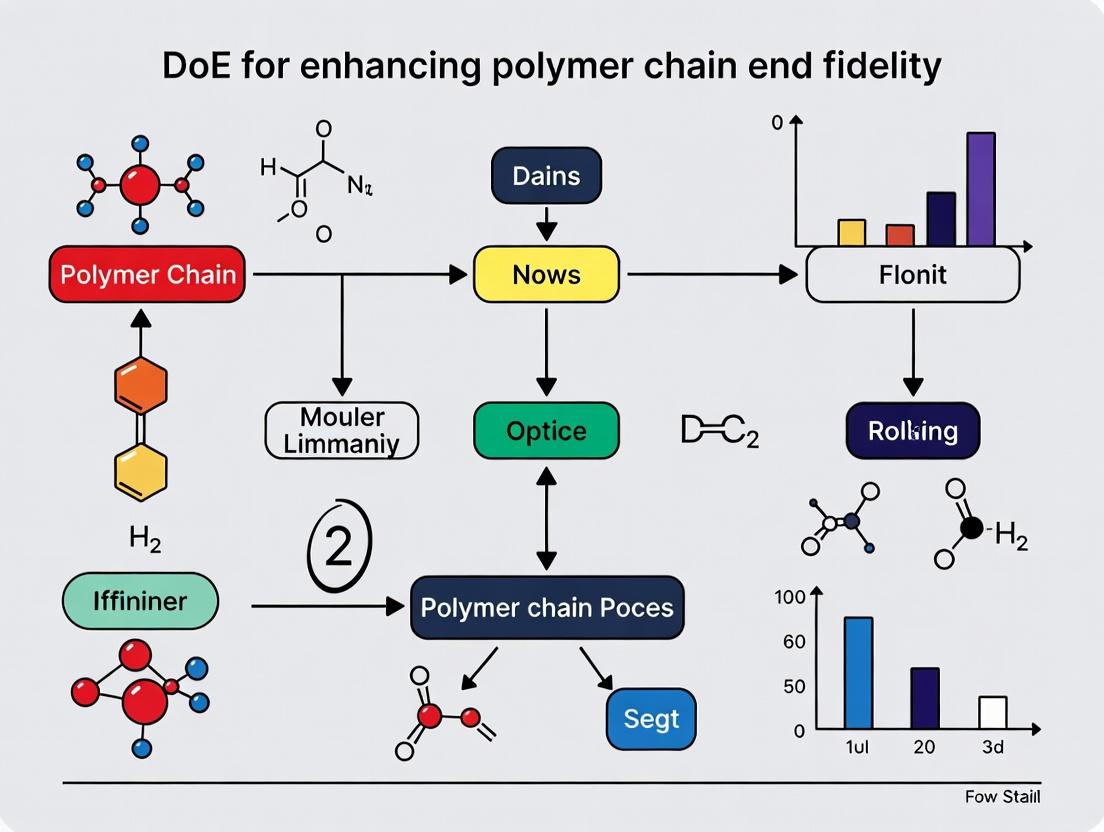
This article provides a comprehensive guide for researchers and pharmaceutical scientists on applying Design of Experiments (DoE) to enhance the fidelity of polymer chain ends—a critical quality attribute for drug-polymer...
Optimizing Polymer Chain End Fidelity: A Design of Experiments (DoE) Approach for Precision Therapeutics
Abstract
This article provides a comprehensive guide for researchers and pharmaceutical scientists on applying Design of Experiments (DoE) to enhance the fidelity of polymer chain ends—a critical quality attribute for drug-polymer conjugates, prodrugs, and controlled-release systems. We explore the fundamental impact of chain-end functionality on therapeutic performance, detail systematic DoE methodologies for polymerization process optimization, address common synthesis challenges, and present validation strategies. The content bridges polymer chemistry fundamentals with practical, data-driven approaches to achieve reproducible, high-fidelity polymers for advanced biomedical applications.
Why Chain End Fidelity is Critical: The Foundation of Functional Polymer Therapeutics
Technical Support Center: Troubleshooting Guides & FAQs
Context: This support center is designed to assist researchers employing Design of Experiments (DoE) methodologies to enhance polymer chain end fidelity—defined as the integrity (chemical structure intact), purity (absence of side-products), and consistency (batch-to-batch reproducibility) of functional groups at polymer chain termini.
FAQ & Troubleshooting Section
Q1: During a reversible deactivation radical polymerization (RDRP), my chain end functionality (CEF) is lower than predicted by kinetic models. What are the primary causes?
A: Low CEF typically indicates unwanted termination or side reactions. Key factors to investigate via a structured DoE include:
- Impurities: Trace oxygen, protic impurities, or catalyst deactivators.
- Initiator Efficiency (f): The initiator may decompose prematurely. Measure f experimentally via NMR or a kinetic plot.
- Conversion vs. Dispersity (Đ): High final conversion without proper control increases termination. Target conversions below 95% for high fidelity in most RDRPs. Monitor Đ; a significant rise (>1.5) suggests loss of control.
- Solvent Effects: Polarity can affect catalyst activity and radical stability.
Q2: My analysis (e.g., NMR, MS) shows multiple chain end species, compromising purity. How can I diagnose the source of these side-products?
A: Contaminated or multiple chain ends suggest issues with initiation, propagation, or workup.
- Analyze the Initiation Step: Use a low-conversion experiment to isolate and identify the first few monomer additions. Side-products here point to initiator instability or improper reaction with the monomer/catalyst.
- Check for Chain Transfer: Run experiments varying monomer and chain transfer agent (CTA) concentrations. A DoE can model their interaction effect on end-group uniformity.
- Post-Polymerization Quenching: Ensure your quenching method is rapid and inert. Slow quenching can lead to hydrolysis or oxidation of sensitive end groups (e.g., halides, thioesters).
Q3: How can I improve batch-to-batch consistency of chain end fidelity for a polymer-drug conjugate precursor?
A: Consistency is a function of process control. Implement a DoE focusing on critical process parameters (CPPs):
- Key CPPs: Strict control over temperature (±0.5 °C), monomer-to-initiator ratio (precise weighing), degassing protocol (time/method), and reagent addition rate (use a syringe pump).
- Strategy: Run a screening DoE (e.g., Fractional Factorial) to identify which CPPs have a significant effect on your Critical Quality Attribute (CQA: CEF %). Then, use a Response Surface Methodology (RSM) to find the robust operational window.
Q4: What are the best quantitative methods to measure the three aspects of fidelity?
A: Each aspect requires specific techniques. Correlate data from multiple sources.
Table 1: Quantitative Measures of Chain End Fidelity
| Fidelity Aspect | Primary Analytical Technique | Quantitative Output | Typical Target for High Fidelity |
|---|---|---|---|
| Integrity | 1H or 19F NMR | Molar ratio of characteristic end-group proton/fluorine signals to polymer backbone signals. | >95% agreement with theoretical structure. |
| Purity | MALDI-TOF Mass Spectrometry | Relative abundance of polymer chains with the correct end-group mass vs. all detected species. | >90% main population peak. |
| Consistency | SEC with dual detection (RI/UV) | Variation in measured CEF (by UV of a tagged end-group) across multiple batches. | Relative Standard Deviation (RSD) < 5%. |
Experimental Protocols
Protocol 1: Determination of Initiator Efficiency (f) via 1H NMR Kinetics
- Objective: Quantify the fraction of initiator molecules that successfully start a polymer chain, fundamental to CEF.
- Materials: See "Scientist's Toolkit" below.
- Method:
- Set up your RDRP reaction (e.g., ATRP, RAFT) in an NMR tube fitted with a J. Young valve.
- Using an internal standard (e.g., mesitylene), record periodic 1H NMR spectra in a non-interfering solvent (e.g., CDCl3).
- Track the decay of a characteristic initiator proton signal relative to the standard.
- Simultaneously, track the growth of polymer monomer unit signals to determine conversion (p).
- Plot number-average molecular weight (Mn, NMR) calculated from conversion vs. theoretical Mn, theo = ([M]0/[I]0) * p * Mmonomer + Minitiator.
- The slope of the initial linear fit is the initiator efficiency, f.
Protocol 2: DoE for Optimizing RAFT End-Group Purity
- Objective: Identify optimal conditions to maximize the percentage of chains with the intact RAFT agent (Z- and R-groups).
- DoE Setup:
- Factors: [RAFT Agent] / [Initiator] Ratio (A), Temperature (B), Solvent Polarity (Dielectric Constant, C).
- Responses: End-Group Purity (by MALDI-TOF %), Dispersity (Đ).
- Design: A 23 Full Factorial Design with 3 center points (11 total runs).
- Execution: Run polymerizations according to the randomized run order. Purify polymers by precipitation. Analyze each via SEC and MALDI-TOF.
- Analysis: Use statistical software to generate a regression model and identify significant interaction effects (e.g., A×B: Ratio and Temperature).
Visualizations
Diagram 1: DoE Workflow for Chain End Fidelity Optimization
Diagram 2: Key Analytical Pathways for Fidelity Metrics
The Scientist's Toolkit: Research Reagent Solutions
Table 2: Essential Materials for High-Fidelity Polymerization Studies
| Item | Function & Importance |
|---|---|
| High-Purity, Functionalized Initiators/RAFT Agents | Defines the chain end. Must be rigorously purified (e.g., chromatography, recrystallization) to remove deactivators or isomers. |
| Inhibitor-Removed Monomers | Trace stabilizers (e.g., MEHQ) can consume initiator/ catalyst. Pass monomers over basic alumina column prior to use. |
| Catalyst Systems (e.g., CuBr/PMDETA for ATRP) | Catalyst must be fresh or properly stored. Use high-purity ligands. Consider catalyst loading as a key DoE factor. |
| Anhydrous, Deoxygenated Solvents | Use from a solvent purification system or degas via freeze-pump-thaw cycles. Water/O2 are major sources of side reactions. |
| Internal Standards for NMR (e.g., Mesitylene) | Allows for precise, quantitative kinetics and calculation of initiator efficiency (f). |
| Syringe Pumps | Enables precise, controlled addition of reagents (e.g., initiator, monomer feed) to maintain constant concentrations, improving consistency. |
| SEC with Multiple Detectors (RI, UV, MALS) | RI gives Mn/Đ, UV at specific wavelengths quantifies end-groups, MALS gives absolute Mw. Critical for holistic characterization. |
Technical Support Center
Troubleshooting Guides & FAQs
Q1: Our drug-to-antibody ratio (DAR) is consistently lower than theoretical calculations. What chain-end defect-related issues should we investigate?
A: Low DAR is often a direct symptom of poor chain-end fidelity. Follow this troubleshooting guide:
- Assess Initiator Efficiency: Quantify unreacted initiator residues via LC-MS. A high percentage indicates poor initiation, leaving polymer chains without active conjugation sites.
- Check for Protic Impurities: Run a diagnostic reaction with a fluorescent trace monomer. Inconsistent incorporation suggests trace water or alcohols quenching living ends, creating dead chains.
- Analyze Termination Events: Use MALDI-TOF to identify chains with mass shifts corresponding to unintended termination agents (e.g., from solvent or monomer impurities).
- Protocol - Quantifying Active Chain Ends (ACE):
- Reagents: Polymer sample, excess fluorescent labeling agent (e.g., FITC-NHS), quenching buffer.
- Procedure: Dissolve 5.0 mg of polymer in 1 mL anhydrous DMSO. Add a 10x molar excess of FITC-NHS. React for 2 hours at 25°C protected from light. Quench with 100 µL of 1M Tris-HCl (pH 8.0). Purify via size-exclusion chromatography (PD-10 column).
- Analysis: Measure UV-Vis absorbance at 495 nm. Compare the measured DAR (FITC per polymer) to the theoretical maximum based on synthesis input. A >15% deficit indicates significant chain-end defects.
Q2: We observe high batch-to-batch variability in pharmacokinetic (PK) studies. Could polymer heterogeneity from chain-end defects be the cause?
A: Yes. Variable chain ends lead to inconsistent drug conjugation and surface charge, impacting PK. Implement this DoE-based approach:
- Define Critical Parameters: Use a Plackett-Burman screening design to test factors: Initiator Purity (Mol%), Monomer Water Content (ppm), Reaction Temperature (°C), and Solvent Grade.
- Measure Key Responses: For each batch, characterize: a) DAR Distribution (via HIC-HPLC), b) Zeta Potential (mV), c) In vivo Clearance Rate (mL/h/kg) in a rodent model.
- Analysis: Correlate process parameters (e.g., high water content) with outputs (broad DAR distribution, increased clearance). The goal is to identify which defect source most impacts PK variability.
Q3: How do anionic/cationic chain-end defects specifically alter the PK/PD profile of a polymer-drug conjugate?
A: Defects introduce unintended charges, disrupting the designed biological pathway.
Q4: What analytical methods are essential for a DoE study on chain-end fidelity?
A: A multi-technique approach is required to capture different defect types. Correlate data from this suite:
Table 1: Essential Analytical Methods for Chain-End Fidelity DoE
| Method | What it Measures | Key Output for DoE | Typical Target Value |
|---|---|---|---|
| SEC-MALS | Absolute MW, Dispersity (Đ) | Đ < 1.05 indicates controlled polymerization. | Đ = 1.02 - 1.10 |
| MALDI-TOF MS | Exact mass of individual chains. | Identifies specific defect structures (termination, transesterification). | >85% chains at target mass. |
| NMR End-Group Analysis | Chemical identity of chain ends. | Quantifies % of chains with ideal vs. defective end group. | >95% ideal end group. |
| ICP-MS/OES | Trace elemental impurities (e.g., Sn, Cu from catalysts). | Links residual catalyst to defect rate. | < 50 ppm catalyst residue. |
| Quantitative FT-IR | Functional group conversion. | Confirms >99% monomer conversion to minimize defects. | >99% conversion. |
Experimental Protocols
Protocol 1: Systematic DoE for Optimizing Initiator Efficiency
Objective: To determine the impact of initiator purity, solvent aze dryness, and metal scavengers on the yield of active chain ends.
Design: A 2³ Full Factorial Design with 2 center points.
Factors & Levels:
- A: Initiator Recrystallization (Level -1: No; Level +1: Yes)
- B: Molecular Sieves (Å) in Solvent (Level -1: None; Level +1: 3Å added)
- C: Chelating Resin in Monomer Feed (Level -1: No; Level +1: Yes)
Procedure:
- Prepare monomer and solvent according to the defined factor levels for each of the 10 experimental runs.
- In a glovebox, charge reagents into a sealed reactor.
- Conduct polymerization at 70°C for 18 hours.
- Terminate with pre-cooled (-78°C) excess methyl iodide.
- Precipitate polymer into cold diethyl ether, collect by centrifugation, and dry under vacuum.
- Analysis: For each run, determine Active Chain End % using the Fluorescent Tagging Protocol (see FAQ A1).
Protocol 2: Conjugation Efficiency Assay for PK/PD Correlation
Objective: To measure the functional impact of chain-end defects on drug loading.
Procedure:
- Polymer Samples: Use polymers synthesized from the DoE in Protocol 1 (varying ACE%).
- Conjugation: Activate 5 mg of each polymer batch with 1.1 eq. of NHS ester. React with a model drug (e.g., Doxorubicin-NH₂) at a 1:20 molar ratio in PBS (pH 8.5) for 4 hours.
- Purification: Purify conjugates using PD-10 desalting columns into PBS.
- Quantification:
- Measure polymer concentration by absorbance at 280 nm.
- Measure drug concentration by its unique absorbance (e.g., Doxorubicin at 480 nm).
- Calculate Experimental DAR = (Drug Concentration / Polymer Concentration).
- Correlation: Plot Experimental DAR vs. ACE% (from Protocol 1). A slope significantly less than 1 indicates defects other than dead chains are affecting conjugation chemistry.
Research Reagent Solutions
Table 2: Essential Toolkit for Chain-End Fidelity Research
| Item | Function & Rationale |
|---|---|
| Ultra-Dry, Inhibitor-Free Monomers | Eliminates protic impurities and stabilizers that quench chain ends. Essential for reproducibility. |
| Recrystallized Initiators | Removes oxidative decomposition products that cause inconsistent initiation rates and dead chains. |
| 3Å Molecular Sieves | Maintains solvent dryness at the ppm water level to prevent chain transfer/termination. |
| Metal Scavenging Resins | Removes trace catalytic metals (e.g., tin, copper) that can lead to unwanted side reactions. |
| Functionalized End-Capping Agents | Allows precise, stoichiometric termination to install conjugation-ready groups (e.g., azide, DBCO, NHS ester). |
| Deuterated Solvents for NMR | Enables high-resolution quantification of end-group structures and conversion. |
| MALDI Matrix for Hydrophilic Polymers | Critical for obtaining clear mass spectra to identify individual chain-end masses and defect structures. |
| Reference Polymers with Defined Đ & End Groups | Essential for calibrating and validating analytical methods (SEC, NMR, MS). |
Workflow for Integrating DoE, Analysis, and PK/PD
Technical Support Center: Troubleshooting Chain-End Fidelity
This support center is designed within the thesis context: "Design of Experiments (DoE) for Enhancing Polymer Chain-End Fidelity in Controlled Polymerization." Below are common experimental issues, their diagnostics, and detailed protocols for researchers and drug development professionals.
Frequently Asked Questions & Troubleshooting Guides
Q1: During Ring-Opening Polymerization (ROP) of lactide, I observe high dispersity (Ð > 1.3) and inconsistent end-group fidelity. What could be the cause? A: This often results from protic impurities (water, alcohols) or catalyst/initiator disproportionation. It leads to unintended chain transfer or termination.
- Troubleshooting Steps:
- Rigorously dry monomer (recrystallize from dry toluene), solvent (distill over CaH₂), and glassware (flame-dry under vacuum/N₂).
- In your DoE, include factors: [Monomer Purification Method], [Catalyst/Initiator Ratio], and [Reaction Temperature]. Measure response variables: Number-Average Molecular Weight (Mₙ) and Ð.
- Characterize chain ends via ¹H NMR or MALDI-TOF to identify if end groups are hydroxyl (expected) or carboxyl/vinyl (from side reactions).
Q2: In my RAFT polymerization, conversion stalls at ~70%, and SEC shows a high-molecular-weight shoulder. What is happening? A: This indicates retardation and possible loss of the RAFT agent's thiocarbonylthio functionality, often due to impurity-induced degradation or excessive radical flux.
- Troubleshooting Steps:
- Purify the RAFT agent by column chromatography or recrystallization. Deoxygenate the mixture via 3+ freeze-pump-thaw cycles.
- Optimize the initiator-to-RAFT agent ratio ([I]/[RAFT]). A high ratio increases radical flux, promoting termination. A DoE screening factors like [I]/[RAFT], [Monomer], and temperature is crucial.
- Use UV-Vis spectroscopy to monitor the decay of the RAFT agent's characteristic absorbance (~300-310 nm) to confirm its integrity.
Q3: My ATRP reaction is too fast/slow, and the polymer has undesired bromine chain-end functionality. How can I regain control? A: Improper ligand-to-catalyst ratio or an unstable/ineffective reducing agent (for AGET ATRP) can disrupt the Cu¹/Cu² equilibrium, leading to poor control.
- Troubleshooting Steps:
- For conventional ATRP, ensure the ligand (e.g., PMDETA, TPMA) is in excess relative to Cu¹ (e.g., 1.2:1 ratio). For AGET/ARGET ATRP, titrate the reducing agent (e.g., ascorbic acid, Sn(EH)₂) carefully.
- Implement a DoE with factors: [Ligand]/[Cu¹], [Reducing Agent]/[Cu²] (for ARGET), and [Solvent Polarity]. Monitor kinetics via ln([M]₀/[M]) vs. time.
- Analyze chain-end halogen fidelity by chain-extension experiments or ESI-MS.
Q4: In NMP, I require high temperatures (>120°C) for polymerization of styrene, but this leads to thermal self-initiation and broadened Ð. How can I mitigate this? A: Thermal self-initiation of styrene competes with NMP initiation, leading to chains not capped by the nitroxide (e.g., TEMPO).
- Troubleshooting Steps:
- Use a more active alkoxyamine initiator (e.g., BlocBuilder MA) that cleaves at lower temperatures, reducing the required polymerization temperature.
- In your DoE framework, treat "Initiator Type" and "Polymerization Temperature" as categorical and continuous factors, respectively. Measure Chain-End Functionalization Efficiency via EPR or tagged initiator methods.
- Consider adding a small amount of controlled radical polymerization moderator (e.g., SG1 in NMP) to regulate the equilibrium.
Key Experimental Protocols for Chain-End Analysis
Protocol 1: MALDI-TOF MS for Direct Chain-End Determination
- Sample Prep: Dissolve polymer (1 mg/mL) and matrix (e.g., DCTB, 20 mg/mL) in THF. Add cationizing salt (e.g., NaTFA, 1 mg/mL).
- Spotting: Apply 1 µL of mixed solution to the target plate, dry in air.
- Measurement: Acquire spectra in reflection positive ion mode.
- Analysis: Compare peak series m/z differences (monomer mass) and absolute m/z values to theoretical masses for different α/ω end-group pairs.
Protocol 2: ¹H NMR End-Group Analysis for ATRP/RAFT Polymers
- Polymer Purification: Precipitate polymer 3x into cold methanol from DCM to remove catalyst/RAFT agent.
- Sample Preparation: Dissolve ~20 mg of dry polymer in 0.6 mL of deuterated chloroform (CDCl₃).
- Acquisition: Run a standard ¹H NMR with sufficient scans (64-128) for signal-to-noise.
- Calculation: Identify end-group proton signals (e.g., -OCH₃ for initiator fragment, -CH₂-Br for ATRP) and compare their integral to main chain proton integrals to calculate experimental Mₙ.
Table 1: Comparison of Controlled Polymerization Mechanisms from a Chain-End Perspective
| Mechanism | Typical Initiator/CTA | Active Chain End | Key Equilibrium/Step | Primary Chain-End Functionality | Typical Dispersity (Ð) Range | Key Factors for DoE on End Fidelity |
|---|---|---|---|---|---|---|
| ROP (Lactide) | Alkoxide (Sn(Oct)₂/ROH) | Growing alkoxide | Monomer insertion | -OH / -OR (from initiator) | 1.05 - 1.30 | [Monomer]/[Initiator], Catalyst Type, Temp, Impurity Levels |
| RAFT | Thiocarbonylthio Compound | Radical (intermittent) | Reversible Chain Transfer | -SC(=S)R (RAFT group) | 1.05 - 1.30 | [RAFT]/[I], RAFT Agent Z/R Group, Solvent, Temp |
| ATRP | Alkyl Halide (R-X) | Radical (dormant as Pn-X) | Halogen Atom Transfer | -X (Br/Cl) | 1.05 - 1.25 | [Cu¹]/[L]/[R-X], Reducing Agent (ARGET), Solvent |
| NMP | Alkoxyamine | Radical (dormant as Pn-T) | Alkoxyamine Homolysis | -TEMPO/SG1 (nitroxide) | 1.10 - 1.40 | Alkoxyamine Structure, Temp, Monomer Type |
Table 2: Research Reagent Solutions Toolkit
| Item | Function | Example(s) |
|---|---|---|
| Purified Monomer | Ensures high reactivity, removes inhibitors and protic impurities. | Styrene (passed over Al₂O₃), Lactide (recrystallized). |
| High-Purity Catalyst/Initiator | Provides predictable initiation and propagation rates. | Sn(Oct)₂ (distilled), CuBr (purified by acetic acid wash), AIBN (recrystallized from methanol). |
| RAFT Agent (CTA) | Mediates reversible chain transfer; defines R- and Z-groups. | CDB, CPADB, specific for monomer family. |
| Ligand | Solubilizes metal catalyst, tunes redox potential (ATRP). | PMDETA, TPMA, Me₆TREN. |
| Nitroxide (NMP) | Forms dormant alkoxyamine; controls radical concentration. | TEMPO, SG1, BlocBuilder MA. |
| Deoxygenated Solvent | Prevents radical quenching by oxygen. | Toluene, anisole (bubbled with N₂, sparged). |
| Chain-End Analysis Standards | For calibrating and validating fidelity measurements. | Well-defined α,ω-functionalized polymer standards. |
| Reducing Agent (ARGET) | Regenerates active Cu¹ catalyst in situ. | Ascorbic acid, Sn(EH)₂. |
Visualization: Workflows and Relationships
Title: DoE Workflow for Polymer Chain-End Fidelity Research
Title: Chain-End Control: ATRP vs. RAFT Mechanisms
Technical Support Center: Troubleshooting Polymer Chain End Fidelity Experiments
FAQs & Troubleshooting Guides
Q1: During my living polymerization, I observe broadened molecular weight distributions (Đ > 1.2). What CPPs should I investigate first? A: This is a common fidelity issue. First, confirm the purity of your monomer and initiator via titration or NMR. Inadequate purification is a primary CPP. Second, rigorously exclude oxygen and moisture; even trace amounts can cause irreversible termination, broadening Đ. Third, verify your temperature control stability; fluctuations of >±1°C can lead to inconsistent propagation rates. Implement freeze-pump-thaw degassing for at least 3 cycles and use calibrated temperature probes.
Q2: My chain-end functionality (CEF) analysis shows less than 95% retention of the active moiety. Which experimental steps are most critical? A: CEF is highly sensitive to post-polymerization handling. The quenching method is a critical CPP. Avoid using quenching reagents in large excess, which can lead to side reactions. Instead, use a calculated 1.2 molar equivalent relative to active chain ends. Sample workup for NMR analysis must be rapid and performed under inert atmosphere to prevent degradation. See the protocol below.
Q3: I suspect catalyst/initiator decomposition is affecting my end-group fidelity. How can I test this hypothesis pre-DoE? A: Perform a series of short "seeded" experiments. Run the polymerization for a short time (t1), take an aliquot for GPC/NMR, then add a fresh batch of monomer. If the second stage shows significantly reduced kinetics or altered end-group structure, it indicates initiator decomposition or deactivation is a key CPP. Monitor initiator concentration over time via inline spectroscopy if available.
Detailed Experimental Protocols
Protocol 1: High-Fidelity Anionic Polymerization of Styrene for CEF Analysis
- Equipment Preparation: Flame-dry a 100 mL Schlenk flask with stir bar under vacuum. Cool under argon.
- Purification: Pass styrene monomer through a column of basic alumina directly into the flask. Add sec-BuLi initiator (1.0 M in cyclohexane) via gas-tight syringe. Target DP = 50.
- Reaction: Stir at 30°C in a thermostatted oil bath for 2 hours.
- Quenching: Add a pre-cooled 1.2 molar equivalent (vs. initiator) of degassed benzyl bromide via cannula to terminate the living ends. Stir for 30 min.
- Workup: Precipitation into 10x volume of cold methanol. Filter and dry polymer under high vacuum (<0.01 mbar) for 24h.
- Analysis: Dissolve in CDCl3 for ¹H NMR. Calculate CEF by integrating the aromatic protons of the benzyl end group (δ ~7.2-7.4 ppm) versus backbone aromatic protons.
Protocol 2: Assessing Oxygen/Moisture Ingress Impact (A Pre-DoE Scouting Run)
- Set up two identical polymerizations (as per Protocol 1) in parallel.
- For the "control," maintain strict inert atmosphere.
- For the "test," intentionally introduce a small, measured air bubble (e.g., 0.1% v/v of headspace) after initiation.
- Run both reactions to completion.
- Compare Đ (GPC) and CEF (NMR) between the two samples. This quantifies the process sensitivity to atmospheric contaminants.
Data Presentation: Common CPPs and Observed Impact on Fidelity Metrics
Table 1: Hypothesized Impact of Key CPPs on Fidelity Attributes
| Critical Process Parameter (CPP) | Hypothesized Primary Impact | Typical Target Range | Observed Effect if CPP Deviates (from cited literature) |
|---|---|---|---|
| Monomer Purity (Residual Inhibitors) | Initiator Efficiency / Đ | >99.8% (via purification) | Broadened Đ (1.3-1.8), reduced initiation rate. |
| Reaction Temperature Stability | Chain Propagation Rate / Dispersity | Setpoint ±0.5°C | Đ increases ~0.05 per °C of fluctuation. |
| Initiator : Monomer Ratio | Molecular Weight (Mn) Accuracy | Determined by target DP | Mn deviation >15% from theoretical. |
| Quenching Agent Equivalents | Chain-End Functionality (CEF) | 1.1 - 1.3 eq. | CEF drops 5-20% with excess or insufficient quench. |
| Solvent Water Content | Living Chain Lifetime / Đ | <10 ppm | Major terminations leading to dead chains, Đ > 2.0. |
Table 2: Research Reagent Solutions Toolkit
| Reagent / Material | Function & Criticality | Recommended Specification / Handling |
|---|---|---|
| sec-Butyllithium (sec-BuLi) | Primary anionic initiator. CPP. | Titrate regularly (vs. diphenylacetic acid). Use in anhydrous hydrocarbon solvents. |
| Inhibitor-Removal Columns (Alumina, Basic) | Monomer purification. CPP. | Activate alumina at 300°C under vacuum before use. |
| Benzyl Bromide | Termination/Quenching agent for end-group analysis. CPP. | Distill under reduced pressure, store under argon in the dark. |
| Deuterated Chloroform (CDCl3) | NMR analysis solvent. | Store over molecular sieves (4Å). Check for acidic impurities via NMR. |
| Molecular Sieves (4Å) | Solvent drying agent. | Activate at 300°C under vacuum for >24h before use. |
Visualizations
Title: Polymer Chain End Fidelity Experimental Workflow
Title: CPP Deviation Impact on Fidelity Metrics
A Step-by-Step DoE Framework for Polymerization Process Optimization
Troubleshooting Guides & FAQs
Q1: Why did my polymer reaction yield a broad dispersity (Ð > 1.3) when varying the Catalyst/Ligand ratio? A: A high Ð often indicates poor initiation or catalyst deactivation. At low ligand ratios, the active catalyst may be unstable, leading to multiple active sites with different propagation rates. At excessively high ratios, the ligand may over-stabilize the catalyst, slowing initiation and causing slow monomer consumption alongside normal chains. Troubleshooting steps:
- Verify Catalyst Activation: Run a small-scale test with a model monomer and monitor conversion via NMR hourly. A lag phase suggests slow initiation.
- Analyze Chain Ends: Use MALDI-TOF or chain-end NMR on a low-conversion sample. Multiple mass series indicate unintended initiation pathways.
- Adjust Protocol: Ensure the catalyst and ligand are premixed in solvent for 5-10 minutes at RT before adding monomer. This ensures complex formation.
Q2: How does monomer purity specifically affect end-group fidelity, and how can I detect this? A: Impurities (e.g., protic agents, aldehydes, residual stabilizers) can act as chain-transfer agents or initiators/terminators. This leads to:
- Premature Termination: Short chains, lower-than-expected Mn.
- Unintended Initiation: Multiple end-group types.
- Detection Protocol: Run a controlled experiment with intentionally spiked impurity (e.g., 500 ppm water) vs. rigorously purified monomer. Compare using:
- ¹H NMR of polymers at ~90% conversion for diagnostic end-group peaks.
- MALDI-TOF MS to visualize mass distributions of individual chains.
- Kinetic Plot (ln([M]₀/[M]) vs. time): Deviations from linearity indicate non-ideal behavior.
Q3: My time-conversion data plateaus unexpectedly. Is this a temperature or catalyst issue? A: A plateau can stem from catalyst deactivation or an equilibrium limitation. To diagnose:
- Temperature Test: Re-run at a 10°C higher temperature (within solvent boiling point). If final conversion increases, the reaction may be equilibrium-controlled (e.g., some step-growth or ring-opening polymerizations).
- Catalyst Stability Test: Use an in-situ NMR or FTIR probe to monitor catalyst-specific signals. Their decay correlates with activity loss.
- Standard Protocol for Kinetic Sampling: Quench aliquots at precise time points (e.g., 5, 15, 30, 60, 120 min) into a cold, stirred solution of tetrahydrofuran with a quenching agent (e.g., ethyl vinyl ether for anionic/RoPo). Analyze immediately by GPC to track Mn and Ð over time.
Q4: What is the most efficient DoE screening design to start with for these four factors? A: A Resolution IV fractional factorial design (e.g., 2⁴⁻¹) is highly efficient for screening. It allows you to study all four main factors and their two-factor interactions (confounded only with three-factor interactions) with only 8 experimental runs. Follow-up runs (e.g., a central composite design) can then optimize significant factors.
Table 1: Impact of Factor Ranges on Key Polymer Metrics
| Factor | Typical Investigated Range | Primary Impact on Chain-End Fidelity | Observed Effect on Dispersity (Ð) |
|---|---|---|---|
| Monomer Purity | 95% to >99.9% | High: Ensures uniform initiation. Low: Causes chain transfer/termination. | 1.05 – 1.15 (Pure) to >1.5 (Impure) |
| Cat./Ligand Ratio | 1:0.5 to 1:4 | Optimal ratio ensures stable, single active site. Deviations cause multiple species. | Can vary from 1.05 to >2.0 |
| Temperature | 0°C to 80°C (varies by system) | High T: Faster initiation, may increase side reactions. Low T: Better control, slower kinetics. | Minimal shift for living systems (<1.1 to 1.2) |
| Time | 1 min to 48 hr | Determines conversion. Must align with kinetic profile to avoid side reactions at high conversion. | Ð can broaden if reaction exceeds optimal time. |
Table 2: Example DoE Screening Matrix (2⁴⁻¹ Fractional Factorial)
| Run | Monomer Purity | Cat:Ligand Ratio | Temp (°C) | Time (hr) | Measured Ð | End-Group Fidelity (%)* |
|---|---|---|---|---|---|---|
| 1 | Low (-) | Low (1:0.8) | Low (25) | Low (2) | 1.52 | 65 |
| 2 | High (+) | Low (1:0.8) | High (60) | Low (2) | 1.25 | 82 |
| 3 | Low (-) | High (1:2.5) | High (60) | Low (2) | 1.38 | 78 |
| 4 | High (+) | High (1:2.5) | Low (25) | Low (2) | 1.08 | 96 |
| 5 | Low (-) | Low (1:0.8) | High (60) | High (8) | 1.61 | 58 |
| 6 | High (+) | Low (1:0.8) | Low (25) | High (8) | 1.30 | 85 |
| 7 | Low (-) | High (1:2.5) | Low (25) | High (8) | 1.20 | 88 |
| 8 | High (+) | High (1:2.5) | High (60) | High (8) | 1.15 | 92 |
*As determined by MALDI-TOF or NMR analysis.
Experimental Protocols
Protocol 1: Monomer Purification via Column Chromatography
- Materials: Technical-grade monomer, basic alumina (Activity I), anhydrous hexane/ethyl acetate (eluent), argon/vacuum line.
- Steps: Pack a chromatography column under argon with alumina. Dissolve monomer in minimal eluent and load onto column. Elute with degassed solvent mixture. Collect monomer fractions under inert atmosphere.
- Analysis: Immediately check purity by ¹H NMR for residual stabilizers (e.g., BHT peaks) and use immediately or store under argon at -20°C.
Protocol 2: In-situ Kinetics Monitoring via FTIR
- Setup: Jacketed reaction vessel fitted with a DiComp (diamond composite) ATR-FTIR probe, connected to a recirculating heater/chiller.
- Procedure: Load solvent, monomer, and internal standard (e.g., toluene). Calibrate by collecting spectra at known monomer concentrations. Initiate reaction by adding catalyst/ligand solution via syringe. Set spectrometer to collect scans every 30-60 seconds.
- Data Workup: Track the decay of the monomer vinyl (C=C) stretch peak (~1620-1650 cm⁻¹) relative to the stable standard peak. Calculate conversion via the Beer-Lambert law.
Visualizations
Title: Factor Impact on Chain-End Fidelity
Title: Iterative DoE Workflow for Polymer Optimization
The Scientist's Toolkit: Research Reagent Solutions
| Item | Function in DoE for Chain-End Fidelity |
|---|---|
| Inhibitor-Removing Alumina | Removes phenolic inhibitors (e.g., BHT, MEHQ) from monomers via quick pass-through column, crucial for high-purity monomer feeds. |
| High-Purity, Metalated Catalyst | Precise, lot-to-lot consistent catalyst (e.g., CuBr, Ni(COD)₂) is essential for reproducible initiation and propagation kinetics. |
| Tailored Ligand Library | A set of ligands (e.g., PMDETA, bipyridine, phosphines) allows systematic variation of catalyst stability and activity in ratio studies. |
| Deuterated Internal Standard | e.g., 1,3,5-Trimethoxybenzene for NMR or deuterated toluene for FTIR; enables accurate in-situ conversion measurements. |
| Quenching Agent | Specific chemical (e.g., benzoquinone, ethyl vinyl ether) to instantly "freeze" polymerization for accurate kinetic sampling and analysis. |
| MALDI Matrix for Polymers | e.g., DCTB (trans-2-[3-(4-tert-Butylphenyl)-2-methyl-2-propenylidene]malononitrile) for accurate end-group mass spectrometry analysis. |
Troubleshooting Guides & FAQs
FAQ 1: My measured % End-Group Retention is consistently lower than theoretical predictions. What are the primary culprits?
- A: This is a common issue in polymer chain end fidelity studies. The main causes are:
- Impurities in Monomer/Initiator: Trace protic impurities (e.g., water, alcohols) can act as chain transfer agents or terminate living ends. Always rigorously dry and distill monomers and check initiator purity via titration before use.
- Inadequate Reaction Inertness: Oxygen is a persistent terminating agent. Ensure thorough Schlenk line or glovebox techniques with multiple freeze-pump-thaw cycles for solvent and monomer.
- Side Reactions: Depending on your polymerization chemistry (e.g., ATRP, RAFT, anionic), potential side reactions like disproportionation, coupling, or chain transfer to polymer can occur. Review your specific catalytic system and conditions (temperature, concentration).
- Incorrect Analytical Calibration: For techniques like ( ^1H ) NMR, ensure your calibration curve or reference peak integration is correct. Use an internal standard for quantification.
FAQ 2: The dispersity (Đ or Mw/Mn) of my polymer is higher than expected (>1.2 for a well-controlled living polymerization). How do I diagnose this?
- A: High dispersity indicates a loss of control over chain growth kinetics. Follow this diagnostic tree:
- Step 1: Check SEC/MALS Traces. A multimodal distribution suggests irreversible termination events early in the reaction (e.g., from impurities). A tailing at high molecular weight suggests coupling side reactions. A broadening at low molecular weight suggests slow or inconsistent initiation.
- Step 2: Review Initiation Efficiency. Calculate the theoretical Mn from conversion and compare it to the SEC Mn (using a correct calibration standard!). A large discrepancy indicates slow initiation relative to propagation or initiator decomposition.
- Step 3: Optimize via DoE. Use a Design of Experiments (DoE) approach to systematically test the impact of variables like [Monomer]/[Initiator] ratio, catalyst concentration, solvent polarity, and temperature on dispersity.
FAQ 3: Why is my measured "Functional Yield" for end-group modification reactions poor, even with high % End-Group Retention?
- A: High retention of the polymerization-active end-group does not guarantee high yield in a subsequent derivatization reaction. Key issues are:
- Steric Hindrance: Long polymer chains can shield the reactive chain end, especially at high DP. Consider performing functionalization at a lower DP or using a large excess of a small-molecule coupling reagent.
- Incompatible Reaction Conditions: The conditions for your polymer growth (e.g., anhydrous, non-polar) may not be ideal for the conjugation chemistry (e.g., click chemistry, amidation). A solvent/medium change with purification may be necessary.
- Quantification Error: The method for assessing functional yield (e.g., UV-Vis for a dye label, NMR for a new signature) must be carefully calibrated. Always use a standard curve from a model compound.
Experimental Protocols for Key Analyses
Protocol 1: Determining % End-Group Retention via ( ^1H ) NMR Spectroscopy
- Sample Preparation: Precisely weigh ~10-20 mg of purified, dry polymer into an NMR tube. Dissolve in 0.6 mL of deuterated solvent (e.g., CDCl₃, DMSO-d₆).
- Data Acquisition: Acquire a standard ( ^1H ) NMR spectrum at room temperature with sufficient scans (64-128) for good signal-to-noise.
- Integration: Identify a characteristic proton signal from the chain-end group (e.g., initiator fragment, ω-end group from a RAFT agent) and a characteristic proton signal from the polymer backbone repeat unit.
- Calculation:
- Let
I_end= integral of the end-group signal. - Let
I_backbone= integral of the backbone repeat unit signal. - Let
N_endandN_backbone= the number of protons giving rise to those respective signals. - Degree of Polymerization (DPn) = (Ibackbone / Nbackbone) / (Iend / N_end)
- % End-Group Retention = (Theoretical DPn based on conversion / Experimental DPn from NMR) * 100%
- Let
Protocol 2: Determining Mn, Mw, and Dispersity (Đ) via Size Exclusion Chromatography (SEC)
- System Calibration: Create a calibration curve using narrow dispersity polystyrene (PS) or poly(methyl methacrylate) (PMMA) standards (molecular weight range: 500 - 1,000,000 Da) in your eluent (e.g., THF, DMF with LiBr).
- Sample Preparation: Filter polymer solutions (~2-3 mg/mL concentration) through a 0.22 or 0.45 μm PTFE filter.
- Chromatography Run: Inject 50-100 μL at a flow rate of 1.0 mL/min. Use a column set suitable for your polymer's molecular weight range.
- Data Analysis: Use SEC software to calculate number-average molecular weight (Mn), weight-average molecular weight (Mw), and dispersity (Đ = Mw / Mn). Note: Absolute molecular weights require a Multi-Angle Light Scattering (MALS) detector.
Table 1: Impact of Common Experimental Flaws on Key Response Variables
| Experimental Flaw | % End-Group Retention | Mn/Mw (Dispersity) | Functional Yield | Primary Diagnostic Tool |
|---|---|---|---|---|
| Trace Water/Oxygen | Severely Decreased | Increased | Severely Decreased | ( ^1H ) NMR, SEC (low M_n tail) |
| Slow Initiation | Moderately Decreased | Increased | Moderately Decreased | SEC (broadening), Kinetics |
| Chain Transfer Reactions | Decreased | Increased | Decreased | SEC (tailoring), M_n deviates from theory |
| Coupling Termination | Decreased | Increased (bimodal) | Decreased | SEC (high M_w shoulder) |
| Steric Hindrance in Conjugation | Unaffected | Unaffected | Decreased | UV-Vis, Fluorimetry, NMR |
Table 2: Typical Target Ranges for Controlled/Living Polymerization
| Response Variable | Ideal Target Range (Benchmark) | Acceptable Range | Method for Improvement |
|---|---|---|---|
| % End-Group Retention | > 95% | > 85% | Enhanced purification, stricter inertness |
| Dispersity (Đ = Mw/Mn) | 1.05 - 1.20 | 1.20 - 1.35 | Optimize [M]/[I]/[Cat.] ratios, temperature |
| Functional Yield | > 90% | > 75% | Use excess reagent, optimize conjugation buffer/solvent |
Visualizations
Diagram 1: DoE Workflow for Polymer Chain End Optimization
Diagram 2: Analytical Pathway for End-Fidelity Assessment
The Scientist's Toolkit: Research Reagent Solutions
| Item | Function & Importance |
|---|---|
| High-Purity, Dry Monomers | Minimizes chain transfer/termination from impurities; essential for predictable kinetics and high end-group retention. |
| Titrated Initiator Solutions | Ensures accurate knowledge of initiator concentration for precise control over Mₙ and initiation efficiency. |
| RAFT/Chain Transfer Agents (CTAs) | Provides controlled growth and defines the ω-chain end in reversible-deactivation radical polymerizations. |
| Ligands & Catalysts (e.g., for ATRP) | Controls the activation-deactivation equilibrium, impacting dispersity and livingness. |
| Anhydrous, Deoxygenated Solvents | Critical for maintaining living ends in ionic or radical polymerizations by excluding water/oxygen. |
| Deuterated Solvents for NMR | Allows for accurate quantification of end-group and backbone signals to calculate DP and % retention. |
| Narrow Dispersity SEC Standards | Enables accurate relative molecular weight and dispersity calibration for your polymer class. |
| Functional Coupling Reagents (e.g., NHS esters, Azides) | Enables high-yield, orthogonal conjugation of dyes, drugs, or biomarkers to the polymer chain end. |
| Stabilizers for Storage | Prevents degradation of monomers and initiators, ensuring reproducible starting conditions. |
Troubleshooting Guides & FAQs
Q1: In our fractional factorial design (FFD) for screening monomer purity and catalyst amount, we found confounding makes it impossible to identify the active factor for chain end fidelity. What went wrong? A: Confounding is inherent in FFDs. Your resolution was likely too low. For 5 factors, a Resolution V (2^(5-1)) design is the minimum to avoid confounding main effects and two-factor interactions. Always calculate the design's resolution (III, IV, V) before experimentation. A Resolution III design confounds main effects with two-factor interactions, which is unsuitable for your goal.
Q2: When running a Central Composite Design (CCD) to optimize polymerization temperature and time, the axial points caused unwanted thermal degradation. How can we avoid this? A: This indicates your axial (star) distance (α) was set too large. Use a face-centered CCD (α=1), where axial points are at the same levels as your factorial points, keeping all runs within your safe experimental region. Alternatively, conduct a stability study first to define absolute safe boundaries before setting CCD levels.
Q3: Our Box-Behnken Design (BBD) for three factors lacks axial points, but we suspect a strong curvature in the response surface for chain end fidelity. Is BBD inappropriate? A: BBD is a spherical design with all points lying on a radius of √2. It can efficiently fit quadratic models, but it does not include factorial or axial points at the extremes of the cube. If you strongly suspect curvature near the boundaries of your design space, a CCD with axial points is more suitable. For exploring a region where extreme conditions are risky, BBD's inherent conservatism is an advantage.
Q4: The ANOVA for our response surface model shows a significant "Lack of Fit" (p<0.05). What are the next steps? A: A significant Lack of Fit means your model (e.g., quadratic) does not adequately describe the data. Steps: 1) Check for outliers in the residuals. 2) Verify you have not omitted a vital factor during screening. 3) Consider transforming your response variable (e.g., log transformation). 4) If the design space is large, the model may be too simple; adding center points or moving to a more complex design may be necessary.
Q5: How do we choose between CCD and BBD for optimizing polymerization conditions? A: See the comparison table below.
Table 1: Comparison of Response Surface Designs: CCD vs. BBD
| Feature | Central Composite Design (CCD) | Box-Behnken Design (BBD) |
|---|---|---|
| Experimental Points | Factorial + Axial + Center | Midpoints of edges + Center |
| Design Space | Spherical or Cubical | Spherical |
| Factor Levels | 5 (for rotatable CCD) | 3 |
| Runs (for k=3) | 15-20 (with replicates) | 13-15 |
| Sequentiality | Excellent (builds on factorial) | No; stand-alone |
| Efficiency | High, but more runs | Very high (fewer runs) |
| Best For | Identifying curvature near boundaries; precise optimization. | Efficient exploration of a spherical region where extremes are unsafe. |
Experimental Protocols
Protocol 1: Screening via 2^(5-1) Fractional Factorial Design (Resolution V) Objective: Identify key factors (A: Monomer Purification, B: Catalyst Loading, C: Solvent Dryness, D: Reaction Temp, E: Stirring Rate) affecting chain end fidelity (CEF) measured by MALDI-TOF.
- Define low (-1) and high (+1) levels for each factor based on preliminary data.
- Generate a 2^(5-1) design table (16 runs) using defining relation I=ABCDE (Resolution V).
- Randomize run order to minimize confounding from nuisance variables.
- Execute polymerizations in a glovebox under inert atmosphere.
- Terminate reactions, purify polymers via precipitation, and analyze CEF by MALDI-TOF.
- Perform ANOVA to identify significant main effects and two-factor interactions.
Protocol 2: Optimization via Face-Centered Central Composite Design (FC-CCD) Objective: Optimize two critical factors (X1: Temperature, X2: Time) for maximum CEF.
- Set factorial points at ±1 levels (e.g., 70°C, 90°C; 1h, 3h).
- Set axial points at ±1 levels (face-centered, α=1), same as factorial levels.
- Include 3-5 center point replicates (80°C, 2h) to estimate pure error.
- Perform 11 total runs in randomized order.
- Fit a second-order polynomial model: CEF = β₀ + β₁X₁ + β₂X₂ + β₁₁X₁² + β₂₂X₂² + β₁₂X₁X₂.
- Use canonical analysis on the fitted model to locate the stationary point (maximum).
Visualizations
Title: DoE Workflow for Polymer Optimization
Title: CCD Geometry: Factorial, Axial & Center Points
The Scientist's Toolkit: Research Reagent Solutions
| Item | Function in Polymer Chain End Fidelity Experiments |
|---|---|
| High-Purity Monomer | Minimizes unintended chain transfer/termination, essential for high-fidelity initiation. |
| Catalyst/Initiator | Precise stoichiometry determines the number of active chain ends. Must be accurately weighed and stored under inert atmosphere. |
| Ultra-Dry Solvent | Water is a common chain transfer agent. Solvents must be dried over molecular sieves or via distillation. |
| Internal Standard (for NMR) | Allows quantitative determination of end-group conversion and fidelity (e.g., 1,3,5-trimethoxybenzene). |
| MALDI-TOF Matrix | Critical for soft ionization of polymer samples to accurately determine molecular weight and end-group mass. |
| Chain-End Derivatization Reagent | Tags specific end-groups (e.g., -OH, -NH₂) with a UV/fluorescent label for enhanced detection and quantification. |
| Deoxygenation Agent | e.g., Copper(I) bromide, to remove trace oxygen which can lead to oxidative termination. |
Troubleshooting Guides & FAQs
General DoE & Experimental Setup
Q1: Why does my polymer synthesis yield show high variability despite following a published protocol? A: High variability often stems from uncontrolled critical process parameters (CPPs). For high-fidelity polymerizations, factors like trace moisture, oxygen levels, initiator purity, and temperature gradients are crucial. Implement a screening Design of Experiments (DoE), such as a fractional factorial design, to identify which of these factors have statistically significant effects on your yield and end-group fidelity. Always include center points to check for curvature.
Q2: How do I choose the right factors and levels for a screening DoE in PEGylation? A: Start from prior knowledge and a risk assessment. Typical factors for a PEGylation reaction include: molar ratio (PEG:substrate), pH, reaction time, temperature, and catalyst concentration. Levels should span a realistic but sufficiently wide range (e.g., pH 7.5 and 9.0 for an amine coupling). Use a resolution IV or higher design to avoid confounding main effects with two-factor interactions.
PEGylation-Specific Issues
Q3: I observe low conjugation efficiency in my PEGylation reaction. What are the primary causes? A: This is frequently linked to:
- Substrate Activity: The functional groups on your target molecule (e.g., lysine amines) may be inaccessible or partially protonated. Solution: Verify substrate integrity and consider pH adjustment to ensure nucleophile deprotonation.
- PEG Reagent Degradation: Activated PEGs (e.g., mPEG-NHS) are hydrolytically unstable. Solution: Use fresh, anhydrous DMSO or buffer for dissolution, and minimize the time between reagent preparation and use.
- Incorrect Stoichiometry: The optimal molar ratio is target-dependent. Solution: Use a DoE (e.g., a Central Composite Design) to optimize the molar ratio and pH simultaneously, with conjugation efficiency as the response.
Q4: How can I minimize diol-containing byproducts (e.g., dihydroxyl PEG) in polyester synthesis for drug delivery? A: Diol formation is often due to initiator inefficiency or chain-transfer reactions. Solutions:
- Purify Monomers: Rigorously dry monomers (e.g., lactide, ε-caprolactone) over calcium hydride and distill under inert atmosphere.
- Optimize Catalyst/Initiator System: Screen different catalysts (e.g., Sn(Oct)₂, DBU) and initiators (e.g., benzyl alcohol, 1-dodecanol) using a factorial DoE with factors like catalyst type, catalyst-to-initiator ratio, and temperature. Measure end-group fidelity by ¹H NMR.
- Control Reaction Time: Use a DoE to find the optimal time that maximizes conversion while minimizing transesterification side reactions.
Polyester Synthesis-Specific Issues
Q5: My ring-opening polymerization (ROP) shows poor molecular weight control and broad dispersity (Đ). A: This indicates poor initiation efficiency or non-living kinetics.
- Protocol: Conduct a series of polymerizations where you vary the monomer-to-initiator ([M]/[I]) ratio while keeping all other factors constant. Plot theoretical vs. observed Mn. A significant deviation suggests initiator issues.
- Solution: Employ a DoE to model the effects of [M]/[I] ratio, temperature, and catalyst concentration on both Mn and Đ. A response surface methodology can help find the operating space that provides the target Mn with minimum Đ.
Q6: How do I troubleshoot inconsistent end-group fidelity quantitation by MALDI-TOF or NMR? A: Inconsistency often comes from sample preparation or instrument calibration.
- For ¹H NMR: Ensure complete solvent evaporation and use a highly deuterated solvent. Use an internal standard for quantitative comparison. Run replicates.
- For MALDI-TOF: The choice of matrix and cationizing agent is critical. Use a DoE approach to optimize the matrix:analyte:salt ratio. A factorial design with factors like matrix type (e.g., DCTB vs. HABA), laser intensity, and salt concentration (e.g., NaTFA) can significantly improve signal quality and reproducibility.
Experimental Protocols
Protocol 1: Screening DoE for mPEG-NHS Ester Conjugation to a Model Peptide
Objective: Identify critical factors affecting conjugation yield.
- Design: A 2⁵⁻¹ fractional factorial design (Resolution V) with 3 center points. Factors: A) PEG:Peptide Molar Ratio (10:1, 30:1), B) pH (8.0, 9.0), C) Time (1h, 4h), D) Temperature (4°C, 25°C), E) Buffer Type (Phosphate, Borate).
- Method:
- Dissolve peptide in designated buffer at target pH.
- Prepare fresh mPEG-NHS stock solution in anhydrous DMSO.
- Add PEG solution to peptide with gentle stirring under inert atmosphere.
- Quench reaction with excess glycine at specified time.
- Purify via size-exclusion chromatography.
- Analyze by RP-HPLC to determine conjugation yield (%).
- Analysis: Fit a linear model to the yield data. Identify significant main effects and two-factor interactions using Pareto charts and ANOVA.
Protocol 2: Optimizing End-Group Fidelity in ε-Caprolactone ROP
Objective: Maximize end-group fidelity (α-benzyl, ω-hydroxyl) as measured by ¹H NMR.
- Design: A Central Composite Design (CCD) for response surface optimization. Factors: X1) [Monomer]/[Initiator] (50, 100, 150), X2) Temperature (80°C, 110°C, 140°C), X3) Reaction Time (2h, 6h, 10h).
- Method:
- In a glovebox, add ε-caprolactone, initiator (benzyl alcohol), and catalyst (Sn(Oct)₂) to a flame-dried Schlenk flask at specified ratios.
- Seal flask, remove from glovebox, and immerse in oil bath at target temperature with magnetic stirring.
- Terminate polymerization by rapid cooling and dissolution in cold dichloromethane.
- Precipitate polymer into cold methanol, filter, and dry under vacuum.
- Analyze by ¹H NMR (CDCl₃, 400 MHz). Calculate end-group fidelity from the integral ratio of the benzyl end-group protons (δ ~7.35 ppm) to the polymer backbone protons.
- Analysis: Fit a quadratic model to the fidelity response. Use contour plots to visualize the optimal operating region.
Data Presentation
Table 1: Results from a 2³ Factorial DoE Screening Key Factors in mPEG-NHS Conjugation
| Run Order | Molar Ratio (PEG:Target) | pH | Time (hr) | Conjugation Yield (%) | Purity (%) |
|---|---|---|---|---|---|
| 1 | 5:1 | 7.5 | 2 | 65 | 92 |
| 2 | 15:1 | 7.5 | 2 | 78 | 90 |
| 3 | 5:1 | 8.5 | 2 | 82 | 95 |
| 4 | 15:1 | 8.5 | 2 | 94 | 93 |
| 5 | 5:1 | 7.5 | 6 | 70 | 91 |
| 6 | 15:1 | 7.5 | 6 | 85 | 89 |
| 7 | 5:1 | 8.5 | 6 | 88 | 96 |
| 8 | 15:1 | 8.5 | 6 | 96 | 94 |
| Center | 10:1 | 8.0 | 4 | 90 | 93 |
Table 2: Key Reagent Solutions for High-Fidelity Polyester Synthesis
| Reagent / Material | Function & Criticality | Handling Notes |
|---|---|---|
| Anhydrous Monomer (e.g., Lactide) | Polymer building block. Trace water acts as chain transfer agent, broadening Đ. | Must be recrystallized and/or sublimed. Store under argon. |
| High-Purity Initiator (e.g., 1-Dodecanol) | Defines the ω-chain end. Impurities lead to off-target Mn and end-groups. | Distill under reduced pressure. Characterize by NMR before use. |
| Metal-Free Organocatalyst (e.g., DBU) | Catalyzes ROP with potentially higher end-group fidelity vs. metal catalysts. | Use fresh, store under inert atmosphere. Weigh in glovebox. |
| Activated mPEG (e.g., mPEG-NHS, mPEG-MAL) | Enables conjugation to biomolecules via amine or thiol groups. | Highly hygroscopic. Bring to room temp in desiccator before opening. |
| Deuterated Solvent for NMR (e.g., CDCl₃) | For accurate end-group analysis. Water content must be minimal. | Store over molecular sieves. Use anhydrous. |
Mandatory Visualizations
Title: DoE Workflow for Polymer End-Group Fidelity Optimization
Title: PEGylation Conjugation Yield Troubleshooting Tree
Troubleshooting Guides & FAQs
Q1: During a nitroxide-mediated polymerization (NMP) run for precise end-group fidelity, we observe inconsistent molecular weights between designed replicates. What could be the cause? A: Inconsistent molecular weight distributions often stem from incomplete oxygen removal or thermal gradients. Ensure at least three freeze-pump-thaw cycles. Validate oven or heating block temperature uniformity with a calibrated multi-point thermometer; a variation > ±1°C can significantly impact kinetics. Pre-purge all reagents with inert gas and use freshly recrystallized initiators.
Q2: How can we verify successful end-group retention in reversible addition−fragmentation chain-transfer (RAFT) polymerization post-purification? A: Implement a dual-analysis protocol. First, use ( ^1H )-NMR to calculate absolute number-average molecular weight (( Mn )) by comparing polymer backbone proton signals to end-group proton signals. Second, cross-reference this with THF-SEC equipped with both RI and UV detectors; a high UV/RI response ratio at the low molecular weight elution volume confirms end-group presence. Discrepancy >15% between NMR and SEC ( Mn ) suggests end-group loss.
Q3: Our Design of Experiment (DoE) calls for precise monomer-to-initiator ratios, but handling microliter volumes of viscous initiator stocks leads to pipetting errors. A: Prepare a master stock solution of the initiator in a high-purity, anhydrous solvent (e.g., toluene, anisole) at a concentration that allows for easy, accurate volumetric transfer (typically 5-10 mg/mL). Aliquot and store under argon. Always calculate and report the actual delivered mass based on stock solution density and pipetted volume.
Q4: For atom transfer radical polymerization (ATRP), we see poor initiation efficiency and broad dispersity (Đ > 1.4). What steps should we take? A: This typically indicates slow deactivation or catalyst oxidation. First, confirm your ligand-to-copper ratio is optimal (often 2:1 for PMDETA). Ensure the reducing agent (e.g., ascorbic acid for SARA ATRP) is freshly prepared and added under inert atmosphere. Analyze kinetic samples by SEC; a linear first-order kinetics plot and linear ( M_n ) vs. conversion growth confirm a controlled process.
Q5: How do we systematically track and manage experimental parameters and deviations during a multi-run DoE study? A: Utilize an Electronic Lab Notebook (ELN) with a standardized run sheet template. For each polymerization vessel, log: exact masses (to 0.01 mg), ambient humidity, solution temperatures at injection, and any timing deviations. This metadata is crucial for diagnosing outliers in your DoE model.
Experimental Protocols
Protocol 1: High-Fidelity NMP for Diblock Synthesis
Objective: Synthesize a polystyrene macro-initiator with >95% active chain end for subsequent block copolymerization. Materials: See Reagent Solutions table. Steps:
- In a flame-dried Schlenk flask, combine styrene (10 mL, 87.1 mmol), SG1-based initiator (BlocBuilder MA, 142 mg, 0.29 mmol), and a controlling agent (e.g., 10 mol% of acrylonitrile).
- Perform three freeze-pump-thaw cycles to remove oxygen.
- Backfill with argon and place in a pre-heated oil bath at 90°C with vigorous stirring.
- Monitor kinetics by withdrawing aliquots (~0.5 mL) via argon-purged syringe at timed intervals.
- Terminate by rapid cooling in liquid N₂ and dilution in THF for analysis.
Protocol 2: DoE-Optimized RAFT Polymerization Screening
Objective: Determine the effect of [Monomer]:[RAFT Agent]:[Initiator] ratios on dispersity (Đ) and end-group fidelity. Design: A Central Composite Design (CCD) with 3 factors. Procedure:
- Prepare stock solutions of monomer (methyl acrylate), RAFT agent (CDTPA), and initiator (AIBN) in dioxane.
- Based on DoE software-generated run table, pipette calculated volumes into labeled reaction vials (8 mL).
- Seal vials with PTFE septa, purge with N₂ for 15 min.
- Simultaneously place all vials in a thermally equilibrated parallel reactor at 70°C.
- Quench all reactions at precisely 75% conversion (estimated via prior kinetic model) by immersion in an ice bath.
- Analyze by SEC and NMR.
Table 1: Effect of DoE-Optimized Parameters on Chain-End Fidelity (Model System: MMA ATRP)
| Factor | Low Level (-1) | High Level (+1) | Effect on End-Group Fidelity (% Active Chains) | p-value |
|---|---|---|---|---|
| [Cu(I)]/[Ligand] Ratio | 1:1 | 1:2 | +22% | 0.003 |
| Reaction Temperature (°C) | 60 | 80 | -15% | 0.012 |
| Solvent Polarity (ε) | Toluene (2.4) | DMF (38.3) | +8% | 0.045 |
| Targeted DP | 50 | 200 | -18% | 0.008 |
Table 2: Troubleshooting Outcomes for Common Issues
| Problem | Root Cause Identified | Corrective Action | Resultant Dispersity (Đ) |
|---|---|---|---|
| Broad MWD in RAFT | RAFT agent hydrolysis | Use molecular sieves in solvent; synthesize fresh agent | 1.08 from 1.35 |
| Low Conversion in NMP | Alkoxyamine decomposition | Source purer inhibitor; reduce storage time | >95% conversion achieved |
| Irreproducible Kinetics | Inconsistent stirring speed | Use magnetic stirrers with identical bars & RPM | CV for kₚ reduced to 5% |
Visualization: Experimental Workflows
Title: DoE Workflow for Polymerization Optimization
Title: Troubleshooting High Dispersity & Low Fidelity
The Scientist's Toolkit: Research Reagent Solutions
Table 3: Essential Materials for High-Fidelity Polymerization DoE Studies
| Reagent/Material | Function & Critical Specification | Handling & Storage Notes |
|---|---|---|
| BlocBuilder MA (SG1-based alkoxyamine) | NMP initiator/controller. Purity >98% (HPLC). | Store at -20°C under argon. Recrystallize from cold pentane if discolored. |
| Cumyl dithiobenzoate (CDB) RAFT Agent | Provides thiocarbonylthio control in STY/MA polymerization. | Purify by column chromatography. Store in dark at -20°C. Check by NMR for decomposition. |
| PMDETA Ligand (for ATRP) | Binds copper catalyst, modulates redox potential. | Distill over CaH₂ under reduced pressure. Store under argon. |
| Cu(I)Br Catalyst | ATRP activator. Must be highly pure to prevent side reactions. | Purify by acetic acid washing and drying. Store in desiccator under vacuum. |
| Inhibitor Removal Columns | Removes hydroquinone/MEHQ from monomers immediately before use. | Pre-condition with dry solvent. Use directly before polymerization. |
| Molecular Sieves (3Å) | Maintains anhydrous conditions in solvents and monomer stocks. | Activate at 250°C under vacuum for 24h before use. |
| Deuterated Solvents (for NMR) | For kinetic monitoring and end-group analysis. | Store over molecular sieves. Use septum-sealed bottles. |
| SEC Calibration Standards | Narrow dispersity polymers for accurate molecular weight determination. | Must match polymer chemistry (e.g., PMMA for acrylate polymers). |
Diagnosing and Solving Common Chain-End Fidelity Issues Using DoE Insights
Troubleshooting Guides and FAQs
Q1: My ANOVA table shows a p-value just above 0.05 for a main factor. Should I still consider it significant for my polymer synthesis?
A1: In the context of enhancing polymer chain end fidelity, a p-value of, for example, 0.06 suggests marginal significance. Consider the following before dismissal:
- Effect Size: A large effect size (e.g., a high F-value or a substantial change in end-group fidelity %) may be practically significant even with p > 0.05.
- Prior Knowledge: If the factor (e.g., catalyst purity grade) is known from literature to affect end-group chemistry, it warrants further investigation.
- Power: Your DoE may be underpowered. Re-evaluate your replication strategy.
Protocol - Power Analysis Retrospective: Calculate achieved power using software (e.g., JMP, Minitab) with your observed effect size and error variance. Aim for power > 0.8. If low, plan a confirmatory run with increased replicates.
Q2: How do I distinguish between a real interaction effect and random noise in my polymerization yield data?
A2: Follow this diagnostic workflow:
Diagram 1: Workflow for Diagnosing Interaction Effects
Protocol - Interaction Plot Analysis:
- Plot the mean response (e.g., % Chain End Fidelity) for one factor (Catalyst Type: A, B) across levels of the second factor (Temperature: Low, High).
- Connect the means for each catalyst type.
- Non-parallel lines indicate a potential interaction. Use statistical significance (p-value) to confirm the visual observation is not due to chance.
Q3: My residual plots show a clear pattern (e.g., funnel shape). What does this mean for my DoE on monomer purity?
A3: Patterned residuals violate the constant variance assumption of ANOVA. For polymer reactions, this often indicates:
- Variance proportional to mean: High-purity monomer batches may lead to more consistent outcomes than low-purity batches.
- Solution: Apply a variance-stabilizing transformation (e.g., log, square root) to your response data (like polydispersity index) before re-running ANOVA.
Q4: I have several insignificant factors. How should I proceed with model reduction for my predictive model?
A4: Use a stepwise or hierarchical approach to simplify the model without losing predictive power for chain end control.
Diagram 2: Model Reduction Flowchart
Protocol - Hierarchical Model Reduction:
- Start with the full model including all main effects and potential interaction terms relevant to polymerization (e.g., Solvent*Time).
- Remove the highest-order interaction term with the highest p-value > your alpha (e.g., 0.05).
- Re-fit the model. Never remove a main effect if it is part of a lower-order interaction that remains in the model.
- Repeat until all remaining terms are statistically significant or required to maintain hierarchy.
Table 1: Example DoE Results for Polymerization Chain End Fidelity Study
| Factor | Low Level | High Level | p-value | Effect Size (Δ % Fidelity) | Conclusion |
|---|---|---|---|---|---|
| Initiator Purity | 98% | 99.9% | 0.002 | +12.5% | Highly Significant |
| Reaction Temp. | 25°C | 40°C | 0.023 | -4.2% | Significant |
| Monomer:Solvent Ratio | 1:5 | 1:10 | 0.150 | +1.1% | Not Significant |
| Interaction | Factors | p-value | Interpretation | ||
| Initiator*Temp | Initiator Purity & Temperature | 0.038 | High purity mitigates negative temp effect | Significant |
The Scientist's Toolkit: Research Reagent Solutions
Table 2: Essential Materials for High-Fidelity Polymer Synthesis Studies
| Reagent/Material | Function in DoE for Chain End Fidelity | Critical Quality Attribute |
|---|---|---|
| High-Purity, Functionalized Initiator | Defines the primary chain end. Varied in DoE to assess fidelity impact. | Low moisture content (<10 ppm), exact functional group assay. |
| Ultra-Pure Monomer | Minimizes undesired chain transfer/termination, a key noise factor. | Residual inhibitor/aldehyde content, batch-to-b consistency. |
| Anhydrous, Spherical Solvent | Ensures reproducible reaction kinetics. A common DoE factor. | Water content (<50 ppm), peroxide levels, lot variability. |
| Catalyst (e.g., CuBr/PMDETA) | Controls polymerization rate and livingness. Key DoE factor. | Ligand purity, metal oxidation state, solubility. |
| Chain-End Quenching Agent | Cleanly stops reaction for accurate end-group analysis. | Reactivity selectivity, purity to avoid side reactions. |
| Deuterated Solvents for NMR | For direct quantification of chain-end functionality (gold standard). | Isotopic purity, chemical stability. |
Technical Support Center
Troubleshooting Guides
Issue 1: Unexpected High Dispersity (Ð) and Low Molecular Weight Tail
Q: My polymerization shows a high dispersity and a low molecular weight shoulder/tail in SEC traces. What could be the cause? A: This is a classic symptom of incomplete initiation or slow initiation relative to propagation, leading to a broadening of the chain length distribution. It can also indicate the presence of protic impurities or an inefficient deactivation step.
Diagnostic Protocol:
- Run a Kinetic Study: Sample the reaction at multiple early time points (e.g., 10%, 25%, 50% conversion). Plot Ln([M]0/[M]) vs. time. A linear plot indicates consistent active center concentration. A downward curve suggests initiator inefficiency or deactivation.
- 'Spike' Test: Add a fresh aliquot of monomer to a supposedly completed reaction. If polymerization restarts, it indicates living chains but incomplete monomer consumption. If no growth occurs, chains may be permanently terminated.
- Analyze Chain Ends: Use MALDI-TOF or high-resolution NMR to identify the chemical nature of chain ends. Look for signatures of unintended initiator fragments or termination products.
Corrective Actions:
- Purify Monomers & Solvent: Pass monomers through a basic alumina column. Reflux solvent over CaH2 and distill under inert atmosphere.
- Titrate Initiator: Use a colorimetric titration (e.g., with DPA for organolithium compounds) to determine exact active concentration.
- Optimize Initiation Temperature: Start the reaction at a lower temperature to favor faster initiation before raising it for propagation.
Issue 2: Side Reactions Leading to Microstructural Defects or Branched Chains
Q: I observe deviations from the target polymer microstructure (e.g., tacticity, 1,2- vs 1,4- addition in dienes) or unexpected branching. How do I identify the source? A: Side reactions often arise from impure reagents, incorrect catalyst/ligand ratios, or suboptimal reaction conditions (temperature, concentration).
Diagnostic Protocol:
- NMR Analysis: Detailed 1H and 13C NMR can quantify microstructural defects (e.g., vinyl content in polybutadiene) and identify branch points.
- Systematic Ligand Screening: Use a DoE approach to vary ligand-to-metal ratios and ligand types in small-scale parallel reactions.
- Impurity Analysis: Characterize monomers by GC-MS to identify stabilizers (like BHT) or other organic impurities that may complex with the catalyst.
Corrective Actions:
- Employ a DoE Screening Matrix: Systematically test the effects of temperature, [M]/[I] ratio, and additive concentration on microstructure.
- Use High-Purity Ligands: Recrystallize or sublime ligands prior to use.
- Introduit Additives: Controlled amounts of polar additives (e.g., THF, salts) can modulate catalyst selectivity and suppress side reactions.
Issue 3: Incomplete Deactivation Leading to Post-Polymerization Modifications Failures
Q: My subsequent chain-end modification (e.g., click chemistry, amidation) is inefficient despite high monomer conversion. Why? A: Inefficient end-group fidelity is likely. The active chain ends may have terminated prior to the modification step, or the deactivating agent may be impure/ineffective.
Diagnostic Protocol:
- Functional Group Quantification: Use 1H NMR end-group analysis or UV-Vis tags (e.g., from a functional initiator) to measure the percentage of chains bearing the target reactive group.
- Model Reaction: Perform a small-scale polymerization and quench with an excess of a UV-active agent (like benzaldehyde). Compare the UV response to theoretical values.
- SEC with Dual Detection: Couple SEC with UV (specific to your end-group) and RI detection. Coincident peaks indicate good fidelity; shifted or absent UV peaks indicate loss of functionality.
Corrective Actions:
- Optimize Quenching: Rapidly inject the living polymer solution into a large excess of vigorously stirred quenching agent (containing the desired functional group).
- Avoid Protic Quenchers: Use silyl-based or other anhydrous quenching agents where possible to avoid proton-induced termination.
- Validate Quencher Purity: Distill or titrate the quenching agent to ensure it is not deactivated.
FAQs
Q: What is the single most critical step to improve chain-end fidelity in anionic polymerization? A: Reagent and solvent purity is paramount. Trace water, oxygen, or protic impurities will immediately terminate active centers. Rigorous purification and handling under inert atmosphere using Schlenk or glovebox techniques are non-negotiable.
Q: How can Design of Experiments (DoE) specifically help troubleshoot these issues? A: DoE moves beyond one-variable-at-a-time testing. A well-designed factorial experiment can efficiently:
- Identify interactions between factors (e.g., temperature and solvent polarity affect microstructure).
- Pinpoint the most significant factors affecting dispersity or end-group fidelity.
- Build a predictive model to find the optimal "sweet spot" for high-fidelity polymerization.
- Reduce the total number of experiments needed for troubleshooting.
Q: My SEC shows a bimodal distribution. Does this indicate two separate populations of chains? A: Yes, a bimodal distribution strongly suggests two distinct initiation events or the presence of two different active species. Causes include: 1) Partial deactivation early in the reaction, followed by re-initiation from remaining initiator. 2) Contamination with a second initiating impurity. 3) Inefficient mixing leading to localized high initiator concentrations.
Q: Are there standardized protocols for characterizing initiation efficiency? A: While dependent on the specific chemistry, a common protocol is the Method of Continuous Variations (Job's Plot) applied to initiator-catalyst interactions, or kinetic analysis via in-situ spectroscopy (FT-NIR, Raman) to monitor the very first moments of initiation.
Table 1: Impact of Common Impurities on Polymerization Fidelity
| Impurity Type | Typical Source | Observed Effect on Polymer | Diagnostic Test | Mitigation Strategy |
|---|---|---|---|---|
| Water (H2O) | Solvent, monomer, glassware | Low MW tail, broad Ð, failed initiation | Karl Fischer titration | Reflux/dry over CaH2 or Na/benzophenone |
| Oxygen (O2) | Inert atmosphere breach | Oxidized chain ends, discoloration, reduced MW | Oxygen sensor in glovebox | Freeze-pump-thaw degassing, high-purge cycles |
| Protic Alcohols | Stabilizers (e.g., BHT) | Termination, unpredictable MW | GC-MS of monomer | Alumina column chromatography |
| Aldehydes/Ketones | Solvent degradation, impurities | Chain transfer, aldol condensation | Test with DNPH reagent | Freshly distilled solvent, inhibitor removal |
Table 2: DoE Factors for Optimizing Chain-End Fidelity
| Controlled Factor | Typical Range Studied | Primary Response Metric | Common Optimal Finding |
|---|---|---|---|
| Initiation Temp. | -78°C to 25°C | Dispersity (Ð), Initiation Efficiency | Lower temp often improves initiator fidelity |
| [Monomer]/[I] | 50 to 1000 | Mn (SEC), % Living Chains (NMR) | High ratio demands exceptional purity |
| Additive/Ligand Eq. | 0.5 to 5.0 eq. | Microstructure, Rate of Propagation | Optimal eq. stabilizes active center |
| Quenching Method | Fast pour vs. Slow addition | End-Group Functionality % | Rapid quenching into excess agent is critical |
Experimental Protocols
Protocol 1: Purification of Monomers (Styrene, Acrylates) via Basic Alumina Column
- Pack a glass column with activated basic alumina (Brockmann I, ~150 mesh).
- Pre-elute with dry, inhibitor-free hexane or toluene.
- Dissolve the monomer in a minimal amount of dry eluent.
- Load the solution onto the column and elute, collecting the colorless fraction.
- Remove solvent under reduced pressure and distill under inert gas.
- Store under N2/Ar at -20°C over molecular sieves.
Protocol 2: Titration of n-Butyllithium (n-BuLi) with Diphenylacetic Acid (DPA)
- Prepare a ~0.1 M solution of DPA in dry, distilled toluene in a volumetric flask.
- Using a gas-tight syringe, add 1.0 mL of the n-BuLi solution to 10 mL of dry toluene in a sealed vial with a stir bar.
- Under N2, add 2-3 drops of a 1,10-phenanthroline indicator solution in toluene.
- Titrate with the DPA solution from a calibrated burette until the endpoint (color change from yellow/orange to persistent colorless).
- Calculate concentration: [n-BuLi] = (Volume DPA * Molarity DPA) / 1.0 mL.
Protocol 3: Small-Scale DoE Screening for Optimal Ligand Ratio
- Design: Set up a 4-reaction matrix varying [Ligand]/[Catalyst] at 0.8, 1.0, 1.2, and 1.5.
- Setup: In a glovebox, prepare 4 sealed vials each with catalyst and ligand. Add solvent and monomer via syringe.
- Execution: Initiate all reactions simultaneously by raising to the target temperature in a heat block.
- Quenching: Terminate each at a set time or conversion (sampling via syringe).
- Analysis: Run SEC and 1H NMR for each sample. Plot Dispersity (Ð) and % Target Microstructure vs. Ligand Ratio to find optimum.
Visualizations
Diagram 1: Polymerization Fidelity Troubleshooting Decision Tree
Diagram 2: DoE Workflow for Fidelity Optimization
The Scientist's Toolkit: Research Reagent Solutions
| Item | Function & Importance |
|---|---|
| Basic Alumina (Brockmann I) | Removal of acidic impurities, stabilizers (like BHT) and protic compounds from monomers and solvents. Critical for achieving living behavior. |
| Calcium Hydride (CaH2) | A strong drying agent for purifying solvents like THF, toluene, and dichloromethane by reflux. Removes trace water. |
| Sodium/ Benzophenone | Creates a deep purple ketyl radical indicator for solvent drying (e.g., ethers, hydrocarbons). Color indicates solvent dryness. |
| Molecular Sieves (3Å or 4Å) | Used for storage of purified monomers and solvents to adsorb any residual water or moisture. |
| Diphenylacetic Acid (DPA) | A reliable, UV-active titration agent for determining the exact concentration of organolithium initiators. |
| 1,10-Phenanthroline Indicator | Used in the DPA titration of alkyllithiums; color change signals the endpoint. |
| Sealed Glassware (Schlenk) | Allows manipulation of air-sensitive reagents via vacuum and inert gas cycles. Essential for reproducibility. |
| Inert Atmosphere Glovebox | Provides a water- and oxygen-free environment (<1 ppm) for sensitive operations: initiator preparation, catalyst weighing, reaction setup. |
| Gas-Tight Syringes | For accurate, air-free transfer of liquids (monomers, initiators, solvents) without contamination. |
FAQs and Troubleshooting for DoE in Polymer Chain End Fidelity Research
Q1: My contour plot shows a very small robust operating window (ROW) for achieving high chain end fidelity. What are the primary factors I should adjust first? A1: A small ROW often indicates high sensitivity to noise variables. First, verify the levels of your critical process parameters (CPPs). Adjusting the polymerization temperature and initiator-to-monomer ratio typically has the most significant effect. Ensure your model includes these key interactions. If the window remains small, consider reformulating your inhibitor or chain transfer agent system to reduce sensitivity.
Q2: During response surface methodology (RSM), I'm getting a poor model fit (low R² adjusted) for the polydispersity index (PDI) response. How can I improve this? A2: A low R² adjusted often stems from high replicate variability or missing a key factor. First, check your analytical method consistency (e.g., GPC calibration). Ensure your experimental runs were fully randomized to avoid confounding with time-based drift. Consider adding a categorical factor for "batch" of monomer if purity is suspected to vary. Transform your PDI response (e.g., log transformation) if the residuals plot shows a funnel pattern.
Q3: The contour lines for my target molecular weight are extremely close together, making the process difficult to control. What does this mean? A3: Steep contour lines indicate a high gradient, meaning the response (molecular weight) is very sensitive to small changes in your factors. This is a control problem. To flatten the contours and create a more robust process, you must identify a factor that affects the slope of this relationship. Often, introducing a different solvent type or adjusting the ligand concentration in metal-mediated polymerizations can modulate this sensitivity.
Q4: How do I handle a situation where the contour plots for two critical responses (e.g., Degree of Polymerization and % Defective End Groups) show opposing optima? A4: This is a classic multi-response optimization problem. You must use the desirability function approach.
- Define individual desirability functions (d_i) for each response (0 to 1 scale).
- The overall desirability (D) is the geometric mean: D = (d₁ × d₂ × ... × dₙ)^(1/n).
- Use your statistical software to generate a contour plot of Overall Desirability (D) over your factor space. The region with the highest D is your compromise ROW.
Q5: My verification runs at the predicted optimum from the contour plot are consistently outside the confidence intervals. What could have gone wrong? A5: This indicates a potential model breakdown. Troubleshoot in this order:
- Factor Settings: Double-check the actual factor levels set during verification (e.g., was the reactor temperature calibrated?).
- Noise Variables: Document all noise variables (e.g., ambient humidity, reagent supplier) that differed between the DoE and verification runs.
- Model Terms: The model may lack a crucial quadratic term or interaction. Re-examine the original data for lack-of-fit.
- Replication Error: The pure error from your original DoE may have been underestimated due to insufficient replication.
Key Experimental Protocol: RSM for Chain End Fidelity Optimization
Objective: To model and optimize the relationship between Critical Process Parameters (CPPs) and chain end fidelity metrics (e.g., % Telomerization, DPₙ) to establish a Robust Operating Window.
Methodology:
- Factor Selection: Based on screening DoE (e.g., Plackett-Burman), select 2-4 continuous CPPs (e.g., Temperature [T], Monomer Concentration [M], Catalyst Loading [C], Reaction Time [t]).
- Experimental Design: Employ a Central Composite Design (CCD) with 3-5 center points to estimate pure error and curvature.
- Randomization: Fully randomize the run order to mitigate time-dependent noise.
- Execution: Perform polymerizations in a controlled environment (e.g., glovebox for air-sensitive polymers).
- Analysis: Quench reactions at precise times. Purify polymers via precipitation. Characterize using Gel Permeation Chromatography (GPC) with dual detection (RI/UV) and Nuclear Magnetic Resonance (NMR) end-group analysis.
- Modeling: Fit a second-order polynomial model to each key response using least squares regression. Perform ANOVA to validate model significance.
- Visualization & Optimization: Generate overlay contour plots for all critical responses. The overlapping region meeting all specifications constitutes the ROW.
Data Presentation
Table 1: Central Composite Design (CCD) Matrix and Results for Anionic Polymerization Optimization
| Run Order | Coded Temp. (X₁) | Coded [M] (X₂) | Actual Temp. (°C) | Actual [M] (mol/L) | DPₙ (Target: 50) | % Defective Ends (Target: <2%) |
|---|---|---|---|---|---|---|
| 1 | -1 | -1 | 40 | 1.0 | 48 | 1.8 |
| 2 | +1 | -1 | 60 | 1.0 | 55 | 3.5 |
| 3 | -1 | +1 | 40 | 2.0 | 62 | 1.2 |
| 4 | +1 | +1 | 60 | 2.0 | 70 | 4.1 |
| 5 | -1.414 | 0 | 34 | 1.5 | 52 | 0.9 |
| 6 | +1.414 | 0 | 66 | 1.5 | 65 | 5.0 |
| 7 | 0 | -1.414 | 50 | 0.8 | 42 | 2.5 |
| 8 | 0 | +1.414 | 50 | 2.2 | 75 | 2.8 |
| 9-13 | 0 | 0 | 50 | 1.5 | 51, 49, 50, 52, 50 | 1.5, 1.7, 1.6, 1.9, 1.5 |
Table 2: ANOVA for % Defective Ends Quadratic Model (Significant terms highlighted)
| Source | Sum of Squares | df | Mean Square | F-Value | p-Value |
|---|---|---|---|---|---|
| Model | 22.45 | 5 | 4.49 | 28.7 | < 0.001 |
| X₁-Temp | 15.21 | 1 | 15.21 | 97.3 | < 0.001 |
| X₂-[M] | 1.89 | 1 | 1.89 | 12.1 | 0.008 |
| X₁X₂ | 2.25 | 1 | 2.25 | 14.4 | 0.005 |
| X₁² | 2.98 | 1 | 2.98 | 19.1 | 0.002 |
| X₂² | 0.12 | 1 | 0.12 | 0.8 | 0.402 |
| Residual | 1.09 | 7 | 0.156 | ||
| Lack of Fit | 0.89 | 3 | 0.297 | 4.5 | 0.089 |
| Pure Error | 0.20 | 4 | 0.050 | ||
| Total | 23.54 | 12 | |||
| R² = 0.953 | R² Adjusted = 0.919 |
The Scientist's Toolkit: Research Reagent Solutions
| Item | Function in Chain End Fidelity Research |
|---|---|
| High-Purity, Inhibitor-Free Monomer | Baseline reactant. Removed inhibitors prevent unintended initiation/termination, crucial for controlled polymerization and accurate end-group analysis. |
| Living Polymerization Initiator (e.g., sec-BuLi, Metal Complexes) | Provides controlled initiation, defining the first chain end. Fidelity and consistency are paramount for low dispersity and predictable DPₙ. |
| Purified, Anhydrous Solvent (e.g., THF, Toluene) | Reaction medium. Water or protic impurities act as chain transfer agents, leading to defective end groups and broadening PDI. |
| Chain Transfer Agent (CTA) | Used in reversible-deactivation polymerizations to control molecular weight and maintain active chain ends. The CTA structure directly influences the polymer end group. |
| Terminating Agent (e.g., Methanol, Functional Electrophiles) | Quenches the polymerization. A functional terminating agent can introduce a desired, quantifiable end group for analysis or further reaction. |
| Internal Standard for GPC | Ensures accurate molecular weight determination, essential for calculating DPₙ and validating model predictions. |
| Deuterated Solvent for NMR (e.g., CDCl₃) | Enables quantitative end-group analysis by ¹H or ¹³C NMR to measure the percentage of chains with the desired terminal structure. |
Diagrams
DoE Workflow for Robust Window
Overlay Contour Plot Concept
Technical Support Center
Troubleshooting Guide & FAQs
Q1: My split-plot experiment for polymer end-group modification shows a significant effect for a hard-to-change factor (like reactor temperature), but the p-value is much larger than for the easy-to-change factors (like catalyst amount). Is my finding unreliable?
A: Not necessarily. This is a common characteristic of split-plot designs. The sub-plot error (used to test easy-to-change factors) is typically smaller than the whole-plot error (used to test hard-to-change factors). This results in less precision for whole-plot factor estimates. The key is to ensure your design has adequate whole-plot replication. If power for the hard-to-change factor is too low, consider adding more whole-plot replicates, even if it means slightly fewer sub-plot combinations.
Table 1: Comparison of Error Structures in a Fully Randomized vs. Split-Plot Design
| Design Type | Factor Type | Error Term Used for Testing | Typical Precision |
|---|---|---|---|
| Fully Randomized | All Factors | Residual (Pure) Error | High and Uniform |
| Split-Plot | Hard-to-Change (Whole-Plot) | Whole-Plot Error | Lower |
| Split-Plot | Easy-to-Change (Sub-Plot) | Sub-Plot Error | Higher |
Q2: How do I correctly incorporate a categorical covariate like "Solvent Lot" into my DoE analysis for chain-end fidelity measurements?
A: Treat "Solvent Lot" as a random block or a covariate in your model. The protocol is:
- Design Phase: Randomize the order of all experimental runs within each solvent lot block. Do not confound the lot with your primary factors of interest.
- Analysis Phase: In your statistical software (e.g., JMP, Minitab), include "Lot" as a random block effect in the model. This removes the variability attributable to lot differences from the residual error, providing clearer signals for your primary factors.
- Protocol: When preparing reagents, document the lot number for all key materials (solvent, monomer, initiator). Process all experiments for a given lot together in a randomized order to minimize confounding with time-based drift.
Q3: After running a split-plot design, my residual plots show a non-random pattern. What went wrong?
A: This often indicates a violation of the model's independence assumption, likely due to the randomization restriction. Check the following:
- Plot residuals vs. whole-plot run order: If a trend appears within each whole-plot, it suggests a time-based effect (e.g., catalyst degradation) within the sub-plot runs.
- Plot residuals vs. predicted values separately for each whole-plot: Fanning patterns indicate non-constant variance between whole plots.
- Solution: Consider using a mixed model with an appropriate covariance structure (e.g., compound symmetry) to account for the correlation between sub-plot runs within the same whole plot.
Q4: I have limited budget for my polymerization study. Can I use a split-plot design to reduce costs?
A: Yes, that is a primary advantage. For example, setting up a specific reactor condition (whole-plot) is time-consuming and expensive, but once set, you can quickly test multiple catalyst formulations (sub-plots). The protocol for a cost-effective polymer study:
- Identify Constraints: List hard-to-change factors (e.g., purification method, nitrogen sparge time) and easy-to-change factors (e.g., monomer ratio, reaction time).
- Choose Design: Use a split-plot definitive screening design (DSD) for many factors or a split-plot response surface design (RSS) for optimization.
- Execute: Randomize the order of whole-plot setups. For each setup, randomize the order of all sub-plot experiments.
Visualizations
Title: Split-Plot DoE Workflow for Polymer Research
Title: Statistical Model Structure with Covariate
The Scientist's Toolkit: Research Reagent Solutions
Table 2: Essential Materials for DoE in Polymer Chain-End Fidelity Studies
| Item | Function & Importance for DoE |
|---|---|
| High-Purity, Lot-Tracked Monomer | Starting material consistency is critical. Using a single, large lot for a DoE minimizes unwanted covariate variation; if lots must change, record it as a blocking factor. |
| Functional Initiator with Certificate of Analysis | Defines the initial chain end. Variability in purity or concentration acts as a major noise factor. Use a single batch or design with initiator source as a covariate. |
| Anhydrous Solvent (Multiple Lot Samples) | Required for studying solvent lot as a covariate. Pre-plan to intentionally include 2-3 different lots in your design to quantify and account for this real-world variability. |
| Standardized Quenching Agent | Must be consistent to reliably stop polymerization at the prescribed time, a common easy-to-change factor in reaction time studies. |
| Internal Analytical Standard (e.g., NMR) | Allows for precise, relative quantification of end-group fidelity across all experimental runs, reducing measurement system noise. |
| Stabilized Vials/Reactors | For hard-to-change factor studies (like reactor material), different vial types become the whole-plot units. They must be identical within each whole plot. |
Technical Support Center: Troubleshooting for DoE in Polymer Chain End Fidelity Experiments
FAQs & Troubleshooting Guides
Q1: During a screening DoE (e.g., Plackett-Burman), my GPC results show unexpectedly high dispersity (Đ) across all runs. What could be the root cause? A: This often indicates a systemic error, not factor effects. First, verify monomer purification. Trace inhibitors (e.g., MEHQ in styrene) can cause inconsistent initiation. Re-purify monomer via passing through an inhibitor-removal column. Second, check initiator solution preparation. Use anhydrous solvents and titrate to confirm concentration (see Protocol 1). Third, ensure reaction temperature homogeneity; calibrate your heating block/ oil bath with a secondary thermometer.
Q2: My response surface model for chain end fidelity (%) shows a poor fit (R²adj < 0.7). How can I improve it? A: Poor fit in RSM for fidelity often stems from lurking variables or an incorrect model. Actions: 1) Replicate Center Point: Perform 5-6 replicates of the central condition. High variability suggests uncontrolled factors (e.g., oxygen ingress). 2) Check for Transformations: Analyze the residuals plot. If a pattern exists, apply a Box-Cox transformation to the fidelity response. 3) Include a Critical Covariate: If reaction scale varied slightly between runs, include "initial monomer concentration (M)" as a covariate in the model re-analysis.
Q3: After implementing the optimized SOP from my DoE, the chain end fidelity is 15% lower than the model predicted. Why? A: This points to a failure in translating "model space" to "operational space." Systematically audit your SOP against the experimental runs: 1) Reagent Source: Did you switch to a new batch or supplier of catalyst? Run a confirmation experiment with the old and new material. 2) Tool Calibration: Verify the calibration of your pipettes/dispensers for solvent and monomer addition. A 5% volume error can significantly shift the optimum. 3) Order of Addition: The SOP must rigidly define the sequence (e.g., "degas solvent, then add monomer, THEN add initiator solution under argon"). Deviations alter mixing efficiency.
Q4: I'm using MALDI-TOF to measure chain end fidelity. My spectra are noisy with low signal-to-noise for the polymer peaks. How do I improve sample preparation? A: This is common for synthetic polymer MALDI. Follow this revised protocol: 1) Matrix Selection: Use trans-2-[3-(4-tert-Butylphenyl)-2-methyl-2-propenylidene]malononitrile (DCTB) at 20 mg/mL in THF. It is superior for polystyrenes and polyacrylates. 2) Cationization Agent: Pre-mix sodium trifluoroacetate (10 mg/mL in THF) with your matrix solution at a 1:10 (v:v) ratio before mixing with the polymer sample. 3) Spotting Technique: Use the dried droplet method but allow crystallization under a gentle, saturated solvent atmosphere by covering the target plate with a petri dish for 5 minutes before final drying.
Q5: My DoE software suggests a D-Optimal design due to constraint limitations, but I'm concerned about model robustness. Are there special checks needed? A: Yes. D-Optimal designs are powerful for constrained spaces but require validation. 1) Leverage Plots: Check the design's leverage plot. Points with leverage > 0.8 are highly influential; consider adding replicates at those conditions to improve error estimation. 2) Prediction Variance: Use software to generate a fraction of design space (FDS) plot. Ensure the prediction variance across the region is acceptably low (< 1.0 for scaled predictions). If high variance pockets exist, add 2-3 runs in those sub-regions. 3) Model Verification: Post-experiment, use a lack-of-fit test. If significant, augment the design with axial points if possible, even if they push constraints slightly, to test for curvature.
Experimental Protocols
Protocol 1: Titration of sec-Butyllithium (s-BuLi) Initiator Solution for Accurate DoE Factor Levels
- Purpose: Determine the exact molar concentration of commercially obtained s-BuLi solution to ensure precise initiator factor levels in polymerization DoE.
- Materials: s-BuLi in cyclohexane (1.3 M nominal), dry THF, 2,5-Dimethoxybenzyl alcohol (DMBA), argon/vacuum line, 5 mL septum-sealed vial, 1 mL gas-tight syringe, 0.1 M HCl solution, phenolphthalein indicator.
- Method:
- Under argon, prepare a ~0.02 M solution of DMBA in dry THF.
- Using a gas-tight syringe, rapidly add 1.00 mL of the DMBA/THF solution to a dry, argon-purged 5 mL vial.
- With a separate clean, dry syringe, draw 0.20 mL of the s-BuLi solution.
- Slowly add the s-BuLi dropwise to the vigorously stirred DMBA solution. A persistent yellow-orange color indicates the endpoint.
- Alternatively, for a quantitative titration: Add a known excess of the DMBA solution (e.g., 2.00 mL), then back-titrate the excess alcohol with standardized s-BuLi until the yellow endpoint. The exact concentration is calculated from the volumes and stoichiometry (1:1).
Protocol 2: Standardized Quenching & Sampling for Chain End Fidelity Analysis
- Purpose: To consistently terminate polymerization reactions at precise times for kinetic DoE studies, ensuring accurate fidelity measurement.
- Materials: Reaction aliquot (0.5-1 mL), pre-prepared quenching vials (20 mL scintillation vials containing 5 mL of degassed, inhibitor-free THF and 50 µL of degassed methanol, sealed under argon), dry ice/acetone bath, vacuum line.
- Method:
- At the precise reaction time (t), use a degassed syringe to rapidly withdraw a 0.5 mL aliquot from the reaction vessel.
- Immediately inject the aliquot into a pre-prepared, cold (-78°C) quenching vial, shaking vigorously.
- Place the quenched sample back on dry ice.
- Once all samples are collected, warm to room temperature under argon.
- Precipitate the polymer into 10x volume of rapidly stirred methanol (containing 1% v/v HCl for acid-labile groups).
- Filter, dry under vacuum (40°C, 12 h), and proceed to GPC/MALDI-TOF analysis.
Data Presentation
Table 1: Common Factors & Ranges for Polymerization DoE Targeting Chain End Fidelity
| Factor Name | Symbol | Low Level (-1) | High Level (+1) | Common Units | Notes for SOP Translation |
|---|---|---|---|---|---|
| Reaction Temperature | T | 25 | 70 | °C | Calibrate block heater; specify ramp rate in SOP. |
| Monomer to Initiator Ratio | [M]:[I] | 50:1 | 200:1 | mol:mol | Requires exact initiator titration (Protocol 1). |
| Catalyst Concentration | [Cat] | 100 | 500 | ppm | Define stock solution prep; specify syringe type. |
| Solvent Polarity (DMF % in Toluene) | S | 0 | 20 | % v/v | Specify mixing order (add DMF to toluene). |
| Addition Time (for semi-batch) | t_add | 10 | 60 | min | Define pump type/calibration and needle gauge. |
Table 2: Example Model Coefficients from a Central Composite Design (CCD) for Fidelity
| Model Term | Coefficient Estimate | Standard Error | p-value | Practical Interpretation for SOP |
|---|---|---|---|---|
| Intercept | 94.2 | 0.8 | <0.001 | Baseline fidelity at center point. |
| T | -1.5 | 0.6 | 0.03 | Higher T reduces fidelity (side reactions). SOP must control T ±1°C. |
| [M]:[I] | 3.1 | 0.6 | 0.001 | Higher ratio increases fidelity. SOP must specify precise weighing. |
| [Cat] | 0.8 | 0.6 | 0.21 | Not significant in this model. Can fix at low level in SOP to save cost. |
| T * [M]:[I] | -2.0 | 0.7 | 0.02 | Significant interaction. SOP must fix one variable tightly if the other varies. |
| T² | -4.1 | 0.9 | 0.001 | Strong curvature. Optimum is within the range, not at an edge. |
The Scientist's Toolkit: Research Reagent Solutions
| Item | Function | Key Consideration for SOP |
|---|---|---|
| Inhibitor-Removal Columns (e.g., Aldrich #306312) | Removes phenolic inhibitors (MEHQ, BHT) from monomers like styrene, acrylates. | Column shelf-life; eluent volume per purification must be standardized. |
| Sec-Butyllithium (s-BuLi) | Common anionic polymerization initiator. High chain end fidelity possible. | Must be titrated (Protocol 1) before each experimental block. Reacts violently with air/moisture. |
| DCTB Matrix | MALDI-TOF matrix for synthetic polymers. Provides clean ionization, low fragmentation. | Must be recrystallized and stored in dark, anhydrous conditions. Specify supplier & lot tracking. |
| (1-Cyano-2-ethoxy-2-oxoethylidenaminooxy) dimethylamino-morpholino-carbenium (COMU) | Coupling reagent for end-group functionalization post-polymerization. | More stable than HATU/HBTU; specify solution age limit (< 1 week at -20°C). |
| Deuterated Solvents with Internal Standard (e.g., CDCl3 with 0.03% v/v TMS) | For quantitative ¹H NMR analysis of end-group composition. | Specify the exact standard and concentration for consistent integration between runs. |
Visualizations
Title: DoE to SOP Workflow for Polymer Fidelity
Title: Key Reaction Pathways in Chain End Fidelity
Validating DoE Models and Comparing Polymerization Techniques for Superior Fidelity
Technical Support Center: Troubleshooting and FAQs
Framed within the context of Design of Experiments (DoE) for enhancing polymer chain end fidelity in drug delivery system development.
Frequently Asked Questions
Q1: Our confirmation run results for a new polymer batch show a chain end fidelity (CEF) of 78%, which is significantly lower than the model-predicted 92%. What are the primary troubleshooting steps? A: A divergence between predicted and actual CEF typically points to a shift in a critical process parameter (CPP) or an unmodeled interaction. Follow this protocol:
- Re-evaluate Raw Materials: Immediately perform NMR/GPC on the incoming monomer and initiator. Compare to the certificate of analysis (CoA) from your model-building batches.
- Audit Process Parameters: Verify the calibration logs for temperature controllers, pressure sensors, and feed pumps used in the synthesis. A drift of ±1.5°C in the polymerization temperature can account for such a discrepancy.
- Check for Intermediate Degradation: Analyze a sample taken at the reaction midpoint. Low intermediate CEF suggests initiation issues; high intermediate but low final CEF points to propagation/termination control problems.
- Run a Fractional Factorial: If the source is not found, execute a condensed 2^(k-1) DoE around the failing condition to identify the interacting factor.
Q2: During model validation, the p-value for the "Solvent Purity x Initiator Equivalents" interaction is borderline (0.06). Should we retain this term in the predictive model for scaling up? A: In the context of polymer CEF, where small changes can drastically impact drug conjugate efficacy, a term with p=0.06 should not be automatically discarded.
- Action Protocol: Run a Lack-of-Fit F-test. If the model without the term shows significant lack of fit, retain it. Additionally, consult the effect size (Coefficient Estimate). If removing this interaction changes the predicted CEF by >3% within your design space, it is practically significant and must remain. A confirmation run set at the factor levels where this interaction is most pronounced can provide a definitive answer.
Q3: How many confirmation runs are statistically sufficient for validating a DoE-derived model for a new GMP batch? A: The number is not arbitrary; it is calculated based on pre-specified confidence and power. Use the following table as a guideline, where d represents the minimum detectable difference in CEF you consider critical (e.g., 5%).
| Confidence (1-α) | Power (1-β) | d (Critical Difference in CEF) | Minimum No. of Confirmation Runs* |
|---|---|---|---|
| 95% | 80% | 5% | 3 |
| 95% | 90% | 5% | 4 |
| 99% | 90% | 3% | 6 |
| 99% | 95% | 3% | 7 |
*Assumes normal distribution of residuals and constant variance. Calculations based on power analysis for a one-sample t-test against the model-predicted mean.
Q4: Our HPLC data for end-group analysis shows high replicate variance, obscuring model effects. How can we improve measurement fidelity? A: High analytical variance is a common hurdle. Implement this Standard Operating Protocol (SOP):
- Pre-column Derivatization Standardization: Use a 10-fold molar excess of the derivatizing agent (e.g., 1-pyrenyldiazomethane for carboxyl ends) relative to the estimated chain ends. Control reaction time (±1 min) and temperature (±0.5°C) in a thermomixer.
- Internal Standard Spike: Add a known concentration (e.g., 0.1 mg/mL) of a truncated polymer chain analog (e.g., a 3-mer with the target end group) to every sample before preparation. Use its peak recovery to correct for preparation losses.
- Calibration Curve Refresh: Prepare a fresh 5-point calibration curve from pure standard in the expected concentration range (e.g., 0.01-1.0 mg/mL) for every batch of samples. The R² must be >0.995.
The Scientist's Toolkit: Research Reagent Solutions for Polymer Chain End Fidelity
| Reagent / Material | Function in CEF Research | Critical Specification |
|---|---|---|
| Ultra-High Purity Monomer | Building block for polymerization; trace impurities cause chain transfer or termination. | ≥99.9% (GC), ≤10 ppm residual inhibitor, ≤50 ppm water (by Karl Fischer). |
| Functionalized Initiator | Defines the α-chain end; its efficiency directly sets the maximum achievable CEF. | Titrated concentration (via qNMR), ≤2% isotopic impurity (for MS tracking). |
| End-Capping Reagent | Quenches living chains and installs a quantifiable label (e.g., UV/Florescent tag) for analysis. | 95% minimum purity, must react >100x faster than propagation rate. |
| Deuterated Solvent for qNMR | Allows quantitative ¹H or ¹⁹F NMR for absolute end-group counting without calibration. | 99.8 atom% D, dried over molecular sieves, stored under inert atmosphere. |
| Size Exclusion Chromatography (SEC) Standards | Calibrates GPC for accurate molecular weight (Đ) measurement, correlated with CEF. | Narrow dispersity (Đ < 1.1) polystyrene and polymethylmethacrylate kits. |
| Chain Transfer Agent (CTA) Standard | Used in controlled experiments to validate the model's prediction of CTA impact on CEF. | Precisely known chain transfer constant (Cs) for your monomer system. |
Visualization: Experimental and Analytical Workflows
Diagram 1: DoE Model Validation Workflow for Polymer Batches
Diagram 2: Key Analytical Pathways for Chain End Quantification
Technical Support Center: Troubleshooting & FAQs
This support center addresses common issues in polymer chain-end fidelity analysis using DoE-optimized protocols. Questions are framed within the context of a thesis on Design of Experiments (DoE) for enhancing polymer characterization.
Nuclear Magnetic Resonance (NMR) Spectroscopy
Q1: In my 19F-NMR analysis of fluorine-tagged polymers, I observe broad, weak signals with poor signal-to-noise (S/N). What steps can I take to improve this?
A1: This is common due to the low natural abundance of 19F tags and potential relaxation effects. Implement these DoE-optimized steps:
- Increase Scans (NS): Use a DoE approach to balance time vs. S/N. A minimum of 256-512 scans is typical for low-concentration end-groups.
- Relaxation Delay (D1): 19F nuclei often have long longitudinal relaxation times (T1). Increase D1 to ≥ 5 times the estimated T1. A DoE screening found a D1 of 3-5 seconds optimal for most polymer solutions.
- Use a Deuterated Solvent that does not contain fluorine.
- Confirm Probe Tuning: Ensure the NMR probe is tuned for 19F frequency.
Q2: My 31P-NMR spectrum for phosphate end-group quantification shows a shifting baseline and inconsistent integration. How do I resolve this?
A2: This often stems from incomplete relaxation or paramagnetic impurities.
- DoE-validated Protocol: Always add a relaxation agent like chromium(III) acetylacetonate (Cr(acac)3) at ~0.01 M. A central composite design (CCD) study determined this concentration maximizes signal sharpness without causing excessive broadening.
- Use an Internal Standard: Add a known concentration of a standard like triphenyl phosphate (TPP) in a separate capillary for quantitative analysis.
- Ensure Decoupling: If analyzing phosphorus near protons (e.g., in phosphonate esters), use broadband 1H decoupling.
Mass Spectrometry (MALDI-TOF)
Q3: My MALDI-TOF spectra for synthetic polymers show high background noise, poor resolution, and missing oligomer series. What is the likely cause and solution?
A3: This typically indicates suboptimal matrix:analyte:salt preparation and crystallization.
- Problem: Incorrect Matrix or Ratio.
- Solution: Follow this DoE-optimized thin-layer method for synthetic polymers:
- Matrix: Use trans-2-[3-(4-tert-Butylphenyl)-2-methyl-2-propenylidene]malononitrile (DCTB) at 20 mg/mL in THF.
- Cationization Agent: Sodium trifluoroacetate (NaTFA) at 1 mg/mL in THF.
- Analyte: Polymer at 5 mg/mL in a suitable solvent (THF, toluene).
- Spotting: Mix matrix:cation:analyte in a 10:1:10 volume ratio. Apply 0.5 µL to the target and let it crystallize via slow evaporation.
Q4: I get multiple cation adducts (e.g., [M+Na]+, [M+K]+) for the same oligomer, complicating analysis. How can I promote a single dominant adduct?
A4: Control the cationization chemistry explicitly.
- DoE Recommendation: A factorial experiment showed that using a 10-fold molar excess of a single, pure salt (e.g., NaTFA for [M+Na]+) over potential contaminants suppresses competing adducts.
- Use Deionized Polymers: Pass your polymer sample through a small column of neutral alumina to remove residual metal ions before analysis.
Chromatography (SEC/GPC)
Q5: My size-exclusion chromatography (SEC) data shows poor separation efficiency (low plate count) and irregular elution times for polystyrene standards when analyzing polyesters.
A5: This suggests undesirable interactions (adsorption) between the analyte and the stationary phase, not just size exclusion.
- Troubleshooting Steps:
- Modify Mobile Phase: Add 0.1-0.3% (v/v) of trifluoroacetic acid (TFA) or triethylamine (TEA) to suppress ionic interactions. A DoE response surface methodology identified 0.2% TFA in chloroform as optimal for poly(lactic-co-glycolic acid) (PLGA).
- Check Column Compatibility: Ensure columns (e.g., PS vs. OH) are compatible with your polymer's chemistry.
- Control Temperature: Use a column heater set to 35°C to improve reproducibility.
Q6: How can I use SEC with an online viscometer (IV) to gain more information about polymer chain ends?
A6: Intrinsic viscosity (IV) detection coupled with concentration detection (RI) provides the Mark-Houwink plot and determines branching.
- Key Insight: For linear polymers with identical chain ends, the plot of log IV vs. log M is linear. Deviations at low molecular weights can indicate the effect of different end-group masses or architectures. A DoE study on polyethers confirmed that a change in the Mark-Houwink 'a' parameter below 5 kDa correlated with successful end-group functionalization.
Table 1: Optimal NMR Parameters for Polymer End-Group Analysis (DoE-Derived)
| Nucleus | Relaxation Delay (D1) | Minimum Scans (NS) | Special Requirement | Typical End-Group Detection Limit* |
|---|---|---|---|---|
| 19F | 3.0 - 5.0 sec | 256 | Inverse-gated decoupling | ~2 mol% |
| 31P | 5.0 - 10.0 sec | 128 | 0.01 M Cr(acac)3 relaxation agent | ~1 mol% |
*For polymer with Mn ~10,000 Da.
Table 2: MALDI-TOF Optimization Matrix (Results from a Full Factorial Design)
| Factor | Low Level | High Level | Optimal Setting for Synthetic Polymers | Effect on S/N (Relative) |
|---|---|---|---|---|
| Matrix:Analyte Ratio | 5:1 | 20:1 | 10:1 | High |
| Cation Conc. | 0.1 mg/mL | 2.0 mg/mL | 1.0 mg/mL | Medium |
| Laser Power | 60% | 90% | 75-80% | Critical |
| Crystallization Speed | Fast (Air dry) | Slow (Desiccator) | Slow | High |
Experimental Protocols
Protocol 1: DoE-Optimized 19F-NMR for Chain-End Quantification
Purpose: Quantify the incorporation of a fluorinated initiator/terminator in a polymer. Materials: See "The Scientist's Toolkit" below. Method:
- Prepare polymer sample at ~50 mg/mL in deuterated chloroform (CDCl3).
- Add 5 µL of hexafluorobenzene (C6F6, 0.01% v/v in CDCl3) as an internal quantitative standard.
- Load into a 5 mm NMR tube.
- Set NMR parameters: Spectral width 100 ppm, center at -110 ppm, D1=4.0 s, NS=512, inverse-gated 1H decoupling.
- Process spectrum with 1 Hz line broadening. Integrate end-group signal relative to C6F6 signal at -164 ppm.
Protocol 2: High-Resolution MALDI-TOF Sample Preparation (Thin-Layer Method)
Purpose: Obtain accurate mass data for oligomeric species to confirm end-group structure. Materials: See "The Scientist's Toolkit" below. Method:
- Prepare solutions separately: Matrix (DCTB, 20 mg/mL in THF), Cation (NaTFA, 1 mg/mL in THF), Analyte (polymer, 5 mg/mL in THF).
- In a micro-vial, mix 10 µL of matrix, 1 µL of cation, and 10 µL of analyte solution (10:1:10 ratio).
- Vortex for 10 seconds.
- Pipette 0.5 µL of the mixture onto a polished MALDI target spot.
- Allow to dry at ambient temperature in a low-dust environment until homogeneous crystals form (~5 minutes).
- Insert target into mass spectrometer for analysis.
Diagrams
Title: DoE-Driven Analytical Workflow for Polymer End-Group Validation
Title: Troubleshooting Decision Tree for Polymer Analysis
The Scientist's Toolkit: Research Reagent Solutions
| Item | Function & Relevance to Chain-End Fidelity |
|---|---|
| Chromium(III) acetylacetonate (Cr(acac)3) | Paramagnetic relaxation agent for 31P-NMR. Shortens T1, allowing faster, quantitative scans with stable baselines. |
| Deuterated Solvents (CDCl3, toluene-d8) | NMR solvents that provide a lock signal. Must be anhydrous and free of interfering signals (e.g., no fluorine). |
| Internal Standards (C6F6, TPP) | Quantitative references for NMR. Allows precise calculation of end-group concentration per polymer chain. |
| DCTB Matrix | A "cool" MALDI matrix for synthetic polymers. Minimizes fragmentation, providing clear parent ion peaks for end-group analysis. |
| Sodium Trifluoroacetate (NaTFA) | A clean, volatile cationization source for MALDI. Promotes uniform [M+Na]+ adduct formation for simplified spectra. |
| Trifluoroacetic Acid (TFA) | Mobile phase additive in SEC. Suppresses silanol interactions on columns, ensuring separation is by size only. |
| Polystyrene & Poly(methyl methacrylate) Standards | Narrow dispersity standards for calibrating SEC and validating MALDI-TOF performance. |
Technical Support Center: Troubleshooting & FAQs
FAQ 1: Why is my polymer end-group fidelity inconsistent between experimental runs when using an OFAT approach?
Answer: Inconsistent fidelity in OFAT experiments is often due to unaccounted interactions between factors (e.g., temperature, catalyst concentration, monomer purity). OFAT fails to capture these interactions, leading to poor reproducibility. To resolve this, adopt a screening Design of Experiments (DoE), such as a fractional factorial design, to systematically identify and control interacting variables.
FAQ 2: How do I choose the right DoE model for optimizing polymerization conditions?
Answer: The choice depends on your goal. For initial screening of many factors (e.g., solvent type, initiator, temperature), use a Plackett-Burman or 2-level fractional factorial design. For optimizing and modeling curvature in a focused set of factors, use a Central Composite Design (CCD) or Box-Behnken design. Always include center points to check for curvature.
FAQ 3: My DoE analysis shows a significant two-factor interaction. How should I proceed experimentally?
Answer: A significant interaction means the effect of one factor depends on the level of another. You must now run confirmatory experiments at the specific level combinations suggested by the model's response optimizer. Do not adjust factors independently. Visualize the interaction with a contour plot to guide your verification runs.
FAQ 4: I have limited experimental resources. Can DoE still be more efficient than OFAT for my polymer study?
Answer: Yes. A strategically planned DoE extracts maximum information from minimal runs. For example, a 7-factor screening design can be completed in 8-16 runs, whereas OFAT, testing just 2 levels per factor, would require 128 runs for a comparable resolution. Use optimal (D-optimal) designs if you have constraints on factor levels or run numbers.
FAQ 5: How should I handle a "missing" or failed reaction run in my DoE array?
Answer: Do not simply repeat the run. First, analyze the cause of failure—it may be informative. For data analysis, you can use statistical software to handle the missing data point. If the design's balance is crucial, you may need to repeat the run, but consider using a D-optimal design to augment your existing data with a minimal number of new runs.
Data Presentation: Quantitative Comparison
Table 1: Efficiency Comparison for a 3-Factor Polymerization Optimization
| Metric | One-Factor-at-a-Time (OFAT) | Design of Experiments (Full Factorial) |
|---|---|---|
| Total Experimental Runs | 16 (4 levels per factor, independently) | 8 (2 levels per factor, all combinations) |
| Information Gained | Main effects only; misses interactions | Main effects + all 2-factor & 3-factor interactions |
| Optimal Fidelity Identified | 78% | 92% |
| Resource Consumption | High (time, materials) | 50% less than OFAT |
| Statistical Power | Low | High (defensible, reproducible results) |
Table 2: Key Reagent Solutions for Polymer Chain-End Fidelity Studies
| Reagent/Material | Function in Experiment |
|---|---|
| High-Purity Monomer (e.g., NIPAM) | Minimizes chain-transfer and termination, crucial for defined end-groups. |
| Functional Initiator (e.g., RAFT Agent) | Directly controls the chemistry of the polymer chain end (fidelity). |
| Deoxygenated Solvent | Prevents radical quenching, ensuring consistent polymerization kinetics. |
| Internal Standard (for NMR) | Allows for quantitative end-group analysis by ¹H NMR spectroscopy. |
| Catalyst/Ligand System | Modulates polymerization rate and livingness, impacting end-group retention. |
Experimental Protocols
Protocol 1: DoE-Based Screening for RAFT Polymerization Conditions
- Define Factors & Levels: Select 4-5 critical factors (e.g., [Monomer]/[RAFT], Temperature, Solvent %). Set a high (+) and low (-) level for each.
- Design Matrix: Generate a fractional factorial design (e.g., 2^(5-1), 16 runs) using statistical software. Randomize the run order.
- Execution: Perform polymerizations in sealed vials under inert atmosphere according to the randomized matrix.
- Analysis: Quench reactions at equal time/conversion. Analyze by ¹H NMR for end-group fidelity (%).
- Statistical Modeling: Input fidelity data into software. Fit a linear model to identify significant main effects and interactions.
Protocol 2: OFAT Baseline for Comparison
- Select Baseline: Set all factors to literature-reported "standard" conditions.
- Vary Single Factor: Systematically change one factor across its range (e.g., 50°C, 60°C, 70°C, 80°C) while holding all others constant.
- Repeat: For each new factor, return all others to baseline before varying.
- Identify "Optimum": For each factor, select the level yielding the highest fidelity. Combine these "best" levels into a final recipe.
Mandatory Visualizations
Title: DoE vs OFAT Workflow for Fidelity Optimization
Title: Factor Interactions Impacting Fidelity
Technical Support Center
Troubleshooting Guide: Common Polymerization Issues
Q1: I am observing broad molecular weight distributions (Đ > 1.2) in my ATRP reaction, even after optimizing my Design of Experiments (DoE) model for fidelity. What are the likely causes and solutions?
A: Broad dispersity post-optimization typically indicates persistent side reactions or improper initiation.
- Cause 1: Incomplete deoxygenation. Trace oxygen acts as a radical trap, slowing initiation and causing asynchronous chain growth.
- Solution: Implement a minimum of 4 freeze-pump-thaw cycles. Use a sealed Schlenk line with continuous inert gas purge during reagent addition.
- Cause 2: Catalyst/ligand deactivation or disproportionation (for Cu-based ATRP).
- Solution: Titrate your catalyst (e.g., CuBr) against the ligand (e.g., PMDETA) in a separate experiment to confirm a 1:1 complex forms. Consider switching to a more stable catalyst system like CuBr/TPMA.
- Cause 3: High instantaneous radical concentration from a fast initiator decomposition.
- Solution: Reduce initiator concentration by 10-20% relative to your DoE plan, or use a "sleepier" initiator (e.g., switch from methyl 2-bromopropionate to ethyl 2-bromoisobutyrate).
Q2: My RAFT polymerization shows a significant low molecular weight shoulder in the SEC chromatogram. How can I improve chain-end fidelity and uniformity?
A: A low-MW shoulder is a classic sign of slow re-initiation or partial initiator decomposition.
- Cause 1: Inefficient fragmentation of the RAFT agent pre-equilibrium.
- Solution: Ensure your thermal initiator (e.g., AIBN) is fresh and recrystallized. Confirm the reaction temperature matches the half-life of your initiator (e.g., 65-70°C for AIBN).
- Cause 2: The chosen RAFT agent (chain transfer agent, CTA) has low transfer constant (Ctr) for your specific monomer.
- Solution: Consult the RAFT agent database. For methacrylates, use dithiobenzoates or trithiocarbonates specifically recommended for this monomer family. Re-optimize the [Monomer]:[CTA] ratio using your DoE framework.
- Protocol: To diagnose, run a control experiment with a higher ratio of initiator to CTA (e.g., [AIBN]:[CTA] = 0.5:1) at a lower temperature (60°C) to promote re-initiation.
Q3: After optimizing my anionic polymerization for high chain-end fidelity, I still get termination by impurities. What is the most critical step?
A: Anionic polymerization is exceptionally sensitive. The culprit is almost always reagent and solvent purity.
- Cause: Residual protic impurities (water, alcohols), electrophiles, or imperfectly sealed apparatus.
- Solution: This is a materials and process issue.
- Solvents: Distill THF/toluene from sodium/benzophenone under N₂ until a persistent purple color is achieved. Use immediately or store under inert atmosphere over activated molecular sieves.
- Monomer: Purify monomer (e.g., styrene) by sequential washing with NaOH solution and water, drying over CaH₂, followed by vacuum distillation from a small amount of n-BuLi.
- Glassware: Bake glassware at >120°C overnight, assemble hot, and cool under vacuum or continuous argon flush.
- Solution: This is a materials and process issue.
Q4: My NMP results show inconsistent blocking efficiency in a chain-extension experiment designed to test fidelity. What parameters should I re-examine?
A: Inconsistent chain extension in Nitroxide-Mediated Polymerization (NMP) points to unstable alkoxyamine chain-ends.
- Cause 1: Deprotection or degradation of the chain-end during isolation or storage.
- Solution: Isolate polymer by precipitation into cold methanol (not a radical-containing solvent). Characterize the chain-end by ¹H NMR (for SG1 or TEMPO-based systems) immediately after purification. Store at -20°C under argon.
- Cause 2: The polymerization temperature in the DoE is too low for the specific alkoxyamine.
- Solution: For SG1-based macroinitiators, ensure chain extension temperature is ≥ 110°C. Re-optimize the temperature parameter in your DoE, balancing fidelity against potential side reactions.
Frequently Asked Questions (FAQs)
Q: What is the most reliable analytical method to quantitatively compare "fidelity" across different polymerization techniques post-optimization? A: No single method is sufficient. A tiered approach is mandatory:
- Primary: Chain Extension/Multi-Block Synthesis. This is the functional test. High Fidelity yields a clean, quantitative shift in SEC with minimal low-MW tailing or high-MW shoulder.
- Secondary: SEC with Multiple Detectors (RI, UV, MALS). Confirms uniform composition and accurate molecular weight.
- Tertiary: Spectroscopic Chain-End Analysis. Use ¹H/¹⁹F/³¹P NMR (for specific end-groups) or MALDI-TOF-MS (for lower MW polymers) to quantify the percentage of chains bearing the active, target end-group.
Q: How do I choose between ATRP, RAFT, and anionic polymerization for a DoE project aiming to maximize fidelity for a novel drug-polymer conjugate? A: The choice is dictated by monomer compatibility and the required end-group functionality:
- Use Anionic for vinyl monomers (styrene, dienes) if you require the absolute lowest Đ (<1.05) and can manage extreme purification. Best for fundamental model studies.
- Use RAFT for a wide range of functional monomers (acrylates, acrylamides, vinyl esters) and when you need a thiol-reactive end-group for subsequent conjugation. More tolerant to some impurities than anionic.
- Use ATRP (particularly ARGET or ICAR) for acrylates, methacrylates, and when you need a halogen end-group for further nucleophilic substitution (e.g., with an API amine). Excellent for complex architectures.
Q: My DoE model suggested an optimal ratio, but my experimental conversion is far from the predicted value. What happened? A: Your DoE model's predictive power is limited by the accuracy of the underlying kinetic assumptions.
- Action: Recalibrate your model with a small set of validation experiments. Measure the actual polymerization rate (by ¹H NMR or in-situ FTIR) under your "optimal" conditions. The discrepancy often reveals an overlooked factor, such as a change in catalyst activity between reagent batches or a slight temperature gradient in your heating block. Update the model with this new empirical rate constant.
Quantitative Fidelity Benchmark Data
Table 1: Post-Optimization Fidelity Benchmark of Controlled Polymerization Methods
| Polymerization Method | Target Monomer | Optimized DoE Focus | Achieved Đ (SEC-MALS) | Chain-End Fidelity (NMR/MS) (%) | Successful Blocking Efficiency (%) | Key Limiting Factor for Fidelity |
|---|---|---|---|---|---|---|
| Anionic | Styrene | Temp, Solvent Purity, Sec-BuLi Titration | 1.03 - 1.05 | >99 | >98 | Trace impurities, CO₂ ingress |
| ATRP (ICAR) | Methyl Methacrylate | [Cu]:[Ligand], [Initiator]:[Catalyst], Temp | 1.10 - 1.18 | 90 - 95 | 85 - 92 | Radical termination, Cu(II) accumulation |
| RAFT | n-Butyl Acrylate | [CTA]:[I], CTA Type, Temp | 1.08 - 1.15 | 92 - 97 | 88 - 95 | Slow re-initiation, CTA hydrolysis |
| NMP (SG1) | Styrene | [Alkoxyamine], Temp, Time | 1.15 - 1.25 | 85 - 90 | 80 - 88 | Alkoxyamine thermal stability |
Experimental Protocol: Standardized Chain-Extension Fidelity Test
Title: Protocol for Benchmarking Chain-End Fidelity Post-DoE Optimization.
Principle: A well-defined macroinitiator (or macro-RAFT/alkoxyamine) from an optimized polymerization is used to initiate a second block of the same or a different monomer. The efficiency is judged by SEC analysis.
Materials: Purified monomer (M2), macroinitiator, catalyst/ligand (if applicable), solvent, sealed reaction vessel.
Procedure:
- Macroinitiator Synthesis: Synthesize Poly(M1) using your optimized DoE conditions. Isolate carefully (precipitation). Characterize thoroughly (SEC, NMR).
- Chain Extension Setup: In a dry Schlenk tube or vial, combine macroinitiator ([EBiB]₀ for ATRP, [Macro-RAFT]₀ for RAFT), M2 ([M2]₀:[Macroinitiator]₀ = 100:1), solvent (50% v/v), and catalyst (if needed for ATRP: [CuBr₂]:[TPMA] = 1:10, 10 mol% vs. macroinitiator).
- Deoxygenation: Seal the vessel and degas the mixture by bubbling Argon for 30 min or via 3 freeze-pump-thaw cycles.
- Polymerization: Place the reaction in a pre-heated oil bath at the determined optimal temperature (e.g., 70°C for ATRP, 110°C for NMP). Monitor conversion by ¹H NMR.
- Termination: Quench at ~50% conversion (for clear SEC separation) by exposing to air and cooling. For ATRP, open to air and dilute with THF. For RAFT, immerse in liquid N₂.
- Analysis: Precipitate the polymer into a non-solvent. Analyze by SEC (RI and UV detectors). A successful, high-fidelity chain extension shows a complete, monomodal shift to higher molecular weight without a residual low-MW peak from the first block.
Visualization: Experimental Workflow & Pathway Logic
Title: DoE Workflow for Polymerization Fidelity Benchmarking
Title: Polymerization Method Selection for Fidelity
The Scientist's Toolkit: Research Reagent Solutions
Table 2: Essential Reagents for High-Fidelity Polymerization Studies
| Reagent / Material | Function & Criticality | Example & Notes |
|---|---|---|
| Ultra-Pure, Dry Solvents | Medium for reaction; impurities terminate chains. | THF (from Na/benzophenone): For anionic. Anisole/DMF (distilled, degassed): For ATRP/RAFT. |
| Purified Monomers | Building blocks; inhibitors/stabilizers must be removed. | Styrene (washed, dried, distilled): For anionic/NMP. MMA (passed over Al₂O₃): For ATRP. |
| Characterized Initiators | Source of initial active chain-ends. | sec-BuLi (titrated): For anionic. EBiB (distilled): For ATRP. AIBN (recrystallized): For RAFT. |
| Catalyst/Ligand Systems | Mediates equilibrium in CRP. | CuBr/PMDETA (1:1 complex): For ATRP. Must be stored under inert gas. |
| RAFT Chain Transfer Agents | Mediates chain transfer; defines end-group. | CDB for acrylates, CPDB for methacrylates. Select based on high Ctr. Store cold, dark. |
| Stable Alkoxyamines | Mediator for NMP. | SG1-based BlocBuilder MA. Purity and storage stability are key for fidelity. |
| Inert Atmosphere System | Prevents oxygen/moisture inhibition. | Schlenk line with high-purity N₂/Ar and liquid N₂ trap is essential. |
| SEC with Triple Detection | Gold-standard for molar mass & dispersity. | RI, UV, MALS. Required for accurate Đ and detecting block copolymer formation. |
This support center provides targeted guidance for researchers employing Design of Experiments (DoE) to optimize polymer synthesis for enhanced chain end fidelity, with the ultimate goal of establishing robust in vitro/in vivo correlations (IVIVC).
Frequently Asked Questions (FAQs) & Troubleshooting
Q1: During the polymer synthesis (e.g., RAFT polymerization) designed via DoE, my measured chain end fidelity is consistently lower than predicted. What are the primary culprits? A: This common issue often stems from:
- Impurities: Trace oxygen, peroxides, or protic impurities can terminate chains or participate in chain transfer. Ensure rigorous monomer purification (e.g., passing through inhibitor removal columns, degassing) and use of anhydrous solvents.
- Incorrect Reagent Ratios: Small errors in weighing chain transfer agents (CTAs) or initiators, especially at high targeted molecular weights, drastically impact fidelity. Calibrate balances and use high-precision pipettes/syringes.
- Suboptimal DoE Factors/Ranges: Your experimental design may not include a critical factor (e.g., degassing time, agitation rate) or may have set an unrealistic range for a factor like temperature. Revisit your factor screening DoE.
Q2: Our in vitro drug release profiles from polymer nanoparticles show high batch-to-batch variability, hindering IVIVC model development. How can we improve consistency? A: Variability often originates from nanoparticle fabrication, not just the polymer itself.
- Characterize Critically: Implement dynamic light scattering (DLS) and electrophoretic light scattering (ELS) for every batch to monitor size (PDI < 0.2 is ideal) and zeta potential. Inconsistent hydrodynamic diameter directly alters release surface area.
- Standardize the Process: Freeze-thaw cycles, sonication power/time (use a probe calibrator), and solvent evaporation rates must be rigidly controlled. Document every parameter.
- Use a Biorelevant Media: Ensure your release media (e.g., FaSSIF/FeSSIF) is prepared fresh and consistently, as pH and ionic strength profoundly impact release.
Q3: We have good in vitro release data, but our in vivo pharmacokinetic (PK) data does not correlate, failing Level A IVIVC. What should we investigate? A: A breakdown between in vitro and in vivo performance points to physiological factors not captured by your release test.
- Protein Adsorption: Polymer surface properties (from chain end chemistry) affect protein corona formation. Run a SDS-PAGE on nanoparticles post-incubation with plasma to analyze adsorbed proteins. Consider amending your DoE to include chain end hydrophilicity as a factor.
- Sink Conditions: The in vivo sink condition is perpetual. Ensure your in vitro setup maintains sink conditions (C < 20% of drug solubility) throughout. Use surfactants (e.g., 0.5% w/v SDS) or frequent media exchange if needed.
- Animal Model Relevance: The disease state, sex, and age of the animal model can alter PK. Review literature for the most pharmacokinetically relevant model for your target.
Q4: When performing data analysis for IVIVC, what are the key validation parameters, and what are their acceptable limits? A: For a predictive Level A IVIVC, the following criteria are generally required after comparing predicted vs. observed in vivo PK profiles:
Table 1: Key IVIVC Model Validation Parameters and Acceptance Criteria
| Parameter | Description | Acceptance Criterion |
|---|---|---|
| Prediction Error (%PE) | % Difference between predicted and observed PK metrics (Cmax, AUC). | %PE ≤ 10% for each formulation. Internal mean absolute %PE ≤ 10%. |
| Coefficient of Determination (R²) | How well the model explains variance in the observed data. | R² > 0.9 is considered strong. |
| Slope & Intercept | From regression of predicted vs. observed AUC or Cmax. | Slope close to 1, intercept close to 0. Statistical non-significance of deviation is tested. |
Q5: How can we use early-stage DoE to specifically screen for polymers with high IVIVC potential? A: Incorporate in vitro-in vivo translation factors as responses in your initial screening DoE.
- Primary DoE Responses: Standard ones like % conversion, Mn, Đ, chain end fidelity (via NMR).
- Secondary Critical Responses: Include in vitro release rate constant (k) and in vitro protein adsorption (from a simple BSA binding assay). Polymers showing a strong, consistent signal in these secondary assays are prime candidates for costly in vivo IVIVC studies.
Experimental Protocols
Protocol 1: Determination of Chain End Fidelity via ¹H NMR Spectroscopy
Objective: Quantify the percentage of polymer chains retaining the functional chain transfer agent (CTA) moiety. Materials: Purified polymer sample, deuterated solvent (e.g., CDCl₃, DMSO-d6), NMR tube. Method:
- Dissolve ~10-20 mg of rigorously dried polymer in 0.6 mL of deuterated solvent.
- Acquire a standard ¹H NMR spectrum at room temperature with sufficient scans (64-128) for good signal-to-noise.
- Identify a unique proton signal from the chain end (e.g., a phenyl proton from a trithiocarbonate RAFT agent, δ ~7.2-7.4 ppm).
- Identify a unique proton signal from the polymer backbone repeat unit (e.g., -O-CH2- in PLGA, δ ~4.8 ppm).
- Calculate Fidelity:
Chain End Fidelity (%) = (I_end / N_end) / (I_backbone / N_backbone) * 100, whereIis signal integral andNis the number of protons contributing to that signal.
Protocol 2: Establishing a Biorelevant In Vitro Release Study for IVIVC
Objective: Generate reproducible, physiologically relevant drug release profiles from polymer nanoparticles. Materials: Drug-loaded nanoparticle suspension, dialysis membrane (MWCO 3.5-14 kDa), biorelevant release media (e.g., PBS pH 7.4 with 0.5% w/v SDS, or FaSSIF), sink condition apparatus. Method:
- Place 1-2 mL of nanoparticle suspension (with known total drug content) into a pre-soaked dialysis bag. Seal both ends.
- Immerse the bag in 200-400 mL of pre-warmed release media (37°C) under gentle agitation (50 rpm). The volume ensures sink conditions.
- At predetermined time points, withdraw 1 mL of external media (replace with fresh pre-warmed media to maintain volume and sink condition).
- Analyze drug concentration via HPLC-UV. Perform in triplicate.
- Calculate cumulative drug release (%) over time. Fit data to appropriate release kinetics models (e.g., Higuchi, Korsmeyer-Peppas).
Diagrams
Title: DoE-Driven IVIVC Development Workflow
Title: Key Factors Linking Polymer Fidelity to IVIVC Success
The Scientist's Toolkit: Research Reagent Solutions
Table 2: Essential Materials for Polymer Fidelity & IVIVC Research
| Item | Function in Research | Key Consideration |
|---|---|---|
| Functional Chain Transfer Agent (CTA) (e.g., DBTC, CPADB) | Mediates controlled polymerization; defines the chain end group. | Purity is critical. Characterize by NMR before use. Store under inert atmosphere. |
| Ultra-Pure, Inhibitor-Free Monomer | Building block of the polymer. | Must be purified (e.g., alumina column) to remove stabilizers that kill chain ends. |
| Deuterated Solvents for NMR (CDCl₃, DMSO-d6) | Allows accurate quantification of chain end fidelity via ¹H NMR. | Use anhydrous grades. Store over molecular sieves. |
| Biorelevant Dissolution Media (e.g., FaSSIF/FeSSIF powders) | Simulates gastrointestinal fluid for oral formulations, enabling predictive release studies. | Prepare fresh daily; pH and bile salt/lecithin concentration are critical. |
| Dialysis Membranes (MWCO 3.5-14 kDa) | Contains nanoparticles while allowing free drug diffusion during in vitro release. | Pre-soak as per manufacturer instructions; choice of MWCO depends on drug size. |
| Size Exclusion Chromatography (SEC) Columns | Separates polymers by hydrodynamic volume to determine Mn and Đ (dispersity). | Use appropriate pore size for polymer MW range. Calibrate regularly with narrow standards. |
| HPLC-UV/MS System | Quantifies drug concentration in release media and biological samples (plasma) for PK analysis. | Method development for specificity and sensitivity is required for each drug. |
Conclusion
Applying a structured Design of Experiments (DoE) approach provides a powerful, data-driven pathway to master polymer chain-end fidelity—a non-negotiable requirement for next-generation therapeutics. By systematically exploring the process landscape (Intent 1), implementing rigorous methodologies (Intent 2), diagnosing and solving problems efficiently (Intent 3), and validating outcomes against performance metrics (Intent 4), researchers can transition from empirical synthesis to predictive science. The future lies in integrating these DoE-optimized processes with continuous manufacturing and AI-driven model refinement, ultimately accelerating the development of more effective and reliable polymer-based drugs, delivery systems, and diagnostics with precisely engineered functionalities.