Natural vs Synthetic Polymers in Drug Delivery: A 2024 Comprehensive Comparison for Biomedical Researchers
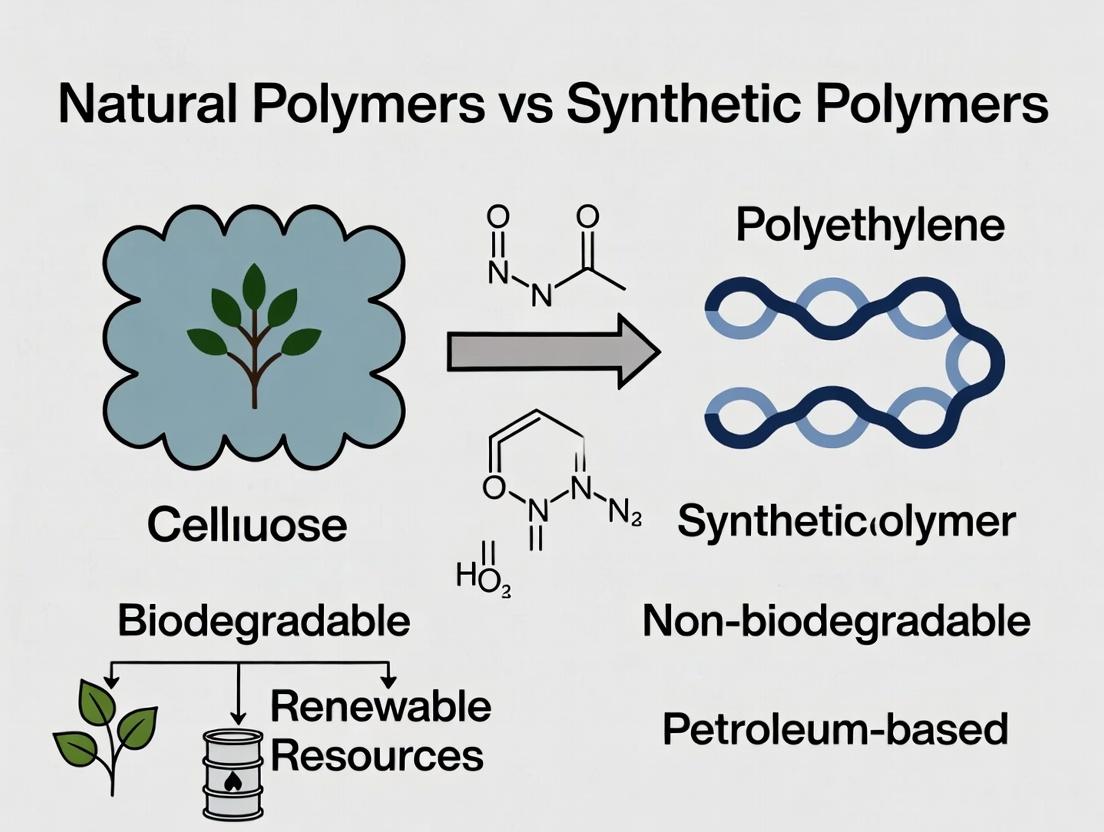
This article provides a detailed comparative analysis of natural and synthetic polymers, tailored for researchers, scientists, and drug development professionals.
Natural vs Synthetic Polymers in Drug Delivery: A 2024 Comprehensive Comparison for Biomedical Researchers
Abstract
This article provides a detailed comparative analysis of natural and synthetic polymers, tailored for researchers, scientists, and drug development professionals. It explores foundational definitions and sources, examines their methodological roles in formulation and controlled release, addresses key challenges in processing and biocompatibility, and validates performance through direct comparative metrics. The review synthesizes current trends to guide rational biomaterial selection for next-generation therapeutics.
Defining the Landscape: Sources, Structures, and Core Properties of Natural and Synthetic Polymers
Within the critical research discourse comparing natural and synthetic polymers, natural polymers are defined as macromolecules synthesized and derived from living organisms. Their investigation is pivotal for advancing sustainable, biocompatible, and functionally diverse materials for biomedical applications, most notably in drug delivery and tissue engineering. This whitepaper provides an in-depth technical guide to five key natural polymers, contextualizing their inherent properties, sourcing, and applications against the benchmark of synthetic alternatives like PLGA, PCL, and PEG.
Technical Deep Dive: Polysaccharides
Polysaccharides are carbohydrate polymers composed of monosaccharide units linked by glycosidic bonds.
Chitosan
- Source: Partial deacetylation of chitin, sourced from crustacean shells (shrimp, crab), insect exoskeletons, and fungal cell walls.
- Chemical Structure: Linear copolymer of β-(1→4)-linked D-glucosamine and N-acetyl-D-glucosamine.
- Key Properties: Cationic nature (unique among natural polymers), pH-dependent solubility, mucoadhesiveness, inherent antimicrobial activity, and biodegradability via lysozyme and bacterial enzymes.
- Primary Biomedical Applications: Hemostatic dressings, wound healing scaffolds, gene/drug delivery vectors (exploiting charge interaction with nucleic acids), and dietary supplements.
Alginate
- Source: Cell walls of brown seaweed (e.g., Laminaria, Macrocystis).
- Chemical Structure: Anionic linear copolymer of β-D-mannuronate (M) and α-L-guluronate (G) residues.
- Key Properties: Ability to form stable, ionotropic hydrogels in the presence of divalent cations (e.g., Ca²⁺, Ba²⁺) via the "egg-box" model, particularly with G-blocks. Gentle, aqueous gelation.
- Primary Biomedical Applications: Cell encapsulation, wound dressings (exudate absorption), 3D bioprinting bioinks, and oral drug delivery (protecting payloads from gastric acid).
Hyaluronic Acid (Hyaluronan)
- Source: Bacterial fermentation (Streptococcus zooepidemicus) and animal-derived tissues (rooster combs, umbilical cords).
- Chemical Structure: Linear, non-sulfated glycosaminoglycan composed of repeating disaccharide units of D-glucuronic acid and N-acetyl-D-glucosamine.
- Key Properties: High hydrophilicity and water retention, viscoelasticity, biodegradation by hyaluronidase, and specific interactions with cell surface receptors (CD44, RHAMM).
- Primary Biomedical Applications: Dermal fillers, osteoarthritis viscosupplementation, ocular surgery, and targeted drug delivery to CD44-overexpressing cancer cells.
Technical Deep Dive: Proteins
Proteins are polypeptide chains of amino acids, folding into complex secondary and tertiary structures that dictate function.
Collagen
- Source: Bovine/porcine skin & tendon, rat tail tendon, marine (fish skin & scales), and recombinant human collagen.
- Chemical Structure: Triple-helix structure composed of three polypeptide α-chains, rich in glycine, proline, and hydroxyproline. Type I is most prevalent.
- Key Properties: High tensile strength, biocompatibility, low immunogenicity (if atelocollagen is used), biodegradability via collagenases (MMPs), and innate cell-binding motifs (e.g., RGD sequences).
- Primary Biomedical Applications: Tissue engineering scaffolds (bone, skin, cornea), hemostats, cosmetic surgery, and drug delivery matrices.
Gelatin
- Source: Partial hydrolytic degradation (acidic or alkaline process) of native collagen.
- Chemical Structure: Denatured collagen, retaining some RGD sequences but lacking the triple-helix structure.
- Key Properties: Thermoresponsive gelation (cold-set gel), amphoteric nature depending on processing (Type A - acidic, isoelectric point ~9; Type B - basic, isoelectric point ~5), and excellent film-forming ability.
- Primary Biomedical Applications: Pharmaceutical capsule shells, hydrogel matrices for 3D cell culture, bioadhesives, and micro/nanoparticle drug carriers.
Silk (Silk Fibroin)
- Source: Bombyx mori silkworm cocoons. Spider silk is a research-grade alternative.
- Chemical Structure: Fibroin protein core with heavy and light chains, characterized by repetitive hydrophobic (GAGAGS) blocks forming anti-parallel β-sheet crystals.
- Key Properties: Exceptional mechanical strength and toughness, tunable biodegradation from weeks to years, processability into diverse formats (films, fibers, sponges, hydrogels), and minimal inflammatory response.
- Primary Biomedical Applications: Surgical sutures, load-bearing tissue engineering (ligament, bone), and advanced drug delivery systems.
Table 1: Key Properties of Featured Natural Polymers
| Polymer | Monomeric Unit(s) | Source (Typical) | Key Functional Properties | Primary Degradation Mechanism |
|---|---|---|---|---|
| Chitosan | D-glucosamine, N-acetyl-D-glucosamine | Crustacean shells | Cationic, mucoadhesive, antimicrobial | Enzymatic (lysozyme, chitosanase) |
| Alginate | β-D-mannuronate (M), α-L-guluronate (G) | Brown seaweed | Ionic crosslinking (Ca²⁺), high swelling | Ion exchange (loss of Ca²⁺), weak acid dissolution |
| Hyaluronic Acid | D-glucuronic acid, N-acetyl-D-glucosamine | Bacterial fermentation | Highly hydrophilic, CD44-receptor binding | Enzymatic (hyaluronidase) |
| Collagen | Amino acids (Gly-X-Y repeats) | Bovine/porcine, marine | Triple-helix, RGD motifs, high tensile strength | Enzymatic (collagenases, MMPs) |
| Gelatin | Amino acids (denatured collagen) | Hydrolyzed collagen | Thermoresponsive gelation, amphoteric | Enzymatic (proteases) |
| Silk Fibroin | Amino acids (GAGAGS repeats) | Silkworm cocoon | High tensile strength, β-sheet crystallinity | Proteolytic (slow) |
Table 2: Comparison of Natural vs. Synthetic Polymers in Key Research Parameters
| Parameter | Natural Polymers (e.g., Collagen, Alginate) | Synthetic Polymers (e.g., PLGA, PEG) |
|---|---|---|
| Source & Renewability | Renewable, biological sources. Batch-to-batch variability. | Petrochemical-based. Highly reproducible synthesis. |
| Biocompatibility | Generally excellent, low toxicity. Risk of immunogenicity/allergens. | Can be designed for high biocompatibility. Potential inflammatory by-products (acidic). |
| Bioactivity | Intrinsic (e.g., RGD, enzymatic degradation). | Typically inert; bioactivity must be conjugated. |
| Degradation | Enzymatic, metabolism-friendly. Rate can be variable. | Hydrolytic (predictable). Acidic by-products possible. |
| Mechanical Properties | Often limited, but tunable via processing/crosslinking. | Wide range, highly tunable during synthesis. |
| Processing | Can be sensitive to solvents, temperature, pH. | Robust, versatile processing conditions. |
| Cost | Variable; sourcing and purification can be expensive. | Often lower cost at scale; raw material price volatility. |
Experimental Protocols
Protocol: Ionotropic Gelation for Alginate Nanoparticle Synthesis
Aim: To prepare drug-loaded alginate nanoparticles for controlled release. Materials: Sodium alginate (low viscosity), calcium chloride (CaCl₂), drug (e.g., doxorubicin HCl), Tween 80, magnetic stirrer, sonicator. Method:
- Dissolve sodium alginate (0.2% w/v) in deionized water under magnetic stirring.
- Dissolve the drug in the alginate solution.
- Prepare a crosslinking solution of CaCl₂ (0.1% w/v) containing 0.01% Tween 80 as a stabilizer.
- Add the CaCl₂ solution dropwise (using a syringe pump at 0.5 mL/min) into the alginate-drug solution under constant sonication (probe sonicator, 80 W, on ice).
- Continue stirring for 60 minutes to allow nanoparticle hardening.
- Purify nanoparticles by centrifugation (15,000 rpm, 30 min, 4°C) and wash twice with deionized water.
- Resuspend in buffer for characterization (size by DLS, entrapment efficiency by HPLC).
Protocol: Solvent Casting for Chitosan/Gelatin Blend Films
Aim: To fabricate composite films for wound dressing applications. Materials: Chitosan (medium MW), gelatin (Type B), acetic acid (1% v/v), glycerol (plasticizer), Petri dish, drying oven. Method:
- Dissolve chitosan (2% w/v) in 1% acetic acid solution with stirring overnight.
- Separately, dissolve gelatin (4% w/v) in deionized water at 50°C.
- Mix chitosan and gelatin solutions at a 70:30 volume ratio. Add glycerol to 20% of total polymer weight.
- Stir the blend for 4 hours at 40°C.
- Pour the solution into a leveled Petri dish and allow to dry at 37°C for 48 hours.
- Neutralize the film by immersing in 1M NaOH for 30 seconds, followed by rinsing with distilled water.
- Dry the neutralized film at room temperature and cut into test specimens for mechanical (tensile) and swelling studies.
Signaling Pathway & Experimental Workflow Diagrams
Diagram 1: HA-CD44 Signaling in Drug Targeting
Diagram 2: Nanoparticle Synthesis Workflow
The Scientist's Toolkit: Research Reagent Solutions
| Item (Supplier Examples) | Function in Natural Polymer Research |
|---|---|
| Lysozyme (Sigma-Aldrich) | Enzyme used to study/enhance the biodegradation rate of chitosan-based materials. |
| Calcium Chloride (CaCl₂), Sigma | Divalent cation used as the crosslinking agent for alginate hydrogel and particle formation. |
| Hyaluronidase (from bovine testes, Merck) | Enzyme used to model or trigger the degradation of hyaluronic acid-based scaffolds or carriers. |
| Collagenase Type I/II (Worthington) | Enzymes for digesting collagen matrices in cell harvest or degradation kinetic assays. |
| MTT/Tetrazolium Salt (Thermo Fisher) | Reagent for assessing cell viability and proliferation on polymer scaffolds (cytocompatibility). |
| 1-Ethyl-3-(3-dimethylaminopropyl)carbodiimide (EDC), Thermo | Zero-length crosslinker for conjugating molecules or stabilizing protein/polysaccharide hydrogels. |
| RGD Peptide (Bachem) | Synthetic peptide used to functionalize polymers lacking intrinsic cell-adhesion motifs. |
| Fluorescein Isothiocyanate (FITC), Sigma | Fluorescent dye for labeling polymers to track cellular uptake or material distribution in vitro/vivo. |
Within the broader research thesis comparing natural and synthetic polymers, this technical guide focuses on the defining characteristics of key synthetic polymer families. Synthetic polymers, engineered for precise chemical structure and predictable properties, offer distinct advantages over their natural counterparts in the realm of drug delivery and biomedical applications. Their primary benefits include reproducible synthesis, tunable degradation kinetics, absence of immunological concerns (e.g., batch-to-batch variability, pathogen risk), and the ability to customize mechanical and physicochemical properties for specific applications. This document provides an in-depth examination of three pivotal families: polyesters, polyethers, and poly(anhydrides).
Polyesters
Polyesters are polymers containing ester functional groups (-COO-) in their main chain. They are widely used as biodegradable materials in drug delivery and tissue engineering.
Key Members:
- Poly(lactic-co-glycolic acid) (PLGA): A copolymer of lactic acid and glycolic acid. Its degradation rate, mechanical strength, and drug release profile can be finely tuned by altering the lactide:glycolide ratio, molecular weight, and end-group chemistry.
- Poly(lactic acid) (PLA): Derived from renewable resources like corn starch. It is more hydrophobic and degrades slower than PLGA, offering higher mechanical strength.
Experimental Protocol: In Vitro Degradation of PLGA Microparticles
- Microparticle Fabrication: Prepare PLGA microparticles using a double emulsion (W/O/W) solvent evaporation technique. Dissolve PLGA (e.g., 50:50 lactide:glycolide, IV 0.6 dL/g) in dichloromethane. Add an aqueous solution of the model drug to form the first emulsion (W/O) via probe sonication. Pour this emulsion into a poly(vinyl alcohol) (PVA) solution under stirring to form the W/O/W emulsion. Stir for 3 hours to evaporate the organic solvent.
- Degradation Study: Weigh accurately 20 mg of particles (W₀) and place them in 5 mL of phosphate-buffered saline (PBS, pH 7.4) in capped tubes.
- Incubation: Place tubes in a shaking water bath at 37°C and 100 rpm.
- Sampling: At predetermined time points (e.g., days 1, 3, 7, 14, 28), centrifuge tubes, remove the supernatant for analysis (pH, drug content, monomer release), and lyophilize the remaining particles.
- Analysis: Determine mass loss (Wt/W₀), monitor molecular weight change via Gel Permeation Chromatography (GPC), and observe morphology changes via Scanning Electron Microscopy (SEM).
Quantitative Data: Degradation & Properties of Common Polyesters
| Polymer | Glass Transition Temp. (Tg) °C | Degradation Time (Months) | Solubility in Common Solvents | Key Application |
|---|---|---|---|---|
| PLGA (50:50) | 45-50 | 1-2 | DCM, Chloroform, Acetone | Sustained release (weeks) |
| PLGA (75:25) | 50-55 | 4-5 | DCM, Chloroform | Longer-term delivery |
| PLA (PLLA) | 55-60 | 12-24 | DCM, Chloroform, Dioxane | Surgical sutures, scaffolds |
Polyethers
Polyethers are characterized by ether linkages (-C-O-C-) in their backbone. Poly(ethylene glycol) (PEG) is the most prominent member in biomedical science.
Key Member: Poly(ethylene glycol) (PEG) PEG is a hydrophilic, non-toxic, and non-immunogenic polymer. Its ability to confer "stealth" properties to nanoparticles and proteins by reducing opsonization and renal clearance is a cornerstone of modern drug delivery (PEGylation).
Experimental Protocol: PEGylation of a Protein Therapeutic
- Activation of PEG: Dissolve linear mPEG-NH₂ (e.g., 20 kDa) in anhydrous DMSO. Add a 5-fold molar excess of a heterobifunctional linker, such as succinimidyl carbonate (SC), and react for 2 hours under argon with stirring. Purify the activated PEG (mPEG-SC) via precipitation in cold diethyl ether.
- Conjugation: Dissolve the target protein (e.g., lysozyme) in a conjugation buffer (e.g., 0.1 M phosphate, pH 8.5). Slowly add a molar equivalent of activated mPEG-SC in buffer with gentle stirring.
- Reaction: Allow the reaction to proceed for 2 hours at 4°C.
- Purification: Separate PEGylated protein from unreacted PEG and native protein using size-exclusion chromatography (SEC) or ion-exchange chromatography.
- Characterization: Confirm conjugation and degree of PEGylation using MALDI-TOF mass spectrometry and SDS-PAGE.
Poly(anhydrides)
Poly(anhydrides) possess anhydride linkages (-CO-O-CO-) connecting monomer units. They are highly surface-eroding polymers, making them ideal for localized, zero-order drug delivery.
Degradation Mechanism: Unlike the bulk erosion of PLGA, poly(anhydrides) degrade primarily at the surface due to the high water lability of the anhydride bond and the inherent hydrophobicity of the polymer matrix. This leads to a more linear release profile.
Experimental Protocol: Synthesis of Poly(sebacic acid) (PSA)
- Monomers Preparation: Recrystallize sebacic acid from ethanol.
- Acetylation: React sebacic acid with acetic anhydride under reflux to form the mixed anhydride monomer (prepolymer).
- Melt Polycondensation: Place the prepolymer in a heated reaction vessel under vacuum (e.g., 180°C, <1 mmHg). Stir the molten mixture for 90 minutes.
- Polymer Recovery: After cooling, dissolve the crude polymer in dichloromethane and precipitate into a 10-fold excess of a cold petroleum ether/ether mixture.
- Characterization: Analyze molecular weight by GPC and confirm structure by ¹H-NMR spectroscopy in CDCl₃.
Quantitative Data: Comparison of Synthetic Polymer Families
| Property | Polyesters (PLGA) | Polyethers (PEG) | Poly(anhydrides) (PSA) |
|---|---|---|---|
| Degradation Mechanism | Bulk Erosion | Non-degradable (Low MW) / Slow | Surface Erosion |
| Typical Degradation Time | Weeks to Years | Stable or Months-Years | Days to Weeks |
| Hydrophilicity | Moderate to High | Very High | Low to Moderate |
| Drug Release Profile | Biphasic (burst then diffusion/erosion) | Diffusion-controlled | Near Zero-Order (surface erosion) |
| Key Advantage | Tunable degradation, FDA history | Stealth, solubility enhancement | Linear release, local delivery |
Mandatory Visualizations
Diagram Title: Bulk vs Surface Erosion Mechanisms
Diagram Title: Polymer Selection Logic for Drug Delivery
The Scientist's Toolkit: Key Research Reagent Solutions
| Reagent / Material | Function & Explanation |
|---|---|
| PLGA (50:50, acid-terminated) | Benchmark biodegradable polymer. Acid end groups accelerate degradation. Used for microparticle/nanoparticle fabrication. |
| mPEG-NHS Ester (MW 5k-20k) | Activated PEG for facile conjugation to primary amines on proteins or peptide drugs, enabling PEGylation. |
| Sebacic Acid | Monomer for synthesizing the model poly(anhydride) poly(sebacic acid) (PSA), enabling surface-eroding delivery systems. |
| Poly(Vinyl Alcohol) (PVA) | Common surfactant/stabilizer used in the emulsification steps for preparing polyester microparticles and nanoparticles. |
| Dichloromethane (DCM) | Volatile organic solvent of choice for dissolving PLGA/PLA in emulsion-based particle formation techniques. |
| Phosphate Buffered Saline (PBS) | Standard aqueous medium for in vitro degradation, release, and biocompatibility testing (simulates physiological pH). |
| Size Exclusion Chromatography (SEC) Columns | For purifying and analyzing PEGylated conjugates and separating polymers by hydrodynamic volume. |
| Gel Permeation Chromatography (GPC) System | Equipped with refractive index and multi-angle light scattering detectors to determine absolute molecular weight and distribution of synthetic polymers. |
Within the broader thesis of Natural Polymers vs. Synthetic Polymers comparison research, this technical guide provides a foundational framework for understanding the core differences in monomer origin, strategies for molecular weight (MW) control, and the resulting structural uniformity. These parameters are critical determinants of polymer performance in applications ranging from biomaterials to drug delivery systems.
Monomer Origin: Biosynthesis vs. Petrochemical Synthesis
The origin of a polymer's monomeric units dictates its inherent chemical functionality, stereochemistry, and potential impurities.
Natural Polymer Monomers: Derived from living organisms via enzymatic biosynthesis. Examples include amino acids (proteins), nucleotides (nucleic acids), monosaccharides (polysaccharides), and isoprene units (natural rubber). These monomers are often chiral, leading to highly stereoregular polymers.
Synthetic Polymer Monomers: Primarily sourced from petrochemical feedstocks through cracking and catalytic reforming. Common monomers include ethylene, propylene, styrene, vinyl chloride, and terephthalic acid. They are typically achiral or exist as racemic mixtures, requiring catalysts to induce stereoregularity.
Key Experimental Protocol for Monomer Analysis:
- Protocol Title: Identification and Purity Analysis of Monomers from Natural vs. Synthetic Sources.
- Methodology:
- Extraction/Purification: For natural monomers (e.g., amino acids from protein hydrolysate), use acid hydrolysis (6M HCl, 110°C, 24h under vacuum) followed by solid-phase extraction. For synthetic monomers, use fractional distillation.
- Analysis: Analyze purified monomers using:
- Chiral High-Performance Liquid Chromatography (HPLC): To determine enantiomeric excess (critical for natural monomers).
- Gas Chromatography-Mass Spectrometry (GC-MS): To profile purity and identify organic impurities or residual solvents.
- Nuclear Magnetic Resonance (NMR) Spectroscopy: (¹H, ¹³C) for definitive structural confirmation and quantification of isomers.
Molecular Weight Control: Dispersity and Its Implications
Control over molecular weight and its distribution (Đ, dispersity) is a fundamental differentiator.
Natural Polymers: MW is controlled by template-directed (nucleic acids) or enzyme-directed (proteins, polysaccharides) biosynthesis. This offers precise chain length for a given gene or enzyme system but can still yield distributions due to post-synthetic modifications or degradation during isolation. Dispersity (Đ) is often low (e.g., ~1.0 for monodisperse proteins).
Synthetic Polymers: MW is controlled by reaction kinetics, stoichiometry, and mechanisms of chain growth (e.g., free-radical, ionic, coordination) or step-growth polymerization. Advanced techniques like living/controlled radical polymerization (ATRP, RAFT) allow for lower Đ. MW averages (Mn, Mw) and Đ are key specifications.
Key Experimental Protocol for MW Determination:
- Protocol Title: Determination of Molecular Weight Averages and Dispersity via Gel Permeation Chromatography (GPC/SEC).
- Methodology:
- Sample Preparation: Dissolve polymer (natural or synthetic) in appropriate eluent (e.g., DMF with LiBr for polar polymers, THF for non-polar) at 2-5 mg/mL. Filter through 0.2 μm PTFE syringe filter.
- System Calibration: Use narrow dispersity polystyrene (or polymer-specific) standards to create a calibration curve of log(MW) vs. retention time.
- Chromatography: Inject sample into the GPC system (isocratic pump, columns series, refractive index detector). Use known flow rate and column temperature.
- Data Analysis: Use software to calculate number-average (Mn), weight-average (Mw) molecular weights, and dispersity (Đ = Mw/Mn) from the chromatogram relative to the calibration curve. For natural polymers like proteins, use Multi-Angle Light Scattering (MALS) detection for absolute MW.
Structural Uniformity: Tacticity, Sequence, and Branching
Structural uniformity encompasses tacticity, monomer sequence, and architecture.
Natural Polymers: Exhibit high uniformity. Proteins have a perfectly defined amino acid sequence (primary structure). Nucleic acids have a defined nucleotide sequence. Polysaccharides like cellulose are linear and stereoregular, while some like glycogen are branched at specific points.
Synthetic Polymers: Uniformity varies. Tacticity (isotactic, syndiotactic, atactic) is controlled by catalysts. Monomer sequence in copolymers can be random, alternating, or block (controlled by polymerization technique). Branching can be uncontrolled (e.g., LDPE) or precisely controlled (e.g., dendrimers).
Key Experimental Protocol for Tacticity/Sequence Analysis:
- Protocol Title: Determination of Polymer Microstructure by ¹³C NMR Spectroscopy.
- Methodology:
- Sample Preparation: Dissolve 20-50 mg of polymer in 0.6 mL of deuterated solvent (e.g., CDCl₃, DMSO-d6).
- NMR Acquisition: Acquire quantitative ¹³C NMR spectrum using inverse-gated decoupling to suppress Nuclear Overhauser Effect (NOE), with a long relaxation delay (≥5 times T1) to ensure accurate integration.
- Spectral Analysis: Identify resonances corresponding to backbone or side-chain carbons sensitive to tacticity (e.g., methine carbon in poly(methyl methacrylate) or methylene carbon in polypropylene). Integrate peaks corresponding to isotactic (mm), syndiotactic (rr), and heterotactic (mr) sequences.
- Calculation: Calculate tacticity triad fractions: [mm], [mr], [rr]. For copolymers, analyze sequence distribution via dyad or triad probabilities.
Table 1: Core Comparison of Polymer Classes
| Parameter | Natural Polymers (e.g., Collagen, Cellulose) | Synthetic Polymers (e.g., Polyethylene, PLA) |
|---|---|---|
| Monomer Origin | Renewable biological feedstocks. Chiral, functionalized. | Primarily petrochemicals. Often achiral. |
| MW Control | Enzyme/template-defined. Often monodisperse (Đ ~1.01-1.1). | Kinetic/stoichiometric control. Dispersity varies (Đ ~1.05-2.0+). |
| Structural Uniformity | Perfect sequence control (proteins). Defined stereochemistry. | Sequence & tacticity controlled by process. Can be tailored. |
| Typical Đ Range | 1.0 - 1.5 | 1.1 - 3.0 (Standard: 1.5-2.0; Controlled: 1.05-1.3) |
| Key Characterization Tools | MALDI-TOF, SEC-MALS, Edman Sequencing, Enzymatic Assays | GPC/SEC, NMR, DSC, TGA |
Table 2: Common Polymerization Techniques & Resulting Parameters
| Technique | Mechanism | MW Control | Typical Đ | Structural Uniformity |
|---|---|---|---|---|
| Free Radical | Chain-growth, random termination. | Moderate (by initiator, temp). | 1.5 - 2.5 | Low (atactic, random branching). |
| Anionic (Living) | Chain-growth, no termination. | High (by monomer/initiator ratio). | 1.01 - 1.1 | High (tacticity control possible, block copolymers). |
| RAFT | Controlled chain-growth, reversible chain transfer. | High (by ratio, conversion). | 1.1 - 1.3 | Moderate-High (functional, block copolymers). |
| Polycondensation | Step-growth, reversible. | Low-Moderate (by stoichiometry, conversion). | 2.0+ (often) | Low (random sequence in copolymers). |
| Enzymatic (Biosynthesis) | Template/Enzyme-directed. | Precise (genetically defined). | ~1.0 (ideal) | Very High (perfect sequence, stereochemistry). |
Visualizations
The Scientist's Toolkit: Research Reagent Solutions
| Item | Function & Relevance |
|---|---|
| Narrow Dispersity Polymer Standards (e.g., PS, PMMA) | Calibrants for GPC/SEC to establish log(MW) vs. retention time relationship for accurate MW determination of unknown samples. |
| Deuterated NMR Solvents (e.g., CDCl₃, DMSO-d₆) | Provide a stable lock signal and minimal interference in NMR spectra for high-resolution polymer microstructure analysis. |
| RAFT Chain Transfer Agent (e.g., CPDB) | Enables controlled radical polymerization, lowering Đ and allowing block copolymer synthesis. Key for mimicking natural polymer uniformity. |
| Protease/Kinase for Natural Polymer Digestion (e.g., Trypsin) | Enzymatically cleaves natural polymers (proteins) into defined fragments for sequencing (MS) or monomer analysis (HPLC). |
| Anionic Initiator (e.g., sec-BuLi) | Used in living anionic polymerization to achieve near-monodisperse synthetic polymers with active chain ends for block copolymerization. |
| Chiral HPLC Column (e.g., Amylose-based) | Separates enantiomers of monomers or analyzes tacticity of polymer hydrolyzates, critical for comparing natural (chiral pure) vs. synthetic sources. |
| MALS Detector (for GPC/SEC) | Provides absolute molecular weight measurement independent of column calibration, essential for natural polymers (e.g., branched polysaccharides). |
Thesis Context: This whitepaper, framed within a broader research thesis comparing natural and synthetic polymers, dissects the core material philosophies of inherent biocompatibility, championed by natural polymers, versus engineered tunable degradation, a hallmark of advanced synthetics. These paradigms are critical for researchers and drug development professionals designing next-generation biomaterials.
Core Philosophies and Material Foundations
The selection between natural and synthetic polymers hinges on a fundamental trade-off: accepting the inherent, often optimal but fixed, biological properties of nature versus engineering precisely controlled, customizable material behavior.
- Inherent Biocompatibility (Natural Polymer Paradigm): This philosophy leverages polymers derived from the extracellular matrix (e.g., collagen, hyaluronic acid) or other biological sources (e.g., chitosan, alginate). Their biocompatibility stems from native ligand sequences (e.g., RGD in fibronectin) recognized by cell surface integrins, which minimize foreign body reactions. Their degradation is primarily enzymatic (e.g., matrix metalloproteinases, hyaluronidases), is often cell-mediated, and produces natural metabolites. However, their degradation rates, mechanical properties, and batch-to-batch consistency are difficult to control.
- Tunable Degradation (Synthetic Polymer Paradigm): This approach utilizes polymers (e.g., PLGA, PCL, PEG-based hydrogels) synthesized from controlled chemical reactions. Biocompatibility is engineered through surface modification, protein repellence (e.g., using PEG), or the incorporation of bio-recognizable motifs. The core advantage is the precise tuning of degradation kinetics—achieved by modulating copolymer ratios (e.g., PLA:PGA in PLGA), crosslink density, or hydrolytically labile bond concentration—to match specific tissue regeneration or drug release timelines.
Table 1: Quantitative Comparison of Representative Polymers
| Polymer (Example) | Type | Degradation Time (Typical Range) | Key Degradation Mechanism | Tensile Modulus (Approx. Range) | Primary Bioactivity Source |
|---|---|---|---|---|---|
| Collagen Type I | Natural | Weeks to Months | Enzymatic (MMP) cleavage | 0.5 - 8 GPa (dense tissue) | Inherent RGD sequences, integrin binding |
| Hyaluronic Acid | Natural | Days to Weeks | Enzymatic (Hyaluronidase) | 0.01 - 0.1 MPa (hydrogel) | CD44 receptor interaction, space-filling |
| PLGA (50:50) | Synthetic | 1-2 Months | Hydrolytic ester cleavage | 1 - 4 GPa (solid) | Engineered via surface conjugation or blending |
| Polycaprolactone (PCL) | Synthetic | >24 Months | Hydrolytic ester cleavage | 0.2 - 0.5 GPa (solid) | Requires functionalization for bioactivity |
| PEG Hydrogel | Synthetic | Days to Months* | Hydrolytic or enzymatic* | 0.001 - 0.1 MPa (hydrogel) | "Blank slate," requires deliberate modification |
* Highly tunable via crosslinker chemistry (e.g., MMP-sensitive peptides). Highly variable based on implant site and enzymatic activity.
Experimental Protocols for Key Evaluations
Protocol 1:In VitroDegradation Kinetics Profiling
Objective: Quantify mass loss and erosion products of natural vs. synthetic polymer scaffolds under simulated physiological conditions.
- Scaffold Fabrication: Prepare sterile, pre-weighed (W₀) discs (e.g., 5mm diameter x 2mm thick) of collagen hydrogel and PLGA via solvent casting/salt leaching.
- Buffer Incubation: Immerse samples (n=5 per group) in 1 mL of phosphate-buffered saline (PBS, pH 7.4) at 37°C. For natural polymers, include a parallel set in PBS containing 100 ng/mL collagenase (for collagen) or hyaluronidase (for HA).
- Sampling: At predetermined timepoints (e.g., days 1, 3, 7, 14, 28), remove samples. Rinse with deionized water and lyophilize.
- Mass Loss Measurement: Weigh dried samples (Wₜ). Calculate percentage mass remaining: (Wₜ / W₀) * 100%.
- Product Analysis: Analyze incubation buffer via HPLC or mass spectrometry to identify and quantify degradation products (e.g., lactic/glycolic acid for PLGA, amino acids for collagen).
Protocol 2: Integrin-Mediated Cell Adhesion Assay
Objective: Compare inherent (natural polymer) vs. engineered (synthetic polymer) cell adhesion mechanisms.
- Surface Preparation: Coat 96-well plates with: (A) Native collagen I (50 µg/mL), (B) PLGA film, (C) PLGA film conjugated with RGD peptide (0.5 mM), (D) PEG hydrogel.
- Cell Seeding: Serum-starve human fibroblasts for 24 hours. Harvest and resuspend in serum-free media. Seed 10,000 cells per well.
- Inhibition Control: Pre-treat a subset of cells with 1 mM RGDS peptide (competitive inhibitor) or an anti-β1 integrin blocking antibody (10 µg/mL) for 30 minutes.
- Adhesion Phase: Incubate plates at 37°C for 90 minutes.
- Quantification: Gently wash wells with PBS to remove non-adherent cells. Fix, stain with crystal violet, solubilize, and measure absorbance at 570 nm. Normalize adhesion to the native collagen control group.
Signaling Pathways in Polymer-Host Interaction
Experimental Workflow for Comparative Biomaterial Study
The Scientist's Toolkit: Essential Research Reagent Solutions
| Item | Function in Research | Example Use-Case |
|---|---|---|
| Recombinant Human Collagen, Type I | Provides a consistent, pathogen-free natural polymer standard with inherent bioactivity. | Coating plates for cell adhesion controls; forming 3D hydrogels for migration studies. |
| PLGA Resin (Various LA:GA Ratios) | Enables study of hydrolytic degradation tunability. | Fabricating microspheres for controlled drug release kinetics experiments. |
| RGD-SPDP Crosslinking Kit | Allows covalent conjugation of integrin-binding peptides to synthetic polymers (e.g., PEG). | Engineering cell-adhesiveness into otherwise inert synthetic hydrogels. |
| Matrix Metalloproteinase 2 (MMP-2) | Enzyme to simulate in vivo degradation of natural polymer scaffolds (collagen, gelatin). | In vitro degradation studies of MMP-sensitive crosslinked hydrogels. |
| Anti-Integrin β1 Blocking Antibody | Tool to inhibit specific cell adhesion pathways and probe mechanism. | Confirming integrin-mediated adhesion on natural polymers or RGD-modified synthetics. |
| AlamarBlue or MTS Assay Kit | Colorimetric/fluorometric measurement of cell viability and proliferation on materials. | Quantifying cytocompatibility of polymer leachables or 3D scaffold cultures. |
| LIVE/DEAD Viability/Cytotoxicity Kit | Dual fluorescence staining to visualize live vs. dead cells on material surfaces. | Assessing acute cytotoxicity and cell distribution within a scaffold after seeding. |
This whitepaper examines the evolution of medical polymers within the critical framework of natural versus synthetic polymer research. The central thesis posits that while first-generation materials were defined by a dichotomy between naturally-derived and purely synthetic systems, modern advances are driven by the intentional hybridization of these classes to create "smart" materials with superior biocompatibility, functionality, and responsiveness. The convergence leverages the bioactive cues of natural polymers with the tunable mechanical and chemical properties of synthetics, enabling next-generation diagnostics, drug delivery, and tissue engineering.
Table 1: Comparison of Key Properties Across Polymer Generations
| Generation | Era | Example Materials (Natural) | Example Materials (Synthetic) | Key Characteristics | Primary Medical Applications |
|---|---|---|---|---|---|
| First | 1960s-1980s | Catgut suture, Cellulose dialysis membranes | Polyethylene (PE), Poly(methyl methacrylate) (PMMA), Poly(vinyl chloride) (PVC) | Bioinert, stable, minimal functionality. Often evoked foreign body response. | Sutures, basic implants, tubing, dialysis. |
| Second | 1980s-2000s | Collagen sponges, Hyaluronic acid fillers, Alginate microcapsules | Poly(lactic-co-glycolic acid) (PLGA), Poly(ethylene glycol) (PEG), Polyurethanes | Designed biodegradability, controlled drug release, improved biocompatibility. | Resorbable sutures, controlled release systems, contact lenses, hydrogels. |
| Third (Smart Hybrids) | 2000s-Present | Engineered silk-elastin-like proteins, Chitosan-graft copolymers | Poly(N-isopropylacrylamide) (pNIPAM), Conducting polymers (PEDOT:PSS), Shape-memory polymers | Stimuli-responsive (pH, temp, enzyme, light), bioactive, conductive, self-healing, hybrid structures. | Targeted drug delivery, bioactive scaffolds, biosensors, neural interfaces, organ-on-a-chip. |
Table 2: Representative Quantitative Data: Natural vs. Synthetic vs. Hybrid Polymers
| Polymer Type | Specific Example | Degradation Time (Typical Range) | Tensile Strength (MPa) | Elastic Modulus (GPa) | Key Advantage | Key Limitation |
|---|---|---|---|---|---|---|
| Natural | Collagen (Type I) | Weeks - Months (enzyme-dependent) | 0.5 - 5 | 0.001 - 0.2 | Inherent cell adhesion, biodegradable | Poor mechanical strength, batch variability |
| Natural | Chitosan | Months - Years (pH-dependent) | 20 - 60 | 0.5 - 2.5 | Antimicrobial, mucoadhesive | Brittle when dry, slow degradation |
| Synthetic | PLGA (50:50) | 1 - 6 Months (hydrolysis) | 40 - 70 | 1.9 - 2.4 | Tunable degradation, high strength | Acidic degradation products, hydrophobic |
| Synthetic | PEG | Non-degradable to years | Low | Very Low | "Stealth" properties, highly hydrophilic | Non-adhesive, lacks functionality |
| Hybrid | PLGA-PEG-PLGA Triblock | Weeks - Months | 10 - 30 | 0.1 - 0.5 | Thermo-responsive gelation, improved drug solubility | Complex synthesis |
| Hybrid | Gelatin Methacryloyl (GelMA) | Days - Weeks (photo/ enzyme) | 0.1 - 1.5 | 0.001 - 0.03 | Photocrosslinkable, cell-responsive RGD sites | UV crosslinking can be cytotoxic |
Experimental Protocols for Key Hybrid Material Characterization
Protocol 3.1: Synthesis and Characterization of an Enzyme-Responsive Hybrid Hydrogel
Objective: To synthesize a hydrogel composed of hyaluronic acid (HA, natural) crosslinked with a peptide sequence degradable by matrix metalloproteinases (MMPs) and grafted with poly(ethylene glycol) (PEG, synthetic) for controlled stiffness and drug release.
Materials:
- Hyaluronic acid (MW: 100 kDa)
- PEG-diacrylate (PEGDA, MW: 3.4 kDa)
- MMP-sensitive peptide (sequence: GPQG↓IWGQ, where ↓ indicates cleavage site)
- Acrylated peptide-PEG conjugate
- Photoinitiator (Irgacure 2959)
- Phosphate Buffered Saline (PBS, pH 7.4)
- Recombinant MMP-2 enzyme
Method:
- Functionalization: Dissolve HA in MES buffer (pH 6.0). Activate carboxylic acid groups on HA using EDC/NHS chemistry. React with adipic acid dihydrazide to form HA-hydrazide.
- Conjugation: React the HA-hydrazide with the aldehyde group of the acrylated peptide-PEG conjugate via hydrazone bond formation. Purify via dialysis.
- Hydrogel Formation: Prepare a pre-gel solution containing 2% (w/v) functionalized HA-PEG conjugate and 0.05% (w/v) photoinitiator in PBS. Pipette into a mold and expose to 365 nm UV light (10 mW/cm²) for 60 seconds for radical crosslinking via acrylate groups.
- Swelling/Degradation Analysis: Weigh dry hydrogel discs (Ws). Swell in PBS at 37°C to equilibrium (Weq). Calculate swelling ratio (Q = Weq/Ws). For degradation, incubate in PBS containing 100 ng/mL MMP-2. Measure remaining mass over time.
- Drug Release Study: Load a model drug (e.g., fluorescein isothiocyanate-dextran) into the pre-gel solution. After gelation, incubate in release medium (PBS ± MMP-2). Sample medium periodically and analyze via fluorometry.
Protocol 3.2: Evaluating Cellular Response to a Natural-Synthetic Electrospun Scaffold
Objective: To assess the adhesion and differentiation of mesenchymal stem cells (MSCs) on aligned nanofibrous scaffolds made from a blend of polycaprolactone (PCL, synthetic) and gelatin (natural).
Materials:
- Polycaprolactone (PCL, MW 80 kDa)
- Gelatin (Type A, from porcine skin)
- Hexafluoro-2-propanol (HFIP)
- Electrospinning apparatus
- Human Bone Marrow-derived MSCs
- Osteogenic differentiation medium (β-glycerophosphate, ascorbic acid, dexamethasone)
- AlamarBlue assay reagent, Phalloidin (actin stain), DAPI (nuclear stain)
Method:
- Scaffold Fabrication: Prepare a 10% (w/v) polymer solution in HFIP with a PCL:Gelatin ratio of 70:30. Load into a syringe with a 21G blunt needle. Electrospin at 15 kV, with a flow rate of 1.0 mL/h and a collection distance of 15 cm onto a rotating mandrel (2000 rpm) to create aligned fibers.
- Sterilization & Pre-conditioning: Crosslink scaffolds with glutaraldehyde vapor to stabilize gelatin. Sterilize under UV light for 1 hour per side. Rinse extensively with sterile PBS and culture medium.
- Cell Seeding: Seed MSCs onto scaffolds at a density of 10,000 cells/cm². Allow to adhere for 2 hours before adding complete medium.
- Proliferation Assay: At days 1, 3, and 7, incubate scaffolds in 10% AlamarBlue reagent for 3 hours. Measure fluorescence (Ex560/Em590) of the medium to quantify metabolic activity.
- Immunofluorescence & Differentiation: At day 7, fix cells, permeabilize, and stain actin cytoskeleton with Phalloidin and nuclei with DAPI. Image using confocal microscopy to assess cell alignment. For osteogenesis, culture in osteogenic medium for 21 days. Perform alizarin red staining to visualize calcium deposits.
Visualizing Concepts and Workflows
Diagram 1: Evolutionary Pathway of Medical Polymers
Diagram 2: Synthesis of an Enzyme-Responsive Hybrid Hydrogel
The Scientist's Toolkit: Key Research Reagent Solutions
Table 3: Essential Materials for Polymer Hybrid Research
| Reagent / Material Category | Specific Example(s) | Primary Function in Research | Key Consideration for Natural vs. Synthetic |
|---|---|---|---|
| Natural Polymer Base | Hyaluronic Acid (various MW), Chitosan (various DA%), Gelatin, Collagen (Type I), Alginate (high/low G), Silk Fibroin | Provides bioactivity, enzymatic degradation sites, and inherent cell-interactive motifs. | Source (animal, microbial), batch-to-batch variability, degree of purity/ endotoxin levels. |
| Synthetic Polymer / Monomer | PEG-diacrylate (PEGDA), PLGA, N-Isopropylacrylamide (NIPAM), Caprolactone, EDOT (for PEDOT) | Imparts controllable mechanical properties, enables radical polymerization, adds stimuli-responsiveness (thermo, electro). | Purity, molecular weight distribution, end-group functionality, presence of toxic catalysts. |
| Crosslinker / Conjugation Agent | EDC/NHS, Glutaraldehyde, Genipin, Methacrylic anhydride (for GelMA), Tetrazine/trans-cyclooctene (bioorthogonal) | Creates covalent bonds between polymer chains or between natural and synthetic components. | Reaction efficiency, specificity, potential cytotoxicity of crosslinker or byproducts. |
| Stimuli-Responsive Element | MMP-sensitive peptides, pH-sensitive linkers (e.g., hydrazone), Azobenzene (light-sensitive), Disulfide bonds (redox-sensitive) | Confers "smart" behavior, allowing material breakdown or property change in response to biological cues. | Cleavage kinetics, stability in circulation, specificity for the target stimulus. |
| Characterization & Assay Kits | AlamarBlue/CCK-8 (viability), Picogreen (DNA quant.), Alizarin Red (osteogenesis), Sulfated GAG assay (chondrogenesis) | Quantifies cellular response (proliferation, differentiation) to the polymer hybrid material. | Assay compatibility with polymer leachates or degradation products (interference). |
From Lab to Clinic: Formulation Strategies and Targeted Applications in Drug Delivery
This technical guide is framed within a comparative research thesis on natural versus synthetic polymers for biomedical applications. The selection of a fabrication technique is intrinsically linked to the polymer class, each offering distinct advantages and limitations. Natural polymers (e.g., collagen, chitosan, alginate, silk fibroin) provide inherent biocompatibility and bioactivity but suffer from batch variability and limited mechanical strength. Synthetic polymers (e.g., PLGA, PCL, PLA, PEG) offer tunable mechanical properties and reproducible degradation rates but may lack cell-interactive motifs. This document provides an in-depth analysis of three pivotal techniques—Electrospinning, Nanoprecipitation, and 3D Bioprinting—detailing their adaptation for both polymer classes.
Electrospinning
Electrospinning uses a high-voltage electric field to draw a polymer solution into micro- to nanoscale fibers, creating highly porous scaffolds ideal for tissue engineering.
Core Principle & Parameters
A polymer solution is extruded through a needle. A high voltage (typically 10-30 kV) is applied, inducing charge repulsion that overcomes surface tension, forming a Taylor cone. A jet is ejected and whipped, undergoing stretching and solvent evaporation before fibers are collected on a grounded collector.
Key Parameters:
- Solution Properties: Polymer concentration (viscosity), solvent volatility, conductivity.
- Process Parameters: Applied voltage, flow rate, needle-to-collector distance.
- Environmental Conditions: Temperature, humidity.
Protocol: Comparative Electrospinning of PLGA and Silk Fibroin
Objective: Fabricate fibrous scaffolds for dermal tissue regeneration.
Materials:
- Polymers: Synthetic: PLGA (85:15, MW ~100kDa). Natural: Silk fibroin (degummed Bombyx mori cocoons).
- Solvents: PLGA: Hexafluoroisopropanol (HFIP). Silk fibroin: 9.3 M LiBr solution (for dissolution), followed by dialysis against water.
- Equipment: Electrospinning unit with syringe pump, high-voltage power supply, grounded collector (flat or rotating mandrel), environmental chamber.
Methodology:
- Solution Preparation:
- PLGA: Dissolve PLGA pellets in HFIP at 12% (w/v) concentration. Stir for 12 hours at room temperature until homogeneous.
- Silk Fibroin: Dissolve degummed silk in 9.3 M LiBr at 60°C for 4 hours. Dialyze against deionized water for 72 hours using a 3.5 kDa MWCO membrane. Concentrate the aqueous solution to ~20% (w/v) by air flow.
- Electrospinning Setup:
- Load solution into a glass syringe with a blunt metallic needle (Gauge 21).
- Set syringe pump flow rate to 1.0 mL/h.
- Set needle-to-collector distance to 15 cm.
- Apply a positive voltage of 18 kV to the needle.
- Use a flat aluminum foil-covered collector.
- Maintain ambient conditions at 25°C and 40% RH.
- Post-processing:
- PLGA: Vacuum-dry scaffolds for 48 hours to remove residual solvent.
- Silk Fibroin: Treat scaffolds with methanol for 30 minutes to induce β-sheet formation (water-insolubilization). Air dry.
Table 1: Electrospinning Parameters and Outcomes for Representative Polymers
| Parameter / Outcome | Synthetic Polymer (PLGA) | Natural Polymer (Silk Fibroin) |
|---|---|---|
| Typical Solvent | HFIP, Chloroform/DMF | Aqueous, Formic Acid |
| Concentration Range | 8-15% (w/v) | 15-30% (w/v) |
| Optimal Voltage | 15-25 kV | 18-28 kV |
| Average Fiber Diameter | 300 ± 150 nm | 800 ± 300 nm |
| Scaffold Porosity | 85-95% | 70-90% |
| Key Post-Processing Step | Solvent Evacuation | Solvent-Induced Crystallization |
| Tensile Strength (MPa)* | 5.2 ± 1.1 | 8.5 ± 2.3 |
| Degradation (Mass Loss) | ~80% in 8 weeks (PBS, 37°C) | ~15% in 8 weeks (Collagenase) |
| *Representative data for optimized mats. |
Diagram 1: Electrospinning Workflow Logic.
Nanoprecipitation
Nanoprecipitation (or solvent displacement) is a facile, one-step method for producing polymeric nanoparticles (NPs), widely used for drug delivery.
Core Principle & Parameters
It is based on the interfacial deposition of a polymer following the displacement of a semi-polar solvent (e.g., acetone) miscible with water from a lipophilic solution. Rapid diffusion of the solvent into the non-solvent (water) reduces interfacial tension, causing spontaneous nanoparticle formation.
Key Parameters:
- Solvent/Non-solvent Pair: Miscibility, polarity.
- Polymer Concentration: Influences NP size and polydispersity.
- Volume Ratios: Organic-to-aqueous phase ratio.
- Mixing Method & Rate: Magnetic stirring vs. pipette dropping vs. microfluidics.
Protocol: PLGA and Chitosan Nanoparticle Formation
Objective: Synthesize drug-loaded nanoparticles for intravenous delivery.
Materials:
- Polymers: Synthetic: PLGA (50:50, carboxylate-terminated). Natural: Chitosan (low MW, deacetylated >85%).
- Solvents: PLGA: Acetone. Chitosan: Acetic acid aqueous solution (1% v/v) + Sodium Tripolyphosphate (TPP) cross-linker.
- Drug Model: Doxorubicin hydrochloride (hydrophilic) / Curcumin (hydrophobic).
- Equipment: Magnetic stirrer, syringe & needle (Gauge 26 optional), centrifugation equipment, dialysis membrane.
Methodology: A. PLGA NPs (for hydrophobic drug):
- Dissolve PLGA (50 mg) and Curcumin (5 mg) in 5 mL of acetone (organic phase).
- Prepare 20 mL of 0.5% (w/v) polyvinyl alcohol (PVA) aqueous solution (aqueous phase).
- Under moderate magnetic stirring (600 rpm), inject the organic phase into the aqueous phase using a syringe, dropwise over 1 minute.
- Stir for 4 hours to allow complete solvent evaporation and NP hardening.
- Centrifuge at 20,000 x g for 30 minutes. Wash pellet with water twice to remove PVA. Resuspend in buffer.
B. Chitosan NPs (via Ionic Gelation, for hydrophilic drug):
- Dissolve chitosan (20 mg) in 10 mL of 1% acetic acid solution. Add Doxorubicin (2 mg) to this solution (A).
- Prepare a 1 mg/mL solution of Sodium TPP in deionized water (B).
- Under magnetic stirring (500 rpm), add solution B (3 mL) dropwise to solution A (10 mL) over 3 minutes.
- Continue stirring for 30 minutes. NPs form spontaneously via electrostatic cross-linking.
- Centrifuge at 15,000 x g for 20 minutes. Wash and resuspend.
Table 2: Nanoprecipitation Parameters and Outcomes for Representative Polymers
| Parameter / Outcome | Synthetic Polymer (PLGA) | Natural Polymer (Chitosan) |
|---|---|---|
| Core Method | Solvent Displacement | Ionic Gelation |
| Organic Solvent | Acetone, THF | Aqueous Acid (Acetic Acid) |
| Aqueous Phase | Water with Stabilizer (e.g., PVA) | Cross-linker Solution (e.g., TPP) |
| Typical Polymer Concentration | 1-10 mg/mL | 0.5-2 mg/mL |
| Mixing Method | Dropwise Injection / Microfluidics | Dropwise Injection |
| Average Particle Size (nm) | 150 ± 40 | 200 ± 60 |
| Polydispersity Index (PDI) | 0.08 - 0.2 | 0.1 - 0.3 |
| Zeta Potential (mV)* | -25 to -40 | +30 to +60 |
| Drug Loading Capacity | High for hydrophobic drugs | High for hydrophilic/charged drugs |
| *pH-dependent. PLGA: negative (COOH); Chitosan: positive (NH₃⁺). |
Diagram 2: Nanoparticle Formation Pathway.
3D Bioprinting
3D bioprinting is an additive manufacturing process to deposit cell-laden bioinks in a layer-by-layer fashion to create complex, living 3D tissue constructs.
Core Principle & Techniques
Extrusion-based is most common for polymers: a bioink (polymer + cells) is extruded through a nozzle via pneumatic or mechanical (piston/screw) force. Crosslinking (physical or chemical) occurs during or after deposition to stabilize the structure.
Key Parameters:
- Bioink Rheology: Viscosity, shear-thinning behavior, yield stress.
- Printability: Filament fusion, shape fidelity.
- Crosslinking Strategy: Ionic (Ca²⁺ for alginate), photo (GelMA), enzymatic, thermal.
- Print Parameters: Pressure, speed, nozzle diameter, layer height.
Protocol: Extrusion Bioprinting with Alginate and GelMA
Objective: Print a 3D lattice structure containing fibroblasts.
Materials:
- Bioink Components: Natural: Alginate (high G-content, 3% w/v in cell culture medium). Synthetic/Semi-synthetic: Gelatin Methacryloyl (GelMA, 10% w/v in medium with 0.5% LAP photoinitiator).
- Cells: Human Dermal Fibroblasts (HDFs), passage 4-6, resuspended at 5x10⁶ cells/mL in bioink precursor.
- Crosslinkers: Alginate: 100 mM CaCl₂ solution (for post-print immersion). GelMA: 405 nm blue light source.
- Equipment: Extrusion bioprinter (pneumatic or mechanical), sterile printing stage, bio-cartridges, conical nozzles (22G-27G).
Methodology: A. Alginate Bioink (Ionic Crosslinking):
- Bioink Prep: Mix sterile alginate powder with complete medium. Gently mix with cell suspension to final 3% alginate, 2x10⁶ cells/mL. Load into a sterile cartridge.
- Printer Setup: Use a 25G nozzle. Set pneumatic pressure to 15-25 kPa, print speed to 8 mm/s, layer height to 150 μm.
- Printing & Crosslinking: Print lattice structure directly into a petri dish. Immediately after printing, gently immerse the construct in 100 mM CaCl₂ solution for 5 minutes.
- Post-processing: Transfer to culture medium. Ions diffuse, providing continued crosslinking.
B. GelMA Bioink (Photo-crosslinking):
- Bioink Prep: Dissolve GelMA and LAP photoinitiator in warm medium (37°C). Cool to room temp, mix with cell suspension to final 10% GelMA, 0.5% LAP, 2x10⁶ cells/mL. Keep in dark until printing.
- Printer Setup: Use a 22G nozzle. Set temperature-controlled stage to 10-15°C to increase viscosity during deposition. Set pressure to 20-30 kPa, speed to 6 mm/s.
- Printing & Crosslinking: Print lattice. After each layer (or immediately after full print), expose the structure to 405 nm light (10 mW/cm²) for 30-60 seconds.
- Post-processing: Transfer to warm culture medium (37°C).
Table 3: 3D Bioprinting Parameters and Outcomes for Representative Bioinks
| Parameter / Outcome | Natural Polymer Bioink (Alginate) | Synthetic/Semi-syn. Bioink (GelMA) |
|---|---|---|
| Primary Crosslinking | Ionic (Divalent cations) | Photopolymerization (Visible/UV light) |
| Gelation Time | Seconds to Minutes (Immersion) | Seconds (On-demand, during print) |
| Key Rheological Property | High viscosity, shear-thinning | Thermo-sensitive, shear-thinning |
| Typical Cell Density | 1-5 x 10⁶ cells/mL | 1-10 x 10⁶ cells/mL |
| Print Fidelity (Shape) | Good, may swell post-crosslink | Excellent, high resolution |
| Mechanical Strength (kPa)* | 5-15 | 2-50 (Tunable via concentration & light) |
| Degradation | Ion exchange (Chelators) | Enzymatic (Collagenase) |
| Cell Viability Post-print (%) | 70-85% | 80-95% |
| *Compressive modulus range. |
Diagram 3: 3D Bioprinting Process Flow.
The Scientist's Toolkit: Key Research Reagent Solutions
Table 4: Essential Materials for Fabrication Techniques
| Item | Primary Function | Example Use Case |
|---|---|---|
| Poly(D,L-lactide-co-glycolide) (PLGA) | Biodegradable synthetic copolymer; tunable degradation rate & mechanical properties. | Electrospun scaffolds, drug-loaded nanoparticles. |
| Silk Fibroin (from B. mori) | High-strength natural protein; excellent biocompatibility and tunable degradation. | Electrospun mats, transparent films for optics. |
| Chitosan (Deacetylated) | Cationic polysaccharide; mucoadhesive, antimicrobial, enables ionic gelation. | Nanoparticles for gene/drug delivery, wound dressings. |
| Alginate (High G-content) | Anionic polysaccharide; rapid ionic crosslinking with Ca²⁺; biocompatible. | 3D bioprinting bioinks, hydrogel bead encapsulation. |
| Gelatin Methacryloyl (GelMA) | Photo-crosslinkable derivative of gelatin; contains cell-adhesive motifs (RGD). | Photopolymerizable 3D bioprinting bioinks. |
| Hexafluoroisopropanol (HFIP) | Highly volatile, fluorinated solvent; dissolves many synthetic and natural polymers. | Solvent for electrospinning PLGA, silk, collagen. |
| Polyvinyl Alcohol (PVA) | Water-soluble polymer; acts as a stabilizer and surfactant. | Stabilizer in PLGA nanoprecipitation. |
| Sodium Tripolyphosphate (TPP) | Poly-anionic crosslinker; induces ionic gelation with cationic polymers. | Crosslinking agent for chitosan nanoparticles. |
| Lithium Phenyl-2,4,6-trimethylbenzoylphosphinate (LAP) | Highly efficient water-soluble photoinitiator; biocompatible, activated by blue/UV light. | Photo-crosslinking of GelMA, PEGDA hydrogels. |
| Calcium Chloride (CaCl₂) | Source of divalent Ca²⁺ cations for ionic crosslinking. | Crosslinking alginate hydrogels post-printing. |
Within the broader research thesis comparing natural and synthetic polymers, natural polymers offer distinct advantages for advanced drug delivery, including biocompatibility, biodegradability, and inherent bioactivity. This technical guide provides an in-depth examination of three critical application areas: mucoadhesive systems for prolonged residence time, stimuli-responsive hydrogels for controlled release, and engineered systems for tissue-specific targeting.
Mucoadhesive Systems: Mechanisms & Characterization
Mechanism: Mucoadhesion involves a two-step process: contact stage (wetting and swelling of the polymer) followed by the consolidation stage (formation of physical entanglements and chemical bonds with the mucin layer). Key natural polymers include chitosan, alginate, hyaluronic acid, and gelatin.
Table 1: Quantitative Comparison of Mucoadhesive Performance for Natural Polymers
| Polymer | Mucoadhesive Strength (N/cm²)* | Adhesion Time (h)* | Common Crosslinker | Key Functional Groups for Adhesion |
|---|---|---|---|---|
| Chitosan | 12.5 ± 1.8 | 6-8 | Genipin, TPP | -NH₃⁺ (ionic with mucin -COO⁻) |
| Alginate | 8.3 ± 1.2 | 4-6 | Ca²⁺ ions | -COO⁻ (ionic with mucin -NH₃⁺) |
| Hyaluronic Acid | 9.7 ± 1.5 | 5-7 | Divinyl sulfone | -COO⁻, -OH (H-bonding) |
| Carboxymethyl Cellulose | 10.1 ± 1.4 | 5-7 | - | -COO⁻, -OH |
*Representative values from ex vivo porcine mucosal models. Strength measured via tensile test.
Experimental Protocol: Ex Vivo Mucoadhesive Strength Measurement (Tensile Method)
- Tissue Preparation: Obtain fresh porcine intestinal mucosa. Mount onto a substrate with cyanoacrylate glue, ensuring the mucosal surface is exposed.
- Polymer Disc Preparation: Fabricate 5mm diameter discs of the test hydrogel (e.g., 2% w/v chitosan in 1% acetic acid, crosslinked with 0.5% w/v tripolyphosphate (TPP)).
- Hydration: Apply 20 µL of simulated intestinal fluid (pH 6.8) to the mucosal surface.
- Contact: Place the polymer disc on the moistened mucosa. Apply a pre-load of 0.5 N for 5 minutes (dwell time) using the upper probe of a texture analyzer.
- Measurement: The upper probe is then raised at a constant speed (e.g., 1 mm/s). The force required to detach the disc from the mucosal surface is recorded as the maximum detachment force (N).
- Calculation: Mucoadhesive strength (N/cm²) = (Maximum detachment force) / (Surface area of the disc).
Diagram 1: Mucoadhesion Mechanism Workflow
Stimuli-Responsive Hydrogels: Design & Triggered Release
Natural polymer hydrogels can be engineered to respond to physiological or external stimuli.
Table 2: Stimuli-Response Profiles of Natural Polymer Hydrogels
| Polymer Base | Stimulus | Response Mechanism | Typical Response Time* | Application Example |
|---|---|---|---|---|
| Alginate | pH (Acidic) | Shrinks (Protonated COOH, less ionic crosslinking) | Minutes | Gastric Drug Protection |
| Alginate | Ionic (Ca²⁺) | Gelation (Egg-box crosslinking) | Seconds | In Situ Gelation |
| Chitosan | pH (Acidic) | Swells/Solubilizes (NH₂ protonation) | 15-30 min | Intestinal Delivery |
| Gelatin | Temperature (~<30°C) | Physical gelation (Helix formation) | Seconds-Minutes | Injectable Depot |
| Dextran | Enzymes (Dextranase) | Degradation (Cleavage of glycosidic bonds) | Hours | Colon-Specific Release |
*Depends on hydrogel dimensions and crosslink density.
Experimental Protocol: pH-Dependent Swelling & Release Kinetics
- Hydrogel Fabrication: Prepare 2% w/v chitosan solution in 1% acetic acid. Add 0.5% w/v TPP crosslinker under stirring. Cast in molds and allow to set. Wash to neutral pH.
- Drying: Pre-weigh dried discs (W_d).
- Swelling Study: Immerse discs in buffers: pH 2.0 (simulated gastric fluid) and pH 7.4 (simulated intestinal fluid). At predetermined intervals, remove disc, blot excess surface liquid, and weigh (W_s).
- Calculation: Swelling Ratio (%) = [(Ws - Wd) / W_d] * 100. Plot vs. time.
- Drug Loading: Soak pre-formed hydrogels in a concentrated drug solution (e.g., model drug FITC-dextran).
- Release Study: Place loaded gel in a vessel with release medium at different pH values. Use USP apparatus (paddle type, 50 rpm, 37°C). Withdraw samples at intervals and analyze via HPLC/UV-Vis.
Diagram 2: Stimuli-Responsive Gel Pathways
Tissue-Specific Targeting: Ligand Engineering & Recognition
Targeting leverages specific interactions between polymer conjugates and cell-surface receptors.
Table 3: Targeting Moieties Grafted onto Natural Polymers
| Natural Polymer | Grafted Targeting Ligand | Target Receptor | Target Tissue/Cell | Conjugation Chemistry |
|---|---|---|---|---|
| Hyaluronic Acid | (Inherent ligand) | CD44 | Cancer Stem Cells | N/A |
| Chitosan | Folic Acid | Folate Receptor | Various Cancer Cells | EDC/NHS coupling |
| Alginate | RGD Peptide | Integrins αvβ3, α5β1 | Endothelial, Tumor | Carbodiimide |
| Dextran | Mannose | Mannose Receptor | Macrophages, Dendritic | Reductive Amination |
Experimental Protocol: Synthesis of Folic Acid-Chitosan Conjugates (FA-CS)
- Activation of Folic Acid (FA): Dissolve FA in DMSO. Add equimolar amounts of N-Hydroxysuccinimide (NHS) and N-(3-Dimethylaminopropyl)-N'-ethylcarbodiimide (EDC). Stir in dark for 4-6 hours to form FA-NHS ester.
- Conjugation: Dissolve medium molecular weight chitosan in 1% acetic acid. Adjust pH to ~6.5 with NaOH. Slowly add the activated FA-DMSO solution dropwise to the chitosan solution under vigorous stirring. React for 24h in the dark.
- Purification: Dialyze the reaction mixture against distilled water (using a 12-14 kDa MWCO membrane) for 72h to remove unreacted FA, EDC, NHS, and DMSO.
- Lyophilization: Freeze and lyophilize the purified conjugate to obtain a powder.
- Characterization: Confirm conjugation via ¹H-NMR (appearance of FA aromatic protons at ~6-8 ppm) and UV-Vis spectroscopy (characteristic FA absorbance at 280 & 360 nm).
Diagram 3: Ligand Targeting to Cell Uptake
The Scientist's Toolkit: Key Research Reagent Solutions
Table 4: Essential Materials for Natural Polymer Research
| Item | Function/Application | Example Product/Specification |
|---|---|---|
| Chitosan (Medium MW, >75% deacetylated) | Mucoadhesive polymer, pH-responsive matrix. | Sigma-Aldrich 448877 |
| Sodium Alginate (High G-content) | Ionic crosslinkable gel for Ca²⁺-responsive systems. | NovaMatrix PRONOVA SLG100 |
| Hyaluronic Acid (MW 50-200 kDa) | CD44-targeting, viscoelastic hydrogel component. | Lifecore Biomedical HA-150K |
| EDC & NHS | Carbodiimide crosslinker for conjugating ligands to polymers. | Thermo Scientific Pierce 77149 & 24510 |
| Tripolyphosphate (TPP) | Ionic crosslinker for chitosan nanoparticles/beads. | Sigma-Aldrich 238503 |
| Folic Acid | Targeting ligand for folate receptor-positive cells. | Sigma-Aldrich F7876 |
| RGD Peptide | Cyclo(Arg-Gly-Asp-D-Phe-Lys) for integrin targeting. | MedChemExpress HY-P1366 |
| Fluorescent Probes (FITC, TRITC) | Covalent labeling of polymers for tracking. | Thermo Scientific F-143 or F-4251 |
| Simulated Fluids | SGF (pH 1.2), SIF (pH 6.8) for in vitro testing. | Prepared per USP guidelines |
| Texture Analyzer | Quantifying mucoadhesive strength and gel mechanics. | TA.XTplus from Stable Micro Systems |
The comparative evaluation of natural and synthetic polymers for biomedical applications remains a pivotal research thesis. While natural polymers (e.g., chitosan, alginate, collagen) offer inherent biocompatibility and bioactivity, synthetic polymers provide unparalleled precision in engineering key performance parameters. This whitepaper examines three advanced platforms—microparticles, implants, and micelles—where the tunability of synthetic polymers (molecular weight, co-polymer composition, degradation kinetics, and functional group density) addresses limitations of natural counterparts, such as batch variability, immunogenicity, and limited mechanical or drug release control.
Technical Guide to Platform Design and Function
Precision-Engineered Microparticles
Polymer Systems: Poly(lactic-co-glycolic acid) (PLGA), Poly(ε-caprolactone) (PCL). Design Principle: Controlled drug release via matrix degradation and diffusion. Particle size (1-100 µm) and porosity dictate release profile and cellular uptake.
Table 1: Key Performance Metrics of PLGA Microparticle Formulations
| Parameter | Value/Range | Impact on Function |
|---|---|---|
| Particle Size (µm) | 1 - 100 | >10µm: phagocytosis; <10µm: endocytosis; targets different immune/disease cells. |
| Encapsulation Efficiency (%) | 60 - 95 | Higher with double emulsion vs. single emulsion methods. |
| Drug Release Half-life (days) | 7 - 60 | Modulated by lactide:glycolide ratio (50:50 faster than 75:25) and molecular weight. |
| Degradation Time | Weeks to months | Controlled by polymer crystallinity and molecular weight. |
Experimental Protocol: Double Emulsion (W/O/W) for Hydrophilic Drug Encapsulation
- Primary Emulsion: Dissolve 100 mg PLGA (50:50, 24kDa) in 2 mL dichloromethane (DCM). Add 0.5 mL aqueous solution containing 10 mg active protein (e.g., vaccine antigen). Probe sonicate (30% amplitude, 30s) on ice to form a water-in-oil (W/O) emulsion.
- Secondary Emulsion: Pour primary emulsion into 100 mL of 2% (w/v) polyvinyl alcohol (PVA) solution. Homogenize at 8000 rpm for 2 minutes to form a W/O/W emulsion.
- Solvent Evaporation: Stir mixture at 500 rpm for 4 hours at room temperature to evaporate DCM.
- Collection & Washing: Centrifuge microparticles at 15,000 x g for 10 minutes. Wash pellet three times with distilled water. Lyophilize for 48 hours.
Long-Acting Implants
Polymer Systems: Poly(lactic acid) (PLA), PLGA, ethylene vinyl acetate (EVA). Design Principle: Zero-order or sustained release over months to years from monolithic matrix or reservoir systems.
Table 2: Commercial Long-Acting Implant Profiles
| Product/Model | Polymer | Drug | Release Duration | Key Indication |
|---|---|---|---|---|
| Zoladex | PLGA (50:50) | Goserelin | 28 or 84 days | Prostate Cancer |
| Nexplanon | EVA | Etonogestrel | Up to 3 years | Contraception |
| Ozurdex | PLGA (50:50) | Dexamethasone | Up to 6 months | Macular Edema |
Experimental Protocol: Hot-Melt Extrusion for Implant Fabrication
- Blending: Physically blend 70% (w/w) PLA (high MW) powder with 30% (w/w) model drug (e.g., antiretroviral) using a mortar and pestle for 15 min.
- Extrusion: Feed blend into a twin-screw micro-extruder. Set temperature profile from hopper to die: 150°C, 160°C, 165°C. Maintain screw speed at 50 rpm.
- Shaping: Extrude through a 2 mm cylindrical die. Allow strand to cool on a silicone mat.
- Cutting & Sterilization: Cut strand into 20 mm lengths (≈100 mg implant). Sterilize via gamma irradiation (25 kGy dose).
Polymeric Micelles
Polymer Systems: Block copolymers (e.g., PEG-PLA, PEG-PCL). Design Principle: Self-assembly of amphiphilic block copolymers in aqueous media to form core-shell nanostructures (10-100 nm). Hydrophobic core solubilizes poorly water-soluble drugs; hydrophilic corona (PEG) provides steric stabilization and "stealth" properties.
Table 3: Characteristics of Polymeric Micelle Systems
| Block Copolymer | CMC (mol/L) | Typical Size (nm) | Drug Loading Capacity (%) | Key Advantage |
|---|---|---|---|---|
| PEG₅₋PLA₁₀₋₂₀₋ | 10⁻⁷ - 10⁻⁶ | 20 - 50 | 5 - 20 | Tunable degradation, FDA-approved components. |
| PEG-PCL | 10⁻⁷ - 10⁻⁶ | 30 - 80 | 10 - 25 | Slower degradation, high compatibility. |
| PEG-Poly(amino acid) | 10⁻⁶ | 50 - 100 | 15 - 30 | Functional side chains for conjugation. |
Experimental Protocol: Solvent Evaporation Method for Micelle Preparation
- Polymer Dissolution: Dissolve 50 mg PEG₅₋PLA₂₀ (5k-20k Da) and 10 mg paclitaxel in 5 mL acetonitrile.
- Film Formation: Pour solution into round-bottom flask. Remove solvent under reduced pressure at 40°C to form a thin, dry polymer/drug film.
- Hydration & Self-Assembly: Add 10 mL phosphate-buffered saline (PBS, pH 7.4) to the flask. Heat to 60°C for 10 minutes, then gently agitate for 2 hours at room temperature.
- Size Fractionation: Filter solution through a 0.22 µm membrane. Optionally, purify via size-exclusion chromatography to remove unencapsulated drug.
The Scientist's Toolkit: Key Research Reagent Solutions
| Reagent/Material | Supplier Examples | Function in Research |
|---|---|---|
| PLGA (50:50, 75:25) | Evonik, Lactel (DURECT) | Benchmark biodegradable polymer for tunable degradation rates (weeks to months). |
| Methoxy-PEG-NHS Ester | Sigma-Aldrich, JenKem | For conjugating hydrophilic PEG corona to targeting ligands or drugs. |
| Polyvinyl Alcohol (PVA, 87-89% hydrolyzed) | Sigma-Aldrich | Common surfactant/stabilizer for forming uniform oil-in-water emulsions in microparticle synthesis. |
| Dialysis Membranes (MWCO 3.5k - 20k Da) | Spectra/Por | Purification of polymeric micelles and determination of drug release profiles. |
| Fluorescent Probes (e.g., Coumarin-6, DIR) | Thermo Fisher | Hydrophobic tracers for imaging and quantifying cellular uptake of particles/micelles. |
| Enzymatic Degradation Assay Kit (Proteinase K for PLA/PLGA) | Sigma-Aldrich | Standardized quantification of polymer degradation kinetics in vitro. |
Visualizations of Key Processes and Workflows
Diagram 1: Double Emulsion Process for Microparticles
Diagram 2: Polymeric Micelle Formation Pathway
Diagram 3: Comparative Drug Release Mechanisms
This technical guide, framed within a broader thesis comparing natural and synthetic polymers, details the core design principles for controlled release systems. The selection of polymer—be it natural (e.g., chitosan, alginate, gelatin) or synthetic (e.g., PLGA, PCL, PEG)—fundamentally dictates the dominant release mechanism, kinetics, and responsiveness to biological triggers.
Core Release Mechanisms: A Quantitative Framework
The release of an active pharmaceutical ingredient (API) from a polymeric matrix is governed by three primary, often interconnected, mechanisms.
Diffusion-Controlled Release
Release occurs as the API diffuses through the polymer matrix or a network of pores filled with fluid. This is dominant in non-degradable systems or during the initial burst release phase.
Key Mathematical Models:
- Fickian Diffusion (Higuchi Model):
Q = k_H * √t, whereQis the cumulative drug released andk_His the Higuchi constant. - Korsmeyer-Peppas Model:
M_t / M_∞ = k * t^n, used to identify release mechanism based on the exponentn.
Table 1: Diffusion Coefficients (D) of Model Drugs in Select Polymers
| Polymer Type | Polymer Name | Model Drug (Mw) | Diffusion Coefficient (D, cm²/s) | Temperature (°C) | Key Influencing Factor |
|---|---|---|---|---|---|
| Synthetic | Poly(ethylene glycol) (PEG) | Theophylline (180 Da) | ~1.2 x 10⁻⁶ | 37 | Hydrophilicity, Swelling |
| Synthetic | Poly(lactic-co-glycolic acid) (PLGA 50:50) | Dexamethasone (392 Da) | ~0.5 - 2.0 x 10⁻¹¹ | 37 | Porosity, Degradation Stage |
| Natural | Chitosan (high DDA) | BSA (66 kDa) | ~1.0 x 10⁻⁹ | 37 | Ionic crosslinking density |
| Natural | Sodium Alginate | Caffeine (194 Da) | ~4.0 x 10⁻⁷ | 37 | Gulumonate content, Ca²⁺ crosslinks |
Degradation-Controlled Release
Release is governed by the chemical or enzymatic cleavage of the polymer backbone, leading to erosion of the matrix. Synthetic polymers often undergo bulk hydrolysis, while natural polymers are susceptible to specific enzymatic degradation.
Table 2: Degradation Kinetics of Representative Polymers
| Polymer Class | Polymer Name | Degradation Mechanism | Half-Life In Vivo | Primary Degradation Products |
|---|---|---|---|---|
| Synthetic | PLGA (50:50) | Hydrolysis of ester bonds | 3-6 weeks | Lactic acid, Glycolic acid |
| Synthetic | Poly(ε-caprolactone) (PCL) | Hydrolysis of ester bonds | 1-2 years | 6-Hydroxycaproic acid |
| Natural | Chitosan | Lysozymal hydrolysis, bacterial enzymes | Variable (days-weeks) | N-acetyl-D-glucosamine, D-glucosamine |
| Natural | Hyaluronic Acid | Hyaluronidase-mediated cleavage | Hours - days | Oligosaccharides |
Triggered Release Mechanisms
Release is initiated by a specific physiological or external stimulus, a key advantage for targeted therapy.
Table 3: Common Triggered Release Mechanisms & Polymer Examples
| Trigger Type | Mechanism | Natural Polymer Response | Synthetic Polymer Response |
|---|---|---|---|
| pH | Swelling/ dissolution at specific pH (e.g., tumoral pH 6.5, gastric pH 1.5). | Chitosan (soluble at pH <6.5), Alginate (forms gel in Ca²⁺ at neutral pH). | Eudragit coatings (dissolve at intestinal pH), Poly(β-amino ester)s (pH-sensitive hydrolysis). |
| Enzymes | Specific cleavage of polymer bonds or linker tethers. | Gelatin (Matrix Metalloproteinases), Dextran (Dextranase). | Peptide-functionalized PEG, Enzyme-cleavable crosslinkers. |
| Redox | Disulfide bond cleavage in reducing environments (e.g., high glutathione in cytosol). | Albumin (native disulfides). | Disulfide-crosslinked polymers, Thioketal-based polymers. |
| Temperature | Phase transition (e.g., Lower Critical Solution Temperature - LCST). | Elastin-like polypeptides (ELPs). | Poly(N-isopropylacrylamide) (pNIPAM). |
Experimental Protocols for Characterization
Protocol: Determining Drug Release Kinetics (USP Apparatus 4)
Objective: To quantify API release profile under sink conditions.
- Formulation: Prepare polymer/drug matrices (e.g., microparticles, films).
- Apparatus: Use a flow-through cell (USP Apparatus 4) with a specified cell size (e.g., 22.6 mm). Maintain temperature at 37.0±0.5°C.
- Media: Select appropriate degassed release medium (e.g., PBS pH 7.4, optionally with 0.1% w/v sodium azide). Ensure sink conditions (C < 20% of solubility).
- Flow Rate: Set a constant flow rate (e.g., 8 mL/min) using a piston pump.
- Fraction Collection: Automatically collect eluent fractions at predetermined time points.
- Analysis: Quantify drug concentration in each fraction using HPLC-UV or fluorescence spectroscopy.
- Data Modeling: Fit cumulative release data to kinetic models (Zero-order, First-order, Higuchi, Korsmeyer-Peppas).
Protocol:In VitroDegradation Study of Polymeric Films
Objective: To monitor mass loss and molecular weight change over time.
- Film Preparation: Solvent-cast polymer films (with/without drug). Determine initial dry mass (W₀) and characterize initial molecular weight (GPC).
- Immersion: Place individual films in vials with 10-20 mL of degradation medium (e.g., PBS pH 7.4, with or without enzymes like lipase or protease). Incubate at 37°C under gentle agitation.
- Sampling: At designated intervals (e.g., days 1, 3, 7, 14, 28), remove samples in triplicate.
- Mass Loss: Rinse samples with deionized water, lyophilize, and measure dry mass (Wₜ). Calculate mass remaining:
%(Wₜ/W₀) x 100. - Molecular Weight: Analyze lyophilized samples via Gel Permeation Chromatography (GPC) to determine Mn and Mw reduction.
- Medium Analysis: Monitor pH change and release of degradation products via NMR or mass spectrometry.
Visualization of Pathways and Workflows
Controlled Release Mechanism Decision Tree
Controlled Release Experiment Workflow
The Scientist's Toolkit: Research Reagent Solutions
Table 4: Essential Materials for Controlled Release Research
| Reagent/Material | Function & Rationale | Example Product/Catalog |
|---|---|---|
| PLGA (50:50, acid-terminated) | Benchmark synthetic copolymer for degradation-controlled release; tunable MW and LA:GA ratio. | Sigma-Aldrich 719897 |
| High DDA Chitosan | Natural cationic polymer for pH-sensitive, mucoadhesive delivery and ionic gelation. | NovaMatrix SeaCure 210 |
| Fluorescein Isothiocyanate (FITC)-Dextran | Model hydrophilic drug/probe with well-defined molecular weights for diffusion studies. | Sigma-Aldrich FD4, FD10, FD20 |
| Dexamethasone | Model hydrophobic, anti-inflammatory drug for encapsulation and release kinetics. | Sigma-Aldrich D4902 |
| Poloxamer 407 (Pluronic F127) | Thermogelling polymer for injectable, temperature-triggered depot systems. | BASF Lutrol F127 |
| NHS-PEG-Maleimide | Heterobifunctional crosslinker for conjugating drugs or creating redox-sensitive (thiol-cleavable) linkages. | Thermo Fisher Scientific 22341 |
| Hyaluronidase (from bovine testes) | Enzyme trigger for studying degradation of hyaluronic acid-based systems. | Sigma-Aldrich H3884 |
| D,L-Dithiothreitol (DTT) | Reducing agent to simulate intracellular glutathione and study redox-triggered release. | Sigma-Aldrich 43816 |
| Simulated Gastric/Intestinal Fluid (USP) | Standardized media for pH-triggered release profiling. | Pickering Laboratories 1700-5000 |
The development of mRNA therapeutics and regenerative combination products represents a paradigm shift in modern medicine. Within this sphere, the choice of polymer—natural or synthetic—is a fundamental determinant of efficacy, safety, and translational success. This whitepaper provides a technical analysis of polymer-based systems for mRNA delivery and scaffold fabrication, framed explicitly within the comparative research thesis of natural versus synthetic polymers. The core dichotomy lies in balancing the biocompatibility, low immunogenicity, and inherent bioactivity of natural polymers (e.g., chitosan, hyaluronic acid, alginate) against the precisely tunable physicochemical properties, reproducibility, and robust encapsulation efficiency of synthetic polymers (e.g., poly(lactic-co-glycolic acid) [PLGA], polyethyleneimine [PEI], lipid nanoparticles [LNPs]). The optimal polymer selection is context-dependent, dictated by the application's specific requirements for transfection efficiency, degradation kinetics, immune modulation, and structural integrity.
Quantitative Comparison: Natural vs. Synthetic Polymers for mRNA Delivery & Scaffolds
The following tables summarize key quantitative data from recent research (2023-2024) comparing polymer classes.
Table 1: Key Polymer Properties for mRNA Delivery Systems
| Polymer (Example) | Polymer Class | mRNA Encapsulation Efficiency (%) (Mean ± SD) | Transfection Efficiency (Relative Light Units) | Cytotoxicity (Cell Viability % at 24h) | Key Advantage | Key Limitation |
|---|---|---|---|---|---|---|
| Branched PEI (25 kDa) | Synthetic | 85 ± 5 | 1.2 x 10^7 | 65 ± 8 | High proton-sponge effect, strong complexation | High cytotoxicity, non-biodegradable |
| PLGA-PEG | Synthetic | 92 ± 3 | 5.4 x 10^6 | 88 ± 5 | Biodegradable, sustained release, FDA-approved | Acidic degradation products, lower burst release |
| Chitosan (80% Deacetylated) | Natural | 75 ± 7 | 3.1 x 10^6 | 95 ± 3 | Excellent biocompatibility, mucoadhesive | Low solubility at physiological pH, variable batch-to-batch |
| Hyaluronic Acid-PEI Conjugate | Hybrid | 88 ± 4 | 8.9 x 10^6 | 82 ± 6 | CD44 receptor targeting, reduced cytotoxicity vs. PEI | More complex synthesis |
| Ionizable Lipid (DLin-MC3-DMA) in LNP | Synthetic (Lipid) | >95 | 1.5 x 10^8 | >90 | Clinically validated, high in vivo efficiency | Complex manufacturing, cold chain requirement |
Table 2: Polymer Scaffold Properties for Combination Products
| Polymer Scaffold | Class | Porosity (%) | Compressive Modulus (kPa) | Degradation Time (Weeks) | mRNA Loading Capacity (µg/mg) | Bioactivity |
|---|---|---|---|---|---|---|
| PLGA | Synthetic | 85-90 | 200-500 | 4-12 | 0.5 - 2.0 | Inert; supports cell attachment with coating |
| Chitosan-Collagen Blend | Natural | 92-97 | 50-150 | 2-6 | 1.0 - 3.5 | Promotes cell adhesion, antimicrobial |
| PEGDA Hydrogel | Synthetic | 70-80 | 10-1000 (tunable) | Non-degradable or tunable | 0.1 - 1.5 | Bio-inert, highly tunable mesh size |
| Alginate-Silicate Nanocomposite | Hybrid (Nat/Synth) | 80-88 | 300-800 | 6-20 | 0.8 - 2.2 | Osteoinductive, sustained release profile |
| Fibrin Gel | Natural | 95-99 | 2-10 | 1-3 | 1.5 - 4.0 | Hemostatic, promotes angiogenesis |
Detailed Experimental Protocols
Protocol: Formulation & Characterization of Polyplex Nanoparticles
Aim: To formulate and characterize mRNA/polymer polyplexes comparing natural (chitosan) and synthetic (PEI) polymers.
- Polymer Solution Preparation: Dissolve chitosan (medium molecular weight, 80-85% deacetylated) at 1 mg/mL in 1% (v/v) acetic acid. Adjust pH to 5.5 with NaOH. Dissolve branched PEI (25 kDa) at 1 mg/mL in nuclease-free water, pH 7.0.
- mRNA Preparation: Dilute chemically modified mRNA (e.g., encoding luciferase or eGFP) in 25 mM sodium acetate buffer, pH 5.0, to a concentration of 0.1 mg/mL.
- Polyplex Formation: Under vigorous vortexing, add the polymer solution dropwise to an equal volume of mRNA solution to achieve desired N/P (nitrogen-to-phosphate) ratios (e.g., 5, 10, 20 for PEI; 10, 30, 50 for chitosan). Incubate for 30 min at room temperature.
- Size and Zeta Potential: Dilute polyplexes 1:50 in 1 mM KCl. Measure hydrodynamic diameter and polydispersity index (PDI) via dynamic light scattering (DLS). Measure zeta potential via phase analysis light scattering (PALS).
- Encapsulation Efficiency: Mix 100 µL of polyplexes with 400 µL of Ribogreen assay dye (1:200 in TE buffer) in two sets. For the total mRNA set, use 10% Triton X-100. For the free mRNA set, use TE buffer only. Incubate 10 min, measure fluorescence (ex/em: 480/520 nm). Calculate EE% = (1 - (Free mRNA Fluorescence / Total mRNA Fluorescence)) x 100.
- In Vitro Transfection: Seed HEK293T cells in 24-well plates. At 70% confluency, treat with polyplexes containing 0.5 µg mRNA/well in serum-free medium. After 4h, replace with complete medium. Assay for protein expression (luminescence/fluorescence) at 24h and 48h.
- Cytotoxicity Assay: In parallel, perform MTT assay at 24h post-transfection. Calculate cell viability relative to untreated controls.
Protocol: Fabrication of mRNA-Loaded, Polymer Scaffolds for Sustained Release
Aim: To fabricate a porous PLGA scaffold for the sustained release of mRNA polyplexes.
- Scaffold Fabrication (Solvent Casting/Particulate Leaching): a. Dissolve PLGA (50:50, MW 50kDa) in chloroform (10% w/v). b. Add sieved sodium chloride (NaCl) particles (150-250 µm) to the PLGA solution at a 9:1 weight ratio (NaCl:PLGA). Mix thoroughly to form a paste. c. Cast the paste into a cylindrical mold (e.g., 5mm diameter x 2mm height). Allow chloroform to evaporate overnight under a fume hood. d. Immerse the solid disc in distilled water for 48h, changing water every 12h, to leach out the NaCl, creating a porous structure. e. Air-dry and lyophilize the scaffold.
- mRNA Loading via Vacuum Infiltration: a. Prepare polyplexes (e.g., PLGA-PEG/mRNA) as in Protocol 3.1. b. Place the dry scaffold in a well of a 48-well plate. Apply 50 µL of polyplex suspension (containing 10 µg mRNA) directly onto the scaffold. c. Place the plate in a vacuum desiccator for 15 minutes to draw the solution into the pores. d. Gently remove excess surface liquid and freeze the scaffold at -80°C for 2h before lyophilization overnight.
- In Vitro Release Study: a. Place each loaded scaffold in 1 mL of PBS (pH 7.4, with 0.01% sodium azide) in a microcentrifuge tube. Incubate at 37°C under gentle agitation. b. At predetermined time points (1h, 4h, 1d, 3d, 7d, 14d), centrifuge tubes, collect 900 µL of release medium, and replace with fresh PBS. c. Quantify released mRNA using the Ribogreen assay (as in 3.1, step 5). Analyze cumulative release profile.
Signaling Pathways & Workflows
Diagram Title: mRNA Polyplex Uptake and Endosomal Escape Pathway
Diagram Title: Research Workflow for Polymer-mRNA System Evaluation
The Scientist's Toolkit: Essential Research Reagent Solutions
Table 3: Key Reagents for Polymer-mRNA Research
| Reagent/Material | Supplier Examples | Function & Rationale for Selection |
|---|---|---|
| Branched Polyethylenimine (PEI), 25 kDa | Polysciences, Sigma-Aldrich | Synthetic gold standard for polyplex formation; high positive charge density facilitates mRNA complexation and endosomal escape via "proton sponge" effect. Critical positive control. |
| Chitosan (Medium MW, >80% Deacetylation) | Sigma-Aldrich, BioSynth | Natural polymer benchmark; offers biocompatibility and mucoadhesive properties. Used to study effects of natural polymer chemistry on complex stability and transfection. |
| PLGA (50:50, acid-terminated) | Evonik (Resomer), Sigma-Aldrich | Synthetic, FDA-approved polymer for scaffold fabrication and nanoparticle formulation. Provides controlled biodegradation and sustained release kinetics. |
| Chemically Modified mRNA (eGFP, Luciferase) | TriLink BioTechnologies, Thermo Fisher | Standardized, highly translatable mRNA with reduced immunogenicity. Essential for quantifying transfection efficiency and tracking delivery. |
| Ribogreen RNA Quantitation Kit | Thermo Fisher | Ultrasensitive fluorescent assay for accurately quantifying both free and encapsulated mRNA in polyplexes and release media. |
| Lipofectamine MessengerMAX | Thermo Fisher | Commercial lipid-based transfection reagent. Used as a critical benchmark for comparing the transfection efficiency of novel polymer formulations. |
| Dynamic Light Scattering (DLS) Zeta Potential Analyzer | Malvern Panalytical (Zetasizer) | Instrument for measuring polyplex hydrodynamic diameter, polydispersity (PDI), and surface charge (zeta potential). Non-negotiable for characterization. |
| MTT Cell Viability Assay Kit | Abcam, Sigma-Aldrich | Colorimetric assay for quantifying cytotoxicity of polymer formulations. Allows high-throughput screening for biocompatibility. |
| Dialysis Membranes (MWCO 3.5-10 kDa) | Spectrum Labs | For purifying polyplexes or dialyzing polymer solutions, removing unencapsulated mRNA, organic solvents, or salts. |
| Porous Scaffold Molds & Salt Porogen (NaCl) | Engineering labs, Sigma-Aldrich | For fabricating scaffolds via solvent casting/particulate leaching. NaCl particle size determines scaffold pore size and interconnectivity. |
Navigating Challenges: Batch Variability, Processing Limits, and Immunogenicity Solutions
The comparative analysis of natural and synthetic polymers is a cornerstone of modern materials science, particularly in biomedical and pharmaceutical applications. While synthetic polymers offer batch-to-batch consistency and tunable mechanical properties, natural polymers—such as chitosan, alginate, hyaluronic acid, collagen, and cellulose—present significant advantages in biocompatibility, biodegradability, and inherent bioactivity. However, their adoption in high-precision applications like drug delivery and tissue engineering is hampered by two primary pitfalls: inherent source variability and insufficient mechanical strength. This whitepaper provides a technical guide to standardized characterization and enhancement protocols, enabling researchers to mitigate these challenges and leverage the full potential of natural polymers.
Quantitative Analysis of Natural Polymer Variability
Source variability in natural polymers arises from factors including species, geographic origin, harvest time, and extraction methodology. This variability manifests in key parameters such as molecular weight (MW), degree of deacetylation (DD) for chitosan, or M/G ratio for alginate, which directly influence polymer performance. The following table summarizes critical variability parameters for common natural polymers, based on recent studies and supplier data.
Table 1: Key Variability Parameters of Common Natural Polymers
| Polymer | Primary Source | Key Variability Parameter | Typical Reported Range | Impact on Properties |
|---|---|---|---|---|
| Chitosan | Crustacean shells, Fungi | Degree of Deacetylation (DD) | 70% - 95% | Solubility, cationic charge density, bioadhesion. |
| Molecular Weight (MW) | 50 - 1000 kDa | Viscosity, mechanical strength, degradation rate. | ||
| Alginate | Brown seaweed | M/G Ratio | 0.5 - 2.5 (Varies by species) | Gel stiffness, porosity, stability to divalent cations. |
| Molecular Weight (MW) | 50 - 150 kDa | Solution viscosity, gelation kinetics. | ||
| Hyaluronic Acid | Bacterial fermentation, Rooster combs | Molecular Weight (MW) | 10 kDa - 4 MDa | Viscosity, hydrogel mesh size, receptor binding affinity. |
| Cellulose | Plants, Bacteria, Tunicates | Crystallinity Index | 40% - 80% | Tensile strength, enzymatic degradation, solubility. |
| Degree of Polymerization (DP) | 300 - 10,000+ | Mechanical properties, processability. | ||
| Collagen | Bovine, Porcine, Marine | Denaturation Temperature (Td) | 35°C - 40°C | In vivo stability, fibril formation capacity. |
Core Experimental Protocols for Standardization
Protocol: Comprehensive Pre-Processing Characterization
Objective: To establish a baseline profile for any natural polymer batch prior to experimental use. Materials: As detailed in The Scientist's Toolkit (Section 6). Methodology:
- Moisture Content: Dry 1g of polymer (W₀) at 105°C under vacuum to constant weight (Wd). Calculate % Moisture = [(W₀ - Wd)/W₀] x 100.
- Molecular Weight Distribution:
- Prepare a 2 mg/mL polymer solution in appropriate buffer (e.g., 0.1M CH₃COOH/0.2M NaCl for chitosan).
- Analyze using Size Exclusion Chromatography (SEC) coupled with Multi-Angle Light Scattering (MALS) and Refractive Index (RI) detection. Use known standards for column calibration specific to the polymer type.
- Chemical Structure Analysis:
- For Chitosan (DD): Use ¹H Nuclear Magnetic Resonance (NMR). Dissolve 15 mg in 1% DCl in D₂O. Calculate DD from the integral ratio of the H2 proton of glucosamine (δ ~3.1 ppm) to the internal standard (e.g., TMSP).
- For Alginate (M/G Ratio): Use ¹H NMR. Hydrolyze a 20 mg sample in D₂O at 80°C for 1 hr. Calculate from integrals of H1 protons of G (δ ~5.1 ppm) and M (δ ~4.9 ppm) residues.
- Record all data in a batch-specific certificate of analysis (CoA). Only batches with parameters within a predefined acceptable range should proceed to formulation.
Protocol: Crosslinking for Enhanced Mechanical Strength
Objective: To improve the mechanical properties of natural polymer hydrogels via controlled crosslinking. Methodology (Example: Genipin-crosslinked Chitosan):
- Prepare a 2% (w/v) chitosan solution in 1% acetic acid, adjusted to pH 5.5.
- Prepare a genipin solution (0.5% w/v) in DMSO.
- Under stirring, add the genipin solution to the chitosan solution at a molar ratio of 1:2 (genipin:chitosan glucosamine units).
- Pour the mixture into a mold and incubate at 37°C for 24-48 hours to form a hydrogel.
- Mechanical Testing: Perform uniaxial compression testing on cylindrical hydrogel samples (e.g., 8mm diameter x 5mm height) using a texture analyzer or dynamic mechanical analyzer (DMA). Report compressive modulus (slope of the linear region of the stress-strain curve).
Table 2: Effect of Crosslinking on Mechanical Properties
| Polymer System | Crosslinker | Crosslinking Condition | Resultant Compressive Modulus (kPa) | Reference Control (Uncrosslinked) |
|---|---|---|---|---|
| Chitosan Hydrogel | Genipin (0.5% w/w) | 37°C, 48h | 45 ± 5 kPa | < 10 kPa |
| Alginate Hydrogel | CaCl₂ (100mM) | Ionic gelation, 10 min | 25 ± 3 kPa | N/A (Requires crosslinker) |
| Alginate Hydrogel | Covalent (EDC/NHS) | 4h, RT | 80 ± 8 kPa | 25 ± 3 kPa (Ionic only) |
| Hyaluronic Acid Hydrogel | Poly(ethylene glycol) diglycidyl ether | 37°C, 6h | 120 ± 15 kPa | < 5 kPa |
Strategic Workflow for Reliable Natural Polymer Research
Standardization and Enhancement Workflow
Key Signaling Pathways in Polymer-Biological Interactions
Understanding the bioactivity of natural polymers requires mapping their interaction with cellular pathways, a distinct advantage over most synthetic polymers.
Chitosan and Hyaluronic Acid Signaling Pathways
The Scientist's Toolkit: Essential Research Reagents & Materials
Table 3: Key Reagent Solutions for Natural Polymer Research
| Item | Function & Rationale |
|---|---|
| Size Exclusion Chromatography (SEC) System with MALS/RI Detectors | Essential for absolute molecular weight and polydispersity index (PDI) determination without reliance on polymer standards. |
| High-Field NMR Spectrometer (≥ 400 MHz) | Gold standard for determining structural parameters like Degree of Deacetylation (chitosan) and M/G ratio (alginate). |
| Food-Grade Organic Acids (e.g., Acetic, Citric) | For preparing stable, biocompatible solvent systems for polysaccharides like chitosan without inducing depolymerization. |
| Biocompatible Crosslinkers (Genipin, EDC/NHS, Oxidized Polysaccharides) | To enhance mechanical properties without introducing cytotoxic compounds (vs. glutaraldehyde). |
| Dynamic Mechanical Analyzer (DMA) or Texture Analyzer | For quantifying viscoelastic and compressive/tensile properties of hydrogels and films. |
| Enzymatic Kits (e.g., Lysozyme, Hyaluronidase, Cellulase) | For standardized in vitro degradation studies relevant to biological environments. |
| Certified Reference Materials (CRMs) for Polymers | For calibrating analytical instruments and validating internal characterization methods. |
| pH-Responsive Fluorescent Dyes (e.g., FITC, Rhodamine conjugates) | For tagging polymers to track degradation and uptake in cellular studies. |
The path to overcoming the pitfalls of natural polymers lies in rigorous, standardized characterization and strategic enhancement. By implementing the pre-processing protocols and crosslinking strategies outlined herein, researchers can transform source variability from a critical flaw into a well-defined variable and achieve mechanical properties comparable to synthetic systems. This methodological shift is essential for advancing the thesis that natural polymers, with their superior biocompatibility and functionality, can be engineered to meet the stringent demands of modern drug delivery and regenerative medicine, offering a viable and often superior alternative to synthetic counterparts.
Within the ongoing research thesis comparing natural and synthetic polymers for biomedical applications, a critical challenge unique to synthetic systems is the management of their degradation. While natural polymers (e.g., collagen, chitosan) often degrade via enzymatic pathways into metabolites readily integrated into natural biochemical cycles, many synthetic polymers (e.g., polyesters like PLGA) degrade primarily via hydrolytic scission. This hydrolysis, particularly for aliphatic polyesters, generates acidic byproducts (e.g., lactic and glycolic acids), which can create an autocatalytic environment, accelerating degradation and leading to local pH drops. This acidic microenvironment can cause inflammatory responses, denature encapsulated therapeutic proteins (e.g., antibodies, vaccines), and impair the function of surrounding tissues. Therefore, achieving "safe clearance" necessitates strategies to actively mitigate these acidic degradation byproducts, a problem less prevalent with naturally derived polymer matrices.
Section 1: Quantifying the Acidic Byproduct Challenge
The degradation kinetics and byproduct generation are intrinsically linked to polymer composition and structure. The following table summarizes key quantitative data for common synthetic polymers versus representative natural polymers.
Table 1: Degradation Profile Comparison of Selected Synthetic and Natural Polymers
| Polymer (Type) | Degradation Mechanism | Primary Byproducts | Typical Degradation Time (Weeks) in vivo | Local pH Drop (Reported Min) | Inflammatory Potential |
|---|---|---|---|---|---|
| PLGA 50:50 (Synthetic) | Bulk hydrolysis (ester cleavage) | Lactic acid, Glycolic acid | 4-8 | ~3.5-4.5 | Moderate to High |
| PLA (Synthetic) | Bulk hydrolysis (ester cleavage) | Lactic acid | 12-96+ | ~4.0-5.0 | Moderate |
| PCL (Synthetic) | Surface erosion (slow hydrolysis) | Caproic acid | >96 | Minimal | Low |
| Poly(anhydride) (Synthetic) | Surface erosion (hydrolysis) | Diacid monomers | 1-8 | Variable | Low to Moderate |
| Collagen (Natural) | Enzymatic (collagenases) | Amino acids (Gly, Pro, Hyp) | Variable (weeks-years) | Neutral | Low (if purified) |
| Chitosan (Natural) | Enzymatic (lysozyme, chitosanase) | Glucosamine, N-acetylglucosamine | Variable (depends on DA) | Neutral to Slightly Basic | Low |
| Hyaluronic Acid (Natural) | Enzymatic (hyaluronidase) | Disaccharide units | 1-7 days (rapid) | Neutral | Low |
Table 2: Impact of Acidic Microenvironment on Payload Stability
| Encapsulated Payload Type | Key Stability Issue Under Low pH | Consequence of Degradation |
|---|---|---|
| Monoclonal Antibodies | Asparagine deamidation, Acidic aggregation, Fragmentation | Loss of antigen binding, Increased immunogenicity |
| Peptide Drugs | Hydrolysis of peptide bonds, Aggregation | Reduced bioactivity, Potential for amyloid formation |
| mRNA / pDNA | Depurination (acid-catalyzed), Strand cleavage | Loss of transfection efficiency, Inactivation |
| Small Molecule (Base-sensitive) | Acid-catalyzed hydrolysis, Chemical modification | Formation of inactive or toxic derivatives |
Section 2: Core Mitigation Strategies & Experimental Protocols
This section outlines detailed methodologies for key experiments in developing and evaluating mitigation strategies.
Experimental Protocol: Formulation andIn VitroDegradation of PLGA Nanoparticles with Basic Additives
Objective: To fabricate PLGA nanoparticles incorporating a basic salt (e.g., Mg(OH)₂) and characterize their degradation kinetics and pH modulation in vitro.
Materials (Research Reagent Solutions):
- PLGA 50:50 (RESOMER RG 503H): Primary matrix polymer, undergoes hydrolytic degradation.
- Polyvinyl Alcohol (PVA, Mw 13-23 kDa): Emulsifier/stabilizer for nanoparticle formation via emulsion-solvent evaporation.
- Magnesium Hydroxide (Mg(OH)₂) nanopowder: Basic additive, neutralizes acidic degradation byproducts.
- Dichloromethane (DCM): Organic solvent for dissolving PLGA.
- Phosphate Buffered Saline (PBS, 0.01 M, pH 7.4): Degradation medium simulating physiological conditions.
- Size Exclusion Chromatography (SEC) Standards: For monitoring polymer molecular weight loss.
Methodology:
- Nanoparticle Preparation: Dissolve 200 mg PLGA and 0, 2, 5, or 10 mg Mg(OH)₂ in 5 mL DCM. Emulsify this organic phase in 20 mL of 2% w/v PVA aqueous solution using a probe sonicator (70% amplitude, 60s over ice). Pour the primary emulsion into 50 mL of 0.3% PVA under stirring. Stir overnight to evaporate DCM. Collect nanoparticles by ultracentrifugation (20,000 rpm, 30 min, 4°C), wash twice with deionized water, and lyophilize.
- In Vitro Degradation Study: Weigh 20 mg of nanoparticles (n=3 per group) into separate vials containing 10 mL PBS. Place vials in an orbital shaker (37°C, 100 rpm). At predetermined time points (Day 1, 3, 7, 14, 28), remove vials.
- pH Measurement: Measure supernatant pH directly using a calibrated micro pH electrode.
- Mass Loss: Pellet particles by centrifugation, wash, lyophilize, and determine dry mass remaining.
- Molecular Weight Analysis: Dissolve the dried particles in THF, filter (0.22 µm), and analyze by SEC to determine Mn and Mw.
- Byproduct Quantification: Analyze supernatant for lactic/glycolic acid content via HPLC (C18 column, mobile phase 0.01N H₂SO₄, flow rate 0.6 mL/min, UV detection at 210 nm).
Experimental Protocol: AssessingIn VivoBiocompatibility and Clearance
Objective: To evaluate inflammatory response and clearance of acid-mitigated vs. control PLGA implants in a rodent model.
Materials:
- PLGA/Mg(OH)₂ Implants (1x2 mm cylinders): Test article fabricated by melt-pressing.
- Control PLGA Implants: Fabricated identically without additive.
- Animal Model: Female Sprague-Dawley rats (n=6 per group per time point).
- Histology Reagents: 10% Neutral Buffered Formalin, Paraffin, H&E stain, CD68 antibody (for macrophages).
Methodology:
- Implantation: Under aseptic conditions and approved IACUC protocol, implant one cylinder subcutaneously in the dorsal region of each rat.
- Explanation and Analysis: Euthanize animals at 1, 4, and 12 weeks. Excise the implant with surrounding tissue.
- Histopathology: Fix tissue in formalin, paraffin-embed, section, and stain with H&E. Score inflammation (0-4) based on cellular infiltrate (polymorphonuclear cells, lymphocytes, macrophages, giant cells).
- Immunohistochemistry: Stain sections with anti-CD68 to quantify macrophage infiltration.
- Implant Retrieval Analysis: Weigh retrieved implants, analyze surface morphology by SEM, and analyze residual polymer molecular weight by SEC.
- Clearance Assessment: Measure systemic levels of lactic acid in plasma via ELISA at each time point. Perform histopathological examination of major clearance organs (liver, kidneys, spleen) for signs of toxicity or accumulated polymer debris.
Section 3: Visualizing Strategies and Workflows
Diagram Title: Acid Byproduct Mitigation Strategy Map
Diagram Title: Experimental Workflow for Evaluation
The Scientist's Toolkit: Essential Research Reagents & Materials
Table 3: Key Research Reagent Solutions for Acid Mitigation Studies
| Item | Function / Relevance | Example (Supplier Specificity Varies) |
|---|---|---|
| PLGA Copolymers | The model synthetic polymer for degradation studies; ratio of Lactide:Glycolide determines degradation rate. | RESOMER series (Evonik), Lactel (DURECT) |
| Basic Salt Additives | Neutralize acidic degradation byproducts in situ; critical test articles for mitigation. | Mg(OH)₂ nanopowder, CaCO₃ (Sigma-Aldrich) |
| Phosphate Buffered Saline (PBS) | Standard isotonic buffer for in vitro degradation studies; lacks proteins/enzymes. | 0.01M, pH 7.4, sterile filtered (Thermo Fisher) |
| Size Exclusion Chromatography (SEC) System | Essential for tracking polymer backbone cleavage (molecular weight loss) over time. | HPLC system with refractive index detector, PSS columns |
| Enzyme-Linked Immunosorbent Assay (ELISA) Kits | Quantify systemic levels of degradation byproducts (e.g., lactic acid) or inflammatory cytokines in vivo. | L-Lactate Assay Kit (Abcam), Rat TNF-alpha ELISA (R&D Systems) |
| Histopathology Stains & Antibodies | Evaluate local tissue response; differentiate cell types in the foreign body response. | H&E Stain Kit, Anti-CD68 (macrophages) antibody (Abcam) |
| Polyvinyl Alcohol (PVA) | Common stabilizer/emulsifier for forming polymeric microparticles and nanoparticles. | Mw 13-23 kDa, 87-89% hydrolyzed (Sigma-Aldrich) |
| Dichloromethane (DCM) | Common organic solvent for dissolving PLGA in emulsion-based particle fabrication. | HPLC grade, anhydrous (Sigma-Aldrich) |
The management of acidic degradation byproducts represents a pivotal challenge that underscores a key point of divergence in the natural versus synthetic polymer thesis. While synthetic polymers offer unparalleled tunability and reproducibility, their degradation pathways often require explicit engineering to match the inherent biocompatibility of natural systems. The strategies and protocols outlined here—incorporating basic additives, designing buffering architectures, and employing rigorous in vitro and in vivo evaluation workflows—provide a roadmap for mitigating this intrinsic issue. Success is measured by the achievement of "safe clearance": the maintenance of a physiologically tolerable local environment, the preservation of therapeutic payloads, and the eventual complete elimination of polymer components without adverse systemic effects. This transforms synthetic polymers from mere delivery vehicles into sophisticated, bio-responsive partners in therapy.
Within the broader research thesis comparing natural and synthetic polymers for biomedical applications, sterilization is a critical, yet often disruptive, processing step. The choice of sterilization method—gamma irradiation, electron beam (e-beam), or ethylene oxide (EtO)—profoundly impacts the material's physical, chemical, and biological properties. This guide provides a technical framework for selecting compatible sterilization methods based on polymer chemistry, with a focus on maintaining functionality for drug delivery and medical devices.
Sterilization Mechanisms & Critical Parameters
Gamma Irradiation
- Mechanism: Cobalt-60 source emits high-energy photons (1.17 & 1.33 MeV). Sterilization occurs via radiolysis of water (indirect) or direct polymer chain scission/crosslinking.
- Typical Dose: 25 kGy (minimum), often 25-40 kGy for sterilization.
- Primary Effect on Polymers: Radical formation leading to chain scission (degradation) or crosslinking. Oxidation can occur if process is not controlled (e.g., in presence of oxygen).
Electron Beam (E-Beam)
- Mechanism: Accelerated electrons (typically 0.5-10 MeV) impart energy directly. Higher dose rate but lower penetration than gamma.
- Typical Dose: 25-40 kGy.
- Primary Effect on Polymers: Similar radical-driven events as gamma, but faster dose delivery can influence radical recombination pathways and temperature rise.
Ethylene Oxide (EtO)
- Mechanism: Alkylation of proteins, DNA, and RNA by the EtO molecule under controlled humidity and temperature.
- Typical Cycle: Gas concentration 400-1200 mg/L, 30-60°C, 40-80% RH, 2-6 hours exposure, followed by prolonged aeration.
- Primary Effect on Polymers: Chemical residue (EtO, ethylene chlorohydrin, ethylene glycol) absorption and potential for hydrolysis or chemical modification.
Table 1: Sterilization Method Compatibility for Common Synthetic Polymers
| Polymer Type (Synthetic) | Gamma Radiation | E-Beam | EtO | Key Degradation Notes & Maximum Tolerated Dose* |
|---|---|---|---|---|
| Polypropylene (PP) | Conditional (Crosslinking) | Conditional (Crosslinking) | Excellent | Gamma/E-beam: Crosslinking dominates <150 kGy; embrittlement above. EtO preferred. |
| Polyethylene (PE, UHMWPE) | Good (Crosslinking) | Good (Crosslinking) | Excellent | Gamma/E-beam: Deliberately crosslinked for implants (25-100 kGy). Oxidation risk. |
| Polystyrene (PS) | Poor | Poor | Excellent | Gamma/E-beam: Severe yellowing, embrittlement via chain scission. Dose limit: ~10 kGy. |
| Polyvinyl Chloride (PVC) | Poor | Poor | Good | Gamma/E-beam: Severe discoloration (HCl elimination), plasticizer degradation. |
| Polycarbonate (PC) | Poor | Poor | Excellent | Gamma/E-beam: Yellowing, loss of impact strength via chain scission. Dose limit: ~10 kGy. |
| Polyetheretherketone (PEEK) | Good | Good | Excellent | High radiation stability. Minor property changes up to 1000 kGy. |
| Polytetrafluoroethylene (PTFE) | Poor | Poor | Good | Gamma/E-beam: Severe chain scission, embrittlement. Dose limit: ~5 kGy. |
| Polyesters (PET, PLA) | Conditional (Chain Scission) | Conditional (Chain Scission) | Good | Gamma/E-beam: Chain scission reduces Mw. PLA more sensitive. Dose limit: ~25-50 kGy. |
| Silicones (PDMS) | Good (Crosslinking) | Good (Crosslinking) | Excellent | Gamma/E-beam: Crosslinking increases modulus; must be assessed. |
Table 2: Sterilization Method Compatibility for Common Natural Polymers & Hydrogels
| Polymer Type (Natural) | Gamma Radiation | E-Beam | EtO | Key Degradation Notes & Maximum Tolerated Dose* |
|---|---|---|---|---|
| Collagen | Conditional (Crosslinking) | Conditional (Crosslinking) | Poor | Gamma/E-beam: Low doses (<15 kGy) can crosslink; higher doses degrade triple helix. EtO causes denaturation. |
| Alginate | Poor (Chain Scission) | Poor (Chain Scission) | Good | Gamma/E-beam: Severe reduction in viscosity and gel strength via chain scission. |
| Chitosan | Conditional (Chain Scission) | Conditional (Chain Scission) | Good | Gamma/E-beam: Depolymerization; dose must be minimized (<10 kGy) for Mw retention. |
| Hyaluronic Acid | Poor (Chain Scission) | Poor (Chain Scission) | Good | Extreme radiation sensitivity. Significant Mw loss at sterilization doses. |
| Cellulose & Derivatives | Poor to Conditional | Poor to Conditional | Excellent | Gamma/E-beam: Chain scission; carboxymethyl cellulose (CMC) more stable than native. |
| Agarose/Gelatin Hydrogels | Conditional (Crosslinking) | Conditional (Crosslinking) | Poor | Low dose can stabilize; sterilization dose typically causes network degradation. |
| Polyhydroxyalkanoates (PHA) | Poor (Chain Scission) | Poor (Chain Scission) | Good | Gamma/E-beam: Random chain scission reduces Mw and alters crystallinity. |
*Maximum tolerated dose refers to approximate dose before critical functional property loss (e.g., Mw, strength) for the intended application. Sterilization dose is typically 25 kGy.
Experimental Protocols for Assessing Sterilization Impact
Protocol 1: Pre- and Post-Sterilization Material Characterization
Objective: To quantify changes in molecular weight, thermal properties, and mechanical integrity. Methodology:
- Sample Preparation: Prepare sterile identical specimens (n≥5) of the polymer film/fiber/device.
- Baseline Testing: Characterize unsterilized controls.
- Gel Permeation Chromatography (GPC): Determine weight-average molecular weight (Mw) and dispersity (Đ).
- Differential Scanning Calorimetry (DSC): Analyze melting temperature (Tm), glass transition (Tg), and crystallinity.
- Tensile Testing: Measure ultimate tensile strength, elongation at break, and modulus.
- Sterilization: Apply standard cycles (e.g., 25 kGy gamma, 25 kGy e-beam, validated EtO cycle) to test groups.
- Post-Sterilization Analysis: Repeat step 2 after aeration/outgassing (for EtO, after 14 days).
- Data Analysis: Use ANOVA to compare pre- and post-sterilization means for significance (p < 0.05).
Protocol 2: Residual Gas Analysis for EtO-Sterilized Polymers
Objective: To measure residual EtO and by-products (ethylene chlorohydrin - ECH, ethylene glycol - EG) as per ISO 10993-7. Methodology:
- Extraction:
- Simulated Use Extraction: Immerse polymer in water or appropriate solvent at 37°C for 24h.
- Exhaustive Extraction: Use soxhlet extraction or incubate at 50°C for 72h.
- Analysis:
- Gas Chromatography (GC): Use headspace GC with flame ionization detector (FID) or mass spectrometer (MS).
- Calibration: Prepare standard curves for EtO, ECH, and EG.
- Calculation: Report residuals in µg/g or µg/cm². Compare to allowable limits (e.g., 4 µg/day for EtO for long-term devices).
Protocol 3: Biological Response Assessment (Cytocompatibility)
Objective: To evaluate the impact of sterilization-induced changes or residues on cell viability. Methodology:
- Extract Preparation: Prepare extracts per ISO 10993-12 (e.g., 0.1 g/mL in culture medium, 37°C, 24h).
- Cell Culture: Seed L929 fibroblasts or relevant cell line in 96-well plates.
- Exposure: Replace medium with serial dilutions of the polymer extract.
- Viability Assay: After 24-72h, perform MTT or AlamarBlue assay.
- Analysis: Calculate % viability relative to negative control. Viability <70% vs control indicates potential cytotoxicity.
Visualization: Polymer Sterilization Decision Pathway
Title: Polymer Sterilization Method Decision Tree
The Scientist's Toolkit: Key Research Reagent Solutions
| Item/Category | Function in Sterilization Research | Example/Note |
|---|---|---|
| Radiation-Sensitive Indicators | Validate dose delivery during gamma/e-beam studies. | Radiochromic films (e.g., GafChromic), perspex dosimeters. |
| Residual Gas Analysis Kits | Standardized reagents for quantifying EtO, ECH, EG. | Certified reference standards for GC headspace analysis. |
| Accelerated Aging Chamber | Simulate long-term shelf-life post-sterilization (per ISO 11607). | Controlled temperature & humidity (e.g., 55°C, 60% RH). |
| FTIR Spectroscopy Supplies | Detect chemical changes (oxidation, new bonds). | ATR crystal for solid polymer analysis; spectral libraries. |
| Cytocompatibility Assay Kits | Assess biological safety of sterilized materials. | MTT, AlamarBlue, or PrestoBlue cell viability assay kits. |
| Headspace GC vials & septa | Safe and reliable preparation of samples for residual analysis. | Certified low-adsorption, high-temperature septa. |
| Controlled Atmosphere Bags | For gamma/e-beam irradiation under inert or oxygen-rich conditions. | Sealed pouches with N₂ or O₂ atmosphere to study oxidation. |
| GPC/SEC Standards | Calibrate columns for accurate molecular weight distribution analysis. | Narrow dispersity polystyrene or polymethylmethacrylate standards. |
Within the broader research context comparing natural and synthetic polymers for drug delivery, optimizing drug-polymer interactions is paramount. This guide details technical strategies to achieve two primary formulation objectives: high drug loading efficiency (LE) and a controlled, sustained release profile that minimizes initial burst release. The choice between natural (e.g., chitosan, alginate, gelatin) and synthetic (e.g., PLGA, PCL, PEG) polymers fundamentally dictates the available toolbox for optimization, as their inherent physicochemical properties and interaction mechanisms differ significantly.
Core Strategies for Optimization
Enhancing Loading Efficiency
Loading efficiency (LE%) is defined as (Mass of drug in carrier / Total mass of drug used) × 100. Strategies are tailored to the loading method: incorporation during particle formation (e.g., emulsion) or post-fabrication adsorption.
Table 1: Strategies for Improving Loading Efficiency by Polymer Type
| Strategy | Mechanism | Preferred Polymer Type (Example) | Technical Consideration |
|---|---|---|---|
| Hydrophobic Interaction | Matching drug & polymer hydrophobicity. | Synthetic (PLGA, PCL for hydrophobic drugs). | Core-shell design in nano-emulsions. |
| Ionic Complexation | Electrostatic attraction between ionized groups. | Natural (Chitosan [+], Alginate [-] for oppositely charged drugs). | Highly pH-dependent. Requires pKa matching. |
| Hydrogen Bonding | H-bond donor/acceptor sites on polymer & drug. | Both (Gelatin, PVA, Cellulose derivatives). | Can be disrupted by aqueous environments. |
| Covalent Conjugation | Drug is tethered via cleavable linker (prodrug). | Both (PEGylation, Chitosan conjugation). | Alters drug pharmacokinetics; requires regulatory scrutiny. |
| Co-precipitation / Co-evaporation | Creating a homogeneous solid dispersion. | Both (Eudragit, HPMC). | Effective for amorphous solid dispersions to enhance solubility. |
Mitigating Burst Release
Burst release is the rapid, often uncontrolled, initial elution of surface-adsorbed or poorly encapsulated drug. It is quantified as the percentage of total drug released within the first 24 hours or at the first early time point.
Table 2: Strategies for Preventing Burst Release
| Strategy | Mechanism | Impact on Natural vs. Synthetic Polymers |
|---|---|---|
| Core-Shell Design | Creates a diffusion barrier shell around drug-loaded core. | Common with synthetic (PLGA-PEG). Natural polymers (alginate-chitosan) can form polyelectrolyte shells. |
| Polymer Crosslinking | Increases mesh density, reducing diffusion rate. | Natural (Chitosan with TPP, Alginate with Ca²⁺). Synthetic (PLGA crosslinking is less common). |
| Surface Coating/Sealing | Applies a secondary polymer layer to seal pores. | Effective for both. Natural (Chitosan coat on alginate). Synthetic (PEG coating on PLGA). |
| Optimized Drying Process | Prevents migration of drug to surface during drying (e.g., using freeze-drying). | Critical for both. Lyoprotectants (sucrose, trehalose) often needed for natural polymer integrity. |
| Increased Core Crystallinity | Using more crystalline polymers (e.g., PCL) slows erosion/diffusion. | Mainly synthetic (PCL > PLGA > PGA). Most natural polymers are amorphous. |
Experimental Protocols for Key Analyses
Protocol: Determining Drug-Polymer Interaction via FTIR
Objective: To identify potential ionic, hydrogen bonding, or covalent interactions between drug and polymer. Materials: Pure drug, pure polymer, physical mixture, and final formulation (e.g., lyophilized nanoparticles). Method:
- Prepare KBr pellets containing ~1-2% w/w of each sample.
- Acquire FTIR spectra in transmittance mode from 4000 to 400 cm⁻¹, 4 cm⁻¹ resolution, 64 scans.
- Overlay spectra. Analyze for:
- Peak shifting (e.g., carbonyl stretch): Indicates hydrogen bonding.
- Peak broadening: Suggests ionic interactions.
- Appearance/disappearance of characteristic peaks: Suggests chemical modification.
Protocol: In Vitro Drug Release & Burst Release Quantification
Objective: To measure release kinetics and calculate burst release percentage. Materials: Dialysis membrane (appropriate MWCO), release medium (e.g., PBS at pH 7.4), water bath shaker. Method:
- Pre-hydrate dialysis membrane. Accurately weigh drug-loaded formulation equivalent to 5 mg drug.
- Disperse in 2 mL of release medium inside the dialysis bag. Seal securely.
- Immerse bag in 200 mL of pre-warmed (37°C) release medium under sink conditions. Stir at 100 rpm.
- At predetermined time points (0.5, 1, 2, 4, 8, 24, 48, 72h...), withdraw 2 mL of external medium and replace with fresh pre-warmed medium.
- Analyze drug concentration via HPLC/UV-Vis. Plot cumulative release (%) vs. time.
- Calculate Burst Release: (Drug released at first time point (e.g., 1h) / Total drug loaded) × 100.
Visualization of Key Concepts
(Strategy Selection for Formulation Goals)
(Formulation Optimization Workflow)
The Scientist's Toolkit: Essential Research Reagents & Materials
Table 3: Key Reagent Solutions for Formulation and Analysis
| Item | Function/Brief Explanation | Example in Natural Polymer Research | Example in Synthetic Polymer Research |
|---|---|---|---|
| Tripolyphosphate (TPP) | Ionic crosslinker for cationic polymers (e.g., Chitosan). | 0.1-1.0% w/v TPP solution for ionotropic gelation. | Not typically used. |
| Calcium Chloride | Ionic crosslinker for anionic polymers (e.g., Alginate). | 0.1-0.5 M CaCl₂ solution for bead formation. | Not typically used. |
| Polyvinyl Alcohol (PVA) | Surfactant & stabilizer in emulsion methods. | Used in secondary emulsion for protein encapsulation. | Critical stabilizer in single/double emulsion for PLGA nanoparticles. |
| Dichloromethane (DCM) | Volatile organic solvent for oil-in-water emulsion. | Limited use (e.g., for hydrophobic core in composite particles). | Primary solvent for dissolving PLGA/PCL. |
| Dialysis Tubing | Molecular weight cut-off (MWCO) membrane for release studies. | MWCO 12-14 kDa for protein/peptide release from alginate/chitosan. | MWCO 3.5-12 kDa for small molecule release from PLGA. |
| Lyoprotectant | Prevents nanoparticle aggregation during freeze-drying. | Trehalose or Sucrose (5% w/v) for stabilizing chitosan nanoparticles. | Trehalose or Mannitol (2-5% w/v) for PLGA nanoparticle storage. |
| Pluronic F-68 | Non-ionic surfactant for stabilizing emulsions/cell culture. | Sometimes used in formulation. | Commonly used as a stabilizer in nanoparticle preparation. |
| PBS (pH 7.4) | Standard isotonic release medium mimicking physiological conditions. | May require addition of enzymes (e.g., lysozyme) for biodegradable studies. | Standard medium for hydrolysis-driven release (PLGA, PCL). |
Within the ongoing research discourse comparing natural and synthetic polymers, a central challenge emerges: natural polymers (e.g., chitosan, alginate, collagen) offer biocompatibility, biodegradability, and bioactivity but suffer from batch-to-batch variability, limited mechanical strength, and rapid degradation. Synthetic polymers (e.g., PLGA, PCL, PEG) provide tunable mechanical properties, predictable degradation, and reproducible synthesis but often lack inherent bio-recognition and can elicit inflammatory responses.
The Hybrid Approach posits that engineered copolymers and composites represent a paradigm shift, transcending the binary comparison by creating systems that synergize the advantages of both classes. This whitepaper provides a technical guide to the design, synthesis, and characterization of such hybrid systems for advanced applications, particularly in drug delivery and regenerative medicine.
Core Hybridization Strategies: Mechanisms & Materials
Chemical Synthesis of Graft and Block Copolymers
This strategy covalently links natural and synthetic polymer segments.
- Mechanism: Creates a single macromolecule with discrete domains. Common techniques include Ring-Opening Polymerization (ROP) initiated from natural polymer motifs, or reversible-deactivation radical polymerizations (e.g., ATRP, RAFT) using natural polymer-derived macro-initiators.
Example: Synthesis of PLGA-g-Chitosan graft copolymer.
Experimental Protocol: PLGA-g-Chitosan Synthesis via Carbodiimide Coupling
- Activation: Dissolve 1g of PLGA-COOH (Mn ~15kDa) in 50ml anhydrous DMSO. Add 0.5g N-Hydroxysuccinimide (NHS) and 0.8g N-(3-Dimethylaminopropyl)-N′-ethylcarbodiimide hydrochloride (EDC). Stir under nitrogen at room temperature for 4 hours to activate terminal carboxyl groups.
- Grafting: Dissolve 0.5g of chitosan (medium molecular weight, 85% deacetylated) in 100ml of 1% (v/v) acetic acid solution. Adjust pH to 5.5 with 1M NaOH. Add the activated PLGA solution dropwise under vigorous stirring.
- Reaction: Continue stirring at room temperature for 24 hours.
- Purification: Dialyze the reaction mixture against distilled water (MWCO 12-14 kDa) for 72 hours with frequent water changes. Lyophilize the final product to obtain a white fibrous solid.
- Characterization: Confirm grafting via 1H-NMR (appearance of characteristic PLGA methylene protons at ~4.8 ppm alongside chitosan saccharide ring protons) and FT-IR (shift in amide I/II bands).
Physical Fabrication of Composites and Blends
This strategy combines polymers through non-covalent interactions (hydrogen bonding, ionic, hydrophobic).
- Mechanism: Creates a heterogeneous multiphase material. Natural polymers often form a bioactive, hydrophilic matrix or coating, while synthetic polymers provide structural reinforcement.
Example: Fabrication of PCL/Alginate Core-Shell Fibrous Scaffolds via Coaxial Electrospinning.
Experimental Protocol: Coaxial Electrospinning of PCL/Alginate Composites
- Solution Preparation:
- Core Solution: Dissolve 12% (w/v) Polycaprolactone (PCL, Mn 80kDa) in a 7:3 (v/v) mixture of Chloroform and Dimethylformamide (DMF). Stir overnight.
- Shell Solution: Dissolve 3% (w/v) Sodium Alginate in deionized water. Add 0.25% (v/v) Polyethylene Oxide (PEO, Mn 900kDa) as a viscosity enhancer. Stir overnight.
- Electrospinning Setup: Use a coaxial spinneret. Connect core solution to the inner syringe and shell to the outer. Set flow rates (Core: 0.8 ml/h, Shell: 1.2 ml/h) using precision syringe pumps.
- Process Parameters: Apply a high voltage of 15-18 kV. Maintain a tip-to-collector distance of 15 cm. Use a rotating mandrel (~500 rpm) as collector.
- Crosslinking: Collect fibers on a substrate. Immerse in a 2% (w/v) Calcium Chloride (CaCl2) solution for 10 minutes to ionically crosslink the alginate shell. Rinse with DI water and dry under vacuum.
- Characterization: Analyze fiber morphology via SEM, core-shell structure via TEM, and composition via FT-IR-ATR.
- Solution Preparation:
Table 1: Comparative Properties of Hybrid Systems vs. Constituent Polymers
| Property | Natural Polymer (e.g., Chitosan) | Synthetic Polymer (e.g., PLGA) | Hybrid System (e.g., PLGA-g-Chitosan) |
|---|---|---|---|
| Tensile Strength (MPa) | 20-40 | 40-60 | 45-70 |
| Elongation at Break (%) | 5-15 | 300-500 | 50-250 |
| Degradation Time (weeks) | 2-8 | 12-50 | 8-30 (tunable) |
| Water Contact Angle (°) | 30-60 | 70-85 | 50-75 |
| Drug Loading Efficiency (%) | 5-15 (hydrophilic) | 10-25 (hydrophobic) | 15-40 (dual-phase) |
| In Vitro Cell Adhesion | High | Low | High |
Table 2: Application-Specific Performance of Hybrid Composites
| Application | System Type | Key Advantage Demonstrated | Measured Outcome (vs. Control) |
|---|---|---|---|
| Sustained Release | PLGA/PEG-Chitosan NPs | Extended circulation & pH-responsive release | 60% release at tumor pH (5.5) vs. 20% at pH 7.4 over 72h |
| Bone Tissue Engineering | PCL/Hydroxyapatite-Collagen Scaffold | Enhanced osteoconductivity & strength | 2.5x increase in in vitro osteoblast proliferation; Compressive modulus of 350 MPa |
| Antimicrobial Wound Dressing | Alginate/PVA-Silver NPs Composite Film | Sustained antimicrobial activity | >99% reduction in S. aureus over 7 days; maintained moist wound interface |
Signaling Pathways in Bioactive Hybrid Systems
Hybrid materials often leverage the bioactivity of natural polymers to elicit specific cellular responses, a key advantage over purely synthetic systems.
Diagram 1: Integrin-Mediated Signaling from Hybrid Biomaterials
The Scientist's Toolkit: Key Research Reagent Solutions
Table 3: Essential Materials for Hybrid Polymer Research
| Reagent/Material | Function in Hybrid Systems | Key Consideration for Selection |
|---|---|---|
| N-Hydroxysuccinimide (NHS) | Activates carboxyl groups for amide bond formation in copolymer synthesis. | Use high-purity, anhydrous grade for efficient conjugation yields. |
| 1-Ethyl-3-(3-dimethylaminopropyl)carbodiimide (EDC) | Zero-length crosslinker; couples carboxyls to amines alongside NHS. | Fresh preparation required due to hydrolysis in aqueous buffers. |
| Heterobifunctional PEG (e.g., NHS-PEG-Maleimide) | A versatile spacer/linker for "click" chemistry conjugations. | PEG chain length (2k-10k Da) determines final conjugate solubility & stealth properties. |
| Trifluoroacetic Acid-d (TFA-d) | Deuterated solvent for NMR analysis of synthetic/natural polymer conjugates. | Enables clear structural elucidation of copolymers in a common solvent. |
| Calcium Chloride (CaCl2) | Ionic crosslinker for polysaccharides (alginate, pectin) in composite hydrogels. | Concentration (1-5% w/v) controls crosslink density and gelation rate. |
| Polyvinyl Alcohol (PVA) | Often used as a viscosity modifier or emulsifier in composite nanoparticle fabrication. | Degree of hydrolysis (87-99%) critically impacts particle stability and drug release. |
| Fluorescein Isothiocyanate (FITC) | Fluorescent label for tracking natural polymer (e.g., chitosan) fate in vitro. | Conjugates to free amine groups; requires purification to remove unbound dye. |
Experimental Workflow for Hybrid System Development
Diagram 2: Development Workflow for Hybrid Polymer Systems
The hybrid approach, through copolymerization and composite formation, provides a powerful engineering framework to move beyond the limitations of the natural-versus-synthetic polymer dichotomy. By enabling precise control over material properties—mechanical integrity, degradation profile, and biointerfacial interactions—these systems unlock new possibilities in creating advanced, application-specific solutions. For researchers in drug development and biomaterials, mastering these techniques is essential for designing the next generation of intelligent therapeutic and regenerative platforms.
Head-to-Head Analysis: Performance Metrics, Regulatory Pathways, and Clinical Translation
This whitepaper provides a technical comparison of critical quantitative performance benchmarks for drug delivery systems, framed within the broader research thesis contrasting natural and synthetic polymers. For researchers, the selection of a polymer matrix hinges on empirical data quantifying Drug Loading Capacity (DLC), Release Kinetics, and Shelf-Life Stability. These parameters directly dictate therapeutic efficacy, dosing regimens, and commercial viability. Natural polymers (e.g., chitosan, alginate, gelatin) offer biocompatibility and enzymatic degradation, while synthetic polymers (e.g., PLGA, PCL, PEG) provide tunable mechanical properties and predictable hydrolysis. A rigorous, data-driven comparison is essential for rational design in advanced drug development.
The following tables consolidate recent experimental findings from peer-reviewed literature, comparing representative natural and synthetic polymers used in nanoparticle or microparticle formulations.
Table 1: Drug Loading Capacity (DLC) Comparison
| Polymer (Type) | Model Drug | Formulation | DLC (%) (Mean ± SD) | Key Determinant | Ref. |
|---|---|---|---|---|---|
| Chitosan (Natural) | Doxorubicin | Ionic-gelation NPs | 8.5 ± 1.2 | Ionic interaction strength, Mw | [1] |
| Alginate (Natural) | BSA Protein | Emulsification MPs | 12.3 ± 2.1 | Crosslink density, protein-polyelectrolyte interaction | [2] |
| Gelatin (Natural) | Curcumin | Desolvation NPs | 6.8 ± 0.9 | Gelatin Bloom strength, drug hydrophobicity | [3] |
| PLGA (Synthetic) | Paclitaxel | Single emulsion NPs | 15.7 ± 2.5 | Lactide:Glycolide ratio, inherent viscosity | [4] |
| PCL (Synthetic) | Rifampicin | Solvent evaporation MPs | 9.4 ± 1.5 | Crystallinity, solvent selection | [5] |
| PEG-PLGA (Synthetic) | siRNA | Dialysis NPs | 3.1 ± 0.4 | N:P ratio, block length | [6] |
DLC Calculation: DLC (%) = (Mass of drug in carrier / Total mass of drug-loaded carrier) × 100
Table 2: Release Kinetics Parameters (Phosphate Buffer, pH 7.4, 37°C)
| Polymer | Model Drug | % Release at 24h | % Release at 168h (1 wk) | Dominant Release Mechanism | Best-Fit Model (R²) | t₅₀ (h) |
|---|---|---|---|---|---|---|
| Chitosan | Doxorubicin | 45 ± 7 | 92 ± 5 | Swelling & diffusion | Higuchi (0.98) | ~12 |
| Alginate | BSA | <10 ± 3 | 65 ± 8 | Degradation & diffusion | Korsmeyer-Peppas (0.99) | ~120 |
| Gelatin | Curcumin | 32 ± 5 | 88 ± 6 | Matrix erosion | First-Order (0.97) | ~48 |
| PLGA (50:50) | Paclitaxel | 25 ± 4 | ~100 | Bulk erosion | Zero-Order (0.96) | ~72 |
| PCL | Rifampicin | 15 ± 3 | 70 ± 7 | Diffusion through pores | Higuchi (0.99) | ~150 |
| PEG-PLGA | siRNA | >95 ± 2 | N/A | Surface dissociation | Burst release | <2 |
t₅₀: Time for 50% cumulative drug release.
Table 3: Shelf-Life Stability Indicators (Accelerated Studies, 40°C/75% RH)
| Polymer System | Critical Stability Parameter | Time 0 | 1 Month | 3 Months | 6 Months | Primary Degradation Mode |
|---|---|---|---|---|---|---|
| Chitosan NPs | Particle Size (nm) | 150 ± 10 | 155 ± 12 | 165 ± 15 | 210 ± 25 | Agglomeration |
| Drug Content (%) | 100 | 98 ± 2 | 95 ± 3 | 88 ± 4 | Chemical degradation | |
| Alginate MPs | Swelling Ratio | 5.2 ± 0.3 | 5.1 ± 0.3 | 4.8 ± 0.4 | 4.0 ± 0.5 | Crosslink hydrolysis |
| PLGA NPs | Particle Size (nm) | 120 ± 5 | 122 ± 6 | 125 ± 7 | 130 ± 8 | Minor aggregation |
| Mw (kDa) | 25.0 | 23.5 | 20.1 | 15.8 | Chain scission | |
| Drug Content (%) | 100 | 99 ± 1 | 97 ± 2 | 94 ± 2 | Minimal loss |
Detailed Experimental Protocols
Protocol: Determining Drug Loading Capacity (DLC)
Method: Indirect Spectrophotometric Assay Reagents: Drug-loaded nanoparticles, appropriate solvent (e.g., DMSO, acetonitrile), PBS (pH 7.4). Procedure:
- Weigh Accurately: Precisely weigh 10 mg of freeze-dried drug-loaded particles (W_total).
- Dissolve/Degrade: Suspend particles in 10 mL of a solvent that completely dissolves the polymer and drug (e.g., DMSO for PLGA). Sonicate for 15 min and vortex vigorously to ensure complete dissolution.
- Centrifuge: Centrifuge at 15,000 rpm for 20 min to pellet any undissolved excipients or stabilizers.
- Analyze Supernatant: Dilute the supernatant appropriately and analyze drug concentration using a pre-validated UV-Vis spectrophotometric or HPLC method against a standard calibration curve.
- Calculate: DLC (%) = (Mass of drug determined / W_total) × 100. Perform in triplicate.
Protocol: In Vitro Release Kinetics Study
Method: Dialysis Bag / Sample-and-Separate Reagents: Drug-loaded particles, release medium (e.g., PBS with 0.1% w/v Tween 80), dialysis membrane (appropriate MWCO). Procedure:
- Prepare Sink: Place an accurately weighed amount of particles (equivalent to ~1 mg drug) into a dialysis bag sealed at both ends or a 50 mL centrifuge tube containing 30 mL release medium pre-warmed to 37°C.
- Incubate: Agitate continuously in a shaking water bath at 37°C, 100 rpm.
- Sample: At predetermined intervals (e.g., 0.5, 1, 2, 4, 8, 24, 48, 72, 168 h), withdraw 1 mL of the external release medium. For the tube method, centrifuge aliquots at 14,000 rpm for 10 min before sampling the supernatant.
- Replenish: Immediately replace the sampled volume with fresh, pre-warmed release medium to maintain sink conditions.
- Analyze: Quantify drug concentration in each sample via HPLC/UV-Vis.
- Model: Fit cumulative release data to kinetic models (Zero-Order, First-Order, Higuchi, Korsmeyer-Peppas) using non-linear regression software.
Protocol: Accelerated Stability Testing
Method: ICH Q1A(R2) Guideline Based Reagents: Sealed vials of lyophilized formulation, desiccant. Procedure:
- Conditioning: Store sealed primary packaging units (e.g., 5 mL glass vials) containing the formulation in a stability chamber set at 40°C ± 2°C and 75% RH ± 5%.
- Time Points: Remove triplicate units at time zero, 1, 3, and 6 months.
- Characterize: Reconstitute or analyze samples for:
- Physical Stability: Particle size (DLS), PDI, zeta potential.
- Chemical Stability: Drug content (HPLC), polymer molecular weight (GPC), degradation products.
- Morphological Stability: SEM/TEM imaging.
- Data Analysis: Plot changes over time. A significant change is typically defined as >10% increase in size, >0.1 change in PDI, or >5% loss of drug content.
Visualizations
Decision Workflow for Polymer Selection
Title: Polymer Selection Decision Workflow
Drug Release Mechanisms from Polymeric Matrices
Title: Primary Drug Release Mechanisms from Polymers
The Scientist's Toolkit: Key Research Reagent Solutions
| Reagent / Material | Function / Purpose | Example Supplier / Product Code |
|---|---|---|
| Poly(D,L-lactide-co-glycolide) (PLGA) | Synthetic, biodegradable copolymer; tunable erosion time via LA:GA ratio. | Sigma-Aldrich (P2191), Evonik (Resomer RG 502H) |
| Chitosan (Low/Medium Mw) | Natural cationic polysaccharide; enables ionic crosslinking & mucoadhesion. | Sigma-Aldrich (448877), NovaMatrix (Protasan) |
| Alginic Acid (Sodium Salt) | Natural anionic polysaccharide; forms gels with divalent cations (Ca²⁺). | Sigma-Aldrich (180947), FMC Biopolymer (Protanal) |
| Poly(ε-caprolactone) (PCL) | Synthetic, semi-crystalline polyester; for prolonged release (>1 year). | Sigma-Aldrich (440744), Perstorp (Capa 6500) |
| Dialysis Tubing (MWCO 12-14 kDa) | Separation of nanoparticles from free drug during release studies. | Spectrum Labs (132680), Repligen (Spectra/Por 4) |
| Poloxamer 407 (Pluronic F127) | Non-ionic surfactant; stabilizes emulsions and nanoparticle dispersions. | Sigma-Aldrich (244228), BASF (Pluronic F127) |
| Tripolyphosphate (TPP) | Ionic crosslinker for chitosan nanoparticles via ionotropic gelation. | Sigma-Aldrich (238503) |
| MTT Reagent (Thiazolyl Blue Tetrazolium Bromide) | Cell viability assay to assess polymer/delivery system cytotoxicity. | Sigma-Aldrich (M5655) |
| Sephadex G-25/G-50 Columns | Size-exclusion chromatography for purification of nanocarriers. | Cytiva (17002501) |
| Dynamic Light Scattering (DLS) / Zetasizer | Instrument for measuring particle size (hydrodynamic diameter), PDI, and zeta potential. | Malvern Panalytical (Zetasizer Nano ZS) |
The selection of polymeric carriers is pivotal in modern drug delivery and biomedical applications. Within the ongoing research thesis comparing natural and synthetic polymers, performance evaluation through standardized in vitro and in vivo studies is non-negotiable. This guide details the core methodologies and metrics for assessing efficacy, toxicity, and biodistribution, providing a framework for direct, data-driven comparison between polymer classes (e.g., chitosan, alginate vs. PLGA, PLA). These studies aim to correlate polymer properties—such as biodegradability, surface charge, and hydrophilicity—with biological outcomes.
In Vitro Performance Assessment
Efficacy Studies: Cellular Uptake and Bioactivity
- Objective: Quantify the interaction of polymer-based formulations (e.g., nanoparticles, hydrogels) with target cells and their functional outcome.
- Key Protocols:
- Cellular Uptake (Flow Cytometry/Confocal Microscopy): Cells are incubated with fluorescently labeled polymer particles. For flow cytometry, cells are trypsinized, washed, and analyzed to determine the percentage of positive cells and mean fluorescence intensity. For confocal, fixed cells are mounted with DAPI and imaged to visualize intracellular localization.
- Cytotoxicity (MTT/XTT Assay): Cells are treated with polymer formulations across a concentration range (e.g., 0.1-1000 µg/mL). After incubation, MTT reagent is added and converted to formazan by viable cells. The crystals are solubilized, and absorbance is measured at 570 nm. Viability is calculated relative to untreated controls.
- Drug Release Kinetics (Dialysis Method): The formulation is placed in a dialysis bag immersed in release medium (e.g., PBS at pH 7.4 and 5.5 to simulate physiological and lysosomal conditions). Samples are withdrawn at timed intervals and replaced with fresh medium. Drug concentration is analyzed via HPLC or UV-Vis spectroscopy.
Toxicity Screening
- Objective: Identify acute biocompatibility issues before in vivo studies.
- Key Protocols:
- Hemolysis Assay: Erythrocytes are isolated from whole blood, washed, and incubated with polymer samples. After centrifugation, hemoglobin release in the supernatant is measured at 540 nm. Triton-X (100% lysis) and PBS (0% lysis) serve as controls.
- Oxidative Stress & Genotoxicity: Detection of Reactive Oxygen Species (ROS) using DCFH-DA dye (fluorescence measurement) or Comet Assay (single-cell gel electrophoresis) to assess DNA damage.
In Vivo Performance Assessment
Experimental Models and Efficacy
- Objective: Validate therapeutic efficacy in a living organism.
- Standard Workflow: Utilizes diseased animal models (e.g., tumor xenografts, inflammatory models).
- Protocol Outline: Animals are randomized into groups (control, free drug, polymer-formulated drug). Formulations are administered via the intended route (e.g., IV, IP, oral). Efficacy is tracked via:
- Tumor Volume: Measured regularly with calipers.
- Biomarker Levels: Analyzed from serum samples (ELISA).
- Survival Studies: Kaplan-Meier analysis.
Biodistribution and Pharmacokinetics (PK)
- Objective: Determine the in vivo fate of the polymer carrier and its payload.
- Key Protocol: Non-Invasive Imaging (IVIS): Formulations are labeled with a near-infrared (NIR) dye (e.g., DiR) or a radiotracer (e.g., ⁹⁹mTc). Animals are imaged at predetermined time points post-injection (e.g., 1, 4, 24, 48h). Major organs are harvested for ex vivo imaging to quantify accumulation.
- PK Analysis: Blood is collected serially post-IV injection. Plasma drug concentration is measured (HPLC-MS) and used to calculate key parameters: AUC (Area Under the Curve), Cmax, t½ (half-life), and clearance.
Systemic Toxicity Evaluation
- Objective: Assess acute and sub-chronic adverse effects.
- Protocols:
- Histopathological Analysis: After study termination, organs (liver, spleen, kidney, heart, lungs) are harvested, fixed in formalin, sectioned, H&E stained, and examined for lesions, inflammation, or necrosis.
- Hematology & Clinical Biochemistry: Blood is analyzed for cell counts (CBC) and serum biomarkers (ALT, AST, creatinine, BUN) to assess organ function.
Table 1: Exemplary In Vitro Performance of Selected Polymers
| Polymer (Type) | Encapsulated Agent | Cell Line | Efficacy (IC₅₀ / Uptake %) | Hemolysis (%) @ 1 mg/mL | Key Advantage | Key Limitation |
|---|---|---|---|---|---|---|
| Chitosan (Natural) | Doxorubicin | MCF-7 | IC₅₀: 2.1 µM; Uptake: ~75% | < 5% | Mucoadhesive, pH-sensitive | Variable viscosity, batch variability |
| PLGA (Synthetic) | Paclitaxel | A549 | IC₅₀: 0.8 µM; Uptake: ~85% | < 2% | Controlled release, reproducible | Acidic degradation products |
| Alginate (Natural) | siRNA | HeLa | Gene Knockdown: ~70% | < 1% | Gentle gelation, biocompatible | Rapid release, weak mechanical |
Table 2: Exemplary In Vivo Pharmacokinetic & Biodistribution Parameters (IV Administration)
| Formulation | Model (Mouse) | t½ (h) | AUC₀→∞ (µg·h/mL) | Max Tumor Accumulation (%ID/g)* | Notable Organ Uptake |
|---|---|---|---|---|---|
| Free Doxorubicin | Balb/c (4T1 tumor) | ~0.5 | 4.2 | 1.5% @ 4h | High: Heart, Kidneys |
| Dox-Loaded Chitosan NPs | Balb/c (4T1 tumor) | ~6.8 | 28.5 | 8.7% @ 24h | High: Liver, Spleen (RES) |
| Dox-Loaded PEG-PLGA NPs | Balb/c (4T1 tumor) | ~18.2 | 112.3 | 12.4% @ 24h | Reduced RES uptake |
*%ID/g: Percentage of Injected Dose per gram of tissue.
Visualization of Core Concepts
Title: Integrated Workflow for Polymer-Based Formulation Evaluation
Title: Intracellular Pathway of Polymer-Based Therapeutics
The Scientist's Toolkit: Essential Research Reagents & Materials
| Item / Reagent Solution | Function in Efficacy/Toxicity/Biodistribution Studies |
|---|---|
| Fluorescent Dyes (e.g., Coumarin-6, DiD, DiR) | Label polymer carriers for quantitative (flow cytometry) and qualitative (confocal, in vivo imaging) tracking of cellular uptake and biodistribution. |
| MTT/XTT/CellTiter-Glo | Tetrazolium or luciferin-based reagents for colorimetric or luminescent quantification of cell viability and proliferation in cytotoxicity assays. |
| Near-Infrared (NIR) Dyes (e.g., Cy7, IR-780) | Critical for non-invasive, real-time in vivo imaging using IVIS systems to track biodistribution over time. |
| Dialysis Membranes (varying MWCO) | Used in in vitro drug release studies to separate released drug from the formulation, enabling sink condition maintenance. |
| ELISA Kits (for Cytokines, Biomarkers) | Quantify specific protein biomarkers in serum or tissue homogenates to assess therapeutic efficacy (e.g., TNF-α reduction) or inflammation. |
| H&E Staining Kit | Standard histological stain (Hematoxylin and Eosin) for evaluating tissue morphology and identifying pathological signs of toxicity in organ sections. |
| HPLC-MS Grade Solvents & Columns | Essential for accurate quantification of drug concentrations in complex biological matrices (plasma, tissue) for PK analysis. |
| PBS (pH 7.4 & 5.5 Buffers) | Standard media for in vitro assays and simulating physiological vs. endolysosomal conditions in release/ stability tests. |
This analysis, framed within a broader thesis comparing natural and synthetic polymers for pharmaceutical applications, provides a technical guide to the economic and process considerations governing material selection. For researchers and drug development professionals, the choice between biopolymers (e.g., chitosan, alginate, hyaluronic acid) and synthetics (e.g., PLGA, PCL, polyacrylates) extends beyond chemical properties to encompass the entire value chain. This whitepaper dissects the core economic drivers: the volatility and sustainability of raw material sourcing, the challenges and capital expenditures of scaling production, and the total cost of ownership for the final formulated product. Current market dynamics and technological advancements critically inform this landscape.
Raw Material Sourcing: Availability, Cost, and Consistency
Natural Polymers
Sourced from biological origins (marine, plant, microbial), natural polymers offer renewable feedstocks but face significant variability. Recent sourcing data highlights key economic factors.
Synthetic Polymers
Derived from petrochemicals, synthetic polymers benefit from established, large-scale supply chains but are subject to geopolitical and fossil fuel price volatility.
Table 1: Comparative Raw Material Sourcing Economics (2024 Data)
| Parameter | Natural Polymers (e.g., Chitosan) | Synthetic Polymers (e.g., PLGA) |
|---|---|---|
| Primary Source | Crustacean shell waste, fungal fermentation | Petrochemical monomers (lactic acid, glycolic acid) |
| Price Volatility (Annual) | High (15-30%), dependent on seasonal & agricultural factors | Moderate (10-20%), linked to oil/gas prices |
| Sourcing Lead Time | 8-16 weeks | 4-8 weeks |
| Batch-to-Batch Variability | High; requires rigorous QC and purification | Low; highly controlled polymerization |
| Sustainability Premium/Cost | Lower environmental impact cost, but high purification cost | Higher carbon tax/offset potential; established EHS protocols |
| Typical Purity Cost (Pharma Grade) | $500 - $5,000/kg | $1,000 - $3,000/kg |
Manufacturing Scalability: From Lab to Production
Scalability presents divergent challenges. Natural polymers often require complex, multi-step purification to remove endotoxins, proteins, and other biological contaminants. Synthetic polymer synthesis, while chemically straightforward, demands precise control over molecular weight and polydispersity, often involving hazardous catalysts and solvents.
Experimental Protocol: Assessing Scalability of Polymer Purification
Title: Scalable Purification and Characterization of Chitosan for Pharmaceutical Use Objective: To produce pharma-grade chitosan from crude chitin with reproducible molecular weight and deacetylation degree (DD). Materials:
- Crustacean chitin flakes.
- Concentrated NaOH (40-50% w/v).
- HCl, acetic acid.
- Ethanol, acetone for precipitation.
- Dialysis membranes (MWCO 12-14 kDa).
- Lyophilizer. Methodology:
- Demineralization: Stir chitin flakes in 1M HCl (15 mL/g) at 25°C for 6h. Filter and wash to neutral pH.
- Deproteinization: Treat demineralized chitin with 1M NaOH (10 mL/g) at 80°C for 4h. Filter and wash.
- Deacetylation: Reflux purified chitin in 40% NaOH (15 mL/g) at 110°C for 4-8h (time controls DD). Quench, filter, and wash.
- Purification: Dissolve crude chitosan in 1% acetic acid, filter (0.45 µm), and precipitate with NaOH to pH 9.0. Collect precipitate.
- Dialysis & Lyophilization: Redissolve in dilute acetic acid, dialyze against deionized water for 72h, and lyophilize.
- Characterization: Determine DD by FTIR or titration. Determine molecular weight by SEC-MALS.
Title: Natural Polymer Purification Workflow
Total process economics integrates raw material costs, capital expenditure (CapEx), operational expenditure (OpEx) including energy and labor, yield, and waste disposal. Synthetic polymer processes typically have higher CapEx for reaction and solvent recovery systems but lower OpEx per kg at scale. Natural polymer processes have lower initial CapEx but higher and more variable OpEx due to purification.
Table 2: Total Cost Modeling for Pilot-Scale Production (Annual 1,000 kg Batch)
| Cost Factor | Natural Polymer Process | Synthetic Polymer (PLGA) Process |
|---|---|---|
| Raw Material Input Cost | $300/kg | $700/kg |
| CapEx (Amortized) | $150/kg | $400/kg |
| OpEx (Energy, Labor) | $400/kg | $200/kg |
| Purification/Waste Disposal | $250/kg | $150/kg |
| Average Total Cost/kg | $1,100/kg | $1,450/kg |
| Key Cost Driver | Variable feedstock quality, high purification burden | High-purity monomers, specialized equipment, solvent recovery |
| Yield Sensitivity | High (yield losses up to 50% possible) | Moderate (yields typically >80% controlled) |
Title: Decision Logic for Polymer Sourcing
The Scientist's Toolkit: Research Reagent Solutions
Table 3: Essential Reagents for Polymer Comparison Research
| Reagent/Material | Function in Research | Key Consideration |
|---|---|---|
| Pharma-Grade Chitosan (Low/High MW) | Model natural polymer for nanoparticle, film, and hydrogel formation. | Specify deacetylation degree (DD >85% for solubility) and molecular weight distribution. |
| PLGA (50:50, 75:25) | Model synthetic copolymer for controlled release studies. | Specify inherent viscosity (IV) and end-group (acid/ester capped) for consistent degradation. |
| Tripolyphosphate (TPP) | Ionic crosslinker for chitosan nanoparticle formation. | Purity affects nanoparticle size and stability; use molecular biology grade. |
| Dichloromethane (DCM) | Solvent for oil-in-water emulsion techniques with PLGA. | Toxic Class 2 solvent; require rigorous safety protocols and residual testing. |
| Crosslinkers (e.g., Genipin, PEGDA) | To modify mechanical properties and gelation kinetics of natural/synthetic hydrogels. | Genipin offers low cytotoxicity vs. glutaraldehyde. PEGDA degree of substitution is critical. |
| SEC-MALS System | Absolute determination of molecular weight and polydispersity for both polymer types. | Essential for correlating polymer properties with performance; requires appropriate mobile phases. |
| Differentiated Cell Lines (e.g., Caco-2, THP-1) | For in vitro biocompatibility, uptake, and inflammatory response assays. | Passage number and culture conditions must be standardized for reproducible results. |
Within the critical research on natural versus synthetic polymers for pharmaceutical applications, the selection of an excipient is governed by stringent regulatory pathways. Two primary routes exist: utilizing a material with Generally Recognized as Safe (GRAS) status or pursuing novel excipient approval. This guide delineates the technical and regulatory distinctions between these pathways for the U.S. Food and Drug Administration (FDA) and the European Medicines Agency (EMA), providing a framework for researchers in polymer-based drug development.
GRAS Status: Definition and Pathways
GRAS is a U.S. FDA designation for substances considered safe by qualified experts under conditions of intended use. It is not an approval but a recognition of safety based on a history of common use in food or on scientific procedures.
Key Pathways to GRAS:
- GRAS Through Scientific Procedures: Requires comprehensive evidence (published studies) demonstrating safety. A GRAS Notice (GRN) can be voluntarily submitted to the FDA for its evaluation.
- GRAS Through Experience Based on Common Use in Food: Requires a substantial history of consumption by a significant number of consumers prior to 1958.
For pharmaceutical use, GRAS status for an oral route can support its use in oral dosage forms, but it does not automatically equate to pharmaceutical acceptability for all routes of administration (e.g., parenteral).
Novel Excipient Approval Process
A novel excipient is one that has not been previously used in a drug product and has not been recognized as safe by the FDA/EMA for the intended route and level of exposure. Its safety must be established as part of a new drug application (NDA/MAA) or via a stand-alone submission.
FDA: There is no formal pre-approval for novel excipients. Safety data is reviewed within the context of a specific Investigational New Drug (IND) application or NDA. The FDA encourages early dialogue through the CMC (Chemistry, Manufacturing, and Controls) regulatory pathway. EMA: Allows for a stand-alone "excipient master file" (EDMF) or "active substance master file" (ASMF) procedure for new excipients, which can be referenced in multiple marketing authorization applications (MAAs).
Comparative Regulatory Requirements: FDA vs. EMA
The following table summarizes the core data requirements for GRAS notification versus novel excipient evaluation.
Table 1: Core Data Requirements Comparison
| Requirement Category | GRAS Notice (FDA) | Novel Excipient (in an NDA/MAA) | EMA Excipient Master File |
|---|---|---|---|
| Primary Goal | Recognize safety under conditions of intended use (often food). | Demonstrate safety & functionality for a specific drug product & route. | Demonstrate quality and safety for reference in multiple MAAs. |
| Toxicology Data | Focus on oral toxicity. May rely on existing literature and historical data. | Comprehensive program required: genetic toxicity, sub-chronic, chronic toxicity, reproductive/developmental studies relevant to the drug's route and duration. | Comparable to novel excipient in an MAA. Full toxicological dataset is required. |
| Chemistry Data | Detailed specification, manufacturing, and stability data. | Extensive CMC data: synthesis, impurities, specifications, stability, compatibility with API. | Full quality module (similar to drug substance): manufacture, characterization, controls, stability. |
| Regulatory Outcome | FDA "has no questions" or issues a letter of objection. Not an approval. | Excipient is approved as part of the specific drug product. | EMF is assessed and can be referenced. The excipient is approved only within the context of referring MAAs. |
| Applicability | Primarily supports use in food and some oral drugs. | Use is tied to the specific approved drug product. | Can support use in multiple future drug products. |
Integration into Natural vs. Synthetic Polymer Research
The regulatory pathway directly impacts polymer selection research. Many natural polymers (e.g., starches, alginates, certain celluloses) may have existing GRAS status for oral use, potentially accelerating early-phase development for oral dosage forms. Synthetic polymers (e.g., novel PLGA variants, dendritic polymers) are more likely to be classified as novel excipients, requiring a significant, costly safety portfolio. The choice between a natural polymer with GRAS status and a novel synthetic polymer hinges on the balance between development speed, cost, and the specific functional requirement of the drug delivery system.
Key Experimental Protocols for Excipient Characterization
The following methodologies are essential for generating data for both GRAS and novel excipient submissions.
Protocol 1: Determination of Polymer Purity and Residual Solvents (ICH Q3C)
- Objective: To quantify impurities and residual solvents in a polymer batch.
- Materials: Test polymer, reference standards for suspected solvents (e.g., toluene, methylene chloride), Gas Chromatograph with Flame Ionization Detector (GC-FID) or Mass Spectrometer (GC-MS).
- Method:
- Prepare a precise solution of the test polymer in a suitable solvent (e.g., DMF for many synthetic polymers).
- Prepare standard solutions of target residual solvents at known concentrations.
- Inject samples into the GC system using a headspace or direct injection technique.
- Quantify residual solvents in the test sample by comparing peak areas to the calibration curve of standards.
- Data Analysis: Report each residual solvent as a percentage (w/w) or parts per million (ppm), ensuring levels are below ICH Class 1 or 2 limits.
Protocol 2: In Vitro Cytotoxicity Assessment (ISO 10993-5)
- Objective: To screen for potential cytotoxic effects of polymer extracts or direct contact.
- Materials: Mouse fibroblast cell line (L929), polymer sample, cell culture media, positive control (e.g., latex), negative control (high-density polyethylene), MTT or XTT assay kit.
- Method (Extract Test):
- Sterilize the polymer and incubate it in cell culture medium at 37°C for 24 hours to create an extract.
- Seed L929 cells in a 96-well plate and culture until 80% confluent.
- Replace medium with the polymer extract, positive, and negative control media. Incubate for 24-48 hours.
- Add MTT reagent. Viable cells reduce MTT to purple formazan crystals.
- Solubilize crystals and measure absorbance at 570 nm.
- Data Analysis: Calculate cell viability relative to the negative control. A reduction in viability by >30% is considered a cytotoxic potential.
Protocol 3: Sub-Acute Oral Toxicity Study (OECD 407)
- Objective: To evaluate toxicological effects after repeated oral dosing over 28 days.
- Materials: Rodents (rats, typically), polymer suspended in vehicle (e.g., 0.5% methylcellulose), metabolic cages, hematology and clinical chemistry analyzers.
- Method:
- Randomly assign animals to control (vehicle only), low, mid, and high-dose groups (n=10/sex/group). Doses are selected based on a prior range-finding study.
- Administer the polymer via oral gavage daily for 28 days.
- Monitor daily for clinical signs, body weight, and food/water consumption.
- Collect blood for hematology and clinical chemistry at termination.
- Perform full necropsy and histopathological examination on all major organs.
- Data Analysis: Identify the No Observed Adverse Effect Level (NOAEL) based on statistical and pathological findings.
Visualizations
Title: Decision Flow for Excipient Regulatory Path
Title: Novel Excipient Development Workflow
The Scientist's Toolkit: Key Research Reagents & Materials
Table 2: Essential Materials for Excipient Characterization Studies
| Item | Function in Research | Example/Application |
|---|---|---|
| Size Exclusion Chromatography (SEC/GPC) System | Determines molecular weight distribution and polydispersity index (PDI) of polymers. | Characterizing PLGA or chitosan batches for consistency. |
| Differential Scanning Calorimeter (DSC) | Measures thermal transitions (Tg, Tm, crystallization) to assess polymer physical stability and compatibility with API. | Detecting interactions between a synthetic polymer and an active ingredient. |
| Forced Degradation Study Reagents | (e.g., 0.1N HCl/NaOH, 3% H2O2, light chamber). To generate degradation products and validate stability-indicating analytical methods. | Establishing the intrinsic stability profile of a novel natural polymer. |
| Caco-2 Cell Line | A model of human intestinal epithelium for in vitro permeability and absorption studies, critical for oral excipient safety. | Screening natural polymer absorption enhancers or assessing transport mechanisms. |
| ISO 10993 Biocompatibility Test Kit | Standardized reagents for cytotoxicity, sensitization, and irritation tests required for excipients used in devices or parenteral drugs. | Initial safety screening of any novel polymer intended for non-oral routes. |
| Validated ELISA or LC-MS/MS Kits | For quantifying specific leachables or biomarkers in toxicology studies (e.g., cytokines, organ damage markers). | Mechanistic understanding of an observed toxicological effect in animal studies. |
Within the broader research thesis comparing natural and synthetic polymers for drug delivery, this whitepaper examines two paradigm-shifting products: Abraxane (nab-paclitaxel), utilizing the natural polymer human serum albumin, and Leuprolide Acetate Depot (Lupron Depot), employing synthetic poly(lactic-co-glycolic acid) (PLGA). These case studies illustrate the distinct material properties, formulation challenges, and translational pathways dictated by polymer origin.
Product Profiles & Quantitative Data
Abraxane (nab-paclitaxel)
Polymer: Human Serum Albumin (HSA). A natural, endogenous protein (~66.5 kDa) functioning as a carrier. Mechanism: Exploits endogenous albumin pathways, including binding to gp60 (albondin) receptor on endothelial cells, leading to caveolae-mediated transcytosis into the tumor interstitium. It may also bind to Secreted Protein Acidic and Rich in Cysteine (SPARC) in the tumor microenvironment.
Lupron Depot (Leuprolide Acetate)
Polymer: Poly(lactic-co-glycolic acid) (PLGA). A synthetic, biodegradable copolymer whose erosion kinetics are tuned by the lactic to glycolic acid ratio. Mechanism: Provides sustained release via diffusion of the peptide drug through aqueous channels in the polymer matrix, followed by drug release controlled by polymer erosion and degradation.
Comparative Quantitative Data
Table 1: Formulation & Pharmacokinetic Comparison
| Parameter | Abraxane (nab-paclitaxel) | Lupron Depot (1-month) |
|---|---|---|
| Polymer Type | Natural (Human Serum Albumin) | Synthetic (PLGA) |
| Polymer Role | Carrier/Colloidal Stabilizer | Matrix for Depot Formation |
| Drug Loading | ~10% (w/w) paclitaxel | ~20% (w/w) leuprolide |
| Particle Size | 120-150 nm (albumin-bound nanoparticles) | Microspheres: 20-100 μm |
| Key Excipients | Human serum albumin, sodium caprylate | PLGA (lactic:glycolic acid ratio ~ 50:50), D-mannitol |
| Admin. Route | Intravenous infusion | Subcutaneous/Intramuscular injection |
| Dosing Frequency | Every 2-3 weeks | Monthly, 3-month, 6-month depots |
| Tmax | ~30 minutes (paclitaxel) | Sustained release over weeks |
| Critical Quality Attribute (CQA) | Nanoparticle size distribution, free drug content | Microsphere size, porosity, drug release profile |
Table 2: Clinical & Translation Comparison
| Parameter | Abraxane | Lupron Depot |
|---|---|---|
| Indication | Metastatic breast cancer, NSCLC, Pancreatic cancer | Prostate cancer, Endometriosis, Central precocious puberty |
| Key Clinical Benefit | Improved efficacy vs. solvent-based paclitaxel; reduced hypersensitivity risk | Sustained chemical castration; improved compliance vs. daily injections |
| Key Polymer Advantage | Biocompatible, endogenous targeting, no solvent-related toxicity | Tunable degradation (weeks-months), predictable release kinetics |
| Primary Challenge | Scalable albumin nanoparticle production, batch-to-batch consistency of natural protein | Controlling initial burst release, managing acidic degradation by-products |
Detailed Experimental Protocols
Protocol for Formulating and Characterizing Albumin-Bound Nanoparticles (Abraxane-like)
Objective: To prepare and characterize paclitaxel-loaded human serum albumin nanoparticles. Materials: See Scientist's Toolkit (Section 5). Methodology:
- High-Pressure Homogenization: Dissolve human serum albumin (HSA) in aqueous buffer (e.g., 10 mM sodium caprylate, pH 5-7). Separately, prepare a solution of paclitaxel in a biocompatible organic solvent (e.g., ethanol).
- Emulsification: Mix the organic phase into the aqueous HSA solution under high-shear mixing to form a coarse emulsion.
- Nanoparticle Formation: Subject the emulsion to high-pressure homogenization (e.g., 15,000 - 20,000 psi) for 10-20 cycles. The process simultaneously disintegrates the emulsion and denatures/ cross-links the albumin, trapping paclitaxel.
- Solvent Removal & Lyophilization: Remove the organic solvent via controlled evaporation or tangential flow filtration. The aqueous nanosuspension is then sterile-filtered (0.22 μm) and lyophilized with appropriate cryoprotectants (e.g., sucrose).
- Characterization:
- Size & Zeta Potential: Analyze by Dynamic Light Scattering (DLS).
- Drug Loading & Encapsulation Efficiency: Quantify paclitaxel content via HPLC after dissolving nanoparticles in acetonitrile or DMSO.
- Morphology: Visualize using Transmission Electron Microscopy (TEM) with negative staining.
- In Vitro Release: Use dialysis against a sink buffer (e.g., PBS with 0.5% Tween 80) at 37°C.
Protocol for Manufacturing PLGA Microsphere Depots (Lupron Depot-like)
Objective: To prepare leuprolide-loaded PLGA microspheres for sustained release. Materials: See Scientist's Toolkit (Section 5). Methodology:
- Double Emulsion (W/O/W):
- Primary Emulsion: Dissolve leuprolide acetate in an inner aqueous phase. Dissolve PLGA polymer in a volatile organic solvent (e.g., dichloromethane, DCM). Emulsify the aqueous drug solution into the organic polymer solution using probe sonication or high-speed homogenization to form a water-in-oil (W/O) emulsion.
- Secondary Emulsion: Inject the primary W/O emulsion into a large volume of an outer aqueous phase containing a stabilizer (e.g., polyvinyl alcohol, PVA) under constant stirring to form a (W/O)/W double emulsion.
- Solvent Extraction/Evaporation: Stir the suspension for several hours to allow the organic solvent to diffuse out and evaporate, hardening the PLGA microspheres.
- Harvesting & Washing: Collect microspheres by filtration or centrifugation, wash extensively with water to remove PVA and free drug, then lyophilize.
- Characterization:
- Particle Size Distribution: Analyze by laser diffraction or sieve analysis.
- Surface Morphology: Examine by Scanning Electron Microscopy (SEM).
- Drug Loading: Extract drug from a known mass of microspheres and quantify via HPLC or peptide-specific assay.
- In Vitro Release Study: Incubate a known mass of microspheres in release medium (e.g., phosphate buffer, pH 7.4) at 37°C under gentle agitation. Sample at intervals, replace the medium, and analyze drug content to generate a release profile over weeks.
Visualizations
Proposed Intracellular Pathway for Abraxane Nanoparticles
PLGA Microsphere Formulation and Release Workflow
The Scientist's Toolkit
Table 3: Key Research Reagent Solutions for Polymer-Based Formulation
| Item | Function in Protocol | Relevance to Case Study |
|---|---|---|
| Human Serum Albumin (HSA), GMP-grade | Natural polymer carrier; provides colloidal stability and biological targeting. | Core component of Abraxane. Sourced from human plasma, requiring high safety standards. |
| PLGA Copolymers (varying LA:GA ratios) | Synthetic polymer matrix; determines degradation rate and release kinetics. | Core component of Lupron Depot. Ratio (e.g., 50:50, 75:25) dictates depot duration. |
| Sodium Caprylate | Stabilizer for albumin solutions; aids in nanoparticle formation during homogenization. | Critical excipient in Abraxane formulation to prevent albumin aggregation. |
| Polyvinyl Alcohol (PVA) | Emulsion stabilizer in double emulsion processes; controls microsphere size and morphology. | Essential for forming uniform PLGA microspheres (Lupron Depot process). |
| Dichloromethane (DCM) | Organic solvent for dissolving PLGA polymer. | Common solvent for PLGA microencapsulation (requires careful residual control). |
| Dynamic Light Scattering (DLS) Instrument | Measures nanoparticle/hydrodynamic size (PDI) and zeta potential. | Critical CQA for Abraxane nanoparticles (120-150 nm). |
| Laser Diffraction Particle Size Analyzer | Measures microparticle size distribution (1-1000 μm range). | Critical CQA for Lupron Depot microspheres (20-100 μm). |
| HPLC System with C18 Column | Quantifies drug loading, encapsulation efficiency, and in vitro release. | Standard for analyzing both small molecule (paclitaxel) and peptide (leuprolide) drugs. |
| Lyophilizer (Freeze Dryer) | Provides long-term stability to temperature-sensitive biopolymer formulations. | Used in final manufacturing step for both Abraxane (lyophilized powder) and PLGA microspheres. |
Conclusion
The choice between natural and synthetic polymers is not a binary decision but a strategic design parameter. Natural polymers offer unparalleled biocompatibility and bioactivity, while synthetic polymers provide precise control and reproducibility. The future of polymer-based drug delivery lies in sophisticated hybrid and engineered systems that transcend this dichotomy, leveraging the strengths of both classes. For researchers, a deep understanding of the comparative landscape outlined here—from foundational properties to validation metrics—is crucial for de-risking development and accelerating the clinical translation of advanced, patient-specific therapeutic systems. Emerging trends point toward AI-driven polymer design and bioinspired smart materials as the next frontier.