Monomers and Polymerization Processes: From Molecular Design to Advanced Drug Delivery Applications
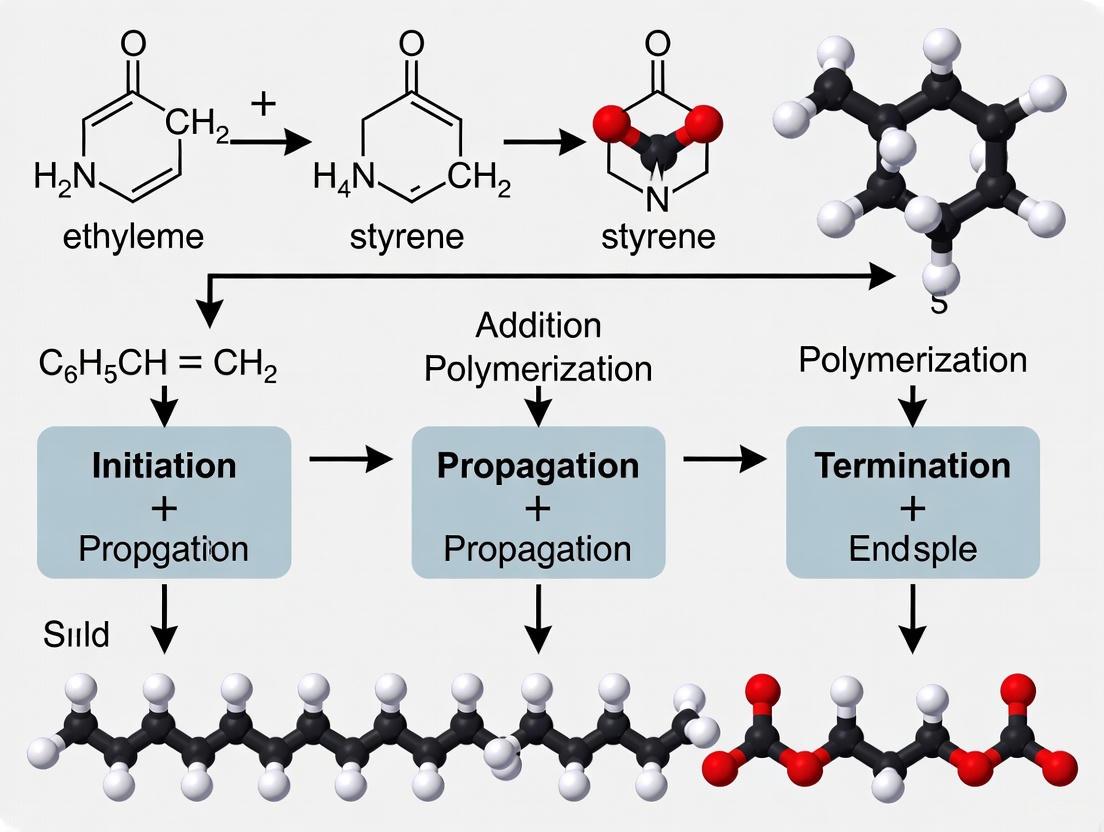
This article provides a comprehensive exploration of monomers and polymerization processes, tailored for researchers, scientists, and drug development professionals.
Monomers and Polymerization Processes: From Molecular Design to Advanced Drug Delivery Applications
Abstract
This article provides a comprehensive exploration of monomers and polymerization processes, tailored for researchers, scientists, and drug development professionals. It covers the foundational principles of polymer science, including monomer classification and step-growth versus chain-growth mechanisms. The content delves into advanced methodological approaches like emulsion and miniemulsion polymerization, highlighting their critical role in creating sophisticated drug delivery systems. It further addresses key industrial challenges such as residual monomer reduction and morphology control, and discusses validation techniques for characterizing polymeric products. By synthesizing foundational knowledge with cutting-edge applications and troubleshooting insights, this article serves as a valuable resource for innovating in the field of polymeric biomaterials.
Building Blocks of Polymers: A Deep Dive into Monomers and Core Polymerization Mechanisms
In both natural and engineered systems, the creation of complex macromolecular structures begins with fundamental molecular units known as monomers. Derived from the Greek words "mono" (meaning one) and "meros" (meaning part), a monomer represents an individual molecular network or discrete molecule that can chemically unite with analogous monomers to form polymers [1]. This chemical unification process, termed polymerization, enables two monomeric units to link together by sharing electrons, ultimately creating large macromolecular architectures with properties far exceeding those of their constituent parts [1]. The essential feature distinguishing monomers from other molecules is polyfunctionality—the capacity to form chemical bonds to at least two other monomer molecules, thereby enabling chain formation [2].
The significance of monomers extends across biological and synthetic domains. In living organisms, glucose monomers link via glycosidic bonds to form biopolymers such as cellulose and starch [1], while amino acids serve as monomeric building blocks for constructing the vast array of proteins essential for life [3]. In synthetic contexts, simple ethylene molecules (C₂H₄) polymerize to form polyethylene, one of the most widely produced plastics globally [3]. The structural characteristics and chemical functionalities of monomers directly determine the physical, mechanical, and chemical properties of the resulting polymers, making monomer selection and design a critical consideration in materials science, drug delivery development, and numerous industrial applications [1].
Monomer Fundamentals: Structure, Function, and Classification
Chemical Definition and Key Characteristics
Monomers are characterized by their specific chemical structure that enables polymerization. Bifunctional monomers, containing two reactive sites, can form only linear, chainlike polymers, while monomers of higher functionality yield cross-linked, network polymeric products [2]. This functionality arises from specific chemical features, including double bonds between atoms (as in ethylene, styrene, or butadiene) or rings of three to seven atoms (as in caprolactam) that can open and form new bonds [2]. Alternatively, monomers may contain two or more reactive atomic groupings, such as a compound that is both an alcohol and an acid, which can undergo repetitive ester formation to create polyesters [2].
The length-to-diameter (L/D) ratio represents a fundamental distinction between monomers and their resulting polymers. For example, while styrene monomer molecules might be conceptually represented by a dot, polystyrene with a degree of polymerization of 1000 would be represented by a line formed by connecting 1000 of these dots in a linear fashion [1]. This dramatic divergence in the L/D ratio creates the profound differences in physical and mechanical properties observed between small molecules and their polymeric counterparts [1].
Classification Schemes for Monomers
Monomers can be systematically categorized based on their chemical structure, functionality, and origin, as detailed in the table below.
Table 1: Classification of Monomers and Their Characteristics
| Classification Basis | Monomer Type | Key Characteristics | Representative Examples |
|---|---|---|---|
| Source | Natural | Derived from biological sources; often biodegradable | Amino acids, glucose, nucleotides [3] [1] |
| Synthetic | Human-made; designed for specific properties | Ethylene, styrene, caprolactam [2] | |
| Functionality | Bifunctional | Two reactive sites; forms linear polymers | Ethylene glycol, terephthalic acid [2] |
| Polyfunctional | Three or more reactive sites; forms cross-linked networks | Glycerol, divinyl benzene [2] | |
| Polymerization Mechanism | Addition | Contains double bonds or rings; no byproduct | Ethylene, styrene, vinyl chloride [2] [4] |
| Condensation | Contains reactive functional groups; releases byproducts | Diacids, diamines, diols [2] | |
| Chemical Nature | Acidic | Can donate protons; forms hydrogen bonds | Methacrylic acid [1] |
| Basic | Can accept protons; forms ionic interactions | Vinylpyridine [1] |
Monomer-Polymer Relationship
The relationship between monomers and polymers represents a fundamental structural hierarchy in materials science. Monomers serve as the essential repeating units that define a polymer's primary structure, while their sequential arrangement dictates the higher-order properties and applications of the resulting macromolecule [3]. The degree of polymerization (DP), represented by 'n' in Equation 1, quantifies this relationship by calculating the number of repeat units in a polymer molecule [1]:
[ n = \frac{M}{M_0} ]
Where (M) is the molecular weight of the polymer and (M_0) is the molecular weight of the repeat unit [1].
When two or more dissimilar monomeric units combine, the resultant product is a copolymer, and the phenomenon is termed copolymerization [1]. Copolymers can be further classified based on the arrangement of monomeric units along the chain, with alternating, periodic, statistical, and block configurations representing the primary architectural variations [1]. For instance, block copolymers comprise homopolymer subunits connected via covalent bonds, with diblock and triblock copolymers representing important categories for advanced material applications [1].
Polymerization Mechanisms: From Monomers to Macromolecules
Chain-Growth (Addition) Polymerization
Chain-growth polymerization, also known as addition polymerization, involves monomers adding sequentially to a growing polymer chain that possesses an active center, such as a free radical, cation, anion, or coordination complex [5]. This mechanism is responsible for approximately 65% of all synthetic polymers produced globally [5] and is characterized by several distinctive features: rapid chain propagation (with individual chains completing in fractions of a second), high molecular weight polymers formed early in the reaction, and retention of all monomer atoms within the final polymer structure [5].
The process occurs through four distinct stages, each with specific timeframes and temperature parameters [5]:
Table 2: Stages of Chain-Growth Polymerization
| Stage | Timeframe | Key Processes | Temperature Range |
|---|---|---|---|
| Initiation | 0.1-1 second | Formation of active radical centers from catalysts or heat; monomers become reactive | 50-200°C (system dependent) [5] |
| Propagation | 0.1-10 seconds | Rapid addition of monomers to growing chains; chain extension | 50-200°C (system dependent) [5] |
| Chain Transfer | Variable | Radicals move between molecules; affects molecular weight distribution | 50-200°C (system dependent) [5] |
| Termination | Variable | Chains stop growing through combination or disproportionation | 50-200°C (system dependent) [5] |
The initiation stage begins with activating initiator molecules into reactive species, typically through thermal decomposition (requiring 125-145 kJ/mol for most peroxide initiators), photochemical activation using UV or visible light, or redox activation through electron transfer between reactants [5]. Once generated, these radicals attack monomer molecules, forming new reactive sites. For example, in ethylene polymerization: R• + CH₂=CH₂ → R-CH₂-CH₂• [5].
Propagation represents the core of chain-growth polymerization, where the radical at the chain end repeatedly adds monomer molecules in rapid succession. Each addition step transfers the radical site to the newly added monomer, maintaining continuous reactivity [5]. This process is exceptionally fast, with individual polymer chains potentially forming in less than 0.1 seconds, as each addition requires only 15-30 kJ/mol of activation energy [5]. The propagation rate constant (kₚ) varies significantly with monomer type: styrene at 60°C exhibits kₚ = 165 L/mol·s, methyl methacrylate at 60°C demonstrates kₚ = 515 L/mol·s, while vinyl acetate under the same conditions shows approximately 2300 L/mol·s [5].
Table 3: Thermodynamic Parameters in Chain-Growth Polymerization
| Parameter | Description | Representative Values |
|---|---|---|
| Activation Energy | Energy required for propagation step | 15-30 kJ/mol [5] |
| Heat of Reaction | Energy released per monomer added | ~83 kJ/mol (for ethylene) [5] |
| Ceiling Temperature (T꜀) | Temperature above which depolymerization occurs | α-Methylstyrene: 61°C; Styrene: ~310°C [5] |
During propagation, chains develop critical architectural features that define ultimate polymer properties. Branching occurs when an active radical abstracts hydrogen from an existing polymer chain through "backbiting" mechanisms. Low-Density Polyethylene (LDPE) contains 15-30 branches per 1000 carbon atoms, resulting in flexibility and lower crystallinity, while High-Density Polyethylene (HDPE) exhibits minimal branching, creating stronger, more crystalline materials [5]. Tacticity, referring to the spatial arrangement of side groups, represents another critical structural parameter controlled during propagation [5].
Step-Growth (Condensation) Polymerization
Step-growth polymerization, alternatively termed condensation polymerization, proceeds through fundamentally different mechanisms than chain-growth pathways. In step-growth systems, monomers react through functional groups, often eliminating small molecules such as water, alcohol, or ammonia as byproducts [5]. This mechanism accounts for approximately 30% of synthetic polymer production [5] and exhibits distinct characteristics, including gradual molecular weight increase throughout the reaction (requiring over 98% conversion for high-performance polymers), byproduct elimination necessitating purification steps, and reactions possible between molecules of any size possessing reactive end groups [5].
The mathematical foundation of step-growth polymerization was established by Carothers' theoretical framework and his famous Carothers equation, which relates the extent of reaction to the average degree of polymerization [5]. Notable examples of condensation polymers include polyesters (PET), polyamides (Nylon 66), polyurethanes, epoxy resins, and polycarbonates, which find extensive applications in fibers, coatings, and engineering plastics [5]. A classic example is the formation of nylon-6,6, where hexamethylenediamine (containing two amine groups) condenses with adipic acid (containing two acid groups), with the elimination of water [2].
The timeframe for step-growth polymerization extends significantly longer than chain-growth processes, typically requiring several hours to achieve high molecular weights, with temperature ranges varying from 50°C to 200°C depending on the specific monomer system [5]. The process generally involves three primary stages: preparation (including monomer purification and precise measurement), polymerization (where functional groups react gradually over hours), and separation (where the polymer is isolated and purified) [5].
Advanced Analytical Techniques for Monomer and Polymer Characterization
NMR Spectroscopy for Microstructural Analysis
Nuclear Magnetic Resonance (NMR) spectroscopy represents a powerful analytical tool for investigating polymer microstructures, including configurational distribution, chemical composition, and monomer sequences in copolymers [6]. Recent advances in multivariate analysis of NMR spectra have enabled precise prediction of chemical composition and monomer sequences, even for structurally similar acrylate copolymers where conventional analysis approaches face limitations due to signal overlap [6].
Experimental Protocol: Multivariate Analysis of NMR Spectra for Acrylate Copolymers
Sample Preparation: Methyl acrylate (MA) and ethyl acrylate (EA) comonomers are distilled under reduced pressure for purification. Nine copolymer and two homopolymer samples are prepared by radical (co)polymerization with varying monomer feed ratios. Reactions are quenched 10 minutes after initiation to limit conversion, ensuring representative primary structures relative to initial feed compositions [6].
NMR Measurement: ¹H and ¹³C NMR spectra are acquired using standard parameters. For ¹H NMR, typical conditions include 64-128 transients with a relaxation delay of 5-10 seconds. For ¹³C NMR, significantly more transients (1000-2000) are required due to lower natural abundance, with relaxation delays of 2-5 seconds [6].
Multivariate Analysis: Partial Least Squares (PLS) regression is applied to the NMR spectral data, using the spectra as explanatory variables and primary structures as objective variables. This statistical approach enables quantitative predictions of chemical composition and monomer sequences at the diad level, even when comonomers belong to the same structural category and exhibit severe spectral overlap [6].
Data Interpretation: The analysis successfully predicts MA composition from both ¹H and ¹³C NMR spectra, with ¹³C NMR providing superior accuracy due to its wider chemical shift range and enhanced structural sensitivity. Monomer sequences, particularly hetero-diad sequences, are more accurately predicted using ¹³C NMR spectra, while ¹H NMR yields only moderate accuracy for sequence analysis [6].
This methodology demonstrates that NMR spectroscopy combined with statistical multivariate analysis offers a robust approach for determining primary structures of acrylate copolymers without requiring individual signal assignments, providing critical structural information previously inaccessible through conventional integration-based approaches [6].
Liquid Chromatography-Mass Spectrometry (LC-MS) for Monomer Composition and Elution Analysis
Liquid Chromatography-Mass Spectrometry (LC-MS) provides complementary capabilities for characterizing monomer composition and quantifying residual monomer elution, particularly relevant for biomedical and dental applications where monomer leaching presents biocompatibility concerns [7].
Experimental Protocol: LC-MS Analysis of Dental Resins
Sample Preparation: Four commercial 3D-printed resin composites are selected, including two provisional resins (Temporary CB, Formlabs and NextDent C&B MFH) and two permanent 3D-printed resins (Saremco print CrownTec and VarseoSmile Crown plus). Unpolymerized resins undergo untargeted LC-MS for compositional screening, while polymerized specimens are immersed in artificial saliva (37°C, 72 hours) to simulate clinical conditions [7].
Untargeted Analysis: Initial screening detects 4,125 chemical features, which are refined to 39 high-confidence resin-derived compounds across the four materials. These compounds primarily include monomers and derivatives, with some photoinitiators and additives. Compound diversity varies significantly by material, with permanent Saremco and VarseoSmile showing the greatest variety [7].
Targeted Quantitative Analysis: Following immersion, targeted quantitative LC-MS is performed to quantify eluted residual monomers using certified standards calibration curves for HEMA, TEGDMA, UDMA, and Bis-EMA. This approach provides precise measurement of monomer release profiles under simulated clinical conditions [7].
Results and Interpretation: The analysis reveals substantial variability in both composition and monomer elution profiles among commercial 3D-printed dental resins. Bis-EMA predominates in Temporary CB, Saremco, and VarseoSmile, while UDMA is most abundant in NextDent, Saremco, and VarseoSmile. Quantitative assessment shows that Temporary CB and VarseoSmile release the highest levels of Bis-EMA, NextDent demonstrates greatest elution of HEMA and UDMA, and VarseoSmile exhibits the highest TEGDMA release. Saremco generally shows the lowest concentrations of all monitored monomers [7].
These findings underscore the material-specific nature of chemical composition and monomer elution in 3D-printed dental resins, highlighting the need for material-specific biocompatibility testing to ensure long-term clinical safety [7].
Monomer-Functionalized Materials for Advanced Applications
Functionalized Monoliths for Selective Sample Preparation
Monolithic materials functionalized with specific monomers have emerged as powerful tools for selective sample preparation in analytical chemistry. Monoliths with large macropores serve as ideal substrates for solid-phase extraction (SPE) coupled with liquid chromatography (LC) due to their low back pressure and versatility across various formats [8]. The functionalization of these monoliths with biomolecules or nanoparticles significantly enhances their selectivity and sensitivity for target analytes [8].
Molecularly Imprinted Polymers (MIPs) represent a particularly advanced application of functional monomers in analytical science. Their synthesis is based on the complexation of a template molecule with functional monomers via non-covalent interactions, followed by polymerization of these monomers around the template with the addition of a cross-linking agent and initiator [8]. After polymerization, template removal creates cavities complementary to the template molecule in terms of size, shape, and position of functional groups [8]. The selection of reagents for MIP synthesis must be carefully considered to create cavities highly specific to the target molecule [8].
These functionalized monoliths can be synthesized in situ directly within capillaries or microchip channels, with polymerization conditions carefully controlled to achieve sufficient permeability for solution percolation while maintaining specific molecular recognition capabilities [8]. Applications include monitoring cocaine in human plasma, where injecting only 100 nL of diluted plasma enables detection limits achievable with simple UV detectors coupled with nanoLC, while maintaining minimal solvent consumption [8].
Table 4: Research Reagent Solutions for Monomer-Functionalized Materials
| Reagent Category | Specific Examples | Function in Experimental Protocols |
|---|---|---|
| Functional Monomers | Methacrylic acid, Vinylpyridine [1] | Provide points of electronic recognition for template rebinding in MIPs |
| Cross-linking Agents | Ethylene glycol dimethacrylate, Divinyl benzene [8] | Create rigid polymer network around template molecules |
| Initiators | Azobisisobutyronitrile (AIBN), Benzoyl peroxide [5] [6] | Generate free radicals to initiate polymerization |
| Template Molecules | Drug compounds, Biomarkers [8] | Create specific recognition cavities during MIP synthesis |
| Porogenic Solvents | Toluene, Cyclohexanol [8] | Control porous structure of resulting monoliths |
Biomedical Polymers for Therapeutic Applications
Monomers and their resulting polymers play increasingly critical roles in biomedical applications, with custom polymer synthesis evolving rapidly to meet healthcare demands. Smart polymers that respond to environmental stimuli such as temperature, pH, or light are gaining significant momentum in healthcare applications [9]. These advanced materials enable controlled drug release based on physiological triggers, create scaffolds that mimic biological environments for tissue engineering, and form the basis for flexible polymers integrated with sensors for real-time health monitoring [9].
The integration of nanotechnology with smart polymers is driving advances in personalized medicine, making treatments more effective and accessible [9]. Hydrogel-based polymers that swell or shrink to release drugs on-demand represent particularly innovative examples, significantly enhancing patient outcomes through precise temporal and spatial control over therapeutic delivery [9].
Biodegradable and bio-based polymers represent another major trend, with sustainability considerations driving adoption of materials that reduce environmental impact while offering comparable or superior properties to conventional polymers [9]. Key drivers include increasingly stringent environmental regulations demanding reduced reliance on fossil fuels and improved waste management, coupled with growing consumer preference for sustainable products [9]. Notable examples include polylactic acid (PLA) for packaging and medical implants, and polyhydroxyalkanoates (PHA) for biodegradable films and coatings [9].
Emerging Trends and Future Perspectives
The field of monomer science and polymer synthesis continues to evolve rapidly, with several emerging trends shaping future research directions and applications. Artificial intelligence-driven design represents a particularly transformative trend, with machine learning algorithms increasingly employed to predict and optimize polymer properties, significantly accelerating materials discovery and development [9]. These data-driven models are revolutionizing custom polymer development, optimizing formulations, and reshaping R&D workflows across academic and industrial settings [9].
Advanced manufacturing techniques including additive manufacturing (3D printing) and continuous flow synthesis are enabling the production of polymers with unprecedented precision and efficiency [9]. Custom polymers specifically designed for additive processes facilitate intricate designs and rapid prototyping, while continuous flow methods provide scalable pathways to produce high-purity polymers with minimal batch-to-batch variation [9].
Sustainable polymer recycling technologies are addressing growing environmental concerns associated with polymer disposal. Innovative approaches including chemical recycling methods that break down polymers into reusable monomers for high-value applications, and enzyme-based recycling systems that decompose plastics into reusable components, represent promising directions for achieving circular economy objectives in polymer science [9].
The expanding applications of functional polymers for electronics continue to drive innovations, with the electronics industry increasingly adopting custom polymers to meet demands for lightweight, flexible, and high-performance materials [9]. Conductive polymers for flexible displays and sensors, dielectric materials for energy storage, and thermally stable polymers for high-performance circuits represent active research frontiers with significant technological implications [9].
As these trends converge, the future of monomer science and polymer synthesis appears positioned to address increasingly complex global challenges while unlocking new opportunities across healthcare, energy, electronics, and sustainability domains. The continued refinement of analytical techniques for characterizing monomer composition and polymer microstructure will remain essential for advancing these developments and ensuring the rational design of next-generation polymeric materials with tailored properties and functions.
In monomer and polymerization process research, the fundamental mechanism by which monomers assemble into macromolecules dictates the strategy for synthesizing polymers with tailored properties. The two primary pathways, step-growth polymerization and chain-growth polymerization, are distinguished by their fundamental reaction mechanisms, kinetics, and the resulting polymer architectures [10]. For researchers and scientists in drug development and material science, selecting the appropriate pathway is critical for controlling molecular weight, dispersity, and ultimate material performance [11]. This whitepaper provides an in-depth technical comparison of these mechanisms, supported by quantitative data, experimental protocols, and visualization tools to guide research and development efforts.
Fundamental Mechanisms and Kinetic Profiles
The processes of step-growth and chain-growth polymerization are fundamentally distinct in their mechanisms and kinetic behavior [12].
Step-Growth Polymerization Mechanism
In step-growth polymerization (SGP), bi-functional or multi-functional monomers react to form dimers, trimers, and longer oligomers in a non-chain reaction process [13] [14]. Any two molecular species with complementary reactive groups can react, and the polymer molecular weight increases gradually throughout the reaction [12]. High molecular weight polymers are only achieved at high conversion rates (typically >98%) of the functional groups [14]. Common examples include polyesters, polyamides (e.g., nylons), and polyurethanes, often formed through reactions like nucleophilic acyl substitution [13].
Chain-Growth Polymerization Mechanism
Chain-growth polymerization (CGP) is a chain reaction characterized by three core steps: initiation, propagation, and termination [15] [16]. An active center—a free radical, cation, anion, or transition metal complex—is generated during initiation. This active center adds monomer units one at a time to a rapidly growing chain during propagation [16] [17]. The reaction mixture thus consists mainly of unreacted monomer and high-molecular-weight polymer, with only a minimal concentration of growing chains [15] [17]. High molecular weight is achieved rapidly, even at low monomer conversion [10].
Table 1: Core Mechanistic Differences Between Step-Growth and Chain-Growth Polymerization
| Characteristic | Step-Growth Polymerization | Chain-Growth Polymerization |
|---|---|---|
| Growth Profile | Growth occurs throughout the matrix between any reactive species [14] | Growth occurs by addition of monomer only at the active chain end(s) [14] [17] |
| Monomer Consumption | Rapid loss of monomer early in the reaction [14] | Monomer concentration decreases steadily over time; some remains at long reaction times [14] [17] |
| Reaction Steps | Similar steps repeated throughout the process [14] | Distinct stages: initiation, propagation, and termination [14] [16] |
| Molecular Weight Build-Up | Molecular weight increases slowly at low conversion; high extents of reaction are required for long chains [12] [14] | Molar mass of the backbone chain increases rapidly at an early stage and remains approximately the same throughout [14] |
| Active Chain Ends | Chain ends remain active throughout the reaction (no termination step) [14] | Chains are not active after termination [14] |
| Initiator Requirement | No initiator is necessary [14] | An initiator or catalyst is required to start the reaction [14] [17] |
Diagram 1: Polymerization mechanisms comparison.
Quantitative Comparison and Kinetics
The kinetic profiles of step-growth and chain-growth polymerizations are fundamentally different, which has direct implications for reaction monitoring and control in research and industrial settings [10].
Step-Growth Kinetics
The kinetics can be modeled using a polyesterification reaction. For an externally catalyzed system, the rate of polymerization is first order in each functional group [14]. The number-average degree of polymerization ((Xn)) is given by: [ Xn = \frac{1}{1-p} ] where (p) is the extent of reaction (fraction of functional groups that have reacted). This shows that (Xn) increases proportionally with time, and a high molecular weight (e.g., (Xn = 100)) requires a very high conversion ((p = 0.99)) [14].
Chain-Growth Kinetics
In contrast, chain-growth polymerization exhibits a rapid increase in molecular weight early in the reaction, with the molecular weight remaining relatively constant throughout the majority of the process [15] [14]. The rate of polymerization is proportional to both the concentration of monomer and the concentration of active centers [10].
Table 2: Kinetic and Molecular Weight Characteristics
| Parameter | Step-Growth Polymerization | Chain-Growth Polymerization |
|---|---|---|
| Kinetic Order | Rate depends on concentration of functional groups [10] | Rate proportional to monomer and initiator concentration [10] |
| Molecular Weight vs. Conversion | Increases slowly at low conversion, sharply near completion [12] [14] | High molecular weight achieved immediately at low conversion [14] |
| Typical Dispersity (Đ) | Đ = 1 + p (theoretically 2 at full conversion) [11] | Varies by mechanism; often broad, but can be controlled (e.g., Đ ≤ 1.5 in living polymerization) [16] [11] |
| Key Mathematical Relationship | (X_n = \frac{1}{1-p}) (Carothers Equation) [14] | Molecular weight controlled by [M]/[I] ratio in living systems [16] |
Diagram 2: Kinetic profiles of polymerization pathways.
Representative Polymer Classes and Applications
The choice of polymerization mechanism directly influences the properties and applications of the resulting material.
Step-Growth Polymers
- Polyamides (Nylon): Synthesized from diamines and dicarboxylic acids (e.g., Nylon-6,6 from 1,6-hexanediamine and adipic acid). They possess high strength, good elasticity, abrasion resistance, and toughness, finding use in fibers, ropes, gears, and bearings [13] [14].
- Polyesters (PET): Formed from dicarboxylic acids and diols (e.g., Polyethylene terephthalate from terephthalic acid and ethylene glycol). They exhibit high Tg and Tm, good mechanical properties, and are used in fibers, films, and beverage bottles [13] [12].
- Polycarbonates: Known for transparency, high impact strength, and good thermal stability. Applications include eyewear lenses, automotive components, and medical devices [14].
Chain-Growth Polymers
- Polyolefins (PE, PP): Produced via coordination catalysis, these are among the most widely produced polymers. Used in packaging, containers, and automotive parts due to their low cost, toughness, and ease of processing [10] [16].
- Polyvinyls (PVC, PS): Synthesized via free-radical polymerization. Polystyrene is used in disposable utensils and insulation, while PVC is used in piping, cables, and siding [16].
- Acrylics (PMMA): Known for optical clarity and weather resistance, used as a glass alternative and in medical devices [16].
Experimental Protocols
Protocol 1: Synthesis of Nylon-6,6 via Step-Growth Polymerization
Principle: This two-stage synthesis involves the formation of a nylon salt from 1,6-hexanediamine and adipic acid, followed by melt polycondensation at elevated temperature to form the polyamide [13] [12].
Procedure:
- Nylon Salt Preparation: Dissolve equimolar amounts of 1,6-hexanediamine (0.1 mol) and adipic acid (0.1 mol) in a 1:1 (v/v) mixture of methanol and water. The salt precipitates upon mixing. Isolate the salt by filtration and recrystallize from methanol.
- Polymerization: Place the dry nylon salt (10 g) in a polymerization tube equipped with an inlet for nitrogen and a vacuum outlet. Flush the tube with nitrogen.
- Heat the tube to 210–220 °C under a slow nitrogen stream for 1–2 hours to initiate the reaction.
- Gradually increase the temperature to 270–280 °C. Slowly apply a vacuum (e.g., < 1 mmHg) to remove the condensed water vapor and drive the equilibrium towards polymer formation.
- Maintain these conditions for 2–3 hours. The completion of the reaction can be monitored by the increase in melt viscosity and the cessation of water evolution.
- After cooling under nitrogen, the solid polymer can be isolated and, if necessary, processed by remelting and extrusion.
Key Considerations: Strict stoichiometric balance between the diamine and diacid is crucial for achieving high molecular weight. The removal of the condensate (water) is essential to shift the equilibrium towards the polymer [12].
Protocol 2: Free-Radical Polymerization of Styrene
Principle: This chain-growth polymerization uses a thermal initiator to generate free radicals that add to styrene monomers, propagating a chain reaction until termination occurs [15] [16].
Procedure:
- Purification: Purify styrene monomer by washing with an aqueous NaOH solution to remove inhibitor, followed by drying over anhydrous calcium chloride. Distill under reduced pressure before use.
- Reaction Setup: In a Schlenk flask, add purified styrene (10 mL, 0.087 mol) and a magnetic stir bar. Degas the solution by performing several freeze-pump-thaw cycles.
- Initiation: Under a positive pressure of inert gas (N₂ or Ar), add a free-radical initiator such as 2,2'-Azobis(2-methylpropionitrile) (AIBN) (10 mg, 0.061 mmol). Seal the flask.
- Propagation & Termination: Place the flask in an oil bath pre-heated to 60–70 °C with constant stirring. The polymerization will proceed for 6–12 hours. The increase in viscosity indicates polymer formation.
- Isolation: After cooling, dissolve the viscous mixture or solid polymer in a minimal amount of a suitable solvent like toluene. Precipitate the polymer by slowly pouring the solution into a large excess of vigorously stirred methanol. Filter the precipitated polystyrene and dry under vacuum until constant weight.
Key Considerations: The concentration of the initiator controls the number of growing chains and thus the average molecular weight. The reaction must be conducted under oxygen-free conditions, as oxygen is an effective radical scavenger that can inhibit the reaction [15].
Advanced Research: Controlling Dispersity in Step-Growth Polymers
A significant challenge in step-growth polymerization is the inherent lack of control over molecular weight distribution (dispersity, Đ), which typically approaches 2.0 at high conversion according to the Flory model (Đ = 1 + p) [11]. Recent advanced research has introduced new methods to overcome this limitation.
Asymmetric Dynamic Bond-mediated Polymerization (ADBP): This novel approach, reported in 2025, uses asymmetric and reversibly deactivated AA'-type dielectrophiles (e.g., isophorone diisocyanate, IPDI) reacting with B₂-type dinucleophiles (e.g., a diol) [11]. The reversibly deactivated A' group (using diisopropylamine, DIPA) creates a preferential reaction pathway.
Mechanism: The polymerization proceeds in two stages. First, an oligomerization stage (conversion, p ≤ 0.6) primarily forms well-defined dimers and trimers, keeping Đ low (≤1.2). This is followed by a polymerization stage (p ≥ 0.6) where these oligomers react, resulting in final polymers with Đ ≈ 1.5, significantly narrower than traditional SGP [11].
Significance for Researchers: This method provides a route to synthesize step-growth polymers like polyurethanes with controlled dispersities (Đ ≤ 1.5), leading to improved nanoscale order, enhanced microphase separation in block copolymers, and superior mechanical properties [11]. It represents a major step towards achieving the level of control in step-growth polymerization that has long been available in controlled chain-growth techniques.
The Scientist's Toolkit: Key Research Reagents
Table 3: Essential Reagents for Polymerization Research
| Reagent / Material | Function in Research | Key Considerations |
|---|---|---|
| Diisopropylamine (DIPA) | Reversible deactivator for isocyanates in ADBP for controlled step-growth [11] | Enables asymmetry in monomer reactivity, crucial for achieving narrow dispersity. |
| AIBN (Azobisisobutyronitrile) | Thermal free-radical initiator for chain-growth polymerizations [15] [17] | Half-life is temperature-dependent; concentration directly influences molecular weight. |
| Dibutyltin Dilaurate (DBTDL) | Common catalyst for polyurethane formation and esterification reactions [11] | Highly effective Lewis acid catalyst; amounts as low as 0.1 mol% are often sufficient. |
| Isophorone Diisocyanate (IPDI) | Asymmetric diisocyanate monomer for polyurethane synthesis [11] | The asymmetry of the -NCO groups is exploited in ADBP to control the reaction pathway. |
| Nylon Salt | Pre-formed, stoichiometric 1:1 salt of diamine and diacid [13] [12] | Ensures exact monomer balance for achieving high molecular weight in polyamides. |
Polymerization, the process of linking small molecules (monomers) into large chains (polymers), is fundamental to creating a vast array of synthetic materials. For chain-growth polymerization, this process is governed by three essential steps: initiation, propagation, and termination. Together, this trilogy of reactions determines the molecular weight, architecture, and ultimate properties of the resulting polymer. For researchers in materials science and drug development, precise control over these steps is paramount for designing polymers with specific functionalities, such as those used in drug delivery systems, biomedical devices, or advanced plastics [18] [19]. This guide provides an in-depth technical examination of these core mechanisms, with a focus on modern controlled radical polymerization techniques that have revolutionized polymer synthesis.
The Fundamental Mechanism: A Detailed Analysis
The journey of creating a polymer chain begins with the generation of an active center and culminates in the cessation of its growth. The following diagram illustrates the logical sequence and key intermediates in this fundamental process.
Initiation
The initiation step generates the active species that will propagate the polymer chain. In free-radical polymerization, this typically involves a two-part process. First, a thermolabile initiator, such as Azobisisobutyronitrile (AIBN), decomposes upon heating to form two primary radical fragments (I•) [20] [21] [22]. Second, these primary radicals react with a monomer molecule (e.g., a methacrylate or styrene derivative), adding across its carbon-carbon double bond. This reaction forms the initial propagating radical (P1•), which is the nucleus for the growing polymer chain [22]. The efficiency of initiation depends on the initiator's decomposition rate and the reactivity of the resulting radicals toward the monomer.
Propagation
Propagation is the chain-elongation stage where the polymer's molecular weight rapidly increases. The active propagating radical (Pn•) at the end of a growing chain successively adds to the double bonds of many monomer molecules [19] [22]. Each addition regenerates the active site at the chain end, allowing the process to continue. This step is extremely fast and is responsible for the bulk of the polymer's mass. The rate of propagation is governed by the concentration of monomer and active chains, as well as the intrinsic reactivity of the monomer-radical pair.
Termination
Termination is the bimolecular reaction that deactivates the propagating radicals, ending chain growth. The two most common pathways are combination and disproportionation [22]. In combination, two growing chains (Pn• and Pm•) couple to form a single dead polymer chain (Pn+m). In disproportionation, a hydrogen atom is transferred from one chain to another, resulting in two dead chains: one with a saturated end-group (Pn-H) and one with an unsaturated end-group (Pm=) [19]. Because termination is a diffusion-controlled process between two highly reactive species, it is often the most difficult step to control in conventional free-radical polymerization.
Table 1: Key Characteristics of the Fundamental Polymerization Steps
| Step | Primary Function | Key Reactants | Products Formed | Kinetic Order |
|---|---|---|---|---|
| Initiation | Generate active centers | Initiator, Monomer | Initial Propagating Radical (P1•) |
First-order in initiator |
| Propagation | Chain elongation | Propagating Radical (Pn•), Monomer |
Longer Propagating Radical (Pn+1•) |
First-order in monomer and active chains |
| Termination | Cease chain growth | Two Propagating Radicals (Pn• and Pm•) |
Dead Polymer (Pn+m or Pn-H + Pm=) |
Second-order in active chains |
Advanced Control: Reversible Deactivation Radical Polymerization (RDRP)
Traditional free-radical polymerization provides limited control over molecular weight and architecture due to irreversible termination. The advent of Reversible Deactivation Radical Polymerization (RDRP) techniques, such as Reversible Addition-Fragmentation Chain Transfer (RAFT), has enabled unprecedented precision [21] [22] [23].
The RAFT process introduces a critical equilibrium between active and dormant chain ends, mediated by a chain transfer agent (CTA). The following workflow details the mechanism of this controlled process.
The RAFT Mechanism
The mechanism of RAFT polymerization introduces additional equilibria to the classic trilogy, enabling control [21] [22] [23]:
- Pre-equilibrium: A propagating radical (
Pn•) reacts with the RAFT agent (a thiocarbonylthio compound) in a reversible addition-fragmentation cycle. The radical adds to the C=S bond of the RAFT agent, forming an intermediate radical. This intermediate fragments, yielding a new radical (R•) and a dormant polymeric chain ending with a thiocarbonylthio group (S=C(Z)S-Pn). - Re-initiation: The expelled
R•radical reacts with monomer to start a new chain, forming a new propagating radical (Pm•). - Main Equilibrium: The core of RAFT control is the rapid equilibrium between all active propagating chains (
Pn•,Pm•) and all dormant chains. This reversible exchange allows all chains to grow at a similar rate, resulting in polymers with narrow molecular weight distributions (low dispersity, Đ). The active species spend most of their time in the dormant state, minimizing irreversible termination events.
Novel Initiation Methods in RAFT
While thermal initiators like AIBN are common, recent advances have introduced sophisticated initiation methods that offer superior spatiotemporal control [21] [24]:
- Photoiniferter (PI)-RAFT: In this approach, the CTA itself acts as the initiator upon irradiation with light. Direct photolysis of the CTA's C–S bond generates the radical species needed to initiate and control the polymerization [24]. A key advantage is the ability to precisely start and stop the reaction by switching the light on and off.
- Photoinduced Electron/Energy Transfer (PET)-RAFT: This method uses a photoredox catalyst under light irradiation to mediate the activation of the RAFT agent via an electron or energy transfer process, rather than direct bond homolysis [21].
Table 2: Comparison of RAFT Polymerization Initiation Methods
| Method | Radical Source | Key Advantage | Typical Conditions | Spatiotemporal Control |
|---|---|---|---|---|
| Thermal Initiation | Thermal decomposition of initiators (e.g., AIBN) [21] [22] | Simplicity, wide applicability | Elevated temperature (e.g., 60-80°C) | No |
| Photoiniferter (PI)-RAFT | Direct photolysis of the RAFT agent [24] | Avoids separate initiator, highly "living" nature | Room temperature, Blue/Green light | Yes, via light switching |
| PET-RAFT | Photoredox catalyst under light [21] | Tolerance to oxygen, wider wavelength range | Room temperature, Visible light | Yes, via light switching |
Experimental Protocols and Reagent Solutions
Detailed Methodology: Photoiniferter (PI)-RAFT Polymerization of Poly(PEGMA)
This protocol describes the synthesis of poly(poly(ethylene glycol) methyl ether methacrylate) (P(PEGMA)), a biocompatible bottle-brush polymer, using PI-RAFT, adapted from recent research [24].
Principle: The trithiocarbonate Chain Transfer Agent (CTA) is directly activated by blue light, acting as a photoiniferter to control the polymerization without a separate chemical initiator.
Materials and Equipment:
- Monomer: PEGMA (Mn = 300 g/mol).
- RAFT Agent: A trithiocarbonate-type CTA (e.g., 2-(((Butylthio)carbonothioyl)thio)propanoic acid).
- Solvent: Anisole, DMSO, or other suitable solvents.
- Reactor: Schlenk tube or vial with a magnetic stir bar.
- Light Source: Blue LED array (λmax = 470 nm, intensity ~1.6 mW cm⁻²).
- Inert Atmosphere: Nitrogen (N₂) gas supply.
- Purification: Dialysis membrane (e.g., 3.5 kDa MWCO).
Procedure:
- Reaction Mixture Preparation: In a vial, dissolve PEGMA and the CTA in the chosen solvent (e.g., 50% v/v monomer concentration) to achieve a molar ratio of
[M]₀ : [CTA] = 100 : 1. Mix thoroughly until a homogeneous solution is obtained. - Degassing: Transfer the solution to a Schlenk tube equipped with a stir bar. Sparge the solution with N₂ gas for 45-60 minutes to remove dissolved oxygen, which inhibits radical polymerization.
- Polymerization: Place the degassed reaction vessel under the blue LED light source at a controlled temperature (e.g., 22°C) with continuous stirring. Initiate the reaction by turning on the light.
- Kinetic Monitoring: At predetermined time intervals (e.g., 0.5, 1, 2, 3 hours), withdraw small aliquots (~0.1 mL) from the reaction mixture under N₂.
- Conversion Analysis: Determine monomer conversion for each aliquot using ¹H NMR spectroscopy in CDCl₃. Compare the integral of the vinyl methylene protons of the remaining monomer (~4.23 ppm) with the corresponding signal of the polymer (~4.01 ppm) [24].
- Polymer Isolation: After the target conversion (e.g., 50%) is reached, stop the reaction by turning off the light and exposing the mixture to air. Dilute the final mixture and dialyze it against deionized water for 48 hours, changing the water regularly. Recover the pure polymer by lyophilization.
Key Considerations: The choice of solvent significantly impacts the polymerization kinetics and control. Anisole has been shown to maintain low dispersity (Đ ~1.30) even at elevated temperatures (40°C) for this system [24]. The wavelength and intensity of the light must be optimized for the specific CTA used.
The Scientist's Toolkit: Essential Reagents for Controlled Polymerization
Table 3: Key Research Reagents for Controlled Radical Polymerization Experiments
| Reagent Category | Specific Examples | Function & Importance |
|---|---|---|
| Initiators | AIBN, ACVA, V-60 [20] [23] | Thermal source of primary radicals to start the polymerization chain reaction. |
| RAFT Agents (CTAs) | Trithiocarbonates, Dithiobenzoates, Dithiocarbamates, Xanthates [21] [22] [23] | Core agent for control; mediates the equilibrium between active and dormant chains to dictate molecular weight and dispersity. |
| Functional Monomers | Methyl methacrylate (MMA), n-Butyl Acrylate (nBA), Styrene, P(PEGMA) [20] [24] [23] | Building blocks of the polymer chain. Functional groups (e.g., phosphate, PEG) impart final material properties. |
| Solvents | Anisole, 1,4-Dioxane, DMSO, DMF [24] | Medium for reaction. Polarity and properties can influence reaction rate, control, and polymer solubility. |
| Specialized Additives | Photoredox Catalysts (for PET-RAFT) [21] | Enable alternative activation pathways (e.g., with light) for greater control and milder reaction conditions. |
Quantitative Data and Performance Metrics
The success of controlled polymerization protocols is quantified by key metrics such as molecular weight control, dispersity (Đ = Mw/Mn), and conversion.
Table 4: Performance Metrics from Representative RAFT Polymerization Experiments
| Polymer System | Conditions | Final Mn (g/mol) | Dispersity (Đ) | Conversion | Key Finding |
|---|---|---|---|---|---|
| Poly(n-butyl acrylate) [23] | Bulk, 70°C, Thermal RAFT | 25,900 | 1.09 | Not Specified | Linear increase in Mn with conversion, indicative of excellent control. |
| P(PEGMA) in Anisole [24] | 50% v/v, 40°C, PI-RAFT | Not Specified | 1.30 | Target: 50% | Anisole identified as a superior solvent for maintaining low Đ at higher temperatures. |
| P(PEGMA) in DMSO [24] | 50% v/v, 22°C, PI-RAFT | Not Specified | >1.30 | Target: 50% | Demonstrated the significant effect of solvent choice on the livingness of the polymerization. |
The trilogy of initiation, propagation, and termination forms the foundational framework of chain-growth polymerization. Mastery of these steps, particularly through advanced techniques like RAFT, allows researchers to transcend the limitations of traditional synthesis. The ability to precisely control molecular weight, architecture, and end-group functionality is no longer a theoretical goal but a practical reality. This empowers scientists, especially in drug development and biomaterials, to engineer bespoke polymeric materials with tailored properties for applications ranging from targeted therapeutics to functional hydrogels. As research continues to refine these processes with novel activation methods and deeper mechanistic understanding, the precision and scope of polymer science will continue to expand.
Monomers, derived from the Greek words mono (one) and meros (part), are fundamental molecular units that serve as the foundation for constructing larger polymer chains or three-dimensional networks through polymerization [25]. These building blocks occupy a central role in both biological systems and industrial processes, creating a diverse landscape of materials with tailored properties. The distinction between natural and synthetic monomers represents more than just origin—it encompasses differences in molecular complexity, functionality, and application potential that are critical for researchers exploring polymerization processes.
Natural monomers such as amino acids, nucleotides, and monosaccharides have evolved over millennia to form the complex biopolymers essential to life, including proteins, nucleic acids, and polysaccharides [26] [25]. In contrast, synthetic monomers are engineered through chemical processes to create materials with specific characteristics not readily available in nature. The growing field of pseudo-natural products (PNPs) further blurs these boundaries by combining natural product fragments in novel arrangements not accessible through biosynthesis pathways [27], creating exciting opportunities for drug discovery and material science.
This technical guide examines the fundamental properties, experimental methodologies, and research applications of both natural and synthetic monomers, with particular emphasis on their roles in pharmaceutical development and biomedical innovation. By providing a comprehensive comparison and detailed experimental protocols, this resource aims to equip researchers with the knowledge necessary to select appropriate monomers for specific applications within their polymerization process research.
Classification and Fundamental Properties
Natural Monomers
Natural monomers are organic molecules found in biological systems that serve as the constitutional units for essential biopolymers [26]. These building blocks share common characteristics of biological origin, specific functionality, and the ability to form complex structures through enzymatic processes.
Table 1: Fundamental Natural Monomers and Their Polymer Forms
| Monomer Class | Specific Examples | Resulting Polymer | Key Functional Groups | Primary Biological Role |
|---|---|---|---|---|
| Amino Acids | Glycine, Glutamine, Valine, Arginine, Cysteine [26] | Proteins (via peptide bonds) [26] | Amino group (-NH₂), Carboxyl group (-COOH) [26] | Catalysis, structure, movement |
| Nucleotides | Adenine, Guanine, Cytosine, Thymine (DNA); Adenine, Guanine, Cytosine, Uracil (RNA) [25] | DNA/RNA (via phosphodiester bonds) [26] [25] | Nitrogenous base, Pentose sugar, Phosphate group [26] | Genetic information storage and transfer |
| Monosaccharides | Glucose, Fructose, Galactose [26] | Cellulose, Starch, Glycogen (via glycosidic bonds) [26] [25] | Hydroxyl groups (-OH), Carbonyl group (-C=O) | Energy storage, structural support |
| Isoprene | 2-methyl-1,3-butadiene [26] | Natural rubber (cis-1,4-polyisoprene) [26] [25] | Conjugated diene | Elasticity, specialized plant functions |
The twenty proteinogenic amino acids represent a key class of natural monomers characterized by the presence of both amino and carboxylic acid functional groups, allowing them to form peptide bonds through condensation reactions [26]. These monomers contain variable side chains that dictate the higher-order structure and function of the resulting proteins. Nucleotides, consisting of a nitrogenous base (purine or pyrimidine), pentose sugar, and phosphate group, serve as monomers for DNA and RNA through phosphodiester linkages [26]. The most abundant natural monomer is glucose, which polymerizes via glycosidic bonds to form cellulose, starch, and glycogen [25]. Isoprene (2-methyl-1,3-butadiene) represents another significant natural monomer that forms cis-1,4-polyisoprene, the primary component of natural rubber [26] [25].
Synthetic Monomers
Synthetic monomers are human-made compounds deliberately designed and produced for specific polymerization processes and applications. These monomers typically feature simpler chemical structures than their natural counterparts and are derived predominantly from petrochemical sources.
Table 2: Common Synthetic Monomers and Their Industrial Applications
| Monomer | Chemical Structure | Polymer Form | Polymerization Mechanism | Primary Industrial Applications |
|---|---|---|---|---|
| Ethylene | H₂C=CH₂ [28] [25] | Polyethylene [28] [25] | Addition polymerization [28] | Plastic bags, bottles, containers [28] |
| Vinyl Chloride | H₂C=CHCl [28] | Polyvinyl Chloride (PVC) [28] | Addition polymerization [28] | Plumbing pipes, electrical insulation [28] |
| Tetrafluoroethylene | F₂C=CF₂ [26] | Polytetrafluoroethylene (Teflon) [26] | Addition polymerization | Non-stick coatings, chemical-resistant materials |
| Caprolactam | (CH₂)₅C(O)NH [26] | Nylon-6 [26] | Ring-opening polymerization [26] | Textile fibers, engineering plastics |
| Ethyl Methacrylate | H₂C=C(CH₃)COOCH₂CH₃ [25] | Poly(methyl methacrylate) variants | Addition polymerization | Acrylic plastics, artificial nails [25] |
Ethylene represents the simplest and most widely used synthetic monomer, forming polyethylene through addition polymerization [28] [25]. This process involves free radical initiation that opens the double carbon bond, allowing chain propagation through successive monomer additions [28]. Modified ethylene derivatives including vinyl chloride and tetrafluoroethylene expand the property range of resulting polymers [25]. Specialty monomers represent an advanced category of synthetic monomers engineered with specific functional groups to impart tailored properties such as enhanced durability, flexibility, or chemical resistance to the resulting polymers [29].
Comparative Analysis: Structural and Functional Relationships
The fundamental distinction between natural and synthetic monomers lies in their structural complexity and functional diversity. Natural monomers have evolved to perform specific biological functions through precise molecular recognition, while synthetic monomers are designed primarily for processability and material properties.
Molecular Complexity and Side Groups
Natural monomers exhibit considerable structural complexity with diverse functional groups that enable sophisticated molecular interactions. Amino acids feature side chains ranging from simple hydrogen atoms (glycine) to complex aromatic and heterocyclic systems (tryptophan, histidine). This diversity allows proteins to fold into precise three-dimensional structures with specific binding pockets and catalytic capabilities. Similarly, nucleotides contain heterocyclic base pairs capable of specific hydrogen bonding (Watson-Crick base pairing) that enables precise genetic coding [30].
In contrast, most industrial synthetic monomers prioritize structural simplicity and symmetry to facilitate efficient polymerization and create materials with uniform properties. Ethylene, propylene, and vinyl monomers feature straightforward hydrocarbon structures with minimal functionalization, allowing for high molecular weight polymers with regular chain structures. This fundamental difference in complexity directly impacts the functionality and applications of the resulting polymers.
Polymerization Mechanisms and Byproducts
Natural monomers typically undergo enzymatic polymerization processes that are highly regulated and efficient under mild physiological conditions. Amino acids polymerize through ribosome-catalyzed reactions at ambient temperatures and neutral pH, with water as the only byproduct [26]. Nucleotide polymerization involves similarly precise enzymatic control during DNA replication and transcription.
Synthetic polymerization employs more energetically demanding processes, often requiring high temperatures, pressures, and catalyst systems. Addition polymerization of monomers like ethylene involves free radical initiation that breaks double bonds to form active chain carriers [28]. Condensation polymerization, used for producing nylons and polyesters, generates small molecule byproducts such as water or methanol that must be removed to drive the reaction to completion [26].
Experimental Approaches and Research Methodologies
Analyzing DNA Polymerase Interactions with Synthetic Nucleotides
The study of how DNA polymerases recognize and utilize synthetic nucleotides provides critical insights for multiple research domains, including mutagenesis studies, cancer research, and the development of novel therapeutics [30].
Experimental Protocol:
- Template Design: Synthesize DNA oligonucleotides containing specific synthetic nucleotide analogs at defined positions using solid-phase synthesis [30]. Common modifications include abasic sites (tetrahydrofuran derivatives), base analogs with altered hydrogen bonding patterns, or fluorescent nucleotides for FRET studies [30].
Polymerase Assay: Incubate the modified template with the DNA polymerase of interest (e.g., Klenow fragment, Taq polymerase, or Y-family translesion polymerases) in appropriate reaction buffer containing Mg²⁺ ions and natural or modified nucleoside triphosphates [30].
Product Analysis: Separate extension products using polyacrylamide gel electrophoresis to determine insertion efficiency opposite synthetic nucleotides and subsequent extension capability. Alternatively, use mass spectrometry for precise characterization of incorporated nucleotides [30].
Kinetic Analysis: Employ steady-state or pre-steady-state kinetic measurements to determine catalytic efficiency (kcat/Km) for nucleotide incorporation opposite natural and synthetic templates [30].
Structural Studies: When possible, conduct X-ray crystallography of polymerase-DNA-dNTP ternary complexes to visualize molecular interactions between synthetic nucleotides and polymerase active sites [30].
Diagram 1: Nucleotide Incorporation Assay
Evaluating Synthetic Polymer Mimics of Natural Proteins
Recent advances have enabled the creation of synthetic polymers that mimic specific functions of natural proteins using simplified building blocks [31] [32].
Experimental Protocol:
- Computational Design: Utilize deep learning algorithms (e.g., modified variational autoencoder) trained on natural protein databases (approximately 60,000 proteins) to identify key physicochemical parameters (charge distribution, hydrophobicity profiles) required for specific functions [32].
Monomer Selection: Select 2-6 synthetic building blocks (typically acrylate or methacrylate derivatives used in plastics) that match the identified physicochemical properties of the target natural protein [32].
Random Heteropolymer (RHP) Synthesis: Conduct controlled radical polymerization of selected monomers in specific ratios to create RHP libraries with statistical distributions of functional groups [32].
Functional Validation:
- For artificial blood plasma: Test ability to stabilize natural protein biomarkers without refrigeration using UV-Vis spectroscopy, circular dichroism, and ELISA assays [32].
- For artificial cytosol: Assess capability to support ribosomal protein synthesis in cell-free systems using radiolabeled amino acids or fluorescent tags [32].
- Perform single-molecule optical tweezers studies to compare RHP structural mechanics with natural proteins [32].
Biocompatibility Testing: Evaluate immune response, cytotoxicity, and degradation profiles using mammalian cell cultures and appropriate biological assays [32].
Research Reagent Solutions for Monomer Studies
Table 3: Essential Research Reagents for Monomer and Polymerization Studies
| Reagent/Category | Specific Examples | Research Function | Application Notes |
|---|---|---|---|
| DNA Polymerases | Klenow Fragment (A family), Taq polymerase, Dpo4 (Y family) [30] | Study nucleotide incorporation efficiency & fidelity | Different families show varying ability to utilize synthetic nucleotides [30] |
| Synthetic Nucleotides | Abasic site analogs, Base analogs, Fluorescent nucleotides [30] | Probe DNA polymerase specificity & mechanism | Template or incoming dNTP position; reveals polymerase active site constraints [30] |
| Computational Tools | Modified Variational Autoencoders, Deep Learning Algorithms [32] | Design synthetic polymers mimicking natural proteins | Trained on natural protein databases to identify key physicochemical parameters [32] |
| Polymerization Initiators | Hydrogen peroxide, Azo compounds [28] | Free radical initiation for addition polymerization | Thermal cleavage generates free radicals with unpaired electrons [28] |
| Characterization Methods | Single-molecule optical tweezers, FRET, Mass spectrometry [30] [32] | Analyze polymer structure, mechanics & interactions | Reveals forces maintaining synthetic polymer structures vs natural proteins [32] |
Emerging Applications and Research Directions
Pseudo-Natural Products (PNPs) in Drug Discovery
Pseudo-natural products (PNPs) represent an innovative approach that combines natural product fragments in novel arrangements not accessible through natural biosynthesis pathways [27]. This strategy advances beyond the chemical space explored by nature by integrating principles of biology-oriented synthesis (BIOS) and fragment-based compound design. Notably, 60% of chemotherapeutic agents originate from natural products, highlighting the continued importance of natural monomer-derived compounds in drug discovery [27]. PNPs enable the exploration of alternative molecular scaffolds that maintain biological relevance while exhibiting improved drug-like properties compared to purely natural or synthetic compounds.
Research applications of PNPs focus primarily on target identification, mechanism of action studies, and development of new therapeutic agents for numerous diseases employing the newest techniques in pharmacology, biotechnology, and genetic engineering [27]. These compounds are particularly valuable for targeting protein-protein interactions and allosteric binding sites that have proven challenging for traditional small molecule drugs.
Synthetic Polymers as Protein Replacements
Groundbreaking research has demonstrated that synthetic polymers composed of just 2-6 building blocks can mimic specific functions of natural proteins, challenging the paradigm that biological complexity requires molecular diversity [31] [32]. These random heteropolymers (RHPs) successfully replicated functions of blood plasma by stabilizing natural protein biomarkers without refrigeration and even enhanced thermal stability of natural proteins—an improvement over real blood plasma [32]. Artificial cytosol created using this approach supported functional ribosomes that continued protein synthesis in test tube environments [32].
Diagram 2: Synthetic Polymer Design Workflow
The design framework employs deep learning methods to match natural protein properties with synthetic polymer characteristics, focusing primarily on electric charges and hydrophobicity rather than precise atomic-level structural mimicry [32]. This approach successfully "fools" biological systems into accepting synthetic polymers as part of the natural protein environment, opening possibilities for hybrid biological systems where plastic polymers interact seamlessly with natural proteins [32].
Natural-Synthetic Polymer Blends for Biomedical Applications
Blends of natural and synthetic polymers represent a growing research area that combines the biocompatibility of natural polymers with the mechanical strength and processability of synthetic polymers [33]. These hybrid materials are being developed for diverse biomedical applications including wound healing, tissue engineering, drug delivery systems, and medical implants [33].
Table 4: Applications of Natural-Synthetic Polymer Blends in Biomedicine
| Application Domain | Natural Polymer Component | Synthetic Polymer Component | Key Advantages | Current Status |
|---|---|---|---|---|
| Wound Healing | Chitosan, Collagen, Gelatin [33] | Polycaprolactone (PCL), Polyvinyl alcohol (PVA) [33] | Enhanced fluid exchange, antimicrobial properties, improved healing | Advanced development for diabetic wound treatment [33] |
| Tissue Engineering | Silk fibroin, Collagen, Hyaluronic acid [33] | Polycaprolactone (PCL), Polylactic acid (PLA) [33] | Superior cell proliferation, mechanical resilience, biodegradability | Research phase with promising in vitro results [33] |
| Drug Delivery | Albumin, Chitosan [33] | Poly(lactic-co-glycolic acid) (PLGA), Polyesters [33] | Controlled release kinetics, targeted delivery, reduced side effects | Several systems in clinical trials [33] |
| Nerve Regeneration | Chitosan, Collagen [33] | Polycaprolactone (PCL), Graphene-doped polymers [33] | Guided nerve growth, electrical conductivity in composites | Pre-clinical development for peripheral nerve repair [33] |
These blended systems address the mechanical limitations of natural polymers while maintaining biological recognition signals necessary for optimal tissue integration and function. Current research focuses on optimizing blend composition, manufacturing processes, and characterization methods to create materials with precisely tailored properties for specific clinical applications [33].
The distinction between natural and synthetic monomers continues to blur as research advances in areas such as pseudo-natural products, synthetic biological polymers, and sophisticated natural-synthetic hybrid systems. The future of monomer research lies in developing increasingly sophisticated integration strategies that leverage the unique advantages of both natural and synthetic building blocks.
Several key trends are likely to shape future research directions. AI-driven design of synthetic polymers will expand beyond current charge and hydrophobicity parameters to incorporate more sophisticated biomimetic principles [32]. The development of dynamic monomer systems that respond to environmental stimuli will enable "smart" polymers with adaptive properties. Sustainable sourcing of both natural and synthetic monomers will become increasingly important, with growing emphasis on renewable feedstocks and biodegradable polymer systems [33]. Additionally, the convergence of synthetic biology with polymer science will create new production pathways for monomeric building blocks through engineered metabolic pathways rather than traditional chemical synthesis.
As these fields continue to evolve, researchers will benefit from maintaining a holistic perspective that considers not only the structural and chemical properties of monomers but also their biological interactions, environmental impact, and manufacturing scalability. The most significant breakthroughs will likely emerge from interdisciplinary approaches that combine insights from chemistry, biology, materials science, and computational modeling to create the next generation of functional monomers and polymers.
Synthetic Strategies and Biomedical Breakthroughs: Applying Polymerization in Drug Delivery
Advanced heterogeneous polymerization techniques are fundamental to the production of a wide array of polymeric materials, from commodity plastics to specialized medical and electronic components. These processes—emulsion, miniemulsion, and suspension polymerization—enable precise control over molecular architecture, particle morphology, and final material properties by leveraging the principles of radical polymerization within compartmentalized environments. Within the broader context of monomer and polymerization process research, the selection of an appropriate technique is dictated by the target polymer's application, required purity, molecular weight, and particle characteristics. This whitepaper provides an in-depth technical examination of these core methods, emphasizing their mechanistic foundations, experimental protocols, and contemporary applications to equip researchers and scientists with the knowledge to navigate their development projects effectively.
Suspension polymerization is a heterogeneous radical polymerization technique where water-insoluble liquid monomers, along with oil-soluble initiators, are dispersed into droplets (typically 10-500 μm) within a continuous aqueous phase. The system is stabilized by suspending agents (e.g., polyvinyl alcohol or inorganic salts) and vigorous agitation, with each droplet functioning as an isolated micro-reactor. This process mimics bulk polymerization on a microscale, yielding discrete spherical polymer particles that are easily isolated by filtration or centrifugation [34].
Miniemulsion polymerization also involves dispersing a monomer phase in a continuous aqueous phase, but it produces much smaller droplets, typically in the submicron range (50-500 nm). A key distinction is the use of a surfactant and a costabilizer (a water-insoluble compound) to suppress Ostwald ripening, thereby achieving droplet stability for periods ranging from hours to months. Prevalent nucleation of these monomer droplets is a unique feature, minimizing the need for mass transfer through the aqueous phase during polymerization [35].
Emulsion polymerization traditionally relies on the nucleation of particles in monomer-swollen micelles (heterogeneous nucleation) or by precipitation of oligomers from the aqueous phase (homogeneous nucleation). Monomer droplets are large (1-10 μm) and generally do not serve as the primary locus for particle nucleation. The process requires a surfactant concentration above the critical micelle concentration (CMC) and typically uses water-soluble initiators [35].
Table 1: Comparative Analysis of Advanced Polymerization Techniques
| Feature | Suspension Polymerization | Miniemulsion Polymerization | Conventional Emulsion Polymerization |
|---|---|---|---|
| Droplet/Particle Size | 10 - 500 μm [34] | 50 - 500 nm [35] | Final particles: 10 - 200 nm; Monomer droplets: 1 - 10 μm [35] |
| Stabilizing System | Suspending agents (e.g., PVA, inorganic salts) [34] | Surfactant + Costabilizer (e.g., hexadecane, cetyl alcohol) [35] | Surfactant (above CMC) [35] |
| Initiator Type | Oil-soluble (e.g., BPO, AIBN) [34] | Oil-soluble [35] | Typically water-soluble [35] |
| Primary Locus of Nucleation | Monomer droplets [34] | Monomer droplets [35] | Micelles or aqueous phase [35] |
| Mass Transfer Dependence | Not applicable (isolated droplets) | Low (minimized via costabilizer) [35] | High (monomer diffuses from droplets) [35] |
| Key Advantage | Simple product isolation, high purity, efficient heat removal [34] | Incorporation of highly hydrophobic monomers, encapsulation [35] | High polymerization rates, high molecular weights [35] |
| Typical Applications | PVC, polystyrene beads, ion-exchange resins [34] | Hybrid polymers, controlled radical polymerization, encapsulation [35] | Synthetic rubber, paints, adhesives [35] |
Mechanism and Workflow Diagrams
Suspension Polymerization Mechanism
Suspension polymerization proceeds through a free-radical mechanism confined within individual monomer droplets. The process begins with the thermal decomposition of an oil-soluble initiator within the droplet, generating primary radicals that initiate chain growth with monomer molecules. Propagation continues within the isolated droplet, and termination occurs primarily via bimolecular radical recombination or disproportionation. The high surface area of the droplets and the high heat capacity of the surrounding aqueous phase facilitate efficient heat dissipation, mitigating the risk of runaway reactions due to the exothermic nature of polymerization [34].
Miniemulsion Polymerization Workflow
The miniemulsion process is characterized by a workflow that ensures the formation and polymerization of stable submicron droplets. The key steps include: 1) Preparation of a coarse pre-emulsion by mixing the aqueous and organic phases; 2) Subjecting the pre-emulsion to high-shear homogenization (e.g., ultrasonication or high-pressure homogenizers) to form minidroplets; 3) Polymerizing the stabilized miniemulsion using an oil-soluble initiator, with nucleation occurring primarily within the droplets [35].
Experimental Protocols
Protocol for Suspension Polymerization of Polystyrene Beads
This protocol outlines the synthesis of polystyrene beads, a classic application of suspension polymerization [34].
Dispersion Preparation:
- In a suitable reaction vessel equipped with a mechanical stirrer, condenser, and thermometer, prepare the aqueous continuous phase by dissolving 0.5 g of polyvinyl alcohol (PVA, Mw ~89,000-98,000, 99+% hydrolyzed) in 150 mL of deionized water. Heat gently (~60°C) with moderate stirring (200-300 rpm) until the PVA is fully dissolved.
- Prepare the monomer phase by mixing 30 g of purified styrene (inhibitor removed by passing through a basic alumina column) with 0.15 g of benzoyl peroxide (BPO, 75% remainder water). Ensure the initiator is completely dissolved in the monomer.
- Add the monomer phase to the aqueous phase in the reaction vessel. The typical monomer-to-water ratio in this protocol is 1:5.
Droplet Formation and Stabilization:
- Increase the agitation speed to 400-500 rpm to disperse the monomer phase into droplets. Maintain this speed for 20-30 minutes to achieve a stable dispersion of monomer droplets. The droplet size distribution is controlled by the balance between disruptive hydrodynamic forces and restorative interfacial tension.
Polymerization:
- Heat the reaction mixture to 70 ± 1 °C under a nitrogen atmosphere to initiate the decomposition of BPO.
- Maintain vigorous agitation and temperature for 6-8 hours. Monitor the reaction to ensure the droplet suspension remains stable and to prevent coalescence.
Product Isolation:
- After the reaction is complete, cool the mixture to room temperature.
- Isolate the polymer beads by filtration or centrifugation.
- Wash the beads repeatedly with deionized water and finally with methanol to remove any residual stabilizer or monomer.
- Dry the resulting polystyrene beads under vacuum at 50°C for 12 hours.
Protocol for Miniemulsion Polymerization with Hydrophobic Monomers
This protocol is designed for polymerizing hydrophobic monomers (e.g., lauryl methacrylate) that are difficult to handle via conventional emulsion polymerization due to diffusional limitations [35].
Miniemulsion Formulation:
- Prepare the aqueous phase by dissolving 0.5 g of sodium dodecyl sulfate (SDS) in 150 g of deionized water.
- Prepare the organic phase by mixing 30 g of lauryl methacrylate with 1.2 g of hexadecane (as costabilizer) and 0.18 g of lauroyl peroxide.
Pre-emulsification and Homogenization:
- Combine the aqueous and organic phases with mild magnetic stirring to form a coarse pre-emulsion.
- Subject the coarse pre-emulsion to high-shear homogenization. Using a ultrasonic processor (e.g., 400 W, ½" tip), sonicate the mixture for 5 minutes at 80% amplitude while cooling in an ice bath to dissipate heat. Alternatively, use a high-pressure homogenizer at 5000 psi for 5 cycles.
Polymerization:
- Transfer the resulting milky miniemulsion to a reactor equipped with a stirrer, condenser, and nitrogen inlet.
- Purge the system with nitrogen for 20 minutes to remove oxygen while stirring at 200 rpm.
- Heat the reaction to 70 ± 1 °C to initiate polymerization. Continue the reaction for 4-6 hours.
Latex Characterization:
- Cool the final latex to room temperature.
- Analyze the particle size and distribution using dynamic light scattering (DLS). Filter the latex through a glass wool plug to remove any coagulum before analysis.
The Scientist's Toolkit: Research Reagent Solutions
Table 2: Essential Reagents and Materials for Advanced Polymerization
| Reagent/Material | Function | Technical Notes |
|---|---|---|
| Polyvinyl Alcohol (PVA) | Suspending agent / Stabilizer | Provides steric stabilization in suspension polymerization; molecular weight and degree of hydrolysis affect droplet size and stability [34]. |
| Benzoyl Peroxide (BPO) | Oil-soluble initiator | Common radical initiator for suspension and miniemulsion; half-life should align with reaction duration (e.g., ~10h at 70°C) [34]. |
| Sodium Dodecyl Sulfate (SDS) | Surfactant | Anionic surfactant used in emulsion and miniemulsion to lower interfacial tension and stabilize droplets/particles [35]. |
| Hexadecane / Cetyl Alcohol | Costabilizer | Suppresses Ostwald ripening in miniemulsions by creating an osmotic pressure barrier within droplets; crucial for long-term stability [35]. |
| Hydrophobic Monomer (e.g., Lauryl Methacrylate) | Monomer | Exemplifies monomers suited for miniemulsion due to extremely low water solubility; difficult to incorporate via conventional emulsion [35]. |
| Azobisisobutyronitrile (AIBN) | Oil-soluble initiator | Alternative to BPO; offers different decomposition kinetics (e.g., 10h half-life at ~65°C) [34]. |
| Hydroxyethyl Cellulose (HEC) | Thickener / Stabilizer | Increases continuous phase viscosity in emulsions, slowing down droplet creaming/sedimentation and enhancing stability [36]. |
Recent Advances and Future Outlook
The field of advanced polymerization continues to evolve, driven by demands for sustainability, functionality, and precision. Key trends include the development of Reversible-Deactivation Radical Polymerization (RDRP) techniques, such as reversible addition-fragmentation chain-transfer (RAFT) polymerization, within miniemulsion systems. This allows for the synthesis of dispersed polymers with well-defined microstructures, block copolymers, and complex architectures under milder conditions [35] [37].
Furthermore, there is a strong emphasis on sustainable aqueous systems, with research focused on minimizing organic solvent diluents and developing bio-derived stabilizers and initiator systems to lower environmental footprints [34]. The application of machine learning (ML) is also emerging as a powerful tool for navigating polymer structure-property relationships and accelerating the discovery of new functional monomers and polymers, helping to overcome challenges of data sparsity in polymer science [38].
Finally, innovative post-functionalization strategies, such as photoinduced C–H functionalization, are being explored to introduce new functional groups (e.g., amide groups) directly into commodity polymer backbones like polyethers. This presents significant opportunities for upcycling polymers and creating materials with tailored properties that are difficult to access through direct polymerization alone [39].
The evolution of drug delivery systems has been significantly advanced by the development of stimuli-responsive polymers (SRPs), often termed "smart polymers." These materials represent a transformative approach in pharmaceutical sciences, capable of undergoing predictable and often reversible changes in their physical or chemical properties in response to subtle environmental variations [40] [41]. Framed within the broader context of monomer and polymerization process research, these systems exemplify how precise molecular engineering can create sophisticated functionality from carefully designed chemical structures. The fundamental appeal of SRPs lies in their ability to provide spatiotemporal control over therapeutic release, improving treatment efficacy while minimizing off-target effects [42]. This technical guide explores the engineering principles behind these advanced polymer systems, focusing on their stimuli-responsive mechanisms, biodegradation pathways, and implementation in controlled release applications for biomedical use.
The design of these systems is intrinsically linked to advancements in polymerization chemistry and monomer functionalization. By incorporating specific stimuli-labile functional groups during polymer synthesis, researchers can create materials that respond to biological cues or externally applied triggers [43]. Furthermore, the integration of biodegradable linkages ensures that these materials can safely break down into metabolizable products after fulfilling their therapeutic function, addressing critical concerns regarding long-term biocompatibility and device retrieval [44] [45]. This synergy between responsive behavior and controlled degradation represents the forefront of biomaterials engineering for drug delivery applications.
Classification and Mechanisms of Stimuli-Responsive Polymers
Stimuli-responsive polymers are classified based on their triggering mechanisms, which can be either internal (endogenous) or external (exogenous) to the biological system. The molecular design of the polymer backbone, determined by the selection of monomers and polymerization techniques, directly dictates which stimuli will trigger a response and the nature of the subsequent structural or property changes [40].
Internal Stimuli-Responsive Systems
Internal stimuli-responsive systems leverage pathological or physiological conditions unique to the disease microenvironment. These systems activate automatically when encountering specific biological triggers, making them ideal for autonomous, targeted drug release.
pH-Responsive Polymers: These systems exploit the pH variations in different physiological compartments (e.g., acidic tumor microenvironment, pH ~6.5-7.0, or endosomal/lysosomal compartments, pH ~4.5-6.0) [42]. They are synthesized to contain ionizable functional groups (e.g., carboxylic acids, amines) or acid-labile linkages (e.g., acetals, hydrazones) within their backbone or as pendant groups. Upon protonation or deprotonation in the target pH environment, these polymers undergo structural transformations such as swelling, dissociation, or backbone cleavage. For example, poly(lactic acid)-poly(ethyleneimine) conjugates demonstrate burst release of doxorubicin as pH shifts from physiological (7.4) to acidic (5.4) conditions [42].
Enzyme-Responsive Polymers: These polymers incorporate specific peptide sequences or chemical structures that are substrates for enzymes overexpressed at disease sites [42]. Enzyme-polymer interactions typically cause cleavage of these labile linkages, triggering drug release. Common targets include matrix metalloproteinases (MMPs) in tumor tissues, cathepsin B in lysosomes, and hyaluronidases in inflamed tissues. A PEGylated alkynylated peptide dendrimer showed minimal drug release in the absence of Cathepsin B, demonstrating high specificity [42].
Redox-Responsive Polymers: These systems capitalize on the significant redox potential gradient between the extracellular space (oxidizing, with high glutathione disulfide, GSSG) and intracellular compartments (reducing, with high glutathione, GSH). Polymers containing disulfide linkages (-S-S-) in their backbone or as crosslinkers undergo reversible cleavage in the presence of high GSH concentrations (2-10 mM intracellularly versus ~2-20 μM extracellularly) [40] [46].
External Stimuli-Responsive Systems
External stimuli-responsive systems require application of an external trigger, allowing precise operator control over the timing and location of drug release. This approach enables on-demand therapeutic dosing in response to changing patient needs.
Thermo-Responsive Polymers: These polymers exhibit reversible phase transitions (e.g., sol-gel transitions) at specific temperatures, typically designed to occur near physiological temperature (37°C) [40] [41]. The most widely studied are polymers with lower critical solution temperature (LCST) behavior, such as poly(N-isopropylacrylamide) (PNIPAM), which transition from hydrophilic to hydrophobic as temperature increases through their LCST. This property enables injectable depot formulations that form in-situ gels at body temperature [42].
Photo-Responsive Polymers: These systems incorporate chromophores (e.g., azobenzene, spiropyran, o-nitrobenzyl groups) that undergo conformational changes or cleavage upon light exposure [46]. Different wavelengths offer varying tissue penetration: UV light (low penetration, higher energy) for superficial applications, and near-infrared (NIR) light (deeper penetration) for internal targets. NIR-responsive diselenide-cross-linked poly(methacrylic acid) nanogels allowed controlled on-demand drug release with specific irradiation times [42].
Magnetic Field-Responsive Systems: These typically incorporate superparamagnetic iron oxide nanoparticles (SPIONS) within a polymer matrix [42] [46]. When exposed to an alternating magnetic field (AMF), SPIONS generate localized heat, triggering drug release through either thermal activation of the polymer matrix or enhanced drug diffusion. This approach enables precise spatial control, as the magnetic field can be focused on specific anatomical sites [42].
Ultrasound-Responsive Systems: Ultrasound triggers drug release through thermal effects (local heating) or mechanical effects (cavitation, microstreaming) [42]. Poly(ethylene glycol)-based systems demonstrated a six-fold increase in cumulative drug release upon ultrasound application, with pulsed stimulation often outperforming constant stimulation [42].
Table 1: Performance Characteristics of Stimuli-Responsive Polymer Systems
| Stimulus Type | Representative Polymers | Response Mechanism | Trigger Threshold | Release Kinetics |
|---|---|---|---|---|
| pH | Poly(lactic acid)-poly(ethyleneimine), N-carboxyethyl chitosan | Protonation/deprotonation, bond cleavage | pH 5.4-7.4 | Burst release (up to 80% in 2-4h at target pH) |
| Temperature | PNIPAM, Poly(ethylene glycol) methyl ether methacrylate | Phase transition (LCST) | 32-40°C | Switch-like release at transition temperature |
| Light (NIR) | Diselenide-cross-linked PMAA, β-cyclodextrin with azobenzene | Photothermal, bond cleavage | 650-900 nm | On-demand, stepwise with multiple irradiation cycles |
| Magnetic Field | SPION-loaded PLGA, Chitosan-PEG | Hyperthermia, matrix relaxation | 100-500 kHz AMF | Pulsatile release correlated with field application |
| Enzyme | PEG-peptide conjugates, Poly(maleic acid) | Substrate cleavage | Enzyme-specific (e.g., 0.1-10 U/mL Cathepsin B) | Sustained release over 24-72h post-trigger |
Biodegradation Mechanisms and Kinetics
The biodegradation of polymer systems is a critical design consideration, particularly for implantable or injectable drug delivery applications where retrieval may not be feasible. Biodegradation involves the chemical decomposition of polymers through enzymatic activity, hydrolysis, or other environmental factors, resulting in fragments that can be metabolized or excreted [44] [45].
Fundamental Degradation Pathways
The biodegradation of polymers occurs through two primary pathways, often operating concurrently:
Bulk Erosion: The degradation process occurs throughout the entire polymer matrix, with water penetration rates exceeding degradation rates. This often leads to a relatively constant molecular weight reduction throughout the material until sudden mass loss occurs. Poly(lactic acid) (PLA) and poly(glycolic acid) (PGA) primarily undergo bulk erosion through random hydrolysis of their ester backbone [44].
Surface Erosion: Degradation is confined to the polymer surface, with the erosion rate exceeding the water penetration rate. This results in a gradual decrease in device dimensions while maintaining structural integrity. Poly(anhydrides) and poly(ortho esters) typically exhibit surface erosion, which can provide more predictable, zero-order release kinetics [44].
The degradation process typically occurs in two stages: initially, extracellular enzymes and abiotic factors (hydrolysis, oxidation) depolymerize long-chain polymers into shorter oligomers; subsequently, these oligomers are bioassimilated by microorganisms and mineralized into environmentally benign products like CO₂, H₂O, and biomass (under aerobic conditions) or CH₄ (under anaerobic conditions) [45].
Factors Influencing Biodegradation
Multiple factors determine the biodegradation profile of polymer systems, each of which can be modulated through monomer selection and polymerization techniques:
Chemical Structure and Composition: The presence of hydrolytically or enzymatically labile bonds in the polymer backbone directly influences degradation rates. Ester, anhydride, amide, and carbonate linkages are particularly susceptible to hydrolysis or enzymatic cleavage [44]. For instance, PLA degrades through hydrolysis of its ester linkages, a process influenced by the presence of enzymes and abiotic factors [44].
Crystallinity: Amorphous regions of polymers are more accessible to water penetration and enzymatic attack than crystalline regions, leading to faster degradation. The degree of crystallinity can be controlled through monomer selection, copolymerization, and processing conditions [45].
Molecular Weight: Higher molecular weight polymers generally exhibit slower degradation rates due to the need for more chain scission events to produce soluble fragments [45].
Morphology and Porosity: Increased porosity and surface area enhance contact with aqueous media or enzymes, accelerating degradation. Processing techniques like porogen leaching, gas foaming, and electrospinning can control these morphological characteristics [44].
Table 2: Degradation Profiles of Common Biodegradable Polymers
| Polymer | Degradation Mechanism | Primary Degradation Products | Typical Degradation Time | Influencing Factors |
|---|---|---|---|---|
| PLA | Hydrolysis of ester bonds | Lactic acid, CO₂, H₂O | 12-24 months | Molecular weight, crystallinity, catalyst residue |
| PGA | Hydrolysis of ester bonds | Glycolic acid, CO₂, H₂O | 6-12 months | High crystallinity accelerates initial strength loss |
| Polycaprolactone (PCL) | Enzymatic and hydrolytic cleavage | Caproic acid, CO₂, H₂O | 24-48 months | Low Tg, crystalline nature slows degradation |
| Chitosan | Enzymatic (lysozyme) cleavage | Glucosamine, N-acetyl-glucosamine | Variable (weeks to months) | Degree of deacetylation, molecular weight |
| Starch-based polymers | Enzymatic (amylase) cleavage | Glucose, oligosaccharides | Weeks | Amylose/amylopectin ratio, modifications |
Experimental Protocols for Synthesis and Characterization
Synthesis of pH-Responsive Polymer Nanoparticles
Objective: To synthesize and characterize poly(lactic acid)-poly(ethyleneimine) (PLA-PEI) nanoparticles for pH-triggered drug release [42].
Materials:
- D,L-lactide monomer: Primary building block for biodegradable polyester segment
- Poly(ethyleneimine): Cationic polymer providing pH-responsive amine groups
- Stannous octoate (Sn(Oct)₂: Catalyst for ring-opening polymerization
- Doxorubicin hydrochloride: Model chemotherapeutic drug
- Dichloromethane: Organic solvent for polymer dissolution
- Poly(vinyl alcohol): Stabilizer for emulsion formation
Procedure:
- Polymer Synthesis: Conduct ring-opening polymerization of D,L-lactide using stannous octoate (0.3% w/w) as catalyst at 140°C for 8 hours under nitrogen atmosphere [44].
- Conjugation: React the terminal hydroxyl groups of PLA with PEI (MW 10,000 Da) using carbodiimide chemistry in dichloromethane at room temperature for 24 hours.
- Nanoparticle Formation: Employ emulsion-solvent evaporation method. Dissolve PLA-PEI copolymer (100 mg) and doxorubicin (10 mg) in dichloromethane (5 mL). Emulsify in 20 mL of poly(vinyl alcohol) solution (1% w/v) using probe sonication (100 W, 2 minutes).
- Purification: Evaporate organic solvent under reduced pressure with continuous stirring. Collect nanoparticles by centrifugation (15,000 rpm, 30 minutes) and wash three times with deionized water.
- Characterization: Determine particle size and zeta potential using dynamic light scattering. Measure drug loading efficiency by HPLC after nanoparticle dissolution in acetonitrile.
Evaluation of Stimuli-Responsive Drug Release
Objective: To quantify drug release profiles from stimuli-responsive polymers under different trigger conditions.
Materials:
- Phosphate Buffered Saline (PBS): Physiological pH (7.4) release medium
- Acetate buffer: Acidic pH (5.0-6.0) release medium
- Dialysis membranes (MWCO 12-14 kDa): For separation of released drug
- Enzyme solutions (e.g., Cathepsin B, MMP-9): For enzyme-responsive systems
- Light source (LED or laser): For photo-responsive systems (specific wavelengths)
- Alternating magnetic field generator: For magnetic-responsive systems
Procedure:
- Sample Preparation: Place drug-loaded nanoparticles (equivalent to 1 mg drug) in dialysis bags and suspend in release medium (50 mL).
- Trigger Application:
- For pH-responsive systems: Use acetate buffer (pH 5.0) versus PBS (pH 7.4)
- For enzyme-responsive systems: Add specific enzyme (e.g., 10 U/mL Cathepsin B) to release medium
- For photo-responsive systems: Apply light pulses (e.g., NIR laser, 808 nm, 1.5 W/cm² for 5-minute intervals)
- For magnetic-responsive systems: Apply alternating magnetic field (300 kHz, 20 kA/m for 10-minute intervals)
- Sampling: Withdraw release medium samples (1 mL) at predetermined time points and replace with fresh medium.
- Analysis: Quantify drug concentration using UV-Vis spectroscopy or HPLC at appropriate wavelengths.
- Kinetic Modeling: Fit release data to appropriate mathematical models (zero-order, first-order, Higuchi, Korsmeyer-Peppas) to understand release mechanisms.
The diagram below illustrates the experimental workflow for developing and evaluating stimuli-responsive polymer systems:
Polymer Development and Evaluation Workflow
The Scientist's Toolkit: Essential Research Reagents and Materials
Table 3: Key Research Reagents for Smart Polymer Development
| Reagent/Material | Function/Purpose | Application Examples | Considerations |
|---|---|---|---|
| Stannous Octoate (Sn(Oct)₂) | Catalyst for ring-opening polymerization | PLA, PGA, PCL synthesis | Concentration critical for controlling molecular weight; residual metal may affect biocompatibility |
| N-Isopropylacrylamide (NIPAM) | Thermo-responsive monomer | Synthesis of PNIPAM-based polymers | Purification essential to remove inhibitors; LCST can be tuned through copolymerization |
| Carbodiimide Crosslinkers (EDC, DCC) | Zero-length crosslinkers for conjugation | Polymer-peptide/protein conjugates | Aqueous (EDC) vs organic (DCC) media; requires careful optimization of stoichiometry |
| Superparamagnetic Iron Oxide Nanoparticles (SPIONS) | Magnetic responsiveness | Hyperthermia-triggered drug release | Surface functionalization crucial for stability; size affects magnetic properties |
| Azobenzene Derivatives | Photo-responsive chromophores | Light-triggered systems | Cis-trans isomerization kinetics; wavelength specificity |
| Disulfide-containing Crosslinkers | Redox-responsive linkages | Intracellular delivery systems | Stability in circulation; rapid cleavage in reducing environments |
| Enzyme-Sensitive Peptide Sequences | Enzyme-responsive elements | Disease-specific activation (MMP, cathepsin) | Sequence specificity critical; susceptibility to nonspecific proteolysis |
Visualization of Stimuli-Responsive Mechanisms
The following diagram illustrates the multi-stimuli responsiveness of smart polymer systems and their biomedical applications:
Multi-Stimuli Responsive Mechanisms and Applications
The engineering of stimuli-responsive and biodegradable polymer systems represents a significant advancement in controlled release technologies, directly resulting from sophisticated monomer design and polymerization process control. These smart materials demonstrate remarkable adaptability to biological cues or externally applied triggers, enabling precise spatiotemporal control over therapeutic release [40] [46]. The integration of biodegradable elements ensures that these systems can safely clear from the body after fulfilling their therapeutic function, addressing key biocompatibility concerns [44] [45].
Future developments in this field will likely focus on multi-stimuli responsive systems that can respond to complex biological patterns, improved biodegradation profiles matching specific clinical timelines, and enhanced targeting capabilities [40] [43]. As polymerization techniques advance and our understanding of biological triggers deepens, smart polymer systems are poised to enable increasingly sophisticated therapeutic approaches across a broad spectrum of diseases, ultimately contributing to more effective and personalized medical treatments.
Polymeric architectures represent a cornerstone of modern biomedical engineering, providing innovative solutions for complex medical challenges. The strategic design of microspheres, hydrogels, and nanocarriers enables precise control over therapeutic agent delivery, tissue regeneration, and diagnostic applications. These architectures originate from fundamental polymerization processes and monomer selection, which dictate their ultimate physicochemical properties and biological performance. The field has evolved significantly from first-generation bio-inert materials to third-generation biomimetic and bioactive systems that actively participate in biological processes to promote healing and restoration of function [47]. This progression underscores the critical relationship between monomer chemistry, polymerization techniques, and final architectural functionality—a relationship that forms the core of advanced medicinal applications and drives the remarkable growth of the polymer biomaterials market, projected to reach $169.88 billion by 2029 [47].
Fundamental Polymer Science and Polymerization Techniques
The properties and applications of polymeric materials are intrinsically linked to their composition and architecture, which are determined by the chemical bonds formed during polymerization. Multi-mechanism polymerization has emerged as a powerful strategy for creating sophisticated polymer structures with precise control over functionality [48].
Polymerization Classifications
Polymerization techniques can be broadly categorized based on their mechanistic approaches and temporal sequences:
Table 1: Classification of Polymerization Techniques
| Category | Subcategory | Core Process | Key Characteristics | Representative Architectures |
|---|---|---|---|---|
| Stepwise Polymerization | - | Separate synthesis and purification steps between reactions | Enables synthesis of distinct polymer sections; multiple steps limit yield and increase cost | Block copolymers, graft polymers |
| One-Pot Polymerization | Sequential | Reactions occur in same location in specific order | Cascade/tandem reactions where product of one reaction serves as substrate for the next | Multi-block copolymers with defined monomer sequences |
| Simultaneous | Different mechanisms combined in single reaction | All reagents added together; mechanisms may interact | Complex architectures with diverse functionalities | |
| Orthogonal | Independent mechanisms without mutual interaction | High selectivity reactions like click chemistry combined with conventional polymerization | Functionalized nanoparticles, targeted carriers | |
| Hybrid | Mechanisms interact chemically or through weak interactions | Can produce undesired side products or enable novel structures if well-tuned | Stimuli-responsive hydrogels, composite microspheres |
Advanced Polymerization Mechanisms
Contemporary polymer synthesis employs sophisticated mechanisms to achieve precise architectural control:
Reversible-Deactivation Radical Polymerization (RDRP): Techniques including atom transfer radical polymerization (ATRP), reversible addition-fragmentation chain-transfer (RAFT), and nitroxide-mediated polymerization (NMP) provide exceptional control over molecular weight, dispersity, and composition [48]. RAFT polymerization, in particular, enables synthesis of well-defined polymers under various conditions using a chain transfer agent to control the reaction [49].
Click Chemistry: This powerful tool allows for creating diverse structures with precise control over molecular weight, composition, and design, producing polymers with high purity and minimal side reactions [49].
Ring-Opening Polymerization (ROP): Particularly valuable for synthesizing biodegradable polyesters like polylactic acid (PLA), polyglycolic acid (PGA), and polycaprolactone (PCL) widely used in biomedical applications [47] [49].
The selection of polymerization technique directly influences critical architectural parameters including degradation kinetics, drug release profiles, mechanical properties, and ultimately, clinical performance.
Polymeric Architectures: Design, Fabrication, and Characterization
Hydrogel Microspheres (HMs)
Hydrogel microspheres are three-dimensional, cross-linked hydrophilic polymer networks that combine high water content with structural integrity, making them ideal platforms for drug delivery, cell carriers, and tissue engineering [50].
Composition and Material Selection
Table 2: Biomaterials for Hydrogel Microsphere Fabrication
| Material | Type | Key Advantages | Limitations | Biomedical Applications |
|---|---|---|---|---|
| Gelatin | Natural | Contains RGD cell adhesion sites; promotes cell proliferation and differentiation | Poor thermal stability; low mechanical strength | Tissue engineering scaffolds, drug delivery systems |
| Alginate | Natural | Biocompatible; ionic crosslinking ability; biodegradable | Excessive swelling properties; low cell adhesion | Cell encapsulation, wound healing matrices |
| Hyaluronic Acid | Natural | Excellent biocompatibility; high hydrophilicity; lubricating function | Poor mechanical properties; rapid degradation | Cartilage repair, ocular treatments, dermatological applications |
| Chitosan | Natural | inherent antibacterial properties; self-healing performance; biocompatible | Poor water solubility; high pH sensitivity | Antimicrobial wound dressings, mucosal drug delivery |
| Polyethylene Glycol | Synthetic | Excellent water solubility; controllable molecular weight; easily modified | Poor cell adhesion; lacks bioactivity; potential immunogenicity | Drug delivery vehicles, hydrogel matrices |
| Silk Fibroin | Natural | Excellent mechanical properties; thermal stability; ease of surface modification | Lack of RGD sequences; restricted cell diffusion and growth | Load-bearing tissue constructs, sustained release systems |
Fabrication Technologies
Microfluidic Technology: Enables production of monodisperse microspheres with precise control over size, morphology, and functionality through soft lithography using polydimethylsiloxane (PDMS) chips [50].
Electrohydrodynamic (EHD) Spraying: Utilizes electrical forces to generate fine, monodisperse droplets that form microspheres upon crosslinking [50].
Batch Emulsion: A conventional method involving mechanical mixing of immiscible phases to form droplets, though with less control over size distribution compared to microfluidics [50].
Experimental Protocol: GelMA Hydrogel Microsphere Fabrication
Material Preparation: Dissolve gelatin methacryloyl (GelMA) in PBS at 60°C to create a 5-15% (w/v) solution. Add photoinitiator (Irgacure 2959) at 0.5% (w/v) concentration [50].
Microsphere Generation: Utilize a flow-focusing microfluidic device with oil phase (mineral oil with 2% span-80) and aqueous GelMA phase. Adjust flow rates to achieve desired droplet size (typically 50-200 μm) [50].
Photocrosslinking: Expose droplets to UV light (365 nm, 5-10 mW/cm²) for 30-60 seconds to initiate crosslinking while maintaining stable droplet formation.
Collection and Washing: Collect crosslinked microspheres in collection tube, wash three times with PBS containing 1% tween-80, then twice with pure PBS to remove oil residue.
Characterization: Analyze size distribution using laser diffraction, morphology via scanning electron microscopy, and swelling ratio by measuring volume change in PBS at 37°C [50].
Polymeric Nanoparticles and Nanocarriers
Polymeric nanoparticles have emerged as superior vehicles for biologic delivery due to their versatility and biocompatibility, offering protection from degradation, targeted delivery, and increased therapeutic half-lives [51].
Design Considerations
Rational design of polymeric nanoparticles requires careful consideration of:
Material Selection: Balancing biodegradability, biocompatibility, and functionalization capability. Common polymers include PLGA, PLA, chitosan, and poly(ethylene glycol)-poly(lactic acid) (PEG-PLA) copolymers [52] [51].
Surface Functionalization: Modifying surfaces with targeting ligands (e.g., peptides, antibodies) for specific tissue or cell targeting [51].
Stimuli-Responsiveness: Incorporating sensitivity to pH, temperature, or enzymes for controlled release at target sites [52].
Architectural Varieties
Nanogels: Cross-linked hydrogel nanoparticles that offer high water content, tunable drug release, and versatile functionalization [53].
Layer-by-Layer Nanoparticles: Precisely engineered thin films assembled through alternating deposition of complementary polymers [51].
Self-Assembled Nanoparticles: Formed through spontaneous organization of amphiphilic block copolymers in aqueous solutions [51].
Dendrimers: Highly branched, monodisperse macromolecules with multiple functional surface groups [52].
Experimental Protocol: PLGA Nanoparticle Preparation via Nano-precipitation
Polymer Solution: Dissolve 50 mg PLGA (50:50 lactic:glycolic acid ratio) in 5 mL acetone to create 1% (w/v) solution.
Aqueous Phase: Prepare 20 mL of 0.5% (w/v) polyvinyl alcohol (PVA) solution in deionized water.
Nano-precipitation: Add PLGA solution dropwise (0.5 mL/min) into aqueous phase under constant sonication (100 W) using probe sonicator.
Solvent Removal: Stir resulting nano-suspension overnight at room temperature to evaporate organic solvent.
Purification: Centrifuge at 15,000 rpm for 30 minutes, resuspend pellet in deionized water, and repeat three times to remove excess PVA.
Lyophilization: Add cryoprotectant (5% trehalose), freeze at -80°C, and lyophilize for 48 hours to obtain dry powder [51].
The Scientist's Toolkit: Essential Research Reagent Solutions
Table 3: Key Reagents for Polymeric Architecture Research
| Reagent/Category | Function | Specific Examples | Application Notes |
|---|---|---|---|
| Photoinitiators | Initiate photopolymerization | Irgacure 2959, LAP (Lithium phenyl-2,4,6-trimethylbenzoylphosphinate) | Critical for UV crosslinking of methacrylated polymers like GelMA; concentration typically 0.1-0.5% |
| Crosslinking Agents | Form stable 3D networks | Calcium chloride (alginate), genipin (chitosan), glutaraldehyde | Ionic crosslinkers preferred for cell encapsulation applications |
| Surfactants | Stabilize emulsions | Span-80, Tween-80, PVA | Essential for microsphere formation; concentration affects size and distribution |
| Biodegradable Polymers | Matrix formation | PLGA, PLA, PCL, chitosan, alginate | Selection depends on degradation rate requirements (weeks to months) |
| Functional Monomers | Introduce responsive properties | N-isopropylacrylamide (thermo-responsive), acrylic acid (pH-sensitive) | Enable smart drug release systems responsive to biological triggers |
| RAFT Agents | Control radical polymerization | Cyanomethyl dodecyl trithiocarbonate, CDTP | Provide molecular weight control and narrow dispersity in synthetic polymers |
Applications in Biomedicine
Drug Delivery Systems
Polymeric architectures enable sophisticated drug delivery paradigms:
Controlled Release Systems: PLGA-based microparticles provide sustained drug release over weeks to months, significantly reducing dosing frequency for chronic conditions [54].
Stimuli-Responsive Delivery: Smart hydrogels incorporating pH- or temperature-sensitive components release therapeutics in response to specific pathological triggers [52].
Biologics Delivery: Nanoparticles protect unstable biologics (proteins, nucleic acids) from degradation and facilitate intracellular delivery [51].
Tissue Engineering and Regenerative Medicine
3D Scaffolds: Bio-mimetic hydrogel structures emulate natural extracellular matrix, providing mechanical, spatial, and biological cues that guide cellular responses including adhesion, proliferation, and differentiation [47].
Cell Delivery Vehicles: Hydrogel microspheres serve as injectable carriers for mesenchymal stem cells (MSCs) and other therapeutic cells, maintaining viability and function during delivery and integration [50].
Cartilage and Bone Regeneration: Composite scaffolds combining structural synthetic polymers (PCL) with bioactive natural polymers (hyaluronic acid) support complex tissue regeneration [47].
Advanced Medical Devices and Implants
Antimicrobial Coatings: Chitosan-based coatings with inherent antibacterial properties prevent device-related infections [52].
Structural Implants: Poly(ether ether ketone) (PEEK) and ultra-high-molecular-weight polyethylene (UHMWPE) provide durable, biocompatible solutions for joint replacements and orthopedic applications [47].
Wound Healing Systems: Multifunctional wound dressings integrate antimicrobial, healing, and protective functions through sophisticated polymer architectures [47].
Relationship Diagrams
Polymer Architecture Design Pathway This diagram illustrates the logical relationship from fundamental monomers through polymerization processes to final architectural designs and their medical applications.
Material Fabrication Workflow This workflow outlines the sequential decision-making process from material selection through fabrication to functionalization for biomedical applications.
Challenges and Future Perspectives
Despite significant advancements, several challenges persist in the clinical translation of polymeric architectures:
Scalability and Reproducibility: Transitioning from laboratory-scale production to industrial manufacturing while maintaining quality and consistency remains challenging, particularly for complex architectures like hydrogel microspheres and nanoparticles [50] [54].
Long-term Biocompatibility and Safety: Comprehensive understanding of long-term immune responses, degradation products, and clearance mechanisms requires further investigation [47].
Regulatory Standardization: The rapid innovation in polymeric systems has outpaced regulatory frameworks, creating hurdles in clinical translation [47].
Future directions focus on several promising areas:
Personalized Polymeric Designs: Patient-specific implants and drug delivery systems based on individual anatomical and physiological parameters [52].
Hybrid Natural-Synthetic Systems: Combining the biocompatibility of natural polymers with the mechanical robustness and reproducibility of synthetic polymers [47].
Intelligent Responsive Systems: Next-generation architectures with multi-stimuli responsiveness for enhanced spatial and temporal control [52].
Machine Learning Integration: ML-driven approaches to navigate formulation complexity, streamline development, and accelerate creation of innovative systems [54].
The convergence of advanced polymerization techniques, sophisticated architectural designs, and biological understanding promises to unlock new frontiers in biomedical applications of polymeric materials, ultimately enabling more effective and personalized medical treatments.
The evolution of drug delivery systems represents a cornerstone of modern therapeutics, with polymeric nanoparticles (PNPs) emerging as a groundbreaking advancement for targeted therapy. These systems leverage the unique properties of both natural and synthetic polymers to encapsulate therapeutic agents, enhancing bioavailability and facilitating controlled release to improve efficacy while minimizing side effects [55]. The development of PNPs is intrinsically linked to the fundamental research on monomers and polymerization processes, which allows for precise control over the polymer's architectural and functional characteristics [56]. This case study delves into the intricate process of developing these sophisticated drug delivery systems, framed within the context of monomer and polymerization research. It provides a detailed technical guide for researchers and drug development professionals, covering polymer selection, synthesis, key characterization methodologies, and the evaluation of therapeutic performance, complete with structured data and experimental protocols.
Polymer Foundations: From Monomer to Functional Material
The journey of a targeted drug delivery system begins at the molecular level with the selection of monomers and the chosen polymerization pathway. The chemical structure and functionality of the monomeric units directly dictate the final polymer's properties, including its degradability, biocompatibility, and interaction with biological systems [56] [55].
Natural vs. Synthetic Polymers: A Comparative Analysis
Natural polymers, such as polysaccharides (e.g., chitosan, alginate, hyaluronic acid) and proteins (e.g., collagen, gelatin), are derived from biological sources. They are prized for their inherent biocompatibility, biodegradability, and low immunogenicity [33] [57] [58]. Their structure often mimics the native extracellular matrix, providing excellent cellular recognition [58]. However, they can suffer from batch-to-batch variability and poor mechanical properties, which often necessitates blending or cross-linking [33] [58].
Synthetic polymers, including poly(lactic-co-glycolic acid) (PLGA), poly(lactic acid) (PLA), and polyethylene glycol (PEG), offer superior tunability and controlled synthesis. Through precise polymerization techniques, researchers can control molecular weight, composition, and architecture, thereby tailoring degradation rates and drug release profiles [56] [54]. A significant advancement in this field is the emergence of supramolecular polymers, which are constructed through highly reversible non-covalent interactions. These systems exhibit inherent degradability, ease of preparation, and smart responsiveness to biological stimuli, making them promising candidates for intelligent drug delivery [59].
Table 1: Key Characteristics of Natural and Synthetic Polymers Used in Drug Delivery
| Polymer Type | Examples | Key Advantages | Key Limitations |
|---|---|---|---|
| Natural Polymers | Chitosan, Collagen, Alginate, Gelatin [57] [58] | Excellent biocompatibility, inherent biodegradability, biomimicry, cellular recognition [33] [58] | Batch-to-batch variability, potential immunogenicity, lower mechanical strength [58] |
| Synthetic Polymers | PLGA, PLA, PEG [54] [55] | Reproducible synthesis, tunable mechanical properties and degradation kinetics, functionalization ease [56] [55] | Lack of inherent bioactivity, potential toxicity from degradation products [55] |
| Stimuli-Responsive Polymers | pH- or temperature-sensitive polymers [56] [55] | "Smart" drug release at target site (e.g., tumor microenvironment), improved therapeutic precision [55] | Complex synthesis and characterization, potential premature release [55] |
Polymerization and Conjugation Monitoring with NMR Spectroscopy
Nuclear Magnetic Resonance (NMR) Spectroscopy is an indispensable tool for monitoring polymerization reactions and verifying the success of subsequent functionalization steps. It is the primary method for tracking the conversion of monomer to polymer by observing the disappearance of monomer peaks and the appearance of polymer peaks in the spectrum [56].
For block copolymer synthesis, which is common in nanoparticle self-assembly, NMR is critical for assessing the "livingness" of the polymerization, ensuring consistent chain growth with minimal termination [56]. Furthermore, when drugs or targeting moieties are conjugated to the polymer backbone, NMR can confirm successful linkage through the emergence of new characteristic peaks or chemical shift changes. Two-dimensional NMR techniques (e.g., COSY, HSQC) provide even deeper insights into the local chemical environment around the conjugation site [56].
Experimental Protocol: Monitoring Polymerization Kinetics via ¹H NMR
- Objective: To determine monomer conversion and reaction kinetics.
- Procedure:
- Sample Preparation: Dissolve a small aliquot (≈5-10 mg) of the reaction mixture in a deuterated solvent (e.g., CDCl₃, D₂O) at regular time intervals.
- NMR Acquisition: Acquire a ¹H NMR spectrum for each aliquot.
- Data Analysis: Identify a unique proton peak from the monomer and a corresponding peak from the polymer. The conversion can be calculated using the formula:
Conversion (%) = [1 - (Imonomer / Ireference)t / (Imonomer / Ireference)t₀] × 100
where
Iis the integration of the chosen peaks, andt₀is the initial time point. An internal standard with a known concentration can be used as the reference for absolute quantification [56].
Fabrication and Characterization of Polymeric Nanoparticles
Fabrication Techniques
The method of nanoparticle fabrication profoundly impacts critical attributes such as size, polydispersity, drug loading efficiency, and release profile. Common techniques include nanoprecipitation, emulsion-solvent evaporation, and microfluidics.
Experimental Protocol: Nanoprecipitation for PNP Formation
- Objective: To fabricate PNPs with a narrow size distribution.
- Materials: Polymer (e.g., PLGA), drug (e.g., a hydrophobic anticancer agent), organic solvent (e.g., acetone), aqueous phase (e.g., water with stabilizer).
- Procedure:
- Organic Phase: Dissolve the polymer and the drug in a water-miscible organic solvent.
- Aqueous Phase: Prepare an aqueous solution containing a stabilizer like poly(vinyl alcohol) (PVA) or polysorbate.
- Precipitation: Under moderate magnetic stirring (500-1000 rpm), rapidly inject the organic phase into the aqueous phase.
- Solvent Removal: Stir the mixture for 3-4 hours to allow for complete solvent diffusion and nanoparticle hardening.
- Purification: Purify the resulting nanoparticle suspension by centrifugation or dialysis to remove free drug and solvent residues.
- Storage: The PNPs can be stored as a suspension at 4°C or lyophilized for long-term storage [60] [55].
Essential Characterization Methods
Rigorous characterization is mandatory to ensure the PNPs meet the desired specifications for biological application.
- Size and Surface Charge: Dynamic Light Scattering (DLS) is used to determine the hydrodynamic diameter and polydispersity index (PDI). Zeta potential measurement indicates the surface charge, which influences colloidal stability and cellular interactions [56] [55].
- Morphology: Advanced techniques like Electron Microscopy (SEM, TEM) are employed to visualize nanoparticle shape, surface texture, and core-shell structure [56].
- Drug Loading and Release: Drug loading capacity and encapsulation efficiency are quantified using chromatography (HPLC) or UV-Vis spectroscopy. In vitro release studies are conducted by dialyzing the PNPs against a buffer (e.g., PBS) under sink conditions, with samples taken at intervals to profile the release kinetics [55].
Table 2: Standard Characterization Techniques for Polymeric Nanoparticles
| Parameter | Characterization Technique | Key Output | Significance |
|---|---|---|---|
| Size & PDI | Dynamic Light Scattering (DLS) [56] [55] | Hydrodynamic diameter, Polydispersity Index | Influences cellular uptake, biodistribution, and EPR effect [55] |
| Surface Charge | Zeta Potential Measurement [55] | Zeta potential (mV) | Predicts colloidal stability; high positive/negative charge prevents aggregation |
| Morphology | Scanning/Transmission Electron Microscopy (SEM/TEM) [56] | Visual image of shape and structure | Confirms nano-scale size and desired morphology (spherical, cylindrical, etc.) |
| Chemical Structure | Nuclear Magnetic Resonance (NMR) [56], FTIR | Polymer and drug-conjugate linkage confirmation | Verifies successful polymer synthesis and functionalization |
| Drug Loading | HPLC, UV-Vis Spectroscopy [55] | Drug Loading (%), Encapsulation Efficiency (%) | Determines the therapeutic payload and cost-effectiveness |
| In Vitro Release | Dialysis method with HPLC/UV-Vis analysis [55] | Cumulative drug release profile over time | Predicts in vivo release kinetics and dosing regimen |
Diagram 1: PNP fabrication via nanoprecipitation.
The Scientist's Toolkit: Research Reagent Solutions
The following table details essential materials and their functions for developing and evaluating polymeric-based drug delivery systems, as featured in the cited experimental work.
Table 3: Essential Research Reagents for Polymer-Based Drug Delivery Development
| Reagent / Material | Function / Application | Technical Notes |
|---|---|---|
| PLGA (Poly(lactic-co-glycolic acid)) [54] [61] | Biodegradable synthetic polymer backbone for nanoparticle matrix; provides controlled release kinetics. | Ratio of lactide to glycolide allows tuning of degradation rate. |
| Chitosan [57] [58] | Natural mucoadhesive polymer; enhances permeability and enables targeted delivery to mucosal tissues. | Requires acidic conditions for solubility; degree of deacetylation affects performance. |
| Polyethylene Glycol (PEG) [55] [62] | Surface coating agent (PEGylation) to impart "stealth" properties, reducing opsonization and extending circulation half-life. | Molecular weight and density on surface are critical parameters. |
| Poly(vinyl alcohol) (PVA) [60] | Stabilizer and surfactant used during emulsion and nanoprecipitation to control particle size and prevent aggregation. | Concentration and degree of hydrolysis are key for reproducible results. |
| Dialysis Membranes [55] | Purification of PNPs and conducting in vitro drug release studies. | Molecular weight cut-off (MWCO) must be selected to retain PNPs but allow passage of free drug/solvent. |
| MTT/XTT Reagents | In vitro assessment of cell viability and nanoparticle cytotoxicity. | Measures mitochondrial activity; results must be interpreted in context of nanoparticle interference. |
| Targeting Ligands (e.g., Folic Acid, Peptides) [55] [62] | Conjugated to polymer or nanoparticle surface for active targeting to specific cell receptors (e.g., overexpressed on cancer cells). | Coupling chemistry (e.g., EDC/NHS) must be optimized to preserve ligand activity. |
Evaluating Therapeutic Performance
In Vitro and In Vivo Assessment
The efficacy of developed PNPs must be validated through a hierarchy of biological tests. In vitro studies begin with cytotoxicity assays (e.g., MTT) on target and normal cell lines to establish safety and therapeutic window [55]. Cellular uptake studies, often using fluorescence microscopy or flow cytometry with dye-loaded PNPs, quantify internalization efficiency [62].
In vivo evaluation is critical for translating formulations to the clinic. This includes pharmacokinetic (PK) studies to profile the drug's circulation time, biodistribution studies to confirm targeting and accumulation at the disease site, and ultimate efficacy studies in disease models (e.g., tumor volume reduction in xenograft models) [56] [61].
Experimental Protocol: Cellular Uptake Study via Flow Cytometry
- Objective: To quantify the internalization of PNPs into target cells.
- Procedure:
- Fluorescent Labeling: Incorporate a lipophilic fluorescent dye (e.g., DiI or Coumarin-6) into the PNP matrix during fabrication.
- Cell Treatment: Incubate the target cells with a suspension of fluorescent PNPs for a predetermined time (e.g., 1-4 hours).
- Washing: Thoroughly wash the cells with cold PBS to remove any PNPs adhering to the cell surface.
- Trypsinization and Analysis: Trypsinize the cells, resuspend in PBS, and immediately analyze using flow cytometry. The geometric mean fluorescence intensity of the treated cells, compared to untreated controls, provides a quantitative measure of cellular uptake [62].
Advanced and Stimuli-Responsive Systems
The frontier of drug delivery lies in "smart" systems. A prominent example is the development of particles that release their payload in response to specific biological stimuli. For instance, Zhang et al. designed hybrid particles containing black phosphorus quantum dots (BPQDs) within a gelatin matrix. Upon exposure to near-infrared (NIR) light, the BPQDs generate heat, melting the gelatin and triggering the controlled release of encapsulated drugs and antimicrobial peptides, which is highly beneficial for wound healing [57].
Diagram 2: Smart PNP triggered drug release.
This case study underscores the pivotal role of fundamental monomer and polymerization research in engineering advanced targeted drug delivery systems. By meticulously selecting and synthesizing natural, synthetic, or hybrid polymers, and employing controlled fabrication and thorough characterization techniques, researchers can create sophisticated PNPs that navigate biological barriers to deliver therapeutics with precision. The integration of stimuli-responsive elements and active targeting ligands further enhances the potential of these systems for personalized medicine. Despite the challenges in scalability, stability, and regulatory compliance, the continued convergence of polymer science, nanotechnology, and biology promises to unlock the full therapeutic potential of polymeric nanoparticles, heralding a new era in the treatment of complex diseases.
Navigating Industrial and Laboratory Challenges in Polymer Synthesis and Scale-Up
Overcoming Residual Monomer Content and Maximizing Conversion Rates
In polymer science, particularly for applications in drug delivery and medical devices, the completeness of the polymerization reaction is paramount. The monomer conversion rate and the resultant residual monomer content are critical quality attributes that directly influence the safety, biocompatibility, and mechanical performance of the final polymer product [63] [64]. Incomplete conversion can lead to the leaching of toxic monomers, potential cytotoxicity, and compromised material properties [64] [65]. Achieving high conversion is a complex challenge, governed by a delicate balance of reaction kinetics, mass transfer, and process conditions. This whitepaper provides an in-depth technical guide to the analytical methods, optimization strategies, and advanced modeling techniques used to overcome the persistent challenge of residual monomer content and maximize conversion rates, framing the discussion within the broader context of monomer and polymerization process research.
Analytical Methods for Quantifying Conversion and Residual Monomer
Accurately determining the degree of conversion (DC) and residual monomer content is the foundation of process optimization. Several sophisticated analytical techniques are employed, each with distinct principles and applications.
Spectroscopic Techniques
Fourier Transform Infrared (FTIR) Spectroscopy is a cornerstone technique for monitoring polymerization kinetics in real-time. It operates by tracking the disappearance of the characteristic carbon-carbon double bond (C=C) absorbance peaks in the monomer (e.g., at 1638 cm⁻¹) as the reaction proceeds [63]. The degree of conversion (DC) is calculated by comparing this peak's intensity before and during polymerization, often relative to an unchanging reference peak. A highly reliable FTIR method involves studying the kinetics of an optical resin layer sandwiched between KBr crystals, allowing for measurements from 5 seconds up to weeks after initiation without the need for error-prone reference bands [63]. Raman Spectroscopy operates on a similar principle, using inelastic light scattering to monitor the relative height of the C=C Raman peak against a reference carbonyl (C=O) peak to calculate local conversion [66].
Chromatographic Techniques
For direct quantification of unreacted species, chromatographic methods are preferred due to their high sensitivity and specificity.
- Gas Chromatography (GC): GC with a Flame Ionization Detector (GC-FID) is a robust and highly sensitive method for determining residual monomer content in polymers like PLA, PLGA, and PCL. Gas Chromatography coupled with Mass Spectrometry (GC/MS) offers excellent sensitivity and the ability to speciate and identify unknown volatile compounds [64]. These methods typically require an extraction step to isolate monomers from the polymer matrix [65].
- High-Performance Liquid Chromatography (HPLC) is ideal for non-volatile or high molecular weight monomers. As demonstrated in the analysis of dental acrylic resins, HPLC with UV detection can successfully separate and quantify various methacrylates, such as methyl methacrylate and 1,6-hexanediol dimethacrylate, following a methanol extraction from polymer specimens [67].
Other Analytical Techniques
Nuclear Magnetic Resonance (NMR) Spectroscopy allows for the quantification of monomers directly from a solution sample without extensive extraction, providing additional structural information, though it is less sensitive than GC methods [64] [65]. Differential Scanning Calorimetry (DSC) is another technique that has been used to determine the degree of conversion [63].
The table below summarizes the key characteristics of these analytical methods.
Table 1: Analytical Techniques for Monitoring Monomer Conversion and Residual Content
| Technique | Principle | Key Application | Sample Considerations |
|---|---|---|---|
| FTIR Spectroscopy | Tracks decrease in C=C bond absorbance | Real-time kinetic studies of conversion [63] | Requires thin, transparent samples (e.g., between KBr crystals) |
| Raman Spectroscopy | Tracks decrease in C=C bond scattering | Local conversion measurement with spatial resolution [66] | Suitable for solid and liquid samples |
| GC-FID / GC-MS | Separation and detection of volatile species | Highly sensitive quantification of residual monomers [64] | Requires monomer extraction; sample mass ~100 mg [64] |
| HPLC | Separation and detection of non-volatile species | Quantification of high-MW or non-volatile monomers [67] | Suitable for extracted samples or solutions |
| NMR Spectroscopy | Detection of specific atomic nuclei | Direct quantification from solution; structural elucidation [64] [65] | Less sensitive than GC; no extraction needed for solutions |
Experimental Workflow for Analysis
The following diagram outlines a generalized experimental workflow for determining residual monomer content, from sample preparation to data analysis.
Analysis Workflow for Residual Monomer
Key Strategies for Maximizing Conversion and Minimizing Residual Monomer
Optimizing conversion is a multi-parameter problem. Evidence-based strategies target the initiation, propagation, and termination stages of the radical chain reaction.
Optimization of Initiation and Irradiation Conditions
The choice and management of the initiation source are critical for achieving high conversion.
- Light Source Efficacy: In photopolymerization, the light source's spectral output must match the initiator's absorption profile. Studies on dental resins show that LED sources can be twice as effective as halogen sources for the same energy dose (e.g., 38 J/cm²), leading to a statistically significant higher degree of conversion [63].
- Irradiation Time and Dose: Sufficient irradiance time is required for adequate monomer conversion. Research indicates that for a monolayer of dental resin, an optimal irradiance time of 20 seconds is recommended, with a layer thickness not exceeding 2 mm to ensure uniform curing [63].
- Continuous Initiator Addition: In nitroxide-mediated living free-radical polymerization (LFRP), a technique involving the continuous addition of a radical initiator can increase the polymerization rate by more than three-fold compared to a single-batch addition, while maintaining control over molecular weight at higher monomer conversion [68].
Manipulation of Reaction Kinetics and Process Parameters
Fundamental reaction parameters offer powerful levers for controlling conversion.
- Temperature Control: Temperature has a profound impact on both the reaction rate and the final conversion. Higher temperatures can enhance the polymerization rate but also require careful management to avoid undesirable side effects. For instance, maximal conversion in dental resins (~70%) was achieved at body temperature (37°C) within 24 hours, a significant acceleration compared to the 7 days required at 22°C [63]. Precise temperature control is also vital in industrial reactors to prevent fouling and thermal runaway, which can compromise product quality [69].
- Monomer Molecular Weight and Flexibility: Formulating with monomers of higher molecular weight can lead to more complete conversion. This is because higher monomer molecular weight results in a lower reactive group (C=C) density, which reduces the polymerization shrinkage stress and heat generation that can otherwise hinder the reaction. Systems with high chain flexibility, such as certain injectable triblock copolymers, have demonstrated complete monomer conversion [66].
- Managing the Gel Effect: The Trommsdorff or gel effect, where the termination rate decreases dramatically due to restricted diffusion of polymer chains, can be leveraged to accelerate the reaction. However, advanced kinetic models are needed to predict and control this complex phenomenon [70].
Advanced Process Control and Modeling
Modern polymer reactor consistency relies on moving from empirical control to model-based optimization.
- Kinetic Modeling: Advanced deterministic and stochastic models (e.g., Method of Moments, Kinetic Monte Carlo) have become indispensable for predicting polymerization kinetics, molecular weight distributions, and copolymer compositions [70] [71]. These models integrate fundamental reaction steps with mass and heat transfer phenomena, enabling in-silico design and optimization [70].
- Data-Driven and Predictive Control: Industrial processes can leverage existing plant data to build predictive models for key variables like reactor temperature. Transitioning from traditional PID control to multivariable advanced process control (APC) or AI-driven systems allows for simultaneous optimization of multiple process variables (e.g., feed rate, condenser duty), leading to sustained throughput improvements and fewer off-spec batches [69].
The table below consolidates these strategies and their mechanistic basis.
Table 2: Strategies for Maximizing Monomer Conversion
| Strategy | Mechanistic Basis | Experimental Example / Quantitative Outcome |
|---|---|---|
| Optimize Light Source & Dose | Matches initiator absorption; delivers sufficient energy for radical generation. | LED source twice as effective as halogen; 20s irradiance at 2mm thickness [63]. |
| Control Temperature | Increases radical generation and propagation rate; enhances polymer chain mobility. | Maximal DC (~70%) achieved in 24h at 37°C vs. 7 days at 22°C [63]. |
| Continuous Initiator Addition | Maintains active radical concentration, compensating for termination events. | >3x rate increase in nitroxide-mediated LFRP [68]. |
| Use High MW / Flexible Monomers | Reduces C=C density, minimizing shrinkage stress and heat that hinder conversion. | Complete monomer conversion achieved in injectable triblock systems [66]. |
| Apply Kinetic Modeling & APC | Predicts and optimizes complex reaction dynamics and heat transfer in real-time. | Reduces batch-to-batch variability; trims energy use by 5-15% [69]. |
Logical Framework for Optimization
The interplay of the strategies discussed above can be visualized as a logical decision framework for tackling high residual monomer content.
Optimization Strategy Framework
The Scientist's Toolkit: Essential Reagents and Materials
Successful experimentation in this field requires a suite of specialized reagents and materials. The following table details key items referenced in the literature.
Table 3: Key Research Reagent Solutions for Polymerization Studies
| Reagent / Material | Function | Example Application |
|---|---|---|
| Camphorquinone (CQ) | Photo-initiator | Absorbs blue light (~470 nm) to generate free radicals for polymerization; widely used in dental resins [63]. |
| Nitroxide (e.g., TEMPO) | Stable Free Radical | Mediates living free-radical polymerization, controlling molecular weight and distribution; enables synthesis of block copolymers [68]. |
| Diurethandimethacrylate / Bis-GMA | Cross-linking Monomer | Common monomer base in resin composites; forms a highly cross-linked network upon polymerization [63]. |
| KBr (Potassium Bromide) Crystals | FTIR Sample Substrate | Used to create transparent pellets or layers for transmission-mode FTIR spectroscopy, allowing real-time reaction monitoring [63]. |
| AIBN (Azobisisobutyronitrile) | Thermal Initiator | Decomposes upon heating to generate radicals; used in bulk and solution polymerizations (e.g., styrene) [68]. |
| scCO₂ (Supercritical CO₂) | Reaction Medium | Serves as a green solvent for heterogeneous polymerization (e.g., of vinylidene fluoride), facilitating heat and mass transfer [71]. |
The pursuit of minimal residual monomer and maximum conversion is a cornerstone of producing safe, high-performance polymeric materials for research and drug development. While established analytical techniques like FTIR and GC-MS provide critical data, and operational strategies like optimized irradiation and temperature control offer direct improvement levers, the future lies in the sophisticated integration of advanced kinetic modeling and smart process control.
Emerging trends point towards the increased use of hybrid modeling that couples first-principles kinetics with machine learning to accelerate simulations and improve predictive accuracy [70]. Furthermore, the principles of kinetic modeling are now being applied in reverse to design depolymerization processes for chemical recycling, creating a closed-loop lifecycle for polymers [70]. By adopting a holistic approach that combines rigorous analysis, targeted optimization strategies, and state-of-the-art computational tools, researchers can systematically overcome the challenges of residual monomer content, paving the way for next-generation polymer synthesis with unparalleled precision and sustainability.
Controlling Particle Morphology and Size Distribution in Heterogeneous Polymerization
Heterogeneous polymerization processes, including emulsion, suspension, and seeded polymerization, are indispensable in industrial production for manufacturing polymers with specific morphologies and size distributions. These processes enable the synthesis of materials critical for applications ranging from drug delivery and immunoassays to advanced coatings and composite materials. [71] [72] The core challenge in these systems lies in managing the complex interplay between reaction kinetics and mass transfer phenomena across multiple phases. The ability to precisely control particle characteristics such as size, distribution, and internal structure is paramount for achieving desired performance properties in the final product. This guide provides a comprehensive technical framework for understanding and manipulating these critical parameters within the broader context of monomer behavior and polymerization process research, offering researchers detailed methodologies and current modeling approaches for advanced material design. [71]
Fundamental Principles of Heterogeneous Polymerization
Heterogeneous polymerization encompasses systems where two or more phases coexist during the reaction. These systems are broadly classified into two categories: those that begin as multiphase (e.g., emulsion and suspension polymerization) and those that start as homogeneous but undergo phase separation as polymerization proceeds (e.g., in the production of high-impact polystyrene). [71] The primary advantage of heterogeneous systems includes effective heat dissipation, which prevents thermal runaway—a critical safety consideration in large-scale production. Furthermore, they offer superior control over product morphology and facilitate the production of high molecular weight polymers. In aqueous systems, they also simplify the separation of polymer products, thereby reducing post-processing costs. [71]
The complexity of these systems arises from the presence of competing polymerization loci and significant mass transfer processes that govern the concentration of components in each phase. This mass transfer directly influences the kinetics of the reaction and the ultimate structure and properties of the polymer product. Unlike homogeneous systems, where characterization is relatively straightforward, real-time monitoring of composition and distribution in each phase of a heterogeneous system presents significant challenges. Consequently, modeling and simulation have become indispensable tools for elucidating reaction and transfer features, providing detailed insights into polymer chain microstructure and guiding process optimization. [71]
Mass Transfer and Thermodynamic Controls
Adequate interphase mass transfer models are crucial for accurately predicting the kinetics and final properties in heterogeneous polymerization. The equilibrium thermodynamic model, often based on Flory-Huggins solution theory, assumes phase equilibrium throughout the reaction, with equal chemical potentials for each component in all phases. This model is particularly useful for predicting the point of phase separation and component distribution, though it can be computationally intensive and relies on the availability of the Flory-Huggins interaction parameter (χ). [71]
For simplified systems, the simple partition model assumes a constant concentration ratio of reactants between two phases, neglecting changes during polymerization. In contrast, the two-film theory uses concentration gradients as the driving force for mass transfer and accounts for resistance through laminar boundary layers on either side of the phase interface. This model is essential when mass transfer is the rate-determining step. [71]
The table below summarizes the key mass transfer models used in heterogeneous polymerization kinetics.
Table 1: Key Mass Transfer Models in Heterogeneous Polymerization
| Model Name | Driving Force | Key Principle | Applicability |
|---|---|---|---|
| Equilibrium Thermodynamic Model [71] | Chemical potential gradient | Assumes system is in phase equilibrium; chemical potentials of components are equal in each phase. | Systems where equilibrium is reached quickly; requires Flory-Huggins parameter (χ). |
| Simple Partition Model [71] | Chemical potential gradient (simplified) | Assumes a fixed concentration ratio of reactants between the two phases. | Simplified analysis where details of changes during polymerization can be neglected. |
| Two-Film Theory [71] | Concentration gradient | Mass transfer resistance is in the laminar boundary layers on both sides of the phase interface. | When interfacial resistance is large and mass transfer is the rate-determining step. |
The selection of an appropriate model depends on the specific polymerization system and the dominant physical processes. For instance, the two-film theory has been successfully applied to explain the bimodal molecular weight distribution in the polymerization of vinylidene fluoride in supercritical CO₂, identifying interphase radical transfer as a key cause. [71]
Modeling Particle Size Distribution (PSD)
The accurate prediction and control of Particle Size Distribution (PSD) is a central focus in emulsion polymerization research. The evolution of PSD is mathematically described by Population Balance Equations (PDEs)—a set of hyperbolic partial integro-differential equations. Solving these equations requires robust numerical methods and modeling approaches. [73]
Two primary modeling approaches exist for handling the number of radicals per particle: the 0-1/0-1-2 model and the Pseudo-Bulk (PB) model. The 0-1 model allows particles to contain zero or one radical, while the 0-1-2 model allows up to two radicals. The Pseudo-Bulk approach, conversely, assumes all particles of the same size contain the same average number of radicals. [73] Recent research indicates that the PB model has a structural problem in adequately representing PSDs with steep fronts and its use for this purpose is discouraged. The 0-1 or 0-1-2 models are often more reliable, particularly for ab initio batch polymerizations without coagulation. [73]
Numerical solution techniques are critical for obtaining reliable PSD predictions. The Finite Volume (FV) method with high-resolution discretization schemes and the Weighted-Residual Method (MWR), such as the Orthogonal Collocation on Finite Elements (OCFE), are considered efficient and precise. These methods help avoid numerical oscillations and "spurious dispersion" that can occur when solving the challenging PDEs associated with PSD evolution, especially in systems with steep fronts. [73]
Table 2: Modeling Approaches and Numerical Methods for PSD Prediction
| Aspect | Options | Characteristics and Recommendations |
|---|---|---|
| Modeling Approach [73] | 0-1 / 0-1-2 Model | Particles contain a discrete number of radicals (0-1 or 0-1-2). More reliable for ab initio systems. |
| Pseudo-Bulk (PB) Model | Assumes an average number of radicals per particle. Structurally problematic for steep PSD fronts; use discouraged for such cases. | |
| Numerical Method [73] | Finite Volume (FV) | High-resolution schemes are efficient, precise, and avoid numerical oscillations. Recommended. |
| Weighted-Residual Methods (MWR) | Includes Orthogonal Collocation on Finite Elements (OCFE). Effective for solving PDEs. | |
| Method of Moments (MMs) | Useful for computing average properties (e.g., average diameter) but not full distribution. |
Strategies for Controlling Morphology and Size
Seeded Polymerization for Monodisperse Particles
Seeded polymerization is a powerful technique for producing highly uniform polymer beads. This method separates the nucleation and growth stages, which is critical for achieving monodispersity. [72] The process typically involves a two-stage swelling method where seed particles are first swollen with monomer before polymerization. The final bead size and its distribution are directly related to the size and uniformity of the initial seed particles. [72]
Theoretical and experimental investigations show that the Coefficient of Variation (CV) of the final beads can be estimated from the CV of the seed particles. Ideal particle size growth during the swelling stage suggests that the CV should remain constant if monomer absorption is saturated. However, experimental results often show an increase in CV due to inhomogeneous parameters. [72] Key factors affecting the final size distribution include:
- Size distribution of seed particles: Using more uniform initial seeds is the most direct way to achieve uniform final beads. [72]
- Temperature rise rate: Higher temperature rise rates can lead to a broader distribution. [72]
- Swelling time: Insufficient swelling time can result in inhomogeneous monomer absorption, increasing CV. [72]
Controlling Particle Morphology in Composite Latexes
For structured particles like core-shell morphologies, control is governed by the concomitance of thermodynamic and kinetic factors. Thermodynamic factors determine the equilibrium morphology of the final composite particle, while kinetic factors dictate how easily this favored morphology can be achieved. [74]
A common synthesis strategy is a two-stage emulsion polymerization, beginning with a seed latex. The second-stage polymerization is often conducted under semi-batch conditions with controlled monomer addition. Reaction calorimetry is a valuable tool for monitoring and optimizing this process, allowing precise determination of when to start the second monomer addition—typically after 80-90% conversion of the first monomer. [74]
Advanced characterization techniques like tapping-mode Scanning Force Microscopy (SFM) are instrumental in quantifying the resulting particle morphology and the nanostructuration of resulting latex films, providing feedback for process optimization. [74]
Experimental Protocols and Characterization
Key Research Reagent Solutions
The following table details essential materials and their functions in heterogeneous polymerization experiments, particularly for controlled systems.
Table 3: Key Research Reagents and Their Functions in Heterogeneous Polymerization
| Reagent | Function / Role | Example Context |
|---|---|---|
| Sodium Dodecyl Sulfate (SDS) [73] [75] | Surfactant; stabilizes emulsion droplets and polymer particles. | Emulsion polymerization of styrene and methyl methacrylate. [73] |
| Polyvinyl Alcohol (PVA) [75] | Stabilizer; prevents coalescence of monomer droplets in suspension polymerization. | Suspension polymerization of methyl methacrylate (MMA). [75] |
| Copper Nanowires (CuNWs) [75] | Catalyst; enables controlled radical polymerization in aqueous heterogeneous media. | Green emulsion/suspension polymerization of MMA. [75] |
| Potassium Persulfate (KPS) [73] | Initiator; generates free radicals in the aqueous phase upon thermal decomposition. | Ab initio emulsion homopolymerization of styrene and MMA. [73] |
| Ethyl α-bromoisobutyrate (EBiB) [75] | Initiator for ATRP; provides alkyl halide group for radical generation/deactivation. | Copper-mediated controlled radical polymerization of MMA. [75] |
| PMDETA Ligand [75] | Ligand; complexes with copper catalyst, modulating its activity in ATRP. | Copper-mediated controlled radical polymerization. [75] |
Protocol: Emulsion Polymerization with Copper Nanowires
This protocol describes a controlled, "green" emulsion polymerization of Methyl Methacrylate (MMA) using copper nanowires (CuNWs) as a catalyst, yielding particles of approximately 605 nm. [75]
- Reactor Setup: In a three-necked round bottom flask, dissolve 0.03 g of SDS in 20 mL of distilled water. Purge the solution with nitrogen to create an inert atmosphere. [75]
- Monomer Mixture Preparation: In a separate container, also under a nitrogen blanket, prepare a mixture containing 4 mL of purified MMA, 0.001 mL of EBiB initiator, 0.01 mL of PMDETA ligand, and 0.012 mL of CuNWs. [75]
- Combination and Reaction: Inject the monomer mixture into the reactor containing the aqueous SDS solution. Maintain continuous stirring at 400 rpm for 24 hours at room temperature. [75]
- Isolation and Analysis: To determine conversion, precipitate the resulting emulsion in methanol, then filter and dry the particles at 70°C. The particles can be analyzed via NMR, GPC, SEM, and DLS. [75]
Protocol: Suspension Polymerization with Copper Nanowires
This protocol produces larger PMMA particles (around 956 nm) via a suspension process. [75]
- Reactor Setup: Dissolve 0.08 g of PVA in 20 mL of distilled water in a nitrogen-purged, three-necked round-bottom flask. [75]
- Monomer Mixture Preparation: Under nitrogen, prepare a mixture of 4 mL MMA, 0.001 mL EBiB, 0.01 mL PMDETA, and 0.012 mL CuNWs. [75]
- Combination and Reaction: Inject the monomer mixture into the PVA solution. Maintain continuous stirring at 400 rpm for 24 hours at room temperature. [75]
- Isolation and Analysis: Separate the polymer particles from water by filtration. Wash with hot water to remove the PVA stabilizer. Dry the particles at 70°C for characterization. [75]
Characterization Techniques
- Gel Permeation Chromatography (GPC): Used to determine molecular weight, molecular weight distribution (dispersity, Đ), and confirm the controlled nature of the polymerization. A successful controlled polymerization will show a linear evolution of molecular weight with conversion and a low dispersity. [75]
- Dynamic Light Scattering (DLS): Measures the hydrodynamic diameter and size distribution of particles in dispersion. [75]
- Electron Microscopy (SEM/TEM): Provides direct images of particle morphology, size, and surface characteristics. SEM is suitable for surface topology, while TEM can reveal internal structures. [75]
- Nuclear Magnetic Resonance (NMR): Validates polymer structure and measures monomer conversion. [75]
Achieving precise control over particle morphology and size distribution in heterogeneous polymerization requires a multidisciplinary approach integrating thermodynamics, reaction kinetics, and mass transfer principles. The selection of an appropriate mass transfer model and a robust PSD modeling approach is fundamental to accurate prediction and scale-up. Experimentally, techniques like seeded polymerization and semi-batch core-shell synthesis, coupled with precise control over reagents and process parameters, enable the production of tailored polymer particles. The advent of green polymerization methods, such as those employing recoverable copper nanowire catalysts, further enhances the sustainability and applicability of these processes. By combining advanced modeling, strategic experimental protocols, and comprehensive characterization, researchers can systematically design polymer particles with specific architectures to meet the demanding requirements of advanced applications in drug development, electronics, and materials science.
Optimization of Emulsification and Droplet Nucleation in Miniemulsion Processes
Miniemulsion polymerization is an advanced heterophase polymerization technique where submicron monomer droplets act as confined nanoreactors. This process is of significant interest for both academic research and industrial applications, enabling the production of hybrid nanoparticles for use in paints of high color intensity, electronic devices, and medical applications [76]. The core principle involves a two-stage process: first, emulsifying a nanoparticle-in-monomer suspension in a continuous phase, and second, polymerizing the filled monomer droplets. The identity of these droplets is maintained throughout polymerization, keeping both mass and particle number constant [76]. Successful implementation requires precise optimization of emulsification and droplet nucleation to achieve desired particle sizes, morphology, and homogeneity while avoiding secondary nucleation that leads to unfilled polymer particles.
Emulsification Process Optimization
Technical Challenges in Droplet Break-Up
The emulsification step is critically important as the droplet size distribution directly determines final product properties [76]. Breaking up particle-loaded droplets presents specific challenges, including increased viscosity, abrasiveness, and the presence of agglomerates that hinder deformation and break-up, resulting in large, non-spherical droplets [76]. The deformation and disruption of droplets during emulsification depends on the balance between deforming viscous stresses and shape-conserving interfacial stresses, characterized by the capillary number (Ca): Ca = τ · d / (2 · γ) where τ is the shear stress, γ is the interfacial tension, and d is the droplet diameter [76]. Droplet break-up occurs only when the capillary number exceeds a critical value (Ca_crit), which itself depends on the viscosity ratio (λ) between the dispersed and continuous phases.
High-Pressure Homogenization
For miniemulsion processes, particularly those involving particle-loaded droplets, high-pressure homogenization has proven to be a highly effective emulsification method [76]. This technology utilizes high-pressure piston pumps (100-5000 bar) and homogenization units containing narrow gaps where fluid acceleration creates stresses responsible for droplet break-up through simple shear, elongational shear, turbulent fluctuations, and cavitation [76]. Research demonstrates that with agglomerates eliminated, droplets containing 50 wt.% silica nanoparticles can be successfully broken down to sizes below 300 nm [76].
To address abrasion concerns from nanoparticles, a High Pressure Post Feeding (HPPF) process can be implemented, where a second fluid flow is mixed directly after the orifice valve [76]. This configuration avoids passage of abrasive particles through the narrow gap while maintaining effective droplet break-up in the turbulence field after the valve.
Surfactant Optimization
Surfactant concentration requires careful optimization to stabilize miniemulsions against coalescence without promoting secondary nucleation. When surfactant concentration is too high, micellar and homogeneous nucleation can occur, leading to undesired unfilled polymer particles [76]. The optimal surfactant concentration depends on both droplet size and the concentration/surface modification of nanoparticles [76]. For nanoparticle-loaded systems, surface modification must be adjusted to ensure proper encapsulation and compatibility.
Table 1: Key Parameters for Emulsification Optimization
| Parameter | Optimal Range/Value | Impact on Process |
|---|---|---|
| Viscosity Ratio (λ) | 0.1 < λ < 1 (simple shear flow) | Determines droplet deformation and break-up efficiency [76] |
| Homogenization Pressure | 100-5000 bar | Higher pressures generally produce smaller droplet sizes [76] |
| Surfactant Concentration | System-dependent critical value | Prevents coalescence while avoiding secondary nucleation [76] |
| Nanoparticle Load | Up to 50 wt.% demonstrated | Higher loads increase viscosity and abrasiveness [76] |
| Surface Modification | Lipophilic (e.g., MPS for silica) | Enables encapsulation in monomer phase [76] |
Droplet Nucleation Mechanisms
Nucleation Pathways
In miniemulsion polymerization, droplet nucleation serves as the dominant nucleation mechanism, where initiator molecules start polymerization within the droplet, which acts as a nanoreactor [76]. This mechanism preserves droplet identity throughout polymerization. Atypical experimental methods including conductivity measurements, optical microscopy, and nonstirred polymerizations have revealed that spontaneous emulsification occurs, producing monomer droplets even in quiescent styrene-in-water systems [77]. These spontaneously formed droplets, ranging from several nanometers to hundreds of nanometers, significantly influence particle nucleation, morphology, and swelling behavior [77].
Experimental evidence confirms that micelles of low-molecular-weight surfactants are not a major locus of particle nucleation [77]. Instead, particle nucleation in ab initio batch emulsion polymerizations begins at extremely low solid contents (typically below 1%), making detection challenging. Conductivity measurements have proven particularly effective for identifying nucleation onset in surfactant-free polymerizations [77].
Radical Entry and Particle Growth
Particle growth depends primarily on monomer and radical concentration per particle. Brownian dynamics simulations demonstrate that matter capture by particles strongly depends on polymer volume fraction and the size of captured species, including primary free radicals, oligomers, single monomer molecules, or clusters [77]. The thermodynamics of latex particle swelling with monomer is frequently described using the Morton-Kaizerman-Altier (MKA) equation, though this approach has quantitative limitations in predicting monomer concentration per particle [77].
Advanced Process Monitoring and Optimization
Automated and Self-Optimizing Systems
Recent advances include developing self-driving laboratories for emulsion polymerization, integrating flow chemistry, online characterization, and smart automation to rapidly screen and optimize transformations [78]. These systems utilize bespoke multi-geometry flow reactors for aqueous free-radical emulsion polymerization, with online dynamic light scattering enabling programmed design-of-experiment (DoE) or closed-loop optimization campaigns [78]. Machine learning algorithms can target or map feasible particle sizes, significantly accelerating process development.
These automated platforms typically comprise multi-reactor systems with cascades of miniature continuous stirred-tank reactors (CSTRs) followed by sonicated tubular reactors with multiple pumps for reagent delivery [78]. This configuration enables exploration of multidimensional parameter spaces including surfactant concentration, seed fraction, monomer ratio, and feed rate. Implementation of such systems has demonstrated completion of 16 reactions in under three days, dramatically reducing traditional development timelines and manual effort [78].
Analytical Characterization Techniques
Comprehensive analysis of miniemulsion systems requires multiple characterization techniques:
- Particle Size Analysis: Dynamic light scattering (DLS), analytical ultracentrifugation (AUC) [77]
- Chemical Composition: Gel permeation chromatography (GPC) for molecular weight distributions [77]
- Morphological Analysis: Transmission electron microscopy (TEM), optical microscopy, UV-fluorescence microscopy [77]
- Interfacial Properties: Zeta potential measurements [77]
- Thermal Analysis: Differential scanning calorimetry (DSC) for phase behavior [79]
- Process Monitoring: Conductivity, turbidity, FOQELS for nucleation detection [77]
Experimental Protocols
High-Pressure Homogenization Procedure
For emulsifying particle-loaded monomer droplets:
- Preparation: Disperse inorganic nanoparticles (e.g., silica) in monomer phase using lipophilic surface modification (e.g., MPS treatment for silica) [76].
- Pre-emulsification: Combine monomer phase with continuous aqueous phase containing surfactant using preliminary mixing.
- High-Pressure Homogenization: Process the coarse emulsion through a high-pressure homogenizer at 100-5000 bar pressure for 1-5 passes [76].
- Abrasion Mitigation: For highly abrasive nanoparticle systems, utilize HPPF configuration to protect pump and disruption unit [76].
- Quality Control: Analyze resulting droplet size distribution via dynamic light scattering to verify target size (<300 nm for 50 wt.% silica load) [76].
Nucleation Detection Method
For monitoring particle nucleation in surfactant-free systems:
- Reactor Setup: Utilize an all-Teflon reactor with conductivity probe, turbidity measurement, and temperature control [77].
- Aqueous Phase Preparation: Carefully degas water by vacuum treatment and boiling, then fill reactor at temperature above target (e.g., 70°C) [77].
- Monomer Addition: Introduce distilled monomer (e.g., styrene) to form separate phase with minimal dispersion.
- Initiator Injection: Inject initiator solution (e.g., KPS in water) to commence polymerization while continuously monitoring conductivity [77].
- Nucleation Point Identification: Identify nucleation time (t_N) as the point where conductivity-time curve slope abruptly decreases, indicating massive particle nucleation [77].
Formulation Optimization Protocol
For developing optimized miniemulsion formulations:
- Surfactant Screening: Evaluate multiple surfactant systems (e.g., Tween 60/Span 60 mixtures) at varying HLB values [79].
- HLB Optimization: Identify optimal Hydrophile-Lipophile Balance (HLB = 8 demonstrated for NPCEs) for stability and crystallization behavior [79].
- Ratio Optimization: Determine optimal surfactant-to-oil (S/O) ratio (e.g., 1:5 for NPCEs) balancing droplet size and viscosity [79].
- Nucleating Agent Selection: Incorporate appropriate nucleating agents (e.g., tetradecanol at 2 wt.%) to control supercooling [79].
- Stability Validation: Subject optimized formulations to thermal cycling (e.g., 300 cycles) and shear stability testing [79].
Visualization of Processes
Miniemulsion Process Workflow
Diagram 1: Comprehensive miniemulsion process workflow from material preparation to final product.
Emulsification Optimization Logic
Diagram 2: Logical relationship between emulsification challenges and optimization strategies.
The Scientist's Toolkit
Table 2: Essential Research Reagent Solutions for Miniemulsion Processes
| Reagent/Material | Function/Purpose | Application Notes |
|---|---|---|
| 3-Methacryloxypropyltrimethoxysilane (MPS) | Chemical coupling agent for nanoparticle surface modification | Promotes monomer adsorption on silica surface and polymer formation [76] |
| Tween 60/Span 60 Surfactant System | Nonionic surfactant mixture for droplet stabilization | Optimal at HLB = 8 for balance of stability and crystallization [79] |
| Tetradecanol (C14-OH) | Nucleating agent for supercooling suppression | Optimal at 2 wt.% to reduce supercooling to <0.5°C [79] |
| Potassium Peroxodisulfate (KPS) | Water-soluble initiator for polymerization | Thermal decomposition provides free radicals [77] |
| Sodium Dodecyl Sulfate (SDS) | Anionic surfactant for electrostatic stabilization | Provides stabilization through electrical double layer [77] |
| High-Pressure Homogenizer | Equipment for droplet size reduction | Creates necessary stresses for breaking particle-loaded droplets [76] |
Optimization of emulsification and droplet nucleation in miniemulsion processes requires integrated understanding of multiphase fluid dynamics, interfacial chemistry, and polymerization kinetics. Key success factors include implementing high-pressure homogenization with appropriate abrasion protection, optimizing surfactant systems to balance stability and nucleation behavior, and controlling nucleation mechanisms through advanced monitoring techniques. Emerging technologies such as self-driving laboratories with machine learning optimization represent the future of rapid process development in this field. By systematically addressing the challenges of viscosity management, agglomerate prevention, and secondary nucleation control, researchers can reliably produce hybrid nanoparticles with targeted properties for advanced applications across multiple industries.
Strategies for Enhancing Biocompatibility and Reducing Toxicity of Polymeric Carriers
In the realm of drug delivery and biomedical applications, polymeric carriers have emerged as foundational components for transporting therapeutic agents, ranging from small-molecule chemotherapeutics to complex biologics [51] [80]. Their performance and safety are intrinsically linked to the monomers selected and the polymerization processes employed during their synthesis. The very architecture of a polymer—dictated by its monomeric building blocks and the conditions of its assembly—determines critical properties such as degradation kinetics, mechanical strength, and, most importantly, its interaction with biological systems [81]. Biocompatibility and reduced toxicity are not merely additive properties but must be engineered into the carrier from the initial stages of rational design. This guide details the advanced strategies and methodologies that researchers can employ to achieve this goal, ensuring that polymeric carriers are not only effective but also safe for clinical use.
Foundational Principles: Biocompatibility and Toxicity
Key Properties and Metrics
The successful application of a polymeric carrier hinges on a thorough understanding of its fundamental physicochemical and biological properties.
- Degradation Mechanisms: Polymers primarily degrade through hydrolysis or enzymatic pathways. In hydrolytic degradation, water molecules cleave bonds in the polymer backbone, such as the ester bonds in polylactic acid (PLA). This process is highly sensitive to environmental factors; for instance, the hydrolysis rate of PLA can increase by 30–50% with a 50°C temperature rise under high humidity (>90%) [81]. Enzymatic degradation involves specific enzymes (e.g., lipases, esterases) breaking down the polymer, and its rate is also accelerated by increased temperature and humidity [81]. The degradation products must be non-toxic and readily metabolized or cleared from the body.
- Biocompatibility Metrics: Biocompatibility is assessed through rigorous evaluation of toxicity, allergic potential, and immunogenicity. It is crucial to note that even polymers generally regarded as safe, such as poly(ethylene glycol) (PEG), can present challenges. The formation of anti-PEG antibodies has been reported, which can alter the biodistribution of nanocarriers, trigger hypersensitivity reactions, and destabilize formulations [81]. Similarly, PLA can provoke inflammatory reactions in vivo, though modifications like conjugation with short-chain PEG have been shown to enhance its histocompatibility [81].
- Mechanical and Thermal Characteristics: The mechanical properties of a polymer must be matched to its application. Natural polymers like collagen and chitosan offer excellent biocompatibility and promote cell adhesion but often lack the mechanical strength for load-bearing applications. They are frequently blended with synthetic polymers like PLA or polycaprolactone (PCL) or reinforced with inorganic materials to improve their strength [81]. Thermal properties, analyzed via techniques like Differential Scanning Calorimetry (DSC) and Thermogravimetric Analysis (TGA), are vital for understanding the polymer's stability during processing and storage [81].
The Rational Design Workflow
Enhancing biocompatibility is a systematic process that begins at the molecular level. The following diagram outlines the key decision points in the rational design of a polymeric carrier.
Material Selection and Polymer Synthesis Strategies
The choice of material is the first and most critical step in designing a safe polymeric carrier. The following table compares the key characteristics of commonly used biocompatible polymers.
Table 1: Comparison of Selected Biocompatible and Biodegradable Polymers
| Polymer | Origin | Key Properties | Degradation Mechanism | Toxicity Considerations |
|---|---|---|---|---|
| PLGA | Synthetic | FDA/EMA approved; tunable degradation via LA:GA ratio; high drug loading [82] [83] | Hydrolytic (into lactic and glycolic acid) [83] | Minimal toxicity; metabolites are natural body acids [83] |
| PLA | Synthetic | Good mechanical strength; tunable crystallinity [81] | Hydrolytic & Enzymatic [81] | Can provoke inflammatory response; often requires modification [81] |
| PCL | Synthetic | Slow degradation; high flexibility [81] | Hydrolytic [81] | Generally good biocompatibility; often blended with other polymers [81] |
| PEG | Synthetic | Hydrophilic; confers "stealth" properties; reduces protein adsorption [81] | Non-degradable or slow hydrolytic | Traditionally considered safe, but anti-PEG antibodies can cause immune reactions [81] |
| Chitosan | Natural | Biocompatible; mucoadhesive; promotes wound healing [81] | Enzymatic [81] | Low toxicity; excellent biocompatibility profile [81] |
| Collagen | Natural | Excellent biocompatibility; native component of ECM [81] | Enzymatic [81] | Low immunogenicity; well-tolerated [81] |
Advanced Synthesis and Functionalization
Beyond selecting a base polymer, synthesizing and engineering the polymer architecture is crucial for enhancing biocompatibility and functionality.
- Copolymer Blending: Combining polymers allows for the optimization of properties. For example, introducing PCL into PLA blends has been shown to influence the thermal properties, degradation rate, and flexibility of 3D-printed scaffolds, tailoring them for specific tissue engineering applications [81].
- Stimuli-Responsive Design: Polymers can be engineered to release their payload in response to specific biological stimuli, minimizing off-target toxicity. This includes:
- pH-Sensitive Systems: Designed to release drugs in the acidic microenvironment of tumors (pH ~6.5-6.8) or endosomes (pH ~5.0-6.0) [84] [83].
- Redox-Sensitive Systems: Utilize disulfide links that are cleaved in the high glutathione (GSH) concentrations found inside cancer cells [84] [83].
- Enzyme-Responsive Systems: Degrade in the presence of overexpressed enzymes (e.g., matrix metalloproteinases) in the tumor microenvironment [83].
Surface Engineering and Functionalization
The surface of a polymeric carrier dictates its initial interaction with biological systems, making surface engineering a primary strategy for reducing toxicity and improving biocompatibility.
"Stealth" Coatings to Evade Immune Recognition
A common method to prevent opsonization and rapid clearance by the mononuclear phagocyte system is to create a hydrophilic, neutral "stealth" shield around the nanoparticle.
- PEGylation: Covalently attaching PEG chains to the surface of polymeric carriers is a gold-standard technique. PEG creates a hydrated barrier that sterically hinders the adsorption of opsonin proteins, significantly extending circulation time [84] [81]. However, as noted previously, the potential for anti-PEG immunity necessitates careful consideration [81].
- Alternative Stealth Polymers: To address concerns with PEG, researchers are exploring alternatives like poly(2-oxazoline)s, polysarcosines, and zwitterionic polymers, which offer similar stealth properties with potentially lower immunogenicity.
Ligand-Based Active Targeting
While "stealth" coatings promote longer circulation, active targeting enhances specificity. By conjugating targeting ligands to the polymer surface, carriers can be directed to overexpressed receptors on specific cells, improving therapeutic efficacy and reducing off-target effects [84] [85]. The table below summarizes commonly used targeting moieties.
Table 2: Common Ligands for Active Targeting of Polymeric Carriers
| Ligand Type | Example | Target Receptor | Key Application |
|---|---|---|---|
| Small Molecules | Folic Acid | Folate Receptor | Various cancers (e.g., colorectal, ovarian) [84] [83] |
| Peptides | RGD | Integrins αvβ3 | Angiogenesis, tumor targeting [84] |
| Polysaccharides | Hyaluronic Acid | CD44 | Cancer stem cells, colorectal cancer [84] [83] |
| Antibodies/Fragments | Trastuzumab (anti-HER2) | HER2/neu | HER2-positive breast cancer [84] |
| Aptamers | AS1411 | Nucleolin | Various cancers [84] |
Purification, Characterization, and Analytics
Rigorous purification and characterization are non-negotiable steps to ensure the safety and quality of polymeric carriers. Residual solvents, unreacted monomers, catalysts, and surfactants from synthesis are common sources of toxicity.
Key Purification Techniques
- Dialysis: Effective for removing small-molecule impurities by diffusion through a semi-permeable membrane.
- Centrifugation: Used to precipitate nanoparticles and separate them from the suspension medium, often followed by washing and re-dispersion.
- Tangential Flow Filtration (TFF): A scalable method for concentrating and purifying nanoparticle suspensions by continuously flushing out impurities.
Essential Characterization Workflow
A comprehensive characterization protocol is essential to confirm the properties of the polymeric carrier and ensure batch-to-batch consistency. The workflow and key techniques are visualized below.
Table 3: Key Characterization Techniques for Polymeric Carriers
| Technique | Parameter Analyzed | Significance for Biocompatibility/Toxicity |
|---|---|---|
| Dynamic Light Scattering (DLS) | Hydrodynamic diameter, Polydispersity Index (PDI) | Size affects biodistribution and clearance; low PDI indicates batch uniformity [82]. |
| Zeta Potential Measurement | Surface charge | High negative or positive charge can promote non-specific cell adhesion and rapid clearance; near-neutral charge often desired for stealth [80]. |
| Transmission/Scanning Electron Microscopy (TEM/SEM) | Particle morphology, surface texture | Confirms spherical shape and identifies surface defects that could impact performance [82]. |
| High-Performance Liquid Chromatography (HPLC) | Drug Loading Capacity (DLC), Encapsulation Efficiency (EE) | High EE and DLC reduce the amount of carrier and free drug needed, minimizing potential excipient toxicity [84] [82]. |
| Differential Scanning Calorimetry (DSC) | Glass transition temperature (Tg), crystallinity | Thermal properties influence degradation rate and drug release kinetics [81]. |
Experimental Protocols for Biocompatibility Assessment
Detailed Protocol: In Vitro Cytotoxicity Assay (CCK-8)
This protocol is a standard method for assessing the preliminary cytotoxicity of polymeric carriers.
- Objective: To evaluate the in vitro cytotoxicity of polymeric nanoparticles on relevant cell lines.
- Materials:
- Test Article: Sterile, purified polymeric nanoparticle suspension.
- Cells: Relevant cell lines (e.g., RAW264.7 macrophages, MC3T3-E1 osteoblasts) [82].
- Reagent: Cell Counting Kit-8 (CCK-8), which contains a water-soluble tetrazolium salt [82].
- Equipment: CO₂ incubator, microplate reader, 96-well cell culture plates.
- Procedure:
- Seed cells in a 96-well plate at a density of 5,000 - 10,000 cells per well and culture for 24 hours to allow cell attachment.
- Prepare a series of dilutions of the nanoparticle suspension in culture medium.
- Remove the medium from the cells and add 100 µL of each nanoparticle dilution to the wells. Include wells with culture medium only (blank) and cells with medium only (untreated control).
- Incubate the plate for 24-48 hours at 37°C in a 5% CO₂ incubator.
- After incubation, carefully add 10 µL of the CCK-8 solution to each well.
- Incubate the plate for 1-4 hours at 37°C.
- Measure the absorbance of each well at 450 nm using a microplate reader.
- Data Analysis: Calculate cell viability as a percentage relative to the untreated control:
% Viability = (Abs_sample - Abs_blank) / (Abs_control - Abs_blank) * 100. An IC₅₀ value can be determined from dose-response curves.
Detailed Protocol: Hemocompatibility Testing
For intravenous applications, assessing interaction with blood components is critical.
- Objective: To determine the hemolytic potential of polymeric carriers.
- Materials: Fresh human or animal whole blood, phosphate buffered saline (PBS), Triton X-100 (positive control), test nanoparticle suspension, centrifuge.
- Procedure:
- Collect fresh blood and centrifuge to isolate red blood cells (RBCs). Wash the RBCs three times with PBS to obtain a stock RBC suspension.
- Dilute the stock RBC suspension in PBS.
- Incubate the diluted RBC suspension with the test nanoparticles, a negative control (PBS), and a positive control (1% Triton X-100) for 1 hour at 37°C.
- Centrifuge the samples and measure the absorbance of the supernatant at 540 nm.
- Data Analysis: Calculate the percentage of hemolysis:
% Hemolysis = (Abs_sample - Abs_negative) / (Abs_positive - Abs_negative) * 100. A value of less than 5% is typically considered hemocompatible.
The Scientist's Toolkit: Essential Research Reagents
Table 4: Key Reagent Solutions for Polymer Biocompatibility Research
| Reagent / Material | Function in Research | Specific Example |
|---|---|---|
| PLGA | Biodegradable polymer backbone for nanoparticle formation; FDA-approved for clinical use [82] [83]. | 50:50 PLA:PGA ratio copolymer used for controlled drug delivery [82]. |
| Polyvinyl Alcohol (PVA) | Surfactant used in emulsion-based synthesis (e.g., solvent evaporation) to stabilize nascent nanoparticles and control size [82]. | 2% PVA aqueous solution used in formulating PLGA NPs [82]. |
| Dichloromethane (DCM) / Acetone | Organic solvent mixture used to dissolve hydrophobic polymers and drugs during nanoparticle formulation [82]. | DCM:Acetone (4:1) mixture for dissolving PLGA and drugs [82]. |
| CCK-8 Assay Kit | Colorimetric kit for rapid, sensitive quantification of cell viability and proliferation in cytotoxicity studies [82]. | Used to test cytocompatibility of NPs on RAW264.7, BMSC, and MC3T3 cells [82]. |
| Calcein AM/PI Staining Kit | Fluorescent live/dead cell viability assay; Calcein AM (green) stains live cells, Propidium Iodide (red) stains dead cells. | Used for direct visualization of cytocompatibility alongside CCK-8 assay [82]. |
The journey toward creating highly biocompatible and minimally toxic polymeric carriers is a multifaceted endeavor that must be grounded in rational design. It begins with the prudent selection of monomers and polymerization techniques that yield polymers with favorable degradation profiles and inherent biocompatibility. This foundation is strengthened through sophisticated architectural design, including the creation of copolymers and stimuli-responsive systems. Surface engineering through stealth coatings and targeted ligands then tailors the carrier's interaction with the complex biological environment to maximize delivery efficiency and minimize adverse effects. Finally, rigorous purification, comprehensive characterization, and systematic in vitro and in vivo biocompatibility testing are indispensable for validating safety and efficacy. By integrating these strategies—from molecular design to functional assessment—researchers can successfully navigate the path from novel polymer synthesis to the clinic, enabling the development of next-generation drug delivery systems that are both powerful and safe.
Analytical Techniques and Performance Evaluation of Polymeric Drug Delivery Systems
The properties and performance of polymeric materials are intrinsically linked to their chemical composition, architecture, and physical characteristics. For researchers and scientists engaged in monomer and polymerization process research, precise characterization of molecular weight, dispersity, and thermal properties is not merely a procedural step but a fundamental requirement for understanding structure-property relationships. These parameters dictate critical aspects of polymer behavior, including processability, mechanical strength, and end-use applicability across industries from drug delivery systems to advanced manufacturing [86] [87].
The polymerization mechanism—whether step-growth, chain-growth, or advanced multi-mechanism approaches—directly influences the molecular weight distribution (MWD) of the final product. As polymers transition from laboratory curiosities to materials solving real-world challenges, characterization methodologies have evolved from basic mechanical tests to sophisticated analytical techniques that provide unprecedented insights into polymer architecture and behavior [86] [48]. This technical guide examines current methodologies for characterizing essential polymer properties, with particular emphasis on emerging techniques and their integration into the polymer development workflow.
Molecular Weight and Dispersity Fundamentals
Definitions and Significance
The molecular weight of a polymer and its distribution across chains are among the most critical quality control variables in industrial polymerization processes, as they directly influence numerous end-use properties [87].
- Number-Average Molecular Weight (Mₙ): The arithmetic mean of molecular weights of all polymer chains in a sample, calculated by dividing the total molecular weight by the number of molecules.
- Weight-Average Molecular Weight (M𝓌): Reflects the molecular weight distribution, giving more weight to heavier molecules.
- Dispersity (Đ): Also called polydispersity index (PDI), is defined as M𝓌/Mₙ and describes the breadth of the molecular weight distribution.
A polymer sample with Đ = 1 is perfectly monodisperse (all chains identical), while higher values indicate increasingly broad molecular weight distributions. It is crucial to note that two polymers with identical Mₙ and M𝓌 values may have significantly different molecular weight distributions, which can lead to different properties and performance characteristics [87]. For this reason, controlling and characterizing the entire molecular weight distribution—not just averages—is essential for many advanced applications.
Molecular Weight Distribution Control in Polymerization
Controlling molecular weight distribution presents significant challenges in polymerization process research. Primary difficulties arise from measurement time delays inherent in molecular weight analysis, where delays can be on the order of one hour even with advanced instrumentation [87].
Advanced control strategies for MWD manipulation in batch processes include:
- Reactor Temperature Programming: Computing discrete sequences of reactor temperature setpoints that lead to the best match of a target molecular weight distribution at final desired monomer conversion [87].
- On-line Estimation Techniques: Using extended Kalman filters to incorporate infrequent and delayed off-line molecular weight measurements, recomputing and updating control parameters at each sampling point during polymerization [87].
- Multi-mechanism Polymerization: Employing one-pot polymerization approaches that combine different mechanisms (e.g., radical with ring-opening polymerization) to achieve sophisticated chain architectures and molecular weight distributions [48].
For free-radical batch polymerization of methyl methacrylate, research has demonstrated that reactor temperature policies consisting of one or at most two step changes in reactor temperature between upper and lower bounds may be sufficient for controlling broad molecular weight distributions [87].
Thermal Analysis Techniques
Thermal analysis encompasses a suite of techniques that measure physical and chemical properties of polymers as functions of temperature. These methods provide crucial information about phase transitions, thermal stability, and composition throughout polymer development.
Table 1: Fundamental Thermal Analysis Techniques for Polymer Characterization
| Technique | Acronym | Primary Measurements | Key Polymer Applications | Strengths |
|---|---|---|---|---|
| Differential Scanning Calorimetry | DSC | Heat flow differences between sample and reference | Glass transition temperature (Tg), melting point, crystallization temperature, percent crystallinity, cure kinetics [88] [89] | Highly accurate measurement of phase transitions and heat capacities; can separate overlapping thermal events [89] |
| Thermogravimetric Analysis | TGA | Mass changes as function of temperature or time | Thermal stability, decomposition temperature, filler/content composition, moisture/volatile content [88] [89] | Quantitative analysis of multiple mass loss events; small sample size with minimal preparation [89] |
| Thermomechanical Analysis | TMA | Dimensional changes with temperature | Coefficient of thermal expansion, thermal history, softening point [88] | Measures dimensional stability under thermal stress |
| Dynamic Mechanical Analysis | DMA | Viscoelastic properties under oscillatory stress | Glass transition temperature, storage/loss moduli, damping behavior, crosslink density, phase separation [88] [89] | Exceptional sensitivity to glass transitions; characterizes time-temperature superposition [89] |
Advanced and Coupled Thermal Techniques
Beyond fundamental measurements, advanced thermal techniques provide deeper insights into polymer structure and behavior:
- TGA with Evolved Gas Analysis (TGA-EGA): Couples thermogravimetric analysis with FTIR or mass spectrometry to identify gaseous decomposition products, enabling decomposition mechanism studies and contaminant identification [89].
- Temperature-Modulated DSC (MDSC): Applies sinusoidal temperature modulation superimposed over linear heating rates to separate overlapping thermal events and measure weak transitions more accurately [89].
- Dielectric Analysis (DEA): Measures electrical permittivity and loss factor as functions of temperature, frequency, and time, providing complementary information to DMA on molecular mobility [90].
The future development of thermal analysis lies in two directions: more precise measurements using traditional techniques that extract additional information regarding material structure, interface, and morphology; and combination with other in-situ temperature-controlled experiments (diffraction, scattering, microscopy, spectroscopy) to investigate structural evolution with changing thermal properties [90].
Advanced Characterization Methodologies
Rheological Approaches to Molecular Weight Distribution
Rheological measurements offer an attractive alternative for molecular weight distribution characterization due to their ease of use and lower cost compared to chromatographic methods. Traditional approaches relate MWD to rheology using the "double reptation" model, which works reasonably well for well-entangled polymers but has known limitations [91].
A groundbreaking 2025 study presents an inverse method for determining general molecular weight distribution from polymer rheology without prior assumptions about the MWD functional form [92]. This approach:
- Solves the inverse problem directly using Lagrange multiplier constraints on the MWD to establish uniqueness [92].
- Applies reptation-based models to various polymers including polycarbonate, polyethylene, and polystyrene [92].
- Provides viable MWD predictions when the polymer's rheology is well-described by reptation theory [92].
For complex polydisperse systems, recent advances incorporate a "tube model for predicting the stress and dielectric relaxations of polydisperse linear polymers" that considers five embedded tubes affecting different relaxation pathways, providing more accurate predictions than approximate double reptation methodology [91].
Dynamic Mechanical Thermal Analysis (DMTA) for Application-Specific Testing
Dynamic Mechanical Thermal Analysis has emerged as a powerful technique for evaluating polymers under conditions mimicking real-world application scenarios, particularly for impact-resistant systems [93]. DMTA characterizes the viscoelastic spectrum through three fundamental parameters:
- Storage Modulus (E′ or G′): Represents the elastic component, corresponding to mechanical energy stored during loading and related to material stiffness [89] [93].
- Loss Modulus (E″ or G″): Represents the viscous component, indicating the material's ability to dissipate mechanical energy through internal molecular motions [89] [93].
- tan δ (E″/E′ or G″/G′): The loss tangent, with peak maximums representing glass transitions where materials exhibit long-range cooperative molecular motion [89].
DMTA testing modes provide application-relevant insights through:
- Amplitude Sweeps: Applying varying deformation amplitudes (1-100 µm) at constant frequency and temperature to investigate structural stability during deformation, mimicking impact scenarios [93].
- Frequency Sweeps: Testing across frequency ranges (0.1-100 Hz) to simulate material behavior during normal wear (low frequencies) versus impact events (high frequencies) [93].
- Temperature Sweeps: Evaluating properties across temperature ranges (-60 to 60°C) to simulate seasonal operating conditions [93].
Research on polymer foams for protective equipment has revealed an inverse relationship between tan δ at 100 Hz and the maximum impact force needed to destroy specimens, enabling predictive design of energy-absorbing materials [93].
Experimental Protocols and Workflows
Polymer Development Workflow
The polymer development process transitions from conducting numerous quick tests on many material candidates to running fewer, more in-depth tests on selected candidates [88]. The diagram below illustrates the complete polymer development workflow with integrated characterization techniques:
Diagram 1: Polymer development workflow with characterization techniques
Molecular Weight Distribution Control Protocol
Based on experimental studies for optimal molecular weight distribution control in batch free-radical polymerization processes [87]:
Materials:
- Monomer: Methyl methacrylate (MMA)
- Initiator: 2,2'-azobis(2-methyl-butanenitrile) (Vazo 67)
- Solvent: Ethyl acetate
Experimental Setup:
- 4-liter stainless steel jacketed reactor
- Densitometer for online monomer conversion monitoring
- Temperature control via coolant circulation through reactor jacket
- Gel permeation chromatography (GPC) for molecular weight distribution analysis
Procedure:
- Charge reactor with MMA, initiator, and ethyl acetate solvent
- Compute initial sequence of reactor temperature setpoints using nonlinear programming to match target MWD
- Initiate polymerization with temperature control via coolant temperature adjustment
- Monitor conversion in real-time using densitometer
- Collect periodic samples for GPC analysis (accounting for measurement delay)
- Implement extended Kalman filter to incorporate delayed MWD measurements
- Update reactor temperature setpoints based on state estimation at each sampling point
- Continue until final desired monomer conversion is achieved
This protocol successfully demonstrates control of the entire polymer chain length distribution, not just molecular weight averages, in batch polymerization processes [87].
DMTA Protocol for Impact-Resistant Polymer Foams
Based on studies of polymer foams for impact-resistant systems [93]:
Sample Preparation:
- Cut specimens to dimensions compatible with DMTA clamp system (typically rectangular strips for tension or compression, or bars for flexural testing)
- Ensure uniform thickness and smooth, parallel surfaces
- Condition samples at standard temperature and humidity before testing
Instrumentation and Parameters:
- DMTA instrument with temperature chamber and interchangeable clamps
- Amplitude sweep: 1-100 µm at constant frequency and temperature
- Frequency sweep: 0.1-100 Hz at constant temperature and strain within linear viscoelastic range
- Temperature sweep: -60 to 60°C at constant frequency and strain
- Strain amplitude determined initially by amplitude sweep to identify linear viscoelastic region
Data Analysis:
- Identify glass transition temperature as peak in tan δ curve
- Correlate storage modulus with material stiffness under impact
- Relate loss modulus with energy dissipation capacity
- Establish relationship between tan δ at high frequency (100 Hz) and impact force resistance
This protocol successfully differentiates performance of polyolefin, polyurethane, and rubber foams for protective applications [93].
Research Reagent Solutions
Table 2: Essential Research Reagents and Materials for Polymer Characterization
| Reagent/Material | Function/Application | Technical Considerations |
|---|---|---|
| Methyl methacrylate (MMA) | Model monomer for free-radical polymerization studies [87] | Commonly used in polymerization kinetics and MWD control studies |
| 2,2'-azobis(2-methyl-butanenitrile) (Vazo 67) | Free-radical initiator for solution polymerization [87] | Thermal decomposition characteristics well-suited for controlled studies |
| Ethyl acetate | Solvent for free-radical solution polymerization [87] | Appropriate polarity for MMA polymerization; minimal chain transfer |
| Polycarbonate, polyethylene, polystyrene | Reference materials for rheological MWD determination [92] | Well-characterized polymers for method validation |
| Polyolefin, polyurethane, rubber foams | DMTA reference materials for impact applications [93] | Representative materials with distinct viscoelastic properties |
| Hermetic DSC pans | Sample containment for DSC measurements [89] | Prevent mass loss during heating; ensure measurement accuracy |
| Platinum TGA crucibles | High-temperature sample containment for TGA [89] | Inert, withstand extreme temperatures without contamination |
The characterization of molecular weight, dispersity, and thermal properties remains fundamental to polymer science and engineering, with advanced techniques continuously emerging to provide deeper insights into structure-property relationships. The integration of rheological methods for molecular weight distribution determination, sophisticated DMTA protocols for application-specific testing, and advanced thermal analysis techniques represents the current state of the art in polymer characterization.
For researchers engaged in monomer and polymerization process research, these characterization methodologies enable precise control over polymer architecture and properties. Emerging approaches, including inverse methods for determining MWD from rheology and multi-mechanism polymerization techniques, continue to push the boundaries of polymeric material design. As thermal analysis techniques evolve toward more precise measurements and combination with in-situ structural characterization methods, researchers will gain unprecedented ability to understand and optimize polymer materials for specific applications across biomedical, automotive, electronics, and sustainable technology sectors.
The controlled release of therapeutic agents from polymeric matrices represents a cornerstone of modern drug delivery technology, enabling sustained drug action, improved patient compliance, and reduced side effects. This field sits at the intersection of polymer science, pharmaceutics, and chemical engineering, where the fundamental processes of monomer polymerization directly dictate the structural and functional properties of the final drug delivery system. The kinetics of drug release in vitro are governed by a complex interplay of diffusion, polymer swelling, and matrix degradation phenomena, all of which originate from the chemical architecture established during polymerization [94].
Understanding and modeling these release mechanisms is paramount for rational drug delivery system design. Mathematical models provide powerful tools for predicting release profiles, optimizing formulation parameters, and reducing experimental trial-and-error. From classical diffusion-based equations to modern machine learning approaches, the evolution of modeling techniques has progressively enhanced our ability to capture the complex, nonlinear nature of drug release from polymeric systems [95] [96] [97]. This technical guide explores the fundamental principles, experimental methodologies, and advanced modeling techniques that define the current state of in vitro release kinetics for polymeric drug delivery systems.
Fundamental Mechanisms of Drug Release
Drug release from polymeric matrices occurs through several primary mechanisms, often operating concurrently. The specific release kinetics depend on the polymer's physicochemical properties, drug characteristics, and environmental conditions.
Diffusion-Controlled Release: In monolithic devices where drug is dissolved or dispersed within a polymer matrix, diffusion is often the primary release mechanism. For dissolved systems (where initial drug concentration, C₀, is below the polymer's saturation concentration, CS), release follows Fickian diffusion principles described by Fick's second law. For dispersed systems (C₀ > CS), the situation is more complex, involving a moving boundary as drug particles dissolve, leading to the well-known Higuchi equation for planar geometry: Mt = S√[(2C₀ - CS)CS D t], where Mt is the cumulative mass released, S is the surface area, D is the diffusivity, and t is time [94].
Solvent-Activated Systems: Hydrophilic polymers undergo swelling upon contact with aqueous media, creating a complex interplay of solvent penetration, polymer chain relaxation, and drug dissolution. These systems typically exhibit a transition from glassy to rubbery state, creating simultaneously moving diffusion and swelling fronts. The power-law expression M_t/M∞ = ktⁿ is commonly used to describe such transport, where the exponent n indicates the release mechanism (n = 0.5 for Fickian diffusion, n = 1 for Case II relaxation-controlled transport, and 0.43 < n < 1 for anomalous transport) [94].
Biodegradable Systems: For polymers containing hydrolytically or enzymatically labile bonds, surface or bulk erosion provides an additional release mechanism. The dominant process—surface versus bulk erosion—depends on the relative rates of solvent penetration, degradation product diffusion, and backbone cleavage [94]. Poly(lactic-co-glycolic acid) (PLGA) systems exemplify this complexity, where drug release occurs through multiple mechanisms: initial diffusion through polymeric shells, convection through pores, osmotic pumping, and finally, degradation-mediated release as the polymer erodes [97].
Table 1: Fundamental Drug Release Mechanisms from Polymeric Matrices
| Release Mechanism | Governing Principles | Mathematical Description | Typical Polymer Systems |
|---|---|---|---|
| Diffusion-Controlled | Fickian diffusion through polymer matrix or pores | Higuchi model: Mt = S√[(2C₀ - CS)C_S D t] | Non-swellable matrices, reservoir systems |
| Swelling-Controlled | Solvent penetration, glassy-rubbery transition | Power-law: M_t/M∞ = ktⁿ | Hydrophilic polymers (HPMC, PEO) |
| Erosion-Controlled | Polymer cleavage (bulk or surface erosion | Mass loss proportional to erosion rate | Biodegradable polyesters (PLGA, PLA) |
| Osmotically-Controlled | Osmotic pressure gradients | Zero-order release kinetics | Systems with osmotic agents |
Mathematical Modeling Approaches
Classical Mathematical Models
Traditional drug release modeling employs mechanistic and empirical approaches derived from mass transport principles. For swellable and dissoluble polymers like polyethylene oxide (PEO), comprehensive models must account for multiple simultaneous processes: swelling and water penetration, three-dimensional concentration-dependent diffusion of both drug and water, and polymer dissolution. These models typically involve solving coupled partial differential equations with moving boundary conditions to track the evolving interface between swollen and glassy polymer regions [98].
A particularly sophisticated model for cylindrical PEO tablets incorporates concentration-dependent diffusion coefficients and explicitly derived moving boundary conditions. This model successfully predicted water uptake, dimensional changes, polymer dissolution, and drug release profiles for PEO with different molecular weights, demonstrating that the overall release process depends heavily on matrix swelling, diffusion phenomena, polymer dissolution, and initial tablet dimensions [98].
For simpler diffusion-dominated systems, the early-stage release from PLGA nanoparticles often follows the power-law model, which helps characterize the initial burst release phase critical for achieving therapeutic concentrations [97].
Table 2: Classical Mathematical Models for Drug Release Kinetics
| Model Name | Mathematical Form | Application Scope | Key Parameters |
|---|---|---|---|
| Higuchi | Mt = S√[(2C₀ - CS)C_S D t] | Drug release from planar matrices with dispersed drug | C₀ (initial drug loading), C_S (drug solubility), D (diffusivity) |
| Power-Law (Peppas) | M_t/M∞ = ktⁿ | Swellable polymer matrices, various geometries | k (release constant), n (release exponent) |
| Korsmeyer-Peppas | M_t/M∞ = ktⁿ | Polymeric films, cylinders, spheres | n (diffusion exponent indicates mechanism) |
| Weibull | M_t/M∞ = 1 - exp[-(t/T)^b] | Empirical description of complex release profiles | T (scale parameter), b (shape parameter) |
Data-Driven and Machine Learning Approaches
Recent advances have introduced machine learning (ML) techniques that overcome limitations of traditional mathematical models, which often rely on idealized assumptions about matrix homogeneity and constant diffusion coefficients [97]. ML algorithms can capture complex, nonlinear relationships in drug release data without requiring pre-specified mathematical forms.
Hybrid Mass Transfer and ML Models: A novel hybrid approach combines classical mass transfer theory with machine learning for predicting drug diffusion in three-dimensional spaces. After solving the mass transfer equation (incorporating diffusion) via computational fluid dynamics, the generated concentration data trains ML models including ν-Support Vector Regression (ν-SVR), Kernel Ridge Regression (KRR), and Multi Linear Regression (MLR). The ν-SVR model demonstrated superior predictive performance with an R² score of 0.99777, significantly outperforming other approaches [95].
DrugNet for PLGA Systems: For PLGA-based drug delivery systems, the DrugNet model—a multilayer perceptron (MLP) neural network—successfully predicts drug release curves using key physicochemical characteristics of both PLGA carriers and drug molecules as inputs. Compared to traditional Korsmeyer-Peppas and Weibull models, DrugNet reduced mean squared error by 20.994 and 1.561, respectively, while increasing R² values, demonstrating significantly enhanced curve-fitting capability [96].
Integrated ML and Experimental Approaches: Combining ML with in vitro experiments creates a powerful synergistic research paradigm. By training algorithms on literature-derived datasets encompassing drug release percentages, environmental pH, particle size, drug solubility, and molecular weight, researchers can guide experimental design and predict release profiles under novel conditions [97]. This approach efficiently explores the complex parameter space governing drug release behavior.
Experimental Methodologies
Standard In Vitro Release Protocol
Materials and Matrix Preparation: Polyethylene oxide (PEO) with molecular weights of 4×10⁶ and 8×10⁶ has been extensively used as a model swellable and dissoluble polymer matrix. Tablets are typically prepared by thoroughly mixing drug powder (e.g., caffeine) with polymer in a mortar, followed by compression using a hydraulic press (e.g., 38 MPa for 1 minute) with standard tablet punches (10-mm diameter) [98].
Dissolution Testing: In vitro release studies are conducted using standard dissolution apparatus (USP type I or II) with predetermined medium volumes (e.g., 500 mL deionized water) maintained at 37±0.5°C with constant stirring (50 rpm). Samples are withdrawn at predetermined time intervals, filtered, and analyzed for drug content using appropriate analytical methods (e.g., UV spectrophotometry) [98].
Swelling and Erosion Measurements: Parallel experiments characterize matrix swelling and erosion. Swelling is quantified by measuring dimensional changes (diameter and thickness) or water uptake at various time points. Polymer dissolution is tracked by determining the residual polymer mass after drying the partially dissolved matrix [98].
Formulation Variability Studies
Systematic studies examining excipient effects on drug release kinetics provide crucial design insights. For PEO and xanthan gum matrices, excipients like lactose, dibasic calcium phosphate (DCP), and microcrystalline cellulose (MCC) in varying ratios (1:3, 1:1, and 3:1 w/w polymer:excipient) significantly impact release profiles. Formulations with higher lactose content exhibit increased porosity, decreased hardness, and faster drug release, with PEO:lactose (1:3) showing the highest dissolution efficiency (64±8%) and shortest mean dissolution time (77±10 minutes) [99].
Kinetic analysis reveals that most PEO formulations follow the Peppas model, indicating non-Fickian transport governed by both diffusion and polymer erosion mechanisms. In contrast, xanthan gum formulations typically follow the Higuchi model, suggesting more diffusion-dominated release [99].
Table 3: Essential Research Reagent Solutions for Polymeric Drug Delivery Systems
| Reagent/Category | Function/Purpose | Examples & Specific Applications |
|---|---|---|
| Polymeric Matrices | Drug carrier, release rate modulator | Polyethylene oxide (PEO), Hydroxypropyl methylcellulose (HPMC), PLGA |
| Model Drugs | Release kinetics marker | Caffeine, propranolol HCl, various antibiotics |
| Excipients | Modify matrix properties, control release | Lactose (enhance release), Microcrystalline cellulose (retard release) |
| Dissolution Media | Simulate physiological conditions | Phosphate-buffered saline (PBS, pH 7.4), various pH solutions |
| Analytical Tools | Quantify drug concentration | UV-Vis spectrophotometry, HPLC |
Integration with Polymerization Research
The design of novel monomers and polymerization processes fundamentally controls drug release kinetics by determining polymer architectural features. Sustainable polymerization methods using bio-based monomers—including vegetable oils, lignin derivatives, terpenes, proteins, and carbohydrates—are increasingly explored for pharmaceutical applications [100]. These approaches align with green chemistry principles while offering tailored degradation and release profiles.
Advanced polymerization techniques like iron-initiated radical polymerization provide environmentally friendly alternatives to conventional methods. Using commercially available iron(III) acetylacetonate as a catalyst and tetramethyldisiloxane (TMDSi) as a reducing agent under mild conditions (40°C), this method produces poly(acrylate)s with significant molecular weights (up to 400 kg mol⁻¹) and unimodal dispersity [101]. The resulting polymers exhibit strong viscoelastic properties and high elasticity influenced primarily by molecular weight, characteristics that directly impact drug release behavior from matrices formed from these materials.
The connection between polymerization control and drug release extends to molecular weight management, where higher molecular weight PEO (8×10⁶ vs. 4×10⁶) exhibits greater swelling capacity and consequently modified drug release kinetics [98]. Similarly, PLGA properties including molecular weight, polydispersity index, monomer ratio, and particle characteristics serve as critical input parameters for predictive models like DrugNet [96], creating a direct link between polymerization process control and ultimate pharmaceutical performance.
The modeling of in vitro drug release kinetics from polymeric matrices has evolved substantially from classical diffusion-based equations to sophisticated hybrid approaches combining mass transfer principles with machine learning. The integration of these computational tools with carefully designed experimental protocols provides a powerful framework for understanding and predicting drug release behavior. This progression mirrors advancements in polymerization research, where controlled synthesis of bio-based and conventionally derived polymers enables precise tuning of matrix properties. As the field advances, the synergy between predictive modeling, experimental validation, and novel polymer synthesis will continue to accelerate the development of optimized drug delivery systems with precisely controlled release profiles, ultimately enhancing therapeutic efficacy across diverse medical applications.
In the evolving landscape of polymer science, the selection of a polymer platform is a critical determinant in the success of applications ranging from drug delivery to industrial materials. This whitepaper provides a technical comparative analysis of three significant polymer platforms: polyesters, polyacrylates, and dendrimers. Framed within broader monomer and polymerization process research, this guide details their synthesis, structural properties, and functional performance, supported by experimental data and methodologies. The analysis is structured to assist researchers and drug development professionals in making informed material selections based on quantitative metrics and application-oriented characteristics.
Polymer Platforms: Synthesis, Structure, and Properties
Dendrimers
Dendrimers are synthetic, highly branched, monodisperse macromolecules with a well-defined core–shell architecture and nanoscale dimensions [102] [103]. Their synthesis occurs via step-wise iterative approaches, primarily divergent (building outward from a core) or convergent (pre-assembling dendrons later attached to a core) methods [102]. Key families include polyamidoamine (PAMAM), polypropylene imine (PPI), and polyester dendrimers (e.g., those based on bis-MPA monomers) [104] [105] [103]. Their properties are generation-dependent, with higher generations (e.g., G4-G10) offering more terminal functional groups, larger internal cavities, and sizes ranging from ~1 nm to over 10 nm [102] [103]. A defining characteristic is their monodispersity, which leads to consistent, reproducible behavior [102]. The surface is readily adaptable, allowing functionalization with targeting ligands, dyes, or drugs via covalent conjugation or physical encapsulation [106] [105] [103].
Polyesters
This analysis focuses on aliphatic hyperbranched polyesters, such as the commercial Boltorn series, synthesized from 2,2-bis(hydroxymethyl)propionic acid (bis-MPA) monomers [104]. They are typically produced via a one-pot polycondensation of AB˅x-type monomers, a more economical and scalable, though less precise, process compared to dendrimer synthesis [104] [107]. This results in a polydisperse structure containing dendritic, linear, and terminal units, with a degree of branching (DB) less than 1.0 [104]. Their properties are heavily governed by extensive hydrogen-bonding networks formed between their numerous hydroxyl groups, leading to higher glass transition temperatures (T˅g) in their native hydroxylated form [104]. They are notable for being biodegradable, as their ester bonds can be hydrolyzed or enzymatically cleaved [106].
Polyacrylates
Polyacrylates, such as poly(methyl methacrylate), belong to the family of vinyl polymers synthesized primarily via radical polymerization techniques [70] [71]. These can be homogeneous (bulk, solution) or heterogeneous (emulsion, suspension) processes. Their chains are typically linear but can include random branching [70]. The polymerization kinetics are complex, involving initiation, propagation, termination, and chain transfer steps, and are influenced by diffusion limitations (the Trommsdorff effect) [70]. Recent advances in modeling these processes using deterministic and stochastic models, combined with machine learning, have enhanced the predictability and control over their molecular weight distribution and architecture [70] [71]. A key modern focus is on developing recyclable polyacrylates through depolymerization strategies, reversing the polymerization process back to monomer under specific conditions [70] [108].
Table 1: Comparative Structural and Synthetic Characteristics
| Characteristic | Dendrimers | Hyperbranched Polyesters | Polyacrylates |
|---|---|---|---|
| Architecture | Perfectly branched, monodisperse, globular | Irregularly branched, polydisperse | Typically linear, can be branched, polydisperse |
| Synthetic Method | Divergent/Convergent iterative synthesis | One-pot polycondensation (e.g., of bis-MPA) | Radical polymerization (free, RAFT, ATRP) |
| Key Structural Feature | Nanoscopic size, defined interior cavities | Presence of linear units, extensive H-bonding | Carbon-carbon backbone, pendant ester groups |
| Scalability & Cost | Complex, multi-step, high cost | Commercially scalable, cost-effective (e.g., Boltorn) | Highly scalable, industrially established |
| Biodegradability | Varies; polyester dendrimers are biodegradable [106] | Yes (ester bonds) | Generally non-biodegradable; focus on depolymerization [70] |
Experimental Analysis and Performance Comparison
Key Analytical Methodologies
A multifaceted experimental approach is required to elucidate the structure-property relationships in these polymers. The following protocols are critical for a comparative analysis:
1. Synthesis of bis-MPA Based Dendrimer (D2) and Hyperbranched Polymer (HBP2) [104]:
- Dendrimer Synthesis: A second-generation (D2) hydroxylated dendrimer is synthesized via an iterative divergent approach. A pentaerythritol core undergoes sequential anhydride coupling with bis-MPA monomer. Each step requires purification (e.g., silica gel column chromatography) to achieve a perfect degree of branching (DB = 1.0).
- Hyperbranched Polymer Synthesis: The second pseudo-generation HBP (HBP2) is synthesized via a one-pot polycondensation of bis-MPA with an ethoxylated pentaerythritol core. The reaction is catalyzed by potassium carbonate in a solvent mixture (e.g., DMAc and toluene) with azeotropic removal of water.
2. Nuclear Magnetic Resonance (NMR) Spectroscopy [104]:
- Purpose: To determine molecular structure, degree of branching (DB), and confirm successful synthesis.
- Protocol: Acquire ¹H NMR spectra in a suitable deuterated solvent (e.g., DMSO-d6). For the bis-MPA system, the dendrimer (D2) shows a single resonance for terminal hydroxyls, while the HBP (HBP2) shows separate resonances for linear and terminal hydroxyls. The DB is calculated from the ratio of integrated signals from dendritic, linear, and terminal units.
3. High-Pressure Dilatometry (PVT Measurements) [104]:
- Purpose: To investigate the temperature and pressure dependence of specific volume and calculate fractional free volume.
- Protocol: The polymer sample is placed in a high-pressure cell and subjected to a range of temperatures (e.g., above T˅g) and pressures. The specific volume is recorded as a function of pressure (P), volume (V), and temperature (T). Data is fitted to equations of state (e.g., Simha-Somcynsky).
4. Differential Scanning Calorimetry (DSC) [104]:
- Purpose: To determine thermal transitions, primarily the glass transition temperature (T˅g).
- Protocol: Subject a few milligrams of sample to a controlled heating/cooling cycle (e.g., -50°C to 150°C at 10°C/min under N₂). The T˅g is identified as the midpoint of the heat capacity change in the second heating scan.
5. Gel Permeation Chromatography (GPC) [107]:
- Purpose: To determine molecular weight (M˅n, M˅w) and dispersity (Đ).
- Protocol: Dissolve the polymer in an appropriate eluent (e.g., THF) and pass it through a column calibrated with polymer standards (e.g., polystyrene). The elution time is correlated with molecular size.
Quantitative Performance Data
Experimental data reveals key differences in the bulk properties and performance of these polymer platforms.
Table 2: Comparative Experimental Property Data
| Property | Dendrimer (G2, bis-MPA) | Hyperbranched Polyester (G2, bis-MPA) | Polyacrylates (General) |
|---|---|---|---|
| Dispersity (Đ) | Monodisperse (Đ ~1.0) [102] | Polydisperse (Đ > 1.5, can be much higher) [104] [107] | Polydisperse (Đ typically 1.5-2.5 for FRP, lower for CRP) [70] |
| Degree of Branching (DB) | 1.0 (Perfect) [104] | ~0.52 - <1.0 (Imperfect) [104] [107] | Linear (DB=0) to low branching |
| Glass Transition (T˅g) | Governed by H-bonding; similar to HBP when plotted as T-T˅g [104] | Governed by H-bonding; can be modified by end-group capping [104] | Tunable via co-monomer composition; generally lower than H-bonded polyesters |
| Fractional Free Volume | Fits Simha-Somcynsky EOS; superimposes with HBP against T-T˅g [104] | Fits Simha-Somcynsky EOS; similar to dendrimer when plotted against T-T˅g [104] | Modelable with advanced kinetic models [70] [71] |
| Solubility | High, tunable by end-groups [102] | High, particularly for hydroxylated versions [104] [107] | Varies with pendant group; can be engineered for aqueous or organic solubility |
| Viscosity (Solution) | Low intrinsic viscosity, compact structure [107] | Low intrinsic viscosity compared to linear analogs [107] | Viscosity depends on molecular weight and chain entanglement |
Application in Drug Delivery: A Focal Analysis
Drug delivery highlights the functional consequences of the structural differences among these platforms. The following diagram illustrates the primary pathways for creating dendrimer-based drug delivery systems, which offer the highest degree of functionalization.
Table 3: Drug Delivery Application Profile
| Application | Dendrimers | Hyperbranched Polyesters | Polyacrylates |
|---|---|---|---|
| Loading Method | Covalent conjugation, encapsulation, gene complexation [106] [103] | Primarily encapsulation in internal cavities [104] | Typically formulated into nanocarriers (e.g., micelles, nanogels) [109] |
| Drug Solubilization | High; e.g., paclitaxel solubility increased 9000-fold [103] | High for hydrophobic drugs via unimolecular micelle behavior [104] | High; core of polymeric nanomicelles solubilizes hydrophobic drugs [109] |
| Targeting | Excellent; precise conjugation of targeting ligands (e.g., aptamers) to surface [106] [105] | Possible via end-group modification [104] | Achieved by functionalizing the surface of nanocarriers [109] |
| Stimuli-Response | High design flexibility with cleavable linkers (pH, ROS, enzyme) [105] [103] | Limited information in search results | Engineered into nanocarriers (e.g., pH-sensitive micelles) [109] |
| Key Challenge | Cationic surface-associated cytotoxicity (e.g., PAMAM); requires surface engineering [105] | Polydispersity can lead to batch-to-batch variability [104] | Biodegradability and clearance; focus on recyclable systems [70] [108] |
The Scientist's Toolkit: Essential Research Reagents and Materials
Table 4: Key Reagents and Materials for Experimental Research
| Reagent/Material | Function/Application | Example Use-Case |
|---|---|---|
| bis-MPA Monomer | AB˅2-type branching monomer for synthesizing polyester dendrimers and HBPs [104]. | Core building block for Boltorn hyperbranched polyesters and iterative dendrimer synthesis [104]. |
| Pentaerythritol Core | Multifunctional initiator core for divergent dendrimer synthesis [104]. | Serves as the central core molecule for building second-generation bis-MPA dendrimers [104]. |
| Potassium Carbonate (K₂CO₃) | Base catalyst in polycondensation reactions [104] [107]. | Facilitates the esterification reaction during the one-pot synthesis of hyperbranched polyesters [104]. |
| Deuterated Solvents (e.g., DMSO-d6) | Solvent for NMR spectroscopy for structural analysis [104]. | Used to dissolve polymer samples for ¹H NMR analysis to determine degree of branching and purity [104]. |
| Poly(ethylene glycol) (PEG) | Polymer for conjugation to enhance solubility and biocompatibility [105] [103]. | PEGylation of PAMAM dendrimers to reduce cytotoxicity and prolong circulation time in vivo [105]. |
| RAFT/MADIX Agent | Chain transfer agent for controlled radical polymerization [70]. | Controls molecular weight and architecture during the synthesis of polyacrylates, reducing dispersity [70]. |
The choice between dendrimers, hyperbranched polyesters, and polyacrylates is a trade-off between structural precision, synthetic scalability, and application-specific performance. Dendrimers offer unparalleled monodispersity and functionalization control, making them premier candidates for sophisticated nanomedicine, albeit at a higher cost. Hyperbranched polyesters provide a compelling balance, offering many dendritic advantages like low viscosity and high functionality through more economical synthesis, suitable for industrial-scale drug delivery and material applications. Polyacrylates, with their highly tunable properties and well-established, scalable production, remain pillars of material science, with ongoing research enhancing their sustainability through advanced depolymerization techniques. The decision framework for researchers hinges on prioritizing either perfect structure and multi-functionality (dendrimers), cost-effective and scalable branching (hyperbranched polyesters), or versatile mechanical properties and recyclability (polyacrylates).
The efficacy of a drug delivery system (DDS) is fundamentally governed by three interdependent performance pillars: its capacity to encapsulate a therapeutic agent (drug loading capacity), the kinetics with which the drug is released at the target site (release profile), and the precision with which the system delivers its payload to diseased cells while sparing healthy tissue (targeting efficiency). For polymeric nanoparticles (PNPs)—a cornerstone of modern nanomedicine—these performance parameters are not inherent but are engineered during the synthesis and formulation process. The selection of monomers and the subsequent polymerization process dictate the fundamental properties of the resulting polymer, which in turn control the behavior of the PNPs. A deep understanding of the relationship between monomer chemistry, polymer characteristics, and final DDS performance is therefore critical for researchers and drug development professionals aiming to design innovative and effective therapeutic strategies. This guide provides a technical assessment of the core methodologies and experimental protocols used to evaluate these key performance indicators within the context of advanced polymerization research.
Core Performance Parameters and Quantitative Assessment
The performance of polymer-based drug carriers can be quantified through a series of standardized parameters. The data for these assessments are often derived from techniques like nanoprecipitation, a versatile method for formulating PNPs that provides significant advantages in drug delivery applications due to its simplicity, efficiency, and scalability [110]. The table below summarizes the key quantitative metrics used for this evaluation.
Table 1: Key Quantitative Metrics for Assessing Drug Delivery System Performance
| Performance Parameter | Metric | Definition & Formula | Typical Target Range |
|---|---|---|---|
| Drug Loading Capacity | Drug Loading (DL) | (Mass of loaded drug / Total mass of nanoparticles) × 100% | 5 - 20% [110] |
| Encapsulation Efficiency (EE) | (Mass of loaded drug / Total mass of drug fed) × 100% | > 70% [110] | |
| Drug Release Profile | Burust Release (Initial) | Drug released within the first few hours | Minimize |
| Sustained Release Duration | Time for 50-80% drug release (T~50~, T~80~) | Days to weeks [111] | |
| Targeting Efficiency | Cellular Uptake Efficiency | (Fluorescence in cells / Total fluorescence) × 100% (for fluorescently tagged NPs) | Context-dependent |
| Specificity Index | (Uptake in target cells / Uptake in non-target cells) | > 2 [112] |
Drug Loading Capacity
Drug Loading (DL) and Encapsulation Efficiency (EE) are the primary metrics for evaluating a system's capacity. As shown in Table 1, DL represents the mass percentage of drug in the final nanoparticle formulation, whereas EE measures the process's effectiveness in incorporating the available drug. High DL reduces the quantity of carrier material needed, while high EE indicates a cost-effective and efficient process. These parameters are profoundly influenced by the physicochemical properties of the polymer, which are a direct consequence of the monomer selection. For instance, the versatility of PNPs, including polymeric micelles and liposomes, allows for improved compatibility with lipophilic and oil-soluble drugs, making them particularly useful for drugs with poor solubility and stability [112]. Furthermore, the choice of polymer and drug encapsulation method directly influences the release kinetics, facilitating sustained and controlled drug release tailored to therapeutic needs [112].
Drug Release Profiles
The drug release profile describes the rate at which the encapsulated drug is released from the nanoparticle under specific conditions. A key challenge is mitigating the "burst release"—a rapid, initial release of surface-adsorbed drug—which can lead to off-target toxicity. An ideal profile often involves a minimal burst followed by a sustained, controlled release over a prolonged period, which can range from days to weeks, as evidenced by studies on PLGA microparticles [111]. The release kinetics are governed by a combination of drug diffusion and polymer degradation, both of which can be engineered at the monomer level. The emergence of smart polymers that respond to specific physiological conditions marks a transformative approach, facilitating targeted and controlled release to minimize off-target effects and maximize therapeutic outcomes [112].
Targeting Efficiency
Targeting efficiency measures a DDS's ability to selectively accumulate in diseased tissues. This can be achieved through passive or active mechanisms. The Enhanced Permeability and Retention (EPR) effect, a passive targeting mechanism, leverages the leaky vasculature and poor lymphatic drainage of many tumors to facilitate nanoparticle accumulation [112]. Active targeting involves decorating the nanoparticle surface with ligands (e.g., antibodies, peptides, folates) that bind specifically to receptors overexpressed on target cells [112]. This leads to increased drug accumulation at the target site while minimizing off-target effects. Surface modification techniques, such as PEGylation, significantly enhance targeting efficiency by minimizing interactions with non-target tissues and facilitating better penetration into target areas [112]. Experimental data, such as that from Fol/R7 nanoparticles, demonstrates that active targeting can enhance cellular uptake and apoptosis in drug-resistant cancer cells [112].
Experimental Protocols for Performance Assessment
Nanoparticle Synthesis via Nanoprecipitation
A common and efficient method for formulating drug-loaded PNPs is nanoprecipitation, also known as solvent displacement [110].
Protocol:
- Preparation of Organic Phase: Dissolve the polymer (e.g., PLGA, PLA-PEG, chitosan) and the hydrophobic drug in a water-miscible organic solvent such as acetone, tetrahydrofuran, or ethanol.
- Preparation of Aqueous Phase: Use deionized water, a salt solution, or a surfactant solution as the anti-solvent.
- Mixing: Rapidly mix the organic phase with the aqueous phase under stirring. This can be done using:
- Batch Nanoprecipitation: Simple, rapid mixing via pipette or controlled drop-wise addition using a pump [110].
- Flash Nanoprecipitation (FNP): Rapid mixing in a confined space to ensure mixing times shorter than nucleation time, yielding superior control over particle size distribution [110].
- Microfluidic Nanoprecipitation: Uses multiple channels with small fluid volumes for precise control over mixing and, consequently, particle size and morphology [110].
- Solvent Removal: Remove the organic solvent by evaporation under reduced pressure or continuous stirring.
- Purification and Collection: Purify the resulting nanoparticle suspension by centrifugation or dialysis to remove free, unencapsulated drug and solvent residues. The nanoparticles can then be collected for further characterization.
Characterizing Physicochemical Properties
The performance of PNPs is heavily influenced by their inherent physicochemical properties, which must be rigorously characterized.
- Size and Surface Charge: Dynamic Light Scattering (DLS) is used to determine the hydrodynamic diameter and polydispersity index (PDI), which indicates size distribution. Electrophoretic Light Scattering measures the zeta potential, which predicts colloidal stability.
- Chemical Structure and Drug Conjugation: Nuclear Magnetic Resonance (NMR) Spectroscopy is an essential tool. It can monitor polymerisation conversion and confirm the successful conjugation of drugs or dyes to the polymer backbone by analysing characteristic peak shifts or the emergence of new peaks [56]. Diffusion-ordered (DOSY) NMR can also be used to determine molecular weight distributions [56].
- Morphology: Advanced techniques like Electron Microscopy (SEM/TEM) provide direct visualisation of nanoparticle size, shape, and surface morphology.
In Vitro Drug Release Studies
Protocol:
- Place a known amount of drug-loaded nanoparticles into a dialysis membrane tube with a specific molecular weight cutoff.
- Immerse the dialysis bag in a release medium (e.g., phosphate-buffered saline, PBS) at a physiological pH (7.4) or a pH mimicking the target site (e.g., pH 5.5-6.5 for tumor microenvironments).
- Maintain the system under constant agitation and at a controlled temperature (e.g., 37°C).
- At predetermined time intervals, withdraw a sample of the release medium and replace it with an equal volume of fresh medium to maintain sink conditions.
- Analyze the drug concentration in the collected samples using a validated analytical method (e.g., HPLC, UV-Vis spectroscopy).
- Plot the cumulative percentage of drug released against time to generate the release profile.
In Vitro Cellular Uptake and Targeting Assays
Protocol:
- Cell Culture: Grow target cells (e.g., cancer cells expressing a specific receptor) and non-target control cells in appropriate media.
- Nanoparticle Treatment: Incubate the cells with fluorescently labelled nanoparticles. For active targeting studies, use both ligand-functionalized nanoparticles and non-functionalized (e.g., PEGylated) nanoparticles as a control.
- Incubation and Washing: Incubate for a set time (e.g., 1-4 hours), then thoroughly wash the cells to remove non-internalized nanoparticles.
- Analysis:
- Flow Cytometry: Detach and analyze the cells using a flow cytometer to quantify the mean fluorescence intensity of the cell population, which is proportional to nanoparticle uptake.
- Confocal Microscopy: Fix the cells and use a confocal laser scanning microscope to visually confirm the internalization and subcellular localization of the nanoparticles.
Diagram: Experimental Workflow for Assessing Targeting Efficiency
The Scientist's Toolkit: Essential Research Reagents and Materials
The following table details key materials and their functions in the development and assessment of polymeric drug delivery systems, with a focus on monomers and polymers.
Table 2: Essential Research Reagents and Materials for Polymer-Based Drug Delivery
| Category | Item | Function & Rationale |
|---|---|---|
| Monomers & Polymers | PLGA (Poly(lactide-co-glycolide)) | Biocompatible, biodegradable copolymer; the "gold standard" for controlled-release microparticles and nanoparticles. Its degradation rate and drug release profile can be tuned by varying the LA:GA ratio [111]. |
| PEG (Polyethylene glycol) | Used for PEGylation; creates a hydrophilic "stealth" corona on nanoparticles to reduce opsonization, prolong circulation time, and enhance passive targeting via the EPR effect [112] [113]. | |
| Bio-based Monomers (e.g., vegetable oils, lignin derivatives, terpenes) | Sustainable alternatives to petroleum-based monomers, used in emulsion polymerization to enhance process sustainability and create novel polymer properties [100]. | |
| Smart/Stimuli-Responsive Monomers | Monomers that form polymers responsive to specific triggers (e.g., pH, temperature, enzymes). Enable precise, on-demand drug release in target microenvironments [112] [113]. | |
| Formulation Aids | CTAB (Cetyltrimethylammonium bromide) | A surfactant commonly used as a structure-directing agent in the sol-gel synthesis of Mesoporous Silica Nanoparticles (MSNs) [113]. |
| Chitosan | A natural polymer used to coat nanoparticles (e.g., MSNs) to improve biocompatibility and impart mucoadhesive or permeation-enhancing properties [113]. | |
| Characterization Tools | Fluorescent Dyes (e.g., Cy5, FITC) | Conjugated to polymers or nanoparticles to enable tracking and visualization in cellular uptake studies and biodistribution experiments. |
| Targeting Ligands (e.g., Folic Acid, RGD Peptides, Antibodies) | Conjugated to the nanoparticle surface to facilitate active targeting by binding to receptors overexpressed on specific cell types (e.g., cancer cells) [112]. |
Advanced Concepts: Integrating Monomer Design and Machine Learning
The design of functional monomers is a critical frontier for optimizing DDS performance. A major challenge in polymer science has been establishing structure-property relationships that integrate monomer chemistry with final polymer performance. Machine learning (ML) has emerged as a powerful tool to navigate this complex space. However, its application has been hindered by data sparsity. Recent work addresses this by creating comprehensive databases of monomer-level chemical and physical properties for millions of synthetically accessible polymers [38]. These databases include properties like molecular weight (MW), octanol-water partition coefficient (LogP), polar surface area (TPSA), and quantum chemistry-derived electronic properties, which are intimately related to final polymer performance [38]. This approach allows researchers to explore functional monomer design with weakly correlated properties, enabling the simultaneous optimization of multiple performance parameters, such as biodegradability and drug encapsulation efficiency, directly from monomer selection.
Diagram: Data-Driven Monomer to Performance Pipeline
The systematic assessment of drug loading capacity, release profiles, and targeting efficiency is fundamental to the rational design of advanced polymeric drug delivery systems. As detailed in this guide, these performance metrics are not independent but are intricately linked to the foundational choices made in monomer selection and polymerization strategy. The integration of traditional experimental protocols with cutting-edge computational approaches, such as machine learning-powered monomer design, is paving the way for a new era in nanomedicine. By leveraging a deep understanding of the structure-property-performance relationship, researchers can now more efficiently design and synthesize next-generation, intelligent drug carriers that offer enhanced therapeutic efficacy, reduced side effects, and personalized treatment solutions for complex diseases.
Conclusion
The field of monomers and polymerization presents a powerful toolkit for addressing complex challenges in drug delivery and biomedicine. By understanding foundational mechanisms, researchers can design sophisticated polymeric systems with precise control over drug release kinetics and targeting. Methodological advances enable the creation of stimuli-responsive and biodegradable carriers, while robust troubleshooting strategies ensure product safety and efficacy. Looking forward, the convergence of polymer science with biological insights will drive the next generation of intelligent delivery systems. Future directions include the development of polymers capable of molecular recognition, enhanced intracellular delivery, and personalized therapeutic regimens, ultimately leading to more effective and patient-specific treatments. The ongoing innovation in this field, as evidenced by recent research into environmentally friendly monomers and advanced microsphere fabrication, promises to significantly impact clinical outcomes.
References
- 1. Monomer - an overview | ScienceDirect Topics [https://www.sciencedirect.com/topics/neuroscience/monomer]
- 2. Monomer | Definition & Facts [https://www.britannica.com/science/monomer]
- 3. Monomers and Polymers | Research Starters [https://www.ebsco.com/research-starters/chemistry/monomers-and-polymers]
- 4. What Is Polymerization? Types, Mechanism, and Examples [https://chandra-asri.com/en/blog/what-is-polymerization]
- 5. 4 Stages of Polymerization: Chain and Step-Growth [https://crazyforchem.com/blog/stages-of-polymerization/]
- 6. Statistical Prediction of Chemical Composition and ... [https://www.sciencedirect.com/science/article/abs/pii/S0032386125013746]
- 7. Comparative LC-MS Analysis of Monomer Composition ... [https://pubmed.ncbi.nlm.nih.gov/41276065/]
- 8. HPLC 2025 Preview: Functionalized Monoliths as ... [https://www.chromatographyonline.com/view/functionalized-monoliths-as-selective-sample-preparation-materials]
- 9. Emerging Trends in Custom Polymer Synthesis for 2025 ... [https://resolvemass.ca/emerging-trends-in-custom-polymer-synthesis-for-2025-and-beyond/]
- 10. What's the Difference Between Step-Growth and Chain- ... [https://eureka.patsnap.com/article/whats-the-difference-between-step-growth-and-chain-growth-polymerization]
- 11. Enhancing the Self‐Assembly of Step‐Growth Polymers by ... [https://pmc.ncbi.nlm.nih.gov/articles/PMC12455433/]
- 12. 2.3: Step Growth and Chain Growth [https://chem.libretexts.org/Bookshelves/Organic_Chemistry/Polymer_Chemistry_(Schaller)/02%3A_Synthetic_Methods_in_Polymer_Chemistry/2.03%3A_Step_Growth_and_Chain_Growth]
- 13. 30.4: Step-Growth Polymers [https://chem.libretexts.org/Bookshelves/Organic_Chemistry/Organic_Chemistry_(Morsch_et_al.)/30%3A_Synthetic_Polymers/30.04%3A_Step-Growth_Polymers]
- 14. Step-growth polymerization [https://en.wikipedia.org/wiki/Step-growth_polymerization]
- 15. 30.1: Chain-Growth Polymers [https://chem.libretexts.org/Bookshelves/Organic_Chemistry/Organic_Chemistry_(Morsch_et_al.)/30%3A_Synthetic_Polymers/30.01%3A_Chain-Growth_Polymers]
- 16. Chain-growth polymerization [https://en.wikipedia.org/wiki/Chain-growth_polymerization]
- 17. Chain Growth Polymerization - an overview [https://www.sciencedirect.com/topics/engineering/chain-growth-polymerization]
- 18. Free Course: 高分子化 学 与物理 from Beijing Normal... | Class Central [https://www.classcentral.com/course/xuetangx-370309]
- 19. 78、活性自由基聚合:从原理到应用的全面解析原创 [https://blog.csdn.net/sand8/article/details/155087673]
- 20. 在离子液体中快速制备一种磷酸基功能化的多面体寡聚硅氧 ... [https://www.ebiotrade.com/newsf/2025-11/20251106002957272.htm]
- 21. Recent Advances in RAFT Polymerization: Novel Initiation ... [https://pmc.ncbi.nlm.nih.gov/articles/PMC6415088/]
- 22. Reversible addition−fragmentation chain-transfer ... [https://en.wikipedia.org/wiki/Reversible_addition%E2%88%92fragmentation_chain-transfer_polymerization]
- 23. Let's learn RAFT polymerization remotely! | Wako Blog [https://labchem-wako.fujifilm.com/us/wako-blog/030205.html]
- 24. Solvent and temperature effects in the photoiniferter RAFT ... [https://pmc.ncbi.nlm.nih.gov/articles/PMC12124182/]
- 25. - Wikipedia Monomer [https://en.wikipedia.org/wiki/Monomer]
- 26. - Definition, Classification, Examples, FAQs Monomers [https://www.careers360.com/chemistry/monomers-topic-pge]
- 27. Applications of Natural and Pseudo-Natural Products in ... [https://www.mdpi.com/journal/cimb/special_issues/1V6D29J00P]
- 28. Polymers: from DNA to rubber ducks - Curious [https://www.science.org.au/curious/everything-else/polymers]
- 29. How Specialty Monomers Works — In One Simple Flow ... [https://www.linkedin.com/pulse/how-specialty-monomers-works-one-simple-flow-2025-vicqc]
- 30. Synthetic Nucleotides as Probes of DNA Polymerase ... [https://pmc.ncbi.nlm.nih.gov/articles/PMC3377560/]
- 31. Can synthetic polymers replace the body's natural proteins? [https://www.nsf.gov/news/can-synthetic-polymers-replace-bodys-natural]
- 32. Can synthetic polymers replace the body's natural proteins? [https://physics.berkeley.edu/news/can-synthetic-polymers-replace-body%E2%80%99s-natural-proteins]
- 33. Synergistic approaches in natural and synthetic polymer ... [https://www.sciencedirect.com/science/article/abs/pii/S0014305725004495]
- 34. Suspension polymerization [https://grokipedia.com/page/Suspension_polymerization]
- 35. Miniemulsion polymerization [https://www.sciencedirect.com/science/article/abs/pii/S0079670002000102]
- 36. Advances in emulsion stability: A review on mechanisms ... [https://pmc.ncbi.nlm.nih.gov/articles/PMC12311586/]
- 37. From radical to reversible-deactivation ... [https://www.sciencedirect.com/science/article/abs/pii/S0079670025000115]
- 38. Functional monomer design for synthetically accessible ... [https://pubs.rsc.org/en/content/articlehtml/2025/sc/d4sc08617a]
- 39. Post-functionalization of polyethers by photoinduced C–H ... [https://www.nature.com/articles/s41467-025-63254-z]
- 40. Advances in stimuli-responsive polymers for biomedical ... [https://www.sciencedirect.com/science/article/abs/pii/S0927796X25002189]
- 41. Review Article A review of smart polymeric materials [https://www.sciencedirect.com/science/article/pii/S2773207X24000393]
- 42. Stimuli-Responsive Drug Release from Smart Polymers [https://pmc.ncbi.nlm.nih.gov/articles/PMC6787590/]
- 43. Advanced Biocompatible and Biodegradable Polymers [https://pubmed.ncbi.nlm.nih.gov/41228661/]
- 44. Review of the Synthesis and Degradation Mechanisms ... [https://pmc.ncbi.nlm.nih.gov/articles/PMC11723253/]
- 45. Recent advances in biodegradable polymers for ... [https://www.nature.com/articles/s41529-022-00277-7]
- 46. Recent advances in stimuli-responsive polymer systems for ... [https://www.sciencedirect.com/science/article/abs/pii/S0079670019301704]
- 47. Polymeric Materials in Biomedical Engineering: A Bibliometric ... [https://pmc.ncbi.nlm.nih.gov/articles/PMC12608308/]
- 48. Multi-mechanism polymerization as a promising tool for ... [https://www.sciencedirect.com/science/article/abs/pii/S007967002500067X]
- 49. Polymer Synthesis: Varying Methods for Polymers and Resins [https://nationalpolymer.com/blog/synthesis-of-polymers-and-resins/]
- 50. Hydrogel Microspheres as Versatile Platforms for Biomedical ... [https://pmc.ncbi.nlm.nih.gov/articles/PMC12508632/]
- 51. Advanced rational design of polymeric nanoparticles for ... [https://pubmed.ncbi.nlm.nih.gov/40484283/]
- 52. Latest advancements and trends in biomedical polymers ... [https://www.sciencedirect.com/science/article/abs/pii/S0168365925000744]
- 53. Hydrogel Nanoparticles in Drug Delivery: A Review [https://www.sciencedirect.com/science/article/pii/S2949866X25000644]
- 54. Polymer microparticles in an evolving drug delivery ... [https://www.sciencedirect.com/science/article/pii/S0378517325007434]
- 55. Polymeric Nanoparticles in Targeted Drug Delivery [https://pubmed.ncbi.nlm.nih.gov/40219222/]
- 56. Characterisation of polymeric nanoparticles for drug delivery [https://pubs.rsc.org/en/content/articlehtml/2025/nr/d5nr00071h]
- 57. Natural and Synthetic Polymers for Biomedical ... [https://www.mdpi.com/2073-4360/16/8/1159]
- 58. Advances of naturally derived biomedical polymers in ... [https://www.frontiersin.org/journals/chemistry/articles/10.3389/fchem.2024.1469183/full]
- 59. Supramolecular Polymers for Drug Delivery [https://pubmed.ncbi.nlm.nih.gov/39961052/]
- 60. Scale-up polymeric-based nanoparticles drug delivery ... [https://www.sciencedirect.com/science/article/pii/S2352952022000111]
- 61. Biomedical Application of Polymeric Materials - PMC [https://pmc.ncbi.nlm.nih.gov/articles/PMC12431390/]
- 62. Polymeric Nanoparticles in Targeted Drug Delivery [https://www.mdpi.com/2073-4360/17/7/833]
- 63. A Reliable Method of Measuring the Conversion Degrees of ... [https://pmc.ncbi.nlm.nih.gov/articles/PMC8950861/]
- 64. Residual Monomer Analysis and Testing [https://www.polymersolutions.com/testing/residual-monomer-analysis-medical-device-testing/]
- 65. Residual Monomer Analysis [https://measurlabs.com/products/residual-monomer-quantification/]
- 66. Monomer Conversion - an overview [https://www.sciencedirect.com/topics/engineering/monomer-conversion]
- 67. Development and Application of Methods for Determination ... [https://pubmed.ncbi.nlm.nih.gov/16177959/]
- 68. Rate enhancement of nitroxide-mediated living free-radical ... [https://www.sciencedirect.com/science/article/abs/pii/S0032386199006898]
- 69. Improving Polymer Reactor Consistency With Low Capital ... [https://imubit.com/article/polymer-reactor-consistency/]
- 70. Kinetic modeling for radical polymerization and ... [https://www.sciencedirect.com/science/article/abs/pii/S2211339825000644]
- 71. State-of-the-art heterogeneous polymerization kinetic ... [https://pubs.rsc.org/en/content/articlehtml/2025/re/d5re00005j]
- 72. A theoretical and experimental investigation of the size ... [https://www.sciencedirect.com/science/article/abs/pii/S0021979709012843]
- 73. Precise Modeling of the Particle Size Distribution in ... [https://pmc.ncbi.nlm.nih.gov/articles/PMC10674919/]
- 74. Control of Particle Morphology - MPIKG [https://www.mpikg.mpg.de/152574/Control_of_Particle_Morphology]
- 75. Toward green polymerization in the presence of copper ... [https://link.springer.com/article/10.1007/s00289-025-05909-x]
- 76. Emulsification of particle loaded droplets with regard to ... [https://www.sciencedirect.com/science/article/abs/pii/S1385894713007122]
- 77. Towards a consistent mechanism of emulsion ... [https://pmc.ncbi.nlm.nih.gov/articles/PMC2755736/]
- 78. Self-driving laboratory for emulsion polymerization [https://www.sciencedirect.com/science/article/pii/S1385894725015219]
- 79. Ultrasonically regenerable nano-phase change emulsions with ... [https://pubs.rsc.org/en/content/articlehtml/2025/im/d5im00104h]
- 80. Advanced rational design of polymeric nanoparticles for ... [https://www.sciencedirect.com/science/article/abs/pii/S0168365925005607]
- 81. Advanced Biocompatible and Biodegradable Polymers [https://pmc.ncbi.nlm.nih.gov/articles/PMC12611034/]
- 82. Synthesis and performance optimization of multi-bioactive ... [https://www.nature.com/articles/s41598-025-25043-y]
- 83. Advances in PLGA-based polymeric nanocarriers for ... [https://molecular-cancer.biomedcentral.com/articles/10.1186/s12943-025-02435-2]
- 84. Advances in Doxorubicin Chemotherapy: Emerging Polymeric ... [https://pmc.ncbi.nlm.nih.gov/articles/PMC12293504/]
- 85. Targeted delivery and controlled release of polymeric ... [https://www.sciencedirect.com/science/article/pii/S2667325825000639]
- 86. Advancements In Polymer Testing: What's New In 2025 [https://www.qualiteklab.com/advancements-in-polymer-testing-2025/]
- 87. Experimental studies on optimal molecular weight ... [https://www.sciencedirect.com/science/article/abs/pii/S0009250998000955]
- 88. Material Analysis Techniques for Every Stage of Polymer ... [https://www.tainstruments.com/material-analysis-techniques-for-every-stage-of-polymer-development-blog/]
- 89. Thermal Analysis Techniques | Polymers [https://www.eag.com/app-note/thermal-analysis-techniques/]
- 90. Thermal analysis: the next two decades [https://www.sciencedirect.com/science/article/abs/pii/S0040603100004378]
- 91. On polydispersity, molecular weight distribution and rheology [https://archive.aps.org/smt/2025/mar-f56/2/]
- 92. Inverse method for determining general molecular weight ... [https://arxiv.org/abs/2506.14926]
- 93. Preliminary study on the dynamic mechanical thermal ... [https://www.nature.com/articles/s41598-025-25803-w]
- 94. Polymers for Drug Delivery Systems - PMC - PubMed Central [https://pmc.ncbi.nlm.nih.gov/articles/PMC3438887/]
- 95. Computational hybrid analysis of drug diffusion in three- ... [https://www.nature.com/articles/s41598-025-03803-0]
- 96. The Prediction of the In Vitro Release Curves for PLGA-Based ... [https://pmc.ncbi.nlm.nih.gov/articles/PMC12030581/]
- 97. Machine learning integrated with in vitro experiments for ... [https://www.nature.com/articles/s41598-024-82728-6]
- 98. Mathematical modeling and in vitro study of controlled drug ... [https://www.sciencedirect.com/science/article/abs/pii/S0168365904005334]
- 99. Comparative analysis of drug release kinetics in ... [https://pubs.rsc.org/en/content/articlelanding/2025/pm/d4pm00296b]
- 100. Exploring Bio-Based Monomers in Emulsion and ... [https://pubmed.ncbi.nlm.nih.gov/40041976/]
- 101. Iron-initiated radical polymerization of acrylate monomers [https://pubs.rsc.org/en/content/articlehtml/2025/py/d5py00645g]
- 102. Dendrimers: Exploring Their Wide Structural Variety and ... [https://www.mdpi.com/2073-4360/15/22/4369]
- 103. Dendrimer-based drug delivery systems: history, challenges ... [https://jbioleng.biomedcentral.com/articles/10.1186/s13036-022-00298-5]
- 104. Insights and comparison of structure–bulk property ... [https://www.sciencedirect.com/science/article/abs/pii/S0032386121007205]
- 105. Engineering PAMAM dendrimers for optimized drug delivery [https://www.sciencedirect.com/science/article/pii/S2666978125000236]
- 106. Polyester Dendrimers: Smart Carriers for Drug Delivery [https://www.mdpi.com/2073-4360/6/1/179]
- 107. Comparison of Properties among Dendritic and ... [https://pmc.ncbi.nlm.nih.gov/articles/PMC6274044/]
- 108. Supramolecular driven crystallization controls polymer ... [https://www.nature.com/articles/s41565-025-02048-2]
- 109. Polymeric nanocarriers in drug delivery, bioimaging, and ... [https://pmc.ncbi.nlm.nih.gov/articles/PMC12547661/]
- 110. Recent Advances in Different Nanoprecipitation Methods ... [https://www.scientificarchives.com/article/recent-advances-in-different-nanoprecipitation-methods-for-efficient-drug-loading-and-controlled-release]
- 111. A dataset on formulation parameters and characteristics of ... [https://www.nature.com/articles/s41597-025-04621-9]
- 112. Polymeric Nanoparticles in Targeted Drug Delivery: Unveiling ... [https://pmc.ncbi.nlm.nih.gov/articles/PMC11991310/]
- 113. A Review on the Recent Advancements of Polymer ... [https://www.mdpi.com/2073-4360/17/12/1640]