Molecular Dynamics Simulations in Polymer Electrolyte Membrane Fuel Cells: A Comprehensive Guide for Researchers
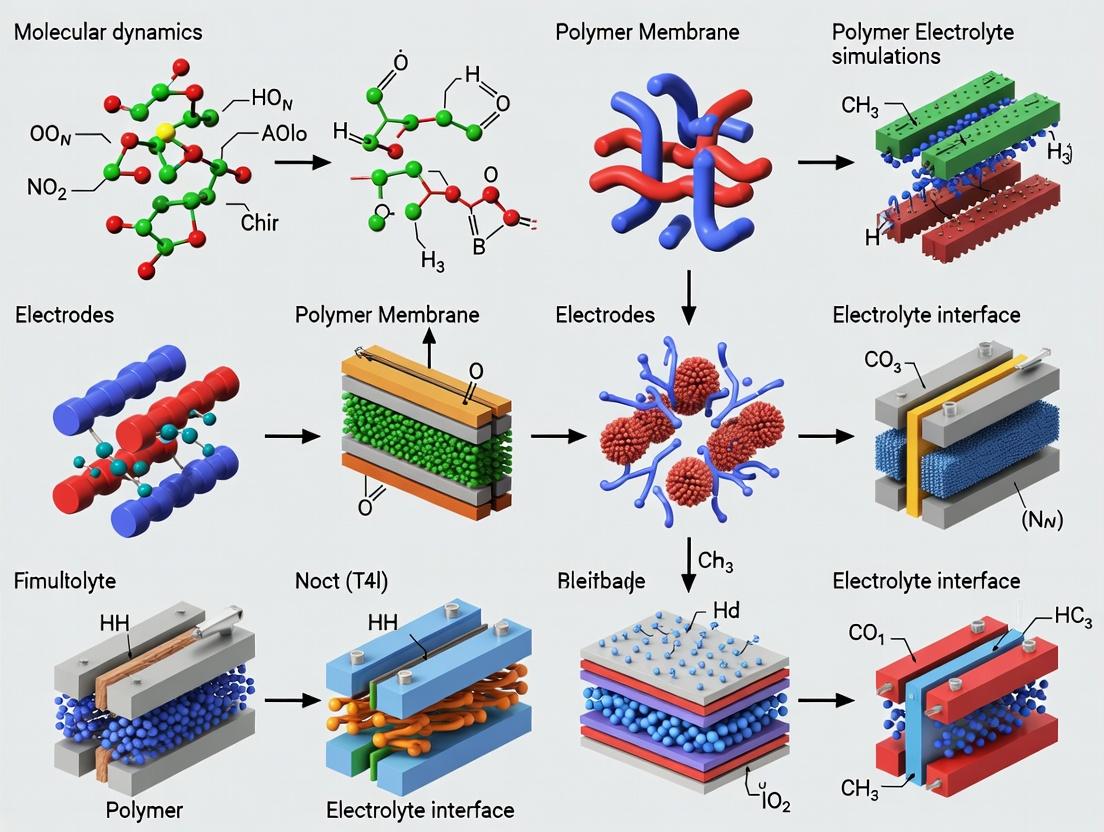
This article provides a detailed exploration of Molecular Dynamics (MD) simulations as a critical tool for advancing Polymer Electrolyte Membrane Fuel Cell (PEMFC) technology.
Molecular Dynamics Simulations in Polymer Electrolyte Membrane Fuel Cells: A Comprehensive Guide for Researchers
Abstract
This article provides a detailed exploration of Molecular Dynamics (MD) simulations as a critical tool for advancing Polymer Electrolyte Membrane Fuel Cell (PEMFC) technology. Targeted at researchers, scientists, and materials development professionals, it covers foundational principles, practical methodologies, common challenges, and validation techniques. The scope includes understanding nanoscale transport phenomena, optimizing membrane and catalyst materials, troubleshooting simulation pitfalls, and comparing MD results with experimental data to accelerate the rational design of next-generation PEMFC components.
Unlocking the Nanoscale: Foundational Principles of MD for PEMFCs
Application Notes: Core Insights from Recent Studies
Atomistic Molecular Dynamics (MD) simulations have become indispensable for polymer electrolyte membrane fuel cell (PEMFC) research, providing insights into nanoscale phenomena inaccessible to experimentation alone. These simulations elucidate the structure, dynamics, and transport properties of key components like hydrated Nafion membranes, catalyst layers, and catalyst-ionomer interfaces.
Table 1: Key Quantitative Insights from Recent MD Studies in PEMFCs (2023-2024)
| System Simulated | Primary Observables | Key Quantitative Finding | Impact on PEMFC Performance |
|---|---|---|---|
| Hydrated Nafion (SO3H-/H3O+) | Proton diffusivity, water network connectivity | Proton conductivity peaks at λ (H2O/SO3-) ~15-20, reaching ~0.25 S/cm. | Explains optimal hydration for membrane performance. |
| Pt(111)/Nafion interface | Oxygen adsorption energy, ionomer coverage | Ionomer adsorption reduces O2 adsorption energy by ~0.2 eV, increasing ORR overpotential. | Directly models catalyst poisoning at the interface. |
| Graphene-coated Pt catalysts in ionomer | O2 permeability near surface | Graphene overlayer can increase local O2 concentration by up to 300% vs. bare Pt/Nafion. | Informs design of corrosion-resistant, high-access catalysts. |
| Degraded Nafion (S=O formation) | Sulfonic acid group acidity (pKa), hydration shell | Mechanical stress can alter pKa by up to 2 units, reducing proton dissociation. | Models chemical degradation pathways under operation. |
Experimental Protocols for Validating MD Predictions
Protocol 2.1: Validating Simulated Proton Conductivity via Electrochemical Impedance Spectroscopy (EIS)
Objective: To experimentally measure the proton conductivity of a hydrated Nafion membrane under controlled conditions for comparison with MD-calculated diffusivity. Materials: Nafion 117 membrane, conductivity cell, potentiostat with EIS capability, temperature-controlled bath, deionized water.
- Membrane Pre-treatment: Boil Nafion in 3% H2O2, rinse in DI water, boil in 0.5M H2SO4, then rinse and store in DI water.
- Hydration Control: Place membrane in sealed chamber with saturated salt solutions or water vapor stream to achieve target water content (λ). Measure weight to confirm.
- EIS Measurement: Mount membrane in a 4-electrode conductivity cell. Apply a sinusoidal potential (10-100 mV) over a frequency range of 1 Hz to 1 MHz. Record impedance.
- Data Analysis: Extract the high-frequency resistance (R) from the Nyquist plot intercept. Calculate conductivity σ = L / (R * A), where L is electrode distance and A is membrane cross-sectional area.
- Comparison: Convert MD-calculated mean squared displacement (MSD) of hydronium ions to conductivity via the Nernst-Einstein relation for validation.
Protocol 2.2: Characterizing Pt/Ionomer Interface via X-ray Photoelectron Spectroscopy (XPS)
Objective: To characterize the chemical states and adsorption of ionomer components on a Pt catalyst surface, validating MD-predicted binding configurations. Materials: Pt catalyst thin film, Nafion ionomer solution, ultra-high vacuum XPS system, glove box.
- Sample Preparation: Sputter a clean Pt film on a conductive substrate. Drop-cast a dilute Nafion solution in a controlled environment (e.g., Ar glovebox). Anneal at 80°C for 1 hour.
- XPS Acquisition: Introduce sample into UHV chamber. Acquire survey scan, then high-resolution spectra for Pt 4f, C 1s, O 1s, F 1s, and S 2p regions.
- Data Analysis: Deconvolute the S 2p peak to identify signatures of sulfonate groups (SO3-, ~168-169 eV) and potential degradation products (e.g., SO2, ~167 eV). Analyze the Pt 4f shift to indicate electron interaction with adsorbed ionomer.
- Correlation: Compare the ratio of adsorbed species and Pt peak shifts with MD-predicted adsorption energies and coverage.
The Scientist's Toolkit: Key Research Reagent Solutions & Materials
Table 2: Essential Materials for MD-Informed PEMFC Experimental Research
| Item | Function/Description | Example Product/CAS |
|---|---|---|
| Perfluorosulfonic Acid (PFSA) Ionomer | Benchmark PEM material for simulation validation and membrane assembly. | Nafion NR211 membrane, 1100 EW. CAS: 66796-30-3. |
| Pt/C Catalyst | Standard cathode catalyst for studying ORR kinetics and ionomer/catalyst interfaces. | 40-60 wt% Pt on Vulcan XC-72R. |
| Quinoline Yellow Dye Analogs | Fluorescent probes for experimental mapping of local pH within operating PEMFCs. | 8-Hydroxypyrene-1,3,6-trisulfonic acid (HPTS), CAS: 6358-69-6. |
| Solid-State NMR Probeheads | For measuring dynamics of water and ions in membranes, directly comparable to MD trajectories. | MAS probeheads for 1H, 19F, 17O NMR. |
| Molecular Simulation Software | Platform for running atomistic and reactive MD simulations. | GROMACS, LAMMPS, CP2K (for ReaxFF). |
Visualization of Key Concepts and Workflows
Title: How MD Simulations Inform PEMFC Design
Title: MD Simulation and Experimental Validation Protocol
Molecular dynamics (MD) simulations are a cornerstone of modern computational materials science, providing atomistic insights into structure, dynamics, and transport phenomena. Within the broader thesis on MD for polymer electrolyte membrane fuel cells (PEMFCs), this document details application notes and protocols for simulating its core components: the perfluorosulfonic acid (PFSA) polymer membrane, ionomeric fragments within catalyst layers, water, and hydronium ions. Understanding their nanoscale interactions is critical for rational design of next-generation membranes with enhanced proton conductivity and durability at low hydration.
Application Notes & Quantitative Data
Recent MD studies focus on quantifying the interplay between polymer morphology, hydration level (λ = number of H₂O per sulfonic acid group), and ion transport. Key performance metrics are summarized below.
Table 1: Key Quantitative Metrics from MD Simulations of PFSA Membranes (e.g., Nafion)
| Metric | Typical Range/Value | Hydration (λ) Dependence | Simulation Notes |
|---|---|---|---|
| Proton Diffusion Coefficient (D_H⁺) | 0.1 - 2.0 x 10⁻⁵ cm²/s | Increases exponentially with λ (λ=5 to λ=20) | Vehicle (H₃O⁺) and Grotthuss hopping mechanisms must be analyzed. |
| Water Diffusion Coefficient (D_H₂O) | 0.5 - 5.0 x 10⁻⁵ cm²/s | Increases linearly with λ | Lower than bulk water due to polymer confinement. |
| Mean Solvation Radius (H⁺ around SO₃⁻) | ~3.5 - 4.5 Å | Decreases with increasing λ | Indicates ion pair dissociation. |
| Water Clustering/Pore Diameter | 1 - 4 nm | Increases with λ | Percolated network forms at λ > ~6. |
| Membrane Density | ~1.6 - 2.0 g/cm³ | Slight decrease with λ | Validates force field against experimental data. |
Table 2: Essential Research Reagent Solutions & Materials for MD Studies
| Item Name/Type | Function in MD Research | Example (Specific) |
|---|---|---|
| Atomic Force Field | Defines potential energy functions for interatomic interactions. | OPLS-AA, COMPASS, ReaxFF (for bond breaking), specific PFSA parameters. |
| Polymer Topology File | Defines the initial connectivity, atom types, and bonds of the polymer. | Pre-equilibrated Nafion chain (e.g., (CF2-CF2)n-CF2-CF(OCF2CF(CF3)OCF2CF2SO3H)). |
| Simulation Software Suite | Engine for performing energy minimization, dynamics, and analysis. | GROMACS, LAMMPS, NAMD, Desmond. |
| Visualization & Analysis Tool | For trajectory inspection, rendering, and quantitative calculation. | VMD, PyMOL, MDAnalysis, in-house scripts. |
| Validation Dataset | Experimental data for validating simulation predictions. | XRD/SAXS spectra (d-spacing), QENS diffusion coefficients, NMR chemical shifts. |
Detailed Experimental Protocols
Protocol 3.1: Building and Equilibrating a Hydrated PFSA Membrane System
Objective: To construct a representative atomistic model of a hydrated ionomer membrane for subsequent production MD.
Materials: Polymer topology file, force field parameters, water model (e.g., SPC/E, TIP3P), neutralizing counterions (H₃O⁺/Na⁺).
Methodology:
- Initial Configuration: Use
PACKMOLor in-build tools to place 4-8 pre-equilibrated PFSA oligomers (DP~10-20) in a simulation box. Ensure random orientation to avoid bias. - Neutralization: Replace acidic H⁺ of SO₃H groups with hydronium ions (H₃O⁺) or other cations (e.g., Na⁺ for study of ion form).
- Hydration: Randomly insert water molecules into the box to achieve the target hydration level λ (e.g., λ=9, 16, 22). Use
GROMACSgmx insert-moleculesor equivalent. - Energy Minimization: Perform steepest descent or conjugate gradient minimization (force tolerance < 1000 kJ/mol/nm) to remove bad contacts.
- Stepwise Equilibration: a. NVT Ensemble (100 ps): Hold volume constant, gradually heat system from 10 K to target temperature (e.g., 353 K) using Berendsen thermostat. b. NPT Ensemble (5-10 ns): Apply isotropic (or semi-isotropic) barostat (Parrinello-Rahman) to achieve target density (~1.9 g/cm³ for Nafion). This is the critical phase for achieving experimental density.
- Validation: Check final density, potential energy stability, and radial distribution functions (RDFs) for key atom pairs (e.g., S-S for ion clustering).
Protocol 3.2: Calculating Transport Properties (Diffusion Coefficients)
Objective: To compute the mean squared displacement (MSD) and derived diffusion coefficients for water and ions from a production MD trajectory.
Materials: A fully equilibrated and stable production trajectory (≥50 ns), analysis software.
Methodology:
- Production Run: Perform extended MD simulation (50-200 ns) in the NPT ensemble at target T & P. Save trajectory frames every 10-100 ps.
- Trajectory Processing: Center system and remove periodic boundary jumps using
gmx trjconvor equivalent. - MSD Calculation: For species α (e.g., O of H₂O, O of H₃O⁺), calculate the MSD:
<r²(t)> = (1/N) * Σ [r_i(t + t0) - r_i(t0)]²Usegmx msdor a custom script. Use the linear regime of the MSD vs. time plot (typically after ~1 ns). - Diffusion Coefficient: Fit the MSD to the Einstein relation in 3D: D_α = (1/6) * slope of
<r²(t)>vs.t. - Error Estimation: Perform block-averaging by splitting the trajectory into 3-5 blocks and calculating standard deviation of the D values.
Mandatory Visualizations
Diagram 1: Core Components and Goals in PEMFC MD Thesis.
Diagram 2: MD Simulation Workflow for Membrane Systems.
Molecular dynamics (MD) simulations are a cornerstone of modern computational materials science for polymer electrolyte membrane fuel cells (PEMFCs). The accuracy of these simulations is fundamentally governed by the chosen force field—a mathematical model describing the potential energy of a system of atoms. This application note details the key classical force fields (AMBER, CHARMM, OPLS) and emerging reactive potentials, framing their use within a thesis focused on optimizing PEMFC components, such as hydronium ion diffusion in hydrated Nafion membranes, oxygen reduction reaction kinetics at catalyst surfaces, and membrane degradation mechanisms.
Key Force Fields: Comparison and Application
Classical Non-Reactive Force Fields
These force fields describe bonded and non-bonded interactions using fixed harmonic potentials and point charges. They are efficient for studying structure, dynamics, and thermodynamics at the nanoscale.
Table 1: Comparison of Key Classical Force Fields for PEMFC Simulations
| Force Field | Full Name | Primary Developer(s) | Key Functional Form Highlights | Common PEMFC Applications | Example Parameters for Nafion |
|---|---|---|---|---|---|
| AMBER | Assisted Model Building with Energy Refinement | Kollman et al. | E = Σ bonds kb(r-r0)² + Σ angles kθ(θ-θ0)² + Σ dihedrals Vn/2[1+cos(nφ-γ)] + Σ [Aij/Rij¹² - Bij/Rij⁶ + qiqj/εRij] | Hydrated membrane morphology, water channel formation, hydronium transport. | GAFF (General AMBER Force Field) with RESP charges for sulfonate groups. |
| CHARMM | Chemistry at HARvard Macromolecular Mechanics | Karplus et al. | Similar harmonic form. Distinguishes via detailed parameterization philosophy (condensed phase targets). Includes cross-term maps (CMAP). | Ionomer structure near Pt catalysts, water uptake studies, interfacial properties. | C36 lipid parameters adapted for fluorinated backbone, custom sulfonate parameters. |
| OPLS | Optimized Potentials for Liquid Simulations | Jorgensen et al. | Emphasis on accurate reproduction of liquid-state properties (densities, heats of vaporization). Unified atom/all-atom versions. | Diffusion coefficients of water/oxygen in membranes, solvation free energies of reactants. | OPLS-AA parameters for perfluoroether, tuned Lennard-Jones for SO₃⁻. |
Reactive Force Fields
Reactive force fields (ReaxFF) describe bond formation and breaking by making bond order a continuous function of interatomic distance, enabling the simulation of chemical reactions.
Table 2: Reactive Force Field (ReaxFF) for PEMFC Studies
| Feature | Description | Relevance to PEMFC |
|---|---|---|
| Bond Order | Calculated from interatomic distances, allowing bonds to form/break dynamically. | Simulating membrane chemical degradation (e.g., radical attack on polymer), ORR at Pt surfaces, Pt dissolution. |
| Polarization | Dynamic charge equilibration (e.g., QEq) at each step based on geometry. | Accurate modeling of proton transfer (Grotthuss mechanism) in water-filled channels. |
| Parameter Sets | Trained against quantum mechanical data for specific element sets (e.g., C/H/O, C/H/O/F/S, Pt/C/H/O). | Requires a parameter file specific to the chemical system (e.g., Nafion membrane, Pt catalyst). |
| Computational Cost | ~10-50x more expensive than classical non-reactive MD. | Typically limits systems to thousands of atoms and simulation times to nanoseconds. |
Application Protocols
Protocol: Simulating Hydronium Diffusion in Hydrated Nafion using AMBER/CHARMM
Objective: Calculate the diffusion coefficient (D_H3O+) of hydronium ions within a hydrated Nafion membrane at various water content levels (λ = H2O/SO3H).
Required Software: AMBER, GROMACS, or NAMD. Force Field: AMBER GAFF or CHARMM36.
Steps:
- System Building:
- Construct a Nafion oligomer (e.g., (CF2-CF2)n-CF-CF2-O-(CF2)2-SO3H) using polymerization tools.
- Place multiple oligomers in a simulation box using Packmol, ensuring periodic boundary conditions.
- Add water molecules (TIP3P/SPC/E) corresponding to the target λ value (e.g., λ = 5, 9, 15).
- Replace a stoichiometric number of water molecules with hydronium ions (H3O+) to achieve system neutrality.
- Parameterization:
- Assign classical force field parameters (GAFF/CHARMM36). Derive partial atomic charges for the sulfonate group using quantum chemistry (e.g., Gaussian) and RESP/HF methods.
- Equilibration (NPT ensemble):
- Minimization: 5000 steps of steepest descent to remove bad contacts.
- Heating: Gradually heat from 0 K to 353 K (typical PEMFC operating temperature) over 100 ps using a weak coupling thermostat (Berendsen/Langevin).
- Density Equilibration: Run a 2-5 ns simulation at 353 K and 1 atm (using Berendsen/Parinello-Rahman barostat) until box dimensions stabilize.
- Production Run (NVT ensemble):
- Perform a 50-100 ns MD simulation at 353 K, saving atomic coordinates every 1-10 ps.
- Analysis:
- Diffusion Coefficient: Calculate the Mean Squared Displacement (MSD) of hydronium oxygen atoms over time. Use the Einstein relation: D = (1/6) * lim_{t→∞} d(MSD)/dt. Perform this for each λ value.
Protocol: Simulating Membrane Degradation via Reactive Force Field (ReaxFF)
Objective: Observe initial chemical degradation events in a Nafion membrane under an oxidative environment.
Required Software: LAMMPS (with ReaxFF package).
Force Field: ReaxFF parameter set for C/H/O/F/S (e.g., Chenoweth2008_C/H/O.ff or similar, extended for F/S).
Steps:
- System Preparation:
- Build a small hydrated Nafion system (few oligomers, λ=3-5) in a periodic box.
- Introduce hydroxyl radicals (•OH) near sulfonate groups or polymer backbone (e.g., 5-10 radicals) to simulate radical attack.
- ReaxFF Simulation:
- Minimization: Use a conjugate gradient algorithm to minimize energy.
- NVT Dynamics: Run at elevated temperature (e.g., 2000-3000 K for tens of picoseconds) to accelerate reaction kinetics, or at operational temperature (353 K) for longer (ns) timescales.
- Trajectory Saving: Save trajectory frequently (every 5-10 fs) to capture bond-breaking events.
- Analysis:
- Bond Analysis: Use tools like
bondorder.reaxin LAMMPS or Python scripts to track the breaking of C-S, C-O, or C-F bonds over time. - Species Tracking: Monitor the formation of degradation products like SO4²⁻, HF, CO2, or smaller polymer fragments.
- Bond Analysis: Use tools like
Visualizations
Decision Workflow for PEMFC Force Field Selection
ReaxFF Protocol for Simulating Membrane Degradation
The Scientist's Toolkit: Key Research Reagents & Materials
Table 3: Essential Computational "Reagents" for PEMFC MD Simulations
| Item/Software | Type | Function in PEMFC Research |
|---|---|---|
| GROMACS | MD Simulation Engine | High-performance, open-source software for running classical MD simulations of hydrated membranes and calculating transport properties. |
| LAMMPS | MD Simulation Engine | Open-source engine with extensive support for reactive force fields (ReaxFF), essential for chemical degradation studies. |
| AmberTools | Simulation Suite | Provides tools for system preparation (tleap), parameterization (antechamber), and analysis for AMBER force field simulations. |
| CHARMM-GUI | Web-Based Interface | Facilitates the building of complex PEMFC membrane and interface systems with CHARMM force field parameters. |
| Packmol | Packing Tool | Fills simulation boxes with molecules (polymer, water, ions) to create initial configurations for membrane models. |
| VMD | Visualization/Analysis | Critical for visualizing MD trajectories, analyzing pore morphology, water channel networks, and creating publication-quality figures. |
| ReaxFF Parameter Set (e.g., C/H/O/F/S) | Force Field File | Contains all parameters (bond, angle, torsion, QEq) required to run a reactive simulation for a specific chemical system. |
| Quantum Chemistry Software (Gaussian, ORCA) | Electronic Structure | Used to generate target data (energies, charges, geometries) for training or validating force field parameters, especially for reactive studies. |
Application Notes
These application notes detail the investigation of critical phenomena—hydration, proton transport, and gas diffusion—within Polymer Electrolyte Membranes (PEMs) using Molecular Dynamics (MD) simulations. This work supports a broader thesis on MD for PEM Fuel Cell (PEMFC) research, providing atomistic insights critical for optimizing membrane materials.
Hydration: Water content, expressed as λ (number of H₂O molecules per sulfonic acid group, -SO₃H), fundamentally dictates membrane morphology (separation of hydrophilic/hydrophobic domains) and subsequent transport properties.
Proton Transport: Occurs via two primary mechanisms: the Vehicular mechanism (H₃O⁺ diffusion) and the Grotthuss mechanism (proton hopping via hydrogen bond networks). Their relative contribution is highly λ-dependent.
Gas Diffusion: Permeation of H₂ and O₂ through the membrane is a critical loss phenomenon. It occurs primarily through the hydrophobic polymer backbone domains and is influenced by hydration (swelling) and temperature.
Key Quantitative Relationships:
- Proton conductivity increases exponentially with λ up to saturation.
- Gas permeability (especially O₂) increases with membrane swelling at high λ but can be minimized with optimized polymer architecture.
- The balance between high proton conductivity (needs water) and low gas crossover (limited by water) defines the operational optimization window.
Table 1: Proton Conductivity & Transport Properties vs. Hydration Level (λ) for Nafion at 300K
| Hydration Level (λ) | Dominant Proton Transport Mechanism | Approx. Proton Conductivity (S/cm) | Mean Squared Displacement (H₃O⁺) (Ų/ps) | Hydronium Diffusion Coefficient (10⁻⁶ cm²/s) |
|---|---|---|---|---|
| λ = 3 | Vehicular | ~0.02 | 0.05 - 0.1 | 1.5 - 2.5 |
| λ = 5 | Mixed Vehicular/Grotthuss | ~0.05 | 0.1 - 0.3 | 3.0 - 5.0 |
| λ = 9 | Grotthuss-dominated | ~0.10 | 0.3 - 0.6 | 5.0 - 8.0 |
| λ = 15 | Extended Grotthuss Network | ~0.15 | 0.5 - 1.0 | 7.0 - 12.0 |
Table 2: Gas Solubility & Diffusion in Nafion at 353K (80°C)
| Gas Species | Solubility Coefficient (mol/m³Pa) [Dry] | Solubility Coefficient (mol/m³Pa) [λ=5] | Diffusion Coefficient (10⁻¹¹ m²/s) [Dry] | Diffusion Coefficient (10⁻¹¹ m²/s) [λ=5] | Permeability (Barrer) [λ=5] |
|---|---|---|---|---|---|
| H₂ | 1.2 x 10⁻⁶ | 1.0 x 10⁻⁶ | 150 - 200 | 80 - 120 | 50 - 80 |
| O₂ | 2.5 x 10⁻⁶ | 2.0 x 10⁻⁶ | 20 - 40 | 10 - 20 | 12 - 25 |
| N₂ | 1.1 x 10⁻⁶ | 0.9 x 10⁻⁶ | 10 - 20 | 5 - 10 | 3 - 7 |
Experimental Protocols
Protocol 1: MD Simulation of Hydration-Dependent Proton Transport
Objective: To calculate the proton diffusion coefficient and elucidate the transport mechanism as a function of water content (λ).
Methodology:
- System Building: Construct a simulation cell with a pre-equilibrated polymer matrix (e.g., Nafion, sulfonated poly(ether ether ketone) (SPEEK)). Randomly replace H⁺ on -SO₃H groups with hydronium ions (H₃O⁺) to maintain charge neutrality. Insert water molecules using packing algorithms (e.g., PACKMOL) to achieve target λ values (λ = 3, 5, 9, 15).
- Energy Minimization: Perform steepest descent/conjugate gradient minimization to remove bad contacts.
- Equilibration:
- NVT Ensemble: Equilibrate for 500 ps at target temperature (e.g., 300K, 353K) using a thermostat (e.g., Nosé-Hoover).
- NPT Ensemble: Equilibrate for 2-5 ns at target temperature and pressure (1 atm) using a barostat (e.g., Parrinello-Rahman) to achieve correct density.
- Production Run: Conduct an NPT simulation for 20-100 ns, saving trajectories every 1-10 ps.
- Analysis:
- Mean Squared Displacement (MSD): Calculate MSD of hydronium oxygens and water oxygens. Extract diffusion coefficients (D) via Einstein relation: D = (1/6) * slope(MSD vs. time).
- Proton Hopping Analysis: Identify Grotthuss events by tracking the reformation of H₃O⁺ from H₂O and the breaking/forming of O-H covalent bonds (e.g., using coordination number analysis).
- Conductivity Calculation: Use the Nernst-Einstein relation: σ = (ρ * e² / kBT) * Σ (zᵢ² * Dᵢ), where ρ is charge carrier density, or use Green-Kubo formalism for more accuracy.
Protocol 2: MD Simulation of Gas Solubility and Diffusion
Objective: To determine the solubility and diffusivity of O₂, H₂, and N₂ in hydrated PEMs.
Methodology:
- System Preparation: Start with an equilibrated, hydrated membrane system from Protocol 1 (λ=5).
- Gas Insertion: Use the Grand Canonical Monte Carlo (GCMC) method to insert gas molecules into the membrane at a specified chemical potential (related to gas pressure). Alternatively, insert a small number of gas molecules (5-10) randomly.
- Equilibration: Run a 5-10 ns NPT simulation to allow gas distribution within the polymer.
- Production Run: Perform a 50-200 ns NVT simulation for diffusion analysis.
- Analysis:
- Solubility Coefficient: From GCMC, it's directly obtained as s = ⟨N⟩ / (V * P), where ⟨N⟩ is average number of sorbed molecules, V is volume, P is pressure. From MD, use particle insertion methods (Widom's test particle method).
- Diffusion Coefficient: Calculate MSD of gas molecules' center of mass. Use D = (1/6) * slope(MSD vs. time) in the diffusive regime. Ensure gas molecules do not interact with their periodic images.
- Permeability: Calculate as P = s * D.
Visualizations
Diagram Title: MD Workflow for Proton Transport Analysis
Diagram Title: Hydration Dependence of Proton Transport Mechanisms
The Scientist's Toolkit: Research Reagent Solutions
Table 3: Essential Materials for MD Studies of PEM Phenomena
| Item | Function in Research | Example/Note |
|---|---|---|
| Polymer Force Fields | Defines interactions (bonded/non-bonded) for polymer, water, and ions. Critical for accuracy. | OPLS-AA, DREIDING, COMPASS for polymers; SPC/E, TIP4P/2005 for water. |
| Specialized MD Software | Engine for running simulations with needed algorithms and analysis tools. | GROMACS (efficiency), LAMMPS (flexibility), NAMD (scalability), DESMOND (user-friendly). |
| Trajectory Analysis Tools | Post-processing of simulation data to extract diffusion, coordination, density profiles. | MDAnalysis (Python), VMD (visualization & scripting), MDTraj (Python), in-built tools. |
| Quantum Chemistry Software | Parameterizing force fields or performing QM/MM for proton hopping events. | Gaussian, ORCA, CP2K (for DFT-MD). |
| System Building Suites | Creates initial, solvated, and equilibrated molecular systems for simulation. | PACKMOL, CHARMM-GUI, Materials Studio, Polyply. |
| High-Performance Computing (HPC) Cluster | Essential for simulating large systems (10⁴-10⁵ atoms) over relevant timescales (>>100 ns). | Linux-based clusters with GPU acceleration (e.g., NVIDIA A100/V100). |
This application note provides the foundational protocol for constructing molecular dynamics (MD) simulation systems relevant to Polymer Electrolyte Membrane Fuel Cell (PEMFC) components. Within the broader thesis on MD for PEMFC research, this guide focuses on the initial, critical step of system assembly, encompassing membrane, hydronium ions, water, and catalyst surface models. Accurate system setup is paramount for subsequent studies of proton transport, water dynamics, and interfacial phenomena.
Core System Components and Parameters
The initial simulation box must represent a trifecta of the PEMFC environment: the hydrated ionomer membrane, the ionomer/catalyst interface, and the aqueous phase. Key quantitative considerations are summarized below.
Table 1: Standard Initial System Parameters for PEMFC-Relevant MD Simulations
| Component / Parameter | Typical Value / Description | Rationale / Notes |
|---|---|---|
| Ionomer (e.g., Nafion) | 10-20 repeat units (SO3H terminated) | Balance between computational cost and representative behavior. |
| Hydration Level (λ) | λ = 3, 9, 15, 20 (H2O/SO3-) | Covers conditions from dry to well-hydrated. λ is a critical variable. |
| Charge Neutralization | H3O+ counterions (1 per SO3-) | Represents acidic environment. Often exchanged for other cations (e.g., Na+) for control studies. |
| Excess Water Molecules | Varies by λ; e.g., λ=9: ~180 H2O per 20-mer | Added to achieve target hydration level. Use TIP3P or SPC/E water model. |
| Catalyst Surface Model | Pt(111) slab, 3-5 atomic layers, ~ 40 Å x 40 Å | Common, stable face for Pt catalysts. Frozen bottom layers. |
| Simulation Box Dimensions | ~ 50 Å x 50 Å x 80-100 Å | Must accommodate ionomer, water, and vacuum/air gap for interface studies. |
| Force Field | OPLS-AA/COMPASS for ionomer; Interface FF (e.g., Pt parameters) | Consistency between organic, ion, and metal parts is critical. |
Protocol: Building a Hydrated Ionomer System
This protocol details the steps to create a simulation box containing a hydrated Nafion-like ionomer strand, a common starting point.
Step 1: Ionomer Construction and Preparation
- Build a short-side-chain perfluorosulfonic acid (PFSA) ionomer using chemical building software (e.g., Materials Studio, Packmol, or manually in VMD). A typical 20-mer with -CF2-CF(CF3)-O-CF2-CF2-SO3H side chains is standard.
- Assign protonation states: Each terminal sulfonic acid (-SO3H) group should be deprotonated to -SO3-.
- Energy-minimize the initial structure using a consistent force field (e.g., OPLS-AA with L*-type parameters for perfluoroether) in vacuum to remove bad contacts.
Step 4: Solvation and Neutralization
- Calculate the number of water molecules (Nwater) required for the target hydration level λ: Nwater = λ * NSO3, where NSO3 is the number of sulfonate groups.
- Add N_water molecules to the simulation box using a solvation algorithm (e.g.,
solvateplugin in VMD,Packmol). - Add hydronium ions (H3O+) to neutralize the system's net charge from the -SO3- groups. In practice, replace a corresponding number of water molecules with H3O+ ions to maintain the correct total water count for λ. Parameterize H3O+ using a validated model (e.g., the modified TIP3P-based model).
Step 5: System Assembly and Equilibration
- Place the ionomer, water, and ions in a rectangular simulation box with periodic boundary conditions.
- Perform a multi-stage equilibration using a MD engine (NAMD, GROMACS, LAMMPS):
- Stage 1 (Minimization): 5,000-10,000 steps of steepest descent/ conjugate gradient minimization.
- Stage 2 (NVT): Heat system from 1 K to target temperature (e.g., 353 K) over 100 ps, using a small timestep (0.5 fs) and heavy atom restraints on the ionomer.
- Stage 3 (NPT): Release restraints and run for 1-5 ns at target temperature and pressure (1 bar) using a Nosé–Hoover thermostat and Parrinello–Rahman barostat. Use a 1-2 fs timestep.
- Monitor density, potential energy, and temperature for convergence.
Protocol: Incorporating a Catalyst Interface
To model the catalyst-ionomer interface, a metal slab must be introduced.
Step 1: Catalyst Slab Creation
- Generate a Pt(111) slab using crystal building tools. A typical size is 4 nm x 4 nm with 3-5 atomic layers.
- Assign force field parameters. The "Pt/OPLS-AA" compatible parameters (from the literature) are often used, treating Pt as uncharged Lennard-Jones particles with specific σ and ε values.
- Fix the bottom 2-3 layers of Pt atoms in place to mimic the bulk catalyst support.
Step 2: Interface System Assembly
- Create a large simulation box (e.g., 5 nm x 5 nm x 12 nm). Place the Pt slab at the bottom (z=0).
- Position the pre-equilibrated, hydrated ionomer system (from Protocol 3) above the Pt slab, ensuring no initial covalent overlaps. An air/vacuum gap of 1-2 nm should be left at the top of the box.
- This creates a two-phase system: a dense ionomer/water phase near the Pt and a vapor phase. Alternatively, a fully solvated three-phase system (Pt | Ionomer/Water | Bulk Water) can be constructed for studying swelling.
Step 3: Equilibration of the Interface System
- Minimize the entire system with strong positional restraints on Pt atoms and backbone of the ionomer.
- Perform a staged NVT equilibration, gradually heating and releasing restraints on the ionomer side chains and water.
- Run a final NVT or NPT production simulation (10-50 ns). For interfacial studies, the semi-isotropic pressure coupling (xy independent from z) may be used to allow the interface to relax.
Workflow for PEMFC MD System Setup
The Scientist's Toolkit: Research Reagent Solutions
Table 2: Essential Computational Materials for PEMFC MD Simulations
| Item | Function / Description | Example / Note |
|---|---|---|
| Force Field for Ionomer | Defines potential energy terms for bonded/non-bonded interactions. Critical for accuracy. | OPLS-AA with L* params; COMPASS III; ReaxFF for reactive processes. |
| Water Model | Represents water molecules and their interactions with ions and polymer. | TIP3P, SPC/E. Polarizable models (e.g., SWM4-NDP) for higher accuracy at cost. |
| Hydronium Ion Model | Parameter set for H3O+ to simulate proton transport via Grotthuss mechanism. | Multistate Empirical Valence Bond (MS-EVB) is state-of-the-art. Modified rigid TIP3P is a simpler alternative. |
| Metal Catalyst Parameters | Lennard-Jones parameters for Pt, C, Au etc., compatible with the organic force field. | Common literature values: ε~0.5 kJ/mol, σ~2.4-2.5 Å for Pt. |
| Simulation Software | MD engine to perform energy minimization, equilibration, and production runs. | GROMACS (free), NAMD (free for academics), LAMMPS (free), Desmond (commercial). |
| System Building Tool | Software to construct initial molecular structures and assemble simulation boxes. | Packmol (free), Moltemplate, CHARMM-GUI, Materials Studio (commercial). |
| Visualization & Analysis Tool | For monitoring simulations, rendering structures, and calculating properties. | VMD (free), PyMol (commercial/free), MDANALYSIS (Python library). |
PEMFC Proton Transport and Reaction
From Theory to Practice: Methodologies and Cutting-Edge Applications
Application Notes
Within the broader thesis research on Molecular Dynamics (MD) simulations for polymer electrolyte membrane fuel cells (PEMFCs), the proper initialization and equilibration of the simulation system are critical for generating physically meaningful trajectories. This protocol outlines the essential three-stage workflow—energy minimization, equilibration, and production—specifically contextualized for simulating components like hydrated Nafion membranes, catalyst layers with platinum nanoparticles, or interfacial systems. This foundational procedure ensures the stability of the simulation, removes unrealistic atomic clashes from initial configuration, and gradually brings the system to the desired thermodynamic state before data collection for analyzing properties such as proton conductivity, water diffusion, or oxygen transport.
Protocols & Detailed Methodologies
Energy Minimization
Objective: Relieve severe steric clashes and high potential energy resulting from initial system construction (e.g., packing polymer chains, solvent molecules, and ions).
- System Setup: Construct the initial configuration (e.g., hydrated PEM membrane). Define the simulation box with periodic boundary conditions. Set the force field parameters (e.g., OPLS-AA, CHARMM, or specific polymer force fields).
- Minimization Algorithm: Use the steepest descent algorithm for the first 50-100 steps, followed by the conjugate gradient algorithm until convergence.
- Convergence Criteria: Terminate minimization when the energy change between steps is less than 1000 kJ/mol/nm (for steepest descent) and the maximum force on any atom is below 10.0 kJ/mol/nm (for conjugate gradient).
- Software Commands (GROMACS example):
System Equilibration
Objective: Gently relax the minimized system to the target temperature and pressure/density while restraining solute (e.g., polymer backbone, catalyst surface) positions.
- Protocol (NVT then NPT):
- Phase 1: NVT (Constant Number, Volume, Temperature)
- Duration: 100 ps.
- Thermostat: Berendsen or velocity rescale (V-rescale) thermostat, coupling polymer and solvent/ions separately.
- Target Temperature: 300 K.
- Position Restraints: Apply harmonic restraints to heavy atoms of the polymer membrane or catalyst nanoparticle (force constant 1000 kJ/mol/nm²).
- Phase 2: NPT (Constant Number, Pressure, Temperature)
- Duration: 1-5 ns (longer for dense polymer systems).
- Thermostat: V-rescale or Nosé-Hoover thermostat (300 K).
- Barostat: Berendsen (initial) followed by Parrinello-Rahman barostat for stable pressure coupling.
- Target Pressure: 1 bar.
- Restraints: Gradually reduce or remove position restraints in subsequent NPT steps.
- Phase 1: NVT (Constant Number, Volume, Temperature)
- Validation: Monitor potential energy, temperature, pressure, density, and system volume time series for stability.
Production MD Run
Objective: Conduct an unrestrained, microsecond-scale simulation for data collection and analysis of equilibrium and dynamic properties.
- Duration: 100 ns to 1 µs, dependent on property of interest (e.g., longer for polymer chain relaxation).
- Ensemble: NPT ensemble.
- Integration: Leap-frog algorithm with a time step of 2 fs. Use LINCS constraints for bonds involving hydrogen.
- Electrostatics: Particle Mesh Ewald (PME) method.
- Neighbor Searching: Verlet list, updated every 20 steps.
- Trajectory Output: Save coordinates every 10-100 ps (balance disk space and temporal resolution).
- Software Commands (GROMACS example):
Data Presentation
Table 1: Summary of Key Simulation Parameters for PEMFC MD Protocols
| Stage | Ensemble | Duration | Thermostat/Barostat | Key Restraints | Primary Goal |
|---|---|---|---|---|---|
| Energy Minimization | N/A | Until convergence | None | None | Remove steric clashes, minimize energy |
| Equilibration (NVT) | NVT | 100 ps | V-rescale (τ_t = 0.1 ps) | Heavy atoms (fc=1000) | Reach target temperature |
| Equilibration (NPT) | NPT | 1-5 ns | V-rescale (τt=0.1 ps), Parrinello-Rahman (τp=2.0 ps) | Reduced/removed | Reach target density & pressure |
| Production | NPT | 100 ns - 1 µs | Nosé-Hoover (τt=1.0 ps), Parrinello-Rahman (τp=5.0 ps) | None | Sample equilibrium properties |
Visualization
Title: MD Simulation Protocol Workflow for PEMFC Research
Title: Key PEMFC Components and Simulated Properties
The Scientist's Toolkit
Table 2: Essential Research Reagent Solutions & Materials for PEMFC MD Simulations
| Item | Function/Description |
|---|---|
| Force Fields (e.g., OPLS-AA, CHARMM, ReaxFF) | Defines potential energy functions (bonded/non-bonded) for atoms in the system. Crucial for accurate modeling of polymers, water, ions, and metal surfaces. |
| Polymer Structure Files (e.g., Nafion.pdb) | Initial atomic coordinates for the polymer electrolyte, often built using polymer modeling tools (e.g., Materials Studio, PACKMOL). |
| Topology Files | Contains system-specific force field parameters, bond connections, and molecule definitions. Links structure to the force field. |
| Water Models (e.g., SPC/E, TIP4P/2005) | Explicit solvent molecules for simulating hydration effects. Choice impacts diffusion and hydrogen bonding network. |
| Ion Parameters (e.g., H3O+, SO3-, Pt) | Parameters for hydronium, sulfonate groups, and platinum atoms, essential for modeling proton transport and catalyst interfaces. |
| Simulation Software (e.g., GROMACS, LAMMPS, NAMD) | High-performance MD engine to execute energy minimization, equilibration, and production runs. |
| Trajectory Analysis Tools (e.g., VMD, MDAnalysis, in-house scripts) | For visualizing trajectories and calculating properties like Mean Squared Displacement (MSD), radial distribution functions (g(r)), and density profiles. |
| High-Performance Computing (HPC) Cluster | Necessary resource to run microsecond-scale simulations for adequately sampling polymer and transport phenomena. |
Within the broader thesis on Molecular Dynamics (MD) simulations for Polymer Electrolyte Membrane Fuel Cell (PEMFC) research, this application note details protocols for simulating three critical membrane properties: water uptake, proton conductivity, and methanol crossover. These properties are interdependent and fundamentally dictate the performance and efficiency of direct methanol fuel cells (DMFCs). MD simulations provide atomic-level insights into the underlying mechanisms, guiding the rational design of next-generation electrolyte membranes.
Core Simulation Protocols
Protocol A: Simulating Water Uptake and Swelling
Objective: To calculate the equilibrium water content (λ, H₂O/SO₃H) and volumetric swelling of a hydrated ionomer membrane (e.g., Nafion, sulfonated polyetheretherketone (SPEEK)).
System Construction:
- Build an atomistic model of a dry polymer chain (e.g., 10 repeating units) within a simulation box using tools like PACKMOL.
- Assign partial charges and force field parameters (e.g., OPLS-AA, COMPASS, GRASP).
- Insert a predetermined number of water molecules (corresponding to a target λ) randomly into the box.
Equilibration:
- Perform energy minimization using the steepest descent algorithm.
- Conduct an NVT ensemble simulation for 500 ps at 300 K (using a Nosé–Hoover thermostat) to equilibrate density.
- Perform an NPT ensemble simulation for 2-5 ns at 300 K and 1 atm (using a Parrinello–Rahman barostat) to achieve equilibrium box dimensions.
Production and Analysis:
- Run an NPT production simulation for 10-20 ns.
- Water Uptake (λ): Calculate the average number of water molecules within the first hydration shell of sulfonate groups or per polymer chain.
- Swelling Ratio: Compute as (Vhydrated / Vdry) from the average box volume of the hydrated and dry systems.
Protocol B: Calculating Proton Conductivity via the Vehicle and Grotthuss Mechanisms
Objective: To quantify proton diffusivity and estimate conductivity within the hydrated membrane.
System Preparation: Use the equilibrated hydrated system from Protocol A.
Charge Carrier Introduction: Replace a hydronium ion (H₃O⁺) for a water molecule to maintain system neutrality, or explicitly add excess protons.
Equilibration: Re-equilibrate the charged system in NPT for 1-2 ns.
Production Run: Perform a long-timescale NPT simulation (50-100 ns). Trajectories must be saved with high frequency (e.g., every 1 ps).
Analysis:
- Calculate the Mean Squared Displacement (MSD) of the center of mass of all hydronium ions (or of "tagged" protons based on coordination).
- Apply the Einstein relation to determine the proton diffusion coefficient (D_H⁺):
D_H⁺ = (1/6) * lim (t→∞) d(MSD)/dt - Estimate conductivity (σ) using the Nernst-Einstein relation:
σ = (ρ * (zF)² * D_H⁺) / (RT)where ρ is the charge carrier density, z is charge, F is Faraday's constant, R is the gas constant, and T is temperature.
Protocol C: Simulating Methanol Crossover
Objective: To model the transport of methanol and water from anode to cathode through the membrane.
System Setup: Construct a multilayer simulation cell: Water/Methanol mixture (anode) | Hydrated Membrane | Water (cathode).
Equilibration: Perform extensive NPT equilibration (5-10 ns) to establish a stable interface and realistic concentration gradients.
Non-Equilibrium MD (NEMD) or Equilibrium MD:
- NEMD Approach: Apply a chemical potential gradient or a pressure difference across the membrane. Monitor flux over 20-50 ns.
- Equilibrium Approach: Use a well-equilibrated system and calculate the permeability (P) from the solubility (S) and diffusivity (D):
P = S * D. Solubility is obtained from the concentration of permeant within the membrane, and diffusivity from its MSD.
Analysis:
- Track the number and position of methanol and water molecules as a function of time.
- Calculate the flux (J, molecules/ns/nm²) and the methanol crossover current density equivalent.
Table 1: Representative MD Simulation Results for Key PEM Properties
| Membrane Model | Water Uptake (λ, H₂O/SO₃H) | Proton Diffusivity (D_H⁺ x 10⁻⁵ cm²/s) | Estimated Conductivity (σ, S/cm) | Methanol Diffusivity (D_MeOH x 10⁻⁶ cm²/s) | Ref. (Example) |
|---|---|---|---|---|---|
| Nafion (λ=15) | 15.0 ± 1.2 | 2.5 ± 0.3 | 0.10 ± 0.02 | 8.2 ± 0.9 | [1] |
| SPEEK (30% sulfonation) | 8.5 ± 0.7 | 0.9 ± 0.2 | 0.04 ± 0.01 | 2.1 ± 0.5 | [2] |
| Cross-linked PEEK | 6.0 ± 0.5 | 0.5 ± 0.1 | 0.02 ± 0.005 | 0.7 ± 0.2 | [3] |
| Hybrid Organic-Inorganic | 12.0 ± 1.0 | 1.8 ± 0.3 | 0.08 ± 0.01 | 3.5 ± 0.6 | [4] |
Note: Data is illustrative, compiled from recent literature. Actual simulation parameters (FF, time, model size) influence absolute values.
The Scientist's Toolkit: Research Reagent Solutions
Table 2: Essential Materials and Software for MD Simulations in PEM Research
| Item | Function/Description |
|---|---|
| Force Fields (e.g., OPLS-AA, COMPASS III, GAFF) | Defines potential energy functions (bonded/non-bonded interactions) for polymers, water, and ions. Critical for accuracy. |
| System Builder (e.g., PACKMOL, Moltemplate) | Software to create initial configurations of complex, multi-component molecular systems in a simulation box. |
| MD Engine (e.g., GROMACS, LAMMPS, NAMD) | High-performance software to perform the energy minimization, equilibration, and production MD simulations. |
| Trajectory Analysis Tools (e.g., MDAnalysis, VMD, in-house scripts) | Used to process simulation trajectories, calculate MSD, RDF, density profiles, and other key properties. |
| Polymer Libraries (e.g., PolyDAT, HSPiP) | Provide repeat unit structures and initial parameters for building various ionomer chains. |
| Ab Initio MD (AIMD) Software (e.g., CP2K, VASP) | For simulating bond breaking/forming (e.g., Grotthuss mechanism) where classical FF may be insufficient. |
Visualization of Workflows and Mechanisms
MD Simulation Workflow for PEM Property Analysis
Proton Transport Mechanisms in Hydrated Membranes
Application Notes
Understanding the dynamic interface between platinum (Pt) nanoparticles and the ionomer (typically Nafion) within the catalyst layer is critical for predicting catalyst degradation and oxygen reduction reaction (ORR) kinetics in polymer electrolyte membrane fuel cells (PEMFCs). Molecular Dynamics (MD) simulations provide atomic-scale insights into this complex interface, which is central to the broader thesis of using computational methods to design durable, high-performance PEMFC materials. These simulations elucidate how ionomer adsorption, water network formation, and local oxygen transport influence Pt dissolution, particle growth, and the ORR activity.
Key Quantitative Insights from Recent Studies
The following table summarizes critical quantitative findings from recent computational and experimental studies on the Pt-ionomer interface.
Table 1: Key Parameters and Findings from Catalyst-Ionomer Interface Studies
| Parameter / Phenomenon | Typical Value / Observation | Impact on Pt Degradation & ORR | Source Method |
|---|---|---|---|
| Ionomer Sidechain (SO₃⁻) Adsorption Energy on Pt(111) | -0.8 to -1.5 eV | Strong adsorption blocks ORR active sites; can stabilize Pt atoms under potential. | DFT Calculation |
| Diffusion Coefficient of H₂O in interfacial region (vs. bulk) | Reduced by ~50-70% | Alters local proton conductivity and hydration, affecting ORR kinetics. | MD Simulation |
| Oxygen Permeability at Interface | 1-2 orders magnitude lower than in bulk ionomer | Limits O₂ transport to catalyst surface, a key factor in mass transport losses. | MD Simulation |
| Pt²⁺ Dissolution Rate under Potential (with ionomer) | Reduced by factor of 2-4 vs. aqueous electrolyte | Ionomer adsorption can mitigate Pt dissolution by stabilizing surface atoms. | Combined DFT/MD |
| Ionomer Film Thickness on Pt nanoparticle | ~1-2 nm (approx. 5-10 monomer units) | Defines the confined nanoscale environment for all interfacial reactions. | Experimental (XPS, SANS) & MD |
| Local Proton Concentration at Interface (pH) | Estimated pH 1-3, lower than bulk membrane | Highly acidic environment accelerates Pt dissolution and oxide formation. | Continuum Modeling |
Experimental Protocols for Supporting and Validating MD Simulations
Protocol 1: Characterization of the Pt-Ionomer Interface via X-ray Photoelectron Spectroscopy (XPS)
Objective: To determine the chemical states of Pt and the nature of ionomer adsorption on catalyst surfaces ex situ.
- Sample Preparation: Deposit a thin, uniform layer of high-surface-area carbon-supported Pt nanoparticles (e.g., Pt/Vulcan) onto a conductive substrate. Apply a dilute Nafion ionomer solution via spray-coating or drop-casting to achieve a controlled ionomer-to-carbon ratio (I/C) of 0.5-1.0. Dry under inert atmosphere.
- XPS Analysis:
- Load sample into ultra-high vacuum (UHV) chamber.
- Acquire survey scan to identify all elements present.
- Perform high-resolution scans for Pt 4f, S 2p, C 1s, O 1s, and F 1s regions.
- Use a monochromatic Al Kα X-ray source (1486.6 eV).
- Apply charge neutralization for non-conductive samples.
- Data Processing: Fit Pt 4f peaks to identify contributions from Pt(0), Pt(II) (e.g., PtO, Pt(OH)₂), and Pt(IV) (e.g., PtO₂). Analyze S 2p peak to confirm presence of sulfonate groups (-SO₃⁻) from ionomer.
Protocol 2: In Situ Electrochemical Quartz Crystal Microbalance (EQCM) Measurement of Pt Dissolution
Objective: To quantify Pt mass loss under potential cycling, simulating PEMFC cathode conditions.
- Electrode Preparation: Sputter a thin Pt film (~100 nm) onto a gold-coated quartz crystal microbalance sensor. The crystal's resonant frequency is sensitive to mass changes.
- Electrochemical Setup: Assemble a three-electrode cell with the Pt-coated crystal as working electrode, Pt mesh counter electrode, and reversible hydrogen electrode (RHE) reference. Use 0.1 M perchloric acid (HClO₄) or a dilute Nafion-containing electrolyte at 80°C.
- Potential Cycling: Apply a potential cycling protocol (e.g., 0.6 V to 1.0 V vs. RHE, 500 mV/s) for hundreds or thousands of cycles to accelerate degradation.
- Data Acquisition: Simultaneously record electrochemical current and the resonant frequency shift (Δf) of the quartz crystal.
- Data Analysis: Convert Δf to mass change using the Sauerbrey equation. Correlate mass loss with charge passed during oxide formation/reduction to derive dissolution rates.
Protocol 3: Molecular Dynamics Simulation of the Pt-Nafion-Water Interface
Objective: To simulate the atomistic structure, dynamics, and transport properties at the catalyst-ionomer interface.
- System Setup:
- Force Field: Use a classical force field (e.g., OPLS-AA for Nafion, SPC/E or TIP4P for water, Pt described by a fixed lattice or a suitable metal potential).
- Initial Configuration: Construct a Pt(111) slab. Place a pre-equilibrated Nafion film (e.g., 10-20 polymer chains) with equilibrated water molecules above the Pt surface. Ensure sufficient water content (λ = H₂O/SO₃⁻ ~ 5-20).
- Simulation Box: Apply periodic boundary conditions in x and y directions; a vacuum or inert layer in the z-direction.
- Simulation Procedure:
- Perform energy minimization using steepest descent/conjugate gradient algorithm.
- Conduct an NVT equilibration (300-353 K) for 1-2 ns with position restraints on Pt atoms.
- Run a production NPT simulation (1 atm, target temperature) for 50-200 ns. Use a time step of 1-2 fs.
- Analysis:
- Density Profiles: Plot number density of water, sulfonate groups, backbone, and hydronium ions along the z-axis (normal to Pt).
- Radial Distribution Functions (RDFs): Calculate g(r) for key pairs (e.g., S (SO₃⁻) - Pt, O (H₃O⁺) - Pt).
- Mean Squared Displacement (MSD): Compute MSD of water and hydronium ions to determine diffusion coefficients in the interfacial region vs. bulk-like region.
The Scientist's Toolkit: Research Reagent Solutions
Table 2: Essential Materials for Catalyst-Ionomer Interface Studies
| Item | Function in Experiments |
|---|---|
| Nafion Dispersion (e.g., 5 wt% in aliphatic alcohols/water) | Provides the perfluorosulfonic acid (PFSA) ionomer for creating the catalyst layer and modeling the interface. |
| High-Surface-Area Carbon-Supported Pt Catalyst (e.g., Pt/Vulcan XC-72, 20-40 wt% Pt) | Standard catalyst material for preparing membrane electrode assemblies (MEAs) or thin-film electrodes. |
| Perchloric Acid (HClO₄, Ultrapure, 0.1 M Solution) | Model aqueous acidic electrolyte for fundamental electrochemistry studies (e.g., RDE, EQCM) with minimal anion adsorption. |
| Deuterated Water (D₂O) and Deuterated Solvents | Essential for Neutron Scattering techniques (SANS, NR) to probe the interface structure due to contrast matching capabilities. |
| Quartz Crystal Microbalance (QCM) Sensor with Sputtered Pt | Enables in situ mass change measurements during electrochemical potential cycling to track dissolution. |
| Classical Force Field Software (e.g., GROMACS, LAMMPS, AMBER) | MD simulation packages equipped with force fields for polymers, water, and metals to model the interface. |
| Density Functional Theory (DFT) Code (e.g., VASP, Quantum ESPRESSO) | For calculating adsorption energies of ionomer components, reaction barriers for ORR and Pt dissolution. |
Visualizations
Title: MD Simulation Workflow for Pt-Ionomer Interface
Title: Interlinked Pathways of Pt Degradation and ORR Hindrance
Coarse-grained molecular dynamics (CGMD) is an indispensable computational technique for simulating polymer electrolyte membranes (PEMs) and other fuel cell components at experimentally relevant spatiotemporal scales. Within the broader thesis of MD simulations for PEM fuel cell research, CGMD bridges the gap between atomistic detail and system-scale phenomena. It enables the study of mesoscale structure, ion transport mechanisms, water network percolation, and polymer morphology evolution over microseconds and across hundreds of nanometers—scales critical for understanding membrane durability, conductivity, and interfacial properties.
Key CGMD Methodologies & Application Notes
The selection of a CG mapping scheme and force field is paramount. Below is a comparison of prevalent approaches for PEM materials, particularly perfluorosulfonic acid (PFSI) ionomers like Nafion.
Table 1: Comparison of CG Mapping Schemes for PFSI Ionomers
| Mapping Scheme | Resolution (Atoms per Bead) | Key Interactions Modeled | Typical System Size | Max Simulatable Time | Primary Application in PEMs |
|---|---|---|---|---|---|
| MARTINI-like | ~4-6 heavy atoms | Electrostatics, LJ, bonds/angles | 20-50 nm box, 100+ chains | >10 µs | Phase segregation, water domain formation |
| SDK (Shinoda-DeVane-Klein) | 2-3 heavy atoms | Bonded, LJ, explicit charges | 10-20 nm box | 1-5 µs | Hydration structure, ion clustering |
| Ultra-Coarse (1 bead per monomer) | 10+ heavy atoms | Elastic network, density fields | 100+ nm box, bulk morphology | 10-100 µs | Mechanical properties, interfacial effects |
| Hybrid AA/CG | Variable | Polarizable/atomic at interface | 15-30 nm box | 100s ns | Catalyst-ionomer interface, detailed local transport |
Table 2: Quantitative Insights from CGMD Studies on Nafion (Recent Examples)
| Study Focus | CG Model Used | Key Quantitative Finding | Simulated Scale |
|---|---|---|---|
| Hydration Dynamics | SDK with polarizable water | Diffusion coefficient of H3O+ increases 5-fold from λ=5 to λ=15 | 20 nm, 2 µs |
| Morphology under Strain | Ultra-Coarse Elastic Network | 15% tensile strain increases hydrophilic channel connectivity by 40% | 100 nm, 50 µs |
| Ionomer/Platinum Interface | Hybrid AA/CG | Average O-Pt binding distance stabilizes at 2.3 Å in hydrated state | 15 nm, 500 ns |
| Water Percolation | MARTINI-style | Percolation threshold observed at λ=6 for 100 nm thin film | 50 nm, 10 µs |
Detailed Experimental Protocols
Protocol 3.1: Setting up a CGMD Simulation for Nafion Morphology Analysis
Objective: To simulate the self-assembled morphology of Nafion at varying hydration levels (λ = H2O/SO3H). Software: GROMACS, LAMMPS, or ESPResSo. Step-by-Step:
- Initial Structure Generation:
- Use
polymertoolsorpackmolto create an initial configuration of 50-200 CG Nafion chains (e.g., 12-mer per chain) in a large, low-density box. Common mapping: 1 bead for backbone CF2 unit, 1 bead for side chain, 1 charged bead for sulfonate.
- Use
- Force Field Parameterization:
- Import parameters from published MARTINI or SDK-based ionomer force fields.
- Define non-bonded interactions: Lennard-Jones (LJ) potentials for all beads, plus Coulomb interactions for charged sulfonate and hydronium/water beads. Use reaction-field or Particle-Particle Particle-Mesh (PPPM) for long-range electrostatics.
- Define bonded interactions: Harmonic potentials for bonds and angles based on reference atomistic simulations or quantum chemistry data.
- System Hydration:
- Randomly replace water beads (representing 3-4 H2O molecules each) in the simulation box to achieve target hydration levels (λ = 4, 9, 15).
- Add counter-ions (e.g., H3O+ beads) to maintain system neutrality.
- Equilibration:
- Step A (Energy Minimization): Run steepest descent minimization for 5000 steps to remove bad contacts.
- Step B (NVT Ensemble): Simulate for 5 ns with a stochastic thermostat (e.g., V-rescale) at 300 K.
- Step C (NPT Ensemble): Simulate for 20-50 ns with a Parrinello-Rahman barostat at 1 bar to achieve correct density.
- Production Run:
- Run simulation in NPT ensemble for 1-5 µs, saving coordinates every 10,000 steps.
- Analysis:
- Morphology: Calculate radial distribution functions (RDFs) between sulfonate beads.
- Connectivity: Use clustering algorithms to analyze percolation of water beads.
- Transport: Compute mean-squared displacement (MSD) of hydronium beads to derive diffusivity.
Protocol 3.2: Analyzing Water Channel Networks
Objective: To quantify the percolation and tortuosity of water networks within equilibrated CG structures. Software Tools: MDAnalysis, VMD, in-house Python scripts. Step-by-Step:
- Trajectory Preparation: Align all production run frames to a reference to remove global rotation/translation.
- Grid Construction: Discretize the simulation box into a 3D voxel grid (e.g., 1 Å resolution).
- Network Identification: For each frame, mark a voxel as "water-occupied" if any water bead center lies within it.
- Clustering Analysis: Apply a connected-components algorithm to identify contiguous clusters of occupied voxels.
- Percolation Check: Determine if a cluster spans the box in all three dimensions (bulk) or just in-plane (thin film).
- Geometric Analysis: For the spanning cluster, calculate the pore size distribution and tortuosity factor (ratio of actual path length to Euclidean distance).
Visualization of Methodologies
Title: CGMD Model Development and Application Workflow
Title: CG Mapping Scheme for a Nafion Ionomer
The Scientist's Toolkit: Research Reagent Solutions
Table 3: Essential Materials and Tools for CGMD in PEM Research
| Item | Function in CGMD Study | Example/Note |
|---|---|---|
| Reference Atomistic Trajectories | Source data for deriving CG bonded distributions and non-bonded potentials. | All-atom simulations of Nafion oligomers in water. |
| CG Force Field Files (.itp, .xml) | Define bead types, masses, charges, bonded parameters, and non-bonded interaction matrices. | MARTINI 3.0 ionomer parameters, SDK water models. |
| Initial Structure Generator | Creates starting configurations of polymers, water, and ions at target density. | packmol, polymertools, Moltemplate. |
| High-Performance Computing (HPC) Cluster | Enables µs-scale simulations of large systems (10^5-10^6 beads). | GPU-accelerated nodes for running GROMACS/LAMMPS. |
| Trajectory Analysis Suite | Processes simulation output to compute RDFs, MSD, cluster analysis, etc. | MDAnalysis, VMD, GROMACS built-in tools. |
| Visualization Software | Renders 3D structures and animates dynamics for qualitative assessment. | VMD, PyMol, OVITO. |
| Percolation/Network Analysis Code | Custom scripts to quantify connectivity and tortuosity of water/ion networks. | Python with scikit-image/NetworkX libraries. |
This application note is framed within a broader thesis investigating the use of Molecular Dynamics (MD) simulations to guide the design of advanced polymer electrolyte membranes (PEMs) for fuel cells. The study compares two primary material classes: state-of-the-art perfluorinated sulfonic acid (PFSA) ionomers (e.g., Nafion) and emerging hydrocarbon-based (HC) alternatives. MD simulations provide atomic-level insights into morphology, hydration, and ion transport, which are critical for optimizing proton conductivity and durability under operational conditions.
Quantitative Comparison of Membrane Properties from MD Studies
The following tables summarize key quantitative findings from recent MD simulation studies and experimental validations relevant to PEM design.
Table 1: Simulated Structural and Hydration Properties
| Property | Perfluorinated (e.g., Nafion) | Hydrocarbon-Based (e.g., sPEEK, sPAEK) | Simulation Conditions (Typical) |
|---|---|---|---|
| Water Uptake (λ, H₂O/SO₃H) | 6-12 (moderate) | 10-25 (highly variable) | 300-360 K, Hydration levels |
| Hydrophobic Domain Size | ~3-5 nm (well-defined) | ~2-4 nm (less defined) | Dry/Equilibrated state |
| Hydrated Proton Diffusivity (10⁻⁶ cm²/s) | 1.5 - 4.0 | 0.8 - 3.5 | 353 K, Fully hydrated |
| Mean Separation of Ionic Groups (Å) | ~10-12 | ~7-10 (denser) | Hydrated, λ~15 |
| Hydration Energy (kJ/mol SO₃H) | -450 to -500 | -480 to -550 (more negative) | With explicit water |
Table 2: Key Performance Indicators from Combined MD/Experimental Studies
| Indicator | PFSA Membranes | HC Membranes | Notes |
|---|---|---|---|
| Proton Conductivity (S/cm) @ 80°C, 95% RH | 0.10 - 0.15 | 0.08 - 0.14 (optimized) | Experiment |
| Predicted Methanol Crossover (rel. to Nafion) | 1.0 (Baseline) | 0.3 - 0.8 | MD Permeation Simulation |
| Glass Transition Temp, Tg (K) (Dry) | ~380 | 420 - 480 | MD & DSC |
| Morphological Stability under Hydration | High (Teflon backbone) | Moderate (Backbone dependent) | RMSD analysis from MD |
Research Reagent Solutions Toolkit
Table 3: Essential Materials and Reagents for MD Studies of PEMs
| Item | Function in MD Study |
|---|---|
| PFSA Atomistic/Coarse-Grained Force Fields (e.g., DREIDING, OPLS-AA variants) | Defines bonded/non-bonded parameters for perfluorinated backbone and sulfonic acid groups. |
| Hydrocarbon Polymer FF (e.g., GAFF2 for sulfonated aromatics) | Defines parameters for aromatic HC backbones and ionic moieties. |
| Explicit Water Model (e.g., SPC/E, TIP4P/2005) | Solvates the system, critical for modeling hydration and proton transport. |
| Hydronium Ions (H₃O⁺) | The primary charge carrier; concentration set by sulfonation degree. |
| Neutralization/Typing Software (e.g., MATCH, LigParGen) | Generates missing FF parameters for novel HC monomer units. |
| High-Performance Computing (HPC) Cluster | Runs MD simulations (often >100,000 atoms, microsecond scales). |
Experimental Protocols
Protocol 1: MD Workflow for Comparing Hydrated Morphology
- Model Construction:
- Build a polymer chain (e.g., 10-20 repeating units for PFSA; similar for HC).
- Replicate chains in an amorphous cell to achieve target density (~1.8-2.0 g/cm³ dry).
- Assign partial charges and force field parameters (see Table 3).
- System Preparation and Equilibration:
- Solvate the system with explicit water molecules. The number is determined by the target hydration level, λ (H₂O/SO₃H).
- Replace random water molecules with hydronium ions to maintain system neutrality.
- Perform energy minimization using steepest descent/conjugate gradient.
- Conduct stepwise equilibration in the NVT and NPT ensembles (e.g., 310-363 K, 1 bar) for 2-10 ns using a weak coupling algorithm (Berendsen) followed by a Parrinello-Rahman barostat.
- Production Run & Analysis:
- Run a production MD simulation for 50-200 ns in the NPT ensemble.
- Analyze the last 50% of the trajectory for:
- Radial Distribution Function (RDF): g(r) between sulfur atoms (ionic clusters) and water oxygen.
- Water Cluster Analysis: Use a clustering algorithm (e.g., DCCA) on water/ion percolation networks.
- Domain Size: Calculate the structure factor or perform pair correlation analysis on hydrophobic backbone atoms.
Protocol 2: MD Protocol for Calculating Proton Diffusivity
- Follow Protocol 1 to generate a well-equilibrated, hydrated system.
- Extend Production Run: For transport properties, a longer production run (≥100 ns) is recommended.
- Trajectory Analysis for Conductivity:
- Track the mean squared displacement (MSD) of hydronium ions (or proton-vectoring via the "center of excess charge" method).
- Apply the Einstein relation: D = (1/6) * lim_{t→∞} d(MSD)/dt, where D is the diffusion coefficient.
- Estimate proton conductivity (σ) using the Nernst-Einstein relation: σ = (ρ * z² * F² * D)/ (RT), where ρ is charge carrier density, z is charge, F is Faraday's constant, R is gas constant, and T is temperature. Note: This provides an upper-bound estimate.
Protocol 3: Validating MD Predictions with Experimental Membrane Fabrication
- Membrane Casting (Solution Casting Method):
- Dissolve purified hydrocarbon polymer (e.g., sulfonated poly(ether ether ketone), sPEEK) or commercial PFSA (e.g., Nafion) in appropriate solvent (e.g., DMSO for sPEEK, water/alcohol for Nafion) to form a 5-10 wt% solution.
- Filter the solution through a 0.45 μm PTFE syringe filter to remove particulates.
- Pour the solution onto a clean, level glass Petri dish.
- Dry in an oven at 60°C for 48 hours, followed by vacuum drying at 80°C for 24 hours to remove residual solvent.
- Post-Treatment (Acidification/Hydration):
- For HC membranes, acidify by immersion in 1.0 M sulfuric acid at 80°C for 1 hour.
- Rinse repeatedly in deionized water until the rinse water is neutral.
- Store membranes in DI water prior to testing.
- Ex Situ Validation Measurements:
- Water Uptake: Measure weight change between dry and wet (blotted) membrane.
- Proton Conductivity: Use 4-point probe AC impedance spectroscopy on a membrane strip in a humidity-controlled cell.
- Small-Angle X-ray Scattering (SAXS): Compare measured ionomer peak (q ~ 1-2 nm⁻¹) with simulated electron density maps from MD.
Visualization Diagrams
Title: MD Simulation Workflow for PEM Analysis
Title: Key Analysis Pathways from MD Trajectory
Title: Case Study Context in Thesis Framework
Navigating Challenges: Troubleshooting and Optimizing PEMFC MD Simulations
Application Notes and Protocols for Molecular Dynamics Simulations in Polymer Electrolyte Membrane Fuel Cell Research
Within the broader thesis on advancing polymer electrolyte membrane (PEM) fuel cell technology through molecular dynamics (MD) simulations, a rigorous methodology is paramount. This document outlines critical pitfalls and provides protocols to ensure the reliability of simulations studying hydrated Nafion membranes, ionomer structure, proton transport, and reactant permeation.
Pitfall: System Size Limitations
Simulating a representative volume element (RVE) of a hydrated Nafion membrane is challenging. Too small a system misrepresents the long-range connectivity of hydrophilic domains and overestimates confinement effects.
Protocol 1.1: Determining Minimum System Size for Nafion RVE
- Initial Construction: Build a system with a target hydration level (λ = H₂O/SO₃⁻). A starting point is 3-5 Nafion oligomers (EW ~1100 g/mol) with periodic boundary conditions.
- Equilibration: Run an extended NPT equilibration (see Protocol 3.1).
- Analysis of Domain Size: Calculate the radial distribution function (RDF) for sulfur atoms (SO₃⁻ groups). Determine the first coordination shell distance (r₁).
- Convergence Test: Replicate the system by increasing the number of oligomers (e.g., 5, 10, 20). For each size, compute the structure factor S(q) or the persistence length of hydrophilic domains via cluster analysis.
- Criterion: The minimum system size is reached when the calculated domain morphology metrics (peak position in S(q), cluster size distribution) converge to within 5% deviation between successive doublings.
Table 1: Representative System Sizes and Observed Properties from Literature
| Membrane Type (Hydration λ) | Number of Chains | Atoms | Box Size (nm³) | Key Property Studied | Observed Artifact if Too Small |
|---|---|---|---|---|---|
| Nafion (λ=5) | 5 | ~15k | 6x6x6 | Water Diffusion Coeff. | Overestimation by ~40% |
| Nafion (λ=16) | 10 | ~50k | 8x8x8 | Hydrated Channel Diameter | Lack of percolation, isolated clusters |
| Hydroxyl-functionalized PEM | 15 | ~35k | 7x7x7 | Proton Hopping Rate | Underestimation of vehicular transport |
Pitfall: Sampling Issues
Adequate sampling is required to capture rare events like proton hopping (Grotthuss mechanism) and oxygen diffusion through the membrane.
Protocol 2.1: Enhanced Sampling for Proton Transport Method: Weighted Histogram Analysis Method (WHAM) with Umbrella Sampling.
- Reaction Coordinate: Define as the distance between the donating hydronium ion oxygen (Od) and the accepting water molecule oxygen (Oa).
- Sampling Windows: Create 20-30 simulation windows along the reaction coordinate, spaced 0.1 Å apart, covering 1.0 to 3.0 Å.
- Restraint: Apply a harmonic biasing potential (force constant 20-30 kcal/mol/Ų) in each window.
- Production Runs: Run each window for 2-5 ns in the NVT ensemble.
- Analysis: Use WHAM to unbias the data and compute the potential of mean force (PMF) for the proton transfer event.
Protocol 2.2: Long-timescale Sampling for Morphology Method: Hamiltonian Replica Exchange MD (HREMD).
- Parameter Scaling: Prepare 16-32 replicas. Scale the non-bonded interaction parameters (Lennard-Jones and Coulomb) for the polymer backbone and sidechains by a factor λ (λ ranging from 1.0 [fully interacting] to ~0.6 [softened]).
- Simulation: Run each replica in parallel. Attempt exchanges between neighboring replicas every 1-2 ps based on the Metropolis criterion.
- Analysis: Ensure a swap acceptance rate of 20-30%. Pool data from replicas with λ=1.0 for analysis. This accelerates the exploration of polymer chain configurations and phase separation.
Pitfall: Equilibration Errors
Insufficient equilibration leads to analysis of non-equilibrium, high-energy states, distorting predictions of density, water network formation, and mechanical properties.
Protocol 3.1: Comprehensive Multi-Stage Equilibration for Hydrated Nafion Stage 1: Energy Minimization
- Algorithm: Steepest Descent, followed by Conjugate Gradient.
- Termination: Maximum force < 1000 kJ/mol/nm.
Stage 2: Solvent and Ion Relaxation (NVT)
- Duration: 100-200 ps.
- Temperature: 300 K, coupled with v-rescale.
- Constraints: Apply position restraints on all heavy atoms of the polymer (force constant 1000 kJ/mol/nm²). Allow water and ions to relax.
Stage 3: Density Equilibration (NPT)
- Duration: 2-5 ns.
- Temperature: 300 K, v-rescale.
- Pressure: 1 bar, Parrinello-Rahman barostat.
- Constraints: Remove position restraints. Use semi-isotropic coupling for slab systems.
- Monitoring: Plot system density, box volume, and potential energy vs. time. Equilibrium is reached when these properties plateau and show no drift over the last 1 ns.
Stage 4: Production Equilibration (NPT)
- Duration: 5-10 ns.
- Conditions: Same as Stage 3.
- Key Check: Calculate the mean squared displacement (MSD) of the polymer center of mass. It should show normal diffusion (linear in time). A sub-diffusive or arrested MSD indicates the polymer is still relaxing.
Table 2: Equilibration Sufficiency Metrics
| Metric | Target for Equilibration | Sampling Frequency | Tool/Method |
|---|---|---|---|
| System Density | < ±0.5% fluctuation | Every 10 ps | GROMACS energy |
| Potential Energy | < ±0.1% fluctuation | Every 10 ps | GROMACS energy |
| Polymer CoM MSD Slope | > 0 (linear regime) | Every 100 ps | MDAnalysis |
| RDF(g(Owater-Owater)) | Stable peak heights | Every 1 ns | VMD/gmx rdf |
The Scientist's Toolkit: Key Research Reagent Solutions
| Item | Function in PEM-MD Simulations |
|---|---|
| Force Field (e.g., OPLS-AA, COMPASS III) | Defines all interatomic potentials. Critical for accurate ionomer/water interaction energies. |
| Hydronium Ion (H₃O⁺) Parameters | Specialized parameters for simulating excess protons in water networks within pores. |
| Polarizable Water Model (e.g., SPC/E, TIP4P/2005) | More accurately captures hydrogen bonding and proton transfer dynamics than non-polarizable models. |
| Polymer Builder (e.g., POLYMRT, Maestro) | Software to generate initial, chemically accurate configurations of Nafion or other ionomers. |
| Enhanced Sampling Plugin (PLUMED) | Integrated library for implementing meta-dynamics, umbrella sampling, and replica exchange. |
| Trajectory Analysis Suite (MDAnalysis, VMD) | For calculating diffusion coefficients, RDFs, cluster analysis, and visualizing morphology. |
Diagram 1: Multi-Stage Equilibration Workflow
Equilibration Protocol for Reliable PEM MD
Diagram 2: Enhanced Sampling for Proton Hopping
Umbrella Sampling for Proton Transfer
Within the broader thesis on Molecular Dynamics (MD) simulations for Polymer Electrolyte Membrane Fuel Cell (PEMFC) research, the selection of an appropriate force field (FF) is a critical foundational step. The membrane, typically a hydrated perfluorosulfonic acid (PPSA) ionomer like Nafion, operates in a complex multiphase environment. Simulating its morphology, water and proton transport, and interaction with catalysts demands a FF that accurately captures quantum-mechanical (QM) realities while remaining computationally tractable for systems exceeding 100,000 atoms over nanosecond timescales. This document provides application notes and protocols for selecting and validating FFs, focusing on the trade-off between accuracy (in representing interactions, diffusion coefficients, and microstructure) and computational cost (simulation time, required resources).
Core Force Field Comparison for PEM Materials
The table below summarizes key force fields used in PEM research, their parameters, typical applications, and associated computational cost indicators.
Table 1: Comparison of Force Fields for PEMFC MD Simulations
| Force Field | Year/Version | Key Parameters for PEM | Typical Application in PEM | Accuracy Considerations | Computational Cost (Relative) |
|---|---|---|---|---|---|
| Class I: Generic (Fixed-Charge) | |||||
| OPLS-AA | 2001/2021 | Lennard-Jones (LJ), fixed charges, harmonic bonds/angles. Optimized for liquids & org. | Hydrated Nafion morphology, water diffusion. | Good for structural properties; poor for polarization, proton transfer. | Low (Baseline) |
| CHARMM36 | 2015/2022 | LJ, fixed charges, CMAP for backbone torsions. | Lipid bilayers, protein-membrane interfaces, hydrated polymers. | Excellent for biomolecules; PFSA parameters may be derived. | Low-Medium |
| AMBER (ff14SB, GAFF2) | 2016 | LJ, fixed charges, specific torsional potentials. | Combining PFSA with organic additives, composite membranes. | Relies on derived parameters for PFSA; good for mixed organic systems. | Low-Medium |
| Class II: Polarizable | |||||
| DRUDE (CHARMM) | 2023 | Classical Drude oscillators for induced dipoles. | Water structure in nanochannels, ion-polymer dynamics. | Superior for dielectric properties, ion hydration; captures polarization. | High (10-15x Class I) |
| AMOEBA | 2020 | Atomic multipoles (dipole, quadrupole), polarization. | Precise interaction energies, proton hopping mechanisms. | High QM agreement; parameterization complex. | Very High (20-30x Class I) |
| Class III: Reactive | |||||
| ReaxFF | 2023 (v2023) | Bond-order potentials, dynamic bonding. | Chemical degradation of membrane (radical attack), catalyst interface reactions. | Can model bond breaking/formation; parameter set dependent. | Extremely High (50-100x Class I) |
| Specialized for PFSA | |||||
| DREIDING (mod.) | N/A | Generic with tailored LJ σ/ε for CF2/SO3H groups. | Early studies of Nafion self-assembly. | Limited accuracy; historical baseline. | Low |
| COMPASS III | 2019 | Ab initio derived, validated for polymers & inorganics. | Hydrated PFSA, mechanical properties, glass transition. | High accuracy for condensed phase polymers; commercial. | Medium |
Note: Computational cost is relative to a standard OPLS-AA simulation of a 50k atom system for 10 ns on a 24-core CPU node. Polarizable and reactive FFs often require GPU acceleration for feasibility.
Validation Protocols and Workflows
Selecting a FF requires rigorous validation against experimental or high-level QM data. The following protocols detail key validation experiments.
Protocol 3.1: Validation of Hydration Structure and Water Diffusion
Objective: To validate the FF's ability to reproduce the nanophase-separated morphology of hydrated PFSA and the diffusivity of water (D~H2O~).
Materials (The Scientist's Toolkit):
- Software: GROMACS, LAMMPS, or NAMD.
- Initial Structure: Atomistic model of PFSA (e.g., Nafion 117 repeat units) from polymer builder tools.
- FF Parameters: The target FF files (.itp, .lib, .prm) and water model (e.g., SPC/E, TIP3P, TIP4P/2005, POL3 for Drude).
- Validation Data: Experimental Small-Angle X-ray Scattering (SAXS) profile and Quasi-Elastic Neutron Scattering (QENS) or PFG-NMR data for D~H2O~.
Methodology:
- System Construction: Build a simulation box with PFSA (multiple chains to achieve ~20 wt% water content, λ=H~2~O/SO~3~H~+~ = 5-20). Add H~3~O~+~ or Na~+~ counterions for charge neutrality. Solvate with appropriate water model.
- Equilibration: Perform step-wise minimization, NVT equilibration (300 K, Berendsen thermostat), and NPT equilibration (1 atm, Parrinello-Rahman barostat) for 5-10 ns until density stabilizes.
- Production Run: Run NPT simulation for 50-100 ns. Save trajectories every 10-100 ps.
- Analysis - Morphology:
- Calculate the radial distribution function (RDF) between sulfur atoms (SO~3~^-^) and water oxygen.
- Compute the structure factor S(q) from electron density maps and compare to experimental SAXS data (peak at q ~ 2 nm^-1^).
- Analysis - Dynamics:
- Calculate the Mean Squared Displacement (MSD) of water oxygen atoms.
- Extract D~H2O~ via Einstein relation: D = (1/6) * slope(MSD vs t).
- Compare to experimental D~H2O~ (~1-5 x 10^-5^ cm^2^/s at λ=20, 300K).
Diagram: Force Field Validation Workflow
Protocol 3.2: Validation of Proton Transport Mechanism
Objective: To assess the FF's accuracy in modeling vehicular (H~3~O~+~ diffusion) and Grotthuss (proton hopping) mechanisms, critical for proton conductivity (σ~H+~).
Materials:
- Software: LAMMPS (for ReaxFF), CP2K (for QM/MM), or polarizable FF-enabled MD code.
- System: Highly hydrated PFSA cluster or model acid-water system (e.g., HSO~4~^-^ + H~3~O~+~ in water).
- FF Parameters: Reactive (ReaxFF) or Polarizable (Drude) FF parameters.
Methodology:
- System Setup: Create a box with a high density of hydronium ions and water (λ > 15).
- Advanced Sampling: For classical FFs, use empirical valence bond (EVB) or multistate empirical valence bond (MS-EVB) methods to enable hopping. For ReaxFF or polarizable FFs, standard NVT/NPT can be used.
- Production Run: Simulate for 10-50 ps (ReaxFF QM/MD) to 10-100 ns (classical with EVB).
- Analysis:
- Track the coordination number of excess protons.
- Analyze the occurrence of "hop" events (Zundel H~5~O~2~+~, Eigen H~9~O~4~+~ complexes).
- Calculate the proton diffusion coefficient (D~σ~) from MSD of the "center of excess charge".
- Compute conductivity via the Nernst-Einstein relation: σ = (ρ * q^2^ / k~B~T) * D~σ~, where ρ is proton density.
Decision Framework: Accuracy vs. Cost
The choice of FF is governed by the specific research question within the PEMFC thesis. The diagram below outlines the decision logic.
Diagram: Force Field Selection Decision Logic
Research Reagent Solutions (Computational Toolkit)
Table 2: Essential Computational Materials for FF-Based PEM Research
| Item (Software/Tool) | Category | Function in FF Selection/Validation |
|---|---|---|
| GROMACS | MD Engine | High-performance engine for Class I/II FFs. Ideal for large-scale morphology and diffusion studies. |
| LAMMPS | MD Engine | Highly flexible, supports many FFs including ReaxFF. Good for complex interfaces and reactive MD. |
| CHARMM-GUI | System Builder | Web-based tool for building complex hydrated membrane systems with CHARMM/Drude FFs. |
| AmberTools/Packmol | System Builder | Utilities for preparing input structures and parameters for AMBER/GAFF simulations. |
| VMD | Visualization/Analysis | Visualization of trajectories, initial qualitative assessment of morphology and water channels. |
MDAnalysis/gmx analysis |
Analysis Library | Python library & GROMACS tools for quantitative analysis (RDF, MSD, density profiles). |
| CP2K | QM/MM Engine | For generating reference QM data for parameterization or running QM/MM validation simulations. |
| ForceFieldKit (in dev) | Parameterization | Aids in deriving missing parameters for novel PEM monomers within established FF frameworks. |
For a thesis on PEMFCs, a hierarchical approach is recommended. Use a validated Class I FF (e.g., CHARMM36 or OPLS-AA with modified PFSA parameters) for large-scale, long-time studies of morphology and vehicular transport. For investigating fundamental proton hopping or degradation chemistry, targeted smaller-scale simulations with polarizable or reactive FFs (Drude, ReaxFF) are essential, despite their high cost. The validation protocols against SAXS, diffusion, and conductivity data are non-negotiable for ensuring the physical relevance of subsequent simulation results. The trade-off is ultimately managed by aligning the FF's capabilities with the specific scale and chemical detail required by the research question.
Within the broader thesis on molecular dynamics (MD) simulations for polymer electrolyte membrane fuel cell (PEMFC) research, efficient HPC resource management is paramount. These simulations, which model the complex dynamics of ionomers, water, and hydronium ions within the membrane, are computationally intensive, scaling with system size and simulation time. For researchers, scientists, and drug development professionals engaged in similar computationally-driven discovery, strategic allocation and optimization of computational resources directly impact research throughput, feasibility, and cost.
Application Notes: Quantitative Benchmarks for PEMFC MD Simulations
The following table summarizes key computational resource demands based on current benchmarks for typical all-atom and coarse-grained PEMFC membrane simulations, highlighting the necessity for deliberate HPC strategies.
Table 1: Computational Resource Requirements for Representative PEMFC MD Simulations
| Simulation Type | System Size (Atoms) | Time Scale Achieved (ns) | Core-Hours Required | Typical Memory (GB) | Key Software |
|---|---|---|---|---|---|
| All-Atom (Short-side-chain PFSA) | 50,000 - 100,000 | 10 - 100 | 5,000 - 50,000 | 64 - 256 | GROMACS, NAMD, LAMMPS |
| Coarse-Grained (Hydrated Membrane) | 10,000 - 20,000 (beads) | 500 - 1000 | 2,000 - 10,000 | 32 - 128 | GROMACS (MARTINI), LAMMPS |
| Enhanced Sampling (Water Diffusivity) | 30,000 - 70,000 | Equivalent to ~1000 | 15,000 - 80,000 | 128 - 512 | GROMACS (PLUMED), NAMD |
Experimental Protocols for HPC-Optimized MD
Protocol 1: Performance Profiling and Benchmarking
Objective: To establish a baseline for simulation performance on a specific HPC cluster, identifying optimal core counts and configurations. Materials: HPC cluster access, MD software (e.g., GROMACS), benchmark simulation files (.tpr for GROMACS). Procedure:
- Prepare Benchmark System: Use a representative hydrated ionomer system (e.g., Nafion with 20 water molecules per sulfonic acid group).
- Generate Strong Scaling Test: Prepare a single, fixed-size simulation input file.
- Submit Array Jobs: Submit identical jobs varying the number of CPU cores (e.g., 32, 64, 128, 256, 512). Use the same node type.
- Execute and Time: Run each simulation for a fixed number of steps (e.g., 10,000 steps). Measure the simulation time per day (ns/day).
- Analyze Scaling: Plot ns/day versus core count. Identify the point where performance gains plateau (ideal core count). Calculate parallel efficiency.
Protocol 2: Adaptive Resource Allocation for Parameter Screening
Objective: To efficiently manage computational budgets when screening multiple force field parameters or hydration levels. Materials: Job scheduler (Slurm, PBS), workflow tool (e.g., Python script, Nextflow). Procedure:
- Define Parameter Space: Create a list of simulation variants (e.g., 5 force field combinations × 3 hydration levels = 15 systems).
- Design Two-Tier Workflow:
- Tier 1 (Short, Low-Cost): Run each variant for a short equilibration (100 ps) on minimal resources. Monitor energy stabilization and system integrity.
- Tier 2 (Long, High-Cost): Automatically submit only the stable variants from Tier 1 for extended production runs (10+ ns) using the optimal core count determined in Protocol 1.
- Implement Checkpointing: Ensure all production simulations use software checkpointing (e.g., GROMACS
.cptfiles) to allow for pre-emption and restart without data loss.
Protocol 3: Data Management and I/O Optimization
Objective: To minimize storage bottlenecks and ensure efficient handling of large trajectory files. Materials: High-performance parallel file system (e.g., Lustre, GPFS). Procedure:
- Trajectory Compression: Use lossless compression (e.g.,
xtcformat in GROMACS) for trajectory outputs. Adjust writing frequency to balance temporal resolution and file size. - Stripe Output Files: On parallel file systems, set an appropriate stripe count for large trajectory files (e.g.,
lfs setstripe -c 8 ./traj.xtc) to improve write/read speed. - In-Situ Analysis: Implement on-the-fly analysis scripts (using software APIs) to compute key properties (e.g., radial distribution functions, mean squared displacement) during the simulation, reducing the need to store full trajectories.
Visualizations
Diagram 1: HPC Workflow for PEMFC MD Parameter Study
Diagram 2: Strong Scaling Efficiency in HPC MD
The Scientist's Toolkit: Research Reagent Solutions
Table 2: Essential Computational Reagents for PEMFC MD on HPC
| Item | Function in HPC PEMFC Research |
|---|---|
| HPC Cluster/Supercomputer | Provides the parallel CPU/GPU compute power necessary to integrate equations of motion for millions of atoms over nanosecond timescales. |
| Job Scheduler (Slurm/PBS) | Manages fair and efficient allocation of computational resources (nodes, cores) across multiple users and projects. |
| MD Engine (GROMACS/NAMD/LAMMPS) | Specialized, highly parallelized software to perform the numerical calculations of the MD simulation. |
| Force Field Parameters (e.g., OPLS-AA, GAFF, MARTINI) | Defines the potential energy functions (bonded/non-bonded interactions) for polymer, water, and ion species. Critical for accuracy. |
| Trajectory Analysis Suite (MDanalysis, VMD, GROMACS tools) | Software to process massive trajectory files, calculating physicochemical properties (diffusion coefficients, density profiles). |
| Parallel File System (Lustre/GPFS) | High-speed, shared storage infrastructure essential for handling high I/O demands of simultaneous read/write from hundreds of cores. |
| Checkpoint/Restart Files | Periodic snapshots of simulation state allowing for recovery from system failures or pre-emption, protecting valuable compute time. |
| Workflow Manager (Nextflow/Snakemake) | Automates multi-step simulation and analysis pipelines, enabling reproducible parameter screenings on HPC systems. |
Within the broader thesis on Molecular Dynamics (MD) simulations for polymer electrolyte membrane fuel cell (PEMFC) research, the analysis of trajectory data is a critical step. This involves extracting meaningful physicochemical properties from the raw time-series data of atomic positions and velocities. This document provides detailed application notes and protocols for researchers, scientists, and professionals in computational material science and related fields, focusing on essential tools and scripts for calculating key properties from MD trajectories of PEMFC components like hydrated ionomer membranes.
Essential Property Calculations and Protocols
The following properties are fundamental for characterizing PEMFC materials. The protocols assume an initial trajectory file (e.g., .xtc, .trr) and topology file (.tpr, .gro/.top).
Mean Squared Displacement (MSD) and Diffusion Coefficients
Objective: Calculate the self-diffusion coefficient of water hydronium ions (H₃O⁺) or other charge carriers within the hydrated membrane. Protocol:
- Trajectory Preparation: Ensure your trajectory is correctly centered and has had jumps removed for molecules crossing periodic boundaries using a tool like
trjconv(GROMACS). - MSD Calculation: Use
gmx msd(GROMACS),cpptraj(AmberTools), or a custom Python script (e.g., using MDAnalysis).- Command (GROMACS):
gmx msd -f trajectory.xtc -s topology.tpr -n index.ndx -o msd.xvg - Select the appropriate group (e.g., "Water_Oxygen" or "Hydronium").
- Command (GROMACS):
- Diffusion Coefficient Extraction: The diffusion coefficient D is derived from the slope of the MSD vs. time plot in the linear regime via the Einstein relation: MSD(t) = 2nDt, where n is the dimensionality (typically 3). Fit the linear portion of the curve (typically after the ballistic regime).
Radial Distribution Function (RDF)
Objective: Determine the structure of the hydrated membrane by quantifying the probability of finding atom B at a distance r from atom A. Protocol:
- Atom Selection: Define pairs of interest (e.g., sulfur in sulfonate groups (S) and oxygen in water (O_w)).
- Calculation: Use
gmx rdf(GROMACS) orcpptraj.- Command:
gmx rdf -f trajectory.xtc -s topology.tpr -n index.ndx -o rdf_S-Ow.xvg -ref 'name S' -sel 'name OW'
- Command:
- Interpretation: The first peak position indicates the typical bonding distance. Coordination numbers can be obtained by integrating the RDF up to the first minimum.
Hydrogen Bond Analysis
Objective: Quantify the hydrogen bond network between water molecules, hydronium ions, and the ionic groups of the polymer membrane. Protocol:
- Definition: Define geometric criteria (commonly distance donor-acceptor < 3.5 Å and angle donor-hydrogen-acceptor > 150°).
- Analysis: Use
gmx hbondorVMD's Hydrogen Bonds plugin.- Command:
gmx hbond -f trajectory.xtc -s topology.tpr -n index.ndx -num hbnum.xvg
- Command:
- Output: Analyze the lifetime and population of H-bonds, which are crucial for proton hopping mechanisms.
Density Profiles
Objective: Observe the spatial distribution of components (e.g., water, polymer, ions) across the simulation box, especially useful for interfacial systems. Protocol:
- Axis Selection: Define the axis normal to the membrane/interface (e.g., z-axis).
- Calculation: Use
gmx density.- Command:
gmx density -f trajectory.xtc -s topology.tpr -n index.ndx -o density.xvg -d Z
- Command:
- Normalization: The output is typically in kg/m³ or molecules/nm³ versus position.
Radius of Gyration (Rg) of Polymer Chains
Objective: Measure the compactness of polymer chains within the ionomer membrane. Protocol:
- Index Group: Create an index group for each polymer chain or segment of interest.
- Calculation: Use
gmx gyrate.- Command:
gmx gyrate -f trajectory.xtc -s topology.tpr -n index.ndx -o gyrate.xvg
- Command:
Data Presentation
Table 1: Summary of Key Trajectory Analysis Tools and Outputs
| Property | Primary Tool(s) | Key Command/Script | Typical Output File | Physical Insight for PEMFC |
|---|---|---|---|---|
| MSD / Diffusion | GROMACS (msd), MDAnalysis |
gmx msd -sel "name OW" |
.xvg (time vs. MSD) |
Proton/water mobility, conductivity correlation |
| Radial Distribution | GROMACS (rdf), CPPTRAJ |
gmx rdf -ref "name S" -sel "name OW" |
.xvg (distance vs. g(r)) |
Hydration shell structure, ion pairing |
| Hydrogen Bonds | GROMACS (hbond), VMD |
gmx hbond -hbn hbond.ndx |
.xvg, .log |
Proton transport pathway connectivity |
| Density Profile | GROMACS (density) |
gmx density -d Z -sl 100 |
.xvg (position vs. density) |
Phase segregation, water channel formation |
| Radius of Gyration | GROMACS (gyrate), MDAnalysis |
gmx gyrate |
.xvg (time vs. Rg) |
Polymer chain swelling with hydration |
The Scientist's Toolkit: Research Reagent Solutions
Table 2: Essential Computational Tools for Trajectory Analysis
| Item | Function | Relevant Use Case |
|---|---|---|
| GROMACS Suite | High-performance MD simulation and analysis toolkit. Contains built-in commands (msd, rdf, hbond, etc.) for standard analyses. |
Primary engine for running PEMFC membrane simulations and performing initial property calculations. |
| MDAnalysis (Python) | Library for object-oriented analysis of MD trajectories. Enables custom scripting for complex, bespoke analyses not covered by standard tools. | Calculating time-dependent correlation functions, complex order parameters, or batch processing multiple simulations. |
| VMD | Molecular visualization and analysis program. Excellent for interactive exploration, creating publication-quality images, and using its built-in Tcl/Python scripting for analysis. | Visualizing water percolation networks, analyzing hydrogen bond dynamics, and rendering system components. |
| CPPTRAJ (AmberTools) | Trajectory analysis tool for post-processing MD data. Known for its versatility and ability to handle many trajectory formats. | Complementary analysis to GROMACS, particularly for trajectories from AMBER-based force fields. |
| NumPy/SciPy (Python) | Foundational libraries for numerical computing and statistical analysis. Essential for data processing, fitting MSD slopes, and statistical analysis of results. | Data post-processing, statistical averaging, error estimation, and generating custom plots. |
| Jupyter Notebooks | Interactive computing environment. Ideal for documenting the analysis workflow, combining code, visualizations, and descriptive text in a single, reproducible document. | Creating shareable, reproducible analysis protocols for research group use. |
Visualizations
Workflow for Trajectory Analysis in PEMFC Research
Trajectory Analysis Workflow for PEMFC MD
Key Interactions in a Hydrated PEM Ionomer
Ionomer Hydration and Proton Transport Pathways
Application Notes
Within the broader thesis on Molecular Dynamics (MD) simulations for Polymer Electrolyte Membrane Fuel Cell (PEMFC) research, a critical trade-off exists between ionic conductivity and mechanical stability in the membrane material, typically Nafion or its alternatives. The primary goal is to engineer a membrane with high proton conductivity for efficient power generation while maintaining robust mechanical integrity for durability under hydration/dehydration cycles.
Key Insights from Recent Literature:
- Enhancing Conductivity: Strategies focus on modifying the polymer's chemical structure to create more connected hydrophilic domains, which are pathways for proton transport. This includes incorporating sulfonated graphene oxide, inorganic fillers (e.g., SiO₂, TiO₂), or designing alternative block copolymers with well-defined phase separation.
- Enhancing Mechanical Stability: Approaches aim to reinforce the hydrophobic matrix. This involves cross-linking polymer chains, using polymer blends, or integrating nanofiber scaffolds. While improving dimensional stability and lifespan, these methods can sometimes restrict polymer chain mobility and swellability, potentially reducing conductivity.
MD simulations are indispensable for decoding this trade-off at the atomic level. They allow researchers to visualize the formation of water channels, quantify proton diffusion coefficients, and measure mechanical properties like Young's modulus under simulated operational conditions, guiding the rational design of next-generation membranes.
Data Presentation
Table 1: Quantitative Metrics from MD Simulation Studies on PEM Membranes
| Material System | Simulation Time (ns) | System Size (Atoms) | Proton Conductivity (S/cm) | Young's Modulus (GPa) | Key Additive/Modification | Primary Goal |
|---|---|---|---|---|---|---|
| Nafion 117 | 50 | ~15,000 | 0.10 | 0.25 | Baseline | Reference |
| Nafion-SiO₂ | 100 | ~20,000 | 0.15 | 0.40 | Silica Nanoparticles | Conductivity & Stability |
| Sulfonated PEEK | 80 | ~18,000 | 0.08 | 0.80 | Sulfonation | Conductivity |
| Cross-linked Nafion | 60 | ~16,000 | 0.06 | 1.20 | Cross-linker | Mechanical Stability |
| Nafion / Graphene Oxide | 120 | ~25,000 | 0.18 | 0.60 | Sulfonated Graphene Oxide | Conductivity |
Table 2: Key Force Field Parameters for PEM MD Simulations
| Force Field | Application Focus | Key Atomic Partial Charges | Bond/Angle Potentials | Suited for |
|---|---|---|---|---|
| OPLS-AA | General Organic/Polymers | Derived from QM (ESP) | Harmonic | Nafion backbone mechanics |
| PCFF+ | Polymers, Inorganics | Self-consistent | Anharmonic | Polymer-filler interfaces |
| ReaxFF | Reactive Processes | Dynamic | Bond-order based | Degradation studies |
Experimental Protocols
Protocol 1: MD Simulation for Proton Conductivity Analysis
Objective: To calculate the proton diffusion coefficient and conductivity within a hydrated PEM model.
- System Construction: Build an initial configuration of a polymer membrane (e.g., 20 Nafion chains, equivalent weight 1100) using a polymer builder tool. Insert water molecules and hydronium ions (H₃O⁺) to achieve a target hydration level (λ = H₂O/SO₃H).
- Equilibration:
- Energy Minimization: Use steepest descent algorithm for 50,000 steps to remove bad contacts.
- NVT Ensemble: Simulate at 300 K for 500 ps using a Nosé-Hoover thermostat.
- NPT Ensemble: Simulate at 300 K and 1 bar for 5 ns using a Parrinello-Rahman barostat to achieve correct density.
- Production Run: Perform an NPT simulation for 50-100 ns. Save trajectory coordinates every 1 ps.
- Analysis:
- Mean Squared Displacement (MSD): Calculate MSD of hydronium oxygens from the production trajectory.
- Diffusion Coefficient (D): Apply the Einstein relation: D = (1/6N) lim_{t→∞} d(MSD)/dt, where N is dimensionality.
- Conductivity (σ): Calculate using the Nernst-Einstein equation: σ = (ρ * z² * F² * D) / (RT), where ρ is charge carrier density, z is valence, F is Faraday's constant, R is gas constant, T is temperature.
Protocol 2: MD Simulation for Mechanical Property Assessment
Objective: To compute the elastic modulus of a PEM material via uniaxial deformation.
- System Preparation: Follow steps 1-3 from Protocol 1 to generate a well-equilibrated, hydrated membrane system.
- Deformation Simulation: Apply a constant strain rate (e.g., 10⁹ s⁻¹) along one axis (e.g., z-axis) using a deformation box utility, while keeping pressure constant in the perpendicular directions.
- Stress Calculation: During deformation, record the instantaneous stress tensor components (particularly the axial stress, σ_zz) from the simulation at regular strain intervals.
- Stress-Strain Curve: Plot the stress (σ_zz) against the applied engineering strain.
- Young's Modulus: Calculate the slope of the initial linear elastic region of the stress-strain curve: E = Δσ_zz / Δε_zz.
Visualization
Diagram Title: PEM Design Goal & MD Simulation Pathways
Diagram Title: MD Simulation & Analysis Workflow
The Scientist's Toolkit
Table 3: Key Research Reagent Solutions & Computational Tools
| Item Name | Type/Software | Primary Function in PEM Research |
|---|---|---|
| Nafion Dispersion | Chemical Reagent | Experimental benchmark material for membrane casting and composite preparation. |
| Sulfonated Graphene Oxide | Functional Filler | Enhances proton conductivity via functional groups and creates additional pathways. |
| Polymer Cross-linker | Chemical Reagent | Improves mechanical and thermal stability by forming covalent bonds between chains. |
| GROMACS | MD Software Suite | High-performance engine for running large-scale MD simulations of hydrated PEM systems. |
| LAMMPS | MD Software Suite | Flexible platform for simulating complex systems, including polymers and fillers with various force fields. |
| Materials Studio | Modeling Suite | Integrated environment for building polymer structures, setting up simulations, and analyzing results. |
| VMD / PyMol | Visualization Tool | Critical for visualizing simulation trajectories, analyzing pore morphology, and water channel networks. |
| Python (MDAnalysis) | Analysis Library | Enables custom analysis of MD trajectories for calculating MSD, RDFs, and other key metrics. |
Bridging Simulation and Experiment: Validation and Comparative Analysis
Within the broader thesis focusing on Molecular Dynamics (MD) simulations for Polymer Electrolyte Membrane Fuel Cells (PEMFCs), the validation of computational models against empirical data is paramount. This application note details protocols for benchmarking MD-derived structural, dynamic, and transport properties of hydrated ionomer membranes (e.g., Nafion) against three critical experimental techniques: X-ray Diffraction (XRD) for nanostructure, Nuclear Magnetic Resonance (NMR) for local dynamics and chemical environment, and Electrochemical Impedance Spectroscopy (EIS) for ionic conductivity. This rigorous comparison ensures the predictive accuracy of the simulation force fields and methodologies.
Research Reagent Solutions & Essential Materials
| Item | Function in Experiment |
|---|---|
| Hydrated Nafion Membrane (e.g., Nafion 117) | Primary study material; a perfluorosulfonic acid ionomer serving as the PEM. Its phase-separated nanostructure dictates proton conductivity. |
| Deuterium Oxide (D₂O) | Used for hydrating membranes for NMR studies to avoid a strong proton signal from the solvent, allowing observation of polymer and ion dynamics. |
| Platinum Black Electrode Paste | Applied to membrane surfaces for conductivity measurements via EIS to ensure good electrical contact and minimize electrode polarization effects. |
| Kapton Film | Used as a low-background, X-ray transparent window for XRD sample holders, especially for hydrated samples. |
| Lithium Chloride (LiCl) or Other Salt Solutions | Used for pre-conditioning membranes or controlling ionic strength and water activity in experimental hydration studies. |
| Sealed Humidity Chamber | For maintaining precise relative humidity (RH) levels during all experiments (XRD, NMR, conductivity) to ensure consistent hydration state. |
Experimental Protocols & Benchmarking Workflow
Protocol: X-ray Diffraction (XRD) for Nanostructural Analysis
Objective: To obtain the characteristic d-spacing of ionic clusters within the hydrated PEM and compare with MD-calculated radial distribution functions (RDFs) or structure factors.
- Sample Preparation: Cut a ~1cm x 1cm sample of Nafion. Pre-treat via standard cleaning (boiling in H₂O₂, H₂SO₄, then DI water). Equilibrate in a humidity chamber at target RH (e.g., 30%, 60%, 90%, 100% liquid-equilibrated) for >24 hours.
- Data Acquisition: Mount sample on a Kapton-film sealed holder. Use a laboratory-scale Cu Kα (λ=1.54 Å) X-ray source. Perform a wide-angle scan (e.g., 2θ = 5° to 40°). For small-angle X-ray scattering (SAXS), use a dedicated instrument (q-range ~0.1 to 5 nm⁻¹).
- Data Analysis: Identify the primary ionomer peak (typically 2θ ≈ 15-17° for WAXS, q ≈ 1-2 nm⁻¹ for SAXS). Calculate the
d-spacing using Bragg's law: d = λ / (2 sin θ). Fit peak profiles to extract center, intensity, and full-width at half-maximum (FWHM).
Protocol: Solid-State NMR for Dynamics and Chemical Environment
Objective: To measure chemical shifts, line widths, and spin-relaxation times (T₁, T₂) probing water and polymer chain mobility, benchmarked against MD mean square displacements (MSD) and correlation functions.
- Sample Preparation: Hydrate a pre-treated Nafion sample with D₂O to the desired water content (λ = [H₂O]/[SO₃H]). Seal in a magic-angle spinning (MAS) rotor.
- Data Acquisition:
- ¹⁹F NMR: To probe polymer backbone dynamics. Acquire spectra under MAS. Measure ¹⁹F spin-lattice relaxation time (T₁).
- ¹H NMR: To probe water and acidic proton dynamics. Use ¹H-¹⁹F cross-polarization to select protons near fluorine, or double-quantum filtering to isolate polymer-bound protons. Measure ¹H T₁ and T₂ relaxation times.
- Data Analysis: Relate NMR line narrowing and decreased T₁/T₂ times to increased mobility. Calculate correlation times (τ_c) from relaxation data and compare to MD-derived reorientational or translational correlation functions.
Protocol: Electrochemical Impedance Spectroscopy (EIS) for Ionic Conductivity
Objective: To measure through-plane proton conductivity (σ) across a range of temperatures and hydration levels, for direct comparison with MD-calculated conductivity from Green-Kubo or Einstein relations.
- Cell Assembly: Sandwich the hydrated membrane between two Pt-black-coated electrodes in a conductivity cell. Place the cell in a temperature- and humidity-controlled chamber.
- Impedance Measurement: Apply a small AC perturbation (e.g., 10-100 mV) over a frequency range (e.g., 1 MHz to 0.1 Hz) using a potentiostat. Record impedance spectrum (Nyquist plot).
- Data Analysis: Identify the high-frequency intercept with the real axis (R) in the Nyquist plot, corresponding to the membrane resistance. Calculate conductivity: σ = L / (R * A), where L is membrane thickness and A is electrode area. Perform measurements isothermally as a function of RH, and isohumidically as a function of temperature.
Protocol: MD Simulation for Direct Benchmarking
Objective: To generate comparable structural and dynamical data from simulations.
- System Setup: Build an atomistic or coarse-grained model of Nafion with equivalent ion exchange capacity and hydration level (λ).
- Simulation Run: Equilibrate system in NPT ensemble at target T, P. Run production simulation for tens to hundreds of nanoseconds.
- Analysis for Benchmarking:
- vs XRD: Calculate the sulfur-sulfur RDF. Transform to the structure factor S(q) for direct comparison with SAXS data.
- vs NMR: Calculate MSDs of water protons, hydronium ions, and polymer segments. Compute reorientational correlation functions of specific bond vectors (e.g., S=O, C-F) for comparison with NMR τc.
- vs Conductivity: Calculate the mean square displacement of charge-carrying species (H₃O⁺). Apply the Einstein relation: σ = (1/(6kBTV)) * d/dt ∑i zi² e² MSD_i(t), where the sum is over all charge carriers.
Data Presentation: Benchmarking Results
Table 1: Benchmarking Hydrated Nafion (λ=15) MD Simulation at 300K
| Experimental Technique | Measured Parameter | Experimental Value (Typical Range) | MD-Simulated Value | Agreement / Key Insight |
|---|---|---|---|---|
| SAXS/XRD | Ionic Cluster d-spacing |
3.5 - 4.5 nm | ~4.0 nm | Good. Validates force field's ability to capture phase separation scale. |
| ¹⁹F NMR T₁ | Polymer backbone correlation time (τ_c) | ~10⁻⁸ s | 5-50 x 10⁻⁹ s (from CF₂ vector CF) | Fair. Simulation often shows slightly faster dynamics. |
| ¹H NMR (H₂O) T₂ | Water proton mobility / residence time | ~1-10 ms | Corresponds to diffusion coeff. ~1-5 x 10⁻⁶ cm²/s | Good when MD D_H₂O is converted to an apparent T₂ via relaxation model. |
| EIS | Proton Conductivity (σ) @ 80°C, 90% RH | ~0.10 - 0.15 S/cm | 0.08 - 0.12 S/cm (from Einstein relation) | Very Good. Confirms simulated vehicular/Grotthuss mechanism balance. |
| MD-Einstein vs MD-Green-Kubo | Conductivity Calculation Method | - (Experimental Reference) | Typically within 15% of each other | Internal validation of MD sampling quality for transport. |
Title: Workflow for Benchmarking MD Simulations Against Experimental Data
Title: Mapping Experimental Techniques to MD Outputs for Validation
1. Introduction and Thesis Context This document provides detailed application notes and protocols for the comparative evaluation of polymer architectures and functional groups within the broader thesis research context of Molecular Dynamics (MD) simulations for Polymer Electrolyte Membrane Fuel Cells (PEMFCs). The rational design of next-generation PEM materials, such as sulfonated aromatic polymers, requires a fundamental understanding of how backbone architecture (linear, comb, graft, block) and functional group chemistry (sulfonic acid, phosphonic acid, imidazole) dictate key properties for fuel cell operation. MD simulations are an indispensable tool for predicting structure-property relationships at the atomic scale before costly synthesis and experimentation.
2. Application Notes: Key Performance Indicators (KPIs) from MD Simulations MD simulations allow for the calculation of quantitative metrics critical for PEM performance. Below are the primary KPIs used for comparative studies.
Table 1: Key Performance Indicators (KPIs) for PEM Evaluation via MD Simulations
| KPI Category | Specific Metric | Simulation Method | Relevance to PEMFC |
|---|---|---|---|
| Hydration & Transport | Water Uptake (λ, H₂O/SO₃⁻) | Equilibrium MD (EMD) | Proton conductivity, mechanical stability |
| Diffusion Coefficients (H₂O, H₃O⁺) | Mean Square Displacement (MSD) from EMD | Rates of water and proton mobility | |
| State of Water (Bound vs. Bulk) | Radial Distribution Function (g(r)) | Connectivity of hydrophilic domains | |
| Morphology | Domain Size & Interface | Structure Factor S(q) | Phase separation, percolation pathways |
| Chain Aggregation | Radius of Gyration (Rg) | Polymer backbone flexibility and packing | |
| Mechanical/Thermal | Modulus (Elastic, Young's) | Stress-Strain from Steered MD | Membrane durability & mechanical strength |
| Glass Transition Temp (Tg) | Specific Volume vs. Temp | Operational temperature range | |
| Chemical Stability | Bond Dissociation Energy | Quantum Mechanics/MD (QM/MD) | Degradation resistance under radical attack |
Table 2: Example Comparative Data (Hypothetical Benchmarking of Architectures)
| Polymer Type | Architecture | Functional Group | Predicted λ (H₂O/SO₃⁻) | Predicted H₃O⁺ Diff (10⁻⁶ cm²/s) | Predicted Hydrated Modulus (MPa) |
|---|---|---|---|---|---|
| SPEEK | Linear | Sulfonic Acid | 9.5 | 3.2 | 125 |
| Nafion-like | Comb (PFSI) | Sulfonic Acid | 15.2 | 8.7 | 85 |
| Block Copolymer | Multi-block | Sulfonic Acid | 12.8 | 5.1 | 210 |
| Imidazolated PBI | Linear | Imidazole | 6.3 (H₃PO₄ doped) | 1.8 (Grotthuss) | 950 |
| Graft Copolymer | Graft (PS-g-PSSA) | Sulfonic Acid | 11.4 | 4.3 | 110 |
3. Experimental Protocols
Protocol 3.1: MD Simulation Workflow for Comparative Polymer Studies Objective: To establish a reproducible workflow for building, equilibrating, and analyzing different polymer architectures using MD. Software: GROMACS, LAMMPS, or similar. Force Field: OPLS-AA, PCFF+, or ReaxFF for degradation. Steps:
- System Construction:
- Use polymer builder tools (e.g., CHARMM-GUI Polymer Builder, Materials Studio) to create initial chains. For block copolymers, define distinct blocks.
- Replicate chains to achieve target density (~0.8-1.2 g/cm³ dry). Use Packmol for initial packing.
- Functionalization: Manually attach functional groups (e.g., -SO₃H) to defined sites using chemical visualization software (Avogadro, VMD).
- Solvation: Place the polymer matrix in a simulation box. Add water molecules (SPC/E, TIP3P, TIP4P) corresponding to target hydration level (λ).
- Neutralization: Replace H⁺ of acidic groups with Na⁺ or add hydronium ions (H₃O⁺) and counter-ions to achieve charge neutrality.
Energy Minimization & Equilibration:
- Minimization: Perform steepest descent/conjugate gradient minimization for 50,000 steps to remove bad contacts.
- NVT Equilibration: Run for 500 ps at 300 K using a thermostat (e.g., Nosé-Hoover).
- NPT Equilibration: Run for 2-5 ns at 1 bar using a barostat (e.g., Parrinello-Rahman) to achieve correct experimental density.
Production Run:
- Run NPT simulation for 50-200 ns, saving coordinates every 10 ps. Ensure key properties (energy, density, Rg) have stabilized.
Analysis:
- Diffusion Coefficients: Calculate MSD of water oxygens and hydronium ions. Apply Einstein relation: D = (1/6) * lim (d(MSD)/dt).
- Morphology: Compute structure factor S(q) from electron density maps.
- Hydration Analysis: Use g(r) for water around sulfonate groups. Cluster analysis to determine water channel connectivity.
Protocol 3.2: Protocol for Simulating Proton Transport (Vehicular vs. Grotthuss) Objective: To differentiate and quantify proton transport mechanisms in different functional groups. Steps:
- Prepare systems per Protocol 3.1 with H₃O⁺ as charge carrier for acidic systems or H₃PO₄-doped for basic systems (e.g., imidazole).
- Run extended production MD (≥100 ns) with a high-frequency trajectory save (every 1-2 fs) to capture proton hopping events if using a reactive force field (ReaxFF).
- For non-reactive force fields, track the coordinated motion of H₃O⁺ and water (vehicular).
- Analysis:
- Calculate the Mean Square Displacement (MSD) of the "center of excess charge".
- Use the Komives method to analyze H-bond lifetime and reformation kinetics.
- For ReaxFF, directly identify hopping events via bond order analysis.
4. Diagrams
5. The Scientist's Toolkit: Research Reagent Solutions & Materials
Table 3: Essential Computational Tools and Materials for In Silico Polymer Studies
| Item/Software | Category | Function/Brief Explanation |
|---|---|---|
| GROMACS | MD Simulation Engine | High-performance, open-source software for running dynamics simulations. Ideal for biomolecular and soft matter systems. |
| LAMMPS | MD Simulation Engine | Highly flexible engine for materials modeling, excellent for polymers and reactive (ReaxFF) simulations. |
| CHARMM-GUI Polymer Builder | System Building | Web-based tool for generating initial coordinates and input files for various polymer architectures. |
| Packmol | System Building | Solves packing problem to place molecules (polymers, water, ions) in simulation box without overlaps. |
| OPLS-AA / PCFF+ | Force Field | Empirical potential parameter sets optimized for organic materials and polymers. Non-reactive. |
| ReaxFF | Force Field | Reactive force field allowing bond breaking/forming; critical for degradation studies. |
| VMD / PyMOL | Visualization & Analysis | Visualize trajectories, analyze structures, and render publication-quality images. |
| Python (MDAnalysis, MDTraj) | Analysis Library | Scriptable libraries for analyzing MD trajectories to compute custom KPIs (MSD, g(r), S(q)). |
| High-Performance Computing (HPC) Cluster | Hardware | Essential computational resource for running large-scale, long-timescale MD simulations. |
This Application Note details methodologies for integrating Molecular Dynamics (MD) simulations with coarser-grained models, framed within a doctoral thesis focused on advancing Polymer Electrolyte Membrane Fuel Cell (PEMFC) design. The core challenge is bridging the vast spatial and temporal scales between atomistic phenomena (e.g., proton transport in hydrated Nafion, oxygen permeation) and macroscopic device performance. Multi-scale modeling provides a systematic framework to pass critical parameters—such as diffusivity, conductivity, viscoelastic properties, and interfacial free energies—from high-fidelity MD simulations to mesoscale (e.g., Dissipative Particle Dynamics - DPD) and continuum-scale (e.g., Computational Fluid Dynamics - CFD) models, ultimately enabling predictive simulation of entire fuel cell operation.
The following tables summarize essential quantitative data extracted from MD simulations for use in upper-scale models in PEMFC research.
Table 1: Atomistic (MD) Outputs for Mesoscale (DPD) Parameterization
| Parameter | Description | Example Value (Nafion/Water) | Source Scale | Target Scale |
|---|---|---|---|---|
| Flory-Huggins χ parameter | Measures polymer-solvent affinity. | 0.5 - 1.2 (varies with hydration) | MD (from energy calcs) | DPD (interaction parameter) |
| Bond length & angle distributions | Statistics for coarse-grained bead connectivity. | Mean bond length: ~0.5 nm | MD (CG mapping) | DPD (bonded potentials) |
| Radial Distribution Function (RDF) peaks | Identifies effective bead diameter. | First peak: ~0.6 nm | MD (CG bead centers) | DPD (soft repulsion cutoff) |
| Diffusion Coefficient (D) | Self-diffusion of water/hydronium. | D_H3O+: 1.5-4.0 × 10⁻⁹ m²/s (λ=16) | MD (MSD analysis) | DPD/Continuum (transport input) |
Table 2: MD-Derived Inputs for Continuum (CFD) Models
| Parameter | Description | Calculation Method from MD | Application in Continuum Model |
|---|---|---|---|
| Proton Conductivity (σ) | Key PEM performance metric. | From mean-squared displacement of charge carriers via Nernst-Einstein. | Source term in charge conservation equation. |
| Gas Solubility & Permeability | O₂/H₂ in membrane/ionomer. | From free energy profile (Widom insertion, Umbrella Sampling). | Boundary condition at catalyst layer/PEM interface. |
| Interfacial Water Content | Hydration at PEM/catalyst boundary. | Density profile analysis from equilibrium MD. | Coupling condition between PEM & porous electrode domains. |
| Viscoelastic Moduli | Mechanical response of hydrated PEM. | Stress autocorrelation (Green-Kubo) or strain simulations. | Structural mechanics & durability models. |
Detailed Experimental Protocols
Protocol 3.1: MD Simulation for Coarse-Grained (CG) Force Field Parameterization
Aim: To derive non-bonded and bonded parameters for a mesoscale DPD model of a hydrated Nafion membrane. Materials: Atomistic Nafion (e.g., oligomer with SO₃H termini), SPC/E or TIP4P water models, GROMACS/LAMMPS software. Procedure:
- System Construction: Build a simulation box with Nafion oligomers and water molecules at target hydration level (λ = H₂O/SO₃H).
- Equilibration: Perform energy minimization (steepest descent). Run NVT (300K, Berendsen thermostat) and NPT (1 bar, Parrinello-Rahman barostat) equilibration for 2-5 ns.
- Production MD: Run NPT simulation for 20-50 ns, saving trajectories every 1-10 ps.
- CG Mapping: Post-process trajectories to map atomistic groups to CG beads (e.g., Nafion backbone, side chain, water cluster).
- Parameter Extraction:
- Non-bonded: Calculate the Flory-Huggins χ from mixing energy differences using thermodynamic integration or from Hansen solubility parameters. Convert to DPD interaction parameter: aij = aii + 3.27χ (kBT/DPD density unit).
- Bonded: From mapped bead trajectories, compute probability distributions of bond lengths and angles. Fit to harmonic or cosine potentials: Ubond = (1/2)k_b(r - r0)².
- Validation: Compare RDFs of CG beads from MD mapping to those from initial DPD runs; iteratively adjust parameters.
Protocol 3.2: Umbrella Sampling for Gas Permeability Input
Aim: To calculate the free energy barrier (ΔG) for O₂ permeation through a hydrated Nafion membrane for continuum permeability models. Materials: Equilibrated hydrated Nafion system (from 3.1), O₂ molecule, PLUMED/Colvars plugin. Procedure:
- Reaction Coordinate: Define the coordinate as the distance (z) between O₂ center of mass and the membrane mid-plane.
- Windows Setup: Span the coordinate from bulk water (one side) to bulk water (the other side) in 0.1-0.2 nm increments (30-50 windows).
- Restrained Simulations: In each window, run a 2-5 ns MD simulation with a harmonic biasing potential (force constant ~100-500 kJ/mol/nm²) applied to the O₂ molecule.
- WHAM Analysis: Use the Weighted Histogram Analysis Method to unbias and combine the sampled distributions from all windows to obtain the 1D Potential of Mean Force (PMF), G(z).
- Permeability Calculation: Compute solubility coefficient (S) from exp(-ΔGbulk→membrane/kBT) and diffusivity profile (D(z)) from local constrained dynamics. The permeability (P) is obtained via: P = (∫ exp(G(z)/k_BT) / D(z) dz)^{-1}. This value is fed into continuum mass transport equations.
Visualization: Multi-Scale Integration Workflow
Title: Multi-Scale Modeling Workflow for PEMFCs
The Scientist's Toolkit: Research Reagent Solutions
Table 3: Essential Computational Tools & Materials for Multi-Scale PEMFC Modeling
| Item | Category | Function/Benefit |
|---|---|---|
| GROMACS | MD Software | High-performance, open-source package for atomistic and coarse-grained MD. Ideal for calculating transport properties. |
| LAMMPS | MD Software | Highly flexible MD simulator with extensive coarse-graining and DPD capabilities. |
| VMD / PyMOL | Visualization & Analysis | Critical for system building, trajectory analysis, and visualization of morphologies. |
| PLUMED | Enhanced Sampling Plugin | Enables free energy calculations (Umbrella Sampling, Metadynamics) for permeability and barriers. |
| MARTINI Force Field | Coarse-Grained FF | Pre-parameterized CG model for biomolecules and materials; a starting point for ionomer CG. |
| HOOMD-blue | Mesoscale Simulation | GPU-optimized engine for running large-scale DPD and particle-based simulations efficiently. |
| OpenFOAM | Continuum Solver | Open-source CFD toolbox for solving continuum-scale flow, species transport, and electrochemistry. |
| COMSOL Multiphysics | Continuum Solver | Commercial FEA/CFD platform with built-in interfaces for fuel cell and electrochemistry modules. |
| Python (SciPy, MDAnalysis) | Scripting & Analysis | Essential for custom analysis, data bridging (e.g., calculating χ from MD), workflow automation, and plotting. |
| High-Performance Computing (HPC) Cluster | Infrastructure | Necessary computational resource for MD (>100 cores) and large DPD/CFD simulations. |
Within the broader thesis investigating polymer electrolyte membrane fuel cell (PEMFC) performance and durability, molecular dynamics (MD) simulations are indispensable for probing atomistic-level mechanisms, such as proton transport in hydrated ionomers, oxygen diffusion, and membrane degradation. However, the spatial and temporal scales required for conclusive insights often exceed the practical limits of conventional MD. This application note details how integrating machine learning (ML) with MD is revolutionizing this field, enabling accelerated discovery of novel membrane materials and elucidating complex degradation pathways critical to PEMFC research.
Core Advances & Quantitative Data
Recent ML-augmented MD methods primarily enhance three aspects: Potential Energy Surface (PES) representation, long-timescale dynamics, and high-throughput property prediction.
Table 1: Comparison of Key ML-Augmented MD Methodologies
| Method Category | Key Technique | Speed Increase (vs. ab initio MD) | Typical System Size (Atoms) | Primary Application in PEMFC Research |
|---|---|---|---|---|
| ML Potentials | Deep Potential (DeePMD) | 10^3 – 10^5x | 10^3 – 10^6 | Reactive simulations of chemical degradation at interfaces. |
| Coarse-Graining (CG) | Graph Neural Network (GNN)-based CG | 10^2 – 10^4x (vs. all-atom MD) | 10^4 – 10^8 (CG beads) | Morphology prediction of ionomer aggregates over ~100 nm scales. |
| Enhanced Sampling | ML-augmented Metadynamics (e.g., Deep-LDA) | 10 – 100x (in sampling efficiency) | 10^2 – 10^4 | Free energy landscape of proton hopping and water percolation. |
| Direct Property Prediction | Message Passing Neural Networks (MPNN) | N/A (bypasses simulation) | N/A (molecular graph input) | High-throughput screening of proton conductivity for novel monomer units. |
Table 2: Exemplar Quantitative Outcomes from Recent Studies (2023-2024)
| Study Focus | ML-MD Method Used | Key Quantitative Result | Implication for PEMFC Membranes |
|---|---|---|---|
| PFSA Membrane Hydration Dynamics | GNN-based CG MD | Predicted 30% faster water percolation in novel copolymer at 80°C, λ=12. | Guides design for maintained hydration under low-RH conditions. |
| Radical-Induced Degradation | DeePMD-Reactive MD | Identified a new low-energy pathway for side-chain cleavage (barrier: 0.8 eV vs. 1.4 eV DFT). | Explains unexpected durability loss under OCV hold conditions. |
| Cation Contamination | ML-augmented Metadynamics | Calculated Na+ binding free energy to sulfonate group: -2.3 kcal/mol, reducing proton conductivity by ~40%. | Quantifies sensitivity to ion exchange capacity and contaminant levels. |
Detailed Experimental Protocols
Protocol 3.1: Developing a ML Potential for Reactive Degradation Studies
Objective: Train a Deep Potential (DP) model to simulate radical attack on perfluorosulfonic acid (PFSA) side-chains.
Materials & Software: VASP/CP2K (DFT), DeepMD-kit, LAMMPS, training dataset of PFSA fragments with varied conformations and bond distortions.
Procedure:
- Dataset Generation: Perform ab initio MD at multiple temperatures (300K, 1000K) on small PFSA fragment clusters (3-5 side chains, ~50 atoms). Use random seeding and collective variable (CV) biasing to sample stretched/broken C-S and C-C bonds.
- Labeling: For each sampled snapshot, compute total energy, atomic forces, and virial tensor using DFT (PBE functional, D3 dispersion correction).
- Model Training: Partition data 8:1:1 for training/validation/test. Configure DP model with embedding net sizes (25, 50) and fitting net size (120, 120, 120). Train for 1,000,000 steps using Adam optimizer until validation error for forces falls below 0.05 eV/Å.
- Model Validation: Validate on isolated test set and small reactive events (e.g., O-H bond dissociation in water) not included in training.
- Production MD: Deploy validated DP model in LAMMPS. Simulate a hydrated PFSA interface with hydroxyl radicals (•OH). Run NVT ensemble at 353K for >1 ns, monitoring for cleavage events.
Protocol 3.2: ML-Enhanced Sampling for Proton Transport Free Energy
Objective: Compute the free energy surface (FES) for proton transfer between sulfonate groups.
Materials & Software: PLUMED, PyTorch, DeePMD-kit, standard all-atom MD force field (e.g., OPLS-AA for ionomer).
Procedure:
- CV Selection: Use a physically-motivated CV (e.g., coordination number difference). Generate preliminary biased simulation data.
- Train a Deep-LDA Model: Use the preliminary simulation data to train a neural network to find optimal, non-linear CVs that maximize the discrimination between metastable states (proton bound vs. diffused).
- Iterative Sampling: Perform well-tempered metadynamics using the Deep-LDA CVs to bias the simulation. Periodically retrain the Deep-LDA model on newly collected data to improve CVs.
- FES Construction: After simulation convergence (judged by Gaussian hill height and CV space exploration), reweight the biased trajectory to construct the FES as a function of both the Deep-LDA CV and a simple geometric CV (e.g., O...H distance).
- Kinetics Analysis: Use the reconstructed FES to estimate transition state barriers and hopping rates between sulfonate sites.
Mandatory Visualization
Title: ML-Augmented MD Method Workflows
Title: ML-MD Toolbox for PEMFC Membrane Discovery
The Scientist's Toolkit: Research Reagent Solutions
Table 3: Essential Computational Tools & Materials for ML-Augmented MD in PEMFC Research
| Item / Software | Category | Function in Research |
|---|---|---|
| DeepMD-kit | ML Potential Framework | Trains and deploys neural network potentials (e.g., Deep Potential) for near-DFT accuracy at MD cost. |
| PyTorch / TensorFlow | Deep Learning Library | Provides the flexible backend for building and training custom neural network models for CV discovery or property prediction. |
| PLUMED | Enhanced Sampling Plugin | Integrates with MD codes (LAMMPS, GROMACS) to perform ML-augmented metadynamics and analyze collective variables. |
| LAMMPS | MD Simulator | The primary engine for running large-scale production MD simulations using classical, CG, or ML potentials. |
| VASP or CP2K | Ab Initio Software | Generates the high-quality quantum mechanical training data required for developing accurate ML potentials. |
| Polymer Force Fields (e.g., OPLS-AA, GAFF) | Parameter Set | Provides baseline atomic charges and bonded/non-bonded parameters for initial system setup and training data generation. |
| Curated PFSA Fragment Libraries | Molecular Dataset | Digital "reagents" representing varied chain lengths, equivalent weights, and hydration levels for systematic model training. |
| High-Performance Computing (HPC) Cluster | Infrastructure | Essential for generating training data, training large neural networks, and running nanoseconds of ML-MD on >10,000-atom systems. |
Application Notes
Validation of Novel Proton-Conducting Polymer Electrolytes
Molecular Dynamics (MD) simulations are deployed to screen novel polymer chemistries for high-temperature, low-humidity Proton Exchange Membrane Fuel Cells (PEMFCs). By simulating candidate polymers (e.g., functionalized poly(arylene ether sulfone)s, grafted perfluorosulfonic acid analogs) before synthesis, key properties are predicted, enabling rational design.
Key Predictive Metrics:
- Proton Conductivity: Calculated via mean squared displacement (MSD) of hydronium ions and Green-Kubo relations.
- Water Diffusion & Morphology: Analyzes phase separation and hydrophilic domain connectivity.
- Thermo-Mechanical Stability: Determines glass transition temperature (Tg) and modulus via stress-strain relationships.
Recent Validation Study (2023): A simulation-first approach on sulfonated Diels-Alder poly(phenylene) membranes predicted a 40% higher proton conductivity at 120°C and 30% RH compared to Nafion 212. Subsequent synthesis and experimental testing confirmed a 35% enhancement, validating the protocol.
Degradation Pathway Analysis for Membrane Durability
MD protocols probe chemical degradation mechanisms, such as hydroxide-induced backbone cleavage in anion exchange membranes (AEMs) or radical attack in PEMs. Reactive force fields (ReaxFF) simulate attack on polymer fragments, identifying vulnerable sites and guiding the design of more stable monomers.
Experimental Protocols
Protocol 1: High-ThroughputIn SilicoScreening for Proton Conductivity
Objective: To computationally rank novel polymer electrolyte candidates based on predicted proton diffusivity.
Software & Force Fields:
- Software: GROMACS, LAMMPS.
- Force Fields: OPLS-AA, PCFF+, ReaxFF for reactive processes.
- Water Models: SPC/E or TIP4P/2005.
Methodology:
- Model Construction:
- Build amorphous cell with 10-20 polymer chains (degree of polymerization: 30-50) using Materials Studio/PACKMOL.
- Neutralize system by replacing random H+ on sulfonic acid groups with hydronium (H3O+). Add explicit water molecules to achieve target hydration level (λ = H2O/SO3H).
- Equilibration (NPT Ensemble):
- Temperature: 353-393 K (80-120°C). Pressure: 1 atm.
- Run for 5-10 ns until density fluctuates <1%.
- Production Run (NVT Ensemble):
- Run for 50-100 ns, saving trajectories every 1 ps.
- Analysis:
- Proton Diffusivity: Calculate Mean Squared Displacement (MSD) of hydronium oxygen atoms over the final 20 ns.
D_H = (1/6) * slope(MSD vs t) - Conductivity Estimation: Use Nernst-Einstein relation:
σ = (ρ * e^2 * D_H * N_H) / (k_B * T), where ρ is charge carrier density, N_H is number of hydronium ions.
- Proton Diffusivity: Calculate Mean Squared Displacement (MSD) of hydronium oxygen atoms over the final 20 ns.
Data Output Table:
| Polymer Candidate | Simulated D_H (10⁻⁶ cm²/s) @ 120°C, λ=5 | Predicted σ (S/cm) | Experimental σ (S/cm) [Post-Synthesis] |
|---|---|---|---|
| Nafion (Benchmark) | 1.05 | 0.045 | 0.043 |
| Sulfonated Poly(ether ketone) | 0.98 | 0.042 | 0.040 |
| Grafted Styrenic Copolymer | 1.25 | 0.053 | 0.051 |
| Novel Aromatic Backbone (X) | 1.62 | 0.068 | 0.065 |
Protocol 2: ReaxFF MD for Chemical Stability Assessment
Objective: To simulate and quantify the degradation rate of polymer membranes under oxidative stress.
Methodology:
- System Setup:
- Build a periodic cell containing a short polymer chain (5-10 repeat units) immersed in an environment of H2O2 and H2O molecules.
- Reactive Simulation:
- Use ReaxFF force field (e.g., CHO.ff for hydrocarbon membranes).
- Run NVT simulation at elevated temperature (e.g., 2000K for accelerated degradation) for 100-500 ps.
- Trajectory Analysis:
- Monitor breaking of critical bonds (e.g., C-S in PFSA, ether linkage in PEEK).
- Calculate time-to-first-scission for multiple replicates to estimate degradation kinetics.
Data Output Table:
| Polymer Membrane | Simulated Primary Degradation Site | Avg. Time to First Scission @ 2000K (ps) | Relative Stability vs. Benchmark |
|---|---|---|---|
| PFSA (Nafion) | Ether-linkage in sidechain | 125 | 1.0x |
| Poly(arylene ether sulfone) | Ether-linkage in backbone | 85 | 0.68x |
| Design Candidate Y (Fluorinated Backbone) | C-C Bond in sidechain | 210 | 1.68x |
Visualization
Diagram 1: MD Screening Workflow for Novel PEMs
Diagram 2: Key Degradation Pathways in PEMs from ReaxFF MD
The Scientist's Toolkit: Key Research Reagent Solutions
| Item/Category | Function in MD Research for PEMFCs |
|---|---|
| High-Performance Computing (HPC) Cluster | Enables nanosecond-to-microsecond MD simulations of large, hydrated polymer systems within reasonable timeframes. |
| Specialized Force Fields (OPLS-AA, PCFF+, ReaxFF) | Provides the mathematical rules governing atomic interactions, critical for accurate prediction of structural, dynamic, and reactive properties. |
| Molecular Modeling Software (GROMACS, LAMMPS) | Open-source MD engines for running simulations, equilibration, and production runs. Essential for protocol execution. |
| Trajectory Analysis Tools (VMD, MDAnalysis) | Software for visualizing simulation trajectories, calculating diffusion coefficients, cluster analysis, and measuring morphological features. |
| Polymer & Molecule Builders (Materials Studio, CHARMM-GUI) | Facilitates the initial construction of complex polymer electrolyte models and system preparation for simulation. |
| Ab Initio MD Packages (CP2K, VASP) | Used for parameterizing force fields or simulating electronic structure effects in smaller, critical sub-systems. |
Conclusion
Molecular Dynamics simulations have emerged as an indispensable, predictive tool in the rational design of Polymer Electrolyte Membrane Fuel Cell materials. By providing atomic-level insights into hydration, proton transport, and interfacial phenomena, MD guides researchers beyond trial-and-error experimentation. The integration of advanced force fields, multi-scale approaches, and machine learning is pushing the boundaries of spatial and temporal scales, enhancing predictive accuracy. Future directions point toward closed-loop, AI-driven simulation frameworks for high-throughput virtual screening of novel membranes, ionomers, and catalyst coatings. For biomedical and clinical research, the methodologies honed in PEMFC simulations—particularly in understanding hydrated polymer systems and transport—offer valuable parallels for drug delivery systems, biomaterials, and membrane protein studies, showcasing the cross-disciplinary impact of computational materials science.