Glass Transition Temperature (Tg) Explained: A Foundational Guide for Biomedical Researchers
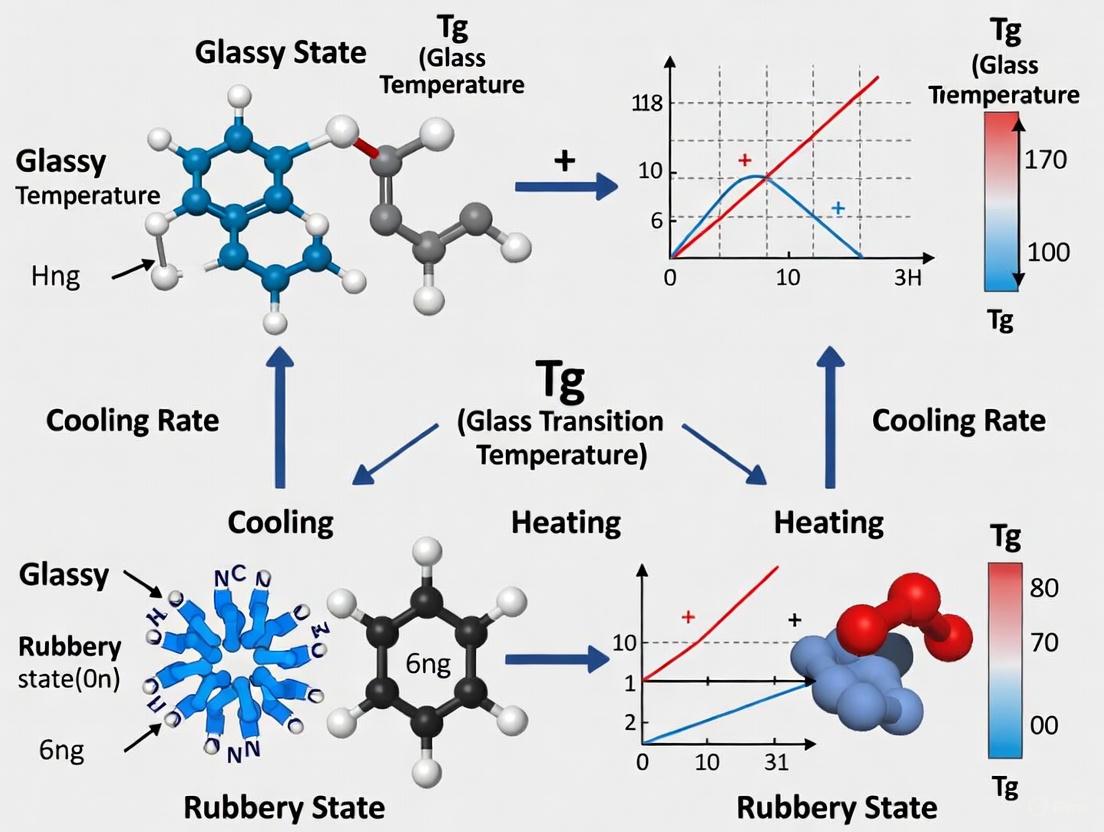
This article provides a comprehensive exploration of the glass transition temperature (Tg), a critical thermal property of amorphous materials, with a specific focus on applications in pharmaceutical and drug development...
Glass Transition Temperature (Tg) Explained: A Foundational Guide for Biomedical Researchers
Abstract
This article provides a comprehensive exploration of the glass transition temperature (Tg), a critical thermal property of amorphous materials, with a specific focus on applications in pharmaceutical and drug development research. It covers the foundational science behind Tg, including its definition and the distinction between amorphous and semi-crystalline polymers. The content details the methodologies for accurate Tg measurement, such as DSC and DMA, and addresses common challenges like burst release in PLGA-based drug delivery systems. Furthermore, it offers guidance on troubleshooting measurement discrepancies and validates findings through comparative analysis of material data, equipping scientists with the knowledge to optimize material selection and processing for advanced biomedical applications.
What is Glass Transition Temperature? Core Concepts and Polymer Fundamentals
The glass–liquid transition, or glass transition, is the gradual and reversible transition in amorphous materials (or in amorphous regions within semicrystalline materials) from a hard and relatively brittle "glassy" state into a viscous or rubbery state as the temperature is increased [1]. An amorphous solid that exhibits a glass transition is called a glass. The reverse transition, achieved by supercooling a viscous liquid into the glass state, is called vitrification [1]. The glass transition temperature (Tg) characterizes the range of temperatures over which this transition occurs, and it is always lower than the melting temperature (Tm) of the crystalline state of the material, if one exists [1].
Unlike melting, which is a first-order phase transition involving discontinuities in thermodynamic properties, the glass transition is not considered a true thermodynamic phase transition [1] [2]. Rather, it is a phenomenon extending over a temperature range defined by several conventions. Upon cooling or heating through this glass-transition range, the material exhibits a smooth step in the thermal-expansion coefficient and in the specific heat [1]. The question of whether some phase transition underlies the glass transition remains a matter of ongoing research [1].
Fundamental Principles and Molecular Mechanisms
The Molecular Nature of the Transition
At the molecular level, the glass transition can be understood through the concept of chain mobility and free volume [3]. Polymers are long-chain molecules that, given sufficient thermal energy, undergo bond rotations and conformational changes. At low temperatures, the amorphous regions of a polymer are in the glassy state where molecules are effectively frozen in place—they may vibrate slightly but lack segmental motion [2].
As the polymer is heated, its volume expands, increasing the free volume—the space not occupied by polymer chains. This additional space allows chain segments to wiggle and slide past one another [3]. At the glass transition temperature, the free volume becomes sufficient to enable coordinated molecular motion, and the material transitions to its rubbery state [3]. This increased molecular mobility below Tg, the material is hard, rigid, and brittle because molecular motion is severely restricted [4]. Above Tg, the increased mobility of polymer chain segments allows the material to become soft and flexible [2] [4].
Key Differences from Melting
It is crucial to distinguish the glass transition from melting, as these are fundamentally different processes:
Table 1: Comparison between Glass Transition and Melting
| Characteristic | Glass Transition | Melting |
|---|---|---|
| Fundamental Nature | Second-order transition range [2] | First-order phase transition [2] |
| Molecular Process | Onset of segmental motion in amorphous regions [4] | Transition from ordered crystal to disordered melt [4] |
| Thermodynamics | No latent heat; change in heat capacity [2] | Absorbs latent heat of fusion [3] |
| Volume Change | Continuous change in slope [2] | Abrupt discontinuity [2] |
| Structural Order | Property of disordered amorphous regions [2] | Property of ordered crystalline regions [4] |
Experimental Characterization of Tg
Measurement Techniques
The glass transition temperature is operationally defined, and different measurement techniques yield slightly different values [1]. The most common methods include:
Differential Scanning Calorimetry (DSC)
DSC monitors the difference in heat flow between a sample and reference as temperature changes. The glass transition appears as a step change in the baseline of the heat flow curve due to the change in heat capacity (Δcp) [4] [5]. Standard test methods include ASTM E1356 and ISO 11357-2 [4] [5]. DSC is suitable for solids, powders, and liquids [5].
Dynamic Mechanical Analysis (DMA)
DMA applies oscillatory stress to measure stiffness (storage modulus, E') and energy dissipation (loss modulus, E'') as functions of temperature. Tg is identified from the peak in E'' or tan δ (E''/E') [6] [4] [5]. DMA is extremely sensitive to glass transitions and can detect transitions not easily visible by DSC [6]. Standard methods include ASTM E1640 [4].
Thermomechanical Analysis (TMA)
TMA measures dimensional changes versus temperature. The glass transition is observed as an inflection point in the thermal expansion curve due to the change in the coefficient of thermal expansion [1] [5]. This method is described in standards such as ASTM E1545 [5].
The following diagram illustrates the generalized experimental workflow for characterizing the glass transition:
Experimental Protocol for DMA Measurement
For researchers requiring detailed methodologies, the following protocol for determining Tg via Dynamic Mechanical Analysis has been documented in recent studies:
- Sample Preparation: Process the material (e.g., rice flour) by milling and sieving to obtain a fraction below 177 μm [6]. Determine the moisture content gravimetrically according to established standards like AACCI Method 44-15.02 [6].
- Instrument Calibration: Calibrate the DMA (e.g., PerkinElmer 8000) according to manufacturer specifications [6].
- Temperature Program: Conduct temperature sweeps by heating samples at a controlled rate (e.g., 2°C/min) from below to above the anticipated Tg range [6].
- Frequency Setting: Maintain a constant frequency during the sweep (e.g., 1 Hz) [6].
- Data Acquisition: Monitor storage modulus (E'), loss modulus (E''), and tan δ as functions of temperature [6].
- Data Analysis: Determine Tg using multiple criteria [6]:
- Tg-onset: Inflection point temperature of the E' curve.
- Tg-midpoint: Peak temperature of the E'' curve.
- Tg-endset: Peak temperature of the tan δ curve.
Glass Transition in Material Systems
Tg Values for Engineering Polymers
The glass transition temperature varies significantly with chemical structure. The following table provides characteristic Tg values for common polymers:
Table 2: Glass Transition Temperatures of Selected Polymers
| Polymer | Tg (°C) | State at Room Temperature | Commercial/Technical Name |
|---|---|---|---|
| Tire Rubber | -70 [1] | Rubbery (Above Tg) | - |
| Polypropylene (atactic) | -20 [1] [2] | Transitional | - |
| Poly(vinyl acetate) (PVAc) | 28-30 [1] [2] | Transitional | - |
| Poly(vinyl chloride) (PVC) | 80-81 [1] [2] | Glassy (Below Tg) | - |
| Poly(vinyl alcohol) (PVA) | 85 [1] [2] | Glassy (Below Tg) | - |
| Polyethylene terephthalate) (PET) | 69-70 [1] [2] | Glassy (Below Tg) | - |
| Polystyrene | 100 [1] [2] | Glassy (Below Tg) | - |
| Poly(methyl methacrylate) | ~100-105 [1] [2] | Glassy (Below Tg) | PMMA |
| Polypropylene (isotactic) | 100 [2] | Glassy (Below Tg) | - |
Factors Influencing Tg
The glass transition temperature is not an intrinsic material constant but depends on multiple factors:
- Molecular Weight: In straight-chain polymers, increasing molecular weight decreases chain end concentration, reducing free volume and increasing Tg [4].
- Chemical Cross-linking: Increased cross-linking restricts polymer chain mobility, decreasing free volume and raising Tg [4].
- Plasticizers: Addition of plasticizers increases free volume between polymer chains, allowing them to slide past each other at lower temperatures and thus decreasing Tg [4].
- Moisture Content: Water acts as a plasticizer. Increased moisture content forms hydrogen bonds between chains, increasing free volume and decreasing Tg [6] [5].
- Molecular Structure: Bulky side groups restrict chain mobility, increasing Tg, while flexible backbone linkages lower Tg [4].
- Pressure: Increased pressure reduces free volume, resulting in a higher Tg [4].
The relationship between these factors and the resulting material properties is summarized below:
Advanced Applications and Current Research
Pharmaceutical Development
In pharmaceutical sciences, the glass transition is critical for enhancing drug bioavailability. Amorphous drugs often exhibit higher water solubility than their crystalline counterparts, but they are physically and chemically less stable [7]. Understanding Tg helps prevent recrystallization from supercooled and glassy states, ensuring drug stability and efficacy [7]. Recent research focuses on drug-biopolymer dispersions to improve physical stability, investigating molecular mechanisms in systems like the anxiolytic drug nordazepam mixed with biodegradable biopolymers [7].
Cryopreservation and Thermal Stress Management
Recent groundbreaking research has explored the role of Tg in cryopreservation by vitrification—stabilizing biological matter in a glassy state at low temperatures [8]. This approach could transform organ transplantation and wildlife conservation. A key challenge is avoiding thermal stress cracking during temperature cycling [8].
A 2025 study in Scientific Reports provided experimental and computational evidence that thermal stresses are strongly dependent on the Tg of the vitrification solution [8]. Using a custom cryomacroscope platform and deep learning-based image segmentation, researchers demonstrated that solutions with higher Tg (e.g., 63 wt% Sucrose, Tg = -82°C) experience lower stress and reduced cracking compared to those with lower Tg (e.g., 49 wt% DMSO, Tg = -131°C) when thermally cycled under identical conditions [8]. This relationship is attributed to an inverse correlation between Tg and thermal expansion coefficient—solutions with higher Tg expand and contract less during temperature changes, generating lower thermal stress [8]. This insight suggests that conventional vitrification solutions may be ill-suited for avoiding thermal stress, opening new avenues for designing next-generation cryopreservation protocols.
Food Science and Grains
In food science, Tg explains phenomena like fissure formation in rice during drying. Research on IRGA 424 rice has shown that drying and tempering above Tg preserves quality by preventing regions with different mechanical properties that cause fissuring [6]. Tg of rice flour decreases from approximately 104.7°C to 42.1°C (tan δ peak) as moisture content increases from 9.3% to 22.3% [6], demonstrating water's plasticizing effect.
The Scientist's Toolkit: Essential Research Reagents and Materials
Table 3: Key Research Reagents and Materials for Glass Transition Studies
| Reagent/Material | Function in Research | Example Application |
|---|---|---|
| Dimethyl Sulfoxide (DMSO) | Cryoprotectant agent | Aqueous vitrification solutions for cryopreservation [8] |
| Glycerol | Cryoprotectant and plasticizer | Vitrification solutions; modulates Tg and thermal expansion [8] |
| Xylitol | Polyol plasticizer | Binary aqueous solutions for studying Tg-stress relationship [8] |
| Sucrose | Disaccharide modifying Tg | High-Tg vitrification solutions to reduce thermal stress cracking [8] |
| Sorbitol | Plasticizer and sugar substitute | Model system for studying water plasticization effects on Tg [5] |
| Poly-L-lactide (PLLA) | Biodegradable biopolymer | Drug-polymer dispersions for pharmaceutical stability studies [7] |
| Schiff Bases | Model glass-formers | Investigating relaxation behaviors and tunable Tg values [7] |
The glass transition represents a fundamental property of amorphous materials with far-reaching implications across scientific disciplines and industrial applications. From the design of polymers with tailored mechanical properties to the stabilization of pharmaceutical formulations and the advancement of cryopreservation technologies, a deep understanding of Tg and its controlling factors is indispensable. Current research continues to unravel the complexities of this transition, exploring the interplay between molecular structure, thermodynamic properties, and material performance. The ongoing investigation into relationships between Tg and other material properties, such as thermal expansion, promises to enable new engineering solutions in fields ranging from biomedical engineering to materials science.
The physical and mechanical properties of polymers are profoundly influenced by their internal microstructure, specifically the arrangement of their long molecular chains. This arrangement falls primarily into two categories: amorphous and semi-crystalline structures. Amorphous polymers possess a random, disordered molecular structure, often compared to a bowl of cooked spaghetti, where the chains are tangled without long-range order [9] [10]. In contrast, semi-crystalline polymers feature a mixed morphology consisting of highly ordered, packed crystalline regions (lamellae) embedded within a disordered amorphous matrix [11] [12]. The degree of crystallinity, which can range from 10% to 80%, is a critical factor determining the final properties of the material [11]. For semi-crystalline polymers, this crystalline fraction typically must exceed approximately 25% to exhibit characteristic semi-crystalline behavior [11]. Understanding this fundamental structural distinction is essential for researchers and scientists to predict material performance, select appropriate polymers for specific applications, and design novel materials with tailored properties.
Structural Architecture and Molecular Order
The foundational difference between amorphous and semi-crystalline polymers lies in the spatial organization of their polymer chains, which directly dictates their thermal transitions and ultimate material characteristics.
Amorphous Polymers: In amorphous polymers, the molecular chains are arranged in a random, haphazard fashion, resulting in a structure that lacks any long-range order [9] [10]. This disorganization means the chains are physically entangled but do not pack into a consistent, repeating pattern. When heated, these materials do not possess a sharp melting point. Instead, they undergo a gradual softening as the temperature increases, eventually becoming a viscous liquid [9] [11]. This gradual softening occurs because the polymer transitions through a leathery or rubbery state before achieving full flow.
Semi-Crystalline Polymers: Semi-crystalline polymers exhibit a more complex, two-phase structure. Within these materials, the polymer chains fold and organize into tight, ordered packs known as lamellae, which form the crystalline regions [11] [12]. These lamellae act as robust physical cross-links, reinforcing the material. However, it is thermodynamically improbable for all chain segments to incorporate into these perfect crystals. Therefore, the lamellae are dispersed within and connected by regions of disordered, amorphous chains [12]. This dual nature gives semi-crystalline polymers a distinct melting point (Tm), corresponding to the dissociation of the crystalline lamellae, while the amorphous parts still undergo a glass transition (Tg) [11].
The following diagram illustrates the fundamental structural differences between these two polymer classes.
The Glass Transition Temperature (Tg) in Context
The glass transition temperature (Tg) is a critical thermal property, defined as the temperature at which the amorphous regions of a polymer transition from a hard, glassy state to a softer, rubbery state upon heating [13] [4] [1]. This is not a phase transition with a latent heat, like melting, but rather a second-order transition marked by a change in the rate of physical properties, such as a step change in the heat capacity or coefficient of thermal expansion [1] [14].
Behavior Below and Above Tg: Below its Tg, an amorphous polymer is in a glassy state; the molecular chains are frozen in place, lacking the thermal energy to slide past one another. This results in a material that is hard, rigid, and often brittle [4] [10]. Above the Tg, the amorphous regions enter a rubbery state. Sufficient thermal energy allows for segmental chain motion, granting the material flexibility, leather-like properties, and the ability to undergo large deformations [13] [4].
Role in Semi-Crystalline Polymers: In semi-crystalline polymers, the Tg specifically pertains to the behavior of the amorphous regions between the crystalline lamellae [13] [12]. Below the Tg, these amorphous regions are glassy and brittle. Above the Tg, they become rubbery. However, the material often retains significant mechanical integrity because the crystalline lamellae, which remain solid until the melting point (Tm), act as a reinforcing scaffold [13] [11]. This allows many semi-crystalline polymers like polypropylene (PP) to be used at service temperatures between their Tg and Tm [13].
The following table provides the Tg values for common polymers, illustrating the wide range across different material types.
Table 1: Glass Transition Temperatures of Common Polymers
| Polymer | Abbreviation | Type | Tg (°C) |
|---|---|---|---|
| General Purpose Polystyrene | GPPS | Amorphous | 100 [13] |
| Polycarbonate | PC | Amorphous | 145 [13] |
| Polysulfone | PSU | Amorphous | 190 [13] |
| Polyetherimide | PEI | Amorphous | 210 [13] |
| Polypropylene (atactic) | PP | Semi-Crystalline | -20 [13] |
| High-Density Polyethylene | HDPE | Semi-Crystalline | -120 [13] |
| Liquid Silicone Rubber | LSR | Thermoset | -125 [13] |
| Polyetheretherketone | PEEK | Semi-Crystalline | 140 [13] |
Comparative Analysis of Key Properties
The structural differences between amorphous and semi-crystalline polymers manifest in distinct mechanical, thermal, optical, and chemical properties. The following table summarizes these key differences, providing a clear overview for material selection.
Table 2: Property Comparison of Amorphous and Semi-Crystalline Polymers
| Property | Amorphous Polymers | Semi-Crystalline Polymers |
|---|---|---|
| Molecular Structure | Random, disordered chains [9] [10] | Ordered crystalline regions + amorphous regions [11] [12] |
| Thermal Behavior | Gradual softening over a temperature range; no true melting point [9] [11] | Sharp melting point (Tm); remains structured above Tg until Tm [13] [11] |
| Optical Clarity | Typically transparent [13] [9] | Typically opaque or translucent [13] [11] |
| Mechanical Properties | High impact resistance; good stiffness at low temps [13] [9] | High stiffness, strength, and toughness; poor impact resistance [9] [15] |
| Chemical Resistance | Generally poor [9] [11] | Excellent, due to tight molecular packing [13] [15] |
| Wear & Fatigue | Poor wear and fatigue resistance [11] | Excellent wear and fatigue resistance [11] |
| Shrinkage & Dimensional Stability | Low, isotropic shrinkage; good stability [13] [15] | High, anisotropic shrinkage; can warp [9] [15] |
| Bonding | Bonds well with adhesives [11] | Difficult to bond with adhesives [11] |
Detailed Discussion of Properties
Mechanical Properties: Semi-crystalline polymers generally exhibit superior strength, stiffness, and toughness compared to amorphous polymers because the densely packed crystalline lamellae effectively resist mechanical deformation [9] [15]. This makes them suitable for structural and load-bearing components. However, amorphous polymers typically possess higher impact resistance at room temperature, as their tangled chains can absorb more energy before fracturing [9].
Thermal Properties: The defining thermal difference is the presence of a sharp melting point (Tm) in semi-crystalline polymers, which amorphous materials lack [11]. Furthermore, semi-crystalline polymers can often be used at temperatures above their Tg, as the crystalline regions maintain structural integrity. Amorphous polymers, however, will soften and lose their shape once the service temperature significantly exceeds their Tg [13].
Chemical and Environmental Resistance: The tight molecular packing in the crystalline regions of semi-crystalline polymers creates a tortuous path, making it difficult for chemicals and solvents to penetrate. This results in excellent chemical resistance [13] [15]. Amorphous polymers, with their more open and disordered structure, are generally more susceptible to chemical attack and solvent-induced swelling [9].
Optical Properties: The random structure of amorphous polymers does not scatter visible light significantly, which is why materials like polycarbonate (PC) and polystyrene (PS) are often transparent [13] [9]. In contrast, the crystalline regions in semi-crystalline polymers have a different refractive index than the amorphous matrix. This interface scatters light, rendering these materials typically opaque [11].
Experimental Characterization and Protocols
Accurately characterizing polymer morphology and thermal transitions is fundamental to research and development. The following section details key experimental methodologies.
The Scientist's Toolkit: Essential Research Reagents and Equipment
Table 3: Key Reagents and Equipment for Polymer Thermal Analysis
| Item | Function/Brief Explanation |
|---|---|
| Differential Scanning Calorimeter (DSC) | Measures heat flow into/out of a sample vs. temperature. Primarily used to determine Tg (as a step change in heat capacity) and Tm (as an endothermic peak) [4] [10]. |
| Dynamic Mechanical Analyzer (DMA) | Applies an oscillatory stress to a sample and measures the resulting strain over a temperature range. Highly sensitive for detecting Tg via dramatic changes in storage (E') and loss (E") moduli [4] [16]. |
| Tensile Testing Machine | Pulls a standardized polymer specimen at a constant rate to measure mechanical properties like tensile strength, elongation at break, and elastic modulus [10]. |
| Inert Gas (e.g., N₂) | Purging gas used in thermal analysis equipment (DSC, DMA) to prevent polymer oxidation or degradation at high temperatures [4]. |
| Standard Reference Materials | Calibration standards (e.g., indium, zinc) with known melting points and enthalpies, used to calibrate DSC instruments for accurate temperature and enthalpy measurement [4]. |
Key Experimental Protocols
Determining Tg by Differential Scanning Calorimetry (DSC)
Principle: DSC monitors the difference in heat flow between a polymer sample and an inert reference as they are heated or cooled at a controlled rate. The glass transition is observed as a step change in the heat flow curve due to the change in heat capacity of the amorphous regions as they become mobile [4] [10].
Protocol:
- Sample Preparation: Place a small, precisely weighed sample (5-10 mg) in a hermetic aluminum DSC pan. An empty pan of the same type is used as a reference.
- Instrument Calibration: Calibrate the DSC cell for temperature and enthalpy using high-purity standards like indium.
- Thermal Cycle:
- Equilibration: Equilibrate at a starting temperature well below the expected Tg (e.g., 50°C below).
- Heating Scan: Heat the sample and reference at a standardized rate (commonly 10°C/min) through the transition region to a temperature above the expected Tg.
- Data Analysis: Identify the Tg from the resulting thermogram. It is conventionally reported as the midpoint of the step transition in the heat flow curve, as defined by standards like ASTM E1356 [4].
Determining Tg by Dynamic Mechanical Analysis (DMA)
Principle: DMA applies a small oscillatory deformation to a sample and measures the resulting stress, allowing the calculation of the storage modulus (E', elastic response), loss modulus (E", viscous response), and tan δ (E"/E', damping). The Tg is marked by a rapid drop in E' and peaks in E" and tan δ, indicating the onset of large-scale molecular motion [16].
Protocol:
- Sample Preparation: Prepare a polymer specimen compatible with the DMA clamping system (e.g., a rectangular bar for dual cantilever bending).
- Experimental Parameters:
- Deformation Mode: Select an appropriate mode (e.g., tension, bending).
- Frequency: Set a fixed oscillation frequency (e.g., 1 Hz).
- Temperature Ramp: Program a constant heating rate (e.g., 2-5°C/min) over a suitable temperature range.
- Data Collection: The instrument automatically records E', E", and tan δ as a function of temperature.
- Data Analysis: The Tg can be defined in multiple ways from DMA data, offering sensitivity to different aspects of the transition:
- Onset of E' Drop: Indicates the beginning of mechanical softening.
- Peak of E" Curve: Correlates with the energy dissipation maximum.
- Peak of Tan δ Curve: Represents the point of greatest damping [16].
The experimental workflow for thermal characterization is outlined below.
Factors Influencing Polymer Morphology and Tg
The tendency of a polymer to form amorphous or semi-crystalline structures, as well as the specific value of its Tg, is governed by its chemical architecture and processing conditions.
Molecular Structure:
- Chain Flexibility: Flexible polymer backbones (e.g., with C-O or Si-O bonds) have low energy barriers for bond rotation, leading to lower Tg values. Rigid backbones (e.g., with aromatic rings) result in higher Tg values [14].
- Side Groups: The presence of bulky or polar side groups (e.g., Cl, CN, phenyl rings) increases steric hindrance and intermolecular forces, restricting chain mobility and raising the Tg [4] [14].
- Cross-linking: Chemical cross-links tether polymer chains together, drastically reducing their mobility. An increase in cross-link density leads to a significant increase in Tg [4] [14].
Processing and External Factors:
- Cooling Rate: Rapid cooling (quenching) from the melt can prevent polymer chains from having sufficient time to organize into crystals, resulting in an amorphous solid with a higher frozen-in free volume and a lower effective Tg. Slow cooling promotes crystallization [11] [14].
- Plasticizers: The addition of small-molecule plasticizers increases the free volume between polymer chains, spacing them apart and allowing them to slide more easily. This effectively lowers the Tg of the material [4] [14].
- Molecular Weight: In general, increasing the molecular weight of a polymer decreases the concentration of chain ends, which are sites of increased free volume. This reduction in free volume leads to an increase in Tg, which eventually plateaus at very high molecular weights [4].
The glass transition temperature ((Tg)) is a critical physical parameter that marks the reversible transition of an amorphous material from a hard, glassy state into a rubbery or viscous liquid state. Unlike the sharp phase transition of crystalline melting, the glass transition occurs over a temperature range and represents a profound change in molecular mobility without a change in molecular structure. For researchers and drug development professionals, understanding (Tg) is essential for designing polymer-based drug delivery systems, stabilizing biological formulations, and developing advanced materials with tailored mechanical properties. This phenomenon finds relevance in diverse applications, from the stabilization of dried Bacillus cereus in low-moisture foods to the performance of polymeric excipients in solid dispersions [17].
This guide explores the molecular origins of (T_g) through two interconnected theoretical frameworks: the kinetic perspective of chain mobility and the thermodynamic concept of free volume. These principles provide the foundation for predicting and manipulating the glass transition to achieve desired material behaviors in scientific and industrial contexts.
The Chain Mobility Perspective: A Kinetic Theory of Tg
The kinetic approach to the glass transition focuses on the molecular motions of polymer chains and the energy required for these motions to occur. Below (T_g), the thermal energy available is insufficient to allow large-scale segmental motion, effectively freezing the polymer chains into a rigid, amorphous solid [14].
Molecular Mechanism of Chain Motion
In a polymer chain, elastic deformation involves altering the distance between chain-ends. This requires changes in polymer conformation, which are achieved at the molecular level by the rotation of individual carbon-carbon (C-C) bonds, shifting between trans and gauche positions. This change in torsion angles is a thermally activated process [14].
- Below (T_g): Thermal energy is inadequate to overcome the energy barrier for bond rotation. Molecular conformations are frozen, and the material behaves as a glass.
- Above (T_g): Sufficient thermal energy exists to permit torsion angle changes. Chains can change shape, and the material exhibits rubbery or liquid behavior.
The apparent value of (T_g) is not absolute but depends on the time-scale of observation due to the kinetic nature of this process [14].
Factors Influencing Chain Mobility and (T_g)
The bulk response of a polymer is governed by chain mobility, which is influenced by several molecular and architectural factors [14].
Table 1: Molecular Factors Affecting Chain Mobility and (T_g)
| Factor | Effect on Chain Mobility | Effect on (T_g) | Molecular Rationale |
|---|---|---|---|
| Chain Length | Increases | Increases | Shorter chains have more chain ends per unit volume, creating more free volume and reducing (T_g). |
| Chain Flexibility | Increases | Decreases | A flexible backbone (e.g., siloxanes) has a lower activation energy for conformational changes. |
| Bulky Side Groups | Decreases | Increases | Large, rigid side groups (e.g., benzene rings) sterically hinder bond rotation. |
| Polar Groups | Decreases | Increases | Strong intermolecular forces (e.g., from -Cl, -CN, -OH groups) restrict chain movement. |
| Branching | Variable | Variable | More branches increase chain ends (decreasing (Tg)) but also hinder rotation (increasing (Tg)). The net effect is system-dependent. |
| Cross-linking | Decreases | Increases | Chemical bonds between chains drastically reduce mobility, raising (T_g). |
| Plasticizers | Increases | Decreases | Small molecules between chains act as molecular lubricants, increasing free volume and mobility. |
The Free Volume Theory: A Thermodynamic Perspective
Free volume theory provides a complementary, intuitive framework for understanding the glass transition. It posits that the total volume ((V{Tot})) of a rubber or polymer is composed of the intrinsic volume ((Vi)) occupied by the molecules themselves and the free volume ((V_f))—the empty space or voids between molecules not occupied by molecular chains [18].
The free volume fraction ((f)) is calculated as: [ f = \frac{Vf}{V{Tot}} = \frac{V{Tot} - Vi}{V_{Tot}} ] [18]
Free Volume and Molecular Diffusion
This theory is crucial for explaining diffusion processes. For a molecule (e.g., a gas like hydrogen or a small-molecule drug) to diffuse through a polymer, it requires a critical local free volume to move into. The diffusion coefficient ((D)) is exponentially related to the free volume fraction [18]: [ D = R T Ad \exp\left(-\frac{Bd}{f}\right) ] where (R) is the gas constant, (T) is temperature, and (Ad) and (Bd) are parameters related to the size and shape of the diffusing molecule and the polymer, respectively [18].
The Free Volume Interpretation of (T_g)
As a polymer melt is cooled, its total volume decreases. The occupied volume contracts linearly, but the free volume is squeezed out more rapidly. At (Tg), the free volume reaches a critical minimum, and segmental motions cease as there is insufficient space for chains to rearrange. In the liquid state above (Tg), free volume forms a percolating structure allowing large-scale rearrangements. Below (Tg), free volume exists only in small, isolated pockets, arresting global structural changes [18]. The reduction of free volume with temperature explains the dramatic increase in viscosity and relaxation times observed near (Tg).
Experimental Protocols for Measuring (T_g)
Several experimental techniques probe the changes in molecular mobility or free volume at the glass transition.
Thermal Rheological Analysis (TRA)
This method measures the mechanical response of a material to stress as a function of temperature, which is directly linked to molecular mobility.
- Principle: As a material passes through (T_g), its mechanical modulus (e.g., storage modulus, G') drops significantly due to the onset of molecular flow.
- Protocol: A small, oscillatory stress or strain is applied to a sample while it is heated at a controlled rate. The temperature at which a sharp decrease in storage modulus or a peak in the mechanical loss factor (tan δ) occurs is reported as (T_g) [17].
- Application: This method has been used to measure the (T_g) of dried bacterial cells like Bacillus cereus and Salmonella enterica to understand their survival in low-moisture environments [17].
Differential Scanning Calorimetry (DSC)
DSC is one of the most common techniques for measuring (T_g).
- Principle: DSC detects the change in heat capacity ((Cp)) that occurs at (Tg) as the material transitions from a glass to a rubber.
- Protocol: A sample and an inert reference are heated at a constant rate (e.g., 10°C/min). At (Tg), the sample's heat capacity increases, requiring more heat to raise its temperature at the same rate as the reference. This appears as a step change in the DSC heat flow curve. The midpoint of the step transition is typically taken as (Tg) [14].
Visualizing the Interplay of Theories and Experiment
The following diagram synthesizes the kinetic, thermodynamic, and experimental concepts of the glass transition into a single workflow, illustrating their interconnected relationships.
The Scientist's Toolkit: Key Reagents and Materials
Research into glass transition and its applications requires specific materials and analytical tools.
Table 2: Essential Research Reagents and Materials for Tg Studies
| Reagent/Material | Function/Application | Example Context |
|---|---|---|
| Model Polymers | Fundamental studies on the effects of chain structure, length, and tactility on (T_g). | Amorphous polymers like polystyrene and poly(methyl methacrylate). |
| Plasticizers | To study the reduction of (T_g) and understand free volume and mobility. | Small esters (e.g., phthalates) added to polymers like PVC [14]. |
| Cross-linking Agents | To investigate the increase in (T_g) and the restriction of chain mobility. | Peroxides or multifunctional monomers used in rubber vulcanization [14]. |
| Bacterial Cultures | For studying the role of vitrification in the desiccation tolerance of biologics. | Gram-positive (e.g., Bacillus cereus) and Gram-negative (e.g., Salmonella) strains [17]. |
| Cryoprotectants | To stabilize biological structures during freezing/drying by influencing (T_g). | Trehalose, sucrose, or glycerol used in lyophilization of proteins or bacteria [17]. |
| Differential Scanning Calorimeter (DSC) | The primary instrument for directly measuring (T_g) via heat capacity change. | Used for characterizing polymers, pharmaceuticals, and biological samples. |
| Thermal Mechanical Analyzer (TMA)/TRA | Measures dimensional changes (TMA) or mechanical properties (TRA) vs. temperature. | Determining softening point and coefficient of thermal expansion [17]. |
The glass transition temperature (Tg) is a critical thermal property that defines the temperature at which an amorphous polymer transitions from a hard, glassy state to a soft, leathery, or rubbery state [13] [19]. This transition is not a phase change like melting but a second-order transition characterized by a change in the heat capacity of the material without a latent heat of transition [20]. Below the Tg, polymer chains are frozen in place, lacking the mobility to slide past one another, resulting in a material that is hard, rigid, and often brittle [4] [20]. Above the Tg, the polymer chains gain sufficient thermal energy to initiate long-range segmental motion, allowing the material to become soft and flexible [13] [20].
The Tg is fundamentally tied to the mobility of the polymer chains. Upon heating, the increased thermal energy overcomes the intermolecular forces holding the chains together, increasing the "free volume" and allowing the chains to begin moving [19] [4]. The Free Volume Theory posits that at the Tg, the polymer achieves a consistent critical value of free volume (approximately 2.5%) that permits this segmental motion [19]. This change in molecular mobility manifests macroscopically as a dramatic shift in material properties, including tensile strength, modulus of elasticity, and impact resistance [13]. Understanding Tg is therefore essential for predicting and designing a polymer's performance in its end-use application.
Tg and Polymer Class Fundamentals
The relationship between a polymer's Tg and its service temperature is a primary factor in classifying its behavior and application.
- Below Tg: The material is in a glassy state. It is hard, rigid, and brittle, similar to glass [4] [20].
- Above Tg: The material is in a rubbery or leathery state. It is soft, flexible, and can undergo large deformations [13] [4].
The following diagram illustrates how the service temperature relative to Tg defines the material class and its resulting mechanical properties.
Amorphous vs. Semi-Crystalline Morphology
A polymer's morphology fundamentally influences its thermal transitions.
- Amorphous Polymers: These possess a random and disordered molecular structure [13] [4]. They do not have a sharp melting point but gradually soften upon heating through the glass transition. These materials are typically transparent and are used either well below their Tg (as rigid plastics) or above it (as rubbers) [13]. Examples include polystyrene (PS) and polycarbonate (PC) [13].
- Semi-Crystalline Polymers: These feature a mix of ordered crystalline regions and disordered amorphous regions [13] [4]. They exhibit both a Tg (associated with the amorphous parts) and a distinct melting temperature (Tm) (associated with the crystalline parts). The crystalline regions provide structure and integrity even above the Tg, allowing these materials to be used in applications beyond their Tg [13]. Polypropylene (PP) is a common example [13].
The table below summarizes the key differences.
Table 1: Characteristics of Amorphous and Semi-Crystalline Polymers
| Feature | Amorphous Polymers | Semi-Crystalline Polymers |
|---|---|---|
| Molecular Structure | Random, disordered chains [13] | Ordered crystalline regions + amorphous regions [13] |
| Glass Transition (Tg) | A defining property; only transition for purely amorphous materials [4] | Exhibited by the amorphous portions [4] |
| Melting Point (Tm) | None defined; softens gradually [13] | Distinct, sharp melting point [13] |
| Shrinkage | Low [13] | High [13] |
| Common Examples | ABS, PC, PS, PMMA [13] | PP, PEEK, PET, POM [13] |
Tg by Polymer Class
Thermoplastics
Thermoplastics are polymers that become soft and moldable upon heating and solidify upon cooling, a process that is reversible [13]. Their behavior is heavily influenced by whether they are amorphous or semi-crystalline.
- Amorphous Thermoplastics: These materials are used below their Tg in their glassy state, where they are hard and rigid [20]. For instance, general-purpose polystyrene (GPPS) with a Tg of ~100°C is a stiff, transparent plastic at room temperature [13].
- Semi-Crystalline Thermoplastics: The amorphous regions of these polymers undergo the glass transition. However, the crystalline regions remain ordered and provide mechanical strength above the Tg until the melting point is reached [13]. Polypropylene (PP), with a Tg of approximately -20°C, is tough and flexible at room temperature but becomes brittle in freezing conditions when the temperature drops below its Tg [13].
Thermosets
Thermoset polymers possess a three-dimensional, cross-linked network structure formed during curing [21]. These cross-links profoundly restrict the mobility of the polymer chains. While the amorphous regions of a thermoset still have a Tg, the extensive cross-linking typically results in a high Tg [13] [19]. The cross-links prevent the polymer from melting upon heating; instead, thermosets will degrade or decompose at high temperatures [13]. They are often used below their Tg, making them rigid and dimensionally stable, as seen in epoxies and phenolics [13]. The Tg of an epoxy resin, for example, is affected by the cross-link density, the choice of curing agent, and fillers [21] [19].
Elastomers
Elastomers are a class of polymers defined by their ability to undergo large, reversible deformations. They are typically used well above their Tg, which is often far below room temperature, ensuring they are in a soft, rubbery state during application [4] [20]. This low Tg allows the polymer chains to be highly mobile and flexible. While some thermoplastic elastomers exist, most conventional elastomers, like liquid silicone rubber (LSR), are lightly cross-linked thermosets. This limited cross-linking provides recovery and prevents permanent flow while maintaining a very low Tg, such as -125°C for LSR [13].
Table 2: Glass Transition Temperature and Application of Common Polymers
| Polymer Class | Material | Tg (°C) | Application Context |
|---|---|---|---|
| Amorphous Thermoplastic | General Purpose Polystyrene (GPPS) | 100 [13] | Used below Tg; rigid and glassy at room temperature [20] |
| Amorphous Thermoplastic | Polycarbonate (PC) | 145 [13] | Used below Tg; high strength and rigidity at room temperature [13] |
| Semi-Crystalline Thermoplastic | Polypropylene (PP) | -20 [13] | Used above Tg at room temperature; crystalline regions provide structure [13] |
| Semi-Crystalline Thermoplastic | Polyetheretherketone (PEEK) | 140 [13] | High-performance plastic; Tg and Tm allow for high service temperatures. |
| Thermoset | Epoxy Resin | 50 - >250 [19] | High Tg from cross-linking; used for coatings, composites, and adhesives [21] |
| Thermoset Elastomer | Liquid Silicone Rubber (LSR) | -125 [13] | Used far above Tg; highly flexible and rubbery at room temperature [13] |
Factors Influencing Glass Transition Temperature
The Tg of a polymer is not an intrinsic fixed value but is governed by its chemical structure and formulation.
- Molecular Structure and Rigidity: The presence of bulky, inflexible side groups on the polymer backbone restricts rotation around chemical bonds, leading to a higher Tg [19] [4]. A rigid polymer chain, such as that in polyetherimide (PEI, Tg = 210°C), has a much higher Tg than a flexible chain like polyethylene (Tg ≈ -120°C) [13].
- Cross-linking: Chemical cross-links tie polymer chains together, drastically reducing their mobility. An increase in cross-link density leads to a direct increase in Tg [19] [4]. This is a key mechanism for controlling Tg in thermosets like epoxies [21].
- Plasticizers: These are small molecules that insert themselves between polymer chains, effectively increasing the free volume and allowing chains to slide past each other more easily. This results in a decrease in Tg [19] [4]. Plasticizers are commonly used to make materials like PVC flexible.
- Molecular Weight: In linear polymers, increasing molecular weight leads to a higher Tg. This is because chain ends, which constitute regions of higher free volume, become less concentrated as chains get longer [19] [4].
Experimental Determination of Tg
Accurately measuring Tg is crucial for material development and quality control. Several thermo-analytical techniques are employed, each with its own advantages.
Differential Scanning Calorimetry (DSC)
DSC is a widely used technique that measures the difference in heat flow between a sample and a reference as a function of temperature [22] [4]. As the polymer undergoes the glass transition, its heat capacity changes, resulting in a shift in the baseline of the heat flow curve. The Tg is typically reported as the midpoint of this step transition [4].
- Standards: ASTM E1356, ASTM D3418, ISO 11357-2 [4].
- Protocol Outline:
- A small sample (5-10 mg) is sealed in an aluminum crucible.
- The sample and an inert reference are heated at a controlled, constant rate (e.g., 10°C/min) under a nitrogen purge.
- The instrument measures the heat flow difference required to maintain both at the same temperature.
- The resulting thermogram is analyzed for the glass transition step.
Dynamic Mechanical Analysis (DMA)
DMA is an exceptionally sensitive method for determining Tg as it directly probes the mechanical motions of the polymer chains [22] [23]. A sinusoidal stress is applied to the sample, and the resulting strain is measured. The Tg is identified by a dramatic drop in the storage modulus (E'), which represents the elastic component, and a peak in the loss modulus (E'') or tan δ, which represent the viscous component and damping, respectively [23].
- Standards: ASTM E1640 [4].
- Protocol Outline:
- A sample of defined geometry (e.g., a tension film, a 3-point bend bar) is mounted in the instrument.
- A temperature sweep is conducted at a fixed frequency and strain amplitude.
- The storage modulus (E'), loss modulus (E''), and tan δ are recorded as a function of temperature.
- The Tg can be reported as the onset of the drop in E', or the peak temperature of the E'' or tan δ curves [23].
The following workflow contrasts the operational principles of DSC and DMA, the two most prominent techniques for Tg determination.
Advanced Molecular Dynamics Simulations
Beyond experimental methods, Molecular Dynamics (MD) Simulation is a powerful computational tool for predicting Tg and understanding its molecular origins. Researchers simulate the behavior of polymer chains at different temperatures using force fields like COMPASS or UFF [21]. Properties such as density, free volume, or mean-squared displacement are tracked, and the Tg is identified by a change in the slope of these properties versus temperature [21]. This method is particularly valuable for screening new polymer compositions or studying the effect of nanofillers (e.g., ZIF-8 metal-organic frameworks in epoxy) before synthesis [21].
The Scientist's Toolkit: Key Reagents and Materials for Tg Research
Table 3: Essential Materials and Reagents for Polymer Tg Analysis
| Item | Function/Description |
|---|---|
| Differential Scanning Calorimeter | Instrument for measuring heat flow changes associated with Tg and other thermal transitions [22] [4]. |
| Dynamic Mechanical Analyzer | Instrument for applying oscillatory stress to measure viscoelastic properties (E', E'', tan δ) and determine Tg with high sensitivity [22] [23]. |
| High-Purity Indium | A metal standard used for calibration of DSC instruments, due to its sharp and well-defined melting point [4]. |
| Inert Gas Supply (N₂) | Used to purge the DSC and DMA instruments to prevent oxidative degradation of samples during heating [4]. |
| Molecular Simulation Software | Software platforms (e.g., Material Studio) used to build polymer models and perform molecular dynamics simulations to predict Tg [21]. |
| Reference Pan (for DSC) | An empty, sealed crucible used as the inert reference in a DSC experiment [4]. |
| Standard Polymer Samples | Polymers with known and well-characterized Tg values (e.g., Polystyrene) used for method validation and instrument qualification. |
| Curing Agents (e.g., TETA) | Amine-based hardeners used to cross-link epoxy resins, directly influencing the final Tg of the thermoset [21]. |
| Metal-Organic Frameworks (e.g., ZIF-8) | Nanoporous fillers studied in nanocomposites to modify mechanical properties and Tg of the polymer matrix [21]. |
Why Tg is a Temperature Range, Not a Single Point
The glass transition temperature (Tg) is a critical parameter in material science, particularly for polymers and amorphous solids, dictating their mechanical properties and operational limits. Contrary to common simplification, Tg is not a discrete thermodynamic phase transition but a kinetically controlled process occurring over a temperature range. This whitepaper elucidates the fundamental principles behind the range-like nature of Tg, examining the roles of molecular mobility, thermal history, and experimental conditions. Through detailed experimental protocols and data analysis, we provide researchers and drug development professionals with a comprehensive framework for accurately characterizing and applying Tg concepts in advanced material design and pharmaceutical development.
The glass–liquid transition, or glass transition, is the gradual and reversible transition in amorphous materials (or in amorphous regions within semicrystalline materials) from a hard and relatively brittle "glassy" state into a viscous or rubbery state as the temperature is increased [1]. An amorphous solid that exhibits a glass transition is called a glass. The glass-transition temperature Tg characterizes the temperature range over which this transition occurs, typically marked by a change in relaxation time on the order of 100 seconds [1]. It is crucial to recognize that this transition is not a first-order phase change like melting or freezing, which occur at a single, well-defined temperature with discontinuous changes in properties such as volume and enthalpy. Instead, the glass transition is a kinetic phenomenon where the material's response is intrinsically linked to the timescale of observation.
The molecular origin of Tg lies in the behavior of polymer chains or the molecules of a glass-forming liquid. Below the Tg range, these molecular segments are frozen in place, resulting in a rigid, glassy state. As temperature increases, these segments gain sufficient thermal energy to initiate rotational and translational motions, leading to a gradual softening of the material over a range of temperatures [13] [1]. This change is a second-order transition marked by a continuous change in primary derivatives of the Gibbs free energy (such as volume and enthalpy) but a discontinuous change in secondary derivatives (such as the thermal expansion coefficient and heat capacity) [1]. The following sections will explore the theoretical underpinnings, experimental evidence, and practical implications of this critical material property.
The Theoretical Foundation: Why Tg is a Range
The Kinetic Nature of the Glass Transition
The fundamental reason Tg manifests as a range, not a point, is its inherent kinetic character. Unlike a true thermodynamic phase transition, the glass transition does not occur at equilibrium. When an amorphous material is cooled, the relaxation time—the time required for molecular segments to reconfigure—increases dramatically. At a certain temperature during cooling, the relaxation time becomes so long that the material cannot reach equilibrium on a practical timescale. The system falls out of equilibrium, and the liquid structure becomes "frozen-in," forming a glass [1]. The temperature at which this occurs depends directly on the cooling rate; a faster cooling rate results in a higher observed Tg because the system has less time to relax and thus falls out of equilibrium at a higher temperature. This direct link between the timescale of the experiment and the measured Tg value is a hallmark of a kinetic process.
The Role of Free Volume and Molecular Mobility
A complementary perspective involves the concept of free volume—the unoccupied space between molecular chains that facilitates movement. As a polymer melt cools, its volume decreases, and the available free volume is reduced. The glass transition range corresponds to the temperature interval where the free volume reaches a critical low value such that the coordinated large-scale motion of chain segments ceases [1]. This process is gradual. Upon heating through the Tg range, the increased molecular vibrations lead to a gradual expansion, creating more free volume and allowing for the onset of molecular mobility. Because the distribution of chain segment lengths and local molecular environments is not uniform, this "unfreezing" does not happen simultaneously for all segments. Segments in less constrained environments may gain mobility at a lower temperature than those in more densely packed or restricted regions, leading to a broadened transition observed over a range.
Experimental Evidence and Measurement Variability
The kinetic nature of Tg is unequivocally demonstrated by the fact that its measured value is dependent on experimental conditions. Various techniques probe different aspects of molecular mobility, and each operates on a specific timescale, leading to variations in the reported Tg.
Differential Scanning Calorimetry (DSC) Protocol
Objective: To determine the glass transition temperature by measuring the change in heat capacity as a function of temperature.
- Sample Preparation: Precisely weigh 5-10 mg of the sample into an aluminum DSC crucible and seal it with a lid. An empty, sealed crucible serves as a reference.
- Instrument Calibration: Calibrate the DSC cell for temperature and enthalpy using high-purity standards such as indium and zinc.
- Experimental Method:
- Purge the DSC cell with an inert gas (e.g., Nitrogen at 50 mL/min).
- Load the sample and reference crucibles.
- Cool the sample to at least 50°C below the expected Tg at a controlled rate (e.g., 10°C/min) and hold isothermally for 5 minutes to establish a uniform thermal history.
- Heat the sample at a standard rate (e.g., 10°C/min) to a temperature above the transition.
- Data Analysis: Identify the Tg from the resulting heat flow curve. It is conventionally reported as the midpoint of the step change in heat capacity, as illustrated in the figure below. The onset and endset temperatures of this step clearly define the range of the transition [1].
Thermogravimetric Analysis (TGA) and Derivative (DTG) Protocol
Objective: To assess thermal stability and decomposition, which can be related to the upper limits of material use, often informed by Tg.
- Sample Preparation: Load approximately 7 mg of sample into a platinum pan.
- Instrument Setup: Utilize a TGA Q500 thermal gravimetric analyzer or equivalent. Maintain a nitrogen atmosphere with a flow rate of 90 mL/min [24].
- Experimental Method:
- Begin at 30 ± 5 °C.
- Heat the sample to 1000 °C at a constant heating rate of 10 °C/min.
- Data Analysis: Record the mass loss (TG curve). The derivative of the TG curve (DTG) identifies temperatures of maximum mass loss rate. While not a direct measure of Tg, this protocol characterizes degradation events that constrain the practical application temperature window relative to Tg [24].
Impact of Measurement Parameters on Tg
The measured Tg value is not a fixed material constant but is influenced by operational definitions, as summarized in the table below.
Table 1: Impact of Experimental Conditions on Measured Tg
| Experimental Factor | Effect on Measured Tg | Theoretical Rationale |
|---|---|---|
| Heating/Cooling Rate | Faster rates lead to a higher measured Tg. | A faster rate gives molecular chains less time to relax, so the system falls out of equilibrium at a higher temperature [1]. |
| Measurement Technique | Different methods (DSC, Dilatometry, DMA) yield different Tg values. | Each technique probes different physical properties (heat capacity, volume, modulus) with different characteristic timescales [1]. |
| Material History | Annealing below Tg can lower the measured Tg; prior stress can raise it. | Thermal and mechanical history alters the non-equilibrium frozen-in structure, affecting the energy required to initiate molecular motion [1]. |
This variability is not an experimental error but a direct consequence of the kinetic nature of the glass transition. Therefore, reporting Tg requires specifying the experimental method and conditions to be scientifically meaningful.
The Scientist's Toolkit: Key Reagents and Materials
Characterizing Tg and developing materials based on its principles requires a specific set of reagents and analytical tools. The following table outlines essential solutions and materials used in this field.
Table 2: Key Research Reagent Solutions for Tg Studies
| Reagent/Material | Function/Brief Explanation |
|---|---|
| Polymer Standards (e.g., PS, PMMA) | Used for calibration of thermal analyzers like DSC and TGA. Their well-established Tg values provide a reference for method validation [1]. |
| Inert Gas (e.g., Nitrogen, 50-90 mL/min) | Purge gas in thermal analysis instruments (DSC, TGA) to prevent oxidative degradation of samples at high temperatures, ensuring data reflects thermal transitions rather than chemical decomposition [24]. |
| Dielectric Spectroscopy Fluids | Immersion fluids for dielectric analysis (DEA), a technique that measures molecular mobility by monitoring dielectric loss, providing another way to characterize the Tg range via relaxation times. |
| Enteric-Coating Polymers (e.g., Cellulose Acetate Phthalate) | Used in pharmaceutical development to create drug delivery systems with targeted release. Their Tg and dissolution pH are critical for controlling drug release kinetics in the gastrointestinal tract [25]. |
| Biodegradable Polymers (e.g., PLA, PLGA) | Key materials in modern drug delivery systems. Their Tg dictates drug release profiles, device stability, and degradation rates in vivo [25]. |
| Ligand-Functionalized Nanocarriers | Components of actively targeted drug delivery systems. The Tg of the nanocarrier material influences its stability, drug release, and ability to accumulate at target tissues [25]. |
Implications for Drug Development and Material Science
Understanding Tg as a range, not a point, has profound implications, especially in the development and manufacturing of biologics and solid dosage forms.
Stability of Amorphous Solid Dispersions
Many modern drugs are formulated as amorphous solid dispersions to enhance bioavailability. These metastable systems are prone to crystallization, which can reduce drug absorption. The breadth of the Tg range informs the storage conditions and shelf-life predictions. Storage closer to or above the Tg range dramatically increases molecular mobility, potentially leading to rapid crystallization. Understanding the range allows formulators to define a safe storage temperature margin rather than relying on a single, potentially misleading, Tg point [25].
Process Development and Manufacturing
In processes like lyophilization (freeze-drying) of biologics, the product is often stabilized in an amorphous glassy matrix. The primary drying phase must be conducted below Tg' (the glass transition temperature of the maximally concentrated freeze-concentrate) to avoid collapse, which compromises stability and product appearance. As Tg is a range, process design must account for this, ensuring the product temperature remains safely within the glassy state throughout the process, guaranteeing stability and efficacy of the final drug product [26].
Material Selection and Performance
For polymeric materials used in medical devices or packaging, the Tg range determines their mechanical behavior in use. A polymer with a broad Tg transition may exhibit a gradual softening, which can be desirable for certain applications, while a sharp transition might be needed for others. The relationship between Tg and other thermal properties is critical for selection, as shown in the comparative data for common polymers below.
Table 3: Glass Transition Temperature Data for Selected Polymers [27] [13] [1]
| Polymer | Tg Range / Value (°C) | Material Class | Key Characteristics |
|---|---|---|---|
| Polycarbonate (PC) | 145 - 150 | Amorphous | High impact strength, transparency, used well below its Tg in its glassy state [13] [1]. |
| Polystyrene (PS) | 83 - 102 | Amorphous | Hard, rigid plastic; used in its glassy state well below Tg [27] [1]. |
| Polypropylene (PP) | -20 to -10 | Semi-crystalline | Becomes brittle below its Tg; used above Tg where crystalline regions provide structure and flexibility [27] [13]. |
| Polyetheretherketone (PEEK) | 140 - 157 | Semi-crystalline | High-performance thermoplastic; can be used above its Tg due to strong crystalline structure [27] [13]. |
| Liquid Silicone Rubber (LSR) | -125 | Thermoset Elastomer | Crosslinked structure allows it to be used far above its Tg, remaining flexible and rubbery [13]. |
| Polyvinyl Chloride (PVC) unplasticized | 60 - 100 | Amorphous | Tg range shows dependence on formulation and molecular weight; rigid at room temperature [27] [1]. |
The glass transition temperature, Tg, is fundamentally a temperature range due to its kinetic nature and the distribution of molecular relaxation times within amorphous materials. It is not a single point and is unequivocally influenced by experimental parameters and material history. A deep understanding of this concept is not merely academic; it is essential for robust material selection, predictive stability modeling, and reliable process development in advanced industries, including pharmaceutical drug product development. Framing Tg as a range provides a more accurate and powerful framework for designing and characterizing the next generation of advanced materials and therapeutic formulations.
Measuring Tg and Its Critical Role in Drug Delivery and Material Design
The glass transition temperature (Tg) is a fundamental thermal property of amorphous materials and the amorphous regions of semi-crystalline polymers. It defines the critical temperature at which a polymer transitions from a hard, glassy state to a soft, rubbery state [4]. This transition is not a first-order phase change like melting but a second-order transition associated with a change in the slope of physical properties such as volume, enthalpy, and modulus [28]. Understanding and accurately measuring Tg is crucial for predicting material performance, including mechanical properties, thermal stability, and solubility, which is vital for applications ranging from pharmaceutical formulation to plastic manufacturing [28] [4].
At the molecular level, below the Tg, polymer chains are frozen in place, lacking the mobility to slide past one another. Above the Tg, sufficient thermal energy allows for the onset of coordinated molecular motion, leading to a dramatic change in material properties [4]. The value of Tg is influenced by several factors, including molecular weight, chemical structure, the presence of plasticizers (like water), and cross-link density [28] [4]. For instance, increasing molecular weight generally increases Tg, while the addition of plasticizers decreases it [28].
Principal Techniques for Tg Measurement
Differential Scanning Calorimetry (DSC)
Principle of Operation: Differential Scanning Calorimetry (DSC) is a thermo-analytical technique that measures the difference in heat flow between a sample and an inert reference as they are subjected to a controlled temperature program [29] [30]. When a material undergoes its glass transition, the heat capacity changes, resulting in a shift in the baseline of the heat flow curve [30] [31]. This shift appears as a step change in the DSC thermogram, as the amorphous regions require more energy to increase in temperature once the chains gain mobility [4].
Experimental Protocol:
- Sample Preparation: A small sample (typically 5-20 mg) is placed in a hermetic or vented crucible. For solids, a thin disk or powder is used to ensure good thermal contact [30] [31].
- Instrument Calibration: Calibrate the instrument for temperature and enthalpy using high-purity standards like indium [32].
- Method Development: Select a temperature range that encompasses the expected Tg. A common heating rate is 10°C/min under an inert nitrogen purge [30] [33]. For more complex transitions, Temperature Modulated DSC (MDSC) can be employed to separate overlapping thermal events [30].
- Data Analysis: The glass transition is identified as a step change in the heat flow curve. The Tg value is typically reported as the mid-point of the transition between the extrapolated onset and endset temperatures, as defined by standards like ASTM E1356 [4].
Strengths and Limitations:
- Strengths: The technique is relatively fast, requires a small sample size, and provides quantitative data on other thermal events like melting, crystallization, and cure enthalpy [30] [31]. It is a standardized and widely accessible method.
- Limitations: DSC can lack sensitivity for detecting Tg in materials with very weak heat capacity changes, such as highly cross-linked polymers, filled materials, or thin layers [34] [31]. The signal can also be obscured if decomposition occurs in the same temperature region [30].
Dynamic Mechanical Analysis (DMA)
Principle of Operation: Dynamic Mechanical Analysis (DMA) applies a sinusoidal oscillating stress to a sample and measures the resulting strain [34] [30]. This technique characterizes the viscoelastic properties of a material by determining the storage modulus (E' or G'), which represents the elastic component; the loss modulus (E" or G"), which represents the viscous component; and the damping factor (tan δ = E"/E') [34] [30]. The glass transition is marked by a dramatic drop in the storage modulus and a distinct peak in the tan δ curve, as the material's ability to dissipate energy (damping) reaches a maximum [30].
Experimental Protocol:
- Sample Preparation: The sample must be machined or molded into a specific geometry (e.g., a rectangular bar, thin film, or fiber) compatible with the clamping mode (tension, compression, flexure, or shear) [30].
- Clamping and Alignment: The sample is securely mounted in the chosen clamp, ensuring proper alignment and contact. An initial low force may be applied to keep the sample taut [30].
- Method Development: An amplitude sweep is first performed to determine the Linear Viscoelastic Range (LVR). A temperature ramp is then defined with a specific oscillatory frequency (e.g., 1 Hz) and a controlled heating rate (e.g., 2-5°C/min) [34] [30].
- Data Analysis: The glass transition temperature is most sensitively identified from the peak maximum of the tan δ curve. The onset of the drop in the storage modulus can also be reported [34] [30].
Strengths and Limitations:
- Strengths: DMA is the most sensitive method for detecting Tg, capable of characterizing subtle transitions like β-relaxations and measuring Tg in thin films or highly filled composites where DSC might fail [34] [31]. It provides a full viscoelastic profile of the material.
- Limitations: The technique is more complex and expensive than DSC. Sample preparation is more involved, and the sample must be self-supporting in a defined geometry [31].
Thermomechanical Analysis (TMA)
Principle of Operation: Thermomechanical Analysis (TMA) measures the dimensional changes of a material (such as expansion or penetration) under a static load as a function of temperature or time [29] [34]. Below the Tg, the material expands at a certain rate. As it passes through the glass transition into the rubbery state, the rate of expansion increases significantly due to greater molecular mobility, which appears as a change in the slope of the dimensional change curve [34]. In penetration mode, the probe will noticeably sink into the sample as the material softens at Tg [34].
Experimental Protocol:
- Sample Preparation: A solid sample with flat, parallel surfaces is required. Typical sample thickness is around 0.5 mm for penetration mode [34].
- Probe Selection: Choose the appropriate probe (e.g., flat-ended for expansion, spherical-ended for penetration) based on the property of interest [34].
- Method Development: A very low constant force (e.g., 0.005 N for expansion, 0.1-0.5 N for penetration) is applied to the probe. A controlled heating rate (e.g., 5-20°C/min) is set [34].
- Data Analysis: The Tg is determined from the onset or intersection point of the two linear portions of the dimensional change curve, indicating the change in the coefficient of thermal expansion [34].
Strengths and Limitations:
- Strengths: TMA is excellent for directly measuring properties like the coefficient of thermal expansion (CTE) and softening point [34] [31]. It can be more accurate than DSC for measuring Tg in highly cross-linked or filled materials [31].
- Limitations: The measured Tg can be influenced by the applied load and heating rate. Sample preparation must ensure good contact and parallelism [34] [33].
Comparative Analysis of Techniques
Table 1: Comparison of Key Tg Measurement Techniques
| Feature | DSC | DMA | TMA |
|---|---|---|---|
| Property Measured | Heat Flow (Change in Heat Capacity) [29] [30] | Viscoelastic Moduli (E', E", tan δ) [34] [30] | Dimensional Change (Expansion/Penetration) [29] [34] |
| Typical Tg Indicator | Mid-point of step change in baseline [4] | Peak of tan δ curve [34] [30] | Onset of change in slope (expansion) [34] |
| Sensitivity to Tg | Moderate | Very High [34] [31] | Moderate to High [31] |
| Sample Requirements | Small (1-20 mg); powder, film, or chip [30] [31] | Specific geometry required (bar, film); self-supporting [30] [31] | Solid with flat surfaces; defined geometry helpful [34] [31] |
| Additional Information | Melting point, crystallization, enthalpy, purity [30] [31] | Full viscoelastic spectrum, sub-Tg relaxations, cross-link density [34] [30] | Coefficient of Thermal Expansion (CTE), softening point [34] [31] |
Table 2: Example Tg Values for Polyethylene Terephthalate (PET) Measured by Different Techniques [34]
| Technique | Experimental Conditions | Reported Tg |
|---|---|---|
| DSC | Heating rate: 20 K/min | 80 °C |
| TGA/DSC | Heating rate: 20 K/min, in N₂ | 81 °C |
| TMA | Heating rate: 20 K/min | 77 °C |
| DMA | Frequency: 1 Hz, Heating rate: 2 K/min (tan δ peak) | 81 °C |
The data in Table 2 demonstrates that while different techniques can yield slightly different absolute values for Tg due to their specific measurement principles and conditions, the results are generally consistent. DMA, reporting from the tan δ peak, is often considered the most sensitive indicator of the molecular mobility associated with the glass transition [34].
Essential Research Reagents and Materials
Table 3: Key Research Reagents and Materials for Tg Analysis
| Item | Function/Application |
|---|---|
| Hermetic Crucibles/Pans (DSC) | To encase samples and prevent vaporization of volatile components during heating, ensuring accurate mass and heat flow measurement [30]. |
| Inert Purge Gas (e.g., Nitrogen) | Standard atmosphere for DSC and TGA to prevent oxidative degradation during heating, allowing for the measurement of intrinsic thermal properties [30] [31]. |
| Calibration Standards (e.g., Indium, Zinc) | High-purity metals with known melting points and enthalpies used for accurate temperature and heat flow calibration of DSC instruments [32]. |
| Polymer Reference Materials | Well-characterized polymers with known Tg values (e.g., Polystyrene) used for verification of method accuracy and instrument performance across all techniques [4]. |
| Clamp Kits and Probes (DMA/TMA) | Various fixtures (tension, 3-point bend, compression, shear) and probes (expansion, penetration) to accommodate different sample types and measurement modes [34] [30]. |
DSC, DMA, and TMA are the three primary techniques for measuring the glass transition temperature (Tg), each with distinct principles and applications. DSC is a versatile and widely used method for general thermal characterization. DMA offers superior sensitivity for detecting Tg and other transitions, providing a deep understanding of a material's mechanical behavior. TMA is the preferred technique when dimensional stability and thermal expansion are critical parameters.
These techniques are highly complementary. A comprehensive material characterization strategy often begins with DSC for a broad overview, followed by DMA for detailed mechanical analysis and TMA for dimensional studies. The choice of technique depends on the specific material, the property of interest, and the required sensitivity, enabling researchers and product developers to make informed decisions for material selection, processing, and application performance.
The glass transition temperature (Tg) is a critical physical parameter in polymer science, marking the temperature at which an amorphous material transitions from a hard, glassy state to a soft, rubbery state [35]. This transition profoundly impacts material properties, including stiffness, ductility, and thermal stability [35]. Within the broader context of Tg research, understanding the capabilities and limitations of different measurement techniques is paramount. This guide provides an in-depth comparative analysis of the primary methods for Tg determination, focusing on their relative sensitivity and the intricacies of data interpretation, to aid researchers in selecting the most appropriate methodology for their specific applications.
Fundamental Principles of Glass Transition
The glass transition is a second-order transition, manifesting as a step change in physical properties rather than a distinct phase change with latent heat [35]. At the molecular level, as temperature increases, thermal energy overcomes the intermolecular forces restricting the polymer chains, allowing them to undergo large-scale molecular motions [23]. This increase in chain mobility results in significant changes in the material's thermal, mechanical, and electrical properties [35]. Unlike melting, which is a first-order transition at a specific temperature (Tm) for crystalline regions, the glass transition occurs over a temperature range and is a property of the amorphous regions of a polymer [4].
Several analytical techniques are employed to characterize the glass transition, each probing different material properties affected by this transition. The most prominent methods include Dynamic Mechanical Analysis (DMA), Differential Scanning Calorimetry (DSC), and Thermomechanical Analysis (TMA). The choice of technique often depends on the nature of the sample and the specific property of interest for the application.
Table 1: Summary of Primary Tg Measurement Methods
| Method | Property Measured | Principle of Operation | Best For Applications Involving |
|---|---|---|---|
| Dynamic Mechanical Analysis (DMA) [16] [23] | Changes in mechanical properties (storage modulus E', loss modulus E", tan δ) | Applies a small oscillatory stress/deformation and measures the resultant strain. | Structural polymers, composites, and materials where mechanical performance is critical [35] [16]. |
| Differential Scanning Calorimetry (DSC) [35] [4] | Heat flow difference between sample and reference | Measures the energy absorbed or released by the sample during thermal transitions. | Polymers used in thermal applications, quality control, and general thermal characterization [35]. |
| Thermomechanical Analysis (TMA) [35] | Dimensional changes (thermal expansion/compression) | Measures the change in size of a sample under a negligible load as a function of temperature. | Coatings, adhesives, and films where dimensional stability is key [35]. |
| Dielectric Analysis (DEA) [35] | Changes in electrical properties (dielectric constant, loss factor) | Monitors the material's response to an oscillating electrical field. | Polymers for electronics, insulation, and materials with polar groups [35]. |
Figure 1: Tg Measurement Techniques and Properties Probed
In-Depth Methodological Analysis
Dynamic Mechanical Analysis (DMA)
Experimental Protocol
DMA characterizes the viscoelastic properties of a material by applying a small, sinusoidal deformation and measuring the resulting stress [16]. Standard test specimens, such as rectangular bars (e.g., 50 mm x 10 mm x 2 mm) or cylindrical rods, are used [36]. The experiment involves a temperature ramp, typically at a rate of 2°C/min to 5°C/min, while the sample is subjected to oscillatory stress at a fixed frequency, commonly 1 Hz [16] [36]. It is critical to validate that the chosen ramp rate does not introduce thermal lag, which can be done by comparing results with a temperature sweep method that allows for full thermal equilibration at each step [16]. The key parameters measured are:
- Storage Modulus (E' or G'): The elastic component, representing the energy stored and recovered per cycle.
- Loss Modulus (E" or G"): The viscous component, representing the energy dissipated as heat per cycle.
- Tan Delta (tan δ): The ratio of the loss modulus to the storage modulus (E"/E' or G"/G'), indicating the material's damping ability [16] [23] [36].
Data Interpretation and Sensitivity
DMA is exceptionally sensitive to the glass transition, often detecting transitions that are difficult to observe with DSC [16]. The Tg can be identified through three distinct features in the data, which occur at different temperatures within the transition range [23]:
- Onset of Storage Modulus (E') Drop: This is the temperature at which the material begins to lose its rigid, load-bearing capacity. It is identified by the intersection of tangents drawn from the glassy plateau and the steepest part of the modulus drop during transition [16] [23]. This typically provides the lowest Tg value and is a conservative estimate for the upper-use temperature of a structural material [16].
- Peak of Loss Modulus (E"): This peak corresponds to the temperature of maximum energy dissipation and is associated with large-scale segmental motion of the polymer chains [16] [23]. It represents an intermediate Tg value.
- Peak of Tan Delta (tan δ): This is the most commonly reported Tg value from DMA [23]. It signifies the temperature where the material has the highest ratio of viscous to elastic behavior. This peak is typically the sharpest and easiest to identify but yields the highest Tg value of the three methods [23].
Table 2: Tg Values from Different DMA Interpretation Methods
| Analysis Method | Physical Significance | Reported Tg Value (Relative) |
|---|---|---|
| Onset of E' Drop | Temperature where mechanical stiffness begins to decrease significantly; start of large-scale chain motion. | Lowest |
| Peak of E" | Temperature of maximum mechanical energy dissipation. | Intermediate |
| Peak of Tan δ | Temperature where viscous (damping) behavior is maximized relative to elastic behavior. | Highest |
Figure 2: DMA Data Interpretation Workflow
Differential Scanning Calorimetry (DSC)
Experimental Protocol
DSC operates by measuring the heat flow difference between a sample and an inert reference as they are subjected to a controlled temperature program [4]. A sample of 5-20 mg is encapsulated in a standard aluminum pan and heated at a constant rate, typically 10°C/min, under an inert atmosphere. The instrument records the heat flow required to maintain the sample at the same temperature as the reference, detecting thermal events such as the glass transition [4]. Standard methods include ASTM E1356 and ISO 11357-2 [4].
Data Interpretation and Sensitivity
The glass transition in DSC is observed as a step change in the heat flow curve due to a change in the heat capacity (Cp) of the material as it transitions from a glass to a rubber [4]. The reported Tg is typically taken as the midpoint of this step change between the extrapolated onset and extrapolated endset temperatures [4]. While DSC is a robust and widely used technique, it is generally less sensitive to the glass transition than DMA because it measures a bulk thermal property rather than a mechanical one directly linked to molecular mobility [16]. Its sensitivity can be insufficient for some materials or for detecting subtle transitions [16].
Thermomechanical Analysis (TMA)
Experimental Protocol
TMA measures dimensional changes in a material as a function of temperature or time. The sample is placed on a quartz stage, and a probe exerting a minimal load (e.g., for expansion measurements) is placed on its surface. The assembly is then heated at a constant rate, and the probe's displacement, corresponding to the sample's expansion or contraction, is recorded [35].
Data Interpretation and Sensitivity
The Tg is identified by a distinct change in the coefficient of thermal expansion (CTE). Below Tg, the material expands at one rate; above Tg, in the rubbery state, the expansion rate increases. The Tg is reported as the intersection point of the two linear thermal expansion regions [35]. TMA is highly sensitive to changes in free volume and chain mobility that affect dimensional stability, making it ideal for films, coatings, and adhesives [35].
Critical Comparison of Sensitivity and Data Interpretation
The choice of measurement technique significantly influences the observed Tg value and its interpretation. DMA is universally recognized as the most sensitive method for detecting the glass transition due to its direct measurement of mechanical properties tied to molecular motion [16] [23]. It can detect transitions in materials or conditions where DSC shows little to no change [16]. However, this high sensitivity comes with complexity in data interpretation, as there are multiple, equally valid ways to report Tg from a single experiment [16] [23].
DSC, while less sensitive, provides a more straightforward interpretation centered on a single midpoint Tg value [4]. It is an excellent tool for quality control and general thermal characterization. TMA offers unique insight into dimensional stability, a critical property for many applications, but may not be the best choice for highly filled or reinforced composites where the signal can be masked.
Table 3: Comparative Analysis of Tg Measurement Methods
| Method | Relative Sensitivity to Tg | Key Advantages | Key Limitations/Considerations |
|---|---|---|---|
| Dynamic Mechanical Analysis (DMA) | Very High | High sensitivity; provides rich data on viscoelastic properties (E', E", tan δ); can detect multiple transitions. | Data interpretation is more complex (multiple Tg values); requires carefully shaped specimens; results are frequency-dependent [16] [23]. |
| Differential Scanning Calorimetry (DSC) | Moderate | Simple sample preparation; standard, straightforward data interpretation (midpoint Tg); measures other thermal events (melting, crystallization). | Lower sensitivity can make transitions in some materials difficult to detect; measures a bulk thermal effect, not mechanical [16]. |
| Thermomechanical Analysis (TMA) | Moderate to High | Directly measures dimensional stability, a key application property; simple data interpretation. | Signal can be less distinct for reinforced composites; mechanical contact may not be suitable for very soft materials. |
Advanced and Emerging Techniques
Machine Learning (ML) in Tg Prediction
Machine learning has emerged as a powerful tool for predicting Tg, accelerating material discovery. Recent studies have assembled large datasets (e.g., 900+ homopolymers or 1200+ polyimides) to train predictive models [37] [38]. For instance, Support Vector Machine (SVM) models have achieved R² values of 0.77-0.81 for homopolymers, while Categorical Boosting (CatBoost) models for polyimides have reached an R² of 0.895 [38] [37]. These models use molecular descriptors derived from the polymer's structure (e.g., number of rotatable bonds, electronic indices) to build a Quantitative Structure-Property Relationship (QSPR) [37] [38]. This approach allows for the high-throughput screening of virtual polymers, guiding the synthesis of materials with a desired Tg.
The Scientist's Toolkit: Essential Research Reagents and Materials
Table 4: Key Materials and Reagents for Tg-Related Research
| Item | Function/Relevance in Tg Research |
|---|---|
| Polymer/Resin Systems | The fundamental material under study. Examples include epoxies, polycarbonate (PC), acrylonitrile butadiene styrene (ABS), and polyimides (PI), each with characteristic Tg ranges [35] [27] [39]. |
| Cross-linking Agents (Hardeners) | For thermosets, these reagents (e.g., amines, anhydrides) create a 3D network, significantly increasing the Tg. The degree of cross-linking is a primary factor controlling Tg [39]. |
| Catalysts/Initiators | Substances like 2-methylimidazole (2MI) initiate or accelerate the curing (cross-linking) reaction in thermosets, influencing the cure kinetics and final Tg [39]. |
| Plasticizers | Low molecular weight additives (e.g., phthalates) that increase the free volume between polymer chains, enhancing chain mobility and thereby lowering the Tg [35] [4]. |
| Fillers and Reinforcements | Materials like glass fibers (GF), carbon fibers (CF), or mineral fillers can restrict polymer chain mobility, potentially increasing the Tg, and also modify the mechanical response measured by techniques like DMA [35] [27]. |
| Inert Gas (e.g., Nitrogen) | Used in DSC, TMA, and DMA instruments during heating to prevent oxidative degradation of the polymer sample, which could alter the Tg measurement. |
The accurate measurement of the glass transition temperature is a cornerstone of polymer characterization. This analysis demonstrates that no single technique is universally superior; rather, the choice involves a strategic trade-off between sensitivity, information content, and operational simplicity. DMA offers unparalleled sensitivity and a deep understanding of viscoelastic behavior, while DSC provides straightforward, standardized data. TMA delivers critical information on dimensional stability. The emerging integration of machine learning promises to further transform the field, enabling the predictive design of polymers with tailored Tg values. Researchers must therefore be adept in both the experimental protocols and the nuanced interpretation of data from these complementary techniques to advance the understanding and application of polymeric materials.
The Critical Link Between Tg and Drug Release Kinetics in PLGA Nanoparticles
Poly(lactic-co-glycolic acid) (PLGA) nanoparticles represent a cornerstone of modern drug delivery systems, acclaimed for their biocompatibility, biodegradability, and versatility in encapsulating therapeutic agents [40]. The glass transition temperature (Tg), a fundamental thermal property, serves as a critical determinant of the polymer's physical state and mechanical behavior, thereby directly influencing drug release profiles and nanoparticle performance in vivo [41] [4]. This technical guide examines the relationship between Tg and drug release kinetics, providing researchers with experimental methodologies and analytical frameworks to optimize PLGA-based formulations. Understanding and controlling Tg is not merely a characterization exercise but an essential prerequisite for designing predictable and effective nanocarriers that maintain therapeutic windows and minimize side effects.
Theoretical Foundations: Tg and Its Determinants in PLGA
Defining the Glass Transition Temperature
The glass transition temperature (Tg) is the critical temperature at which an amorphous polymer transitions from a hard, glassy state to a soft, rubbery state [4] [42]. This transition is not a phase change but a kinetic phenomenon marked by a significant change in the polymer's physical and mechanical properties. Below Tg, polymer chains possess limited mobility, frozen in place, making the material rigid and brittle. Above Tg, chains gain sufficient thermal energy to undergo segmental motion, resulting in increased flexibility and ductility [4]. For PLGA nanoparticles used in drug delivery, this transition has profound implications for drug release kinetics, polymer degradation, and ultimately, therapeutic efficacy.
Key Factors Influencing PLGA's Tg
The Tg of PLGA is not a fixed value but varies significantly based on several polymer characteristics and environmental conditions, as summarized in Table 1.
Table 1: Factors Affecting the Glass Transition Temperature of PLGA
| Factor | Effect on Tg | Underlying Mechanism |
|---|---|---|
| Lactide:Glycolide (LA:GA) Ratio | Higher LA content increases Tg [43]. | Increased polymer hydrophobicity and chain stiffness. |
| Molecular Weight (Mw) | Higher Mw increases Tg [4]. | Reduced chain end concentration and free volume. |
| End-Group Chemistry | Acid-terminated PLGA has a lower Tg than ester-capped [43]. | Autocatalytic degradation from carboxylic acid end groups. |
| Presence of Plasticizers (e.g., Water) | Decreases Tg [41] [42]. | Increased free volume and chain mobility. |
| Drug Loading | Variable effect based on drug properties [41]. | Can act as a plasticizer or increase Tg via molecular interactions. |
The lactide-to-glycolide ratio is perhaps the most significant factor. Glycolic acid units are more hydrophilic and have a lower Tg than lactic acid units. Consequently, PLGA 50:50 typically has a Tg of 45–50 °C, while a higher lactide content (e.g., 75:25) increases the Tg to 50–55 °C [43]. Molecular weight also plays a crucial role; higher molecular weights reduce the concentration of chain ends, which are regions of increased free volume and mobility, leading to a higher Tg [4]. Furthermore, the physical environment is critical. Water acts as a potent plasticizer for PLGA; when nanoparticles are in an aqueous dispersion, water penetration significantly lowers the measured Tg compared to a dry powder sample [41].
Experimental Methodologies for Tg Characterization
Core Analytical Techniques
Accurately determining the Tg of PLGA nanoparticles requires robust thermal analysis techniques. The most common methods, along with their standardized protocols, are detailed below.
Table 2: Key Experimental Techniques for Measuring Tg of PLGA Nanoparticles
| Technique | Measured Parameter | Standard Test Method | Sample Preparation & Critical Parameters |
|---|---|---|---|
| Differential Scanning Calorimetry (DSC) | Heat capacity change [4] [42]. | ASTM E1356, ASTM D3418, ISO 11357-2 [4]. | Use 5-10 mg of freeze-dried nanoparticles. Heating rate: 5-10 °C/min under N₂ atmosphere. Tg identified as the midpoint of the transition in the heat flow curve [42]. |
| Dynamic Mechanical Analysis (DMA) | Modulus and loss tangent (tan δ) [4] [42]. | ASTM E1640 [4]. | Analyzes nanoparticle films or compressed pellets. Heating rate: 5 °C/min, frequency: 1 rad/s. Tg identified as the peak in the loss modulus (G″) or tan δ curve [44]. |
| Thermogravimetric Analysis (TGA) | Weight loss vs. temperature [42]. | - | Complements DSC by assessing thermal stability and moisture content, which can plasticize the polymer. |
Integrated Workflow for Tg and Release Kinetics Analysis
The following diagram illustrates a recommended experimental workflow for correlating Tg with drug release kinetics, integrating the techniques described above.
Tg as a Governing Factor in Drug Release Mechanisms
The Interplay of Tg, Water Penetration, and Polymer Degradation
The drug release from PLGA nanoparticles is a complex process governed by diffusion and polymer degradation, both intrinsically linked to Tg [45] [40] [43]. In a dry state, PLGA is below its Tg, forming a rigid, glassy matrix that traps the drug. Upon introduction to an aqueous physiological environment, water penetrates the matrix. If the Tg of the hydrated polymer drops below the experimental temperature (e.g., 37°C), the polymer transitions to a rubbery state [41]. This transition dramatically increases chain mobility and free volume, facilitating two key processes:
- Enhanced Drug Diffusion: The increased porosity and mobility in the rubbery state allow for faster drug diffusion out of the polymer matrix, often leading to an initial burst release [41].
- Accelerated Hydrolytic Degradation: Ester bonds in the PLGA backbone become more accessible to water, accelerating bulk erosion through hydrolytic chain scission [43]. This degradation further increases mesh size and porosity, sustaining drug release over a longer period.
Impact of Formulation Modifications on Tg and Release
Formulation strategies directly manipulate Tg to achieve desired release profiles. A key example is the incorporation of poly(ethylene glycol) (PEG). PEG is highly hydrophilic and acts as a polymer plasticizer. Its inclusion in PLGA-PEG copolymers or blends significantly lowers the Tg of the system by increasing water uptake and free volume [45]. This results in faster and more extensive drug release compared to pure PLGA. A study on Aclacinomycin A (ACM)-loaded microspheres demonstrated that increasing PEG content from 0% to 15% led to a faster initial burst (burst-phase kinetic constant, k_b, increased from 0.082 to 0.288) and a higher degradation-controlled release rate (degradation kinetic constant, k, increased from 0.054 to 0.093 day⁻¹) [45].
Conversely, loading with a hydrophobic drug or using a high-lactide PLGA can raise the Tg, maintaining the polymer in a glassy state for longer. This slows down both diffusion and degradation, resulting in a more sustained and prolonged release profile [41].
Case Study & Data Analysis: Correlating Tg and Release Kinetics
Experimental Data from PLGA-PEG Microspheres
Aclacinomycin A (ACM) was encapsulated in PLGA-PEG microspheres with varying PEG content (0%, 5%, 10%, or 15%) using the oil-in-water solvent evaporation method [45]. The produced microspheres were characterized for size, drug loading, and encapsulation efficiency, followed by in vitro drug release studies. The release data were fitted to the Corrigan model, which accounts for burst release and degradation/erosion phases [45].
Table 3: Experimental Data on Tg, Release Kinetics, and Formulation Parameters [45]
| Formulation | PEG Content (%) | Reported Tg Range for Polymer Type (°C) | Burst Release Constant (k_b) | Degradation Constant (k, day⁻¹) | Release Mechanism Shift |
|---|---|---|---|---|---|
| PLGA | 0 | 45-50 (for 50:50 PLGA) [43] | 0.082 | 0.054 | Slower, degradation-controlled |
| PLGA-5%PEG | 5 | Lowered vs. PLGA (plasticized) | 0.138 | 0.063 | Transitional |
| PLGA-10%PEG | 10 | Lowered vs. PLGA (plasticized) | 0.198 | 0.078 | Enhanced diffusion & degradation |
| PLGA-15%PEG | 15 | Lowered vs. PLGA (plasticized) | 0.288 | 0.093 | Dominant diffusion & rapid erosion |
Visualization of the Tg-Release Relationship
The relationship between formulation, Tg, and the resulting drug release kinetics can be visualized as a causal pathway, as shown in the diagram below.
The Scientist's Toolkit: Essential Reagents and Materials
Table 4: Key Research Reagent Solutions for Investigating Tg and Drug Release in PLGA Nanoparticles
| Reagent/Material | Function/Description | Key Considerations |
|---|---|---|
| PLGA Copolymers | Base biodegradable polymer; available in varying LA:GA ratios, Mw, and end-groups [45] [43]. | Select based on desired degradation rate (e.g., 50:50 for fast, 75:25 for slow) and Tg. |
| PLGA-PEG Diblock Copolymers | Introduces hydrophilicity to manipulate Tg, reduce burst release, and enhance stealth properties [45]. | PEG content (e.g., 5%, 10%, 15%) directly influences water uptake and release kinetics [45]. |
| Poly(Vinyl Alcohol) (PVA) | Common surfactant/stabilizer used in emulsion-based nanoparticle fabrication [45] [41]. | Molecular weight and concentration can affect particle size, surface properties, and release profile [41]. |
| Dichloromethane (DCM) | Organic solvent for dissolving PLGA in single emulsion methods [45]. | Volatility affects nanoparticle solidification; residual solvent can plasticize polymer and lower measured Tg [42]. |
| Differential Scanning Calorimeter (DSC) | Primary instrument for measuring Tg via heat capacity change [4] [42]. | Critical to use freeze-dried samples and control heating rate for reproducible results. |
| Phosphate Buffered Saline (PBS) | Standard medium for in vitro release studies, simulating physiological pH [45]. | pH and ionic strength can influence polymer degradation and drug release. |
The glass transition temperature (Tg) is an indispensable parameter in the rational design of PLGA nanoparticle drug delivery systems. It provides a powerful predictive tool for understanding and controlling drug release kinetics. By manipulating Tg through careful selection of polymer composition, molecular weight, and formulation additives like PEG, researchers can strategically engineer release profiles ranging from rapid to sustained release. Advanced thermal analysis techniques, particularly DSC and DMA, are crucial for accurate Tg determination. Future advancements will likely rely on integrating this fundamental understanding with computational modeling and machine learning to accelerate the development of next-generation, precisely tuned PLGA-based therapeutics.
In the development of advanced drug delivery systems, controlling the initial burst release of an active pharmaceutical ingredient (API) is a paramount challenge that directly impacts therapeutic efficacy and safety. Burst release, the rapid and often uncontrolled initial elution of a drug from its carrier, can lead to toxic plasma concentrations and reduced long-term effectiveness. Among the various material properties that influence this phenomenon, the glass transition temperature (Tg) serves as a fundamental parameter governing polymer chain mobility and, consequently, drug release kinetics. Tg represents the critical temperature at which amorphous polymers transition from a hard, glassy state to a soft, rubbery state, dramatically altering their free volume, permeability, and molecular mobility. For drug delivery professionals, understanding and manipulating Tg provides a powerful strategy for engineering precisely controlled release profiles tailored to specific therapeutic requirements.
This technical guide examines the profound influence of Tg on drug delivery performance within the broader context of controlled release dosage forms. As pharmaceutical science moves beyond conventional systems that "suffer from poor bioavailability and fluctuations in plasma drug level" [46], the rational design of advanced delivery platforms demands meticulous control over material properties. Tg stands as a pivotal factor in this design paradigm, affecting multiple release mechanisms including diffusion-controlled systems, swelling-controlled matrices, and erosion-mediated delivery. The integration of Tg considerations into the formulation workflow enables researchers to predict and modulate the critical balance between initial burst release and sustained drug release, ultimately optimizing bioavailability and therapeutic outcomes for diverse pharmaceutical applications.
Theoretical Foundations: Tg and Drug Release Mechanisms
Fundamental Relationship Between Tg and Polymer Chain Dynamics
The glass transition temperature (Tg) represents a second-order phase transition where amorphous polymers undergo significant changes in their physical properties without a distinct change in molecular structure. Below Tg, polymer chains exist in a rigid, glassy state with limited molecular mobility, where chain segments are effectively frozen in place and can only undergo vibrational motions. Above Tg, polymers transition to a rubbery state characterized by increased free volume and enhanced segmental mobility, allowing for large-scale molecular motions and chain rearrangements. This transition has profound implications for drug delivery systems, as the rate of drug diffusion through a polymer matrix is directly governed by the mobility of the polymer chains and the available free volume for molecular transport.
The relationship between Tg and drug release kinetics can be quantitatively described using free volume theory, which posits that molecular diffusion occurs through voids created by statistical fluctuations in molecular packing. Below Tg, the limited free volume significantly restricts drug molecule mobility, potentially leading to incomplete drug release. Above Tg, the increased free volume and chain mobility facilitate drug diffusion, but can also promote rapid initial burst release if not properly controlled. The Williams-Landel-Ferry (WLF) equation mathematically describes this temperature dependence of polymer viscoelastic properties:
log(aT) = -C₁(T - Tref) / (C₂ + (T - T_ref))
Where aT is the shift factor, T is the temperature, Tref is the reference temperature (often Tg), and C₁ and C₂ are material-specific constants. This relationship highlights the dramatic change in polymer properties around Tg and underscores the importance of formulating delivery systems with Tg values appropriate for their intended storage conditions and in vivo environment.
Tg-Mediated Control of Burst Release in Different Delivery Systems
Burst release occurs when drug molecules located at or near the surface of a delivery system rapidly dissolve and diffuse into the surrounding medium. This phenomenon is particularly pronounced in systems where the polymer matrix undergoes a rapid transition from glassy to rubbery state upon hydration, creating temporary channels for drug escape. Tg influences this process through multiple mechanisms:
Matrix Plasticization: Water absorption plasticizes hydrophilic polymers, lowering their effective Tg and potentially triggering a glass-to-rubber transition that accelerates drug release. The extent of plasticization depends on the polymer-water interaction parameter and the initial Tg value relative to the application temperature.
Free Volume Evolution: As a polymer hydrates and transitions from glassy to rubbery state, the increase in free volume creates additional pathways for drug diffusion. Systems with Tg values close to physiological temperature (37°C) are particularly susceptible to dramatic changes in release rate with minor temperature fluctuations.
Crystallization Tendency: Polymers with Tg values well above storage temperatures exhibit reduced molecular mobility, which can inhibit crystallization of both the polymer and the encapsulated drug, maintaining amorphous dispersions with enhanced dissolution properties.
The critical challenge in formulation design lies in selecting polymers with Tg values that provide sufficient stability during storage (Tg > storage temperature) while enabling controlled release at the target physiological temperature. This often involves blending polymers with different Tg values or incorporating plasticizers to fine-tune the effective Tg of the final dosage form.
Table 1: Influence of Tg on Drug Release Mechanisms in Different Controlled Release Systems
| Release Mechanism | Role of Tg | Impact on Burst Release | Optimal Tg Range |
|---|---|---|---|
| Diffusion-Controlled Systems | Governs polymer chain mobility and drug diffusion coefficient | High Tg reduces initial burst by restricting surface drug mobility | 40-80°C above storage temperature |
| Swelling-Controlled Systems | Determines swelling kinetics and front velocity | Moderate Tg allows gradual hydration minimizing burst | 20-40°C above application temperature |
| Erosion-Controlled Systems | Affects water penetration and degradation rates | Higher Tg slows water ingress reducing initial burst | 30-60°C above application temperature |
| Reservoir Systems | Influences membrane permeability and integrity | High Tg membranes provide better control over burst | 50-100°C above application temperature |
Experimental Methodologies for Investigating Tg-Release Relationships
Determination of Glass Transition Temperature in Drug-Loaded Systems
Accurate characterization of Tg in pharmaceutical formulations requires sophisticated analytical techniques capable of detecting changes in material properties during the glass transition. The following methodologies represent standard approaches for Tg determination:
Differential Scanning Calorimetry (DSC): This primary technique measures heat flow differences between a sample and reference as a function of temperature. The glass transition appears as a step change in the heat capacity curve. For precise Tg measurement, a sample size of 5-15 mg is typically sealed in aluminum pans and subjected to a controlled heating rate (5-20°C/min) under nitrogen purge. The midpoint of the transition region is conventionally reported as Tg. For drug-polymer systems, DSC can detect Tg shifts indicating compatibility or phase separation.
Dynamic Mechanical Analysis (DMA): DMA provides enhanced sensitivity for detecting Tg by measuring viscoelastic properties (storage modulus, loss modulus, and tan delta) as a function of temperature or frequency. The peak in tan delta or the onset of decrease in storage modulus corresponds to Tg. This technique is particularly valuable for film coatings, implants, and other structural dosage forms where mechanical properties directly influence performance.
Thermomechanical Analysis (TMA): TMA monitors dimensional changes as a function of temperature, with Tg identified by a change in the coefficient of thermal expansion. This method is especially useful for evaluating the effects of Tg on tablet compaction, film swelling, and other dimension-dependent processes.
For drug-loaded systems, it is essential to compare the Tg of the pure polymer with that of the drug-polymer blend. An absence of Tg shift suggests phase separation, while a single, composition-dependent Tg indicates molecular mixing and potential solid solution formation. Plasticizing effects of the drug itself must be considered, as many active compounds can significantly lower the Tg of the polymer matrix.
Protocol for Correlating Tg with Release Kinetics
Establishing quantitative relationships between Tg and drug release profiles requires a systematic experimental approach:
Materials Preparation:
- Select a model polymer system with variable Tg (e.g., PLGA of different lactide:glycolide ratios, or polymethacrylates with different functional groups)
- Incorporate a model drug (e.g., acetaminophen, diclofenac sodium) at 10-30% loading
- Prepare formulations using identical processing conditions (solvent evaporation, hot melt extrusion, or spray drying) to minimize method-induced variability
Characterization Protocol:
- Determine Tg for each formulation using DSC (triplicate measurements)
- Conduct in vitro release studies in appropriate dissolution media (pH 1.2, 6.8, or 7.4) at 37°C with sink conditions maintained
- Sample at predetermined time points (0.5, 1, 2, 4, 8, 12, 24, 48 hours) and analyze drug concentration via HPLC or UV-Vis spectroscopy
- Calculate cumulative release and determine burst release percentage (release at 1 hour) and release rate constants
Data Analysis:
- Plot burst release percentage versus Tg to establish correlation
- Fit release data to appropriate mathematical models (zero-order, first-order, Higuchi, Korsmeyer-Peppas)
- Determine diffusion exponents from Korsmeyer-Peppas model to identify release mechanisms
- Perform statistical analysis (ANOVA) to confirm significance of Tg effects
This protocol enables researchers to establish quantitative relationships between Tg and release parameters, facilitating predictive formulation design.
Quantitative Analysis: Tg Effects on Release Kinetics
The relationship between Tg and drug release parameters follows predictable trends that can be exploited for rational formulation design. Systematic studies across multiple polymer systems have revealed consistent patterns that allow researchers to anticipate how modifications to Tg will impact key performance indicators, particularly burst release. The following quantitative data, compiled from extensive literature analysis, provides guidance for formulation scientists seeking to optimize drug delivery systems through Tg control.
Table 2: Tg Influence on Drug Release Parameters in Various Polymer Systems
| Polymer System | Tg Range (°C) | Burst Release (%) | Time for 50% Release (h) | Release Mechanism Shift |
|---|---|---|---|---|
| PLGA (50:50) | 40-50 | 25-45 | 10-24 | Diffusion to erosion |
| PLGA (75:25) | 50-55 | 15-30 | 24-72 | Dominantly erosion |
| PLGA (85:15) | 55-60 | 10-25 | 72-168 | Slow erosion |
| Eudragit RS | 55-65 | 5-15 | 48-120 | Diffusion-controlled |
| Eudragit RL | 50-60 | 15-30 | 24-60 | Diffusion-controlled |
| Cellulose Acetate | 120-130 | 2-8 | 100-200 | Osmotic/diffusion |
| PCL | (-60)-(-65) | 40-70 | 5-15 | Rapid diffusion |
Data analysis reveals several critical trends. First, higher Tg polymers generally demonstrate reduced burst release and extended release profiles due to restricted chain mobility at physiological temperature. Second, the magnitude of Tg effect depends on the specific polymer chemistry and drug-polymer interactions. Third, the relationship between Tg and release kinetics is often nonlinear, with threshold effects observed near physiological temperature. These quantitative relationships enable predictive modeling of release behavior based on fundamental material properties.
Advanced Formulation Strategies for Tg Optimization
Polymer Blending and Plasticization Approaches
Strategic manipulation of Tg represents a powerful formulation tool for controlling drug release profiles. Several established approaches enable fine-tuning of this critical parameter:
- Polymer Blending: Combining high-Tg and low-Tg polymers creates systems with intermediate Tg values and tailored release characteristics. For example, blending cellulose acetate (Tg ≈ 125°C) with PEG (Tg ≈ -65°C) produces films with progressively decreasing Tg and increasing permeability as PEG content increases. The Fox equation often predicts the Tg of miscible blends:
1/Tg_blend = w₁/Tg₁ + w₂/Tg₂
Where w₁ and w₂ are the weight fractions of the two polymers. This approach enables precise tuning of release profiles between the extremes of the individual polymer components.
Plasticizer Incorporation: Plasticizers are low molecular weight additives that reduce polymer-polymer interactions, thereby lowering Tg and increasing chain mobility. Common pharmaceutical plasticizers include triethyl citrate, dibutyl sebacate, and polyethylene glycol. The extent of Tg reduction depends on plasticizer chemistry, concentration, and compatibility with the polymer. Typically, 10-20% plasticizer can reduce Tg by 20-40°C, significantly impacting drug release rates.
Copolymerization: Designing copolymers with specific monomer ratios provides a fundamental approach to Tg control. For example, varying the lactide:glycolide ratio in PLGA enables Tg adjustment from 35°C to 55°C, with higher lactide content yielding higher Tg and slower release rates.
Nanostructured Systems and Composite Architectures
Advanced drug delivery platforms leverage nanoscale engineering and composite structures to achieve sophisticated Tg-mediated release control:
Core-Shell Nanoparticles: These systems utilize shell polymers with carefully selected Tg values to create barrier layers that control drug diffusion from the core. Shells with Tg above physiological temperature maintain their structural integrity, providing sustained release, while those with Tg near body temperature can undergo responsive changes in permeability.
Stimuli-Responsive Hydrogels: Smart hydrogels designed with Tg values near physiological temperature can exhibit dramatic swelling changes in response to minor temperature fluctuations, enabling pulsatile release profiles. These systems often combine temperature sensitivity with pH or enzyme responsiveness for multi-stimuli triggered release.
Multilayer Films and Devices: Alternating layers of high-Tg and low-Tg polymers create complex release profiles with programmable kinetics. The high-Tg layers act as barrier films controlling drug release from the low-Tg reservoir layers, enabling sophisticated temporal control including pulsatile release and zero-order kinetics.
These advanced approaches demonstrate how fundamental understanding of Tg-release relationships can be translated into sophisticated formulation strategies for precise release control.
The Scientist's Toolkit: Essential Reagents and Materials
The experimental investigation of Tg-release relationships requires specific materials and characterization tools. The following table details essential research reagents and their functions in studying Tg effects on drug delivery performance.
Table 3: Research Reagent Solutions for Investigating Tg-Related Phenomena
| Reagent/Material | Function in Tg Research | Example Applications |
|---|---|---|
| PLGA Resins | Model polymer with tunable Tg based on LA:GA ratio | Nanoparticles, microspheres, implants for sustained release |
| Polymethacrylates (Eudragit) | Polymers with specific Tg values for film formation | Coated tablets, microparticles with pH-dependent Tg effects |
| Triethyl Citrate | Plasticizer to modify polymer Tg | Reduction of Tg in coating formulations for modified release |
| Differential Scanning Calorimeter | Primary instrument for Tg measurement | Characterization of Tg in solid dispersions and polymer blends |
| Dynamic Mechanical Analyzer | Measurement of viscoelastic properties at Tg | Film coating characterization, gel formation studies |
| Hydration Chambers | Controlled humidity exposure for plasticization studies | Investigation of water-induced Tg depression in hydrogels |
| Model API Compounds | Drugs with known crystallization tendencies | Study of drug-polymer interactions and Tg modification |
Computational Modeling and Prediction of Tg Effects
The integration of computational approaches provides powerful tools for predicting Tg effects on drug release, reducing experimental screening requirements. Multi-scale modeling strategies bridge molecular-level interactions with macroscopic release behavior:
Molecular Dynamics (MD) Simulations: MD can predict Tg values by monitoring volume-temperature relationships or mobility changes during simulated cooling. These simulations provide atomic-level insights into how drug molecules affect polymer chain packing and mobility, helping to explain experimentally observed Tg shifts in solid dispersions [47].
Coarse-Grained Models: Methods like Dissipative Particle Dynamics (DPD) enable simulation of larger systems over longer timescales, modeling drug diffusion through polymer matrices with varying Tg. These approaches can predict release kinetics and identify diffusion barriers related to glassy domains within the polymer structure [47].
Finite Element Analysis (FEA): Continuum-scale modeling incorporates Tg effects on diffusion coefficients and polymer erosion to predict complex release profiles from devices with heterogeneous structures. These models can simulate the moving front between glassy and rubbery polymer states during hydration and its impact on drug release kinetics.
The emerging integration of artificial intelligence with these computational approaches further enhances predictive capabilities. Machine learning algorithms can identify complex, non-linear relationships between polymer structure, processing conditions, Tg, and resulting release profiles, accelerating the design of optimized delivery systems [48].
Visualization of Tg-Mediated Release Control Mechanisms
The following diagrams illustrate key concepts and relationships in Tg-controlled drug delivery systems, created using Graphviz DOT language with the specified color palette.
Diagram 1: Tg Impact on Polymer State and Drug Release
Diagram 2: Experimental Workflow for Tg-Release Correlation
The strategic manipulation of glass transition temperature represents a powerful approach for controlling burst release and optimizing drug delivery performance. As pharmaceutical formulations grow increasingly sophisticated, the fundamental relationship between Tg and release kinetics provides a scientific basis for rational design of controlled release systems. Future advancements in this field will likely focus on several key areas:
Intelligent Responsive Systems: Next-generation delivery platforms will exploit Tg transitions in a more dynamic manner, creating systems that respond to specific physiological signals with precisely timed release pulses. These systems may utilize subtle temperature differences between tissues or in response to pathological conditions.
Computational Prediction and AI Integration: The integration of artificial intelligence with first-principles modeling will enable accurate prediction of Tg values and their effects on release kinetics, dramatically accelerating formulation development. Machine learning algorithms can identify non-intuitive relationships between polymer structure, processing parameters, and resulting Tg-release behavior [48].
Multi-Stimuli Responsive Materials: Future systems will combine Tg-mediated temperature responsiveness with other triggers such as pH, enzyme activity, or magnetic fields, creating sophisticated feedback-controlled delivery systems capable of maintaining therapeutic drug levels despite changing physiological conditions.
As drug delivery science continues to evolve, the precise control over molecular mobility afforded by Tg engineering will remain a cornerstone technology for developing safer, more effective therapeutic systems with optimized release profiles tailored to specific clinical needs.
The glass transition temperature (Tg) is a fundamental property of amorphous polymers, defining the critical temperature at which a polymer transitions from a hard, glassy state to a soft, rubbery state [49]. This transition is not a phase change like melting, but rather a relaxation process where polymer chains gain sufficient mobility to slide past one another, resulting in significant changes in physical and mechanical properties [50]. For researchers, scientists, and drug development professionals, understanding and accurately applying Tg is crucial for predicting polymer performance in real-world applications, particularly in controlled drug delivery systems where temperature-dependent behavior directly impacts therapeutic efficacy.
The importance of Tg extends across multiple domains of polymer science and application. In thermal properties, polymers exhibit markedly different characteristics above and below their Tg. Below Tg, polymers behave as rigid, glassy materials with high stiffness and brittleness, while above Tg, they transition to more flexible, rubbery states with enhanced elasticity [49]. This transition profoundly influences polymer processing parameters, as effective shaping and forming typically require temperatures above Tg to achieve flowability during extrusion and injection molding, followed by cooling below Tg to maintain the final object shape [49]. For performance prediction, Tg serves as a critical indicator of how polymers will behave under various environmental conditions, influencing flexibility, impact resistance, and tensile strength in applications ranging from automotive components to medical devices [49].
Factors Influencing Glass Transition Temperature
The glass transition temperature of a polymer is not a fixed value but is influenced by multiple factors stemming from molecular structure and composition. Understanding these factors enables researchers to tailor materials for specific application requirements.
Molecular Structure and Composition
- Chain Flexibility: Polymers with rigid backbone structures exhibit higher Tg values because restricted molecular motion requires more thermal energy to achieve the transition to rubbery state [51]. Aromatic groups in the polymer backbone typically increase Tg, while flexible alkyl chains lower it.
- Intermolecular Interactions: Strong intermolecular forces, particularly hydrogen bonding between polymer chains, significantly increase Tg by creating additional energy barriers that must be overcome for chain mobility to occur [51]. The density and strength of these interactions directly correlate with elevated transition temperatures.
- Side Groups: Bulky side groups restrict chain mobility and increase Tg, while small, flexible side groups typically have the opposite effect [49]. The steric hindrance provided by large side groups creates a more rigid molecular structure.
Copolymer Composition and Molecular Weight
For copolymer systems like PLGA (poly(lactic-co-glycolic acid)), the monomer ratio significantly influences Tg. The Tg of PLGA increases with higher lactide content, with PLGA 90:10 (lactide:glycolide) exhibiting the highest Tg and PLGA 50:50 the lowest at approximately 35.7°C [50]. This relationship occurs because the more hydrophobic lactide segments contribute greater chain rigidity compared to glycolide segments.
Molecular weight also plays a critical role in determining Tg, as described by the Flory-Fox equation:
Tg = Tg,∞ - K/Mn
Where Tg,∞ is the maximum theoretical Tg at infinite molecular weight, K is an empirical parameter related to free volume, and Mn is the number-average molecular weight [50]. As molecular weight increases, the concentration of chain ends decreases, resulting in reduced free volume and higher Tg values [50]. For example, PLGA with molecular weight of 8,000 g/mol has a Tg of 42.17°C, while PLGA with molecular weight of 110,000 g/mol exhibits a Tg of 52.62°C [50].
Table 1: Factors Influencing Glass Transition Temperature
| Factor | Effect on Tg | Molecular Mechanism | Example |
|---|---|---|---|
| Chain Rigidity | Increases Tg | Restricted backbone rotation | Aromatic polymers > Aliphatic polymers |
| Intermolecular Forces | Increases Tg | Enhanced chain interaction | Hydrogen bonding > Van der Waals forces |
| Bulky Side Groups | Increases Tg | Steric hindrance to rotation | Polystyrene > Polyethylene |
| Molecular Weight | Increases Tg | Reduced chain end concentration | Higher MW PLGA > Lower MW PLGA |
| Plasticizers | Decreases Tg | Increased free volume | Plasticized PVC < Unplasticized PVC |
| Crosslinking | Increases Tg | Restricted chain mobility | Thermosets > Thermoplastics |
Measuring Tg: Experimental Methodologies
Accurate determination of glass transition temperature is essential for material characterization and selection. Several well-established techniques provide complementary approaches to measuring Tg, each with distinct advantages and applications.
Differential Scanning Calorimetry (DSC)
Differential Scanning Calorimetry (DSC) operates by measuring the heat flow difference between a polymer sample and a reference material under controlled temperature conditions [49]. As the polymer undergoes glass transition, a step change in heat capacity occurs, manifesting as a shift in the baseline of the heat flow curve [49].
Experimental Protocol:
- Prepare 5-10 mg of polymer sample in a sealed aluminum crucible
- Employ an empty reference crucible of identical type
- Set heating rate of 10°C/minute under nitrogen purge (50 mL/min)
- Program temperature range from -50°C to 200°C or as required
- Identify Tg from the inflection point in the heat flow curve
DSC provides quantitative data on the heat capacity change during glass transition and is widely used due to its simplicity and rapid analysis time. However, it may lack sensitivity for detecting subtle transitions in highly crosslinked or filled polymer systems.
Dynamic Mechanical Analysis (DMA)
Dynamic Mechanical Analysis (DMA) represents a highly sensitive technique that applies oscillatory stress to a polymer sample while measuring the viscoelastic response as a function of temperature [52] [49]. DMA detects changes in storage modulus (E'), loss modulus (E"), and tan delta (damping factor) throughout the glass transition [49].
Experimental Protocol:
- Prepare polymer sample with precise dimensions (e.g., 20×10×1 mm for film)
- Select appropriate deformation mode (tension, compression, or bending)
- Set frequency typically at 1 Hz with strain amplitude ensuring linear viscoelastic response
- Program temperature ramp of 2-5°C/minute
- Identify Tg from peak in tan delta curve or onset of storage modulus decrease
DMA offers exceptional sensitivity for detecting Tg (typically ±0.2 K) and provides additional mechanical property information beyond the thermal transition itself [49]. The technique is particularly valuable for characterizing the performance of polymers under mechanical stress at different temperatures.
Thermomechanical Analysis (TMA)
Thermomechanical Analysis (TMA) measures dimensional changes in polymers as a function of temperature, detecting Tg through changes in the coefficient of thermal expansion [49]. As polymers transition from glassy to rubbery state, their thermal expansion characteristics change significantly.
Experimental Protocol:
- Prepare polymer sample with parallel surfaces (e.g., 5mm diameter disk)
- Apply minimal constant force (e.g., 0.01N) using probe
- Program heating rate of 2-5°C/minute
- Monitor dimensional changes with temperature
- Determine Tg from intersection of tangents drawn from glassy and rubbery region slopes
TMA provides excellent sensitivity for detecting Tg in thin films and coatings, and directly measures dimensional stability—a critical parameter for many applications.
Diagram 1: Experimental workflow for polymer Tg measurement showing the three primary techniques and their respective detection methods.
Tg in Drug Delivery Systems: PLGA Case Study
In pharmaceutical applications, particularly for controlled drug delivery systems, Tg plays a critical role in determining release kinetics and stability. Poly(lactic-co-glycolic acid) (PLGA) has emerged as a particularly important polymer due to its FDA approval, biocompatibility, and tunable degradation properties [50].
Tg and Drug Release Behavior
The glass transition temperature of PLGA-based drug delivery vehicles significantly impacts drug release profiles. When PLGA particles are exposed to physiological temperature (37°C) at or above their Tg, the polymer transitions to a rubbery state, enabling increased chain mobility that facilitates drug diffusion from the polymer matrix [50]. This phenomenon directly influences the potential for burst release—a common challenge in PLGA drug delivery systems where a large portion of the drug is suddenly released rather than exhibiting controlled release [50].
The Tg of drug-loaded PLGA particles typically ranges from 30°C to 60°C, indicating that these systems may undergo glass transition under standard drug release conditions at 37°C [50]. This transition leads to substantial changes in physicochemical properties that can accelerate drug release rates. Understanding this relationship is essential for designing drug delivery systems with predictable release profiles.
Factors Affecting PLGA Tg and Drug Release
Multiple factors influence the Tg of PLGA systems and consequently their drug release behavior:
- Monomer Ratio: PLGA with higher lactide content (e.g., 90:10) exhibits higher Tg compared to balanced ratios (50:50) [50]
- Molecular Weight: Higher molecular weight PLGA demonstrates elevated Tg values according to the Flory-Fox equation [50]
- Drug-Polymer Interactions: Incorporated drugs can plasticize the polymer matrix, lowering Tg and potentially accelerating release
- Manufacturing Process: Preparation methods (emulsification-solvent evaporation, nanoprecipitation, microfluidics) affect particle morphology and Tg [50]
Table 2: PLGA Composition Effects on Tg and Drug Release Properties
| PLGA Lactide:Glycolide Ratio | Approximate Tg (°C) | Degradation Rate | Drug Release Profile |
|---|---|---|---|
| 50:50 | 35.7 [50] | Fastest | Rapid initial release |
| 65:35 | ~45 | Intermediate | Moderate duration |
| 75:25 | ~50 | Intermediate | Extended release |
| 85:15 | ~52 | Slow | Sustained release |
| 90:10 | Highest [50] | Slowest | Prolonged release |
Advanced Prediction Methods for Tg
Traditional experimental approaches for determining Tg are increasingly supplemented by computational and data-driven methods that enable rapid prediction and screening of polymer properties.
Machine Learning Approaches
Machine learning (ML) has emerged as a powerful tool for predicting polymer Tg based on structural features, achieving impressive accuracy without requiring experimental inputs [51]. Recent studies have demonstrated that ML models can predict Tg with R² values up to 0.97 and mean absolute errors of approximately 7-7.5 K [51].
Key structural descriptors used in ML prediction include:
- Flexibility: The most influential feature for Tg prediction, quantifying chain rigidity [51]
- Side Chain Occupancy Length: Describes steric effects of substituents
- Polarity: Measures molecular charge distribution affecting intermolecular forces
- Hydrogen Bonding Capacity: Quantifies potential for strong intermolecular interactions
Among ML algorithms, Extra Trees (ET) and Gaussian Process Regression (GPR) have demonstrated the highest predictive performance for Tg [51]. These models significantly outperform traditional quantitative structure-property relationship (QSPR) approaches and provide rapid screening capabilities for novel polymer design.
Data-Driven Formulation Design
Machine learning approaches are revolutionizing polymer formulation for drug delivery systems. ML models trained on experimental datasets can predict drug release profiles from polymeric systems before physical preparation, accelerating the design of novel drug delivery formulations [53]. This approach is particularly valuable for complex systems like 3D-printed dosage forms, representing a frontier for personalized medicine and precise drug delivery [53].
Artificial Neural Networks have shown superior performance in predicting drug release from polymeric drug delivery systems compared to both traditional mathematical models and alternative ML approaches [53]. For scenarios involving complex relationships with multiple output parameters, ensemble-based models have proven particularly advantageous [53].
Diagram 2: Machine learning workflow for predicting polymer Tg from structural features, showing key descriptors and algorithm performance.
The Scientist's Toolkit: Research Reagent Solutions
Table 3: Essential Materials and Methods for Polymer Tg Research
| Reagent/Instrument | Function/Application | Key Characteristics |
|---|---|---|
| Differential Scanning Calorimeter | Tg measurement via heat capacity change | High sensitivity, rapid analysis, standard method [49] |
| Dynamic Mechanical Analyzer | Tg measurement via viscoelastic properties | Exceptional sensitivity (±0.2K), provides mechanical properties [49] |
| Thermomechanical Analyzer | Tg measurement via dimensional changes | Excellent for thin films, measures thermal expansion [49] |
| PLGA Copolymers | Biodegradable drug delivery matrix | FDA-approved, tunable Tg via monomer ratio [50] |
| Polymer Plasticizers | Modifying Tg for specific applications | Lowers Tg, increases chain mobility [49] |
| Crosslinking Agents | Enhancing high-temperature performance | Increases Tg, improves mechanical properties [52] |
| Machine Learning Algorithms | Predicting Tg from molecular structure | Rapid screening, high accuracy (R²=0.97) [51] |
Glass transition temperature serves as a critical design parameter for predicting polymer performance across diverse application environments, particularly in pharmaceutical development where temperature-dependent behavior directly impacts product efficacy and safety. The comprehensive understanding of factors influencing Tg—from molecular structure to processing parameters—enables researchers to strategically design polymer systems with tailored properties. Advanced prediction methods, including machine learning approaches, are revolutionizing material selection by providing accurate Tg estimation without extensive experimental screening. As polymer science continues to evolve, the strategic application of Tg principles will remain fundamental to developing next-generation materials with optimized performance characteristics for specific application environments.
Solving Tg Measurement Challenges and Optimizing for Drug Formulation
Within the broader context of glass transition temperature (Tg) research, a fundamental challenge persists: the accurate and reliable measurement of this critical property is often compromised by experimental artifacts. The glass transition is not a first-order phase transition but a dynamic range where amorphous polymers transition from a hard, glassy state to a soft, rubbery state, marked by dramatic changes in physical and mechanical properties [4]. This technical guide examines two pervasive sources of artifacts—overlapping signals and thermal history effects—that complicate Tg interpretation across materials science and pharmaceutical development. Understanding these artifacts is essential for researchers seeking to establish robust structure-property relationships, ensure product stability, and predict material behavior under application conditions. This paper provides a comprehensive analysis of these challenges, supported by experimental data, standardized protocols, and mitigation strategies aligned with current industry practices and research.
Theoretical Background: The Nature of Tg and Measurement Challenges
The glass transition temperature (Tg) is an intrinsic property of the amorphous regions in polymers, marking the temperature at which cooperative segmental motion begins, transforming the material from a rigid glassy state to a flexible rubbery state [54]. Below Tg, polymers are hard and brittle due to limited molecular mobility, while above Tg, they become soft and flexible as molecular chains gain mobility [4]. This transition profoundly impacts mechanical properties, including tensile strength, impact resistance, modulus of elasticity, and operational temperature range [13].
For researchers in pharmaceutical development, Tg directly influences drug stability, dissolution profiles, and shelf life, particularly for amorphous solid dispersions. The Tg demarcates embrittlement and dictates morphological evolution in various systems, making its accurate prediction crucial for designing stable formulations [55]. Despite its fundamental importance, Tg measurement encounters two persistent challenges:
- Overlapping Signals: Multiple thermal events occurring simultaneously can obscure the true glass transition signal.
- Thermal History Effects: Previous processing, annealing, or storage conditions create non-equilibrium states that significantly alter measured Tg values.
These artifacts complicate data interpretation and can lead to incorrect conclusions about material stability and performance, necessitating sophisticated analytical approaches and careful experimental design.
Overlapping Signals in Tg Determination
In thermal analysis, the glass transition signal often overlaps with other thermal events, complicating its accurate identification. Common sources of overlapping signals include:
- Relaxation Endotherms: Enthalpic recovery peaks from physical aging can mask or distort the glass transition step change in DSC thermograms [39].
- Crystallization Exotherms: Cold crystallization events in semi-crystalline polymers may immediately follow the Tg, particularly during first heating scans [4].
- Evaporation Endotherms: Solvent or water loss creates endothermic peaks that can overlap with Tg, especially in hygroscopic materials common in pharmaceutical applications [56].
- Multiple Transitions: Distinct glass transitions from backbone and side-chain motions in conjugated polymers create multiple G″ peaks in DMA that may overlap depending on their proximity [55].
- Degradation Events: Thermal decomposition onset in less stable materials can obscure later heating scans.
Experimental Manifestations Across Techniques
Table 1: Overlapping Signal Artifacts in Different Analytical Techniques
| Technique | Manifestation of Overlap | Common Confounding Signals |
|---|---|---|
| DSC | Baseline shift obscured by endotherm/exotherm | Enthalpic relaxation, crystallization, evaporation, degradation |
| DMA | Multiple peaks in tan δ or G″ | Side-chain and backbone relaxations, local chain motions |
| DTA | Temperature difference drift | Simultaneous thermal events with different enthalpic contributions |
| TMA | Dimensional change deviation | Shrinkage, expansion, or softening from non-Tg events |
The complexity of overlapping signals is particularly evident in conjugated polymers used in organic electronics, where DMA reveals separate glass transitions for backbones and alkyl side chains. For instance, in poly(3-alkylthiophene) (P3AT), the backbone Tg decreases while the side chain Tg increases with longer alkyl side chains—a phenomenon termed "internal plasticization" [55]. Without proper technique selection and parameter optimization, these overlapping events can lead to incorrect Tg assignments.
Mitigation Strategies for Overlapping Signals
- Multi-Method Verification: Correlate results from DSC with more sensitive techniques like DMA, which often provides better resolution of overlapping transitions [55].
- Modulated DSC (MDSC): Separate reversing (heat capacity-related) and non-reversing events (kinetic processes) to isolate Tg from overlapping enthalpic relaxations [39].
- Systematic Heating Rate Variation: Employ different heating rates to shift kinetic events relative to the Tg, which is less rate-dependent.
- Stepwise Annealing Protocols: Identify and isolate relaxation endotherms through controlled thermal treatments.
- Complementary Characterization: Combine thermal analysis with X-ray diffraction to identify crystalline phases or TGA to monitor mass loss concurrently.
Thermal History Effects on Tg Measurement
Origins and Impact of Thermal History
Thermal history refers to the specific heating, cooling, and processing conditions a material experiences before Tg measurement, which create non-equilibrium glassy states that significantly influence measured values. These effects arise from the kinetic nature of the glass transition, where the system falls out of equilibrium during vitrification. Key factors include:
- Cooling Rate Effects: Faster cooling rates result in higher measured Tg values due to reduced molecular rearrangement time, creating glasses with higher enthalpy [57].
- Annealing Treatments: Isothermal annealing below Tg allows structural relaxation toward equilibrium, producing enthalpy loss that manifests as endothermic peaks near Tg [39].
- Processing Conditions: Manufacturing processes like injection molding, extrusion, or thermal spray coatings create complex thermal histories that lock-in stresses and affect free volume [58].
- Storage History: Long-term storage under different temperature and humidity conditions alters molecular mobility and relaxation states, particularly in pharmaceutical glasses.
In textile research, PET fibres exhibit different behaviours due to their thermal and mechanical history during spinning, drawing, and fabric processing. Heating above Tg during dyeing and finishing treatments modifies fibre structure, meaning identical textile structures with identical compositions can behave differently when their manufacture changes [56].
Case Study: Epoxy Cure Monitoring
The relationship between Tg and conversion in thermosetting polymers provides a compelling case study of thermal history effects. Research on epoxy resin systems demonstrates that Tg increases with crosslinking conversion, following a predictable path independent of cure temperature or heating rate [39].
Table 2: Tg vs. Conversion for a Model Epoxy System
| Conversion (%) | Tg (°C) | Material State |
|---|---|---|
| 23% | 57 | B-staged, processable |
| 50% | 95 | Intermediate gelation |
| 70% | 125 | Vitrified state |
| 90% | 165 | Near-full cure |
| 100% (Tg∞) | 180 | Fully crosslinked |
This cure path independence means the Tg-conversion relationship remains consistent for both isothermal and non-isothermal curing profiles [39]. For pharmaceutical researchers developing crosslinked systems or solid dispersions, this principle allows prediction of the conversion state from Tg measurements, regardless of thermal history.
Mitigation Strategies for Thermal History Effects
- Controlled Thermal Erasure: Implement a standardized pre-scan heating protocol above Tg (but below degradation) to erase previous thermal history, followed by controlled cooling.
- First vs. Second Heat Comparison: Always compare first and second DSC heating scans to identify history-dependent events, with the second heat representing a more standardized state.
- Isothermal Annealing Studies: Characterize relaxation kinetics through systematic annealing below Tg to quantify enthalpic recovery effects.
- Controlled Humidity Protocols: Standardize sample drying and storage conditions to minimize moisture plasticization effects, particularly for hydrophilic systems [56].
- Cooling Rate Standardization: Apply consistent cooling rates (typically 10-20°C/min) after thermal erasure to ensure reproducible thermal history.
Experimental Protocols for Robust Tg Determination
Standardized DSC Protocol for Tg Detection
Differential Scanning Calorimetry (DSC) remains the most prevalent technique for Tg determination, with several standardized methodologies:
- Sample Preparation: Encapsulate 5-15 mg of material in hermetically sealed pans to prevent moisture loss. For powders, ensure consistent packing density.
- Temperature Program:
- Equilibrate at 50°C below expected Tg
- Heat at 10°C/min to 30°C above expected Tg under nitrogen purge (50 mL/min)
- Cool at 10-20°C/min to starting temperature
- Repeat for second heat to assess thermal history effects
- Tg Identification: Report the midpoint temperature of the heat capacity step change in the second heating scan, with onset and endpoint temperatures noted for transition breadth.
- Standard Compliance: Follow ASTM E1356-08 or ASTM D3418-15 for polymer systems [4].
Dynamic Mechanical Analysis (DMA) Protocol
DMA provides enhanced sensitivity for detecting subtle transitions, particularly in filled systems or semi-crystalline materials where DSC signals may be weak:
- Sample Geometry: Prepare rectangular specimens (typical dimensions: 10-20mm length × 5-10mm width × 0.1-2mm thickness) depending on material stiffness.
- Deformation Mode: Use tensile geometry for freestanding films, 3-point bending for rigid specimens, or shear for compliant materials.
- Temperature Ramp: Heat at 3°C/min from 30°C below to 30°C above expected Tg with 0.05% strain amplitude (from linear viscoelastic region) at 1Hz frequency [56].
- Tg Identification: Primary Tg as peak in tan δ curve or onset of storage modulus drop. For conjugated polymers, the peak in G″ (loss modulus) at higher temperatures indicates backbone Tg [55].
- Standard Compliance: Follow ASTM E1640-13 for assignment of Tg by DMA [4].
Emerging Protocols: Machine Learning and MD Simulations
Advanced computational approaches now complement experimental Tg determination:
- Machine Learning Prediction: For polyimides, Categorical Boosting (CATB) algorithms achieve Tg prediction with R²=0.895 using 1261 data points, significantly reducing experimental screening needs [54].
- Molecular Dynamics (MD) Verification: All-atom MD simulations validate ML predictions with as low as 6.75% deviation from experimental values, providing atomic-level insights into segmental mobility [54].
- Convolutional Neural Networks: Grad-CAM attention maps identify chemical substructures most influential for Tg prediction in polyacrylates, enhancing model interpretability [57].
The Scientist's Toolkit: Research Reagent Solutions
Table 3: Essential Materials and Methods for Tg Research
| Tool/Reagent | Function/Application | Technical Notes |
|---|---|---|
| Hermetic DSC Pans | Containment for volatile samples | Prevents moisture loss during heating; essential for hygroscopic pharmaceuticals |
| DSC-TGA Simultaneous Instrument | Correlated mass and thermal analysis | Identifies overlapping degradation events; quantifies moisture content [56] |
| Dynamic Mechanical Analyzer | Mechanical relaxation mapping | Superior for detecting multiple transitions; sensitive to side-chain motions [55] |
| Controlled Humidity Chamber | Standardized conditioning | Controls plasticization effects; essential for hydroscopic polymer studies |
| Latent Catalyst Systems | Controlled crosslinking kinetics | Enables flow before cure; critical for epoxy processing studies [39] |
| RDKit Software Package | Molecular descriptor generation | Converts SMILES to 210 descriptors for ML-based Tg prediction [54] |
| Graph Neural Networks | Interpretable Tg prediction | Identifies key substructures influencing Tg via attention maps [57] |
Advanced Visualization of Tg Determination Workflow
The following diagram illustrates a comprehensive workflow for addressing artifacts in Tg determination, integrating experimental and computational approaches:
Tg Determination with Artifact Mitigation
Accurate determination of glass transition temperature requires meticulous attention to overlapping signals and thermal history effects that can compromise data integrity. This technical guide has established that:
- Overlapping thermal events must be deconvoluted through multi-technique approaches, with DMA particularly valuable for resolving complex relaxation spectra.
- Thermal history effects can be systematically managed through standardized thermal erasure protocols and careful interpretation of first versus second heating scans.
- Emerging computational methods, including machine learning and molecular dynamics simulations, offer powerful complementary approaches for Tg prediction and validation.
- Standardized experimental protocols aligned with ASTM and ISO standards provide essential frameworks for reproducible Tg determination across research laboratories.
For the pharmaceutical development professional, these principles ensure accurate Tg determination critical for predicting amorphous drug stability, dissolution behavior, and shelf life. Future advances in computational prediction and high-throughput experimentation will continue to enhance our ability to navigate the complex interplay of molecular structure, processing history, and thermal properties. Through the systematic application of these principles, researchers can transform Tg measurement from a potential source of artifact to a reliable cornerstone of material characterization and development.
The characterization of glass transition temperature (Tg) represents a critical parameter in the development of complex formulations across pharmaceutical, polymer, and material sciences. Tg defines the temperature region where an amorphous material transitions from a hard, glassy state to a soft, rubbery state, profoundly influencing stability, mechanical properties, and performance [4] [59]. For researchers and drug development professionals, accurately determining Tg is not merely a procedural requirement but a fundamental investigation into the thermodynamic behavior of their formulations.
Among the suite of thermal analysis techniques available, Differential Scanning Calorimetry (DSC) and Dynamic Mechanical Analysis (DMA) have emerged as two of the most powerful yet fundamentally different methods [60] [61]. The choice between them is not always straightforward and depends heavily on the formulation's nature, the physical information required, and the context of the research question. DSC monitors heat flow associated with thermal transitions, while DMA measures the mechanical response of a material to a periodic stress as a function of temperature [60] [62]. This technical guide provides an in-depth comparison of these techniques, offering a structured framework for selecting the appropriate method based on specific analytical needs within complex formulation development.
Theoretical Foundations of DSC and DMA
The Nature of the Glass Transition
The glass transition is a second-order transition characterized by a change in the thermal and mechanical properties of a material without a latent heat of transition [61]. At the molecular level, it represents the temperature at which amorphous regions of a polymer gain sufficient thermal energy for coordinated molecular motion to begin. Below Tg, molecular chains are frozen in place; above Tg, they gain sufficient mobility to slide past one another [4]. This change in mobility manifests as a shift in heat capacity (detectable by DSC) and a dramatic change in viscoelastic properties (detectable by DMA).
Fundamental Principles of DSC
DSC is a thermo-analytical technique that measures the difference in heat flow between a sample and a reference material as they are subjected to a controlled temperature program [61]. It provides quantitative and qualitative data on endothermic and exothermic processes, including melting, crystallization, curing, and glass transition. The glass transition is observed in a DSC thermogram as a stepwise change in the baseline heat flow, corresponding to a change in the heat capacity (Cp) of the material [61]. The midpoint of this step change is typically reported as the Tg.
Fundamental Principles of DMA
DMA, also referred to as Dynamic Mechanical Thermal Analysis (DMTA), is a technique that applies a small oscillatory stress or strain to a sample and measures the resulting strain or stress [60]. This allows for the calculation of two key viscoelastic properties:
- Storage Modulus (E' or G'): The elastic component, representing the energy stored and recovered per cycle.
- Loss Modulus (E" or G"): The viscous component, representing the energy dissipated as heat per cycle.
The ratio of the loss modulus to the storage modulus is known as the loss tangent (tan δ). As a material undergoes a glass transition, the storage modulus drops significantly, and the loss modulus and tan δ peak, indicating a transition from an energy-elastic to an entropy-elastic state [60]. The temperature of the tan δ peak is often reported as the Tg from DMA.
Technical Comparison: DSC vs. DMA for Tg Detection
The following table summarizes the core differences in how DSC and DMA detect and characterize the glass transition.
Table 1: Technical Comparison of DSC and DMA for Tg Detection
| Feature | Differential Scanning Calorimetry (DSC) | Dynamic Mechanical Analysis (DMA) |
|---|---|---|
| Fundamental Measurement | Heat flow difference (e.g., mW) between sample and reference [61] | Mechanical response to oscillatory stress (Modulus, Tan δ) [60] |
| Primary Tg Signal | Step change in heat capacity (midpoint reported) [61] | Peak in Tan δ or Loss Modulus; sharp drop in Storage Modulus [60] [59] |
| Detection Sensitivity | Lower sensitivity for weak transitions; can be masked by other thermal events [63] [60] | Highly sensitive to molecular motions; can detect subtle transitions DSC may miss [60] |
| Primary Information | Thermodynamic and calorimetric properties (Tg, Tm, ΔH, Cp) [64] [61] | Viscoelastic and mechanical properties (E', E", Tan δ, viscosity) [60] |
| Sample Form | Versatile (powders, liquids, solids); minimal preparation [64] | Requires specific geometry (film, fiber, bar); often requires compaction of powders [60] |
| Quantitative Output | Quantitative heat capacity and enthalpy changes [61] | Qualitative to semi-quantitative moduli (highly geometry-dependent) [60] |
Experimental Protocols for Tg Determination
DSC Experimental Methodology
Sample Preparation:
- Mass: A small sample mass (typically 5-20 mg) is used to ensure temperature uniformity and rapid heat transfer [62].
- Form: Samples can be analyzed as powders, granules, or small solid pieces. For powders, they are often placed in an open, vented, or hermetically sealed aluminum crucible depending on the need to contain or study volatile components [64].
- Preparation: For pharmaceutical powders, samples are used as-is without compaction to avoid altering the solid state [60].
Instrument Parameters:
- Temperature Range: The range should encompass the expected transition, typically from at least 50°C below to 50°C above the anticipated Tg.
- Heating Rate: A standard heating rate of 10°C/min is common, though slower rates (e.g., 5°C/min) can improve resolution for complex transitions [59].
- Atmosphere: An inert purge gas, such as nitrogen at a flow rate of 50 mL/min, is standard to prevent oxidative degradation [59].
Data Analysis: The Tg is determined from the thermogram by identifying the step change in heat flow. According to standard test methods like ASTM E1356, the Tg is assigned as the midpoint of the step change between the extrapolated onset and extrapolated endset temperatures [4].
DMA Experimental Methodology
Sample Preparation:
- Geometry: The sample must be prepared to fit the specific clamping geometry of the instrument (e.g., single/dual cantilever, 3-point bend, tension, shear). This often requires compacting powders into a solid tablet or film [60].
- Compaction: Powders may be pressed under high pressure (>5000 lbs) to form a solid tablet, which raises potential concerns about altering the sample's physical structure [60].
- Alternative: Specialized powder holders or disposable powder cells have been developed to characterize loose powders without compaction, though the resulting moduli are considered "apparent" or qualitative [60].
Instrument Parameters:
- Deformation Mode: Selection of an appropriate mode (bending, tension, compression, shear) based on the sample's mechanical properties.
- Frequency: A single frequency (e.g., 1 Hz) is standard for temperature ramps, but multi-frequency analysis can provide deeper insights into molecular relaxations.
- Strain/Amplitude: The amplitude is set to ensure the measurement is within the material's linear viscoelastic region.
- Heating Rate: A slower heating rate (e.g., 1-3°C/min) is often used to ensure thermal equilibrium throughout the sample [63].
Data Analysis: The Tg can be defined in multiple ways from a DMA thermogram, leading to different reported values from the same dataset [59]. Common definitions include:
- The onset of the drop in the storage modulus (E').
- The peak temperature of the loss modulus (E").
- The peak temperature of the tan δ curve.
It is critical to report which definition is used, as the tan δ peak is typically 5-20°C higher than the E" peak and the DSC Tg [59].
Workflow for Method Selection
The following diagram illustrates a logical decision-making workflow for selecting between DSC and DMA based on research objectives and sample characteristics.
Application in Pharmaceutical and Complex Formulations
Case Studies and Comparative Data
The practical differences between DSC and DMA are best illustrated through real-world experimental challenges.
Case 1: The Challenge of Weak Transitions in Polypropylene A study on different polypropylene (PP) grades highlighted a significant limitation of DSC. Using standard ASTM methods (D7426), DSC failed to distinguish between homopolymer, block copolymer, and random copolymer PP grades, reporting a generic Tg of -35°C for all. In contrast, sub-zero oscillatory rheometry (a technique related to DMA) revealed distinct Tg values: PP Homopolymer at 8.4°C, PP Block Copolymer at -4.8°C, and PP Random Copolymer at -14.7°C. This 40°C discrepancy from the DSC data was critical for understanding real-world performance, as an inaccurate Tg can lead to unexpected brittleness or deformation [63].
Case 2: Sensitivity Advantage for Amorphous Pharmaceuticals Research on amorphous powders like Felodipine (an active pharmaceutical ingredient - API) demonstrated DMA's superior sensitivity. Using a custom powder holder, DMA successfully characterized the thermal transitions of loose powder samples without compaction, which is crucial for APIs whose structure may be altered by compression. The study concluded that "temperature transitions are more detectable by DMA than by DSC as mechanical changes are more dramatic than changes in the heat capacity" [60]. This is particularly important for formulations where the amorphous content dictates solubility and bioavailability.
Case 3: Inconsistencies in Epoxy Resin Characterization A 2025 study on epoxy resin directly compared TDA, DMA, and TMA on the same instrument to eliminate inter-instrument variability. The results showed that Tg values for the same material measured by DSC, TMA, and DMA can differ significantly (e.g., 125.81°C, 146.47°C, and 156.76°C, respectively). These large differences, stemming from the different physical properties measured and the definition of Tg, complicate communication among researchers. The study emphasized the importance of using complementary techniques and clearly stating the Tg definition used [59].
The Scientist's Toolkit: Essential Research Reagents and Materials
The following table details key materials and reagents commonly used in Tg analysis of complex formulations, particularly in the pharmaceutical industry.
Table 2: Essential Research Reagents and Materials for Tg Analysis
| Item | Function/Application |
|---|---|
| Hermetically Sealed Crucibles | To contain volatile components or study samples in a controlled vapor pressure environment during DSC [64]. |
| Disposable Aluminum Powder Holders | Specialized holders for DMA that allow testing of loose powder samples without compaction, preserving the native solid-state structure [60]. |
| Inert Purge Gas (Nitrogen) | Standard atmosphere for thermal analysis to prevent oxidative degradation of the sample during heating [59]. |
| Reference Materials (e.g., Indium) | High-purity standards for calibrating the temperature and enthalpy response of the DSC instrument. |
| Amorphous APIs (e.g., Felodipine) | Model active pharmaceutical ingredients used to study the stability and behavior of amorphous dispersions, a key area where Tg is critical [60]. |
| Polymer Excipients (e.g., HPMC, PEO) | Commonly used polymeric carriers in solid dispersions; their Tg and compatibility with APIs are routinely characterized [60]. |
| Plasticizers (e.g., Water, Glycerol) | Used to study the depression of Tg, which is a critical factor in product stability and shelf-life prediction [28]. |
Selecting the right method for characterizing the glass transition in complex formulations is a strategic decision that directly impacts the quality and applicability of the research data. DSC is the unequivocal choice for obtaining fundamental thermodynamic data, such as heat capacity changes, and for its simplicity and applicability to a wide range of sample forms with minimal preparation. Conversely, DMA is the superior technique when the research question revolves around the mechanical performance of a solid dosage form, when extreme sensitivity to weak or multiple transitions is required, or when analyzing multi-phase systems.
A comprehensive characterization strategy should not view these techniques as mutually exclusive but as complementary. The convergence of data from both DSC and DMA provides the most robust understanding of a formulation's behavior. For critical applications in pharmaceutical development and advanced material science, a multi-technique approach, potentially including other methods like TGA or coupled techniques (e.g., TG-FTIR), is highly recommended to eliminate uncertainty and build a complete physico-mechanical profile of the complex formulation [65]. Ultimately, the informed selection and expert application of these powerful thermal analysis tools are paramount for ensuring the stability, efficacy, and performance of final products.
Optimizing PLGA Nanoparticle Fabrication to Control Tg and Minimize Burst Release
The fabrication of Poly(lactic-co-glycolic acid) (PLGA) nanoparticles for controlled drug delivery represents a cornerstone of modern pharmaceutical development. Within this domain, the glass transition temperature (Tg) emerges as a fundamental polymer property that profoundly influences nanoparticle mechanical stability, degradation kinetics, and ultimately, drug release profiles. Tg is the critical temperature at which amorphous polymers transition from a rigid, glassy state to a softer, rubbery state, a shift that dramatically alters their physical and mechanical properties [4]. For PLGA-based drug delivery systems, controlling Tg is paramount for minimizing the initial burst release phenomenon—a rapid, often uncontrolled drug release phase occurring within the first hours of immersion in a biological fluid, primarily due to the leakage of drug located near the particle surface [66]. This in-depth technical guide synthesizes current scientific understanding to provide researchers and drug development professionals with strategies to optimize PLGA nanoparticle fabrication by deliberately engineering Tg, thereby achieving desired, controlled release kinetics for a wide range of therapeutic applications.
Theoretical Foundations: Linking PLGA Properties, Tg, and Drug Release
Fundamentals of Glass Transition Temperature (Tg) in Polymers
The glass transition is a characteristic of the amorphous regions of a polymer. For semi-crystalline polymers like PLGA, which contain both amorphous and crystalline regions, the Tg is a property of the amorphous phase [4].
- Below Tg: The polymer is in a hard, rigid, and brittle glassy state. Polymer chains are frozen in place, and drug diffusion through the matrix is extremely slow [67] [4].
- Above Tg: The polymer transitions into a soft, flexible, and rubbery state. The increased free volume and molecular mobility of the polymer chains allow for significantly faster drug diffusion and increased water penetration, accelerating polymer degradation and drug release [67] [4].
The Tg of PLGA is not a single fixed value but can be tuned over a wide range based on its chemical composition and structure, making it a powerful lever for controlling drug release kinetics.
The Burst Release Phenomenon in PLGA Systems
Burst release is a common challenge in PLGA micro- and nanoparticle formulations. It is characterized by a rapid drug release during the initial hours following immersion, resulting from the immediate diffusion of drug molecules situated at or near the particle surface [66]. A significant burst can lead to toxic initial drug concentrations, reduced therapeutic efficacy over the intended delivery period, and compromised predictability of the delivery system. The extent of burst release is influenced by factors including drug loading, encapsulation efficiency, particle size, and critically, the polymer properties that govern Tg [66].
Key Factors for Optimizing PLGA Formulation to Control Tg
The Tg of PLGA can be systematically engineered by manipulating polymer synthesis and formulation parameters. The table below summarizes the primary factors under a formulator's control and their impact on Tg.
Table 1: Key Formulation Factors Affecting PLGA Glass Transition Temperature and Burst Release
| Factor | Impact on Tg | Mechanism | Effect on Burst Release |
|---|---|---|---|
| Lactide:Glycolide (LA:GA) Ratio | Higher LA content increases Tg [43]. | Lactide is more hydrophobic, leading to stronger interchain interactions and reduced chain mobility [43]. | A higher Tg (more lactide) typically slows initial hydration and diffusion, reducing burst release. |
| Molecular Weight (Mw) | Increasing Mw increases Tg [43] [4]. | Higher Mw reduces the concentration of chain ends, which are regions of high free volume, thereby restricting chain mobility [4]. | Higher Mw can strengthen the polymer matrix, reducing pore formation and surface drug leakage. |
| End-Group Chemistry | Acid-terminated PLGA has a lower Tg than ester-capped [43]. | Acid end groups catalyze hydrolytic degradation (autocatalysis), effectively plasticizing the polymer [43]. | Acid-terminated polymers may degrade faster, potentially increasing burst, though the effect is complex. |
| Addition of Plasticizers | Decreases Tg [4]. | Plasticizer molecules insert between polymer chains, increasing free volume and facilitating chain slippage [4]. | Can significantly increase burst release by enhancing polymer permeability and drug diffusion. |
| Crystallinity | Increased crystallinity restricts amorphous chain mobility, raising the effective Tg [67]. | Crystalline regions act as physical cross-links, immobilizing the adjacent amorphous chains [67]. | Crystalline domains can act as barriers to diffusion, potentially reducing burst release. |
The following diagram illustrates the logical relationships between these tunable formulation parameters, the resulting PLGA properties, and the ultimate performance of the drug delivery system.
Experimental Protocols for Tg Measurement and Burst Release Analysis
Determining Glass Transition Temperature
Accurate measurement of Tg is essential for characterizing PLGA formulations. The most common and sensitive techniques are thermal analysis methods.
Table 2: Key Techniques for Measuring Glass Transition Temperature (Tg)
| Technique | Principle | Sample Requirements | Applicable Standards |
|---|---|---|---|
| Differential Scanning Calorimetry (DSC) | Measures heat flow difference between sample and reference during controlled temperature program. Tg is identified as a step change in heat flow [67] [4]. | 2-10 mg of solid powder or particles. | ASTM E1356, ASTM D3418, ISO 11357-2 [4]. |
| Dynamic Mechanical Analysis (DMA) | Applies a oscillatory stress and measures the resultant strain. Tg is identified from the peak in the loss modulus (E") or tan(δ) curve [4] [6]. | Requires a solid specimen with defined geometry (e.g., film, molded pellet). | ASTM E1640 [4]. |
Detailed DSC Protocol:
- Sample Preparation: Accurately weigh 5-10 mg of thoroughly dried PLGA nanoparticles into a standard aluminum DSC pan. Crimp the pan hermetically with a lid.
- Instrument Calibration: Calibrate the DSC cell for temperature and enthalpy using high-purity indium or zinc standards.
- Method Programming: Set a heating scan from -50°C to 100°C at a constant rate of 10°C/min under a nitrogen purge gas (50 mL/min) to prevent oxidative degradation.
- Data Analysis: Analyze the resulting thermogram. The glass transition appears as a step-wise endothermic shift in the baseline. The Tg value is typically reported as the midpoint of this transition step [4].
Quantifying Burst Release from PLGA Nanoparticles
Standard In Vitro Release Study Protocol:
- Incubation Medium: Place a precisely weighed amount of drug-loaded nanoparticles (equivalent to 5-10 mg of drug) into a vial containing a suitable release medium (e.g., phosphate-buffered saline, PBS, at pH 7.4) maintained at 37°C under gentle agitation [66].
- Sampling: At predetermined time points (e.g., 0.5, 1, 2, 4, 8, 12, 24 hours), centrifuge the suspension or use a filtration syringe to withdraw a sample of the release medium.
- Analysis: Analyze the drug concentration in the supernatant/filtrate using a validated analytical method (e.g., HPLC or UV-Vis spectroscopy).
- Data Modeling: Fit the initial release data (first 24 hours) to the Corrigan model for burst release [66]: ( Mt / M\infty = F{B,in} (1 - e^{-kb t}) ) Where ( Mt / M\infty ) is the fraction of drug released at time ( t ), ( F{B,in} ) is the fraction of drug released during the burst phase, and ( kb ) is the burst release rate constant (day⁻¹). A high ( F{B,in} ) and ( kb ) indicate a pronounced burst effect.
The Scientist's Toolkit: Essential Research Reagents and Materials
Table 3: Essential Research Reagents for PLGA Nanoparticle Formulation
| Reagent/Material | Function/Role in Formulation | Key Considerations |
|---|---|---|
| PLGA Resins | The biodegradable polymer matrix. The backbone of the delivery system. | Select based on LA:GA ratio (e.g., 50:50, 65:35, 75:25, 85:15), Mw, and end-group chemistry (acid vs. ester) to target a specific Tg [43]. |
| Dichloromethane (DCM) / Ethyl Acetate | Organic solvent for dissolving PLGA in emulsion-based fabrication methods. | DCM is common but regulated; ethyl acetate is a less toxic alternative. Solvent choice affects particle morphology and drug loading. |
| Polyvinyl Alcohol (PVA) | A surfactant/stabilizer used in single or double emulsion methods to prevent nanoparticle aggregation. | Concentration and molecular weight of PVA impact particle size, surface characteristics, and release profile. |
| Plasticizers (e.g., Triethyl Citrate) | Additive used to intentionally lower Tg and increase flexibility of the polymer matrix. | Use sparingly and with caution, as they can significantly increase the burst release rate [4]. |
| Drug Compound | The active pharmaceutical ingredient (API) to be encapsulated. | Hydrophilicity/hydrophobicity, molecular weight, and compatibility with PLGA are critical for loading efficiency and release kinetics [68] [66]. |
The following workflow diagram maps the critical decision points and processes involved in fabricating and characterizing PLGA nanoparticles, from raw materials to final performance evaluation.
Optimizing PLGA nanoparticle fabrication requires a deep understanding of the interrelationship between polymer composition, Tg, and drug release behavior. By systematically selecting the LA:GA ratio, molecular weight, and end-group chemistry, researchers can precisely engineer a PLGA matrix with a Tg that ensures structural integrity and modulates the initial hydration rate, thereby effectively minimizing the undesirable burst release. The experimental frameworks for DSC and in vitro release testing provide robust methods for characterizing and validating these formulations. As the field advances, the integration of these fundamental principles with advanced manufacturing techniques and high-throughput screening will accelerate the development of next-generation PLGA-based drug delivery systems with optimized, predictable performance for clinical translation.
The Impact of Thermal History and Annealing on Measured Tg Values
The glass transition temperature (Tg) is a critical physical property that defines the temperature at which an amorphous material transitions from a hard, glassy state to a soft, rubbery state. This value is not a material constant but is profoundly influenced by the material's thermal history, including the processes of annealing—a controlled heat treatment involving heating and cooling. Within the broader context of glass transition research, understanding these effects is paramount for researchers and drug development professionals who rely on precise Tg measurements to predict the stability, durability, and performance of materials, from polymers to pharmaceutical amorphous solid dispersions. This guide synthesizes current research to provide an in-depth analysis of how thermal history and annealing protocols impact measured Tg values, supported by quantitative data, detailed methodologies, and visual workflows.
Theoretical Foundations: Why Thermal History Influences Tg
The glassy state is a non-equilibrium state, and the structure of a glass formed from the melt is inherently dependent on the kinetics of the cooling process. When a material is cooled rapidly through its glass transition region, the molecular chains and segments are "frozen" into a configuration that is not the most thermodynamically stable. This state is characterized by a higher enthalpy and volume than the corresponding equilibrium supercooled liquid at the same temperature.
- Effect of Cooling Rate: A faster cooling rate results in a glass with a more "frozen-in" non-equilibrium structure, typically manifesting as a higher measured Tg. Conversely, a slower cooling rate allows molecular segments more time to relax towards an equilibrium configuration, resulting in a denser glass and a lower measured Tg.
- Role of Annealing: Annealing below Tg allows the material to relax toward its equilibrium state. This process, known as physical aging, involves a reduction in enthalpy and volume. From a experimental perspective, this structural relaxation means that a previously annealed sample will exhibit a different Tg compared to a rapidly cooled sample, as the annealing process has altered the initial energy state from which the measurement is taken [69].
The molecular-level changes during annealing are subtle but critical. Studies on amorphous solid water (ASW) have shown that upon annealing, structures undergo significant compaction and pore collapse governed by small, continuous rearrangements of molecules. These changes occur even at relatively low temperatures and are highly dependent on the annealing temperature and the initial formation conditions of the amorphous solid [69].
Quantitative Data: The Effects of Annealing on Material Properties
The impact of annealing is quantifiable not only through shifts in Tg but also through changes in other mechanical and structural properties. The following tables summarize data from research on various materials, illustrating how annealing conditions alter material characteristics.
Table 1: Impact of Short-Term Annealing on Oxygen-Free Copper after High-Pressure Torsion (HPT) [70]
| HPT Turns | Annealing Condition | Microhardness (Hv) | Microstructural Observations |
|---|---|---|---|
| 1/2 | None (As-processed) | ~100 (Center) to ~137 (Edge) | High dislocation density, non-uniform microstructure |
| 1/2 | 398 K for 15 minutes | Significant drop, especially at edges (~2mm from center) | Grain growth, reduction in dislocation density, initiation of recrystallization |
| 10 | 398 K for 15 minutes | Less significant reduction in hardness | Higher thermal stability, less grain coarsening |
Table 2: Structural Evolution of Amorphous Solid Water (ASW) upon Annealing [69]
| Annealing Temperature Range | Observed Structural Changes | Implications for Tg |
|---|---|---|
| 38 - 68 K | Irreversible phase transition; breaking of hydrogen bonds becomes possible; gradual compaction | Alters the low-temperature energy landscape, affecting the subsequent Tg measurement. |
| 60 - 80 K | Efficient diffusion of water molecules; surface smoothing; elimination of small pores | Reduction in free volume and enthalpy, leading to a more stable glass structure. |
| Up to 160 K | Continuous compaction and pore collapse via small molecular rearrangements | Progressive relaxation of the glassy structure, shifting the Tg to a more stable, defined value. |
Experimental Protocols for Tg Measurement and Annealing
Reproducible measurement of Tg and a systematic investigation of annealing effects require standardized protocols. The following sections detail key methodologies.
Standard Protocol for Tg Measurement via Differential Scanning Calorimetry (DSC)
Differential Scanning Calorimetry (DSC) is the most common technique for determining Tg. The following protocol ensures accurate and reproducible results [71]:
- Instrument Calibration: Calibrate the DSC instrument (e.g., Mettler-Toledo DSC 821) for temperature and heat flow using high-purity standards such as indium and zinc.
- Sample Preparation:
- Bring powder samples to a set starting temperature (e.g., 25°C) using quick-cooling to reach equilibrium.
- Hermetically seal a small, precise mass of the sample (e.g., 4 mg) into a 50 µL aluminium (Al) DSC pan.
- Use an empty, identical Al pan as a reference.
- DSC Scan:
- Purge the sample chamber with an inert gas like nitrogen at a flow rate of 25 mL/min.
- Scan the sample over a relevant temperature range (e.g., from -40 to 150°C) at a controlled heating rate (e.g., 10°C/min).
- Data Analysis:
- Use the instrument's software (e.g., STARe Software Version 8.1) to analyze the heat flow curve.
- The Tg is identified as a step change in the heat flow curve. The midpoint value of this transition is typically reported as the Tg.
Protocol for Investigating Annealing Effects on Tg
To systematically study the impact of annealing, researchers can employ a protocol that modifies the thermal history prior to the standard DSC scan.
- Sample Preparation and Baseline Measurement:
- Prepare identical samples from the same batch of material.
- For amorphous materials, erase the thermal history by heating the sample to at least 10-20°C above its expected Tg, holding for a short time (e.g., 5 minutes), and then quenching it rapidly (e.g., in liquid nitrogen) to create a consistent initial state.
- Annealing Treatment:
- Place the quenched samples into a temperature-controlled oven or environmental chamber set to the desired annealing temperature (Tₐ). Tₐ is typically chosen to be 10-30°C below the expected Tg of the quenched material.
- Anneal the samples for varying durations (e.g., 15 minutes, 1 hour, 5 hours) [70].
- Tg Measurement:
- After annealing, immediately measure the Tg of each sample using the standard DSC protocol outlined in Section 4.1.
- Data Comparison:
- Compare the Tg values, the shape of the Tg transition, and any associated relaxation enthalpies (visible as endothermic peaks near Tg) across the different annealing conditions.
Visualizing the Workflow and Molecular Impact
The following diagrams, created using Graphviz, illustrate the experimental workflow and the theoretical molecular changes underpinning the observed phenomena.
Experimental Workflow for Tg-Annealing Studies
Molecular Rearrangement During Annealing
The Scientist's Toolkit: Essential Research Reagents and Materials
Table 3: Essential Materials and Reagents for Tg and Annealing Research
| Item | Function/Brief Explanation |
|---|---|
| Differential Scanning Calorimeter (DSC) | The primary instrument for measuring the heat flow associated with the glass transition. It detects the change in heat capacity at Tg. |
| Hermetic Sealed DSC Pans | Specially designed aluminum pans that prevent sample evaporation or degradation during heating scans, ensuring data integrity. |
| High-Purity Calibration Standards | Materials like Indium and Zinc with precisely known melting points and enthalpies of fusion. They are used to calibrate the temperature and heat flow scales of the DSC. |
| Inert Purge Gas (e.g., Nitrogen) | An inert atmosphere within the DSC cell that prevents oxidative degradation of the sample during heating. |
| Temperature-Controlled Oven/Chamber | A precisely controlled environment for performing annealing studies at specific temperatures (Tₐ) and durations. |
| Quenching Medium (e.g., Liquid N₂) | A rapid cooling medium used to "freeze" a material in a non-equilibrium glassy state with a reproducible initial thermal history. |
Strategies for Regulating Drug Crystallization and Dissolution via Effective Tg
In the pharmaceutical sciences, the glass transition temperature (Tg) serves as a pivotal parameter influencing the stability and performance of drug formulations, particularly for poorly water-soluble compounds. Tg represents the critical temperature at which amorphous materials transition from a brittle, glassy state to a softer, rubbery state, accompanied by significant changes in molecular mobility, thermodynamic properties, and physical stability [72] [73]. This transition is especially relevant for amorphous solid dispersions (ASDs), which have emerged as a transformative strategy for enhancing the solubility and bioavailability of Biopharmaceutical Classification System (BCS) Class II and IV drugs [74] [75]. Understanding and effectively modulating Tg enables formulation scientists to inhibit crystallization during storage, maintain supersaturation during dissolution, and ultimately improve therapeutic outcomes. Within the context of a broader thesis on glass transition temperature, this technical guide explores advanced strategies for leveraging Tg to control drug crystallization and dissolution behavior, providing drug development professionals with both theoretical foundations and practical implementation methodologies.
The inherent instability of amorphous pharmaceutical systems poses a significant challenge for formulation scientists. Above Tg, molecular mobility increases dramatically, facilitating nucleation and crystal growth that can compromise dissolution advantages and product stability [74]. Consequently, a fundamental understanding of Tg and its relationship to crystallization kinetics is essential for developing robust amorphous formulations. This guide integrates thermodynamic principles, characterization techniques, and formulation strategies that utilize Tg as a key design parameter, drawing upon recent advances in pharmaceutical research to provide a comprehensive framework for regulating crystallization and dissolution processes in drug development.
Theoretical Foundations: Tg in Amorphous Pharmaceutical Systems
Fundamental Concepts of Glass Transition
Amorphous pharmaceuticals lack the long-range molecular order characteristic of crystalline materials, existing instead in a high-energy thermodynamic state that confers enhanced solubility but inherent physical instability [75] [76]. The glass transition represents a kinetic, reversible change in the material's physical state without the abrupt enthalpy change associated with melting. Below Tg, molecular motions are largely restricted, with materials exhibiting glassy, vitreous properties that impart physical stability. Above Tg, increased molecular mobility in the rubbery state enables diffusion, reorganization, and ultimately crystallization [74] [73].
The glass-forming ability (GFA) and glass stability (GS) of a drug substance are critical determinants in amorphous formulation design. These properties can be evaluated through the reduced glass transition temperature (Trg = Tg/Tm), which predicts the crystallization tendency during cooling from the melt. Materials with Trg values approaching 1.0 (typically >0.7) generally exhibit superior glass-forming ability, while lower values indicate a higher propensity for crystallization [74].
Thermodynamic and Kinetic Principles Governing Tg
The stability of amorphous systems is governed by an interplay of thermodynamic and kinetic factors. Molecular mobility represents the primary kinetic factor influencing crystallization, encompassing both global motions (associated with viscous flow and overall molecular rearrangement) and local motions (involving limited molecular segments) [75]. Global mobility is significantly reduced below Tg, explaining why amorphous systems remain stable in the glassy state despite thermodynamic driving forces toward crystallization.
The Gordon-Taylor equation provides a fundamental thermodynamic relationship for predicting the Tg of binary mixtures, such as API-polymer combinations in ASDs:
Tg(mix) = (w1Tg1 + Kw2Tg2) / (w1 + Kw2)
Where w1 and w2 represent the weight fractions of components 1 and 2, Tg1 and Tg2 their respective glass transition temperatures, and K an adjustable parameter related to the strength of molecular interactions [77] [73]. Positive deviations from ideal mixing predictions often indicate specific, favorable drug-polymer interactions (e.g., hydrogen bonding, ionic interactions) that enhance stability, while negative deviations may suggest poor miscibility or phase separation [77].
Table 1: Key Thermodynamic and Kinetic Parameters in Tg-Guided Formulation
| Parameter | Symbol | Description | Formulation Significance |
|---|---|---|---|
| Glass Transition Temperature | Tg | Temperature of glassy to rubbery transition | Predicts storage stability and molecular mobility |
| Reduced Glass Transition Temperature | Trg = Tg/Tm | Ratio of Tg to melting point | Indicates glass-forming ability (GFA) |
| Fragility Index | m | Degree of deviation from Arrhenius behavior | Predicts crystallization tendency above Tg |
| Gordon-Taylor Constant | K | Parameter for binary mixture Tg | Quantifies drug-polymer interaction strength |
Experimental Characterization of Tg and Related Transitions
Core Analytical Techniques
Differential Scanning Calorimetry (DSC) represents the primary technique for Tg determination in pharmaceutical systems. Conventional DSC measures heat flow differences between sample and reference materials as a function of temperature, with Tg manifested as a step change in the baseline corresponding to the change in heat capacity [72] [64]. For complex pharmaceutical samples where Tg may be obscured by overlapping thermal events (e.g., dehydration, enthalpic relaxation, crystallization), Modulated DSC (MDSC) provides enhanced characterization capabilities by separating reversible (heat capacity) and non-reversible (kinetic) thermal events [72] [73].
Critical parameters for accurate Tg determination include:
- Sample preparation: 5-10 mg of representative sample, properly sealed to avoid moisture effects [72]
- Heating rate: Typically 10°C/min for optimal signal clarity [72]
- Modulation parameters (for MDSC): Appropriate amplitude and period to resolve Tg from overlapping transitions [73]
Thermogravimetric Analysis (TGA) complements DSC studies by evaluating thermal stability and decomposition behavior, while sorption analysis quantifies moisture uptake under controlled humidity conditions – a critical consideration given water's potent plasticizing effect on amorphous systems [64].
Advanced Characterization Methods
Beyond thermal analysis, comprehensive ASD characterization employs complementary techniques to evaluate solid-state properties and intermolecular interactions:
- Powder X-ray Diffraction (PXRD): Confirms amorphous nature and detects crystalline content [74]
- Fourier Transform Infrared Spectroscopy (FTIR): Identifies specific drug-polymer interactions (e.g., hydrogen bonding) [77] [74]
- Solid-state Nuclear Magnetic Resonance (ssNMR): Provides molecular-level insights into mixing behavior and molecular mobility [74] [75]
- Dielectric Spectroscopy: Quantifies molecular mobility across broad timescales and temperatures [75]
Table 2: Experimental Techniques for Tg and Related Transitions Characterization
| Technique | Primary Application | Sample Requirements | Key Output Parameters |
|---|---|---|---|
| Conventional DSC | Primary Tg determination | 3-10 mg, sealed pan | Tg onset, midpoint, endpoint; Δcp |
| Modulated DSC (MDSC) | Complex samples with overlapping transitions | 5-10 mg, hermetic seal | Reversing/non-reversing signals; separated Tg |
| Thermogravimetric Analysis (TGA) | Thermal stability/decomposition | 5-20 mg, open pan | Weight loss profiles; degradation onset |
| Dynamic Vapor Sorption (DVS) | Hygroscopicity and plasticization | 10-50 mg, open sample pan | Moisture uptake; Tg depression by humidity |
| Fourier Transform Infrared (FTIR) | Molecular interactions | 1-2 mg, KBr pellets | Hydrogen bonding shifts; interaction mapping |
Formulation Strategies for Tg Modulation
Amorphous Solid Dispersions (ASDs) and Polymer Selection
Amorphous solid dispersions represent the predominant strategy for stabilizing amorphous drugs against crystallization through Tg elevation. By molecularly dispersing a low-Tg drug within a high-Tg polymer matrix, ASDs achieve a composite system with enhanced kinetic stability [74] [75]. The resulting Tg elevation reduces molecular mobility, increasing the energy barrier for nucleation and crystal growth while maintaining the solubility advantages of the amorphous state.
Polymer selection critically influences ASD performance through multiple mechanisms:
- Tg elevation: High-Tg polymers (e.g., HPMCAS Tg ~120°C, PVP-VA64 Tg ~100°C) significantly increase system Tg [75]
- Anti-plasticizing effect: Polymers increase system viscosity, reducing molecular mobility [74]
- Interfacial inhibition: Specific drug-polymer interactions (e.g., hydrogen bonding) inhibit crystal nucleation [77]
- Congruent release: Optimal polymer selection enables simultaneous release of drug and polymer, maintaining supersaturation [77]
Table 3: Common Polymers in ASD Formulations and Their Properties
| Polymer | Typical Tg (°C) | Mechanism of Action | Commercial Examples |
|---|---|---|---|
| HPMCAS | 110-120 | pH-dependent solubility; inhibits precipitation | Celecoxib, Venetoclax ASDs |
| PVP-VA64 | 100-110 | Hydrogen bonding; crystal growth inhibition | Itraconazole, Ritonavir ASDs |
| HPMC | 150-180 | Gel formation; diffusion barrier | Itraconazole, Tacrolimus ASDs |
| Soluplus | ~70 | Amphiphilic properties; stabilization | Various pipeline formulations |
| Eudragit E PO | ~50 | Swelling; pH-dependent release | Modified release formulations |
Emerging Approaches and Excipient Innovations
Formulation science has evolved through successive generations of solid dispersion technology, each offering distinct approaches to Tg management:
- First-generation: Crystalline carriers (e.g., urea, sugars) forming eutectic mixtures [76]
- Second-generation: Amorphous polymers creating molecular dispersions [76]
- Third-generation: Surfactant-containing systems addressing dissolution and precipitation challenges [76]
- Fourth-generation: Insoluble/swellable polymers enabling controlled release of poorly-soluble drugs [76]
Recent innovations include ternary ASD systems incorporating surfactants (e.g., TPGS, SLS) that further enhance dissolution performance and physical stability, particularly at higher drug loadings [77] [75]. Additionally, co-amorphous systems utilizing small molecule coformers (e.g., amino acids, organic acids) provide alternative stabilization pathways through specific molecular interactions without the need for polymeric carriers [77].
Tg-Guided Process Optimization and Stability Assessment
Manufacturing Process Considerations
The method of ASD preparation significantly influences Tg, morphology, and ultimate performance. Common manufacturing techniques include:
Spray Drying:
- Process: Rapid solvent evaporation from drug-polymer solution
- Tg considerations: Residual solvent can plasticize system; annealing may be required
- Scale-up factors: Solvent selection, drying kinetics, and particle engineering
Hot-Melt Extrusion (HME):
- Process: Thermal processing of drug-polymer blend under shear
- Tg considerations: Processing temperature must exceed Tg but avoid degradation
- Scale-up factors: Screw design, thermal stability, and downstream processing
KinetiSol Dispersing:
- Process: High-shear thermomechanical processing without solvents
- Tg considerations: Suitable for high-Tg polymers and heat-sensitive APIs
- Scale-up factors: Energy input control and thermal management [75]
Emerging evidence suggests that preparation method can profoundly impact solid-state properties. For instance, ASDs of lumefantrine with poly(acrylic acid) prepared by slurry conversion showed 70% protonation versus only 20% for melt-quenched samples, resulting in 6-fold higher apparent solubility [77].
Stability Testing and Predictive Modeling
Long-term stability of amorphous systems requires maintenance of storage conditions below Tg, with sufficient margin to account for Tg depression by moisture uptake. Accelerated stability protocols typically include:
- Storage at elevated temperatures (above and below Tg)
- Controlled humidity exposure (0-75% RH)
- Periodic monitoring of crystallinity (PXRD), Tg (DSC), and dissolution performance
The Fragility Index (m) provides a predictive framework for crystallization tendency, classifying materials as "strong" (low m, Arrhenius behavior) or "fragile" (high m, non-Arrhenius behavior) glass formers. Fragile systems typically exhibit sharper Tg transitions and greater crystallization propensity above Tg, informing storage condition selection and formulation design [74].
Advanced modeling approaches, including molecular dynamics simulations and machine learning algorithms, are increasingly employed to predict drug-polymer miscibility, Tg, and physical stability, reducing reliance on traditional trial-and-error approaches [75]. These in silico tools enable rapid screening of polymer candidates and drug loading optimization before committing to resource-intensive experimental studies.
Experimental Protocols for Tg-Focused Formulation Development
Protocol 1: Determination of Tg and Miscibility in ASDs
Objective: Characterize Tg and assess drug-polymer miscibility in spray-dried dispersions
Materials:
- API (poorly water-soluble compound)
- Polymer carriers (HPMCAS, PVP-VA64, etc.)
- Organic solvents (methanol, dichloromethane, acetone)
- DSC instrumentation with modulated capability
- Spray dryer with appropriate nozzle configuration
Methodology:
- Prepare 5-10% w/v drug-polymer solutions in suitable solvent systems
- Conduct spray drying under optimized conditions: inlet temperature 80-120°C, aspiration rate 80-100%, feed rate 3-5 mL/min
- Collect and dry samples under vacuum (40°C, 24 h) to remove residual solvents
- Perform DSC analysis: 5-10 mg samples in sealed pans, heating rate 10°C/min from -20°C to 200°C
- For MDSC: apply modulation amplitude ±0.5-1.0°C, period 60-100 s
- Determine Tg from midpoint of transition in reversing heat flow signal
- Compare experimental Tg values with Gordon-Taylor predictions to assess miscibility
Data Analysis:
- Positive deviation from Gordon-Taylor prediction suggests specific drug-polymer interactions
- Single, composition-dependent Tg indicates molecular mixing
- Multiple Tgs suggest phase separation and limited miscibility
Protocol 2: Evaluation of Crystallization Inhibition in Dissolution
Objective: Assess the ability of high-Tg ASD formulations to maintain supersaturation
Materials:
- ASD formulations with varying Tg values
- Pure crystalline and amorphous API as controls
- Dissolution apparatus (USP II)
- Appropriate dissolution media (pH 1.2, 4.5, 6.8)
- In-line UV probe or HPLC for concentration monitoring
Methodology:
- Characterize Tg of all ASD formulations per Protocol 1
- Conduct non-sink dissolution studies: drug concentration 3-5x equilibrium solubility
- Sample at predetermined timepoints (5, 10, 15, 30, 60, 120, 240, 480 min)
- Filter samples immediately (0.45 μm PVDF) and analyze drug concentration
- Monitor precipitate formation by light obscuration or particle counting
- Correlate supersaturation maintenance time with formulation Tg and drug-polymer interactions
Data Analysis:
- Calculate area under the dissolution curve (AUC) for 0-8h
- Determine time to 20% decrease from maximum concentration (T80)
- Correlate dissolution performance with Tg and polymer composition
The Scientist's Toolkit: Essential Research Reagents and Materials
Table 4: Key Research Reagents for Tg-Focused Formulation Development
| Category/Reagent | Function/Application | Key Characteristics |
|---|---|---|
| Polymer Carriers | ||
| HPMCAS (Hydroxypropyl methylcellulose acetate succinate) | pH-dependent soluble polymer for ASD | High Tg (~120°C); inhibits precipitation |
| PVP-VA64 (Copovidone) | Water-soluble polymer for ASD | Moderate Tg (~105°C); good hydrogen bond acceptor |
| HPMC (Hypromellose) | Hydrophilic matrix former | High Tg (150-180°C); gel-forming properties |
| Soluplus | Amphiphilic polymer for ASD | Self-emulsifying; moderate Tg (~70°C) |
| Surfactants | ||
| TPGS (D-α-Tocopherol polyethylene glycol succinate) | Bioenhancer and crystallization inhibitor | Amphiphilic; P-gp inhibition |
| SLS (Sodium lauryl sulfate) | Anionic surfactant for dissolution enhancement | Micelle formation; concentration-dependent effects |
| Pluronic F68 | Non-ionic triblock copolymer | Crystal growth inhibition; thermoresponsive properties |
| Characterization Standards | ||
| Indium | DSC calibration standard | Sharp melting point at 156.6°C; enthalpy calibration |
| Sapphire | Heat capacity calibration standard | Temperature-dependent cp for baseline correction |
Effective regulation of drug crystallization and dissolution through Tg modulation represents a cornerstone of modern amorphous formulation design. The strategic selection of high-Tg polymeric carriers, optimized processing conditions, and comprehensive characterization protocols enables formulators to navigate the delicate balance between solubility enhancement and physical stability. As pharmaceutical development increasingly confronts molecules with challenging physicochemical properties, the principles outlined in this technical guide provide a framework for rational formulation design centered on Tg management.
Emerging trends in Tg-focused formulation include the integration of computational prediction tools for drug-polymer miscibility, the development of novel polymeric carriers with targeted interaction capabilities, and the application of advanced process analytical technologies for real-time monitoring of Tg-related transitions during manufacturing [75]. Furthermore, the growing understanding of molecular mobility in complex multi-component systems continues to refine our ability to predict long-term stability from short-term accelerated studies. By leveraging these advances within a systematic Tg-focused development framework, pharmaceutical scientists can more effectively harness the solubility advantages of amorphous systems while ensuring robust product performance throughout the shelf life.
Benchmarking Tg Data: Standardization, Comparison, and Material Selection
Standardizing Tg Measurement Protocols for Reproducible Research
The glass transition temperature (Tg) represents a critical threshold in material science, marking the temperature at which an amorphous material transitions from a hard, glassy state to a soft, rubbery state. This transition profoundly impacts mechanical properties, dimensional stability, and thermal behavior across diverse applications from pharmaceutical stabilization to polymer engineering. Despite its fundamental importance, Tg values for identical materials can vary significantly between laboratories due to differences in measurement methodologies, instrument calibration, sample preparation, and data interpretation protocols [78]. This lack of standardization directly undermines research reproducibility, hinders reliable material comparison, and compromises the quality of data used in critical applications such as drug development and high-performance material design.
The establishment of robust, standardized measurement protocols is therefore not merely an academic exercise but a practical necessity for advancing reproducible science. Standardization ensures that Tg data can be compared with confidence across different laboratories and over time, enabling reliable material selection, quality control, and predictive modeling of material behavior under operational conditions. This guide provides a comprehensive technical framework for standardizing Tg measurements, addressing methodological selection, experimental execution, and data interpretation to enhance reproducibility across research and development sectors.
Fundamental Tg Concepts and Measurement Principles
The glass transition is a kinetic phenomenon, not a first-order thermodynamic phase transition, exhibiting a characteristic temperature range over which polymer chains gain sufficient mobility for coordinated molecular motion. This transition affects numerous material properties, including specific heat capacity, thermal expansion, and viscoelastic behavior [79].
- Molecular Basis: Below Tg, polymer chains are frozen in disordered arrangements, with only limited vibrational motion. As temperature increases through the Tg range, segments of the polymer chains gain sufficient thermal energy to rotate and translate, leading to significant changes in material properties.
- Thermodynamic Signatures: The glass transition is characterized by a step change in specific heat capacity (Cp) as measured by Differential Scanning Calorimetry (DSC), and a peak in the loss modulus (tan δ) as measured by Dynamic Mechanical Analysis (DMA) [79] [80].
- Practical Implications: Tg determines the upper-use temperature for many polymeric materials, influences processing parameters, and affects long-term stability and aging behavior. In pharmaceuticals, Tg dictates storage conditions for amorphous drugs and biopreservation protocols [8] [81].
Table 1: Key Thermodynamic and Mechanical Changes at Tg
| Property | Below Tg | Through Tg Transition | Measurement Technique |
|---|---|---|---|
| Specific Heat Capacity (Cp) | Constant lower value | Step increase | Differential Scanning Calorimetry (DSC) |
| Storage Modulus (E') | High, relatively constant | Significant decrease (orders of magnitude) | Dynamic Mechanical Analysis (DMA) |
| Loss Modulus (E")/tan δ | Low | Exhibits a peak | Dynamic Mechanical Analysis (DMA) |
| Thermal Expansion Coefficient | Lower value | Increases | Thermomechanical Analysis (TMA) |
| Molecular Mobility | Restricted (glass state) | Increased segmental motion | Various |
Primary Tg Measurement Techniques and Standardization Protocols
Differential Scanning Calorimetry (DSC)
Principle: DSC measures the heat flow difference between a sample and reference material as a function of temperature or time under controlled atmosphere. The glass transition is detected as a step change in heat flow due to the change in heat capacity [79].
Standardized Protocol (Based on ASTM E1356, ASTM D3418):
- Sample Preparation: Prepare 5-20 mg of material in hermetically sealed pans to ensure intimate thermal contact and prevent moisture loss. For polymers, ensure consistent thermal history by using identical annealing procedures.
- Instrument Calibration: Calibrate temperature and enthalpy using certified reference materials (e.g., indium, tin, zinc) following manufacturer specifications. Perform baseline correction with empty pans.
- Experimental Parameters:
- Use nitrogen purge gas at 50 mL/min
- Heating rate: 10°C/min (note: Tg value increases with heating rate)
- Temperature range: Typically -50°C to 50°C above expected Tg
- Data Interpretation: Identify Tg using the midpoint (half-extrapolated) method from the thermal transition curve. Report onset and endpoint temperatures for characterization of transition breadth [79].
Applications: Ideal for determining Tg of polymers, pharmaceuticals, and amorphous materials. Particularly useful for quantifying the heat capacity change (ΔCp) at Tg, which provides information about the extent of mobility gained.
Dynamic Mechanical Analysis (DMA)
Principle: DMA applies oscillatory stress to a sample and measures the resulting strain, quantifying the storage modulus (elastic response), loss modulus (viscous response), and tan δ (damping) as functions of temperature, time, or frequency [80].
Standardized Protocol (Based on ASTM D7028):
- Sample Preparation: Prepare specimens to dimensions of 56 ± 4 × 12 ± 1 × 2.0 ± 0.5 mm for three-point bending mode. Condition samples to equilibrium moisture content as Tg is highly sensitive to plasticization by water.
- Instrument Calibration: Calibrate force, displacement, and temperature according to manufacturer guidelines. Verify furnace temperature uniformity.
- Experimental Parameters:
- Frequency: 1 Hz (standard), though frequency dependence provides valuable information
- Heating rate: 5°C/min
- Strain amplitude: Ensure operation within linear viscoelastic region
- Data Interpretation: Identify Tg from:
- Onset of storage modulus decrease
- Peak of loss modulus
- Peak of tan δ (typically highest reported value) [80]
Applications: Particularly sensitive for detecting subtle transitions in composite materials, crosslinked systems, and for characterizing the breadth of relaxation processes. Essential for structure-property relationships in reinforced polymers.
Thermogravimetric Analysis (TGA)
Principle: While not directly measuring Tg, TGA monitors mass change as a function of temperature or time in a controlled atmosphere, providing complementary data on thermal stability that is crucial for establishing appropriate Tg measurement conditions [79].
Standardized Protocol:
- Sample Preparation: Use 10-50 mg of material in platinum or alumina crucibles. Ensure representative sampling.
- Instrument Calibration: Calibrate temperature using magnetic Curie point standards or melting point standards.
- Experimental Parameters:
- Heating rate: 10-20°C/min
- Atmosphere: Nitrogen for inert conditions, switch to air for oxidation studies
- Data Interpretation: Identify decomposition temperatures, moisture content, and filler content that may influence Tg measurements [79].
Applications: Determine thermal stability limits for materials before Tg measurement, quantify plasticizer or solvent content that affects Tg, and analyze filler content in composites.
Table 2: Standardized Parameters Across Tg Measurement Techniques
| Parameter | DSC | DMA | TMA |
|---|---|---|---|
| Sample Mass/Dimensions | 5-20 mg | 56 × 12 × 2 mm (beam) | 3-5 mm height (film) |
| Heating Rate (°C/min) | 10 | 5 | 5 |
| Atmosphere | N₂ (50 mL/min) | Air or N₂ | Air or N₂ |
| Standard Reference | ASTM E1356, ASTM D3418 | ASTM D7028 | ASTM E831 |
| Primary Tg Indicator | Midpoint of Cp step | Peak of tan δ | Onset of dimensional change |
Experimental Design and Workflow Standardization
The measurement of reproducible Tg values requires careful attention to experimental design beyond simply following standardized methods. The workflow below illustrates the critical path for obtaining reliable Tg data:
Sample Preparation and History Effects
Thermal History Erasure: Different thermal histories (cooling rates, annealing treatments) significantly impact measured Tg values. Standardize by implementing a thermal erasure protocol: heat samples to 50°C above anticipated Tg for 5-10 minutes, then cool at a controlled rate (typically 10°C/min) to erase previous thermal history [78].
Moisture Content Control: Water acts as a potent plasticizer for many polymers, depressing Tg by increasing molecular mobility. For hygroscopic materials, implement standardized conditioning protocols (e.g., desiccation over dried silica gel or equilibrium at controlled relative humidity using saturated salt solutions) and report moisture content with Tg data [80].
Sample Geometry and Mass: For DSC, use sample masses between 5-20 mg to balance signal quality with thermal lag. For DMA, maintain consistent specimen dimensions according to the standard method (e.g., ASTM D7028 specifies 56 ± 4 × 12 ± 1 × 2.0 ± 0.5 mm for beam specimens) [80].
Method Selection Guidelines
Choosing the appropriate measurement technique depends on material properties, available equipment, and the specific information required:
Advanced Standardization Considerations
Intertechnique Correlation and Validation
Different measurement techniques yield different Tg values for the same material due to their sensitivity to different physical properties. For example, DMA typically reports higher Tg values than DSC because it detects the onset of larger-scale molecular motions. Establishing laboratory-specific correlation factors between techniques enables internal consistency.
Validation Protocol:
- Select well-characterized reference materials with documented Tg values (e.g., polystyrene, polycarbonate)
- Measure Tg using multiple techniques under standardized conditions
- Develop correlation curves for material classes of interest
- Implement regular verification using control charts
The reproducibility of biomedical measurements relies on such rigorous standardization, as demonstrated in orthopedic imaging where intraclass correlation coefficients (ICCs) >0.75 are considered excellent reliability benchmarks that can be adopted for Tg measurement validation [82].
Temperature Rate Dependencies
Tg exhibits heating rate dependence, with faster rates shifting Tg to higher temperatures due to the kinetic nature of the transition. The standard relationship follows: [ \frac{d(\ln q)}{d(1/T_g)} = -\frac{\Delta h}{R} ] where q is heating rate, Δh is the apparent activation energy, and R is the gas constant.
Standardization Requirement: Always report heating rates with Tg values. For comparative studies, use identical heating rates across measurements. When developing specification limits, consider the expected heating rates in application conditions.
Statistical Quality Control for Tg Measurements
Implement statistical process control for Tg measurements to monitor method performance over time:
- Control Charts: Track Tg values of reference materials with upper and lower control limits
- Precision Estimates: Determine within-laboratory repeatability (same operator, same instrument) and intermediate precision (different days, different operators)
- Uncertainty Budgeting: Quantify contributions to measurement uncertainty from calibration, sample preparation, and instrument parameters
Essential Research Reagents and Materials
Table 3: Key Reagents and Reference Materials for Tg Research
| Material/Reagent | Function/Application | Standardization Role |
|---|---|---|
| Indium (Tm = 156.6°C, ΔHf = 28.5 J/g) | DSC temperature and enthalpy calibration | Primary calibrant for temperature and heat flow verification |
| Polystyrene Reference | Polymer Tg standard (∼100°C) | Method validation and interlaboratory comparison |
| Hermetic Sealing Pans | DSC sample encapsulation | Prevent moisture loss and ensure contact during measurement |
| Dynamic Mechanical Analyzer | Viscoelastic property measurement | Tg determination via modulus changes per ASTM D7028 [80] |
| Controlled Humidity Chambers | Sample conditioning | Standardize moisture content for hygroscopic materials |
| Nitrogen Gas Supply | Inert atmosphere provision | Prevent oxidative degradation during heating scans |
| Certified Reference Materials | Instrument performance verification | Traceable standards for quality assurance programs |
Standardizing Tg measurement protocols requires systematic attention to methodological selection, sample preparation, instrument calibration, and data interpretation. The implementation of standardized approaches across research laboratories enables meaningful comparison of data, enhances research reproducibility, and builds confidence in material specifications critical for advanced applications in pharmaceuticals, polymers, and composite development.
By adopting the protocols and considerations outlined in this technical guide, researchers can significantly reduce interlaboratory variability in Tg determination. The continued development of certified reference materials and standardized validation protocols will further enhance reproducibility, ultimately strengthening the scientific foundation for material selection and design across diverse technological fields.
Comparative Tg Tables for Common Pharmaceutical Polymers (e.g., PLGA, PVP, PVP/VA)
The glass transition temperature (Tg) is a fundamental thermal property that profoundly influences the selection, processing, and performance of polymeric excipients in drug development. It defines the temperature at which an amorphous polymer transitions from a rigid, glassy state to a softer, rubbery state [4]. This transition is not a first-order phase change like melting but rather a kinetic boundary marked by a change in the molecular mobility of the polymer chains [83] [84]. Below the Tg, molecular motions are frozen, and the material is hard and brittle. Above the Tg, segments of the polymer chains gain sufficient thermal energy to move, resulting in a more flexible and viscous material [4].
For pharmaceutical scientists, the Tg is a critical parameter that dictates a polymer's applicability in formulations. It affects key product attributes including mechanical properties, storage stability, drug release profiles, and long-term performance of solid dispersions, polymeric nanoparticles, and implantable devices [85] [86]. A polymer used above its Tg may undergo physical aging, crystallization of the active pharmaceutical ingredient (API), or unwanted deformation. Conversely, processing a polymer too far below its Tg can lead to brittle films or fractures in coated dosage forms. Therefore, a precise understanding and comparison of Tg values for common pharmaceutical polymers is essential for rational formulation design.
Fundamental Concepts and Determinants of Tg
Molecular Basis of the Glass Transition
At the molecular level, the glass transition is governed by the mobility of polymer chains. In the glassy state, the chains are effectively frozen in a disordered arrangement, and the only motions possible are small-scale vibrations and bond rotations. As the temperature increases, the polymer's specific volume increases, creating more free volume—the empty space between polymer chains [4]. At the Tg, the free volume reaches a critical point that allows for the coordinated, large-scale segmental motion of the polymer backbone [83]. This onset of mobility is what leads to the dramatic changes in physical properties observed at the Tg. The relationship between specific volume and temperature for an amorphous polymer, which illustrates this change in slope at Tg, is shown in Figure 1.
Key Factors Influencing Tg
The Tg of a polymer is not an immutable constant; it is influenced by its chemical structure and several external factors [4].
- Chemical Structure: Stiff polymer backbones, bulky side groups, and high levels of chain symmetry increase Tg by restricting chain mobility. In contrast, flexible linkages in the backbone and long, flexible alkyl side chains lower the Tg [44].
- Molecular Weight: In general, Tg increases with molecular weight. This is because longer polymer chains have more entanglements and a lower concentration of chain ends, which are regions of higher free volume [4].
- Plasticization: The addition of small molecules known as plasticizers, including water, significantly reduces Tg. Plasticizers insert themselves between polymer chains, shielding the polymer-polymer interactions and increasing free volume, thereby facilitating chain movement at lower temperatures [4] [86]. This is a critical consideration for hygroscopic polymers.
- Cross-linking: Chemical cross-links between polymer chains drastically reduce molecular mobility, leading to an increase in Tg [4].
- Crystallinity: Semi-crystalline polymers contain both ordered crystalline regions and disordered amorphous regions. The Tg is a property of the amorphous phase. However, the rigid crystalline regions act as physical cross-links, restricting the motion of the amorphous chains and effectively raising the observed Tg [4].
Tg Values of Common Pharmaceutical Polymers
The following tables consolidate Tg values for polymers frequently used in pharmaceutical applications. These values should be used as a guide, as the actual Tg of a specific polymer lot can vary based on its molecular weight, tacticity, and processing history.
Common Biodegradable and Specialty Polymers
Table 1: Tg of Common Pharmaceutical Polymers
| Polymer Name | Polymer Full Name / Description | Min Tg (°C) | Max Tg (°C) |
|---|---|---|---|
| PLGA | Poly(D,L-lactide-co-glycolide), 50:50 [86] | 40 | 50 |
| PLA | Polylactide (Poly(D,L-lactic acid)) [86] | 50 | 60 |
| PVP/VA | Poly(1-vinylpyrrolidone-co-vinyl acetate) [85] | ~105* | ~105* |
| PVP | Polyvinylpyrrolidone (data for reference) | Information missing from search results | |
| PC | Polycarbonate [4] [13] | 145 | 145 |
| PSU | Polysulfone [4] [13] | 190 | 190 |
| PMMA | Polymethyl methacrylate [4] [13] | 90 | 105 |
Note: The value for PVP/VA is based on a specific grade used in a research study and may not represent all commercial grades.
The Impact of Copolymer Composition and Molecular Weight
The Tg of copolymers like PLGA is not a simple average of its homopolymers. It is finely tunable, which is a powerful tool for formulators.
- Lactide:Glycolide Ratio: In PLGA, the glycolide (GA) monomer is more rigid than the lactide (LA) monomer. Therefore, a PLGA 50:50 copolymer has a lower Tg (∼40-50°C) than a PLGA 75:25 (higher LA content) [86]. Increasing the LA content generally increases the Tg.
- Molecular Weight: As a general rule, the Tg of a polymer increases with its molecular weight before eventually plateauing at higher molecular weights. This effect is observed in PLA and PLGA grades [86].
Experimental Determination of Tg
Accurately measuring Tg is crucial, and several standardized thermo-analytical techniques are employed, each with its own sensitivities and applications.
Differential Scanning Calorimetry (DSC)
Principle: DSC measures the difference in heat flow between a polymer sample and an inert reference as they are heated or cooled at a controlled rate. As the polymer undergoes the glass transition, its heat capacity increases, resulting in a shift in the baseline of the heat flow curve, which appears as a step transition (see Figure 2) [83] [86].
Standard Protocol (for a typical pharmaceutical polymer):
- Sample Preparation: Encapsulate 5-10 mg of accurately weighed polymer in a hermetic aluminum pan. An empty pan of the same type is used as a reference.
- Instrument Calibration: Calibrate the DSC cell for temperature and enthalpy using high-purity standards like indium.
- Temperature Program:
- Equilibrate at -90°C (or a suitable starting temperature well below the expected Tg).
- Heat at a constant rate (e.g., 10°C/min for screening, 1-5°C/min for more precise measurement) to a temperature above the expected Tg.
- A common modification involves a second heating scan after cooling to erase the thermal history.
- Data Analysis: The Tg is typically reported as the midpoint temperature of the step transition in the heat flow curve, as defined by standards like ASTM E1356 or ISO 11357-2 [4].
Dynamic Mechanical Analysis (DMA)
Principle: DMA is often more sensitive than DSC for detecting Tg, especially for semi-crystalline or cross-linked polymers. It applies a small oscillating stress to the sample and measures the resulting strain. The Tg is identified by a dramatic drop in the storage modulus (E' or G'), which signifies a loss of stiffness, and a peak in the loss modulus (E" or G") or tan δ (damping factor), which indicates a maximum in energy dissipation [87] [16] [44].
Standard Protocol:
- Sample Preparation: The sample is prepared to fit the clamping geometry (e.g., tension, compression, torsion, or a film clamp for 3-point bending).
- Experimental Parameters:
- A temperature ramp is performed (e.g., 2-5°C/min) at a fixed oscillation frequency (e.g., 1 Hz or 1 rad/s).
- The strain amplitude is kept within the linear viscoelastic region of the material.
- Data Analysis: The Tg can be determined in three primary ways from a single experiment (see Figure 3):
- Onset of E' drop: The temperature where the storage modulus begins to decrease sharply.
- Peak of E": The temperature at the maximum of the loss modulus peak.
- Peak of tan δ: The temperature at the maximum of the tan δ peak. It is critical to report which method was used, as the tan δ peak typically occurs at a higher temperature than the E" peak [16]. This method is covered by standards such as ASTM E1640 [4].
The following workflow diagram illustrates the decision-making process for selecting and executing the appropriate Tg measurement technique.
Figure 1: Tg Measurement Selection Workflow
The Scientist's Toolkit: Essential Reagents and Materials
Table 2: Key Research Reagents and Materials for Tg Studies
| Item | Function/Application in Tg Research |
|---|---|
| Polymer Samples (PLGA, PLA, PVP/VA) | The primary materials under investigation. The molecular weight, dispersity, and copolymer ratio must be well-characterized. |
| Hermetic Aluminum DSC Pans | To encapsulate the sample during DSC analysis, preventing moisture loss or uptake that could plasticize the sample and alter Tg. |
| DSC Instrument | The primary tool for measuring heat flow changes associated with Tg. Requires calibration with standards like indium. |
| DMA/Rheometer | The preferred instrument for measuring the mechanical manifestations of Tg, especially for stiff or semicrystalline polymers where the DSC transition is weak. |
| Inert Gas (Nitrogen) | Used as a purge gas in thermal analyzers to provide an inert atmosphere and prevent oxidative degradation during heating. |
| Temperature Standards (Indium, Gallium) | High-purity metals with sharp, known melting points used for accurate temperature and enthalpy calibration of DSC instruments. |
| Desiccator | For the dry storage of hygroscopic polymer samples to prevent moisture absorption, which acts as a plasticizer and lowers Tg. |
Advanced Topics: Tg in Polymer Mixtures and Drug-Polymer Systems
Predicting Tg in Polymer Blends and API-Polymer Dispersions
In pharmaceutical formulations, polymers are rarely used alone. They are often blended with other polymers or contain a dispersed API. The Tg of a binary mixture is often estimated using the Gordon-Taylor equation (and its special case, the Fox equation), which is a weighted average of the components' Tgs [44] [86]. For more complex systems with specific interactions, the Kwei equation is used, which includes an additional term (q) to account for the strength of these intermolecular interactions [86].
Tg and Phase Behavior: A Critical Link
Knowledge of the Tg is indispensable for constructing phase diagrams of API-polymer systems, such as amorphous solid dispersions (ASDs). These diagrams map out the regions of solubility, crystallization, and amorphous-amorphous phase separation (APS) [86]. Ensuring that the storage temperature is below the Tg of the formulation is a key strategy to immobilize the API and polymer chains, thereby preventing crystallization and APS, which can compromise product stability and performance. Advanced thermodynamic models like PC-SAFT (Perturbed-Chain Statistical Associating Fluid Theory) are now used to predict this phase behavior, including the Tg-composition curve, to guide the formulation development process [86].
The following diagram summarizes the key molecular and formulation factors that influence the Tg of a polymeric system and their direct consequences on the final drug product.
Figure 2: Factors Influencing Tg and Drug Product Consequences
Glass Transition Temperature (Tg) is a fundamental thermal property in polymer science and materials engineering, representing the temperature range at which an amorphous or semi-crystalline polymer transitions from a hard, glassy state to a soft, rubbery state [88]. This transition is not a sharp phase change like melting but rather a kinetic phenomenon where molecular chains gain sufficient mobility to initiate segmental motion [89]. Below Tg, polymer chains are effectively "frozen" in place, creating a rigid, brittle material. As temperature increases through the Tg range, these chains begin to move, increasing free volume and decreasing modulus, which significantly impacts mechanical and thermal properties [89] [88].
The precise determination of Tg is critical for numerous applications, from pharmaceutical development to electronics manufacturing. In drug development, Tg influences polymorphism, purity, and storage behavior of active pharmaceutical ingredients (APIs) and excipients [31]. For printed circuit boards (PCBs), Tg determines dimensional stability under thermal stress during soldering and operation [89]. Despite its importance, Tg values for the same material can vary significantly between measurement techniques and laboratories, creating challenges for researchers and engineers who rely on consistent, reproducible data. This technical guide examines the sources of these discrepancies and provides methodologies for improved Tg characterization.
Fundamental Principles of Tg Measurement
The Nature of Tg as a Transition Region
A critical understanding for interpreting Tg variability is that glass transition is not a sharp thermodynamic phase transition but rather a dynamic transition region influenced by molecular mobility [89]. Unlike melting temperature (Tm), which occurs at a well-defined point for crystalline materials, Tg encompasses a temperature range where the material's properties gradually change from glassy to rubbery states [88]. This inherent breadth means that different techniques, which probe different material properties, will naturally identify slightly different points within this transition range as "the" Tg value.
The molecular perspective explains this behavior: as temperature increases through Tg, local chain segments gain sufficient thermal energy to overcome energy barriers, initiating micro-Brownian motion [88]. This molecular mobilization occurs progressively rather than simultaneously across all polymer chains, creating the observed transition range. The reported Tg typically represents an average value calculated from this range, with the exact point depending on measurement methodology and data interpretation conventions [88].
Key Factors Influencing Tg Values
Multiple factors contribute to variations in measured Tg values, both intrinsic to the material and extrinsic to measurement conditions:
- Molecular weight: Higher molecular weight typically increases Tg by restricting chain mobility [90].
- Chain flexibility: More flexible polymer chains result in lower Tg values [90].
- Cross-linking density: Increased cross-linking raises Tg by restricting molecular motion [90] [89].
- Plasticizers: Additives that increase chain mobility lower Tg [90].
- Thermal history: Previous heating/cooling cycles affect molecular arrangement and thus Tg [89].
- Moisture content: Water acts as a plasticizer, significantly lowering Tg in hygroscopic materials [89].
- Degree of cure: In thermoset systems, incomplete curing results in lower Tg values [89].
Measurement Techniques and Their Methodological Differences
Various analytical techniques measure Tg by detecting different manifestations of the glass transition phenomenon. Each method has distinct principles, sensitivities, and limitations that contribute to inter-technique variability.
Differential Scanning Calorimetry (DSC)
DSC measures heat flow differences between a sample and reference as temperature changes [31]. During glass transition, the polymer's heat capacity increases, creating a characteristic step change in the baseline [88]. By convention, Tg is typically reported as the midpoint of this transition [88].
Experimental Protocol:
- Prepare 5-20 mg sample in hermetically sealed aluminum pans
- Perform temperature ramp from -50°C to 300°C at 10°C/min under nitrogen purge (50 mL/min)
- Calculate Tg from the midpoint of the heat capacity step change in the second heating cycle
- Validate with indium standard for temperature and enthalpy calibration
Advantages: Standardized method (ASTM E1356), simple sample preparation, provides additional thermal data (melting point, crystallization, oxidative stability) [31] [89]. Limitations: Less sensitive for materials with weak heat capacity changes, high filler content, or highly cross-linked systems [31].
Dynamic Mechanical Analysis (DMA)
DMA applies oscillatory stress or strain to measure viscoelastic properties including storage modulus (E'), loss modulus (E"), and damping factor (tan δ) as functions of temperature [31]. Tg is identified from peaks in E" or tan δ curves, corresponding to maximum energy dissipation during molecular mobilization [89].
Experimental Protocol:
- Prepare solid sample in specific geometry (tension, compression, bending, or shear modes)
- Apply oscillatory deformation at fixed frequency (typically 1 Hz) while ramping temperature
- Identify Tg from peak position in tan δ or loss modulus curve
- Use multiple frequencies to construct activation energy plots
Advantages: Most sensitive method for detecting Tg, provides complete viscoelastic profile, excellent for detecting subtle transitions [31] [89]. Limitations: More expensive equipment, complex sample preparation, lower maximum temperature compared to TMA [31].
Thermomechanical Analysis (TMA)
TMA measures dimensional changes in response to temperature variation using a probe in contact with the sample [31]. Tg is identified by a change in the coefficient of thermal expansion (CTE) slope as the material transitions from glassy to rubbery state [89].
Experimental Protocol:
- Prepare sample with flat, parallel surfaces (typically 3-5mm thickness)
- Apply minimal constant force (0.01-0.1N) with quartz probe
- Heat at 5°C/min while monitoring dimensional changes
- Calculate Tg from intersection point of CTE slopes before and after transition
Advantages: Directly measures dimensional stability, excellent for high cross-link density or filled materials [31]. Limitations: Requires specific sample geometries, less sensitive to secondary transitions [31].
Comparison of Technique Sensitivities
Table 1: Comparison of Tg Measurement Techniques
| Technique | Measurement Principle | Typical Tg Indicator | Temperature Range | Sample Requirements |
|---|---|---|---|---|
| DSC | Heat flow difference | Midpoint of heat capacity step | -170°C to 600°C | 5-20 mg; powder/film |
| DMA | Viscoelastic response | Peak in tan δ or loss modulus | -150°C to 600°C | Solid; specific geometry |
| TMA | Dimensional change | Change in CTE slope | -150°C to 1100°C | Solid; flat parallel surfaces |
| Dilatometry | Volumetric change | Change in expansion rate | -180°C to 1000°C | Cylindrical/rectangular solid |
Quantitative Comparison of Tg Values Across Techniques
Different measurement techniques probe distinct physical properties during the glass transition, leading to inevitable variations in reported Tg values. Understanding these systematic differences is crucial for interpreting literature data and specification sheets.
Technique-Specific Tg Variations
Table 2: Typical Tg Variations Across Measurement Techniques
| Material | DSC Tg (°C) | DMA Tg (°C) | TMA Tg (°C) | Reported Range (°C) |
|---|---|---|---|---|
| Standard FR-4 Epoxy | 130-135 | 125-130 | 135-140 | 125-140 |
| Polycarbonate | 145-150 | 140-145 | 150-155 | 140-155 |
| Polyethylene Terephthalate (PET) | 70-80 | 65-75 | 75-80 | 65-80 |
| Epoxy Resins | 150-200 | 145-195 | 155-205 | 145-205 |
The data in Table 2 illustrates consistent patterns in technique-based Tg variations. DMA typically reports the lowest Tg values because it detects the initial onset of molecular chain mobility through mechanical damping [89]. TMA often yields higher values as it captures the point where dimensional changes become significant, which occurs later in the transition range [89]. DSC values generally fall between DMA and TMA, representing the midpoint of the heat capacity change [88]. These systematic differences explain why datasheets for the same material may report varying Tg values depending on the characterization method used.
Experimental Factors Contributing to Variability
Beyond fundamental technique differences, specific experimental parameters significantly impact measured Tg values:
- Heating/cooling rates: Faster rates (e.g., 20°C/min) can increase observed Tg by 3-10°C compared to slower rates (1°C/min) due to thermal lag and kinetic effects [89].
- Sample history and preparation: Annealing, quenching, or processing history creates different molecular arrangements affecting Tg [89].
- Atmosphere and moisture: Samples measured in humid environments or without proper purging show depressed Tg values due to plasticization [31].
- Sample mass and geometry: Thicker samples may exhibit thermal gradients, while different geometries in mechanical testing affect stress distribution [31].
- Data analysis methods: The algorithm for determining the exact transition point (midpoint, inflection, onset, or extrapolated onset) varies between laboratories [88].
Experimental Design for Tg Method Validation
Standardized Protocol for Method Comparison
To minimize discrepancies when comparing Tg values across techniques or laboratories, implement a standardized validation protocol:
- Sample preparation: Use identical material from the same batch, with documented history (processing conditions, storage time, environmental exposure)
- Conditioning: Dry all samples simultaneously in a vacuum oven at appropriate temperature (e.g., 50°C for 24 hours) and store in desiccators
- Instrument calibration: Verify temperature and sensitivity calibration using certified reference materials (indium, zinc, tin) for DSC; modulus standards for DMA
- Parameter synchronization: Use consistent heating rates (typically 10°C/min) and sample masses where possible across techniques
- Replication: Perform minimum triplicate measurements with fresh samples for each technique
- Documentation: Record complete methodological details including sample geometry, atmosphere, purge gas flow rate, and data analysis parameters
Statistical Analysis of Tg Data
Implement statistical methods to quantify measurement variability:
- Calculate within-technique precision: Standard deviation across replicate measurements
- Determine between-technique bias: Paired t-tests comparing mean values from different methods
- Assess correlation strength: Linear regression analysis between techniques
- Establish uncertainty budgets: Identify and quantify major sources of measurement uncertainty
The Scientist's Toolkit: Essential Research Reagents and Materials
Table 3: Essential Materials for Tg Research and Analysis
| Item | Function/Application | Technical Considerations |
|---|---|---|
| Hermetic DSC Pans | Encapsulation of samples for DSC analysis | Prevent moisture loss/absorption during measurement; aluminum for moderate temperatures, gold for high temperatures |
| Reference Materials | Temperature and sensitivity calibration | Indium (Tm=156.6°C), tin (Tm=231.9°C), zinc (Tm=419.5°C) for verification |
| Purge Gases | Create controlled atmosphere during measurement | Nitrogen for inert conditions, oxygen for oxidation studies, dry air for standard operation |
| Modulus Standards | DMA calibration and verification | Certified polymers with known viscoelastic properties (e.g., PMMA, polyethylene) |
| CTE Standards | TMA and dilatometry verification | Materials with certified expansion coefficients (e.g., aluminum, silica) |
| Desiccants | Sample moisture control | Molecular sieves, silica gel for maintaining dry storage conditions before analysis |
| Encapsulation Press | Hermetic sealing of DSC samples | Ensure integrity of seal to prevent artifacts from solvent evaporation |
Visualization of Tg Measurement Workflows
Tg Analysis Decision Pathway
Multi-technique Tg Verification Workflow
The discrepancies in Tg values between techniques and laboratories stem from fundamental differences in what each method measures during the glass transition process. DSC detects thermal effects, DMA measures mechanical responses, and TMA monitors dimensional changes - each capturing different aspects of the same complex molecular phenomenon [31] [89]. Rather than seeking a single "correct" Tg value, researchers should recognize that these techniques provide complementary information about material behavior.
For critical applications, particularly in pharmaceutical development and high-performance electronics, a multi-technique approach provides the most comprehensive characterization [31] [89]. Reporting Tg should always include the measurement method, specific experimental parameters, and data analysis procedures to enable proper interpretation and comparison. By implementing standardized protocols, understanding technique-specific limitations, and applying appropriate statistical analysis, researchers can minimize unnecessary variability and make informed decisions based on reliable Tg data that accurately predicts material performance in target applications.
Leveraging Tg for Predictive Modeling of Formulation Stability and Performance
The glass transition temperature (Tg) is a fundamental physicochemical parameter that demarcates the transition of an amorphous material from a brittle, glassy state to a rubbery, viscous state. In pharmaceutical science, Tg is a critical indicator of the physical stability of amorphous solid dispersions (ASDs), biotherapeutic formulations, and other drug delivery systems. Below Tg, molecular mobility is significantly restricted, which inhibits detrimental processes like crystallization and chemical degradation, thereby preserving the product's stability and shelf life. The characterization and prediction of Tg are therefore paramount for rational formulation design, especially for poorly water-soluble drugs (PWSDs) classified under BCS Class II and IV, where amorphous formulations are often employed to enhance solubility and bioavailability [74] [75].
The significance of Tg extends beyond mere stability prediction; it is a cornerstone for accelerated drug development. Understanding the relationship between Tg and formulation composition allows scientists to design stable systems with optimal drug-polymer ratios, select appropriate excipients, and define suitable storage conditions. Furthermore, the integration of Tg data with advanced predictive modeling approaches, including machine learning (ML) and artificial intelligence (AI), is reshaping formulation strategies. These data-driven methods reduce the reliance on traditional trial-and-error experimentation, enabling more efficient and effective development of robust pharmaceutical products [75] [91].
Tg Measurement and Analysis Techniques
Core Principles of Tg
The glass transition is a kinetic phenomenon characterized by changes in thermodynamic properties such as heat capacity, enthalpy, and volume. When an amorphous material is heated through its Tg, it transitions from a glassy state (with low molecular mobility) to a rubbery state (with increased molecular mobility and free volume). This transition is crucial for ASDs because the rubbery state above Tg has higher molecular mobility, which can lead to devitrification—the crystallization of the amorphous drug, negating its solubility advantages. The reduced glass transition temperature (Trg = Tg/Tm), where Tm is the melting temperature, is often used to determine the glass-forming ability (GFA) of a system and its propensity for crystallization [74].
Experimental Protocols for Tg Determination
Accurate measurement of Tg is non-trivial, especially for complex systems like conjugated polymers or semi-crystalline materials where the transition can be suppressed or obscured. A combination of complementary analytical techniques is typically employed to obtain reliable data [55].
- Modulated Differential Scanning Calorimetry (MDSC): This is one of the most common techniques. The protocol involves hermetically sealing a small sample (e.g., 4 mg) in a dedicated pan. The sample is then heated at a controlled rate (e.g., 2°C/min) with a specific modulation period (e.g., 60 seconds) and amplitude (e.g., ±1°C). Tg is identified as a step change in the heat flow curve, often reported as the midpoint of the transition. Sample preparation should be conducted in a controlled atmosphere (e.g., a nitrogen glove box with <10% moisture) to prevent environmental effects [92].
- Rheological Measurements: Dynamic mechanical analysis via rheometry is a highly sensitive method, particularly for materials where DSC signals are weak. The sample is subjected to oscillatory shear at a fixed frequency (e.g., 1 rad/s) while being heated (e.g., at 5°C/min). The glass transition is identified as the peak in the loss modulus (G″). This method can distinguish between backbone Tg and side chain Tg in polymers with flexible alkyl side chains [55].
- Dielectric Spectroscopy: This technique probes molecular mobility by measuring the dielectric properties of a material as a function of frequency and temperature. It is particularly useful for understanding local and segmental motions associated with the glass transition [75].
- Solid-State Nuclear Magnetic Resonance (ssNMR) and Fourier Transform Infrared (FTIR) Spectroscopy: These advanced techniques provide insights into drug-polymer miscibility, molecular interactions, and phase behavior, which are critical for interpreting Tg data in the context of formulation stability [74] [75].
Table 1: Key Analytical Techniques for Tg Measurement and Formulation Characterization
| Technique | Measured Parameter | Key Application in ASD Analysis | Sample Considerations |
|---|---|---|---|
| Modulated DSC (MDSC) | Heat Flow | Determines Tg, melting point (Tm), and recrystallization tendencies. | Small sample (2-5 mg), requires hermetic sealing. |
| Rheology | Storage (G') and Loss (G") Moduli | Unambiguously identifies backbone Tg, even in semicrystalline polymers. | Requires solid or semi-solid sample of sufficient size. |
| Powder X-Ray Diffraction (PXRD) | Crystalline Structure | Confirms amorphousness and detects recrystallization. | Powdered sample. |
| Solid-State NMR (ssNMR) | Molecular Environment & Mobility | Probes drug-polymer interactions and phase separation. | Requires specialized expertise and equipment. |
| FTIR Spectroscopy | Molecular Vibrations | Identifies drug-polymer interactions (e.g., hydrogen bonding). | Can be used on solid powders or thin films. |
Predictive Modeling of Tg and Formulation Stability
Quantitative Structure-Property Relationships (QSPR) for Tg
Predicting Tg directly from a molecule's chemical structure is a highly sought-after goal. Quantitative Structure-Property Relationship (QSPR) models and group contribution methods have been developed for this purpose. These models operate on the principle that Tg increases with molecular stiffness and the bulkiness of side groups, while decreasing with the length of flexible alkyl side chains. A seminal approach for conjugated polymers demonstrated that a single adjustable parameter, an effective atomic mobility (ζ), calculated from the repeat unit structure, can predict Tg with a root-mean-square error of 13°C. This model successfully captured the "internal plasticization" effect, where flexible alkyl side chains suppress the backbone Tg [55]. Such fundamental correlations provide a powerful tool for the in silico design of polymers and small molecules with desired Tg values early in the development process.
Machine Learning and Bayesian Optimization
The application of machine learning (ML) has revolutionized the predictive modeling of formulation stability. ML algorithms can process complex, non-linear relationships between formulation variables (e.g., drug-polymer ratio, excipient types) and critical quality attributes like Tg and physical stability.
- Bayesian Optimization (BO) is a particularly powerful ML technique for formulation development. It operates as an iterative, self-improving cycle:
- A Gaussian process model is built from initial experimental data.
- An acquisition function uses the model to suggest the next most informative experiment to run.
- The new experimental result is fed back into the dataset.
- The model is updated, and the cycle repeats, progressively honing in on the optimal formulation [91].
Case studies have shown the successful use of BO to optimize vaccine formulations by predicting critical parameters like Tg' (the glass transition temperature of the maximally freeze-concentrated solute) for lyophilized products. The models achieved high prediction accuracy (R²) with low root-mean-square errors, demonstrating their reliability even with relatively small datasets [91]. This approach is highly efficient, overcoming the limitations of traditional design of experiments (DoE) by exploring a wider design space with fewer experimental runs.
Table 2: Comparison of Predictive Modeling Approaches for Formulation Stability
| Modeling Approach | Underlying Principle | Key Inputs | Primary Outputs | Advantages |
|---|---|---|---|---|
| QSPR/Group Contribution | Empirical correlation of structural features to properties. | Chemical structure, bond flexibility, group descriptors. | Predicted Tg, other thermal properties. | Fast, requires only chemical structure. |
| Bayesian Optimization (BO) | Iterative probability-based optimization. | Formulation composition, process parameters, experimental results. | Optimized formulation recipe, predicted CQAs (e.g., Tg, stability). | Highly efficient, minimizes experimental runs, ideal for complex systems. |
| Molecular Dynamics (MD) Simulation | Atomistic modeling of molecular motions and interactions. | Force field parameters, initial molecular coordinates. | Molecular mobility, interaction energies, simulated Tg. | Provides atomic-level insight into stabilization mechanisms. |
| Physiologically Based Pharmacokinetic (PBPK) Modeling | Mechanistic modeling of in vivo absorption and disposition. | In vitro dissolution data, API & formulation properties, physiological parameters. | Predicted in vivo performance (bioavailability). | Links formulation properties to clinical outcomes. |
The Role of Molecular Mobility and Drug-Polymer Interactions
Predictive models must account for more than just Tg. The overall physical stability of an ASD is governed by a combination of thermodynamic, kinetic, and environmental factors.
- Molecular Mobility: The rate of molecular relaxation below Tg, while slow, is not zero. This sub-Tg mobility can still drive physical instability over a product's shelf life. Dielectric spectroscopy and isothermal microcalorimetry are key tools for quantifying this mobility [74] [75].
- Drug-Polymer Miscibility and Interactions: Successful ASDs require strong drug-polymer miscibility to prevent phase separation. Hydrogen bonding, van der Waals forces, and other molecular interactions between the drug and polymer increase the energy required for phase separation and crystallization, thereby enhancing stability. The strength of these interactions can be predicted using molecular modeling and confirmed with solid-state NMR and FTIR [74] [75].
- The "Spring and Parachute" Effect: Upon dissolution, ASDs can generate a supersaturated solution ("spring"). The role of the polymer is to inhibit drug precipitation by acting as a crystallization inhibitor, maintaining this supersaturation ("parachute"). Predictive models for dissolution performance must, therefore, account for the polymer's ability to suppress nucleation and crystal growth [74].
The following workflow diagram illustrates the integrated experimental and computational approach to leveraging Tg for predictive stability modeling:
Experimental Protocols for Stability Assessment
Protocol: Accelerated Stability Testing of ASDs
Purpose: To evaluate the physical stability of an ASD under accelerated conditions to predict its long-term shelf life. Materials:
- ASD sample (e.g., prepared via hot-melt extrusion or spray drying)
- Controlled stability chambers (varying temperature and relative humidity)
- Hermetic desiccators with saturated salt solutions for humidity control
- Analytical tools: DSC, PXRD, HPLC
Procedure:
- Conditioning: Place ASD samples in stability chambers at selected stress conditions (e.g., 25°C/60% RH, 40°C/75% RH). Include a control sample stored at -20°C or below its Tg.
- Sampling: Withdraw samples at predetermined time points (e.g., 1, 3, 6 months).
- Analysis:
- Physical State: Analyze samples by PXRD to detect the appearance of crystalline peaks.
- Tg Measurement: Use MDSC to monitor any changes in Tg, which may indicate phase separation or plasticization.
- Chemical Stability: Use HPLC to assay for drug content and degradation products.
- Data Modeling: Fit the crystallization data to kinetic models (e.g., Avrami equation) to extrapolate stability at recommended storage conditions [74] [75].
Protocol: Tg Measurement via Modulated DSC
Purpose: To accurately determine the glass transition temperature of an amorphous formulation. Materials:
- Modulated DSC instrument
- Tzero pans and hermetic lids
- Analytical balance
- Nitrogen gas supply
Procedure:
- Sample Preparation: In a controlled, low-humidity environment, accurately weigh approximately 4 mg of the ASD powder into a Tzero pan.
- Sealing: Hermetically seal the pan with the lid to prevent moisture ingress during the run.
- Instrument Setup: Load the sample into the DSC. Purge the cell with nitrogen (e.g., 50 mL/min). Set the method with a heating rate of 2°C/min from 5°C to 180°C, a modulation period of 60 seconds, and an amplitude of ±1°C.
- Data Analysis: In the resulting thermogram, identify the glass transition as a step change in the reversible heat flow. The Tg is typically reported as the midpoint of this transition [92].
The Scientist's Toolkit: Essential Research Reagents and Materials
The following table details key materials and reagents critical for experimental research in Tg measurement and formulation stabilization.
Table 3: Essential Research Reagents for Tg and Stability Studies
| Reagent/Material | Function/Application | Example Usage |
|---|---|---|
| Polymer Carriers (HPMCAS, PVP-VA64) | Matrix former in ASDs to inhibit crystallization and maintain supersaturation. | Primary polymer in spray-dried dispersions for poorly soluble drugs [75]. |
| Disaccharide Sugars (Sucrose, Trehalose) | Stabilizers for lyophilized biotherapeutics; act via water replacement and vitrification. | Lyoprotectant in monoclonal antibody formulations; trehalose preferred for higher Tg [93]. |
| Polyols (Mannitol, Sorbitol) | Tonicity agents and bulking agents in lyophilized formulations. | Mannitol as a crystalline bulking agent; sorbitol as a stabilizer in liquid formulations [93]. |
| Modulated DSC (MDSC) | Primary instrument for thermal analysis and Tg measurement. | Determining Tg, enthalpy relaxation, and other thermal events in ASDs [74] [92]. |
| Saturated Salt Solutions | Creating specific constant relative humidity (RH) environments in stability chambers. | Controlling RH in desiccators for accelerated stability studies (e.g., MgCl₂ for ~33% RH) [75]. |
| Recombinant Human Serum Albumin (rHSA) | Model protein and stabilizing excipient in biotherapeutic formulations. | Used as a stabilizer in vaccine formulations; model protein in stabilization mechanism studies [91] [93]. |
The strategic leverage of glass transition temperature (Tg) is indispensable for the predictive modeling of formulation stability and performance. By integrating robust experimental Tg measurements with advanced in silico approaches like QSPR and Bayesian Optimization, researchers can now transition from a reactive, trial-and-error paradigm to a proactive, predictive framework. This integration enables the rational design of stable amorphous solid dispersions and biotherapeutic formulations, significantly de-risking and accelerating the drug development pipeline.
Future advancements will likely focus on deeper interdisciplinary collaboration between material science, computational chemistry, and pharmaceutics. The continued evolution of AI and multiscale modeling, combined with high-throughput experimentation, will further refine our ability to predict not just Tg but the entire stability profile of a formulation from its fundamental properties. As these technologies mature, the vision of a fully integrated formulation design framework, from molecular structure to clinical performance, moves closer to reality, promising more efficient development of robust and effective medicines [75] [91].
The glass transition temperature (Tg) is a fundamental property of amorphous solid dispersions (ASDs) that profoundly influences their physical stability, dissolution behavior, and ultimate bioperformance. ASDs have emerged as a dominant formulation strategy for enhancing the bioavailability of poorly soluble drugs, which constitute a significant proportion of modern pharmaceutical pipelines [94]. By converting crystalline active pharmaceutical ingredients (APIs) into amorphous forms dispersed within polymer matrices, ASDs achieve higher apparent solubility and dissolution rates through the "spring and parachute" mechanism [94]. However, the metastable nature of amorphous systems presents significant challenges regarding physical stability, where Tg serves as a critical indicator of molecular mobility and crystallization tendency [95].
This case study examines the crucial relationship between Tg and in-vitro performance of ASDs, focusing on how Tg values and their interpretation can guide formulation development. Within the broader thesis of Tg-explained research, we demonstrate how this key material property serves as a predictive tool for ensuring drug product stability and performance. For pharmaceutical scientists, understanding and optimizing Tg is not merely an academic exercise but a practical necessity for developing robust ASD formulations that maintain supersaturation and prevent recrystallization during storage and dissolution [96].
Theoretical Background: Tg as a Critical Performance Predictor
Fundamental Principles of Glass Transition in ASDs
The glass transition represents a reversible transition in amorphous materials from a hard, glassy state to a soft, rubbery state as temperature increases [1]. Below Tg, molecular motions are largely frozen, and the system exists in a kinetically stabilized solid state with minimal molecular mobility. Above Tg, segmental mobility increases dramatically, enabling diffusion and reorganization that can lead to crystallization [4]. This transition is not a first-order phase change but rather a dynamic phenomenon occurring over a temperature range, with the measured Tg value dependent on experimental conditions such as heating rate [1].
In ASD systems, Tg is primarily a property of the amorphous regions where the API is molecularly dispersed within the polymer matrix [4]. The resulting single Tg value, typically intermediate between those of the pure API and polymer, indicates the formation of a homogeneous, single-phase system [95]. This miscibility is crucial for physical stability, as phase separation can create API-rich domains prone to crystallization.
Tg-Stability Relationship: Molecular Mobility and Crystallization Tendency
The relationship between Tg and stability is governed by the Williams-Landel-Ferry (WLF) equation, which describes how molecular mobility increases dramatically as storage temperature approaches Tg [95]. As a general rule, the crystallization risk increases significantly when the storage temperature exceeds Tg - 50°C [83]. Therefore, formulators often aim to maximize Tg relative to anticipated storage conditions through careful polymer selection and composition optimization.
Several factors influence Tg in ASD systems, with polymer selection being paramount. Polymers with rigid backbones, strong intermolecular interactions (hydrogen bonding), and high molecular weights typically confer higher Tg values [4]. Additionally, API-polymer interactions such as hydrogen bonding and dipole interactions can further increase Tg by reducing molecular mobility [95]. Plasticizing effects of moisture or residual solvents can significantly decrease Tg, potentially compromising stability [97].
Experimental Methodologies for Tg Characterization
Principal Analytical Techniques
Table 1: Common Techniques for Tg Measurement in ASDs
| Technique | Principle | Sample Requirements | Standards | Key Output |
|---|---|---|---|---|
| Differential Scanning Calorimetry (DSC) | Measures heat flow difference between sample and reference during temperature programming [4] | 2-5 mg powder; minimal decomposition at Tg [94] | ASTM E1356, ASTM D3418, ISO 11357-2 [4] | Tg as midpoint of heat capacity step change [83] |
| Dynamic Mechanical Analysis (DMA) | Applies oscillatory stress and measures resultant strain; determines viscoelastic properties [4] | Film or compacted powder; appropriate geometry for clamping | ASTM E1640 [4] | Tg as peak in loss modulus or tan delta [83] |
| Thermomechanical Analysis (TMA) | Measures dimensional changes (expansion/penetration) versus temperature [83] | Film or powder compact; uniform surface | - | Tg as change in coefficient of thermal expansion [83] |
Detailed DSC Protocol for Tg Determination
Differential Scanning Calorimetry (DSC) represents the most widely employed method for Tg determination in ASDs due to its minimal sample requirements, rapid analysis time, and quantitative nature [4]. The following protocol details the standard procedure for Tg measurement:
Sample Preparation: Precisely weigh 2-5 mg of ASD powder into a hermetic DSC pan with a pinhole lid to prevent pressure buildup while minimizing moisture uptake [94].
Method Development:
Calibration: Perform temperature and enthalpy calibration using indium and other suitable standards according to instrument manufacturer specifications.
Experimental Run:
- Equilibrate at 25°C
- Heat to 20°C above expected Tg at 10°C/min
- Cool to 25°C at 10-20°C/min
- Reheat to final temperature at 10°C/min (this second heating cycle is typically used for Tg determination to erase thermal history)
Data Analysis: Identify Tg as the midpoint of the step change in heat capacity during the second heating cycle using instrument software [94]. Report both onset and midpoint values for comprehensive characterization.
Case Study: Posaconazole-HPMCAS-MF Solid Dispersions
A comprehensive investigation compared the impact of two common processing techniques - hot-melt extrusion (HME) and spray drying - on the physicochemical properties and performance of posaconazole solid dispersions [94]. The model API, posaconazole, is a BCS Class II weak base drug with poor aqueous solubility (0.79 mg/mL at pH 1, 0.003 mg/mL at pH 3) [94]. Solid dispersions were prepared at 25% drug loading in HPMCAS-MF, a widely used enteric polymer that exhibits pH-dependent solubility and promotes supersaturation.
Table 2: Formulation and Processing Parameters for Posaconazole ASDs
| Parameter | Spray-Dried Dispersion (SDD) | Hot-Melt Extrusion (HME) |
|---|---|---|
| API | Posaconazole (25% w/w) | Posaconazole (25% w/w) |
| Polymer | HPMCAS-MF (75% w/w) | HPMCAS-MF (75% w/w) |
| Process | Solution in acetone → atomization → drying | Powder blend → thermal-mechanical mixing |
| Equipment | ProCepT Micro-Spray Dryer | 18 mm co-rotating twin-screw extruder |
| Key Conditions | Inlet: 95°C, Outlet: 53°C, Feed rate: 5 mL/min | Processing temperature: 130°C, Screw speed: 200 rpm |
| Particle Morphology | Spherical, micron-sized particles | Dense granules after milling |
Tg Results and Physical Characterization
Both processing methods successfully generated amorphous dispersions, as confirmed by the absence of crystalline peaks in XRPD patterns [94]. Thermal analysis revealed distinct Tg values for the two ASD forms:
- Spray-dried ASD: Tg = 120.5°C
- HME ASD: Tg = 115.8°C
The higher Tg observed for the spray-dried material may be attributed to more efficient mixing at the molecular level or differences in residual solvent content. Both formulations exhibited Tg values significantly higher than the pure amorphous posaconazole (Tg ≈ 59°C), demonstrating the stabilizing effect of HPMCAS-MF [94]. The single, composition-dependent Tg for each system confirmed the formation of homogeneous single-phase amorphous systems, critical for physical stability.
In-Vitro Dissolution Performance
A two-stage dissolution test (2 hours at pH 1.2 followed by transfer to pH 6.8) revealed significant differences in dissolution behavior between the two ASD forms [94]. The spray-dried dispersion achieved higher initial supersaturation in the acidic stage but showed more rapid precipitation upon pH change. In contrast, the HME formulation maintained more consistent supersaturation throughout the dissolution test, suggesting better stabilization against precipitation.
Despite these divergent in-vitro profiles, subsequent pharmacokinetic studies in cynomolgus monkeys demonstrated equivalent in-vivo performance for both ASD forms [94]. This finding highlights the complex relationship between in-vitro dissolution metrics and ultimate bioperformance, suggesting that both formulations achieved adequate supersaturation to maximize absorption within the gastrointestinal transit time.
Correlation Analysis: Tg and Performance Metrics
Stability-Tg Relationship
The case study data demonstrate that both ASDs with Tg values substantially above typical storage conditions (25°C) maintained adequate physical stability throughout the study period [94]. This observation aligns with the general stability rule recommending storage at least 50°C below Tg to minimize molecular mobility [83]. The ≈5°C Tg difference between the two formulations did not translate to measurable stability differences under the study conditions, suggesting that both values provided sufficient stability margin.
Dissolution-Tg Relationship
The dissolution differences observed between the two ASD forms cannot be directly attributed to their modest Tg differences. Instead, microstructure variations resulting from different processing routes likely explain the divergent dissolution behaviors [94]. The spray-dried material's higher surface area and spherical morphology may facilitate faster initial dissolution, while the HME process potentially creates more intimate API-polymer mixing that better sustains supersaturation.
This highlights that Tg serves as a necessary but insufficient predictor of dissolution performance. While adequate Tg ensures physical stability, dissolution behavior depends on multiple additional factors including particle morphology, porosity, and the specific nature of API-polymer interactions [94].
Processing-Tg Interrelationship
The case study clearly demonstrates how processing method influences Tg through various mechanisms:
- Thermal History: HME exposes the formulation to mechanical shear and thermal energy that can affect molecular organization and potential degradation [94]
- Residual Solvents: Spray drying may leave trace solvent amounts that plasticize the system unless thoroughly removed [97]
- Mixing Efficiency: Different processes achieve varying degrees of molecular mixing, affecting homogeneity and Tg breadth
These processing-dependent factors underscore the importance of comprehensive characterization beyond simple Tg measurement when evaluating ASD quality and performance.
The Scientist's Toolkit: Essential Research Reagents and Materials
Table 3: Key Materials and Reagents for ASD Development and Characterization
| Category | Specific Examples | Function/Rationale |
|---|---|---|
| Polymers | HPMCAS (e.g., Shin-Etsu), PVP/VA, Soluplus, Eudragit series | Matrix carriers providing amorphous stabilization and dissolution enhancement [94] [98] |
| Surfactants | Poloxamers (Pluronic), Gelucire, Tween 80 | Enhance wetting, maintain supersaturation, prevent recrystallization [98] |
| Solvents | Acetone, methanol, dichloromethane, ethanol | Processing solvents for spray drying or solvent-based methods [94] [97] |
| Characterization Standards | Indium (DSC calibration), alumina (DSC reference) | Ensure measurement accuracy and reproducibility [83] |
| Natural Carriers | Inulin, chitosan, various natural gums | Alternative carriers to synthetic polymers; potentially improved safety profile [98] |
Advanced Considerations and Future Directions
Computational Prediction of Tg
Molecular dynamics (MD) simulations represent an emerging approach for predicting Tg trends in ASD systems before extensive experimental work [95]. These simulations monitor temperature-dependent changes in molecular mean-squared displacement (MSD) or system volume to identify the transition between diffusive liquid and sub-diffusive glassy states [95]. While classical non-polarizable force fields may lack quantitative accuracy, they reliably predict trends and help interpret the roles of hydrogen bonding, cohesive forces, and molecular structure in vitrification behavior [95].
Beyond Single Tg Measurements
Advanced characterization moving beyond single-point Tg measurements includes:
- Tg Breadth Analysis: The temperature range over which Tg occurs provides information about system heterogeneity [4]
- Local Mobility Probes: Techniques like solid-state NMR can detect molecular motions below Tg that may still impact stability [95]
- Humidity Effects: Studies of "wet Tg" as function of moisture content are crucial for understanding real-world stability [97]
This case study demonstrates that Tg serves as an indispensable parameter in ASD development, providing critical insights into physical stability and serving as a benchmark for formulation quality. The posaconazole-HPMCAS-MF system illustrates how Tg values are influenced by processing method while maintaining correlation with stability requirements. However, the dissociation between in-vitro dissolution differences and equivalent in-vivo performance underscores that Tg represents one component in a multifaceted optimization process.
For pharmaceutical scientists, Tg measurement and optimization should be integrated with comprehensive characterization of microstructure, dissolution behavior, and stability under pharmaceutically relevant conditions. The ongoing development of computational prediction methods and advanced characterization techniques promises to further strengthen our ability to correlate Tg with performance outcomes, ultimately enabling more efficient development of robust ASD formulations for enhancing the bioavailability of poorly soluble drugs.
Conclusion
The glass transition temperature (Tg) is far more than a mere material specification; it is a fundamental property that governs the performance and reliability of polymers in biomedical research and drug development. A deep understanding of Tg, from its molecular origins to its practical measurement, is indispensable for formulators. As the field advances, the ability to precisely measure, interpret, and manipulate Tg will be paramount in overcoming persistent challenges such as burst release in nanocarriers and optimizing the stability of amorphous solid dispersions. Future research directions will likely focus on the development of more sophisticated, standardized measurement techniques and the deeper integration of Tg data into predictive models for drug release and long-term stability, ultimately accelerating the creation of more effective and targeted therapeutic systems.
References
- 1. Glass transition [https://en.wikipedia.org/wiki/Glass_transition]
- 2. 8.3: The Glass Transition [https://eng.libretexts.org/Bookshelves/Materials_Science/Polymer_Chemistry_(Whisnant)/08%3A_Transitions/8.03%3A_The_Glass_Transition]
- 3. 4.4: Glass Transition [https://chem.libretexts.org/Bookshelves/Organic_Chemistry/Polymer_Chemistry_(Schaller)/04%3A_Polymer_Properties/4.04%3A_Glass_Transition]
- 4. Glass Transition Temperature (Tg) of Plastics [https://www.specialchem.com/plastics/guide/glass-transition-temperature]
- 5. Glass Transition Temperature - NETZSCH Analyzing & Testing [https://analyzing-testing.netzsch.com/en-US/know-how/glossary/glass-transition-temperature]
- 6. Comparison of mathematical models to predict glass ... [https://pmc.ncbi.nlm.nih.gov/articles/PMC6261222/]
- 7. Glass Transition and Related Phenomena - PMC [https://pmc.ncbi.nlm.nih.gov/articles/PMC10218009/]
- 8. Higher glass transition temperatures reduce thermal stress ... [https://www.nature.com/articles/s41598-025-13295-7]
- 9. Semi-Crystalline vs Amorphous Polymers: Which One Is ... [https://www.xometry.com/resources/materials/semi-crystalline-vs-amorphous-polymers/]
- 10. An Introduction to Amorphous Polymers [https://www.mcpolymers.com/library/introduction-to-amorphous-polymers]
- 11. Polymer Crystallinity Explained: How it Impacts Material ... [https://www.victrex.com/en/blog/2017/polymer-crystallinity-hpp-explained-part-3]
- 12. Chapter 10: Amorphous and Semi-Crystalline Polymers [https://eng.libretexts.org/Bookshelves/Materials_Science/Polymer_Physics_(Steimel)/Chapter_10%3A_Amorphous_and_Semi-Crystalline_Polymers]
- 13. Glass Transition Temperature (Tg) of Polymers [https://www.protolabs.com/resources/design-tips/glass-transition-temperature-of-polymers/]
- 14. The Glass Transition in Polymers (all content) [https://www.doitpoms.ac.uk/tlplib/glass-transition/printall.php]
- 15. Crystalline vs. Amorphous Polymers: Structural Overview [https://polyfluoroltd.com/blog/crystalline-vs-amorphous-polymers-structural-overview/]
- 16. Measurement of Glass Transition Temperatures by ... [https://www.tainstruments.com/applications-notes/measurement-of-glass-transition-temperatures-by-dynamic-mechanical-analysis-and-rheology/]
- 17. The role of glass transition temperature (T g ) and storage ... [https://www.sciencedirect.com/science/article/abs/pii/S0168160525001072]
- 18. Free Volume Theory - an overview [https://www.sciencedirect.com/topics/engineering/free-volume-theory]
- 19. Glass Transition Temperature of Coatings: Essential Concepts [https://www.specialchem.com/coatings/guide/glass-transition-temperature]
- 20. Glass Transition [https://pslc.ws/macrog/tg.htm]
- 21. Mechanical properties and glass transition temperature of ... [https://www.sciencedirect.com/science/article/abs/pii/S0254058423015821]
- 22. Glass Transition Temperature (Tg) Testing [https://resolvemass.ca/glass-transition-temperature-tg-testing/]
- 23. Determining Glass Transition Temperature Using DMA [https://madisongroup.com/determining-glass-transition-temperature-using-dma/]
- 24. 2.5. Thermogravimetric (TG) and Differential ... [https://bio-protocol.org/exchange/minidetail?id=9355119&type=30]
- 25. Advances in drug delivery systems, challenges and future ... [https://pmc.ncbi.nlm.nih.gov/articles/PMC10320272/]
- 26. Roadmap for Drug Product Development and ... [https://www.sciencedirect.com/science/article/pii/S002235492300477X]
- 27. Glass Transition Temperature - an overview [https://www.sciencedirect.com/topics/materials-science/glass-transition-temperature]
- 28. Glass Transition Temperature - an overview [https://www.sciencedirect.com/topics/nursing-and-health-professions/glass-transition-temperature]
- 29. The Heat Is On: 7 Types of Thermal Analysis [https://www.innovatechlabs.com/newsroom/2278/7-types-of-thermal-analysis/]
- 30. Thermal Analysis Techniques | Polymers [https://www.eag.com/app-note/thermal-analysis-techniques/]
- 31. Thermal Analysis Techniques for Material Characterization [https://measurlabs.com/blog/thermal-analysis-technique-comparison/]
- 32. Thermophysical characterization of polymers according to ... [https://www.sciencedirect.com/science/article/abs/pii/S0142941817310139]
- 33. Five methods for Thermal Properties Analysis of Materials ... [https://www.gonoava.com/pl/five-methods-for-thermal-properties-analysis-of-materials-tg-tma-dsc-dma-deta/]
- 34. TGA, TMA, and DMA Analysis of Thermoplastics [https://www.azom.com/article.aspx?ArticleID=16219]
- 35. All About Glass Transition Temperature [https://www.xometry.com/resources/materials/glass-transition-temperature/]
- 36. Glass Transition Temperature (Tg) in Adhesive Materials [https://www.azom.com/article.aspx?ArticleID=23419]
- 37. Prediction and Interpretability Study of the Glass Transition ... [https://pmc.ncbi.nlm.nih.gov/articles/PMC12349611/]
- 38. Machine learning analysis of a large set of homopolymers ... [https://www.nature.com/articles/s42004-024-01305-0]
- 39. The Impact of Conversion on the Glass Transition ... [https://polymerinnovationblog.com/the-impact-of-conversion-on-the-glass-transition-temperature-part-three-more-on-tg-versus-conversion/]
- 40. Multifunctional PLGA nanosystems: enabling integrated ... [https://pmc.ncbi.nlm.nih.gov/articles/PMC12488692/]
- 41. Influence of the glass transition temperature on drug release [https://www.sciencedirect.com/science/article/abs/pii/S037851731631167X]
- 42. How to Estimate Glass Transition Temperature of PLGA? [https://polylactide.com/estimate-glass-transition-temperature-of-plga/]
- 43. Sustained-Release Intra-Articular Drug Delivery: PLGA ... [https://pmc.ncbi.nlm.nih.gov/articles/PMC12566636/]
- 44. Glass transition temperature from the chemical structure of ... [https://pmc.ncbi.nlm.nih.gov/articles/PMC7021822/]
- 45. Drug Release Kinetics of PLGA-PEG Microspheres ... [https://www.mdpi.com/2227-9717/13/1/112]
- 46. Controlled Drug Delivery Systems: Current Status and Future ... [https://pmc.ncbi.nlm.nih.gov/articles/PMC8512302/]
- 47. Predictive design and analysis of drug transport by multi- ... [https://pmc.ncbi.nlm.nih.gov/articles/PMC9712595/]
- 48. Artificial Intelligence‐Driven Nanoarchitectonics for Smart ... [https://pmc.ncbi.nlm.nih.gov/articles/PMC12548523/]
- 49. Glass Transition Temperature in Polymers - Its Importance, ... [https://kdmfab.com/glass-transition-temperature-in-polymers/]
- 50. Glass Transition Temperature of PLGA Particles and the ... [https://pmc.ncbi.nlm.nih.gov/articles/PMC8912735/]
- 51. Machine Learning-assisted Prediction of Polymer Glass ... [https://link.springer.com/article/10.1007/s10118-025-3361-3]
- 52. Material Selection for Elevated Temperature Applications [https://www.tainstruments.com/applications-notes/material-selection-for-elevated-temperature-applications-an-alternative-to-dtul-ta033/]
- 53. Utilizing machine learning for predicting drug release from ... [https://www.sciencedirect.com/science/article/pii/S0010482525001064]
- 54. Prediction and Interpretability Study of the Glass Transition ... [https://www.mdpi.com/2073-4360/17/15/2083]
- 55. Glass transition temperature from the chemical structure of ... [https://www.nature.com/articles/s41467-020-14656-8]
- 56. Thermal and mechanical properties of textiles as a basis ... [https://link.springer.com/article/10.1007/s10973-025-14345-y]
- 57. A glimpse inside materials: Polymer structure – Glass ... [https://www.sciencedirect.com/science/article/abs/pii/S0927025624000843]
- 58. Experimental and theoretical investigations of heat flux in ... [https://www.sciencedirect.com/science/article/pii/S1359431125023993]
- 59. Consistent glass transition temperature of epoxy resin by ... [https://link.springer.com/article/10.1007/s44347-025-00028-2]
- 60. Assessment of Thermal Transitions by Dynamic ... [https://pmc.ncbi.nlm.nih.gov/articles/PMC3986708/]
- 61. Application of Differential Scanning Calorimetry (DSC) and ... [https://www.mdpi.com/2073-4360/12/1/5]
- 62. Thermoanalysis - an overview [https://www.sciencedirect.com/topics/chemistry/thermoanalysis]
- 63. Why Your Polypropylene Tg Might Be Wrong, And What to Do ... [https://www.alpha-technologies.com/blog/why-your-polypropylene-tg-might-be-wrong-and-what-to-do-about-it/]
- 64. Thermal Analysis in Pharmaceutical Research ... [https://www.tainstruments.com/thermal-analysis-in-pharmaceutical-research-development-and-quality-control-blog/]
- 65. Coupled and Simultaneous Thermal Analysis Techniques in ... [https://pmc.ncbi.nlm.nih.gov/articles/PMC10305068/]
- 66. Modeling of the burst release from PLGA micro [https://www.sciencedirect.com/science/article/abs/pii/S0378517317308359]
- 67. Glass Transition Temperature (Tg) - an overview [https://www.sciencedirect.com/topics/engineering/glass-transition-temperature-tg]
- 68. Fabrication and Use of PLGA-based Formulations Designed ... [https://pmc.ncbi.nlm.nih.gov/articles/PMC5768463/]
- 69. A molecular dynamics study of the effect of annealing ... [https://pubs.rsc.org/en/content/articlehtml/2025/cp/d5cp00271k]
- 70. Effects of Short-Term Annealing on the Thermal Stability and ... [https://pmc.ncbi.nlm.nih.gov/articles/PMC11644005/]
- 71. 2.2.13. Glass Transition Temperature (Tg) [https://bio-protocol.org/exchange/minidetail?id=8810806&type=30]
- 72. DSC Glass Transition Analysis: Accurate Tg Detection [https://resolvemass.ca/dsc-glass-transition-analysis-accurate-tg-detection/]
- 73. Importance of glass transition in Pharmaceuticals [https://www.linkedin.com/pulse/importance-glass-transition-pharmaceuticals-ravikiran-allada-ph-d--ffagc]
- 74. Advances in formulation strategies and stability ... [https://www.sciencedirect.com/science/article/abs/pii/S1773224725003259]
- 75. Recent Techniques to Improve Amorphous Dispersion ... [https://pmc.ncbi.nlm.nih.gov/articles/PMC12567211/]
- 76. Advancements in Solid Dispersions for Enhancing Drug ... [https://www.preprints.org/manuscript/202501.0396]
- 77. Developing Multi-Component Solid Formulation Strategies ... [https://pmc.ncbi.nlm.nih.gov/articles/PMC12587386/]
- 78. Polycarbonate Glass Transition Temperature: Understanding ... [https://pom-material.com/blog/polycarbonate-glass-transition-temperature-understanding-the-polymers-high-temperature-characteristics/]
- 79. Summary of Methods for Testing the... | Universal Lab Blog [https://universallab.org/blog/blog/summary_of_methods_for_testing_the_thermodynamic_properties_of_materials/]
- 80. ASTM D7028 Standard Test Method for Glass Transition ... [https://matestlabs.com/test-standards/astm-d7028/]
- 81. Optimization of freezing and thawing protocols for human ... [https://www.sciencedirect.com/science/article/pii/S0011224025000513]
- 82. Reliability and Reproducibility of the EOS 3D Imaging ... [https://pmc.ncbi.nlm.nih.gov/articles/PMC12351149/]
- 83. Glass Transition Temperature - an overview [https://www.sciencedirect.com/topics/physics-and-astronomy/glass-transition-temperature]
- 84. Glass Transition Temperature [https://www.linseis.com/en/wiki/glass-transition-temperature/]
- 85. Engineered PLGA-PVP/VA based formulations to produce ... [https://link.springer.com/article/10.1007/s40204-020-00143-2]
- 86. Effect of Copolymer Properties on the Phase Behavior ... [https://pmc.ncbi.nlm.nih.gov/articles/PMC9965113/]
- 87. Glass Transition Temperature (Tg) Testing [https://resolvemass.ca/890-2/]
- 88. Explaining the Glass Transition Temperature [https://www.mcpolymers.com/library/understanding-the-glasstransition-temperature]
- 89. Glass Transition Temperature (Tg) In PCB Materials [https://www.fastturnpcbs.com/blog/glass-transition-temperature-tg/]
- 90. Glass Transition Temperature [https://www.samaterials.com/blog/glass-transition-temperature.html]
- 91. Bayesian optimization and machine learning for vaccine formulation ... [https://journals.plos.org/plosone/article?id=10.1371/journal.pone.0324205]
- 92. Glass Transition Temperature (Tg) Measurement. [https://bio-protocol.org/exchange/minidetail?id=18936566&type=30]
- 93. Rational Selection of Sugars for Biotherapeutic Stabilization ... [https://www.bioprocessintl.com/formulation/rational-selection-of-sugars-for-biotherapeutic-stabilization-a-practitioner-s-perspective]
- 94. Processing Impact on In Vitro and In Vivo Performance of ... [https://pmc.ncbi.nlm.nih.gov/articles/PMC8401923/]
- 95. Structure and Glass Transition Temperature of Amorphous ... [https://pmc.ncbi.nlm.nih.gov/articles/PMC8400648/]
- 96. Advances in the development of amorphous solid ... [https://www.sciencedirect.com/science/article/pii/S1818087623000612]
- 97. Solvent influence on the phase behavior and glass ... [https://www.sciencedirect.com/science/article/pii/S0939641120303258]
- 98. A Review on Solid Dispersion and Carriers Used Therein ... [https://pmc.ncbi.nlm.nih.gov/articles/PMC7335980/]