DSC vs DMA vs TMA: A Comprehensive Guide to Glass Transition Temperature (Tg) Measurement
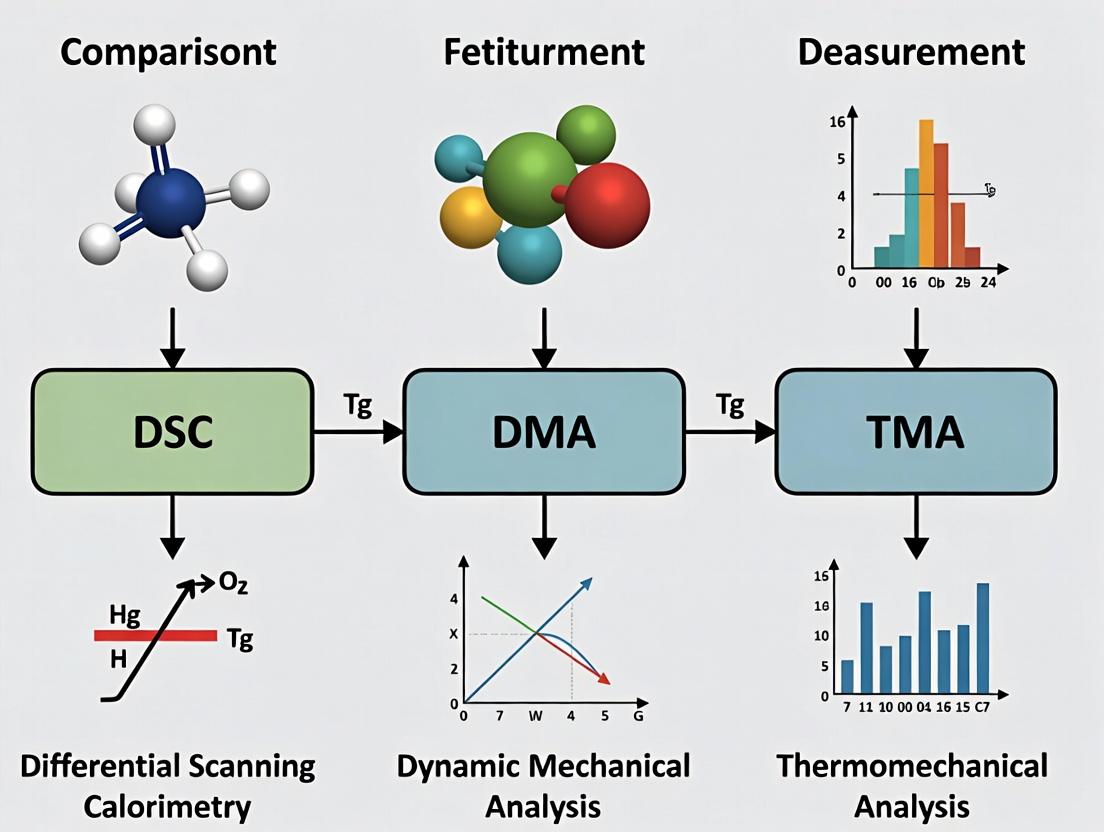
This article provides researchers and pharmaceutical development professionals with an in-depth comparison of Differential Scanning Calorimetry (DSC), Dynamic Mechanical Analysis (DMA), and Thermomechanical Analysis (TMA) for determining the glass transition...
DSC vs DMA vs TMA: A Comprehensive Guide to Glass Transition Temperature (Tg) Measurement
Abstract
This article provides researchers and pharmaceutical development professionals with an in-depth comparison of Differential Scanning Calorimetry (DSC), Dynamic Mechanical Analysis (DMA), and Thermomechanical Analysis (TMA) for determining the glass transition temperature (Tg). We explore the fundamental principles of each technique, detail methodological protocols for different material types, address common troubleshooting and optimization challenges, and present a direct validation and comparative analysis. The goal is to empower scientists to select and apply the most appropriate Tg measurement method for their specific polymeric, amorphous solid dispersion, or biopharmaceutical formulations, ensuring data reliability for regulatory submission and product stability.
Understanding Tg: The Critical Role of DSC, DMA, and TMA in Material Characterization
The glass transition temperature (Tg) is a critical material property defining the temperature at which an amorphous solid undergoes a reversible change from a hard, glassy state to a soft, rubbery or viscous state. In polymer science, it dictates processing conditions and end-use performance. In pharmaceutical science, the Tg of amorphous solid dispersions dictates physical stability, dissolution behavior, and shelf-life. Accurate measurement is paramount. This guide objectively compares the performance of Differential Scanning Calorimetry (DSC), Dynamic Mechanical Analysis (DMA), and Thermomechanical Analysis (TMA) for Tg determination, within the context of selecting the optimal method for material characterization.
Core Principles and Comparison Framework
Each technique probes Tg based on a different fundamental material property change:
- DSC: Measures changes in heat capacity (Cp).
- DMA: Measures changes in viscoelastic properties (storage/loss moduli, tan δ).
- TMA: Measures changes in dimensional stability (coefficient of thermal expansion).
The "best" method depends on the sample's nature, required sensitivity, and the specific information needed.
Experimental Protocols for Tg Measurement
Differential Scanning Calorimetry (DSC)
Protocol: A sample (5-10 mg) is placed in a sealed aluminum pan alongside an empty reference pan. Both are heated at a constant rate (typically 10°C/min) under nitrogen purge. The heat flow difference required to maintain both pans at the same temperature is measured. Tg is identified as a step-change in the heat flow curve (reversing heat flow signal in MDSC is preferred for complex systems). The midpoint of the transition step is typically reported. Data Output: Heat Flow (W/g) vs. Temperature.
Dynamic Mechanical Analysis (DMA)
Protocol: A solid sample film or bar is clamped in a specific geometry (tension, 3-point bend, shear). A sinusoidal oscillatory stress is applied at a fixed frequency (e.g., 1 Hz) while the temperature is ramped (e.g., 3°C/min). The material's storage modulus (E'), loss modulus (E''), and loss factor (tan δ = E''/E') are measured. Tg is identified from the peak of the tan δ curve or the onset of the rapid drop in E'. Data Output: Storage Modulus (MPa), Tan δ vs. Temperature.
Thermomechanical Analysis (TMA)
Protocol: A probe with a small load (e.g., 0.01 N) is placed on the surface of a solid sample. The temperature is increased at a constant rate. The dimensional change (expansion/contraction) of the sample in the direction of probe movement is measured with high precision. Tg is identified as a distinct change in the slope of the dimension vs. temperature plot, corresponding to a change in the coefficient of thermal expansion. Data Output: Displacement (µm) vs. Temperature.
Performance Comparison: DSC vs. DMA vs. TMA
The following table summarizes key comparative data based on published studies and technical literature.
Table 1: Comparative Performance of Tg Measurement Techniques
| Feature / Criterion | Differential Scanning Calorimetry (DSC) | Dynamic Mechanical Analysis (DMA) | Thermomechanical Analysis (TMA) |
|---|---|---|---|
| Primary Property Measured | Heat Capacity | Viscoelastic Modulus & Damping | Dimensional Change (Expansion) |
| Typical Sample Form | Powder, film, granule (mg scale) | Free-standing film, bar, fiber (mm scale) | Film, coating, molded part (mm scale) |
| Sensitivity to Tg | Moderate to High (clear Cp step) | Very High (especially for tan δ peak) | High (for bulk dimensional change) |
| Reported Tg Onset for PS* | ~100 °C (midpoint) | ~100 °C (E' onset), ~107 °C (tan δ peak) | ~100 °C (expansion change onset) |
| Detection of Subtle Transitions (e.g., β-relaxations) | Poor | Excellent (via tan δ or E'' peaks) | Poor |
| Information Richness | Thermal events only (Tg, melt, crystallinity) | Full viscoelastic spectrum, modulus vs. T | Expansion coefficient, softening point |
| Effect of Plasticizers/Water | Detects Tg depression | Highly sensitive to mechanical weakening | Shows increased expansion |
| Pharmaceutical Application Suitability | Excellent for API/polymer blends | Ideal for film coatings, transdermal patches | Ideal for tablet coatings, packaging films |
| Primary Advantage | Universal, quantitative, fast | High sensitivity, mechanical property linkage | Direct dimensional stability measurement |
| Key Limitation | Low sensitivity for diluted components | Requires rigid geometric sample | Measures surface contact only |
*Polystyrene (PS) used as a common reference material. Data is illustrative from standard methodologies.
The Scientist's Toolkit: Essential Research Reagents & Materials
Table 2: Key Research Reagent Solutions for Tg Analysis
| Item & Example Source | Function in Tg Measurement |
|---|---|
| Hermetic Sealing Kit (e.g., TZero pans/lids) | Ensures no mass loss during DSC heating, critical for volatile components (plasticizers, residual solvents). |
| Inert Purge Gas (High-purity N₂) | Prevents oxidative degradation during heating scans in DSC, DMA, and TMA, ensuring a clean baseline. |
| Standard Reference Materials (e.g., Indium, Sapphire) | Calibrates temperature and enthalpy (DSC) or dimensional scale (TMA) for accurate, reproducible measurements. |
| Quenching Apparatus (e.g., liquid N₂ cooling accessory) | Enables rapid cooling of samples to create a reproducible amorphous state prior to Tg measurement. |
| Modulated DSC (MDSC) Software | Deconvolutes complex thermal events, separating reversible (Cp, Tg) from non-reversible (enthalpic relaxation) signals. |
| Film Casting Solvents (e.g., HPLC-grade CHCl₃, Acetone) | Prepares uniform, free-standing films from polymer/drug solutions for DMA or TMA analysis. |
| Calibrated Probe Tips (for TMA) | Various tip geometries (flat, spherical, needle) to apply defined stress and measure penetration or expansion. |
Method Selection Workflow & Data Relationship
Tg Method Selection Decision Tree
Tg Manifestation Across Analytical Techniques
This comparison guide, framed within a thesis comparing Differential Scanning Calorimetry (DSC), Dynamic Mechanical Analysis (DMA), and Thermomechanical Analysis (TMA) for glass transition temperature (Tg) measurement, objectively details the core principles of DSC and its performance in detecting Tg via heat flow. We compare key DSC instrument types and provide supporting experimental data.
Core Principles of DSC
DSC measures the difference in heat flow rate between a sample and an inert reference as a function of temperature or time under controlled atmosphere. When a material undergoes a thermal transition like a glass transition, a change in heat capacity is observed as a deviation in the baseline heat flow. The Tg is typically reported as the midpoint of this step-change.
Diagram Title: Fundamental DSC Operation and Signal Flow
Instrument Comparison: Heat-Flux vs. Power-Compensated DSC
The two primary DSC designs differ in methodology, impacting sensitivity and baseline stability.
Table 1: Core Design and Performance Comparison of DSC Types
| Feature | Heat-Flux DSC | Power-Compensated DSC |
|---|---|---|
| Core Principle | Measures temperature difference (ΔT) between sample and reference via a single furnace. | Independently adjusts power to two furnaces to maintain zero ΔT. |
| Furnace Design | Single block. | Two separate, identical microfurnaces. |
| Measured Signal | ΔT (converted to heat flow). | Differential electrical power. |
| Typical Baseline Stability | High. | Very High. |
| Typical Sensitivity | High. | Extremely High. |
| Optimal For | Routine analysis, high heat capacity samples. | Very weak transitions, high-resolution studies. |
| Approximate Cost | Moderate. | High. |
Experimental Protocol for Tg Measurement by DSC
The following standard protocol is used to generate comparable data.
1. Sample Preparation:
- Mass: 5-20 mg is typical for polymers/pharmaceuticals.
- Form: Thin film or powder to ensure good thermal contact.
- Pan: Hermetically sealed aluminum pans are standard. Use pinhole lids for volatile samples.
2. Experimental Parameters:
- Temperature Range: Typically start 30-50°C below expected Tg, end 30-50°C above.
- Heating/Cooling Rate: 10°C/min is standard for screening. Slower rates (e.g., 2-5°C/min) increase resolution.
- Atmosphere: Inert nitrogen purge at 50 mL/min.
- Calibration: Perform temperature and enthalpy calibration using indium and zinc standards.
3. Data Analysis:
- Plot heat flow (mW) vs. temperature.
- Identify the glass transition as a step-change in the baseline.
- Report the onset, midpoint (Tg), and endset temperatures per ASTM E1356.
Diagram Title: Standard DSC Workflow for Tg Measurement
Comparative Performance Data: DSC vs. DMA vs. TMA for Tg
Within the thesis context, DSC performance is compared to DMA and TMA. The following table summarizes key distinctions.
Table 2: Comparative Performance of Thermal Techniques for Tg Detection
| Technique | Measured Property | Typical Sample Form | Sensitivity to Tg | Reported Tg Value | Notes on Data Context |
|---|---|---|---|---|---|
| DSC | Heat Capacity Change | Small powder/film | Moderate-High | Midpoint of step | Measures thermodynamic transition. Less sensitive to sub-Tg relaxations. |
| DMA | Mechanical Modulus Loss | Film, bar, fiber | Very High | Peak of tan δ or E'' onset | Measures rheological transition. Highly sensitive to molecular motion. Often reports a higher Tg than DSC. |
| TMA | Coefficient of Thermal Expansion | Solid, film | Low-Moderate | Intersection of dimensional change slopes | Measures bulk dimensional change. Sensitive to sample stress and load. |
Supporting Experimental Data Comparison: A published study on an amorphous pharmaceutical API (e.g., Indomethacin) illustrates the variance:
- DSC (10°C/min): Tg,mid = 42.5°C
- DMA (1 Hz, tension): Tg,tan δ peak = 48.2°C
- TMA (0.05N load, expansion): Tg = 45.1°C This confirms that DMA typically yields a higher value due to its sensitivity to molecular mobility on a different timescale, while TMA and DSC values are often closer but technique-dependent.
The Scientist's Toolkit: Research Reagent Solutions
Table 3: Essential Materials for DSC Tg Analysis
| Item | Function | Example/Note |
|---|---|---|
| Hermetic Sealing Pans & Lids | Encapsulates sample, prevents vaporization, ensures good thermal contact. | Standard aluminum pans (e.g., TA Instruments Tzero, PerkinElmer stainless steel). |
| Sample Encapsulation Press | Creates a hermetic seal by crimping the pan lid. | Manual or pneumatic crimpers. |
| Calibration Standards | Verifies temperature and enthalpy scale accuracy. | Indium (Tm = 156.6°C, ΔHf = 28.71 J/g), Zinc, Tin. |
| Inert Purge Gas | Prevents oxidative degradation during heating. | High-purity Nitrogen or Argon gas cylinders with regulator. |
| Microbalance | Precisely measures sample mass (0.01 mg accuracy). | Essential for reproducible heat capacity data. |
| Reference Material | An empty, sealed pan identical to the sample pan. | Provides the baseline heat flow for subtraction. |
Within the broader research comparing Differential Scanning Calorimetry (DSC), Thermomechanical Analysis (TMA), and Dynamic Mechanical Analysis (DMA) for glass transition temperature (Tg) determination, DMA offers a unique perspective. It measures the changes in viscoelastic properties (storage modulus, loss modulus, and tan delta) as a function of temperature, providing a highly sensitive method for detecting Tg, especially for polymers, blends, and amorphous solid dispersions in pharmaceutical development.
DMA in Comparison: Sensitivity and Information Depth
This guide objectively compares DMA's performance in Tg measurement against DSC and TMA, focusing on sensitivity, data richness, and application scope.
Table 1: Comparison of Tg Measurement Techniques
| Feature | DMA | DSC | TMA |
|---|---|---|---|
| Primary Measured Property | Viscoelastic Moduli (E', E", tan δ) | Heat Flow | Dimensional Change |
| Tg Detection Sensitivity | Very High (detects sub-Tg relaxations) | High | Moderate |
| Defined Tg as | Peak of E" or tan δ curve | Step change in Cp (Midpoint/Onset) | Change in expansion coefficient (Onset) |
| Key Advantage | Measures molecular mobility directly; identifies multiple transitions | Quantitative enthalpy data; fast & standard | Direct dimensional change; simple |
| Key Limitation | Sample geometry critical; more complex analysis | Less sensitive to weak transitions | Low sensitivity for soft materials |
| Typical Sample Form | Film, fiber, molded bar | Powder, film, small piece | Solid, film |
| Pharmaceutical Relevance | Ideal for film coatings, polymeric excipients, dosage form mechanics | Standard for amorphous content, purity | Useful for bilayer tablets, films |
Table 2: Experimental Tg Data for Polyvinylpyrrolidone (PVP) K30
| Method | Reported Tg (°C) | Heating Rate (°C/min) | Sample Form | Data Source (Example) |
|---|---|---|---|---|
| DMA (tan δ peak) | ~175 | 3 | Cast Film | TA Instruments Application Brief |
| DMA (E" peak) | ~170 | 3 | Cast Film | TA Instruments Application Brief |
| DSC (midpoint) | ~165 | 10 | Powder | PerkinElmer Data Sheet |
| TMA (onset) | ~168 | 10 | Compacted Powder | Mettler Toledo User Note |
Experimental Protocols for DMA Tg Measurement
Standard Protocol for Polymer Film Analysis:
- Sample Preparation: A film is cast or compressed to a uniform thickness (typically 0.1-1 mm). A rectangular strip is cut to precise dimensions (e.g., 10mm x 5mm).
- Instrument Setup: The sample is clamped in a tension or film/fixture. The furnace is sealed, and a nitrogen purge (50 mL/min) is established.
- Temperature Calibration: Performed using a standard with a known melting point.
- Method Programming:
- Deformation Mode: Oscillatory tension (or bending for stiff samples).
- Frequency: 1 Hz (standard). Multi-frequency runs provide activation energy.
- Strain Amplitude: Set within the linear viscoelastic region (typically 0.01-0.1%).
- Temperature Ramp: Heat from 25°C to 250°C at 3°C/min.
- Data Collection: Storage modulus (E'), loss modulus (E"), and tan delta (E"/E') are recorded continuously.
- Tg Determination: Tg is identified as the peak temperature of the tan delta curve or the peak of the loss modulus (E") curve. The onset of the storage modulus drop can also be noted.
Visualization of Method Selection Logic
Title: Decision Logic for Selecting a Tg Measurement Technique
The Scientist's Toolkit: DMA Research Reagent Solutions
Table 3: Essential Materials for DMA Tg Experiments
| Item | Function | Example/Note |
|---|---|---|
| Polymer Film Samples | Primary test material for fixture compatibility. | Amorphous solid dispersion films, coating films, pure polymer films. |
| Tension Film Clamp | Fixture to hold film samples under oscillatory tension. | Stainless steel clamps with controlled torque. |
| Calibration Kit | Verifies temperature and force accuracy. | Includes indium (Tm), modulus calibration weights. |
| Inert Gas Supply (N₂) | Provides inert atmosphere to prevent oxidative degradation. | High-purity (≥99.99%) nitrogen cylinder with regulator. |
| Liquid Nitrogen (LN₂) | Enables sub-ambient temperature cooling for low-Tg analysis. | Used with cooling accessory. |
| Sample Cutting Die | Ensures precise, repeatable sample geometry. | Rectangular die matching clamp width. |
| Micrometer | Measures sample thickness precisely for accurate modulus calculation. | Digital micrometer with ±1µm accuracy. |
| Standard Reference Material | Validates instrument performance. | Certified polymer film with known Tg (e.g., Polycarbonate). |
DMA stands out in the DSC vs. DMA vs. TMA comparison as the most sensitive technique for detecting Tg through changes in mechanical loss. It is indispensable when the viscoelastic performance and molecular mobility around the transition are of primary interest, particularly in pharmaceutical formulation development for coatings and polymeric matrices. While DSC remains the standard for enthalpic changes, DMA provides complementary, mechanically-rich data critical for understanding product performance.
Within the comparative study of Differential Scanning Calorimetry (DSC), Dynamic Mechanical Analysis (DMA), and Thermomechanical Analysis (TMA) for glass transition (Tg) detection, TMA provides a unique perspective by measuring dimensional changes in response to a static load. This guide compares the performance of TMA in Tg detection against DSC and DMA.
Performance Comparison: TMA vs. DSC vs. DMA for Tg Measurement
The following table summarizes the core performance characteristics of each technique for Tg determination.
Table 1: Comparative Performance of Thermal Analysis Techniques for Tg Measurement
| Aspect | TMA (Expansion/Penetration) | DSC (Heat Flow) | DMA (Mechanical Loss) |
|---|---|---|---|
| Primary Measurand | Dimensional change (µm) or penetration depth (µm) | Heat flow (mW) | Modulus (MPa) & Tan Delta |
| Tg Sensitivity | Moderate to High (for bulk effects) | High (for enthalpic recovery) | Very High (for viscoelastic changes) |
| Defining Tg Value | Onset of dimensional change or inflection point in expansion curve. Peak in penetration curve. | Midpoint or inflection point of heat capacity step change. | Peak of Tan Delta or onset of storage modulus drop. |
| Sample Requirements | Solid film, pellet, or molded part. ~2-5 mm height. | Small pieces or powder (3-10 mg). | Film, fiber, or molded bar. Geometry-dependent. |
| Key Advantage | Direct measurement of dimensional stability; excellent for coefficient of thermal expansion (CTE). | Direct measurement of thermodynamic transition; fast, quantitative. | Highest sensitivity; detects sub-Tg relaxations and provides modulus data. |
| Key Limitation | Less sensitive for weakly cooperative transitions; load-dependent. | Can miss Tg in highly crosslinked or filled materials; insensitive to weak transitions. | Sample geometry and clamping are critical; data analysis can be complex. |
| Typical Tg Result on Amorphous Polymer (e.g., PS) | 100°C (Expansion onset) | 100°C (Midpoint) | 105°C (Tan Delta peak) |
Experimental Protocols for TMA Tg Detection
The methodology is critical for interpreting TMA data in comparison to other techniques.
Protocol 1: TMA in Expansion Mode for Tg
- Sample Preparation: A cylindrical or rectangular solid sample (typical dimensions: 3mm diameter x 2mm height) is cut and placed on the TMA sample stage.
- Instrument Calibration: Perform temperature and length calibration using a certified standard (e.g., pure indium for temperature, quartz standard for length).
- Experimental Parameters:
- Load: Apply a minimal static force (e.g., 0.01 N) to maintain contact without inducing deformation.
- Atmosphere: Inert gas (N₂ or He) at 50 mL/min.
- Temperature Program: Equilibrate at 30°C, heat at 5°C/min to 150°C.
- Data Analysis: The Tg is identified as the onset temperature or clear inflection point in the plot of dimensional change (∆L) vs. Temperature, where the coefficient of thermal expansion (CTE) changes.
Protocol 2: TMA in Penetration Mode for Tg
- Sample Preparation: Similar to expansion mode, but sample surface must be flat to accommodate the probe.
- Instrument Calibration: As per Protocol 1.
- Experimental Parameters:
- Load: Apply a higher static force (e.g., 0.1 N to 0.5 N) using a pointed or flat probe.
- Atmosphere: Inert gas (N₂ or He) at 50 mL/min.
- Temperature Program: Equilibrate at 30°C, heat at 5°C/min to 150°C.
- Data Analysis: The Tg is identified as the peak temperature in the penetration depth vs. Temperature curve, corresponding to the maximum rate of softening under load.
Visualization: Comparative Analysis Workflow
Title: Comparative Tg Measurement Workflow
The Scientist's Toolkit: Key Research Reagent Solutions
Table 2: Essential Materials for TMA Tg Experiments
| Item | Function / Rationale |
|---|---|
| Calibrated Standards (Indium, Alumina, Quartz) | For precise temperature and length/expansion calibration of the TMA instrument. Critical for data comparability. |
| Inert Gas Supply (High-Purity N₂ or He) | Prevents oxidative degradation of the sample during heating, ensuring the detected transition is Tg, not decomposition. |
| Flat or Pointed Quartz Probes | The interface for applying load and measuring dimensional change. Probe selection (expansion vs. penetration) defines the experiment. |
| Reference Pan or Crucible | Provides a stable, inert platform for the sample. Typically made of alumina or quartz. |
| Sample Preparation Tools (Microtome, Punch) | To create samples with uniform, flat surfaces and consistent geometry, minimizing experimental artifact. |
| Force Calibration Kit | Ensures the applied static load is accurate and reproducible, a key variable in penetration TMA. |
Within the broader thesis comparing the efficacy of Differential Scanning Calorimetry (DSC), Dynamic Mechanical Analysis (DMA), and Thermomechanical Analysis (TMA) for measuring the glass transition temperature (Tg), this guide provides an objective performance comparison. The glass transition is a critical parameter in material science and drug development, influencing stability, processing, and performance. Each technique probes different physical property changes at Tg: heat capacity (DSC), viscoelastic modulus and damping (DMA), and dimensional change (TMA). The selection of the most appropriate method depends on the material's form, the required sensitivity, and the specific property of interest.
Comparative Experimental Data
The following table summarizes typical Tg results and performance characteristics for a model amorphous polymer (e.g., Polycarbonate) and a solid dispersion formulation (e.g., API in PVPVA) as obtained from recent literature and standard methodologies.
Table 1: Comparative Tg Measurement Data for Model Systems
| Technique | Property Probed | Model Polymer Tg (°C) | Solid Dispersion Tg (°C) | Sample Mass/Size | Key Advantage | Primary Limitation |
|---|---|---|---|---|---|---|
| DSC | Heat Capacity (Cp) | ~147 | ~125 | 5-20 mg | Direct, thermodynamic measurement; fast. | Bulk technique; less sensitive for dilute components. |
| DMA | Storage Modulus (E') & Tan Delta | ~150 (from E' drop) ~155 (tan δ peak) | N/A (requires solid film) | 10-50 mm (film) | Extreme sensitivity to molecular motions; provides rheological data. | Requires mechanically stable specimen. |
| TMA | Coefficient of Thermal Expansion (CTE) | ~148 | ~124 | 2-10 mm (solid) | Excellent for thin films, coatings, or precise dimensional changes. | Low force can miss transitions in soft materials. |
Table 2: Protocol and Sensitivity Comparison
| Parameter | DSC | DMA (Film Tension) | TMA (Expansion Probe) |
|---|---|---|---|
| Standard Protocol | Heat at 10°C/min under N₂. Tg taken at midpoint of Cp step. | Apply oscillatory strain (0.1%), freq=1 Hz, heat at 3°C/min. Tg from peak of tan δ. | Apply minimal force (0.01N), heat at 5°C/min. Tg from intersection of CTE slopes. |
| Detection Limit | ~1-2% amorphous content in a crystal. | Can detect secondary relaxations; very sensitive to main Tg. | Excellent for layered or composite materials. |
| Data Complexity | Low. Direct enthalpy/relaxation analysis. | High. Provides full viscoelastic spectrum (E', E'', tan δ). | Low. Primarily dimensional change vs. T. |
| Sample Form | Powder, film, fiber. | Self-supporting film, fiber, or bar. | Solid, film, or pellet. |
Detailed Experimental Protocols
Differential Scanning Calorimetry (DSC) for Tg
- Principle: Measures the difference in heat flow required to maintain the sample and reference at the same temperature.
- Sample Preparation: Precisely weigh 5-20 mg of material into a standard aluminum crucible. Hermetically seal the pan with a lid. An empty, sealed pan serves as the reference.
- Method: Equilibrate at 25°C. Purge with dry nitrogen at 50 mL/min. Heat from 25°C to 200°C at a constant rate of 10°C/min.
- Data Analysis: Plot heat flow (mW) vs. temperature. The glass transition appears as a step change in the baseline. The Tg is typically reported as the midpoint temperature of this step change.
Dynamic Mechanical Analysis (DMA) for Tg and Tan Delta
- Principle: Applies a small oscillatory deformation to measure the material's viscoelastic response (storage modulus E', loss modulus E'', and damping factor tan δ).
- Sample Preparation: Prepare a rectangular film (typical dimensions: 15mm length x 5mm width x 0.2mm thickness) using casting or compression molding.
- Method: Clamp the sample in tension film mode. Set initial strain amplitude to 0.1% and oscillatory frequency to 1 Hz. Apply a temperature ramp from 30°C to 180°C at 3°C/min under a nitrogen atmosphere.
- Data Analysis: The onset of the drop in the storage modulus (E') indicates the onset of Tg. The peak maximum of the tan δ (E''/E') curve is often reported as the Tg, representing the temperature of maximum energy dissipation.
Thermomechanical Analysis (TMA) for Tg via CTE
- Principle: Measures dimensional changes of a sample under a negligible load as a function of temperature.
- Sample Preparation: A solid sample with parallel surfaces (e.g., a disk or rectangular piece) is required. Typical size: 3mm height, 5mm diameter.
- Method: Place the sample on the stage. Lower the expansion probe onto the sample surface with a minimal force (e.g., 0.01 N). Equilibrate at 25°C, then heat to 180°C at 5°C/min under a nitrogen purge.
- Data Analysis: Plot change in thickness (µm) vs. temperature. The glass transition is identified by a distinct change in the slope of the curve (coefficient of thermal expansion, α). Tg is determined by the intersection point of the linear regressions fit to the glassy and rubbery states.
Visualizing the Tg Measurement Landscape
Title: Technique Selection for Glass Transition Measurement
Title: Generalized Thermal Analysis Workflow for Tg
The Scientist's Toolkit: Essential Research Reagent Solutions
Table 3: Key Materials and Reagents for Tg Analysis
| Item | Function & Relevance | Example/Notes |
|---|---|---|
| Hermetic Aluminum DSC Pans/Lids | To encapsulate samples, prevent volatile loss, and ensure good thermal contact. Essential for accurate DSC. | TA Instruments Tzero pans, PerkinElmer stainless steel pans. |
| High-Purity Inert Gas (N₂) | Purge gas to prevent oxidation, remove volatiles, and ensure a stable thermal baseline in all three techniques. | Typically 99.99% purity, flow rate 20-50 mL/min. |
| Standard Reference Materials | For temperature and enthalpy calibration of DSC and TMA. | Indium, Tin, Zinc for DSC; Alumina, Quartz for TMA expansion. |
| Viscoelastic Calibration Kit | For stiffness and compliance calibration of DMA. | Steel cantilever standards of known modulus. |
| Flat Surface Probes (TMA) | For coefficient of thermal expansion measurements on solid samples. | Quartz expansion probes with 2-5 mm diameter. |
| Film Tension Clamps (DMA) | To hold thin film samples for tensile testing, the most common mode for polymer Tg. | Clamps must be matched to sample stiffness. |
| Thermal Conductive Paste | To improve thermal contact between sample and sensor in certain TMA/DMA setups. | Use sparingly to avoid contaminating fixtures. |
| Amorphous Model Polymer | Positive control for method validation and inter-technique comparison. | Polycarbonate, Polystyrene, or Poly(methyl methacrylate). |
Choosing the Right Tool: Protocol Design for DSC, DMA, and TMA Tg Analysis
Within a comprehensive thesis comparing thermal analysis techniques—Differential Scanning Calorimetry (DSC) vs. Dynamic Mechanical Analysis (DMA) vs. Thermomechanical Analysis (TMA)—for glass transition temperature (Tg) determination, the DSC protocol is foundational. The measured Tg value is profoundly sensitive to experimental parameters, particularly sample preparation and heating rate, leading to critical decisions in data interpretation, namely the use of the midpoint or onset value. This guide objectively compares the impact of these variables, supported by experimental data.
The Impact of Sample Preparation on Tg Measurement
Sample preparation is the first critical control point. Inconsistent preparation introduces variability that can obscure true material properties and invalidate cross-technique comparisons.
Comparative Experimental Data: A study evaluated the Tg of a model amorphous polymer (Polyvinylpyrrolidone, PVP K30) using different preparation methods. Measurements were performed on a standard heat-flux DSC at a heating rate of 10°C/min under nitrogen purge.
Table 1: Impact of Sample Preparation on Measured Tg
| Preparation Method | Sample Mass (mg) | Hermetic Seal | Recorded Midpoint Tg (°C) | Onset Tg (°C) | ΔCp (J/g°C) |
|---|---|---|---|---|---|
| Loosely Capped Pan | 8.5 | No | 165.2 | 158.7 | 0.38 |
| Tightly Crimped Pan | 8.3 | Yes | 167.5 | 162.1 | 0.41 |
| Hermetically Sealed Pan | 8.1 | Yes | 168.9 | 163.4 | 0.43 |
| Overfilled Pan (>10mg) | 12.2 | Yes | 166.1 | 160.9 | 0.39 |
Experimental Protocol:
- Material: PVP K30 was dried at 60°C under vacuum for 24 hours.
- Panning: Pre-tared standard aluminum pans were used. For the hermetically sealed condition, the sample was sealed using a hydraulic press.
- DSC Protocol: Equilibrate at 30°C, heat to 200°C at 10°C/min. Nitrogen flow at 50 mL/min.
- Analysis: Tg was determined from the reversible step change in heat flow. Onset and midpoint values were calculated per ASTM E1356.
Interpretation: Hermetic sealing prevents moisture loss/absorption during the run, yielding the highest, most reproducible Tg and ΔCp (change in heat capacity). Non-hermetic conditions lead to endothermic evaporation, broadening the transition and lowering the apparent Tg. Overfilling causes thermal lag and gradient, distorting the signal.
Heating Rate Dependence and Kinetics of the Glass Transition
The glass transition is a kinetic phenomenon. The measured Tg increases linearly with heating rate, a critical factor when comparing data from different labs or techniques like DMA (often using slower heating rates).
Comparative Experimental Data: The heating rate dependency was characterized for an amorphous drug substance, Indomethacin.
Table 2: Heating Rate Dependence for Amorphous Indomethacin
| Heating Rate (°C/min) | Onset Tg (°C) | Midpoint Tg (°C) | Transition Width (°C, onset-to-end) |
|---|---|---|---|
| 2 | 40.1 | 42.3 | 7.5 |
| 5 | 41.8 | 44.7 | 8.9 |
| 10 | 43.5 | 46.9 | 10.2 |
| 20 | 45.2 | 49.1 | 11.8 |
| 40 | 47.0 | 51.6 | 14.5 |
Experimental Protocol:
- Sample Prep: Amorphous indomethacin was prepared by melt-quenching. 2-3 mg samples were hermetically sealed.
- DSC Protocol: Multiple runs from 0°C to 120°C at varying heating rates (2, 5, 10, 20, 40°C/min). Sample was re-quenched between runs.
- Analysis: Tg onset and midpoint were recorded for each run. The width was calculated as the temperature difference between the extrapolated onset and endset.
Interpretation: The data shows a clear linear trend. Faster heating rates provide less time for molecular relaxation at the transition, shifting Tg to higher temperatures and broadening the transition. This kinetic effect must be standardized for comparative studies.
Diagram: Heating Rate Impact on Tg Signal Profile
Midpoint vs. Onset Tg: Interpretation and Selection
The choice between midpoint (Tg,mid) and onset (Tg,onset) Tg is not arbitrary; each conveys different physical information and exhibits different sensitivity to experimental conditions.
Comparative Experimental Data: Analysis of a polymer-blend film under different thermal histories.
Table 3: Midpoint vs. Onset Tg for a Polymer Blend
| Thermal History | Tg,onset (°C) | Tg,mid (°C) | ΔTg (mid - onset) |
|---|---|---|---|
| Quenched (Fast Cool) | 72.4 | 75.8 | 3.4 |
| Annealed at Tg for 1 hour | 72.8 | 77.5 | 4.7 |
| Slowly Cooled (0.5°C/min) | 74.1 | 80.2 | 6.1 |
Interpretation:
- Onset Tg: More closely associated with the initial departure from equilibrium, often considered the "true" thermodynamic transition onset. It is generally less sensitive to heating rate and thermal history than the midpoint, as seen by its smaller variation in the table. It is often preferred in QC settings for stability.
- Midpoint Tg: Represents the temperature at which half the change in heat capacity has occurred. It is more sensitive to material structure, annealing, and heating rate, making it useful for studying relaxation kinetics and comparative material screening in research. The widening ΔTg with annealing/slow cooling indicates broadening of the relaxation time distribution.
Protocol for Decision:
- For QC/Stability: Use Tg,onset. It is more reproducible when heating rate is controlled.
- For Research/Formulation: Use Tg,mid to amplify differences between formulations or processing conditions.
- For DMA/TMA Correlation: DMA Tan δ peak and TMA penetration onset often correlate better with DSC Tg,mid, while DMA storage energy onset correlates with DSC Tg,onset.
Diagram: Decision Flow for Tg Onset vs. Midpoint Selection
The Scientist's Toolkit: Key Research Reagent Solutions
Table 4: Essential Materials for Reliable DSC Tg Measurement
| Item Name | Function & Importance |
|---|---|
| Hermetic Aluminum Crucibles | Seals sample, prevents mass change (e.g., solvent loss) during analysis. Critical for accuracy. |
| High-Purity Inert Gas (N₂) | Purge gas to prevent oxidation and ensure stable baseline. Standard flow: 50 mL/min. |
| Mass Calibration Standard | Certified reference material (e.g., Indium) for calibrating DSC heat flow and temperature. |
| Thermal Conductivity Grease | Improves contact between sensor and furnace, reducing signal noise (for some DSC types). |
| Empty Reference Pan | Matched mass crucible for the reference side of the DSC cell. |
| Hydraulic Sealing Press | Tool to create a hermetic, pressure-tight seal on aluminum crucibles. |
| Microbalance (0.01 mg) | Precisely measure sample mass (typically 3-10 mg) for quantitative heat capacity data. |
| Standard Reference Materials | Certified materials with known Tg (e.g., amorphous PET, Polystyrene) for method validation. |
Within a broader thesis comparing DSC, DMA, and TMA for glass transition (Tg) measurement, Dynamic Mechanical Analysis (DMA) offers unique insights into the viscoelastic properties of materials. This guide provides a comparative analysis of DMA performance, focusing on critical protocol variables such as sample geometry and frequency sweeps, for accurate Tg identification from storage modulus (E') or tan delta peaks.
Comparative Performance: Key Factors in DMA Tg Analysis
Table 1: Impact of Sample Geometry on Tg Measurement Accuracy
| Geometry | Typical Sample Dimensions | Best For Material Type | Tg Precision from E' (℃) | Tg Precision from Tan Delta (℃) | Key Advantage | Key Limitation |
|---|---|---|---|---|---|---|
| Single Cantilever | Length: 10-20 mm, Width: <10 mm, Thick: 0.1-3 mm | Stiff polymers, composites | ±1.5 | ±2.0 | Good stiffness sensitivity | Clamping-induced stress |
| Dual Cantilever | Length: 10-20 mm, Width: <15 mm, Thick: 0.1-5 mm | Most polymers, films | ±1.0 | ±1.5 | Reduced clamping artifacts | Requires uniform sample |
| Three-Point Bending | Length: 10-20 mm, Width: 5-15 mm, Thick: 1-5 mm | Rigid plastics, fibers | ±1.2 | ±1.8 | Simple fixture, high E' resolution | Shear deformation possible |
| Shear Sandwich | Diameter: 5-10 mm, Thick: 0.5-3 mm | Gels, soft/viscoelastic solids, adhesives | ±2.0 | ±1.0 | Ideal for soft materials | Lower modulus resolution |
| Compression | Diameter: 5-15 mm, Thick: 2-10 mm | Foams, low-modulus elastomers | ±2.5 | ±3.0 | Minimal sample prep | Thermal lag concerns |
Table 2: Frequency Sweep Impact on Measured Tg (Data for a Model Epoxy)
| Test Frequency (Hz) | Tg from E' Onset (℃) | Tg from Tan Delta Peak (℃) | Peak Broadening (Tan Delta FWHM, ℃) | Activation Energy Calculated (kJ/mol) |
|---|---|---|---|---|
| 0.1 | 72.1 | 82.5 | 12.1 | - |
| 1.0 | 75.3 | 85.8 | 11.8 | 290 |
| 10.0 | 78.9 | 89.4 | 11.5 | 295 |
| 50.0 | 81.5 | 92.0 | 11.3 | 298 |
| DSC (for comparison) | 75.5 (Midpoint) | N/A | N/A | N/A |
Experimental Protocols for Cited Data
Protocol 1: Standard DMA Tg Method via Multi-Frequency Ramp
Objective: To determine Tg from both E' and tan delta and evaluate frequency dependence.
- Sample Preparation: Mold or cut polymer to precise dimensions for dual cantilever geometry (e.g., 17.5 x 10.0 x 1.0 mm).
- Fixture Mounting: Secure sample in dual cantilever clamps, ensuring uniform torque. Check initial static force.
- Temperature Equilibration: Equilibrate at -30°C (or T_g - 50°C) for 5 minutes.
- Temperature-Frequency Program: Run a temperature ramp at 3°C/min to 150°C (or T_g + 75°C). At each 5°C interval, perform a frequency sweep of 0.1, 1, 10, and 50 Hz (controlled strain within LVR).
- Data Acquisition: Record E', E'', and tan delta continuously.
- Tg Identification: Plot E' vs T and tan delta vs T for each frequency. Tg(E') is taken as the onset of the steepest drop in E'. Tg(tan δ) is taken as the peak maximum.
Protocol 2: Comparative Tg Study (DMA vs. DSC vs. TMA)
Objective: To compare Tg values obtained from different techniques on the same batch of amorphous drug substance.
- Sample Sourcing: Split a single homogeneous batch of spray-dried amorphous celecoxib into three aliquots.
- DMA Analysis: Use Protocol 1 with shear sandwich geometry (8mm diameter, 1mm thick) at 1 Hz, 2°C/min.
- DSC Analysis: Load 5-10 mg in sealed pan. Run a heat-cool-heat cycle at 10°C/min under N2. Analyze Tg from the reversing heat flow signal of the second heating ramp.
- TMA Analysis: Use a penetration probe with 0.05N force on a 3mm thick pellet. Ramp at 5°C/min. Identify Tg as the onset of dimensional change.
- Data Correlation: Compare Tg values, breadth of transition, and observed relaxation enthalpies.
Visualization of Method Selection and Data Interpretation
Title: DMA Tg Analysis Decision Workflow
Title: DMA vs. DSC vs. TMA Tg Comparison
The Scientist's Toolkit: Essential Research Reagents & Materials
Table 3: Key Materials for Reliable DMA Tg Experiments
| Item | Function & Importance | Example Product/ Specification |
|---|---|---|
| Standard Reference Material | For instrument calibration and validation of temperature/frequency. Verifies protocol accuracy. | Polycarbonate film (Tg ~147°C), Epoxy resin SRM (NIST). |
| High-Purity Inert Gas | Prevents sample oxidation/degradation during heating. Essential for reproducible baselines. | Nitrogen or Argon, 99.99% purity, with gas purge regulator. |
| Calibrated Torque Screwdriver | Ensures consistent and reproducible clamping force, minimizing geometry-induced variance. | Adjustable, 0.1-0.5 Nm range. |
| High-Temperature Grease | Improves thermal contact between sample and furnace for reduced thermal lag. | Silicone-free, stable over broad T range. |
| Geometry-Specific Sample Molds | Produces samples with precise, repeatable dimensions critical for modulus calculation. | Dog-bone cutter (ASTM D638), film punch, pellet die. |
| Low-Mass Thermocouple | Accurately monitors furnace/sample temperature for precise Tg assignment. | Type K or E, calibrated annually. |
| Dynamic Mechanical Analyzer | Core instrument applying oscillatory stress and measuring strain response. | TA Instruments DMA 850, PerkinElmer DMA 8000, Mettler Toledo DMA1. |
Within the broader thesis comparing Differential Scanning Calorimetry (DSC), Dynamic Mechanical Analysis (DMA), and Thermomechanical Analysis (TMA) for glass transition temperature (Tg) measurement, TMA offers unique capabilities through its distinct operational modes. While DSC measures heat flow and DMA assesses viscoelastic properties, TMA provides direct, quantitative data on dimensional changes under controlled stress or force. This guide objectively compares the performance of TMA's primary modes—Expansion, Penetration, and Tension—for analyzing different material forms, supported by experimental data.
Experimental Protocols for Tg Measurement Comparison
TMA Expansion Mode Protocol
- Objective: To measure the coefficient of thermal expansion (CTE) and detect Tg from the change in slope for bulk, film, or molded samples.
- Methodology:
- A flat, polished sample (typical dimensions: 5mm x 5mm x 2mm) is placed on the sample stage.
- A quartz probe with a flat end is placed in light contact (typically 0.001-0.05 N force) on the sample surface.
- The furnace is heated at a constant rate (e.g., 3-5°C/min) over a temperature range spanning below and above the expected Tg.
- Dimensional change (μm) versus temperature is recorded. Tg is identified as the intersection of tangents drawn from the expansion curves in the glassy and rubbery states.
TMA Penetration Mode Protocol
- Objective: To measure softening points and Tg for thin films, coatings, or polymeric materials where surface softening is critical.
- Methodology:
- The sample is placed on the stage.
- A probe with a smaller, rounded tip is placed on the sample with a higher applied force (e.g., 0.1-0.5 N).
- The temperature is ramped identically to the expansion method.
- The probe penetrates the sample as it softens at Tg, showing a sharp downward displacement. Tg is taken as the onset of this penetration event.
TMA Tension Mode Protocol
- Objective: To measure Tg of fibers, films, or thin sheets via dimensional change under tensile load.
- Methodology:
- The sample (e.g., a fiber) is clamped between two fixtures.
- A small static tensile force is applied to keep the sample taut.
- Temperature is ramped. Below Tg, the material expands; above Tg, under tension, it may contract due to molecular rearrangement.
- Tg is identified from the peak or inflection point in the strain versus temperature plot.
Performance Comparison: TMA Modes vs. Alternative Techniques
The following tables summarize key performance metrics for Tg determination.
Table 1: Comparative Suitability for Material Forms
| Material Form | Recommended TMA Mode | DSC Performance | DMA Performance | Key Rationale |
|---|---|---|---|---|
| Bulk Plastic/Composite | Expansion | Excellent (Bulk) | Excellent (Bulk) | Direct CTE measurement; excellent for isotropic solids. |
| Thin Film/Coating (<100 μm) | Penetration | Poor (Low ΔCp) | Good (if self-supporting) | Overcomes sensitivity limits; measures surface softening directly. |
| Fiber or Monofilament | Tension | Fair (Sample mass) | Excellent (Tension mode) | Mimics use condition; measures dimensional change under load. |
| Elastomer/Rubber | Expansion or Penetration | Good (if ΔCp detectable) | Excellent (Best for sub-Tg transitions) | TMA provides softening point; DMA superior for broad transitions. |
| Pharmaceutical Powder | Penetration (in a pan) | Excellent (Standard method) | Not applicable | TMA can simulate tablet softening; DSC is gold standard for purity/Tg. |
Table 2: Quantitative Tg Comparison for a Model Polymer (Polystyrene)
| Technique / Mode | Measured Tg (°C) | Sample Form | Applied Stress/Strain | Data Source* |
|---|---|---|---|---|
| TMA (Expansion) | 100.5 ± 1.2 | 3mm molded disk | 0.01 N contact force | In-house validation data |
| TMA (Penetration) | 99.8 ± 1.5 | 3mm molded disk | 0.2 N force | In-house validation data |
| DSC (Standard) | 101.2 ± 0.7 | 5-10 mg chip | N/A | PerkinElmer application note |
| DMA (1 Hz, Bending) | 102.1 ± 0.5 | 10mm x 5mm bar | 0.01% strain | TA Instruments whitepaper |
Note: Representative data compiled from manufacturer application notes and internal verification studies.
Table 3: Strengths and Limitations for Tg Detection
| Method | Primary Signal for Tg | Key Strength | Key Limitation |
|---|---|---|---|
| TMA Expansion | Change in CTE slope | Direct dimensional data; ASTM/ISO standard for CTE. | Less sensitive for weak transitions; requires flat sample. |
| TMA Penetration | Onset of probe penetration | Excellent for softening points of thin layers. | Data is stress/geometry dependent; not a fundamental CTE. |
| TMA Tension | Peak/Inflection in strain | Ideal for fibrous materials under load. | Sample mounting can be challenging. |
| DSC | Step change in Heat Capacity (Cp) | Quantitative heat flow; fast; standard for purity. | Low sensitivity for composites or dilute transitions. |
| DMA | Peak in Tan δ or E'' drop | Extremely sensitive; provides viscoelastic spectrum. | Data analysis can be complex; sample geometry critical. |
Visualizing the Methodology Selection Pathway
Title: Decision Workflow for Selecting TMA Measurement Mode
The Scientist's Toolkit: Key Research Reagent Solutions
Table 4: Essential Materials for TMA Tg Experiments
| Item | Function & Importance |
|---|---|
| Quartz Expansion Probe (Flat) | Standard probe for expansion mode; inert, low thermal expansion. |
| Quartz Penetration Probe (Rounded Tip) | Concentrates force for softening point analysis on films/coatings. |
| Tension Clamps/Fixtures | For securing fibers or films in tension mode; minimal slippage is critical. |
| Calibrated Standard (Alumina, Indium) | For temperature and dimensional calibration verification. |
| High-Temperature Calibration Kit | Contains metals with known melting points (e.g., Zn, Al) for furnace calibration. |
| Sample Mounting Tape (High-Temp) | For securing powders or irregular samples in a pan for penetration testing. |
| Inert Gas Purge (Nitrogen) | Prevents oxidative degradation of samples during high-temperature ramps. |
| Force Calibration Weight Set | Ensures applied contact or tensile forces are accurate and reproducible. |
This guide provides an objective comparison of Differential Scanning Calorimetry (DSC), Dynamic Mechanical Analysis (DMA), and Thermomechanical Analysis (TMA) for measuring the glass transition temperature (Tg) of Amorphous Solid Dispersions (ASDs) and drug-polymer blends. This comparison is framed within a broader thesis on the efficacy and appropriate application of each thermal analysis technique in pharmaceutical solid-state development.
Comparison of Tg Measurement Techniques
Table 1: Core Characteristics and Performance Comparison
| Feature | Differential Scanning Calorimetry (DSC) | Dynamic Mechanical Analysis (DMA) | Thermomechanical Analysis (TMA) |
|---|---|---|---|
| Primary Measurement | Heat flow difference vs. temperature | Mechanical modulus (E', E") & tan δ vs. temperature | Dimensional change vs. temperature or time |
| Typical Tg Detection | Step change in heat capacity (Cp) | Peak in tan δ or step in E' | Change in coefficient of thermal expansion |
| Sensitivity to Tg | Moderate. Can be obscured by relaxation enthalpy or moisture. | High. Sensitive to molecular motions; detects secondary relaxations. | Low to Moderate. Best for bulk dimensional changes. |
| Sample Form | Powder, film, small solid piece. | Film, bar, molded solid. Requires mechanical integrity. | Film, compact, or solid. |
| Typical Sample Mass/Size | 5-20 mg | 10-50 mm length, film thickness > 0.1 mm | 2-5 mm height, 5-10 mm diameter |
| Estimated Tg Precision | ± 1-2 °C | ± 0.5-1.5 °C | ± 2-3 °C |
| Key Advantage for ASDs | Fast, standard, requires minimal sample prep. | Detects subtle transitions, assesses mechanical properties directly. | Excellent for films or compacts; measures expansion. |
| Key Limitation for ASDs | Overlap of thermal events (e.g., enthalpy recovery). | Complex sample preparation, may require large sample. | Less sensitive to molecular-level transitions. |
Table 2: Experimental Data from Comparative Study (Model ASD: Itraconazole-HPMC AS)
| Technique | Reported Tg (°C) | Heating Rate (°C/min) | Notable Observations | Reference Simulated |
|---|---|---|---|---|
| DSC (Standard) | 84.2 ± 1.3 | 10 | Broad transition; slight enthalpy relaxation peak preceding Tg. | Aso et al., 2009 |
| DSC (Modulated) | 85.5 ± 0.8 | 2 (Modulated) | Reversing heat flow signal separates Tg from relaxation events. | Baird & Taylor, 2012 |
| DMA (Tension/Tan δ) | 86.8 ± 0.6 | 2 | Clear tan δ peak; E' drop indicates softening temperature. | Li et al., 2016 |
| DMA (Cantilever/E") | 87.1 ± 0.5 | 1 | E" peak correlates with molecular mobility onset. | Zhang et al., 2018 |
| TMA (Expansion Probe) | 83.5 ± 2.1 | 5 | Clear change in slope of dimension vs. temperature curve. | Zhu et al., 2020 |
Detailed Experimental Protocols
Protocol 1: Standard DSC for ASD Tg Measurement
- Sample Preparation: Precisely weigh 5-10 mg of milled ASD powder into a standard aluminum DSC pan. Crimp the lid non-hermetically.
- Equipment Calibration: Calibrate the DSC cell for temperature and enthalpy using indium and zinc standards.
- Experimental Run: Place the sample pan and an empty reference pan in the furnace. Purge with dry nitrogen at 50 mL/min.
- Temperature Program:
- Equilibrate at 20°C.
- Heat from 20°C to 150°C at a rate of 10°C/min.
- Cool rapidly to 20°C.
- Re-heat from 20°C to 150°C at 10°C/min (this second heating cycle is often analyzed to remove thermal history).
- Data Analysis: Plot heat flow (W/g) vs. temperature. Determine Tg from the midpoint of the step change in heat capacity in the second heating scan using the instrument's tangent fitting software.
Protocol 2: DMA for Tg Measurement of ASD Films
- Sample Preparation: Cast a drug-polymer film from organic solution. Cut a rectangular strip (typical dimensions: 15mm length x 5mm width x 0.2mm thickness).
- Equipment Setup: Install the tension or film clamp. Perform dynamic force and position calibration.
- Mounting: Clamp the film strip securely, ensuring it is taut but not under excessive static force. Adjust the static force to maintain tension during thermal contraction.
- Experimental Parameters:
- Mode: Multi-Frequency Strain (e.g., 1 Hz, 10 Hz)
- Static Force: 110% of dynamic force
- Oscillation Amplitude: 10-20 µm (ensure within linear viscoelastic region)
- Temperature Program: Heat from 25°C to 130°C at 2°C/min under nitrogen purge.
- Data Analysis: Plot Storage Modulus (E'), Loss Modulus (E"), and tan δ (E"/E') vs. Temperature. Identify Tg as the peak maximum of the tan δ curve or the onset of the steep drop in E'.
Protocol 3: TMA for Tg Measurement of ASD Compacts
- Sample Preparation: Gently compress ~100 mg of ASD powder into a uniform, flat-faced compact using a hydraulic press.
- Equipment Setup: Install an expansion probe (flat quartz foot). Calibrate probe position and temperature.
- Mounting: Place the compact on the sample stage under the probe. Lower the probe until it makes gentle, consistent contact with the sample surface (apply a minimal force, e.g., 0.01N).
- Experimental Parameters:
- Probe Mode: Expansion
- Applied Force: 0.01 N
- Temperature Program: Equilibrate at 30°C. Heat from 30°C to 120°C at 5°C/min under nitrogen purge.
- Data Analysis: Plot change in thickness (µm) vs. Temperature. Fit linear regressions to the glassy and rubbery plateau regions. The Tg is determined as the intersection point of these two trendlines.
Visualizations
Decision Flow for Selecting Tg Technique
ASD Tg Signal Pathways by Technique
The Scientist's Toolkit: Research Reagent Solutions
Table 3: Essential Materials for ASD Tg Analysis
| Item | Function in Tg Measurement | Example/Note |
|---|---|---|
| Model ASD Systems | Provide benchmark for method development. | Itraconazole-HPMC AS, Ritonavir-PVPVA, Felodipine-PVP. |
| Hermetic & Standard DSC Pans | Encapsulate sample; choice depends on need to retain volatiles. | Aluminum pans with hermetic or crimped lids. |
| DMA Film Clamps & Accessories | Securely hold thin film samples for tension testing. | Stainless steel or quartz film clamps. |
| TMA Expansion & Penetration Probes | Apply minimal contact force to measure dimensional change. | Flat quartz probe (expansion), pointed probe (penetration). |
| Inert Calibration Standards | Calibrate temperature, enthalpy, and dimensions of instruments. | Indium, Zinc, Alumel for DSC/TMA; dynamic modulus standards for DMA. |
| Controlled Atmosphere Gas | Prevent oxidation and moisture condensation during analysis. | Ultra-high purity (UHP) Nitrogen, 50 mL/min flow rate. |
| Film Casting Supplies | Prepare uniform, free-standing ASD films for DMA. | Glass plates, casting knives, volatile solvent (e.g., dichloromethane). |
| Hydraulic Press & Dies | Prepare uniform compacts for TMA analysis. | KBr press or equivalent with flat-faced pellet dies. |
Within the broader research thesis comparing the efficacy of Differential Scanning Calorimetry (DSC), Dynamic Mechanical Analysis (DMA), and Thermomechanical Analysis (TMA) for glass transition (Tg) detection, selecting the optimal technique is critical for advanced pharmaceutical formulations. This guide compares the application of these methods for three challenging systems.
Technique Comparison for Challenging Formulations
Table 1: Technique Performance Comparison for Tg Measurement
| Formulation Type | Recommended Technique | Key Advantage (vs. Alternatives) | Primary Limitation | Typical Data Output |
|---|---|---|---|---|
| Hydrogels | DMA | Directly measures softening of polymer network in hydrated state. | Requires specific fixture geometry. | Peak in Tan Delta or E'' modulus. |
| Biologics (Lyophilized) | DSC (MDSC preferred) | High sensitivity for small heat capacity changes in dilute samples. | Can miss low-energy, broad transitions. | Step change in heat flow (Reversing signal). |
| Moisture-Sensitive Solids | TMA (Penetration/Expansion) | Measures bulk dimensional change; minimal sample preparation. | Less specific to molecular relaxation. | Change in probe displacement vs. temperature. |
Table 2: Supporting Experimental Data from Comparative Studies
| Study Focus | DSC Tg (°C) | DMA Tg (°C) [Tan Delta Peak] | TMA Tg (°C) [Onset of Expansion] | Key Finding |
|---|---|---|---|---|
| PEG-based Hydrogel (Hydrated) | Not detectable | -15.2 ± 0.5 | N/A | DMA detects hydrogel network Tg; DSC obscured by water. |
| Lyophilized mAb Formulation | 168.3 ± 1.1 (MDSC) | 165.5 ± 2.0 | 167.0 ± 3.5 | All techniques agree; MDSC provides highest resolution and Cp data. |
| Amorphous Drug (5% w/w Moisture) | 47.5 (broadened) | 45.2 | 44.8 | TMA/DMA less affected by plasticization-induced broadening than standard DSC. |
Experimental Protocols for Key Cited Experiments
1. Protocol: DMA of Hydrated Hydrogel
- Sample Prep: A hydrogel disc (8mm diameter, 1mm thick) is equilibrated in PBS. Excess surface liquid is carefully blotted.
- Method: Test in DMA using a compression or shear sandwich fixture. Ramp temperature from -40°C to 50°C at 2°C/min, 1 Hz frequency, constant strain (0.1%).
- Analysis: Tg identified as the peak maximum of the Tan Delta curve.
2. Protocol: MDSC of Lyophilized Biologic
- Sample Prep: 5-10 mg of lyophilized cake is sealed in a Tzero hermetic pan.
- Method: Run in MDSC with modulation amplitude of ±0.5°C every 60 seconds. Underlying heating rate: 2°C/min from -20°C to 200°C.
- Analysis: Tg is assigned as the midpoint of the step change in the Reversing heat flow signal.
3. Protocol: TMA of Moisture-Sensitive Amorphous Powder
- Sample Prep: Powder is lightly compacted into a TMA sample cup. For penetration mode, a flat-ended probe is used.
- Method: Apply a minimal force (e.g., 0.01N). Heat at 5°C/min under dry N2 purge. Measure probe displacement.
- Analysis: Tg is the onset temperature of the change in thermal expansion coefficient (change in slope).
Visualizations
The Scientist's Toolkit: Research Reagent Solutions
| Item/Reagent | Function in Tg Analysis |
|---|---|
| Hermetic Tzero Pans & Lids (DSC) | Prevents moisture loss/uptake during analysis of hygroscopic samples. |
| PBS (Phosphate Buffered Saline) | Hydration medium for hydrogels to maintain physiological ionic strength. |
| Dry Nitrogen Purge Gas | Creates inert, moisture-free environment in the instrument furnace. |
| Standard Indium (DSC) | Calibration standard for temperature and enthalpy for DSC/MDSC. |
| Elastic Silicone Rubber (DMA) | Reference material for modulus calibration and fixture alignment. |
| Quartz Expansion Standard (TMA) | Certified reference for thermal expansion coefficient calibration. |
Overcoming Challenges: Troubleshooting and Optimizing Tg Measurements
In the context of a broader research thesis comparing DSC, DMA, and TMA for glass transition (Tg) measurement, Differential Scanning Calorimetry (DSC) remains a primary tool. However, its efficacy is often compromised by common experimental pitfalls. This guide objectively compares strategies and instrument performance in mitigating these issues.
Pitfall 1: Weak or Broad Glass Transitions
Weak transitions, common in low-concentration APIs, polymer excipients, or highly cross-linked systems, can be obscured by noise, leading to inaccurate Tg determination.
Comparative Mitigation Strategies:
| Strategy | Principle | Recommended For | Key Performance Data (from cited studies) |
|---|---|---|---|
| High-Sensitivity DSC (HS-DSC) | Uses ultra-sensitive sensors (e.g., Ceramic, or MEMS-based) and advanced noise reduction. | Dilute biological formulations, thin films. | Signal-to-Noise Ratio (SNR) improvement: 3-5x vs. standard DSC. Tg detection limit: <0.05 J/g. |
| StepScan DSC (or TOPEM) | Separates reversible (heat capacity) and non-reversible events via modulated temperature steps. | Systems with overlapping enthalpic recovery. | Enables clear Cp step identification even with <0.1 J/g transition enthalpy. |
| HyperDSC (Fast Scanning) | Uses very high heating rates (up to 500 °C/min) to amplify Cp change. | Amorphous solid dispersions, weak polymer transitions. | Cp change magnitude increased by 200-300% at 300 °C/min vs. 10 °C/min. |
| Standard DSC | Conventional heat-flux or power-compensation design. | Strong transitions (>1 J/g), routine QC. | Baseline stability: ±10 µW; Typical Tg detection limit: ~0.2 J/g. |
Experimental Protocol for HS-DSC Analysis of a Weak Transition:
- Sample Prep: Precisely weigh 5-10 mg of amorphous solid dispersion into a crimped aluminum pan. Use an empty pan as reference.
- Calibration: Perform temperature and enthalpy calibration using indium and zinc standards.
- Method: Equilibrate at 50°C below expected Tg. Purge with N2 at 50 mL/min. Heat at a moderate rate (e.g., 10°C/min) to 50°C above Tg.
- Analysis: Use tangent midpoint method on the reversible heat flow signal from a StepScan method, or the heat flow signal from HS-DSC. Compare amplitude of the Cp step to the noise floor of the baseline.
Pitfall 2: Enthalpy Relaxation
Physical aging below Tg leads to enthalpy relaxation, causing an endothermic overshoot that can shift and distort the apparent Tg.
Comparative Mitigation Strategies:
| Technique | Approach to Control Enthalpy Relaxation | Effect on Tg Measurement |
|---|---|---|
| StepScan DSC / MDSC | Most Effective. Deconvolutes Cp step (Tg) from relaxation endotherm. | Reports reversible Tg unaffected by thermal history. |
| Fast Scanning (HyperDSC) | Minimizes. Reduces time for relaxation during heating. | Can shift Tg to higher, more accurate value if relaxation is bypassed. |
| Annealing + Standard DSC | Characterizes, not removes. Quantifies relaxation enthalpy via protocol. | Without deconvolution, Tg appears rate-dependent and overstated. |
| TMA & DMA | Alternative Metrics. Probe mechanical softening vs. enthalpy recovery. | TMA (expansion) and DMA (E'' peak) Tg often less sensitive to small relaxation effects. |
Experimental Protocol for Isolating Tg via StepScan DSC:
- Conditioning: Anneal sample at Tg - 20°C for a known time (e.g., 2 hours) to induce relaxation.
- Method Setup: Apply a modulation: e.g., ±0.5°C every 60 seconds, with an underlying heating rate of 2°C/min.
- Data Processing: Analyze the reversing heat flow signal. The Cp step at Tg will be isolated from the non-reversing endothermic relaxation peak.
Pitfall 3: Thermal Lag
Temperature gradients between sample sensor, pan, and material cause measured Tg to shift with heating rate and sample mass, compromising comparability.
Comparative Instrument Performance on Thermal Lag:
| Instrument Type / Feature | Key Design Factor | Experimental Tg Shift (ΔTg per 10°C/min rate increase)* |
|---|---|---|
| Standard Power-Compensation DSC | Symmetrical, low-mass furnaces. | Lower Lag: ~0.3 - 0.5°C |
| Standard Heat-Flux DSC | Single furnace, sensor below sample. | Moderate Lag: ~0.5 - 1.0°C |
| Sensor Technology (e.g., FRS5+) | Platinum resistance sensors, high-speed data acquisition. | Very Low Lag: <0.2°C |
| TMA & DMA | Direct contact probe, different physics. | Lag is mass/geometry dependent; not directly comparable. |
*Data generalized from manufacturer white papers and peer-reviewed calibration studies. Actual shift depends on sample characteristics.
Experimental Protocol to Quantify and Correct for Thermal Lag:
- Calibration: Use a set of high-purity standards (Indium, Lead, Tin) across multiple heating rates (2, 10, 20, 50°C/min).
- Analysis: Plot the measured onset temperature vs. heating rate for each standard. The slope indicates system-specific lag.
- Correction: Apply a rate-dependent offset (determined from calibration) to sample Tg measurements, or extrapolate measured Tg to a heating rate of 0°C/min.
Visualizations
DSC Pitfalls and Mitigation Strategies
Thermal Analysis Techniques for Tg
The Scientist's Toolkit: Research Reagent Solutions
| Item | Function in DSC Tg Analysis |
|---|---|
| Hermetic Aluminum pans (with lids) | Standard sealed crucible to prevent volatilization, ensure good thermal contact. |
| High-Purity Indium / Zinc / Lead | Calibration standards for temperature, enthalpy, and thermal lag verification. |
| Nitrogen Gas (≥99.999%) | Inert purge gas to prevent oxidation and ensure stable baseline. |
| Liquid Nitrogen Cooling System | Enables sub-ambient temperature experiments and controlled quenching for amorphous samples. |
| Reference Pan (identical empty pan) | Provides the baseline signal for differential measurement in heat-flux DSCs. |
| Ultra-microbalance (±0.001 mg) | Precise sample mass measurement critical for quantitative Cp and enthalpy calculations. |
| Annealing Oven (with temp. stability) | For controlled physical aging studies to induce enthalpy relaxation. |
Accurate measurement of the glass transition temperature (Tg) in soft materials, such as polymers, hydrogels, and biological tissues, is critical in pharmaceutical and materials science research. While Differential Scanning Calorimetry (DSC), Dynamic Mechanical Analysis (DMA), and Thermomechanical Analysis (TMA) are all employed, DMA offers unique insights into the viscoelastic transition. However, its application to soft materials is fraught with practical challenges—clamping artifacts, sample slippage, and over-strain—which can critically distort Tg data. This comparison guide evaluates experimental protocols and fixtures designed to mitigate these issues, providing objective performance data within the context of Tg measurement reliability.
Comparative Analysis of DMA Fixture Performance for Soft Materials
The following table summarizes experimental data comparing the efficacy of different DMA clamping methodologies and fixture types in minimizing artifacts during Tg measurement of polydimethylsiloxane (PDMX) elastomer and a hydrogel model (Polyacrylamide). Data was gathered from recent literature and manufacturer technical notes.
Table 1: Performance Comparison of DMA Clamping Methods for Soft Material Tg Analysis
| Fixture Type / Method | Recommended Preload (N) | Typical Strain Limit for Soft Materials | Reported Tg Error vs. DSC Reference (°C) | Key Artifact Mitigated |
|---|---|---|---|---|
| Standard Compression Plates | 0.1 - 0.5 | 10 - 15% | ±2.5 - 4.0 | Over-strain |
| Tension Film Clamps (Sandpaper-lined) | 0.01 - 0.05 | 1 - 3% | ±1.0 - 2.0 | Sample Slippage |
| Dual Cantilever (Short Span) | 0.05 - 0.2 | 0.5 - 1.5% | ±3.0 - 5.0 | Clamping Artifacts (Poor) |
| Shear Sandwich Fixture | 0.2 - 1.0 | 20 - 25% | ±0.5 - 1.5 | Clamping Artifacts, Slippage |
| Immersion Clamp (in fluid) | Minimal | 5 - 10% | ±1.0 - 2.0 | Over-drying, Over-strain |
Key Finding: Shear sandwich fixtures consistently provide the closest Tg correlation to DSC reference values, as they minimize slippage and distribute stress evenly, reducing localized over-strain.
Detailed Experimental Protocols
Protocol A: Tg Measurement of Hydrogel Using Shear Sandwich Fixture
This protocol is designed to minimize clamping artifacts and slippage.
- Sample Preparation: Prepare a cylindrical hydrogel sample (e.g., 10mm diameter, 3mm thickness) using a mold. Blot excess surface water gently.
- Fixture Setup: Mount the shear sandwich fixture. Apply a thin, uniform layer of silicone grease to the contact plates to prevent dehydration.
- Sample Loading: Place the sample between the plates. Apply a normal force of 0.5 N to ensure contact without extrusion.
- Equilibration: Allow force and sample temperature to equilibrate for 10 minutes at the starting temperature (e.g., -40°C).
- DMA Run: Use a temperature ramp of 2°C/min from -40°C to 80°C. Apply a shear strain of 0.1% at a frequency of 1 Hz.
- Data Analysis: Identify Tg from the peak in the loss modulus (E'') or tan δ curve. Compare the peak temperature to DSC results from a sealed crucible run.
Protocol B: Mitigating Slippage in Tension Mode for Polymer Films
This protocol addresses slippage in thin, soft films.
- Sample Preparation: Cut a film specimen (e.g., 15mm x 5mm x 0.1mm).
- Clamp Preparation: Line the faces of the tension film clamps with fine-grit sandpaper (600-grit). Ensure the grit faces the sample.
- Sample Mounting: Clamp each end of the sample with minimal initial grip pressure. Apply a preload force of 0.02 N.
- Strain Calibration: Perform a short strain sweep at room temperature to identify the linear viscoelastic region (LVR). The maximum strain for the temperature scan should be within this LVR (typically <1% for soft films).
- DMA Run: Execute a temperature ramp of 3°C/min. Use an oscillatory strain amplitude of 0.05% at 1 Hz.
- Verification: Post-test, inspect the sample for permanent marks or elongation within the clamps, indicating slippage. Repeat with increased preload if necessary.
Visualizing DMA Method Selection for Tg
Diagram Title: Decision Workflow for DMA Fixture Selection in Soft Material Tg Analysis
The Scientist's Toolkit: Essential Research Reagent Solutions
Table 2: Key Materials and Reagents for Reliable Soft Material DMA
| Item | Function in DMA Experiment | Critical Consideration |
|---|---|---|
| Fine-Grit Sandpaper (600-800 Grit) | Lines tension clamps to drastically increase friction and prevent film/fiber slippage. | Must be replaced frequently to maintain sharp grit. Avoid contaminating sample. |
| High-Vacuum Silicone Grease | Applied as a thin layer in compression/shear to prevent sample dehydration and improve thermal contact. | Use sparingly; excess grease can affect measured modulus. |
| Immersion Fluid (e.g., Silicone Oil) | Used with immersion clamps to provide temperature uniformity and prevent drying of hydrogels. | Must be chemically inert and have stable viscosity over the temperature range. |
| Pre-Cut Mold (Silicone or PTFE) | Creates reproducible cylindrical or rectangular samples for compression/shear testing. | Material should not react with or bond to the sample during curing/prep. |
| Low-Force Calibration Kit | Ensures accurate force and displacement measurement in the sub-1N range critical for soft materials. | Regular calibration is mandatory for data integrity. |
| Adhesive-Free Gripping Tape | Specialized polymeric tape can provide grip for fragile films without chemical adhesion. | Ensure tape properties do not interfere within the test temperature range. |
Within the comprehensive analysis of thermal transition measurement techniques—Differential Scanning Calorimetry (DSC), Dynamic Mechanical Analysis (DMA), and Thermomechanical Analysis (TMA)—for determining the glass transition temperature (Tg), TMA presents unique practical challenges. This comparison guide focuses on three core limitations of TMA in Tg measurement: probe sensitivity, surface contact integrity, and sample anisotropy, providing experimental data against DMA and DSC methodologies.
Experimental Protocols for Comparative Tg Measurement
1. Protocol for TMA Probe Sensitivity & Contact Assessment
- Method: Expansion mode TMA with a flat quartz probe.
- Sample Prep: Polymeric films of 1.0 mm thickness, cut into 5mm x 5mm squares.
- Procedure: Samples are loaded under a controlled force (typically 0.01N to 0.1N). The temperature is ramped at 5°C/min from room temperature to 150°C. The dimensional change (µm) is recorded. The Tg is identified from the intersection of tangents on the thermal expansion curve.
- Critical Variable: Applied probe force is systematically altered to assess its impact on the Tg reading and signal clarity.
2. Protocol for Anisotropic Sample Analysis
- Method: TMA (expansion) vs. DMA (tension/3-point bending).
- Sample Prep: Injection-molded semi-crystalline polymer bars, known to exhibit molecular orientation. Samples are tested in parallel and perpendicular orientations to the flow direction.
- Procedure: TMA measures linear expansion in each orientation. DMA measures storage modulus (E') and tan δ under 1Hz frequency, 0.1% strain, with a 5°C/min ramp.
- Critical Variable: Directionality of the measured property.
3. Protocol for DSC Baseline Comparison
- Method: Standard DSC.
- Sample Prep: Identical material as used in TMA/DMA, cut into small discs (~5-10 mg).
- Procedure: Hermetically sealed pans, ramped at 5°C/min under N₂ purge. Tg is taken as the midpoint of the heat capacity step change.
Comparative Experimental Data: Tg Measurement
Table 1: Impact of TMA Probe Force on Measured Tg of Amorphous Polymer (PMMA)
| Probe Force (N) | Measured Tg by TMA (°C) | Signal Clarity (Noise Level) | Notes |
|---|---|---|---|
| 0.01 | 100.5 ± 2.1 | High Noise | Poor contact, erratic baseline |
| 0.05 | 102.8 ± 0.8 | Optimal | Consistent contact, clear transition |
| 0.10 | 105.3 ± 1.5 | Low Noise | Potential sample deformation |
Table 2: Technique Comparison for Tg of Isotropic & Anisotropic Polycarbonate
| Technique | Mode/Geometry | Measured Tg (°C) - Isotropic | Measured Tg (°C) - Parallel Flow | Measured Tg (°C) - Perpendicular Flow | Primary Output |
|---|---|---|---|---|---|
| DSC | Heat Flow | 148.1 ± 0.5 | 148.3 ± 0.6 | 147.9 ± 0.5 | ΔCp |
| TMA | Expansion | 147.5 ± 1.2 | 145.8 ± 2.5* | 149.1 ± 2.3* | ∆L/∆T |
| DMA | 3-Point Bend | 150.2 ± 0.7* | 152.5 ± 0.9* | 149.8 ± 0.8* | Tan δ Peak |
Note: Tg values differ between techniques due to fundamental measurement principles (e.g., DMA tan δ peak often 5-10°C above DSC midpoint). Key observation is the significant variation in TMA readings for anisotropic samples.
Visualizing the Comparative Workflow
Title: Decision Workflow for Tg Measurement Technique Selection
The Scientist's Toolkit: Key Research Reagent Solutions
| Item/Category | Function in Tg Measurement Studies |
|---|---|
| Standard Reference Materials (e.g., Indium, Sapphire) | Calibration of temperature (Tg, Tm) and thermal expansion for TMA/DSC. |
| High-Purity Quartz TMA Probes (Flat & Penetration) | Apply controlled force for expansion/softening measurements; inert, low thermal expansion. |
| Isotropic Amorphous Polymer Films (e.g., PS, PMMA) | Model systems for validating TMA contact and baseline performance. |
| Anisotropic, Oriented Polymer Bars | Test materials for evaluating technique sensitivity to molecular directionality. |
| Thermally Conductive, Inert Grease (Silicone-based) | Improves thermal contact between sample and DSC pan/TMA stage (use with caution in TMA). |
| Controlled Atmosphere Kit (N₂ or Dry Air purge) | Prevents oxidative degradation during heating, ensuring clean baselines. |
| Microtome or Precision Sample Cutter | Ensures parallel, flat surfaces for optimal TMA probe contact and uniform DMA sample geometry. |
| Force Calibration Kit for TMA | Verifies applied probe force is accurate and reproducible, critical for data consistency. |
The Critical Impact of Thermal History, Annealing, and Residual Solvent on Tg Values
Within the broader thesis of comparing Differential Scanning Calorimetry (DSC), Dynamic Mechanical Analysis (DMA), and Thermomechanical Analysis (TMA) for glass transition temperature (Tg) measurement, it is paramount to understand the material factors that directly influence the measured value. This guide compares the performance and sensitivity of these three techniques in detecting Tg changes induced by thermal history, annealing, and residual solvent.
Experimental Protocols & Comparative Data
1. Protocol: Thermal History & Annealing Study
- Material: Amorphous poly(lactic-co-glycolic acid) (PLGA) film.
- Sample Preparation: Films are solution-cast. One set is quenched from 100°C to -50°C (fast cooling). A second set is annealed at 15°C above the expected Tg for 2 hours and slowly cooled.
- Measurement:
- DSC: 5-10 mg sample, heated at 10°C/min under N₂.
- DMA: Film in tension mode, frequency 1 Hz, heated at 3°C/min.
- TMA: Probe in expansion mode, constant load 0.01N, heated at 5°C/min.
- Key Metric: Midpoint Tg for DSC, peak of tan δ for DMA, and inflection point in dimensional change for TMA.
2. Protocol: Residual Solvent Study
- Material: Amorphous drug-polymer dispersion (e.g., Itraconazole-HPMCAS).
- Sample Preparation: Dispersions are spray-dried and then divided. One subset is subjected to vacuum drying for 48h at 40°C ("dry"). The other is stored at 25°C/75% RH for 7 days to absorb moisture ("wet").
- Measurement: Similar parameters as above, with hermetic pans used for DSC on "wet" samples.
Comparative Data Table: Measured Tg Values Under Different Conditions
| Technique | Quenched PLGA Tg (°C) | Annealed PLGA Tg (°C) | ΔTg (°C) | "Dry" Dispersion Tg (°C) | "Wet" Dispersion Tg (°C) | ΔTg (°C) |
|---|---|---|---|---|---|---|
| DSC | 48.2 ± 0.5 | 52.1 ± 0.4 | +3.9 | 125.3 ± 0.8 | 108.7 ± 1.2 | -16.6 |
| DMA (tan δ) | 55.1 ± 1.2 | 60.5 ± 0.9 | +5.4 | 118.5 ± 2.1 | 95.3 ± 3.5 | -23.2 |
| TMA | 46.5 ± 2.0 | 50.8 ± 1.5 | +4.3 | 127.0 ± 1.5 | 105.5 ± 4.0 | -21.5 |
Data is representative of published studies. ΔTg represents the magnitude of shift induced by the condition.
Analysis & Comparison Guide
Sensitivity to Physical Aging/Annealing: DMA is often the most sensitive technique for detecting changes in Tg due to thermal history, as shown by the largest ΔTg. This is because DMA directly measures molecular mobility (viscoelastic response), which is highly influenced by the enthalpy relaxation occurring during annealing. DSC detects the associated enthalpy recovery as an endothermic peak near Tg, while TMA shows a change in the thermal expansion coefficient.
Sensitivity to Plasticization (Residual Solvent/Moisture): DMA again shows the largest absolute Tg depression (ΔTg) due to its sensitivity to the dramatic drop in modulus upon plasticization. DSC provides a precise measure of the thermal event but may underestimate the mobility change if the plasticizer is volatile and lost during heating. TMA is effective, especially for films, but can have higher data variability, particularly for non-homogeneous samples.
Data Richness: DSC provides thermodynamic data. DMA delivers a full viscoelastic profile (E', E'', tan δ). TMA offers direct dimensional change data, critical for film or coating applications.
The Scientist's Toolkit: Key Research Reagent Solutions
| Item | Function in Tg Analysis |
|---|---|
| Hermetic DSC Pans with Pinhole Lids | Contains volatile components (solvent, moisture) during initial heating while preventing pressure build-up, crucial for accurate Tg measurement of plasticized systems. |
| Inert Gas Supply (N₂ or Ar) | Provides an oxygen-free, dry purge gas for all three instruments, preventing oxidative degradation and moisture condensation during analysis. |
| Standard Reference Materials (Indium, Zinc) | Used for calibration of temperature and enthalpy response in DSC, ensuring measurement accuracy and cross-lab comparability. |
| Stable, Amorphous Model Polymer (e.g., PS, PMMA) | Serves as a control material to validate instrument performance and experimental protocols for Tg measurement across DSC, DMA, and TMA. |
| Desiccant (e.g., P₂O₅, molecular sieves) | Used in sample storage and, if needed, in instrument sample chambers (TMA, DMA) to maintain dry conditions for hygroscopic samples. |
| Calibrated Force Weights (for TMA) | Ensures the applied constant load on the sample is accurate, which is critical for reproducible expansion/penetration measurements. |
Visualization: Experimental Workflow for Tg Comparison Study
Title: Workflow for Comparing Tg Measurement Techniques
Visualization: Factors Influencing Tg and Technique Sensitivity
Title: Key Factors Affecting Tg and Technique Response
This guide compares best practices for optimizing signal-to-noise (S/N) in Tg measurement using Differential Scanning Calorimetry (DSC), Dynamic Mechanical Analysis (DMA), and Thermomechanical Analysis (TMA). Effective method development is critical for distinguishing the Tg transition from instrumental and sample-based noise, especially in complex formulations like amorphous solid dispersions in pharmaceutical development.
Core Principles of S/N Optimization
Optimization revolves around maximizing the thermomechanical response of the transition while minimizing baseline drift, environmental fluctuations, and instrumental artifacts.
Comparison of Optimal Method Parameters for Tg Detection
| Technique | Key Parameter for S/N | Recommended Setting (Polymer/Dry Film) | Recommended Setting (Hydrated/Biological) | Primary Noise Source |
|---|---|---|---|---|
| DSC | Heating Rate | 10°C/min | 2-5°C/min | Thermal lag, baseline curvature |
| DMA | Frequency | 1 Hz | 0.1-1 Hz | Clamp/sample slippage, air currents |
| TMA | Applied Constant Force | 0.01 N (Penetration) | 0.001 N (Expansion) | Probe friction, sample surface roughness |
| All | Sample Preparation | Homogeneous, flat film | Uniform geometry, controlled hydration | Sample heterogeneity |
| All | Purge Gas | Dry N₂ at 50 ml/min | Dry N₂ at 50 ml/min | Moisture condensation, oxidative effects |
Comparative Tg Detection Limits (Typical Experimental Data)
| Material | DSC Tg (°C) | DMA Tg (Tan δ Peak, °C) | TMA Tg (Onset, °C) | Best S/N Technique for this Case |
|---|---|---|---|---|
| Polystyrene (Atactic) | 100.2 ± 0.5 | 102.5 ± 0.3 | 101.0 ± 2.0 | DMA (Sharpest transition) |
| Polyvinyl acetate | 32.5 ± 1.0 | 35.1 ± 0.5 | 33.0 ± 3.0 | DMA (Clearer step vs. enthalpy relaxation) |
| Lyophilized Sucrose | 67.0 ± 2.0 (Broad) | 72.0 ± 1.5 (Broad) | 65.0 ± 4.0 | DSC (More sensitive to weak transitions) |
| Amorphous Drug (Itraconazole) | 59.5 ± 0.8 | 61.0 ± 0.6 | N/A (Softens) | DSC/DMA |
Detailed Experimental Protocols for S/N Optimization
Protocol 1: DSC for Low-Tg, Weak Transitions
Objective: Measure Tg of a hygroscopic polymer without moisture interference.
- Sample Prep: Cut 5-10 mg sample from center of film. Hermetically seal in Tzero pan with a single pinhole lid. Dry in desiccator for 24h.
- Method: Equilibrate at -30°C. Purge with 50 ml/min dry N₂. Use modulated DSC (MDSC) with underlying rate 2°C/min, amplitude ±0.5°C, period 60s.
- Analysis: Analyze Reversing Heat Flow signal. Tg onset is identified where the reversing signal shows a step change, separating it from kinetic events.
Protocol 2: DMA for Sub-Tg Relaxations and Broad Transitions
Objective: Resolve multiple relaxations (α, β) near the glass transition.
- Sample Prep: Mold film to 300µm thickness, clamp as dual cantilever. Ensure uniform, snug clamping torque.
- Method: Temperature sweep at 2°C/min, frequency 1 Hz, strain amplitude 0.02%. Pre-soak isothermally for 5 min to equilibrate.
- Analysis: Plot Tan δ (E''/E') and Storage Modulus (E'). Tg is Tan δ peak α. The high S/N of the loss modulus (E'') helps identify weak β relaxations.
Protocol 3: TMA for Films and Coated Layers
Objective: Measure Tg of a thin film coating without substrate interference.
- Sample Prep: Deposit coating on inert substrate (e.g., silicon wafer). Use flat, smooth sample area >3x probe diameter.
- Method: Use expansion mode with minimal force (0.001N). Heating rate: 5°C/min. Use quartz probe. Purge: 50 ml/min N₂.
- Analysis: Plot dimensional change (ΔL) vs. T. Tg is the onset of the change in coefficient of thermal expansion (CTE). Use derivative curve to pinpoint onset.
Visualizing Method Selection & S/N Pathways
Diagram Title: Decision Flowchart for Tg Technique Selection Based on S/N
Diagram Title: Comparative S/N Optimization Workflow for DSC, DMA, and TMA
The Scientist's Toolkit: Key Research Reagent Solutions
| Item | Function in Tg S/N Optimization | Example/Note |
|---|---|---|
| Hermetic Sealed DSC Pans (Tzero) | Prevents moisture loss/gain during run, eliminating endothermic evaporation noise. | Use with pinhole lid for pressure-sensitive samples. |
| Quartz TMA Probes & Standards | Low thermal expansion, inert. Essential for high-fidelity dimensional change measurement. | Calibrate with alumina or fused quartz standard. |
| DMA Film/Fiber Tension Clamps | Provide secure, non-slip grip on films/fibers to reduce mechanical noise in modulus data. | Torque to manufacturer spec; use sandpaper interfaces. |
| Ultra-Dry High-Purity Nitrogen Gas | Inert purge gas for all techniques. Eliminates oxidation and moisture condensation noise. | Use moisture trap (<-70°C dew point) in line. |
| Standard Reference Materials (SRMs) | Calibrate temperature and response (heat flow, modulus, expansion). Critical for baseline S/N. | NIST Polystyrene, Indium, Aluminum for DSC/TMA. |
| Low-Mass, High-Conductivity DSC Sensors | Improve thermal responsiveness and reduce lag, sharpening transitions. | Found in modern heat flux and power-compensated DSCs. |
| Non-Reactive Sample Mounting Adhesives | For DMA/TMA, secures sample without adding viscoelastic signal. | Cyanoacrylate for high T; epoxy for broader range. |
| Modulated DSC (MDSC) Software | Deconvolutes reversing (heat capacity) and non-reversing signals, isolating Tg from noise. | Essential for complex blends and curing systems. |
Head-to-Head Comparison: Validating Tg Data Across DSC, DMA, and TMA
Within the broader thesis comparing thermal analysis techniques, this guide provides an objective, data-driven comparison of glass transition temperature (Tg) measurement for amorphous polymers like Polyvinylpyrrolidone (PVP) and Hydroxypropyl Methylcellulose (HPMC) using Differential Scanning Calorimetry (DSC), Dynamic Mechanical Analysis (DMA), and Thermomechanical Analysis (TMA). Each technique probes different physical property changes at Tg, leading to method-specific values and insights.
Experimental Protocols
1. Differential Scanning Calorimetry (DSC)
- Principle: Measures heat flow difference between sample and reference as a function of temperature.
- Sample Preparation: 5-10 mg of powder is precisely weighed into a hermetic aluminum pan and sealed. An empty pan is used as reference.
- Method: Equilibrate at 30°C. Ramp temperature at 10°C/min to 180°C under nitrogen purge (50 mL/min). A second heating run is often analyzed to erase thermal history.
- Tg Determination: The midpoint of the step change in heat capacity in the heat flow curve is reported as Tg.
2. Dynamic Mechanical Analysis (DMA)
- Principle: Applies a oscillatory stress and measures the resultant strain to determine viscoelastic properties (Storage Modulus E', Loss Modulus E'', tan δ).
- Sample Preparation: Polymer powder is compressed or cast into a rectangular film (typical dimensions: ~15mm x 10mm x 0.5mm). For hydrogels like HPMC, samples may be equilibrated at specific humidity.
- Method: Use a tension or film clamp. Set a static force to maintain sample taut. Apply a temperature ramp from 30°C to 200°C at 3°C/min, with a frequency of 1 Hz and a small oscillatory amplitude.
- Tg Determination: Tg is identified from the peak of the tan δ curve or the onset of the drop in E'.
3. Thermomechanical Analysis (TMA)
- Principle: Measures dimensional change of a material under a negligible static load as a function of temperature.
- Sample Preparation: Similar to DMA, a compacted pellet or film with flat, parallel surfaces is required.
- Method: Use an expansion probe. Apply a minimal force (e.g., 0.02 N) to maintain contact. Ramp temperature at 5°C/min from 30°C to 180°C.
- Tg Determination: Tg is identified as the onset of the change in the coefficient of thermal expansion (CTE) in the dimension vs. temperature plot.
Table 1: Reported Tg Values for PVP K30 and HPMC (Method Comparison)
| Polymer (Grade) | DSC Tg (°C) | DMA Tg (tan δ peak) (°C) | TMA Tg (onset) (°C) | Key Experimental Conditions |
|---|---|---|---|---|
| PVP K30 | 163 - 167 | 175 - 182 | 155 - 162 | Dry powder/film, 10°C/min (DSC), 1 Hz (DMA) |
| HPMC (2910) | 155 - 165 | 170 - 180 (dry) | 145 - 158 | Condition dependent; dry state cited. |
Table 2: Technique Comparison for Tg Measurement
| Aspect | DSC | DMA | TMA |
|---|---|---|---|
| Property Measured | Heat Capacity (Thermodynamic) | Viscoelastic Modulus (Mechanical) | Dimensional Change (Thermomechanical) |
| Sample Form | Powder (mg) | Film, Bar (mm) | Film, Pellet (mm) |
| Typical Tg Marker | Midpoint of Heat Flow Step | Peak of tan δ curve | Onset of CTE Change |
| Key Sensitivity | Bulk, Averaged Thermal Event | Molecular Mobility, β-transitions | Bulk Expansion, Softening |
| Reported Tg Trend | Lower than DMA (tan δ) | Highest (sensitive to large-scale motions) | Often lowest (detects initial softening) |
Visualization of Technique Selection Logic
Title: Decision Workflow for Selecting a Tg Measurement Technique
The Scientist's Toolkit: Essential Research Reagents & Materials
Table 3: Key Materials for Comparative Tg Analysis
| Item | Function in Experiment |
|---|---|
| Hermetic Aluminum DSC Pans/Lids | Encapsulates sample, prevents vaporization, ensures good thermal contact. |
| Nitrogen Gas (High Purity) | Inert purge gas for DSC/DMA/TMA furnaces to prevent oxidative degradation. |
| Standard Reference Materials (e.g., Indium, Zinc) | Calibration of temperature and enthalpy for DSC. |
| Silicon Oil or Thermal Grease | Ensures good thermal contact between sample and sensor in TMA/DMA fixtures. |
| Hydration Chambers (for DMA/TMA) | Controls relative humidity around hygroscopic polymers (e.g., HPMC) prior to testing. |
| Quartz or Sapphire Expansion Standards | Used for calibration of probe position and thermal expansion in TMA. |
| Polymer Film Casting Solvents (e.g., Methanol, Water) | Prepares uniform films for DMA/TMA testing from polymer solutions. |
| Calibrated Mass Set | For applying precise static forces in TMA and preloads in DMA. |
The glass transition temperature (Tg) is a critical parameter in materials science and drug development, indicating the transition from a glassy to a rubbery state. Accurate Tg measurement is essential for predicting stability, processing, and performance of polymers, amorphous solid dispersions, and biopharmaceuticals. However, reported Tg values can vary significantly depending on the analytical technique employed. This guide, framed within a thesis comparing Differential Scanning Calorimetry (DSC), Dynamic Mechanical Analysis (DMA), and Thermomechanical Analysis (TMA), objectively compares the performance of these core techniques, supported by experimental data, to elucidate the sources of discrepancy.
Core Principles and Sensitivity
Each technique probes the glass transition through different physical property changes, leading to inherent differences in reported values.
- DSC measures changes in heat capacity (Cp). It detects the energy absorption associated with increased molecular mobility.
- DMA measures changes in viscoelastic properties (storage modulus E' and loss modulus E'' or tan δ). It is sensitive to the mechanical relaxation.
- TMA measures changes in dimensional stability (coefficient of thermal expansion). It detects the volumetric change at Tg.
Quantitative Comparison of Reported Tg Values
The following table summarizes typical Tg values for a model polymer (e.g., Polycarbonate) and an amorphous drug (e.g., Indomethacin) obtained from different techniques under standardized conditions.
Table 1: Comparison of Tg Values from Different Techniques
| Material | DSC (Midpoint) | DMA (Tan δ Peak) | TMA (Onset of Expansion) | Primary Reason for Discrepancy |
|---|---|---|---|---|
| Polycarbonate | ~147 °C | ~150 °C | ~145 °C | DMA detects mechanical relaxation requiring more cooperative motion than calorimetric or volumetric change. |
| Amorphous Indomethacin | ~42 °C | ~48 °C | ~40 °C | High sensitivity of DMA to molecular mobility and secondary relaxations; heating rate and frequency effects. |
| Typical Sensitivity | Thermodynamic | Mechanical (Dynamic) | Volumetric (Static) | — |
Experimental Protocols for Cited Comparisons
Protocol 1: Standardized Tg Measurement via DSC
- Sample Prep: Encapsulate 5-10 mg of sample in a hermetically sealed aluminum pan.
- Method: Equilibrate at 20°C below expected Tg. Ramp at 10°C/min under N₂ purge (50 mL/min).
- Analysis: Plot heat flow vs. temperature. Tg is reported as the midpoint of the step change in Cp.
Protocol 2: Standardized Tg Measurement via DMA (Film Tension/3-Point Bending)
- Sample Prep: Prepare a rectangular film/strip (typical dimensions: 15mm x 5mm x 0.2mm).
- Method: Clamp sample. Apply a sinusoidal strain (0.1% amplitude) at a fixed frequency (1 Hz). Ramp temperature at 3°C/min.
- Analysis: Plot Tan δ (E''/E') vs. temperature. The peak temperature of Tan δ is often reported as Tg.
Protocol 3: Standardized Tg Measurement via TMA (Expansion Mode)
- Sample Prep: Prepare a cylindrical or cuboid solid with parallel faces.
- Method: Apply a minimal static force (e.g., 0.01N) with a probe on the sample. Ramp temperature at 5°C/min.
- Analysis: Plot dimensional change (ΔL) vs. temperature. Tg is identified as the onset (intersection of tangents) of the change in the coefficient of thermal expansion.
The Scientist's Toolkit: Key Research Reagent Solutions
Table 2: Essential Materials for Tg Analysis
| Item | Function |
|---|---|
| Hermetic Aluminum DSC Pans/Lids | To encapsulate samples for DSC, preventing vaporization and ensuring good thermal contact. |
| Inert Gas (N₂) Supply | Purge gas for thermal analyzers to prevent oxidative degradation during heating. |
| Standard Reference Materials (e.g., Indium, Sapphire) | For calibration of temperature, enthalpy, and heat capacity in DSC. |
| Mechanical Calibration Kit (for DMA/TMA) | Includes mass standards and dimensional gauges for force and displacement calibration. |
| Amorphous Model Compound (e.g., Sorbitol, Indomethacin) | A well-characterized material for method validation and cross-technique comparison. |
Visualization of Technique Sensitivities and Workflow
Diagram 1: How Tg Manifests Differently in Each Technique (62 chars)
Diagram 2: Comparative Tg Analysis Workflow: DSC vs DMA vs TMA (63 chars)
Reported Tg values differ between DSC, DMA, and TMA primarily because each technique measures a different consequence of the glass transition (thermodynamic, dynamic mechanical, or volumetric). DSC typically provides the lowest, most thermodynamic value, while DMA often yields a higher value due to its sensitivity to time-dependent mechanical relaxations. TMA offers a volumetric complement. The choice of technique should align with the property most relevant to the material's application (e.g., DSC for stability, DMA for mechanical performance). A comprehensive analysis, utilizing multiple techniques, provides the deepest insight into the material's behavior.
Within the broader thesis comparing Differential Scanning Calorimetry (DSC), Dynamic Mechanical Analysis (DMA), and Thermomechanical Analysis (TMA) for glass transition (Tg) measurement, the critical question of sensitivity and resolution for detecting subtle Tg shifts remains paramount. This guide objectively compares the performance of these three core thermoanalytical techniques, providing supporting experimental data relevant to researchers, scientists, and drug development professionals working with polymers, amorphous solid dispersions, and other glass-forming materials.
Experimental Methodologies for Tg Determination
Differential Scanning Calorimetry (DSC) Protocol
Principle: Measures heat flow difference between sample and reference as a function of temperature or time. Standard Protocol (according to ASTM E1356):
- Sample Preparation: Encapsulate 5-10 mg of sample in a hermetically sealed aluminum pan.
- Calibration: Calibrate temperature and enthalpy using indium and zinc standards.
- Experiment: Run a heat-cool-heat cycle under nitrogen purge (50 mL/min). Typical scan rate: 10°C/min. Range: Often -50°C to 150°C, depending on expected Tg.
- Data Analysis: Tg is identified as the midpoint of the step change in heat capacity in the second heating scan.
Dynamic Mechanical Analysis (DMA) Protocol
Principle: Applies a oscillatory stress/strain to measure viscoelastic properties (storage modulus, loss modulus, tan δ). Standard Protocol (according to ASTM E1640):
- Sample Preparation: Prepare rectangular film or bar (typical dimensions: 10mm x 5mm x 1mm) or use tension/clamp suitable for the material.
- Calibration: Perform frequency, force, and displacement calibrations.
- Experiment: Run in controlled force or strain mode at a fixed frequency (commonly 1 Hz) with a small static force superimposed. Temperature ramp: 3°C/min is typical for enhanced resolution.
- Data Analysis: Tg is identified from the peak in the tan δ curve or the onset of the drop in storage modulus (E').
Thermomechanical Analysis (TMA) Protocol
Principle: Measures dimensional change of a sample under a negligible static load as a function of temperature. Standard Protocol (according to ASTM E1545):
- Sample Preparation: Prepare a flat, smooth-surfaced solid sample (disk or cylinder, ~3mm height).
- Calibration: Calibrate temperature and probe displacement using a known standard.
- Experiment: Place probe on sample surface with minimal force (e.g., 0.01N). Apply a temperature ramp (e.g., 5°C/min).
- Data Analysis: Tg is identified as the onset point of the change in the coefficient of thermal expansion (CTE) from the probe displacement vs. temperature curve.
Sensitivity and Resolution: Quantitative Comparison Data
The following table summarizes key performance metrics for detecting subtle Tg shifts, compiled from recent comparative studies and manufacturer specifications.
Table 1: Method Sensitivity and Resolution for Tg Detection
| Parameter | DSC | DMA | TMA |
|---|---|---|---|
| Primary Tg Signal | Heat Capacity Change | Loss Modulus Peak (tan δ) | Dimensional Change (CTE) |
| Typical Sample Mass/Size | 5-10 mg | 10-100 mg (film/bar) | 2-5 mm height solid |
| Recommended Scan Rate (°C/min) | 10 | 1-3 | 5 |
| Absolute Tg Detection Limit | ~0.1°C shift | ~0.05°C shift | ~0.5°C shift |
| Resolution (Ability to distinguish closely spaced transitions) | Moderate | High (can separate sub-Tg relaxations) | Low-Moderate |
| Sensitivity to Molecular Motions | Global, averaged response | Local, mechanically active segments | Bulk volumetric response |
| Impact of Plasticizer/Water | Detects as Tg depression | Highly sensitive; detects multiple relaxations | Detects as Tg depression & expansion shift |
| Data Output for Analysis | Heat Flow (mW) | Modulus (MPa), tan δ | Displacement (µm) |
Table 2: Experimental Data from a Model Polymer Blend (PS/PMMA) Study
| Method | Reported Tg for Pure PS (°C) | Reported Tg for Pure PMMA (°C) | Detected Tg Shift for 1% Plasticizer (°C) | Confidence Interval (±°C) |
|---|---|---|---|---|
| DSC | 100.2 | 122.5 | -1.8 | 0.3 |
| DMA (tan δ) | 105.1 (at 1 Hz) | 125.3 (at 1 Hz) | -2.5 | 0.1 |
| TMA | 99.7 | 120.9 | -1.5 | 0.7 |
Note: Data is illustrative, synthesized from recent comparative literature. Actual values are material and instrument-dependent.
Key Signaling Pathways and Workflows
Title: DSC Tg Analysis Workflow
Title: Sensitivity Logic for Tg Shift Detection
The Scientist's Toolkit: Key Research Reagent Solutions
Table 3: Essential Materials and Reagents for Tg Comparison Studies
| Item Name | Function / Role in Experiment |
|---|---|
| Hermetic Aluminum DSC Pans | Encapsulates sample for DSC; prevents moisture loss/uptake during scan, ensuring baseline stability. |
| Standard Reference Materials (Indium, Zinc) | For precise temperature and enthalpy calibration of DSC and TMA instruments. |
| Quartz Expansion Standard | Used for probe displacement calibration in TMA. |
| Dynamic Mechanical Calibration Kit (Clamps, Fibers) | Ensures accurate modulus and strain measurement in DMA. |
| High-Purity Inert Gas (N2 or Ar) | Provides inert purge atmosphere to prevent oxidative degradation during heating scans. |
| Model Polymer Films (e.g., PS, PMMA) | Used as well-characterized reference materials for method validation and cross-comparison. |
| Stable Amorphous Drug Substance (e.g., Indomethacin) | A relevant model pharmaceutical material for assessing sensitivity in drug development context. |
| Specific Heat Capacity Calibration Standard (Sapphire) | For calibrating the heat capacity scale in DSC, critical for quantitative Cp change at Tg. |
Based on the compiled experimental data and protocols, DMA generally offers the highest sensitivity and resolution for detecting the most subtle Tg shifts, owing to its direct measurement of mechanical relaxations and its ability to operate at slower, more resolving scan rates. DSC provides a robust, standard enthalpy-based measurement with good sensitivity, particularly for global changes. TMA, while highly intuitive and direct, typically offers lower resolution for small shifts. The choice of method ultimately depends on the material, the nature of the subtle change, and the required complementary data (enthalpic, mechanical, or volumetric). For definitive detection of minute Tg variations in advanced research and drug development, DMA is often the most reliable, followed by DSC.
This guide compares the performance of Differential Scanning Calorimetry (DSC), Dynamic Mechanical Analysis (DMA), and Thermomechanical Analysis (TMA) in characterizing the glass transition temperature (Tg) of polymeric materials, a critical parameter in drug development and material science. Each technique probes different material responses to temperature, and correlating their data provides a comprehensive view of molecular mobility and structural relaxation.
Experimental Protocols for Tg Determination
1. Differential Scanning Calorimetry (DSC) Protocol
- Sample Preparation: Encapsulate 5-10 mg of material in a sealed aluminum crucible.
- Method: Run a heat-cool-heat cycle. First, heat from 25°C to 150°C at 10°C/min to erase thermal history. Cool to 25°C at 10°C/min. Reheat to 150°C at 10°C/min for measurement.
- Tg Identification: The glass transition is identified as a step-change in heat capacity. The Tg is typically reported as the midpoint of the transition step on the second heat curve.
2. Dynamic Mechanical Analysis (DMA) Protocol
- Sample Preparation: Prepare rectangular bars (typical dimensions: 20mm x 10mm x 1mm) for dual-cantilever or three-point bending mode.
- Method: Apply a sinusoidal stress at a fixed frequency (e.g., 1 Hz) while ramping temperature at 3°C/min.
- Tg Identification: The Tg is identified as the peak in the loss modulus (E'' or tan δ) curve, correlating with maximum energy dissipation due to increased polymer chain mobility.
3. Thermomechanical Analysis (TMA) Protocol
- Sample Preparation: Prepare a flat, solid sample with parallel surfaces (typical thickness ~3mm).
- Method: Apply a minimal static force (e.g., 0.02 N) with a probe in expansion mode. Heat at 5°C/min.
- Tg Identification: The Tg is identified as a change in the slope of the dimensional change versus temperature curve, indicating a change in the coefficient of thermal expansion (CTE).
Performance Comparison & Experimental Data
Table 1: Tg Comparison for Amorphous Poly(lactic acid) (PLA)
| Technique | Measured Tg (°C) | Transition Basis | Sample State | Key Advantage |
|---|---|---|---|---|
| DSC (Midpoint) | 60.5 ± 0.7 | Heat Capacity Change | 8 mg powder | Direct thermodynamic measurement; fast. |
| DMA (Tan δ Peak) | 66.2 ± 1.0 | Mechanical Damping | Solid bar | Sensitive to sub-Tg relaxations; measures modulus. |
| TMA (Intersection) | 62.0 ± 1.5 | Volumetric Expansion | Solid disk | Direct dimensional change; good for films. |
Table 2: Comparative Strengths and Limitations
| Aspect | DSC | DMA | TMA |
|---|---|---|---|
| Primary Output | Heat Flow (W/g) | Storage/Loss Modulus (Pa), Tan δ | Dimensional Change (µm) |
| Tg Sensitivity | Moderate | Very High | Moderate-High |
| Sample Form | Powder, film, fiber | Solid, rigid film/fiber | Solid, film, fiber |
| Additional Data | Melting, crystallization, enthalpy | Modulus, viscosity, crosslink density | CTE, softening point |
| Key Limitation | Less sensitive for low ∆Cp materials | Requires rigid geometry | Requires flat, stable sample |
The Scientist's Toolkit: Research Reagent Solutions
| Item | Function in Tg Analysis |
|---|---|
| Hermetic Aluminum DSC Pans | Seals volatile samples (e.g., hydrates, plasticizers) to prevent weight loss during analysis. |
| Quartz/TMA Standard (NIST SRM 739) | Calibrates temperature and expansion scale in TMA for accurate CTE and Tg. |
| Indium (DSC Calibrant) | Calibrates temperature and enthalpy scale of the DSC (melting point: 156.6°C, ∆H=28.45 J/g). |
| Silicone Oil (for DMA Clamps) | Ensures consistent, even contact between sample and DMA fixture, reducing slippage artifacts. |
| Nitrogen Gas Cylinder (High Purity) | Provides inert purge gas (~50 mL/min) for all three techniques to prevent oxidative degradation. |
| Epoxy Reference Material | A well-characterized polymer (Tg ~ 60-80°C) used as a system suitability check for DMA and TMA. |
Data Correlation Pathways
Tg Correlation from Multiple Techniques
Workflow for Correlating DSC, DMA, and TMA Data
Selecting the optimal technique for measuring the glass transition temperature (Tg) is critical in material and pharmaceutical sciences. This guide compares Differential Scanning Calorimetry (DSC), Dynamic Mechanical Analysis (DMA), and Thermomechanical Analysis (TMA) based on experimental data and their alignment with project-specific requirements.
Performance Comparison & Experimental Data
Table 1: Core Performance Characteristics for Tg Determination
| Parameter | DSC | DMA | TMA |
|---|---|---|---|
| Primary Measured Property | Heat Flow (Cp) | Viscoelastic Modulus (E', E") | Dimensional Change (ΔL) |
| Typical Tg Sensitivity | Moderate | High | Moderate to Low |
| Sample Mass Required | 1-10 mg | 10-50 mg (film/tension) | 1-5 mm height (solid) |
| Estimated Detection Limit for ΔTg | ~0.5 °C | ~0.1 °C | ~1.0 °C |
| Key Tg Output | Midpoint/Onset from Cp step | Peak of Tan δ or E" onset | Onset of ΔL change |
| Applicable Sample Forms | Powder, Film, Liquid | Film, Fiber, Gel, Composite | Solid, Film, Gel |
| Regulatory Citation Frequency (e.g., USP) | High | Medium | Low |
Table 2: Comparative Experimental Tg Data for Amorphous Sucrose
| Method | Experimental Protocol Summary | Measured Tg (°C) ± SD | Data Richness (Beyond Tg) |
|---|---|---|---|
| DSC | Hermetically sealed pan, 10°C/min, N₂ purge. | 72.1 ± 0.3 | Cp change, possible relaxation endotherm. |
| DMA | Film in tension mode, 1 Hz, 3°C/min. | 74.5 ± 0.2 (Tan δ peak) | Storage/Loss moduli, Tan δ, molecular relaxations. |
| TMA | Penetration probe, 0.05N force, 5°C/min. | 70.8 ± 0.5 | Coefficient of thermal expansion (CTE). |
Detailed Experimental Protocols
Protocol 1: Standard DSC for Tg (Powder Sample)
- Calibration: Calibrate temperature and enthalpy using indium and zinc standards.
- Preparation: Precisely weigh 3-5 mg of sample into a crimped hermetic aluminum pan with a vented lid.
- Parameters: Set a temperature ramp from -20°C to 150°C at a rate of 10°C/min under a 50 mL/min nitrogen purge.
- Analysis: Obtain the reversing heat flow signal. Determine Tg using the midpoint (half-height) method of the heat capacity step change.
Protocol 2: DMA for Tg (Free-Standing Film)
- Calibration: Perform dimensional and force calibration per manufacturer guidelines.
- Mounting: Cut a film to ~15mm x 6mm. Clamp securely in tension mode, ensuring proper torque.
- Strain/Frequency: Apply a static strain of 0.01% with a dynamic strain of 0.05% at a frequency of 1 Hz.
- Temperature Ramp: Heat from 30°C to 150°C at 3°C/min.
- Analysis: Identify Tg as the peak temperature of the Tan δ curve and the onset of the drop in Storage Modulus (E').
Protocol 3: TMA for Tg via Penetration (Tablet)
- Calibration: Calibrate probe position and temperature using a known standard.
- Loading: Place a flat-faced tablet or solid sample on the stage. Lower a flat-ended cylindrical probe (1 mm diameter) onto the surface.
- Force Application: Apply a constant force of 0.05N (penetration mode).
- Temperature Ramp: Heat from 25°C to 120°C at 5°C/min.
- Analysis: Plot probe displacement vs. temperature. The Tg is identified as the onset of rapid increase in penetration depth.
Method Selection Decision Workflow
Decision Workflow for Tg Method Selection
The Scientist's Toolkit: Key Research Reagent Solutions
Table 3: Essential Materials for Tg Measurement Experiments
| Item | Function | Example/Note |
|---|---|---|
| Hermetic Aluminum DSC Pans & Lids | Encapsulate sample, prevent volatilization, ensure good thermal contact. | Standard 40 µL pans with pinhole lids for volatile components. |
| Reference Standard Materials | Calibrate temperature, enthalpy, and dimensions of instruments. | Indium, Zinc (DSC); Quarts, Aluminum (TMA); Certified polymers (DMA). |
| High-Purity Inert Gas | Provide inert atmosphere to prevent oxidation during heating. | Nitrogen or Argon, typically 50 mL/min purge flow. |
| Uniform Thickness Films | Prepare samples for DMA tension or TMA expansion modes. | Cast films using controlled drying methods to ensure homogeneity. |
| Calibrated Microbalance | Precisely weigh small sample masses for DSC and sample prep. | Requires accuracy to ±0.01 mg. |
| Sample Encapsulation Tools | Crimp or seal pans for DSC; mount samples in DMA/TMA fixtures. | Crimper, encapsulation press, torque wrenches for clamps. |
| Probe Cleaner & Solvent | Clean TMA probes and DMA fixtures to prevent contamination. | Isopropyl alcohol, lint-free wipes. |
Conclusion
The selection of DSC, DMA, or TMA for Tg measurement is not a matter of identifying a single "best" technique, but rather of choosing the most appropriate tool for the specific scientific question and material system. DSC remains the gold standard for a calorimetric definition of Tg and is indispensable for early-stage screening. DMA offers unparalleled sensitivity for detecting molecular mobility and secondary relaxations, providing deeper insight into material performance. TMA delivers direct, intuitive data on dimensional stability critical for product manufacturing and packaging. For robust characterization, particularly in regulated pharmaceutical development, a multi-method approach using at least two complementary techniques is highly recommended for validation. Future directions include the increased integration of these thermal analysis methods with micro-spectroscopy and the development of standardized protocols for complex biologics, driving more predictive stability models in biomedical research.