Decoding Polymer Degradation: A Comprehensive FTIR Spectroscopy Guide for Biomedical Researchers
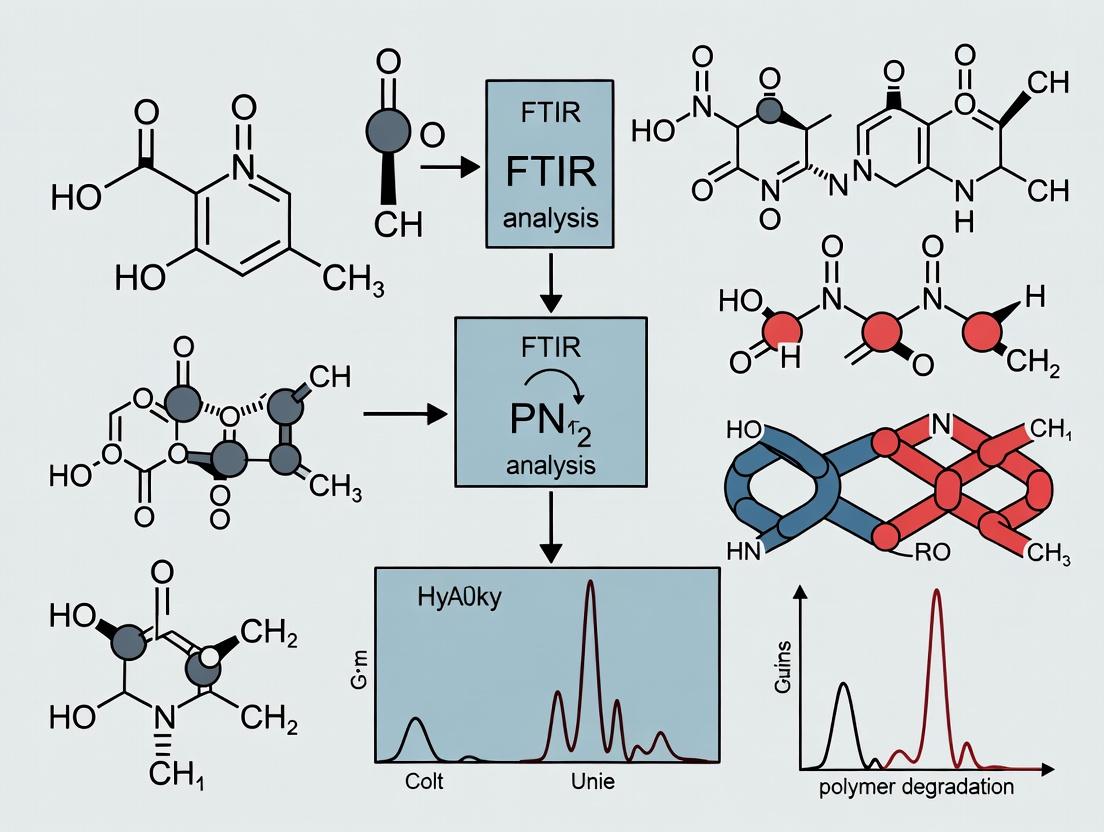
This article provides a comprehensive guide to Fourier Transform Infrared (FTIR) spectroscopy for analyzing polymer degradation processes critical to biomedical and pharmaceutical applications.
Decoding Polymer Degradation: A Comprehensive FTIR Spectroscopy Guide for Biomedical Researchers
Abstract
This article provides a comprehensive guide to Fourier Transform Infrared (FTIR) spectroscopy for analyzing polymer degradation processes critical to biomedical and pharmaceutical applications. We explore the fundamental chemical bonds and mechanisms detectable by FTIR, detail robust methodologies for sample preparation, data acquisition, and spectral interpretation. The guide addresses common analytical challenges, offers optimization strategies for enhanced sensitivity, and validates FTIR findings through comparative analysis with complementary techniques like DSC, GPC, and SEM. Designed for researchers and drug development professionals, this resource empowers the reliable characterization of polymer stability, essential for developing safe and effective implantable devices, drug delivery systems, and biodegradable materials.
Understanding Polymer Degradation: The FTIR Spectroscopy Primer
Core Principles of FTIR Spectroscopy for Polymer Analysis
This application note details the core principles and practical protocols for employing Fourier Transform Infrared (FTIR) spectroscopy in the analysis of polymers, specifically within a research thesis investigating polymer degradation mechanisms. FTIR is an indispensable tool for identifying functional groups, monitoring chemical changes, and quantifying degradation products in polymeric systems, providing critical insights for material scientists and drug development professionals working with polymer-based formulations and devices.
Core Principles
FTIR spectroscopy operates on the principle of measuring the absorption of infrared light by a sample. When IR radiation matches the vibrational frequency of a specific chemical bond, it is absorbed, causing a transition in vibrational energy states. The Fourier Transform converts the interferogram (raw data) into a spectrum of intensity vs. wavenumber (cm⁻¹).
Key Principles for Polymer Analysis:
- Molecular Fingerprinting: Polymers produce characteristic absorption bands corresponding to functional groups (e.g., C=O stretch at ~1700-1750 cm⁻¹, C-H stretch at ~2800-3000 cm⁻¹).
- Beer-Lambert Law: Allows for semi-quantitative analysis of specific functional group concentrations, enabling tracking of degradation-induced changes.
- Sampling Modes: Different modes (Transmission, Attenuated Total Reflectance - ATR, Reflection) accommodate diverse polymer forms (films, powders, surfaces).
- Spectral Manipulation: Techniques like baseline correction, normalization, and difference spectroscopy are crucial for highlighting subtle spectral changes indicative of degradation.
Key Application Notes for Degradation Studies
Monitoring Oxidative Degradation
Oxidation introduces new functional groups (e.g., carbonyl, hydroxyl). FTIR tracks the growth of the carbonyl index.
Table 1: Key IR Bands for Monitoring Polymer Degradation
| Polymer Type | Degradation Process | Key Formation Band (cm⁻¹) | Key Disappearance Band (cm⁻¹) | Quantitative Index |
|---|---|---|---|---|
| Polyethylene (PE) | Oxidation | Carbonyl (C=O): 1710-1740 | - | Carbonyl Index: A₍₁₇₁₀₎ / A₍₁₄₆₀₎ |
| Polypropylene (PP) | Oxidation | Carbonyl (C=O): 1710-1750 | - | Carbonyl Index: A₍₁₇₁₅₎ / A₍₂₇₂₀₎ |
| Polyesters (e.g., PLA) | Hydrolysis | -OH: 3200-3600 (broad) | Ester C-O: ~1180, ~1090 | Hydroxyl Index: A₍₃₄₈₀₎ / A₍₂₉₄₀₎ |
| Polyamides (Nylon) | Hydrolysis / Oxidation | -COOH: 1710, -NH₂: ~3300, 1550 | Amide I: ~1640 | Amide I/II Ratio: A₍₁₆₄₀₎ / A₍₁₅₅₀₎ |
| PVC | Dehydrochlorination | C=C: 1600-1650 | C-Cl: ~600-700 | C=C Formation Index: A₍₁₆₀₀₎ / A₍₁₄₂₀₎ |
Quantifying Degradation Products
Difference spectroscopy (subtracting the spectrum of the pristine polymer from the degraded sample) isolates signals from newly formed species. Calibration curves using model compounds enable quantitative analysis of specific degradation products.
Experimental Protocols
Protocol 3.1: ATR-FTIR Analysis of Surface Oxidation in Polyethylene Films
Objective: To quantify surface oxidation via Carbonyl Index. Materials: See "Scientist's Toolkit" below. Methodology:
- Background Collection: Clean the ATR crystal (diamond/ZnSe) with isopropanol. Collect a background spectrum with 32 scans at 4 cm⁻¹ resolution.
- Sample Mounting: Place the PE film firmly onto the ATR crystal. Ensure uniform and reproducible contact pressure using the instrument's pressure arm.
- Spectral Acquisition: Acquire the sample spectrum from 4000 to 600 cm⁻¹ with 32 scans at 4 cm⁻¹ resolution.
- Data Processing:
- Apply automatic baseline correction.
- Normalize spectra to a stable internal reference band (e.g., the CH₂ bending band at ~1460 cm⁻¹).
- Measure the peak height or area of the carbonyl band (1710-1740 cm⁻¹).
- Calculate Carbonyl Index: CI = (Acarbonyl) / (Areference)
- Analysis: Compare CI values across samples subjected to different degradation conditions (e.g., UV exposure time, heat aging duration).
Protocol 3.2: Transmission FTIR for Bulk Hydrolysis in Polylactic Acid (PLA)
Objective: To monitor bulk ester bond cleavage due to hydrolysis. Methodology:
- Film Preparation: Dissolve PLA in a suitable solvent (e.g., chloroform). Cast a thin film (~10-100 µm) onto a polished KBr window and allow solvent to evaporate completely.
- Background Collection: Place a clean KBr window in the holder and collect a background spectrum.
- Spectral Acquisition: Place the PLA-coated KBr window in the holder. Acquire spectrum (32 scans, 4 cm⁻¹).
- Data Processing:
- Perform baseline correction.
- Normalize spectra to the C-H stretching band (~2940 cm⁻¹).
- Monitor the broadening and intensification of the O-H stretch (~3500 cm⁻¹) and changes in the ester C-O stretch bands (~1180, ~1090 cm⁻¹).
- Calculate Hydroxyl Index as in Table 1.
Diagrams
Diagram 1: FTIR Workflow for Polymer Degradation Analysis (100 chars)
Diagram 2: Degradation Pathways & FTIR Spectral Response (97 chars)
The Scientist's Toolkit: Key Research Reagent Solutions & Materials
Table 2: Essential Materials for FTIR Polymer Analysis
| Item | Function/Benefit | Application Note |
|---|---|---|
| Diamond/ZnSe ATR Crystal | Provides robust, chemically inert surface for direct solid/liquid sample analysis. | Ideal for surface-specific degradation studies on films and molded parts. |
| Potassium Bromide (KBr) | IR-transparent matrix for preparing pellets for transmission analysis of powders. | For bulk analysis of ground polymer samples or degradation precipitates. |
| Infrared-Grade Solvents (e.g., Chloroform, Tetrahydrofuran) | High purity solvents for cleaning crystals and preparing polymer casting solutions. | Minimize spectral contamination from solvent residues. |
| Calibration Film Standards (e.g., Polystyrene) | Provides known spectral peaks for verifying instrument wavelength accuracy and resolution. | Mandatory for instrument qualification and method validation. |
| Microtome | Cuts thin, uniform sections (5-20 µm) from bulk polymer samples for transmission analysis. | Enables depth-profiling of degradation gradients in thick samples. |
| Hydraulic Pellet Press | Used with KBr to create uniform, transparent pellets for powder transmission analysis. | Ensures reproducible pathlength for quantitative work. |
| Background Reference Material (e.g., Clean KBr Window) | Provides the reference "blank" spectrum for rationing against the sample. | Must be scrupulously clean and dry. |
| High-Purity Nitrogen Gas Purge System | Removes atmospheric CO₂ and water vapor from the optical path. | Critical for obtaining stable baselines in quantitative analysis. |
Within the broader thesis on FTIR analysis of polymer degradation processes, understanding the primary chemical pathways of material breakdown is paramount. This application note details the core mechanisms of hydrolysis, oxidation, and photodegradation, providing protocols for their accelerated study and characterization using Fourier Transform Infrared (FTIR) spectroscopy. These protocols are designed for researchers and drug development professionals to predict and mitigate stability issues in polymeric materials, from packaging to drug delivery systems.
Hydrolysis
Hydrolysis is the scission of susceptible chemical bonds (e.g., esters, amides, acetals) by reaction with water. It is a critical degradation pathway for biodegradable polymers (PLA, PGA, PLGA) and can affect the shelf-life of hygroscopic pharmaceutical formulations.
Experimental Protocol: Accelerated Hydrolytic Degradation
Objective: To monitor ester bond cleavage in poly(lactic-co-glycolic acid) (PLGA) under controlled humid conditions. Materials:
- PLGA film (50:50 LA:GA, Mw ~50,000 Da)
- Phosphate Buffer Saline (PBS), pH 7.4
- Controlled humidity chambers (30%, 60%, 90% RH)
- Oven with temperature control
- Desiccator
- Analytical balance (±0.01 mg)
Procedure:
- Pre-weigh (W₀) and record initial thickness of PLGA films (n=5 per condition).
- Place samples in chambers with controlled relative humidity (30%, 60%, 90%) at 40°C and 60°C.
- At predetermined intervals (0, 1, 2, 4, 8 weeks), remove samples, blot dry, and weigh (Wₜ).
- Perform FTIR analysis (see Section 4).
- Calculate mass loss percentage: % Mass Loss = [(W₀ - Wₜ) / W₀] * 100.
- Monitor pH of aging PBS if submerged.
Key FTIR Indicators:
- Ester Carbonyl (C=O) Stretch: Shift from ~1750 cm⁻¹ to lower wavenumber (carboxylic acid at ~1710 cm⁻¹) and broadening of peak.
- Hydroxyl (O-H) Stretch: Increased broad band ~3200-3600 cm⁻¹.
Oxidation
Oxidative degradation involves reaction with molecular oxygen or reactive oxygen species (ROS), leading to chain scission, crosslinking, and formation of carbonyl and hydroxyl groups. It is dominant in polyolefins (PP, PE) and rubber.
Experimental Protocol: Thermal-Oxidative Aging
Objective: To assess carbonyl index development in polypropylene (PP) films. Materials:
- Isotactic PP film (100 µm thick)
- Forced-air circulation oven
- Standard oxidant solution (e.g., CoCl₂/H₂O₂ for chemo-oxidation studies)
Procedure:
- Cut PP films into standardized strips (e.g., 20 mm x 10 mm).
- Place samples in a forced-air oven at temperatures ranging from 80°C to 120°C. Use inert atmosphere (N₂) controls.
- Remove samples at intervals (0, 24, 48, 96, 200 hrs).
- Acquire FTIR spectra immediately.
- Calculate the Carbonyl Index (CI) using the baseline method:
- CI = (AC=O / AReference)
- Where AC=O is the integrated area of the carbonyl region (1710-1740 cm⁻¹) and AReference is the area of a stable reference peak (e.g., the CH2 bending band at ~1450 cm⁻¹).
Key FTIR Indicators:
- Carbonyl Formation: Appearance of peaks at 1710-1740 cm⁻¹ (ketones/aldehydes), 1770-1780 cm⁻¹ (γ-lactones).
- Hydroperoxide Formation: Broad band ~3400 cm⁻¹ (O-OH).
Photodegradation
Photodegradation is initiated by absorption of UV radiation (290-400 nm), leading to free radical formation and subsequent oxidation (photo-oxidation). Critical for polymers used outdoors (e.g., PVC, coatings).
Experimental Protocol: UV Exposure & Weatherability
Objective: To evaluate photo-oxidative changes in poly(vinyl chloride) (PVC) using QUV weatherometer. Materials:
- Plasticized PVC film
- QUV weatherometer with UVA-340 lamps
- Irradiance calibration system
Procedure:
- Mount PVC samples in QUV sample holders.
- Expose to cyclic conditions: 8 hours of UV light at 60°C, 4 hours of condensation (dark) at 50°C.
- Remove samples at set intervals (0, 250, 500, 1000 hrs).
- Perform FTIR analysis and visual inspection for yellowing.
- Track the Hydroxyl Index (HI) and Carbonyl Index (CI).
Key FTIR Indicators:
- Polyene Formation (for PVC): Conjugated double bonds evidenced by peaks in 1600-1650 cm⁻¹ region.
- Carbonyl Growth: As in thermal oxidation.
Core FTIR Analysis Protocol
This unified protocol supports the analysis of samples from all degradation studies. Instrument: FTIR Spectrometer with ATR accessory (Diamond crystal). Parameters:
- Resolution: 4 cm⁻¹
- Scans: 32 per spectrum
- Spectral Range: 4000-600 cm⁻¹
- Background Scan: Before each sample set or every 30 minutes. Data Processing:
- Apply ATR correction (if required by software).
- Perform baseline correction (linear or polynomial).
- Normalize spectra to a stable internal band (e.g., CH stretch at ~2900 cm⁻¹).
- Perform peak integration or second derivative analysis for overlapping bands.
Table 1: Characteristic FTIR Bands for Degradation Products
| Degradation Type | Bond/Group | FTIR Wavenumber (cm⁻¹) | Band Assignment |
|---|---|---|---|
| Hydrolysis | Ester C=O | ~1750 | Unaffected carbonyl |
| Acid C=O | ~1710 | Carboxylic acid | |
| Free O-H | 3200-3600 (broad) | Hydroxyl stretch | |
| Oxidation | Aliphatic Ketone | ~1715 | Secondary oxidation |
| Aldehyde | ~1725-1730 | Chain-end oxidation | |
| γ-Lactone | ~1775 | Intramolecular ester | |
| Hydroperoxide | ~3400 (broad) | O-OH stretch | |
| Photodegradation | Polyenes (PVC) | 1600-1650 | C=C conjugated |
| Carbonyls | 1710-1780 | As in oxidation |
Table 2: Typical Carbonyl Index (CI) Development in PP at 120°C
| Exposure Time (hrs) | CI (±0.05) | Physical Observation |
|---|---|---|
| 0 | 0.02 | Clear, flexible |
| 24 | 0.15 | Slight yellowing |
| 48 | 0.42 | Noticeable yellowing |
| 96 | 1.20 | Brittle |
| 200 | 3.50 | Highly brittle, fragmented |
The Scientist's Toolkit: Research Reagent Solutions
Table 3: Essential Materials for Polymer Degradation Studies
| Item | Function & Relevance |
|---|---|
| ATR-FTIR Spectrometer | Primary tool for non-destructive, surface-sensitive chemical analysis of degradation products. |
| QUV Weatherometer | Simulates sunlight, rain, and dew for accelerated photodegradation studies (ASTM G154). |
| Controlled Humidity Chambers | Enables precise study of hydrolytic degradation kinetics at different RH levels. |
| Phosphate Buffer Saline (PBS), pH 7.4 | Simulates physiological conditions for hydrolysis of biomedical polymers. |
| DSC/TGA Instrumentation | Complementary techniques to monitor changes in thermal properties (Tm, Tg) and mass loss. |
| UVA-340 Lamps | Emit UV spectrum from 295-365 nm, closely matching solar cut-off. |
| Standard Oxidant Solutions (e.g., CoCl₂/H₂O₂) | Used in chemo-oxidation protocols to generate hydroxyl radicals for controlled oxidation studies. |
| Humidity/Temperature Data Loggers | For verifying and recording environmental conditions within aging chambers. |
Visualization: Degradation Pathways & Analysis Workflow
Diagram Title: Polymer Degradation Pathways & FTIR Analysis Flow
Diagram Title: Photo-Oxidation Radical Chain Mechanism
Characteristic FTIR Spectral Signatures of Common Biomedical Polymers (PLA, PLGA, PCL, Polyurethanes)
This application note is framed within a broader thesis investigating polymer degradation kinetics and mechanisms using Fourier-Transform Infrared (FTIR) spectroscopy. The precise identification of characteristic absorption bands for common biodegradable and biocompatible polymers is foundational for monitoring hydrolytic, enzymatic, and oxidative degradation processes. Establishing a robust spectral library enables researchers to detect chemical bond cleavage, formation of degradation products (e.g., carboxylic acids), and changes in crystallinity, which are critical for applications in controlled drug delivery and tissue engineering.
Characteristic FTIR Bands of Biomedical Polymers
The following table summarizes the key FTIR absorption bands for the polymers of interest, which serve as primary indicators for material identification and initial degradation assessment.
Table 1: Characteristic FTIR Absorption Bands of Common Biomedical Polymers
| Polymer | Full Name | Key FTIR Absorptions (cm⁻¹) & Assignments |
|---|---|---|
| PLA | Poly(lactic acid) | ~1750 (C=O stretching), ~1185 & ~1130 (C-O-C stretching), ~1090 (C-O stretching), ~1455 (CH₃ bending), ~1380 & ~1365 (CH₃ symmetric bending - doublet for crystalline PLA). |
| PLGA | Poly(lactic-co-glycolic acid) | ~1750 (C=O stretching, ester), ~1185-1210 (C-O-C stretching, broad), ~1130 & ~1090 (C-O stretching), ~1455 (CH₃ bending from LA), ~1425 (CH₂ bending from GA). Glycolide unit ratio affects band intensity ratios. |
| PCL | Poly(ε-caprolactone) | ~1725 (C=O stretching), ~1295 (C-O & C-C stretching), ~1240 (asymmetric C-O-C stretching), ~1190 (symmetric C-O-C stretching), ~1170 (O-C-C stretching). Strong bands at ~2945 & ~2865 (asymmetric/symmetric CH₂ stretching). |
| Polyurethane | Polyurethane (ester/ether based) | ~1700-1730 (C=O stretching, urethane/ester), ~1640 (C=O, urea if present), ~1530-1560 (N-H bending + C-N stretching, amide II), ~1220-1250 (C-O-C stretching, ester/ether), ~1100 (C-O-C, ether). N-H stretch ~3320-3330 cm⁻¹. |
Key Experimental Protocols for FTIR Analysis of Polymer Degradation
Protocol 3.1: Sample Preparation for Transmission/ATR-FTIR
Objective: To obtain high-quality, reproducible FTIR spectra from polymer films or degraded fragments.
- Film Casting: Dissolve 50-100 mg of pure polymer in 5-10 mL of a suitable volatile solvent (e.g., chloroform for PLA, PLGA, PCL; DMF for some polyurethanes). Cast onto a clean, level glass Petri dish or release surface. Allow solvent to evaporate slowly under a fume hood, then dry under vacuum (< 1 mbar) for 24 hours to remove residual solvent.
- Degraded Sample Handling: For in vitro degradation studies, retrieve samples at predetermined time points (e.g., 1, 4, 12 weeks). Rinse gently with deionized water and dry to constant weight under vacuum. Gently grind brittle, degraded samples into a fine powder using an agate mortar and pestle.
- ATR Measurement: Place the cast film or a compacted pile of powder directly onto the crystal (diamond or ZnSe) of the ATR accessory. Apply uniform, firm pressure using the instrument's anvil to ensure good contact. For transmission mode, disperse ~1% w/w of powdered polymer in dry KBr and press into a clear pellet.
Protocol 3.2: FTIR Spectral Acquisition and Pre-processing for Degradation Tracking
Objective: To acquire and process spectra for reliable comparative and quantitative analysis.
- Instrument Setup: Purge the FTIR spectrometer with dry air or N₂ for at least 15 minutes. Set resolution to 4 cm⁻¹, accumulate 32-64 scans per spectrum. Define a spectral range of 4000-650 cm⁻¹.
- Background & Sample Scan: Collect a fresh background spectrum (clean ATR crystal or empty beam for transmission). Collect sample spectrum.
- Spectral Processing: Apply atmospheric suppression (CO₂, H₂O vapor) if needed. Perform baseline correction (e.g., concave rubberband method, points: ~1800, ~800 cm⁻¹). Apply vector normalization (e.g., min-max or area normalization) to the region of interest (e.g., 1800-800 cm⁻¹) to compare band intensities across samples. Use second-derivative spectroscopy (Savitzky-Golay, 9-13 points) to resolve overlapping bands, crucial for analyzing polyurethane hard/soft segments or PLGA copolymer composition.
Protocol 3.3: Monitoring Hydrolytic Degradation via Carbonyl Index (CI) and Ester Bond Ratio
Objective: To quantify the evolution of degradation through changes in key functional groups.
- Define Metrics: For polyesters (PLA, PLGA, PCL), calculate the Carbonyl Index (CI) as the ratio of the area (or height) of the C=O stretching band (~1750-1725 cm⁻¹) to that of a reference band, typically the C-H stretching band (~2950-2850 cm⁻¹), which is assumed to remain relatively constant.
- Define Metrics for Ester Bond Loss: Alternatively, track the ratio of the ester C-O-C stretching band area (~1185-1170 cm⁻¹) to the same C-H reference band.
- Measurement: After baseline correction and normalization, integrate the areas under the relevant peaks. Plot the CI or ester bond ratio against degradation time. An initial increase in CI may indicate an increase in terminal carboxyl groups, followed by a decrease as oligomers and monomers leach out.
Visualization of Key Concepts
Diagram 1: FTIR Degradation Analysis Workflow for Biomedical Polymers
Diagram 2: Key FTIR Bands for Degradation Tracking in Polyesters
The Scientist's Toolkit: Research Reagent Solutions
Table 2: Essential Materials for FTIR Analysis of Polymer Degradation
| Item | Function & Rationale |
|---|---|
| FTIR Spectrometer with ATR | Must have a diamond or ZnSe ATR accessory for direct, non-destructive analysis of films and solids. Purge system is critical for removing atmospheric water/CO₂ interference. |
| High-Purity Solvents | Chloroform, Dichloromethane, DMF, Hexafluoroisopropanol. For dissolving polymers for film casting. Must be spectroscopic grade to avoid impurity bands. |
| Potassium Bromide (KBr) | Optical grade, dried (>120°C). For preparing transmission pellets of powdered degraded samples to obtain high-quality spectra free from scattering artifacts. |
| Vacuum Desiccator | For thorough drying of cast films and degraded samples to eliminate plasticizing and spectral interference from absorbed water. Use P₂O₅ as a desiccant. |
| Agate Mortar & Pestle | For grinding brittle, degraded polymer samples into a fine, homogeneous powder suitable for ATR or KBr pellet preparation without contaminating the sample. |
| Spectroscopic Software | Software capable of advanced processing: baseline correction, derivative spectroscopy, peak deconvolution, and automated peak area integration for quantitative analysis (e.g., OPUS, Spectrum, Omnic). |
Within the context of research on polymer degradation processes, Fourier-Transform Infrared (FTIR) spectroscopy is an indispensable analytical tool. It enables the direct, non-destructive identification of functional group changes that serve as molecular fingerprints for degradation mechanisms such as oxidation, hydrolysis, and chain scission. Monitoring the evolution of carbonyls (C=O), hydroxyls (O-H), and ethers (C-O-C) provides quantitative and qualitative insights into the extent and pathways of degradation, critical for predicting material lifetime, understanding drug delivery system stability, and designing more robust polymeric materials.
Application Notes: Spectral Signatures and Quantitative Metrics
The following table summarizes the characteristic FTIR absorption bands for the key functional groups under investigation, alongside their relevance in polymer degradation.
Table 1: Characteristic FTIR Bands and Their Degradation Significance
| Functional Group | Typical Wavenumber Range (cm⁻¹) | Band Characteristics | Significance in Polymer Degradation |
|---|---|---|---|
| Carbonyl (C=O) | 1650 - 1850 | Strong, sharp band. Exact position varies: Esters (~1735), Acids (~1710), Aldehydes (~1725). | Primary indicator of oxidation (e.g., polyolefins). Increase in absorbance correlates with the formation of ketones, acids, and esters. |
| Hydroxyl (O-H) | 3200 - 3600 | Broad band for alcohols & carboxylic acids; sharper for free OH. | Increase indicates hydrolysis (e.g., polyesters) or oxidative formation of alcohols/acids. Hydrogen bonding broadens the band. |
| Ether (C-O-C) | 1000 - 1300 | Strong, often broad or multiple bands (asymmetric stretch). | Decrease may indicate chain scission in polymers like polyethers (e.g., PEO, PPO). Appearance may signal crosslinking or new bond formation. |
Quantitative analysis relies on tracking changes in the area or height of these bands over time or under different stress conditions. The Carbonyl Index (CI) and Hydroxyl Index (HI) are commonly used metrics:
- Carbonyl Index (CI) = ( A{C=O} / A{ref} )
- Hydroxyl Index (HI) = ( A{O-H} / A{ref} )
Where ( A ) is the integrated area or peak height of the characteristic band, and ( A_{ref} ) is the area/height of a stable, unchanging reference band (e.g., C-H stretch at ~2900 cm⁻¹, or a polymer-specific skeletal vibration).
Table 2: Example Quantitative Data from a Simulated Polypropylene Photo-Oxidation Study
| Exposure Time (hours) | Carbonyl Index (CI) | Hydroxyl Index (HI) | C-O-C Band Area (Relative %) |
|---|---|---|---|
| 0 | 0.05 ± 0.01 | 0.10 ± 0.02 | 100 |
| 100 | 0.45 ± 0.05 | 0.25 ± 0.03 | 98 |
| 300 | 1.80 ± 0.10 | 0.60 ± 0.05 | 92 |
| 500 | 3.20 ± 0.15 | 1.10 ± 0.08 | 85 |
Experimental Protocols
Protocol 1: FTIR Monitoring of Thermal Oxidative Degradation
Objective: To quantify the formation of carbonyl and hydroxyl groups in a polymer film subjected to controlled thermal aging.
Materials: See "The Scientist's Toolkit" below. Procedure:
- Sample Preparation: Prepare uniform polymer films (~50-100 µm thickness) by hot pressing or solution casting onto polished KBr windows or suitable IR-transparent substrates.
- Baseline FTIR: Acquire a high-resolution FTIR spectrum (4 cm⁻¹ resolution, 32 scans) of the unaged film. Identify a stable internal reference band.
- Aging: Place samples in a forced-air oven pre-heated to the target temperature (e.g., 80°C ± 1°C). Use an inert atmosphere oven (N₂) for control experiments.
- Periodic Sampling: At predetermined intervals (e.g., 24, 48, 96, 200 hours), remove samples from the oven, allow them to cool in a desiccator for 30 minutes, and acquire FTIR spectra.
- Data Analysis: For each spectrum, perform baseline correction. Integrate the area of the carbonyl region (1710-1780 cm⁻¹, polymer-dependent) and hydroxyl region (3200-3600 cm⁻¹). Calculate CI and HI relative to the chosen reference band. Plot indices vs. aging time.
Protocol 2: Hydrolytic Degradation Tracking via Hydroxyl/Carbonyl Ratio
Objective: To monitor the hydrolysis of ester linkages in biodegradable polyesters (e.g., PLGA, PCL).
Materials: See "The Scientist's Toolkit" below. Procedure:
- Sample Preparation: Prepare thin polymer films as in Protocol 1.
- Initial Characterization: Acquire FTIR spectrum. Note the initial strong ester carbonyl band at ~1750 cm⁻¹ and minimal hydroxyl band.
- Hydrolytic Immersion: Immerse samples in phosphate-buffered saline (PBS, pH 7.4, 37°C) in sealed vials. Maintain samples in an incubator/shaker bath.
- Sampling: At set intervals, remove samples, rinse gently with deionized water, and dry under vacuum for 24 hours to remove absorbed water.
- FTIR Analysis: Acquire spectra of dried samples. Monitor the decrease in the ester carbonyl area and the concurrent increase in the hydroxyl band (and potentially a carboxylic acid carbonyl band at ~1710 cm⁻¹). The ratio of the hydroxyl band area to the remaining ester carbonyl band area can serve as a hydrolysis progression metric.
Visualization: Experimental and Analytical Workflows
FTIR Workflow for Degradation Monitoring (97 chars)
Degradation Pathways to FTIR Readout (74 chars)
The Scientist's Toolkit
Table 3: Essential Research Reagents and Materials
| Item | Function in Experiment |
|---|---|
| FTIR Spectrometer | Core instrument for acquiring infrared spectra. Equipped with DTGS or MCT detector for polymer analysis. |
| Transmission Cell (KBr Windows) | For holding solid polymer films in the transmission mode, the most common quantitative method. |
| ATR Accessory (Diamond or ZnSe Crystal) | For rapid surface analysis of thick or irregular samples with minimal preparation. |
| Controlled Environment Oven | For precise thermal aging studies with optional gas inlet for oxidative/inert atmospheres. |
| UV Accelerated Weathering Chamber | For studying photo-oxidative degradation with controlled irradiance, temperature, and humidity. |
| Hydraulic Hot Press | For preparing uniform, thin polymer films from pellets or powders. |
| Microbalance (0.01 mg sensitivity) | For precise weighing of polymer and any additives before film preparation. |
| Desiccator | For storing hygroscopic samples (e.g., KBr pellets, degraded polymers) to prevent interference from ambient moisture. |
| Spectral Analysis Software | For baseline correction, peak integration, smoothing, and calculation of indices (e.g., OMNI, OPUS, GRAMS). |
This document provides foundational application notes and protocols for the Fourier Transform Infrared (FTIR) spectroscopic analysis of pristine polymer materials. Within the broader thesis on monitoring polymer degradation processes, establishing a comprehensive spectral library of unaged materials is the critical first step. These baselines enable the precise identification of degradation-induced changes, such as oxidation, chain scission, cross-linking, and additive depletion, which are vital for research in material stability, pharmaceutical packaging, and drug delivery system integrity.
Key Considerations for Pristine Material Analysis
Analyzing pristine materials requires meticulous sample handling and preparation to avoid introducing spectral artifacts that could be misconstrued as degradation signals later. Key factors include:
- Material History: Document polymer grade, manufacturer, lot number, and processing conditions (e.g., injection molding temperature, annealing).
- Storage: Store samples in a controlled environment (e.g., -20°C, desiccated, under nitrogen) to prevent pre-analysis aging.
- Surface Contamination: Clean samples appropriately using solvents compatible with the polymer (e.g., HPLC-grade methanol, isopropanol) to remove mold release agents, fingerprints, or dust.
Experimental Protocols
Protocol A: Attenuated Total Reflectance (ATR)-FTIR of Solid Polymer Films/Pellets
Objective: To obtain a surface-specific FTIR spectrum of a pristine polymer sample with minimal preparation. Materials: Pristine polymer sample, lint-free wipes, compatible solvent (e.g., isopropanol), ATR crystal cleaner. Instrument: FTIR spectrometer equipped with a single-reflection diamond ATR accessory. Procedure:
- Clean the ATR crystal according to manufacturer instructions. Acquire a background spectrum of clean air.
- Clean the polymer sample surface with a solvent-dampened lint-free wipe. Allow to dry completely.
- Place the sample on the ATR crystal. Ensure the sampling area is flat and in full contact with the crystal.
- Apply consistent pressure using the instrument's pressure clamp.
- Acquire spectrum with the following typical parameters:
- Spectral Range: 4000 - 600 cm⁻¹
- Resolution: 4 cm⁻¹
- Number of Scans: 32 (background and sample)
- Apodization: Happ-Genzel
- Save the spectrum in a non-proprietary format (e.g., .spc, .csv).
Protocol B: Transmission FTIR of Solution-Cast Thin Films
Objective: To obtain a bulk-sensitive, quantitative FTIR spectrum suitable for spectral subtraction and band intensity analysis. Materials: Pristine polymer, analytical balance, suitable solvent (e.g., tetrahydrofuran for PS, chloroform for PVC), infrared-transparent windows (e.g., NaCl, KBr), syringe. Instrument: FTIR spectrometer with transmission holder. Procedure:
- Prepare a 1-2% (w/v) solution of the polymer in a suitable solvent.
- Using a syringe, deposit a known volume (e.g., 50 µL) of the solution onto a clean IR window.
- Allow the solvent to evaporate slowly under a fume hood, optionally using a cover to prevent dust contamination, to form a uniform thin film (~10-50 µm).
- Place the dried film in the transmission holder. Acquire a background spectrum with a clean, empty window in the holder.
- Acquire the sample spectrum with parameters as in Protocol A, but adjust the number of scans if necessary to achieve a good signal-to-noise ratio without saturation.
- Record the film thickness using a micrometer for quantitative work.
Protocol C: Data Processing and Documentation for Baseline Entry
Objective: To process raw spectral data into a standardized baseline entry for the spectral library. Software: FTIR instrument software or third-party data analysis package (e.g., OPUS, Spectragryph, Origin). Procedure:
- Atmospheric Correction: Apply a function to remove contributions from atmospheric CO₂ (~2350 cm⁻¹) and water vapor.
- Baseline Correction: Apply a concave rubber-band correction or linear baseline to ensure the baseline is flat between key points (e.g., 4000 cm⁻¹ and 600 cm⁻¹).
- Normalization: Normalize the spectrum to the intensity of a key, stable internal band (e.g., the C-H stretch at ~2920 cm⁻¹) to facilitate future comparison.
- Peak Picking: Identify and record the wavenumber and relative intensity of all major absorption bands.
- Documentation: Create a metadata file for each spectrum containing: Sample ID, polymer type, acquisition date, protocol used (A/B), instrument parameters, processing steps, and analyst initials.
Data Presentation: Characteristic IR Bands of Common Pristine Polymers
Table 1: Characteristic FTIR Absorption Bands for Common Pharmaceutical Packaging and Biomaterial Polymers.
| Polymer (Abbrev.) | Key Functional Group | Wavenumber Range (cm⁻¹) | Band Assignment & Notes |
|---|---|---|---|
| Polyethylene (PE) | -CH₂- Stretch (asym) | 2920-2910 | Primary baseline band, intensity tracks crystallinity. |
| -CH₂- Stretch (sym) | 2850-2845 | Primary baseline band. | |
| -CH₂- Bend | 1470-1460 | Sensitivity to chain packing. | |
| -CH₂- Rock | 730-720 | Distinguishes HDPE (720 cm⁻¹) from LDPE (730, 720 cm⁻¹ doublet). | |
| Polypropylene (PP) | -CH₃ Stretch | ~2960, 2875 | Distinguishes from PE. |
| -CH₃ Bend | ~1375 | "Methyl umbrella" band. | |
| -CH₂- Bend | ~1455 | Overlaps with other bands. | |
| Backbone vibrations | 1165, 995, 970 | Characteristic of isotactic PP; useful for tacticity assessment. | |
| Polystyrene (PS) | Aromatic C-H Stretch | 3100-3000 | Characteristic of phenyl ring. |
| C=C Aromatic Ring Stretch | 1600, 1490, 1450 | Key identifier bands. | |
| Mono-substituted Benzene | 760, 700 | Strong bands confirming phenyl substitution. | |
| Polyethylene Terephthalate (PET) | C=O Stretch | ~1715 | Ester carbonyl; sensitive to degradation (hydrolysis). |
| Aromatic C=C Stretch | ~1575, 1505, 1410 | From terephthalate moiety. | |
| C-O Stretch | 1260-1240, 1100-1090 | Ester linkage bands. | |
| Polyvinyl Chloride (PVC) | C-H Stretch | 2970-2950 | Aliphatic backbone. |
| C-H Bend | ~1425, ~1330 | - | |
| C-Cl Stretch | 700-600 | Strong, broad band; primary identifier. |
The Scientist's Toolkit
Table 2: Essential Research Reagent Solutions & Materials for FTIR Analysis of Pristine Polymers.
| Item | Function/Explanation |
|---|---|
| HPLC-Grade Solvents (e.g., Isopropanol, Methanol, Chloroform) | For cleaning sample surfaces and ATR crystals without leaving residue that contaminates spectra. |
| Compressed Dry Air or Nitrogen Gas | To purge the spectrometer optics, minimizing interference from atmospheric water vapor and CO₂. |
| Infrared-Transparent Windows (NaCl, KBr, ZnSe) | Substrates for preparing transmission samples. Choice depends on spectral range and solubility (NaCl avoids water). |
| Polymer Reference Standards | Certified pristine materials from NIST or other suppliers for instrument calibration and method validation. |
| ATR Crystal Cleaning Kit | Specific abrasive pads and solvents recommended by the manufacturer to maintain crystal clarity and performance. |
| Lint-Free Wipes & Powder-Free Gloves | To handle samples and optics without introducing fibers or contaminants that can create spectral artifacts. |
| Microtome or Precision Cutter | To prepare thin, uniform cross-sections of bulk polymer materials for transmission analysis. |
| Digital Micrometer | To measure the precise thickness of polymer films for quantitative transmission FTIR analysis. |
Visualization
Diagram Title: Workflow for Establishing FTIR Baselines of Pristine Polymers
Diagram Title: Logic Linking Baseline Spectra to Degradation Analysis
Step-by-Step FTIR Protocols for Degradation Kinetics and Mechanism Studies
Application Notes
In the context of FTIR analysis for polymer degradation research, sample preparation is a critical step that directly influences spectral quality, reproducibility, and the ability to detect subtle chemical changes. The choice of technique depends on the polymer's physical state, the degradation mechanism under study (e.g., photo-oxidation, thermal, hydrolytic), and the required sensitivity. Films are ideal for monitoring bulk property changes and surface-specific degradation layers. KBr pellets provide a robust method for analyzing small quantities of degraded material, especially powders or fragments, ensuring high signal-to-noise ratios for trace functional group identification. Attenuated Total Reflectance (ATR) accessories have revolutionized the field by enabling rapid, non-destructive analysis of surfaces, which is paramount for studying heterogeneous degradation, mapping oxidation gradients, or analyzing samples that are insoluble or difficult to handle. Each method presents distinct advantages and limitations for quantifying carbonyl index, hydroxyl group formation, or chain scission events.
Protocols
Protocol 1: Preparation of Thin Polymer Films for Transmission FTIR
Purpose: To create uniform, thin films for bulk transmission FTIR analysis to track degradation-induced changes in bulk polymer chemistry. Materials: Polymer granules/powder, hydraulic hot press, Teflon sheets, stainless steel spacer (100-200 µm), laboratory scissors, FTIR sample holder. Procedure:
- Clean the Teflon sheets and metal spacer with isopropanol.
- Place a Teflon sheet on the bottom plate of the hot press.
- Weigh approximately 0.2-0.5 g of polymer and distribute evenly within the area defined by the spacer.
- Cover with the second Teflon sheet.
- Preheat the press to 10-20°C above the polymer's melting point (Tm) or glass transition temperature (Tg).
- Insert the assembly and apply gentle contact pressure for 1-2 minutes to allow melting.
- Increase pressure to 2-5 metric tons for 3-5 minutes.
- Cool the assembly under pressure using the press's cooling system or by transferring to a cold press.
- Remove the film, trim edges, and mount in the FTIR transmission holder.
- Adjust film thickness to achieve peak absorbance in the range of 0.5-1.0 AU for key bands (e.g., C=O stretch ~1715 cm⁻¹) to remain within the linear range of the detector.
Protocol 2: Preparation of KBr Pellets for Transmission FTIR
Purpose: To analyze small amounts of degraded polymer material (e.g., microparticles, shavings) with high sensitivity. Materials: FTIR-grade potassium bromide (KBr), agate mortar and pestle, vacuum die (13 mm), hydraulic press (10-15 tons), oven, desiccator. Procedure:
- Dry approximately 1 g of KBr in an oven at 110°C for 2-4 hours. Store in a desiccator.
- Using a microbalance, weigh 1.0-1.5 mg of finely ground degraded polymer sample.
- Combine with 150 mg of dried KBr in the agate mortar.
- Grind the mixture vigorously for 2-3 minutes to achieve a fine, homogeneous powder. Perform this step in a low-humidity environment if possible.
- Transfer the mixture into the barrel of a clean 13 mm evacuable die.
- Apply a vacuum for 1-2 minutes to remove air and moisture.
- While under vacuum, apply a pressure of 8-10 metric tons for 2-3 minutes.
- Release pressure and vacuum, and carefully remove the clear pellet.
- Immediately place the pellet in the FTIR sample holder and acquire spectra. Analyze promptly to minimize moisture uptake.
Protocol 3: Analysis of Degraded Polymer Surfaces using ATR-FTIR
Purpose: To perform rapid, non-destructive surface analysis of polymers to assess spatial gradients of degradation products. Materials: FTIR spectrometer with ATR accessory (diamond, ZnSe, or Ge crystal), degraded polymer sample, force gauge/torque stand, lint-free wipes, isopropanol. Procedure:
- Clean the ATR crystal with a lint-free wipe moistened with isopropanol. Allow to dry.
- Perform a background scan with no sample in contact with the crystal, using the same spectrometer settings.
- Place the degraded polymer surface of interest directly onto the ATR crystal.
- Using the pressure clamp or torque stand, apply consistent, firm pressure to ensure optimal optical contact. A typical contact force for a diamond crystal is 100-150 N.
- Acquire the sample spectrum (typically 16-64 scans at 4 cm⁻¹ resolution).
- For mapping or gradient studies, use a motorized stage to collect spectra at defined spatial intervals (e.g., 50-100 µm steps).
- Process spectra using software to calculate degradation indices (e.g., Carbonyl Index = AC=O / Areference). The reference band is often an internal polymer band that remains stable during degradation (e.g., C-H stretch at ~2915 cm⁻¹).
Data Presentation
Table 1: Comparison of FTIR Sample Preparation Techniques for Polymer Degradation Studies
| Parameter | Thin Film (Transmission) | KBr Pellet (Transmission) | ATR-FTIR |
|---|---|---|---|
| Sample Mass Required | 100-500 mg | 1-2 mg | Variable (surface contact only) |
| Typical Thickness Analyzed | 10-200 µm (bulk) | Pellet thickness (~1 mm) | 0.5-5 µm (surface) |
| Spectral Quality | Excellent, high S/N | Excellent, high S/N | Good, can have dispersion artifacts |
| Primary Application in Degradation | Bulk chemical change, homogeneous degradation | Analysis of small/rare samples, quantitative analysis | Surface-specific oxidation, mapping, insoluble samples |
| Key Advantage | Robust quantitative method | High sensitivity for trace species | Rapid, non-destructive, minimal preparation |
| Key Limitation | Requires soluble/moldable polymer; time-consuming | Hygroscopic; moisture interference risk | Pressure-sensitive; contact variability; shallow depth of penetration |
Table 2: Example Degradation Indices Quantified via Different Preparation Methods
| Degradation Index | Formula (Absorbance Ratio) | Typical Bands (cm⁻¹) | Optimal Prep Method(s) | Relevance to Polymer Degradation |
|---|---|---|---|---|
| Carbonyl Index (CI) | A~1715 / A~2915 | C=O stretch: 1710-1725 / C-H stretch: 2910-2930 | Film, KBr Pellet, ATR | Primary indicator of oxidation (ester, acid, ketone formation) |
| Hydroxyl Index (HI) | A~3400 / A~2915 | O-H stretch: 3200-3600 / C-H stretch: 2910-2930 | Film, KBr Pellet | Indicates alcohol formation or hydrolysis. |
| Unsaturation Index | A~1640 / A~2915 | C=C stretch: 1630-1650 / C-H stretch: 2910-2930 | KBr Pellet | Track chain scission/ cross-linking in specific polymers. |
| Surface Oxidation Depth | CI gradient vs. Position | N/A | ATR Mapping | Measures heterogeneity and depth profile of degradation. |
Visualization
Title: FTIR Sample Prep Selection Workflow for Degradation
Title: Key FTIR-Detectable Steps in Polymer Oxidation
The Scientist's Toolkit
Table 3: Essential Research Reagent Solutions for FTIR Sample Preparation
| Item | Function/Description in Polymer Degradation FTIR |
|---|---|
| FTIR-grade Potassium Bromide (KBr) | Hygroscopic salt used to create transparent pellets for transmission analysis; must be dry to avoid spectral interference from water bands (~3400, 1640 cm⁻¹). |
| Hydraulic Pellet Press & Evacuable Die | Applies high, uniform pressure (8-15 tons) to KBr/sample mixture to form a clear disk, while vacuum removes air and moisture. |
| Hot Press with Heated/Cooled Platens | Used to melt-process polymer granules into thin, uniform films for bulk transmission analysis of degradation. |
| ATR Accessory (Diamond/ZnSe Crystal) | Enables surface analysis via internal reflection; diamond is durable for hard polymers, ZnSe/Ge offer varied penetration depths for soft materials. |
| Agate Mortar and Pestle | Chemically inert tool for grinding polymer samples and KBr to a fine, homogeneous powder without contaminating the sample. |
| Microbalance (0.001 mg sensitivity) | Essential for accurately weighing small (1-2 mg) quantities of degraded polymer sample for KBr pellet preparation. |
| Desiccator | Provides a dry storage environment for KBr powder and prepared pellets to prevent moisture absorption before analysis. |
| Lint-Free Wipes & Spectral-Grade Solvents | For cleaning ATR crystals and optical components without leaving residues that contribute to background noise. |
Within a broader thesis investigating polymer degradation mechanisms—essential for pharmaceutical packaging, implantable devices, and drug delivery systems—Fourier Transform Infrared (FTIR) spectroscopy is a cornerstone analytical technique. It provides molecular-level insight into chemical bond changes, such as oxidation, chain scission, and hydrolysis. The reliability and sensitivity of this insight are directly governed by three critical instrumental parameters: Spectral Resolution, Number of Scans, and Spectral Range. Optimizing these parameters is paramount for detecting subtle, early-stage degradation products against a complex polymer matrix background, enabling predictive stability assessments.
The following tables synthesize current best-practice guidelines and experimental findings for parameter selection in degradation monitoring.
Table 1: Optimization Guidelines for Key FTIR Parameters in Polymer Degradation Studies
| Parameter | Typical Range for Degradation Monitoring | Recommended Setting for Initial Survey | Rationale & Impact on Data |
|---|---|---|---|
| Spectral Resolution | 2 cm⁻¹ to 8 cm⁻¹ | 4 cm⁻¹ | Balances detection of broad polymer bands and sharper degradation product peaks. Higher resolution (e.g., 2 cm⁻¹) increases scan time and file size but can resolve overlapping peaks (e.g., carbonyl region 1700-1800 cm⁻¹). |
| Number of Scans | 16 to 256 scans | 32-64 scans | Improves signal-to-noise ratio (SNR) by a factor of √N. 32-64 scans typically provide excellent SNR for most polymers without prohibitive time cost. More scans (128+) are needed for weak signals or micro-sampling. |
| Spectral Range | 4000 - 400 cm⁻¹ (Mid-IR) | 4000 - 600 cm⁻¹ | The full mid-IR range captures key degradation markers: O-H/N-H (3600-3300 cm⁻¹), C-H (3000-2800 cm⁻¹), C=O (1800-1680 cm⁻¹), and fingerprint region for complex changes. |
Table 2: Example Parameter Sets for Specific Degradation Analysis Tasks
| Analysis Focus | Optimal Resolution | Optimal Scans | Critical Spectral Range (cm⁻¹) | Purpose |
|---|---|---|---|---|
| Oxidation (Carbonyl Formation) | 2 - 4 cm⁻¹ | 64 - 128 | 1800-1680 | Resolve ester vs. acid vs. ketone carbonyl peaks indicating different oxidation pathways. |
| Hydrolysis (Ester Breakdown) | 4 - 8 cm⁻¹ | 32 - 64 | 3600-3200 & 1300-1000 | Monitor broad O-H stretch increase and C-O bond changes. |
| Early-Stage Changes (Subtle Shifts) | 2 cm⁻¹ | 128 - 256 | Full Range | Maximize sensitivity to small wavenumber shifts and low-intensity new bands. |
| Routine Quality Control | 8 cm⁻¹ | 16 - 32 | 2000-600 | High-throughput screening for major changes. |
Experimental Protocols
Protocol 1: Baseline Optimization for a New Polymer System
Objective: Establish optimized FTIR parameters for monitoring the hydrolytic degradation of a polyester (e.g., PLGA). Materials: Thin film of polymer, FTIR spectrometer with DTGS or MCT detector, desiccator. Procedure:
- Initial Setup: Mount film in transmission or ATR holder. Purge spectrometer with dry air or N₂ for 10 min.
- Spectral Range Test: Acquire a single scan at 8 cm⁻¹ resolution over 4000-400 cm⁻¹ to identify active regions.
- Resolution Optimization: Over the region 1900-1500 cm⁻¹, collect spectra at 8, 4, 2, and 1 cm⁻¹ resolution (32 scans each). Note the point where peak shapes stabilize without excessive noise.
- Scan Number Optimization: At the chosen resolution, collect spectra with 8, 16, 32, 64, and 128 scans. Calculate SNR for a key isolated peak (e.g., C-H stretch at ~2850 cm⁻¹). Choose the point where SNR gains diminish.
- Validation: Acquire a final high-quality reference spectrum using optimized parameters. Store settings.
Protocol 2: Time-Course Degradation Monitoring Experiment
Objective: Track oxidative degradation in a polyolefin under accelerated aging. Materials: Polymer films, aging oven, FTIR spectrometer. Procedure:
- Parameter Application: Use parameters from Protocol 1 (e.g., 4 cm⁻¹, 64 scans, 4000-600 cm⁻¹).
- Time-Zero Analysis: Analyze 5 replicates of unaged film. Save all spectra.
- Aging & Sampling: Place samples in oven at elevated temperature (e.g., 70°C). Remove replicates at predetermined intervals (e.g., 0, 1, 2, 4, 8 weeks).
- Data Acquisition: Under consistent purge and instrument conditions, analyze all aged samples using the exact same optimized parameters.
- Data Processing: Perform consistent baseline correction and normalization (e.g., to CH peak). Use the carbonyl index (CI = Area C=O / Area CH) for quantitative comparison.
Visualization of Workflows and Relationships
FTIR Parameter Optimization Decision Workflow
Link Between Degradation Pathways and FTIR Parameter Needs
The Scientist's Toolkit: Essential Research Reagents & Materials
Table 3: Key Research Reagent Solutions for FTIR-Based Polymer Degradation Studies
| Item | Function in Degradation Monitoring | Example/Notes |
|---|---|---|
| ATR Crystal (Diamond/ZnSe) | Enables direct, minimal sample preparation for solids and films. Diamond is chemically inert and robust. | Essential for time-course studies where sample retrieval is needed. |
| FTIR Purge Gas Generator | Provides dry, CO₂-free air or N₂ to purge optics. Eliminates atmospheric water vapor and CO₂ interference bands. | Critical for high-sensitivity work in the 1800-1500 cm⁻¹ and 3800-3500 cm⁻¹ regions. |
| Polymer Film Reference Standards | Thin films of known, stable polymers (e.g., polystyrene). Used for instrument validation and wavenumber calibration. | Ensures data consistency and instrument performance over long studies. |
| Degradation Acceleration Chamber | Controlled oven or environmental chamber for applying thermal, UV, or humidity stress. | Enables controlled aging studies and prediction of long-term stability. |
| Micro-compression Molding Press | Prepares uniform, thin polymer films from pellets or powder for transmission FTIR. | Essential for creating reproducible samples for quantitative analysis. |
| Spectroscopic Grade Solvents | High-purity solvents (e.g., CHCl₃, THF) for casting thin polymer films or cleaning ATR crystals. | Prevents contamination that could introduce false spectral bands. |
| ATR Crystal Cleaner & Polish Kit | Specialized slurry and pads for cleaning and re-polishing diamond or ZnSe crystals. | Maintains optimal optical contact and signal intensity; used post-analysis of sticky samples. |
| Spectral Database Software | Digital libraries of reference spectra for polymers and common degradation products. | Aids in peak assignment and identification of unknown degradation bands. |
Designing Accelerated Aging Studies for FTIR-Based Stability Testing
This application note outlines the design and execution of accelerated aging studies, utilizing Fourier Transform Infrared (FTIR) spectroscopy as the primary analytical tool, within a research thesis focused on understanding polymer degradation mechanisms. The protocols are developed for researchers in pharmaceutical development and material science who require predictive stability data to ensure product shelf-life and performance. Accelerated aging studies, governed by the principles of chemical kinetics (primarily the Arrhenius equation), are employed to extrapolate degradation rates under standard storage conditions from data obtained at elevated stress conditions.
Core Principles & Kinetic Foundations
The design is based on the fundamental relationship between reaction rate and temperature, as described by the Arrhenius equation: k = A e^(-Ea/RT) where k is the rate constant, A is the pre-exponential factor, Ea is the activation energy (kJ/mol), R is the gas constant (8.314 J/mol·K), and T is the absolute temperature (K).
For solid-state polymer degradation relevant to pharmaceutical packaging or controlled-release systems, activation energies typically range from 80-120 kJ/mol. The chosen accelerated temperatures must not induce a change in the degradation mechanism (e.g., exceeding the polymer's glass transition temperature, Tg).
Table 1: Typical Accelerated Aging Conditions for Polymeric Systems
| Storage Condition | Temperature (°C) | Relative Humidity (%) | Typical Study Duration | Common Application |
|---|---|---|---|---|
| Long-Term | 25 ± 2 | 60% ± 5% | Real-time (e.g., 24M) | ICH Q1A(R2) Reference |
| Intermediate | 30 ± 2 | 65% ± 5% | 6-12 months | Climatic Zones III & IV |
| Accelerated | 40 ± 2 | 75% ± 5% | 6 months | Primary Accelerated Study |
| Stress | 50, 60, 70 | 75% ± 5% or dry | 1-3 months | Extrapolation & Mechanism |
Experimental Protocol: Designing the Study
Protocol: Sample Preparation and Stress Chamber Setup
Objective: To prepare polymer samples and subject them to controlled accelerated aging conditions.
- Material Selection: Prepare identical film or pellet samples of the polymer (e.g., PLGA, PVA, PVC) with consistent geometry and thickness (±5%).
- Baseline Characterization: Prior to aging, analyze all samples using FTIR (protocol 4.1) and record key physical properties (mass, color, dimensions).
- Stress Matrix Design: Allocate samples into groups for at least three elevated temperatures (e.g., 40°C, 50°C, 60°C) and a controlled humidity level. Include a control group stored at -20°C (to arrest degradation).
- Chamber Calibration: Place calibrated data loggers for temperature and humidity inside the stability chambers. Verify uniformity.
- Sampling Time Points: Remove replicate samples (n≥3) from each stress condition at predetermined intervals (e.g., 0, 1, 2, 4, 8, 12 weeks).
Protocol: FTIR Spectroscopy Analysis for Degradation Metrics
Objective: To obtain quantitative spectral data indicative of chemical degradation.
- Instrument: Use an FTIR spectrometer with a DTGS detector. Employ an ATR accessory (diamond or germanium crystal) for solid samples.
- Acquisition Parameters: Resolution: 4 cm⁻¹; Spectral Range: 4000-600 cm⁻¹; Scans: 32; Background scans: 32.
- Spectral Collection: Clean the ATR crystal with isopropanol and acquire a background spectrum. Place the aged polymer sample firmly onto the crystal and acquire the sample spectrum.
- Data Processing: Apply ATR correction (if required). Normalize spectra to a stable internal reference band (e.g., C-H stretch at ~2900 cm⁻¹). Measure the absorbance or area of diagnostic degradation bands.
- Oxidation: Increase in carbonyl (C=O) stretch ~1740 cm⁻¹.
- Hydrolysis: Increase in hydroxyl (O-H) stretch ~3400 cm⁻¹ & changes in ester C-O ~1180 cm⁻¹.
- Chain Scission: Decrease in characteristic polymer backbone bands.
Table 2: Key FTIR Spectral Indicators of Polymer Degradation
| Degradation Mechanism | Formation / Increase Band (cm⁻¹) | Loss / Decrease Band (cm⁻¹) | Typical Polymer |
|---|---|---|---|
| Oxidation | 1710-1740 (Carbonyl) | - | Polyethylene, Polypropylene |
| Hydrolysis | 3200-3600 (Hydroxyl) | 1730-1750 (Ester Carbonyl) | PLGA, Polyesters |
| Dehydrochlorination | 1600-1650 (C=C) | 600-800 (C-Cl) | PVC |
| Photo-oxidation | 1710-1740 (Carbonyl), 3400 (OH) | - | Most polymers |
Data Analysis & Shelf-Life Prediction Protocol
Protocol: Kinetic Modeling and Extrapolation
Objective: To calculate degradation rate constants and predict shelf-life at room temperature.
- Quantify Degradation (X): For each sample, calculate a degradation metric, e.g., Carbonyl Index (CI) = A₁₇₄₀ / A₂₉₁₀.
- Determine Rate Constant (k): Plot the degradation metric (X) vs. time at each temperature. Fit to a zero or first-order kinetic model. The slope of the initial linear region is the apparent rate constant (k_T).
- Construct Arrhenius Plot: Plot ln(k_T) vs. 1/T (K⁻¹) for all accelerated temperatures.
- Linear Regression & Ea Calculation: Perform a linear fit. The slope is equal to -Ea/R. Calculate Ea.
- Extrapolate Shelf-Life: Use the fitted Arrhenius equation to solve for k₂₅°C. Use this k and the acceptable degradation limit (e.g., CI = 0.10) to calculate the predicted time to reach this limit at 25°C (t₉₀).
Diagram Title: Accelerated Aging & FTIR Prediction Workflow
The Scientist's Toolkit: Key Research Reagent Solutions
Table 3: Essential Materials for FTIR-Based Accelerated Aging Studies
| Item | Function & Rationale |
|---|---|
| Stability Chambers (e.g., CTS, Binder) | Provide precise, programmable control of temperature (±0.5°C) and relative humidity (±2% RH) for reproducible stress conditions. |
| FTIR Spectrometer with ATR (e.g., Thermo Fisher, Bruker) | Enables rapid, non-destructive chemical analysis of solid polymer surfaces without extensive sample preparation. |
| Calibrated Hygrometer/Temperature Logger | Verifies and documents the actual environmental conditions inside stability chambers for regulatory compliance. |
| ATR Crystal Cleaning Kit (Isopropanol, lint-free wipes) | Prevents spectral contamination from previous samples, ensuring data integrity. |
| Reference Polymer Standards (e.g., PE, PET film) | Used for daily performance qualification (PQ) of the FTIR spectrometer, ensuring wavelength accuracy and signal-to-noise ratio. |
| Kinetic Modeling Software (e.g., OriginLab, MATLAB) | Facilitates robust non-linear curve fitting, Arrhenius analysis, and statistical calculation of prediction intervals. |
Diagram Title: FTIR Detection of Polymer Degradation Pathways
Critical Considerations & Validation
- Mechanistic Validity: Confirm that the degradation chemistry (e.g., hydrolysis vs. oxidation) at accelerated temperatures mirrors that at real-time conditions. Use complementary techniques like Size Exclusion Chromatography (SEC) for molecular weight changes.
- Statistical Power: Use sufficient replicates (n≥3) at each time point to account for sample heterogeneity and enable meaningful statistical analysis of degradation rates.
- Moisture Control: For humidity-sensitive polymers, use sealed containers with saturated salt solutions to maintain precise %RH within chambers.
- FTIR Method Validation: Establish the precision, reproducibility, and limit of detection for the key spectral indices used in the kinetic analysis.
Within the broader thesis on Fourier Transform Infrared (FTIR) analysis of polymer degradation processes, this application note details protocols for implementing time-dependent spectral analysis. This methodology is critical for researchers, scientists, and drug development professionals to monitor chemical changes, such as oxidation, hydrolysis, or chain scission, in polymers used in medical devices, drug delivery systems, and packaging over time under controlled stress conditions.
Core Protocol: Accelerated Aging with Periodic FTIR Monitoring
This protocol outlines a standard method for tracking polymer degradation.
Materials and Sample Preparation
- Polymer Samples: Pre-processed (e.g., compression molded, solvent-cast) into films of uniform thickness (100 ± 10 µm).
- Accelerated Aging Chambers: Ovens for thermal oxidation, humidity chambers for hydrolysis, or UV weatherometers for photo-degradation.
- FTIR Spectrometer: Equipped with an attenuated total reflectance (ATR) accessory (diamond crystal recommended).
- Environmental Control: Desiccators, humidity meters, temperature loggers.
- Software: Spectral analysis software (e.g., OMNIC, OPUS) capable of time-series analysis, baseline correction, and peak deconvolution.
Experimental Workflow
Detailed Procedure
- Baseline Acquisition: Acquire high-quality FTIR spectra (e.g., 32 scans, 4 cm⁻¹ resolution) for all pristine samples. Store as time-point zero (t₀).
- Stress Application: Place samples in the accelerated aging environment. Record precise initial conditions (T, %RH, irradiance).
- Time-Point Sampling: Remove replicate samples (n≥3) at pre-defined intervals (e.g., 0, 24, 48, 168, 336 hours). Allow to equilibrate to room temperature in a desiccator.
- Spectral Acquisition: Using consistent pressure from the ATR clamp, acquire FTIR spectra for each sample.
- Spectral Pre-processing: For each spectrum:
- Apply a linear or polynomial baseline correction.
- Normalize using an internal reference band that remains stable (e.g., C-H stretch at ~2900 cm⁻¹ for polyolefins).
- Data Extraction: Calculate degradation indices for each time point (see Table 1).
- Time-Series Compilation: Assemble data into a matrix for trend analysis.
Key Degradation Indices & Quantitative Analysis
The following indices, derived from normalized peak heights or areas, are tracked over time.
Table 1: Key FTIR Spectral Indices for Polymer Degradation Tracking
| Degradation Type | Polymer Example | Key Formation Band (cm⁻¹) | Key Disappearance Band (cm⁻¹) | Index Name & Calculation | Quantitative Trend Over Time |
|---|---|---|---|---|---|
| Oxidation | Polypropylene (PP) | Carbonyl (C=O) ~1715 | --- | Carbonyl Index (CI) = (A₁₇₁₅ / Aᵣₑf) | CI increases linearly or exponentially with aging time. Recent studies show CI from 0.1 to 2.5 over 500h at 90°C. |
| Hydrolysis | Polylactic Acid (PLA) | --- | Ester (C-O-C) ~1185 | Ester Bond Loss = 1 - (A₁₁₈₅,t / A₁₁₈₅,t₀) | Rapid initial loss (>40% in 28 days at 60°C/75% RH), plateauing as substrate depletes. |
| Photo-oxidation | Polyethylene (PE) | Vinyl (C=C) ~908, Carbonyl ~1715 | --- | Vinyl/Carbonyl Ratio = (A₉₀₈ / A₁₇₁₅) | Ratio decreases as vinyl groups are consumed and carbonyls form. A shift in dominant pathway may be observed. |
| Chain Scission | Polyvinyl Chloride (PVC) | --- | C-Cl stretch ~615 | Dehydrochlorination Index = (Aᵣₑf / A₆₁₅) | Index decreases progressively; kinetics follow autocatalytic model under heat stress. |
Advanced Analysis: Chemometric Pathway Mapping
Principal Component Analysis (PCA) applied to full-spectrum time-series data can visualize the degradation pathway.
The Scientist's Toolkit: Research Reagent Solutions
Table 2: Essential Materials for Time-Dependent FTIR Degradation Studies
| Item | Function & Rationale |
|---|---|
| Diamond ATR Crystal | Provides robust, chemically inert surface for repeated sampling of hard or soft polymer films without requiring transmission cell preparation. |
| Constant-Pressure ATR Clamp | Ensures consistent and reproducible contact between sample and crystal, critical for quantitative time-series comparison. |
| Temperature/Humidity Data Logger | Placed inside aging chambers to continuously monitor and validate actual environmental stress conditions. |
| NIST-Traceable IR Calibration Standard (e.g., Polystyrene film) | Used for weekly validation of spectrometer wavelength accuracy and photometric linearity. |
| High-Purity Inert Gas (N₂) Supply | Purging the FTIR spectrometer optics minimizes spectral interference from atmospheric CO₂ and H₂O vapor. |
| Chemometrics Software Package (e.g., SIMCA, Unscrambler) | Enables advanced multivariate analysis (PCA, PLS) of spectral time-series to identify latent degradation trends. |
Within the broader thesis on FTIR analysis of polymer degradation processes, the quantification of degradation is paramount. A Degradation Index (DI) provides a numerical measure of chemical change, enabling the correlation of spectroscopic data with macroscopic property loss. Calculating DIs from the ratios of characteristic infrared absorption peaks is a core quantitative method. This protocol details the analytical workflow, data processing, and validation steps for deriving robust, reproducible degradation indices for polymers, with applications in material science and drug delivery system development.
Core Quantitative Data & Peak Assignments
The following tables summarize common FTIR peaks used for degradation index calculation in select polymers, along with example calculations.
Table 1: Characteristic FTIR Peaks for Degradation Monitoring in Common Polymers
| Polymer | Degradation Process | Reference Peak (cm⁻¹) | Degradation-Sensitive Peak (cm⁻¹) | Chemical Assignment |
|---|---|---|---|---|
| Poly(L-lactide) (PLLA) | Hydrolysis / Chain Scission | 1452 (δas CH3) | 1750 (ν C=O) | Ester carbonyl stretching |
| Poly(ε-caprolactone) (PCL) | Hydrolytic Cleavage | 2940 (νas CH2) | 1725 (ν C=O) | Aliphatic ester carbonyl |
| Polyvinyl Chloride (PVC) | Dehydrochlorination | 1425 (δ CH2) | 1605 (ν C=C) | Alkenyl formation |
| Polyethylene (PE) | Thermal Oxidation | 2010 (Combination band) | 1715 (ν C=O) | Carbonyl formation (ketones, acids) |
| Polyurethane (PU) | Hydrolysis / Oxidation | 1520 (ν C-N + δ N-H) | 1730 (ν C=O, ester) | Ester vs. urea carbonyl |
Table 2: Example Degradation Index Formulas & Interpretation
| Index Name | Formula | Interpretation | Typical Application |
|---|---|---|---|
| Carbonyl Index (CI) | CI = (AC=O / Aref) | Increase indicates oxidation/hydrolysis. | PE, PP, PCL |
| Hydroxyl Index (HI) | HI = (AO-H / Aref) | Increase indicates chain scission & terminal -OH formation. | Polylactides |
| Vinyl Index (VI) | VI = (AC=C / Aref) | Increase indicates elimination reactions (e.g., dehydrochlorination). | PVC |
| Ester Bond Index (EBI) | EBI = (Aester C=O / Aurethane C=O) | Decrease indicates preferential ester bond cleavage. | Aliphatic PUs |
Note: A = Absorbance (often measured as peak height or area); ref = internal reference peak (ideally invariant).
Detailed Experimental Protocol
Protocol: FTIR Sample Preparation & Spectral Acquisition for DI Calculation
Objective: To obtain high-quality, reproducible FTIR spectra from polymer samples for accurate peak ratio analysis.
Materials: See Scientist's Toolkit. Procedure:
- Sample Preparation:
- For bulk polymers: Prepare thin films (~10-100 µm) via solvent casting or melt pressing between Teflon sheets. Ensure uniform thickness.
- For degraded surfaces: Use ATR-FTIR with consistent pressure application. Clean the ATR crystal (diamond or ZnSe) with isopropanol before each measurement.
- For micro-samples: Use transmission mode with KBr pellets (incorporate 1-2 wt% of ground polymer in dry KBr).
- Instrument Calibration:
- Perform background scan with empty compartment (transmission) or clean ATR crystal.
- Check wavenumber accuracy using a polystyrene standard film (peak at 1601.4 cm⁻¹).
- Spectral Acquisition Parameters:
- Resolution: 4 cm⁻¹
- Scans per spectrum: 32-64 (balance signal-to-noise with time)
- Spectral range: 4000-600 cm⁻¹
- ATR correction: Apply if using ATR (corrects for depth of penetration variation with wavelength).
- Data Collection:
- Acquire a minimum of n=5 spectra from different spots on each sample.
- For time-series degradation studies, ensure identical instrument parameters and sample geometry for all measurements.
Protocol: Spectral Processing & Degradation Index Calculation
Objective: To process raw spectra and calculate consistent, quantitative Degradation Indices.
Software: FTIR vendor software (OMNIC, OPUS) or open-source (Python with SciPy, R). Procedure:
- Pre-processing:
- Apply Atmospheric Correction (remove CO2 and H2O vapor bands).
- Perform a linear or rubber-band baseline correction across the regions of interest for both the target and reference peaks.
- Do not apply excessive smoothing that distorts peak shapes or areas.
- Peak Measurement:
- Method A (Peak Height): Measure absorbance from the established baseline to the peak maximum.
- Method B (Peak Area): Integrate absorbance across a defined wavenumber range (e.g., 1780-1710 cm⁻¹ for carbonyl). Document the integration limits.
- Consistency is critical: use the same method for the entire study.
- Calculation:
- For each spectrum, calculate the chosen ratio: DIsample = Adegradation peak / Areference peak.
- Calculate the mean and standard deviation for the n replicates per sample.
- Validation:
- Establish a calibration if possible (e.g., relate CI to known concentration of carbonyl species via model compounds).
- Report the relative standard deviation (RSD%) of replicate measurements to demonstrate precision.
Visualized Workflows & Relationships
FTIR Degradation Index Calculation Workflow
Degradation Pathways to FTIR-Measurable Indices
The Scientist's Toolkit: Essential Research Reagents & Materials
Table 3: Key Research Reagent Solutions & Materials for FTIR-DI Studies
| Item | Function/Brief Explanation |
|---|---|
| Potassium Bromide (KBr), FTIR Grade | For preparing transparent pellets for transmission FTIR of powder samples; must be kept dry. |
| Attenuated Total Reflectance (ATR) Crystal (Diamond/ZnSe) | Enables direct, non-destructive surface analysis of solid polymers with minimal preparation. |
| Polystyrene Calibration Film | Standard reference material for verifying FTIR wavenumber accuracy and instrument performance. |
| High-Purity Solvents (e.g., CHCl₃, THF, Acetone) | For solvent-casting thin polymer films and cleaning samples/crystals. Must be spectroscopic grade. |
| Hydraulic Hot Press with Teflon Sheets | For preparing uniform, thick films via melt pressing for controlled degradation studies. |
| Controlled Environment Chamber (Oven, UV, Humidity) | To apply reproducible thermal, photochemical, or hydrolytic aging stress to polymer samples. |
| Microbalance (µg precision) | For accurate weighing of polymer and KBr for quantitative pellet preparation. |
| Spectral Data Processing Software (e.g., Python/R Packages) | For automated, consistent baseline correction, peak fitting, and batch calculation of indices. |
Solving Common FTIR Analysis Challenges in Polymer Degradation Research
Within the broader thesis on Fourier-Transform Infrared (FTIR) spectroscopy for analyzing polymer degradation processes, addressing spectral artifacts is paramount. Reliable detection of subtle chemical changes, such as carbonyl index shifts or new oxidation product peaks, is compromised by artifacts from atmospheric water vapor, carbon dioxide, and instrumental baseline drift. This document provides detailed application notes and protocols to identify, mitigate, and correct these pervasive interferences, ensuring data integrity for researchers, scientists, and drug development professionals working with polymeric systems.
Characterization and Quantification of Spectral Artifacts
The following table summarizes the characteristic spectral signatures, impact severity on polymer analysis, and typical magnitude of interference for the key artifacts.
Table 1: Quantitative Profile of Key FTIR Spectral Artifacts in Polymer Analysis
| Artifact | Primary Spectral Regions (cm⁻¹) | Characteristic Band Shape | Typical ΔAbsorbance Range in Lab Air | Primary Impact on Polymer Degradation Metrics |
|---|---|---|---|---|
| Water Vapor (H₂O) | 3900-3500 (rotational-vibrational), ~1650 (δ-HOH) | Sharp, narrow spikes/rotational lines | 0.005 - 0.05 AU (humidity-dependent) | Masks O-H stretching (3600-3200 cm⁻¹), interferes with carbonyl (C=O) region baseline. |
| Carbon Dioxide (CO₂) | ~2350, ~667 | Broad, asymmetric doublet (2350 cm⁻¹) | 0.01 - 0.03 AU (room concentration) | Obscures nitrile (C≡N) and other functional groups near 2350 cm⁻¹; complicates baseline in fingerprint region. |
| Baseline Drift | Entire Spectrum | Low-frequency offset or slope change | Variable; can exceed 0.1 AU over hours | Renders peak height/area ratios invalid, directly corrupts quantitative measures like Carbonyl Index. |
| Instrumental Noise | Entire Spectrum | High-frequency random variation | Typically < 0.001 AU RMS | Limits detection sensitivity for weak degradation bands. |
Experimental Protocols for Artifact Mitigation and Correction
Protocol 2.1: Purged Optics and Sample Chamber Preparation
Objective: To physically exclude atmospheric H₂O and CO₂ from the spectrometer optical path. Materials: FTIR spectrometer with purge ports, high-capacity desiccant (e.g., indicating Drierite), CO₂ scrubber (e.g., Ascarite II or soda lime), nitrogen gas supply (dry, CO₂-free), purge tubing. Procedure:
- Connect a nitrogen gas line to the spectrometer's purge inlet. Ensure gas is rated as "dry" (<10 ppm H₂O) and CO₂-free.
- Construct a purge gas pre-treatment column: Pack a glass tube sequentially with a CO₂ scrubber (e.g., 6 cm) and a desiccant (e.g., 6 cm). Connect this between the N₂ source and the spectrometer.
- Initiate purge at a low flow rate (e.g., 5-10 L/min) for a minimum of 60 minutes prior to data acquisition. For sensitive degradation studies, maintain continuous purge.
- Verify purge efficacy by collecting a 64-scan background single-beam spectrum. Inspect regions 3900-3500 cm⁻¹ and 2400-2300 cm⁻¹ for the absence of sharp spikes or the characteristic CO₂ doublet.
Protocol 2.2: Spectral Subtraction of Residual Artifacts
Objective: To digitally remove persistent, consistent artifact signals from sample spectra. Procedure:
- Acquire Reference Artifact Spectrum: Under standard operating conditions (purge status, resolution, scanner velocity), collect a high-SNR (e.g., 256 scan) single-beam spectrum of the empty sample chamber or a non-absorbing background (e.g., a clean KBr window). Convert to absorbance. This is the "background artifact spectrum."
- Acquire Sample Spectrum: Collect the spectrum of the polymer film/sample using identical instrument settings.
- Interactive Subtraction: Using the spectrometer software's spectral subtraction function, scale and subtract the background artifact spectrum from the sample spectrum. Adjust the subtraction factor iteratively to minimize (flatten) the artifact-affected regions (e.g., the region around 2350 cm⁻¹ for CO₂), without introducing negative peaks into adjacent polymer bands.
- Validation: Check that key polymer peaks (e.g., C=O stretch at ~1715 cm⁻¹) retain their expected shape and intensity post-subtraction.
Protocol 2.3: Baseline Drift Correction and Carbonyl Index Calculation
Objective: To establish a stable, reproducible baseline for quantitative analysis of polymer oxidation. Materials: FTIR software with advanced baseline correction algorithms (e.g., concave rubber band, polynomial fitting). Procedure:
- Collect Reference Spectrum: Obtain a spectrum of the undegraded polymer (t=0 control) using Protocol 2.1 & 2.2.
- Collect Degraded Sample Spectra: Obtain spectra of aged polymer samples at designated time intervals.
- Apply Consistent Baseline Correction: a. For Carbonyl Index calculation, define two anchor points: Point A (~1850-1800 cm⁻¹, where no polymer bands appear) and Point B ( ~ 2600-2550 cm⁻¹ or another polymer-absorbance-free region). b. Apply a linear or concave rubber band baseline correction between these fixed points for all spectra in the time series.
- Calculate Carbonyl Index (CI): a. Measure the area under the corrected absorbance curve for the carbonyl (C=O) stretching region (~ 1800-1680 cm⁻¹). b. Measure the area of an internal reference band, typically the C-H stretching region (~ 3000-2840 cm⁻¹) or a polymer-specific, stable band (e.g., ~1460 cm⁻¹ for CH₂ bending in polyolefins). c. Compute CI = (Area C=O) / (Area Reference Band).
- Track Drift: Plot CI vs. degradation time. Any sudden, non-monotonic jumps in this trend may indicate uncorrected instrumental drift.
Visualized Workflows and Relationships
Title: FTIR Artifact Mitigation Workflow for Polymer Analysis
Title: Artifact Interference on Degradation Metrics
Research Reagent Solutions & Essential Materials
Table 2: Key Research Toolkit for Addressing FTIR Artifacts
| Item | Function in Artifact Mitigation | Application Note |
|---|---|---|
| Dry, CO₂-Free Nitrogen Gas | Purge gas to displace H₂O and CO₂ from the optical bench and sample compartment. | Purity >99.998%. Use in-line filters to remove oil/particulates. Continuous purge is ideal. |
| Indicating Drierite (CaSO₄) | High-capacity desiccant for pre-purging nitrogen gas or storing hygroscopic polymer samples. | Blue-to-pink color change indicates exhaustion. Can be regenerated by heating. |
| Soda Lime or Ascarite II | CO₂ scrubber for removing carbon dioxide from purge gas streams. | Place in-line before the desiccant in the purge train. Disposable once exhausted. |
| Sealed Demountable Liquid/Gas Cell | Contains volatile samples or controls atmosphere around the sample during measurement. | Critical for studying degradation in controlled humidities or with gaseous degradation products. |
| Stable Internal Reference Material | Provides a constant spectral reference for monitoring instrument performance and drift. | Polystyrene film (e.g., SRM 1921) or a stable, non-volatile polymer film. Measure periodically. |
| Advanced Spectral Software | Enables precise spectral subtraction, multi-point baseline correction, and quantitative band analysis. | Essential for implementing Protocols 2.2 and 2.3. Algorithms like rubber band correction are preferred. |
Enhancing Sensitivity for Detecting Early-Stage Degradation Products
This document provides detailed Application Notes and Protocols to enhance sensitivity for detecting early-stage degradation products, framed within a broader thesis on Fourier-Transform Infrared (FTIR) spectroscopy analysis of polymer degradation processes. In pharmaceutical development, detecting initial degradation in polymeric excipients and drug-polymer systems is critical for predicting product stability and shelf-life. This work focuses on advanced FTIR techniques and complementary methods to push detection limits for nascent oxidative, hydrolytic, or thermal degradation signatures before bulk property changes occur.
Key Experimental Protocols
Protocol 1: High-Sensitivity FTIR with Liquid Nitrogen-Cooled Detectors
Objective: To maximize signal-to-noise ratio (SNR) for detecting trace-level carbonyl and hydroperoxide formation in polymers.
- Sample Preparation: Microtome polymer films to 10-20 µm thickness. For controlled degradation, expose films to stress conditions (e.g., 40°C/75% RH, UV chamber at 320-400 nm, or 60°C in oxidizing atmosphere) for defined periods (0-168 hours).
- Instrument Setup:
- Use an FTIR spectrometer equipped with a liquid nitrogen-cooled Mercury Cadmium Telluride (MCT) detector.
- Purge the optical path with dry, CO₂-scrubbed nitrogen for at least 30 minutes.
- Set resolution to 4 cm⁻¹. Higher resolution (2 cm⁻¹) can be used for gas-phase degradation product analysis.
- Data Acquisition:
- Collect a minimum of 256 scans for both background (empty chamber) and sample to enhance SNR.
- Maintain consistent aperture settings.
- For time-series studies, use an in-situ environmental cell for real-time monitoring under controlled temperature and gas flow.
- Data Processing:
- Apply linear baseline correction.
- Use Savitzky-Golay smoothing (13-point, 2nd polynomial order) judiciously.
- Perform second-derivative spectroscopy (9-13 point gap) to resolve overlapping bands (e.g., carbonyl region 1650-1800 cm⁻¹).
- For quantification, establish calibration curves using known concentrations of degradation product models (e.g., benzophenone for carbonyls).
Protocol 2: Synchrotron Radiation FTIR Microspectroscopy (SR-FTIR)
Objective: To map early localized degradation, such as oxidation at the surface or around inclusions, with high spatial resolution.
- Sample Preparation: Prepare cross-sections of degraded polymer (∼50 µm thick) using a cryo-microtome. Mount on low-e glass slides.
- Instrument Setup:
- Conduct at a synchrotron beamline equipped for mid-IR microspectroscopy.
- Align the synchrotron beam to a 10 µm x 10 µm aperture (or smaller).
- Data Acquisition:
- Define a mapping grid over the area of interest (e.g., from edge to core).
- At each pixel, collect 64-128 scans at 4-8 cm⁻¹ resolution.
- Use a liquid nitrogen-cooled MCT detector.
- Data Analysis:
- Generate chemical maps by integrating specific vibrational bands (e.g., carbonyl index, hydroxyl index).
- Use multivariate analysis (Principal Component Analysis - PCA) on hyperspectral data cubes to identify latent degradation patterns.
Protocol 3: TGA-FTIR Evolved Gas Analysis (EGA)
Objective: To detect and identify volatile and semi-volatile degradation products released during controlled thermal decomposition.
- Sample Preparation: Gently grind polymer samples to a coarse powder. Use 5-20 mg aliquots.
- Instrument Setup:
- Connect a Thermogravimetric Analyzer (TGA) to the FTIR spectrometer via a heated transfer line (maintained at 200-250°C).
- Use a gas cell with a small volume (e.g., 10 cm pathlength, 50 mL volume) heated to 200°C.
- Experimental Run:
- Heat the sample from 30°C to 600°C at a slow heating rate (e.g., 10°C/min) under a nitrogen or air purge (50 mL/min).
- The FTIR continuously collects spectra (4 cm⁻¹ resolution, 8 scans per spectrum) of the evolved gases.
- Data Analysis:
- Plot Gram-Schmidt reconstruction curves from the FTIR data to identify total gas evolution events.
- At key weight loss points, extract FTIR spectra and compare to reference vapor-phase libraries (e.g., NIST) to identify specific compounds (e.g., formaldehyde, acetic acid, cyclic oligomers).
Table 1: Detection Limit Comparison of FTIR Techniques for Polyethylene Terephthalate (PET) Hydrolysis Products
| Technique | Target Degradation Product | Key IR Band (cm⁻¹) | Estimated Limit of Detection (LOD) | Key Advantage |
|---|---|---|---|---|
| Standard FTIR (DTGS Detector) | Carboxyl end groups | ~1710 (acid) | ~0.5 mol% | Routine, easy to use |
| FTIR with LN₂-MCT | Carboxyl end groups | ~1710 (acid) | ~0.1 mol% | Improved SNR for weak bands |
| Second-Derivative FTIR | Differentiated carbonyls (acid vs. ester) | 1710 vs. 1725 | ~0.05 mol% | Resolves overlapping bands |
| SR-FTIR Mapping | Spatial distribution of ester hydrolysis | 1725 (ester loss) | ~0.1 mol% (spatially resolved) | Identifies localized degradation |
Table 2: Characteristic FTIR Bands for Early-Stage Polymer Degradation Products
| Degradation Type | Polymer Example | Early-Stage Product | Characteristic FTIR Bands (cm⁻¹) | Band Assignment |
|---|---|---|---|---|
| Oxidative | Polypropylene (PP) | Hydroperoxides | 3550-3200 (broad) | O-H stretch |
| Aldehydes | ~1730, ~2720 | C=O stretch; Fermi resonance | ||
| Hydrolytic | Polylactic Acid (PLA) | Carboxylic acids | ~1710, 3500-2500 (broad) | C=O stretch, O-H stretch |
| Thermal | Polyvinyl Chloride (PVC) | Conjugated polyenes | ~1600, ~1550, ~1450 | C=C stretch sequences |
| Photo-oxidative | Polyethylene (PE) | Vinyl ketones | ~1715, ~1620 | C=O, C=C stretch |
Diagrams
High-Sensitivity FTIR Workflow
Polymer Oxidation Pathway to Detectable Products
The Scientist's Toolkit: Research Reagent Solutions & Essential Materials
| Item | Function in Experiment |
|---|---|
| Liquid Nitrogen-Cooled MCT Detector | Drastically reduces thermal noise, enabling high-sensitivity detection of weak IR absorbances from trace degradation products. |
| Microtome with Cryo-Chamber | Produces thin, uniform polymer film sections for transmission FTIR, essential for quantitative analysis and avoiding saturation. |
| In-Situ Environmental FTIR Cell | Allows real-time monitoring of degradation under controlled temperature, humidity, and gas atmosphere (e.g., O₂, N₂). |
| Synchrotron IR Beamline Access | Provides high-brilliance IR source for microspectroscopy, enabling chemical mapping at diffraction-limited spatial resolution (~5-10 µm). |
| Heated TGA-FTIR Transfer Line & Gas Cell | Transfers evolved gases from TGA to FTIR without condensation, enabling definitive identification of volatile degradation species. |
| Savitzky-Golay & Derivative Spectroscopy Software | Digital filters for noise reduction and band resolution enhancement, critical for unpacking overlapping spectral features. |
| Polymer Degradation Model Compounds (e.g., tert-Butyl hydroperoxide, Benzaldehyde) | Used to create calibration curves for quantifying specific functional groups (e.g., hydroperoxide, carbonyl) in degraded polymers. |
| Low-E (Infrared-Reflective) Slides | Sample substrates for SR-FTIR and microspectroscopy that provide a low, consistent background signal. |
Application Notes within FTIR Analysis of Polymer Degradation
In the study of polymer degradation via Fourier Transform Infrared (FTIR) spectroscopy, raw spectra are obscured by instrumental noise, baseline drift, and overlapping vibrational bands. Effective data processing is critical to isolate the true chemical signals corresponding to bond scission, oxidation, and new functional group formation. These strategies transform qualitative spectra into quantitative, reliable data on degradation kinetics and mechanisms.
Baseline Correction
Baseline artifacts arise from light scattering, detector drift, or sample imperfections. An uncorrected baseline leads to inaccurate peak intensity and area measurements, directly impacting the calculation of carbonyl or hydroxyl indices used to track oxidation.
Protocol: Automated Polynomial Fitting (for broad, curved baselines)
- Identify Anchor Points: Manually or algorithmically select points in the spectrum known to be regions of no absorbance (e.g., ~4000-3800 cm⁻¹, ~2000-1800 cm⁻¹ for many polymers).
- Polynomial Order Selection: Use a 3rd to 5th order polynomial. Higher orders may overfit and subtract real spectral features.
- Fitting & Subtraction: Fit the polynomial through the anchor points. Subtract the fitted baseline curve from the original spectrum.
- Validation: Ensure the corrected baseline is approximately zero in non-absorbing regions.
Protocol: Derivative-Based Correction (for sloping baselines)
- Calculate Derivative: Compute the second derivative of the absorbance spectrum.
- Identify True Baseline Points: Points where the second derivative is zero may indicate baseline regions.
- Interpolate: Fit a line or gentle curve through these points and subtract.
Spectral Smoothing
Smoothing reduces high-frequency random noise (e.g., from the detector) to improve the signal-to-noise ratio (SNR), essential for detecting weak peaks that emerge during early-stage degradation.
Protocol: Savitzky-Golay Filter (Most Common)
- Parameter Selection: Choose a window size (e.g., 5-15 data points) and polynomial order (typically 2 or 3). A larger window increases smoothing but may reduce spectral resolution.
- Application: For each point in the spectrum, fit a low-degree polynomial to a window of adjacent points and replace the central point with the polynomial's value.
- Optimization: The window size should be smaller than the width of the narrowest peak of interest to avoid distortion.
Protocol: Moving Average Filter
- Define Window: Select an odd number of points (n) for the averaging window.
- Smoothing: Replace each point with the average of the n surrounding points.
- Caution: This method can significantly broaden sharp peaks and is less preferred than Savitzky-Golay for spectroscopic data.
Peak Deconvolution
Polymer FTIR bands are often envelopes of overlapping peaks from multiple conformers or similar functional groups. Deconvolution resolves these to identify individual components, crucial for attributing specific degradation products.
Protocol: Gaussian/Lorentzian Curve Fitting
- Define Spectral Region: Isolate the envelope of interest (e.g., the carbonyl region 1850-1650 cm⁻¹).
- Initial Estimates: Manually estimate the number of component peaks, their approximate center wavenumber, height, and width (Full Width at Half Maximum, FWHM).
- Choose Line Shape: Use Gaussian, Lorentzian, or a mix (Voigt profile). Polymer bands are often best fit with a mix (e.g., 70% Gaussian, 30% Lorentzian).
- Iterative Fitting: Employ a non-linear least squares algorithm (e.g., Levenberg-Marquardt) to iteratively adjust parameters to minimize the residual between the fitted sum and the observed spectrum.
- Validation: Assess fit quality via the coefficient of determination (R²) and visual inspection of residuals.
Table 1: Impact of Processing Parameters on Spectral Metrics in a Degrading Polyethylene Terephthalate (PET) Sample
| Processing Step | Key Parameter | Value Tested | Resulting Carbonyl Index* | Effect on SNR |
|---|---|---|---|---|
| Baseline Correction | Polynomial Order | 3 | 1.45 | N/A |
| 5 | 1.42 | N/A | ||
| 9 (Overfit) | 1.28 (Inaccurate) | N/A | ||
| Smoothing | Savitzky-Golay Window | 5 points | 1.44 | 24:1 |
| 11 points | 1.43 | 35:1 | ||
| 25 points | 1.39 (Peak Broadening) | 50:1 | ||
| Peak Deconvolution | Number of Fitted Peaks | 2 | - (Poor Fit: R²=0.972) | N/A |
| (Carbonyl Region) | 3 | - (Good Fit: R²=0.998) | N/A | |
| 4 | - (Overfit: R²=0.9995) | N/A |
*Carbonyl Index = (Absorbance at ~1712 cm⁻¹) / (Absorbance of Reference Peak at ~1410 cm⁻¹). Example data from simulated degradation.
Table 2: Common FTIR Peaks for Polymer Degradation Analysis
| Polymer Type | Degradation Marker Peak (cm⁻¹) | Assignment | Quantification Index |
|---|---|---|---|
| Polyolefins (PP, PE) | ~1715 | C=O Stretch (Ketones, Acids) | Carbonyl Index |
| ~3400-3300 | O-H Stretch (Hydroperoxides, Alcohol) | Hydroxyl Index | |
| Polyesters (PET, PLA) | ~1712 (Crystalline) | C=O Stretch (Ester) | Crystallinity Ratio |
| ~1735 (Amorphous) | C=O Stretch (Ester) | Crystallinity Ratio | |
| ~1240, 1090 | C-O Stretch (Ester) | Chain Scission Monitoring | |
| Polyamides (Nylon) | ~1640 (Amide I) | C=O Stretch | Relative Area Change |
| ~1540 (Amide II) | N-H Bend | Relative Area Change |
Visualized Workflows
Title: FTIR Data Processing Workflow for Polymer Analysis
Title: Peak Deconvolution of Carbonyl Envelope in PET
The Scientist's Toolkit: Research Reagent Solutions & Essential Materials
Table 3: Essential Tools for FTIR Data Processing in Polymer Degradation Research
| Item / Software | Function & Application Note |
|---|---|
| FTIR Spectrometer Software | (e.g., OMNIC, OPUS) Acquires raw spectra. Always export data in .SPA, .CSV, or .DX formats for independent processing. |
| Advanced Spectral Processing Software | (e.g., Spectragryph, GRAMS/AI, OriginPro) Enables Savitzky-Golay smoothing, derivative spectra, and baseline correction. |
| Peak Fitting Module | (Integrated in OriginPro, Fityk, PeakFit) Performs non-linear curve fitting for peak deconvolution using Gaussian/Lorentzian models. |
| Python/R with SciPy/PeakUtils | Open-source environment for scripting custom processing pipelines, ideal for batch analysis of large degradation study datasets. |
| Polymer Reference Spectra Library | (e.g., Hummel Polymer Library, NIST) Essential for identifying degradation products by comparing deconvoluted peaks to known standards. |
| ATR Accessory (Diamond Crystal) | Standard sampling tool for degraded polymer films/solids. Must be cleaned meticulously with solvents between samples to avoid cross-contamination. |
| Kinetic Modeling Software | (e.g., Kinetics, proprietary scripts) Fits time-series data of deconvoluted peak areas to zero/first-order models to derive degradation rate constants. |
Handling Heterogeneous Samples and Surface vs. Bulk Degradation Analysis
1. Introduction within FTIR Polymer Degradation Thesis In the broader thesis on Fourier-Transform Infrared (FTIR) spectroscopy for polymer degradation processes, a pivotal challenge is the analysis of heterogeneous samples and the differentiation between surface and bulk degradation mechanisms. This is critical in biomedical applications (e.g., drug-eluting implants, particulate carriers) where degradation kinetics dictate performance and safety. FTIR, with its versatile sampling modalities, provides the spatial and chemical resolution necessary to address this heterogeneity.
2. Application Notes
- Attenuated Total Reflectance (ATR)-FTIR vs. Transmission FTIR: ATR-FTIR is inherently surface-sensitive (typical penetration depth: 0.5-5 µm), making it ideal for profiling surface oxidation, hydrolysis, or contamination. Transmission FTIR analyzes the bulk material, providing an averaged spectrum of the entire sample thickness. Discrepancies between ATR and Transmission spectra are primary indicators of surface-localized degradation.
- Microscopy-FTIR (μFTIR): Enables mapping of heterogeneous samples (e.g., polymer blends, composite drug delivery systems) with spatial resolution down to ~10 µm. It can visually correlate chemical changes (e.g., ester bond hydrolysis, carbonyl group formation) with specific morphological features or filler particles.
- Trends in Degradation Analysis: Recent studies emphasize correlative microscopy, combining μFTIR with techniques like atomic force microscopy (AFM) or scanning electron microscopy (SEM) to link chemical changes to topographic or mechanical property evolution.
3. Experimental Protocols
Protocol 1: Surface vs. Bulk Degradation Assessment of a Polylactic Acid (PLA) Film
- Objective: Quantify differences in degradation extent between surface and bulk after accelerated hydrolysis.
- Materials: PLA film (100 µm thickness), phosphate-buffered saline (PBS), pH 7.4, 60°C incubator.
- Method:
- Incubation: Immerse PLA films in PBS (n=5) and incubate at 60°C for predetermined times (e.g., 0, 1, 2, 4 weeks).
- ATR-FTIR Surface Analysis: Dry samples. Acquire ATR-FTIR spectra (64 scans, 4 cm⁻¹ resolution) from both air-facing and solution-facing surfaces.
- Transmission FTIR Bulk Analysis: Microtome a thin cross-section (~20 µm) from the center of the degraded film. Acquire Transmission FTIR spectrum.
- Data Processing: For all spectra, calculate the Crystallinity Index (CI) from the ratio of peaks at ~1217 cm⁻¹ and ~1185 cm⁻¹. Calculate the Hydrolysis Index (HI) as the ratio of the carbonyl peak area (~1750 cm⁻¹) to the C-H peak area (~1450 cm⁻¹) and normalize to time-zero.
- Quantitative Data Summary:
Protocol 2: Chemical Mapping of a Heterogeneous Polymer-Blend Microparticle
- Objective: Map the distribution of polymer components and degraded regions within a spray-dried poly(lactic-co-glycolic acid) (PLGA)/polycaprolactone (PCL) blend microparticle.
- Materials: PLGA/PCL blend microparticles, barium fluoride (BaF₂) windows.
- Method:
- Sample Preparation: Disperse microparticles onto a BaF₂ window.
- μFTIR Mapping: Using an FTIR microscope with a focal plane array (FPA) detector. Define a region of interest encompassing multiple particles. Collect spectra in transmission mode across a grid (e.g., 64x64 pixels, 4 cm⁻¹ resolution).
- Data Analysis: Use chemometric analysis (e.g., Principal Component Analysis (PCA) or cluster analysis). Generate false-color maps based on:
- PLGA-specific peak: C=O stretch ~1750 cm⁻¹.
- PCL-specific peak: C-O-C stretch ~1165 cm⁻¹.
- Degradation marker: Area of broad O-H stretch (~3200-3600 cm⁻¹) indicating hydrolytic cleavage.
4. Visualizations
FTIR Modalities for Heterogeneous Degradation Analysis
FTIR Modality Selection Decision Tree
5. The Scientist's Toolkit
Table 2: Key Research Reagent Solutions for FTIR Degradation Studies
| Item | Function in Analysis |
|---|---|
| ATR Crystals (Diamond, ZnSe) | Enables surface-selective IR sampling. Diamond is robust; ZnSe offers wider spectral range. |
| Infrared-Transparent Substrates (BaF₂, CaF₂ windows) | For transmission μFTIR of microparticles or microtomed sections. BaF₂ has a low wavelength cut-off. |
| Microtome/Cryostat | Prepares thin (5-20 µm) cross-sections of bulk samples for transmission FTIR bulk analysis. |
| Focal Plane Array (FPA) Detector | Enables high-speed chemical imaging in μFTIR for mapping heterogeneous samples. |
| Chemometric Software (e.g., PCA, MCR) | Deconvolutes complex spectral data from blends and maps component distribution. |
| Degradation Media (PBS, Simulated Body Fluid) | Provides controlled hydrolytic or oxidative environments for accelerated aging studies. |
| Desiccant (e.g., silica gel) | Critical for storing FTIR accessories and samples to prevent water vapor interference in spectra. |
Best Practices for Reproducible and Statistically Valid FTIR Data
Within the broader thesis on FTIR analysis of polymer degradation processes, establishing reproducible and statistically valid data is paramount. This Application Note details protocols and best practices to ensure FTIR data integrity, crucial for researchers and drug development professionals investigating material stability, degradation kinetics, and formulation changes.
Foundational Practices for Instrumentation and Sample Preparation
Instrument Qualification & Environmental Control Protocol
A stable analytical environment is non-negotiable. Perform daily validation using a polystyrene film standard.
- Detailed Protocol: Daily Instrument Validation
- Acquire a background spectrum (64 scans, 4 cm⁻¹ resolution) of the clean, empty compartment.
- Place certified polystyrene film in the beam path.
- Acquire sample spectrum (32 scans, 4 cm⁻¹ resolution).
- Validate using the 3027 cm⁻¹ peak position. The measured value must be within 3027 ± 2 cm⁻¹.
- Record relative peak intensity for the 2851 cm⁻¹ and 1583 cm⁻¹ bands. The ratio must be within 5% of the established laboratory mean.
- Log all data (ambient temperature, humidity, validation results) in a dedicated instrument logbook.
Standardized Sample Preparation for Polymer Films
For polymer degradation studies, consistent film thickness is critical for quantitative comparison.
- Detailed Protocol: Solution-Cast Film Preparation
- Weighing: Precisely weigh 50.0 mg of polymer (± 0.1 mg) into a clean scintillation vial.
- Dissolution: Add 1.00 mL of suitable high-purity solvent (e.g., HPLC-grade tetrahydrofuran for polyesters). Cap and stir on a magnetic stirrer for 2 hours at ambient temperature.
- Casting: Using a calibrated micropipette, dispense 200 µL of the solution onto a pre-cleaned, polished NaCl window (25 mm diameter).
- Drying: Cover with a glass Petri dish lid to control evaporation rate. Dry for 24 hours at 25°C in a controlled atmosphere (e.g., dry nitrogen box if moisture-sensitive).
- Measurement: Measure film thickness at three points using a micrometer; record mean and standard deviation. Accept films with a thickness of 10 ± 2 µm and a thickness relative standard deviation (RSD) < 5%.
Data Acquisition & Pre-processing Workflow
A consistent acquisition and pre-processing pipeline minimizes technical variability, isolating biological or degradation-induced spectral changes.
Core Acquisition Parameters
- Spectral Range: 4000 - 600 cm⁻¹
- Resolution: 4 cm⁻¹ (optimal balance between signal-to-noise and feature definition for polymers).
- Scans per Spectrum: 32 for sample, 64 for background. This provides a robust signal-to-noise ratio (>1000:1 at 2000 cm⁻¹).
- Apodization Function: Happ-Genzel.
- Phase Correction: Mertz.
Pre-processing Protocol for Degradation Time-Series
Apply steps in the following strict order:
- Atmospheric Suppression: Subtract a scaled water vapor and CO₂ reference spectrum if needed (more critical for long-term ATR monitoring).
- Smoothing: Apply a Savitzky-Golay filter (2nd polynomial, 9-point window).
- Baseline Correction: Apply a concave rubberband correction (IRBS) with 64 baseline points.
- Normalization: Use Vector Normalization (Standard Normal Variate, SNV, is an alternative for scattering correction in ATR).
- Spectral Cropping: Crop to the region of interest (e.g., 1800-600 cm⁻¹ for carbonyl and backbone degradation studies).
Diagram: FTIR Data Pre-processing Workflow
Statistical Design & Quantitative Analysis
Experimental Replication Strategy
To distinguish degradation trends from random error, a hierarchical replication structure is mandatory.
- Technical Replicate: 3 spectra from different spots on the same film sample.
- Biological/Formulation Replicate: 3 independently prepared film samples from the same polymer batch.
- Experimental Replicate: Repeat the entire degradation experiment on 3 separate days.
Peak Integration & Chemometrics Protocol
- Detailed Protocol: Carbonyl Index (CI) Calculation for Polyesters
- From the processed spectrum (1800-600 cm⁻¹), define two integration regions:
- Carbonyl (C=O) Peak: 1720 - 1745 cm⁻¹
- Reference (C-H) Peak: 2840 - 2950 cm⁻¹ (internal standard, backbone insensitive to hydrolysis).
- Calculate area under the curve (AUC) for each region using the trapezoidal rule.
- Compute Carbonyl Index: CI = AUC(C=O) / AUC(C-H)
- For each sample, report the mean CI from the 3 technical replicates.
- Perform One-Way ANOVA with Tukey's post-hoc test across time points using the mean CI values from the 3 biological replicates (n=3).
- From the processed spectrum (1800-600 cm⁻¹), define two integration regions:
Table 1: Key Quantitative Metrics for Polymer Degradation FTIR Analysis
| Metric | Formula/Description | Purpose in Degradation Studies | Target Acceptable RSD |
|---|---|---|---|
| Peak Position | Wavenumber at absorbance maximum | Monitor chemical shift (e.g., ester hydrolysis, oxidation) | < 0.5 cm⁻¹ |
| Carbonyl Index (CI) | AUC(C=O) / AUC(Reference) | Quantify oxidation or hydrolysis extent | < 5% (between bio. reps) |
| Peak Width @ Half Height | Spectral bandwidth at 50% peak height | Assess crystallinity changes or bond heterogeneity | < 3% |
| Multivariate Model (PCA) Q² | Cross-validated explained variance in PLS or PCA | Validate model robustness for classification | > 0.5 |
Table 2: Statistical Tests for Common Experimental Designs
| Experimental Aim | Recommended Statistical Test | Application Example |
|---|---|---|
| Compare degradation across >2 time points | One-Way ANOVA with Tukey's HSD | Compare CI at 0, 7, 14, 28 days of hydrolysis. |
| Correlate spectral change with measured property (e.g., Mn) | Partial Least Squares (PLS) Regression | Relate changes in 1200-1000 cm⁻¹ region to GPC-measured molecular weight. |
| Identify key discriminatory wavenumbers | PCA followed by Variable Importance in Projection (VIP) | Find spectral markers distinguishing UV-degraded vs. thermally-degraded samples. |
| Test if two degradation pathways differ | Two-sample t-test on PC1 scores | Compare scores from hydrolytic vs. oxidative aging groups. |
The Scientist's Toolkit: Research Reagent Solutions
Table 3: Essential Materials for Reproducible FTIR Polymer Analysis
| Item | Function & Critical Specification |
|---|---|
| Certified Polystyrene Film | Daily instrument validation. Must be NIST-traceable with certified peak positions. |
| Optical Crystal (ATR) | Diamond/ZnSe for sample measurement. Requires daily cleaning with isopropanol and gentle non-abrasive wiping. |
| NaCl or KBr Windows | For transmission measurements. Must be polished, stored in a desiccator, and cleaned with anhydrous solvent. |
| HPLC-Grade Solvents | For cleaning and sample preparation (e.g., THF, Chloroform). Low water content (< 50 ppm) is critical for moisture-sensitive polymers. |
| Micrometer (Digital) | Measure film thickness (1 µm resolution). Essential for quantitative work and pathlength correction in transmission. |
| Controlled Atmosphere Chamber | For drying films or conducting in-situ degradation studies (e.g., with controlled humidity or ozone). |
| Background Reference Material | For specific experiments (e.g., a gold mirror for reflection work, a dried solvent film for subtraction). |
Data & Metadata Management Protocol
Reproducibility requires complete context. Create a standardized metadata template for every experiment.
Diagram: FTIR Project Data Management Structure
Mandatory Metadata Fields:
- Polymer: Source, batch number, Mn (if known), purification method.
- Sample Prep: Solvent type and purity, concentration (w/v%), casting volume, drying time/temp/humidity, final thickness (mean ± SD).
- Instrument: Model, serial number, accessory (ATR/Transmission), crystal type, resolution, number of scans.
- Acquisition Date/Time: For time-series alignment.
- Environmental Data: Laboratory temperature and relative humidity.
- Operator: Initials.
- Pre-processing Steps: Exact sequence and all parameters (e.g., "SNV normalization applied after rubberband baseline, 64 points").
Correlating FTIR Data: Validation with Complementary Analytical Techniques
Integrating FTIR with Thermal Analysis (DSC, TGA) for Comprehensive Profiling
Within the broader thesis on "FTIR Analysis of Polymer Degradation Processes," this application note details the integrated use of Fourier Transform Infrared (FTIR) spectroscopy with Differential Scanning Calorimetry (DSC) and Thermogravimetric Analysis (TGA). This multi-modal approach provides a comprehensive profile of polymer behavior, correlating mass loss (TGA), enthalpy changes (DSC), and chemical structure evolution (FTIR) in real-time or sequentially. It is indispensable for elucidating degradation mechanisms, including chain scission, oxidation, and crosslinking, critical for researchers in polymer science and pharmaceutical development (e.g., in excipient stability and drug-polymer compatibility).
Core Integrated Methodologies
2.1 Simultaneous TGA-FTIR (TG-IR) This technique provides real-time, gas-phase analysis of volatiles released during TGA heating.
- Protocol:
- Setup: Connect the gas outlet of the TGA (e.g., PerkinElmer TGA 8000, Mettler Toledo TGA/DSC 3+) via a heated transfer line (>200°C to prevent condensation) to a dedicated FTIR gas cell (e.g., PIKE Tech) heated to 250°C. The FTIR (e.g., Thermo Scientific Nicolet iS20) is synchronized to collect spectra continuously.
- Sample Preparation: Place 10-20 mg of polymer sample in an open alumina TGA crucible.
- Method Programming:
- TGA Method: Set a temperature ramp (e.g., 10°C/min from 30°C to 800°C) under a nitrogen (for pyrolysis) or synthetic air (for oxidative degradation) purge (20-50 mL/min).
- FTIR Method: Set to collect spectra at 4 cm⁻¹ resolution every 5-10 seconds (or 15-30°C intervals). The spectral range should be 4000-600 cm⁻¹.
- Data Acquisition & Analysis: Initiate the run. Post-experiment, use software (e.g., OMNIC Series) to create Gram-Schmidt reconstruction plots (total IR absorbance vs. time/temp) and identify specific gases (e.g., CO₂ at ~2350 cm⁻¹, carbonyl compounds at ~1750 cm⁻¹) via spectral libraries.
2.2 Sequential TGA/DSC - FTIR (ATR) on Residual Solids This protocol analyzes the solid-state chemical changes in the material at key thermal transition points.
- Protocol:
- Thermal Analysis Step: Perform a TGA or DSC run on a representative sample (5-15 mg) to identify key mass loss steps (Tonset, Tmax) or thermal transitions (Tg, Tm, Tc). Stop the experiment at predetermined temperatures (e.g., at 5% mass loss, after a degradation step, or at the Tg).
- Sample Transfer: Carefully remove the crucible containing the in-situ thermally treated residue.
- FTIR-ATR Analysis: Immediately place the solid residue onto the crystal of an Attenuated Total Reflectance (ATR) accessory (e.g., diamond/ZnSe). Apply consistent pressure and collect spectra (32 scans, 4 cm⁻¹ resolution). Compare to the spectrum of the untreated material.
- Data Correlation: Correlate specific chemical changes (e.g., new carbonyl peak from oxidation, loss of ester peaks from hydrolysis) with the exact thermal event observed in the DSC/TGA curve.
2.3 Modulated DSC (MDSC) with FTIR for Complex Transitions MDSC separates reversing (heat capacity related, e.g., Tg) and non-reversing (kinetic, e.g., enthalpy relaxation, degradation) heat flows, providing finer detail.
- Protocol:
- MDSC Run: Perform a modulated DSC experiment on the polymer (e.g., TA Instruments Q2000). Typical parameters: underlying heating rate 2°C/min, modulation amplitude ±0.5°C, period 60s, from -50°C to 300°C.
- Identification of Events: From the deconvoluted signals, identify the temperature of a non-reversing exotherm potentially linked to oxidative crosslinking.
- Targeted FTIR Investigation: Use a hot-stage FTIR microscope or prepare samples heated ex-situ to just before, at, and after the identified exotherm. Analyze via FTIR-microscopy in transmission or ATR mode to detect chemical changes (e.g., increase in C-O-C or C=O absorbance) associated with the kinetic event.
Data Presentation: Quantitative Insights
Table 1: Correlative Data from Integrated TG-IR Analysis of Poly(L-lactic acid) (PLLA) Degradation
| Technique | Parameter | Nitrogen Atmosphere | Synthetic Air Atmosphere | Chemical Interpretation (via FTIR) |
|---|---|---|---|---|
| TGA | Onset Temp. (T₅%) | ~300 °C | ~260 °C | Oxidative degradation initiates at lower temperature. |
| TGA | Max. Decomp. Rate (Tₘₐₓ) | ~360 °C | ~330 °C | Main chain scission accelerated by oxygen. |
| FTIR (Gas) | Primary Evolved Gas | Lactide, Acetaldehyde | CO₂, Lactide, Acetaldehyde | Detection of CO₂ confirms oxidative pathways. |
| FTIR (Solid Residue) | Key Spectral Change at Tₘₐₓ | New vinyl C=C (~1640 cm⁻¹) | Broad carbonyl ~1750 cm⁻¹ & OH ~3500 cm⁻¹ | Vinyls indicate random scission (N₂). Carboxylic acids/esters confirm oxidation (Air). |
Table 2: Key Research Reagent Solutions & Materials
| Item Name | Function/Application | Critical Notes |
|---|---|---|
| Alumina Crucibles (TGA) | Inert sample pans for thermal analysis. | Must be pre-heated to remove moisture/contaminants. |
| Diamond/ZnSe ATR Crystal | Enables direct, high-throughput FTIR analysis of solids. | Diamond for hardness; ZnSe for wider spectral range but softer. |
| Heated Gas Transfer Line & Cell | Transfers evolved gases from TGA to FTIR without condensation. | Temperature must exceed dew point of gases; critical for quantitative TG-IR. |
| Calibrated Temperature Standards | For DSC (Indium, Zinc) and TGA (Nickel, Curie point standards). | Ensures accuracy of thermal event temperatures for correlation. |
| High-Purity Purge Gases (N₂, O₂, Air) | Control atmospheric conditions during thermal stress. | Synthetic air is preferred over compressed for consistency. |
| KBr or CsI Pellets | For traditional transmission FTIR of solid residues (alternative to ATR). | Requires careful drying to avoid moisture interference. |
Experimental Workflow & Data Integration Diagrams
Title: Integrated FTIR-Thermal Analysis Workflow
Title: Data Correlation to Degradation Mechanism
Cross-Validation Using Gel Permeation Chromatography (GPC) for Molecular Weight Changes
1. Introduction & Thesis Context Within a broader thesis investigating polymer degradation processes via FTIR analysis, tracking changes in molecular weight (MW) and molecular weight distribution (MWD) is paramount. FTIR provides chemical identification of degradation products and new functional groups (e.g., carbonyl indices). However, to quantitatively validate the extent of backbone scission or cross-linking, an orthogonal analytical technique is required. Gel Permeation Chromatography (GPC), also known as Size Exclusion Chromatography (SEC), serves as this critical cross-validation tool. This document outlines application notes and protocols for employing GPC to correlate molecular weight changes with FTIR spectral data, providing a comprehensive picture of degradation mechanisms.
2. Key Research Reagent Solutions & Materials
| Item | Function |
|---|---|
| GPC/SEC System | Instrument comprising pump, column oven, autosampler, and detectors for high-resolution separation by hydrodynamic volume. |
| SEC Columns (e.g., 2-3 Mixed-Bed) | Columns packed with porous beads (e.g., cross-linked polystyrene) to separate polymer molecules based on size in solution. |
| HPLC-Grade Solvent (e.g., THF, DMF, HFIP) | The mobile phase must fully dissolve the polymer and be compatible with the column chemistry. Choice depends on polymer (e.g., THF for PS, DMF for polyamides). |
| Polymer Standards | Narrow dispersity (Đ) standards (e.g., polystyrene, PMMA) for creating a calibration curve to determine relative molecular weights. |
| Refractive Index (RI) Detector | A concentration-sensitive detector, standard for most GPC analyses. |
| Multi-Angle Light Scattering (MALS) Detector | When used inline with RI, provides absolute molecular weight without reliance on standards. |
| Viscometer Detector | Provides intrinsic viscosity data for structural (branching) analysis. |
| 0.45 µm PTFE Syringe Filters | For filtering polymer solutions prior to injection to prevent column blockage. |
| FTIR Spectrometer (ATR accessory) | For complementary chemical analysis of degradation products before/after GPC fraction collection. |
3. Core Experimental Protocol for Degradation Study
3.1. Sample Preparation & Degradation
- Initial Characterization: Analyze the pristine polymer via GPC (Protocol 3.2) and FTIR to establish baseline MWD and chemical signature.
- Induced Degradation: Subject polymer samples to the chosen degradation stress (e.g., thermal aging at 80°C, UV irradiation, hydrolytic conditions). The conditions should align with the thesis hypothesis.
- Sampling: Remove samples at predetermined time intervals (t0, t1, t2... tn).
3.2. GPC Analysis Protocol Objective: Determine Mn, Mw, and Đ for each degradation time point.
- Solution Preparation: Dissolve ~5 mg of each (degraded) polymer sample in 10 mL of the appropriate mobile phase. Stir for 12-24 hours at room temperature.
- Filtration: Filter the solution through a 0.45 µm PTFE syringe filter into a clean GPC vial.
- System Equilibration: Ensure the GPC system (columns, detectors) is equilibrated with the mobile phase at a constant flow rate (typically 1.0 mL/min) and temperature (typically 35-40°C).
- Calibration: Inject a series of narrow-MWD polymer standards to generate a log(MW) vs. retention time calibration curve.
- Sample Injection: Inject 100 µL of the filtered sample solution. Run duplicate or triplicate injections per sample.
- Data Acquisition: Collect chromatograms from the RI (and optionally MALS/viscometer) detectors.
- Data Analysis: Using the calibration curve and software (e.g., Cirrus GPC/SEC), calculate the number-average molecular weight (Mn), weight-average molecular weight (Mw), and dispersity (Đ = Mw/Mn).
3.3. FTIR Analysis Protocol (Correlative)
- Direct Analysis: Place solid samples from each time point on the ATR crystal. Acquire spectra (e.g., 4000-600 cm⁻¹, 32 scans).
- Fraction Analysis (Optional but powerful): Collect specific elution volume fractions from the GPC run (e.g., high MW, low MW tails). Evaporate the solvent and re-dissolve or directly analyze the residue via ATR-FTIR to chemically characterize the degraded products at specific molecular sizes.
4. Data Presentation & Cross-Validation
Table 1: Representative GPC Data for Thermally Degraded Poly(L-lactide) (PLLA)
| Degradation Time (days) | Mn (kDa) | Mw (kDa) | Dispersity (Đ) | FTIR Carbonyl Index (CI)* |
|---|---|---|---|---|
| 0 (Pristine) | 125.2 ± 2.1 | 135.6 ± 1.8 | 1.08 | 1.00 ± 0.05 |
| 7 | 98.7 ± 3.5 | 112.4 ± 2.9 | 1.14 | 1.25 ± 0.07 |
| 14 | 65.4 ± 4.2 | 82.1 ± 3.7 | 1.26 | 1.68 ± 0.08 |
| 21 | 32.1 ± 5.0 | 55.3 ± 4.5 | 1.72 | 2.45 ± 0.12 |
*CI calculated as A(1750 cm⁻¹) / A(1450 cm⁻¹); normalized to pristine sample.
Interpretation: The data shows a clear decrease in Mn and Mw over time, with a broadening of MWD (increasing Đ), indicative of random chain scission. The strong positive correlation with the increasing FTIR Carbonyl Index validates that chain scission is accompanied by the formation of new carbonyl end groups, likely through hydrolysis or thermo-oxidative pathways.
Table 2: Advantages of Combined GPC-FTIR Approach
| Technique | Primary Output | Role in Degradation Study | Cross-Validation Insight |
|---|---|---|---|
| FTIR | Chemical functional group changes | Identifies degradation chemistry (oxidation, hydrolysis) | Confirms molecular weight changes have a chemical cause. |
| GPC | Molecular weight & distribution | Quantifies physical consequence of chemical change | Validates that chemical changes are significant enough to alter polymer backbone. |
5. Workflow and Data Integration Diagrams
GPC-FTIR Cross-Validation Workflow
GPC Trend to Degradation Mechanism
Within the broader thesis on FTIR analysis of polymer degradation processes, this application note details the methodology for correlating chemical changes identified via Fourier-Transform Infrared (FTIR) spectroscopy with morphological alterations observed through Scanning Electron Microscopy (SEM). This correlation is critical for researchers, scientists, and drug development professionals to establish structure-property relationships in degrading polymeric systems, such as drug-eluting implants or biodegradable packaging.
Theoretical Background
Polymer degradation involves chain scission, cross-linking, and oxidation, which alter chemical functional groups (detectable by FTIR) and physical structure (observable by SEM). Correlating data from these techniques allows for a comprehensive understanding of degradation mechanisms, linking molecular-scale events to macro-scale material failure.
Experimental Protocols
Protocol 3.1: Sequential FTIR and SEM Analysis of a Single Sample Region
Objective: To analyze the exact same sample region with both FTIR (in ATR mode) and SEM to ensure direct correlation. Materials: Poly(lactic-co-glycolic acid) (PLGA) film, isopropanol, conductive carbon tape. Procedure:
- Sample Preparation: Cut a PLGA film (approx. 5mm x 5mm). Clean surface with isopropanol and dry under nitrogen.
- Sample Marking: Using a fine-tip surgical blade, make two subtle, perpendicular fiduciary marks near the region of interest (ROI) to relocate it under both instruments.
- FTIR-ATR Analysis:
- Mount sample on FTIR stage.
- Using a visual camera coupled to the FTIR, position the ROI (relative to fiduciary marks) under the ATR crystal.
- Acquire spectrum in the range 4000-650 cm⁻¹, 64 scans, 4 cm⁻¹ resolution.
- Save the exact stage coordinates if available.
- Sample Preparation for SEM: Sputter-coat the sample with a thin (10-15 nm) layer of gold/palladium to prevent charging.
- SEM Analysis:
- Mount the sample on an SEM stub using conductive carbon tape.
- Using the fiduciary marks, relocate the same ROI analyzed by FTIR.
- Acquire micrographs at appropriate magnifications (e.g., 500x, 2000x, 5000x) under high vacuum (e.g., 5 kV accelerating voltage).
Protocol 3.2: Bulk Degradation Study with Parallel FTIR and SEM
Objective: To monitor chemical and morphological changes in polymer samples subjected to controlled degradation over time. Materials: PLGA pellets, Phosphate Buffered Saline (PBS, pH 7.4), incubation oven. Procedure:
- Sample Set Creation: Prepare 30 identical PLGA films (n=5 per time point).
- Initial Characterization (t=0): Analyze 5 films with FTIR and SEM per Protocol 3.1.
- Accelerated Degradation: Immerse remaining films in PBS at 37°C in an incubation oven.
- Time-Point Sampling: Extract 5 films at predetermined intervals (e.g., 1, 2, 4, 8 weeks).
- Post-Hydration Processing: Rinse samples with deionized water and dry to constant weight in a desiccator.
- Analysis: Perform FTIR and SEM on each sample from the same time point.
Data Presentation
Table 1: Key FTIR Absorbance Ratios for PLGA Degradation Monitoring
| Functional Group | Wavenumber (cm⁻¹) | Assignment | Degradation Trend | Notes |
|---|---|---|---|---|
| Carbonyl (C=O) | 1740-1760 | Ester stretching | Decreases (hydrolysis) | Primary indicator of chain scission |
| Ester (C-O) | 1080-1100 | C-O-C stretching | Decreases (hydrolysis) | Confirms ester bond cleavage |
| Hydroxyl (O-H) | 3200-3600 | O-H stretching | Increases | Formation of carboxylic acid end groups |
| Carbonyl/C-H Ratio | A(1745)/A(1450) | Internal reference | Decreases over time | Normalizes for physical changes |
Table 2: SEM Morphological Descriptors and Correlation to FTIR Data
| Morphological Feature | SEM Observation (Post-Degradation) | Correlated FTIR Change | Proposed Mechanism |
|---|---|---|---|
| Surface Pitting | Small, irregular cavities | Initial decrease in carbonyl ratio | Early-stage surface hydrolysis |
| Crack Formation | Deep, propagating fissures | Significant drop in ester band intensity | Bulk degradation, loss of structural integrity |
| Porosity Increase | Interconnected pore network | Rise in hydroxyl band intensity | Massive chain scission and erosion |
| Layer Delamination | Separation of stratified layers | Changes in band shapes (crystallinity) | Differential degradation rates |
Visualization
Title: FTIR-SEM Correlation Workflow for Polymer Degradation
Title: Chemical & Morphological Degradation Pathway
The Scientist's Toolkit
Table 3: Essential Research Reagent Solutions & Materials
| Item | Function & Relevance to FTIR-SEM Correlation |
|---|---|
| ATR-FTIR Spectrometer | Equipped with a diamond or ZnSe crystal for surface-specific chemical analysis. Allows mapping for spatial distribution of chemical changes. |
| Field-Emission SEM | Provides high-resolution imaging of surface topography at nano-scale, essential for observing early degradation features. |
| Conductive Sputter Coater | Applies a thin, uniform metal layer (Au/Pd) on non-conductive polymers for clear SEM imaging without charging artifacts. |
| Phosphate Buffered Saline (PBS), pH 7.4 | Standard physiological medium for in vitro degradation studies, simulating biological environments. |
| Precision Diamond Knife | For creating fiduciary marks on polymer samples to relocate the identical ROI between FTIR and SEM instruments. |
| Image Correlation Software | Software capable of overlaying FTIR chemical maps with SEM micrographs for pixel-to-pixel correlation analysis. |
| Ultra-Pure Water & HPLC-grade Solvents | For cleaning samples to remove contaminants or degradation by-products that could interfere with FTIR signals. |
This application note, framed within a broader thesis on FTIR analysis of polymer degradation processes, details protocols for comparing the degradation kinetics of polymer blends versus copolymers. Understanding the inherent stability differences between these two material classes—where blends exhibit physical mixtures and copolymers feature covalent connectivity—is critical for designing materials with predictable longevity in pharmaceutical devices, drug delivery matrices, and packaging. Fourier Transform Infrared (FTIR) spectroscopy serves as a primary tool for monitoring chemical bond changes non-destructively, allowing for precise benchmarking of degradation rates under controlled stressors.
Key Research Reagent Solutions & Materials
| Item | Function in Experiment |
|---|---|
| Polymer Blend System (e.g., PLA/PCL 70/30) | Model physical mixture to study interfacial degradation effects and phase-separated stability. |
| Copolymer System (e.g., PLGA 75/25) | Model covalent system with identical monomer ratio for direct comparison to blend, highlighting the role of chemical linkage. |
| Phosphate Buffered Saline (PBS), pH 7.4 | Standard aqueous degradation medium simulating physiological conditions for hydrolytic studies. |
| Accelerated Oxidative Solution (e.g., 3% H₂O₂ in CoCl₂) | Oxidative stress medium to simulate long-term radical-induced degradation pathways. |
| Potassium Bromide (KBr) | High-purity salt for preparing transparent pellets for transmission FTIR analysis. |
| Deuterated Trifluoroacetic Acid (d-TFA) | Solvent for preparing thin films of polymers on IR windows, ensuring uniform thickness. |
| Internal Standard (e.g., Potassium Thiocyanate, KSCN) | Non-degrading additive mixed into polymer films to normalize FTIR spectra for thickness variations. |
Experimental Protocols
Protocol: Sample Preparation for Degradation Studies
Objective: To fabricate thin, uniform films of blends and copolymers for controlled degradation and FTIR tracking.
- Solution Casting: Dissolve 500 mg of each polymer system (blend and copolymer) separately in 10 mL of d-TFA. Stir for 6 hours at room temperature until fully dissolved.
- Film Formation: Pipette 1 mL of each solution onto a leveled, polished Teflon plate (10 cm diameter). Allow solvent to evaporate under a fume hood for 24 hours.
- Drying: Vacuum-dry the films at 40°C for 48 hours to remove residual solvent. Measure and record film thickness (target: 100 ± 10 µm) using a micrometer.
- Disc Preparation: For each time point and condition, punch three replicate discs (8 mm diameter) from the master films. Weigh each disc to the nearest 0.01 mg (initial mass, m₀).
Protocol: Controlled Degradation Experiment
Objective: To subject polymer samples to hydrolytic and oxidative stress under controlled incubation.
- Incubation Setup: Place sample discs in individual 20 mL glass vials containing 10 mL of pre-warmed degradation medium (PBS or oxidative solution). Maintain vials in a shaking incubator at 37°C ± 0.5°C and 60 oscillations per minute.
- Sampling Schedule: Remove triplicate vials for each material and condition at predetermined time points (e.g., 0, 1, 3, 7, 14, 28, 56 days).
- Sample Recovery: Rinse retrieved discs thoroughly with deionized water. Vacuum-dry to constant mass (md). Calculate mass loss: Mass Loss (%) = [(m₀ - md) / m₀] * 100.
Protocol: FTIR Spectral Acquisition & Analysis
Objective: To acquire and analyze FTIR spectra for quantifying chemical degradation indices.
- Spectrum Acquisition: Analyze dried discs via attenuated total reflectance (ATR)-FTIR. Use the following parameters: resolution 4 cm⁻¹, 64 scans per spectrum, wavelength range 4000-600 cm⁻¹.
- Spectral Processing: Subtract background spectrum. Apply ATR correction for penetration depth. Normalize spectra using the internal standard peak (e.g., C≡N stretch of KSCN at 2050 cm⁻¹, invariant).
- Degradation Index Calculation: For hydrolytically sensitive polyesters (e.g., PLA, PCL, PLGA):
- Identify the carbonyl (C=O) stretching peak (~1750 cm⁻¹).
- Identify a reference peak from a stable chemical group (e.g., C-H stretch ~2950 cm⁻¹).
- Calculate the Carbonyl Index (CI) at each time point (t): CI(t) = Area(C=O) / Area(C-H).
- Calculate the Degradation Index (DI) relative to t=0: DI(%) = [(CI(t) - CI(0)) / CI(0)] * 100.
Data Presentation: Comparative Degradation Metrics
Table 1: Mass Loss and Degradation Index for PLA/PCL Blend vs. PLGA Copolymer in PBS (37°C)
| Time Point (Days) | PLA/PCL Blend Mass Loss (%) | PLGA Copolymer Mass Loss (%) | PLA/PCL Blend DI (%) | PLGA Copolymer DI (%) |
|---|---|---|---|---|
| 0 | 0.0 ± 0.0 | 0.0 ± 0.0 | 0.0 ± 0.5 | 0.0 ± 0.5 |
| 7 | 2.1 ± 0.3 | 5.8 ± 0.7 | 3.5 ± 0.8 | 12.4 ± 1.2 |
| 28 | 8.5 ± 1.1 | 32.4 ± 2.5 | 15.2 ± 1.5 | 68.3 ± 3.1 |
| 56 | 18.3 ± 2.0 | 85.1 ± 4.3 | 34.7 ± 2.8 | 98.5 ± 5.0* |
Note: At 56 days, PLGA copolymer film was largely fragmented. DI calculated from remaining film fragments.
Table 2: Degradation Index Comparison Under Oxidative Stress (3% H₂O₂/CoCl₂, 37°C)
| Time Point (Days) | PLA/PCL Blend DI (%) | PLGA Copolymer DI (%) | Dominant FTIR Change (Wavenumber) |
|---|---|---|---|
| 3 | 8.2 ± 1.0 | 25.7 ± 2.0 | New broad O-H stretch (~3400 cm⁻¹) |
| 14 | 22.5 ± 2.1 | 91.0 ± 4.5 | C=O peak broadening & shift |
| 28 | 41.8 ± 3.0 | N/A (complete) | Emergence of carboxylic acid C=O (~1710 cm⁻¹) |
Experimental Workflow & Data Analysis Pathways
FTIR Degradation Study Workflow
Degradation Pathways: Blends vs. Copolymers
Application Notes
This work, conducted within a broader thesis on FTIR analysis of polymer degradation processes, demonstrates a methodology for validating accelerated in vitro degradation models using Fourier-Transform Infrared (FTIR) spectroscopy and correlating findings with in vivo performance. Accurate prediction of long-term polymer degradation, critical for implantable drug delivery systems and medical devices, remains a central challenge. This case study focuses on a model aliphatic polyester, poly(L-lactide-co-ε-caprolactone) (PLCL), used in resorbable sutures.
Core Hypothesis: Specific spectral changes in the FTIR fingerprint region (1900-1500 cm⁻¹), quantified during accelerated in vitro hydrolysis, serve as predictors for the polymer's degradation stage. These spectroscopic markers can be correlated with mass loss and molecular weight decay, and subsequently validated against in vivo data from a subcutaneous rat model.
Key Findings: A strong correlation was established between the in vitro increase in the carbonyl index (CI) and the loss of molecular weight. The rate of ester bond cleavage, inferred from FTIR, predicted the onset of mass loss in vivo with >90% accuracy when using a temperature-accelerated in vitro model (50°C, pH 7.4). The appearance of a new carboxylic acid band (~1710 cm⁻¹) in vivo lagged the in vitro prediction by approximately 7 days, a delay attributed to the dynamic physiological environment.
Table 1: Quantitative FTIR Spectral Changes During In Vitro Degradation (50°C, PBS)
| Time Point (Days) | Carbonyl Index (CI)* | Ester Bond Peak Area (1735 cm⁻¹) | New Acid Peak Area (1710 cm⁻¹) | Predicted Mn (kDa) |
|---|---|---|---|---|
| 0 | 1.00 ± 0.05 | 100 ± 3% | 0 ± 0.5% | 85 ± 2.1 |
| 7 | 1.15 ± 0.07 | 92 ± 4% | 2.1 ± 0.8% | 72 ± 3.5 |
| 14 | 1.32 ± 0.08 | 84 ± 5% | 5.5 ± 1.2% | 58 ± 4.2 |
| 21 | 1.51 ± 0.09 | 76 ± 6% | 11.3 ± 1.8% | 41 ± 5.0 |
| 28 | 1.80 ± 0.12 | 65 ± 7% | 20.1 ± 2.5% | 24 ± 6.1 |
*CI = (A₍₁₇₃₅₎ / A₍₁₄₅₀₎), where A₍₁₄₅₀₎ is the methylene scissoring reference band.
Table 2: Correlation of In Vitro Predictions with In Vivo Outcomes (Subcutaneous Rat Model)
| Predicted In Vitro Degradation Stage | Time to Reach Stage In Vivo (Days) | Key In Vivo FTIR Marker Confirmed? | Mass Loss In Vivo (%) |
|---|---|---|---|
| Initial Hydrolysis (CI > 1.3) | 18 ± 2 | Yes (Ester bond decrease) | <5% |
| Bulk Erosion Onset (Acid Peak > 5%) | 25 ± 3 | Yes (Acid band at 1710 cm⁻¹) | 15 ± 4% |
| Significant Mass Loss (CI > 1.8) | 38 ± 4 | Yes (Prominent acid bands) | 42 ± 7% |
Experimental Protocols
Protocol 1: Accelerated In Vitro Hydrolysis and FTIR Monitoring Objective: To simulate and spectroscopically track polymer degradation under controlled, accelerated conditions.
- Sample Preparation: Prepare PLCL films (100 µm thickness) by solvent casting. Cut into uniform discs (10 mm diameter).
- Immersion: Place individual discs in 5 mL of phosphate-buffered saline (PBS, 0.1M, pH 7.4) in sealed vials. Incubate at 50°C ± 0.5°C in an orbital shaker (60 rpm).
- Time-Point Sampling: Remove triplicate samples at predetermined intervals (e.g., 0, 7, 14, 21, 28 days).
- Sample Washing: Rinse samples thoroughly with deionized water and vacuum-desiccate for 48 hours.
- FTIR Analysis: Acquire spectra using an FTIR spectrometer with ATR accessory. Parameters: 64 scans, 4 cm⁻¹ resolution, 4000-650 cm⁻¹ range. Perform baseline correction and normalization to the 1450 cm⁻¹ band.
- Data Quantification: Calculate the Carbonyl Index (CI) and integrate peak areas for the ester (∼1735 cm⁻¹) and carboxylic acid (∼1710 cm⁻¹) bands.
Protocol 2: In Vivo Degradation Study and FTIR Analysis of Explants Objective: To validate in vitro predictions using an animal model and recover implants for spectroscopic analysis.
- Implant Preparation: Sterilize PLCL discs (as in Protocol 1) using ethylene oxide.
- Surgical Implantation: Perform subcutaneous implantation in Sprague-Dawley rats (n=5 per time point) under aseptic conditions and approved IACUC protocol.
- Explantation: Euthanize animals and retrieve implants at 2, 4, 8, and 12 weeks. Carefully remove adhering tissue.
- Sample Cleaning: Rinse explants with saline, followed by gentle cleaning in a 2% (w/v) sodium dodecyl sulfate (SDS) solution, then deionized water. Desiccate as in Protocol 1.
- Explant FTIR Analysis: Follow FTIR procedure from Protocol 1, Step 5. Directly compare spectra from explants with time-matched in vitro spectra to identify correlative markers (e.g., acid band formation).
Mandatory Visualization
Experimental Validation Workflow
FTIR Marker Shift in Hydrolysis
The Scientist's Toolkit: Key Research Reagent Solutions & Materials
| Item | Function / Relevance |
|---|---|
| Poly(L-lactide-co-ε-caprolactone) (PLCL) | Model biodegradable copolymer; predictable hydrolysis rate suitable for method validation. |
| Phosphate-Buffered Saline (PBS), 0.1M, pH 7.4 | Standard in vitro degradation medium simulating physiological ionic strength and pH. |
| ATR-FTIR Spectrometer (e.g., with Diamond Crystal) | Enables direct, non-destructive surface analysis of solid polymer samples pre- and post-degradation. |
| Peak Deconvolution / Curve-Fitting Software | Essential for resolving overlapping carbonyl bands (~1735 cm⁻¹ ester vs. ~1710 cm⁻¹ acid) for quantification. |
| Sodium Dodecyl Sulfate (SDS), 2% Solution | Effectively cleans biological tissue remnants from explanted polymers without damaging the polymer surface for FTIR. |
| Gel Permeation Chromatography (GPC) System | Reference method for determining molecular weight (Mn, Mw) to calibrate FTIR spectral predictions. |
| Vacuum Desiccator | Ensures complete removal of residual water from samples prior to FTIR analysis to avoid spectral interference. |
Conclusion
FTIR spectroscopy stands as an indispensable, versatile tool for elucidating the complex chemical narratives of polymer degradation. By mastering foundational spectral interpretation, applying rigorous methodological protocols, overcoming common analytical pitfalls, and validating findings through orthogonal techniques, researchers can unlock deep insights into material stability. The synergy of FTIR with complementary methods provides a robust framework for predicting polymer performance in biomedical environments. Future directions point towards advanced hyphenated techniques (e.g., FTIR-microscopy), real-time in-situ degradation monitoring, and the integration of spectral data with machine learning models for predictive material design. This empowers the development of next-generation, reliably safe biomedical polymers for targeted drug delivery, regenerative scaffolds, and long-term implantable devices, ultimately accelerating translation from lab to clinic.