Decoding Polymer Architecture: A Comprehensive Guide to NMR Spectroscopy for Tacticity and Branching Analysis
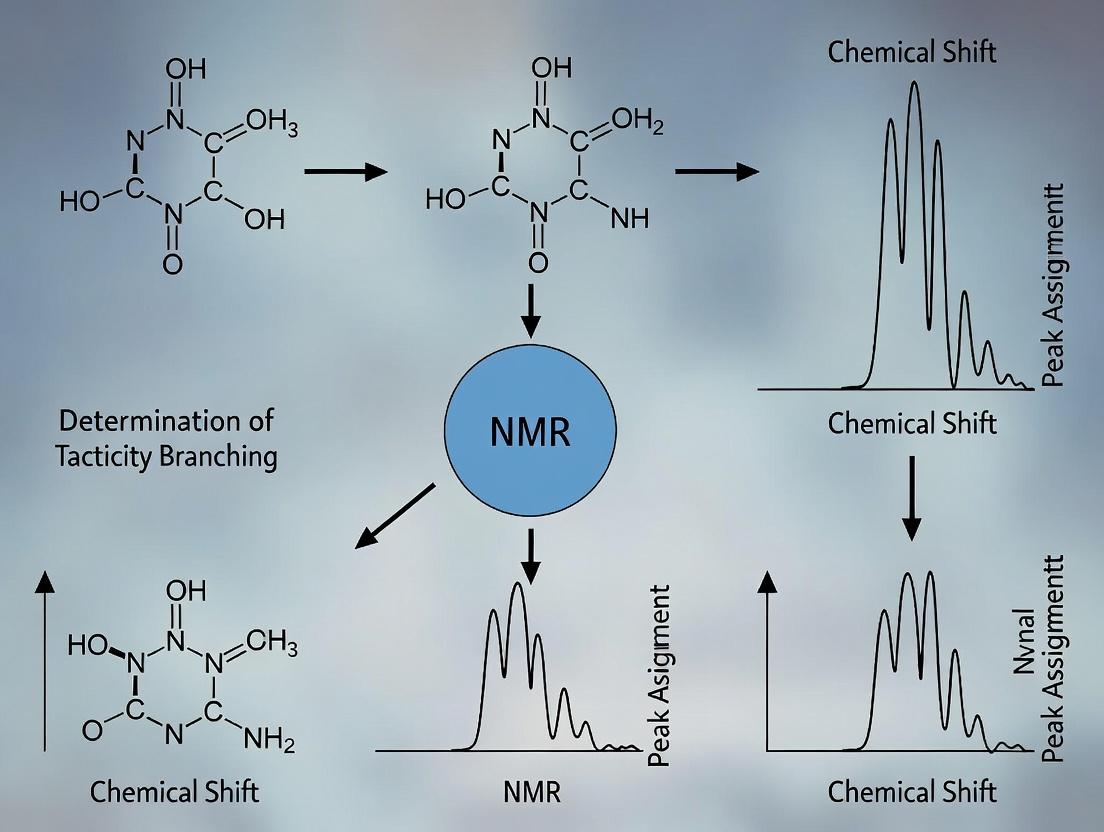
This article provides a complete resource for researchers and development professionals on using Nuclear Magnetic Resonance (NMR) spectroscopy to characterize polymer microstructure.
Decoding Polymer Architecture: A Comprehensive Guide to NMR Spectroscopy for Tacticity and Branching Analysis
Abstract
This article provides a complete resource for researchers and development professionals on using Nuclear Magnetic Resonance (NMR) spectroscopy to characterize polymer microstructure. We cover the foundational principles of chemical shift sensitivity to tacticity (isotactic, syndiotactic, atactic) and branching (short-chain, long-chain). The methodological section details practical 1D and 2D NMR experiments (¹H, ¹³C, DEPT, HSQC) for quantification. We address common challenges in signal resolution, quantification, and sample preparation, offering optimization strategies. Finally, we validate NMR against complementary techniques like SEC-MALS and rheology, establishing its role as the definitive tool for linking polymer structure to material properties critical in biomedical and pharmaceutical applications.
Polymer Microstructure 101: How NMR Chemical Shifts Reveal Tacticity and Branching
Within the broader thesis on advanced NMR spectroscopy for polymer microstructure determination, this document serves as a foundational application note. It precisely defines the key structural targets—stereochemical tacticity (mm, mr, rr triads) and both short- and long-chain branching (SCB, LCB)—critical for understanding polymer properties, from mechanical strength to drug release kinetics in polymeric excipients. Accurate quantification of these parameters via NMR is essential for structure-property elucidation in materials science and pharmaceutical development.
Parameter Definitions and Quantitative Significance
Tacticity Triads
Tacticity describes the stereochemical arrangement of pendant groups along the polymer backbone.
- mm (meso-meso): Two consecutive monomer units with the same stereochemical configuration.
- mr (meso-racemo): A dyad sequence where the configurations differ.
- rr (racemo-racemo): Two consecutive units with opposite configurations.
Branching Parameters
- Short-Chain Branch (SCB): Alkyl branches (e.g., methyl, ethyl, butyl) with lengths typically ≤6 carbons, which significantly affect crystallinity and density.
- Long-Chain Branch (LCB): Branches with lengths comparable to or exceeding the critical entanglement molecular weight, profoundly impacting melt strength and rheology.
Table 1: Typical NMR Chemical Shifts and Influence of Parameters
| Parameter | NMR Nucleus | Typical Chemical Shift Range (δ, ppm) | Key Influenced Polymer Property |
|---|---|---|---|
| mm Triad | ¹³C (e.g., polypropylene) | 21.0-22.0 (methyl) | Melting Point, Tensile Modulus |
| mr Triad | ¹³C (e.g., polypropylene) | 20.5-21.0 (methyl) | Solubility, Optical Clarity |
| rr Triad | ¹³C (e.g., polypropylene) | 19.5-20.5 (methyl) | Impact Strength, Flexibility |
| SCB (Ethyl) | ¹³C (e.g., polyethylene) | ~10.9, ~27.3, ~32.2 | Crystallinity, Density |
| LCB | ¹H (via relaxation) | N/A (indirect detection) | Zero-Shear Viscosity, Elasticity |
Experimental Protocols for NMR Determination
Protocol 3.1: Quantitative ¹³C NMR for Tacticity and SCB Analysis
Objective: To determine tacticity triad distribution and quantify SCB content in polyolefins (e.g., polypropylene, polyethylene).
Materials & Sample Preparation:
- Dissolve 50-100 mg of polymer in 0.6 mL of deuterated solvent (e.g., C₂D₂Cl₄ for 120°C, TCE-d₂ for 90°C). Use a 5 mm NMR tube.
- Add 2-5 mg of chromium(III) acetylacetonate (Cr(acac)₃) as a relaxation agent to ensure quantitative integrals.
- Ensure complete dissolution and homogeneity by heating if necessary.
NMR Acquisition Parameters (Bruker/Avance Platform Example):
- Nucleus: ¹³C
- Observe Frequency: ~125 MHz
- Pulse Program: zgpg30 (inverse-gated decoupling for quantitative NOE suppression)
- Spectral Width: 240 ppm
- Acquisition Time: ~1.5 s
- Relaxation Delay (D1): 5 s (≥ 5*T₁ for complete relaxation)
- 90° Pulse Width: Optimized for sample (~10 µs)
- Number of Scans: 1024-4096
- Temperature: 90°C (TCE-d₂) or 120°C (C₂D₂Cl₄)
Data Processing & Quantification:
- Apply exponential apodization (LB = 1-2 Hz).
- Fourier transform, phase, and baseline correct meticulously.
- For tacticity: Integrate methyl region peaks (polypropylene example: ~19.5-22.5 ppm). Normalize integrals: %mm = (Imm / (Imm+Imr+Irr)) * 100.
- For SCB: Integrate distinct branch end-group signals (e.g., ethyl branch methyl at ~10.9 ppm) and normalize per 1000 total carbons (e.g., SCB/1000C = (Ibranch / Itotal)*1000).
Protocol 3.2: ¹H NMR Relaxometry for LCB Detection
Objective: To qualitatively identify and relatively quantify LCB content via measurement of proton spin-spin (T₂) relaxation times.
Principle: Branches restrict chain mobility, leading to faster relaxation (shorter T₂).
Workflow:
- Prepare a homogeneous 5-10% (w/w) polymer solution in a deuterated solvent.
- Acquisition: Use a Carr-Purcell-Meiboom-Gill (CPMG) pulse sequence.
- Key Parameters: τ (echo delay) = 1-10 ms, number of echoes = variable to fully decay, D1 ≥ 5*T₁.
- Analysis: Fit the decay of echo intensity vs. time to a multi-exponential model. A higher population of short T₂ components correlates with increased LCB content.
Visualization of Workflows
Tacticity & SCB NMR Analysis Workflow
LCB Detection via Relaxometry Principle
The Scientist's Toolkit: Key Research Reagent Solutions
Table 2: Essential Materials for Polymer NMR Analysis
| Item | Function/Benefit |
|---|---|
| Deuterated 1,1,2,2-Tetrachloroethane-d₂ (C₂D₂Cl₄) | High-temperature (120°C) solvent for polyolefins, minimizes viscosity. |
| Chromium(III) Acetylacetonate (Cr(acac)₃) | Paramagnetic relaxation agent; shortens ¹³C T₁ for faster, quantitative analysis. |
| 5 mm High-Temperature NMR Tubes | Withstands repeated heating cycles in aggressive solvents. |
| Internal Quantitative Standard (e.g., HMDS) | Added for absolute concentration determination (optional). |
| NMR Processing Software (e.g., MestReNova, TopSpin) | Essential for advanced baseline correction, integration, and peak deconvolution. |
Within the broader thesis on NMR spectroscopy for polymer tacticity and branching determination, understanding chemical shift sensitivity is foundational. Chemical shifts (δ) in polymers are exquisitely sensitive to local electronic environments, which are dictated by microstructure, including tacticity (isotactic, syndiotactic, atactic), regio-chemistry, branching density, branch length, and chain dynamics. For drug development professionals, this is critical for characterizing polymeric excipients, drug delivery systems, and biomaterials, where microstructure dictates performance, degradation, and drug release profiles.
Quantitative Data: Chemical Shift Sensitivities in Common Polymers
The following tables summarize characteristic chemical shift ranges and their sensitivity to polymer environmental factors.
Table 1: Characteristic ¹H NMR Chemical Shifts for Common Polymer Backbones
| Polymer | Backbone Proton Group | Chemical Shift Range (δ, ppm) | Primary Sensitivity Factor |
|---|---|---|---|
| Polyethylene (PE) | -CH₂- | 1.26 | Branching (methyl shifts to ~0.9 ppm) |
| Polypropylene (PP) | -CH(CH₃)- | 1.40-1.50 | Tacticity (meso/racemo dyad sequences) |
| Polystyrene (PS) | Aromatic ortho-H | 6.4-7.2 | Tacticity (pentad sensitivity) |
| Poly(methyl methacrylate) (PMMA) | -OCH₃ | 3.58-3.62 | Tacticity (triad level; iso/syndio) |
| Poly(ethylene oxide) (PEO) | -O-CH₂-CH₂- | 3.64 | Chain end vs. repeat unit |
Table 2: ¹³C NMR Chemical Shift Sensitivity to Polymer Branching
| Polymer Type | Carbon Type | Linear Chain (δ, ppm) | Short-Chain Branch (δ, ppm) | Long-Chain Branch (δ, ppm) |
|---|---|---|---|---|
| Polyethylene | Methine (CH) | ~34.0 (backbone) | 38.3 (butyl branch point) | ~34.5 (similar to linear) |
| Polyethylene | Methyl (CH₃) | ~14.1 (chain end) | 22.8, 19.9 (ethyl, butyl) | ~14.1 (indistinguishable) |
| Polyolefins | Branch Point CH | -- | 39.5-40.5 (C6/C8 branch) | 39.5-40.5 (subtle differences) |
Application Notes
Tacticity Determination via Chemical Shift Splitting
Chemical shifts for stereosensitive nuclei (e.g., ¹³C in α-methyl groups) split based on the sequence of stereocenters. For PMMA, the α-methyl ¹³C resonance splits into three peaks corresponding to isotactic (mm), heterotactic (mr), and syndiotactic (rr) triads. The intensity ratio quantifies the polymerization mechanism's stereocontrol.
Branching Quantification
Long-chain branching (LCB) in polyethylenes (e.g., LDPE) is probed via ¹³C NMR. While short-chain branches (SCB, e.g., ethyl, butyl) give distinct resonances, LCB often requires specialized methods like ¹³C-enriched samples or coupling with size-exclusion chromatography (SEC-NMR) due to low concentration and similar shift to the backbone.
Sensitivity to Local Dynamics and Solvation
In polymers like poly(N-isopropylacrylamide) (PNIPAM), the -CH(CH₃)₂ group's chemical shift is temperature-dependent, reporting on the coil-to-globule transition. This is vital for designing thermoresponsive drug delivery systems.
Experimental Protocols
Protocol 1: Sample Preparation for High-Resolution Polymer NMR
Objective: Acquire high-resolution ¹H or ¹³C NMR spectra for microstructure analysis. Materials: See "The Scientist's Toolkit" below. Procedure:
- Dissolution: Weigh 10-50 mg of polymer into a clean NMR tube. Add 0.6-0.7 mL of deuterated solvent (e.g., C₂D₂Cl₄ at 120°C for polyolefins, CDCl₃ for many vinyl polymers). Ensure complete dissolution, potentially using a heating block or sonicator.
- Internal Standard: Add a trace amount (<1%) of internal chemical shift reference (e.g., Tetramethylsilane (TMS) at 0 ppm) if the solvent does not contain a reference.
- Degassing (Optional): For sensitive experiments or to reduce solvent signals, gently bubble dry argon or nitrogen through the solution for 1-2 minutes to displace oxygen.
- Cap and Label: Securely cap the tube, invert to mix, and label appropriately.
Protocol 2: ¹H NMR for Tacticity Determination (e.g., PMMA)
Objective: Quantify tacticity triad fractions from the α-methyl ¹H or ¹³C resonance. Instrument Setup:
- Field Strength: Use a spectrometer with a field of ≥300 MHz (¹H frequency) for sufficient dispersion.
- Temperature: Set to 25°C or a temperature where the polymer is fully soluble and chain dynamics are fast.
- Acquisition Parameters:
- Pulse Sequence: Single-pulse (zg) with solvent suppression if needed.
- Spectral Width: 12 ppm.
- Relaxation Delay (D1): ≥ 5 seconds (due to often long T1 for polymers).
- Number of Scans (NS): 64-128 for ¹H; 1024-10000 for ¹³C.
- For ¹³C: Use inverse-gated decoupling to avoid Nuclear Overhauser Effect (NOE) for quantitative integration.
Analysis:
- Phase and Baseline Correct the spectrum.
- Identify the α-methyl proton region (~0.8-1.2 ppm) or the α-methyl carbon region (~16-22 ppm).
- Integrate the peaks corresponding to mm, mr, and rr triads.
- Calculate fractions: $f{mm} = I{mm} / (I{mm}+I{mr}+I_{rr})$, etc.
Protocol 3: ¹³C NMR for Branching Analysis in Polyethylene
Objective: Identify and quantify short-chain branching types and frequency. Instrument Setup:
- Solvent/Temperature: Use 1,2,4-trichlorobenzene-d₂/ortho-dichlorobenzene-d₄ (TCB/ODCB) at 120-130°C.
- Acquisition Parameters:
- Pulse Sequence: Inverse-gated ¹H decoupling to obtain quantitative NOE-suppressed spectra.
- Spectral Width: 240 ppm.
- Relaxation Delay (D1): 10-12 seconds (carbon T1s are long).
- Number of Scans (NS): 2000-5000 to achieve sufficient S/N for low-concentration branch signals. Analysis:
- Reference spectrum to the major backbone -CH₂- peak at 30.0 ppm.
- Identify branch methyl signals: Ethyl (~11 ppm), Butyl (~14.5 ppm), Amyl (~14.2 ppm), etc.
- Quantify branches per 1000 carbons using the formula: $Branches/1000C = (I{branch} / N{branch}) / (I{total} / 2) * 1000$, where $I$ is integral, $N$ is number of carbons in the branch signal, and $I{total}$ is the total backbone integral.
Visualizations
Diagram 1 Title: Polymer NMR Analysis Workflow
Diagram 2 Title: Factors Affecting Polymer Chemical Shift
The Scientist's Toolkit: Research Reagent Solutions
| Item | Function/Benefit | Example Product/Catalog |
|---|---|---|
| Deuterated 1,2,4-Trichlorobenzene (TCB-d₂) | High-temperature solvent for insoluble polymers (polyolefins). Provides lock signal. | Sigma-Aldrich, 483046 |
| Deuterated Chloroform (CDCl₃) | Standard solvent for many vinyl polymers, contains TMS reference. | Cambridge Isotope, DLM-7 |
| Tetramethylsilane (TMS) | Internal chemical shift reference (0 ppm for ¹H and ¹³C). | Sigma-Aldrich, 244850 |
| High-Pressure NMR Tubes | Withstand high temperatures needed for polymer dissolution. | Wilmad, 528-PV-7 |
| NMR Tube Heater/Sonicator | Aids dissolution of intractable polymers in the NMR tube. | Grant Instruments, DB100 |
| Quantitative NMR Software (e.g., Mestrelab Mnova) | For advanced processing, integration, and tacticity/branching analysis. | Mestrelab Research |
| Polymer Standards (e.g., atactic PMMA) | Used for method validation and spectrometer calibration. | Polymer Source, PMMA-50 |
Within the broader thesis on NMR spectroscopy for polymer tacticity and branching determination, the precise assignment of stereochemical sequences is foundational. Tacticity—the stereoregular arrangement of pendant groups along a polymer chain—directly influences crystallinity, thermal properties, and mechanical performance. Nuclear Magnetic Resonance (NMR) spectroscopy, particularly (^{1}\text{H}), (^{13}\text{C}), and increasingly (^{19}\text{F}) NMR, provides the definitive analytical tool for differentiating isotactic (mmmm), syndiotactic (rrrr), and atactic (mrrm) sequences via characteristic chemical shifts and coupling constants. This application note details the protocols and spectral fingerprints essential for this determination.
Core Spectral Fingerprints and Data
The chemical shift sensitivity of the α-methyl or methine protons/carbons to the stereochemistry of neighboring units forms the basis of tacticity determination. For poly(methyl methacrylate) (PMMA), a canonical model system, the α-methyl (^{1}\text{H}) and (^{13}\text{C}) signals are exquisitely sensitive to pentad sequences.
Table 1: Characteristic (^{13}\text{C}) NMR Chemical Shifts (δ, ppm) for PMMA Stereosequences
| Pentad Sequence | Tacticity Assignment | α-CH(_3) (ppm) | C=O (ppm) | C(_α) (ppm) |
|---|---|---|---|---|
| mmmm | Isotactic | 16.6 | 177.8 | 44.8 |
| mmmr | Heterotactic | 16.9 | 177.5 | 45.1 |
| rmmr | Heterotactic | 17.2 | 177.2 | 45.3 |
| mmrr | Heterotactic | 19.0 | 176.8 | 45.6 |
| rmrm | Syndiotactic | 18.4 | 176.5 | 46.0 |
| rrrr | Syndiotactic | 19.8 | 177.0 | 45.0 |
| rrrm | Heterotactic | 19.4 | 177.3 | 45.2 |
Note: Data is representative for spectra acquired in CDCl(_3) at 50-100 MHz for (^{13}\text{C}). Exact values vary with solvent, concentration, and temperature.
Table 2: Key NMR Observables for Tacticity Determination in Common Polymers
| Polymer | Probe Nucleus | Key Resonances | Sequence Length |
|---|---|---|---|
| Polypropylene (PP) | (^{13}\text{C}) | CH(3), CH(2) | Pentad |
| Polystyrene (PS) | (^{13}\text{C}) | Phenyl C-1, CH | Pentad/Triad |
| Poly(vinyl chloride) (PVC) | (^{1}\text{H}) | CH(_2), CHCl | Tetrad/Pentad |
| Poly(lactic acid) (PLA) | (^{1}\text{H}) | CH, CH(_3) | Tetrad |
Experimental Protocols
Protocol 3.1: Sample Preparation for Polymer Tacticity Analysis
Objective: Prepare a homogeneous polymer solution for high-resolution NMR analysis. Materials: See "The Scientist's Toolkit" (Section 6). Procedure:
- Weighing: Accurately weigh 10-20 mg of purified, dry polymer into a clean 5 mm NMR tube.
- Solvent Addition: Add 0.6-0.7 mL of deuterated solvent (e.g., CDCl(3), C(6)D(6), d(6)-DMSO). Select a solvent that fully dissolves the polymer at room temperature.
- Dissolution: Cap the tube and agitate gently. For crystalline polymers (e.g., isotactic PP), heat in a block heater at 60-80°C with occasional vortexing until fully dissolved (may require 2-24 hours).
- Filtration (Optional): If solution is cloudy, filter through a plug of glass wool or a fine syringe filter into a clean NMR tube to remove particulates.
- Sealing: Cap the tube, label it, and wipe the exterior clean.
Protocol 3.2: (^{13}\text{C}) NMR Data Acquisition for Pentad Analysis
Objective: Acquire a quantitative (^{13}\text{C}) NMR spectrum with sufficient signal-to-noise (S/N) for pentad-level analysis. Instrument Setup:
- Insert Sample: Place prepared tube into a NMR spectrometer (≥ 300 MHz (^{1}\text{H}) frequency recommended).
- Lock & Shim: Engage the deuterium lock on the solvent signal and perform automated shimming (gradient shimming preferred).
- Parameter Definition:
- Pulse Program: Use an inverse-gated decoupling sequence (e.g.,
zgig) to suppress Nuclear Overhauser Effect (NOE) for quantitative integration. - Spectral Width: 220-240 ppm.
- Center Frequency: Set to ~110 ppm.
- Pulse Angle: 30° flip angle.
- Relaxation Delay (D1): 10-15 seconds (≥ 5*T(_1) for slow-relaxing carbons).
- Acquisition Time: 1.0-1.5 seconds.
- Decoupling: Broadband (^{1}\text{H}) decoupling (e.g., WALTZ-16) during acquisition only.
- Scans: 2000-5000 transients (aim for S/N > 50:1 for key peaks).
- Pulse Program: Use an inverse-gated decoupling sequence (e.g.,
- Data Acquisition: Run the experiment. Approximate time: 8-20 hours.
- Processing: Apply exponential apodization (LB = 1-2 Hz), zero-filling, Fourier transform, and manual phase correction. Reference spectrum to solvent peak (e.g., CDCl(_3) at 77.16 ppm).
Protocol 3.3: Spectral Deconvolution and Tacticity Calculation
Objective: Quantify the relative proportions of isotactic (m), syndiotactic (r), and atactic/heterotactic sequences. Procedure:
- Peak Assignment: Identify the α-methyl region (16-22 ppm for PMMA). Assign pentad peaks based on literature values (see Table 1).
- Spectral Deconvolution: Use NMR processing software (e.g., MestReNova, TopSpin) to perform peak fitting (deconvolution) with a Lorentzian/Gaussian line shape model.
- Integration: Integrate the area under each fitted peak corresponding to specific pentads.
- Calculation:
- Diad Fractions: m diad = Σ(areas of all pentads starting with m). r diad = Σ(areas of all pentads starting with r). Normalize to 1.
- Triad Fractions: mm = Σ(mmmm, mmmr, mmrr), mr = Σ(rmmr, rmrm, rmrr), rr = Σ(rrrr, rrmr, rrmm).
- Tacticity Index: Persistence ratio ρ = 1 - ( (mr) / (2 * m * r) ). A value of 1 indicates Bernoullian statistics.
Visualizations
Diagram 1: NMR Workflow for Polymer Tacticity Determination
Diagram 2: Spectral Regions for Tacticity Assignment in Common Polymers
Advanced Applications: (^{19}\text{F}) NMR for Fluorinated Polymers
For fluorinated polymers (e.g., PVDF, PTFE), (^{19}\text{F}) NMR offers exceptional sensitivity and a wide chemical shift range for tacticity analysis. Protocol: Use a dedicated (^{19}\text{F}) probe or a broadband probe tuned to (^{19}\text{F}). No deuterated solvent lock is available; therefore, use a coaxial insert with a deuterated solvent for locking. Apply (^{1}\text{H}) decoupling if (^{19}\text{F})-(^{1}\text{H}) couplings are present. Chemical shifts are referenced externally to CFC(_{13}) at 0 ppm.
The Scientist's Toolkit
Table 3: Essential Research Reagent Solutions & Materials
| Item | Function / Explanation |
|---|---|
| Deuterated Chloroform (CDCl(_3)) | Standard NMR solvent for many organic-soluble polymers; provides deuterium lock signal. |
| Deuterated Benzene (C(6)D(6)) | Useful for resolving aromatic polymer signals or inducing solvent shift effects for better separation. |
| Deuterated DMSO (d(_6)-DMSO) | High-boiling polar solvent for dissolving rigid polymers, polyamides, or polyelectrolytes. |
| Tetramethylsilane (TMS) or Cr(acac)(_3) | Internal chemical shift reference (TMS) or relaxation agent (Cr(acac)(_3)) to reduce experiment time. |
| High-Precision 5 mm NMR Tubes | Tubes with consistent wall thickness ensure good magnetic field homogeneity for high-resolution spectra. |
| Coaxial NMR Inserts (e.g., Wilmad) | Allows use of a deuterated lock solvent for samples dissolved in non-deuterated or low-viscosity solvents. |
| NMR Processing Software (e.g., MestReNova, TopSpin) | For Fourier transformation, phase/baseline correction, peak fitting, integration, and quantitative analysis. |
| High-Field NMR Spectrometer (≥ 300 MHz) | Essential for sufficient dispersion of complex pentad/heptad signals in (^{13}\text{C}) spectra. |
Within the broader thesis on NMR spectroscopy for polymer tacticity and branching determination, the precise characterization of short-chain branching (SCB) is paramount. The branch type—methyl, ethyl, or longer alkyl chains—profoundly influences polymer properties such as crystallinity, density, and melt flow. This application note details the advanced 1D and 2D NMR techniques required to unambiguously differentiate between these branch resonances, which often occupy a crowded spectral region (~0.5–1.5 ppm).
Quantitative Spectral Data and Chemical Shifts
The following table summarizes the characteristic ¹³C and ¹H NMR chemical shifts for different branch types in a model polyolefin system (e.g., polyethylene-based). Data is compiled from current literature and experimental observations.
Table 1: Characteristic NMR Chemical Shifts for Branch Resonances
| Branch Type | ¹³C Chemical Shift (ppm) | ¹H Chemical Shift (ppm) | Key Spectral Feature |
|---|---|---|---|
| Methyl (n-Butyl) | 14.1 (ω), 22.8 (ω-1) | 0.89 (t, J ~7 Hz) | Clear triplet, distinct upfield. |
| Ethyl (n-Pentyl) | 11.1 (ω), 27.8 (ω-1) | 0.91 (t), 1.38 (sextet) | Overlapping ω CH₃; unique ω-1 CH₂ pattern. |
| Long-Chain (≥ C₆) | 14.1 (ω), 22.8–32.3 (inner) | 0.88 (br t) | ω CH₃ clusters with main chain; complex inner CH₂ envelope. |
| Branch Point Methine | 34.5–38.0 | 1.20–1.50 (m) | Overlapped region; requires 2D for isolation. |
Table 2: Key 2D NMR Experiments for Branch Differentiation
| Experiment | Core Purpose | Critical Acquisition Parameters |
|---|---|---|
| ¹H-¹³C HSQC | Correlate CH/CH₂/CH₃ groups. | 256–512 t₁ increments; 1–2 sec relaxation delay. |
| ¹H-¹³C HMBC | Connect branches to polymer backbone. | 150–250 t₁ increments; long-range J coupling ~8 Hz. |
| ¹H-¹H COSY | Trace through-bond proton connectivity. | 256 t₁ increments; non-phase-sensitive for speed. |
Experimental Protocols
Protocol 1: Sample Preparation for High-Resolution Branch Analysis
Materials: 30–50 mg polymer, 0.6 mL deuterated solvent (e.g., TCB-d₄, C₂D₂Cl₄), 0.1% TMS, 10 mm NMR tube. Procedure:
- Weigh polymer precisely into a sample vial.
- Add 0.6 mL of pre-heated solvent (~120°C for TCB-d₄) to dissolve the polymer. Use a heating block for 1–2 hours with occasional vortexing.
- Cool slightly, add internal reference (TMS) via micro-syringe.
- Transfer homogeneous solution to a 10 mm NMR tube using a Pasteur pipette.
- Degas with a gentle stream of dry N₂ for 30 seconds before capping.
Protocol 2: ¹³C NMR with Inverse-Gated Decoupling for Quantification
Instrumentation: 400 MHz NMR spectrometer or higher, with a broadband cryoprobe for sensitivity. Acquisition Parameters:
- Set probe temperature to 125°C for TCB solutions.
- Use a 90° pulse, inverse-gated decoupling (Waltz16) to suppress NOE.
- Set spectral width: 240 ppm. Offset: 100 ppm.
- Acquisition time: 1.5 sec. Relaxation delay (D1): 8–10 sec (≥ 5*T1).
- Number of scans: 2000–4000.
- Apply exponential apodization (LB = 1 Hz) before Fourier transform.
Protocol 3: 2D ¹H-¹³C HSQC for Branch Group Separation
Acquisition Parameters:
- Temperature: 125°C.
- Spectral widths: ¹H: 4 ppm (centered at 1 ppm); ¹³C: 40 ppm (centered at 25 ppm).
- Number of t₁ increments: 256. Scans per increment: 8–16.
- Relaxation delay: 1.5 sec. Use echo-antiecho gradient selection.
- Processing: Apply sine-bell window functions in both dimensions; zero-filling to 1k x 1k matrix.
Visualization of Analytical Workflow
NMR Branch Analysis Workflow
NMR Signals & 2D Experiment Links
The Scientist's Toolkit: Key Research Reagents & Materials
Table 3: Essential Research Reagent Solutions
| Item | Function & Rationale |
|---|---|
| 1,1,2,2-Tetrachloroethane-d₂ (C₂D₂Cl₄) | High-boiling, deuterated solvent for high-temp (120°C) polymer dissolution. Provides stable lock signal. |
| Hexamethyldisiloxane (HMDS) / Tetramethylsilane (TMS) | Internal chemical shift reference (0 ppm for ¹H and ¹³C). Inert and volatile for easy sample recovery. |
| 10 mm NMR Tubes (Heavy Wall) | Required for high-temperature applications to withstand pressure and heat stress. |
| Broadband Cryoprobe | NMR probe with cooled electronics for significantly enhanced ¹³C sensitivity, critical for detecting low-level branches. |
| Chromium(III) Acetylacetonate (Cr(acac)₃) | Relaxation agent (~0.03 M) added to reduce ¹³C T1 times, permitting faster pulse repetition. |
| N₂ Gas Line with Dryer | For sample degassing to prevent oxidative degradation during long, high-temperature acquisitions. |
Introduction Within the context of elucidating polymer microstructure for tacticity and branching determination, Nuclear Magnetic Resonance (NMR) spectroscopy is the definitive analytical tool. The choice of nucleus is critical, as each provides complementary information. High-abundance, high-sensitivity ¹H NMR offers rapid qualitative analysis, while quantitative microstructure details rely on ¹³C NMR. Heteronuclei like ¹⁹F and ²⁹Si provide direct, unambiguous analysis of specialized polymers. These application notes detail the protocols and data interpretation strategies for employing these key nuclei in advanced polymer research.
1. The Core Nuclei: ¹H and ¹³C NMR
1.1 ¹H NMR: Rapid Fingerprinting and End-Group Analysis ¹H NMR is the primary tool for initial polymer characterization, offering rapid data acquisition and sensitivity to chain ends and functional groups, crucial for determining molecular weight (via end-group analysis) and confirming monomer incorporation.
Protocol 1.1: Standard ¹H NMR Analysis for Polymer Tacticity (Poly(methyl methacrylate) Example)
- Sample Preparation: Dissolve 10-20 mg of PMMA in 0.6 mL of deuterated chloroform (CDCl₃). Filter through a plug of cotton or a 0.45 μm PTFE filter into a standard 5 mm NMR tube to remove particulates.
- Data Acquisition: Using a 400 MHz or higher field spectrometer, acquire spectra at 25°C. Key parameters: Pulse angle: 30°, Spectral width: 12 ppm, Acquisition time: 4 s, Relaxation delay (D1): 5 s (to ensure full relaxation for quantitative end-group analysis), Number of scans: 16-64.
- Processing & Analysis: Apply an exponential window function (lb = 0.3 Hz) and Fourier transform. Reference the residual CHCl₃ peak to 7.26 ppm. Integrate the α-methyl proton region (0.5-1.5 ppm). The triad tacticity (isotactic mm, syndiotactic rr, heterotactic mr) is determined from the intensity ratios of the resolvable peaks within this region.
Table 1.1: Characteristic ¹H NMR Chemical Shifts for Common Polymer Motifs
| Polymer/Motif | Proton Type | Chemical Shift (δ, ppm) | Information Gained |
|---|---|---|---|
| Poly(methyl methacrylate) | O–CH₃ | ~3.60 | Monomer presence |
| α-CH₃ (tacticity) | 0.6-1.3 | Tacticity (triad levels) | |
| Polyethylene | –CH₂– backbone | 1.26 | Branching from shift deviations |
| Poly(ethylene oxide) | –CH₂–O– | ~3.65 | Main chain, end-group identification |
| Polystyrene | Aromatic o-H | ~6.6-7.2 | Monomer incorporation |
| Chain End (RAFT agent) | –S–CH₂–Ph | ~3.0-3.5 | Molecular weight via end-group integration |
1.2 ¹³C NMR: Quantitative Microstructure Determination ¹³C NMR, despite lower sensitivity, is indispensable for quantitative tacticity determination (pentad level) and branching analysis due to its wide chemical shift dispersion and quantitative nature under appropriate relaxation conditions.
Protocol 1.2: Quantitative ¹³C NMR for Polyolefin Branching & Tacticity
- Sample Preparation: Dissolve 100-200 mg of polyolefin (e.g., polyethylene, polypropylene) in 0.6 mL of deuterated 1,1,2,2-tetrachloroethane-d₂ (TCE-d₂) or o-dichlorobenzene-d₄. Heat to 100-120°C to ensure dissolution.
- Data Acquisition (Inverse Gated Decoupling): Use a high-field spectrometer (≥ 400 MHz for ¹H). Key parameters for quantitative analysis: Pulse angle: 90°, Spectral width: 250 ppm, Center: 100 ppm, Acquisition time: 1.5 s, Relaxation delay (D1): 10-15 s (critical for full ¹³C T1 relaxation), Number of scans: 1024-5000. Use inverse-gated ¹H decoupling to suppress NOE for quantitative integrity.
- Processing & Analysis: Apply an exponential window function (lb = 1-2 Hz), zero-filling, and Fourier transform. Reference the major backbone methylene peak (e.g., for PE, set to 30.00 ppm) or solvent signal. Analyze the methyl region (14-22 ppm) for branch type identification (ethyl, butyl, amyl) and the methine region for polypropylene tacticity (pentad sequences).
Table 1.2: ¹³C NMR Chemical Shifts for Polyolefin Branching & Tacticity
| Polymer/Structure | Carbon Type | Chemical Shift (δ, ppm) | Information Content |
|---|---|---|---|
| Polyethylene | Backbone –CH₂– | 30.0 | Reference peak |
| Ethyl branch –CH₃ | 10.9 | Branch type & frequency | |
| Butyl branch –CH₃ | 14.1 | Branch type & frequency | |
| Polypropylene (PP) | CH₃ (mm pentad) | ~21.8 | Tacticity quantification |
| CH₃ (mr pentad) | ~21.3 | Tacticity quantification | |
| CH₃ (rr pentad) | ~20.0 | Tacticity quantification | |
| Poly(vinyl chloride) | CHCl (mm triad) | ~47.5 | Tacticity quantification |
2. Heteronuclei NMR: Direct Probing of Specialty Polymers
2.1 ¹⁹F NMR: Extreme Sensitivity and Spectral Dispersion ¹⁹F NMR is ideal for fluorinated polymers (e.g., PVDF, PTFE) and polymers with fluorinated tags or initiators. Its high sensitivity (83% of ¹H) and enormous chemical shift range (~800 ppm) make it exquisitely sensitive to microstructural differences.
Protocol 2.1: ¹⁹F NMR for Poly(vinylidene fluoride) (PVDF) Microstructure
- Sample Preparation: Dissolve 10-20 mg of PVDF in 0.6 mL of deuterated dimethylformamide (DMF-d₇) or acetone-d₆ at elevated temperature (60°C).
- Data Acquisition: Use a broadband or dedicated ¹⁹F probe. Key parameters: Pulse angle: 30°, Spectral width: 200 ppm (centered around -100 ppm), Acquisition time: 1.0 s, Relaxation delay: 5 s, Number of scans: 128-256. Use ¹H decoupling if available.
- Analysis: Identify the different diad sequences: head-to-tail (–CF₂–CH₂–CF₂–CH₂–) and head-to-head (–CF₂–CH₂–CH₂–CF₂–). The ¹⁹F chemical shifts are highly sensitive to these configurational differences.
2.2 ²⁹Si NMR: Analyzing Silicones and Silane-Modified Polymers ²⁹Si NMR is essential for silicone (PDMS) chemistry and silyl-protected monomers or end-groups. Its negative magnetogyric ratio and long T1 require careful acquisition parameters.
Protocol 2.2: ²⁹Si NMR for Polydimethylsiloxane (PDMS) End-Group Analysis
- Sample Preparation: Dissolve 100-200 mg of PDMS in 0.6 mL of CDCl₃.
- Data Acquisition (Cr(acac)₃ Relaxation Agent): Add a crystal (~1 mg) of chromium(III) acetylacetonate (Cr(acac)₃) to reduce longitudinal relaxation times (T1). Key parameters: Pulse angle: 90°, Spectral width: 200 ppm, Center: 0 ppm, Acquisition time: 1.0 s, Relaxation delay: 5-10 s (even with relaxation agent), Number of scans: 500-2000. Use inverse-gated decoupling.
- Analysis: Distinguish between M-end (Me₃SiO–, ~0 ppm), D-chain (Me₂SiO, ~ -20 to -22 ppm), and T-branch (MeSiO₃, ~ -65 ppm) units.
The Scientist's Toolkit: Key Research Reagent Solutions
| Reagent/Material | Function & Rationale |
|---|---|
| Deuterated Chloroform (CDCl₃) | Common NMR solvent for organic-soluble polymers; provides internal lock signal. |
| Deuterated o-Dichlorobenzene (ODCB-d₄) | High-temperature solvent for polyolefins; dissolves semi-crystalline polymers at >100°C. |
| Chromium(III) acetylacetonate (Cr(acac)₃) | Paramagnetic relaxation agent for ¹³C, ²⁹Si; drastically reduces experiment time by shortening T1. |
| PTFE (0.45 μm) Syringe Filters | For clarifying polymer solutions, preventing line broadening from particulates. |
| Internal Standard (e.g., Hexamethyldisiloxane) | For quantitative concentration determination or chemical shift referencing in heteronuclear NMR. |
Visualization
Practical NMR Protocols: From Sample Prep to Quantitative Analysis of Polymer Structure
Accurate determination of polymer tacticity and branching via Nuclear Magnetic Resonance (NMR) spectroscopy is fundamentally dependent on sample preparation. Within the broader thesis on NMR spectroscopy for polymer microstructure analysis, this document establishes essential application notes and protocols for preparing polymer solutions. The choice of solvent, optimal concentration, and appropriate temperature are critical to achieving sufficient solubility, chain disentanglement, and high-resolution spectra necessary for distinguishing subtle configurational and structural differences.
Solvent Selection Criteria and Data
The solvent must completely dissolve the polymer without inducing degradation or specific interactions that distort chemical shifts. Deuterated solvents are mandatory for lock and shim functions. Key selection criteria include polymer solubility parameter, chemical inertness, and minimal signal interference in the spectral region of interest.
Table 1: Common Deuterated Solvents for Polymer NMR Analysis
| Deuterated Solvent | Typical Polymers Compatible | Boiling Point (°C) | Key ¹H NMR Residual Solvent Peak (ppm) | Notes for Tacticity/Branching |
|---|---|---|---|---|
| Chloroform-d (CDCl₃) | Polystyrene, Poly(methyl methacrylate), Polyesters | 61.2 | 7.26 | Excellent for many vinyl polymers; inert. |
| Benzene-d6 (C₆D₆) | Polyolefins, Polyethylene, Polypropylene | 80.1 | 7.16 | Good for upfield aliphatic regions; aromatic solvent-induced shifts can aid resolution. |
| Tetrachloroethane-d2 (TCE-d2) | Polyethylene, Polypropylene, Polyesters (at elevated T) | 146 | 6.00 | High boiling point; essential for high-temperature analysis of crystalline polymers. |
| Dimethyl sulfoxide-d6 (DMSO-d6) | Polyamides, Polyacrylonitrile, Polysaccharides | 189 | 2.50 | High polarity; good for hydrogen-bonding polymers; can solvate branching points. |
| Trifluoroacetic acid-d (TFA-d) | Polyamides, Aromatic Polyesters, Insoluble polymers | 72.4 | 11.50 | Aggressive solvent; use for refractory polymers; may hydrolyze sensitive groups. |
Concentration and Temperature Optimization
Optimal concentration balances signal-to-noise ratio with solution viscosity. Excessive viscosity leads to broadened lines, obscuring tacticity splittings. Temperature control reduces viscosity and can average conformational distributions.
Table 2: Recommended Concentration and Temperature Ranges
| Polymer Type | Target Concentration (w/v %) | Recommended Temperature Range | Rationale |
|---|---|---|---|
| Atactic Polystyrene (tacticity analysis) | 2-5% | 25-50°C | Minimizes viscosity for clear aromatic and backbone methine splittings. |
| Poly(methyl methacrylate) (triad tacticity) | 3-7% | 30-60°C | Enhances resolution of α-methyl and ester group peaks. |
| Low-Density Polyethylene (short-chain branching) | 5-10% in TCE-d2 | 100-120°C | Ensures complete dissolution of semi-crystalline polymer; sharpens methyl branch signals. |
| Isotactic Polypropylene (regio-defects) | 1-3% in TCE-d2 or C₆D₆ | 110-130°C | Dissolves helical aggregates; resolves methyl pentad sequences. |
Experimental Protocols
Protocol 1: Standard Solution Preparation for Tacticity Determination (e.g., PMMA)
- Weighing: Accurately weigh 20-30 mg of dried polymer into a clean, dry 5 mm NMR tube.
- Solvent Addition: Using a micro-pipette, add 0.75 mL of deuterated chloroform (CDCl₃). Target a concentration of ~3-4% (w/v).
- Dissolution: Cap the tube tightly and agitate gently using a vortex mixer. Place the tube in a warm water bath (~40°C) if necessary, until the solution is clear and homogeneous (typically 1-2 hours).
- Degassing (Optional for high-precision): Sparge the solution with dry, inert gas (N₂ or Ar) for 1-2 minutes to remove dissolved oxygen, which can cause peak broadening.
- Data Acquisition: Insert the tube into the NMR spectrometer pre-equilibrated to the probe temperature (e.g., 30°C). Allow 5 minutes for thermal equilibration before locking, shimming, and acquiring data.
Protocol 2: High-Temperature Dissolution for Polyolefin Branching Analysis (e.g., LDPE)
- Safety: Work in a fume hood. Use heat-resistant gloves and tongs.
- Preparation: Weigh 25-35 mg of polymer into a 5 mm high-temperature NMR tube.
- Solvent Addition: Add 0.5 mL of 1,1,2,2-tetrachloroethane-d2 (TCE-d2).
- Sealing: Immediately cap the tube tightly to prevent solvent evaporation.
- Heating/Dissolution: Place the tube in a heating block or oil bath at 120°C. Intermittently agitate until the polymer is fully dissolved (may take several hours). Ensure no solid particles remain.
- Acquisition: Transfer the tube to an NMR spectrometer equipped with a high-temperature probe. Set the probe temperature to 120°C. Allow at least 15-20 minutes for complete thermal equilibration before shimming. Adjust lock parameters for the elevated temperature.
Visualizations
Title: Polymer NMR Sample Prep Workflow
Title: Impact of Prep Parameters on NMR Resolution
The Scientist's Toolkit
Table 3: Essential Research Reagent Solutions for Polymer NMR
| Item | Function / Purpose |
|---|---|
| Deuterated Solvents (CDCl₃, C₆D₆, TCE-d2, DMSO-d6) | Provides the NMR lock signal; dissolves polymer without adding interfering proton signals. |
| High-Temperature NMR Tubes (5mm, 528-PV) | Withstand temperatures up to 130°C+ without deformation; required for polyolefin analysis. |
| Micro-Pipettes (50-1000 µL range) | Precisely measures solvent volumes for accurate and reproducible concentration preparation. |
| Polymer Drying Oven/Vacuum Desiccator | Removes residual moisture and volatile components that can affect solubility and cause spurious peaks. |
| Vortex Mixer & Heating Block/Oil Bath | Accelerates and homogenizes dissolution, especially for viscous solutions or high-temperature preparations. |
| Inert Gas (N₂ or Ar) Sparging Setup | Removes dissolved oxygen to reduce T₂ relaxation effects and minimize oxidative degradation at high T. |
| Internal Chemical Shift Reference (e.g., TMS) | Provides a precise ppm calibration point for consistent chemical shift reporting across experiments. |
Within polymer characterization, determining stereoregularity or tacticity is crucial for understanding structure-property relationships. For a polymer like polypropylene, the relative stereochemistry of adjacent chiral centers leads to meso (m, same configuration) and racemo (r, opposite configuration) dyad sequences. These combine to form isotactic (mm), syndiotactic (rr), and heterotactic (mr/rm) triad stereosequences. While other methods exist, high-resolution solution-state ¹³C NMR spectroscopy remains the undisputed gold standard for quantifying these triad distributions. This Application Note details the protocols for employing 1D ¹³C NMR to determine polymer tacticity, framed within the broader thesis research of NMR spectroscopy for polymer microstructure elucidation.
Quantitative Data on Characteristic Chemical Shifts
The methyl region (≈19-22 ppm) of the ¹³C NMR spectrum of polypropylene is exquisitely sensitive to triad tacticity. The following table summarizes the canonical chemical shifts for atactic polypropylene in a high-boiling, aromatic solvent.
Table 1: Characteristic ¹³C NMR Chemical Shifts for Polypropylene Methyl Triad Sequences
| Tacticity Triad | Abbreviation | Approximate Chemical Shift (ppm) | Characteristic |
|---|---|---|---|
| Isotactic | mm | 21.8 | Highest field methyl resonance |
| Heterotactic | mr/rm | 20.8 | Central methyl resonance |
| Syndiotactic | rr | 19.8 | Lowest field methyl resonance |
Note: Exact chemical shifts are solvent- and temperature-dependent. Typical solvents include 1,2,4-trichlorobenzene (TCB) or ortho-dichlorobenzene (ODCB) at 120-135°C. Data compiled from literature and experimental results.
Detailed Experimental Protocol
Protocol 1: Sample Preparation for High-Temperature ¹³C NMR of Polyolefins
Objective: To prepare a homogeneous polymer solution suitable for high-resolution, quantitative ¹³C NMR analysis.
Materials & Procedure:
- Weighing: Accurately weigh 20-40 mg of dry polymer sample into a clean, heat-resistant NMR tube (e.g., Wilmad 507-PP).
- Solvent Addition: Add 0.5-0.7 mL of deuterated solvent (e.g., 1,2,4-Trichlorobenzene-d₄, C₆D₄Cl₂). Include a relaxation agent, Chromium(III) acetylacetonate (Cr(acac)₃), at a concentration of 0.01-0.03 M to reduce long ¹³C relaxation times (T₁).
- Dissolution: Cap the tube and heat in a dedicated tube oven or heating block at 130-150°C until the polymer is completely dissolved (typically 30-60 minutes). Invert the tube periodically to aid mixing.
- Deoxygenation: While the solution is still warm, briefly purge the headspace with dry nitrogen or argon gas to displace oxygen, which can broaden signals, before sealing with the cap.
Protocol 2: ¹³C NMR Data Acquisition for Triad Quantification
Objective: To acquire a quantitative ¹³C NMR spectrum with sufficient signal-to-noise (S/N) and full relaxation for integration.
Instrument Parameters (Typical Setup on a 400-500 MHz NMR):
- Nucleus: Observe ¹³C, decouple ¹H (composite pulse decoupling, e.g., Waltz-16).
- Spectral Width: 220-250 ppm.
- Pulse Angle: 90° ¹³C pulse or smaller (30°-45°).
- Relaxation Delay (D1): 10-15 seconds (ensures >5 x T₁ for quantitative integrals).
- Number of Scans (NS): 1024-4096, depending on sample concentration and instrument sensitivity.
- Temperature: 120-130°C.
- Acquisition Time: ~1 second per scan.
Procedure:
- Insert Sample: Place the prepared, warm NMR tube into the pre-heated NMR probe (set to 120°C).
- Lock & Shim: Allow temperature to equilibrate (~5 min). Engage the deuterium lock and perform standard shimming (gradient or manual) on the lock signal.
- Tune/Match & Calibrrate Pulse: Automatically or manually tune the probe for ¹³C and ¹H channels. Determine the 90° pulse width for ¹³C.
- Set Parameters: Input the acquisition parameters as specified above.
- Run Experiment: Start data acquisition. Total experiment time typically ranges from 3 to 15 hours.
Protocol 3: Data Processing and Triad Analysis
Objective: To process the FID and quantify the relative percentages of mm, mr, and rr triads.
Processing Steps:
- Fourier Transform: Apply exponential line broadening (LB = 1-3 Hz) to the Free Induction Decay (FID) and perform Fourier Transform.
- Phasing & Baseline Correction: Manually phase the spectrum for pure absorption-mode peaks. Apply a polynomial or automatic baseline correction across the region of interest (e.g., 19-23 ppm).
- Integration: Integrate the peaks corresponding to the mm, mr, and rr methyl triad signals. Set integration limits consistently for all samples.
- Normalization: Normalize the three integral values so that their sum equals 100%. These percentages represent the triad fraction.
The Scientist's Toolkit: Research Reagent Solutions
Table 2: Essential Materials for High-Temperature Polymer NMR
| Item | Function/Benefit |
|---|---|
| Deuterated 1,2,4-Trichlorobenzene (C₆D₄Cl₂) | High-boiling aromatic solvent for dissolving crystalline polyolefins at elevated temperatures; provides deuterium lock signal. |
| Chromium(III) Acetylacetonate (Cr(acac)₃) | Paramagnetic relaxation agent. Shortens long ¹³C T₁ relaxation times, enabling faster pulse repetition and quantitative integrals. |
| High-Temp NMR Tubes (e.g., Wilmad 507-PP) | Thin-walled, precision tubes designed to withstand thermal stress and provide optimal magnetic field homogeneity at high temperatures. |
| NMR Tube Oven/Heating Block | For safe, controlled heating of NMR tubes to dissolve polymer samples without solvent evaporation or tube breakage. |
| Digital Micropipettes & Tips | For accurate, reproducible addition of relaxation agent stock solutions. |
Visualization: Experimental Workflow
Title: Workflow for Polymer Tacticity Determination by ¹³C NMR
Visualization: Tacticity Triad Relationship
Title: From Dyad Sequences to NMR Peaks: Tacticity Triads
Application Notes
Within a thesis investigating NMR spectroscopy for determining polymer tacticity and branching, the elucidation of complex macromolecular architectures is paramount. Traditional 1D ¹H and ¹³C NMR often prove insufficient for unambiguous assignment of branch points and tacticity sequences in polymers like polyolefins, polyethers, or branched polysaccharides. This is where advanced 1D/2D NMR techniques become critical. DEPT (Distortionless Enhancement by Polarization Transfer) provides unambiguous carbon multiplicity editing (CH, CH₂, CH₃). HSQC (Heteronuclear Single Quantum Coherence) offers direct ¹H-¹³C one-bond correlation maps, resolving spectral overlap. HMBC (Heteronuclear Multiple Bond Correlation) delivers crucial two- and three-bond ¹H-¹³C connectivities, enabling the "walk" through the polymer skeleton to identify branch points and quaternary carbons. The synergistic application of these experiments allows for the complete structural assignment of polymer branching, including branch length, frequency, and the stereochemical environment at junction points, directly informing polymerization mechanisms and structure-property relationships.
Table 1: Quantitative Comparison of Key NMR Techniques for Branch Analysis
| Technique | NMR Correlation Type | Key Information Provided | Typical Experiment Time (hrs)* | Critical for Identifying |
|---|---|---|---|---|
| ¹³C NMR | 1D Chemical Shift | Chemical environment of all carbons; low sensitivity for branches. | 2-8 | Branch carbon chemical shifts. |
| DEPT-135 | 1D Multiplicity Editing | Distinguishes CH/CH₃ (positive) from CH₂ (negative) signals; quaternary C absent. | 1-4 | Branch end-group methyls (CH₃), methylenes (CH₂) at branch points. |
| HSQC | 2D ¹H-¹³C (¹JCH) | Direct one-bond H-C pairs; resolves overlapped ¹H spectra. | 0.5-2 | Correlation of protons to specific carbons in branches/main chain. |
| HMBC | 2D ¹H-¹³C (²,³JCH) | Long-range H-C correlations over 2-3 bonds. | 2-6 | Connectivity across heteroatoms/quaternary carbons; mapping to branch points. |
*Times are for typical polymer samples at moderate concentrations (~20-50 mg/mL) on a 400-500 MHz spectrometer.
Experimental Protocols
Protocol 1: DEPT-135 NMR Experiment for Multiplicity Determination
Objective: To edit ¹³C NMR signals based on the number of attached protons (CH, CH₂, CH₃) in a polymer sample to identify branch methylene and methyl groups. Materials: Polymer sample (20-50 mg), deuterated solvent (e.g., C₆D₆, CDCl₃), NMR tube. Method:
- Sample Preparation: Dissolve 20-50 mg of polymer in 0.6 mL of deuterated solvent. Filter if necessary to ensure homogeneity.
- Spectrometer Setup: Load sample into a NMR spectrometer (≥ 400 MHz for ¹H frequency). Lock, shim, and tune/probe for ¹H and ¹³C.
- Pulse Sequence: Use the standard DEPT-135 sequence. Key parameters:
- Pulse Angles: θ = 135° final ¹H pulse.
- ¹³C Acquisition: Set spectral width (SW) to 240 ppm, centered at ~110 ppm. Acquire time (AQ) ~1.0 s.
- ¹H Decoupling: Use inverse-gated decoupling (Waltz16 or GARP) only during acquisition to preserve NOE.
- Relaxation Delay (D1): Set to ≥ 1.3 * T1 of the slowest-relaxing ¹³C nucleus (often 2-3 seconds for polymers).
- Number of Scans (NS): 128-512, depending on concentration and field strength.
- Processing: Apply exponential multiplication (LB = 2-3 Hz) and zero-filling before Fourier Transform. Phrase spectrum. CH and CH₃ groups appear as positive signals; CH₂ groups appear as negative signals; quaternary carbons are absent.
Protocol 2: 2D HSQC Experiment for Direct ¹H-¹³C Correlation
Objective: To obtain a 2D map correlating each proton to its directly bonded carbon, resolving overlapped ¹H resonances near branch points. Method:
- Sample & Setup: Use the same sample from Protocol 1. Ensure good shims for optimal line shape.
- Pulse Sequence: Use sensitivity-edited or echo/anti-echo HSQC (e.g., hsqcetgpsp on Bruker, gHSQC on Varian).
- Key Parameters:
- F2 (¹H Dimension): SW = 10-15 ppm, AQ = ~0.1 s, NS = 4-8 per increment, TD (F2) = 1024.
- F1 (¹³C Dimension): SW = 160-220 ppm, Number of Increments (TD1) = 256, centered appropriately.
- ¹JCH Coupling Constant: Set to ~145 Hz (adjust for polymer type, e.g., ~125 Hz for aromatic systems).
- Relaxation Delay (D1): 1.0-2.0 s.
- Total Experiment Time: ~30 mins to 2 hrs.
- Processing: Use linear prediction in F1, zero-filling to 1K x 1K, and apply a squared cosine-bell window function in both dimensions before FT.
Protocol 3: 2D HMBC Experiment for Long-Range ¹H-¹³C Connectivity
Objective: To detect correlations between protons and carbons separated by 2-3 bonds, enabling tracing of polymer backbone and identification of quaternary branch points. Method:
- Sample & Setup: Identical to HSQC setup.
- Pulse Sequence: Use standard HMBC sequence with a low-pass J-filter to suppress one-bond correlations (e.g., hmbcgplpndqf on Bruker).
- Key Parameters:
- F2 (¹H): SW = 10-15 ppm, AQ ~0.1 s, NS = 16-32 per increment, TD (F2) = 2048.
- F1 (¹³C): SW = 220-240 ppm (to include carbonyls if present), TD1 = 512.
- Long-Range Coupling Constant (ⁿJCH): Set the evolution delay for ~8 Hz (≈ 1/(2*8Hz) = 0.0625 s). Atypical value (e.g., 5 Hz) may also be used.
- Relaxation Delay (D1): 1.5-2.0 s.
- Total Experiment Time: 4-12 hours.
- Processing: Process similarly to HSQC but with more aggressive window functions (e.g., sine-bell) due to lower signal-to-noise. Carefully inspect for weak correlations indicative of branch connectivity.
Visualizations
Title: NMR Workflow for Polymer Branch Assignment
Title: HMBC Connectivities at a Branch Point
The Scientist's Toolkit
Table 2: Essential Research Reagent Solutions for Polymer NMR Analysis
| Item | Function in Experiment |
|---|---|
| Deuterated Solvents (C₆D₆, CDCl₃, toluene-d₈) | Provides field-frequency lock for NMR spectrometer; dissolves polymer without significant signal interference. |
| Internal Chemical Shift Standard (TMS, DSS) | Provides a reference point (0 ppm) for calibrating ¹H and ¹³C chemical shifts. |
| High-Purity NMR Tubes (5 mm, 400+ MHz spec) | Holds sample; consistent wall thickness ensures good magnetic field homogeneity and spectral resolution. |
| Relaxation Agent (e.g., Chromium(III) acetylacetonate - Cr(acac)₃) | Added in small amounts to reduce long ¹³C T1 relaxation times, shortening experiment duration. |
| Dry, Oxygen-Free Solvents | For air-sensitive polymers (e.g., polyolefins made with metal catalysts), prevents degradation and sample artifacts. |
Within the broader thesis on employing Nuclear Magnetic Resonance (NMR) spectroscopy for the precise determination of polymer tacticity (sequence stereoregularity) and branching architecture, robust quantification strategies are paramount. The accurate integration of resonances in ¹H, ¹³C, and two-dimensional spectra, followed by the calculation of microstructural percentages, transforms spectral data into quantitative descriptors of polymer structure. These descriptors directly correlate with material properties, informing structure-property relationships critical for advanced polymer design in pharmaceutical excipients, drug delivery systems, and biomaterials.
Foundational Principles and Data Presentation
Quantification relies on the principle that the integrated intensity of an NMR signal is proportional to the number of nuclei contributing to that resonance. For well-resolved peaks belonging to distinct microstructures (e.g., mm, mr, rr triads, or branch points), mole fractions can be calculated directly.
Table 1: Common Microstructural Assignments and Quantification Formulas for Poly(methyl methacrylate) Tacticity
| Microstructure (Triad) | ¹³C NMR Chemical Shift (Carbonyl, δ, ppm) | Representative Integral (I) | Mole Fraction Calculation |
|---|---|---|---|
| Isotactic (mm) | ~177.2 | I_mm | % mm = [Imm / (Imm + Imr + Irr)] × 100 |
| Heterotactic (mr) | ~177.0 | I_mr | % mr = [Imr / (Imm + Imr + Irr)] × 100 |
| Syndiotactic (rr) | ~176.7 | I_rr | % rr = [Irr / (Imm + Imr + Irr)] × 100 |
Table 2: Branching Quantification in Polyethylene via ¹³C NMR
| Branch Type | ¹³C NMR Chemical Shift (Methylene Region, δ, ppm) | Integral per Branch (I_branch) | Branches per 1000 Carbons Calculation |
|---|---|---|---|
| Butyl (or longer) | ~30.0 (Main chain) | Reference | --- |
| Ethyl | ~10.9 (CH₃) | I_ethyl | E = (Iethyl / Itotal) × 1000 × Correction Factor |
| Methyl (Propyl) | ~20.3 (CH₃) | I_me | M = (Ime / Itotal) × 1000 × Correction Factor |
Detailed Experimental Protocols
Protocol 1: Quantitative ¹³C NMR for Tacticity Determination
- Sample Preparation: Dissolve 50-100 mg of polymer in 0.6 mL of deuterated solvent (e.g., CDCl₃, C₂D₂Cl₄). Use a 5 mm NMR tube. Add a relaxation agent, such as chromium(III) acetylacetonate (Cr(acac)₃, ~5 mg), to ensure complete longitudinal relaxation (T1) between pulses.
- NMR Acquisition Parameters:
- Spectrometer: High-field NMR (≥ 400 MHz for ¹H frequency).
- Pulse Sequence: Inverse-gated decoupling pulse sequence to suppress Nuclear Overhauser Effect (NOE).
- Pulse Angle: 90° flip angle.
- Relaxation Delay (D1): Set to ≥ 5 × the longest T1 of quantified nuclei (typically 5-10 seconds).
- Number of Scans (NS): Acquire sufficient scans to achieve a signal-to-noise ratio (SNR) > 100:1 for the smallest peak of interest (often > 1024 scans).
- Acquisition Time: 1-2 seconds.
- Data Processing:
- Apply an exponential window function (line broadening 1-2 Hz) to improve SNR.
- Perform Fourier Transform and phase correction.
- Apply a polynomial baseline correction to ensure a flat baseline across the spectral region of interest.
- Manually define integration regions for each distinct resonance, ensuring all satellite sidebands (from ¹³C-¹³C coupling) are excluded.
- Integrate peaks. Normalize integrals as per Table 1.
Protocol 2: Branch Quantification in Polyolefins via High-Temperature ¹³C NMR
- Sample Preparation: Prepare a 10-15% (w/v) solution of polymer in a high-boiling deuterated solvent (e.g., 1,1,2,2-tetrachloroethane-d₂, TCE-d₂). Use a 10 mm high-temperature NMR tube.
- NMR Acquisition:
- Temperature: 120-130°C to ensure complete dissolution and narrow lines.
- Pulse Sequence: Inverse-gated decoupling.
- Relaxation Delay (D1): 10-15 seconds due to long T1s at elevated temperature.
- NS: > 2000 scans to achieve necessary SNR.
- Data Processing & Calculation: Process as in Protocol 1. Integrate the α-methyl, α-methylene, and branch terminal methyl signals. Calculate branches per 1000 total carbons using the formula: Branch/1000C = (I_branch / I_total) × 1000 × N, where I_total is the integral of a reference signal (e.g., all methylenes), and N is the number of carbons in the reference signal.
Mandatory Visualization
Diagram 1: Quantitative NMR Workflow.
Diagram 2: Logic of % Microstructure Calculation.
The Scientist's Toolkit: Research Reagent Solutions
| Item | Function in Quantification |
|---|---|
| Deuterated Solvents (CDCl₃, TCE-d₂, DMSO-d₆) | Provides a lock signal for field frequency stability and minimizes solvent proton interference. |
| Relaxation Agent (Cr(acac)₃) | Shortens T1 relaxation times, allowing for shorter recycle delays and ensuring full relaxation for quantitative accuracy. |
| Quantitative NMR Tube (5 or 10 mm) | High-quality, matched tubes ensure consistent shimming and spectral line shape. |
| Internal Standard (e.g., Hexamethyldisiloxane, HMDS) | Optional for absolute quantitation; provides a known integral reference for calculating molar concentrations. |
| Software (e.g., MestReNova, TopSpin, ACD/NMR Processor) | Essential for processing (apodization, FT, phasing), baseline correction, and accurate, reproducible peak integration. |
| High-Temperature NMR Probe & Tubes | Enables analysis of semi-crystalline polymers (e.g., polyolefins) by dissolving them at temperatures >100°C. |
Application Notes
This document details the application of Nuclear Magnetic Resonance (NMR) spectroscopy for the structural elucidation of key industrial and biomedical polymers: Polypropylene (PP), Polyethylene (PE), Poly(methyl methacrylate) (PMMA), and Poly(lactic acid) (PLA). Within the broader thesis on NMR for polymer tacticity and branching determination, these case studies highlight methodologies for quantifying microstructural features that dictate macroscopic physical properties.
Polypropylene (PP): (^{13}\text{C}) NMR is the definitive technique for determining tacticity (isotactic, syndiotactic, atactic). The methyl region (19-22 ppm) is diagnostic, with pentad sequences providing detailed catalyst performance and polymerization mechanism insights.
Polyethylene (PE): High-temperature (^{13}\text{C}) NMR (>120°C) is essential for analyzing branching in low-density (LDPE) and linear low-density (LLDPE) polyethylenes. Branch type (butyl, amyl, longer) and frequency are quantified from the backbone methylene region (30 ppm) and characteristic branch end-group signals.
Poly(methyl methacrylate) (PMMA): Tacticity (mm, mr, rr triads) profoundly affects glass transition temperature ((T_g)) and solubility. (^{1}\text{H}) NMR of the α-methyl protons (0.7-1.3 ppm) or (^{13}\text{C}) NMR of the carbonyl/α-methyl carbons provides triad fractions.
Poly(lactic acid) (PLA): NMR quantifies the D/L isomeric ratio (stereocomplexation) and sequence distribution, crucial for crystallization and degradation rates. The methine region (5.1-5.3 ppm) in (^{1}\text{H}) NMR and the carbonyl region in (^{13}\text{C}) NMR are analyzed.
Table 1: Quantitative NMR Data for Common Polymers
| Polymer | Key NMR Nucleus | Chemical Shift Range (Diagnostic) | Measured Parameter | Typical Values/Impact |
|---|---|---|---|---|
| Polypropylene | (^{13}\text{C}) | 19-22 ppm (Methyl) | Tacticity (Pentad) | Isotactic Index: >95% (high crystallinity) |
| Polyethylene | (^{13}\text{C}) | ~30 ppm (Methylene), 14.1 ppm (Methyl) | Branching (Type & per 1000C) | LDPE: 15-30 ethyl branches/1000C; LLDPE: ~10 butyl branches/1000C |
| PMMA | (^{1}\text{H}) | 0.7-1.3 ppm (α-Methyl) | Tacticity (Triad) | Syndiotactic: >70% (higher (T_g) ~125°C) |
| PLA | (^{1}\text{H}) | 5.1-5.3 ppm (Methine) | Stereochemistry (%D or %L) | %L > 98% for high-melt strength |
Experimental Protocols
Protocol 1: Sample Preparation for Polymer NMR Analysis
- Weighing: Accurately weigh 20-50 mg of polymer sample into a 5 mm NMR tube.
- Solvent Addition: Add 0.6-0.7 mL of deuterated solvent.
- For PP/PE: Use 1,2,4-trichlorobenzene-d₄ or ortho-dichlorobenzene-d₄. Heat to ~130°C to dissolve.
- For PMMA: Use chloroform-d at room temperature.
- For PLA: Use chloroform-d or hot dimethyl sulfoxide-d₆.
- Dissolution: Cap and gently heat/shake until complete dissolution is achieved. For semi-crystalline polymers (PP, PE, PLA), prolonged heating (>30 min) at 130-150°C may be required.
- Filtration (Optional): For gels or particles, use a preheated pipette with glass wool to filter the hot solution into a clean NMR tube.
Protocol 2: (^{13}\text{C}) NMR for Tacticity & Branching Determination
- Instrument Setup: Use a spectrometer with a minimum field strength of 400 MHz for (^{1}\text{H}) (100 MHz for (^{13}\text{C})). Equip with a high-temperature probe for PE/PP.
- Acquisition Parameters:
- Nucleus: (^{13}\text{C}{^{1}\text{H}}) (Broadband proton decoupled).
- Temperature: RT (PMMA, PLA) or 120-130°C (PP, PE).
- Pulse Program: Standard zgpg30 or inverse-gated decoupling for quantitative analysis.
- Spectral Width: 240 ppm.
- Relaxation Delay (D1): 5-10 seconds (due to long (T_1) of (^{13}\text{C})).
- Number of Scans: 1024-5000+ to achieve adequate S/N.
- Processing: Apply exponential multiplication (lb=1-2 Hz), Fourier transform, phase, and baseline correction. Reference chemical shifts to solvent signal.
- Integration & Analysis: Integrate relevant peak regions. For tacticity, assign triad/pentad sequences. For PE branching, compare integrals of branch methyl (14.1 ppm) to main chain methylene (~30 ppm).
Protocol 3: (^{1}\text{H}) NMR for Composition & Stereochemistry
- Instrument Setup: Standard room-temperature probe.
- Acquisition Parameters:
- Nucleus: (^{1}\text{H}).
- Pulse Program: zg30.
- Relaxation Delay (D1): 5-10 seconds for quantitative accuracy.
- Number of Scans: 64-128.
- Processing: Fourier transform, phase, and baseline correction. Reference to residual solvent peak (e.g., CHCl₃ at 7.26 ppm).
- Analysis: Integrate characteristic proton signals (e.g., PLA methine protons at 5.1-5.3 ppm to determine D/L ratio; PMMA α-methyl protons for triad tacticity).
Visualizations
Title: Polymer NMR Analysis Decision Workflow
Title: NMR Correlation for Polyethylene Branching
The Scientist's Toolkit
Table 2: Key Research Reagent Solutions for Polymer NMR
| Item | Function in Experiment |
|---|---|
| Deuterated 1,2,4-Trichlorobenzene (TCB-d₄) | High-temperature solvent for dissolving crystalline polyolefins (PE, PP) without degradation. |
| Deuterated Chloroform (CDCl₃) | Standard solvent for ambient-temperature analysis of soluble polymers (PMMA, PLA, PS). |
| Chromium(III) Acetylacetonate (Cr(acac)₃) | Relaxation agent added to reduce long (^{13}\text{C}) T1 times, enabling faster pulse repetition. |
| Tetramethylsilane (TMS) or solvent residual peak | Internal chemical shift reference for calibrating the NMR spectrum. |
| High-Temperature NMR Probe | Specialized probe capable of operating at 130-150°C to keep polyolefins in solution. |
| 5 mm NMR Tubes (Wilmar 507-PP) | High-quality, thin-walled tubes designed for high-temperature work and high resolution. |
| Glass Wool or Filter Syringe | For hot filtration of polymer solutions to remove gels or catalyst residues. |
Solving NMR Challenges: Optimizing Resolution and Accuracy in Polymer Analysis
Within the broader research thesis on employing Nuclear Magnetic Resonance (NMR) spectroscopy for elucidating polymer tacticity and branching architectures, spectral crowding in the ¹H and ¹³C NMR spectra represents a fundamental analytical bottleneck. The subtle stereochemical and branching differences in polymers generate signals with minimal chemical shift dispersion, leading to severe peak overlap. This application note details advanced experimental and computational strategies to overcome this challenge, thereby enabling precise tacticity triad/pentad determination and quantitative branching analysis critical for structure-property relationship studies.
Strategies and Comparative Data Table
The following strategies are systematically compared based on their applicability to polymer NMR.
Table 1: Comparative Overview of Spectral Resolution Enhancement Strategies
| Strategy | Typical Resolution Gain (Δν₁/₂) | Key Polymer Application | Cost/Complexity | Primary Limitation |
|---|---|---|---|---|
| Higher Field NMR (≥ 800 MHz) | ~2x over 400 MHz | General signal dispersion for all polymers | Very High | Instrument access, sample heating |
| 2D NMR (HSQC, TOCSY) | Resolves overlaps into 2nd dimension | Tacticity sequences, branch point identification | Moderate-High | Longer experiment time, data complexity |
| Selective ¹³C Isotope Labeling | Isolates specific carbon resonances | Tracing monomer incorporation, branch topology | High | Synthetic challenge, cost of labeled monomers |
| Non-Uniform Sampling (NUS) 2D NMR | Enables higher resolution in same time | High-res 2D spectra of degradation-sensitive polymers | Moderate | Reconstruction artifacts, requires specialized processing |
| Pure Shift NMR (PSYCHE, etc.) | Collapses ¹H multiplet structure (~10x narrower lines) | Crowded ¹H regions (e.g., backbone methines) | Low-Moderate | Sensitivity penalty, requires good shimming |
| Deep Learning Deconvolution | Resolves sub-resolution peaks (theoretical) | Post-processing of any crowded 1D spectrum | Low (software) | Requires extensive training datasets, "black box" nature |
Detailed Experimental Protocols
Protocol 1: Pure Shift ¹H NMR for Polyolefin Tacticity Analysis
- Objective: Obtain homonuclear decoupled ¹H NMR spectra to resolve overlapping methine/methylene multiplet structures.
- Materials: Polymer solution (e.g., ~10 mg in 0.6 mL deuterated tetrachloroethane, 120°C), 500 MHz NMR spectrometer equipped with a room-temperature or cryogenic probe.
- Procedure:
- Prepare a stable, homogeneous polymer solution. Use an external lock solvent if necessary.
- Acquire a standard ¹H NMR spectrum for reference. Carefully shim to optimize line shape.
- Implement the PSYCHE (Pure Shift Yielded by Chirp Excitation) pulse sequence. Typical parameters: spectral width 12 ppm, acquisition time 2-3 s, relaxation delay 3-5 s, 64-128 scans.
- Use a weak chirp pulse (e.g., 2-5% of B₁ strength) for selective excitation and a long mixing time (~0.5 s) for J-refocusing.
- Process the data with mild exponential line broadening (0.3-1.0 Hz). Integrate the simplified singlet peaks for tacticity (mm, mr, rr) quantification.
Protocol 2: 2D ¹H-¹³C gHSQC with NUS for Branch Point Identification
- Objective: Resolve overlapping ¹H and ¹³C signals by correlating them in two dimensions, specifically targeting branching methyl and methine regions.
- Materials: Polymer sample (≥ 20 mg), 500+ MHz spectrometer with inverse detection probe, non-uniform sampling schedule software.
- Procedure:
- Dissolve polymer in appropriate deuterated solvent (e.g., C₂D₂Cl₄ for polyolefins).
- Set up a standard gradient-HSQC pulse sequence. Set F2 (¹H) spectral width to ~12 ppm and F1 (¹³C) to ~100 ppm (aliphatic region).
- Enable Non-Uniform Sampling (NUS). Use a sampling density of 25-33% of the conventional grid. Generate a Poisson-gap sampling schedule.
- Acquire data with 128-256 increments in the indirect dimension (NUS reduces actual acquired points proportionally).
- Process data using iterative reconstruction software (e.g., NMRPipe, TopSpin). Use squared sine-bell window functions in both dimensions. Analyze cross-peaks to assign branch methyl (¹³C ~20 ppm) and proximal methine/methylene carbons.
Visualization of Experimental Workflows
Diagram 1: Workflow for Resolving Crowded Polymer NMR
Diagram 2: Key Signaling in Pure Shift (PSYCHE) NMR
The Scientist's Toolkit: Research Reagent Solutions
Table 2: Essential Materials for High-Resolution Polymer NMR
| Item | Function in Protocol | Key Consideration for Polymers |
|---|---|---|
| Deuterated 1,1,2,2-Tetrachloroethane (C₂D₂Cl₄) | High-temperature (≥ 100°C) solvent for insoluble polymers like polyolefins. | Excellent solvent power; requires high-temperature NMR probe. |
| Selective ¹³C-Labeled Monomers | Enables tracking of specific atoms into polymer chains via synthesis. | Critical for isolating signals in branching/tacticity studies; expensive. |
| Chromatography-grade Polymer (Narrow MWD) | Provides a well-defined sample for NMR analysis. | Reduces spectral broadening from molecular weight distribution (MWD) effects. |
| Relaxation Agent (e.g., Cr(acac)₃) | Shortens longitudinal relaxation time (T₁), allowing faster pulse repetition. | Accelerates ¹³C or 2D experiment acquisition times for polymers with long T₁. |
| Susceptibility-Matched NMR Tubes (Shigemi) | Minimizes sample volume outside the coil, improving magnetic field homogeneity (shim). | Essential for achieving narrow lines in pure shift and high-field experiments. |
| Non-Uniform Sampling (NUS) Software | Enables high-resolution 2D/3D NMR in less time. | Must be compatible with spectrometer software (e.g., TopSpin) and processing suite. |
Within the broader thesis on employing advanced Nuclear Magnetic Resonance (NMR) spectroscopy for the determination of polymer tacticity and branching architecture, a fundamental experimental challenge arises: the broadening of resonance lines in NMR spectra. This broadening often obscures the fine spectral details necessary for precise tacticity sequencing and branch point identification. This Application Note directly addresses "The Dynamics Problem," where restricted segmental motion in polymer chains, particularly in semi-crystalline, glassy, or highly branched systems, leads to unfavorable spin-spin relaxation times (T₂) and consequently, broad spectral lines. We detail protocols to mitigate this issue through strategic temperature control, magic-angle spinning (MAS), and advanced NMR pulse sequences, thereby recovering high-resolution information critical for structural elucidation.
The relationship between polymer chain dynamics, correlation time (τc), and NMR spectral linewidth (Δν) is governed by the spin-spin relaxation rate (1/T₂). The following table summarizes key parameters and their impact.
Table 1: Polymer Dynamics, Correlation Times, and NMR Linewidth Implications
| Polymer State | Approx. Segmental Correlation Time (τc, seconds) | Expected ¹H NMR Linewidth (Δν, Hz) | Dominant Relaxation Mechanism | Suitability for High-Res Tacticity/Branching NMR |
|---|---|---|---|---|
| Dilute Solution (Fast Motion) | 10⁻¹¹ - 10⁻⁹ | 1 - 10 | Dipolar (partially averaged) | Excellent. Yields sharp lines for detailed coupling analysis. |
| Rubbery State (Above Tg) | 10⁻⁹ - 10⁻⁷ | 10 - 100 | Residual Dipolar | Good. Variable temperature (VT) needed for optimal resolution. |
| Glassy / Semicrystalline (Restricted) | 10⁻⁷ - 10⁻⁵ | 100 - 10,000 | Static Dipolar, Chemical Shift Anisotropy (CSA) | Poor. Broad lines mask tacticity/branching signatures. Requires solid-state methods. |
| Rigid Solid (Frozen) | > 10⁻⁵ | 10,000+ | Static Dipolar, CSA | Very Poor. Advanced solid-state NMR essential. |
Table 2: Experimental Techniques to Overcome the Dynamics Problem
| Technique | Primary Target | Typical Experimental Conditions | Expected Resolution Gain |
|---|---|---|---|
| High-Temperature Solution NMR | Increase thermal motion (↓ τc) | 100-150°C in deuterated solvent (e.g., o-dichlorobenzene-d₄) | Can reduce linewidth by factor of 5-10. |
| Magic-Angle Spinning (MAS) | Average anisotropic interactions | Spinning speed: 5-15 kHz for ¹³C, 60-110 kHz for ¹H. Temperature control critical. | Resolves CSA and dipolar broadening; yields solution-like spectra. |
| Cross Polarization (CP) MAS ¹³C NMR | Enhance sensitivity for rigid segments | Contact time: 1-3 ms. MAS: 8-12 kHz. For rigid, non-motile carbons. | Enables detection of crystalline domains and branch points. |
| ¹H Dipolar Decoupling & CRAMPS | Reduce ¹H-¹H dipolar broadening | Combined Rotation and Multiple-Pulse Spectroscopy. High-speed MAS + multi-pulse sequences. | Can resolve ¹H shifts in solids to ~0.5 ppm. |
| 2D NMR Methods (e.g., WISE) | Correlate dynamics with structure | Wideline Separation (WISE): correlates ¹H linewidth (dynamics) with ¹³C chemical shift (structure). | Maps heterogeneity of chain motion across different carbons. |
Experimental Protocols
Protocol 3.1: High-Temperature Solution-State NMR for Semi-Crystalline Polymers
Aim: To dissolve and acquire high-resolution ¹H/¹³C spectra of polymers with limited solubility at room temp (e.g., polyethylene, polypropylene) for tacticity analysis.
- Sample Preparation: Weigh 10-20 mg of polymer into a 5 mm NMR tube. Add 0.6-0.7 mL of high-boiling deuterated solvent (e.g., o-dichlorobenzene-d₄, 1,2,4-trichlorobenzene-d₃). Seal tube with a PTFE cap.
- Dissolution: Heat the tube in a heating block or oven at 120-150°C until the polymer fully dissolves (may require several hours). Invert tube periodically to mix.
- Data Acquisition (NMR Spectrometer):
- Insert pre-heated tube into a spectrometer equipped with a variable-temperature (VT) probe.
- Set probe temperature to 110-130°C. Allow 10-15 mins for thermal equilibrium.
- Lock, shim, and calibrate pulses at the experimental temperature.
- ¹H NMR: Use a standard zg pulse sequence. Set number of scans (NS) to 32-128. Optimize receiver gain.
- ¹³C{¹H} NMR: Use a zgpg30 sequence with high-power ¹H decoupling. NS > 2000. Set relaxation delay (D1) to 5-8 seconds (long T1 at high temp).
- Processing: Apply exponential apodization (LB = 0.3-1.0 Hz for ¹H, 1-3 Hz for ¹³C). Reference spectra to solvent residual peak.
Protocol 3.2: Basic ¹³C CPMAS for Rigid Polymer Segments
Aim: To acquire high-sensitivity ¹³C spectra from solid polymer samples where dynamics are highly restricted.
- Sample Preparation: Gently pack 50-100 mg of powdered or shredded polymer into a 4 mm zirconia MAS rotor. Ensure packing is homogeneous to avoid spinning sidebands.
- MAS Setup: Insert rotor into a 4 mm CPMAS probe. Set magic angle precisely (~54.74°). Set target MAS speed (e.g., 10,000 Hz). Achieve stable spinning.
- Calibration: Calibrate ¹H 90° pulse length, ¹³C 90° pulse length, and the Hartmann-Hahn match condition for CP using a standard like adamantane or glycine.
- Data Acquisition:
- Set contact time to 2 ms (optimize for your system, typically 1-5 ms).
- Use high-power SPINAL-64 or TPPM ¹H decoupling during acquisition.
- Set recycle delay (D1) to 3-5 seconds (shorter than solution-state due to CP).
- Acquire 1024-4096 scans depending on sensitivity.
- Processing: Apply line broadening (LB = 50-100 Hz) to improve S/N. Perform baseline correction. Reference the methylene peak of polyethylenelike structures to 30.0 ppm externally relative to TMS.
Protocol 3.3: Dynamics Mapping via 2D ¹H-¹³C WISE NMR
Aim: To correlate the ¹H linewidth (indicator of local mobility) with the ¹³C chemical shift (indicator of chemical environment).
- Sample & Setup: Prepare sample as in Protocol 3.2. Use a 4 mm CPMAS probe.
- Pulse Sequence: Employ the standard WISE (Wideline Separation) sequence: ¹H evolution (t1) under static or slow MAS conditions → CP to ¹³C → ¹³C acquisition (t2) with high-power ¹H decoupling.
- Key Parameters: Set initial t1 to capture the full ¹H wideline (~50 µs increment). Use a short CP contact time (0.1-0.5 ms) to suppress ¹H spin diffusion, preserving spatial resolution of dynamics.
- Acquisition: Acquire 32-64 t1 increments with 256-512 scans per increment.
- Processing: Process in F2 (¹³C dimension) with mild LB. In F1 (¹H dimension), do not spin; process to retain the broad lineshape. The resulting 2D plot shows narrow ¹H lines at certain ¹³C shifts (mobile groups) and broad ¹H lines at others (rigid groups).
Visualizations
Title: Strategy to Overcome NMR Line Broadening from Restricted Motion
Title: How 2D WISE NMR Resolves Dynamics vs. Structure
The Scientist's Toolkit: Research Reagent Solutions
Table 3: Essential Materials for Dynamics Problem NMR Studies
| Item | Function & Relevance to "The Dynamics Problem" |
|---|---|
| High-Temp Deuterated Solvents (o-Dichlorobenzene-d₄, 1,2,4-Trichlorobenzene-d₃) | Enables dissolution of semi-crystalline polymers for high-temperature solution NMR, reducing τc and narrowing lines for tacticity analysis. |
| 4 mm Zirconia MAS Rotors with Caps | Holds solid polymer samples for magic-angle spinning experiments to average anisotropic interactions causing broadening. |
| External Chemical Shift Reference (Adamantane, Hexamethylbenzene) | Provides a precise secondary reference for ¹³C chemical shifts in solid-state CPMAS experiments, critical for accurate branching/tacticity assignment. |
| Variable-Temperature (VT) NMR Probe | Permits precise temperature control for both solution (high-temp) and solid-state (low-temp for CP efficiency) studies of chain dynamics. |
| High-Speed MAS Probe (e.g., 60+ kHz for ¹H) | Directly averages strong ¹H-¹H dipolar couplings in solids, enabling high-resolution ¹H NMR (CRAMPS) for direct observation of tacticity-sensitive protons. |
| Model Polymer Standards (e.g., Atactic/Syndiotactic/Isotactic Polystyrene, LDPE/HDPE) | Provide benchmark spectra with known tacticity and branching for method validation and spectral interpretation. |
Application Notes
Accurate quantification in polymer NMR for tacticity and branching analysis is critically undermined by improper handling of longitudinal relaxation times (T₁) and the heteronuclear Nuclear Overhauser Effect (NOE). Within the thesis framework of NMR spectroscopy for polymer tacticity and branching determination, these factors directly corrupt the relationship between signal integral and nucleus count, leading to significant errors in quantifying monomer sequences, branch points, and end groups.
- T₁ Relaxation-Induced Quantification Error: The spin-lattice relaxation time (T₁) dictates the delay required for nuclei to return to equilibrium post-excitation. An insufficient recycle delay (d1) between transients results in partial saturation of signals, especially for nuclei with long T₁, such as quaternary carbons in polymer backbones or branch junctions. This leads to systematically underestimated integrals, skewing compositional analysis.
- NOE-Induced Quantification Error: Heteronuclear NOE enhancements (e.g., {¹H}-¹³C NOE) are not uniform across all nuclei in a polymer chain. Protonated carbons (e.g., -CH₂-) experience a significant signal enhancement, while non-protonated carbons (e.g., quaternary branch points, tacticity-sensitive carbonyls) experience little to no enhancement. Quantitative ¹³C NMR experiments performed with continuous proton decoupling (NOE present) yield integrals that reflect a convoluted mix of nucleus population and NOE efficiency, not just concentration. This invalidates direct integration for comparative quantification.
Data Presentation: Impact of T₁ and NOE on Polymer Signal Intensities
Table 1: Representative T₁ Times and Maximum NOE Enhancements for Key Polymer Nuclei (¹³C at ~125 MHz, in non-viscous solvents)
| Nucleus Type (in Polymer Context) | Typical T₁ Range (seconds) | Max. {¹H}-¹³C NOE (η) | Signal Integral Error Source |
|---|---|---|---|
| Methine (-CH-, tacticity probe) | 1 - 3 | ~1.98 (max. enhancement) | Severe NOE bias; moderate T₁ bias |
| Methylene (-CH₂-, backbone) | 0.5 - 2 | ~1.98 (max. enhancement) | Severe NOE bias; low T₁ bias |
| Methyl (-CH₃, end group) | 2 - 6 | ~1.98 (max. enhancement) | Severe NOE bias; high T₁ bias |
| Quaternary Carbon (branch point) | 10 - 40 | ~1.0 (no enhancement) | Severe T₁ bias; NOE suppression |
| Carbonyl (C=O, tacticity marker) | 15 - 60 | ~1.0 - 1.1 (minimal) | Severe T₁ bias; NOE suppression |
Experimental Protocols
Protocol 1: Determination of T₁ for Polymer Nuclei (Inversion-Recovery)
Objective: Measure site-specific T₁ times to establish a quantitatively accurate recycle delay (d1).
Research Reagent Solutions & Materials:
| Item | Function |
|---|---|
| Deuterated Solvent (e.g., CDCl₃, C₆D₆) | Provides lock signal and dissolves polymer. |
| High-Purity Polymer Sample (~50-100 mg) | Ensures detectable signal-to-noise for all sites. |
| Chromium(III) Acetylacetonate (Cr(acac)₃) ~5 mM | Paramagnetic relaxation agent to shorten long T₁s, reducing experiment time. |
| 5 mm NMR Tube | High-quality tube for consistent shimming. |
| NMR Spectrometer (≥ 300 MHz ¹H frequency) | For ¹³C detection with sufficient sensitivity. |
Methodology:
- Prepare a homogeneous polymer solution (~10-20% w/v) in deuterated solvent. Add a minimal amount of Cr(acac)₃ if T₁ times are suspected to be >10s.
- Load the sample, lock, shim, and tune the probe.
- Run a standard ¹³C spectrum to identify peaks of interest.
- Program the inversion-recovery pulse sequence ([180°-τ-90°-Acquire-d1]n).
- Set a d1 of at least 5 times the estimated longest T₁ (or 60s if unknown).
- Use at least 10-12 linearly spaced τ values from ~0.01s to a value >5T₁(est). Include a τ value set to *d1 as the "fully recovered" reference.
- For quantitative precision, use enough scans per τ to achieve S/N > 50 for the smallest peak of interest.
- Process data (no window function, careful phasing). For each peak, fit the signal intensity (I) vs. τ to: I(τ) = I₀ [1 - 2 exp(-τ / T₁)].
- Set the quantitative recycle delay in subsequent experiments to d1 ≥ 5 * T₁(max).
Protocol 2: Quantitative ¹³C NMR with NOE and T₁ Suppression (Inverse-Gated Decoupling)
Objective: Acquire ¹³C spectra where signal integrals are proportional solely to the number of nuclei, independent of NOE and T₁.
Research Reagent Solutions & Materials:
| Item | Function |
|---|---|
| Deuterated Solvent | Provides lock signal. |
| Relaxation Agent (e.g., Cr(acac)₃, ~0.05 M) | Critically shortens all T₁ times, enabling faster pulsing and suppressing T₁-based intensity differences. |
| High-Purity Polymer Sample | Sample for analysis. |
| 5 mm NMR Tube | Sample container. |
Methodology:
- Prepare polymer solution with added relaxation agent (e.g., 0.05M Cr(acac)₃) to reduce the longest T₁ to < 2 seconds.
- Load, lock, shim, and tune.
- Use an inverse-gated decoupling pulse sequence: [90°-Acquire (with decoupling ON only during acquisition)-d1]n.
- Set the decoupling power to standard Waltz-16 or GARP for adequate broadband decoupling during acquisition.
- Set d1 ≥ 5 * T₁(max after relaxation agent). With agent, d1=10-15s is typically sufficient.
- Set the acquisition time (aq) long enough for full decay (2-4 * T₂*).
- Use a 90° pulse width, calibrated for ¹³C on the actual sample.
- Collect a minimum of 512-1024 transients to achieve necessary S/N for minor stereosequences or branch signals.
- Process with a line-broadening (LB = 1-3 Hz) matching the shimmed linewidth. Do not use integrator normalization. Integrate peaks manually with consistent baselines.
Visualization
Within a broader thesis on employing NMR spectroscopy for determining polymer tacticity and branching, optimal instrument parameterization is fundamental. These parameters—pulse sequences, acquisition times, and digital resolution—directly dictate the sensitivity, resolution, and quantitative accuracy required to distinguish subtle spectral features arising from stereochemical and architectural variations in polymers. This document provides detailed application notes and protocols for their optimization.
Key Parameter Definitions & Quantitative Data
Table 1: Core NMR Parameters for Polymer Analysis
| Parameter | Definition | Typical Range for Polymers (¹H, 500 MHz) | Impact on Spectrum |
|---|---|---|---|
| Spectral Width (SW) | Range of frequencies acquired. | 10-20 ppm | Must cover all signals to avoid folding. |
| Acquisition Time (AQ) | Time domain data acquisition duration (AQ = TD/(2*SW)). | 2-4 seconds | Longer AQ improves digital resolution. |
| Recycle Delay (D1) | Recovery time between scans. | 5-10 s (≥5*T1) | Ensures full relaxation for quantitation. |
| Number of Scans (NS) | Transients averaged. | 32-256 | Improves signal-to-noise ratio (SNR). |
| Time Domain Points (TD) | Number of data points acquired. | 64k-128k | Higher TD increases digital resolution. |
| Digital Resolution (DR) | Data spacing in frequency domain (DR = SW/(TD/2)). | 0.1-0.3 Hz/pt | Crucial for resolving tacticity sequences. |
Table 2: Common NMR Pulse Sequences for Polymer Analysis
| Sequence Name | Primary Application in Polymer Research | Key Parameters |
|---|---|---|
| Single Pulse (ZG) | Quantitative ¹H/¹³C spectra for composition. | D1, NS, AQ |
| Inverse-Gated Decoupling | Quantitative ¹³C with NOE suppression. | D1, PW90, NS |
| DEPT-135 / DEPT-90 | CH/CH₃ vs. CH₂ group editing for branching. | J-coupling (∼145 Hz), delay |
| HSQC | ¹H-¹³C correlation for branch point assignment. | J-coupling, NS, t1 increments |
| TOCSY | Through-bond correlation for tacticity sequences. | Mixing time (60-120 ms) |
Detailed Experimental Protocols
Protocol 1: Optimizing for Quantitative ¹³C NMR of Polymer Branching
Objective: Obtain quantitative ¹³C spectra with sufficient SNR and resolution to integrate branch signals.
- Sample: Prepare ∼100 mg/mL polymer in deuterated solvent (e.g., C₂D₂Cl₄ at 100°C).
- Probe Tuning: Tune and match the broadband observe probe.
- Pulse Sequence: Select inverse-gated decoupling to suppress NOE.
- Parameter Setup:
- Spectral Width (SW): Set to 240 ppm (e.g., -10 to 230 ppm).
- Pulse Angle (PW90): Calibrate 90° pulse.
- Recycle Delay (D1): Determine T1 of key carbons via inversion-recovery; set D1 ≥ 5*T1 (often 10-15 s for polymer carbons).
- Acquisition Time (AQ): Set to 1.5-2 seconds.
- Time Domain Points (TD): Set to 128k.
- Number of Scans (NS): Acquire 512-1024 scans to achieve adequate SNR for low-concentration branch points.
- Processing: Apply exponential line broadening (LB=1-3 Hz) before Fourier Transform. Use manual phase correction and baseline correction.
Protocol 2: High-Resolution ¹H NMR for Tacticity Determination
Objective: Resolve methine proton signals from meso (m) and racemo (r) dyad sequences in poly(α-olefins).
- Sample: Prepare ∼10 mg/mL polymer in deuterated solvent (e.g., CDCl₃ at 25°C).
- Shimming: Perform automated and manual shimming to optimize field homogeneity.
- Pulse Sequence: Standard single pulse (ZG) with presaturation for solvent suppression if needed.
- Parameter Optimization:
- Spectral Width (SW): Set to 2-4 ppm centered on methine region.
- Acquisition Time (AQ): Maximize to ≥4 seconds to achieve digital resolution (DR) < 0.2 Hz/pt.
- Time Domain Points (TD): Set to 64k. (DR = SW/(TD/2)).
- Recycle Delay (D1): Set to 5-10 seconds.
- Number of Scans (NS): Acquire 32-64 scans.
- Processing: Use a mild window function (e.g., Gaussian broadening, LB = -0.1, GB = 0.001) to enhance resolution without sacrificing excessive SNR. Zero-fill to 128k before FT.
Visualization of Workflows
Title: NMR Parameter Optimization Workflow for Polymers
Title: Path to High Digital Resolution
The Scientist's Toolkit: Research Reagent Solutions
Table 3: Essential Materials for NMR Polymer Analysis
| Item | Function & Specification |
|---|---|
| Deuterated Solvents (e.g., CDCl₃, C₂D₂Cl₄, Toluene-d₈) | Provide field-frequency lock and sample solubilization. Must be dry and polymer-grade. |
| NMR Reference Standard (e.g., TMS, Chromium(III) acetylacetonate) | Provides chemical shift reference (0 ppm) or relaxation agent for quantitative ¹³C. |
| High-Precision NMR Tubes (5 mm, 7" length) | High-quality tubes ensure optimal field homogeneity and spectral lineshape. |
| Cryogenically Cooled Probes (e.g., CPTCI, CPBBO) | Significantly enhances sensitivity (SNR) for detecting low-abundance branching or tacticity signals. |
| Sample Preparation Kit (pipettes, syringes, caps) | Ensures accurate concentration (mg/mL) and clean, reproducible sample preparation. |
Within a broader thesis on NMR spectroscopy for polymer tacticity and branching determination, the analysis of insoluble or low-solubility polymers presents a significant bottleneck. Conventional solution-state NMR requires homogeneous molecular dispersion, which is often unattainable for high-performance polymers, semi-crystalline polymers, or highly cross-linked networks. This Application Note details modern strategies to overcome these challenges, enabling critical microstructural elucidation.
Table 1: Comparative Efficacy of Solvent Systems for Challenging Polymers
| Polymer Class | Exemplar Polymer | Problematic Solvent | Effective Solvent/System | Typical Conc. Achieved (wt%) | Heating Required | Key NMR Insight Enabled |
|---|---|---|---|---|---|---|
| Aromatic Polyamides | Poly(m-phenylene isophthalamide) | DMAc, NMP | LiCl/DMAc (3-5% w/v) | 2-5% | 50-80°C | Tacticity via amide region (^1)H/(^{13})C |
| Polyolefins | Ultra-High MW PE, i-PP | Chlorinated aromatics | 1,2,4-Trichlorobenzene (TCB) | 0.5-2% | 120-140°C | Branching frequency ((^{13})C), tacticity (mm, mr, rr) |
| Fluoropolymers | Poly(tetrafluoroethylene) | Common organics | Perfluorinated solvents (e.g., FC-75) | <1% | 70-90°C | –CF(_2)– sequence distribution |
| Conjugated Polymers | P3HT, PBTTT | Chloroform | 1,2-Dichlorobenzene (o-DCB) | 0.5-1.5% | 80-100°C | Regioregularity ((^{1})H), end-group analysis |
| Ladder Polymers | PIM-1 | THF, CHCl(_3) | Hexafluoroisopropanol (HFIP) | 1-3% | 40°C | Bridgehead isotacticity |
Table 2: Solid-State NMR Techniques vs. Solution-State for Insoluble Polymers
| Technique | Sample Requirement | Key Parameter(s) Measured | Typical Experiment Time | Information Gained Relative to Tacticity/Branching |
|---|---|---|---|---|
| High-Temp Solution (^{13})C NMR | Dissolved polymer (≥0.5%) | Chemical Shift, J-coupling | 30 min - 2 hrs | Direct triad/pentad tacticity; branching type/1000C. |
| Magic Angle Spinning (MAS) (^{13})C CP | Powder or swelled solid | Chemical Shift Anisotropy (averaged) | 4 - 12 hrs | Semi-quantitative tacticity from crystalline/amorphous peaks. |
| (^{1})H MAS with CRAMPS | Powder | (^{1})H-(^{1})H dipolar coupling (averaged) | 6 - 24 hrs | Proton-proton proximity for stereosequence assignment. |
| DP/MAS (^{13})C | Powder | Quantitative (^{13})C polarization | 12 - 48 hrs | Quantitative branch concentration; tacticity in mobile regions. |
Experimental Protocols
Protocol 1: High-Temperature (^{13})C NMR for Polyolefin Tacticity and Branching Objective: Determine monomer triad tacticity and ethyl/butyl branch content in isotactic polypropylene (i-PP). Materials: See "The Scientist's Toolkit" (Table 3). Procedure: 1. Sample Preparation: Weigh 20-30 mg of i-PP into a 5mm NMR tube. Add 0.6 mL of TCB-d4. Cap the tube tightly with a PTFE-lined cap. 2. Dissolution: Heat the sealed tube in a thermostated heating block at 120°C for 60-90 minutes with occasional gentle vortexing until the polymer is fully dissolved. 3. NMR Acquisition: Insert the pre-heated tube into a NMR probe pre-heated to 110-120°C. Allow 5 minutes for temperature equilibration. 4. Shimming: Shim on the locked (^2)H signal of the solvent. 5. Data Collection: Acquire a quantitative (^{13})C({^{1})H} spectrum using an inverse-gated decoupling pulse sequence (zgig) to suppress Nuclear Overhauser Effect (NOE). Parameters: 90° pulse, 10-12 sec relaxation delay (D1), 1024-2048 scans. Center the spectrum on the backbone methylene region (45-48 ppm). 6. Processing: Process with 1-3 Hz line broadening. Integrate the methyl region (19-22 ppm). The relative intensities of the mm (21.8 ppm), mr (21.2 ppm), and rr (20.2 ppm) peaks provide triad probabilities. Ethyl branches are identified by a distinct methyl resonance at ~11 ppm.
Protocol 2: (^{13})C Cross-Polarization Magic Angle Spinning (CP/MAS) for an Insoluble Polymer Network Objective: Characterize the microstructure of a cross-linked, insoluble epoxy resin. Materials: 4 mm ZrO(_2) MAS rotor, Kel-F caps, insoluble polymer powder. Procedure: 1. Sample Preparation: Gently grind the polymer to a fine powder using a mortar and pestle. Pack ~50-80 mg of powder uniformly into a 4 mm MAS rotor. 2. Rotor Spinning: Set the MAS controller to achieve stable spinning at 10-12 kHz. Ensure the spinner is stable to minimize sidebands. 3. Probe Tuning: Tune and match the probe at the target MAS frequency. 4. CP Parameters Optimization: Calibrate the (^{1})H 90° pulse length. Set a contact time of 1-2 ms for optimal polarization transfer from (^{1})H to (^{13})C in rigid networks. Use a ramp on the (^{1})H channel during CP for better homogeneity. 5. Data Collection: Acquire (^{13})C CP/MAS spectra with high-power (^{1})H decoupling (TPPM or SPINAL-64) during acquisition. Use a relaxation delay of 3-5 sec. Accumulate 1024-4096 transients. 6. Processing: Process with 50-100 Hz line broadening. Apply a modest phasing correction. Analyze the aliphatic (40-80 ppm) and aromatic (110-160 ppm) regions for cross-linker versus monomer signals, which can inform on network topology.
Visualizations
Title: Decision Workflow for Polymer NMR Analysis
Title: High-Temp Solution NMR Protocol Flow
The Scientist's Toolkit
Table 3: Key Research Reagent Solutions & Materials
| Item | Function in Protocol | Critical Specification/Note |
|---|---|---|
| 1,2,4-Trichlorobenzene-d4 (TCB-d4) | High-temperature NMR solvent for polyolefins. | Deuterated for lock; must be stored under inert gas to prevent oxidation. |
| Lithium Chloride (Anhydrous) | Solubility enhancer for polar polymers (e.g., polyamides). | Must be thoroughly dried (120°C in vacuo) before use to prevent water signals. |
| Hexafluoroisopropanol (HFIP) | Powerful solvent for rigid, ladder polymers. | Highly corrosive; requires use with PTFE-lined caps and careful handling. |
| Perdeuterated 1,2-Dichlorobenzene (o-DCB-d4) | High-boiling solvent for conjugated polymers. | Essential for achieving molecular dispersion of aggregated chains at elevated T. |
| 4 mm ZrO₂ MAS Rotor with Caps | Holds solid powder sample for CP/MAS experiments. | Must be precisely balanced for stable, high-speed spinning (e.g., 12 kHz). |
| Pre-Heated NMR Probe (¹³C/¹H) | Maintains sample temperature for high-temp solution NMR. | Typical range: 100-150°C. Pre-heating prevents thermal shock to samples. |
| PTFE-Lined NMR Tube Caps | Seals NMR tubes for high-temperature use. | Prevents solvent evaporation and leakage, critical for safety and signal stability. |
NMR vs. Other Techniques: Validating Microstructural Data for Material Properties
Correlating NMR Tacticity with Thermal Properties (DSC Tm, Tg) and Crystallinity
1. Introduction and Thesis Context
Within the broader thesis on NMR spectroscopy for polymer microstructure determination, this application note addresses a critical analytical workflow: the quantitative correlation of tacticity data from solution-state NMR with bulk thermal and crystalline properties measured by Differential Scanning Calorimetry (DSC). The stereoregularity of a polymer chain, defined by the spatial arrangement of side groups (tacticity), is a primary determinant of its ability to pack into ordered crystalline lamellae. This crystallinity, in turn, dictates key performance properties such as melting temperature (Tm), glass transition temperature (Tg), and mechanical strength. NMR provides the definitive molecular-level fingerprint (triad/pentad sequences), while DSC and XRD measure the macroscopic consequences. Establishing a quantitative link between these datasets is essential for polymer chemists and materials scientists in designing materials with tailored properties for applications ranging from drug delivery systems to high-performance engineering plastics.
2. Key Quantitative Correlations: Data Summary
Table 1: Correlation of Polypropylene (PP) Tacticity with Thermal Properties and Crystallinity
| Tacticity Parameter (from 13C NMR) | Typical Range | Tm (°C) Range (DSC) | Tg (°C) Range (DSC) | Crystallinity (%) (from DSC ΔHf) |
|---|---|---|---|---|
| mmmm Pentad Fraction | 0.30 (atactic) to >0.99 (isotactic) | ~105 - ~175 | -10 to 0 | ~30 - >60 |
| rr Triad Fraction | <0.05 (isotactic) to >0.95 (syndiotactic) | ~105 - ~150 | -5 to 0 | ~30 - ~60 |
| Mesomeric (m) Dyad Fraction | ~0.5 (atactic) to >0.95 (isotactic) | Correlates broadly with Tm | Correlates weakly | Correlates broadly |
Table 2: Correlation of Poly(methyl methacrylate) (PMMA) Tacticity with Thermal Properties
| Tacticity Parameter (from 1H NMR) | Typical Range | Tg (°C) Range (DSC) | Key Observation |
|---|---|---|---|
| Isotactic (mm) Triad Fraction | 0 - ~0.10 (syndio-rich) | 45 - 130 | Tg decreases with isotacticity. |
| Syndiotactic (rr) Triad Fraction | ~0.90 - ~0.30 | 105 - 45 | Tg increases strongly with syndiotacticity. |
| Heterotactic (mr) Triad Fraction | Variable | Intermediate | Exhibits intermediate Tg. |
3. Experimental Protocols
Protocol 3.1: Polymer Sample Preparation for NMR Tacticity Analysis Objective: To prepare a homogeneous polymer solution for high-resolution NMR analysis. Materials: Polymer sample (10-20 mg), deuterated solvent (e.g., o-dichlorobenzene-d4 for polyolefins at 120°C, CDCl3 for PMMA at room temperature), 5 mm NMR tube. Procedure:
- Weigh 10-20 mg of polymer into a clean vial.
- Add 0.6-0.7 mL of the appropriate deuterated solvent. For crystalline polymers like PP, heat the vial to the solvent's boiling point (using a heat block) to facilitate dissolution.
- Agitate gently until complete dissolution is achieved (may take several hours for high MW samples).
- Using a Pasteur pipette, transfer the solution to a 5 mm NMR tube. Ensure no undissolved material is transferred.
- Cap the tube and label it appropriately.
Protocol 3.2: Quantitative 13C NMR Spectroscopy for Tacticity Determination Objective: To acquire quantitative 13C NMR spectra for triad/pentad sequence analysis. Materials: Prepared NMR sample, NMR spectrometer (≥ 400 MHz for 1H frequency recommended), temperature control unit. Procedure:
- Insert the sample into the magnet and lock, tune, and match the probe.
- Set the probe temperature (e.g., 120°C for polyolefins in o-DCB).
- Calibrate the 90° pulse width for 13C.
- Set acquisition parameters: Use an inverse-gated decoupling pulse sequence (to suppress NOE for quantitativity), a 90° pulse angle, and a relaxation delay (D1) of at least 5 times the longest 13C T1 (often 10-15 seconds total). Spectral width should be 220-250 ppm, centered at ~110 ppm.
- Acquire a sufficient number of transients (512-2000) to achieve a high signal-to-noise ratio in the methine or methyl region for tacticity analysis.
- Process the spectrum with exponential multiplication (LB = 1-2 Hz) and Fourier transform. Reference the spectrum to the solvent peak.
- Integrate the relevant resonance regions (e.g., methyl region of PP at 19-22 ppm) and deconvolute peaks using NMR processing software to assign mm, mr, rr triad or mmmm pentad intensities.
Protocol 3.3: DSC Analysis of Thermal Properties Objective: To determine the glass transition (Tg) and melting temperature (Tm) and enthalpy (ΔHf) of the polymer. Materials: DSC instrument, polymer sample (3-10 mg), sealed aluminum crucibles (Tzero recommended), analytical balance. Procedure:
- Precisely weigh 3-10 mg of the same, solid polymer batch used for NMR into a tared aluminum crucible. Crimp the lid.
- Place the sample crucible and an empty reference crucible in the DSC cell.
- Run a heat/cool/heat cycle under N2 purge (50 mL/min):
- First Heat: Ramp from -50°C to 200°C at 10°C/min (erases thermal history).
- Cooling: Ramp from 200°C to -50°C at 10°C/min.
- Second Heat: Ramp from -50°C to 200°C at 10°C/min (analyzed for Tg, Tm).
- Analyze the second heating curve. Determine Tg as the midpoint of the heat capacity step. Determine Tm as the peak of the endothermic melt transition. Integrate the melting peak area to obtain ΔHf in J/g.
- Calculate % crystallinity: (ΔHf, sample / ΔHf, 100% crystalline reference) x 100. (e.g., For PP, use ΔHf, 100% = 207 J/g).
4. Visualization of the Analytical Workflow
Title: Polymer Tacticity-Property Analysis Workflow
5. The Scientist's Toolkit: Research Reagent Solutions
Table 3: Essential Materials for Tacticity-Property Correlation Studies
| Item | Function & Importance |
|---|---|
| Deuterated Solvents (o-DCB-d4, CDCl3, TCE-d2) | Provides the NMR lock signal and dissolves polymer for high-resolution, quantitative tacticity analysis at relevant temperatures. |
| High-Temperature NMR Probe & Tubes | Enables analysis of polymers requiring elevated temperatures for dissolution (e.g., polyolefins, polyesters). |
| Quantitative 13C NMR Pulse Sequence | Inverse-gated decoupling with long relaxation delays ensures signal intensities are proportional to nucleus count, critical for accurate triad/pentad quantification. |
| DSC Instrument with Tzero Technology | Provides high sensitivity for accurate measurement of Tg, Tm, and ΔHf, with improved baseline for crystallinity calculations. |
| Hermetic Aluminum DSC Crucibles | Prevents sample evaporation or degradation during heating cycles, ensuring mass balance for accurate enthalpy measurements. |
| NMR Data Processing Software with Deconvolution | Essential for integrating and fitting overlapping resonance peaks to extract precise triad/pentad intensities from complex spectra. |
Linking Branching Data from NMR to Rheological Behavior and Melt Strength
This application note, framed within a thesis on NMR spectroscopy for polymer microstructure determination, details the critical link between polymer branching characterized by NMR and the resulting rheological properties, specifically melt strength. For polyolefins like polyethylene (PE) and polypropylene (PP), long-chain branching (LCB) content and architecture are primary determinants of melt processability. While size exclusion chromatography (SEC) with multi-angle light scattering provides molecular weight, only NMR can quantify branching at the molecular level. This protocol integrates quantitative NMR branch data with rheological measurements to establish structure-property relationships essential for materials scientists in polymer and pharmaceutical development (e.g., in excipient design for hot-melt extrusion).
Application Notes
Quantitative Branch Determination via NMR
¹³C NMR spectroscopy remains the definitive technique for quantifying short-chain branching (SCB) in polyolefins. The chemical shift region from 10-50 ppm contains distinct signals for branch methyl groups. For LCB, advanced techniques like ¹H NMR T₂ relaxation or diffusion-ordered spectroscopy (DOSY) are employed to differentiate long- and short-branch effects.
Key Quantitative Data from Recent Studies: Table 1: NMR-Determined Branching Data and Corresponding Rheological Properties for Model Polyethylenes
| Polymer Sample | SCB/1000C (¹³C NMR) | LCB/10⁶ C (⁷) | Zero-Shear Viscosity, η₀ (Pa·s) at 190°C | Relaxation Time, λ (s) | Melt Strength (cN) at 190°C |
|---|---|---|---|---|---|
| Linear LDPE | 3 | <0.01 | 5.0 x 10³ | 0.05 | 4.2 |
| Branched PE-1 | 22 | 0.8 | 2.1 x 10⁵ | 2.1 | 12.7 |
| Branched PE-2 | 18 | 2.5 | 8.9 x 10⁵ | 8.7 | 24.5 |
| mLLDPE | 25 | <0.01 | 6.8 x 10³ | 0.08 | 5.1 |
Data synthesized from current literature on metallocene-catalyzed PEs. LCB frequency estimated via rheological methods calibrated with NMR model polymers.
Rheological Signatures of Branching
The presence of LCB dramatically increases the zero-shear viscosity (η₀), elongational viscosity, and relaxation time (λ). A key analytical marker is the deviation from linear viscoelastic behavior in a Cole-Cole plot or the shear-thinning exponent in dynamic frequency sweeps. Melt strength, measured by rheotens analysis, correlates strongly with strain-hardening behavior in elongational flow, a direct consequence of LCB.
Establishing the Correlation
The protocol involves: (A) Precise NMR quantification of branching parameters. (B) Comprehensive rheological characterization (oscillatory shear, extensional rheometry). (C) Statistical correlation (e.g., via Power-law or Lodge-Arman models) to predict melt strength from NMR-derived branch frequency.
Experimental Protocols
Protocol 1: ¹³C NMR Quantification of Short-Chain Branching in Polyolefins
Objective: To quantify the number of ethyl, butyl, and longer short-chain branches per 1000 carbon atoms.
Materials: See "The Scientist's Toolkit" below.
Procedure:
- Sample Preparation: Dissolve 150-200 mg of polymer in 3 mL of deuterated 1,1,2,2-tetrachloroethane (TCE-d₂) or o-dichlorobenzene-d₄ in a 10 mm NMR tube. Heat at 120°C with intermittent shaking until complete dissolution (~2 hours).
- NMR Acquisition:
- Use a high-field NMR spectrometer (≥ 400 MHz for ¹H, equivalent to 100 MHz for ¹³C) equipped with a high-temperature probe.
- Set probe temperature to 120°C (or 130°C for higher melting polymers).
- Employ an inverse-gated decoupling pulse sequence to suppress Nuclear Overhauser Effect (NOE) for quantitative integration.
- Set a 90° pulse, spectral width of 250 ppm, acquisition time of ~1.3 s, and a relaxation delay (D1) of 5-6 seconds (>5 times the longest T₁).
- Accumulate 1024-2048 transients to achieve adequate signal-to-noise for branch methyl signals.
- Data Analysis:
- Reference the spectrum to the major backbone methylene signal set to 30.00 ppm.
- Identify and integrate branch methyl signals: Butyl (or longer) branches at ~14.1 ppm, Ethyl branches at ~10.6 ppm, Methyl branches at ~21.8 ppm.
- Calculate branches per 1000 total carbons using the formula:
Branch Frequency = (I_br / N_br) / (I_tot / N_tot) * 1000WhereI_br= integral of branch methyl signal,N_br= number of carbons in the branch methyl group (3),I_tot= total integral of all signals from 5-50 ppm,N_tot= total number of carbon atoms represented (typically estimated from polymer structure).
Protocol 2: Linking NMR Data to Melt Strength via Rheology
Objective: To correlate NMR-derived branching data with melt strength measured by rheotens analysis.
Procedure:
- Sample Conditioning: Dry all polymer samples in a vacuum oven at 80°C for 4 hours prior to testing.
- Small-Amplitude Oscillatory Shear (SAOS):
- Perform frequency sweeps (typically 0.01 to 100 rad/s) at 190°C using parallel-plate geometry (25 mm diameter) under nitrogen atmosphere.
- Ensure measurements are within the linear viscoelastic region (strain < 10%).
- Extract zero-shear viscosity (η₀) via the Carreau-Yasuda model fit and weight-average relaxation time (λₘ) from the crossover of G' and G''.
- Melt Strength (Rheotens) Testing:
- Attach a capillary die (length/diameter = 30/2 mm) to the rheometer or an extruder.
- Set a constant extrusion temperature (e.g., 190°C) and piston speed to achieve a specific shear rate (e.g., 50 s⁻¹).
- Guide the extruded strand into the wheels of the Rheotens device. Start the wheels at a minimal speed.
- Program the wheels to accelerate at a constant rate (e.g., 24 mm/s²).
- Record the tensile force (in cN) on the strand versus wheel speed until rupture. The plateau force or maximum force before rupture is the melt strength.
- Data Correlation:
- Plot melt strength against NMR-derived LCB frequency or rheological λₘ.
- Fit the data using a nonlinear regression (e.g., exponential growth model:
Melt Strength = a + b * exp(c * [LCB])).
Visualizations
Title: NMR-Rheology Workflow for Melt Strength Prediction
Title: Branching to Processability Chain
The Scientist's Toolkit: Key Research Reagent Solutions & Materials
Table 2: Essential Materials for NMR-Rheology Correlation Studies
| Item | Function / Explanation |
|---|---|
| Deuterated 1,1,2,2-Tetrachloroethane (TCE-d₂) | High-temperature NMR solvent for polyolefins. Provides a locking signal and dissolves polymers at ~120°C. |
| 10 mm High-Temperature NMR Tubes | Specifically designed to withstand temperatures >120°C and the thermal stress of polymer solutions. |
| Nitrogen Gas Cylinder | Essential for creating an inert atmosphere during high-temperature rheology to prevent polymer oxidative degradation. |
| Parallel Plate Rheometry Tools (25 mm) | Standard geometry for polymer melt rheology. Serrated plates are recommended to prevent wall slip. |
| Rheotens Device | Standardized equipment for measuring the melt strength (tensile force) of an extruded polymer strand under acceleration. |
| Capillary Die (L/D=30/2) | Attaches to rheometer for extrusion in Rheotens tests. Specific dimensions influence shear history. |
| Carreau-Yasuda Model Fitting Software | (e.g., within TA Instruments TRIOS or Anton Paar RheoCompass) to extract zero-shear viscosity (η₀) and relaxation parameters from oscillatory data. |
| Linear Polyethylene Standards | Critical for calibrating rheological methods and establishing baseline "LCB-free" behavior for correlation models. |
Within the research thesis on NMR spectroscopy for polymer tacticity and branching determination, this analysis details how Nuclear Magnetic Resonance (NMR) complements other prominent polymer characterization techniques: Size Exclusion Chromatography (SEC), Light Scattering (LS), and Fourier-Transform Infrared Spectroscopy (FT-IR). Each method provides unique, non-redundant information, and their combined use is essential for comprehensive polymer analysis. While SEC offers hydrodynamic size, LS provides absolute molecular weight, and FT-IR identifies functional groups, NMR is unparalleled in delivering detailed atomic-level insights into polymer microstructure, including tacticity, comonomer sequence distribution, and branching architecture.
Complementary Role of NMR with SEC
Application Notes
SEC separates polymers based on their hydrodynamic volume in solution. However, it requires calibration with standards of known molecular weight (Mw) and similar structure, which introduces significant errors for branched or architecturally complex polymers. NMR complements SEC by providing critical structural parameters that explain SEC elution behavior.
Key Complementarity: NMR determines the degree of branching (e.g., short-chain vs. long-chain branches) and tacticity. This information explains anomalies in SEC elution times. For instance, a highly branched polymer may elute later than a linear one of the same Mw due to its smaller hydrodynamic volume. NMR data allows for more accurate interpretation of SEC chromatograms and can inform the selection of appropriate calibration standards.
Quantitative Data Comparison
Table 1: SEC vs. NMR Capabilities for Polymer Analysis
| Parameter | SEC (with RI/Viscometry) | NMR (e.g., 1H, 13C) |
|---|---|---|
| Primary Output | Relative hydrodynamic volume, Mw/Mn (with calibration) | Chemical structure, tacticity, branching type/degree |
| Molecular Weight | Relative (requires standards); Absolute with coupled LS | Not directly measured; infers from end-group analysis |
| Branching Information | Indirectly inferred from Mark-Houwink plots | Direct quantification of branch points per chain |
| Tacticity Sensitivity | None | Direct measurement (mm, mr, rr triads) |
| Sample Preparation | Dissolution in appropriate eluent | Dissolution in deuterated solvent |
| Key Limitation | Calibration dependency, shear degradation | Low sensitivity for high Mw, requires signal assignment |
Experimental Protocol: SEC-NMR Cross-Validation for Branching
- Objective: To correlate the Mark-Houwink α parameter from SEC-viscometry with the branching frequency determined by NMR.
- Materials: Deuterated solvent (e.g., C2D2Cl4 for PE at 120°C), polymer sample, SEC system with RI, viscometer, and light scattering detectors, high-field NMR spectrometer (≥ 400 MHz).
- Procedure:
- SEC Analysis: Dissolve polymer in SEC eluent (e.g., TCB) at ~2 mg/mL. Analyze using a multi-detector SEC system to obtain the intrinsic viscosity ([η]) and molecular weight distributions.
- Mark-Houwink Plot: Plot log([η]) vs. log(Mw) from SEC data. The slope (α) indicates polymer conformation (α ~0.5-0.6 for branched, ~0.7-0.8 for linear).
- NMR Analysis: Dissolve an identical polymer batch in a hot deuterated solvent. Acquire a quantitative 13C NMR spectrum with sufficient signal-to-noise.
- Branch Quantification: Identify and integrate signals corresponding to branch points (e.g., methyl branch at ~20 ppm for PE) and main-chain carbons. Calculate branches per 1000 carbon atoms using established formulas.
- Correlation: Plot the SEC-derived α parameter against the NMR-derived branch frequency. A calibration curve can be established for similar polymer types.
Complementary Role of NMR with Light Scattering
Application Notes
Light Scattering (Static and Multi-Angle) provides absolute weight-average molecular weight (Mw) and the radius of gyration (Rg). However, it offers no information on chemical composition or microstructure. NMR complements LS by explaining variations in Rg and second virial coefficient (A2).
Key Complementarity: For copolymers, NMR determines comonomer ratio and sequence distribution, which directly influence chain stiffness and solubility, thereby affecting Rg and A2 measured by LS. For branched polymers, NMR's branching data (type and frequency) is crucial for interpreting the conformational information (Rg vs. Mw scaling) obtained from LS.
Quantitative Data Comparison
Table 2: Light Scattering vs. NMR Capabilities for Polymer Analysis
| Parameter | Multi-Angle Light Scattering (MALS) | NMR (e.g., 1H, 13C) |
|---|---|---|
| Primary Output | Absolute Mw, Rg, A2 | Chemical composition, sequence, branching |
| Molecular Weight | Direct, absolute measurement | Indirect via end-group (low Mw only) |
| Size & Conformation | Direct measurement of Rg | No direct measurement |
| Branching Information | Inferred from conformation plot (Rg vs. Mw) | Direct identification and quantification |
| Composition Analysis | No | Direct measurement of comonomer ratio |
| Sample Requirement | Very clean solution, dust-free | Requires deuterated solvent, not dust-sensitive |
Experimental Protocol: Integrating MALS and NMR for Copolymer Analysis
- Objective: To relate the measured Rg and A2 from MALS to the comonomer sequence distribution from NMR.
- Materials: Deuterated solvent matching SEC eluent (e.g., CDCl3, DMF-d7), copolymer sample, SEC-MALS system, high-field NMR spectrometer.
- Procedure:
- SEC-MALS Analysis: Perform SEC-MALS analysis to obtain Mw and Rg distributions across the elution profile.
- Fraction Collection (Optional): Collect SEC fractions at different elution volumes to analyze composition drift.
- NMR Analysis: Analyze the bulk copolymer (and fractions) by quantitative 1H or 13C NMR.
- Sequence Determination: Use chemical shift sensitivity (e.g., triad sequences in methacrylate copolymers) to calculate sequence distribution (e.g., dyad, triad probabilities).
- Correlation: Correlate the MALS-derived A2 values and Rg at specific Mw slices with the local comonomer composition and sequence randomness from NMR. A blocky sequence may show different solution properties than a random one, even at the same overall composition.
Complementary Role of NMR with FT-IR
Application Notes
FT-IR spectroscopy identifies functional groups and chemical bonds based on vibrational frequencies. It is rapid and sensitive but often cannot distinguish between subtle microstructural differences. NMR complements FT-IR by providing definitive structural assignments and quantifying isomeric compositions.
Key Complementarity: FT-IR can quickly indicate the presence of specific groups (e.g., carbonyl, vinyl, methyl). NMR then precisely identifies their chemical environment. For tacticity determination, FT-IR bands (e.g., ~998 cm⁻¹ for syndiotactic PMMA) are often broad and overlapping. NMR is the definitive method for quantifying isotactic, syndiotactic, and heterotactic triads with clear, resolvable signals.
Quantitative Data Comparison
Table 3: FT-IR vs. NMR Capabilities for Polymer Analysis
| Parameter | FT-IR / ATR-FTIR | NMR (e.g., 1H, 13C) |
|---|---|---|
| Primary Output | Functional group identification, hydrogen bonding | Atomic connectivity, tacticity, regio-chemistry |
| Tacticity Determination | Possible for some polymers (e.g., PS, PMMA), often semi-quantitative | Direct, quantitative measurement of triads/pentads |
| Sensitivity | High for polar groups | Generally lower, requires more sample |
| Spatial Resolution | Excellent with microscopy/mapping (~10 µm) | None for imaging; ~mm for high-resolution |
| Quantification | Requires calibration, often difficult | Intrinsically quantitative with proper acquisition |
| Sample Form | Solid, liquid, film (minimal prep) | Must be dissolved (solution-state) |
Experimental Protocol: Tacticity Determination in Poly(methyl methacrylate)
- Objective: To use FT-IR for initial screening and NMR for precise quantification of tactic triads in PMMA.
- Materials: PMMA sample, deuterated chloroform (CDCl3), KBr for pellet (optional), ATR-FTIR spectrometer, 400+ MHz NMR spectrometer.
- Procedure:
- FT-IR Screening: Obtain an ATR-FTIR spectrum of the solid PMMA sample. Observe the C-O stretching region (~1140-1270 cm⁻¹) and the α-methyl vibration region (~750-1050 cm⁻¹). The relative intensities of bands at ~998 cm⁻¹ (syndiotactic) and ~1064 cm⁻¹ (isotactic) provide a preliminary tacticity estimate.
- NMR Sample Prep: Dissolve ~20 mg of the same PMMA sample in 0.6 mL of CDCl3.
- Quantitative 1H NMR: Acquire a 1H NMR spectrum with a long relaxation delay (e.g., 10-15 s) to ensure quantitative integration. The signals for the α-methyl protons appear between ~0.7-1.3 ppm.
- Triad Assignment & Quantification: Assign the peaks: ~0.8 ppm (mm, isotactic), ~1.0 ppm (mr, heterotactic), ~1.2 ppm (rr, syndiotactic). Integrate the areas of these three peaks.
- Calculation: Calculate the fractional tacticity: % mm = (Iₘₘ / (Iₘₘ + Iₘᵣ + Iᵣᵣ)) * 100. Similarly for mr and rr.
- Correlation: Compare the FT-IR band ratio trend with the precise NMR-derived triad fractions to validate or calibrate the FT-IR method for future rapid screening.
The Scientist's Toolkit: Key Research Reagent Solutions
Table 4: Essential Materials for Integrated Polymer Characterization
| Item | Function in Analysis |
|---|---|
| Deuterated Solvents (e.g., CDCl3, TCE-d2, DMF-d7) | Provides a locking signal for NMR spectrometers, dissolves polymer for high-resolution solution-state NMR. |
| Tetrahydrofuran (HPLC Grade, Stabilizer-free) | Common SEC eluent for polymers soluble at room temperature (e.g., polystyrene, PMMA). |
| 1,2,4-Trichlorobenzene (TCB, HPLC Grade) | High-temperature SEC eluent for polyolefins (e.g., PE, PP), requires operation at 140-160°C. |
| NMR Internal Standard (e.g., Tetramethylsilane, Chromium(III) acetylacetonate) | TMS provides chemical shift reference (0 ppm). Relaxation agent (e.g., Cr(acac)3) shortens experiment time for quantitative 13C NMR. |
| Polystyrene or Polyethylene Glycol Calibration Kits | Narrow dispersity standards for calibrating SEC systems, essential for obtaining relative molecular weights. |
| Anhydrous Salts (e.g., 3Å Molecular Sieves) | Used to dry and maintain deuterated NMR solvents, preventing water interference in spectra. |
| Syringe Filters (0.45 µm, PTFE or Nylon) | For filtering SEC and light scattering solutions to remove dust and particulates, preventing scattering artifacts. |
| ATR Crystal Cleaning Kit (e.g., Isopropanol, lint-free wipes) | For maintaining the ATR-FTIR crystal surface, ensuring consistent and high-quality infrared spectra. |
Visualization of Complementary Workflows
Title: Integrated Polymer Characterization Workflow
Title: FT-IR to NMR Tacticity Analysis Protocol
Application Notes
Nuclear Magnetic Resonance (N.M.R.) spectroscopy is a cornerstone technique for polymer characterization, providing unparalleled insights into tacticity, monomer sequencing, and short-chain branching. However, within the context of a thesis focused on N.M.R. for polymer tacticity and branching determination, it is critical to formally define the architectural features that remain inaccessible or ambiguous, even with advanced N.M.R. methodologies. This document delineates these limitations to guide research design and data interpretation.
Primary N.M.R.-Silent Architectural Features:
- Absolute Molecular Weight and Full Distribution: While (^{1}\H) N.M.R. can provide number-average molecular weight ((Mn)) by end-group analysis, this becomes impossible for high molecular weight polymers ((Mn > 20,000 \Da)) where end-group signals vanish into the baseline. It cannot determine weight-average molecular weight ((M_w)) or the full molecular weight distribution (MWD), which is critical for understanding physical properties.
- Long-Range Sequence Distribution (>Pentad): N.M.R. sensitivity for configurational or sequential assignments diminishes rapidly with distance. Tacticity can be determined up to pentad or hexad level, but sequencing over tens or hundreds of monomer units—critical for understanding blockiness or gradient structure—is beyond reach.
- Exact Branch Length and Long-Chain Branching (LCB) Frequency: For polymers like polyethylene, N.M.R. can quantify short-chain branches (e.g., methyl, butyl) with high precision. However, distinguishing branches longer than ~6 carbons becomes difficult, and the absolute frequency of long-chain branches (LCBs, length comparable to the main chain) is notoriously challenging to quantify, requiring hyphenation with techniques like SEC-MALS.
- Topology (Cyclic, Star, H-Shaped): N.M.R. cannot distinguish between linear, cyclic, star, or other complex topological structures if the local chemical environments are identical. A cyclic and a linear polymer of the same chemical composition will yield essentially identical N.M.R. spectra.
- Spatial Arrangement (Branch-on-Branch, Gradient vs. Sharp Block): The three-dimensional placement of branches (e.g., are branches clustered or evenly spaced?) or the precise gradient profile in a copolymer cannot be extracted from one-dimensional N.M.R. data alone.
Table 1: Quantitative Limits of N.M.R. for Polymer Architecture
| Architectural Feature | N.M.R. Capability | Typical Quantitative Limit | Limiting Factor |
|---|---|---|---|
| Molecular Weight (M_n) | End-group analysis | < 20,000 Da | Signal-to-noise of end groups |
| Tacticity Sequence Length | Pentad/Hexad resolution | 5-6 monomer units | Decreasing chemical shift difference |
| Short-Chain Branch Content | Excellent quantification | Down to ~0.1 mol% | Signal-to-noise, spectral overlap |
| Long-Chain Branch Content | Very poor quantification | Not reliably determined | Lack of unique chemical shift |
| Block Length in Copolymers | Limited | <~10 monomer units | Sequence distribution broadening |
Experimental Protocols
Protocol 1: Attempting Long-Chain Branch (LCB) Quantification in Polyethylene via (^{13}\C) N.M.R.
Aim: To highlight the practical challenges in quantifying LCBs using standard (^{13}\C) N.M.R.
Materials:
- Polyethylene sample (potentially containing LCBs)
- Deuterated ortho-dichlorobenzene (o-DCB)
- 10 mm N.M.R. tube
- High-field N.M.R. spectrometer ((>400 \MHz) (^{1}\H) frequency)
Procedure:
- Sample Preparation: Dissolve ~100 mg of polyethylene in 3 mL of o-DCB-d(_4) at 120°C. Filter the hot solution into a 10 mm N.M.R. tube using a warm glass pipette and filter wool.
- N.M.R. Acquisition: Insert the tube into a preheated N.M.R. probe set to 120°C.
- Parameter Setup: Use inverse-gated decoupling to suppress NOE and obtain quantitative spectra. Set acquisition parameters: spectral width 250 ppm, center 100 ppm, pulse angle 90°, relaxation delay 10-15 seconds (crucial for full (^{13}\C) relaxation), number of scans >2000.
- Data Collection: Acquire the spectrum over 12-24 hours to achieve sufficient signal-to-noise in the branched region (approx. 30-40 ppm).
- Analysis: Identify the main chain methylene peak at ~30.0 ppm. Integrate peaks in the branching region (methyl branch at ~19.9 ppm, butyl branch at ~23.1 ppm). Note the absence of a distinct, quantifiable peak for branches longer than hexyl. Attempts to assign very small, broad features in the 34-38 ppm region to branch points are qualitative at best.
Protocol 2: End-Group Analysis for M_n Determination in Polylactide (PLA)
Aim: To demonstrate the molecular weight limit of N.M.R.-based (M_n) determination.
Materials:
- PLA samples with varying known (M_n) (e.g., 2kDa, 10kDa, 50kDa)
- Deuterated chloroform (CDCl(_3))
- 5 mm N.M.R. tube
Procedure:
- Sample Preparation: Dissolve ~20 mg of each PLA sample in 0.7 mL of CDCl(_3).
- N.M.R. Acquisition: Acquire standard quantitative (^{1}\H) N.M.R. spectra at room temperature.
- Parameter Setup: Use a relaxation delay of 5 seconds (≥5x T1 of protons) and a 30° pulse angle for rapid, quantitative acquisition.
- Data Collection: Acquire spectrum with 16-64 scans.
- Analysis:
- Identify the methine proton signal of the main chain at ~5.15 ppm.
- For low (Mn) PLA, identify the methyl proton signal of the chain end (e.g., from an alcohol initiator) at ~1.2-1.6 ppm.
- Calculate (Mn) using the formula: (Mn = \frac{(I{main}/n{main})}{(I{end}/n{end})} \times MW{monomer} + MW{end}), where (I) is the integral, (n) is the number of protons giving rise to the signal.
- Observe the progressive decrease in end-group signal intensity and eventual disappearance into the baseline as (Mn) increases, confirming the ~20kDa practical limit.
Diagrams
Polymer Architecture: NMR Accessible vs. Silent
Polymer Analysis Decision Tree: Beyond NMR
The Scientist's Toolkit
Table 2: Essential Research Reagents & Materials for Complementary Polymer Architecture Analysis
| Item | Function | Application Context |
|---|---|---|
| Deuterated Solvents (o-DCB, TCB, C6D6) | High-temperature, inert solvent for N.M.R. of insoluble/semi-crystalline polymers (e.g., PE, PP). | Sample preparation for high-temperature (^{13}\C) N.M.R. |
| SEC Columns (e.g., PLgel, TSKgel) | Size-based separation of polymer chains in solution. | Essential for SEC-MALS to determine MWD and topology. |
| Multi-Angle Light Scattering (MALS) Detector | Direct measurement of absolute molecular weight and radius of gyration (Rg) of each SEC fraction. | Hyphenated with SEC to quantify LCB and distinguish architectures. |
| Online Viscometer Detector | Measures intrinsic viscosity of each SEC fraction. | Coupled with SEC and MALS (Triple Detection) for branching analysis. |
| MALDI-TOF Mass Spectrometry Matrix | Enables soft ionization of polymer chains for accurate mass determination. | Determining absolute Mn, end groups, and topology for polymers with low polydispersity. |
| Atomic Force Microscopy (AFM) Substrates | Provides a flat, clean surface (e.g., mica) for depositing and imaging single polymer molecules. | Direct visualization of topology (cyclic, linear, star) and chain dimensions. |
Establishing NMR as the Definitive Method for Structure-Property Relationship (SPR) Studies
Within polymer science, particularly for tacticity and branching determination, establishing precise structure-property relationships (SPR) is fundamental. While techniques like SEC and FTIR offer complementary data, Nuclear Magnetic Resonance (NMR) spectroscopy provides unparalleled atomic-level resolution. These application notes and protocols detail methodologies to establish NMR as the definitive SPR tool, enabling researchers to correlate microstructural features (e.g., meso/racemo dyad sequences, branch length/frequency) directly with macroscopic properties (e.g., crystallinity, Tg, mechanical strength).
Key Quantitative Data
Table 1: NMR-Derived Microstructural Correlates to Polymer Properties
| Polymer System | NMR-Measured Parameter | Typical Value Range | Correlated Property | Observed Impact (Representative Data) |
|---|---|---|---|---|
| Polypropylene (PP) | % Meso (m) Pentads ([mmmr]) | 0.95 - 0.99 (i-PP) | Melting Point (Tm) | Tm increases ~5-15°C with increasing isotaciticity (m pentad). |
| Poly(vinyl acetate) (PVAc) | Branching Frequency (per 1000 monomer units) | 5 - 20 (long chain) | Glass Transition Temp (Tg) | Tg decreases by ~1.5°C per branch/1000 units. |
| Polyethylene (PE) | Short Chain Branch (SCB) Length (ethyl, butyl) | 5 - 30 branches/1000C | Density & Crystallinity | Crystallinity drops ~8% per 10 extra butyl branches/1000C. |
| Poly(lactic acid) (PLA) | % Racemo (r) Dyads | 1 - 10% (for stereo-complex) | Hydrolytic Degradation Rate | Rate increases 3-5x with higher racemo content. |
| Polystyrene (PS) | Tacticity (mm/mr/rr triad ratio) | e.g., 8:32:60 (a-PS) | Solubility Parameter | Atactic (mixed) shows 15-20% higher solubility in THF vs. isotactic. |
Table 2: Comparison of NMR Techniques for SPR Studies
| NMR Experiment | Key Measurement | Polymer Application | Typical Analysis Time | SPR Correlation Strength |
|---|---|---|---|---|
| 1D ¹H NMR | Chemical Shift, Integration | End-group, comonomer analysis | 5-10 min | Moderate (bulk composition) |
| 1D ¹³C NMR | Chemical Shift (δ 10-50 ppm) | Tacticity, branching type/length | 30 min - 2 hrs | High (definitive sequence data) |
| 2D HSQC | ¹H-¹³C Correlation | Assign complex branch points | 2-4 hrs | Very High (structural validation) |
| 2D DOSY | Diffusion Coefficient (D) | Branching frequency, Mw estimate | 1-2 hrs | High (hydrodynamic size) |
Experimental Protocols
Protocol 1: ¹³C NMR for Polypropylene Tacticity and Crystallinity Prediction
Objective: Quantify meso (m) and racemo (r) pentad sequences to predict thermal properties. Materials: See Scientist's Toolkit. Procedure:
- Sample Preparation: Dissolve 50-100 mg of polypropylene in 0.6 mL of deuterated 1,1,2,2-tetrachloroethane-d₂ (TCE-d₂) at 120°C. Use a 5 mm NMR tube.
- Instrument Setup: Load sample into a spectrometer with a field strength ≥ 400 MHz for ¹H (100 MHz for ¹³C). Use a dedicated ¹³C dual probe or a cryoprobe for enhanced sensitivity.
- Acquisition Parameters:
- Pulse Program: Inverse-gated decoupling (to suppress NOE for quantitation).
- Pulse Angle: 90°.
- Spectral Width: 240 ppm (centered at 75 ppm).
- D1 (Relaxation Delay): 5 seconds (>5*T1 for all carbons).
- Number of Scans: 1024-4096 (for sufficient S/N).
- Data Processing: Apply exponential line broadening (1-2 Hz). Reference spectrum to the main methylene peak at 21.8 ppm or the solvent peak. Integrate the methyl region (19-22 ppm) for pentad sequences: mmmm, mmmr, rmmr, etc.
- SPR Correlation: Calculate % isotaciticity from pentad integrals. Correlate with Differential Scanning Calorimetry (DSC)-derived Tm and crystallinity %.
Protocol 2: ¹H NMR for Polyethylene Short-Chain Branching (SCB) Frequency
Objective: Precisely determine the number of ethyl, butyl, or longer branches per 1000 carbon atoms. Materials: See Scientist's Toolkit. Procedure:
- Sample Preparation: Dissolve 30 mg of polyethylene in 0.6 mL of deuterated 1,2,4-trichlorobenzene (TCB-d₄) with 0.025 M Cr(III)acac (relaxation agent). Heat at 130°C with agitation.
- Instrument Setup: Use a high-temperature NMR probe. Pre-heat to 120°C.
- Acquisition Parameters:
- Pulse Program: Standard single-pulse experiment with presaturation for solvent suppression.
- Spectral Width: 20 ppm.
- D1: 3 seconds.
- Number of Scans: 128-256.
- Data Processing: Reference spectrum to the main chain methylene signal at 1.30 ppm. Identify and integrate branch terminus signals: Ethyl (CH₃ triplet, ~0.9 ppm), Butyl (CH₃ triplet, ~0.9 ppm; distinct α-methylene at ~1.2 ppm).
- SPR Correlation: Calculate branches per 1000C atoms using integrated ratios. Correlate with Density Gradient Column or XRD crystallinity data.
Visualizations
Title: NMR-Driven SPR Workflow in Polymer Science
Title: NMR Tacticity to Property Correlation
The Scientist's Toolkit
Table 3: Essential Research Reagent Solutions for Polymer NMR-SPR
| Item | Function in SPR Studies |
|---|---|
| Deuterated Solvents (TCB-d₄, TCE-d₂, C₆D₆) | Provides NMR signal lock, dissolves polymers at high temperature for analysis. |
| Relaxation Agent (Cr(III)acac) | Shortens ¹³C T1 relaxation times, enabling faster pulse repetition and quantitative ¹³C NMR. |
| Internal Standard (HMDS, TMS) | Provides a chemical shift reference point for accurate peak assignment across experiments. |
| High-Temperature NMR Probe | Enables analysis of polymers soluble only at elevated temperatures (e.g., polyolefins). |
| Cryogenically Cooled Probe (Cryoprobe) | Dramatically increases sensitivity, reducing experiment time for low-concentration or high-resol. studies. |
| Specialized NMR Tubes (5mm, Wilmad 528-PP) | High-temperature rated, pressure-sealable tubes for use with aggressive solvents. |
| Spectral Database Software (e.g., ACD/Labs, MestReNova) | Aids in peak assignment and quantification through prediction and comparison libraries. |
| Quantitative Calibration Polymers | Polymers with known branching/tacticity for method validation and calibration curves. |
Conclusion
NMR spectroscopy remains the unrivaled, information-rich technique for the detailed determination of polymer tacticity and branching, providing the critical microstructural data that dictates macroscopic material performance. By mastering foundational principles, applying robust methodologies, and intelligently troubleshooting spectral challenges, researchers can extract quantitative, validated structural insights. For biomedical and clinical research, this capability is paramount. Precise control and characterization of polymer tacticity and branching directly influence drug release profiles from polymeric carriers, the degradation rates of biodegradable implants, and the mechanical stability of medical devices. Future directions involve the increased use of high-field and cryoprobed NMR for analyzing complex bio-polymers and formulations in situ, further tightening the link between synthetic precision, NMR characterization, and therapeutic efficacy.