Conducting Polymers in Electronics: Pioneering Sustainable LEDs and Advanced Photovoltaics
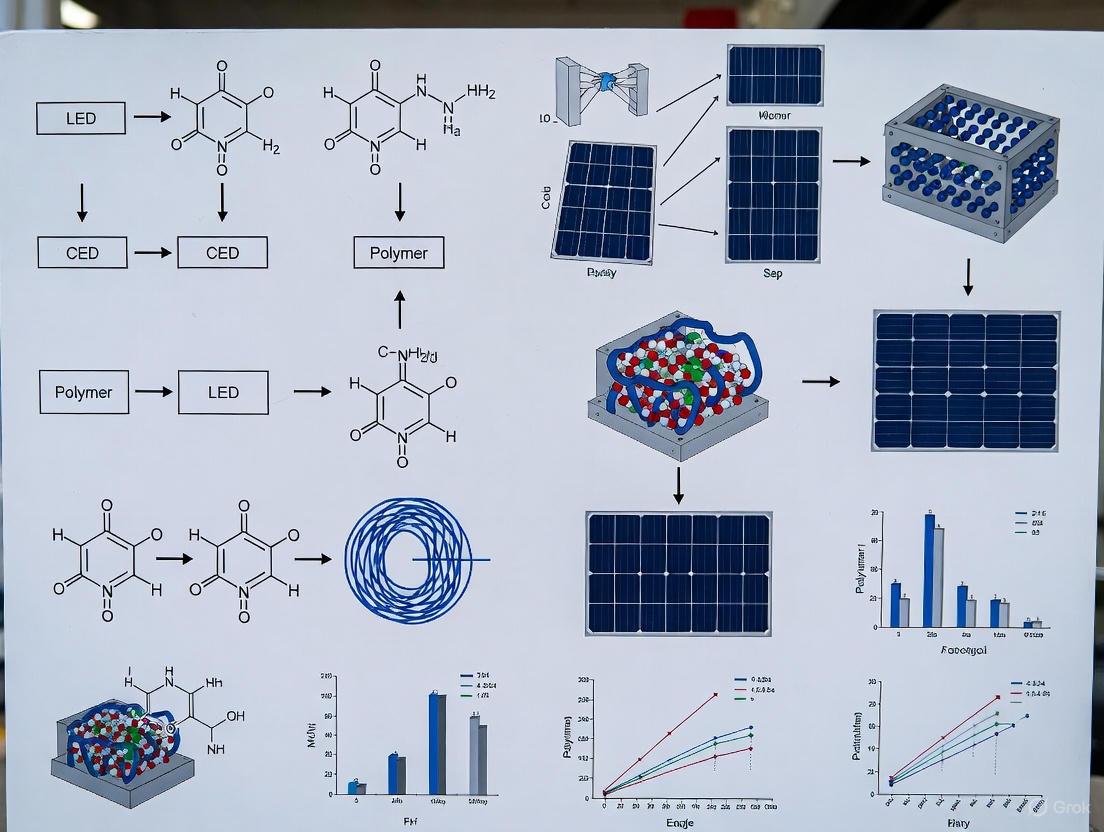
This article provides a comprehensive review for researchers and scientists on the application of conducting polymers in light-emitting diodes (LEDs) and photovoltaic cells.
Conducting Polymers in Electronics: Pioneering Sustainable LEDs and Advanced Photovoltaics
Abstract
This article provides a comprehensive review for researchers and scientists on the application of conducting polymers in light-emitting diodes (LEDs) and photovoltaic cells. It explores the foundational principles of conductive organic materials, detailing their unique electronic structures and the mechanisms behind their optical and electrical properties. The scope extends to advanced synthesis techniques, device architecture, and integration strategies for both OLED displays and third-generation solar cells. The content critically addresses key challenges in stability and scalability while presenting optimization methodologies. A comparative analysis validates the performance of polymer-based devices against conventional technologies, highlighting their transformative potential for flexible, lightweight, and sustainable electronic applications.
The Molecular Foundation of Conducting Polymers: From Discovery to Electronic Structure
The discovery that polymers, traditionally considered insulators, could conduct electricity fundamentally reshaped the landscape of materials science and electronics. This breakthrough centered on polyacetylene, a simple conjugated polymer that, when properly doped, could achieve metallic levels of conductivity. The pioneering work of Hideki Shirakawa, Alan G. MacDiarmid, and Alan J. Heeger in the mid-1970s unveiled this transformative potential, earning them the 2000 Nobel Prize in Chemistry [1] [2]. Their discovery did not merely introduce a new class of materials; it bridged the conceptual gap between the worlds of plastics and metals, launching the field of organic electronics and enabling the development of technologies ranging from flexible transparent conductors to organic light-emitting diodes (OLEDs) and biomedical sensors [3] [4].
This article situates the discovery of conductive polyacetylene within the broader context of research on conducting polymers for LEDs and photovoltaic cells. We detail the historical accident that led to the synthesis of processable polyacetylene films, the critical experiments that revealed their exceptional electronic properties, and the subsequent development of experimental protocols that have become foundational to the field.
The Accidental Discovery and Key Experiments
The path to conductive polyacetylene began with a "fortuitous error" in Hideki Shirakawa's laboratory in 1967. A visiting scientist, Hyung Chick Pyun, inadvertently used a catalyst concentration that was a thousand times too high while attempting to polymerize acetylene [2] [5]. Instead of the typical unprocessable black powder, this mistake yielded a beautiful, silvery, freestanding polyacetylene film with a metallic luster [5]. This serendipitous synthesis was the crucial first step, as it provided a polyacetylene sample in a form suitable for detailed physical and chemical experimentation [6].
The pivotal collaboration began when Shirakawa met Alan MacDiarmid in Tokyo. MacDiarmid, who was working on the inorganic metallic polymer (SN)ₓ, became intrigued upon learning about Shirakawa's silvery organic film [2]. He invited Shirakawa to the University of Pennsylvania, where he and physicist Alan Heeger were conducting research. This interdisciplinary partnership—between a synthetic chemist (Shirakawa), an inorganic chemist (MacDiarmid), and a physicist (Heeger)—proved to be immensely fruitful.
Their key experiment involved exposing the trans-polyacetylene film to iodine vapor (oxidative doping) [2]. When one of Heeger's students measured the conductivity of the iodine-doped film, they observed a staggering increase—the conductivity had jumped by a factor of ten million compared to the pristine film, achieving a conductivity of up to 10³ S/cm [1] [2] [4]. This single experiment demonstrated that an organic polymer could exhibit conductivity comparable to that of metals. The team published their landmark findings in 1977, announcing the synthesis of electrically conducting organic polymers to the world [5].
Table 1: Key Properties of pristine and Iodine-Doped Polyacetylene Films
| Property | Pristine cis-rich film | Pristine trans-rich film | Iodine-Doped trans film |
|---|---|---|---|
| Electrical Resistivity | 2.4 x 10⁸ Ω·cm [6] | 1.0 x 10⁴ Ω·cm [6] | ~10⁻³ Ω·cm (Conductivity ~10³ S/cm) [4] |
| Energy Gap | 0.93 eV [6] | 0.56 eV [6] | Not Applicable (Metallic behavior) |
| Appearance | Copper-coloured [2] | Silvery [2] | Not Specified |
The Molecular Basis of Conductivity
The exceptional electronic properties of polyacetylene and other conductive polymers arise from their unique molecular structure:
- Conjugated Backbone: Polyacetylene consists of a linear chain of carbon atoms with alternating single (σ) and double (π) bonds. This conjugation creates a system where the π-electrons are delocalized across the entire chain, forming a one-dimensional electronic band [2] [4].
- Doping: The pristine polymer is a semiconductor. Doping is the critical process that dramatically enhances conductivity. It involves either oxidation (removing electrons, p-type) or reduction (adding electrons, n-type). In the case of the seminal experiment, oxidation with iodine (I₂) created positively charged sites (holes) along the polymer chain [2].
- Charge Carriers: Upon doping, the polymer backbone undergoes structural changes. The resulting charge carriers are not free electrons as in a metal, but quasiparticles such as polarons and solitons. These are radical cations (or anions) coupled with a local lattice distortion, which can move rapidly along the polymer chain when an electric field is applied [2].
Experimental Protocols and Methodologies
The discovery of conductive polyacetylene was made possible by specific experimental protocols, which have since been refined and become standard in the field.
Synthesis of Polyacetylene Films via the Shirakawa Method
This protocol describes the synthesis of freestanding polyacetylene films, a crucial enabling technique [6] [5].
- Primary Reagents: Acetylene gas (monomer), Ziegler-Natta catalyst (e.g., Ti(OBu)₄ / Al(Et)₃ in an organic solvent like toluene).
- Procedure:
- Catalyst Preparation: Under a strict inert atmosphere (e.g., in a glovebox or using Schlenk techniques), prepare a concentrated solution of the Ziegler-Natta catalyst in toluene.
- Film Formation: Pour the catalyst solution into a reaction vessel. Do not stir. Instead, allow the solution to remain quiescent.
- Polymerization: Introduce acetylene gas into the vessel at a controlled pressure and temperature (e.g., -78°C to room temperature). A polyacetylene film will begin to form on the surface of the catalyst solution.
- Harvesting: After a predetermined reaction time (minutes to hours), carefully remove the resulting freestanding film from the solution.
- Washing: Repeatedly wash the film with an appropriate solvent (e.g., toluene, followed by methanol) to remove any residual catalyst.
- Drying: Dry the film under vacuum to constant weight. The morphology (cis/trans ratio) can be controlled by varying the polymerization temperature [2].
Chemical Doping of Polyacetylene Films
This protocol outlines the process of enhancing the electrical conductivity of the synthesized films through chemical doping [2].
- Primary Reagents: Freestanding polyacetylene film, doping agent (e.g., iodine crystals for p-type, sodium vapor for n-type).
- Procedure:
- Setup: In a sealed glass apparatus (e.g., a two-legged reactor under vacuum), place the pristine polyacetylene film in one leg and the solid doping agent (e.g., I₂) in the other.
- Doping: Cool the leg containing the doping agent (e.g., with liquid N₂) and evacuate the entire system. Isolate the system from the vacuum line.
- Vapor Exposure: Allow the doping agent leg to warm to room temperature, causing its vapor to fill the chamber and contact the polyacetylene film.
- Reaction Monitoring: Observe a rapid color change in the film, indicating the doping reaction. For iodine, the silvery film turns a golden-bronze color.
- Completion: The doping process can be controlled by varying the exposure time and vapor pressure of the dopant. The reaction is typically rapid (seconds to minutes).
- Characterization: The doped film can be removed for conductivity measurements, which typically show an increase in conductivity of many orders of magnitude.
Table 2: Common Doping Agents and Their Effects on Polyacetylene
| Doping Type | Doping Agent | Chemical Reaction | Effect on Conductivity |
|---|---|---|---|
| Oxidative (p-type) | Iodine (I₂) | [CH]ₙ + 3x/2 I₂ → [CH]ₙˣ⁺ + x I₃⁻ [2] | Increase of up to 10⁹ times [2] |
| Oxidative (p-type) | Bromine (Br₂) | Not Specified | Similar to Iodine (High increase) [3] |
| Reductive (n-type) | Sodium (Na) | [CH]ₙ + x Na → [CH]ₙˣ⁻ + x Na⁺ [2] | Significant increase (n-type conductor) |
Electrical Characterization: Four-Point Probe Measurement
To accurately measure the high conductivity of doped films, a four-point probe technique is essential to eliminate the contribution of contact resistances.
- Equipment: Four-point probe station, DC constant current source, high-impedance voltmeter, sample stage.
- Procedure:
- Sample Mounting: Place the doped polyacetylene film on a flat, insulating stage. Ensure good contact.
- Probe Alignment: Position four equally spaced, collinear probes in contact with the surface of the film.
- Current Application: Apply a known, constant DC current (I) between the two outer probes using the current source.
- Voltage Measurement: Measure the voltage drop (V) between the two inner probes using the voltmeter.
- Calculation: The sheet resistance (Rₛ) can be calculated from I and V, and the bulk conductivity (σ) can be derived if the film thickness (t) is known: σ = 1 / (Rₛ * t).
The Scientist's Toolkit: Key Research Reagents and Materials
Table 3: Essential Research Reagents and Materials for Conducting Polymer Research
| Reagent/Material | Function/Description | Key Applications |
|---|---|---|
| Ziegler-Natta Catalyst | A coordination catalyst (e.g., Ti(OBu)₄ / Al(Et)₃) for stereospecific polymerization of acetylene [6]. | Synthesis of polyacetylene films with controllable cis/trans isomeric content [5]. |
| Iodine (I₂) | A strong oxidative (p-type) doping agent that accepts electrons from the polymer backbone [2]. | Used in the seminal doping experiment to dramatically increase polyacetylene conductivity [2]. |
| Poly(3,4-ethylenedioxythiophene): Polystyrene sulfonate (PEDOT:PSS) | A commercially available, water-dispersible conductive polymer complex. PSS acts a counterion and doping agent [3] [7]. | Transparent conductive layers in OLEDs and OPVs; electrochromic devices; bioelectronics [3] [7]. |
| Polyaniline (PANI) | A conductive polymer whose conductivity is highly dependent on both oxidation state and protonation (acid doping) [4]. | Antistatic coatings, corrosion inhibition, printed circuit board manufacturing [2] [4]. |
Impact on Modern Electronics and Future Directions
The discovery of conductive polyacetylene served as the foundation for the entire field of organic electronics. The fundamental principles of conjugation and doping have been applied to a wide range of other polymers, leading to materials with tailored properties for specific applications [3] [8].
The impact is particularly evident in two areas central to the thesis context:
- Light-Emitting Diodes (LEDs): Conjugated polymers like poly(p-phenylene vinylene) (PPV) are used as the active layer in Polymer Light-Emitting Diodes (PLEDs). When an electric current is applied, these semiconductors emit light through electroluminescence, enabling flexible, thin-film displays [2] [4].
- Photovoltaic Cells: In organic solar cells (OPVs), conductive polymers such as poly(3-hexylthiophene) (P3HT) act as electron donors, while fullerene or non-fullerene acceptors act as electron acceptors. This bulk heterojunction architecture efficiently converts light into electricity, offering a path toward low-cost, printable solar panels [3] [7].
Future research continues to build upon this historic breakthrough. The development of conjugated polyelectrolytes (CPEs), which feature ionic side groups, allows for simultaneous electronic and ionic transport, opening new possibilities in bioelectronics and energy storage [8]. Furthermore, the exploration of two-dimensional conjugated coordination polymers (2D c-CPs) promises materials with exceptionally high charge mobility, potentially suitable for advanced hot-carrier applications in optoelectronics [9]. The journey that began with a fortuitous error in a chemistry lab continues to drive innovation at the frontiers of materials science.
The conjugated backbone is the fundamental component of conducting polymers, consisting of a chain of organic molecules with alternating single and double bonds. This structure creates a system of delocalized π-electrons from the overlapping pₓ-orbitals along the polymer chain, which is responsible for the unique electrical and optical properties of these materials [10]. In their pristine, undoped state, conjugated polymers are insulators, but they can achieve significant electrical conductivity through various doping methods, including chemical, electrochemical, or photochemical processes that introduce charge carriers into the π-electron system [10] [7].
The electronic band structure arising from this conjugation creates semiconducting characteristics, with a well-defined highest occupied molecular orbital (HOMO) and lowest unoccupied molecular orbital (LUMO) separated by a band gap typically within the visible light spectrum [8]. The planar configuration of the backbone allows for optimal π-orbital overlap, forming a delocalized pathway that facilitates charge transport along the polymer chain [8]. The development of conductive polymers represents a significant advancement in materials science, earning the Nobel Prize in Chemistry in 2000, and has opened avenues for applications in optoelectronics, energy storage, and conversion devices [8] [7].
Band Structure Fundamentals
The electronic properties of conjugated polymers are governed by their band structure, which arises from the quantum mechanical interactions within the π-conjugated system. The highest occupied molecular orbital (HOMO) and lowest unoccupied molecular orbital (LUMO) represent the valence and conduction band edges, respectively, with their energy separation determining the optical band gap of the material [8].
Backbone engineering through strategic molecular design allows precise tuning of these energy levels. A highly effective approach involves creating donor-acceptor (D-A) architectures by alternating electron-rich (donor) and electron-deficient (acceptor) units along the polymer backbone [8]. This D-A interaction facilitates π-electron delocalization and can lead to the formation of a quinoid resonance structure, effectively reducing the band gap and enhancing electronic properties [8]. Experimental modifications, such as incorporating fluorine or chlorine atoms into the backbone, can further modulate energy levels; fluorination deepens HOMO levels, while chlorination can improve morphological packing and red-shift absorption [8].
Table 1: Fundamental Electronic Properties of Common Conjugated Polymer Backbones
| Polymer | HOMO Level (eV) | LUMO Level (eV) | Band Gap (eV) | Key Characteristics |
|---|---|---|---|---|
| MEH-PPV | ~ -5.0 | ~ -3.0 | ~ 2.0 | Flexible backbone, higher planarity in solution [10] |
| P3HT | ~ -5.0 | ~ -3.0 | ~ 2.0 | Thiophene-based, prone to torsional disorder [10] |
| Th-BDT Polymer | -5.01 | -3.49 | 1.52 | Donor-acceptor design, high planarity [11] |
| O-BDT Polymer | -5.05 | -3.53 | 1.52 | Alkoxy side chains, moderate planarity [11] |
Charge Transport Mechanisms
Charge transport in conjugated polymers occurs through a complex interplay of intra-chain and inter-chain processes that collectively determine the overall charge carrier mobility.
Intra-chain Charge Transport
Intra-chain transport refers to charge movement along individual polymer chains, where the conjugated backbone provides a pathway for charge delocalization. The efficiency of this process depends critically on the planarity and conformational order of the backbone [10]. Torsional disorder between monomer units disrupts π-orbital overlap, reducing transfer integrals and creating energetic barriers that localize charge carriers [10]. Experimental studies comparing isolated chains of poly(phenylene vinylene) (PPV) and polythiophene derivatives have demonstrated that more planar backbones (like PPV) can exhibit hole mobilities over an order of magnitude higher than those with greater torsional freedom (like polythiophene) [10].
Inter-chain Charge Transport
Inter-chain transport occurs between adjacent polymer chains through π-π stacking interactions and is essential for macroscopic charge transport in thin films [8]. In amorphous organic systems, this process is described by an intermolecular hopping mechanism [12]. The charge hopping rate between molecules can be modeled using Marcus theory, which accounts for electronic coupling, reorganization energy, and energetic disorder [12]. Multiscale simulations of amorphous films reveal that charge mobility is not uniform but broadly distributed over several orders of magnitude due to various trapping mechanisms [12].
Table 2: Charge Transport Properties in Different Polymer Systems
| System/Measurement | Hole Mobility (cm² V⁻¹ s⁻¹) | Electron Mobility (cm² V⁻¹ s⁻¹) | Notes | Reference |
|---|---|---|---|---|
| Isolated MEH-PPV chains | ~10⁻¹ (microwave freq.) | - | Intra-chain transport only | [10] |
| Isolated P3HT chains | ~10⁻² (microwave freq.) | - | Intra-chain transport only | [10] |
| CBP amorphous film | 4.5×10⁻³ (avg) | 1.6×10⁻³ (avg) | Macroscopic measurement | [12] |
| CBP mobility distribution | 8.5×10⁻³ (max) to 4.6×10⁻⁵ (min) | 4.2×10⁻³ (max) to 3.0×10⁻⁵ (min) | 100 nm film, shows variability | [12] |
| Percolation threshold | - | - | Polymer acceptors have lower thresholds than small molecules | [13] |
Three primary trap types limit charge transport efficiency in disordered organic systems:
- Diagonal traps (Energetic): Arise from site energy differences between molecules due to electrostatic fluctuations or structural heterogeneity [12].
- Off-diagonal traps (Structural): Result from unfavorable molecular packing that reduces electronic coupling between adjacent sites [12].
- Backward hopping traps: Occur when charges hop against the electric field direction, particularly at low fields or in highly disordered regions [12].
Diagram 1: Charge transport pathways and limitations in conjugated polymer systems, showing how intra-chain and inter-chain processes contribute to overall mobility, with torsional disorder and trapping mechanisms as primary limiting factors [10] [12].
Experimental Characterization Methods
Pulse Radiolysis-Time-Resolved Microwave Conductivity (PR-TRMC)
The PR-TRMC technique enables direct measurement of intra-chain charge mobility by eliminating inter-chain contributions [10]. This electrodeless method involves generating charge carriers through pulsed electron beam irradiation of a dilute polymer solution and detecting conductivity changes via microwave absorption [10].
Protocol: PR-TRMC Measurement for Intra-chain Mobility
- Sample Preparation: Prepare dilute polymer solutions (typically ~1 mg/mL) in an appropriate solvent (e.g., benzene) to ensure chain isolation [10].
- Pulse Radiolysis: Irradiate the solution with a short electron beam pulse (e.g., 10-ns pulse of 3-MeV electrons) to generate charge carriers through solvent ionization [10].
- Charge Transfer: Allow positive charges (holes) to transfer to polymer chains via reaction with solvent radical cations [10].
- Microwave Probing: Monitor time-dependent conductivity using microwave frequencies (e.g., ~30 GHz) to detect charge motion along isolated chains [10].
- Mobility Calculation: Determine the charge carrier mobility from the radiation chemical yield of charges and the maximum change in microwave conductivity [10].
Transient Absorption Spectroscopy
Transient absorption spectroscopy probes charge transfer dynamics by monitoring spectral changes following photoexcitation, providing insights into both intra-chain and inter-chain processes [14].
Protocol: Transient Absorption Measurement of Charge Transfer Dynamics
- Sample Preparation: Prepare polymer solutions at various concentrations (e.g., 0.01-1 mg/mL) or thin films to study concentration-dependent effects [14].
- Pump-Probe Setup: Use a nanosecond laser flash photolysis system with a pulsed Nd:YAG laser as the excitation source and a xenon lamp as the probe light [14].
- Spectral Acquisition: Record time-resolved absorption spectra at delays from nanoseconds to milliseconds after excitation [14].
- Feature Identification: Identify characteristic signals including ground-state bleaching (GSB), stimulated emission (SE), and photoinduced absorption (PIA) features [14].
- Kinetic Analysis: Analyze decay dynamics to distinguish between intra-chain (slower decay) and inter-chain (faster decay) processes [14].
Space-Charge-Limited Current (SCLC) Measurements
The SCLC method determines charge carrier mobility in thin films through electron-only or hole-only devices, particularly useful for studying percolation thresholds and impurity effects [13].
Protocol: SCLC Mobility Measurement in Electron-Only Devices
- Device Fabrication: Fabricate electron-only devices with structure ITO/ZnO/Active Layer/PFN-Br/Ag, optimizing active layer thickness (~100 nm) [13].
- J-V Characterization: Measure current density-voltage (J-V) characteristics in the dark, focusing on the space-charge-limited region [13].
- Mobility Extraction: Fit J-V curves to the Mott-Gurney law: ( J = \frac{9}{8} \epsilon \epsilon_0 \mu \frac{V^2}{L^3} ), where μ is mobility, ε is dielectric constant, ε₀ is vacuum permittivity, and L is active layer thickness [13].
- Percolation Analysis: Measure mobility at different acceptor weight fractions to determine the percolation threshold [13].
- Impurity Tolerance Testing: Introduce insulating polymers (e.g., polystyrene) at varying concentrations to simulate degradation effects on electron transport connectivity [13].
Table 3: Comparison of Experimental Techniques for Characterizing Charge Transport
| Technique | Spatial Resolution | Temporal Resolution | Key Measured Parameters | Advantages | Limitations |
|---|---|---|---|---|---|
| PR-TRMC | Molecular scale (intra-chain) | Nanoseconds | Intra-chain mobility, radiation chemical yield | Eliminates inter-chain effects; measures isolated chains | Requires specialized radiation source; solution-based |
| Transient Absorption Spectroscopy | Molecular to aggregate scale | Femtoseconds to milliseconds | Excited-state dynamics, charge transfer rates, spectral signatures | Provides detailed kinetic information; identifies species | Complex data interpretation; requires modeling |
| SCLC | Device scale (macroscopic) | Steady-state | Charge carrier mobility, trap density, percolation threshold | Simple device structure; directly relevant to devices | Requires complete devices; assumes ideal SCLC regime |
| Time-of-Flight (TOF) | Device scale (macroscopic) | Microseconds | Charge carrier mobility, transit time, disorder parameters | Measures both electrons and holes; established technique | Requires thick films (>1 μm); may not represent thin-film devices |
The Scientist's Toolkit: Research Reagent Solutions
Table 4: Essential Research Reagents for Conjugated Polymer Studies
| Reagent/Material | Function/Application | Key Characteristics | Representative Examples |
|---|---|---|---|
| Conjugated Polyelectrolytes (CPEs) | Dual ionic-electronic conductors; interfacial layers | π-conjugated backbone with ionic side groups; tunable energy levels | PFN-Br, PDTzTI [8] [15] |
| Donor-Acceptor Polymers | Low-bandgap semiconductors; photoactive layers | Alternating electron-rich and electron-deficient units; enhanced charge separation | Th-BDT, O-BDT [8] [11] |
| Conjugated Polymer Ligands | Quantum dot surface functionalization; passivation | Strong π-π interactions with surfaces; improved charge transport | Th-BDT with ethylene glycol side chains [11] |
| PEDOT:PSS | Hole transport layer; transparent electrode | High conductivity (>1000 S cm⁻¹); excellent processability | Commercial Clevios products [7] [15] |
| Polymeric Acceptors | Electron transport in all-polymer solar cells | Enhanced electron transport connectivity; lower percolation thresholds | PY-V-γ [13] |
| Reorganization Energy Standards | Reference for charge transfer calculations | Well-characterized λ values for theoretical modeling | Nelsen's four-point method compounds [12] |
Diagram 2: Integrated experimental workflow for comprehensive charge transport analysis in conjugated polymers, combining multiple characterization techniques to elucidate mechanisms across different length scales [10] [14] [12].
Application in Optoelectronic Devices
The relationship between backbone structure, band properties, and charge transport mechanisms directly influences the performance of conjugated polymers in optoelectronic devices. In organic light-emitting diodes (OLEDs), charge transport and recombination efficiency in the amorphous emission layer determine device efficiency and lifetime [12]. The broad distribution of charge mobilities in amorphous organic films (spanning up to two orders of magnitude) significantly impacts recombination profiles and contributes to efficiency roll-off at high currents [12].
In organic photovoltaics, charge transport connectivity is a critical factor influencing device stability [13]. Polymer acceptors with extended conjugation lengths form more robust electron transport networks with superior connectivity compared to small molecular acceptors, maintaining higher electron mobilities even under adverse conditions such as impurity incorporation or partial degradation [13]. This enhanced connectivity provides greater tolerance to compositional variations, a key advantage for long-term operational stability [13].
For perovskite solar cells, conjugated polymers serve multiple functions including charge transport layers, interfacial passivants, and electrodes [15]. As electron transport layers (ETLs), n-type conjugated polymers like PDTzTI and PFNDI provide favorable energy level alignment while passivating surface defects through coordination between heteroatoms in the polymer backbone and undercoordized Pb²⁺ ions on the perovskite surface [15]. The planar, conjugated structure enables efficient charge extraction while the polymeric nature improves film formation and processing compatibility.
The conjugated backbone serves as the fundamental building block that dictates the electronic and transport properties of conducting polymers. Through strategic backbone engineering, including donor-acceptor architectures and side-chain functionalization, key parameters such as band gap, energy levels, and intermolecular packing can be precisely controlled to optimize material performance for specific applications. Charge transport occurs through a complex hierarchy of intra-chain and inter-chain processes, with overall mobility often limited by various trapping mechanisms arising from energetic and structural disorder. Advanced characterization techniques, particularly PR-TRMC for intra-chain transport and transient absorption spectroscopy for dynamics, provide crucial insights into these processes across multiple length and time scales. As research progresses, a continued deeper understanding of the structure-property relationships governing conjugated backbones will enable the development of next-generation materials with enhanced performance and stability for advanced optoelectronic and energy applications.
π-Conjugated polymers represent a cornerstone of modern organic electronics, merging the electronic properties of semiconductors with the mechanical flexibility and processability of plastics [16]. Their fundamental structure features alternating single and double bonds along the polymer backbone, leading to a delocalized π-electron system that enables electrical conductivity and optical activity [16]. Among these materials, polyaniline (PANI), polypyrrole (PPy), and poly(3,4-ethylenedioxythiophene):poly(styrenesulfonate) (PEDOT:PSS) have emerged as the most technologically significant polymer families, finding extensive applications in photovoltaics, light-emitting diodes, sensors, and energy storage devices [17] [18]. Their utility in optoelectronic devices stems from tunable energy levels, diverse synthesis routes, and the ability to function as both active and interfacial layers [16]. This application note details the properties, synthesis protocols, and photovoltaic applications of these three key polymer families within the context of ongoing research in conducting polymers for energy conversion and storage.
Material Properties and Comparative Analysis
The three polymer families exhibit distinct chemical structures and resulting electronic properties that dictate their specific applications in optoelectronic devices.
Polyaniline (PANI) is characterized by its three distinct oxidation states: leucoemeraldine (fully reduced), emeraldine (partially oxidized), and pernigraniline (fully oxidized) [17]. The emeraldine salt form is electrically conductive, with conductivity that can reach up to 30 S/cm upon doping with protonic acids [17]. PANI demonstrates excellent environmental stability, reversible doping/dedoping chemistry, and remarkable anti-corrosion properties [17].
Polypyrrole (PPy) offers high environmental stability, good electrical conductivity, and biocompatibility [19]. Its conductivity is highly dependent on synthesis conditions and dopants, with reported values typically ranging from 10 to 400 S/cm [19] [20]. PPy is generally insoluble and infusible, presenting processing challenges that are often addressed through the formation of composites and hybrid nanostructures [19].
PEDOT:PSS is a polymer complex where positively charged PEDOT chains are stabilized by negatively charged PSS chains in an aqueous dispersion [21] [22]. This complex exhibits high transparency in the visible region, adjustable electrical conductivity (from 10⁻⁴ to over 4000 S/cm with appropriate treatments), and excellent film-forming properties [18] [22]. The work function of PEDOT:PSS ranges from 5.0 to 5.2 eV, making it particularly suitable as a hole-injection/transport layer [21].
Table 1: Comparative Properties of Key Conducting Polymer Families
| Property | PANI | PPy | PEDOT:PSS |
|---|---|---|---|
| Typical Conductivity Range | 10⁻¹⁰ to 30 S/cm [17] [23] | 10–400 S/cm [19] [20] | 10⁻⁴ to >4000 S/cm [18] [22] |
| Primary Dopants | Protonic acids (HCl, CSA) [17] | Anionic surfactants, FeCl₃, APS [19] | PSS (intrinsic), polar solvents [21] |
| Solubility/Processability | Soluble with functionalized acids [17] | Generally insoluble, requires composites [19] | Excellent water dispersibility [22] |
| Key Advantages | Environmental stability, low cost [17] | High stability, biocompatibility [19] | High transparency, tunable WF [21] |
| Common PV Applications | Hole injection layer, counter electrode [24] [23] [25] | Electrolyte additive, composite electrode [20] | HTL, flexible transparent electrode [21] [22] |
Table 2: Representative Solar Cell Performance Metrics
| Polymer | Device Architecture | Reported Efficiency | Key Function |
|---|---|---|---|
| PANI | Organic PV (P3HT:PCBM) [23] | ~2.5% [23] | Hole injection layer |
| PANI@2D-MoSe₂ | Dye-sensitized Solar Cell [25] | 7.38% [25] | Counter electrode |
| PPy/NL Composite | Dye-sensitized Solar Cell [20] | Optimized at 50% NL [20] | Electrolyte component |
| PEDOT:PSS | Organic Solar Cell [22] | >12% [22] | Flexible electrode |
| PEDOT:PSS | Perovskite Solar Cell [21] | Varies with modification [21] | Hole transport layer |
Experimental Protocols
Synthesis and Fabrication Methods
Electrochemical Synthesis of PANI@2D-MoSe₂ Binary Composite
This protocol describes the synthesis of a PANI and molybdenum selenide composite for use as a high-performance counter electrode in dye-sensitized solar cells (DSSCs), adapted from established procedures [25].
Materials:
- Aniline monomer
- Hydrochloric acid (HCl, 0.1 M)
- Two-dimensional molybdenum selenide (2D-MoSe₂) synthesized via hydrothermal method [25]
- Fluorine-doped tin oxide (FTO) conductive glass substrates
Procedure:
- Prepare the electrolyte solution by dissolving 0.3 g of 2D-MoSe₂ in 50 mL of 0.1 M HCl electrolyte solution.
- Dissolve aniline monomer in 0.1 M HCl to achieve a concentration of approximately 0.1 M.
- Set up a standard three-electrode electrochemical cell:
- Working Electrode: FTO glass substrate
- Counter Electrode: Platinum wire or mesh
- Reference Electrode: Standard calomel electrode (SCE) or Ag/AgCl
- Perform electrochemical polymerization using cyclic voltammetry (CV) with the following parameters:
- Potential window: -1.0 V to +2.0 V (vs. reference electrode)
- Scan rate: 50 mV/s
- Number of cycles: 10
- After polymerization, remove the FTO substrate with the deposited PANI@2D-MoSe₂ film.
- Rinse gently with deionized water and dry under ambient conditions or in a vacuum oven at moderate temperature (50-60°C).
Characterization: The resulting composite can be characterized by FE-SEM and HR-TEM to observe the polymer-covered sheet-like morphology, and by XRD to confirm the octahedral crystalline phase [25].
Chemical Oxidative Polymerization of PPy-PEI Hybrid Nanoparticles
This protocol describes the synthesis of hybrid polypyrrole-polyethyleneimine (PPy-PEI) nanoparticles with tunable size and conductivity for potential use in sensors and energy applications [19].
Materials:
- Pyrrole monomer (distilled under vacuum before use)
- Polyethyleneimine (PEI, hyperbranched polymer)
- Iron(III) chloride (FeCl₃, oxidant)
- Hydrochloric acid (HCl, for acidic medium)
- Methanol (for washing)
Procedure:
- Prepare an acidic aqueous solution (e.g., using HCl) as the reaction medium.
- Dissolve PEI template in the acidic solution. The [PEI]/[PY] ratio can be varied to control particle size.
- Add the distilled pyrrole monomer to the solution.
- In a separate container, dissolve FeCl₃ in cold distilled water. The [FeCl₃]/[PY] molar ratio influences yield and conductivity [19].
- Slowly add the oxidant solution to the monomer/PEI solution in a one-step addition without stirring to initiate polymerization.
- Allow the reaction to proceed for 24 hours at room temperature. A black precipitate of PPy-PEI will form.
- Recover the product by filtration.
- Wash the precipitate thoroughly with methanol and water to remove unreacted monomers and oligomers.
- Dry the final product in a vacuum oven at 70°C.
Notes: Particle size (85-300 nm) can be tuned by varying reactant concentrations. Conductivity can range from 0.1 to 6.9 S/cm [19].
Preparation of High-Conductivity PEDOT:PSS Electrodes
This protocol outlines the processing and post-treatment methods for creating PEDOT:PSS films with high electrical conductivity suitable for use as flexible transparent electrodes in solar cells [21] [22].
Materials:
- PEDOT:PSS aqueous dispersion (e.g., Clevios PH1000)
- Conductivity-enhancing solvent additives: Dimethyl sulfoxide (DMSO), ethylene glycol (EG), or sorbitol
- Substrates (glass or flexible PET)
Procedure:
- Solution Formulation: Mix the PEDOT:PSS aqueous dispersion with a conductivity-enhancing additive.
- A typical recommendation is 5-7% v/v of DMSO or EG added to the dispersion [22].
- Stir the mixture thoroughly for several hours to ensure homogeneity.
- Film Deposition: Deposit the formulated solution onto the substrate.
- Spin-coating: A common method for lab-scale devices. Typical spin speeds range from 2000-4000 rpm for 30-60 seconds to achieve films ~30-100 nm thick.
- Other methods like spray-coating, inkjet printing, or doctor blading can also be used.
- Thermal Annealing: Bake the deposited films on a hotplate.
- Typical annealing temperature: 110-140°C
- Typical annealing time: 10-20 minutes
- Post-Treatment (Optional): For further enhancement of conductivity, implement a post-treatment step.
- Acid Treatment: Carefully treat the film with concentrated sulfuric acid (H₂SO₄) for a short duration, followed by thorough rinsing with water [22].
- Solvent Treatment: Dip-coat or drop-cast a secondary solvent like EG or glycerol onto the annealed film, followed by a second annealing step.
Notes: The chosen formulation and processing parameters significantly impact final conductivity, transparency, and mechanical properties. Films prepared with Clevios PH1000 and optimized treatment can achieve conductivities exceeding 1000 S/cm and transmittance >90% at 550 nm [22].
Device Fabrication Workflow
The following diagram illustrates a generalized workflow for fabricating a solution-processed organic or hybrid solar cell, highlighting the integration points for PANI, PPy, and PEDOT:PSS.
Solar Cell Fabrication Workflow
The Scientist's Toolkit: Research Reagent Solutions
Table 3: Essential Research Reagents for Conducting Polymer-Based Photovoltaics
| Reagent/Material | Function/Application | Example Specifications / Notes |
|---|---|---|
| PEDOT:PSS Aqueous Dispersions | Hole transport layer (HTL), flexible transparent electrode [21] [22] | Clevios P VP AI 4083: Standard HTL (1:6 PEDOT:PSS). Clevios PH1000: High-conductivity electrode (1:2.5 PEDOT:PSS) [21]. |
| Polar Solvent Additives | Secondary dopants to enhance PEDOT:PSS conductivity [21] [22] | Dimethyl sulfoxide (DMSO), Ethylene Glycol (EG). Typically added at 5-7% v/v to dispersion. |
| Aniline Monomer | Precursor for PANI synthesis [17] [25] | Requires distillation before electrochemical synthesis to ensure purity. |
| Protonic Acids | Dopants for PANI to achieve conductive emeraldine salt form [17] [23] | Camphorsulfonic Acid (CSA), HCl. Functionalized acids (e.g., CSA) improve solubility [17]. |
| Pyrrole Monomer | Precursor for PPy synthesis [19] [20] | Requires distillation before chemical oxidative polymerization [19]. |
| Chemical Oxidants | Initiators for chemical polymerization of PANI and PPy [19] [20] | Ammonium Persulfate (APS), Iron(III) Chloride (FeCl₃). Choice affects conductivity and yield [19]. |
| FTO/ITO Coated Glass | Transparent conductive substrates for device fabrication [25] | FTO is often preferred for high-temperature processing. |
| High Boiling Point Solvents | Used for post-treatment of PEDOT:PSS films [21] | Glycerol, Sorbitol. Post-treatment can further enhance film conductivity and morphology. |
Performance and Optimization Strategies
PANI in Photovoltaics
PANI serves effectively as a hole injection layer (HIL) in organic photovoltaic cells (OPVCs). Research demonstrates that both water-based and organic solvent-based PANI dispersions can achieve power conversion efficiencies (PCE) of approximately 2.5% in poly(3-hexylthiophene) (P3HT) and [6,6]-phenyl C61 butyric acid methyl ester (PCBM) bulk heterojunction cells [23]. Performance is highly dependent on the conductivity, thickness, and dopant of the PANI film, with optimal results requiring high transparency (>90%) and a conductivity around 10⁻² S/cm [23]. Recent advancements focus on PANI nanocomposites, such as the PANI@2D-MoSe₂ binary composite, which demonstrates superior performance as a counter electrode in DSSCs, achieving an efficiency of 7.38%, significantly outperforming pristine PANI (5.07%) and even Pt (6.61%) in some configurations [25]. This enhancement is attributed to the combined high conductivity and catalytic activity of the composite.
PPy in Energy Applications
PPy's role in photovoltaics often involves its use in composite materials to enhance electrical properties and device performance. For instance, in DSSCs, incorporating PPy into nanolignin (NL)-based electrolytes significantly improves performance compared to pure NL electrolytes [20]. The PPy/NL composite's electrical conductivity is tunable based on the NL content, with a DC conductivity decrease from 2.88 × 10⁻⁵ S/cm to 1.82 × 10⁻⁸ S/cm as the NL concentration increases tenfold [20]. Optimizing the NL ratio to 50% in the composite maximizes DSSC efficiency [20]. PPy's high stability and conductivity make it a valuable component for creating conductive networks within otherwise insulating or semiconducting matrices.
PEDOT:PSS in State-of-the-Art Solar Cells
PEDOT:PSS is the most widely deployed conducting polymer in organic and hybrid photovoltaics, primarily as a hole transport layer (HTL) and flexible transparent electrode [21] [22]. Its high work function (5.0-5.2 eV) enables efficient hole collection, while its aqueous processability allows for facile integration into device architectures [21]. When employed as a flexible electrode in single-junction PSCs, PEDOT:PSS has enabled PCEs exceeding 12% [22]. However, limitations include acidity (potentially corrosive to ITO) and hygroscopicity, which can accelerate device degradation [21]. Optimization strategies focus on:
- Conductivity Enhancement: Using solvent additives (DMSO, EG) and post-treatments (acid, solvent) to achieve conductivities over 1000 S/cm [21] [22].
- Stability Improvement: Employing cross-linking agents, base treatments (KOH, NaOH) to neutralize acidity, and moisture-blocking interlayers [21].
- Work Function Tuning: Modifying with polar solvents or specific dopants (e.g., PSS-Na, PFI) to optimize energy level alignment with the active layer [21].
PANI, PPy, and PEDOT:PSS each offer a unique portfolio of electronic, optical, and processing properties that make them indispensable for research and development in organic and hybrid photovoltaics. PANI provides excellent environmental stability and customizable conductivity through doping. PPy is valued for its high stability and utility in composites. PEDOT:PSS stands out for its high conductivity, transparency, and commercial availability, making it the current material of choice for interfacial layers and flexible electrodes. The continued advancement of these materials hinges on overcoming challenges related to long-term operational stability, parasitic absorption, and further optimization of cost-effective, scalable processing techniques. The development of novel nanocomposites and sophisticated chemical modification protocols, as outlined in this note, will be crucial for enhancing device performance and pushing the boundaries of conducting polymer-based electronics.
Doping, the intentional introduction of impurities into a material, serves as a fundamental paradigm for precisely tuning the electrical properties of semiconductors. In the context of conducting polymers, this process transforms insulating or semiconducting organic materials into conductors with metallic-like performance, enabling their application in organic light-emitting diodes (OLEDs), photovoltaic cells, and other advanced electronic devices [26]. The breakthrough discovery that doping could enhance polyacetylene's conductivity by several orders of magnitude earned the 2000 Nobel Prize in Chemistry, establishing conductive polymers as a pivotal research field [26] [27].
This article details the experimental frameworks and mechanistic principles underpinning doping strategies for conducting polymers. We provide application notes and standardized protocols to facilitate the rational design of materials with tailored electronic properties for optoelectronic applications, particularly focusing on organic electronics and energy conversion systems where controlled conductivity is paramount.
Doping Mechanisms and Classifications
Doping in conjugated polymers operates through distinct mechanisms that introduce charge carriers into the π-conjugated backbone, dramatically altering their electronic structure. Unlike inorganic semiconductors where dopants substitutionally replace host atoms, organic semiconductor doping primarily relies on charge transfer reactions [26].
Charge Transfer Mechanisms
p-type doping occurs when the polymer acts as an electron donor, transferring electrons to an acceptor dopant. This leaves behind positively charged holes on the polymer backbone, forming polarons or bipolarons that serve as charge carriers [26]. Common p-type dopants include halogen atoms (e.g., iodine), Lewis acids (e.g., FeCl₃), and organic acceptors like F₄TCNQ (2,3,5,6-tetrafluoro-7,7,8,8-tetracyanoquinodimethane) [28] [26].
n-type doping involves the polymer acting as an electron acceptor, where dopants donate electrons to the polymer backbone, creating negative charge carriers [26]. This process is more challenging due to the instability of n-doped polymers in ambient conditions, but can be achieved using reagents such as sodium naphthalide or N-DMBI [26].
Advanced Doping Strategies
Recent advances have introduced sophisticated doping strategies that overcome thermodynamic limitations:
Coupled Reaction Doping leverages a thermodynamically favorable reaction to drive an otherwise unfavorable doping process. By adding additives that are highly reactive to the reduction product of the dopant, this approach creates a coupled reaction system that significantly improves electron transfer efficiency. For instance, adding Lewis acids like tris(pentafluorophenyl)borane (BCF) to nitroxide derivative dopants can enhance electrical conductivity by 3-7 orders of magnitude [29].
Acid-Triggered Side Chain Cleavage represents an innovative chemical approach where treating a specially designed polymer (POET-T2-COOH) with a strong acid (TfOH) removes insulating side chains, dramatically improving backbone planarity and charge delocalization. When combined with traditional dopants like F₄TCNQ, this "cleavage with doping" approach can boost conductivity by up to 100,000 times compared to conventional doping methods [27].
Experimental Protocols
Bulk Iodine Doping of Titanocene Polyamine
Principle: This protocol utilizes elemental iodine as a p-type dopant for the condensation polymer derived from titanocene dichloride and 2-nitro-1,4-phenylenediamine. The doping process increases bulk conductivity by 10 to over 1,000-fold through charge transfer complex formation [28].
Materials:
- Titanocene polyamine polymer (synthesized from titanocene dichloride and 2-nitro-1,4-phenylenediamine)
- Crystalline iodine (I₂)
- Hydraulic pellet press
- Heating mantle with temperature control
- Impedance analyzer for conductivity measurements
Procedure:
- Polymer Synthesis: Synthesize the titanocene polyamine polymer via classical aqueous interfacial polycondensation of titanocene dichloride and 2-nitro-1,4-phenylenediamine, achieving a molecular weight of approximately 2.4 × 10⁴ g/mol [28].
- Sample Preparation: Grind the polymer to a fine powder and compress into discs using a hydraulic press at standardized pressure.
- Doping Process: Mechanically mix polymer discs with precise amounts of iodine (3-15% by weight). For uniform doping, the mixture can be briefly heated (10-60 seconds) to volatilize iodine and enhance dispersion within the polymer matrix.
- Conductivity Measurement: Measure bulk conductivity using a two-electrode system with an impedance analyzer across a frequency range of 100 Hz to 1 MHz. Calculate conductivity from impedance data accounting for sample dimensions.
- Characterization: Employ FTIR spectroscopy to identify the formation of C-I compounds (band at 664 cm⁻¹) and monitor the shift in Ti-N band from 496 to 473 cm⁻¹, confirming successful doping [28].
Notes: Conductivity increases with iodine concentration up to 10-15% doping level. Heating beyond 60 seconds causes iodine evaporation, progressively reducing conductivity until returning to pre-doped levels after 480 seconds of heating [28].
Coupled Reaction Doping for Polymeric Semiconductors
Principle: This advanced protocol enhances p-type doping efficiency in donor-acceptor copolymers like DPP4T by introducing a coupled reaction system. A Lewis acid additive forms a thermodynamically favorable complex with reduced dopant species, driving complete electron transfer from polymer to dopant [29].
Materials:
- DPP4T polymer (poly(2,5-bis(2-octyldodecyl)-3,6-di(thiophen-2-yl)diketopyrrolo[3,4-c]pyrrole-1,4-dione-alt-thieno[3,2-b]thiophene))
- Nitroxide derivative dopants (e.g., TEMPO)
- Lewis acid additives (e.g., tris(pentafluorophenyl)borane, BCF)
- Anhydrous chlorobenzene or chloroform
- Nitrogen glove box
- Glass substrates
- Spin coater or drop-casting equipment
Procedure:
- Solution Preparation: Prepare separate solutions of DPP4T (5-10 mg/mL), dopant (molar ratio 0.01-0.9 relative to polymer repeating unit), and Lewis acid additive in anhydrous chlorobenzene within a nitrogen glove box.
- Solution Mixing: Combine dopant and Lewis acid solutions at 1:1 molar ratio, then mix with polymer solution to achieve desired final concentration.
- Film Deposition: Deposit doped polymer films via drop-casting or spin-coating onto cleaned glass substrates under inert atmosphere.
- Film Drying: Slowly dry films under nitrogen protection at room temperature for 12-24 hours to facilitate solvent evaporation and doping process completion.
- Electrical Characterization: Measure electrical conductivity using four-point probe method and Seebeck coefficient with specialized instrumentation.
Notes: The coupled reaction system enables two-electron transfer per dopant molecule, significantly enhancing doping efficiency. Optimal dopant-to-polymer molar ratio is approximately 0.9, achieving conductivities up to 15.5 S/cm in DPP4T systems [29].
Acid-Triggered Side Chain Cleavage Doping
Principle: This innovative approach simultaneously removes insulating alkyl side chains and introduces dopants, dramatically enhancing backbone planarity and charge transport. The process synergistically combines strong acids with primary dopants to achieve unprecedented conductivity levels [27].
Materials:
- POET-T2-COOH polymer (specially designed with cleavable side chains)
- Trifluoromethanesulfonic acid (TfOH) or similar strong acid
- F₄TCNQ dopant
- Anhydrous solvents (chloroform, toluene)
- Nitrogen glove box
- Thermal annealing equipment
Procedure:
- Polymer Design: Utilize POET-T2-COOH polymer incorporating hydrolysable ester groups in side chains and carboxyl groups for enhanced dopant interaction.
- Solution Preparation: Prepare polymer solution in anhydrous chloroform (5-10 mg/mL) and separate solutions of TfOH and F₄TCNQ.
- Sequential Doping: First treat polymer films with TfOH vapor or solution to cleave insulating butyl side chains (releasing isobutylene), converting side chains to hydroxyl groups.
- Primary Doping: Subsequently expose the side chain-modified polymer to F₄TCNQ solution to p-dope the conjugated backbone.
- Post-treatment: Thermally anneal films at 100°C for 1 hour to enhance molecular ordering and remove residual solvents.
Notes: This approach achieves conductivity enhancements of ~100,000× compared to conventional doping of similar polymers. Doped films exhibit exceptional stability, retaining conductivity after 50 days in inert conditions and showing resistance to solvent exposure and thermal degradation [27].
Data Presentation and Analysis
Table 1: Quantitative Comparison of Doping Methods for Conducting Polymers
| Doping Method | Polymer System | Dopant/Additive | Maximum Conductivity Achieved | Conductivity Enhancement | Key Findings |
|---|---|---|---|---|---|
| Bulk Iodine Doping | Titanocene polyamine | Iodine (3-15 wt%) | Not specified | 10-1,000× | Conductivity increases with iodine concentration up to 10-15%; heating reverses effect due to iodine evaporation [28] |
| Coupled Reaction Doping | DPP4T | TEMPO + BCF (Lewis acid) | 15.5 S/cm | 3-7 orders of magnitude | Enables two-electron transfer; optimal dopant ratio of 0.9; maintains p-type character with high Seebeck coefficient [29] |
| Acid-Triggered Side Chain Cleavage | POET-T2-COOH | F₄TCNQ + TfOH (acid) | Not specified | 100,000× | Simultaneous side chain removal and doping; exceptional environmental and thermal stability [27] |
| Vapor Phase Doping | Polyacetylene | Iodine vapor | Metallic conductivity | Several million times | Nobel Prize-winning approach; established foundation for conducting polymer field [26] |
Table 2: Research Reagent Solutions for Doping Experiments
| Reagent | Chemical Classification | Function in Doping Process | Application Notes |
|---|---|---|---|
| Iodine (I₂) | Halogen oxidant | p-type dopant through electron acceptance | Effective for vapor-phase or bulk mixing; reversible with heating; used in titanocene polyamine systems [28] |
| F₄TCNQ | Organic acceptor molecule | Strong p-type dopant with high electron affinity | Often used with acid additives; effective for high-conductivity applications [26] [27] |
| TEMPO Derivatives | Nitroxide-based dopants | p-type dopants for coupled reaction systems | Require Lewis acid additives for enhanced efficiency; enable two-electron transfer [29] |
| Tris(pentafluorophenyl)borane (BCF) | Lewis acid | Additive for coupled reaction doping | Binds to reduced dopant species, driving thermodynamically favorable doping reaction [29] |
| Trifluoromethanesulfonic Acid (TfOH) | Strong Brønsted acid | Triggers side chain cleavage and enhances doping | Removes insulating alkyl chains while synergistically enhancing primary dopant effect [27] |
| FeCl₃ | Metal salt oxidant | p-type dopant through oxidation of polymer backbone | Effective for various conjugated polymers; requires controlled conditions [26] |
Doping Workflow Visualization
Doping Strategy Selection Workflow
Charge Transfer Mechanism in p-type Doping
Application in Organic Electronics
The strategic doping of conjugated polymers enables their application across diverse organic electronic devices, particularly OLEDs and photovoltaic cells, where tailored conductivity is essential for device performance.
In organic photovoltaics (OPVs), doped conjugated polymers serve as hole transport materials (HTMs) and electron transport materials (ETMs) that enhance charge separation and reduce recombination losses [30] [31]. For instance, in perovskite solar cells (PSCs), doped polymers like poly(3,4-ethylenedioxythiophene) (PEDOT) facilitate efficient hole extraction from the perovskite active layer, critically influencing power conversion efficiencies [30]. Similarly, in dye-sensitized solar cells (DSSCs), doped polymers function as catalytic counter electrodes and solid-state electrolytes, enabling improved charge transport and device stability [30].
For organic light-emitting diodes (OLEDs), doping enables precise control over charge injection and transport layers, balancing electron and hole flux within the emission layer to maximize radiative recombination efficiency [31] [26]. Doped charge transport layers also facilitate exciton confinement within the active region, significantly enhancing device efficiency and operational lifetime.
The development of advanced doping strategies continues to expand the application scope of conducting polymers into emerging technologies including flexible electronics, bioelectronic sensors, and thermoelectric energy harvesting systems, where the combination of tunable electronic properties and mechanical flexibility offers distinct advantages over conventional inorganic semiconductors [26] [27].
Fundamental Optical Properties for Light Emission and Absorption
The exploration of fundamental optical properties is paramount for advancing the performance of optoelectronic devices based on conducting organic polymers. These materials have transitioned from their traditional role as electrical insulators to becoming versatile semiconductors capable of efficient light emission and absorption, enabling transformative technologies in photovoltaics and light-emitting diodes (LEDs) [32]. Their unique capabilities stem from a π-conjugated electron system along the polymer backbone, where alternating single and double bonds create delocalized π-electron clouds that significantly reduce the energy gap between the highest occupied molecular orbital (HOMO) and the lowest unoccupied molecular orbital (LUMO) to semiconductor-like levels of 1–3 eV [33] [34]. This electronic structure forms the foundation for their distinctive light-matter interactions, including strong absorption across visible wavelengths and efficient light emission properties that can be systematically tuned through molecular engineering [35] [34].
Within the context of a broader thesis on conducting polymers for LEDs and photovoltaic cells, understanding these optical properties provides the critical link between molecular design and device performance. When these organic semiconductors absorb photons, they primarily generate excitons (electron-hole pairs bound by Coulombic interactions) rather than free charge carriers, with binding energies typically ranging from 0.3 to 1.0 eV [34]. This fundamental characteristic necessitates careful device engineering, particularly in photovoltaic applications where donor-acceptor heterojunctions provide the necessary energy level offset to dissociate these excitons into free charges [34]. Conversely, in LED applications, injected electrons and holes form excitons that recombine radiatively, producing light whose color and efficiency depend intimately on the polymer's optical characteristics and electronic structure [32] [34].
Fundamental Optical Properties and Characterization
Key Optical Parameters
The optical behavior of conducting polymers is quantified through several fundamental parameters that directly influence device performance in LEDs and photovoltaics. These parameters can be systematically measured and engineered to optimize materials for specific applications.
Table 1: Fundamental Optical Properties of Conducting Polymers and Their Significance
| Optical Property | Symbol | Definition | Significance in Optoelectronics | Typical Range/Values |
|---|---|---|---|---|
| Absorption Maximum | λabs, max | Wavelength of maximum photon absorption | Determines light-harvesting range in photovoltaics; defines material color | 380–700 nm (visible range for 63% of chromophores) [35] |
| Emission Maximum | λemi, max | Wavelength of maximum photon emission | Determines emission color in LEDs; indicates bandgap energy | 380–700 nm (visible range for 88% of chromophores) [35] |
| Extinction Coefficient | εmax | Measure of absorption strength at specific wavelength | Indicates absorption efficiency; crucial for thin-film device design | log₁₀(εmax) > 2.5 for most chromophores [35] |
| Photoluminescence Quantum Yield | ΦQY | Ratio of photons emitted to photons absorbed | Measures light emission efficiency; critical for LED performance | Ranges from 0 to 1; standards include rhodamine 6G (ΦQY ≈ 1) [35] |
| Fluorescence Lifetime | τ | Average time a molecule remains in excited state before emission | Informs about excited state dynamics; affects device response times | Typically 0.1–20 ns (≈5% > 20 ns) [35] |
| Bandwidth (FWHM) | σabs, σemi | Full width at half maximum of absorption/emission peaks | Indicates spectral purity; narrower bands provide more saturated colors | Typically extracted from spectra in nm or cm⁻¹ [35] |
The absorption and emission properties of conducting polymers arise from electronic transitions between the HOMO and LUMO levels, modified by vibrational states that create characteristic spectral features [34]. When a photon is absorbed, electrons are excited from the HOMO to LUMO, creating a vibronic progression in the absorption spectrum due to coupling with molecular vibrations. Emission occurs when excited electrons return to the ground state, typically showing a Stokes shift (energy difference between absorption and emission maxima) due to geometric relaxation in the excited state [34]. This vibronic structure leads to characteristic absorption and emission bands rather than sharp transitions, with the spectral shape influenced by both electronic and vibrational states.
Experimental Protocol: Characterization of Optical Properties
Protocol 1: Comprehensive Optical Characterization of Conducting Polymers
Purpose: To quantitatively measure the fundamental optical properties of conducting polymers, including absorption maxima, emission maxima, extinction coefficients, photoluminescence quantum yield, and fluorescence lifetime.
Materials and Equipment:
- Ultraviolet-visible (UV-Vis) spectrophotometer
- Spectrofluorimeter with integrating sphere accessory
- Time-resolved fluorescence spectroscopy system
- Quartz cuvettes (for solution measurements)
- Solid sample holders (for thin-film measurements)
- Reference standards (e.g., rhodamine 6G, quinine sulfate for quantum yield calibration)
- High-vacuum system for thin-film preparation (optional)
- Solvents (high-purity, spectroscopic grade)
Procedure:
Sample Preparation:
- For solution measurements: Prepare polymer solutions in appropriate solvents at concentrations typically yielding absorbance < 0.1 at the absorption maximum to avoid inner-filter effects. Ensure complete dissolution and homogeneity.
- For thin-film measurements: Deposit polymer films on optically transparent substrates (e.g., quartz) using appropriate methods (spin-coating, drop-casting, or thermal evaporation). Ensure uniform thickness and optical clarity.
Absorption Measurements:
- Calibrate the UV-Vis spectrophotometer with a blank reference (pure solvent or clean substrate).
- Record absorption spectra across the UV-Vis range (typically 250-800 nm) with appropriate resolution (1-2 nm).
- Determine the absorption maximum (λabs, max) and full width at half maximum (σabs) from the corrected spectrum.
- For extinction coefficient (εmax) calculation: Measure absorbance at λabs, max for a series of dilutions and apply the Beer-Lambert law (A = εcl, where A is absorbance, c is concentration, and l is path length). Plot absorbance versus concentration; the slope gives εmax.
Emission Measurements:
- Calibrate the spectrofluorimeter using appropriate wavelength and intensity standards.
- Select an excitation wavelength typically corresponding to the absorption maximum or a nearby peak.
- Record emission spectra, ensuring the detection range covers from slightly below the excitation wavelength to well beyond the expected emission maximum.
- Determine the emission maximum (λemi, max) and bandwidth (σemi) from the corrected spectrum.
- Correct spectra for instrument response function using manufacturer-provided correction files.
Quantum Yield Determination:
- Using an integrating sphere attached to the spectrofluorimeter, measure the integrated photoluminescence intensity of both the sample and a reference standard with known quantum yield.
- For solution measurements: Use matched concentrations with absorbance < 0.1 at excitation wavelength.
- Calculate absolute photoluminescence quantum yield (ΦQY) using established protocols, comparing the integrated emission of the sample to that of the reference standard with correction for refractive index differences.
Fluorescence Lifetime Measurements:
- Using time-resolved fluorescence spectroscopy (typically time-correlated single photon counting), excite the sample with a pulsed laser source at an appropriate wavelength.
- Collect the fluorescence decay curve at the emission maximum.
- Fit the decay curve to appropriate models (single or multi-exponential) to extract fluorescence lifetime components (τi) and amplitudes (Ai).
- Calculate the average lifetime: τ = Σ(Aiτi)/ΣAi.
Data Analysis and Interpretation:
- Compile all measured parameters into a comprehensive optical properties table.
- Analyze the Stokes shift (λemi, max - λabs, max) as an indicator of structural reorganization in the excited state.
- Compare emission spectra obtained with different excitation wavelengths to check for sample heterogeneity.
- For thin films, consider effects of molecular packing, intermolecular interactions, and potential aggregation on optical properties.
Troubleshooting:
- If absorption is too high (>2), dilute samples further to avoid detector saturation and inner-filter effects.
- If emission signals are weak, increase integration times or concentration (while maintaining absorbance < 0.1 at excitation wavelength).
- For quantum yield measurements, ensure reference standards are freshly prepared and properly matched to sample conditions.
Figure 1: Optical property characterization workflow for conducting polymers
Material Design and Synthesis Protocols
Backbone Engineering and Side-Chain Modification
The optical and electronic properties of conducting polymers can be systematically tuned through strategic molecular design, primarily through backbone engineering and side-chain modification. The conjugated backbone largely determines the energy level distribution and electronic conductivity of these materials [8]. In organic semiconductors, charge carriers are transported along the conjugated polymer backbone via intra-chain transport and inter-chain π-π stacking interactions [8]. The chemical structure features alternating single and double bonds, where the σ bonds form the molecular backbone, and the conjugated π electrons become delocalized, creating conductive pathways for mobile charges within the polymer [8].
A highly effective strategy for designing low-bandgap semiconducting polymers involves alternating donor (D) and acceptor (A) units along the polymer backbone in a regular pattern [8]. The interactions between the D and A components facilitate π electron delocalization, leading to a quinoid mesomeric structure along the polymer main chain, resulting in a reduced bandgap [8]. This D-A approach enables precise tuning of the HOMO and LUMO energy levels, which directly influence the absorption and emission characteristics of the material. For instance, incorporating fluorine into polymer backbones can deepen the HOMO energy levels without significantly affecting the bandgap or light-harvesting properties [8].
Table 2: Common Building Blocks for Conducting Polymer Design
| Material Component | Representative Examples | Function in Polymer Design | Impact on Optical Properties |
|---|---|---|---|
| Donor Units | Thiophene, Carbazole, Triphenylamine | Provide electron-rich character; determine HOMO energy level | Influence absorption onset and emission color [8] |
| Acceptor Units | Perylenediimide (PDI), Fluorene derivatives | Provide electron-deficient character; determine LUMO energy level | Narrow bandgap; enhance charge separation [8] |
| Side Chains | Alkyl, Ethylene glycol, Ionic groups | Improve solubility and processability; control molecular packing | Affect interchain interactions and film morphology [8] |
| Dopants | Dodecylbenzenesulfonic acid (DBSA) | Enhance conductivity through oxidative or reductive doping | Can modify absorption characteristics and quenching efficiency [33] |
Side-chain engineering plays an equally crucial role in determining the ultimate optical properties and device performance. The attachment of polar side chains to create conjugated polyelectrolytes (CPEs) enables simultaneous electronic and ionic transport, expanding their applicability in various optoelectronic devices [8]. These side chains not only aid in processing but also facilitate the use of these materials in organic multilayer devices, including organic solar cells (OSCs) and perovskite solar cells (PSCs) [8]. The presence of specific side chains can influence molecular packing, thin-film morphology, and ultimately the efficiency of light emission and absorption processes in functional devices.
Experimental Protocol: Chemical Synthesis of Polyaniline
Protocol 2: Chemical Oxidation Synthesis of Polyaniline for Optoelectronic Applications
Purpose: To synthesize conductive polyaniline (PANI) via chemical oxidation polymerization, producing material suitable for optical and electronic characterization.
Materials and Equipment:
- Aniline monomer (distilled under reduced pressure before use)
- Oxidizing agent: Ammonium persulfate (APS) or ammonium peroxy disulfate
- Dopant acid: Hydrochloric acid (HCl) or camphorsulfonic acid (CSA)
- Solvents: Deionized water, toluene (for interfacial polymerization)
- Inert atmosphere setup (nitrogen or argon gas)
- Magnetic stirrer with temperature control
- Ice bath
- Filtration setup (Buchner funnel and filter paper)
- Vacuum oven for drying
Procedure:
Chemical Oxidation Polymerization (Standard Method):
- Dissolve aniline monomer (1.0 M) in 1 M HCl solution (100 mL) in a round-bottom flask.
- Cool the solution to 0-5°C using an ice bath while stirring under inert atmosphere.
- Prepare a separate solution of ammonium persulfate (1.0 M) in 1 M HCl, pre-cooled to 0-5°C.
- Slowly add the oxidant solution to the aniline solution dropwise with vigorous stirring, maintaining temperature below 5°C.
- Continue stirring for 4-24 hours, allowing the reaction mixture to gradually warm to room temperature.
- Observe color change to dark green, indicating formation of emeraldine salt form of PANI.
Product Isolation and Purification:
- Filter the resulting dark green precipitate using a Buchner funnel.
- Wash repeatedly with deionized water, followed by acetone or ethanol to remove oligomers and unreacted starting materials.
- Dry the product under dynamic vacuum at 40-60°C for 24 hours.
- Characterize the product using UV-Vis spectroscopy (dissolved in appropriate solvents or as thin film) and four-point probe conductivity measurements.
Alternative Method: Interfacial Polymerization:
- Dissolve aniline monomer in organic solvent (toluene or chloroform) in a beaker.
- Carefully layer an aqueous solution of oxidant (ammonium persulfate) and dopant acid over the organic phase without mixing.
- Polymerization occurs at the interface between the two immiscible liquids, forming a PANI film.
- Carefully collect the interfacial film for characterization and device fabrication.
Critical Parameters for Optical Quality:
- Temperature control: Maintaining low temperature during initial polymerization stages controls reaction kinetics and polymer chain length.
- Oxidant to monomer ratio: Typically 1:1 molar ratio for optimal conductivity and molecular weight.
- Dopant selection: Different dopant acids (HCl vs. CSA) can significantly influence optical properties and solubility.
- Reaction time: Longer reaction times generally yield higher molecular weight polymers with shifted optical spectra.
Characterization:
- UV-Vis spectroscopy of polymer solutions or films should show characteristic peaks at ~330-360 nm (π-π* transition) and ~400-450 nm (polaron-π* transition) for the conductive emeraldine salt form.
- The conductivity of PANI is dependent upon dopant concentration, reaching metal-like conductivity only when pH is less than 3 [33].
- FT-IR spectroscopy can verify the oxidation state and doping level of the product.
Figure 2: Polyaniline synthesis and processing workflow
The Scientist's Toolkit: Essential Research Reagents and Materials
Table 3: Essential Research Reagents for Conducting Polymer Synthesis and Characterization
| Category | Specific Reagents/Materials | Function/Purpose | Application Notes |
|---|---|---|---|
| Monomer Precursors | Aniline, Pyrrole, Thiophene, Acetylene | Building blocks for polymer synthesis | Require purification (distillation/recrystallization) before use [33] |
| Oxidizing Agents | Ammonium persulfate, Iron(III) chloride | Initiate chemical oxidation polymerization | Concentration and addition rate affect polymer structure [33] |
| Dopants | HCl, Camphorsulfonic acid, DBSA | Enhance conductivity; modify optical properties | Determine electrical and optical characteristics of final product [33] |
| Solvents | Chloroform, Toluene, THF, Water | Medium for synthesis and processing | Affect molecular weight and morphology during polymerization [33] |
| Catalysts | Ziegler-Natta, Luttinger catalysts | Facilitate specific polymerization routes | Essential for polyacetylene synthesis [33] |
| Optical Standards | Rhodamine 6G, Quinine sulfate | Calibrate quantum yield measurements | Require careful preparation and handling [35] |
| Spectroscopic Tools | UV-Vis spectrophotometer, Spectrofluorimeter | Characterize absorption and emission | Require regular calibration with reference standards [35] |
The fundamental optical properties of conducting polymers—including absorption and emission characteristics, quantum yields, and excited-state dynamics—provide the critical foundation for their application in advanced optoelectronic devices. Through systematic material design incorporating donor-acceptor backbone engineering and strategic side-chain functionalization, researchers can precisely tune these properties to meet specific application requirements in photovoltaics and LED technologies [8]. The experimental protocols outlined for both characterization and synthesis provide robust methodologies for developing and evaluating new materials in this rapidly advancing field.
The unique advantage of conducting polymers lies in their ability to combine the electronic and optical properties of semiconductors with the processing flexibility and mechanical properties of plastics [34]. This combination enables innovative device architectures, including flexible displays, lightweight photovoltaic cells, and biocompatible sensors. As research continues to advance our understanding of the relationship between molecular structure, optical properties, and device performance, conducting polymers are poised to play an increasingly important role in next-generation optoelectronic technologies. The quantitative framework presented here for measuring, analyzing, and optimizing fundamental optical properties provides researchers with the necessary tools to contribute to this exciting field.
Synthesis, Fabrication, and Device Integration for LEDs and Photovoltaics
Advanced fabrication techniques are pivotal in transitioning conducting polymer research from laboratory-scale curiosities to commercially viable technologies for light-emitting diodes (LEDs) and photovoltaic cells. The unique physical and chemical properties of conductive polymers—including mechanical flexibility, tunable electronic characteristics, and solution processability—demand specialized manufacturing approaches that preserve their functional integrity while enabling scalable production [7]. Electrochemical deposition, roll-to-roll printing, and spray coating have emerged as three particularly promising methodologies that address these requirements while offering complementary advantages for different applications and device architectures [36] [37]. This document provides detailed application notes and experimental protocols for implementing these techniques within research and development settings focused on organic electronic devices.
Electrochemical Deposition
Application Notes
Electrochemical deposition enables controlled synthesis of conductive polymer thin films directly onto conductive substrates through electrochemical oxidation of monomer species. This technique offers significant advantages for applications requiring precise thickness control, high conductivity, and conformal coatings on complex geometries [38]. Unlike chemical synthesis methods, electrochemical approaches produce polymers with enhanced conductivity and controllable morphology by regulating deposition parameters such as applied potential, current density, and electrolyte composition [7]. The method is particularly valuable for creating uniform, pinhole-free films for electrode interfaces in supercapacitors, battery systems, and as charge transport layers in photovoltaic devices [7].
The process leverages the intrinsic doping capabilities of conjugated polymer systems, where the electrochemical parameters directly control the doping level and consequently the electronic properties of the resulting film [7]. Commonly deposited polymers include polyaniline (PANI), polypyrrole (PPy), and poly(3,4-ethylenedioxythiophene) (PEDOT), each offering distinct electrical and morphological characteristics suited to different device applications [7].
Experimental Protocol: Electrodeposition of PEDOT Films
Materials and Equipment:
- Monomer Solution: 3,4-ethylenedioxythiophene (EDOT) monomer (0.01-0.05M) in appropriate electrolyte (e.g., lithium perchlorate in acetonitrile or propylene carbonate)
- Working Electrode: Conducting substrate (ITO, FTO, or metal electrodes)
- Counter Electrode: Platinum mesh or foil
- Reference Electrode: Ag/AgCl or saturated calomel electrode (SCE)
- Potentiostat/Galvanostat with three-electrode configuration
- Electrochemical cell with temperature control capability
Procedure:
- Substrate Preparation: Clean conducting substrates (e.g., ITO glass) sequentially in detergent solution, deionized water, acetone, and isopropanol using ultrasonic bath for 15 minutes each. Treat with oxygen plasma or UV-ozone for 15-30 minutes to enhance surface wettability and adhesion.
Electrolyte Preparation: Dissolve EDOT monomer (0.01-0.05M) in electrolyte solution containing 0.1M lithium perchlorate in anhydrous acetonitrile. Purge solution with inert gas (N₂ or Ar) for 20-30 minutes to remove dissolved oxygen.
Electrochemical Setup: Assemble three-electrode system in electrochemical cell with prepared substrate as working electrode, platinum counter electrode, and reference electrode. Ensure consistent spacing (1-2 cm) between electrodes.
Deposition Parameters:
- Potentiostatic Method: Apply constant potential of 0.9-1.2 V vs. Ag/AgCl reference electrode for 30-300 seconds, depending on desired film thickness.
- Galvanostatic Method: Apply constant current density of 0.1-0.5 mA/cm² for 60-600 seconds.
- Maintain solution temperature at 20-25°C with continuous stirring during deposition.
Post-Deposition Processing: Carefully remove deposited film from electrolyte solution. Rinse thoroughly with clean solvent (acetonitrile or ethanol) to remove residual monomer and electrolyte. Dry under inert atmosphere or vacuum overnight.
Optimization Notes:
- Film thickness correlates directly with total charge passed during deposition; monitor charge density for reproducibility.
- Higher deposition potentials/currents increase nucleation density but may reduce film uniformity.
- Additives such as pyridine or lutidine can improve film morphology by buffering solution pH near electrode surface.
Electrochemical Deposition Workflow
Research Reagent Solutions
Table 1: Essential Reagents for Electrochemical Deposition
| Reagent | Function | Typical Concentration | Notes |
|---|---|---|---|
| EDOT Monomer | Polymer precursor | 0.01-0.05 M | Core building block for PEDOT films |
| Lithium Perchlorate | Supporting electrolyte | 0.1 M | Provides ionic conductivity; affects film morphology |
| Acetonitrile | Solvent | Solvent base | Anhydrous conditions critical for reproducibility |
| Poly(sodium 4-styrenesulfonate) | Dopant/counterion | Varies | Added to control film properties and stability |
| Pyridine | Morphology additive | 1-5 vol% | Improves film uniformity and reduces overoxidation |
Roll-to-Roll Printing
Application Notes
Roll-to-roll (R2R) printing represents a high-throughput manufacturing platform capable of producing large-area organic electronic devices with commercial viability [39]. This continuous processing method enables fabrication of flexible, lightweight photovoltaic cells and LEDs on plastic substrates with significantly reduced production costs compared to batch processing [40]. Recent advances have demonstrated R2R processing of polymer-based photovoltaic modules with printing speeds exceeding 10 m/min [40].
The scalability benefits of R2R processing are particularly valuable for organic photovoltaics (OPVs) and perovskite solar cells (PSCs), where rapid deposition of multiple functional layers with precise registration is essential [36]. Compatibility with flexible substrates enables non-planar and conformal device integration for wearable electronics and building-integrated photovoltaics [41]. Current research focuses on overcoming challenges related to film uniformity, defect density, and morphological control during high-speed deposition [40].
Experimental Protocol: R2R Fabrication of Organic Photovoltaic Modules
Materials and Equipment:
- Flexible Substrate: Polyethylene terephthalate (PET) or polyethylene naphthalate (PEN) web with transparent conductive electrode (e.g., ITO or Ag nanowires)
- Active Layer Materials: Polymer donor: non-fullerene acceptor blends (e.g., PM6:BTP-eC9 or PM6:DTY6:L8-BO)
- Charge Transport Layers: PEDOT:PSS dispersions for hole transport; metal oxide nanoparticles for electron transport
- R2R Printing System: Unwind/rewind stations, tension control, deposition modules (slot-die, gravure, or flexographic), and in-line drying zones
- Environmental Enclosure: For controlling atmosphere (oxygen <0.1 ppm, humidity <1% RH if needed)
Procedure:
- Substrate Preparation and Pretreatment:
- Plasma treat flexible substrate web (width: 100-300 mm) to increase surface energy and improve wetting.
- Preheat substrate to 40-60°C before first deposition station to facilitate solvent evaporation.
Bottom Electrode Deposition (if required):
- Utilize slot-die coating to apply additional conductive layer (e.g., Ag grid) for current collection.
- Dry at 80-120°C for 1-2 minutes in inline oven.
Charge Transport Layer Deposition:
- Apply electron or hole transport layer via slot-die coating with solution flow rate of 0.1-0.5 mL/min and web speed of 0.5-2 m/min.
- Use precision pump with pulse dampener to ensure uniform flow.
- Thermally anneal at 100-140°C for 2-5 minutes in drying tunnel.
Active Layer Deposition:
- Employ pre-metered slot-die coating with optimized solution viscosity (10-100 cP) using green solvents like o-xylene or toluene [41].
- Maintain solution temperature at 60-80°C for improved material solubility and film formation.
- Set web speed to 1-3 m/min with coating gap of 50-200 μm.
- Implement in-line optical monitoring for film quality control.
Top Electrode Deposition:
- Deposit opposite charge transport layer using same methodology.
- Apply transparent top electrode via sputtering (for metal oxides) or slot-die coating (for conductive polymers).
Encapsulation:
- Laminate with barrier film (e.g., multilayer structure of PET/ALU/PET) using UV-curable or thermal adhesive.
- Implement in-line quality control including photoluminescence imaging and IV testing.
Optimization Notes:
- Solution viscosity and surface tension must be optimized for specific web speeds and coating methods.
- Drying kinetics significantly impact active layer morphology; multi-zone ovens enable controlled solvent removal.
- Tension control is critical to prevent web wandering and ensure layer-to-layer registration.
Roll-to-Roll Fabrication Workflow
Performance Metrics and Optimization
Table 2: R2R Printing Parameters for Organic Photovoltaics
| Parameter | Typical Range | Impact on Device Performance | Optimization Strategy |
|---|---|---|---|
| Web Speed | 0.5-5 m/min | Affects film thickness and morphology; slower speeds enable better crystallinity | Balance between throughput and efficiency; 1-2 m/min optimal for most systems |
| Coating Gap | 50-300 μm | Determines wet film thickness and final layer uniformity | Adjust based on solution viscosity and web speed |
| Drying Temperature | 60-140°C | Controls solvent evaporation rate and active layer morphology | Multi-zone profile: lower initial temperature with gradual increase |
| Solution Viscosity | 10-500 cP | Impacts coating uniformity and defect density | Add rheology modifiers (e.g., FDDO) to suppress coffee-ring effect [41] |
| Tension Control | 10-50 N/m | Affects layer registration and dimensional stability | Maintain constant tension ±5% throughout process |
Spray Coating
Application Notes
Spray coating offers unique advantages for depositing conducting polymer films on non-planar or textured substrates, enabling conformal coatings and multi-layer device fabrication without cross-layer dissolution [42] [43]. This technique is particularly valuable for research-scale optimization and prototyping due to its flexibility in material composition and deposition parameters. Recent studies have demonstrated spray-coated organic solar cells with power conversion efficiencies comparable to spin-coated devices while offering superior scalability [43].
The atomization process in spray coating can influence the electrical properties of the deposited films. For instance, pristine PEDOT:PSS can transition from p-type to n-type behavior when deposited via ultrasonic spray coating without solvent additives, enabling creation of homojunction diodes from a single material system [42]. This electrical property switching is attributed to bond rearrangement during the atomization process, where high-frequency ultrasonic vibration and air pressure cause cavitation effects that modify the material's electronic structure [42].
Experimental Protocol: Spray Coating of Organic Solar Cells
Materials and Equipment:
- Active Layer Solution: PM6:DTY6:L8-BO (1:1.2:0.2 weight ratio) in toluene (10-15 mg/mL total concentration) [43]
- Substrate: ITO-coated glass or flexible PET/ITO
- Spray Coating System: Ultrasonic nozzle spray coater with XYZ motion stage, substrate heater, and compressed air supply
- Environmental Control: Fume hood or glove box for atmospheric control
Procedure:
- Ink Formulation:
- Dissolve donor polymer (PM6) in toluene at 60°C with stirring for 4-6 hours until completely dissolved.
- Add acceptor materials (DTY6 and L8-BO) in specified ratios and stir for additional 2-4 hours at 40°C.
- Filter solution through 0.45 μm PTFE filter to remove undissolved aggregates.
Substrate Preparation:
- Pattern ITO substrates via photolithography or laser etching to define electrode areas.
- Clean substrates sequentially with detergent, deionized water, acetone, and isopropanol.
- Treat with UV-ozone for 15 minutes to improve surface wettability.
- Pre-heat substrates to 40-60°C on temperature-controlled stage.
Spray Coating Parameters:
- Nozzle Type: Ultrasonic nozzle with frequency of 94-140 kHz [42]
- Nozzle-to-Substrate Distance: 5-10 cm (optimize for specific solution)
- Air Pressure: 0.1-0.5 Bar (where applicable) [42]
- Solution Flow Rate: 0.5-2 mL/min
- Stage Speed: 5-20 mm/s with 50% overlap between passes
- Substrate Temperature: 40-80°C during deposition
Post-Deposition Processing:
- Transfer as-sprayed films to hotplate for thermal annealing at 80-110°C for 10-20 minutes.
- For multi-layer devices, implement orthogonal solvent strategies to prevent layer dissolution.
- Complete device fabrication with electrode deposition (e.g., thermal evaporation of Ag or Al).
Optimization Notes:
- Solvent selection critically impacts film formation; toluene promotes gradual assembly and superior morphology compared to chloroform [43].
- Higher substrate temperatures during deposition accelerate solvent evaporation, reducing coffee-ring effects.
- Multiple thin passes produce more uniform films than single thick deposits.
Spray Coating Experimental Workflow
Performance Comparison of Fabrication Techniques
Table 3: Comparative Analysis of Advanced Fabrication Techniques
| Parameter | Electrochemical Deposition | Roll-to-Roll Printing | Spray Coating |
|---|---|---|---|
| Throughput | Low (batch process) | Very High (continuous) | Medium (batch or semi-continuous) |
| Film Quality | Excellent uniformity, controlled thickness | Good uniformity, some edge effects | Good conformality, potential roughness |
| Scalability | Limited to electrode size | Excellent for mass production | Good for large areas |
| Material Utilization | High efficiency | High efficiency (pre-metered) | Moderate (overspray losses) |
| Equipment Cost | Moderate | High | Low to Moderate |
| Typical Applications | Supercapacitors, sensors, interfacial layers | Flexible OPVs, perovskite modules, wearable devices | Prototyping, non-planar substrates, multi-layer devices |
| Resolution | Limited by electrode geometry | 10-100 μm | 100-1000 μm |
| Reported PCE for OPVs | N/A | 17.85% (modules) [41] | Comparable to spin-coating [43] |
The selection of appropriate fabrication techniques is critical for optimizing the performance and commercial viability of conducting polymer-based optoelectronic devices. Electrochemical deposition provides exceptional control over film properties at the laboratory scale, while roll-to-roll printing enables high-throughput manufacturing of flexible, large-area devices. Spray coating offers a versatile middle ground with particular utility for research optimization and specialized substrate geometries. As these technologies continue to mature, interdisciplinary approaches combining materials science, fluid dynamics, and process engineering will further enhance device performance and manufacturing efficiency. The protocols and application notes provided herein offer researchers comprehensive guidelines for implementing these advanced fabrication techniques in both basic research and pre-commercial development environments.
Organic Light-Emitting Diodes (OLEDs) represent a revolutionary display and lighting technology whose operation fundamentally depends on the sophisticated properties of conductive polymers. These organic macromolecules, characterized by an extended conjugated π-electron system along their polymer backbone, provide the semiconducting properties essential for light emission when excited by electric current [44]. Within OLED architectures, conductive polymers serve dual critical functions: as charge-transporting layers that facilitate efficient injection and transport of holes and electrons, and as emissive materials where charge recombination produces light [45] [44]. The optimization of these materials has enabled OLEDs to achieve their characteristic advantages, including excellent color refinement, wide viewing angles, fast response times, and compatibility with flexible substrates [45] [46]. This document details the application specifications and experimental protocols for utilizing conductive polymers in OLED technology, framed within the broader context of conducting polymers research for LEDs and photovoltaic cells.
Conductive Polymers in OLED Architectures: Application Notes
Core Functions and Material Requirements
In a typical multilayer OLED device, conductive polymers are strategically deployed to optimize performance. Their primary functions include:
- Hole Injection/Transport: Hole-transporting layers (HTLs) facilitate the injection of holes from the anode and their transport toward the emissive layer. Ideal HTL materials exhibit high hole mobility, suitable highest occupied molecular orbital (HOMO) levels for efficient hole injection, high triplet energy (Eₜ) for exciton confinement, and morphological stability with high glass transition temperature (T𝑔) to prevent crystallization during device operation [45].
- Electron Injection/Transport: While less common than their hole-transporting counterparts, certain conductive polymers can also function as electron-transporting layers (ETLs), though this application often utilizes other organic materials.
- Emissive Layer: When used as emissive materials, conjugated polymers directly emit light through radiative recombination of excitons. Their emission color can be tuned through chemical modification of the polymer backbone and side chains [44].
Table 1: Key Property Requirements for Conductive Polymers in OLED Applications
| Property | Target Value/Range | Impact on Device Performance |
|---|---|---|
| Hole Mobility | >10⁻⁴ cm²/V·s | Reduces driving voltage, improves efficiency [45] |
| HOMO Level | -5.0 to -5.5 eV | Matches anode work function for efficient hole injection [45] |
| Triplet Energy (Eₜ) | >2.4 eV | Confines excitons within emissive layer, reduces quenching [45] |
| Glass Transition Temp (T𝑔) | >100°C | Ensures thermal and morphological stability during operation [45] |
| Photoluminescence Quantum Yield | >70% | Maximizes efficiency of radiative recombination [44] |
Material Classes and Performance Specifications
Several classes of conductive polymers have been developed and optimized for specific roles within OLED devices. The selection of a particular material depends on the target application and performance requirements.
Table 2: Performance Characteristics of Common Conductive Polymer Classes in OLEDs
| Material Class | Example Materials | Typical Function | Key Performance Metrics |
|---|---|---|---|
| Polythiophene Derivatives | PEDOT:PSS, P3HT | Hole Injection Layer (HIL) | Sheet resistance: <100 Ω/sq; Transparency: >85% [47] [48] |
| Polyfluorene Derivatives | DM258, DM259, DM260 | Hole Transport Layer (HTL) | Turn-on voltage: ~5 V; Max brightness: >9,800 cd/m² [45] |
| Polyphenylene Vinylene (PPV) | MEH-PPV, Super Yellow | Emissive Layer | Emission max: 520-551 nm (Yellow-Green) [44] |
| Triphenylamine-Based | NPB, TPD, TAPC | Hole Transport Layer (HTL) | High T𝑔; suitable HOMO levels [45] |
| Carbazole-Based | TCTA, mCP, CBP | Host & Hole Transport Material | High triplet energy; good chemical stability [45] |
Experimental Protocols: Fabrication and Characterization
Protocol 1: Solution-Processing of Fluorene-Based Hole Transport Layers
This protocol details the synthesis and processing of fluorene-based hole-transporting materials (HTMs) such as DM258, DM259, and DM260 for high-efficiency OLED devices [45].
Synthesis of Fluorene-Phenothiazine Derivatives
- Alkylation of Phenothiazine: Dissolve 10H-phenothiazine (1) in anhydrous dimethylformamide (DMF). Add 1.2 equivalents of 1-bromohexane and 2 equivalents of potassium carbonate. Heat the reaction mixture to 80°C under nitrogen atmosphere for 12 hours with continuous stirring. Cool to room temperature and pour into ice-cold water. Extract the product, 10-hexylphenothiazine (2), with dichloromethane and purify via column chromatography [45].
- Vilsmeier Formylation: Dissolve compound (2) in anhydrous DMF and cool to 0°C. Add 1.1 equivalents of phosphorus oxychloride (POCl₃) dropwise while maintaining temperature below 5°C. Warm the reaction mixture to room temperature and stir for 12 hours. Quench with aqueous sodium acetate solution and extract with dichloromethane to obtain 3-formyl-10-hexylphenothiazine (3). Purify via recrystallization [45].
- Bromination and Final Coupling: Brominate 2,7-dibromofluorene using N-bromosuccinimide (NBS) in chlorobenzene under reflux for 8 hours. For the final coupling, react equimolar amounts of the formylated phenothiazine derivative (3) and the brominated fluorene intermediate in toluene using p-toluenesulfonic acid as a catalyst. Reflux the reaction mixture for 24 hours, then cool and purify the resulting HTM (DM258, DM259, or DM260, depending on substituents) via column chromatography followed by train sublimation [45].
Device Fabrication and Testing
- Substrate Preparation: Clean patterned ITO-coated glass substrates sequentially in acetone, isopropanol, and deionized water using ultrasonic baths for 15 minutes each. Treat with oxygen plasma for 5 minutes to improve surface wettability and work function [45].
- HTL Deposition: Prepare a 5 mg/mL solution of the synthesized HTM (e.g., DM259) in chlorobenzene. Filter the solution through a 0.2 μm PTFE syringe filter. Deposit the HTL via spin-coating at 2000 rpm for 60 seconds in a nitrogen-filled glovebox (<1 ppm O₂ and H₂O) [45].
- Thermal Annealing: Transfer the coated substrate to a hot plate and anneal at 80°C for 30 minutes to remove residual solvent and improve film morphology [45].
- Complete Device Fabrication: Transfer the substrate to a thermal evaporation chamber under high vacuum (<5×10⁻⁶ Torr). Sequentially deposit the remaining layers: emissive layer (e.g., host-dopant system), electron transport layer (e.g., TPBi), and cathode (e.g., LiF/Al) through shadow masks to define pixel areas [45].
- Encapsulation: Immediately transfer the completed devices to a glovebox for encapsulation using a glass lid and UV-curable epoxy resin to prevent degradation from moisture and oxygen [45].
- Characterization: Measure current-voltage-luminance characteristics using a semiconductor parameter analyzer coupled with a calibrated photodiode. Record electroluminescence spectra using a spectrometer. All measurements should be performed at room temperature in ambient atmosphere following encapsulation [45].
Protocol 2: Oxidative Chemical Vapor Deposition (oCVD) of PEDOT HTLs
This protocol describes the vapor-phase deposition of high-purity, conformal PEDOT layers for enhanced hole injection in hybrid OLED architectures [48].
oCVD Reactor Setup and Deposition
- Substrate Preparation: Prepare and clean substrates as described in Protocol 3.1.2. Load substrates into the oCVD reaction chamber, ensuring secure contact with the temperature-controlled stage [48].
- Reactor Baseline: Pump down the reactor to base pressure (<50 mTorr) using a rotary vane vacuum pump. Set the substrate stage temperature to 100°C and the reactor walls to 115°C to prevent deposition outside the substrate area [48].
- Precursor Introduction: Heat the EDOT monomer source vessel to 125°C and the oxidant source vessel (vanadium oxytrichloride, VOCl₃, or antimony pentachloride, SbCl₅) to 30°C. Introduce vaporized monomer and oxidant into the reactor chamber at precisely controlled flow rates of 2 sccm each, using nitrogen as a carrier gas at 1 sccm per line [48].
- Polymerization: Maintain the reactor pressure at 1 Torr using an automated pressure control system. Allow the polymerization to proceed for 5-80 minutes, depending on the desired film thickness (typically 30-100 nm) [48].
- Post-Processing: After deposition, purge the chamber with nitrogen and vent to atmosphere. Remove the coated substrates for subsequent device fabrication steps as described in Protocol 3.1.2 [48].
Characterization of oCVD PEDOT Films
- Thickness Measurement: Determine film thickness using spectroscopic ellipsometry or surface profilometry.
- Conductivity Analysis: Measure sheet resistance using a four-point probe system. Calculate electrical conductivity, noting that oCVD PEDOT typically achieves conductivities >7500 S/cm, significantly higher than solution-processed PEDOT:PSS [48].
- Morphological Study: Characterize film conformality and surface morphology using atomic force microscopy (AFM) and scanning electron microscopy (SEM). oCVD PEDOT should exhibit uniform, pinhole-free coverage even on textured surfaces [48].
The Scientist's Toolkit: Essential Research Reagents and Materials
Table 3: Key Research Reagent Solutions for OLED Conductive Polymer Research
| Reagent/Material | Function/Application | Notes & Handling |
|---|---|---|
| PEDOT:PSS Dispersion | Hole injection layer formulation | Commercially available (e.g., Clevios); often enhanced with co-solvents (5-10% DMSO or EG) to boost conductivity [48] [46] |
| Chlorobenzene | Solvent for HTL deposition | Anhydrous grade (>99.8%); used for spin-coating polymer solutions; handle in glovebox due to toxicity [45] |
| Vanadium Oxytrichloride (VOCl₃) | Oxidant for oCVD PEDOT | Moisture-sensitive; store under inert atmosphere; causes severe skin burns [48] |
| Triphenylamine-Based HTMs | Small-molecule hole transporters | Examples: NPB, TPD; typically purified by gradient sublimation before use [45] |
| Fluorene-Phenothiazine Derivatives | Solution-processable HTMs | Custom synthesized; examples: DM258, DM259, DM260; hexyl substitution enhances solubility [45] |
Workflow and Interrelationships in OLED Device Engineering
The development of high-performance OLED devices using conductive polymers follows a systematic workflow from material selection to performance validation. The diagram below illustrates this process and the critical interrelationships between different research components.
OLED Development Workflow
This engineering workflow demonstrates the iterative nature of OLED development, where performance validation directly informs subsequent material design cycles. The process begins with rational material design informed by molecular engineering principles, proceeds through controlled synthesis and precise device fabrication, and culminates in comprehensive characterization and validation that feeds back to guide further material optimization [45] [44].
The strategic implementation of conductive polymers as transport layers and emissive materials continues to drive advancements in OLED technology. The application notes and detailed protocols provided herein establish a framework for the effective utilization of these materials in research settings. Solution-processable fluorene-based HTMs like the DM259 derivative demonstrate exceptional promise with turn-on voltages of approximately 5V and maximum brightness exceeding 9,800 cd/m² [45], while vapor-deposition techniques such as oCVD enable the fabrication of high-purity, conformal PEDOT layers with superior conductivity [48]. As the field progresses, the intersection of material innovation and processing refinements will further enhance device efficiency, stability, and commercial viability, solidifying the role of conductive polymers in the future of organic optoelectronics.
Organic photovoltaics (OPVs) represent a transformative class of solar energy converters utilizing carbon-based semiconductors. Their potential for lightweight, flexible, and semi-transparent solar panels is driven by advances in the bulk heterojunction (BHJ) architecture, where a nanoscale blend of electron-donor and electron-acceptor materials facilitates efficient charge generation. This Application Note provides a consolidated overview of recent breakthroughs in BHJ active layer design, including performance metrics, standardized protocols for fabrication and characterization, and essential research tools. Framed within a broader thesis on conducting polymers, this document serves as a practical guide for researchers and scientists developing next-generation photovoltaic materials and devices.
Recent Performance Breakthroughs in BHJ OPVs
Recent material and device engineering strategies have propelled single-junction OPV power conversion efficiencies (PCEs) beyond 20% [49]. The table below summarizes key performance data from recent high-performing OPV systems, highlighting the evolution of the BHJ architecture.
Table 1: Performance Metrics of Recent High-Efficiency OPV Systems
| Active Layer System/Strategy | Architecture | Certified PCE (%) | Key Stability Metric | Reference/System |
|---|---|---|---|---|
| High-Entropy Acceptor Blend | BHJ | 20.0 (certified) | 3x improvement in T80 lifetime | [50] |
| Slot-Die Coated BHJ (PM6:Y7-12) | Conventional BHJ | 15.24 | >80% performance retention after 800 hours (inverted BHJ) | [51] |
| Layer-by-Layer (LbL) | Sequential | 20.0 (certified) | - | [50] |
| Binary Non-Fullerene System | BHJ | 19.7 | - | [30] |
Experimental Protocols for BHJ Fabrication and Characterization
Scalable Fabrication of OPVs via Slot-Die Coating
This protocol outlines the fabrication of OPV devices under ambient conditions using slot-die coating, a roll-to-roll compatible method, as demonstrated for PM6:Y7-12 based systems [51].
3.1.1. Materials and Equipment
- Substrates: Patterned ITO-coated glass.
- Donor Material: PM6.
- Acceptor Material: Y7-12.
- Transport Layers: ZnO nanoparticles (electron transport layer), BM-HTL (hole transport layer).
- Electrode: Silver (Ag).
- Solvent: o-Xylene (a green solvent).
- Equipment: Slot-die coater, thermal annealer, environmental chamber (for controlled humidity/temperature).
3.1.2. Step-by-Step Procedure
- Substrate Cleaning: Clean ITO substrates with sequential sonication in detergent, deionized water, acetone, and isopropanol. Dry with nitrogen gas and treat with UV-ozone for 20 minutes.
- Electron Transport Layer (ETL) Deposition: Slot-die coat a ZnO nanoparticle dispersion onto the ITO substrate. Maintain a coating speed of 4 mm/s and a substrate temperature of 60°C. Anneal at 120°C for 10 minutes.
- Active Layer Deposition:
- Prepare the BHJ solution by dissolving donor (PM6) and acceptor (Y7-12) in o-xylene with a total concentration of 16 mg/mL (D:A ratio 1:1.2).
- Stir the solution overnight at 80°C.
- Filter the solution through a 0.45 μm PTFE filter immediately before coating.
- Slot-die coat the active layer solution onto the ZnO layer using a speed of 2 mm/s and a substrate temperature of 70°C.
- Hole Transport Layer (HTL) Deposition: Slot-die coat the BM-HTL solution onto the active layer.
- Top Electrode Deposition: Thermally evaporate a silver (Ag) electrode (≈100 nm thickness) through a shadow mask under high vacuum (<5×10⁻⁶ mbar).
- Encapsulation: Encapsulate the completed devices using a glass lid and UV-curable epoxy to prevent ambient degradation.
3.1.3. Quality Control
- Use Laser Beam Induced Current (LBIC) mapping to assess spatial photocurrent uniformity across the active area and identify recombination losses [51].
High-Entropy Acceptor Formulation for Enhanced Performance and Stability
This protocol describes the preparation of a high-entropy (HE) acceptor blend, a strategy that enhances morphological stability and reduces voltage losses by mixing multiple structurally similar acceptors [50].
3.2.1. Materials
- Polymer Donor: PM6.
- Non-Fullerene Acceptors (NFAs): A set of Y6 derivatives with similar backbones but varied functional groups (e.g., Y6, BTP-2F, BTP-2Cl).
3.2.2. Procedure
- Component Selection: Select four to five NFAs with similar molecular structures and energy levels to ensure thermodynamic miscibility.
- Solution Preparation:
- Dissolve the selected acceptor components in near-equimolar ratios in chloroform or chlorobenzene.
- The total acceptor concentration should be consistent with standard binary blends (e.g., 16-20 mg/mL).
- Alternatively, for a more integrated approach, synthesize an HE acceptor material directly via a one-pot synthesis method [50].
- Blend Solution Preparation: Combine the HE acceptor blend with the PM6 donor polymer in the desired D:A ratio (e.g., 1:1.2) and stir overnight.
- Device Fabrication: Spin-coat or slot-die coat the blend solution onto the ETL, followed by deposition of the HTL and electrodes as described in Protocol 3.1.
3.2.3. Characterization and Validation
- Morphological Analysis: Use Grazing-Incidence Wide-Angle X-Ray Scattering (GIWAXS) to confirm a reduced degree of structural order but maintained charge transport pathways [50].
- Optoelectronic Analysis: Conduct external quantum efficiency (EQE) and charge transport measurements to verify suppressed non-radiative recombination and reduced voltage losses compared to binary reference devices.
The Scientist's Toolkit: Essential Research Reagents and Materials
Table 2: Key Research Reagent Solutions for BHJ OPV Development
| Material/Reagent | Function/Application | Examples & Notes |
|---|---|---|
| Polymer Donors (D) | Primary light-absorbing and hole-transporting material in the BHJ. | PM6: A widely used high-performance donor polymer. |
| Non-Fullerene Acceptors (A) | Electron-accepting and transporting materials; determine voltage and photocurrent. | Y6 and its derivatives (e.g., Y7-12, GS-ISO): Enable high efficiency. High-Entropy Blends: Physically mixed or one-pot synthesized multi-component acceptors for stability [50]. |
| Electron Transport Layers (ETL) | Selective electron extraction and hole blocking. | Zinc Oxide (ZnO): Solution-processable, used in conventional and inverted architectures [51]. |
| Hole Transport Layers (HTL) | Selective hole extraction and electron blocking. | PEDOT:PSS: Common for ITO-patterning. BM-HTL: Used in slot-die coated devices [51]. |
| Solvents | Processing medium for active and transport layers. | Chlorobenzene, Chloroform: Common for lab-scale spin-coating. o-Xylene: A greener solvent for scalable processing [51]. |
| Deep Learning Frameworks | Accelerated screening of donor-acceptor pairs. | SolarPCE-Net: A dual-channel deep learning model that predicts PCE by quantifying D-A interfacial coupling effects [52]. |
Workflow and Architecture Visualization
BHJ Charge Generation and Extraction Process
Diagram 1: BHJ charge generation and extraction process.
Scalable OPV Device Fabrication Workflow
Diagram 2: Scalable OPV device fabrication workflow.
Within the broader scope of thesis research on conducting polymers for optoelectronic devices, this document details their specific, critical applications in two third-generation photovoltaic technologies: as hole-transport layers (HTLs) in perovskite solar cells (PSCs) and as counter electrodes (CEs) in dye-sensitized solar cells (DSSCs). The integration of conducting polymers addresses key challenges of cost, stability, and performance, bridging materials science with scalable energy device fabrication [30] [53]. These polymers combine the electrical properties of semiconductors with the mechanical flexibility and processing advantages of plastics, making them ideal for advanced solar cell architectures [3].
This note provides a structured comparison of their functions, summarizes performance data in standardized tables, and offers detailed experimental protocols for their preparation and integration, serving as a practical guide for researchers and scientists in the field.
Scientific Background and Component Roles
Conducting Polymers as Hole-Transport Layers in Perovskite Solar Cells
In a standard PSC architecture, the HTL is a p-type material deposited directly atop the perovskite absorber layer. Its primary function is to extract and transport photo-generated holes to the counter electrode while blocking the back-flow of electrons, thus minimizing charge recombination [54] [30]. The operational principle of a PSC is shown in Figure 1.
diagram 1: PSC Structure and Hole Transport
Figure 1: Simplified n-i-p PSC structure illustrating hole extraction and transport. Photons generate electron-hole pairs in the perovskite layer. Holes are transported through the polymer-based HTL to the metal electrode, while electrons travel through the ETL to the FTO glass.
Conducting polymers like PTAA and PEDOT:PSS have emerged as superior HTL materials. They offer several advantages:
- Tunable Energy Levels: Their highest occupied molecular orbital (HOMO) can be aligned with the valence band of the perovskite for efficient hole extraction [54].
- High Hole Mobility: Ensures rapid transport of charges, reducing recombination losses.
- Solution Processability: Enables low-cost, scalable fabrication techniques such as spin-coating and slot-die coating [40].
- Flexibility: Contributes to the development of flexible and wearable photovoltaic devices.
Their use has been instrumental in achieving PSCs with power conversion efficiencies (PCEs) now exceeding 26% for single-junction cells [55].
Conducting Polymers as Counter Electrodes in Dye-Sensitized Solar Cells
In a DSSC, the counter electrode serves a dual purpose: it collects electrons from the external circuit and catalyzes the reduction of the redox species in the electrolyte (e.g., I₃⁻ to I⁻) [55] [56]. A diagram of the DSSC's working principle is shown in Figure 2.
diagram 2: DSSC Working Principle
Figure 2: Charge flow in a DSSC. Electrons injected from the dye travel through the external circuit to the polymer-based counter electrode, where they catalyze the reduction of the electrolyte.
Traditionally, platinum has been the standard CE material, but its high cost and susceptibility to corrosion by the iodide/tri-iodide electrolyte have driven the search for alternatives [55] [53]. Conducting polymers such as polyaniline (PANI), polypyrrole (PPy), and PEDOT are excellent candidates due to their:
- High Electrical Conductivity: Ensures efficient electron collection.
- High Electrocatalytic Activity: Facilitates the reduction of the redox couple.
- Corrosion Resistance: Offers superior long-term stability in electrolyte environments compared to Pt.
- Low-Cost and Abundance: Drastically reduces material costs [53] [56].
- Optical Transparency: Enables the fabrication of bifacial, transparent solar cells.
Recent advances have demonstrated that DSSCs with conducting polymer CEs can achieve PCEs of over 9%, making them competitive with Pt-based cells [53].
Performance Data and Comparative Analysis
Performance of Polymer-Based Hole Transport Layers
Table 1: Performance metrics of common conducting polymers used as Hole-Transport Layers in PSCs.
| Polymer Material | Typical Architecture | Average PCE (%) | Key Advantages | Stability Concerns |
|---|---|---|---|---|
| PTAA | n-i-p | >24 [40] | High efficiency, good hydrophobicity | High cost, requires doping |
| PEDOT:PSS | p-i-n | ~18-20 [30] | High transparency, low-temperature processing | Acidity, hygroscopicity |
| P3HT | n-i-p | ~20-22 [54] | Good charge transport, commercially available | Requires precise morphology control |
Performance of Polymer-Based Counter Electrodes
Table 2: Performance comparison of conducting polymers as Counter Electrodes in DSSCs versus benchmark materials.
| CE Material | Reported PCE (%) | Cost Factor | Stability | Primary Fabrication Method |
|---|---|---|---|---|
| Platinum (Pt) - Benchmark | 7.2 - 8.7 [56] | Very High | Corrodes in I⁻/I₃⁻ electrolyte [53] | Sputtering, Thermal Decomposition |
| Polyaniline (PANI) | Up to 9.0 [53] | Low | Good corrosion resistance | Electro-polymerization |
| Polypyrrole (PPy) | ~7.5 - 8.5 [53] | Low | Good corrosion resistance | In-situ Chemical Polymerization |
| PEDOT | ~6.5 - 8.0 [30] | Low | High stability & transparency | Electrodeposition, Spray Coating |
| PEDOT:PSS | ~5.5 - 7.2 [53] | Low | Good mechanical flexibility | Spin-coating, Blade-coating |
Experimental Protocols
Protocol 1: Fabrication of a PEDOT:PSS Hole-Transport Layer for p-i-n Perovskite Solar Cells
This protocol describes the deposition of PEDOT:PSS via spin-coating for a p-i-n (inverted) planar PSC architecture on an ITO/glass substrate.
Workflow: HTL Deposition and Perovskite Coating
Figure 3: Experimental workflow for the deposition of a PEDOT:PSS hole-transport layer.
Materials
- Substrate: Pre-patterned ITO-coated glass.
- HTL Material: PEDOT:PSS aqueous dispersion (e.g., Clevios PV P AI 4083).
- Solvents: Deionized (DI) water, Isopropanol (IPA).
- Equipment: Spin coater, hotplate, UV-ozone cleaner, plasma cleaner.
Step-by-Step Procedure
Substrate Cleaning:
- Ultrasonic clean ITO/glass substrates in 2% Hellmanex solution, DI water, acetone, and IPA for 15 minutes each.
- Dry under a stream of nitrogen or dry air.
- Treat with UV-ozone or oxygen plasma for 15-20 minutes to improve wettability and work function.
PEDOT:PSS Solution Preparation:
- Filter the PEDOT:PSS dispersion through a 0.45 μm PVDF syringe filter immediately before use to remove aggregates.
HTL Deposition:
- Place the clean substrate on the spin coater chuck.
- Dispense ~100-200 μL of filtered PEDOT:PSS to cover the substrate center.
- Spin-coat using a two-step program:
- Step 1: 2000-5000 rpm for 30-60 seconds (adjust to achieve target thickness of ~30-50 nm).
- Note: For better film formation, substrate may be pre-heated to 40-50°C prior to coating.
Annealing:
- Transfer the wet film directly to a hotplate and anneal at 120-150°C for 15-30 minutes in air.
- Allow the substrate to cool to room temperature before proceeding to the next layer deposition.
Quality Control
- A uniform, deep blue film without visible streaks or defects should be obtained.
- Film thickness can be verified by spectroscopic ellipsometry or profilometry.
- Sheet resistance can be measured using a four-point probe.
Protocol 2: Preparation of a Polypyrrole (PPy) Counter Electrode for DSSCs
This protocol outlines the in-situ electrochemical polymerization of PPy on FTO glass, which yields a CE with high catalytic activity and adhesion.
Workflow: PPy Counter Electrode Fabrication
Figure 4: Experimental workflow for the electrochemical deposition of a polypyrrole counter electrode.
Materials
- Substrate: Fluorine-doped Tin Oxide (FTO) glass (e.g., TEC-7 or TEC-15).
- Monomer: Pyrrole, distilled and stored under nitrogen at -4°C before use.
- Electrolyte Salt: Lithium perchlorate (LiClO₄) or sodium dodecyl sulfate (SDS).
- Solvent: Acetonitrile or DI water.
- Equipment: Potentiostat/Galvanostat, standard three-electrode electrochemical cell.
Step-by-Step Procedure
Substrate Preparation:
- Clean FTO glass as described in Protocol 4.1.1, ensuring the conductive surface is free of organic residues.
Electropolymerization Electrolyte:
- Prepare a solution of 0.1 M pyrrole monomer and 0.1 M LiClO₄ in acetonitrile. For aqueous synthesis, use 0.2 M pyrrole and 0.2 M SDS in DI water. Stir thoroughly.
Electrochemical Setup:
- Assemble a standard three-electrode cell with the FTO glass as the working electrode, a platinum mesh as the counter electrode, and an Ag/AgCl reference electrode.
- Immerse the electrodes in the prepared electrolyte solution.
Polymerization:
- Use chronoamperometry (constant potential) or cyclic voltammetry for deposition.
- Chronoamperometry: Apply a constant potential of 0.8 - 1.0 V vs. Ag/AgCl for 100-300 seconds. The charge passed controls the film thickness.
- Cyclic Voltammetry: Cycle the potential between -0.2 V and +1.0 V vs. Ag/AgCl at a scan rate of 50 mV/s for 10-20 cycles.
- A black PPy film will form on the FTO substrate.
- Use chronoamperometry (constant potential) or cyclic voltammetry for deposition.
Post-treatment:
- Carefully remove the PPy/FTO electrode and rinse thoroughly with the solvent (acetonitrile or DI water) to remove any unreacted monomer or electrolyte.
- Dry in an oven or on a hotplate at 80-100°C for 1 hour to improve adhesion and stability.
Quality Control
- The film should be uniform and strongly adherent to the FTO.
- Electrochemical activity can be tested using cyclic voltammetry in the I⁻/I₃⁻ redox couple electrolyte. A high peak current for the I₃⁻ reduction indicates good catalytic activity.
- Charge transfer resistance (Rct) should be measured by electrochemical impedance spectroscopy (EIS); a low Rct (< 5 Ω·cm²) is desirable [53].
The Scientist's Toolkit: Essential Research Reagents and Materials
Table 3: Key materials and reagents for developing polymer-based components in PSCs and DSSCs.
| Reagent/Material | Function/Application | Example Product/Note |
|---|---|---|
| PEDOT:PSS Dispersion | Conductive polymer for HTL (PSC) and CE (DSSC) | Clevios P VP AI 4083 (for HTL), Clevios PH 1000 (for CE) |
| PTAA | High-performance polymeric HTL for PSCs | EM Index, >99.9% purity, used in n-i-p structures |
| Pyrrole Monomer | Precursor for synthesizing Polypyrrole CEs | Sigma-Aldrich, must be freshly distilled for optimal polymerization |
| Li-TFSI Salt | P-type dopant for enhancing conductivity of HTLs (e.g., in Spiro-OMeTAD, PTAA) | Sigma-Aldrich, used with tBP oxidant |
| TBP (4-tert-Butylpyridine) | Additive to improve HTL morphology and reduce recombination | Sigma-Aldrich, commonly used in PSC HTL formulations |
| I⁻/I₃⁻ Redox Electrolyte | Standard redox mediator for testing DSSC CEs | e.g., Iodolyte AN-50 from Solaronix |
| FTO/ITO Coated Glass | Transparent conductive substrate for device fabrication | Xop Glass, Sigma-Aldrich (Sheet Resistance: 7-15 Ω/sq) |
The convergence of conducting polymers, LEDs, and photovoltaic cells with textile engineering is revolutionizing the development of flexible and wearable electronics. These advancements are paving the way for smart textiles and portable devices capable of monitoring health, generating energy, and providing therapeutic interventions. Electronic textiles (e-textiles) leverage the intrinsic properties of textiles—softness, flexibility, breathability, and scalability—and integrate them with electronic functionalities [57] [58]. This fusion is largely driven by innovations in materials science, particularly the design of conductive polymer hybrid materials and the refinement of fabrication techniques that allow for the seamless incorporation of electronics into flexible substrates [59] [46]. Framed within broader thesis research on conducting polymers, LEDs, and photovoltaics, this document provides detailed application notes and experimental protocols to guide researchers and scientists in the development of next-generation wearable systems.
Foundational Concepts and Material Properties
Hierarchical Structure of E-Textiles
The functionality of therapeutic e-textiles originates from a hierarchical structure, progressing from fibers to yarns to fabrics, each level contributing distinct mechanical and functional properties essential for wearable systems [58].
- Fiber Level: This is the fundamental building block. Both natural fibers (e.g., cotton, silk) and synthetic polymers (e.g., polyester, nylon) provide flexibility, breathability, and mechanical strength. Conductivity is imparted by incorporating materials such as silver nanowires, carbon nanotubes, liquid metal, or conductive polymers like PEDOT:PSS. For instance, fibers with integrated carbon nanotubes have achieved electrical conductivities exceeding 15 kS/cm while maintaining minimal resistance variation under strain [58]. Optical functionalities can also be embedded at this stage using plastic optical fibers for light-based therapies [58].
- Yarn Level: Multiple functional fibers are integrated into a single, continuous structure through twisting, braiding, or coaxial arrangements. This enhances mechanical resilience and system-level functionality. A core-sheath configuration can optimize conductivity while protecting the functional core. Yarns can sustain stretching over 60% strain with a resistance change of less than 10%, which is critical for dynamic body movements [58].
- Fabric Level: Yarns are organized into fabrics via weaving, knitting, or nonwoven assembly.
- Woven Fabrics offer high dimensional stability and tensile strength, suitable for precise alignment of functional yarns [58].
- Knitted Fabrics provide exceptional stretchability (up to 300%) and conform naturally to body contours, ideal for rehabilitation garments [58].
- Nonwoven Fabrics, formed by fiber entanglement, exhibit high porosity and are used in breathable wound dressings and drug delivery platforms [58].
Key Conducting Polymers and Composites
Conductive polymers (CPs) are a class of organic materials that exhibit electrical conductivity while retaining the flexibility and processability of plastics. Their discovery dates back to 1977 with polyacetylene, a breakthrough that earned the Nobel Prize in Chemistry for Heeger, MacDiarmid, and Shirakawa [59] [46]. Key CPs include polyaniline (PANI), polypyrrole (PPy), and poly(3,4-ethylenedioxythiophene) (PEDOT) [59]. While pristine CPs have promising properties, their application is often enhanced through hybridization with other materials like carbonaceous compounds (e.g., graphene, carbon nanotubes) or metal oxides to improve electrical, optical, and mechanical performance [59] [46]. These conductive polymer hybrids can be structured as core–shell assemblies, interpenetrating networks, layered composites, or dispersed nanocomposites [59].
Table 1: Key Conducting Polymers and Their Properties in Flexible Electronics
| Conducting Polymer | Key Properties | Common Applications in Wearables |
|---|---|---|
| Polyaniline (PANI) | Tunable conductivity, environmental stability, ease of synthesis [46]. | Energy storage devices, sensors [46]. |
| Polypyrrole (PPy) | Good conductivity, stability, processability [46]. | Sensors, supercapacitors [46]. |
| PEDOT:PSS | High conductivity, excellent optical transparency, stability [59] [46]. | Organic LEDs (OLEDs), organic solar cells (OSCs), transparent electrodes [59] [46]. |
| Polythiophene (PTh) & Derivatives | High electrical conductivity, environmental stability [46]. | Organic solar cells, organic light-emitting diodes (OLEDs) [46]. |
Application Notes
Energy Harvesting and Storage
The quest for self-sustaining wearable systems has accelerated research into energy harvesting and storage solutions that are flexible, efficient, and compatible with textile substrates.
- Organic Photovoltaics (OPVs) and Solar Cells: OPVs, based on carbon-containing materials, are lightweight and can be fabricated on flexible substrates, enabling their integration into clothing or portable gear [60] [61]. A significant challenge has been the performance limitation of electron transport layers, such as zinc oxide (ZnO), which often contain defects. Recent research demonstrates that modifying ZnO interlayers with novel polymer zwitterions incorporating naphthalene diimide conjugated units can passivate these defects. This approach enhances charge extraction and protects the active layer from photodegradation, leading to organic solar cells with a power conversion efficiency of nearly 18% and improved stability—a critical combination for flexible and wearable electronics [62].
- Flexible Supercapacitors and Batteries: Conductive polymers are pivotal in developing flexible energy storage devices like supercapacitors and lithium-ion batteries (LIBs) [46]. Their high surface area, enhanced electrochemical performance, and biocompatibility make them ideal for these applications. Fabrication techniques such as electrospinning and in-situ polymerization are used to create conductive textile-based electrodes with high capacitance and longevity, essential for powering wearable sensors and displays [46].
Light-Emitting Devices and Displays
Organic Light-Emitting Diodes (OLEDs) represent a major application of conducting polymers in wearable displays and lighting. OLEDs are characterized by their thin, flexible structure and ability to emit bright, vibrant light with low power consumption [63]. Recent innovations have led to devices with exceptionally high external quantum efficiencies (EQE), such as deep-blue phosphorescent OLEDs with an EQE of 30.8% [63] and ultrabright near-infrared OLEDs for applications in sensing and communication [63]. The development of body-conformable light-emitting materials is a key research frontier, aiming to integrate displays directly onto skin or textiles for dynamic information presentation or therapeutic light delivery [63].
Sensing and Therapeutic Applications
E-textiles are particularly well-suited for healthcare applications, providing continuous, non-invasive monitoring and intervention.
- Health Monitoring Sensors: Textile-based electrochemical sensors can monitor vital signs (e.g., heart rate, sweat composition) for medical and sports applications [57] [58]. These sensors leverage the hierarchical structure of textiles to create comfortable, long-term monitoring platforms.
- Therapeutic Stimulation: E-textiles can deliver various therapeutic stimuli, including electrical, thermal, and optical modalities [58]. For example, electrical stimulation can aid in neuromuscular therapy and wound healing, while thermal stimulation can manage pain and joint stiffness. Optical fibers integrated into textiles can guide light for photodynamic therapy or photobiomodulation [58].
- Wearable Ultrasound Electronics: Emerging flexible and wearable ultrasound devices represent a significant advancement over traditional rigid probes. These systems enhance portability, enable continuous monitoring, and facilitate real-time diagnostics without requiring a skilled operator, making them promising for blood-pressure monitoring and deep-tissue imaging [64].
Experimental Protocols
Protocol 1: In-Situ Polymerization of Conductive Polymer on Textile
Purpose: To create a uniformly conductive textile substrate for use in sensors or electrodes. Principle: This method involves the direct formation of a conductive polymer (e.g., PANI or PPy) within or around the textile fibers, ensuring strong interfacial bonding and conformal coverage [59] [46].
Materials and Reagents:
- Textile substrate (e.g., woven polyester or knitted cotton fabric)
- Monomer (e.g., aniline or pyrrole)
- Oxidizing agent (e.g., ammonium persulfate (APS) or ferric chloride)
- Dopant acid (e.g., hydrochloric acid, HCl)
- Solvent (Deionized water)
Procedure:
- Substrate Preparation: Pre-cut the textile substrate to desired dimensions. Clean by sonicating in ethanol and deionized water to remove impurities, then dry completely.
- Monomer Solution Preparation: Dissolve the monomer (e.g., 0.1 M aniline) in a 1 M HCl solution. Stir thoroughly.
- Oxidant Solution Preparation: Dissolve the oxidizing agent (e.g., 0.1 M APS) in deionized water.
- Polymerization: Immerse the clean textile substrate into the monomer solution for 30 minutes, ensuring full saturation. Slowly add the oxidant solution to the mixture while stirring gently.
- Reaction: Allow the polymerization to proceed for 2-4 hours at room temperature. The substrate will gradually darken, indicating polymer formation.
- Post-Processing: Remove the coated textile and rinse thoroughly with deionized water and ethanol to remove unreacted monomers and oligomers.
- Drying: Dry the conductive textile in a vacuum oven at 60°C for 6 hours.
Characterization:
- Electrical Conductivity: Measure using a four-point probe method.
- Surface Morphology: Analyze using Scanning Electron Microscopy (SEM).
Protocol 2: Fabrication of a Textile-Based Electrochemical Sensor
Purpose: To fabricate a flexible sweat sensor for monitoring electrolyte levels (e.g., Na⁺, K⁺). Principle: Conductive yarns are integrated into a textile structure via embroidery or weaving to create a working electrode. A selective ionophore membrane is then deposited to confer ion specificity [57] [58].
Materials and Reagents:
- Conductive yarn (e.g., silver-plated nylon filament)
- Base textile (e.g., knitted cotton band)
- Ion-selective membrane components: Ionophore, PVC polymer, plasticizer, and ionic additive.
- Tetrahydrofuran (THF) solvent
Procedure:
- Electrode Integration: Using an automated embroidery machine, stitch the conductive yarn onto the base textile in a three-electrode configuration (Working, Reference, Counter electrode).
- Membrane Formulation: Prepare the ion-selective membrane cocktail by dissolving the PVC polymer, plasticizer, ionophore, and ionic additive in THF.
- Membrane Deposition: Using a micro-pipette, deposit a small volume (e.g., 50 µL) of the membrane cocktail onto the surface of the working electrode.
- Solvent Evaporation: Allow the THF to evaporate overnight at room temperature, forming a thin, selective membrane over the electrode.
- Conditioning: Before use, condition the sensor in a solution containing the target ion (e.g., 0.1 M NaCl for Na⁺ sensor) for 12 hours.
Validation:
- Calibration: Measure the electrochemical potential (e.g., using Open Circuit Potentiometry) in standard solutions with known ion concentrations to generate a calibration curve.
- Selectivity: Test the sensor against interfering ions to determine the selectivity coefficient.
Protocol 3: Modification of ZnO Electron Transport Layer with Polymer Zwitterions for OSCs
Purpose: To enhance the efficiency and stability of organic solar cells by passivating defects in zinc oxide (ZnO) electron transport layers. Principle: Polymer zwitterions, with their conjugated units and zwitterionic pendant groups, are used to modify ZnO nanoparticles. The zwitterions passivate electron traps, adjust energy levels, and the conjugated units offer UV protection to the active layer [62].
Materials and Reagents:
- Zinc oxide nanoparticles (dispersed in solvent)
- Synthesized Naphthalene Diimide (NDI)-based polymer zwitterions (BZ or CZ) [62]
- Organic solar cell active layer materials (e.g., PM6:Y6 blend)
- Solvents (e.g., chloroform, methanol)
Procedure:
- Solution Preparation: Prepare a solution of ZnO nanoparticles according to standard synthetic protocols. Separately, prepare a solution of the polymer zwitterion (BZ or CZ) in methanol.
- Mixing and Modification: Add the polymer zwitterion solution to the ZnO nanoparticle dispersion under vigorous stirring. The mixture is stirred for 12 hours to ensure effective modification.
- Film Deposition: Spin-coat the modified ZnO solution onto pre-cleaned ITO-glass substrates. Anneal the films at a mild temperature (e.g., 100°C) for 10 minutes to remove residual solvent.
- Device Fabrication: Subsequent layers of the organic solar cell (active layer, hole transport layer, and metal electrodes) are deposited on top of the modified ZnO layer using techniques like spin-coating and thermal evaporation under controlled conditions.
Characterization:
- Device Performance: Current density-voltage (J-V) measurements under simulated solar illumination to determine power conversion efficiency (PCE).
- Film Morphology: Atomic Force Microscopy (AFM) to examine film uniformity.
- Defect Analysis: Photoluminescence (PL) spectroscopy to assess defect passivation.
Data Presentation and Analysis
Table 2: Performance Metrics of Flexible Energy Devices Utilizing Conducting Polymers
| Device Type | Key Material | Performance Metric | Value | Reference / Context |
|---|---|---|---|---|
| Organic Solar Cell (OSC) | Polymer zwitterion-modified ZnO | Power Conversion Efficiency (PCE) | ~18% | [62] |
| Deep-Blue Phosphorescent OLED | Platinum(II)-based emitter | External Quantum Efficiency (EQE) | 30.8% | [63] |
| Textile Supercapacitor | PPy/PANI on carbon cloth | Specific Capacitance | Reported values range widely (e.g., 350–1200 F/g) | [46] |
| Conductive Fiber | Liquid metal incorporated fiber | Conductivity / Stability | >15 kS/cm; <16% resistance change at 100% strain | [58] |
The Scientist's Toolkit: Research Reagent Solutions
Table 3: Essential Materials for Flexible and Wearable Electronics Research
| Reagent/Material | Function | Example Application Notes |
|---|---|---|
| PEDOT:PSS | Conductive polymer; used as a transparent electrode and hole transport layer. | High conductivity and flexibility; essential for OLEDs and OSCs. Often requires secondary doping for optimal performance [59] [46]. |
| Polyaniline (PANI) | Conducting polymer for charge storage and sensing. | Tunable conductivity via doping; used in supercapacitors and electrochemical sensors [46]. |
| Silver Nanowires (AgNWs) | Conductive filler for creating transparent conductive films. | Forms percolation networks on flexible substrates; used in touch sensors and electrodes. High conductivity and flexibility [58]. |
| Zinc Oxide (ZnO) Nanoparticles | Electron transport layer in photovoltaics. | Requires defect passivation (e.g., with polymer zwitterions) for optimal device performance [62]. |
| Naphthalene Diimide-based Polymer Zwitterions | Modifier for metal oxide transport layers. | Passivates defects, improves charge extraction, and provides UV protection in OSCs [62]. |
| Liquid Metal (e.g., EGaIn) | Highly conductive and stretchable conductor. | Incorporated into fibers or elastomers for circuits that remain conductive under extreme deformation (>100% strain) [58]. |
| Carbon Nanotubes (CNTs) | Conductive nanomaterial for fibers and composites. | Imparts high conductivity and mechanical strength to yarns and fabrics; used in sensors and actuators [58]. |
| Polyimide Substrate | Flexible and thermally stable substrate for electronics. | Withstands high processing temperatures (>250°C) and numerous bending cycles, ideal for flexible printed circuit boards (PCBs) [65]. |
Workflow and System Diagrams
Diagram 1: E-Textile Fabrication Workflow. This diagram outlines the generalized experimental workflow for developing functional e-textiles, from material selection to final prototype evaluation.
Diagram 2: E-Textile Structural Hierarchy. This diagram illustrates the hierarchical construction of e-textiles, from functional fibers to the final application-ready fabric system.
Addressing Stability, Efficiency, and Scalability Challenges
Strategies for Bandgap Engineering to Enhance Light Absorption and Current Density
In the pursuit of higher-performing organic optoelectronic devices, such as photovoltaic cells and light-emitting diodes (LEDs), bandgap engineering has emerged as a fundamental discipline. The optical bandgap of a material directly determines the range of photons it can absorb from the solar spectrum, thereby setting the theoretical upper limit for the short-circuit current density (Jsc) in solar cells [66]. For π-conjugated polymers and organic semiconductors, tailoring the bandgap allows researchers to optimize both the current density and the open-circuit voltage, which are critical parameters for enhancing the overall power conversion efficiency (PCE) [67] [31]. This document, framed within broader thesis research on conducting polymers for LEDs and photovoltaics, outlines detailed application notes and experimental protocols for bandgap engineering strategies. The content is designed to provide researchers and scientists with practical methodologies to systematically design and characterize low-bandgap materials, thereby maximizing light absorption and current density in organic solar cells and other optoelectronic devices.
Fundamental Principles of Bandgap Engineering
The bandgap (E₉) of a semiconductor is the energy difference between its highest occupied molecular orbital (HOMO) and its lowest unoccupied molecular orbital (LUMO). In π-conjugated polymers, the electronic structure arises from the delocalized π-electrons along the polymer backbone. A classic example is polyacetylene (PA), where each carbon atom is sp² hybridized, and the unhybridized 2pz orbitals overlap to form delocalized π-bonds along the chain. This delocalization is responsible for the semiconducting properties of the material [31].
A narrower bandgap offers two primary advantages for photovoltaics:
- Enhanced Light Absorption: It allows the material to absorb a broader range of photons, including those in the infrared region, leading to a higher photocurrent and increased Jsc [31].
- Optimal Voltage Management: It enables a reduction in the energy offset between the donor and acceptor molecular orbital energy levels, which can help reduce open-circuit voltage (Voc) loss [31].
The bandgap of organic semiconductors can be influenced by several intrinsic molecular factors, including bond length alternation, the degree of planarity of the polymer backbone, its aromaticity, and the incorporation of electron-withdrawing or electron-donating functional groups [66].
Key Bandgap Engineering Strategies and Protocols
The following sections detail specific, actionable strategies for bandgap engineering.
Molecular Structure Design via Donor-Acceptor Copolymerization
Principle: Creating conjugated polymers by alternating electron-rich (donor) and electron-deficient (acceptor) units in the main chain induces intramolecular charge transfer. This interaction effectively reduces the bandgap by pushing the HOMO energy level up and pulling the LUMO energy level down [31].
Experimental Protocol: Synthesis of a Donor-Acceptor Copolymer
- Monomer Selection: Choose appropriate donor (e.g., benzodithiophene) and acceptor (e.g., thienopyrroledione) units based on their molecular orbital energy levels.
- Polymerization Reaction: Perform a Yamamoto coupling or Stille polycondensation reaction.
- Example (Stille Polycondensation):
- Reagents: Distannyl-derivatized donor monomer, dibromo-derivatized acceptor monomer, Pd₂(dba)₃ (palladium catalyst), P(o-tol)₃ (ligand), anhydrous toluene, and anhydrous DMF.
- Procedure: In an inert atmosphere glovebox, combine the donor monomer (0.5 mmol), acceptor monomer (0.5 mmol), Pd₂(dba)₃ (0.02 mmol), and P(o-tol)₃ (0.08 mmol) in a Schlenk flask. Add degassed toluene (5 mL) and DMF (1 mL). Heat the reaction mixture at 100-110°C for 48-72 hours with vigorous stirring.
- Work-up: After cooling, precipitate the polymer into a 10-fold volume of stirring methanol. Collect the resulting fibrous solid via filtration. Purity the polymer via sequential Soxhlet extraction with methanol, hexanes, and chloroform. Recover the polymer from the chloroform fraction by precipitation in methanol and dry under vacuum overnight.
- Example (Stille Polycondensation):
Chemical Doping for Bandgap Tuning
Principle: Introducing dopant atoms into a semiconductor lattice can significantly alter its electronic properties. Dopants can create additional energy states within the bandgap, effectively reducing the energy required for electronic transitions and increasing charge carrier concentration [68].
Experimental Protocol: DFT Analysis of Doping in SiC
- Computational Setup: Employ Density Functional Theory (DFT) calculations using a package like Quantum ESPRESSO or CASTEP.
- Model Construction: Build a crystal model of the host material (e.g., 4H-SiC). Create doped models by substituting specific lattice atoms with dopant atoms (e.g., Nitrogen (N) or Aluminum (Al)).
- Calculation Parameters:
- Pseudopotential: Use ultrasoft pseudopotentials.
- Functional: Select the GGA-PBE exchange-correlation functional.
- k-point mesh: Use a 5 × 5 × 5 k-point mesh for Brillouin zone sampling.
- Cut-off Energy: Set a plane-wave cut-off energy of 550 eV.
- Analysis: Calculate the electronic band structure, density of states (DOS), and projected DOS (PDOS) for both pristine and doped models to quantify changes in the bandgap and Fermi energy.
Table 1: DFT-Calculated Doping Effects on 4H-SiC Electronic Properties [68]
| System | Bandgap (eV) | Fermi Energy (eV) | Formation Energy (eV/f.u.) |
|---|---|---|---|
| Pristine 4H-SiC | 2.11 | 10.40 | -0.54 |
| N-doped 4H-SiC | 0.24 | 10.97 | -8.57 |
| Al-doped 4H-SiC | 1.21 | 9.60 | -3.00 |
Application of External Pressure
Principle: Applying hydrostatic pressure can reduce interatomic distances, increasing orbital overlap. This can lead to a reduction in the bandgap and, in some cases, a transition from an indirect to a direct bandgap, which is highly beneficial for optoelectronic applications due to more efficient light absorption and emission [69].
Experimental Protocol: Pressure-Dependent Bandgap Study
- Sample Preparation: Synthesize or procure the material of interest (e.g., LiMCl₃ (M = Mg, Be) perovskite powders) and characterize its phase purity via XRD.
- High-Pressure Setup: Load the sample into a diamond anvil cell (DAC) equipped with a pressure-transmitting medium (e.g., silicone oil) and a pressure calibrant (e.g., ruby fluorescence scale).
- Application of Pressure: Incrementally increase the hydrostatic pressure from 0 GPa to a target pressure (e.g., 100 GPa), allowing the system to stabilize at each step.
- In-situ Characterization: At each pressure step, collect:
- Raman Spectroscopy data to monitor structural phase transitions.
- Photoluminescence (PL) Spectroscopy to track shifts in the emission peak, which correlates with bandgap changes.
- Alternatively, for a theoretical study, perform DFT geometry optimization and electronic structure calculations at different simulated pressures, as described in Section 3.2.
Table 2: Pressure-Dependent Bandgap Evolution of LiMCl₃ Perovskites (DFT Data) [69]
| Material | Pressure (GPa) | Bandgap (eV) | Bandgap Type |
|---|---|---|---|
| LiMgCl₃ | 0 | 4.00 | Indirect |
| LiMgCl₃ | 100 | 2.56 | Direct |
| LiBeCl₃ | 0 | 2.39 | Indirect |
| LiBeCl₃ | 100 | 0.10 | Indirect |
Interfacial Passivation and Solvent Engineering
Principle: In thin-film devices like perovskites, defect states at surfaces and grain boundaries act as charge recombination centers, which impede charge collection and reduce effective current density. Passivation layers and solvent engineering can mitigate these defects, reducing non-radiative recombination and improving device performance, especially under low-light (indoor) conditions [70].
Experimental Protocol: Passivation of a Perovskite Layer
- Perovskite Film Deposition: Deposit the perovskite precursor solution (e.g., a low-bandgap FA₀.₈₃Cs₀.₁₇Pb(I₀.₈Br₀.₂)₃) onto a substrate via spin-coating.
- Anti-Solvent Engineering: During the spin-coating process, dynamically apply an anti-solvent (e.g., Dichlorobenzene) onto the spinning film to rapidly induce crystallization. This enhances crystallinity and reduces bulk defects compared to other anti-solvents like chlorobenzene.
- Interfacial Passivation:
- Prepare a solution of passivating agent (e.g., Phenethylammonium Bromide (PEABr) in isopropanol (1-2 mg/mL)).
- After annealing the perovskite film, spin-coat the PEABr solution onto the cooled film.
- Anneal the film again at a moderate temperature (e.g., 100°C for 10 minutes) to form a 2D/3D heterostructure, where the 2D layer passivates surface defects.
- Characterization: Use steady-state and time-resolved photoluminescence (TRPL) to quantify the reduction in non-radiative recombination, observed as an increase in charge carrier lifetime.
The Scientist's Toolkit: Essential Research Reagents and Materials
Table 3: Key Reagent Solutions for Bandgap Engineering Research
| Reagent/Material | Function/Application | Brief Explanation |
|---|---|---|
| Palladium Catalysts (e.g., Pd₂(dba)₃) | Polymer Synthesis | Catalyzes cross-coupling reactions (e.g., Stille, Yamamoto) for donor-acceptor copolymer synthesis. |
| Donor/Acceptor Monomers | Molecular Design | Building blocks for creating low-bandgap conjugated polymers via intramolecular charge transfer. |
| Phenethylammonium Halides (PEAI, PEABr) | Interfacial Passivation | Forms a 2D layer on 3D perovskites, passivating surface defects and reducing charge recombination. |
| Dichlorobenzene | Solvent Engineering | Used as an anti-solvent in perovskite processing to improve crystallinity and mitigate bulk defects. |
| Diamond Anvil Cell (DAC) | Pressure Studies | Applies high hydrostatic pressure to materials for in-situ study of pressure-dependent bandgap tuning. |
| Computational Software (e.g., CASTEP, Quantum ESPRESSO) | Theoretical Modeling | Uses DFT to predict electronic properties, band structures, and the effects of doping or pressure. |
Workflow and Pathway Visualization
The following diagram illustrates the logical decision pathway and experimental workflow for selecting and implementing bandgap engineering strategies, from material design to characterization.
Diagram 1: A logical workflow for selecting and implementing bandgap engineering strategies, from defining the target to final characterization and device integration.
The strategic application of these bandgap engineering techniques is critical for advancing the performance of optoelectronic devices. The experimental protocols and reagents detailed herein provide a foundation for researchers to systematically explore and optimize material properties, contributing to the ongoing development of more efficient conducting polymer-based photovoltaics and LEDs.
The integration of conducting polymers into photovoltaic cells and LEDs represents a frontier in organic electronics, merging the worlds of flexible processing with advanced optoelectronic performance [30] [71]. However, the commercial viability of these devices, particularly for outdoor energy generation or long-lifetime light emission, is critically dependent on their operational stability. Conducting polymers and associated materials like perovskites are inherently susceptible to degradation when exposed to environmental stressors such as oxygen, humidity, and UV radiation [72] [73]. This application note, framed within broader thesis research on conducting polymers for energy and lighting, provides a detailed, experimentalist-focused resource. It outlines the specific degradation mechanisms, quantifies the performance of various stabilization strategies, and provides standardized protocols for evaluating and enhancing device longevity, with the goal of equipping researchers with the tools to advance these technologies toward commercial readiness.
Degradation Mechanisms and Pathways
Understanding the precise failure modes is the first step in developing effective countermeasures. Degradation in devices incorporating conducting polymers and perovskites is not a singular phenomenon but a set of interrelated pathways, often accelerated by combined environmental stresses.
Moisture-Induced Degradation: Water vapor is a primary agent of decay. In perovskite solar cells (PSCs), moisture ingress causes the hydration of the perovskite crystal structure, leading to its decomposition into lead salts and organic ammonium halides, resulting in irreversible performance loss [72]. For many conducting polymers, prolonged exposure to humidity can lead to swelling, de-doping, and a consequent decline in electrical conductivity [74].
Oxygen and Photo-Oxidation: Oxygen, particularly under illumination, drives photo-oxidative reactions. In polymers, this can break conjugated double bonds in the backbone, disrupting the pathway for charge transport [71]. In perovskites, oxygen can infiltrate grain boundaries and interfaces, creating trap states that promote non-radiative recombination of charge carriers, lowering voltage and efficiency [72].
Thermal and UV Stress: Elevated temperatures can accelerate all the above processes. For instance, the organic cations in hybrid perovskites can volatilize at higher temperatures, leading to a non-stoichiometric and defective surface [72]. UV radiation provides the energy to break chemical bonds directly and can induce ion migration within perovskites, a process severely exacerbated by simultaneous thermal stress [73]. Research on wide-bandgap perovskites has shown that while they may be stable under light alone, the combination of heat and light (ISOS-L2 protocol) proves to be the most destructive, causing bulk material degradation [73].
Ion Migration and Interfacial Degradation: Under electrical bias and environmental stress, ions within the perovskite lattice or from adjacent layers can migrate. This leads to the formation of parasitic shunting pathways, interfacial barriers to charge extraction, and phase segregation (e.g., halide segregation in mixed-halide perovskites), which undermines the optoelectronic properties [72] [73]. Studies indicate that under thermal stress in the dark, the dominant degradation mode is often the formation of a barrier at the interface between the perovskite and the charge transport layer, rather than bulk degradation [73].
The diagram below illustrates the primary degradation pathways and their synergistic relationships.
Figure 1: Degradation Pathways in Polymer-Perovskite Devices. This diagram maps how primary environmental stressors trigger specific degradation mechanisms at the material and interface levels, leading to overall device failure.
Material Solutions and Performance Data
A multi-faceted approach to stabilization is required, involving advanced encapsulation, interfacial engineering, and the development of more robust intrinsic materials. The following sections and tables summarize key strategies and their quantified effectiveness.
Advanced Encapsulation and Coatings
Encapsulation is the first line of defense, creating a physical barrier against environmental permeation.
Polymer-Based Encapsulants: Traditional ethylene vinyl acetate (EVA) is being superseded by more stable materials. Polyolefin elastomers (POEs) demonstrate superior UV resistance and reduced water vapor transmission rates (WVTR), critically reducing potential-induced degradation (PID) [71]. Transparent conductive coatings like PEDOT:PSS also serve a dual role as a protective layer [74].
Innovative Protective Layers: Beyond standard encapsulants, novel coating chemistries are emerging. For instance, replacing conventional ammonium-based surface ligands with more resilient amidinium-based molecules has been shown to triple the T90 lifetime (the time to retain 90% initial efficiency) of perovskite solar cells, achieving 1,100 hours under harsh conditions while maintaining 26.3% efficiency [75]. Furthermore, superhydrophobic and anti-reflective polymer coatings have demonstrated the ability to maintain over 95% of initial power output after 12 months of outdoor exposure, a significant improvement over uncoated modules [71].
Table 1: Performance of Advanced Encapsulation and Coating Strategies
| Material/Strategy | Key Properties/Improvement | Reported Performance Data | Reference |
|---|---|---|---|
| Polyolefin Elastomer (POE) | Superior UV stability, reduced water vapor transmission vs. EVA. | Reduced potential-induced degradation; WVTR as low as 10⁻⁶ g m⁻² per day. | [71] |
| Amidinium-Based Coating | Replaces unstable ammonium ligands; provides robust defect passivation. | T90 lifetime tripled to 1,100 hours; PCE of 26.3%. | [75] |
| Superhydrophobic Polymer Coating | Self-cleaning, anti-soiling, and water-repellent. | Retained >95% of initial power after 12 months outdoors. | [71] |
| PEDOT:PSS Thin Film | Serves as transparent conductive layer and protective barrier. | High transparency (>85%), tunable work function, sheet resistance <100 Ω/sq. | [30] [74] |
Interfacial and Bulk Material Engineering
Enhancing the intrinsic stability of the active materials and their interfaces is crucial for long-term performance.
Stable Hole Transport Materials (HTMs): Conducting polymers like PTAA are proving to be excellent, stable alternatives to small-molecule HTMs like Spiro-OMeTAD, offering comparable performance with improved thermal stability and reduced cost [72] [71].
Additive Engineering and Passivation: Incorporating specific polymers into the perovskite precursor solution or at grain boundaries can significantly suppress ion migration and reduce defect densities. For example, introducing conductive polyaniline or polypyrrole networks into the perovskite layer improves carrier utilization and suppresses hysteresis, enhancing both performance and stability [72]. These materials form stable interactions with perovskite grains, constructing cross-linked structures that improve film stability [72].
Table 2: Performance of Interfacial and Bulk Stabilization Strategies
| Material/Strategy | Function/Mechanism | Reported Performance Data | Reference |
|---|---|---|---|
| PTAA Polymer HTM | Stable hole-transport layer; reduces interfacial recombination. | Comparable PCE to Spiro-OMeTAD with improved thermal stability. | [72] [71] |
| Conductive Polyaniline (PANI) Additive | Enhances hole conductivity; passivates grain boundaries. | Suppressed hysteresis; improved stability under operating conditions. | [72] |
| Conductive Polypyrrole (PPy) Networks | Improves charge carrier utilization; reduces recombination losses. | Enhanced device performance and operational stability. | [72] |
| Donor-Acceptor Copolymers (e.g., PM6) | Active layer in OSCs with optimized morphology and energy alignment. | Power conversion efficiencies (PCE) exceeding 18-20% in single-junction devices. | [71] |
Experimental Protocols for Stability Assessment
Standardized and rigorous testing is essential for accurate comparison of stability across different studies and materials. The following protocols are adapted from international consensus standards.
Protocol 1: Damp Heat Testing (ISOS-D-2)
This test evaluates device stability under high humidity and temperature, primarily assessing encapsulation efficacy and moisture resistance.
- Objective: To determine the stability of the device under accelerated aging conditions of high relative humidity and temperature.
- Materials & Equipment:
- Device under test (complete solar cell or LED)
- Environmental chamber with precise temperature and humidity control
- Source Measure Unit (SMU) or solar simulator with I-V measurement capability
- Data logging system
- Procedure: a. Initial Characterization: Measure the initial performance parameters (PCE, VOC, JSC, FF for solar cells; luminance/LEQE for LEDs) under standard test conditions (e.g., AM 1.5G, 1000 W/m²). b. Stress Application: Place the un-encapsulated or encapsulated devices in the environmental chamber. Set the conditions to 85°C and 85% relative humidity (RH) in the dark. This is known as the "damp heat" test (ISOS-D-2) [73]. c. Monitoring: Periodically remove samples from the chamber at predefined intervals (e.g., 24, 48, 96, 200, 500 hours). Allow them to cool to room temperature in a dry environment before re-measuring performance. d. Data Analysis: Plot normalized performance parameters (e.g., PCE/PCE_initial) versus time. Calculate the T80 or T90 lifetime (time for parameter to drop to 80% or 90% of its initial value).
- Expected Outcome: Studies show wide-bandgap perovskite devices may retain only ~80% of initial efficiency after 95 hours under ISOS-D-2, with degradation often linked to interfacial transport barriers [73].
Protocol 2: Light Soaking with Thermal Stress (ISOS-L-2)
This protocol tests stability under the combined, accelerated stress of light and heat, which is most representative of real-world operating conditions.
- Objective: To assess device degradation under continuous illumination at elevated temperatures, probing bulk and interfacial stability.
- Materials & Equipment:
- Device under test
- Solar simulator or high-power LED array providing 1 Sun equivalent intensity
- Temperature-controlled stage or chamber
- SMU for in-situ or ex-situ measurement
- Procedure: a. Initial Characterization: As in Protocol 1. b. Stress Application: Place devices under continuous, full-spectrum illumination (1 Sun, 1000 W/m²) at a controlled temperature of 65°C (ISOS-L-2) [73]. Ensure the chamber is sealed to prevent moisture interference unless testing combined damp heat and light. c. Monitoring: At regular intervals, temporarily halt the stress to perform I-V characterization at standard conditions (e.g., 25°C). d. Data Analysis: As in Protocol 1. Monitor for both rapid initial burn-in degradation and subsequent linear performance loss.
- Expected Outcome: This is often the most destructive test. For example, wide-bandgap perovskites can drop to 80% of initial efficiency in only 35 hours under ISOS-L-2, with clear signs of bulk perovskite degradation and ion segregation [73].
Protocol 3: UV Exposure Testing
This test specifically evaluates the resilience of materials and interfaces to high-energy photons.
- Objective: To quantify the impact of UV radiation on device performance, particularly on polymer-based charge transport layers and perovskite interfaces.
- Materials & Equipment:
- Device under test
- UV light source (e.g., UV-B or UV-C lamps with appropriate filters)
- Thermal management to avoid confounding heating effects
- SMU or characterization tool
- Procedure: a. Initial Characterization: As in Protocol 1. b. Stress Application: Expose devices to a controlled UV intensity (e.g., 1-5 Suns equivalent in UV range) at a stabilized, moderate temperature (e.g., 40-50°C). The use of a UV-filter to block wavelengths below 400 nm can serve as a control. c. Monitoring: Periodically measure device performance as described previously. d. Data Analysis: Compare the degradation rate of UV-exposed devices with control devices aged under visible light only.
- Expected Outcome: UV exposure can lead to severe photo-oxidation of polymers and the creation of defect states in metal oxide transport layers (e.g., TiO₂), which in turn degrade the perovskite interface [72].
The workflow for a comprehensive stability study, integrating these protocols, is visualized below.
Figure 2: Experimental Workflow for Stability Assessment. A recommended workflow for a comprehensive stability study, incorporating multiple standardized stress tests to probe different degradation mechanisms.
The Scientist's Toolkit: Key Research Reagents and Materials
Table 3: Essential Materials for Enhancing Device Stability
| Material/Reagent | Function in Device | Key Benefit for Stability | Example Use Case |
|---|---|---|---|
| PEDOT:PSS | Hole transport layer (HTL) or transparent electrode. | High conductivity & transparency; forms a protective interfacial layer. | Serves as the HTL in organic solar cells and perovskite LEDs [30] [74]. |
| PTAA | Polymer-based hole transport material. | Superior thermal stability compared to Spiro-OMeTAD; reduces interfacial recombination. | Used as the HTL in high-efficiency, stable n-i-p perovskite solar cells [72] [71]. |
| Polyolefin Elastomer (POE) | Encapsulation polymer. | High UV resistance; low water vapor transmission rate; reduces potential-induced degradation. | Used as the primary encapsulant foil in commercial and research-scale module packaging [71]. |
| Amidinium Iodide Salts | Surface passivation ligand for perovskites. | Chemically stable alternative to ammonium salts; resists thermal decomposition. | Applied as a post-treatment coating on perovskite films to enhance thermal and operational stability [75]. |
| Polyaniline (PANI) | Conductive additive or hole transport material. | Enhances hole conductivity; can passivate grain boundaries in bulk heterojunctions. | Incorporated into the perovskite layer or as an additive in transport layers to suppress hysteresis [72]. |
In the field of organic electronics, encompassing photovoltaics and light-emitting diodes (LEDs), the performance of devices is intrinsically linked to the nano-scale morphology of the active polymer layer. [76] [77] Achieving an optimal structure with desired crystallinity and phase separation is paramount for efficient charge transport and light emission. Solvent engineering and thermal annealing have emerged as two critical post-deposition techniques for exerting precise control over this morphology. This document provides detailed application notes and experimental protocols for researchers aiming to optimize the nano-scale film structure of conducting polymers for advanced electronic applications.
The following tables consolidate key quantitative findings from recent literature on the effects of solvent engineering and thermal annealing on polymer film properties and device performance.
Table 1: Impact of Solvent Properties on Perovskite Film Crystallization and Device Performance [78]
| Solvent | Saturated Vapor Pressure (kPa) | Dielectric Constant | PbI2 Signal Intensity (XRD) | Film Quality & Morphology | Device PCE (%) |
|---|---|---|---|---|---|
| Ethanol (EA) | 7.87 | 24.6 | High | Incomplete conversion, substantial residual PbI2 | - |
| Isopropanol (IPA) | 6.02 | 19.9 | Strong | Decomposition after air annealing | - |
| n-Butanol (nBA) | 0.86 | 17.5 | Lowest | Minimal perovskite decomposition, uniform | 29.4 (Tandem) |
| n-Pentanol (nPA) | 0.27 | 13.9 | Strong | Slow volatilization, residual solution causes degradation | - |
Table 2: Effect of Polymer Concentration and Thermal Annealing on P3HT:PCBM Solar Cells [77]
| P3HT:PCBM Concentration (wt%) | Annealing Condition | Absorption Peak (nm) | Short-Circuit Current (Jsc, mA/cm²) | Fill Factor (%) | Power Conversion Efficiency (%) |
|---|---|---|---|---|---|
| 1 | 150°C, 10 min | ~500 (red-shifted) | 7.25 | 49 | 2.13 |
| 2 | 150°C, 10 min | - | - | - | - |
| 3 | 150°C, 10 min | - | - | - | - |
Table 3: Mechanical Property Enhancement via Crosslinking in Semiconducting Polymers [79]
| Polymer System | Treatment | Young's Modulus | Solvent Resistance | Key Characterization |
|---|---|---|---|---|
| DPP-Carbazole copolymer with 1,3-butadiyne side chains | UV-induced polydiacetylene (PDA) crosslinking | Significant enhancement | Robust, enables sequential deposition | Raman spectroscopy, QNM, UV-vis |
Experimental Protocols
Protocol 1: Solvent Engineering for Air-Processed Wide-Bandgap Perovskite Films
This protocol is adapted from the scalable fabrication of perovskite/silicon tandem solar cells in air. [78]
- Objective: To fabricate high-quality, wide-bandgap perovskite (~1.68 eV) films in ambient air using a solvent engineering strategy to mitigate moisture-induced degradation.
- Materials:
- Inorganic framework (e.g., co-evaporated or solution-processed PbI2/CsBr).
- Organic salt solution: Formamidinium iodide (FAI) and Methylammonium bromide (MABr) dissolved in n-Butanol (nBA).
- Substrate: Textured or flat silicon/glass with appropriate charge transport layers.
- Equipment: Blade coater, Hotplate, Environmental chamber (for controlled humidity, optional).
- Procedure:
- Substrate Preparation: Clean the substrate and deposit the inorganic framework.
- Solution Preparation: Dissolve the organic salts (FAI/MABr) in nBA solvent. The use of nBA is critical due to its low polarity and moderate volatilization rate.
- Blade-Coating: Deposit the organic salt solution onto the inorganic framework using a blade-coater in ambient air.
- Gas Quenching: Apply gas quenching to initiate crystallization and control film formation.
- Thermal Annealing: Transfer the film to a hotplate and anneal at 100-150°C for 10-20 minutes to complete the crystallization process.
- Key Observations: nBA mitigates the yellowing of the organic salt solution (oxidation of I− to I2) and leads to a more complete conversion of the inorganic framework to perovskite with minimal residual PbI2, as confirmed by XRD and SEM.
Protocol 2: Optimizing P3HT:PCBM Morphology via Concentration and Annealing
This protocol is based on classical optimization of bulk heterojunction solar cells. [77]
- Objective: To achieve enhanced crystallization, interchain interaction, and phase separation in P3HT:PCBM bulk heterojunction films for improved photovoltaic performance.
- Materials: Regioregular P3HT, PCBM, Chlorobenzene (or other suitable solvents like dichlorobenzene).
- Equipment: Spin coater, Hotplate, Nitrogen glovebox (recommended).
- Procedure:
- Solution Preparation: Prepare P3HT:PCBM (1:1 weight ratio) solutions in chlorobenzene at varying concentrations (e.g., 1, 2, and 3 wt%). Stir at 60°C for at least 1 hour to ensure complete dissolution.
- Film Deposition: Spin-coat the solutions onto prepared substrates (e.g., ITO/PEDOT:PSS).
- Solvent Annealing (Slow Growth): Allow the wet film to dry slowly in a covered petri dish for a period to promote self-organization and crystallization.
- Thermal Annealing: Transfer the film to a hotplate and anneal at 150°C for 10 minutes in a nitrogen environment.
- Key Observations: Lower concentrations (e.g., 1 wt%) in chlorobenzene, combined with thermal annealing, lead to a red-shift and broadening of the P3HT absorption peak, indicating better crystallization and stronger interchain interaction. This results in higher short-circuit current (Jsc) and fill factor.
Protocol 3: UV-Induced Crosslinking for Solvent-Resistant Semiconducting Films
This protocol outlines a method to engineer robust and solvent-resistant polymer films, which is crucial for multilayer device fabrication. [79]
- Objective: To create a crosslinked network within a semiconducting polymer film via UV-induced topochemical polymerization, enhancing mechanical properties and solvent resistance.
- Materials: Diketopyrrolopyrrole–carbazole conjugated copolymer functionalized with 1,3-butadiyne groups on the carbazole side chains (Polymer P1). [79]
- Equipment: UV lamp, Spin coater, Nitrogen glovebox.
- Procedure:
- Film Deposition: Spin-coat a solution of the diacetylene-functionalized polymer onto a substrate to form a thin film.
- UV Irradiation: Expose the solid-state film to UV light for a specified duration to initiate the topochemical polymerization of the 1,3-butadiyne moieties, forming polydiacetylene (PDA) crosslinks.
- Characterization: Use Raman spectroscopy to confirm the formation of PDA crosslinks. Solvent resistance can be tested by immersing the crosslinked film in a solvent that would normally dissolve the uncrosslinked polymer (e.g., chloroform) and monitoring film integrity via UV-vis spectroscopy.
- Key Observations: The crosslinking process preserves the film's morphology (as seen by AFM and GIWAXS) while significantly increasing its Young's modulus and allowing for the deposition of subsequent layers without dissolving the underlying film.
The Scientist's Toolkit: Essential Research Reagents
Table 4: Key Reagents for Morphology Control in Conductive Polymer Research
| Reagent / Material | Function / Role in Morphology Control | Example Application |
|---|---|---|
| n-Butanol (nBA) | Low-polarity solvent for organic salts; reduces moisture absorption and controls crystallization kinetics in air. | Air fabrication of perovskite films for tandem solar cells. [78] |
| Chlorobenzene | Common solvent for fullerene-based blends; influences phase segregation and polymer crystallization during drying. | Processing P3HT:PCBM bulk heterojunction solar cells. [77] |
| 1,8-Diiodooctane (DIO) | Solvent additive with high boiling point and preferential solubility for fullerene derivatives; tunes nanoscale phase separation in bulk heterojunctions. | Optimizing morphology in polymer:fullerene and some non-fullerene acceptor solar cells. [76] |
| Diacetylene-functionalized Polymers | Contains 1,3-butadiyne moieties that undergo UV-induced topochemical polymerization; creates a covalent crosslinked network within the film. | Engineering solvent-resistant, mechanically robust semiconducting films for multilayer electronics. [79] |
| Poly(3-hexylthiophene) (P3HT) | A model semiconducting polymer whose crystallinity and nanoscale ordering with acceptors like PCBM are highly influenced by processing conditions. | Fundamental and applied research on organic solar cells and field-effect transistors. [77] [80] |
Workflow and Pathway Diagrams
The following diagram illustrates the logical relationship and decision-making pathway involved in selecting and applying morphology control techniques.
Film Morphology Control Pathway - This workflow outlines the sequential and iterative process of optimizing film structure through solvent engineering and post-deposition treatments.
Enhancing Charge Carrier Mobility and Reducing Recombination Losses
In the field of organic electronics, encompassing photovoltaic cells (OPVs) and light-emitting diodes (LEDs), the performance of devices is fundamentally governed by two intertwined physical phenomena: charge carrier mobility and charge carrier recombination. Charge carrier mobility refers to the ease with which electrons or holes can move through a semiconducting material when an electric field is applied, directly influencing the current a device can deliver. Recombination losses occur when photogenerated electrons and holes meet and annihilate each other, releasing their energy as heat or light instead of electricity, which severely limits the output voltage and efficiency of solar cells [81]. For conducting polymers, these parameters are not intrinsic material properties but are profoundly dependent on the molecular ordering and nanoscale morphology of the polymer solid state [82]. The strategic enhancement of mobility and suppression of recombination is therefore critical for advancing the performance of organic electronic devices, a core focus of modern materials science research.
This application note provides a detailed framework of protocols and analytical techniques for researchers aiming to optimize these key parameters. It is structured within the broader context of a thesis on conducting polymers, bridging fundamental material science with practical device engineering for OPVs and LEDs.
Fundamental Principles and Relationship to Device Performance
The electrical conductivity of semiconducting polymers originates from their conjugated backbone, characterized by alternating single and double bonds. This structure allows for the delocalization of π-electrons along the polymer chain, enabling charge transport [82]. The transport occurs through two primary mechanisms: intrachain coupling, where charge carriers move along the polymer backbone, and interchain coupling, which facilitates charge hopping between adjacent chains or folded segments of a chain [82]. Intrachain coupling is typically stronger, but efficient interchain coupling is crucial for minimizing charge localization at structural defects.
In the context of OPVs, recombination losses are a primary contributor to voltage loss, which currently impedes their performance compared to inorganic and perovskite solar cells [81]. These voltage losses are categorized into radiative and non-radiative components, linked to the decay dynamics of various excitons (singlet, triplet, and charge-transfer state) [81]. Optimizing the nanomorphology of the active layer to facilitate efficient charge separation and transport while suppressing recombination pathways is therefore paramount.
Table 1: Key Parameters and Their Impact on Device Performance
| Parameter | Definition | Influence on Device Performance | Ideal Characteristic |
|---|---|---|---|
| Charge Carrier Mobility (μ) | The drift velocity of a charge carrier per unit electric field. | Determines the extraction efficiency of charges, impacting the short-circuit current (J_SC) and fill factor (FF) in solar cells. | High, balanced electron and hole mobility. |
| Recombination Loss | The loss of photogenerated charge carriers through electron-hole annihilation. | Directly reduces the open-circuit voltage (V_OC) and overall power conversion efficiency (PCE). | Minimized, particularly non-radiative recombination. |
| Critical Length (L_c) | The maximum distance a charge can travel at average velocity within a single hopping time; Lc = μ0 / (2β²ω_H) [83]. | A decisive factor for thick-film performance, superior to zero-field mobility as a screening criterion [83]. | Large critical length for efficient thick-film devices. |
| π-π Stacking Distance | The distance between the centers of aromatic rings in adjacent polymer chains. | Smaller distances lead to stronger interchain coupling and higher charge carrier mobility [82]. | Minimized (typically 0.35-0.45 nm). |
Strategies for Enhancing Charge Carrier Mobility
Material Selection and Molecular Engineering
The choice of material and its inherent molecular structure sets the upper limit for potential charge carrier mobility.
- Donor-Acceptor Copolymers: Systems like PM6 and PTB7 have driven OPV efficiencies beyond 20% by creating optimal energy level alignment and charge transport pathways [40].
- Liquid-Crystalline Polymers: Polymers like PBTTT possess rigid, highly conjugated backbones that self-assemble into highly ordered lamellar structures. This liquid-crystalline behavior facilitates anisotropic charge transport, resulting in high carrier mobility, which is beneficial for both OPVs and thermoelectric devices [84].
- Non-Fullerene Acceptors: Next-generation acceptors, particularly Y6-based systems, have revolutionized OPV performance by extending light absorption into the near-infrared while maintaining high open-circuit voltages [40].
Processing and Post-Processing Protocols
The solid-state morphology of polymers is critically determined by processing conditions. The following protocols are designed to induce a high degree of molecular order.
Protocol 3.2.1: Solvent Vapor Annealing (SVA) for Morphology Control
Objective: To enhance molecular packing and crystallinity in a spin-cast polymer film, thereby reducing π-π stacking distance and improving mobility. Materials:
- Spin-coated polymer thin film (e.g., PBTTT, PM6) on a substrate.
- Solvent with high vapor pressure and good solubility for the polymer (e.g., chloroform, tetrahydrofuran).
- Sealable chamber (e.g., glass petri dish).
- Hotplate.
Procedure:
- Place the substrate with the as-cast film inside the sealable chamber.
- Introduce a small container (e.g., a vial lid) filled with 1-2 mL of the annealing solvent into the chamber, ensuring it does not spill onto the film.
- Seal the chamber and allow the solvent vapor to permeate the atmosphere. The exposure time (typically 1-30 minutes) must be optimized for the specific polymer-solvent system.
- Carefully remove the film from the chamber and transfer it to a hotplate for a brief thermal anneal (e.g., 100°C for 10 minutes) to remove residual solvent and stabilize the morphology.
- Characterize the improved morphology using Grazing-Incidence Wide-Angle X-ray Scattering (GIWAXS) to confirm reduced π-π stacking distance [82].
Protocol 3.2.2: Critical Length Screening for Thick-Film Material Selection
Objective: To identify acceptor materials suitable for high-performance thick-film (>300 nm) organic solar cells, where charge transport is a major bottleneck. Materials:
- Donor polymer (e.g., PM6, D18).
- Candidate small-molecule acceptors (e.g., BTP-eC9, L8-BO, Y11, ITIC).
- Materials for electron-only device: ITO substrate, Al electrode, PDINN as charge injection layer.
Procedure:
- Fabricate electron-only devices with the structure ITO/Al/Active Layer (~300 nm)/PDINN/Ag for each donor:acceptor blend [83].
- Perform alternating current (AC) conductivity measurements on the devices across a frequency range (e.g., 1 Hz to 1 MHz) at different applied voltages.
- Fit the obtained conductivity-frequency spectrum using the Almond-West formula: σ(ω) = σ_0[1 + (ω/ω_H)^n], where σ_0 is the DC conductivity, ω_H is the hopping frequency, and n is the frequency exponent [83].
- Extract the zero-field mobility (μ_0) and field-dependence factor (β) for each blend using Space-Charge-Limited Current (SCLC) or other appropriate models.
- Calculate the Critical Length (L_c) for each acceptor system using the formula: L_c = μ_0 / (2β²ω_H) [83].
- Prioritize acceptor materials with a larger critical length, as this parameter synergistically captures zero-field mobility, hopping frequency, and field-dependence, making it a more reliable predictor of thick-film performance than mobility alone.
Strategies for Reducing Recombination Losses
Recombination losses can be mitigated by engineering the material's interfaces and bulk morphology to separate charges efficiently and minimize trap states.
Interface Engineering with 2D Materials
Two-dimensional (2D) materials can be used as interfacial layers to optimize band alignment, passivate defects, and enhance charge extraction.
- As Electron Transport Layers (ETLs): n-type 2D materials like MoS₂, WS₂, and SnS₂ can be incorporated as ETLs in perovskite solar cells, lowering interfacial recombination current and pushing efficiencies beyond 25% [85].
- As Hole Transport Layers (HTLs): p-type 2D materials like WSe₂ and doped graphene derivatives can raise the work function at the perovskite interface, improving fill factors [85].
- As Active Buffers: Ultrathin Ti₃C₂Tₓ MXene and h-BN layers can passivate surface traps and suppress ion migration, adding significant voltage in inverted devices [85].
Protocol 4.1.1: Incorporating 2D Materials as an Interfacial Layer
Objective: To deposit a 2D material (e.g., MoS₂) as an ETL to reduce recombination at the electrode-active layer interface. Materials:
- Dispersion of 2D material nanosheets (e.g., MoS₂ in isopropanol, 1 mg/mL).
- Substrate with bottom electrode (e.g., ITO).
- Oxygen plasma cleaner.
- Spin coater.
Procedure:
- Clean the ITO substrate with oxygen plasma for 10 minutes to improve wettability.
- Spin-coat the 2D material dispersion onto the ITO substrate at 3000 rpm for 30 seconds.
- Anneal the film on a hotplate at 100°C for 10 minutes to remove the solvent.
- Proceed with the deposition of the subsequent active layer. The 2D interlayer will facilitate better electron extraction and block holes, thereby reducing recombination at the ITO interface [85].
Active Layer Morphology Optimization
In organic solar cells, the nanoscale phase separation in the bulk heterojunction (BHJ) is critical. Optimal bi-continuous networks with domain sizes comparable to the exciton diffusion length (~10-20 nm) are required for efficient charge separation and transport.
- Donor-Acceptor Blend Optimization: Refining the morphology of donor-acceptor composites is crucial for high efficiency and reduced recombination [85]. The use of processing additives, thermal annealing, and selection of compatible donor-acceptor pairs can drive this optimization.
Advanced Characterization and Data Analysis
Moving beyond basic current density-voltage (J-V) measurements is essential for understanding the underlying mechanisms governing device performance.
Protocol: Machine Learning-Assisted Parameter Extraction
Objective: To extract key material parameters like charge carrier mobility and trap state density from a standard light J-V curve using a machine learning framework, minimizing the need for complex characterization. Materials:
- Fabricated solar cell device.
- Solar simulator for measuring light J-V curve.
- Software: Pre-trained neural network model (e.g., as described in [86]).
Procedure:
- Measure the light J-V curve of the device under test (DUT) under standard AM1.5 illumination.
- Input the J-V curve data into the pre-trained ML model. The model is trained on a large synthetic dataset generated from drift-diffusion simulations that include trap states [86].
- The model outputs a probabilistic prediction for parameters such as mobility and trap density, providing both the value and a confidence assessment by comparing the DUT to a reference device [86].
- Use these extracted parameters to diagnose performance bottlenecks, such as whether a low fill factor is due to low mobility or high trap-assisted recombination.
Protocol: Automated High-Throughput Processing Optimization
Objective: To autonomously explore a multi-dimensional processing parameter space for formulating electronic polymer films with high conductivity and low defects. Materials:
- Automated platform (e.g., Polybot) with solution handling, blade-coating, annealing, and characterization stations [87].
- Polymer system of interest (e.g., PEDOT:PSS).
- Additives (e.g., dimethyl sulfoxide, ethylene glycol).
- Solvents for post-treatment.
Procedure:
- Define the parameter search space, which may include: additive type, additive ratio, blade-coating speed, coating temperature, post-processing solvent, post-coating speed, and post-coating temperature [87].
- The AI-guided platform (e.g., using Importance-Guided Bayesian Optimization) will autonomously execute experimental loops: formulation, coating, post-processing, and conductivity/defect measurement [87].
- The algorithm prioritizes experiments based on previous results, efficiently navigating the complex parameter space to find optimal conditions for high conductivity and low defects.
- Analyze the resulting dataset to identify the most important processing factors and their relationships to the final film properties.
Table 2: Research Reagent Solutions and Essential Materials
| Material / Reagent | Function / Role | Example Application |
|---|---|---|
| PEDOT:PSS | A conductive polymer complex used as a transparent hole transport layer (HTL). | Serves as the anode interface layer in OPVs and OLEDs to facilitate hole injection/collection [40] [87]. |
| PBTTT | A liquid-crystalline conjugated polymer with high charge carrier mobility. | Used as the active material in organic field-effect transistors (OFETs) and as a model system for studying ordered polymer morphologies [84]. |
| PM6 | A high-performance donor polymer used in bulk-heterojunction solar cells. | Blended with non-fullerene acceptors (e.g., Y6, BTP-eC9) to form the photoactive layer in OPVs [86] [83]. |
| BTP-eC9 | A state-of-the-art small-molecule non-fullerene acceptor. | Used as an acceptor with donors like PM6 or D18 to create high-efficiency OPV blends, particularly suited for thick-film devices [86] [83]. |
| Dimethyl Sulfoxide (DMSO) | A common secondary dopant for PEDOT:PSS. | Added to PEDOT:PSS dispersions to enhance conductivity by changing the polymer's conformation and improving inter-domain connectivity [87]. |
| PDINN | A perylene diimide derivative used as an electron transport layer (ETL). | Deposited between the active layer and the cathode in OPVs to improve electron collection and reduce recombination [83]. |
| MoS₂ Nanosheets | A 2D transition metal dichalcogenide. | Used as an electron transport layer or an additive to passivate defects and reduce recombination in perovskite and organic solar cells [85]. |
Workflow and Decision Pathways
The following diagrams summarize the key experimental and diagnostic workflows described in this application note.
Diagram 1: Workflow for enhancing charge carrier mobility through material selection and processing.
Diagram 2: Diagnostic pathway for identifying and reducing recombination losses.
Scalable Manufacturing Hurdles and Solutions for Commercial Viability
The integration of conducting polymers into advanced devices such as light-emitting diodes (LEDs) and photovoltaic cells represents a frontier in organic electronics, blending the electrical properties of semiconductors with the mechanical flexibility and processability of plastics [59] [88]. For researchers and scientists, particularly those exploring cross-disciplinary applications in energy and biomedicine, the transition from laboratory-scale synthesis to industrial manufacturing is fraught with challenges. These hurdles span material consistency, operational stability, and the economic viability of production methods [89] [40]. This application note dissects the primary scalable manufacturing hurdles for conducting polymers—focusing on polyaniline (PANI), polypyrrole (PPy), and poly(3,4-ethylenedioxythiophene) (PEDOT)—and provides detailed protocols and data-driven solutions to enhance their commercial adoption. The content is structured to serve as a practical guide for overcoming key bottlenecks in material synthesis, film processing, and device integration, underpinned by quantitative performance data and scalable experimental methodologies.
Major Manufacturing Hurdles and Quantitative Analysis
Scaling conducting polymer production introduces multi-faceted challenges that impact device performance and commercial feasibility. The table below summarizes the core hurdles, their technical manifestations, and consequences for device applications such as photovoltaics and LEDs.
Table 1: Key Manufacturing Hurdles in Conducting Polymer Processing
| Hurdle Category | Specific Challenge | Impact on Device Performance & Scalability | Commonly Affected Polymers |
|---|---|---|---|
| Material Performance Consistency | Batch-to-batch variations in molecular weight and doping levels [88]. | Inconsistent conductivity and optical properties; impacts efficiency and yield of OPVs and PSCs [40]. | PANI, PPy, PEDOT:PSS |
| Environmental Stability | Sensitivity to moisture and oxygen leading to conductivity degradation [88] [40]. | Reduced operational lifetime; requires robust encapsulation, increasing complexity and cost [40]. | PPy, PEDOT |
| Processing Complexity | Difficulty in achieving uniform large-area films via solution processing [40]. | Low manufacturing yield for flexible displays and large-area solar modules [89]. | PEDOT:PSS |
| Cost of Raw Materials & Synthesis | High cost of specific monomers and dopants; complex purification steps [89] [88]. | Limits economic viability for large-scale applications like solar farms and automotive lighting [89]. | PEDOT:PSS |
| Scalability of Synthesis | Challenges in maintaining reaction kinetics and heat transfer in large-volume reactors [59]. | Compromised electronic properties (e.g., carrier mobility) when scaling from gram to kilogram batches [59]. | PANI, PPy |
These hurdles are interconnected. For instance, processing complexity often exacerbates performance consistency issues, while the cost of materials can dictate the economic feasibility of solutions aimed at improving environmental stability.
Detailed Experimental Protocols for Scalable Synthesis and Fabrication
This section provides standardized protocols for the synthesis and processing of conducting polymers, designed to ensure reproducibility and address key scalability challenges.
Protocol: Scalable Chemical Polymerization of Polyaniline (PANI)
This protocol describes the oxidative chemical polymerization of aniline to produce PANI in a scalable batch process, suitable for initial gram-to-kilogram scale-up trials [59].
- Primary Objective: To synthesize electrically conductive PANI (emeraldine salt form) with consistent molecular weight and doping level.
- Research Reagent Solutions:
- Aniline monomer: The precursor; must be freshly distilled to avoid oxidation by-products.
- Hydrochloric Acid (HCl, 1M): Serves as both the reaction medium (providing protons for doping) and the source of dopant anions.
- Ammonium Persulfate ((NH₄)₂S₂O₈): Oxidizing agent, initiates and sustains the polymerization reaction.
- Deionized Water: Solvent for the aqueous polymerization.
- Procedure:
- Reactor Setup: Use a jacketed 5L glass reactor equipped with an overhead mechanical stirrer, a thermocouple, and an inlet for nitrogen gas.
- Monomer Solution: Charge 2L of 1M HCl into the reactor. Add 100 g (1.07 mol) of distilled aniline to the acid under constant stirring (200 rpm). Purging the solution with nitrogen for 20 minutes to create an inert atmosphere.
- Oxidizer Solution: In a separate vessel, dissolve 125 g (0.55 mol) of ammonium persulfate in 500 mL of 1M HCl. Cool this solution to 0-4°C in an ice bath.
- Polymerization: Begin the reaction by adding the cold oxidizer solution dropwise to the stirred monomer solution over 1 hour, maintaining the reactor temperature at 0-5°C using the cooling jacket.
- Reaction Completion: Continue stirring for an additional 12 hours, allowing the temperature to rise to ambient conditions (25°C). The formation of a dark green precipitate indicates the successful formation of PANI emeraldine salt.
- Product Isolation: Isolate the precipitate by vacuum filtration using a 0.45 µm PTFE membrane.
- Purification: Wash the solid cake sequentially with 1M HCl (1L), acetone (500 mL), and deionized water (2L) until the filtrate is clear and colorless. This removes oligomers, unreacted monomer, and excess oxidant.
- Drying: Transfer the filter cake to a vacuum oven and dry at 60°C for 24 hours to obtain a free-flowing PANI powder.
- Scalability Notes: For larger batches (>1 kg), control over exothermic heat is critical. A semi-batch process with controlled addition rates and efficient heat exchange is recommended. Consistent stirring is vital to prevent localized overheating and ensure uniform particle size [59].
Protocol: Roll-to-Roll (R2R) Slot-Die Coating of PEDOT:PSS Films
This protocol outlines the procedure for fabricating large-area, uniform thin films of PEDOT:PSS on flexible substrates, a critical process for flexible electronics and solar cells [40].
- Primary Objective: To produce highly conductive and transparent PEDOT:PSS films on flexible PET substrates with a target sheet resistance of <100 Ω/sq and transparency >85%.
- Research Reagent Solutions:
- PEDOT:PSS Dispersion (e.g., Clevios PH1000): The conductive polymer ink.
- Dimethyl Sulfoxide (DMSO, 5% v/v): Secondary dopant to enhance conductivity.
- Zonyl FS-300 Fluorosurfactant (0.1% v/v): Wetting agent to improve substrate adhesion and film uniformity.
- Isopropyl Alcohol (IPA): Cleaning solvent.
- Flexible PET/ITO Substrate: Conductive, transparent flexible base.
- Procedure:
- Ink Formulation: Mix the PEDOT:PSS dispersion with 5% v/v DMSO and 0.1% v/v Zonyl surfactant. Filter the final ink formulation through a 0.45 µm PVDF syringe filter.
- R2R System Setup: Configure the R2R coater with the following stations: unwinder, plasma treater, slot-die coating head, in-line drying oven (60-100°C), and rewinder.
- Substrate Preparation: Pass the PET substrate through the plasma treatment unit (at 100 W for 30 seconds) to increase surface energy and promote ink wettability.
- Coating Parameters:
- Web Speed: 1 meter/minute
- Pump Flow Rate: 0.5 mL/minute
- Gap Height: 150 µm
- Substrate Temperature: 40°C
- Coating Execution: Engage the coating head and initiate the web motion. Monitor the meniscus for stability to ensure a uniform, defect-free coating.
- Drying and Annealing: Pass the coated web through a 3-zone oven with temperatures set at 80°C, 120°C, and 140°C for 2 minutes each to remove water and anneal the film.
- Final Film: The resulting transparent film should be homogeneous without coffee-ring effects or pinholes.
- Troubleshooting: If film uniformity is poor, adjust the wetting agent concentration or the substrate temperature. Post-treatment with ethylene glycol vapor or acid sprays can further enhance conductivity [40].
The workflow for the synthesis and fabrication of these materials can be visualized as follows:
Figure 1: Workflow for Scalable Polymer Processing. This diagram outlines the integrated process from synthesis to film fabrication, highlighting critical hurdles (red) and their corresponding solutions (yellow) at key stages.
Data-Driven Solutions and Performance Metrics
Addressing scalability requires solutions that are not only technically sound but also economically viable. The following table compares advanced manufacturing strategies and their impact on key performance metrics.
Table 2: Performance Comparison of Scaling Strategies for Conducting Polymers
| Manufacturing Strategy | Target Polymer | Key Performance Metric | Lab-Scale Result | Pilot/Scale-up Result | Solution to Hurdle |
|---|---|---|---|---|---|
| In-situ Polymerization on Nanostructures [59] | PANI/Carbon Nanotube | Electrical Conductivity (S/cm) | 150 S/cm | 120 S/cm | Enhances material consistency and interfacial charge transport. |
| Solvent Vapor Post-Treatment [40] | PEDOT:PSS | Sheet Resistance (Ω/sq) | 50 Ω/sq | 80 Ω/sq | Mitigates processing complexity, improves conductivity. |
| Polyolefin Elastomer (POE) Encapsulation [40] | Perovskite Solar Cells | Lifetime (months, T80 @ 85°C) | 12 months | 10 months | Addresses environmental stability degradation. |
| Roll-to-Roll (R2R) Processing [40] | PEDOT:PSS | Coating Speed (m/min) / Defect Density | 5 m/min / Low | 10 m/min / Moderate | Directly addresses scalability and cost of fabrication. |
The data indicates a critical trend: while most materials experience a performance dip during scale-up, the relative decrease can be minimized through optimized strategies. For instance, R2R processing successfully increases production speed, albeit with a potential, manageable increase in defect density [40]. Furthermore, advanced encapsulation polymers like polyolefin elastomers (POE) have demonstrated the ability to maintain over 95% of initial power output after 12 months of outdoor exposure, a significant improvement over unencapsulated devices or those using traditional materials [40].
The Scientist's Toolkit: Essential Research Reagents
Successful scale-up relies on the precise selection and function of key materials. The following table catalogs essential reagents for developing and fabricating conducting polymer-based devices.
Table 3: Essential Research Reagent Solutions for Conducting Polymer R&D
| Reagent/Material | Function/Application | Example in Protocol | Scalability Consideration |
|---|---|---|---|
| PEDOT:PSS Dispersion | Conductive polymer ink for transparent electrodes and hole transport layers. | R2R coating of flexible films. [40] | Commercially available in large volumes; formulation stability is key. |
| Ammonium Persulfate | Oxidizing agent for chemical polymerization of PANI and PPy. | Oxidizer in PANI synthesis. [59] | Low-cost and widely available, suitable for large-scale reactions. |
| Ethylene Glycol (EG) / DMSO | Secondary dopants for PEDOT:PSS to enhance electrical conductivity. | Post-treatment or additive for R2R films. [40] | Inexpensive, but integration into a continuous process needs optimization. |
| Polyolefin Elastomer (POE) | Advanced encapsulant for protecting devices from moisture and oxygen. | Protective layer in perovskite solar cells. [40] | More expensive than EVA but offers superior stability, justifying cost for high-value devices. |
| Zonyl Fluorosurfactant | Wetting agent to reduce surface tension and improve film-forming properties. | Additive in PEDOT:PSS ink for uniform coating. [40] | Required in very low concentrations, making it scalable. |
The path to commercial viability for conducting polymers in LEDs and photovoltaics hinges on systematically overcoming manufacturing hurdles through integrated material and process engineering. The protocols and data presented here demonstrate that solutions such as optimized doping, R2R processing, and advanced encapsulation can directly address challenges in consistency, stability, and scalability [59] [40]. The future development of these materials will be accelerated by emerging trends, including the application of machine learning for polymer discovery [40], the development of biodegradable conductive polymers [89], and the refinement of 3D/4D printing techniques for complex device architectures [89]. For researchers, the priority remains the translation of laboratory innovations into scalable, economically sustainable manufacturing processes that do not compromise the unique functional properties of these versatile materials.
Performance Benchmarks, Market Analysis, and Future Trajectory
This application note details recent efficiency benchmarks and experimental protocols for two key classes of conducting polymer devices: Organic Photovoltaics (OPVs) and Organic Light-Emitting Diodes (OLEDs). For OPVs, the primary metric is the Power Conversion Efficiency (PCE), which quantifies the fraction of incident light power converted into electrical power. For OLEDs, the key performance metrics are luminous efficacy (measured in lumens per Watt, lm/W), which describes the energy efficiency of light generation, and External Quantum Efficiency (EQE), which measures the number of photons emitted per electron injected. The data and methods herein are framed within ongoing research on conducting polymers, highlighting their role in enabling lightweight, flexible, and manufacturable optoelectronic devices [32] [30].
Performance Benchmarks in Organic Photovoltaics (OPVs)
State-of-the-Art Power Conversion Efficiencies
OPV technology has seen rapid progress, driven by innovations in non-fullerene acceptors (NFAs), device architecture, and interfacial engineering. Table 1 summarizes the recent performance benchmarks for different OPV configurations.
Table 1: Recent Power Conversion Efficiency (PCE) Benchmarks for OPVs
| Device Type / Configuration | Reported PCE (%) | Certified PCE (%) | Key Characteristics | Citation |
|---|---|---|---|---|
| High-Entropy Organic Photovoltaics | 20.6 (max)20.1 (avg) | 20.0 | Blend of multiple acceptor components; enhanced stability | [50] |
| Inverted OPV (BHT@ZnO ETL) | 19.5 | 18.97 | Excellent operational stability; T80 ~7,700 hours | [90] |
| Inverted OPV (SiOxNy Passivation) | 18.55 | 18.49 | Passivated ZnO layer; T80 ~24,700 hours | [90] |
| Slot-Die Coated BHJ (Conventional) | 15.24 | - | Scalable, ambient processing | [51] |
| Slot-Die Coated Mini-Module | 13.06 | - | 13.8 cm² area; demonstrates scalability | [51] |
The pursuit of higher PCE increasingly focuses on optimizing device architecture. The inverted (n-i-p) structure is considered more promising for commercialization due to its superior compatibility with printing processes and better environmental robustness compared to the conventional (p-i-n) structure [90]. A significant breakthrough for inverted OPVs has been the passivation of the electron transport layer (ETL), typically ZnO, to suppress its photocatalytic reactivity that leads to the decomposition of organic molecules. Strategies such as capping ZnO nanoparticles with 3-(3,5-di-tert-butyl-4-hydroxyphenyl)propionic acid (BHT) have simultaneously boosted PCEs to nearly 20% and extended operational lifetimes [90].
Experimental Protocol: Fabrication of High-Efficiency Inverted OPVs
The following protocol outlines the key steps for fabricating a stable, high-efficiency inverted OPV, based on the BHT@ZnO passivation strategy [90].
Principle: The inverted structure uses a metal oxide ETL for better printing compatibility and environmental robustness. The protocol focuses on passivating this layer to minimize defects and photocatalytic degradation.
Materials:
- Substrate: ITO-coated glass.
- Electron Transport Layer (ETL): ZnO nanoparticle dispersion.
- Passivation Agent: BHT (3-(3,5-di-tert-butyl-4-hydroxyphenyl)propionic acid).
- Photoactive Layer: Ternary blend of polymer donor PM6 and non-fullerene acceptors BTP-eC9 and o-BTP-eC9.
- Hole Transport Layer (HTL): Molybdenum trioxide (MoO₃).
- Electrode: Silver (Ag).
Procedure:
- Substrate Preparation: Clean ITO-glass substrates with sequential sonication in detergent, deionized water, acetone, and isopropanol. Treat with UV-ozone for 15-20 minutes.
- ETL Deposition & Passivation:
- Prepare the BHT@ZnO solution by mixing BHT with the ZnO nanoparticle dispersion.
- Deposit the BHT@ZnO layer onto the ITO substrate via spin-coating or slot-die coating.
- Anneal the film at 100-150°C for 10-15 minutes to form a stable COO–Zn complex, passivating surface oxygen vacancies.
- Photoactive Layer Deposition:
- Prepare a solution of the PM6:BTP-eC9:o-BTP-eC9 ternary blend in a suitable organic solvent (e.g., chloroform).
- Deposit the active layer via spin-coating or slot-die coating in a nitrogen-filled glovebox.
- Allow the film to dry slowly to optimize phase separation and morphology.
- HTL and Electrode Evaporation:
- Transfer the device into a thermal evaporation chamber.
- Thermally evaporate a thin layer (~10 nm) of MoO₃ as the HTL.
- Thermally evaporate a thick layer (~100 nm) of Ag as the top anode.
- Encapsulation: Encapsulate the completed device with a glass lid or barrier film using UV-curable epoxy resin to prevent degradation from moisture and oxygen.
Visualization: Inverted OPV Fabrication Workflow The following diagram illustrates the layered structure and fabrication sequence of an inverted OPV.
Performance Benchmarks in Organic Light-Emitting Devices
Efficacy and Efficiency in OLEDs and OLETs
While luminous efficacy is a standard metric for lighting, research frontiers often report current efficiency (cd/A) and External Quantum Efficiency (EQE). Table 2 compares performance data for state-of-the-art OLED lighting and emerging Organic Light-Emitting Transistors (OLETs).
Table 2: Recent Performance Benchmarks for Organic Light-Emitting Devices
| Device Type | Efficacy / Efficiency | Key Characteristics | Citation |
|---|---|---|---|
| Color-Tunable White OLED | 106 lm/W (peak power efficiency) | Wide CCT range (3451 K to 11411 K); dual-emission layer | [91] |
| Commercial OLED Lighting Panel | 23 - 45 lm/W (real-world fixture) | Glare-free, diffuse light; limited market penetration | [91] |
| Narrow-Emissioin OLET | EQE >20%Current Eff.: 26.3-72.6 cd/A | Intrinsic microcavity; narrow FWHM (13-19 nm); 97% BT.2020 color gamut | [92] |
The data reveals a divergence between application targets. For general lighting, the focus is on improving the luminous efficacy and lifetime of white OLEDs to compete with LEDs, though commercial products still lag in performance [91]. For next-generation displays, research is advancing Organic Light-Emitting Transistors (OLETs), which integrate the switching function of a transistor with light emission. Recent demonstrations of OLETs with intrinsic microcavities achieve exceptionally narrow emission spectra (Full Width at Half Maximum of 13-19 nm) and high EQEs, making them promising for high-color-purity displays and optical communications [92].
Experimental Protocol: Realizing Narrow Emission in OLETs
This protocol describes the methodology for fabricating an OLET with a narrow emission spectrum using an intrinsic microcavity structure [92].
Principle: A Fabry-Pérot microcavity is formed between a fully reflective bottom mirror and a semi-transparent top electrode. Multiple photon oscillations within this cavity reinforce a specific wavelength, leading to spectrally pure, narrow-band emission.
Materials:
- Substrate/Mirror: Silicon (Si) substrate with a fully reflective Silver (Ag) mirror.
- Organic Semiconductors: High-mobility emissive materials (e.g., t-DABNA (red), tCzphB-Fl (green), Ir(mphmq)₂tmd (blue)).
- Source/Drain Electrodes: Gold (Au).
- Top Electrode: Semi-transparent Ytterbium/Magnesium-Silver (Yb/Mg:Ag).
Procedure:
- Bottom Mirror Preparation: Deposit a thick, continuous layer of Ag onto a clean Si wafer to serve as the fully reflective bottom mirror.
- OLET Stack Fabrication:
- Sequentially deposit the organic semiconductor layers (planar OFET and OLED layers) onto the Ag mirror via thermal evaporation under high vacuum.
- Define the source and drain electrodes (Au) through a shadow mask.
- Top Electrode Deposition:
- Thermally evaporate a thin, semi-transparent bilayer of Yb/Mg:Ag. This layer acts as the second, semi-reflective interface of the microcavity and the out-coupling interface for light.
- Device Characterization:
- Measure the current-voltage characteristics to confirm transistor operation.
- Use a spectrometer to measure the electroluminescence spectrum and confirm the narrowing of the Full Width at Half Maximum (FWHM).
Visualization: OLET Microcavity Structure The following diagram illustrates the device architecture that creates the narrow emission through an intrinsic microcavity.
The Scientist's Toolkit: Essential Research Reagents and Materials
Table 3 catalogs key materials and their functions in the experimental protocols for high-performance OPVs and OLEDs/OLETs.
Table 3: Key Research Reagent Solutions for OPV and OLET Research
| Material / Reagent | Function / Role | Application / Note |
|---|---|---|
| PM6 | Polymer donor in the photoactive layer. | A benchmark material in high-efficiency OPV blends [50] [90]. |
| BTP-eC9 / Y-series NFAs | Non-fullerene acceptor (NFA). | High-performance acceptor with tunable bandgap for efficient charge generation [50] [90]. |
| BHT (3-(3,5-di-tert-butyl-4-hydroxyphenyl)propionic acid) | Radical scavenger and ZnO passivator. | Suppresses photocatalytic degradation at the ETL interface in inverted OPVs [90]. |
| ZnO Nanoparticles | Electron Transport Layer (ETL). | Common metal oxide ETL in inverted OPVs; requires passivation [90]. |
| PEDOT:PSS | Hole Transport Layer (HTL). | Conducting polymer used as an HTL in conventional OPVs [30] [90]. |
| MoO₃ | Hole Transport Layer (HTL). | Metal oxide HTL used in inverted OPVs [90]. |
| t-DABNA, tCzphB-Fl, Ir(mphmq)₂tmd | Narrow-band emitters (Red, Green, Blue). | Used in OLETs to achieve high color purity and wide color gamut [92]. |
| Yb/Mg:Ag | Semi-transparent top electrode. | Serves as the out-coupling electrode in top-emitting OLED/OLET microcavities [92]. |
Conducting polymers represent a unique class of materials that combine the electronic properties of semiconductors with the mechanical advantages and processing capabilities of plastics. Within the context of advanced research into organic light-emitting diodes (OLEDs) and photovoltaic cells, these materials offer transformative potential by enabling flexible, lightweight, and cost-effective electronic devices. Unlike conventional inorganic semiconductors, conducting polymers possess inherent mechanical flexibility, significantly lower specific gravity, and the potential for low-cost manufacturing through solution-based processing techniques [46] [93]. This application note details the quantifiable advantages and provides standardized protocols for evaluating these properties, serving as a practical resource for researchers and scientists developing next-generation optoelectronic devices.
Mechanical and Physical Properties
The mechanical and physical properties of conducting polymers are fundamental to their application in flexible and wearable electronics. Their unique combination of electrical conductivity and polymer-like characteristics allows for innovative device designs not possible with rigid materials.
Flexibility and Elasticity
Conducting polymers can be engineered to exhibit remarkable mechanical flexibility, enabling their use in applications requiring repeated bending, stretching, or conforming to irregular surfaces. This flexibility stems from their polymeric chain structure, which allows for significant molecular-level deformation without fracture.
- Intrinsic Chain Flexibility: The backbone of π-conjugated polymers, such as PEDOT:PSS and polyaniline (PANI), consists of molecular chains that can twist and bend, providing intrinsic flexibility at the nanoscale [93].
- Composite Enhancement: When combined with elastomers or hydrogel matrices, conducting polymers can form conductive polymeric hydrogels (CPHs) or composites that exhibit exceptional tensile strength and elasticity, making them suitable for soft robotics and wearable sensors [46].
- Strain Resilience: Devices fabricated from these materials can maintain electrical functionality under mechanical strain, a critical requirement for flexible displays and wearable health monitors [94].
Lightweight Characteristics
A primary advantage of polymers over metals is their significantly lower density, which translates directly to reduced device weight.
- Density Comparison: Plastics have a significantly lower specific gravity than metals, making them inherently lighter [95]. This is quantified in Table 1.
- Application Impact: The lightweight nature of conductive polymers is crucial for applications in aerospace, portable electronics, and electric vehicles, where reducing mass directly improves fuel efficiency, portability, and performance [89] [96]. For instance, replacing metal wiring with conductive polymers in aircraft or automobiles can lead to substantial weight savings.
Quantitative Property Comparison
The following table summarizes key mechanical and physical properties of common conducting polymers compared to traditional materials, highlighting their advantages for flexible electronics.
Table 1: Comparative Properties of Conducting Polymers and Traditional Materials
| Material | Density (g/cm³) | Typical Conductivity (S/cm) | Flexibility (Strain to Failure %) | Key Characteristics |
|---|---|---|---|---|
| PEDOT:PSS | ~1.0 [93] | Up to 8,797 (single crystal) [93] | High (Varies with formulation) | High conductivity, transparency, intrinsic stretchability [93] |
| Polyaniline (PANI) | ~1.1-1.3 [97] | 10⁻²–10⁰ (Emeraldine salt) [93] | Moderate to High | Tunable conductivity, excellent environmental stability [46] [97] |
| Polypyrrole (PPy) | ~1.5 [46] | High (Varies with doping) [46] | Good | Good environmental stability, high conductivity, redox properties [46] [93] |
| Copper (Cu) | 8.96 | 5.96 × 10⁷ [97] | Very Low | High conductivity, but heavy and rigid |
| Silicon (Si) | 2.33 | Semiconductor | Brittle | High-performance but inflexible |
Economic Advantages and Manufacturing Potential
The economic benefits of conductive polymers are driven by material costs, scalable manufacturing processes, and overall lifecycle efficiencies, making them increasingly competitive in the global market.
Low-Cost Potential and Market Trajectory
The conductive polymers market is experiencing robust growth, reflecting their increasing adoption and economic viability.
- Raw Material and Processing Costs: The monomers for polymers like PANI and PPy are generally less expensive than high-purity metals or inorganic semiconductors like indium tin oxide (ITO). Solution-based processing further reduces energy and capital costs compared to the high-vacuum, high-temperature processing required for inorganics [59] [95].
- Market Growth: The global conductive polymers market was valued at approximately USD 4.9 billion in 2024 and is projected to reach USD 6.4 billion by 2031, growing at a compound annual growth rate (CAGR) of 3.9% [96]. This growth is fueled by demand in electronics, energy storage, and automotive sectors.
- Competitive Landscape: The market features key players like 3M, RTP Company, Parker Hannifin, and Sumitomo Chemical, with the top three manufacturers accounting for about 15% of the market share. North America is the largest market, followed by Europe [96].
High-Efficiency Manufacturing
Conducting polymers are compatible with high-throughput, low-cost manufacturing techniques that are unsuitable for traditional materials.
- Solution-Based Processing: Techniques like inkjet printing, screen printing, and roll-to-roll coating enable the rapid fabrication of large-area electronic devices on flexible substrates at near-ambient temperatures [59] [98]. This simplifies production and reduces energy consumption.
- Additive Manufacturing: 3D printing of conductive polymers allows for the creation of complex, customized geometric shapes with minimal material waste, offering advantages for prototyping and small-batch production [89].
- Tooling and Cycle Time: The tooling process for plastics is quicker than for metals, leading to shorter manufacturing cycles and lower overall production costs [95].
Quantitative Economic Data
Table 2: Economic and Manufacturing Analysis of Conductive Polymers
| Factor | Quantitative Data | Economic Impact |
|---|---|---|
| Global Market Size (2024) | USD 4,932 Million [96] | Substantial and growing market presence |
| Projected Market Size (2031) | USD 6,422 Million [96] | Positive growth trajectory (3.9% CAGR) |
| Cost Efficiency | Lower raw material and processing costs vs. metals [95] [96] | Significant cost savings in production |
| Manufacturing Efficiency | Shorter cycle times vs. metal parts [95] | Reduced labor and capital costs |
| Weight Reduction | Significantly lower specific gravity vs. metals [95] | Lower shipping costs and improved fuel efficiency in transport applications |
Experimental Protocols
This section provides detailed methodologies for the synthesis, fabrication, and characterization of conductive polymer films and devices, with a focus on applications in LEDs and photovoltaics.
Protocol: In Situ Polymerization of Polyaniline (PANI) for Transparent Electrodes
This protocol describes the chemical synthesis of PANI, a common material for charge transport layers and transparent electrodes [46] [59].
1. Research Reagent Solutions
Table 3: Essential Reagents for PANI Synthesis
| Reagent/Material | Function | Specifications |
|---|---|---|
| Aniline monomer | Primary reactant for polymerization | ≥99.5%, purified by distillation |
| Ammonium Persulfate (APS) | Oxidizing initiator for polymerization | ≥98.0%, analytical grade |
| Hydrochloric Acid (HCl) | Dopant and reaction medium | 1M solution in deionized water |
| Deionized (DI) Water | Solvent | Resistivity >18 MΩ·cm |
2. Procedure
- Purification: Purify aniline monomer via distillation under reduced pressure to remove oxidation impurities.
- Solution Preparation: Dissolve 0.1 mol of aniline in 200 mL of 1M HCl solution. In a separate flask, dissolve 0.125 mol of APS in 200 mL of 1M HCl. Cool both solutions in an ice bath to 0-5°C.
- Polymerization: Slowly add the APS solution to the aniline solution with constant stirring. Maintain the temperature below 5°C throughout the addition.
- Reaction: Allow the mixture to react for 4-6 hours, during which a dark green precipitate of emeraldine salt PANI will form.
- Purification: Isolate the precipitate by vacuum filtration. Wash sequentially with 1M HCl, acetone, and copious amounts of DI water until the filtrate is clear and neutral.
- Drying: Dry the resulting PANI powder in a vacuum oven at 50°C for 24 hours.
3. Characterization
- Conductivity: Measure using a four-point probe method on a pressed pellet or film [99].
- UV-Vis Spectroscopy: Confirm the oxidation state (emeraldine salt) by absorbance peaks at ~420 nm and ~800 nm.
Protocol: Fabrication of a Flexible PEDOT:PSS Anode via Spin-Coating
This protocol outlines the preparation of a flexible, conductive PEDOT:PSS film, commonly used as a transparent anode in OLEDs and organic solar cells [93] [98].
1. Research Reagent Solutions
Table 4: Essential Materials for Flexible Electrode Fabrication
| Reagent/Material | Function | Specifications |
|---|---|---|
| PEDOT:PSS dispersion | Conductive polymer dispersion | Aqueous dispersion, ~1.3 wt% |
| Dimethyl Sulfoxide (DMSO) | Conductivity enhancer | ≥99.9%, anhydrous |
| Flexible Substrate | Device support | Poly(ethylene terephthalate) (PET) or Polyimide |
| Isopropyl Alcohol (IPA) | Cleaning solvent | ≥99.8%, electronic grade |
2. Procedure
- Substrate Preparation: Cut the flexible substrate to desired dimensions. Clean ultrasonically in IPA for 15 minutes and treat with UV-ozone for 10 minutes to improve wettability.
- Ink Formulation: Add 5% v/v of DMSO to the PEDOT:PSS dispersion. Filter the final solution through a 0.45 μm PVDF syringe filter.
- Deposition: Program the spin coater for a two-step process: 500 rpm for 5 seconds (spread) followed by 3000 rpm for 30 seconds (thin).
- Coating: Pipette the filtered PEDOT:PSS solution onto the center of the substrate. Execute the spin program immediately.
- Annealing: Transfer the coated substrate to a hot plate and anneal at 120°C for 15 minutes to remove residual water and improve conductivity.
3. Characterization
- Surface Resistivity: Measure using a four-point probe or a surface resistance meter with a concentric ring probe (e.g., per IEC 61340-2-3) [99].
- Optical Transmittance: Characterize with UV-Vis spectrophotometry in the 400-800 nm range.
- Mechanical Flexibility: Test by measuring resistance change in situ during bending cycles over different radii.
Workflow Visualization
The following diagram illustrates the logical workflow for developing and evaluating conductive polymer-based devices, integrating the protocols above.
Diagram 1: Conductive Polymer Device Development Workflow
Application in LEDs and Photovoltaics
The unique properties of conductive polymers are directly applicable to the performance and form factor of optoelectronic devices.
- Flexible OLED Displays and Lighting: PEDOT:PSS and PANI are extensively used as transparent anodes and hole-injection layers in OLEDs. Their flexibility enables the creation of rollable displays and conformable lighting panels, while their solution processability allows for low-cost manufacturing of large-area devices [46] [93].
- Organic Photovoltaic (OPV) Cells: In solar cells, conductive polymers like PEDOT:PSS serve as buffer layers to facilitate charge collection. Their tunable work function and transparency help maximize light absorption in the active layer. The lightweight and flexible nature of these polymers is key to developing portable solar chargers and building-integrated photovoltaics (BIPV) [46] [97].
- Emerging Electrochromic Devices: Advanced electrochromic polymers with meta-conjugated linkers (MCLs) can switch from a transparent to a colored state with high contrast (>93%) and excellent stability (>5000 cycles). This technology is promising for smart windows, displays, and adaptive optics, benefiting from the same mechanical and economic advantages [98].
The Scientist's Toolkit
A curated list of essential materials and equipment is critical for research in conductive polymers for LED and photovoltaic applications.
Table 5: Key Research Reagent Solutions for Optoelectronic Device Fabrication
| Category | Specific Examples | Function in Research |
|---|---|---|
| Conductive Polymers | PEDOT:PSS, PANI (Emeraldine Salt), PPy | Act as transparent electrodes, hole-transport layers, or active materials in devices [46] [93]. |
| Dopants/Additives | DMSO, Ethylene Glycol, Surfactants | Enhance electrical conductivity, improve film formation, and modify wetting properties [93]. |
| Oxidizing Agents | Ammonium Persulfate (APS), Ferric Chloride | Initiate chemical polymerization of monomers like aniline and pyrrole [59]. |
| Flexible Substrates | PET, Polyimide (Kapton), PEN | Provide flexible, lightweight, and often transparent support for devices [93]. |
| Characterization Tools | Four-Point Probe, Surface Resistance Meter, Spectro-electrochemistry Setup | Measure electrical conductivity (surface/volume resistivity), and correlate optical properties with electrochemical state [99] [98]. |
Market Growth and Investment Trends in Polymer-Based Electronics and Solar Technology
The field of polymer-based electronics and solar technology is undergoing a rapid transformation, driven by the convergence of material science advancements and global demands for sustainable, flexible, and efficient energy solutions. Conducting polymers, once a laboratory curiosity, have emerged as cornerstone materials in this revolution, uniquely combining the electrical properties of semiconductors with the mechanical flexibility, processability, and cost-effectiveness of plastics. This evolution is framed within a broader thesis on conducting polymers research, where their application in light-emitting diodes (LEDs) and photovoltaic cells is demonstrating unprecedented potential to redefine the boundaries of electronic and energy devices. The global market for conducting polymers is projected to grow from an estimated USD 7.7 billion in 2025 to USD 18.0 billion by 2035, registering a compound annual growth rate (CAGR) of 8.9% [100]. This growth is underpinned by intensive research and development (R&D) aimed at improving conductivity, environmental stability, and scalability for mass production, positioning these materials at the forefront of the next generation of electronic and energy technologies [100].
Market Growth Analysis and Quantitative Outlook
The market dynamics for polymer-based electronics and solar technology reveal a sector characterized by robust growth, diverse applications, and significant regional variations. This growth is catalyzed by several key drivers, including the rising miniaturization trend in the electronics industry, the growing demand for efficient energy storage solutions, and the widening adoption of these materials in biomedical applications [100]. The ability of conducting polymers to be printed onto flexible substrates makes them ideal for the burgeoning markets of wearable devices, foldable smartphones, and the Internet of Things (IoT) [100].
Table 1: Global Market Outlook for Polymer-Based Electronic and Solar Materials
| Material/Market Segment | Market Size (2024/2025) | Projected Market Size (2030/2035) | Forecast CAGR | Primary Growth Drivers |
|---|---|---|---|---|
| Electronic Polymers (Overall) [101] | $10 Billion (by 2030) | 8.1% (2024-2030) | Demand for lightweight electronics, flexible/wearable devices, polymer-based adhesives for semiconductors. | |
| Conducting Polymers (Overall) [100] | $7.7 Billion (2025) | $18.0 Billion (by 2035) | 8.9% (2025-2035) | Miniaturization in electronics, demand for energy storage, anti-static packaging, electric vehicles. |
| Organic Polymer Electronics [102] | 22.3% (2025-2030) | Demand for enhanced displays (OLEDs), flexible electronics, high-performance consumer goods. | ||
| U.S. Specialty Polymers [103] | $27.98 Billion (2024) | $59.52 Billion (by 2034) | 7.84% (2025-2034) | High-performance requirements in automotive, aerospace, medical, and electronics sectors. |
Geographically, the market landscape is shifting, with the Asia-Pacific (APAC) region emerging as a dominant force. APAC is expected to witness the highest growth in the organic polymer electronics market, driven by a strong foothold of key vendors, a booming consumer electronics industry, and significant investments in production capacity [102]. Similarly, the electronic polymer market will see its highest growth in APAC due to the region's expanding economy, growing population, and rising investments in innovation [101]. The competitive landscape is characterized by major players like Sony Corporation, Merck KGaA, and DuPont, who are focusing on R&D investments, strategic mergers and acquisitions, and expanding manufacturing facilities to secure their market position [102] [101].
Table 2: Regional Market Analysis and Key Applications
| Region/Country | Projected Market Value / Key Statistic | Fastest-Growing Application Segments | Key Regional Drivers |
|---|---|---|---|
| Asia-Pacific (APAC) | Highest growth CAGR globally [102] [101] | Organic Displays (OLEDs), Consumer Electronics, Electric Vehicles | Expanding economy, growing population, strong electronics manufacturing base, government support. |
| United States | Projected market value of USD 18 billion by 2035 [100] | Energy Storage (Batteries, Supercapacitors), Biomedical Applications | Booming renewable energy sector, demand for electric vehicles, significant R&D investment. |
| China | Projected market value of USD 2.7 billion by 2035 [100] | OLEDs, Printed Circuit Boards, Flexible Electronics, Electric Vehicles | Leading producer and consumer of electronic devices; government initiatives (e.g., "Made in China 2025"). |
| Japan | Projected market value of USD 1.9 billion by 2035 [100] | Electric Vehicles, Advanced Consumer Electronics | Technological leadership, focus on quality and high-performance materials. |
| Global | Anti-Static Packaging accounts for ~38.6% of conducting polymer application share [100] | Anti-Static Packaging, Capacitors, Actuators & Sensors, Solar Energy | Proliferation of sensitive electronic components, need for protection during storage and transportation. |
Application Notes: Conducting Polymers in Photovoltaics and Electronics
The Central Role of Polymers in Next-Generation Solar Cells
Conducting polymers have become key innovations in solar cell technology, significantly improving the performance, stability, and versatility of third-generation photovoltaics, including dye-sensitized solar cells (DSSCs), perovskite solar cells (PSCs), and organic solar cells (OSCs) [30]. Polymers such as polyaniline, polypyrrole, and poly(3,4-ethylenedioxythiophene):poly(styrenesulfonate) (PEDOT:PSS) have demonstrated remarkable potential in enhancing charge separation, reducing recombination losses, and enabling the fabrication of flexible, lightweight solar panels [30].
In PSCs, which are replacing silicon-based cells due to their higher efficiency and cost-effectiveness, polymers are widely employed as functional layers to facilitate efficient charge transport, provide interfacial passivation, and enhance mechanical flexibility and environmental stability [104]. For instance, polymers can serve as hole transport layers (HTLs) in the so-called "inverted" p-i-n structures, with materials like PEDOT:PSS and PTAA (poly(triaryl amine)) being prominent examples due to their high mobility and transparency [104]. The conductivity of PEDOT:PSS can be enhanced to exceed 1000 S cm⁻¹ through appropriate doping, making it suitable for use even as a transparent electrode [104]. Furthermore, n-type conjugated polymers are emerging as promising electron transport layers (ETLs), offering advantages like energy level tunability and interfacial defect passivation. Thiazole-imide-based and naphthalene diimide (NDI)-based polymers have achieved power conversion efficiencies (PCEs) exceeding 20% in experimental PSCs [104].
Beyond charge transport, polymers are critical in other solar applications. Transparent solar panel technology, which uses materials like transparent luminescent solar concentrators (TLSCs) or semi-transparent perovskite cells, allows windows and building facades to generate electricity without sacrificing aesthetics [105]. Encapsulation polymers, such as poly(ethylene vinyl acetate) (EVA) and thermoplastic polyolefins (TPOs), are essential for protecting photovoltaic cells from environmental degradation caused by factors like ultraviolet (UV) radiation, thereby ensuring module longevity exceeding 30 years [106].
Dominance in Flexible Electronics and Display Technologies
The organic polymer electronics market is heavily driven by the display segment, particularly Organic Light-Emitting Diodes (OLEDs) [102]. OLED technology enables efficient, bright, and thin displays that can also be made transparent and flexible, finding applications in laptops, tablets, TV sets, and lighting. The penetration of OLED displays in the smartphone market is forecast to reach 80% by 2026 [102]. This growth is fueled by consumer demand for enhanced image quality and the ability of manufacturers to achieve product differentiation. The trend towards flexible and wearable electronics further amplifies the demand for lightweight, durable, and solution-processable conducting polymers, which can be engineered into innovative form factors that traditional inorganic materials cannot support.
Experimental Protocols for Polymer-Based Photovoltaic Research
Protocol: Fabrication and Testing of a Polymer-Modified Perovskite Solar Cell
This protocol details the methodology for constructing an n-i-p structured perovskite solar cell utilizing a polymer-based electron transport layer (ETL), a common research focus for enhancing device stability and performance.
Objective: To fabricate a perovskite solar cell with a polymer ETL and characterize its photovoltaic performance and stability.
Materials and Reagents:
- Substrate: Patterned Fluorine-doped Tin Oxide (FTO) glass.
- Perovskite Precursor Solution: e.g., Lead iodide (PbI₂) and methylammonium iodide (MAI) in a suitable solvent like DMF/DMSO.
- Polymer ETL Solution: e.g., PFN-Br or a naphthalene diimide-based polymer (PFNDI) dissolved in methanol or other mild solvents [104].
- Hole Transport Layer (HTL): spiro-OMeTAD solution, doped with lithium bis(trifluoromethanesulfonyl)imide (Li-TFSI) and tert-butylpyridine (tBP).
- Back Electrode: Gold (Au) or Silver (Ag) source for thermal evaporation.
Methodology:
Substrate Preparation: Clean the FTO glass substrates sequentially in a detergent solution, deionized water, acetone, and isopropanol using an ultrasonic bath for 15 minutes each. Dry with a nitrogen stream and treat with UV-ozone for 20 minutes to enhance surface wettability.
Deposition of Polymer Electron Transport Layer:
- Prepare a dilute solution (e.g., 0.5-1.0 mg/mL) of the selected polymer (e.g., PFNDI) in methanol [104].
- Deposit the polymer ETL onto the clean FTO substrate via spin-coating at 3000-4000 rpm for 30 seconds.
- Anneal the film on a hotplate at 100°C for 10 minutes to remove residual solvent.
Deposition of Perovskite Active Layer:
- Deposit the perovskite precursor solution onto the polymer ETL via a two-step spin-coating process (e.g., 1000 rpm for 10 s, then 4000 rpm for 30 s).
- During the second spin-coating step, 100 µL of chlorobenzene is dripped onto the spinning substrate 10 seconds before the end of the program to induce crystallization.
- Anneal the perovskite film on a hotplate at 100°C for 30-60 minutes to form a dense, crystalline layer.
Deposition of Hole Transport Layer:
- Spin-coat the doped spiro-OMeTAD solution onto the cooled perovskite layer at 4000 rpm for 30 seconds.
Thermal Evaporation of Back Electrode:
- Transfer the sample into a thermal evaporation chamber under high vacuum.
- Deposit a 80-100 nm thick layer of gold or silver through a shadow mask to define the active area of the solar cell.
Performance and Stability Characterization:
- Current-Voltage (J-V) Measurements: Use a solar simulator under standard AM 1.5G illumination (100 mW/cm²) to measure the power conversion efficiency (PCE), open-circuit voltage (Voc), short-circuit current density (Jsc), and fill factor (FF).
- Stability Testing: Age the encapsulated devices under continuous illumination or in ambient conditions (e.g., 25°C, 30-50% relative humidity). Monitor the retention of PCE over time (e.g., 1000 hours) to assess long-term performance [104].
Diagram 1: Workflow for fabricating a polymer-modified perovskite solar cell.
Protocol: Accelerated UV Aging Test for PV Encapsulation Polymers
This protocol outlines a procedure for assessing the durability of polymer encapsulants under controlled UV stress, a critical test for predicting module lifetime.
Objective: To evaluate the photooxidation kinetics and mechanism of encapsulation polymers under accelerated UV LED aging.
Materials and Reagents:
- Polymer Films: Commercial encapsulation polymers (e.g., Thermoplastic Polyolefins - TPOs) with and without UV absorbers, cut into thin films.
- Equipment: UV LED aging chamber capable of controlling temperature and irradiance at specific wavelengths (e.g., 305 nm UVA/UVB) [106].
- Characterization Tools: Fourier-Transform Infrared (FTIR) Spectrometer, UV-Visible Spectrometer.
Methodology:
Sample Preparation: Cut the polymer encapsulant into thin films of uniform thickness (e.g., 50-100 µm). Triplicate samples are recommended for statistical significance.
Baseline Characterization:
- Acquire FTIR absorption spectra for each sample to establish the baseline, focusing on the carbonyl absorption region (1600-1800 cm⁻¹).
- Acquire UV-Visible absorption spectra to measure the initial concentration of UV absorbers (if present) [106].
Accelerated Aging:
- Place the samples in the UV LED chamber.
- Set the desired aging parameters:
- Expose samples for a predetermined period (e.g., up to 700 hours), removing triplicates at regular intervals for analysis.
Post-Aging Analysis:
- After each interval, acquire FTIR spectra of the aged samples and quantify the growth of carbonyl absorption bands (e.g., at 1712 cm⁻¹ for carboxylic acids) as a marker of polymer matrix photooxidation [106].
- For films with UV absorbers, use UV-Vis spectroscopy to track the decay in absorbance at the characteristic peak (e.g., 332 nm) [106].
Data Analysis:
- Plot the carbonyl index (absorbance at 1712 cm⁻¹) versus aging time for different temperatures.
- Determine the apparent photooxidation rate (v) from the linear portion of the degradation curve.
- Use an Arrhenius plot (ln(v) vs. 1/T) to calculate the apparent activation energy (Eₐ) for the photooxidation reaction, which can be used to extrapolate aging kinetics to different environmental conditions [106].
Diagram 2: Workflow for accelerated UV aging of PV encapsulation polymers.
The Scientist's Toolkit: Essential Research Reagents and Materials
Table 3: Key Research Reagent Solutions for Polymer-Based Solar Cell Development
| Reagent/Material | Function/Application | Key Characteristics & Notes |
|---|---|---|
| PEDOT:PSS | Hole Transport Layer (HTL) in inverted (p-i-n) PSCs and OSCs; transparent electrode [104]. | High conductivity (when doped), good transparency, solution-processable. HOMO level ~5.0-5.2 eV for good alignment with perovskite. |
| PTAA | Hole Transport Layer (HTL) in high-efficiency PSCs [104]. | High hole mobility, excellent film-forming properties. Often requires doping with Li-TFSI and tBP. |
| PFN-Br / PEI Derivatives | Polymer Electron Transport Layer (ETL) [104]. | Induces vacuum level shifting via dipole formation for efficient electron collection. Soluble in mild alcohols, enabling orthogonal processing. |
| Spiro-OMeTAD | Small Molecule Hole Transport Layer (HTL) in standard (n-i-p) PSCs [104]. | Widely used benchmark HTL. Requires oxidative doping (e.g., with Li-TFSI) to achieve sufficient conductivity. |
| NDI-based Polymers (e.g., PFNDI) | Electron Transport Layer (ETL) [104]. | n-Type conjugated polymer. Offers energy level tunability and can passivate interfacial defects via specific chemical interactions (e.g., P–O–Pb bonds). |
| Thermoplastic Polyolefins (TPOs) | PV Cell Encapsulation [106]. | Provides mechanical support, electrical insulation, and environmental protection. Formulations with UV absorbers delay photooxidation of the polymer matrix and underlying cells. |
| Poly(ethylene vinyl acetate) (EVA) | Traditional PV Encapsulation Polymer. | Industry standard; requires careful control of UV aging conditions to avoid rapid degradation via photooxidation mechanisms [106]. |
Life-Cycle Assessment and Environmental Impact Compared to Conventional Materials
Life-Cycle Assessment (LCA) has emerged as an indispensable methodological framework for quantifying the environmental footprint of advanced materials, including conducting polymers, LEDs, and photovoltaic cells. As a cradle-to-grave analysis, LCA systematically evaluates environmental impacts across a product's complete life cycle, from raw material extraction through manufacturing, transportation, use, and final disposal [107]. This approach provides researchers and industry professionals with critical insights that enable evidence-based decisions for sustainable materials development.
The standardized LCA framework, as defined by ISO 14040 and 14044, consists of four iterative phases: goal and scope definition, inventory analysis, impact assessment, and interpretation [108]. For electronic materials research, this methodology enables direct comparison between emerging sustainable alternatives and conventional benchmark materials, revealing trade-offs and improvement opportunities across multiple environmental impact categories. Current research demonstrates that LCA applications are expanding beyond traditional boundaries to incorporate materials circularity, multiple product life cycles, and dynamic material flows essential for advancing circular economy principles in electronics manufacturing [109].
Quantitative LCA Data for Electronic Materials
Comparative Analysis of Piezoelectric Materials
Table 1: LCA Comparison of Piezoelectric Materials for Energy Harvesting
| Material Parameter | PZT (Conventional) | FASnI₃-PVDF (Lead-free) | Impact Reduction |
|---|---|---|---|
| Piezoelectric coefficient (d₃₃) | 300-1000 pm/V [110] | 73 pC/N [110] | - |
| Processing temperature | >1000°C (sintering) [110] | ~70°C (active layer) [110] | ~93% lower thermal energy |
| Lead content | High (PbO, Pb) [110] | None [110] | 100% reduction in heavy metals |
| Energy-intensive deposition | Required (PLD, sputtering) [110] | Not required | Significant process energy savings |
| Regulatory status | RoHS exemptions expiring [110] | Fully compliant | Future-proof against regulations |
| Overall environmental impact | Consistently higher across all lifecycle stages [110] | Significantly lower | Comprehensive impact reduction |
Photovoltaic Systems LCA Metrics
Table 2: Environmental Impact of Electricity from PV Systems (Selected Studies)
| Impact Category | NY State Distributed PV Mean [111] | NY State Distributed PV Range [111] | Conventional Grid (NY State) [111] | NREL Harmonized Global Average [111] |
|---|---|---|---|---|
| Global Warming Potential (gCO₂eq/kWh) | 45.6 | 25.2 - 88.5 | 189.2 | 40 |
| Key contributing factors | Capacity factor, system design, location | Monocrystalline vs. polycrystalline panels, area-power ratio | Natural gas, oil-peaking plants | 30-year panel life, 4.66 kWh/m²/day insolation |
| End-of-life benefit inclusion | Reduces impact 2-16% across categories [111] | - | - | - |
| Technology trends | Mono-Si efficiency increasing, kerf loss decreasing [112] | - | - | Bifacial panels dominating by 2030 [113] |
Experimental Protocols for LCA of Electronic Materials
Protocol: Comparative LCA for Novel Piezoelectric Composites
Goal and Scope Definition
- Purpose: Quantitatively compare environmental performance of lead-free halide perovskite composites against conventional PZT piezoelectrics for energy harvesting applications [110]
- Functional Unit: 1 cm² of thin-film piezoelectric energy harvester capable of generating 10 μW/cm² under standardized mechanical excitation
- System Boundaries: Cradle-to-grave, including raw material acquisition, synthesis, device fabrication, use phase (including potential energy recovery), end-of-life treatment, and accidental release scenarios [110]
- Impact Categories: Global warming potential, human toxicity, ecotoxicity, resource depletion, acidification, eutrophication
Life Cycle Inventory (LCI) Data Collection
- Material Inventory: Document all material inputs with exact quantities including precursors, solvents, substrates, and packaging materials
- Energy Accounting: Record all energy inputs for synthesis (e.g., calcination temperatures: 800-900°C for PZT vs. 70°C for FASnI₃-PVDF), thin-film deposition (sputtering/PLD for PZT vs. solution-processing for perovskites), and annealing [110]
- Manufacturing Parameters: Document processing conditions, yield efficiencies, solvent recovery rates, and waste stream compositions
- Use Phase Modeling: Estimate operational energy recovery potential based on piezoelectric coefficients (PZT: 300-1000 pm/V; FASnI₃-PVDF: 73 pC/N) and application-specific loading conditions [110]
- End-of-Life Scenarios: Model disposal pathways including recycling potential, landfill behavior, and incineration outcomes
Life Cycle Impact Assessment (LCIA)
- Characterization Models: Apply ReCiPe 2016 methodology for midpoint and endpoint impact categories [113]
- Normalization and Weighting: Use region-specific normalization factors based on intended market (e.g., European Union for RoHS compliance assessment) [110]
- Uncertainty Analysis: Employ Monte Carlo simulation to address parameter uncertainties in novel material inventories
Figure 1: LCA methodology workflow for electronic materials following ISO 14040/14044 standards.
Protocol: Integrating Microplastic Emissions in LCA for Polymer-Based Electronics
Specialized Inventory for Polymer Emissions
- Microplastic Release Estimation: Quantify microplastic generation during manufacturing, use phase, and disposal of polymer-based electronic components using methodologies from the Plastic Leak Project (PLP) [114]
- Degradation Testing: Conduct accelerated degradation studies in relevant environmental media (marine, freshwater, terrestrial) to determine polymer-specific degradation rates [114]
- Fate Factor Development: Combine degradation rates with sedimentation, resuspension, and deep burial rates to calculate environmental fate factors for specific polymers
Impact Assessment for Microplastic Emissions
- Characterization Factors: Apply polymer-specific characterization factors that incorporate fate, exposure, and effect components for microplastics [114]
- Ecosystem Impact Quantification: Express impacts as Potentially Affected Fraction of species (PAF) due to physical effects of microplastics on marine biota [114]
- Weighting: Assess relative importance of microplastic impacts compared to other lifecycle impacts; studies show microplastics can account for up to 30% of total ecosystem quality impacts in endpoint assessment [114]
The Researcher's Toolkit: Essential Materials and Methods
Table 3: Research Reagent Solutions for Sustainable Electronic Materials
| Reagent/Material | Function in Research | Sustainability Consideration | Application Example |
|---|---|---|---|
| FASnI₃ perovskite | Lead-free piezoelectric active material [110] | Avoids RoHS-restricted lead content; low-temperature processing | Piezoelectric energy harvesters [110] |
| PVDF matrix | Polymer host for composite piezoelectric materials [110] | Provides mechanical flexibility; enables solution processing | Flexible piezoelectric composites [110] |
| Recycled Concrete Powder (RCP) | Supplementary cementitious material [115] | Construction waste valorization; reduces cement consumption | Sustainable substrate/building integration [115] |
| Waste Tire Steel Fiber (WTSF) | Reinforcement fiber in composites [115] | Tire waste valorization; replaces virgin steel fibers | Structural components for PV mounting [115] |
| Polyethylene (PE) fibers | Enhance ductility and crack resistance [115] | Can incorporate recycled content; improves durability | Composite structural elements [115] |
Advanced Methodological Considerations
Addressing Circular Economy in LCA
Traditional LCA frameworks are largely linear, assessing environmental burdens from cradle to grave. However, for a comprehensive sustainability assessment of electronic materials, researchers should incorporate circular economy principles through:
- Closed-loop Modeling: Implement cradle-to-cradle approaches that account for multiple product lifecycles and closed-loop recycling [109]
- Dynamic Material Flow Analysis: Track material stocks and flows through multiple use cycles to accurately represent circular systems [109]
- Consequential LCA Modeling: Assess system-wide consequences of material choices, including displacement effects and market mechanisms [109]
Standardized Reporting and Interpretation
For LCA results to effectively support sustainable materials development, researchers should:
- Contextualize Results: Compare against relevant benchmarks (e.g., conventional materials, regulatory thresholds, sustainability goals)
- Communicate Uncertainty: Quantitatively address uncertainties in emerging material inventories through sensitivity analysis
- Identify Improvement Hotspots: Pinpoint specific lifecycle stages and processes with the greatest improvement potential
- Enable Decision-Making: Formulate specific, actionable recommendations for materials selection, process optimization, and circular economy strategies
The integration of comprehensive LCA during early-stage materials development enables researchers to design sustainability into novel electronic materials from inception, rather than as an afterthought. This approach accelerates the development of high-performance materials with minimized environmental footprint, supporting the transition toward sustainable electronics manufacturing.
Conclusion
Conducting polymers have unequivocally established themselves as a cornerstone for the next generation of electronic and optoelectronic devices. By synthesizing the key insights from molecular foundations to device validation, it is clear that these materials offer an unparalleled combination of electronic functionality, mechanical flexibility, and processing advantages. While challenges in long-term operational stability and large-scale manufacturing persist, ongoing research in material design and device engineering is rapidly closing these gaps. The future direction points toward the development of multifunctional, biodegradable, and even transient electronic systems. For the scientific community, the imperative is to deepen the collaboration between synthetic chemistry, computational modeling, and device physics to unlock new polymer architectures with tailored properties, ultimately paving the way for truly sustainable and integrative technological solutions.
References
- 1. Hideki Shirakawa – Facts - NobelPrize.org [https://www.nobelprize.org/prizes/chemistry/2000/shirakawa/facts/]
- 2. The Nobel Prize in Chemistry 2000 - Popular information [https://www.nobelprize.org/prizes/chemistry/2000/popular-information/]
- 3. From batteries to biosensors: Conductive polymers make ... [https://www.cas.org/resources/cas-insights/conductive-polymers]
- 4. Conductive polymer [https://en.wikipedia.org/wiki/Conductive_polymer]
- 5. New Insight into the “Fortuitous Error” that Led to the 2000 ... [https://riviste.fupress.net/index.php/subs/article/view/973]
- 6. The discovery of polyacetylene film – the dawning of an era ... [https://www.sciencedirect.com/science/article/abs/pii/S1567173901000529]
- 7. Conductive Polymer Thin Films for Energy Storage and ... [https://www.mdpi.com/2073-4360/17/17/2346]
- 8. Recent material development and applications of conjugated ... [https://pubs.rsc.org/en/content/articlehtml/2025/lp/d5lp00012b]
- 9. Unveiling high-mobility hot carriers in a two-dimensional ... [https://www.nature.com/articles/s41563-025-02246-2]
- 10. Effect of backbone structure on charge transport along ... [https://www.sciencedirect.com/science/article/abs/pii/S0969806X04004815]
- 11. Conjugated Polymer‐Driven Compact Crystal Packing and ... [https://pmc.ncbi.nlm.nih.gov/articles/PMC12490187/]
- 12. Elucidation of molecular-level charge transport in an ... [https://www.nature.com/articles/s41524-025-01526-4]
- 13. Revealing electron transport connectivity as an important ... [https://www.nature.com/articles/s41467-025-60599-3]
- 14. and inter-chain charge transfer dynamics of conjugated ... [https://www.sciencedirect.com/science/article/abs/pii/S0022231325005125]
- 15. Polymer Functional Layers for Perovskite Solar Cells [https://www.mdpi.com/2073-4360/17/19/2607]
- 16. π-Conjugated Polymers and Their Application in Organic ... [https://www.mdpi.com/2073-4360/14/4/716]
- 17. Preparations, Properties, and Applications of Polyaniline and ... [https://pmc.ncbi.nlm.nih.gov/articles/PMC8234317/]
- 18. PEDOT:PSS materials for optoelectronics, thermoelectrics ... [https://pubs.rsc.org/en/content/articlehtml/2023/ta/d3ta03213b]
- 19. Preparation and characterization of hybrid polypyrrole ... [https://pmc.ncbi.nlm.nih.gov/articles/PMC11109234/]
- 20. Nanolignin–polypyrrole nanocomposites: synthesis, electrical ... [https://pubs.rsc.org/en/content/articlehtml/2025/ra/d5ra04454e]
- 21. PEDOT:PSS in Solar Cells [https://www.ossila.com/pages/pedot-pss-in-solar-cells]
- 22. Research Progress on Polymer Solar Cells Based ... [https://pmc.ncbi.nlm.nih.gov/articles/PMC7022521/]
- 23. Polyaniline as a hole injection layer on organic ... [https://www.sciencedirect.com/science/article/abs/pii/S0927024809003043]
- 24. Development in PANI based solar cells: Progress on high- ... [https://www.sciencedirect.com/science/article/pii/S2949822825004137]
- 25. Electrochemical Synthesis of Polyaniline and Sheet-like ... [https://www.mdpi.com/2079-4991/15/5/384]
- 26. Effect of Doping on Conjugated Polymer [https://ncstate.pressbooks.pub/advancesinpolymerscience/chapter/the-influence-of-doping-on-structure-property-relationships-in-organic-semiconducting-polymers/]
- 27. New Approach Boosting Polymer Conductivity 100000 Times ... [https://chem.unc.edu/news/new-approach-boosting-polymer-conductivity-100000-times-holds-immense-potential-for-organic-electronics/]
- 28. Effect of Electrical Conductivity Through the Bulk Doping ... [https://pmc.ncbi.nlm.nih.gov/articles/PMC4030901/]
- 29. Efficient molecular doping of polymeric semiconductors ... [https://www.nature.com/articles/s41467-024-50293-1]
- 30. Conducting Polymers in Solar Cells: Insights, Innovations, ... [https://www.mdpi.com/2673-401X/5/4/34]
- 31. Conducting Polymers for Optoelectronic Devices and ... [https://pmc.ncbi.nlm.nih.gov/articles/PMC7695322/]
- 32. A review on conducting organic polymers [https://www.sciencedirect.com/science/article/pii/S2405844025007558]
- 33. Conducting polymers: a comprehensive review on recent ... [https://pmc.ncbi.nlm.nih.gov/articles/PMC9133880/]
- 34. Organic Semiconducting Polymers in Photonic Devices [https://www.mdpi.com/2076-3417/15/7/4028]
- 35. Experimental database of optical properties of organic ... [https://www.nature.com/articles/s41597-020-00634-8]
- 36. Review of Progress on Printing Techniques Towards ... [https://www.mdpi.com/1996-1073/18/1/6]
- 37. the promising outlook of open-air perovskite printing [https://pubs.rsc.org/en/content/articlehtml/2025/se/d5se00002e]
- 38. Electrochemical synthesis of conducting polymers [https://www.sciencedirect.com/science/article/abs/pii/B9780443301247000062]
- 39. A printing-inspired digital twin for the self-driving, high- ... [https://www.sciencedirect.com/science/article/pii/S2666386424003072]
- 40. Multifunctional roles and advances of polymers in solar cell ... [https://pubs.rsc.org/en/content/articlehtml/2025/ra/d5ra05820a?page=search]
- 41. Sustainable eco-friendly printing of high-performance large ... [https://www.nature.com/articles/s41467-025-63530-y]
- 42. Solvent free spray coated n type PEDOT PSS thin film for ... [https://www.nature.com/articles/s41598-024-73971-y]
- 43. Organic solar cells spray-coated in air with enhanced ... [https://pubs.rsc.org/en/content/articlelanding/2025/el/d5el00081e]
- 44. Recent Advances in Conjugated Polymers for Light ... [https://pmc.ncbi.nlm.nih.gov/articles/PMC3111649/]
- 45. Solution Processable Fluorene-Based Hole Transporting ... [https://www.sciencedirect.com/science/article/abs/pii/S0379677925000979]
- 46. Advances in Conductive Polymer-Based Flexible ... [https://www.mdpi.com/2504-477X/9/1/42]
- 47. OLED Conducting Layer Materials in the Real World [https://www.linkedin.com/pulse/oled-conducting-layer-materials-real-world-5-uses-youll-4weif/]
- 48. Enhancing Hybrid Solar Cell Performance with Conducting ... [https://www.mdpi.com/1996-1073/18/21/5757]
- 49. Materials and Device Engineering Perspective: Recent ... [https://pubmed.ncbi.nlm.nih.gov/40434195/]
- 50. Article Efficient and stable high-entropy organic photovoltaics [https://www.sciencedirect.com/science/article/abs/pii/S2542435125000327]
- 51. Breakthrough in Organic Solar Cells: Devices Hit 15% ... [https://www.infinitypv.com/news/breakthrough-in-organic-solar-cells-devices-hit-15-efficiency-and-high-performance-for-800-hours-using-slot-die-coating]
- 52. Accelerating the discovery of high-efficiency donor–acceptor ... [https://pubs.rsc.org/en/content/articlehtml/2025/ta/d5ta04854k]
- 53. Intrinsically conductive polymer electrodes for thin-film ... [https://www.sciencedirect.com/science/article/abs/pii/S0378775325014776]
- 54. Role of transport layers in efficiency enhancement ... [https://www.sciencedirect.com/science/article/abs/pii/S136403212500468X]
- 55. Next-generation counter electrodes for dye-sensitized solar ... [https://www.sciencedirect.com/science/article/pii/S2214993724003580]
- 56. An overview of the preparation and application of counter ... [https://pmc.ncbi.nlm.nih.gov/articles/PMC10114283/]
- 57. Electronic textiles [https://www.sciencedirect.com/science/article/abs/pii/S0065237724000231?via%3Dihub]
- 58. Textile electronic systems for therapeutic applications [https://www.nature.com/articles/s41528-025-00495-4]
- 59. Design, structure, and application of conductive polymer ... [https://pubs.rsc.org/en/content/articlehtml/2025/ra/d5ra04634c?page=search]
- 60. Organic Electronics in 2025: Innovations That Will Change ... [https://www.signalintegrityjournal.com/articles/3907-organic-electronics-in-2025-innovations-that-will-change-your-life]
- 61. Advanced Solar Materials Shaping Next-Gen Solar Panels ... [https://energyscaperenewables.com/post/advanced-solar-materials-next-gen-panels-2025/]
- 62. Scientists boost organic solar cell efficiency using polymer ... [https://www.pv-magazine.com/2025/09/18/scientists-boost-organic-solar-cell-efficiency-using-polymer-zwitterions/]
- 63. Nature Photonics - Organic LEDs [https://www.nature.com/subjects/organic-leds/nphoton]
- 64. Recent progress of flexible and wearable ultrasound electronics [https://pubs.rsc.org/en/content/articlehtml/2025/tc/d5tc03140k]
- 65. Mass Producing Flexible PCBs for Wearable Tech [https://www.allpcb.com/blog/pcb-knowledge/the-future-is-flexible-mass-producing-flexible-pcbs-for-wearable-tech.html]
- 66. Structure and Optical Bandgap Relationship of π-Conjugated Systems | PLOS One [https://journals.plos.org/plosone/article?id=10.1371/journal.pone.0086370]
- 67. How to design low bandgap polymers for highly efficient organic solar cells - ScienceDirect [https://www.sciencedirect.com/science/article/pii/S1369702113004598]
- 68. Wide Bandgap Monthly Insights - October 2025 [https://www.powerelectronicsnews.com/wide-bandgap-monthly-insights-october-2025/]
- 69. DFT insights into bandgap engineering of lead-free LiMCl ... [https://www.nature.com/articles/s41598-025-90621-z]
- 70. Abstracts E-book | 33rd International Materials Research Congress [https://www.mrs-mexico.org.mx/imrc2025/imrc-abstract-read.php?r=00928&id=18]
- 71. Multifunctional roles and advances of polymers in solar cell ... [https://pmc.ncbi.nlm.nih.gov/articles/PMC12478300/]
- 72. Role of conducting polymers in enhancing the stability and ... [https://www.sciencedirect.com/science/article/abs/pii/S2589234721000312]
- 73. Mapping stability challenges in wide bandgap ... [https://www.perovskite-info.com/mapping-stability-challenges-wide-bandgap-perovskite-solar-cells]
- 74. Conductive Polymer Thin Films for Energy Storage and ... [https://pmc.ncbi.nlm.nih.gov/articles/PMC12431518/]
- 75. Stability of perovskite solar cells tripled with protective coating [https://news.northwestern.edu/stories/2024/11/stability-of-perovskite-solar-cells-doubled-with-protective-coating]
- 76. Elucidating different roles of solvent additives in organic ... [https://www.sciencedirect.com/science/article/abs/pii/S1385894724049088]
- 77. Effect of P3HT:PCBM concentration in solvent on ... [https://www.sciencedirect.com/science/article/abs/pii/S0927024809000361]
- 78. Solvent engineering for scalable fabrication of perovskite ... [https://www.nature.com/articles/s41467-024-49351-5]
- 79. Engineering solvent resistance in semiconducting polymer ... [https://pubs.rsc.org/en/content/articlehtml/2025/ra/d5ra02367j]
- 80. Nanostructured conductive polymers: synthesis and ... [https://pubs.rsc.org/en/content/articlehtml/2025/tb/d4tb02513j]
- 81. Charge carrier recombination and voltage losses in organic ... [https://pubs.rsc.org/en/content/articlehtml/2025/mh/d5mh00445d]
- 82. Carrier Mobility, Electrical Conductivity, and Photovoltaic ... [https://www.mdpi.com/1996-1944/18/19/4580]
- 83. Critical length screening enables 19% efficiency in thick ... [https://www.nature.com/articles/s41467-025-64808-x]
- 84. An Emerging Liquid-Crystalline Conducting Polymer ... [https://link.springer.com/article/10.1007/s40820-025-01916-9]
- 85. Emerging Role of 2D Materials in Photovoltaics: Efficiency ... [https://pmc.ncbi.nlm.nih.gov/articles/PMC12361036/]
- 86. A Framework to Pinpoint Performance Bottlenecks in ... [https://arxiv.org/html/2507.11740v1]
- 87. Autonomous platform for solution processing of electronic ... [https://www.nature.com/articles/s41467-024-55655-3]
- 88. How Conducting Polymers Works — In One Simple Flow ... [https://www.linkedin.com/pulse/how-conducting-polymers-works-one-simple-flow-2025-ca1nc]
- 89. The Global Conductive Polymers Market 2025-2035 [https://www.futuremarketsinc.com/the-global-conductive-polymers-market-2025-2035/]
- 90. Multifunctional interface engineering enables efficient and ... [https://www.nature.com/articles/s41467-025-60214-5]
- 91. OLED Lighting's Long Fade, and a Possible Flicker of Revival [https://inside.lighting/news/25-09/oled-lightings-long-fade-and-possible-flicker-revival]
- 92. A new bright future for organic light-emitting transistors - PMC [https://pmc.ncbi.nlm.nih.gov/articles/PMC12628155/]
- 93. Recent Developments and Implementations of Conductive ... [https://pmc.ncbi.nlm.nih.gov/articles/PMC9504310/]
- 94. A review on conductive polymers and their hybrids for ... [https://www.sciencedirect.com/science/article/abs/pii/S2542529321000638]
- 95. What Are the Advantages of Polymers Over Metals? [https://www.piedmontplastics.com/blog/polymer-vs-metal?srsltid=AfmBOoqxe87MjnB6MgpsKJTZHMSXUVNd90fuO_dGVJB96y2o8FUexsx5]
- 96. Conductive Polymers Market Expands at 3.9% CAGR [https://www.prnewswire.com/news-releases/conductive-polymers-market-expands-at-3-9-cagr--driving-innovation-in-electronics--energy--valuates-reports-302388457.html]
- 97. A review on conducting organic polymers [https://pmc.ncbi.nlm.nih.gov/articles/PMC11835703/]
- 98. Transparent Electrochromic Polymers with High Optical ... [https://pmc.ncbi.nlm.nih.gov/articles/PMC11200217/]
- 99. Promoting the reliable and safe use of conductive polymers [https://www.linkedin.com/pulse/esd-standards-conductive-polymers-promoting-reliable-safe-3mtac]
- 100. Conducting Polymer Market | Global Market Analysis Report [https://www.futuremarketinsights.com/reports/conducting-polymer-market]
- 101. Electronic Polymer Market Report: Trends, Forecast and ... [https://www.lucintel.com/electronic-polymer-market.aspx]
- 102. Organic Polymer Electronics Market Size & Share Analysis [https://www.mordorintelligence.com/industry-reports/organic-polymer-electronics-market]
- 103. U.S. Specialty Polymers Market Size to Surpass USD 59.52 ... [https://www.towardschemandmaterials.com/insights/us-specialty-polymers-market]
- 104. Polymer Functional Layers for Perovskite Solar Cells - PMC [https://pmc.ncbi.nlm.nih.gov/articles/PMC12526870/]
- 105. 7 New Solar Panel Technology Trends for 2025 [https://www.greenlancer.com/post/solar-panel-technology-trends]
- 106. UV LED ageing of polymers for PV cell encapsulation [https://www.nature.com/articles/s41529-024-00501-6]
- 107. Life Cycle Assessment (LCA) – Everything you need to know [https://ecochain.com/blog/life-cycle-assessment-lca-guide/]
- 108. and Polymer - Environment (Group 6) | PPTX LCA [https://www.slideshare.net/slideshow/polymer-and-environment-lca-group-6/61894031]
- 109. The Frontiers in Life Cycle Assessment Considering ... [https://www.sciltp.com/journals/eesus/articles/2510001959]
- 110. Comparative life of lead-free halide perovskite... cycle assessment [https://pubs.rsc.org/en/content/articlehtml/2025/se/d5se00717h]
- 111. The Environmental Life Cycle Assessment of Electricity ... [https://www.mdpi.com/1996-1073/15/19/7278]
- 112. Fact Sheet: Environmental Life Cycle Assessment of ... [https://iea-pvps.org/fact-sheets/fact-sheet-environmental-life-cycle-assessment-of-electricity-from-pv-systems/]
- 113. Environmental Life Cycle Assessment of the Materials ... [https://pmc.ncbi.nlm.nih.gov/articles/PMC12195399/]
- 114. Modeling marine microplastic emissions in Life ... Cycle Assessment [https://pmc.ncbi.nlm.nih.gov/articles/PMC11962433/]
- 115. Life cycle assessment of eco-friendly high performance ... [https://www.nature.com/articles/s41598-025-21151-x]