Bulk vs Surface Polymerization: Strategic Approaches for Optimizing Impurity Adsorption in Pharmaceutical Development
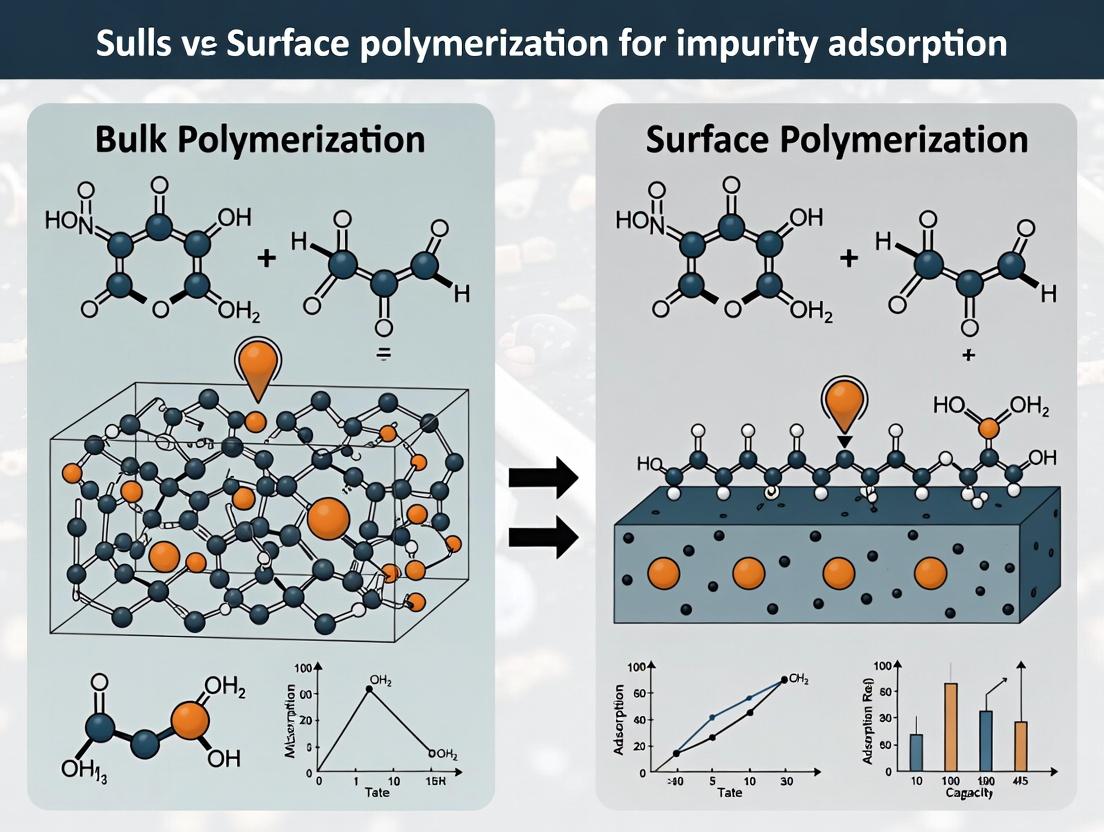
This article provides a comprehensive comparison of bulk and surface polymerization techniques for creating polymeric adsorbents to remove process-related and product-related impurities in drug development.
Bulk vs Surface Polymerization: Strategic Approaches for Optimizing Impurity Adsorption in Pharmaceutical Development
Abstract
This article provides a comprehensive comparison of bulk and surface polymerization techniques for creating polymeric adsorbents to remove process-related and product-related impurities in drug development. It explores the foundational science behind each method, details practical application protocols for common impurity challenges (endotoxins, host cell proteins, leachables, product aggregates), addresses critical troubleshooting and optimization parameters, and validates performance through comparative case studies. Aimed at researchers and process scientists, the content synthesizes current literature and best practices to guide the strategic selection and refinement of polymer-based purification strategies for biologics and small molecules, ultimately impacting drug safety, efficacy, and regulatory compliance.
Core Principles: Understanding the Science of Polymer Adsorbents for Impurity Clearance
Within the context of impurity adsorption research, the selection between bulk and surface polymerization strategies defines the physical and chemical battlefield on which materials are synthesized. These techniques dictate critical parameters such as porosity, surface area, functional group accessibility, and mechanical stability of the resultant polymers, directly influencing their adsorption efficiency, kinetics, and selectivity for target impurities in complex matrices like drug formulations.
Core Principles & Comparison
Table 1: Fundamental Comparison of Bulk vs. Surface Polymerization
| Parameter | Bulk Polymerization | Surface Polymerization (e.g., Grafting-from) |
|---|---|---|
| Primary Process | Monomer + initiator polymerized in mass. | Initiator immobilized on substrate; polymer grown from surface. |
| Typical Porosity | Low (non-porous) or macroporous (with porogen). | Highly dependent on substrate; can create thin films or brushes. |
| Surface Area (BET, m²/g) | Low (< 5) for non-porous; High (100-1000) for porous networks. | Variable: Moderate (10-500) depending on graft density & substrate. |
| Functional Group Density | High throughout the bulk. | High, but concentrated at the interface. |
| Mass Transfer Kinetics | Can be slow for non-porous bulk; faster for macroporous. | Typically fast due to thin, accessible layer. |
| Mechanical Stability | High, cross-linked monoliths are robust. | Can be lower; depends on graft/substrate bond strength. |
| Primary Application in Adsorption | High-capacity, batch-mode adsorption of impurities. | Flow-through systems, coatings, selective membranes. |
Table 2: Adsorption Performance Metrics for Model Impurities
| Polymer Type | Synthesis Method | Target Impurity | Max. Adsorption Capacity (mg/g) | Equilibrium Time (min) | Reference Year |
|---|---|---|---|---|---|
| Poly(HEMA-co-EDMA) Monolith | Bulk (Thermal) | Endotoxin | 12.5 ± 1.8 | 120 | 2023 |
| Poly(NIPAm) Brush on Silica | Surface-Initiated ATRP | Bisphenol A | 45.2 ± 3.1 | 30 | 2024 |
| MIP for β-Lactam Antibiotics | Bulk (Precipitation) | Amoxicillin | 89.7 ± 4.5 | 90 | 2023 |
| Poly(acrylic acid) Grafted Membrane | Surface-Initiated RAFT | Heavy Metal Ions (Pb²⁺) | 156.3 ± 8.2 | < 15 | 2024 |
Experimental Protocols
Protocol 1: Synthesis of a Macroporous Bulk Polymer Monolith for Impurity Adsorption
Objective: To create a high-surface-area, cross-linked poly(glycidyl methacrylate-co-ethylene glycol dimethacrylate) [poly(GMA-co-EDMA)] monolith via bulk polymerization for the adsorption of phenolic impurities.
Materials (Research Reagent Solutions):
- GMA (Glycidyl Methacrylate): Principal monomer providing epoxy functional groups for later modification.
- EDMA (Ethylene Glycol Dimethacrylate): Cross-linker to create a rigid, insoluble porous network.
- Cyclohexanol & 1-Dodecanol (Porogen Mix): Solvent mixture to induce phase separation and create pores.
- AIBN (Azobisisobutyronitrile): Thermal free-radical initiator.
- Toluene (HPLC Grade): Washing solvent to remove porogens and unreacted monomers.
Procedure:
- In a glass vial, mix GMA (24% v/v), EDMA (16% v/v), cyclohexanol (45% v/v), and 1-dodecanol (15% v/v) thoroughly.
- Add AIBN (1% w/w relative to total monomers) and dissolve by sonication.
- Degas the mixture by sparging with nitrogen or argon for 10 minutes.
- Seal the vial and place it in a water bath at 65°C for 24 hours to complete polymerization.
- Carefully break the vial and retrieve the polymer monolith.
- Wash the monolith sequentially with toluene, methanol, and water (500 mL each) over 72 hours using a Soxhlet extractor to remove all porogens and unreacted species.
- Dry the monolith under vacuum at 50°C for 24 hours. Characterize porosity via nitrogen sorption (BET) and microscopy (SEM).
Protocol 2: Surface-Initiated Atom Transfer Radical Polymerization (SI-ATRP) of a Polymer Brush
Objective: To graft a poly(2-(dimethylamino)ethyl methacrylate) (PDMAEMA) brush from a silicon wafer substrate for the adsorption of anionic impurities.
Materials (Research Reagent Solutions):
- ATRP Initiator-Silane (e.g., (11-(2-Bromo-2-methyl)propionyloxy) undecyltrichlorosilane): Provides immobilized initiator sites on the substrate.
- DMAEMA Monomer: Functional monomer providing tertiary amine groups for ionic interaction.
- PMDETA (N,N,N',N'',N''-Pentamethyldiethylenetriamine): Ligand for the ATRP catalyst complex.
- Cu(I)Br: Catalyst for the ATRP reaction.
- Methanol/Toluene Mixture (3:1 v/v): Solvent system for the polymerization.
- Anhydrous Toluene & Ethanol: For substrate cleaning and initiator deposition.
Procedure:
- Clean a silicon wafer with piranha solution (Caution: Extremely corrosive), rinse with water and ethanol, and dry under nitrogen.
- Immerse the wafer in a 1 mM solution of the ATRP initiator-silane in anhydrous toluene for 18 hours under nitrogen atmosphere to form the initiator monolayer.
- Rinse the wafer thoroughly with toluene and ethanol to remove physisorbed silane, then dry under nitrogen.
- In a Schlenk flask, degas a mixture of DMAEMA (10 mL), PMDETA (100 µL), and methanol/toluene (20 mL) by bubbling with nitrogen for 30 minutes.
- Add Cu(I)Br (30 mg) to the flask under nitrogen. Allow the catalyst to form the active complex.
- Quickly transfer the initiator-functionalized wafer into the reaction mixture. Seal and let the SI-ATRP proceed at 40°C for a predetermined time (e.g., 2-6 hours) to control brush thickness.
- Remove the wafer and rinse copiously with methanol and water to terminate the reaction and remove physisorbed polymer.
- Characterize brush thickness via ellipsometry and functionality via X-ray photoelectron spectroscopy (XPS).
Visualizations
Title: Synthesis Pathways for Bulk and Surface Polymers
Title: Impurity Adsorption Mechanisms Comparison
The Scientist's Toolkit: Key Research Reagent Solutions
| Reagent/Material | Function in Polymerization & Adsorption Research |
|---|---|
| Cross-linkers (e.g., EDMA, DVB) | Creates three-dimensional network in bulk polymers, providing mechanical stability and defining porosity. Critical for surface grafting density. |
| Porogens (e.g., Cyclohexanol, Toluene) | In bulk polymerization, induces phase separation to create pore structure. Removed post-polymerization to reveal high surface area. |
| Controlled Radical Initiators (e.g., ATRP/RAFT agents) | Enables precise growth of polymer chains with controlled thickness and composition from surfaces (SI-ATRP, SI-RAFT). |
| Functional Monomers (e.g., GMA, MAA, DMAEMA) | Provide the specific chemical groups (epoxy, carboxyl, amine) responsible for impurity binding via covalent, ionic, or affinity interactions. |
| Silane Coupling Agents (e.g., ATRP-initiator silane) | Forms a covalent bond between inorganic substrates (SiO₂, metals) and organic polymer initiators, enabling robust surface grafting. |
| Metal Catalyst Systems (e.g., Cu(I)/Ligand) | Catalyzes controlled radical polymerization reactions (e.g., ATRP). Requires careful removal post-synthesis for adsorption applications. |
| Molecular Templates (for MIPs) | Used in bulk/precipitation polymerization to create molecularly imprinted polymers (MIPs) with shape-specific cavities for target impurity recognition. |
Introduction and Thesis Context Within the research paradigm comparing bulk versus surface polymerization for designing advanced adsorbents, a critical question emerges: how do the fundamental properties of the synthesized polymer dictate its capacity to bind specific impurities? This application note details how systematic investigation of polymer morphology (physical structure) and chemistry (functional groups) reveals the governing mechanisms of impurity adsorption. This knowledge directly informs the choice between bulk polymerization (yielding particles with defined bulk morphology) and surface polymerization (creating thin films on substrates) for target applications in drug purification and impurity clearance.
Key Polymer Properties Dictating Adsorption
The efficacy of a polymeric adsorbent is governed by an interplay of morphological and chemical factors. The following table summarizes the primary properties and their influence.
Table 1: Morphological and Chemical Properties Governing Adsorption
| Property | Description | Influence on Impurity Binding | Typical Characterization Method |
|---|---|---|---|
| Specific Surface Area (m²/g) | Total accessible area per mass. | Higher area provides more binding sites, crucial for small impurities. | BET (Brunauer-Emmett-Teller) N₂ adsorption. |
| Pore Size Distribution | Volume of micro- (<2 nm), meso- (2-50 nm), and macropores (>50 nm). | Micropores: small molecules. Mesopores: larger organics, peptides. Macropores: facilitate diffusion. | N₂ adsorption/desorption isotherms (BJH method). |
| Particle Size & Shape | Diameter and geometry of polymer beads or film thickness. | Smaller particles/thinner films reduce diffusion path length. Shape affects flow dynamics. | Scanning Electron Microscopy (SEM), Dynamic Light Scattering (DLS). |
| Swelling Ratio | Volume change in solvent. | High swelling increases intraparticle diffusion but may reduce mechanical stability. | Gravimetric analysis in target solvent. |
| Surface Functional Groups | Chemical moieties (e.g., -OH, -COOH, -N⁺R₃, -C₆H₅) at the interface. | Dictates binding mechanism: hydrogen bonding, electrostatic, hydrophobic, π-π interactions. | Fourier-Transform Infrared Spectroscopy (FTIR), X-ray Photoelectron Spectroscopy (XPS). |
| Hydrophilicity/Hydrophobicity | Affinity for water vs. organic solvents. | Determines compatibility with solvent and selectivity for hydrophobic/hydrophilic impurities. | Water Contact Angle measurement. |
Experimental Protocols for Mechanism Elucidation
Protocol 2.1: Synthesis of Model Polymers via Bulk vs. Surface Polymerization Objective: To create polymers with controlled morphology and chemistry for comparative adsorption studies. Materials: Monomer (e.g., styrene, methyl methacrylate, functional monomer like vinylpyridine), cross-linker (divinylbenzene), initiator (AIBN), porogen (toluene, cyclohexanol), substrate for surface polymerization (silica beads, sensor chip). Procedure for Bulk Polymerization:
- Prepare a mixture of monomer (80% v/v), cross-linker (20% v/v), and porogen (50% v/v relative to monomers). Add 1 wt% AIBN initiator.
- Degas via nitrogen bubbling for 15 minutes.
- Polymerize at 70°C for 24 hours in a sealed vial.
- Crush the resulting monolith, wash sequentially with THF, methanol, and water, then sieve to obtain 50-100 µm particles.
- Dry under vacuum at 50°C. Procedure for Surface-Initiated Polymerization (Grafting-from):
- Silanize substrate (e.g., silica beads) with an initiator-bearing silane (e.g., ATRP initiator).
- Immerse initiator-functionalized substrate in a degassed solution of monomer, cross-linker (lower %, e.g., 5%), and porogen in solvent.
- Activate polymerization (via ATRP catalyst or thermal initiation) for a controlled time (e.g., 2-4h) to form a thin film.
- Wash thoroughly and dry.
Protocol 2.2: Batch Adsorption Isotherm Experiment Objective: To quantify impurity binding capacity and affinity. Materials: Model polymer (from Protocol 2.1), target impurity solution (e.g., benzodiazepine in ethanol, endotoxin in buffer), HPLC vials, orbital shaker, HPLC or UV-Vis spectrometer. Procedure:
- Precisely weigh 10 mg of polymer into 2 mL HPLC vials (n=6).
- Prepare a dilution series of the impurity (e.g., 5, 10, 25, 50, 100, 200 µg/mL).
- Add 1 mL of each concentration solution to the polymer vials. Prepare triplicate controls (solution without polymer).
- Seal vials and agitate at 25°C for 24h to reach equilibrium.
- Centrifuge and analyze supernatant concentration (Cₑ, µg/mL).
- Calculate: qₑ = (C₀ - Cₑ) * V / m, where qₑ is adsorbed amount (µg/mg), C₀ is initial concentration, V is volume (L), m is mass (mg).
- Fit data to Langmuir or Freundlich isotherm models.
Protocol 2.3: Kinetics of Adsorption and Diffusion Analysis Objective: To determine the rate of adsorption and identify the rate-limiting step (surface binding vs. pore diffusion). Materials: As in 2.2, with emphasis on precise timekeeping. Procedure:
- Weigh 50 mg polymer into a flask with 50 mL of impurity solution at a known concentration.
- Stir continuously. At fixed time intervals (e.g., 1, 3, 5, 10, 20, 40, 60, 120 min), withdraw 500 µL aliquots.
- Immediately filter (0.2 µm) and analyze residual concentration (Cₜ).
- Calculate: qₜ = (C₀ - Cₜ) * V / m.
- Fit data to Pseudo-First-Order and Pseudo-Second-Order kinetic models. Analyze initial data with the Weber-Morris intraparticle diffusion model.
Visualization of Research Workflow and Mechanisms
Title: Polymer Adsorbent Research Workflow
Title: Morphology & Chemistry Drive Binding Mechanisms
The Scientist's Toolkit: Key Research Reagents & Materials
Table 2: Essential Materials for Polymer Adsorption Research
| Item | Function & Rationale |
|---|---|
| Divinylbenzene (DVB) | Cross-linking agent for creating rigid, porous polymer networks. Controls swelling and stability. |
| Azobisisobutyronitrile (AIBN) | Thermal free-radical initiator for standard bulk polymerization reactions. |
| Atom Transfer Radical Polymerization (ATRP) Kit | Enables controlled surface-initiated polymerization for uniform thin films. |
| Porogens (Toluene, Cyclohexanol) | Inert solvents that create pore structure during polymerization; removed post-synthesis. |
| Functional Monomers (e.g., 4-Vinylpyridine, Methacrylic Acid) | Introduce specific chemical groups (basic pyridine, acidic carboxyl) for tailored interactions. |
| Model Impurity Standards | High-purity compounds (e.g., phenol, benzodiazepines, endotoxin) for controlled adsorption studies. |
| Silica Microspheres (3-10 µm) | Common substrate for grafting surface polymers, providing a well-defined base morphology. |
| BET Surface Area Analyzer | Instrument to quantify specific surface area and pore size distribution via gas adsorption. |
Application Notes on Impurity Targets
Endotoxins (Lipopolysaccharides, LPS)
Endotoxins are pyrogenic components of the outer membrane of Gram-negative bacteria. Their presence in biologics can cause severe febrile reactions in patients. In the context of bulk vs. surface polymerization research, adsorbents designed for endotoxin removal must address their high negative charge and amphiphilic nature. Bulk polymerized resins with tailored pore architectures are effective for capturing larger LPS aggregates, while surface-functionalized membranes excel in high-throughput, flow-through applications.
Host Cell Proteins (HCPs)
HCPs are a complex mixture of proteins co-produced with the recombinant therapeutic protein. Their persistence can elicit immunogenic responses. Effective removal requires adsorbents with broad selectivity. Bulk polymerized materials with heterogeneous, multimodal surfaces can bind a wider spectrum of HCP isoforms due to varied interaction sites. Surface-polymerized layers on base matrices offer more defined, ligand-specific removal but may have lower capacity for diverse HCP populations.
Aggregates
Protein aggregates, ranging from dimers to large sub-visible particles, are critical quality attributes due to their heightened immunogenicity risk. Separation often relies on size exclusion and hydrophobic interactions. Monolithic columns produced via bulk polymerization provide superior convective mass transfer for aggregate removal in flow-through mode. Surface-grafted polymeric brushes can be engineered to selectively repel aggregates via steric exclusion.
Leachables
Leachables are chemical compounds that migrate from processing components (e.g., filters, chromatography resins, tubing) into the product stream. Adsorbents for leachable removal, such as activated carbon or polymeric scavengers, benefit from high surface area. Bulk polymerized porous carbons offer high capacity for diverse organic leachables, while surface-imprinted polymers can be designed for specific, high-affinity capture of known problematic leachables like ligands from affinity resins.
Table 1: Comparative Performance of Bulk vs. Surface Polymerization Adsorbents for Key Impurities
| Impurity Target | Typical Specification | Bulk Polymerization Adsorbent (Dynamic Binding Capacity*) | Surface Polymerization Adsorbent (Dynamic Binding Capacity*) | Key Removal Mechanism |
|---|---|---|---|---|
| Endotoxins | <0.1 EU/mg | 1-2 x 10⁶ EU/mL resin | 5-10 x 10⁵ EU/mL membrane | Ionic/Hydrophobic Interaction |
| HCPs | <10-100 ppm | 10-30 mg HCP/mL resin (broad spectrum) | 5-15 mg HCP/mL resin (targeted) | Multimodal/ Affinity Interaction |
| Aggregates | <1.0% | >95% removal (high molecular weight) | >99% removal (specific size cut-off) | Size Exclusion / Steric Repulsion |
| Leachables | ppb to ppm levels | High capacity (e.g., 50 mg/g for model leachable Tri-n-butyl phosphate) | Selective capacity (e.g., 20 mg/g for Protein A ligand) | Hydrophobic / Molecular Imprinting |
Note: Values are representative ranges from current literature and vendor data sheets. Actual capacity depends on polymer chemistry, feedstock, and process conditions.
Experimental Protocols
Protocol: Evaluating HCP Removal with a Novel Bulk Polymerized Multimodal Resin
Objective: Determine the dynamic binding capacity (DBC) of a bulk polymerized adsorbent for a complex HCP mixture. Materials: Bulk polymerized multimodal resin (e.g., prototype poly(acrylate-co-vinylamine) beads), clarified CHO cell harvest, binding buffer (50 mM Tris, 150 mM NaCl, pH 7.4), elution buffer (50 mM Tris, 1 M NaCl, pH 7.4), HPLC system, HCP ELISA kit. Procedure:
- Column Packing: Pack a 1 mL TRICORN column with the bulk polymerized resin per manufacturer's instructions. Equilibrate with 10 CV of binding buffer.
- Load Preparation: Adjust clarified harvest to conductivity/pH matching binding buffer. Filter through a 0.22 µm membrane.
- Breakthrough Analysis: Load the adjusted harvest onto the column at a linear velocity of 150 cm/h. Collect flow-through fractions.
- DBC Determination: Quantify HCP concentration in flow-through fractions via ELISA. The DBC at 10% breakthrough (DBC₁₀) is calculated as:
DBC₁₀ = (Loaded HCP at 10% breakthrough) / (Resin volume). - Elution: Strip bound material with 5 CV of elution buffer. Regenerate and sanitize.
Protocol: Assessing Leachable Scavenging by Surface-Imprinted Polymers
Objective: Measure the binding kinetics and capacity of a surface-grafted, molecularly imprinted polymer (MIP) for a target leachable (e.g., Protein A ligand). Materials: Surface-MIP functionalized beads (base matrix: silica, graft layer: methacrylic acid-co-ethylene glycol dimethacrylate), control non-imprinted polymer (NIP) beads, spiked buffer solution with known concentration of target leachable, LC-MS/MS system. Procedure:
- Batch Binding: In triplicate, add 10 mg of MIP or NIP beads to 1 mL of spiked solution in a microcentrifuge tube. Incubate with mixing for set times (e.g., 5, 15, 30, 60, 120 min).
- Separation: At each time point, centrifuge tubes and collect supernatant.
- Analysis: Quantify the remaining free leachable concentration in the supernatant using a validated LC-MS/MS method.
- Calculation: Calculate amount bound per mg of polymer at each time point. Plot to determine kinetic parameters and saturation capacity.
- Specificity Test: Repeat with structurally similar compounds to assess selectivity of the MIP layer.
Diagrams
Title: Adsorbent Selection Workflow for Impurity Removal
Title: Endotoxin Immunogenic Signaling Pathway
The Scientist's Toolkit
Table 2: Essential Research Reagents & Materials for Impurity Adsorption Studies
| Item | Function in Research | Example/Note |
|---|---|---|
| CHO HCP ELISA Kit | Quantifies total host cell protein concentration in process samples. Critical for assessing HCP clearance by adsorbents. | Commercial kits from Cygnus, F550, etc. |
| Limulus Amebocyte Lysate (LAL) Assay Kit | Gold-standard for detecting and quantifying endotoxin (LPS) levels. | Gel-clot, chromogenic, or turbidimetric formats. |
| Size-Exclusion HPLC (SE-HPLC) Columns | Separates and quantifies protein monomers, fragments, and aggregates. | TSKgel, BioResolve, etc. |
| LC-MS/MS System | Identifies and quantifies specific leachables, HCP species, and chemical impurities with high sensitivity. | Triple quadrupole or high-resolution mass spectrometers. |
| Bulk Polymerization Monomers | Building blocks for creating porous, high-capacity adsorbent resins. | e.g., Styrene, divinylbenzene, glycidyl methacrylate. |
| Surface Grafting Initiators | Enable controlled radical polymerization from base matrix surfaces for thin film creation. | e.g., Azo-initiators, atom transfer radical polymerization (ATRP) initiators. |
| Model Impurity Solutions | Defined mixtures for controlled adsorption experiments. | e.g., Purified LPS, spiked leachable standards, aggregate-enriched mAb samples. |
| Robotic Liquid Handlers | Automates high-throughput screening of adsorption conditions and polymer chemistries. | Essential for Design of Experiments (DoE). |
The development of high-performance adsorbents for impurity removal in pharmaceutical manufacturing hinges on the precise engineering of material properties. Within the broader research thesis comparing bulk versus surface polymerization strategies, the triad of porosity, surface area, and functional group density emerges as the critical determinant of adsorption capacity, kinetics, and selectivity. Bulk polymerization often produces materials with high functional group loadings but may suffer from diffusion limitations due to poor pore connectivity. Conversely, surface polymerization on pre-formed porous substrates can optimize accessibility but may limit total active site density. This application note details protocols and analyses for characterizing this "trinity" to guide rational adsorbent design.
Quantitative Comparison of Adsorbent Materials
The following table summarizes key performance data for representative adsorbents synthesized via bulk and surface polymerization techniques, as reported in recent literature (2023-2024).
Table 1: Comparative Performance of Model Adsorbents for Pharmaceutical Impurity (e.g., Genotoxic Nitrosamine) Removal
| Adsorbent Type & Synthesis Method | BET Surface Area (m²/g) | Total Pore Volume (cm³/g) | Average Pore Width (nm) | Functional Group Density (mmol/g) | Adsorption Capacity for N-Nitrosodimethylamine (NDMA) (mg/g) | Key Reference (Recent) |
|---|---|---|---|---|---|---|
| Hypercrosslinked Polymer (Bulk) | 1200 - 1800 | 1.0 - 1.8 | 1.5 - 3.0 | 4.5 - 6.0 (aryl groups) | 120 - 180 | Micropor. Mesopor. Mat., 2023, 359, 112663 |
| Molecularly Imprinted Polymer (Bulk) | 350 - 600 | 0.4 - 0.7 | 8.0 - 15.0 | 1.8 - 3.2 (carboxy) | 85 - 110 (high selectivity) | Chem. Eng. J., 2024, 481, 148552 |
| Grafted Polymer on Mesoporous Silica (Surface) | 450 - 700 | 0.7 - 1.1 | 6.0 - 10.0 | 2.0 - 3.5 (amine/thiol) | 95 - 130 | J. Hazard. Mater., 2023, 441, 129842 |
| Polymerized Ionic Liquid on Carbon (Surface) | 900 - 1100 | 0.9 - 1.3 | 2.0 - 4.0 | 3.0 - 4.5 (ionic groups) | 140 - 170 | ACS Appl. Mater. Interfaces, 2024, 16, 5, 6741 |
| Metal-Organic Framework (Bulk-like) | 1500 - 3000 | 0.7 - 1.4 | 0.8 - 2.5 | 7.0 - 10.0 (open metal sites) | 200 - 250 (humid sensitivity) | Sci. Adv., 2023, 9, eadi6566 |
Detailed Experimental Protocols
Protocol 3.1: Synthesis of Amine-Functionalized Adsorbent via Surface-Initiated ATRP
This protocol details the grafting of poly(glycidyl methacrylate) with post-modification to introduce amine groups onto silica substrate.
I. Materials & Reagents:
- Mesoporous silica SBA-15 (pore size ~8 nm).
- (3-Aminopropyl)triethoxysilane (APTES), 99%.
- 2-Bromoisobutyryl bromide (BiBB), 98%.
- Glycidyl methacrylate (GMA), purified via inhibitor remover.
- Copper(I) bromide (CuBr), purified by acetic acid washing.
- N,N,N',N'',N''-Pentamethyldiethylenetriamine (PMDETA), 99%.
- Anhydrous toluene and tetrahydrofuran (THF).
- Ethylenediamine for post-grafting ring-opening.
II. Procedure:
- Silica Amine-Functionalization: Suspend 2.0 g of SBA-15 in 100 mL anhydrous toluene. Add 4 mL APTES. Reflux under N₂ for 24h. Cool, filter, and wash with toluene, methanol, and dry under vacuum.
- Initiator Immobilization: Under N₂, suspend aminated silica in 80 mL anhydrous THF in an ice bath. Add 3 mL BiBB dropwise. Stir for 24h at 0°C, then RT. Filter, wash with THF, dry.
- Surface-Initiated ATRP: In a Schlenk flask, degas 20 mL GMA, 20 mL toluene, 0.1 g CuBr, and 0.2 mL PMDETA by three freeze-pump-thaw cycles. Add 1.0 g initiator-functionalized silica. Seal and stir at 60°C for 6h. Quench in liquid N₂.
- Work-up: Dilute with THF, filter. Wash polymer-grafted silica with THF, Cu-removing solution (EDTA), water, methanol. Dry.
- Amine Functionalization: React 1.0 g of PGMA-grafted silica with 50 mL ethylenediamine at 80°C for 48h. Filter, wash with water/methanol, dry.
III. Characterization:
- Porosity/Surface Area: N₂ physisorption at 77K (BET, BJH methods).
- Functional Group Density: Elemental Analysis (N%) or acid-base titration.
- Grafting Confirmation: FT-IR (disappearance of epoxide ring at ~910 cm⁻¹, appearance of amine bands).
Protocol 3.2: Batch Adsorption Isotherm for Impurity Uptake
I. Materials:
- Test adsorbent (e.g., from Protocol 3.1).
- Target impurity stock solution (e.g., 1000 ppm NDMA in water).
- HPLC vials, LC-MS system for analysis.
- Phosphate buffer (pH 7.4) or relevant drug formulation matrix.
II. Procedure:
- Prepare impurity solutions in relevant matrix at concentrations (C₀) ranging from 1 to 100 ppm.
- In separate 8 mL vials, add 10.0 mg of adsorbent to 5.0 mL of each solution.
- Seal vials and agitate in a thermostated shaker (25°C, 250 rpm) for 24h to reach equilibrium.
- Filter solutions through 0.22 µm nylon syringe filter.
- Analyze filtrate concentration (Cₑ) via calibrated HPLC-MS.
- Calculate equilibrium adsorption capacity: qₑ (mg/g) = (C₀ - Cₑ) * V / m, where V is volume (L), m is adsorbent mass (g).
- Fit qₑ vs. Cₑ data to Langmuir/Freundlich isotherm models.
Visualization of Concepts and Workflows
Diagram 1: Trinity Governing Adsorbent Performance
Diagram 2: Bulk vs Surface Polymerization Pathways
Diagram 3: Adsorbent Performance Evaluation Workflow
The Scientist's Toolkit: Essential Research Reagent Solutions
Table 2: Key Reagents and Materials for Adsorbent Research
| Item Name | Function/Benefit | Key Consideration for Selection |
|---|---|---|
| Mesoporous Silica (SBA-15, MCM-41) | High-surface-area, tunable pore size substrate for surface polymerization. Provides well-defined porosity. | Pore diameter should accommodate monomer/growing polymer chains. High purity to avoid catalytic side reactions. |
| Functional Silanes (e.g., APTES, MPTMS) | Coupling agents to attach polymerization initiators or functional groups to oxide surfaces. | Anhydrous conditions required for consistent monolayer formation. |
| Controlled Radical Polymerization Kits (ATRP, RAFT) | Enable precise grafting of polymer brushes with controlled thickness and functionality from surfaces. | Choice of initiator/chain transfer agent and metal ligand (for ATRP) critical for control. Requires degassing. |
| High-Purity Crosslinkers (DVB, EGDMA) | Create rigid, porous networks in bulk polymerization. Define mesh size and swelling properties. | Divinylbenzene (DVB) grade (% isomers) significantly impacts final polymer morphology. |
| Pharmaceutical Impurity Standards | Certified reference materials for adsorption studies (e.g., nitrosamines, APIs, genotoxic impurities). | Must match the impurity profile of the actual drug process. Stability in solution is key. |
| Porous Polymer Reference Materials | Commercially available adsorbents (e.g., HP-20 resin, Zorbax) for benchmarking performance. | Provides a baseline for comparing novel synthetic adsorbents. |
| BET Surface Area & Pore Analyzer | Instrument for measuring the trinity's first two components: surface area, pore volume, and pore size distribution. | Analysis model (BET, DFT, BJH) must be chosen based on material type (micro/mesoporous). |
Recent Advances in Monomer Design and Polymer Architecture for Selective Adsorption
Application Notes
Selective adsorption materials are critical for applications ranging from pharmaceutical impurity scavenging to environmental remediation. The efficacy of these materials is governed by the synergistic combination of monomer functionality and polymer architectural control. Within the broader thesis context of Bulk vs. Surface Polymerization for Impurity Adsorption Research, recent advances highlight a strategic shift. Bulk polymerization techniques (e.g., precipitation, suspension) are being refined to create high-capacity, monolithic adsorbents with tailored porosity. Conversely, surface polymerization methods (e.g., grafting, thin-film deposition) are engineered to create thin, conformal, and accessible binding layers on inert substrates, minimizing diffusion limitations. The choice between these paradigms depends on the target impurity's concentration, accessibility of binding sites, and the required mechanical stability of the polymer composite.
Table 1: Comparison of Bulk vs. Surface Polymerization Approaches for Selective Adsorption
| Feature | Bulk Polymerization (Precipitation/Suspension) | Surface Polymerization (Grafting-from) |
|---|---|---|
| Primary Architecture | Beads, monoliths, macroporous networks | Polymer brushes, thin films on substrates (e.g., silica, membranes) |
| Binding Site Location | Throughout the particle bulk (may be diffusion-limited) | Primarily on the surface (easily accessible) |
| Typical Capacity (Quantitative Example) | High (e.g., 150-300 mg/g for heavy metals) | Lower but highly efficient (e.g., 50-100 mg/g for proteins) |
| Kinetics | Often slower, controlled by pore diffusion | Typically faster, controlled by surface binding |
| Mechanical Stability | High (self-supported) | Dependent on substrate; grafting improves stability |
| Best Suited For | High-concentration impurities, flow-through columns | Low-concentration targets, sensor interfaces, coating complex geometries |
Table 2: Recent Monomer Designs for Targeted Impurities
| Target Impurity Class | Monomer Functionality | Proposed Interaction Mechanism | Reported Adsorption Efficacy |
|---|---|---|---|
| Pharmaceutical Impurities (Endotoxins) | Cationic groups (e.g., vinylbenzyl trimethylammonium) | Electrostatic binding to lipid A phosphates | >99% removal from solution in batch studies |
| Heavy Metals (Pb²⁺, Cd²⁺) | Amidoxime, carboxylate, dithiocarbamate | Chelation / Ion exchange | Qmax ~220 mg/g for Pb²⁺ (pH 5.0) |
| Organic Dyes (Methylene Blue) | Sulfonic acid, carboxylic acid | Ionic & π-π interactions | Qmax ~400 mg/g for cationic dyes |
| Bisphenol A (Endocrine Disruptor) | Methacrylic acid, β-cyclodextrin derivatives | Hydrogen bonding & host-guest inclusion | >85% removal from wastewater streams |
Experimental Protocols
Protocol 1: Synthesis of Bulk Molecularly Imprinted Polymer (MIP) Beads for Selective Dye Adsorption
- Objective: To prepare bulk MIP beads selective for methylene blue (MB) via precipitation polymerization.
- Materials: Methacrylic acid (MAA, functional monomer), ethylene glycol dimethacrylate (EGDMA, crosslinker), AIBN (initiator), methylene blue (template), acetonitrile (porogen).
- Procedure:
- Dissolve the template (MB, 0.25 mmol) and MAA (1.0 mmol) in 50 mL of acetonitrile in a sealed glass vial. Pre-polymerize for 1 hour at room temperature.
- Add EGDMA (5.0 mmol) and AIBN (20 mg). Purge with nitrogen for 10 minutes to remove oxygen.
- Place the vial in a water bath at 60°C for 24 hours under constant agitation.
- Collect the polymer beads by filtration. Wash sequentially with methanol:acetic acid (9:1 v/v) until no MB is detected in the eluent (UV-Vis), then with pure methanol to neutralize.
- Dry the beads under vacuum at 50°C for 12 hours. Non-imprinted polymer (NIP) controls are synthesized identically but without the MB template.
Protocol 2: Surface-Initiated Polymer Brush Grafting for Protein A Capture
- Objective: To graft poly(glycidyl methacrylate) (PGMA) brushes from silica particles for antibody purification.
- Materials: Silica microparticles, (3-aminopropyl)triethoxysilane (APTES), glycidyl methacrylate (GMA), CuBr/PMDETA (ATRP catalyst system), sodium L-ascorbate.
- Procedure:
- Surface Amination: Silica particles are refluxed with 2% APTES in toluene for 6 hours, then washed and dried to introduce amine initiator sites.
- ATRP Grafting: In a Schlenk flask under N₂, mix GMA (10 mmol), CuBr (0.1 mmol), and PMDETA (0.1 mmol) in 20 mL water/methanol (1:1). Add aminated silica (1 g) and sodium ascorbate (0.2 mmol).
- React at 30°C for 4 hours with gentle stirring.
- Stop the reaction by exposing to air. Wash particles thoroughly with water and methanol.
- Ligand Immobilization: Incubate PGMA-grafted silica with a Protein A solution (1 mg/mL in carbonate buffer, pH 9.5) at 25°C for 24 hours. The epoxy groups of PGMA will covalently bind to amine groups on Protein A.
Visualizations
Title: Polymer Synthesis Path Selection
Title: MIP vs NIP Synthesis
The Scientist's Toolkit: Research Reagent Solutions
| Item | Function & Relevance |
|---|---|
| Functional Monomers (e.g., MAA, 4-VP) | Provide complementary chemical groups (COOH, pyridine) to interact with target impurities via H-bonding, ionic, or van der Waals forces. |
| Cross-linkers (e.g., EGDMA, DVB) | Create the 3D polymer network. Ratio to monomer controls architecture porosity, rigidity, and binding site accessibility. |
| RAFT/ATRP Initiators | Enable controlled radical polymerization for precise architecture engineering (e.g., block copolymers, polymer brushes). |
| Porogens (e.g., Toluene, Cyclohexanol) | Solvents that dictate the morphology in bulk polymerization, creating the pore structure essential for diffusion. |
| Silane Coupling Agents (e.g., APTES) | Modify inorganic substrate surfaces (silica, glass) with initiator groups for subsequent surface polymerization. |
| Template Molecules | The impurity or analog around which an MIP is synthesized, creating specific recognition sites upon removal. |
From Lab to Process: Practical Protocols for Implementing Polymer Adsorption Strategies
This application note provides a detailed protocol for the bulk (or mass) polymerization of adsorbents, framed within a broader research thesis comparing bulk versus surface polymerization for impurity adsorption. Bulk polymerization, characterized by the reaction of pure monomer(s) with an initiator in the absence of a solvent, offers advantages in producing high-purity, dense polymer networks ideal for selective adsorption in downstream pharmaceutical purification. This guide is intended for researchers and drug development professionals seeking to synthesize tailored adsorbents for the removal of specific impurities, such as genotoxic compounds, catalysts, or process-related by-products.
Core Principles & Thesis Context
In impurity adsorption research, the polymerization method dictates critical adsorbent properties. Bulk polymerization creates a homogeneous polymer matrix with consistent cross-linking density, often leading to high capacity but potentially slower diffusion kinetics for large impurities. This contrasts with surface polymerization techniques (e.g., grafting), which modify a pre-existing substrate, creating a heterogeneous structure with potentially faster binding kinetics but lower total capacity. The choice hinges on the target impurity's size, polarity, and concentration.
Research Reagent Solutions & Essential Materials
The following table details key reagents and their functions for a generalized bulk polymerization protocol for adsorbent synthesis.
Table 1: Essential Reagents for Bulk Polymerization of Adsorbents
| Reagent/Material | Function | Key Considerations |
|---|---|---|
| Functional Monomer(s) (e.g., Methacrylic acid, Vinylpyridine, Divinylbenzene) | Primary building block(s) providing the polymeric backbone and functional groups for adsorption. | Choice dictates selectivity (e.g., acidic monomers for basic impurities). |
| Cross-linking Agent (e.g., Ethylene glycol dimethacrylate - EGDMA) | Creates a three-dimensional, insoluble network, controlling porosity and mechanical stability. | Concentration directly affects surface area, pore size, and swelling. |
| Free Radical Initiator (e.g., Azobisisobutyronitrile - AIBN) | Thermally decomposes to generate free radicals, initiating the chain-growth polymerization. | Must be soluble in the monomer mixture; decomposition temperature sets reaction conditions. |
| Porogen (e.g., Toluene, Cyclohexanol) | Inert solvent added to the monomer mixture to create pores during polymerization, later removed. | Critically controls the final adsorbent's surface area and pore morphology. |
| Inhibitor Remover Columns | Used to purify monomers by removing polymerization inhibitors (e.g., hydroquinone) before reaction. | Essential for achieving predictable polymerization kinetics and high molecular weight. |
Detailed Experimental Protocol: Synthesis of a Methacrylate-Based Bulk Polymer Adsorbent
Objective
To synthesize a high-capacity, macroporous poly(methacrylic acid-co-ethylene glycol dimethacrylate) adsorbent via bulk thermal polymerization for the adsorption of basic pharmaceutical impurities.
Materials Preparation
- Monomers: Methacrylic acid (MAA), Ethylene glycol dimethacrylate (EGDMA).
- Initiator: Azobisisobutyronitrile (AIBN).
- Porogen: Toluene.
- Equipment: Three-neck round-bottom flask, reflux condenser, nitrogen inlet, heating mantle with stirrer, oil bath, vacuum oven.
Step-by-Step Procedure
1. Monomer Mixture Preparation:
- Pass MAA and EGDMA through basic alumina columns to remove inhibitors.
- In a beaker, combine MAA (20.0 mL, 20 mol%), EGDMA (80.0 mL, 80 mol% cross-linker), and toluene (100 mL, 50% v/v relative to total monomers) as a porogen.
- Add AIBN (0.5 g, 1% w/w relative to total monomers). Stir magnetically until complete dissolution.
2. Polymerization Setup:
- Transfer the homogeneous mixture to a three-neck round-bottom flask.
- Attach a reflux condenser and a nitrogen gas inlet.
- Sparge the mixture with dry nitrogen gas for 20 minutes while stirring to remove dissolved oxygen, a radical inhibitor.
3. Thermal Polymerization:
- Submerge the flask in a pre-heated oil bath at 70°C.
- Maintain under a gentle nitrogen atmosphere with continuous stirring for 24 hours. The mixture will become viscous and eventually form a rigid monolith.
4. Post-Polymerization Processing:
- Carefully break the polymer monolith into small pieces.
- Soxhlet extract the polymer with ethanol for 24 hours to remove the porogen, unreacted monomers, and oligomers.
- Dry the extracted polymer particles in a vacuum oven at 60°C to constant weight.
- Grind the monolith and sieve to obtain a desired particle size fraction (e.g., 100-200 μm).
Characterization & Performance Metrics
Key properties of the synthesized adsorbent should be characterized and compared against adsorbents made via surface polymerization.
Table 2: Typical Characterization Data for Bulk-Polymerized Adsorbent
| Property | Method | Typical Result (Bulk Polymerization) | Comparative Note (vs. Surface Polymerization) |
|---|---|---|---|
| BET Surface Area | N₂ Physisorption | 350 - 600 m²/g | Generally higher than surface-grafted materials. |
| Average Pore Diameter | BJH Analysis | 20 - 50 nm | Tunable via porogen ratio; often broader distribution. |
| Swelling Ratio | Gravimetric in Solvent | 1.5 - 3.0 (in MeOH) | Lower than lightly cross-linked gels but significant. |
| Functional Group Density | Elemental Analysis/Titration | 4 - 8 mmol COOH/g | High, as the entire matrix is functionalized. |
| Adsorption Capacity | Batch binding for model amine | 0.8 - 1.5 mmol/g | High capacity, but kinetics may be pore-diffusion limited. |
| Adsorption Kinetics (t₉₀) | Batch kinetic study | 60 - 120 min | Often slower than thin surface films due to bulk diffusion. |
Experimental Protocol for Batch Adsorption Testing
Objective
To evaluate the adsorption capacity and kinetics of the synthesized bulk polymer for a target basic impurity (e.g., 4-dimethylaminopyridine, DMAP).
Procedure
- Prepare a standard solution of the impurity (e.g., 1.0 mM DMAP in methanol-water mixture).
- Accurately weigh 20.0 mg of the sieved polymer adsorbent into a series of glass vials.
- Add 10.0 mL of the impurity solution to each vial. Run in triplicate.
- Agitate the vials in a thermostated shaker at 25°C for predetermined time intervals (e.g., 5, 15, 30, 60, 120, 240 min).
- At each time point, centrifuge a vial and analyze the supernatant via UV-Vis spectroscopy to determine residual impurity concentration.
- Calculate adsorption capacity (Q, mmol/g) and plot Q vs. time for kinetics, and Q at equilibrium vs. concentration for isotherm modeling (e.g., Langmuir, Freundlich).
Decision Workflow & Synthesis Pathways
Title: Adsorbent Synthesis Method Decision Tree
Bulk Polymerization Reaction Mechanism & Process
Title: Bulk Polymerization to Adsorbent Workflow
Within the broader research comparing bulk versus surface polymerization for impurity adsorption, this guide focuses on surface-specific techniques. Bulk polymerization creates homogeneous resins with adsorptive sites distributed throughout, often leading to slower diffusion kinetics and inaccessible sites for large impurities. Surface polymerization, or grafting, confines the polymer layer to the substrate exterior, creating a high-density, easily accessible interface ideal for selectively capturing impurities like host cell proteins, DNA, or endotoxins in biopharmaceutical streams. This application note details practical protocols for grafting on three key substrates: beads, membranes, and fibers.
Key Substrate Properties and Selection
Table 1: Comparative Substrate Properties for Surface Grafting
| Property | Polymeric Beads (e.g., PS, Agarose) | Polymeric Membranes (e.g., PES, Nylon) | Polymeric Fibers (e.g., PP, PET) |
|---|---|---|---|
| Primary Geometry | Spherical, 10-100 µm diameter | Flat-sheet, hollow fiber; 0.1-1 mm thickness | Diameter: 1-50 µm; woven/nonwoven mats |
| Surface Area (m²/g) | 50-500 (porous) | 5-50 (highly porous) | 1-10 (non-porous fiber) |
| Typical Grafting Target | Interior & exterior pore surfaces | Pore lumen surfaces and top layer | Fiber exterior surface |
| Key Advantage for Adsorption | Very high capacity, packed-bed operation | Low pressure drop, fast convective flow | High mechanical strength, modular formats |
| Common Grafting Method | RAFT, ATRP, "graft-from" | UV-Initiated, Plasma-Activated, "graft-to" | γ-Ray Initiated, Thermal "graft-from" |
Protocols for Surface Polymerization
Protocol 3.1: UV-Initiated Grafting on Polyethersulfone (PES) Membranes
This protocol is optimal for creating a thin, uniform polymer brush layer for high-flow adsorption.
- Substrate Pre-treatment: Cut PES membrane (0.45 µm pore) into 5 cm diameter discs. Soak in 50% ethanol for 30 min, rinse with DI water, and dry under N₂.
- Photo-initiator Coating: Prepare a 5 mM solution of Benzophenone in acetone. Immerse membrane discs for 10 sec, then air-dry in the dark for 5 min.
- Monomer Solution Preparation: In a Schlenk tube, degass 20 mL of an aqueous solution containing 10% (w/v) acrylamide monomer and 1% (w/v) N,N'-methylenebisacrylamide crosslinker by bubbling N₂ for 30 min.
- Grafting Reaction: Place initiator-coated membrane in a quartz reaction chamber. Add degassed monomer solution to submerge the membrane. Illuminate with UV light (365 nm, 100 W) for 2-10 minutes under N₂ atmosphere. Time controls graft density.
- Post-processing: Rinse grafted membrane extensively with 60°C DI water for 24h to remove homopolymer and unreacted monomer. Characterize via ATR-FTIR for C=O stretch at ~1650 cm⁻¹ and gravimetric analysis for grafting yield (%GY = [(Wg - W0)/W0] * 100).
Protocol 3.2: ATRP "Graft-From" on Polystyrene Beads
This controlled radical technique allows precise control over brush length and density on bead surfaces.
- Surface Initiation Site Immobilization: Suspend 1 g of chloromethylated polystyrene beads (100 µm, 1 mmol Cl/g) in 20 mL anhydrous toluene. Add 2 mmol of 2-Bromoisobutyryl bromide and 2 mmol of triethylamine. React at 40°C for 12h under argon.
- Beads Washing: Filter beads and sequentially wash with toluene, methanol, and dichloromethane. Dry under vacuum.
- ATRP Grafting Reaction: In a Schlenk flask, add 0.5 g of initiator-functionalized beads, 10 mL degassed anisole, 10 mmol of glycidyl methacrylate monomer, 0.1 mmol of CuBr catalyst, and 0.2 mmol of bipyridine ligand. Conduct three freeze-pump-thaw cycles.
- Polymerization: React at 60°C for 4-8h with stirring. Terminate by exposing to air and diluting with THF.
- Cleaning: Filter beads and wash with THF, EDTA solution (to remove Cu), and methanol. Soxhlet extract with methanol for 24h. Characterize graft density via elemental analysis (Bromine %).
Protocol 3.3: Plasma-Activated Grafting on Polypropylene Fibers
A versatile method for activating inert fiber surfaces to enable subsequent grafting.
- Plasma Activation: Place nonwoven polypropylene fiber mat in a plasma chamber. Evacuate to 0.2 mbar and introduce argon gas at a flow rate of 20 sccm. Apply RF plasma (40 W) for 60 seconds to generate surface peroxides.
- In-situ Vapor Phase Grafting: Immediately after plasma treatment, introduce acrylic acid vapor into the chamber (from a reservoir heated to 50°C) at 1 mbar for 15 minutes, allowing graft polymerization via peroxide decomposition.
- Post-treatment: Vent chamber and remove fibers. Wash in a 50°C stirred 0.1M NaOH solution for 6h to remove poly(acrylic acid) homopolymer. Rinse with DI water to neutral pH and dry.
- Characterization: Confirm grafting via Toluidine Blue O dye assay (carboxyl group quantification) and SEM for surface morphology changes.
The Scientist's Toolkit: Essential Research Reagents & Materials
Table 2: Key Reagent Solutions for Surface Polymerization
| Item | Function & Role in Grafting | Example/Note |
|---|---|---|
| Benzophenone | Type II Photo-initiator. Abstracts H from substrate, creating surface radicals for grafting. | Used in UV-initiation on polymers like PES, Nylon. Light-sensitive. |
| 2-Bromoisobutyryl bromide | ATRP initiator precursor. Functionalizes surfaces with alkyl halide groups to initiate polymerization. | Key for "graft-from" ATRP. Handle under inert, anhydrous conditions. |
| CuBr/Bipyridine Complex | ATRP catalyst system. Controls the equilibrium between active and dormant polymer chains. | Enables controlled polymer growth. Must be degassed. |
| Acrylic Acid Monomer | Common grafting monomer. Imparts hydrophilic, anionic, and reactive carboxyl groups. | Used for ion-exchange or further conjugation. Inhibited (e.g., MEHQ). |
| Glycidyl Methacrylate | Epoxy-containing monomer. Grafted brushes provide reactive epoxides for ligand coupling. | Useful for immobilizing proteins, amines post-grafting. |
| Argon Plasma | Surface activation. Creates radicals, peroxides, or reactive groups on inert polymer surfaces. | Enables grafting on PP, PTFE. Must be used immediately post-activation. |
| Degassed Solvents | Reaction medium for controlled polymerization. Oxygen removal is critical to prevent radical quenching. | Anisole, toluene, water treated by N₂ bubbling or freeze-pump-thaw. |
Table 3: Adsorptive Performance of Surface-Grafted Materials for Impurity Removal
| Substrate & Grafting Method | Target Impurity | Grafted Polymer/Ligand | Key Performance Metric | Reported Value (Range) |
|---|---|---|---|---|
| PES Membrane (UV-Grafting) | Bovine Serum Albumin | Poly(N-vinyl pyrrolidone) | Dynamic Binding Capacity (10% breakthrough) | 18-25 mg/mL membrane volume |
| Polystyrene Beads (ATRP) | Endotoxin (LPS) | Poly(cationic methacrylate) | Removal Efficiency in spiked buffer | >99.5% (from 100 EU/mL) |
| Polypropylene Fibers (Plasma + Graft) | Metal Ions (Cu²⁺) | Poly(acrylic acid) | Maximum Adsorption Capacity (Qmax) | 45-60 mg/g dry fiber |
| Agarose Beads (RAFT Grafting) | Monoclonal Antibody (aggregates) | Poly(ionic liquid) | Aggregate Reduction in harvest feed | 85-95% clearance, >95% monomer recovery |
| Nylon Membrane (Redox-Initiated) | Genomic DNA | Poly(ethyleneimine) | Capacity for DNA (flow-through mode) | 2-4 mg DNA/m² membrane surface |
Workflow and Pathway Visualizations
Title: Decision Workflow for Grafting vs Bulk Polymerization
Title: UV-Initiated Surface Grafting Mechanism
Within the thesis context of Bulk vs Surface Polymerization for Impurity Adsorption Research, selecting the appropriate polymerization strategy is critical. The choice hinges on the physicochemical nature of the target impurity. This framework provides a decision protocol and application notes for matching impurity types to polymerization methods to optimize adsorbent performance in pharmaceutical purification.
Application Notes & Decision Framework
Framework for Matching Impurity to Polymerization Method
The polymerization method dictates the adsorbent's morphology, accessibility of functional groups, and kinetic profile. Bulk polymerization creates highly cross-linked networks with high capacity for small molecules, while surface polymerization (e.g., grafting) creates brush-like layers ideal for accessing large biomolecules.
Table 1: Impurity Characteristics and Recommended Polymerization Method
| Impurity Type | Typical Size (MW/Da) | Key Physicochemical Property | Recommended Polymerization Method | Rationale |
|---|---|---|---|---|
| Small Molecule APIs/Intermediates | 150 - 500 | High Log P, specific H-bonding | Bulk (Precipitation) | High cross-linking density for molecular imprinting; high capacity. |
| Genotoxic Impurities (GTIs) | 70 - 250 | Electrophilic, often aromatic | Bulk (Suspension) | Creates porous beads with high surface area for covalent or π-π interactions. |
| Endotoxins (LPS) | 10,000 - 1,000,000 | Amphiphilic, aggregate-forming | Surface Grafting | Grafted cationic polymer brushes interact with LPS lipid A without pore blockage. |
| Host Cell Proteins (HCPs) | 10,000 - 100,000+ | Diverse pI, complex 3D structures | Surface-Initiated ATRP | High-density, tunable functional brushes for multimodal or affinity interactions. |
| Viral Particles | 20 - 400 nm | Particulate, surface glycoproteins | Surface Grafting + Cross-linking | Creates a hydrated, functional "soft" layer for size exclusion & binding. |
| Metal Ions (Catalyst residues) | N/A | Charged, small ionic radius | Bulk (Emulsion) | Fine particles/beads with chelating ligands (e.g., iminodiacetate) distributed throughout. |
| Oligonucleotide Fragments | 1,000 - 10,000 | Poly-anionic backbone | Surface-Initiated RAFT | Precise control over graft density/chain length for ion-exchange or hybridization. |
Table 2: Comparative Performance Metrics of Polymerization Methods
| Polymerization Method | Typical Capacity (mg/g) for Model Impurity* | Binding Kinetics (Time to 90% qₑ) | Scalability (1-10) | Suitability for Continuous Flow |
|---|---|---|---|---|
| Bulk (Monolithic) | 120-180 (Small Molecule) | Slow (2-4 hrs) | 3 | Low |
| Bulk (Suspension Beads) | 80-150 (GTIs) | Moderate (30-60 min) | 9 | High |
| Surface Grafting (ATRP) | 40-80 (HCP) | Fast (<10 min) | 5 | Medium |
| Surface Grafting (RAFT) | 30-70 (Oligonucleotide) | Fast (<10 min) | 5 | Medium |
*Capacity varies widely with ligand and impurity. Values are indicative ranges.
Detailed Experimental Protocols
Protocol 2.1: Bulk Suspension Polymerization for GTI Adsorbent
Objective: Synthesize porous, functional polymeric beads for adsorption of aromatic GTIs like N-nitrosamines. Materials: See "Scientist's Toolkit" below. Procedure:
- Prepare the organic phase: Dissolve 20 g of styrene, 5 g of divinylbenzene (cross-linker), and 0.5 g of benzoyl peroxide (initiator) in 25 mL of toluene (porogen).
- Prepare the aqueous phase: Dissolve 1.0 g of poly(vinyl alcohol) stabilizer in 200 mL of deionized water in a 500 mL round-bottom flask equipped with a condenser, overhead stirrer, and nitrogen inlet.
- Purge both phases with nitrogen for 15 minutes to remove oxygen.
- Add the organic phase to the aqueous phase with vigorous stirring (400-500 rpm) to form a stable droplet suspension. Maintain a nitrogen atmosphere.
- Heat the reaction mixture to 70°C and polymerize for 18 hours with continuous stirring.
- Cool to room temperature. Filter the beads and wash extensively with water, ethanol, and acetone.
- Soxhlet extract the beads with acetone for 24 hours to remove porogen and unreacted monomers.
- Dry under vacuum at 60°C for 12 hours. Characterize by BET (surface area), SEM (morphology), and FTIR (functionality).
Protocol 2.2: Surface-Initiated ATRP for HCP Adsorbent
Objective: Grow a dense poly(glycidyl methacrylate) brush from silica substrate for subsequent functionalization with affinity ligands. Materials: See "Scientist's Toolkit" below. Procedure:
- Substrate Silanization: Activate 10 g of silica particles (100 µm, 300 Å pores) by heating at 120°C under vacuum for 2 hours. Cool under nitrogen. In anhydrous toluene, react with (3-aminopropyl)triethoxysilane (APTES, 2% v/v) under reflux for 12 hours. Wash with toluene and dry.
- Initiator Immobilization: React APTES-silica with α-bromoisobutyryl bromide (BiBB, 2 equiv.) in anhydrous THF with triethylamine as acid scavenger, at 0°C for 1 hour, then RT for 12 hours. Wash with THF and dry. This yields the ATRP initiator-functionalized silica (Si-Br).
- Surface-Initiated ATRP: In a Schlenk flask, dissolve glycidyl methacrylate (GMA, 10 mL) in 50 mL of anisole. Add the ligand complexes: Cu(I)Br (20 mg) and N,N,N',N'',N''-pentamethyldiethylenetriamine (PMDETA, 40 µL). Degass by three freeze-pump-thaw cycles.
- Under nitrogen, quickly add 2.0 g of Si-Br to the monomer/catalyst solution. Seal and place in an oil bath at 60°C for 2 hours with gentle agitation.
- Terminate the reaction by exposing to air and diluting with THF. Filter the particles (now Si-PGMA).
- Wash sequentially with THF, water, and methanol. Dry under vacuum. Characterize graft density by TGA (weight loss %).
- Functionalization: React the epoxide groups of the PGMA brush with a chosen ligand (e.g., 1,2-ethylenediamine for cation exchange, or Cibacron Blue for affinity) in appropriate buffer at 50°C for 24 hours.
The Scientist's Toolkit
Table 3: Key Research Reagent Solutions for Polymerization & Adsorption Studies
| Item | Function/Explanation | Example in Protocols |
|---|---|---|
| Divinylbenzene (DVB) | High-efficiency cross-linker in bulk polymerization. Creates rigid, porous 3D network. | Protocol 2.1: Creates porous bead structure. |
| Azobisisobutyronitrile (AIBN) | Thermally decomposing radical initiator for bulk/solution polymerizations. | Alternative to BPO in Protocol 2.1. |
| (3-Aminopropyl)triethoxysilane (APTES) | Coupling agent. Provides amino groups to anchor initiators or polymers onto oxide surfaces. | Protocol 2.2: Step 1, links silica to ATRP initiator. |
| α-Bromoisobutyryl bromide (BiBB) | ATRP initiator precursor. Reacts with surface amines to install alkyl halide initiator sites. | Protocol 2.2: Step 2, creates the surface-bound ATRP initiator. |
| Cu(I)Br / Ligand Complex | ATRP catalyst system. Controls the equilibrium between active and dormant species for living polymerization. | Protocol 2.2: Step 3, enables controlled brush growth. |
| Glycidyl methacrylate (GMA) | Versatile monomer with an epoxide ring. The ring allows post-polymerization modification with various ligands. | Protocol 2.2: Primary brush-forming monomer. |
| Dynamic Binding Capacity (DBC) Test Column | Small-scale chromatography column (e.g., 0.5 cm ID) to measure adsorbent capacity under flow conditions. | Used in performance validation post-Protocols 2.1 & 2.2. |
| Size-Exclusion Chromatography (SEC) MALS | Analyzes polymer brush molecular weight and dispersity (Đ) cleaved from the surface. | Characterization post-Protocol 2.2. |
Visualizations
Decision Framework for Polymerization Method Selection
ATRP Grafting Protocol Workflow
Within the context of a broader thesis comparing bulk versus surface polymerization strategies for designing adsorbents for impurity removal, the integration of these materials into downstream processing (DSP) configurations is a critical research frontier. The choice of operational configuration—Batch, Packed-Bed, or Membrane Adsorber—profoundly impacts binding capacity, throughput, impurity clearance, and scalability. This application note provides detailed protocols and comparative analysis for evaluating novel polymeric adsorbents synthesized via bulk or surface methods across these three primary DSP configurations, focusing on applications like host cell protein (HCP) and DNA clearance in monoclonal antibody (mAb) purification.
Comparative Analysis of Configurations
The performance of adsorbents is highly dependent on their integration format. The table below summarizes key operational and performance parameters.
Table 1: Comparative Analysis of Adsorber Configurations
| Parameter | Batch Adsorption | Packed-Bed Chromatography | Membrane Adsorber |
|---|---|---|---|
| Contact Mode | Stirred-tank, suspension | Fixed-bed, percolation | Convective flow-through pores |
| Binding Kinetics | Diffusion-limited (slow) | Diffusion-limited (pore diffusion) | Convection-dominated (fast) |
| Typical Residence Time | 30 - 120 minutes | 2 - 6 minutes | 0.1 - 0.5 minutes |
| Pressure Drop | Very Low | High (scale-dependent) | Low to Moderate |
| Dynamic Binding Capacity (DBC10%) | Not applicable (static) | 25 - 75 g/L for Protein A; 10-50 g/L for ion-exchange | 1 - 5 g/mL (volumetric) |
| Scalability | Simple in principle, but large volumes | Challenging (bed uniformity, pressure) | Straightforward (membrane stacking) |
| Best Suited for | Pre-treatment, nucleic acid removal, endpoint polishing | High-resolution capture and polishing | High-throughput flow-through polishing, virus removal |
| Compatibility with Bulk Polymer | High (beads, particles) | High (beads must withstand pressure) | Low (requires coating on pre-formed membrane) |
| Compatibility with Surface Polymer | Medium (coated particles) | Medium (grafted beads) | High (ideal for grafting on membranes) |
Experimental Protocols
Protocol 1: Batch Adsorption for HCP Reduction
Objective: Evaluate static binding capacity and kinetics of bulk-polymerized adsorbent beads for HCP removal from clarified harvest. Materials:
- Test adsorbent: Bulk-polymerized polymeric beads (e.g., 50 µm diameter).
- Solution: Clarified CHO cell harvest containing mAb (~5 g/L) and HCPs (~100,000 ppm).
- Equipment: Orbital shaker, centrifuge, HPLC system, HCP ELISA kit.
Procedure:
- Equilibration: Suspend 0.1 g of adsorbent beads in 10 mL of equilibration buffer (e.g., 50 mM Tris, pH 7.5). Shake for 15 minutes. Centrifuge and discard supernatant.
- Adsorption: Add 10 mL of clarified harvest to the equilibrated beads. Shake at 150 rpm at room temperature.
- Sampling: Withdraw 1 mL samples at t = 5, 15, 30, 60, and 120 minutes. Immediately centrifuge to separate beads.
- Analysis: Analyze supernatant via HCP ELISA to determine residual HCP concentration. Calculate binding capacity (mg HCP / g adsorbent) over time.
- Regeneration: Wash beads with 1 M NaCl, then 0.1 M NaOH, and re-equilibrate for reuse studies.
Protocol 2: Packed-Bed Chromatography for Aggregate Removal
Objective: Determine the dynamic binding capacity (DBC) of surface-polymerized grafted agarose resin for mAb aggregate removal. Materials:
- Column: Tricorn 5/50 (5 mm diameter).
- Adsorbent: Agarose resin functionalized with surface-polymerized cationic grafts.
- Sample: Partially purified mAb solution spiked with 10% aggregates.
- Equipment: ÄKTA pure or similar FPLC system, UV detector, SEC-HPLC.
Procedure:
- Packing: Prepare a 50% slurry of the resin. Pack into the column at 300 cm/hr using packing buffer. Determine bed height (target ~5 mL column volume).
- Equilibration: Equilibrate with 5 CVs of 50 mM sodium acetate, pH 5.0.
- Loading: Load the mAb sample at 10 g/L resin loading, at a linear flow velocity of 150 cm/hr. Collect flow-through.
- Wash & Elution: Wash with 5 CVs of equilibration buffer. Elute bound aggregates using a linear gradient from 0 to 1 M NaCl over 20 CVs.
- Analysis: Analyze load, flow-through, and elution fractions by SEC-HPLC to quantify aggregate removal. Calculate DBC at 10% breakthrough (DBC10%).
Protocol 3: Membrane Adsorber for Flow-Through DNA Clearance
Objective: Assess the performance of a membrane adsorber functionalized with surface-polymerized anion-exchange ligands for DNA clearance in flow-through mode. Materials:
- Membrane: Commercial 1 mL (0.5 mL/cm²) anion-exchange capsule adsorber (e.g., Mustang Q).
- In-situ modification solution for surface grafting (e.g., monomer + initiator).
- Sample: Purified mAb in 50 mM Tris, pH 8.0, spiked with 1000 ppm host cell DNA.
- Equipment: Peristaltic pump or syringe pump, UV monitor, fraction collector, qPCR system.
Procedure:
- Surface Modification (if applicable): Flush virgin membrane with grafting solution. Initiate polymerization via UV or thermal treatment. Wash extensively.
- System Setup: Install the membrane capsule in a flow path. Avoid introducing air bubbles.
- Equilibration: Equilibrate with 10 CVs of 50 mM Tris, pH 8.0.
- Loading & Flow-Through: Load the DNA-spiked mAb solution at a challenge of 5 kg mAb per L membrane volume, using a residence time of 0.2 minutes (e.g., 5 mL/min for 1 mL device). Collect the entire flow-through pool.
- Strip & Clean: Strip bound DNA with 5 CVs of 1 M NaCl, followed by 0.5 M NaOH.
- Analysis: Quantify DNA in load and product pool using qPCR. Calculate log reduction value (LRV).
The Scientist's Toolkit
Table 2: Essential Research Reagent Solutions
| Item | Function in Context |
|---|---|
| Bulk-Polymerized Beads | Macroporous polymer particles (e.g., poly(styrene-divinylbenzene)) for batch or packed-bed use, offering high surface area from internal pores. |
| Surface-Grafting Monomer Solution | Contains monomers (e.g., [2-(methacryloyloxy)ethyl]trimethylammonium chloride) and initiators to create polymer brushes on existing bead/membrane surfaces. |
| Clarified Cell Harvest | Complex feedstock containing the product, HCPs, DNA, and other impurities; used for realistic binding studies. |
| HCP ELISA Kit | Quantifies host cell protein concentrations pre- and post-adsorption to determine clearance efficiency. |
| qPCR Reagents | For ultra-sensitive detection and quantification of trace levels of host cell DNA in process streams. |
| SEC-HPLC Column | Size-exclusion chromatography to separate and quantify mAb monomers, aggregates, and fragments. |
| ÄKTA or FPLC System | Provides precise control over flow rates, gradients, and detection for packed-bed experiments. |
| Anion-Exchange Membrane Capsule | Pre-formed, scalable membrane device ideal for testing surface-modified convective adsorbers. |
| Regeneration Buffers (NaOH, NaCl) | Critical for cleaning and sanitizing adsorbents to restore capacity and ensure longevity. |
Process Configuration Decision Workflow
Title: DSP Configuration Selection Workflow
Adsorbent Integration & Performance Pathway
Title: From Polymer Synthesis to DSP Performance
The optimization of downstream purification is critical in biopharmaceutical development. This case study is framed within a broader research thesis comparing bulk polymer synthesis versus surface-initiated polymerization for creating advanced adsorbents. The core hypothesis is that while bulk polymerization yields materials with high capacity due to a porous network, surface-initiated polymerization on pre-formed supports (e.g., beads) allows for precise, thin, and accessible polymer grafts optimized for capturing specific, challenging impurities like Protein A leachate and silicone oil emulsion droplets.
Application Notes: Custom Polymer Functionality
Target Impurities and Binding Mechanisms
Protein A Leachate: Fragments of immobilized Protein A ligand that leach from chromatography resins during monoclonal antibody (mAb) purification. Custom polymers are designed with mixed-mode ligands (e.g., incorporating hydrophobic, cation-exchange, or metal-chelating groups) that selectively bind the leached Protein A (≈5-50 kDa) over the much larger mAb.
Silicone Oil: Used as a lubricant in pre-filled syringes and process vessels, it can form sub-micron droplets (0.1-10 µm) that co-purify with biologics, posing immunogenicity risks. Hydrophobically tuned polymers with optimized surface energy and pore morphology are designed to capture these droplets via hydrophobic interactions and size exclusion.
Comparative Performance Data
Table 1: Performance of Bulk vs. Surface Polymer Adsorbents for Impurity Removal
| Parameter | Bulk Polymer (Polymer Monolith) | Surface-Grafted Polymer (on Agarose Bead) |
|---|---|---|
| Polymer Morphology | Macroporous, continuous network | Thin film (< 100 nm) on spherical support |
| Primary Target | Silicone oil droplets | Protein A leachate |
| Dynamic Binding Capacity | 12 mg silicone oil / mL adsorbent | 8 mg Protein A / mL adsorbent |
| Removal Efficiency | >95% (from 500 ppm to <25 ppm) | >99% (from 1000 ng/mL to <10 ng/mL) |
| Flow Rate Compatibility | Moderate (high pressure drop) | High (low pressure drop) |
| Regeneration Cycles | 5 cycles before 15% capacity loss | 20 cycles before 10% capacity loss |
| Thesis Advantage | High capacity for particulate impurities | Superior selectivity & kinetics for soluble impurities |
Experimental Protocols
Protocol: Synthesis of Bulk Polymer Monolith for Silicone Oil Capture
Objective: Synthesize a hydrophobic copolymer monolith via bulk free-radical polymerization. Materials:
- Monomer Mix: Butyl methacrylate (BuMA, 24% v/v), ethylene glycol dimethacrylate (EGDMA, 16% v/v) as crosslinker.
- Porogens: Cyclohexanol (48% v/v), 1-dodecanol (12% v/v).
- Initiator: 2,2'-Azobis(2-methylpropionitrile) (AIBN, 1% w/w wrt monomers). Procedure:
- Weigh and mix porogens in a 20 mL vial.
- Add monomers and AIBN to the porogen mixture. Vortex until AIBN dissolves.
- Degas the solution by sparging with nitrogen for 10 minutes.
- Transfer the solution to a suitable mold (e.g., a 5 mL polypropylene syringe barrel sealed at the bottom).
- Incubate the mold in a water bath at 60°C for 20 hours to complete polymerization.
- Wash the resulting monolith exhaustively with ethanol and then PBS to remove porogens and unreacted components.
- Characterize pore size distribution by mercury intrusion porosimetry (expected range: 1-10 µm).
Protocol: Surface-Initiated ATRP for Protein A Leachate Adsorbent
Objective: Graft a mixed-mode polymer brush (cationic/hydrophobic) onto agarose beads. Materials:
- Support: NHS-activated Sepharose 4 Fast Flow beads.
- Initiator: 2-Bromo-2-methylpropionic acid N-hydroxysuccinimide ester.
- Monomer Solution: 2-(Dimethylamino)ethyl methacrylate (DMAEMA, 80 mol%), hydroxypropyl methacrylate (HPMA, 20 mol%) in 50:50 water/methanol.
- Catalyst: Cu(I)Br / Tris(2-pyridylmethyl)amine (TPMA) complex. Procedure:
- Initiator Immobilization: Suspend 10 mL NHS-agarose beads in 20 mL ice-cold 1 mM HCl. Add 5 mL of a 50 mM initiator solution in anhydrous DMF. React on a rotary mixer for 2 hours at 4°C. Block excess NHS groups with 1 M ethanolamine. Wash with water and methanol.
- Deoxygenation: Transfer initiator-functionalized beads to a Schlenk flask. Add monomer solution and catalyst (CuBr:TPMA at 1:1.1 molar ratio). Seal and perform three freeze-pump-thaw cycles to remove oxygen.
- Polymerization: Backfill the flask with nitrogen and place it in an oil bath at 30°C. Allow polymerization to proceed under gentle agitation for 4 hours.
- Termination & Cleanup: Expose the reaction mixture to air to terminate ATRP. Filter the beads and wash sequentially with EDTA solution, methanol, and 0.1 M acetic acid. Store in 20% ethanol.
Protocol: Impurity Removal and Quantification
Protein A Leachate Assay:
- Pack a 1 mL column with surface-grafted polymer beads.
- Load 50 column volumes (CV) of a clarified mAb harvest spiked with 1000 ng/mL recombinant Protein A at a linear flow rate of 150 cm/hr.
- Collect the flow-through and measure Protein A concentration via a validated ELISA.
- Regenerate the column with 5 CV of 0.1 M glycine-HCl, pH 2.5.
Silicone Oil Emulsion Capture Test:
- Prepare a standardized silicone oil emulsion (500 ppm in PBS) by high-pressure homogenization.
- Incubate 1 mL of bulk polymer monolith (crushed to particles) with 10 mL of the emulsion in an end-over-end mixer for 1 hour.
- Filter the suspension through a 0.45 µm filter (to capture polymer particles).
- Analyze the filtrate for silicone oil concentration using infrared spectroscopy or nanoparticle tracking analysis (NTA).
Diagrams
Title: Thesis Framework Linking Polymer Synthesis to Case Studies
Title: Bulk Polymer Synthesis & Silicone Oil Testing Workflow
Title: Surface Polymer Grafting & Leachate Assay Workflow
The Scientist's Toolkit: Research Reagent Solutions
Table 2: Key Materials for Custom Polymer Adsorbent Research
| Item | Function & Relevance in Research |
|---|---|
| Ethylene glycol dimethacrylate (EGDMA) | Crosslinking agent in bulk polymerization. Controls mesh size and mechanical stability of monoliths. |
| 2-Bromo-2-methylpropionic acid N-hydroxysuccinimide ester | ATRP initiator functionalized for covalent immobilization on amine-reactive supports (e.g., NHS-agarose). |
| Cu(I)Br / TPMA Catalyst System | Robust catalyst for aqueous ATRP. Enables controlled grafting from surfaces with minimal termination. |
| NHS-activated Sepharose 4 Fast Flow | Model spherical support for surface polymerization. Provides defined geometry and high flow for chromatography. |
| Butyl methacrylate (BuMA) | Hydrophobic monomer for synthesizing polymers targeting silicone oil via hydrophobic interactions. |
| 2-(Dimethylamino)ethyl methacrylate (DMAEMA) | Cationic monomer providing ion-exchange functionality for capturing negatively charged Protein A leachate. |
| Nanoparticle Tracking Analyzer (NTA) | Instrument for quantifying and sizing residual silicone oil droplets in the sub-micron range post-adsorption. |
| Protein A ELISA Kit | High-sensitivity analytical method for quantifying leachate levels in process streams before and after adsorption. |
Solving Real-World Challenges: Optimizing Polymer Adsorbent Performance and Stability
Application Notes: Bulk vs. Surface Polymerization for Impurity Adsorption
Within the broader thesis investigating bulk versus surface polymerization strategies for selective impurity adsorption in biopharmaceuticals, three critical operational pitfalls consistently compromise performance: non-specific binding (NSB), dynamic capacity loss, and polymer degradation. Bulk polymerization, forming three-dimensional monoliths or beads, offers high volumetric capacity but risks poor mass transfer and inaccessible binding sites. Surface polymerization, grafting thin functional layers onto solid supports, provides superior accessibility and kinetics but often at the cost of total capacity and long-term stability.
Recent studies (2023-2024) highlight that NSB of product molecules to adsorption media can exceed 5% in poorly optimized systems, directly impacting yield. Capacity loss over 10-15 cycles frequently falls between 20-40%, linked to polymer degradation or fouling. The choice of polymerization method dictates the primary degradation pathway: bulk polymers suffer more from hydrolytic or mechanical cleavage, while surface-grafted layers are prone to oxidative or shear-induced loss.
Key Quantitative Findings
Table 1: Comparative Performance and Pitfalls of Polymerization Methods
| Parameter | Bulk Polymerization | Surface Polymerization | Measurement Method |
|---|---|---|---|
| Typical Static Binding Capacity (Target Impurity) | 45-120 mg/g | 15-50 mg/g | Batch Adsorption Isotherm (Langmuir) |
| Common NSB Level (Product) | 2-8% | 1-5% | Radiolabeled Tracer / HPLC Assay |
| Avg. Capacity Loss after 20 Cycles | 25-40% | 15-30% | Cyclic Adsorption-Desorption |
| Primary Degradation Mode | Hydrolytic cleavage, cracking | Oxidative scission, shear erosion | FTIR, SEM, Leachable Analysis |
| Ligand Density | High (but may be inaccessible) | Moderate to High (accessible) | Elemental Analysis, Titration |
| Impact of Pore Diffusion Limitation | Severe | Minimal | Uptake Kinetics Modeling |
Table 2: Mitigation Strategies and Their Efficacy
| Pitfall | Mitigation Strategy | Typical Efficacy Improvement | Key Trade-off |
|---|---|---|---|
| Non-Specific Binding | Incorporation of hydrophilic co-monomers (e.g., PEG-DA) | 60-80% reduction in NSB | May reduce total capacity by 10-20% |
| Capacity Loss | Post-polymerization cross-linking (e.g., with glutaraldehyde) | Extends cycle life by ~50% | Can increase NSB |
| Polymer Degradation (Hydrolytic) | Use of hydrolysis-resistant monomers (e.g., acrylamides vs. acrylates) | Degradation rate reduced by factor of 3-5 | Cost, polymerization kinetics |
| Fouling-Induced Loss | Periodic NaOH/CIP cleaning | Restores >95% of lost capacity | Risk of degrading base matrix |
Experimental Protocols
Protocol 1: Quantifying Non-Specific Binding in Batch Adsorption
Objective: Measure the percentage of the target therapeutic protein (e.g., a monoclonal antibody) that binds non-specifically to bulk or surface-polymerized adsorbents. Materials: Polymer adsorbent, PBS (pH 7.4), target mAb solution (1 mg/mL), irrelevant protein (e.g., BSA, 1 mg/mL), low-binding microcentrifuge tubes, HPLC system with SEC column. Procedure:
- Weigh 10 mg of dry polymer into a low-binding tube (n=3).
- Add 1 mL of PBS, equilibrate on rotator for 30 min. Centrifuge (5000g, 2 min), discard supernatant.
- Add 1 mL of mAb solution. Incubate on rotator for 60 min at 25°C.
- Centrifuge (5000g, 5 min). Carefully collect supernatant.
- Quantify unbound mAb in supernatant via HPLC-SEC, using a pre-established calibration curve.
- Calculate NSB: % NSB = [(Initial mAb - Unbound mAb) / Initial mAb] x 100%.
- Repeat steps 1-6 using an irrelevant protein (BSA) to assess general protein adsorption.
Protocol 2: Accelerated Aging for Degradation and Capacity Loss
Objective: Simulate long-term use and identify degradation pathways. Materials: Polymer adsorbent, relevant buffer (e.g., acetate, pH 5.0), oxidative challenge (0.1% H₂O₂), shaking incubator. Procedure:
- Baseline Capacity: Determine the static binding capacity for a model impurity (e.g., Host Cell Protein) per Protocol 1. This is C₀.
- Stress Treatment: Divide adsorbent into three groups (n=3 per group).
- Group A (Hydrolytic): Incubate 50 mg adsorbent in 5 mL of buffer (pH 5.0) at 40°C with gentle shaking for 7 days.
- Group B (Oxidative): Incubate in buffer + 0.1% H₂O₂ at 25°C for 24 hours.
- Group C (Control): Incubate in buffer at 4°C for 7 days.
- Wash: Wash all adsorbents 3x with buffer post-incubation.
- Post-Stress Capacity: Measure the static binding capacity again (Cᵢ).
- Analysis: Calculate % Capacity Loss = [(C₀ - Cᵢ) / C₀] x 100%. Characterize polymer fragments in supernatants from stress treatments via LC-MS.
Protocol 3: Surface Polymerization Grafting and Characterization
Objective: Create a thin, functional polymer layer on silica beads via surface-initiated ATRP. Materials: Silica beads (5 µm, 100 Å pores), (3-Aminopropyl)triethoxysilane (APTES), α-bromoisobutyryl bromide (BiBB), Cu(I)Br, PMDETA ligand, functional monomer (e.g., glycidyl methacrylate), methanol, toluene. Procedure:
- Silane Initiation: Clean silica beads in piranha solution (Caution!), rinse, dry. Suspend in dry toluene with 2% APTES, reflux under N₂ for 12h. Wash with toluene and methanol. Dry (Silica-NH₂).
- Initiator Immobilization: React Silica-NH₂ with BiBB (10 equiv) in dry toluene with triethylamine (12 equiv) at 0°C→RT for 6h. Wash extensively (Silica-Br).
- Surface ATRP: In a Schlenk flask, degas monomer (20 equiv in MeOH:H₂O 1:1). Add Silica-Br, Cu(I)Br, PMDETA ligand under N₂. Seal and react at 30°C for 1-4h.
- Termination: Expose to air, dilute, filter. Wash beads sequentially with water, methanol, and EDTA solution to remove catalyst.
- Characterization: Confirm grafting via FTIR (C=O stretch ~1730 cm⁻¹), TGA (weight loss step), and elemental analysis for Br.
The Scientist's Toolkit
Table 3: Key Research Reagent Solutions
| Item | Function in Context | Example/Catalog Consideration |
|---|---|---|
| Hydrophilic Cross-linker | Reduces NSB by increasing surface hydrophilicity; modulates mesh size. | Poly(ethylene glycol) diacrylate (PEG-DA, MW 575). |
| Controlled Radical Initiator | Enables surface-initiated polymerization with controlled thickness. | α-Bromoisobutyryl bromide (BiBB) for ATRP. |
| Hydrolysis-Resistant Monomer | Mitigates hydrolytic degradation of polymer backbone in acidic/basic conditions. | N-isopropylacrylamide (NIPAm) vs. methyl acrylate. |
| High-Porosity Solid Support | Base material for surface polymerization; provides mechanical stability. | Silica or polymeric beads (>500 m²/g surface area). |
| Radiolabeled Tracer | Gold-standard for quantifying low-level NSB and adsorption isotherms. | Iodine-125 labeled monoclonal antibody. |
| Cleaning-in-Place (CIP) Solution | For evaluating capacity regeneration and degradation resistance. | 0.5-1.0 M NaOH solution. |
Visualizations
Diagram Title: Polymerization Route to Common Pitfalls
Diagram Title: Pitfall Assessment & Mitigation Workflow
Thesis Context: This work is part of a comparative study on impurity adsorption, investigating the performance and tunability of bulk-polymerized monoliths versus surface-polymerized grafted membranes. The optimization of binding and elution conditions is critical to determine which polymer architecture offers superior selectivity and dynamic binding capacity for host cell protein (HCP) removal in monoclonal antibody (mAb) purification.
1. Introduction The efficiency of an impurity adsorption step in bioprocessing hinges on the precise interplay of binding and elution conditions. For both bulk (monolith) and surface (grafted membrane) polymeric adsorbents, parameters such as pH, ionic strength, and the presence of modifiers dictate the electrostatic and hydrophobic interactions with target impurities. Systematic screening is required to identify a robust design space that maximizes impurity binding while allowing for complete elution and regeneration.
2. Research Reagent Solutions Toolkit
| Reagent/Material | Function in Experiment |
|---|---|
| Polymeric Adsorbents | Bulk polymer (CIMmultus monolith) & surface-grafted membrane (Sartobind membrane). Serve as the solid-phase for impurity capture. |
| Model Feed Solution | Purified mAb (1-5 g/L) spiked with known HCPs (e.g., CHO HCP ELISA standards). Simulates clarified cell culture harvest. |
| Buffer System Kit | Citrate, Phosphate, Tris, Acetate buffers (pH 3.0-9.0). Provides the pH environment for binding/elution screening. |
| Salt Solutions | NaCl, (NH₄)₂SO₄, Na₂SO₄ solutions (0-2000 mM). Modifies ionic strength to screen electrostatic vs. hydrophobic interactions. |
| Elution Modifiers | Arginine, Ethylene glycol, Urea, Triton X-100 (0-1 M or % v/v). Disrupts specific interactions for impurity recovery. |
| Analytical Tools | HPLC (SEC, HIC modes), CHO HCP ELISA Kit, SDS-PAGE. Quantifies mAb purity, impurity clearance, and adsorbent capacity. |
3. Core Experimental Protocols
Protocol 3.1: High-Throughput Screening via 96-Well Plate Format Objective: Rapidly identify preliminary condition ranges for binding (pH, conductivity) and elution (modifiers).
- Adsorbent Preparation: Pipette 50 µL of slurry or a 3-mm disk of each polymer type into separate wells of a 96-well filter plate.
- Equilibration: Wash each well with 200 µL of screening buffer (varying pH 3, 5, 7, 9 at 50 mM ionic strength).
- Loading: Apply 150 µL of model feed solution (adjusted to match equilibration buffer conditions) to each well. Incubate with gentle shaking for 30 min.
- Washing: Pass 200 µL of equilibration buffer through the plate via vacuum.
- Elution: Apply 150 µL of elution buffers (varying pH, 0-2 M NaCl, or 0-1 M arginine) to respective wells. Collect flow-through.
- Analysis: Analyze flow-through fractions from load, wash, and elution steps via HCP ELISA and SEC-HPLC.
Protocol 3.2: Dynamic Binding Capacity (DBC) Determination at Lab Scale Objective: Measure the practical binding capacity of each adsorbent under optimal conditions from Protocol 3.1.
- Column Packing: Pack a 1 mL column (e.g., Omnifit) with bulk monolith particles or stacked grafted membranes.
- System Setup: Connect to an ÄKTA or equivalent FPLC system. Equilibrate with 10 CVs of optimal binding buffer.
- Breakthrough Analysis: Load the mAb/HCP feed at a linear velocity of 100 cm/h. Continuously monitor UV 280 nm and collect fractions.
- DBC Calculation: Calculate DBC at 10% HCP breakthrough (DBC₁₀) using the formula: DBC₁₀ = (HCP load at breakthrough point) / (adsorbent volume).
- Elution & Regeneration: Elute with optimized elution buffer, followed by 3 CV of 1 M NaOH for sanitization.
4. Data Presentation: Screening Results
Table 1: Impact of Binding pH on Host Cell Protein (HCP) Log Reduction Value (LRV) Conditions: Load in 50 mM buffer, conductivity <5 mS/cm. LRV = log₁₀(HCP load / HCP flow-through).
| Adsorbent Type | pH 3.0 | pH 5.0 | pH 7.0 | pH 9.0 |
|---|---|---|---|---|
| Bulk Polymer Monolith | 0.8 LRV | 1.5 LRV | 2.2 LRV | 1.9 LRV |
| Surface-Grafted Membrane | 0.5 LRV | 2.4 LRV | 1.8 LRV | 1.0 LRV |
Table 2: Elution Efficiency with Various Modifiers Conditions: Bound at optimal pH. Elution efficiency = (HCP in eluate / Total bound HCP) * 100%.
| Elution Buffer | Bulk Polymer Monolith | Surface-Grafted Membrane |
|---|---|---|
| 1 M NaCl | 65% | 40% |
| 0.5 M Arginine, pH 5.0 | 85% | 92% |
| 30% Ethylene Glycol | 95% | 78% |
| 0.1% Triton X-100 | 70% | 60% |
5. Visualization of Workflow and Findings
Title: Workflow for Adsorbent Condition Optimization
Title: Key Findings from Condition Optimization
This application note details protocols for tuning polymer affinity, a critical subtopic within the broader thesis investigating Bulk vs. Surface Polymerization for Impurity Adsorption. The core hypothesis posits that surface-initiated polymerization (SIP) offers superior selectivity tuning capabilities compared to bulk-phase synthesized polymers, due to precise control over grafting density, chain conformation, and localized functional group presentation at the interface. These protocols are designed to test this by systematically modifying polymer properties and quantifying their adsorption performance against specific pharmaceutical impurities.
Research Reagent Solutions Toolkit
| Item Name | Function & Rationale |
|---|---|
| Functional Monomers (e.g., 4-Vinylpyridine, Methacrylic acid) | Imparts the primary chemical affinity (e.g., ionic, H-bonding) towards the target impurity. Choice is guided by impurity chemistry. |
| Cross-linker (e.g., Ethylene glycol dimethacrylate - EGDMA) | Controls mesh size and rigidity of the polymer network, influencing diffusion and size-based selectivity. |
| Iniferter/RAFT Agent (for SIP) | Enables controlled surface-initiated polymerization (e.g., photoiniferters, thiol-based RAFT agents) for precise chain growth. |
| Silicon/Gold Substrates (for SIP) | Provide uniform surfaces for initiator immobilization and subsequent polymer brush growth. |
| Bulk Polymer Porogen (e.g., Toluene, Cyclohexanol) | Creates pores in bulk polymers during synthesis, increasing surface area and access to binding sites. |
| Target Impurity & Competitor Analogs | High-purity samples of the target (e.g., genotoxic impurity) and structurally similar compounds for selectivity testing. |
| HPLC-MS/MS System | For ultra-sensitive quantification of impurity adsorption isotherms and selectivity coefficients. |
Protocol A: Tuning via Monomer Composition & Cross-linking in Bulk MIPs
Objective: To synthesize bulk Molecularly Imprinted Polymers (MIPs) with varied affinity and evaluate selectivity against a target genotoxic impurity (e.g., N-Nitrosodimethylamine, NDMA).
Materials: Methacrylic acid (MAA), 4-Vinylpyridine (4-VP), EGDMA, AIBN, NDMA, template molecule (analog), acetonitrile, acetic acid.
Procedure:
- Template Complexation: Pre-assemble 1 mmol template with 4 mmol functional monomer (MAA or 4-VP) in 20 mL porogen (acetonitrile) for 1 hr.
- Polymerization: Add 20 mmol EGDMA (cross-linker) and 0.1 mmol AIBN (initiator). Purge with N₂, seal, and polymerize at 60°C for 24h.
- Template Removal: Crush polymer, Soxhlet extract with methanol/acetic acid (9:1) for 48h.
- Batch Rebinding: Incubate 20 mg of crushed polymer in 2 mL of solution containing 10 ppm NDMA and a competitor (e.g., N-Nitrosodiethylamine, NDEA) for 6h.
- Analysis: Filter and analyze supernatant via HPLC-MS/MS to determine free concentration. Calculate adsorbed amount (Q).
Key Variables: Functional monomer type (acidic/basic), cross-linking % (50%, 70%, 90%), template-to-monomer ratio.
Protocol B: Grafting Density & Chain Length Control via Surface Polymerization
Objective: To create polymer brushes via Surface-Initiated Atom Transfer Radical Polymerization (SI-ATRP) and investigate how grafting density (σ) and chain length (DPn) affect selectivity.
Materials: Silicon wafers, (3-Aminopropyl)triethoxysilane (APTES), 2-Bromoisobutyryl bromide, CuBr, PMDETA, monomer (e.g., 2-Hydroxyethyl methacrylate - HEMA), functional initiator for post-grafting.
Procedure:
- Substrate Initiation: Clean Si wafer, silanize with APTES, then react with 2-bromoisobutyryl bromide to create ATRP initiator surface.
- SI-ATRP: For varied chain length: Use [Monomer]:[CuBr]:[PMDETA] = [100]:[1]:[1] in anisole. Run parallel reactions for different times (1h, 4h, 12h). For varied grafting density: Dilute initial initiator sites via mixed silane chemistry.
- Post-Functionalization: React hydroxyl groups of PHEMA brushes with succinic anhydride (to introduce carboxyls) or 1-ethyl-3-(3-dimethylaminopropyl)carbodiimide (EDC)/N-hydroxysuccinimide (NHS) chemistry to attach specific affinity ligands.
- QCM-D Analysis: Mount functionalized wafer chip in Quartz Crystal Microbalance with Dissipation. Flow buffer (baseline), then impurity solution, then buffer again. Monitor frequency (ΔF) and dissipation (ΔD) shifts in real-time to calculate mass adsorbed and viscoelastic properties.
Table 1: Comparison of Selectivity Coefficients (α) for NDMA over NDEA
| Polymer Type | Synthesis Variable | Binding Capacity QNDMA (μmol/g) | Selectivity Coefficient (α = QNDMA/QNDEA) |
|---|---|---|---|
| Bulk MIP (MAA) | 70% Cross-link | 45.2 ± 3.1 | 2.1 ± 0.3 |
| Bulk MIP (4-VP) | 70% Cross-link | 38.7 ± 2.8 | 1.5 ± 0.2 |
| Bulk MIP (MAA) | 90% Cross-link | 18.9 ± 1.5 | 3.8 ± 0.4 |
| Surface Brush (Low σ) | DPn ≈ 50 | 0.12 ± 0.01* | 4.5 ± 0.6 |
| Surface Brush (High σ) | DPn ≈ 50 | 0.28 ± 0.02* | 2.2 ± 0.3 |
| Surface Brush (Med σ) | DPn ≈ 200 | 0.55 ± 0.03* | 6.7 ± 0.8 |
Note: Surface brush capacity in μmol/m².
Table 2: Kinetic Parameters from QCM-D Analysis
| Polymer Architecture | ΔF (Hz) | ΔD (x10⁻⁶) | Estimated Mass (ng/cm²) | Association Rate (ka, M⁻¹s⁻¹) |
|---|---|---|---|---|
| Low σ, DPn 50 | -25.1 | 1.2 | 445 | 1.2 x 10³ |
| High σ, DPn 50 | -58.7 | 8.5 | 1040 | 3.5 x 10³ |
| Med σ, DPn 200 | -42.3 | 3.8 | 750 | 1.8 x 10³ |
Visualizations
Thesis Research Framework for Polymer Tuning
Surface Polymer Brush Tuning Workflow
Factors Governing Polymer Selectivity
Application Notes and Protocols
Within the framework of research on Bulk vs. Surface Polymerization for Impurity Adsorption, the development of GMP-compliant adsorbents presents distinct scalability and terminal sterilization challenges. Bulk-polymerized resins (e.g., traditional porous polymers) offer high capacity but face significant hurdles in achieving consistent, homogeneous polymerization at scale. Surface-polymerized or grafted adsorbents provide precise, tunable ligand presentation ideal for specific impurity targets (e.g., host cell proteins, leached Protein A), but their complex synthesis requires meticulous control to ensure reproducibility across manufacturing scales.
A primary obstacle for both classes is the validation of terminal sterilization methods, such as autoclaving (121°C, 15 psi steam). This process can degrade polymeric matrices, hydrolyze critical ligands, or alter pore architecture, leading to reduced adsorption capacity and lot-to-lot variability—unacceptable in a GMP downstream purification train.
Table 1: Impact of Terminal Sterilization Methods on Adsorbent Performance
| Adsorbent Type | Polymerization Core | Sterilization Method | Key Performance Change (Quantitative) | Capacity Retention |
|---|---|---|---|---|
| Bulk Polymer (Polystyrene DVB) | Bulk, suspension | Gamma Irradiation (25 kGy) | Ligand density stable; minor chain scission | 95-98% |
| Bulk Polymer (Agarose) | Bulk, emulsion | Autoclaving (121°C, 30 min) | Bead shrinkage/ fusion; reduced pore volume | 70-85% |
| Surface-Grafted Polymer | Surface-initiated ATRP | Ethanol (70%, 24h RT) | No chemical change; effective microbial reduction | 98-100% |
| Surface-Grafted Polymer | Surface-initiated ATRP | Autoclaving (121°C, 20 min) | Graft hydrolysis; ligand density decrease ~40% | 60-75% |
Experimental Protocol 1: Assessing Sterilization Impact on Ligand Density
- Objective: Quantify the functional ligand density of a surface-polymerized adsorbent before and after autoclaving.
- Materials: Surface-grafted adsorbent (e.g., vinyl sulfone-based graft with Protein A mimetic ligand), 0.1 M NaOH, 0.1 M HCl, pH meter, autoclave.
- Method:
- Pre-sterilization Titration: Weigh 1.0 g of adsorbent (wet weight) into a sealed, porous container. Equilibrate in 50 mL of 0.1 M NaCl for 30 min. Titrate from pH 7.0 to 2.0 with 0.1 M HCl under gentle stirring, recording pH vs. volume. Repeat titration from 7.0 to 11.0 with 0.1 M NaOH.
- Sterilization: Autoclave the sealed container with adsorbent at 121°C for 20 minutes. Allow to cool and equilibrate to room temperature.
- Post-sterilization Titration: Repeat the precise titration procedure from Step 1.
- Analysis: Calculate the ligand density (µmol/mL settled resin) from the difference in titration curves pre- and post-autoclave, focusing on the inflection point corresponding to the ligand's pKa. A shift or reduction in buffering capacity indicates ligand hydrolysis or degradation.
Experimental Protocol 2: Scalability Assessment of Bulk Polymerization for Bead Consistency
- Objective: Evaluate critical quality attributes (CQA) of a bulk-polymerized adsorbent across laboratory (10g), pilot (1kg), and manufacturing (10kg) batch scales.
- Materials: Monomer mixture, initiator, stabilizer, reactor vessels (0.1L, 10L, 100L), sieves (20-100µm), porosimeter, HPLC.
- Method:
- Scaled Polymerization: Perform suspension polymerization using identical monomer:initiator:porogen ratios and agitation speed (scaled for reactor geometry) across the three vessel scales. Maintain identical temperature profiles.
- CQA Analysis:
- Particle Size Distribution: Sieve a representative sample from each batch. Calculate the mean diameter and % coefficient of variation (CV).
- Pore Characteristics: Perform nitrogen adsorption (BET) on dried, cleaned samples from each batch to determine average pore diameter and specific surface area.
- Ligand Coupling Efficiency: After a standard ligand immobilization reaction on each batch, use elemental analysis (for nitrogen/sulfur) or a spectrophotometric assay to quantify coupled ligand. Report as µmol/mL resin.
- Scalability Success Criteria: Pilot and manufacturing batches must maintain a ±10% range of the laboratory batch's mean values for all CQAs.
The Scientist's Toolkit: Key Research Reagent Solutions
| Item | Function in Adsorbent R&D |
|---|---|
| Atom Transfer Radical Polymerization (ATRP) Initiator | Enables controlled, surface-initiated "grafting-from" polymerization for precise ligand grafting density and length. |
| Vinyl Sulfone-Activated Base Matrix | Provides a robust, hydrophilic base bead (e.g., agarose) for ligand coupling or as a substrate for surface grafting. |
| Size-Exclusion Chromatography (SEC) Standards | Used in inverse SEC experiments to characterize pore size distribution and steric accessibility of grafted polymers. |
| Model Impurity Solution (e.g., Cytochrome c, BSA) | A well-characterized protein mixture used in batch binding studies to measure dynamic binding capacity (DBC) under various conditions. |
| Challenge Spore Suspension (e.g., Geobacillus stearothermophilus) | Biological indicator used to validate the efficacy of terminal sterilization methods (e.g., autoclave, gamma) on the final packed adsorbent bed. |
Diagram 1: Workflow for Scalable Adsorbent Development & Sterilization
Diagram 2: Sterilization Impact on Adsorbent Structure & Function
1. Introduction
Within a broader thesis investigating bulk versus surface polymerization for impurity adsorption, the economic viability of synthesized adsorbents is paramount. Superior adsorption capacity, a focus of material synthesis research, must be coupled with demonstrable reusability to justify industrial adoption. These application notes detail standardized protocols for regeneration cycle studies and lifetime analysis, critical for translating novel polymeric adsorbents from bench-scale research to cost-effective processes in pharmaceutical development.
2. Key Research Reagent Solutions
Table 1: Essential Materials for Regeneration Studies
| Reagent/Material | Function | Key Considerations |
|---|---|---|
| Target Analytic (e.g., specific API impurity) | Primary adsorbate for loading studies. | Purity must be standardized; a stable, detectable compound is essential. |
| Model Challenge Solution | Simulates the crude process stream containing the target impurity. | Composition (pH, ionic strength, solvents, co-impurities) must mimic real conditions. |
| Regeneration Eluent | Solution designed to desorb the bound impurity and restore adsorbent capacity. | Selection (e.g., organic solvent, pH swing, salt solution) depends on adsorption mechanism. Must not degrade polymer matrix. |
| Cleaning-in-Place (CIP) Solution | For removing strongly adsorbed foulants or precipitates after multiple cycles. | Harsher than regeneration eluent (e.g., 0.1-1.0 M NaOH, 70% ethanol). Compatibility with polymer chemistry is critical. |
| High-Performance Liquid Chromatography (HPLC) System | Quantifies residual analyte concentration in effluent for capacity calculation. | Method must be validated for the analyte in both loading and regeneration streams. |
3. Experimental Protocols
3.1. Protocol: Dynamic Breakthrough Capacity & Initial Loading
- Objective: Determine the saturated adsorption capacity of the polymer under flow conditions.
- Materials: Packed column or cartridge with characterized polymer adsorbent, HPLC system, model challenge solution, loading pump.
- Method:
- Condition the adsorbent bed with 5-10 bed volumes (BV) of a buffer matching the challenge solution pH.
- Continuously pump the model challenge solution (concentration C₀) through the bed at a defined linear flow rate (e.g., 2-5 cm/min).
- Collect effluent fractions at regular intervals (or use in-line UV monitor).
- Analyze effluent concentration (C) via HPLC until C/C₀ = 0.95 (breakthrough) and subsequently until C/C₀ = 1.0 (saturation).
- Data Analysis: Calculate Dynamic Binding Capacity (DBC) at breakthrough (e.g., DBC˅10% at C/C₀=0.1) and Saturated Capacity (Q˅sat).
3.2. Protocol: Regeneration Cycle & Lifetime Study
- Objective: Assess the recovery of adsorption capacity after repeated loading-regeneration cycles.
- Materials: Loaded adsorbent from 3.1, regeneration eluent, CIP solution, storage buffer (e.g., 20% ethanol).
- Method:
- Regeneration: After loading to saturation, pass 5-10 BV of the optimized regeneration eluent through the bed.
- Equilibration: Flush with 5-10 BV of initial conditioning buffer.
- Capacity Re-test: Repeat the Dynamic Breakthrough Capacity protocol (3.1).
- Cycle: Repeat steps 1-3 for a minimum of 10-20 cycles.
- Deep Clean: After every 5 cycles, perform a CIP with 3-5 BV of CIP solution, followed by thorough equilibration.
- Storage: If pausing, store the adsorbent in an appropriate bacteriostatic storage buffer.
- Data Analysis: Plot Normalized Capacity (% of initial Q˅sat) versus Cycle Number.
4. Data Presentation
Table 2: Lifetime Study Data for Bulk vs. Surface-Imprinted Polymers
| Cycle # | Bulk Polymer Qsat (mg/g) | Normalized Capacity (%) | Surface Polymer Qsat (mg/g) | Normalized Capacity (%) | Regeneration Eluent Used |
|---|---|---|---|---|---|
| 1 (Initial) | 142.5 ± 3.2 | 100.0 | 98.7 ± 2.1 | 100.0 | -- |
| 3 | 138.1 ± 2.8 | 96.9 | 96.5 ± 2.0 | 97.8 | 70% Methanol/30% H₂O |
| 5 | 130.4 ± 3.5 | 91.5 | 95.1 ± 1.8 | 96.4 | 70% Methanol/30% H₂O |
| 7 | 125.8 ± 4.1 | 88.3 | 94.8 ± 1.9 | 96.0 | 70% Methanol/30% H₂O |
| 10 | 118.9 ± 5.0 | 83.4 | 94.5 ± 2.2 | 95.7 | 70% Methanol/30% H₂O |
| 11 | 139.5 ± 3.1 | 97.9 | 98.2 ± 1.7 | 99.5 | CIP: 0.5 M NaOH |
| 15 | 115.2 ± 4.8 | 80.8 | 93.0 ± 2.3 | 94.2 | 70% Methanol/30% H₂O |
5. Visualized Workflows
Title: Regeneration Cycle Experimental Workflow
Title: Regeneration Studies in Thesis Context
Head-to-Head Analysis: Validating Efficiency and Economics of Adsorption Platforms
This application note, framed within a broader thesis on bulk versus surface polymerization for impurity adsorption, provides a detailed comparison of key performance metrics for polymeric adsorbents. The purification of biotherapeutics, particularly monoclonal antibodies (mAbs), requires efficient removal of impurities like host cell proteins (HCPs), DNA, and aggregates. This document compares the efficacy of traditional bulk polymer particles against advanced surface-functionalized polymers in terms of dynamic binding capacity (DBC), binding kinetics, and target product recovery. The methodologies and data presented are intended for researchers, scientists, and drug development professionals engaged in downstream process optimization.
Experimental Protocols
Protocol 1: Dynamic Binding Capacity (DBC) Determination
Objective: To determine the DBC of bulk polymer and surface polymer adsorbents for a model impurity (e.g., a specific HCP or aggregate) under flow conditions. Materials:
- Bulk polymer resin (e.g., porous cross-linked methacrylate bead)
- Surface polymer adsorbent (e.g., core-shell particle with a functionalized polymer layer)
- AKTA chromatography system or equivalent
- Buffer: 50 mM Tris, 150 mM NaCl, pH 7.4
- Model impurity solution (characterized HCP pool or aggregated mAb)
- Empty chromatography columns (e.g., 0.66 cm ID) Procedure:
- Column Packing: Pack each adsorbent slurry into separate columns to a bed height of 10 cm (approx. 3.5 mL bed volume). Equilibrate with 10 column volumes (CV) of buffer.
- Sample Loading: Load the model impurity solution at a linear flow velocity of 150 cm/h. Continuously monitor the column effluent at 280 nm.
- Breakthrough Analysis: The DBC at 10% breakthrough (DBC₁₀) is calculated using the formula: DBC₁₀ = (C₀ * V₍b₁₀₎) / Vbed, where C₀ is the inlet impurity concentration, V₍b₁₀₎ is the volume of effluent collected at 10% of the inlet UV signal, and Vbed is the settled bed volume.
- Regeneration: Strip bound impurities with 5 CV of 1 M NaOH, followed by re-equilibration with buffer. Perform triplicate runs.
Protocol 2: Binding Kinetics Analysis
Objective: To compare the adsorption kinetics of an impurity onto bulk and surface polymers. Materials:
- Bulk and surface polymer adsorbents
- Agitated batch vessel or 96-well plate system
- Buffer as in Protocol 1.
- Model impurity solution.
- HPLC or plate reader for supernatant analysis. Procedure:
- Equilibration: Suspend a known mass (e.g., 0.1 mL settled resin) of each adsorbent in buffer in separate vessels.
- Kinetic Study: Spike the impurity solution into each vessel to achieve a known starting concentration. Agitate continuously.
- Sampling: Withdraw supernatant samples at defined time intervals (e.g., 1, 2, 5, 10, 20, 60 min).
- Analysis: Quantify the residual impurity concentration in each sample. Fit the data to a pseudo-first-order or second-order kinetic model to determine the rate constant (k) and the time to reach 50% of equilibrium capacity (t₁/₂).
Protocol 3: Product Recovery and Purity Assessment
Objective: To evaluate the recovery of the target product (e.g., mAb) and the final purity after adsorption with each polymer type. Materials:
- Clarified cell culture harvest containing mAb and impurities.
- Bulk and surface polymer adsorbents.
- Batch incubation system.
- Protein A affinity chromatography kit.
- HCP ELISA kit, CE-SDS system. Procedure:
- Adsorption: Incubate a fixed volume of harvest with each adsorbent (equal binding capacity for the target impurity) for 60 minutes with gentle mixing.
- Separation: Centrifuge or filter to separate the adsorbent.
- Analysis:
- Recovery: Quantify the mAb titer in the supernatant pre- and post-adsorption using Protein A HPLC.
- Purity: Analyze the supernatant for residual HCPs (ELISA), high molecular weight aggregates (CE-SDS or SEC-HPLC), and DNA (quantitative PCR).
Data Presentation
Table 1: Comparative Performance Metrics of Adsorbents
| Performance Metric | Bulk Polymer Adsorbent | Surface Polymer Adsorbent | Notes / Conditions |
|---|---|---|---|
| DBC₁₀ for HCPs (mg/mL) | 12.5 ± 1.2 | 28.7 ± 1.8 | Model CHO HCP pool, 150 cm/h, 50 mM Tris pH 7.4 |
| DBC₁₀ for Aggregates (mg/mL) | 4.3 ± 0.5 | 9.1 ± 0.6 | Heat-induced mAb aggregates, 100 cm/h |
| Kinetic Rate Constant, k (min⁻¹) | 0.15 ± 0.02 | 0.38 ± 0.03 | Pseudo-first-order model for HCP adsorption |
| Time to 50% Equilibrium, t₁/₂ (min) | 8.5 ± 0.9 | 3.2 ± 0.4 | For HCP adsorption |
| Target mAb Recovery (%) | 98.5 ± 0.5 | 99.2 ± 0.3 | Post-adsorption in harvest |
| Final HCP Reduction (Log Removal) | 1.2 ± 0.1 | 2.1 ± 0.2 | From harvest supernatant |
| Final Aggregate Reduction (%) | 45 ± 5 | 78 ± 4 | From harvest supernatant |
Visualizations
Diagram Title: Dynamic Binding Capacity Determination Workflow
Diagram Title: Thesis Framework: Comparing Polymer Architectures
The Scientist's Toolkit
Table 2: Essential Research Reagent Solutions
| Item | Function in Experiments |
|---|---|
| Porous Bulk Polymer Beads | Traditional adsorbent with functional groups throughout the porous matrix; baseline for capacity comparison, but may have diffusion limitations. |
| Core-Shell Surface Polymer Adsorbents | Particles with a solid, non-porous core and a thin, functionalized polymer surface layer; designed for fast kinetics and reduced pore diffusion. |
| Characterized Model HCP Pool | A well-defined mixture of host cell proteins used as a representative impurity challenge to ensure consistent, relevant DBC and kinetics measurements. |
| Monoclonal Antibody (mAb) Feedstock | Clarified cell culture harvest containing the target product and native impurities (HCPs, DNA, aggregates) for recovery and purity studies. |
| High-Throughput Screening Plates | 96-well filter plates pre-filled with adsorbents, enabling parallel, small-scale binding kinetics and capacity screening. |
| HCP ELISA Kit | Quantitative assay for detecting and quantifying residual host cell proteins in process streams, critical for purity assessment. |
| Analytical Size-Exclusion Chromatography (SEC-HPLC) | System for quantifying monomeric vs. aggregated antibody species pre- and post-adsorption to assess aggregate removal. |
| Buffers & Regenerants (e.g., Tris, NaOH) | Equilibration buffers to maintain pH/conductivity and harsh regenerants (NaOH) to strip bound impurities and clean adsorbents for reuse studies. |
Within the research thesis comparing bulk polymerization versus surface-initiated polymerization for creating adsorbent materials to remove genotoxic impurities (GTIs) and other contaminants from pharmaceuticals, a critical economic and practical assessment is required. This analysis evaluates the trade-offs between raw material costs, the complexity of synthesis, and overall process economics for both approaches, guiding researchers toward viable, scalable solutions.
Quantitative Data Comparison
Table 1: Raw Material Cost & Availability
| Material / Component | Bulk Polymerization (e.g., Polymeric Resin Beads) | Surface Polymerization (e.g., Silica-Grafted Polymer) | Notes & Current Market Context (2024-2025) |
|---|---|---|---|
| Monomer | High purity divinylbenzene, styrene, methacrylates. Cost: ~$50-200/kg. | Often specialized monomers with functional handles (e.g., vinylbenzyl chloride, ATRP initiators). Cost: ~$200-1000/kg. | Surface polymerization often requires tailor-made, higher-cost monomers for controlled grafting. |
| Substrate/Matrix | None (self-supported). | High-purity porous silica, graphene oxide, or magnetic nanoparticles. Cost: ~$100-500/kg. | Substrate cost is a major additive for surface methods. |
| Initiator | Common thermal initiators (AIBN, KPS). Cost: ~$100/kg. | Surface-immobilized initiators (e.g., silane-ATRP initiators). Cost: ~$1000-5000/kg. | Surface initiators are complex, specialty chemicals. |
| Solvent | Large volume required for precipitation, washing. Cost: Moderate. | Lower volume often used in grafting-from approaches. Cost: Moderate. | Solvent recovery impacts economics for both. |
| Scale-up Potential | High. Well-established industrial processes for bead polymers. | Moderate to Low. Multi-step functionalization poses engineering challenges. | Bulk bead production is a commodity chemical process. |
Table 2: Synthesis Complexity & Process Metrics
| Parameter | Bulk Polymerization | Surface Polymerization |
|---|---|---|
| Number of Key Steps | 1-2 (polymerization, sieving). | 3-5 (substrate activation, initiator grafting, polymerization, thorough washing). |
| Reaction Time | 4-24 hours. | 12-72 hours (cumulative for multiple steps). |
| Purification Difficulty | Moderate (washing, Soxhlet extraction). | High (requires rigorous washing to remove physisorbed polymer). |
| Characterization Needs | Standard: FTIR, BET, particle size analysis. | Advanced: XPS, TGA, ellipsometry, TEM to confirm grafting. |
| Reproducibility | High. | Can be lower due to sensitivity of surface chemistry. |
Table 3: Projected Process Economics for GTI Adsorbent Production
| Economic Factor | Bulk Polymerization | Surface Polymerization | Implication for Drug Development |
|---|---|---|---|
| Capital Equipment Cost | Low to Moderate (standard reactors). | High (requires Schlenk lines, glove boxes for sensitive chemistry). | Higher barrier to entry for surface methods. |
| Cost per kg Adsorbent | $100 - $500 | $1,000 - $10,000+ | Bulk polymers are cost-effective for large-scale API streams. |
| Adsorption Capacity (Hypothetical) | Moderate (5-50 mg GTI/g adsorbent). | Can be Very High per unit mass of polymer, but low per total composite mass. | Performance must justify higher cost. |
| Lifetime/Reusability | Good, but may swell/degrade. | Excellent, robust inorganic core. | Surface composites may offer better total lifetime value. |
| Regulatory CMC Filing | Straightforward if using common GRAS monomers. | Complex; requires full characterization of grafted layer. | Bulk polymers have a clearer regulatory path. |
Experimental Protocols
Protocol 1: Synthesis of Bulk Cross-linked Polymeric Beads (Suspension Polymerization)
Aim: To synthesize porous poly(divinylbenzene-co-ethylvinylbenzene) beads for impurity adsorption. Materials: See "Scientist's Toolkit" below. Procedure:
- Prepare the aqueous phase: In a 500 mL round-bottom flask equipped with a mechanical stirrer, dissolve 1.0 g of poly(vinyl alcohol) (PVA) and 2.0 g of sodium chloride in 200 mL of deionized water.
- Prepare the organic phase: In a beaker, mix 45 mL of divinylbenzene (80% grade), 5 mL of ethylvinylbenzene, 0.5 g of benzoyl peroxide (initiator), and 50 mL of toluene (porogen). Stir until initiator dissolves.
- With vigorous stirring (300-400 rpm) of the aqueous phase, slowly add the organic phase to form a stable droplet suspension.
- Purge the reaction mixture with nitrogen for 20 minutes.
- Heat the reaction to 75°C and maintain for 18 hours under constant stirring and nitrogen atmosphere.
- Cool to room temperature. Filter the beads and wash sequentially with hot water, methanol, and tetrahydrofuran (THF) in a Soxhlet extractor for 24 hours.
- Dry the beads under vacuum at 60°C for 12 hours.
- Sieve to obtain the desired particle size fraction (e.g., 75-150 μm).
Protocol 2: Surface-Initiated ATRP on Silica Particles for Grafted Polymer Brushes
Aim: To graft poly(glycidyl methacrylate) brushes from silica surfaces for subsequent functionalization towards GTI adsorption. Materials: See "Scientist's Toolkit" below. Procedure: Part A: Silica Surface Initiator Immobilization
- Activate 5.0 g of porous silica (300 m²/g) by heating at 120°C under vacuum for 12 hours.
- In a dry Schlenk flask under N₂, add the activated silica to 100 mL of anhydrous toluene.
- Add 5 mL of (3-aminopropyl)triethoxysilane (APTES). Reflux under N₂ for 24 hours.
- Cool, filter, and wash thoroughly with toluene, dichloromethane, and methanol. Dry under vacuum.
- Re-suspend the aminopropyl-functionalized silica (SiO₂-NH₂) in 100 mL dry dichloromethane. Add 3 mL of triethylamine and cool to 0°C.
- Slowly add 2.5 mL of 2-bromoisobutyryl bromide. Allow to warm to room temperature and stir for 24 hours.
- Filter, wash extensively with DCM, methanol, and water. Dry to yield SiO₂-Br (ATRP initiator-functionalized silica).
Part B: Surface-Initiated ATRP
- In a Schlenk tube, combine 1.0 g of SiO₂-Br, 10 mL of glycidyl methacrylate (GMA), 20 mg of Cu(I)Br, and 30 mg of bipyridine ligand.
- Add 20 mL of a degassed mixture of methanol/water (3:1 v/v).
- Perform three freeze-pump-thaw cycles to degas the mixture.
- Backfill with N₂ and place in an oil bath at 40°C for 6 hours.
- Stop the reaction by exposing to air and diluting with THF.
- Filter the particles. Wash sequentially with THF, EDTA solution (to remove copper), water, and methanol.
- Dry under vacuum to yield SiO₂-PGMA. Confirm grafting via TGA (mass loss step) and XPS (appearance of C=O and epoxy C-O signals).
Visualization
Decision Flow for Polymerization Method Selection
Bulk vs. Surface Synthesis Step Comparison
The Scientist's Toolkit: Key Research Reagent Solutions
Table 4: Essential Materials for Bulk Polymerization Protocol
| Item | Function in Research | Key Consideration for Cost-Benefit |
|---|---|---|
| Divinylbenzene (DVB, 80%) | Cross-linking monomer creating rigid, porous polymer network. | Technical grade reduces cost. Purity affects surface area and porosity. |
| Toluene (Porogen) | Creates pores during polymerization by phase separation. | Inexpensive. Must be removed and recycled for process economics. |
| Poly(vinyl alcohol) (PVA) | Stabilizer in suspension polymerization; controls bead size. | Low cost. Molecular weight and hydrolysis grade affect bead morphology. |
| Benzoyl Peroxide | Thermal free-radical initiator. | Low cost, shelf-life sensitive. Requires safe storage. |
| Soxhlet Extractor | Critical for removing porogen and unreacted monomers. | Capital equipment. Throughput is a process bottleneck. |
Table 5: Essential Materials for Surface Polymerization Protocol
| Item | Function in Research | Key Consideration for Cost-Benefit |
|---|---|---|
| Porous Silica Particles | High-surface-area substrate for polymer grafting. | Cost and consistent porosity (pore size, volume) are major variables. |
| (3-Aminopropyl)triethoxysilane (APTES) | Coupling agent to introduce amine groups on silica. | Moisture-sensitive. High purity required for reproducible grafting density. |
| 2-Bromoisobutyryl Bromide | Reacts with amines to install ATRP initiator sites. | Expensive, corrosive, moisture-sensitive. Key cost driver. |
| Glycidyl Methacrylate (GMA) | Monomer providing reactive epoxide groups post-grafting. | Moderate cost. Epoxide allows versatile further functionalization. |
| Cu(I)Br / Bipyridine | Catalyst system for Atom Transfer Radical Polymerization (ATRP). | Copper must be meticulously removed; potential regulatory concern. |
Application Notes
Within the research thesis on Bulk vs. Surface Polymerization for Impurity Adsorption, this comparative analysis evaluates how novel adsorbents, engineered via different polymerization strategies, perform against critical impurities in monoclonal antibody (mAb) and adeno-associated virus (AAV) purification. The core hypothesis is that surface-polymerized grafts offer superior clearance of large, soluble host cell impurities (e.g., HCP, DNA) due to tailored pore accessibility, while bulk-polymerized resins may more effectively capture smaller, diffusible impurities. The following case studies quantify the impurity clearance and step yield for model mAb and AAV processes using a side-by-side platform.
Table 1: Impurity Clearance and Yield in mAb Purification (Protein A Eluate Polishing)
| Purification Step / Adsorbent Type | HCP Log Reduction (LRV) | DNA LRV | HMW Aggregates LRV | Step Yield (%) |
|---|---|---|---|---|
| Cation Exchange (Surface-Polymerized Ligand) | 1.8 | 2.5 | 1.5 | 95 |
| Mixed-Mode (Bulk-Polymerized Matrix) | 1.2 | 1.9 | 2.1 | 92 |
| Anion Exchange (Surface-Grafted Polymer) | 2.3 | 3.4 | 0.8 | 97 |
Table 2: Impurity Clearance and Yield in AAV Purification (Clarified Lysate)
| Purification Step / Adsorbent Type | Empty Capsids (%) | Host Cell DNA LRV | Host Cell Protein LRV | Step Recovery (Full Capsids, %) |
|---|---|---|---|---|
| Anion Exchange (Convective Bulk Polymer) | 40% reduction | 1.5 | 1.0 | 75 |
| Affinity (Surface-Polymerized Capto Ligand) | 70% reduction | 2.8 | 2.2 | 85 |
| Cation Exchange (Grafted Hydrogel) | 30% reduction | 1.8 | 1.7 | 80 |
Experimental Protocols
Protocol 1: High-Throughput Screening of Adsorbents for mAb Polishing
- Objective: Determine binding capacity and impurity clearance for novel adsorbents from Protein A eluate.
- Materials: See Scientist's Toolkit.
- Method:
- Equilibrate 96-well filter plates containing 5 µL of each adsorbent (bulk- and surface-polymerized types) with 200 µL of Buffer A (50 mM Sodium Acetate, pH 5.0).
- Load 150 µL of clarified mAb Protein A eluate (2-5 mg/mL mAb) to each well. Incubate with orbital shaking at 800 rpm for 60 minutes at 25°C.
- Apply vacuum to collect flow-through. Wash wells with 200 µL of Buffer A and collect.
- Elute bound material with 150 µL of Buffer B (50 mM Sodium Acetate, 1 M NaCl, pH 5.0).
- Analyze load, flow-through, and eluate fractions via HPLC-SEC (for aggregates), ELISA (for HCP), and qPCR (for DNA). Calculate dynamic binding capacity, LRVs, and yield.
Protocol 2: AAV Empty/Full Capsid Separation on Anion-Exchange Adsorbents
- Objective: Assess the separation efficiency of empty and full AAV capsids using different polymerized anion-exchange resins.
- Materials: See Scientist's Toolkit.
- Method:
- Pack two 0.5 mL columns: one with bulk-polymerized quaternary amine resin, one with surface-grafted polymer resin.
- Equilibrate both columns with 10 CV of Equilibration Buffer (20 mM Tris, 150 mM NaCl, pH 8.5).
- Load 1 mL of clarified AAV lysate (~1e12 vg/mL) onto each column at a linear flow rate of 300 cm/hr.
- Wash with 10 CV of Equilibration Buffer.
- Elute with a 20 CV linear gradient from 150 mM to 500 mM NaCl in 20 mM Tris, pH 8.5. Collect 1 mL fractions.
- Analyze all fractions for absorbance at 260 nm (DNA/empty capsids) and 280 nm (protein). Quantify full capsid titer via ddPCR and empty capsid ratio via AUC or TEM. Pool appropriate fractions for yield and impurity analysis.
Mandatory Visualizations
mAb Platform with Polishing Step Case Studies
AAV Platform with AEX Case Studies
Adsorbent Design Drives Impurity Clearance
The Scientist's Toolkit
| Research Reagent / Material | Function in Protocol |
|---|---|
| Prefilled 96-Well Filter Plates (e.g., Capto ImpRes screens) | High-throughput miniaturized column for parallel adsorption screening. |
| Surface-Polymerized CEX Resin (e.g., Eshmuno CPX) | Cation exchanger with grafted polymers for selective HCP/DNA removal in mAb flows. |
| Bulk-Polymerized Mixed-Mode Resin (e.g., Capto adhere) | Hydrophobic charge induction resin for aggregate and impurity removal. |
| AAV9 Affinity Resin (e.g., POROS CaptureSelect AAVX) | Surface-engineered ligand for full/empty AAV capsid capture and HCP clearance. |
| Convective Bulk AEX Resin (e.g., Mustang Q) | Quaternary amine-coated bulk polymer membrane for flow-through AAV purification. |
| Analytical Ultracentrifugation (AUC) | Gold-standard method for quantifying empty/full AAV capsid ratio. |
| Droplet Digital PCR (ddPCR) | Absolute quantification of AAV vector genome titer without standard curves. |
| Host Cell Protein ELISA Kit | Quantifies residual HCP levels in mAb and AAV samples post-purification. |
Within a thesis investigating bulk versus surface polymerization for synthesizing novel adsorbents targeting pharmaceutical impurities (e.g., genotoxic impurities, residual solvents), rigorous Quality Assurance and Quality Control (QA/QC) are paramount. The chosen polymerization route profoundly influences the adsorbent's physical and chemical properties, which in turn dictate adsorption efficacy. This protocol details the integrated application of four cornerstone analytical techniques for comprehensive adsorbent characterization.
Application Notes & Protocols
Brunauer-Emmett-Teller (BET) Surface Area Analysis
Application Note: BET analysis is critical for distinguishing between bulk and surface-polymerized adsorbents. Surface polymerization typically yields a higher specific surface area (SSA) and tailored pore size distribution, directly correlating with increased adsorption capacity for target impurities. Protocol: N₂ Physisorption at 77 K
- Degassing: Weigh ~0.2 g of adsorbent into a clean sample tube. Subject the sample to vacuum degassing at 120°C for a minimum of 6 hours to remove physisorbed contaminants.
- Analysis: Transfer the degassed tube to the analysis port. The instrument exposes the sample to incremental doses of N₂ at liquid nitrogen temperature (77 K), measuring the equilibrium pressure and adsorbed volume at each point.
- Data Calculation: Use the BET equation on the linear region of the isotherm (typically P/P₀ = 0.05-0.30) to calculate the SSA. Pore volume and size distribution are derived from the adsorption/desorption branch using appropriate models (e.g., BJH, DFT).
Table 1: Representative BET Data for Polymerized Adsorbents
| Polymerization Type | Specific Surface Area (m²/g) | Total Pore Volume (cm³/g) | Average Pore Diameter (nm) | Implication for Adsorption |
|---|---|---|---|---|
| Bulk Polymerization | 450 ± 25 | 0.65 | 5.8 | Moderate capacity, suited for larger molecules. |
| Surface Polymerization | 810 ± 40 | 1.20 | 3.2 | High capacity, optimal for small, planar impurities. |
| Commercial Activated Carbon | 1050 ± 50 | 0.95 | 3.6 | Benchmark for performance comparison. |
Fourier-Transform Infrared (FTIR) Spectroscopy
Application Note: FTIR identifies functional groups introduced via specific monomers or surface modification. It can confirm the success of surface polymerization by detecting unique surface chemistries not present in the bulk-polymerized or core material. Protocol: Attenuated Total Reflectance (ATR)-FTIR
- Sample Preparation: Ensure the adsorbent is dry. For powder samples, no preparation is needed for ATR.
- Background Scan: Clean the ATR crystal (diamond or ZnSe) with isopropanol and perform a background scan.
- Measurement: Place a small amount of adsorbent powder directly onto the crystal and clamp to ensure good contact. Scan from 4000 to 400 cm⁻¹ with 4 cm⁻¹ resolution and 32 scans.
- Analysis: Subtract the background. Identify key functional group peaks (e.g., O-H, C=O, C-N, aromatic C-H) to confirm polymer identity and surface modification.
Scanning Electron Microscopy (SEM)
Application Note: SEM provides visual evidence of morphological differences. Bulk polymers may show dense, irregular particles, while surface polymerization on a template reveals a conformal coating or distinct surface topography. Protocol: SEM Imaging of Adsorbent Morphology
- Sample Mounting: Adhere dry adsorbent powder to an aluminum stub using double-sided carbon tape.
- Coating: Sputter-coat the sample with a thin layer (~10 nm) of gold/palladium in an argon atmosphere to prevent charging.
- Imaging: Insert the stub into the SEM chamber. Under high vacuum, image at accelerating voltages of 5-15 kV. Capture micrographs at various magnifications (e.g., 500x, 10,000x, 50,000x) to assess overall morphology and surface texture.
High-Performance Liquid Chromatography (HPLC)
Application Note: HPLC is the ultimate functional QC test, quantifying the adsorption capacity and kinetics of the material for specific target impurities. Protocol: Batch Adsorption Capacity Test
- Standard Solution: Prepare a known concentration (C₀, e.g., 100 ppm) of the target impurity (e.g., N-nitrosamine) in a relevant solvent/vehicle.
- Adsorption Experiment: In triplicate, add a precise mass (e.g., 10.0 mg) of adsorbent to 10.0 mL of the standard solution in a sealed vial. Agitate in a controlled shaker at 25°C for 24 hours to reach equilibrium.
- Sample Filtration: Separate the adsorbent by filtration (0.22 μm syringe filter).
- HPLC Analysis: Inject the filtrate onto a validated HPLC method (e.g., C18 column, UV/FLD detection). Quantify the equilibrium concentration (Cₑ).
- Calculation: Calculate the adsorption capacity, Qₑ (mg/g), using: Qₑ = (C₀ - Cₑ) * V / m, where V is solution volume (L) and m is adsorbent mass (g).
Table 2: HPLC-Derived Adsorption Capacity for N-Nitrosamine Impurity
| Adsorbent Type | Initial Conc. C₀ (ppm) | Eq. Conc. Cₑ (ppm) | Adsorption Capacity Qₑ (mg/g) | Removal Efficiency (%) |
|---|---|---|---|---|
| Bulk Polymer | 100.0 | 42.5 ± 2.1 | 57.5 ± 2.1 | 57.5 |
| Surface Polymer | 100.0 | 18.3 ± 1.5 | 81.7 ± 1.5 | 81.7 |
| Control (No Adsorbent) | 100.0 | 99.8 ± 0.5 | - | 0.2 |
Workflow & Relationship Diagrams
Adsorbent QA/QC Characterization Workflow
The Scientist's Toolkit: Research Reagent Solutions
| Item | Function in QA/QC Protocol |
|---|---|
| Nitrogen Gas (99.999%) | Adsorptive gas for BET surface area and pore size analysis. |
| Degas Station | Prepares adsorbent samples by removing moisture and volatiles under vacuum and heat prior to BET analysis. |
| ATR Crystal (Diamond) | Robust sampling interface for direct FTIR analysis of solid adsorbent powders. |
| Sputter Coater (Au/Pd Target) | Applies a conductive metal layer onto non-conductive adsorbent samples for clear SEM imaging. |
| HPLC Column (C18, 150 x 4.6 mm, 5 µm) | Stationary phase for separating and quantifying target impurities in adsorption efficiency tests. |
| Certified Reference Standard | High-purity analyte used to prepare calibration standards for quantitative HPLC analysis. |
| 0.22 µm Nylon Syringe Filter | Critical for clarifying solutions after adsorption experiments prior to HPLC injection. |
| Porosity Reference Material | Certified standard (e.g., alumina) for validating the calibration of the BET analyzer. |
Within the broader thesis investigating Bulk Polymerization versus Surface Polymerization methodologies for crafting adsorbent polymers to control pharmaceutical impurities, the regulatory assessment of extractables and leachables (E&L) is paramount. The chosen polymerization approach fundamentally alters the polymer's architecture, which in turn dictates its E&L profile and the subsequent validation strategy required for regulatory compliance (e.g., FDA, EMA, ICH Q3E). This application note details the comparative E&L considerations and provides experimental protocols for characterization.
Comparative E&L Profiles & Regulatory Implications
Table 1: Impact of Polymerization Approach on E&L Profile & Validation Focus
| Aspect | Bulk (Mass) Polymerization | Surface Polymerization (e.g., Grafting) |
|---|---|---|
| Polymer Architecture | Homogeneous, cross-linked network. Potential for trapped monomers/oligomers. | Heterogeneous. Core substrate with a thin, functionalized surface layer. |
| Primary Extractables Source | Residual initiators, monomers, polymerization solvents, degradation products from the entire matrix. | Unreacted grafting agents, initiator fragments, and oligomers from the surface layer; potential core substrate bleed. |
| Leachable Risk Profile | Higher potential for matrix-derived leachables (e.g., plasticizers, antioxidants if used) over time. | Generally lower, more predictable leachable profile from the defined surface chemistry. Risk from surface layer delamination. |
| Analytical Evaluation Threshold (AET) Calculation | Must consider total mass of polymer in contact with the drug product. | Can be refined based on the mass of the active surface layer only, potentially raising the AET. |
| Key Regulatory Validation Requirements | Full ICH Q3E compliance. Extensive migration studies under accelerated conditions. Validation for a broad range of suspected compounds. | Focused surface characterization. Validation must prove stability of the grafted layer and absence of delamination. |
| Comparative Adsorption Thesis Link | Bulk polymers may introduce competing leachables that adsorb to active sites, reducing impurity capacity. | Surface-engineered polymers minimize inert mass, reducing background leachables and maximizing targeted impurity adsorption. |
Experimental Protocols
Protocol 1: Simulated Extraction Study for E&L Profiling
Objective: To identify and semi-quantify extractables from bulk vs. surface-polymerized adsorbents under exaggerated conditions.
Materials: See Scientist's Toolkit below. Procedure:
- Preparation: Mill polymer to a consistent particle size (e.g., 100-200 μm). Pre-wash with high-purity water and dry.
- Extraction:
- Use three solvents of varying polarity: e.g., Water (pH 2, 7, 10), Ethanol/Water (50:50), Hexane.
- Ratio: 1 g polymer per 5 mL solvent (per ISO 10993-12:2021).
- Conditions: Incubate at 40°C, 60°C, and 70°C for 24, 72, and 168 hours. Include controls.
- Analysis:
- Non-Volatile Residue (NVR): Evaporate 50 mL extract to dryness, weigh residue.
- GC-MS: For volatile/semi-volatile organics. Use headspace (HS) for volatiles.
- LC-HRMS (Q-TOF): For non-volatile organics. Employ suspect screening for known monomers/initiators.
- ICP-MS: For elemental impurities.
Protocol 2: Leachable Migration Study under Process Conditions
Objective: To quantify leachables in the actual drug product formulation or simulant under normal process contact conditions.
Procedure:
- Test Article Preparation: Pack adsorbent polymer into a lab-scale column representative of the intended use (e.g., impurity scavenger column).
- Exposure: Recirculate or stagnantly contact the relevant drug product/formulation buffer through/over the polymer bed at the intended process temperature (e.g., 25°C) for the maximum intended contact time (e.g., 24 hours).
- Sample Analysis: Analyze the final drug product/simulant using LC-MS/MS and GC-MS/MS for targeted leachables identified in Protocol 1. Methods must be fully validated per ICH Q2(R1) for specificity, LOD/LOQ, accuracy, and precision.
- Safety Assessment: Compare quantified leachables to established thresholds (e.g., Threshold of Toxicological Concern (TTC), AET, Permitted Daily Exposure (PDE)).
Diagrams
Title: E&L Strategy Flow: Polymerization to Regulatory Submission
Title: E&L Assessment & Validation Workflow
The Scientist's Toolkit: Key Research Reagent Solutions
Table 2: Essential Materials for E&L Studies on Adsorbent Polymers
| Item / Reagent Solution | Function in E&L Studies |
|---|---|
| Polymer Adsorbent (Bulk & Surface-grafted) | Test article for comparative extraction. Surface-grafted examples include poly(HPMA)-grafted silica or poly(AEMA)-grafted polymeric cores. |
| LC-MS Grade Solvents (Water, Acetonitrile, Methanol, Hexane) | Used for extraction simulations and as mobile phases in analysis to prevent background interference. |
| Adjustable pH Buffers (e.g., Phosphate, Citrate, Ammonium Acetate) | To simulate a range of drug product conditions during extraction and migration studies. |
| Stable Isotope-Labeled Standards (e.g., ¹³C, ²H) | Internal standards for accurate quantification of target leachables (monomers, initiators) via LC/GC-MS/MS. |
| SPME Fibers & HS Vials | For headspace sampling of volatile organic compounds (VOCs) prior to GC-MS analysis. |
| Certified Elemental Standards (for ICP-MS) | For calibration and quantification of elemental impurities (e.g., catalysts like Sn, Al, Zn). |
| Reference Standards of Suspect Compounds | Monomers (e.g., acrylamide, divinylbenzene), initiators (e.g., AIBN, APS), and antioxidants for positive identification. |
| Simulated Drug Product/Formulation Buffer | A placebo or simplified model of the active drug product for realistic migration studies. |
Conclusion
The choice between bulk and surface polymerization for impurity adsorption is not a matter of superiority but of strategic alignment with the specific impurity challenge, process constraints, and economic drivers. Bulk polymers often offer high capacity and straightforward synthesis for volume-driven applications, while surface-functionalized materials provide precision, speed, and unique selectivity, particularly in flow-through or membrane formats. Successful implementation hinges on a deep understanding of polymer-impurity interactions, rigorous optimization of operating conditions, and comprehensive validation against critical quality attributes. Future directions point toward smart, stimuli-responsive polymers, multi-modal grafts, and continuous, integrated purification platforms. By leveraging the strengths of both methodologies, researchers can design more robust, efficient, and cost-effective purification steps, directly contributing to the development of safer and more accessible therapeutics. The evolution of these materials will continue to be a critical enabler in the face of increasingly complex modalities like cell and gene therapies.