Amorphous vs. Semicrystalline Materials: A Thermal Properties Guide for Pharmaceutical and Material Scientists
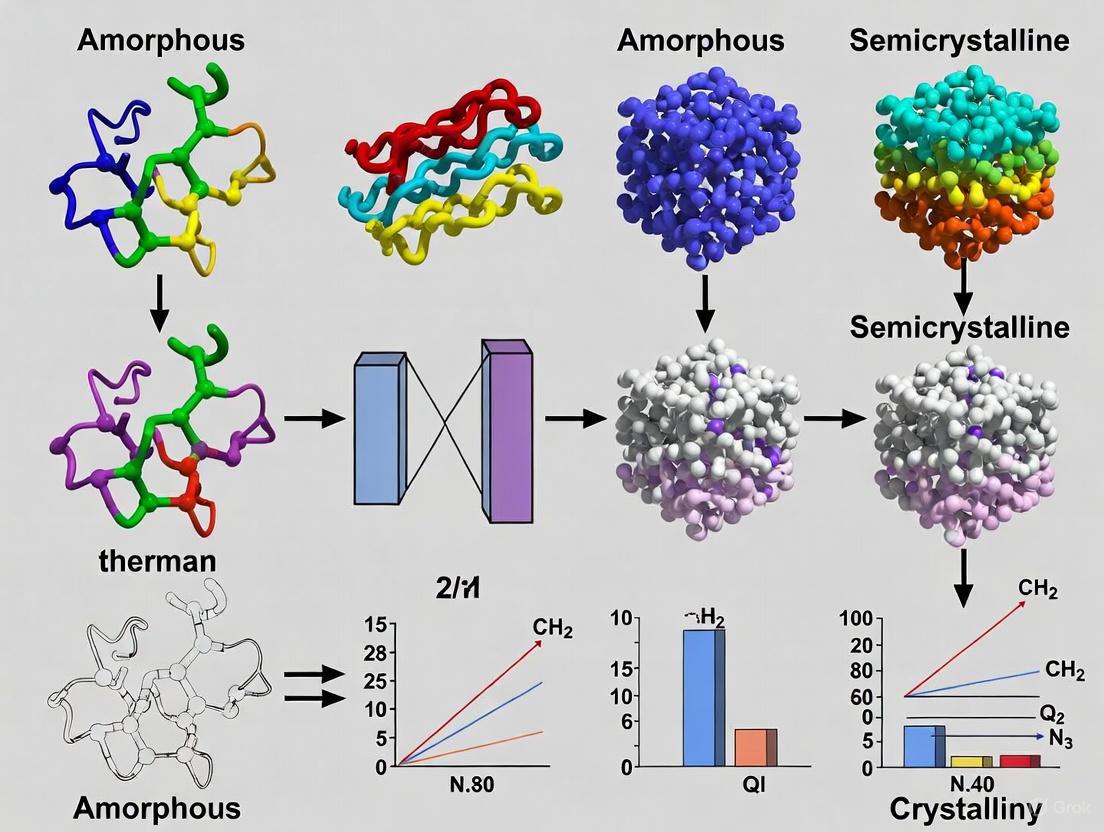
This article provides a comprehensive analysis of the thermal properties of amorphous and semicrystalline materials, crucial for researchers and drug development professionals.
Amorphous vs. Semicrystalline Materials: A Thermal Properties Guide for Pharmaceutical and Material Scientists
Abstract
This article provides a comprehensive analysis of the thermal properties of amorphous and semicrystalline materials, crucial for researchers and drug development professionals. It explores the fundamental principles governing molecular mobility, crystallization behavior, and their direct impact on material performance. The scope spans from foundational concepts and advanced characterization methodologies to practical application guidelines, troubleshooting common issues, and validating material performance through comparative analysis. By synthesizing recent research findings, this review serves as a strategic resource for optimizing material selection and processing parameters in pharmaceutical formulation and advanced material design, with particular emphasis on thermal stability, conductivity, and mechanical behavior.
Molecular Origins: Unraveling the Fundamental Thermal Behavior of Amorphous and Semicrystalline Structures
The performance and properties of thermoplastics are fundamentally governed by their internal molecular architecture. Polymers are broadly categorized into two distinct classes based on this architecture: amorphous and semicrystalline [1]. This division is not merely academic; it dictates every aspect of a polymer's behavior, from its thermal response and mechanical strength to its optical characteristics and chemical resistance [2] [3]. Understanding this molecular-level structural order is crucial for researchers and scientists, particularly in advanced fields like drug development, where material selection can influence device performance, drug stability, and release profiles.
The core distinction lies in the arrangement of the polymer chains. Amorphous polymers exhibit a random, entangled structure, often compared to a plate of cooked spaghetti, lacking any long-range order [2] [3]. In contrast, semicrystalline polymers feature a hybrid structure, with organized, tightly packed crystalline regions—called spherulites—embedded within a disordered amorphous matrix [2]. This fundamental architectural difference is the origin of their divergent properties and processing behaviors, a relationship that forms the thesis of this analysis within the broader context of thermal properties research.
Molecular Architecture: A Tale of Two Structures
The Amorphous Phase
In the amorphous phase, polymer chains are arranged in a random, coiled, and entangled manner without any long-range order [3]. This disorganized structure lacks a sharp melting point. Instead, when heated, amorphous polymers gradually soften over a range of temperatures as the material transitions from a hard, glassy state to a soft, rubbery state, and eventually to a viscous liquid [4] [5]. This transition point is known as the glass transition temperature (Tg) [4]. The isotropic nature of the molecular structure means these materials shrink uniformly in all directions during cooling, leading to better dimensional stability and less warpage [6] [2]. The random molecular arrangement also allows light to pass through with less scattering, which is why amorphous polymers are often transparent [3].
The Semicrystalline Phase
Semicrystalline polymers possess a dual-phase structure characterized by organized, tightly packed crystalline areas interspersed with unordered amorphous regions [2] [4]. The crystalline regions, or crystallites, are areas where the polymer chains are folded and aligned in an orderly pattern, creating a highly organized molecular structure [5]. This structured architecture results in a defined melting point (Tm), where the material transitions rapidly from a solid to a low-viscosity liquid upon absorbing a specific amount of heat [1] [3]. The crystalline structure scatters light, typically rendering these materials opaque or translucent [3]. Their flow is anisotropic, meaning they experience non-uniform shrinkage—less in the direction of flow and more in the transverse direction—which can lead to dimensional instability during processing [1] [5].
The following diagram illustrates the fundamental architectural differences between these two polymer phases and their direct link to material properties.
Figure 1: Molecular Architecture and Resulting Properties of Polymer Phases
Comparative Analysis of Key Properties
The architectural differences between amorphous and semicrystalline polymers manifest in distinct property profiles, which are critical for material selection in research and development applications.
Table 1: Comparative Properties of Amorphous and Semicrystalline Polymers
| Property | Amorphous Polymers | Semicrystalline Polymers |
|---|---|---|
| Molecular Structure | Random, coiled, entangled chains [2] [3] | Organized crystalline regions in amorphous matrix [2] [4] |
| Melting Behavior | Gradual softening over a temperature range; no sharp melting point [3] [4] | Sharp melting point at a specific temperature [1] [3] |
| Optical Clarity | Often transparent or translucent [3] | Usually opaque or translucent [3] |
| Density | Higher density polymers [3] | Lower density polymers [3] |
| Chemical Resistance | Generally lower chemical resistance [3] [5] | Excellent chemical resistance [3] [5] |
| Shrinkage & Warpage | Isotropic shrinkage; lower warpage [6] [2] | Anisotropic shrinkage; higher warpage [6] [5] |
| Mechanical Properties | High impact resistance, poor fatigue resistance [2] [3] | Good strength & wear resistance, lower impact resistance [2] [5] |
| Thermoforming | Easier to thermoform [2] | Difficult to thermoform [3] |
Thermal and Mechanical Performance
The thermal behavior of these polymer classes extends beyond melting characteristics. Amorphous polymers, such as polycarbonate (PC) and polysulfone (PSU), typically exhibit superior impact resistance and bond well to substrates, making them suitable for structural applications and environments with mechanical shock [1] [3]. However, they are more prone to stress cracking and offer poor fatigue resistance [2]. Their glass transition temperature (Tg) is a critical parameter, representing the transition from a glassy to a rubbery state [4].
Semicrystalline polymers, including polyamide (PA) and polypropylene (PP), form tough plastics with excellent resistance to wear, bearings, and structural loads [3]. They maintain good stiffness and strength, with a very low coefficient of friction, but their impact resistance is generally inferior to amorphous polymers [3] [5]. The degree of crystallinity is a key variable that influences many material characteristics and can be controlled through processing conditions and thermal history [6].
Experimental Data and Research Findings
Mould Material Interaction Study
A significant study investigating the interaction between polymer type and mould material revealed substantial differences in production efficiency and part quality. The research employed steel and aluminium mould cavities to process different polymers, assessing critical injection parameters for a high-production automotive component (cup holder) [6].
Table 2: Cycle Time Reduction in Aluminium Moulds vs. Steel Moulds [6]
| Polymer Type | Specific Material | Cycle Time Reduction |
|---|---|---|
| Semicrystalline | Polypropylene (PP) | 40.6% to 52.5% |
| Semicrystalline | Polyamide (PA) | 56% to 63.5% |
| Amorphous | Acrylonitrile Butadiene Styrene (ABS) | Less significant reductions compared to semicrystalline materials |
The study concluded that for productivity factors, moulds made of aluminium using semicrystalline polymers showed more significant reductions in cycle time compared to amorphous materials [6]. Furthermore, regarding warpage, amorphous materials displayed the lowest values for both types of moulds, but aluminium moulds exhibited the lowest warping results and smaller variations for all polymers [6].
Experimental Protocol: Taguchi Method and Simulation
The experimental methodology for this comparative study utilized a structured approach to ensure statistical significance and practical relevance [6].
1. Experimental Planning: The Taguchi experimental planning method was employed as a fractionated factorial approach. This "off-line quality control" method involves a small number of samples from trial phases, which present high variance levels in quality parameters compared to production parts. This technique allows for the determination of the optimum combination of factors and interactions that influence variable-response behavior with fewer samples and decreased testing costs without affecting the conclusions [6].
2. Numerical Simulation: Numerical simulations were performed using MoldFlow 2024 software to analyze the injection molding process for different polymer types (ABS and PC for amorphous; PP and PA for semicrystalline) in both steel and aluminium moulds. The simulations assessed key parameters including cycle time, warpage, and cooling efficiency [6].
3. Statistical Analysis: Statistical tests were conducted using Minitab 19 software. Analysis of Variance (ANOVA) was applied to the numerical simulation results to identify the most important parameters for each response variable. The statistical variables used to assess the results included the R² value, P-value, and the intrinsic error of the model [6].
The following workflow diagram outlines the experimental methodology used in the cited study.
Figure 2: Experimental Workflow for Polymer Processing Analysis
The Scientist's Toolkit: Research Reagent Solutions
Table 3: Essential Materials and Analytical Methods for Polymer Research
| Item/Reagent | Function/Application in Research |
|---|---|
| Polymer Grades (ABS, PC, PP, PA) | Base materials for comparative studies of amorphous vs. semicrystalline structures; selected for differences in mechanical and physical properties [6]. |
| Mould Materials (Steel, Aluminium) | Cavity materials for injection moulding studies; aluminium with superior thermal conductivity (up to 5x greater than steel) reduces cycle times significantly [6]. |
| Thermal Stabilizers & Antioxidants | Additives to improve thermal behavior and oxidative stability of polymers during processing and in service [4]. |
| Fillers (Glass Fiber, Ceramic Powder) | Enhance thermal resistance and mechanical properties; glass fiber increases stiffness while potentially reducing impact strength [4]. |
| Differential Scanning Calorimetry (DSC) | Analytical technique to determine glass transition temperature (Tg), melting point (Tm), and degree of crystallinity. |
| Taguchi Experimental Design | Statistical method for optimizing process parameters with minimal experimental runs; identifies key factors influencing output variables [6]. |
| ANOVA Statistical Analysis | Identifies most significant parameters affecting response variables; validates experimental results through R², P-value, and intrinsic error analysis [6]. |
The molecular architecture of polymers—whether amorphous or semicrystalline—serves as the fundamental determinant of their thermal, mechanical, and processing characteristics. The experimental data confirms that semicrystalline polymers like polyamide and polypropylene exhibit significantly greater cycle time reductions (up to 63.5%) when processed in high-thermal-conductivity aluminium moulds compared to amorphous materials [6]. This has substantial implications for manufacturing efficiency in high-volume production environments, such as automotive components.
For researchers and drug development professionals, this architectural understanding provides a predictive framework for material selection. Amorphous polymers, with their isotropic behavior, dimensional stability, and transparency, are advantageous for applications requiring precise dimensions and optical clarity [1] [3]. Conversely, semicrystalline polymers offer superior chemical resistance, wear performance, and structural integrity for components subjected to mechanical stress and harsh environments [3] [5]. The choice between these two fundamental architectural forms ultimately depends on the specific performance requirements, environmental conditions, and processing constraints of the intended application, with the structural order at the molecular level dictating macroscopic performance.
Understanding the thermal transition behavior of polymers is fundamental to materials science, dictating the processing, performance, and end-use applications of everything from commodity plastics to advanced pharmaceutical formulations. Within this context, two transitions are paramount: the glass transition (Tg) and the melting point (Tm). The glass transition is a phenomenon of the amorphous regions in a polymer, marking the temperature at which chains gain sufficient mobility to transition from a hard, glassy state to a soft, rubbery one [7]. In contrast, the melting point is a first-order transition characteristic of the crystalline regions, where well-ordered structures break down into a disordered melt [7]. For researchers and scientists, accurately characterizing these transitions is not merely academic; it is crucial for predicting material stability, mechanical integrity, and solubility, which in turn informs quality control, formulation development, and regulatory compliance [7] [8]. This guide objectively compares these behaviors across different polymer states and details the experimental protocols essential for their study.
Fundamental Concepts: Amorphous vs. Semi-Crystalline Polymers
The thermal behavior of a polymer is intrinsically linked to its microstructure. Polymers are broadly classified based on the arrangement of their molecular chains, which directly influences their thermal and mechanical properties.
- Amorphous Polymers: These polymers possess a random, disordered molecular structure, much like a plate of spaghetti. The chains are physically entangled but lack long-range order. This structure creates more free volume, allowing chains to move at lower temperatures and resulting in a lower Tg [7]. They do not have a true melting point; instead, they gradually soften upon heating. Common examples include polystyrene (PS), poly(methyl methacrylate) (PMMA), and atactic polyvinyl chloride (PVC) [7].
- Semi-Crystalline Polymers: These materials feature a heterogeneous structure containing both ordered crystalline regions and disordered amorphous regions. The crystalline regions are held together by strong, organized molecular interactions, giving the polymer a defined melting point (Tm). The amorphous regions, interspersed between the crystalline domains, are responsible for the glass transition [7]. The crystalline structures restrict chain mobility, leading to a higher Tg compared to a purely amorphous polymer of the same chemistry. Polyethylene (PE) and poly(ε-caprolactone) (PCL) are classic examples [9] [7].
Table 1: Comparison of Amorphous and Semi-Crystalline Polymer Characteristics
| Characteristic | Amorphous Polymers | Semi-Crystalline Polymers |
|---|---|---|
| Molecular Structure | Random, disordered | Mixture of ordered (crystalline) and disordered (amorphous) regions |
| Glass Transition (Tg) | A defining property; lower due to more free volume | Property of the amorphous parts; higher due to restricted mobility from crystals |
| Melting Point (Tm) | Does not have a sharp Tm; softens over a range | Has a sharp, defined Tm due to crystalline regions |
| General Transparency | Often transparent | Often opaque or translucent |
| Mechanical Properties | Hard and brittle below Tg; soft and flexible above Tg | Tough, and combine strength with some flexibility |
Comparative Thermal Transition Data
The following tables provide characteristic transition temperatures for a selection of common polymers, offering a reference point for researchers comparing material properties.
Table 2: Glass Transition Temperatures (Tg) of Selected Polymers [7]
| Polymer Name | Min Tg (°C) | Max Tg (°C) |
|---|---|---|
| ABS - Acrylonitrile Butadiene Styrene | 90.0 | 102.0 |
| Polycarbonate (PC) | 145.0 | 150.0 |
| Polystyrene (PS), General Purpose | 100.0 | 100.0 |
| Poly(methyl methacrylate) (PMMA) | 105.0 | 105.0 |
| Polyvinyl Chloride (PVC) | 75.0 | 85.0 |
| Cellulose Acetate (CA) | 100.0 | 130.0 |
| Polyisobutylene (PIB) | -70.0 | -50.0 |
Table 3: Thermal Properties of Semi-Crystalline Polymers from Experimental Studies
| Polymer Name | Melting Point (Tm) °C | Glass Transition (Tg) °C | Experimental Context |
|---|---|---|---|
| Poly(ε-caprolactone) (PCL) | 59 - 64 [9] | -60 [9] | Bulk polymer, studied via Spectral Reflectance [9] |
| Poly(ethylene glycol) (PEG) | 64 - 66 [9] | -65 [9] | Bulk polymer, studied via Spectral Reflectance [9] |
| Polyethylene (PE) | ~120 - 130 | -125 | N/A (for comparison) |
| Polylactic Acid (PLA) | ~150 - 180 | ~55 - 60 | N/A (for comparison) |
Factors Influencing Transition Temperatures
A polymer's Tg and Tm are not fixed material constants but are influenced by its chemical structure and external conditions. Key factors include:
- Molecular Weight: In straight-chain polymers, increasing molecular weight decreases the concentration of chain ends, which are sites of increased free volume. This reduction in free volume restricts chain mobility, leading to an increase in Tg. This dependence is strong in the oligomeric regime but typically plateaus at higher molecular weights [10] [7].
- Chemical Structure and Plasticizers: The presence of bulky side groups or polar groups increases the energy required for chain motion, thereby raising the Tg. Conversely, adding small molecule plasticizers increases the free volume between polymer chains, allowing them to slide past each other more easily and significantly depressing the Tg [7]. Similarly, absorbed water can act as a plasticizer for some polymers, reducing Tg [7].
- Cross-Linking and Crystallinity: Chemical cross-links tightly bind polymer chains together, drastically reducing their mobility and resulting in a higher Tg [7]. In semi-crystalline polymers, the crystalline regions act as physical cross-links, similarly restricting the motion of amorphous chains and elevating the observed Tg.
- Thermal History and Processing: The thermal history of a polymer, such as its cooling rate from the melt or annealing treatments, can affect the free volume and degree of crystallinity, thereby influencing the measured Tg and Tm.
Experimental Protocols for Characterizing Transitions
A range of sophisticated techniques is available for characterizing thermal transitions, each with unique strengths and applications.
Differential Scanning Calorimetry (DSC)
Methodology Overview: DSC is a thermo-analytical technique that measures the difference in heat flow between a sample and an inert reference as they are subjected to a controlled temperature program [11] [12]. When the sample undergoes a thermal transition (e.g., glass transition, melting, or crystallization), it will absorb or release more heat than the reference, resulting in a peak or a step change in the heat flow curve [8] [12].
Protocol for Tg and Tm:
- Sample Preparation: Encapsulate 1-10 mg of the polymer in a hermetic aluminum crucible [11] [12].
- Experimental Run: Heat the sample and reference at a constant rate (e.g., 10°C/min) over a temperature range that spans the expected transition(s) under an inert nitrogen atmosphere [12].
- Data Analysis:
Dynamic Mechanical Analysis (DMA)
Methodology Overview: DMA applies a small oscillatory stress to a sample and measures the resulting strain, determining the viscoelastic storage modulus (E' or G'), loss modulus (E" or G"), and tan(δ) (the damping factor) as functions of temperature, time, or frequency [13]. This technique is exceptionally sensitive to the glass transition.
Protocol for Tg:
- Sample Preparation: Prepare a sample of defined geometry (e.g., a rectangular bar or a thin film) compatible with the clamping system (e.g., tension, bending, or shear) [13].
- Experimental Run: Ramp the temperature at a controlled rate (e.g., 2°C/min) while applying a small oscillatory deformation at a fixed frequency [13].
- Data Analysis: The Tg can be identified through three methods (see Diagram 1):
- Onset of E' Drop: The temperature at which the storage modulus begins to decrease sharply.
- Peak of E" (Loss Modulus): The temperature at which the loss modulus reaches a maximum.
- Peak of Tan(δ): The temperature at which the tan(δ) curve peaks. This typically gives the highest Tg value of the three methods [13].
Thermogravimetric Analysis (TGA)
Methodology Overview: TGA measures the mass change of a sample as a function of temperature or time in a controlled atmosphere [11] [12]. While it does not directly measure Tg or Tm, it is crucial for determining the thermal stability of a polymer and identifying decomposition temperatures, which defines the upper temperature limit for processing and application [12].
Protocol for Thermal Stability:
- Sample Preparation: Place 5-30 mg of powder or a small solid piece into an open alumina crucible [11] [12].
- Experimental Run: Heat the sample at a constant rate (e.g., 20°C/min) from room temperature to beyond its decomposition point (e.g., 800°C) under nitrogen (for stability) or air (for oxidative stability) [12].
- Data Analysis: The onset of a mass loss step in the resulting thermogram indicates the start of decomposition or the loss of volatiles (e.g., moisture or solvent) [12].
Supplementary Techniques
- Spectral Reflectance: An emerging technique for thin films that measures thickness changes due to thermal expansion during melting or contraction during crystallization. It is beneficial for in-situ studies of substrate-supported films where traditional calorimetry is challenging [9].
- Thermomechanical Analysis (TMA): Measures dimensional changes (thermal expansion) in a material as a function of temperature, providing complementary data on Tg and coefficient of thermal expansion [8].
Diagram 1: Experimental workflow for key thermal analysis techniques and their primary outputs for identifying Tg and Tm.
The Scientist's Toolkit: Essential Research Reagents and Materials
Table 4: Key Materials and Reagents for Polymer Thermal Studies
| Item Name | Function/Application |
|---|---|
| Hermetic Aluminum Crucibles | Standard sealed pans for DSC to contain sample and prevent vaporization during heating. |
| Nitrogen Gas (High Purity) | Inert purge gas for DSC and TGA to prevent oxidative degradation during analysis. |
| Reference Materials (e.g., Indium, Zinc) | Calibration standards for temperature and enthalpy in DSC. |
| Polymer Standards (e.g., PS, PCL) | Well-characterized polymers with known Tg/Tm for method validation and instrument calibration. |
| Spin Coater & Solvents (e.g., Toluene) | For preparing thin-film polymer samples on silicon wafers for techniques like Spectral Reflectance [9]. |
Advanced Research: Thermal Transport in Amorphous Polymers
Understanding thermal transitions extends to how heat is transported through polymeric materials. Recent research using lattice dynamics and Green-Kubo Mode Analysis (GKMA) has revealed that thermal conductivity in amorphous polymers is dominated by localized modes (locons), contrary to the common picture of heat transport in other amorphous materials [14]. These locons, which involve vibrations highly concentrated on a subset of atoms, account for over 90% of the vibrational modes and contribute to over 80% of the thermal conductivity in systems like amorphous polystyrene (PS) and poly(methyl methacrylate) (PMMA) [14]. This finding provides a molecular-level explanation for the generally low thermal conductivity of polymers and suggests that engineering inter-chain interactions, rather than just intra-chain structure, could be a pathway to controlling thermal properties [14].
The demystification of glass transition and melting behavior is central to the rational design and application of polymeric materials. As detailed in this guide, the fundamental difference between amorphous and semi-crystalline structures dictates distinct thermal profiles, which can be precisely characterized using a suite of complementary techniques like DSC, DMA, and TGA. For researchers in fields from drug development to advanced materials, a rigorous understanding of these transitions—and the factors that influence them—provides the critical insights needed to ensure material stability, optimize processing conditions, and ultimately, guarantee product performance.
The investigation of molecular mobility in amorphous and semi-crystalline materials represents a critical frontier in pharmaceutical science and material engineering. Understanding cooperative relaxation dynamics is not merely an academic exercise but a practical necessity for predicting stability, performance, and bioavailability of pharmaceutical formulations. Thermally Stimulated Current (TSC) spectrometry has emerged as a powerful technique for probing these molecular motions with exceptional sensitivity, offering insights that often remain obscured by conventional analytical methods [15].
This technique operates at a low equivalent frequency, granting it superior resolution for detecting molecular relaxation processes compared to more common approaches like dielectric spectroscopy [16]. For pharmaceutical researchers and scientists, TSC provides a unique window into the solid-state behavior of both active pharmaceutical ingredients (APIs) and excipients, enabling more informed decisions in drug development and formulation design. The following analysis compares TSC spectrometry with alternative methodologies, provides detailed experimental protocols, and contextualizes findings within the broader framework of amorphous and semi-crystalline thermal properties research.
Fundamental Principles of TSC Spectrometry
Theoretical Basis of TSC
Thermally Stimulated Current spectrometry is a dielectric technique that measures the depolarization currents released by a material as it is heated through its molecular relaxation transitions. The fundamental principle relies on the polarization and subsequent depolarization of molecular dipoles under controlled thermal conditions. When a material contains polar groups or molecules with dipole moments, these can be aligned by applying an electric field at an elevated temperature where molecular mobility is sufficient. Upon cooling while maintaining the field, these dipoles become "frozen" in their aligned state. During subsequent heating in the absence of the field, the dipoles gain thermal energy and return to their random orientations, generating a measurable current at characteristic temperatures [15].
The relaxation time (τ) describes the time required for a specific molecular motion to be completed and is temperature-dependent, typically following an Arrhenius relationship: τ(T) = τ₀ exp(Eₐ/kT) where τ₀ is the pre-exponential factor, Eₐ is the activation energy, k is the Boltzmann constant, and T is the absolute temperature [15]. TSC excels in accurately determining these parameters without extrapolation or assumptions required by other techniques.
Classification of Molecular Relaxations
TSC spectroscopy distinguishes between two primary types of molecular relaxations:
Non-cooperative relaxations (e.g., β-relaxations): These involve independent motions of specific molecular segments, side groups, or chain ends without coordinated movement. They typically occur at lower temperatures and exhibit lower activation energies. For instance, in hydroxyethyl cellulose (HEC) films, a β-relaxation detected at -57±2°C originates from independent orientation of short sections of the HEC polymer chain ends and the hydroxyethyl side groups [16].
Cooperative relaxations (e.g., α-relaxations, glass transitions): These require coordinated movement of larger molecular domains and are characterized by higher activation energies and temperatures. The glass transition (T𝑔) represents a primary cooperative process where significant segments of polymer chains gain mobility [16]. These cooperative processes follow a compensation law characteristic of highly coordinated relaxation mechanisms [17].
Table 1: Characteristics of Molecular Relaxation Processes Detectable by TSC
| Relaxation Type | Molecular Origin | Typical Temperature Range | Activation Energy | Pharmaceutical Significance |
|---|---|---|---|---|
| Non-cooperative (β) | Localized side group motions, chain end movements | Below ambient temperatures | Low (often < 100 kJ/mol) | Precursor to larger motions, may indicate stability issues |
| Cooperative (α) | Segmental backbone mobility, glass transition | Ambient to elevated temperatures | High (often > 100 kJ/mol) | Directly related to physical stability, crystallization tendency |
| Crystalline Defects | Motions within crystal imperfections | Variable, often near melting point | Medium to High | Affects polymorphic stability, dissolution behavior |
| Solid-Solid Transitions | Molecular rearrangements between polymorphs | Transition-specific | High | Impacts polymorphic form stability and interconversion |
Comparative Analytical Techniques
TSC Versus Conventional Thermal Analysis
When selecting characterization techniques for amorphous and semi-crystalline materials, researchers must consider the complementary strengths and limitations of each method. The following comparison highlights how TSC spectrometry complements and extends capabilities beyond conventional thermal analysis techniques.
Table 2: Comparison of TSC with Other Analytical Techniques for Molecular Mobility Assessment
| Technique | Detection Principle | Effective Frequency | Key Strengths | Principal Limitations |
|---|---|---|---|---|
| TSC Spectrometry | Depolarization current during controlled heating | Very low (~0.001-0.1 Hz) | High resolution of overlapping transitions; Direct calculation of activation energies; Extreme sensitivity (10⁻¹⁶ A) | Requires polarizable samples; Less established in pharma; Limited to solid-state characterization |
| Differential Scanning Calorimetry (DSC) | Heat flow difference during temperature programming | Medium (~0.01-0.1 Hz) | Widely available; Standardized protocols; Provides thermodynamic data (ΔH, T𝑔) | Lower resolution for broad transitions; Limited sensitivity for weak relaxations; Indirect mobility assessment |
| Dielectric Spectroscopy (DS) | AC current response to oscillating electric field | Broad (10⁻⁵-10¹⁰ Hz) | Broad frequency range; Well-established theory; Commercial availability | Overlapping relaxations difficult to deconvolute; Requires conductive electrodes; Complex data interpretation |
| Dynamic Mechanical Analysis (DMA) | Mechanical response to oscillatory stress | 0.01-100 Hz | Sensitive to glass transitions; Measures viscoelastic properties; Standard method for mechanical relaxations | Limited to self-supporting samples; Potential for mechanical damage; Complex sample preparation |
Unique Advantages of TSC in Pharmaceutical Research
TSC spectrometry offers several distinctive advantages for pharmaceutical applications:
Enhanced Sensitivity to Amorphous Content: TSC directly probes molecular mobility, making it exceptionally sensitive to amorphous phases in predominantly crystalline matrices. Studies have demonstrated detection limits as low as 2.5% amorphous content in crystalline irbesartan, with potential for further optimization of experimental parameters [17].
Superior Resolution of Complex Transitions: The low equivalent frequency of TSC enables clear separation of overlapping relaxation processes. For instance, TSC identified two distinct glass transitions in polyethyleneglycols (PEGs) that appeared as weak, unresolved events in MTDSC [15]. The transitions, separated by 10-15°C, provided insights into different amorphous regions within the semi-crystalline polymer.
Early Detection of Instability: Molecular mobilities detectable by TSC often precede major transitions observed by other techniques. Research on indomethacin revealed significant molecular mobility 20°C below the conventionally measured T𝑔, explaining its tendency to crystallize just below the glass transition [15]. This early warning capability is crucial for predicting stability issues in amorphous pharmaceuticals.
Experimental Protocols and Methodologies
Standard TSC Experimental Procedure
The following protocol outlines the fundamental TSC measurement process, synthesized from multiple methodological descriptions in the search results [18] [16] [15]:
Sample Preparation:
- For pharmaceutical powders: Compress into pellets (typically 1-3 mm thick) using a hydraulic press.
- For polymers: Prepare free-standing films (typically 100-500 µm thick) by solvent casting or compression molding.
- Ensure good contact with electrodes by applying conductive coatings (gold or silver) if necessary.
Sample Polarization:
- Heat the sample to the initial polarization temperature (T𝑝), typically slightly above the relaxation of interest.
- Apply a DC electric field (typically 100-500 V/mm) for a sufficient time (usually 2-5 minutes) to allow dipole alignment.
Freezing Dipolar Orientations:
- Cool the sample to a cryogenic temperature (typically -150°C to -100°C) while maintaining the electric field.
- This "freezes" the aligned dipoles in their non-equilibrium state.
Depolarization Current Measurement:
- Remove the electric field and heat the sample at a constant rate (typically 5-10°C/min).
- Measure the resulting depolarization current using a highly sensitive electrometer (capable of detecting currents as low as 10⁻¹⁶ A).
Data Analysis:
- Identify relaxation peaks in the global TSC spectrum.
- Calculate activation parameters (Eₐ, τ₀) for each relaxation process.
Figure 1: TSC Experimental Workflow. The diagram illustrates the sequential steps in a standard TSC measurement protocol.
Thermal Windowing Procedure
For complex relaxation processes like the glass transition, TSC employs a "thermal windowing" or "fractional polarization" technique to deconvolute overlapping processes:
Global Spectrum Acquisition: First, obtain a standard TSC spectrum to identify temperature regions of interest.
Selective Polarization:
- Polarize the sample at a specific temperature (T𝑝) within the relaxation region of interest.
- Immediately cool the sample by 3-10°C (temperature window) before proceeding with standard cooling.
Multiple Window Acquisition: Repeat step 2 across the entire temperature range of the complex relaxation using overlapping windows.
Data Reconstruction: Analyze the set of elementary peaks to determine the distribution of relaxation times and activation parameters across the transition [15].
This approach enables researchers to extract detailed information about the heterogeneity of molecular mobility within what appears as a single broad transition in other techniques.
Research Reagent Solutions and Materials
Successful TSC analysis requires specific materials and instrumentation. The following table catalogs essential research reagents and their functions in TSC experiments.
Table 3: Essential Research Reagents and Materials for TSC Experiments
| Material/Reagent | Specifications | Function in TSC Analysis | Example Applications |
|---|---|---|---|
| Reference Standards | High-purity indomethacin, caffeine polymorphs | Method validation and calibration | Verifying instrument response; Quantifying amorphous content [15] |
| Electrode Coatings | Conductive silver or gold paste | Ensuring electrical contact with sample | Creating uniform electric field across sample; Minimizing air gaps [16] |
| Pharmaceutical Polymers | HEC, PEG, HPMC of various molecular weights | Model systems for method development | Studying molecular weight effects on mobility; Excipient characterization [16] [15] |
| Cryogenic Fluids | Liquid nitrogen or helium | Sample cooling to cryogenic temperatures | Freezing molecular motions; Enabling low-temperature polarization |
| Standard Solvents | HPLC-grade water, organic solvents | Sample preparation (film casting, cleaning) | Creating uniform films; Removing contaminants before analysis [16] |
Applications in Pharmaceutical Research
Characterization of Amorphous Pharmaceutical Systems
TSC spectrometry provides critical insights into amorphous pharmaceutical materials, which are increasingly utilized to enhance solubility and bioavailability of poorly soluble APIs. The technique's exceptional sensitivity to molecular mobility makes it ideal for:
Stability Assessment: The breadth of the TSC glass transition signal (typically 20-30°C for indomethacin) compared to the narrower DSC transition (approximately 5°C) reveals that molecular rearrangements begin at temperatures significantly below the conventional T𝑔 [15]. This finding validates the empirical pharmaceutical practice of storing amorphous materials at least 50°C below their T𝑔 to minimize crystallization.
Homogeneity Evaluation: The relationship between pre-exponential factors (τ₀) and activation energies (Eₐ) across a relaxation reveals the homogeneity of amorphous systems. Linear compensation behavior indicates a homogeneous amorphous phase, while non-linear relationships suggest heterogeneity that could impact stability and performance [15].
Quantification of Amorphous Content: TSC can detect and quantify low levels of amorphous content in predominantly crystalline materials. For irbesartan, a calibration curve enabled quantification with a detection limit of 2.5% amorphous content [17]. This sensitivity makes TSC valuable for monitoring process-induced amorphization during manufacturing.
Analysis of Semi-Crystalline and Polymorphic Systems
In semi-crystalline pharmaceuticals, TSC provides unique insights into the complex interplay between ordered and disordered regions:
Polymorphic Characterization: TSC can distinguish between polymorphic forms based on their distinct molecular mobilities. For caffeine Forms I and II, TSC revealed previously unknown relaxation processes responsible for molecular rearrangements prior to the main solid-solid transition [15].
Crystalline Defect Analysis: Different crystalline forms exhibit distinct TSC responses based on their internal mobility. While the B form of irbesartan showed no specific dielectric response, the A form displayed molecular motions localized within its channel structure, demonstrating how crystal packing influences molecular mobility [18] [17].
Semi-Crystalline Complexity: TSC studies support the view that semi-crystalline pharmaceuticals should not be considered as simple two-phase systems. Research on recrystallized irbesartan samples revealed complex behavior explainable by either an "idealized one-state model" (independent amorphous and crystalline phases) or classical one-state model, depending on thermal history [17].
Figure 2: TSC Pharmaceutical Application Domains. The diagram categorizes major application areas for TSC spectrometry in pharmaceutical research.
Thermally Stimulated Current spectrometry represents a powerful, albeit underutilized, technique for characterizing molecular mobility in pharmaceutical systems. Its exceptional sensitivity to both cooperative and non-cooperative relaxation processes provides insights that complement and extend information obtained from conventional thermal analysis methods. The ability to directly probe molecular motions, quantify low levels of amorphous content, and deconvolute complex transitions makes TSC particularly valuable for understanding and predicting the stability and performance of amorphous and semi-crystalline pharmaceuticals.
As pharmaceutical development increasingly embraces amorphous solid dispersions and other metastable systems, techniques like TSC that can probe the fundamental molecular motions governing stability will become increasingly essential. The integration of TSC data with information from other analytical methods provides a comprehensive picture of solid-state behavior, enabling more rational design of robust pharmaceutical formulations with optimized performance characteristics.
The interplay between the degree of crystallinity (Xc), glass transition temperature (Tg), and storage modulus represents a fundamental relationship governing the thermomechanical behavior of semicrystalline polymers. These materials consist of an interpenetrating network of rigid crystalline lamellae and disordered amorphous regions, with the relative proportion and arrangement of these phases dictating ultimate material performance [19]. For researchers and scientists engaged in material selection for applications ranging from drug development to high-performance engineering components, understanding these structure-property relationships is essential. The crystallinity degree serves as a critical control parameter, influencing not only the stiffness and load-bearing characteristics of a polymer but also its transition temperatures and dimensional stability. This guide systematically examines the experimental evidence demonstrating how Xc modulates key thermal and mechanical properties, providing a comparative framework for predicting material behavior across different thermal environments and structural configurations.
Fundamental Concepts: Crystallinity, Tg, and Storage Modulus
In semicrystalline polymers, molecular chains fold into ordered regions called crystallites, while the remaining segments form disordered amorphous regions [20]. The degree of crystallinity (Xc) quantifies the volume or weight fraction of the crystalline phase within the material. This parameter profoundly influences material properties because crystalline and amorphous regions exhibit vastly different mechanical behaviors and thermal responses.
The glass transition temperature (Tg) marks the temperature region where the amorphous phase transitions from a hard, glassy state to a soft, rubbery state, accompanied by a sudden loss in mechanical stiffness [21]. Importantly, in semicrystalline polymers, the amorphous regions are often constrained by adjacent crystalline lamellae, which can significantly alter the Tg compared to that of a purely amorphous material [22].
The storage modulus, typically measured via dynamic mechanical analysis (DMA), represents the elastic (solid-like) response of a material and indicates its stiffness under dynamic loading conditions [19]. For semicrystalline polymers, the storage modulus demonstrates characteristic temperature dependence, reflecting the contributions of both crystalline and amorphous components. Below the Tg, amorphous regions are rigid and contribute significantly to stiffness, while above Tg, the crystalline phase primarily governs modulus retention until the melting point is approached [20].
Table 1: Key Characteristics of Polymer Morphologies
| Property | Semi-crystalline Polymers | Amorphous Polymers |
|---|---|---|
| Molecular Structure | Regions of ordered, patterned structure bounded by unorganized amorphous regions [20] | Unorganized, loose structure with no long-range order [20] |
| Thermal Transition | Distinct melting point (Tm) [20] | Softens above glass transition temperature (Tg) without true melting [20] |
| Mechanical Behavior vs. Temperature | Modulus stable below Tg, steady decline between Tg and Tm [20] | Relatively consistent modulus until approaching Tg, then sharp decline [20] |
Experimental Evidence: How Xc Influences Thermal and Mechanical Properties
Crystallinity and Storage Modulus Relationship
The relationship between crystallinity and storage modulus is complex and temperature-dependent, as demonstrated by systematic studies on poly(4-methyl-1-pentene) (P4M1P). Research reveals that at temperatures below the Tg, samples with lower crystallinity can exhibit a higher storage modulus. This counterintuitive behavior is attributed to the density differences between phases in P4M1P, where the amorphous phase becomes denser than the crystalline phase at lower temperatures [19]. However, as temperature increases, this relationship reverses, and the storage modulus shows a positive correlation with crystallinity at elevated temperatures [19].
The mechanical behavior of semicrystalline polymers can be conceptualized using composite theory models. At temperatures above Tg, where the amorphous phase is rubbery and compliant, the crystalline skeleton largely governs the mechanical response, making it closer to the Voigt rule of mixtures (upper bound) where components are arranged in parallel [19]:
G = αGc + (1-α)Ga
where G is the shear modulus of the bulk material, α is the crystalline volume fraction, and Gc and Ga are the shear moduli of the crystalline and amorphous phases, respectively.
Constrained Amorphous Phase and Tg Behavior
The glass transition in semicrystalline polymers does not occur in a "free" amorphous phase but rather in amorphous regions constrained by surrounding crystals. This confinement significantly stiffens the amorphous regions, with the elastic modulus of the interlamellar amorphous phase (Ea) in polyethylene reaching approximately 40 MPa—more than ten times higher than the 3 MPa modulus of the unconstrained amorphous phase [22].
This stiffening effect diminishes with increasing temperature due to the activation of α relaxation processes within the crystals, which gradually increases molecular mobility and reduces the constraining influence of the crystalline phase [22]. The thickness of the crystalline lamellae further modulates this effect; thicker crystals produce a more pronounced α relaxation shift to higher temperatures, thereby enhancing the stiffening effect on the amorphous phase [22].
Multi-Material Properties from Single Formulations
Recent advances in 3D printing demonstrate how crystallinity can be controlled to create dramatic property variations from a single monomer formulation. By manipulating printing temperature and light intensity, researchers can selectively trap a liquid crystalline monomer in either an ordered LC phase or a largely amorphous state during polymerization [23]. This approach enables pixel-to-pixel resolution of material properties, creating stiff, opaque regions alongside soft, transparent regions within a single printed part—all from an identical chemical formulation [23].
Comparative Data Analysis
Table 2: Experimental Data on Crystallinity-Property Relationships
| Polymer Material | Crystallinity Influence | Effect on Storage Modulus | Effect on Tg/Transition Behavior |
|---|---|---|---|
| Poly(4-methyl-1-pentene) (P4M1P) | Negative modulus dependence at low T; positive dependence at high T [19] | At 60°C: Increases with crystallinity [19] | Density crossover point at ~60°C affects mechanical behavior [19] |
| High-Density Polyethylene (HDPE) | Constrained amorphous regions [22] | Amorphous phase modulus (Ea) = ~40 MPa (constrained) vs. ~3 MPa (unconstrained) [22] | α relaxation processes in crystals influence amorphous phase stiffness [22] |
| Liquid Crystalline Monomer Formulation | Controlled by printing temperature [23] | Curing from LC phase: Stiff material; Curing from isotropic phase: Soft material [23] | Optical property differentiation (opaque vs. transparent) based on phase during curing [23] |
Experimental Methodologies
Determining the Amorphous Phase Modulus (Ea)
A novel methodology for determining the elastic modulus of the amorphous phase (Ea) in semicrystalline polymers involves combining swelling agents with mechanical testing and structural characterization:
- Sample Preparation: Compression mold polymer films of specified thickness (e.g., 0.5-4 mm) [19] [22].
- Swelling Agent Application: Expose samples to swelling agents such as n-octane or n-hexane, which preferentially penetrate and deform the amorphous regions without affecting crystals [22].
- Local Strain Measurement: Use Small-Angle X-ray Scattering (SAXS) to quantify changes in the long period (lamellar stacking distance) during swelling, representing local strain in the amorphous regions [22].
- Stress Assessment: Determine the yield stress required to initiate deformation in the swollen amorphous phase [22].
- Modulus Calculation: Calculate Ea by analyzing the stress-strain relationship specific to the amorphous component [22].
This method has been successfully applied to various polyethylenes and polypropylene, revealing Ea values significantly higher than those of unconstrained amorphous phases due to the restrictive influence of the crystalline lamellae [22].
Dynamic Mechanical Analysis (DMA) Protocol
DMA provides direct measurement of the storage modulus across a temperature range:
- Sample Preparation: Prepare specimens with varying thermal histories (quenched, slow-cooled, annealed) to achieve different crystallinity levels [19].
- Temperature Ramping: Conduct tests over a defined temperature range (e.g., -25°C to 75°C) at a controlled heating rate [22].
- Frequency and Strain Control: Apply oscillatory deformation at fixed frequency and strain amplitude to measure the storage modulus [19].
- Data Analysis: Correlate modulus changes with temperature and crystallinity, identifying transitions and structure-property relationships [19].
Thermal Protocols for Crystallinity Control
Different thermal histories during processing create materials with distinct crystalline architectures:
- Quenching: Rapid cooling to room temperature or ice water produces low crystallinity with thin crystals [19].
- Slow Cooling: Gradual cooling to ambient temperature yields higher crystallinity [19].
- Annealing: Heating quenched samples below the melting point (e.g., at 150°C) increases crystallinity and perfects crystal structure [19].
Research Reagent Solutions
Table 3: Essential Materials and Research Tools
| Reagent/Material | Function in Research | Application Example |
|---|---|---|
| Swelling Agents (n-octane, n-hexane) | Selectively penetrates and deforms amorphous regions for Ea measurement [22] | Local deformation of amorphous phase in HDPE for modulus calculation [22] |
| Liquid Crystalline Monomers | "Switchable" monomers enabling property control via processing parameters [23] | Multi-material 3D printing from single formulation [23] |
| Photoinitiator Systems | Initiate photopolymerization under specific wavelength and intensity conditions [23] | Controlling network formation in vat photopolymerization [23] |
| Reference Polymers (P4M1P, HDPE, LDPE) | Model systems for studying crystallinity-property relationships [19] [22] | Fundamental studies on constrained amorphous phase [22] |
Conceptual Framework and Signaling Pathways
The relationship between crystallinity, amorphous phase confinement, and macroscopic properties follows a logical pathway that can be visualized as follows:
Crystallinity-Property Relationship Pathway
The experimental workflow for investigating these relationships integrates multiple characterization techniques:
Experimental Workflow for Property Analysis
The degree of crystallinity (Xc) exerts a profound and multi-faceted influence on the glass transition temperature and storage modulus of semicrystalline polymers. Rather than operating in isolation, Xc interacts with temperature and crystalline architecture to determine material behavior through mechanisms such as amorphous phase confinement and α relaxation processes. The experimental data and methodologies presented in this guide provide researchers with a framework for predicting and tailoring polymer properties for specific applications. Emerging techniques, such as multi-temperature 3D printing from single formulations, further demonstrate how precise control over crystallinity enables the creation of materials with spatially graded properties [23]. For scientists engaged in advanced material development, mastering these crystallinity-property relationships is essential for designing next-generation polymeric materials with optimized thermal and mechanical performance.
The Pressure-Volume-Temperature (PVT) behavior of polymers is a critical relationship that describes how their specific volume changes in response to variations in temperature and pressure. This behavior fundamentally dictates polymer processing outcomes and final product properties, particularly during cooling phases in manufacturing techniques like injection molding. The thermodynamic response of polymers during cooling diverges significantly between amorphous and semicrystalline structures, with the latter exhibiting more complex behavior due to crystallization kinetics that are heavily influenced by cooling conditions [24] [25]. Understanding these differences is essential for researchers and scientists working in material development, particularly as they relate to thermally induced stresses and dimensional stability in final products [26]. This guide provides a comprehensive experimental and theoretical comparison of how amorphous and semicrystalline polymers behave during cooling, with specific emphasis on PVT relationships and their practical implications for material selection and processing optimization.
Fundamental Differences in PVT Behavior
Thermal Transitions and Specific Volume Response
The specific volume (the inverse of density) of polymers exhibits distinct patterns for amorphous and semicrystalline materials during cooling, primarily due to differences in their molecular organization and transition behaviors:
Amorphous polymers typically display a single, relatively gradual change in slope at the glass transition temperature (Tg), where the material transitions from a rubbery to a glassy state without any abrupt volume discontinuity [27]. The specific volume curve during cooling remains largely continuous, with the primary transition occurring over a temperature range rather than at a precise point.
Semicrystalline polymers exhibit a more complex response characterized by multiple transitions. These materials display both a glass transition and a distinct melting/crystallization transition, where an abrupt change in specific volume occurs due to the first-order phase transition associated with crystallization [25] [28]. The crystallization process manifests as a significant, relatively sharp reduction in specific volume as molecular chains organize into ordered crystalline regions.
Table 1: Characteristic Transition Behaviors During Cooling
| Polymer Type | Primary Transitions | Specific Volume Change | Order of Transition |
|---|---|---|---|
| Amorphous | Glass transition (Tg) | Continuous slope change | Second-order |
| Semicrystalline | Glass transition (Tg) and Crystallization (Tc) | Abrupt decrease at Tc | First-order (crystallization) |
The Influence of Cooling Rate
The cooling rate during processing exerts dramatically different effects on amorphous versus semicrystalline polymers, with the latter showing significantly greater sensitivity:
For amorphous polymers, the cooling rate primarily affects the glass transition temperature, with faster cooling resulting in a higher apparent Tg and greater nonequilibrium volume, though these effects are generally moderate in magnitude [25] [27].
For semicrystalline polymers, the cooling rate profoundly impacts both the crystallization temperature and the final degree of crystallinity. As cooling rate increases, the crystallization temperature decreases, and the ultimate crystallinity is reduced due to limited time available for molecular reorganization [25] [28]. This relationship follows a predictable pattern where both onset crystallization temperature (Ts) and maximum crystallization temperature (Tm) decrease according to the relationship: Ts = d₁ - k₁ × r^t¹ and Tm = d₂ - k₂ × r^t², where r represents the cooling rate [28].
Table 2: Cooling Rate Impact on Polymer Properties
| Cooling Rate Effect | Amorphous Polymers | Semicrystalline Polymers |
|---|---|---|
| Transition Temperature | Slight increase in Tg with cooling rate | Significant decrease in crystallization temperature with cooling rate |
| Specific Volume | Moderate increase with cooling rate | Substantial increase (lower density) with cooling rate |
| Structural Order | Minimal impact on free volume distribution | Major reduction in crystallinity degree |
Experimental Characterization of PVT Behavior
PVT Measurement Techniques
Accurately characterizing PVT behavior requires specialized instrumentation capable of controlling both pressure and temperature while precisely measuring specific volume changes. Several experimental approaches have been developed:
Confining Fluid Technique: This method utilizes a fluid (typically mercury) to transmit pressure to the polymer sample while measuring volume changes. Advanced setups can achieve cooling rates up to 60 K/s and pressures of 20 MPa, making them suitable for simulating processing conditions [26]. The apparatus measures specific volume simultaneously with temperature history and pressure application, providing comprehensive data sets for analysis.
High-Pressure Capillary Rheometer: This instrument can perform isothermal or isobaric PVT measurements according to ISO 17744 standards [28]. It employs a capillary tube with specific diameter-to-length ratios (typically 25:2) and requires precise sample mass control (approximately 3 kg for accurate results). Data points are recorded at regular temperature intervals (e.g., 2°C) during controlled cooling cycles.
Injection Molding Machine-Based Measurement: Some methodologies adapt actual injection molding equipment to measure PVT relationships, providing data under truly process-relevant conditions [27]. This approach benefits from direct relevance to processing environments but may sacrifice some measurement precision.
Flash Differential Scanning Calorimetry (FSC)
For characterizing crystallization behavior at high cooling rates relevant to actual processing, Flash DSC has emerged as a powerful tool:
Instrument Capabilities: Modern FSC instruments (e.g., Flash DSC 2+) can achieve ultra-high cooling rates of up to 40,000 K/s, far exceeding conventional DSC limitations and matching the extreme conditions encountered in injection molding [28].
Experimental Protocol: The measurement process involves (1) heating the sample to erase thermal history (e.g., 220°C for PP), (2) cooling to a low temperature (e.g., 0°C) at precisely controlled rates, and (3) reheating to detect melting behavior. The cooling scans reveal temperatures of crystallization, while heating scans analyze the crystallinity developed during prior cooling [28].
Data Interpretation: From FSC curves, researchers extract the onset crystallization temperature (Ts) and maximum crystallization temperature (Tm). The extrapolated start temperature (Ts) is determined where the extrapolated baseline intersects with the tangent to the curve at the point of inflection, corresponding to the start of the transition. The peak temperature (Tm) is the temperature where the exothermic peak reaches its maximum [28].
The following workflow diagram illustrates the experimental methodology for characterizing polymer crystallization behavior using Flash DSC:
Mathematical Modeling of PVT Behavior
The Two-Domain Tait Equation
The Tait equation represents the most widely used model for describing PVT behavior in polymers, particularly for processing simulations. The standard form of the two-domain Tait equation is expressed as:
[ v(p,T) = v0(p0,T) \left[1 - C \ln\left(1 + \frac{p}{B(T)}\right)\right] + v_t(p,T) ]
Where:
- ( v(p,T) ) is the specific volume at pressure p and temperature T
- ( v0(p0,T) ) is the specific volume at zero pressure
- ( C ) is a universal constant (0.0894)
- ( B(T) ) represents pressure sensitivity as a function of temperature
- ( v_t(p,T) ) accounts for the specific volume decrease due to crystallization [25] [29]
The model utilizes different parameter sets for the melt (m) and solid (s) states, with the transition between domains defined by a transition temperature ( Tt ) that varies with pressure according to ( Tt = b5 + b6p ) [25] [29].
Cooling Rate Dependent Modifications
Traditional Tait equations lack cooling rate dependence, limiting their accuracy for simulating real processing conditions. Recent advances have introduced cooling rate dependencies through parameter modifications:
For semicrystalline polymers, the transition temperature parameter ( b_5 ) (representing crystallization onset) is made cooling rate-dependent using the relationship:
[ b5 = b{51} - b_{52} \times \ln(q) ]
where ( q = \frac{\dot{T}}{\dot{T}_0} ) represents the ratio of current cooling rate to the reference cooling rate [29].
The zero-pressure specific volume parameter in the melt state ( b_{1m} ) is adjusted according to:
[ b{1m} = b{11m} - ((b{52} \times \ln(q)) \times b{2m}) ]
This modification ensures proper continuity during phase transition while accounting for crystallization shifts [29].
The following diagram illustrates the structure and modifications of the cooling rate-dependent PVT model:
Model Implementation in Process Simulation
The practical application of cooling rate-dependent PVT models has been demonstrated through integration with commercial simulation software:
Moldflow Integration: Researchers have successfully implemented enhanced PVT models in Autodesk Moldflow Insight via the Solver API interface, enabling more accurate predictions of shrinkage and warpage in injection-molded components [25] [29].
3D Tetrahedron Mesh Compatibility: The cooling rate-dependent models have been validated using 3D tetrahedron meshed calculation models, confirming their suitability for complex geometries where simplified approaches (e.g., middle-layer or surface meshing) prove inadequate [25].
Experimental Validation: Modified PVT models show excellent agreement with experimental data, achieving remarkable statistical accuracy with R² values of 99.82% and average absolute percent deviations as low as 0.21% [24].
Table 3: Essential Equipment for PVT and Crystallization Studies
| Equipment/Reagent | Primary Function | Key Specifications | Application Context |
|---|---|---|---|
| Flash DSC 2+ | High-rate crystallization analysis | Cooling rates to 40,000 K/s | Characterization of crystallization at processing-relevant conditions |
| High-Pressure Capillary Rheometer | PVT diagram measurement | ISO 17744 compliance | Isobaric and isothermal PVT data collection |
| Confining Fluid Dilatometer | Specific volume measurement | 60 K/s cooling, 20 MPa pressure | PVT behavior at intermediate cooling rates |
| Polypropylene Reference Material | Benchmark semicrystalline polymer | MFR: 18 g/10 min (230°C, 2.16 kg) | Model material for crystallization studies |
| Tait Model Parameters | Mathematical modeling | b₁-b₉ coefficients | PVT behavior simulation |
Comparative Analysis and Research Implications
Quantitative Comparison of PVT Behaviors
The differences between amorphous and semicrystalline polymers manifest clearly in quantitative PVT measurements:
Specific Volume Values: At processing temperatures (e.g., 200°C), amorphous polymers such as polycarbonate typically exhibit specific volumes of approximately 0.95-1.05 cm³/g, while semicrystalline polymers like polypropylene show similar values in the melt state. However, upon cooling to room temperature, amorphous polymers contract to about 0.85-0.95 cm³/g, while semicrystalline materials achieve significantly lower values of 0.75-0.85 cm³/g due to crystalline packing [27].
Cooling Rate Sensitivity: Research demonstrates that for semicrystalline polypropylene, increasing cooling rate from 2°C/min to 10°C/min can reduce crystallinity by 15-25%, with corresponding specific volume increases of 1.5-3.0% [30] [28]. Amorphous polymers show less than 0.5% specific volume change over the same cooling rate variation.
Implications for Processing and Product Development
The differential PVT behavior between amorphous and semicrystalline polymers has significant practical implications:
Injection Molding: For semicrystalline polymers, the cooling rate variation through part thickness creates through-thickness crystallinity gradients, leading to differential shrinkage and potential warpage. Amorphous materials exhibit more uniform shrinkage due to their weaker cooling rate dependence [26].
Dimensional Stability: Semicrystalline products may experience post-molding crystallization and subsequent dimensional changes over time, particularly when exposed to elevated temperatures. Amorphous components generally demonstrate superior dimensional stability once initially cooled [26].
Process Simulation Accuracy: Traditional simulation approaches that neglect cooling rate effects for semicrystalline polymers can exhibit significant errors in predicting final part dimensions and properties. Implementing cooling rate-dependent PVT models improves prediction accuracy by 20-40% for critical dimensions [25] [29].
The PVT behavior during cooling diverges fundamentally between amorphous and semicrystalline polymers, with the latter exhibiting complex cooling rate dependence due to crystallization kinetics. These differences necessitate distinct approaches to material characterization, process optimization, and simulation modeling. Experimental techniques such as Flash DSC have revealed the profound influence of cooling rate on crystallization temperatures and ultimate crystallinity in semicrystalline systems. Mathematical models incorporating cooling rate parameters through modified Tait equations now enable more accurate process simulations, particularly for injection molding applications. Understanding these differential behaviors provides researchers and development professionals with critical insights for material selection, process design, and quality optimization in polymer-based products and drug delivery systems.
Advanced Characterization and Processing: Techniques for Analyzing and Manipulating Thermal Properties
Understanding the thermal properties of amorphous and semicrystalline materials is a cornerstone of advanced materials science, polymer research, and pharmaceutical development. These properties dictate material behavior under thermal stress, directly influencing performance, stability, and processing conditions. This guide provides an objective comparison of four pivotal analytical techniques—Differential Scanning Calorimetry (DSC), Dynamic Mechanical Thermal Analysis (DMTA), Thermally Stimulated Current (TSC), and Heat Accumulation Spectroscopy (HAS)—framed within contemporary research on amorphous semicrystalline thermal properties. The selection of an appropriate analytical tool is critical, as each technique probes distinct material properties through different physical principles. For researchers investigating complex phenomena such as glass transitions, molecular mobility, crystallization kinetics, and viscoelastic behavior, a nuanced understanding of the capabilities, limitations, and complementary nature of these techniques is essential. This article synthesizes current methodologies, experimental data, and practical protocols to serve as a foundational resource for scientists making informed decisions in thermal analysis.
Differential Scanning Calorimetry (DSC)
DSC operates on the principle of measuring the heat flow difference between a sample and an inert reference as they are subjected to a controlled temperature program. It directly assesses enthalpic changes associated with thermal transitions. There are two primary types: Heat-Flux DSC, where the sample and reference are contained in a single furnace and the temperature difference is measured, and Power-Compensated DSC, which uses separate furnaces and measures the power required to maintain the sample and reference at the same temperature [31] [32]. Power-compensated DSC is noted for its superior sensitivity and precise temperature control, making it suitable for materials requiring fine thermal resolution [33]. Key measurements include glass transition temperature (Tg), melting point, crystallization temperature, heat of fusion, and specific heat capacity.
Dynamic Mechanical Thermal Analysis (DMTA)
DMTA, also referred to as Dynamic Mechanical Analysis (DMA), characterizes a material's viscoelastic properties by applying a oscillatory stress or strain and measuring the resultant strain or stress. It provides data on the storage modulus (E') (elastic response), loss modulus (E") (viscous response), and tan delta (tan δ) (damping, the ratio of loss to storage modulus) as functions of temperature, time, or frequency [34] [35]. DMTA is exceptionally sensitive to the glass transition, which is detected as a peak in tan δ or a sharp drop in the storage modulus, revealing molecular relaxations that are often undetectable by DSC.
Thermally Stimulated Current (TSC)
Thermally Stimulated Current (TSC) is a highly sensitive dielectric technique for studying molecular relaxations in polymers and amorphous materials. In a TSC experiment, the sample is polarized by an electric field at a higher temperature, "freezing" in the dipole orientations by cooling the sample under the field. The field is removed, and the sample is heated at a constant rate. The depolarization current, resulting from the reorientation of molecular dipoles as they gain mobility, is measured as a function of temperature. This yields a spectrum with peaks corresponding to specific molecular relaxation processes, including the glass transition and secondary relaxations [32]. TSC can effectively "resolve" complex relaxations into their constituent processes.
Heat Accumulation Spectroscopy (HAS)
Heat Accumulation Spectroscopy (HAS) is a less common technique mentioned in the user's request. Detailed technical principles and standard methodologies for HAS were not identified in the search results. Based on the name and context among other thermal techniques, it is presumed to be a method for investigating thermal stability or energy release properties, potentially under non-equilibrium conditions. Its specific application to amorphous semicrystalline research could not be substantiated from available sources, and it will be noted where information is unavailable in subsequent sections.
Comparative Performance Analysis
The following tables provide a direct, data-driven comparison of the operational characteristics and performance outputs of DSC, DMTA, and TSC.
Table 1: Comparative Overview of Thermal Analysis Techniques
| Feature | DSC | DMTA | TSC |
|---|---|---|---|
| Primary Measured Property | Heat Flow (mW) [35] | Storage/Loss Modulus, Tan Delta [35] | Depolarization Current (A) |
| Key Measured Transitions | Melting (Tm), Crystallization (Tc), Glass Transition (Tg), Curing Enthalpy [32] | Glass Transition (Tg), Sub-Tg Relaxations, Crosslinking Density [35] | Glass Transition (Tg), Localized Dipole Relaxations |
| Typical Sample Mass | 1 - 10 mg [35] | Varies with geometry (e.g., film, bar) | Thin films/coatings |
| Detection Sensitivity for Tg | Moderate (step change in Cp) [34] | High (peak in tan δ) [35] | Very High (direct current measurement) |
| Fundamental Principle | Thermodynamic (Enthalpic) [34] | Mechanical (Viscoelastic) [34] | Dielectric (Dipolar) |
Table 2: Quantitative Data from Experimental Studies
| Experiment / Material | DSC Data | DMTA Data | TSC Data |
|---|---|---|---|
| Polymer Composite (Epoxy) | Cure exotherm: ~300 J/g [35] | Tan δ peak for crosslinked network | Not available in search results |
| Biomaterial (Collagen Scaffold) | Denaturation Enthalpy: 122 J/g [35] | Storage Modulus drop from 2.1 GPa to 85 MPa at Tg [35] | Not available in search results |
| Starch/Gluten System at Low Moisture | Tg ~50-60°C (heating rate dependent) [34] | Not available in search results | Not available in search results |
| Semicrystalline Polymer (PEEK/CF) | Tm variation: ±5°C [35] | 18% reduction in interfacial adhesion [35] | Not available in search results |
Key Comparative Insights:
- Complementary Nature: DSC and DMTA detect the glass transition through different phenomena. DSC identifies the change in heat capacity, while DMTA detects the associated mechanical relaxation, often at a slightly higher temperature [34] [35]. A 2023 study on epoxy composites confirmed that DMTA better quantifies crosslinking density, whereas DSC is superior for capturing the total enthalpy of the curing reaction [35].
- Sensitivity: DMTA and TSC are recognized as more sensitive than DSC for detecting weak transitions and secondary relaxations, especially in highly crosslinked or rigid amorphous materials where the change in heat capacity is minimal [34].
- Throughput vs. Detail: DSC provides absolute thermodynamic parameters (e.g., ΔH) and is a workhorse for routine characterization. While high-throughput DSC exists, conventional systems have lower throughput compared to some spectroscopic methods. TSC, though highly sensitive, is not typically a high-throughput technique [35].
Experimental Protocols for Key Measurements
Protocol 1: Determining Glass Transition in Amorphous Polymers via DSC and DMTA
Objective: To characterize the glass transition temperature (Tg) of an amorphous polymer film using complementary DSC and DMTA techniques.
Materials:
- Amorphous polymer (e.g., Polystyrene, PMMA)
- DSC instrument (e.g., TA Instruments Discovery series, Mettler Toledo DSC 3+) [36] [37]
- DMTA instrument (e.g., TA Instruments DMA Q800)
- Hermetic aluminum pans for DSC
- Sample clamp for DMTA (e.g., tension or dual-cantilever)
- Sample Preparation: Precisely weigh 5-10 mg of the polymer and seal it in a hermetic aluminum pan. An empty, sealed pan serves as the reference.
- Instrument Calibration: Calibrate the DSC for temperature and enthalpy using indium or other certified standards.
- Temperature Program: Equilibrate at -30°C. Heat the sample and reference at a constant rate of 10°C/min to 150°C. Maintain an inert atmosphere (e.g., N2 gas at 50 mL/min).
- Data Analysis: In the resulting heat flow curve, identify the glass transition as a step-like change. The Tg is typically reported as the midpoint of the transition step.
DMTA Methodology [35]:
- Sample Preparation: Cut the polymer film to the dimensions required for the selected clamp (e.g., a rectangular bar of 20mm x 10mm x 0.5mm).
- Instrument Setup: Mount the sample securely in the clamp, ensuring good contact without over-tightening. Set the oscillation frequency (e.g., 1 Hz) and strain amplitude within the linear viscoelastic region.
- Temperature Program: Equilibrate at -30°C. Heat the sample at a constant rate of 3°C/min to 150°C.
- Data Analysis: Plot storage modulus (E') and tan delta (tan δ) versus temperature. The Tg is identified as the peak temperature of the tan δ curve.
Protocol 2: Investigating Curing Kinetics of Thermosets via DSC
Objective: To monitor the curing reaction and determine the kinetics of a thermoset resin using non-isothermal DSC.
Materials:
- Uncured thermoset resin (e.g., epoxy, polyester powder coating) [37]
- DSC instrument (Mettler Toledo DSC 3+ or equivalent)
- High-pressure crucibles (if needed)
Methodology [37]:
- Sample Preparation: Place 5-10 mg of the uncured resin in an aluminum crucible. A lid may be placed on the pan but not hermetically sealed to allow for potential gas escape.
- Experimental Run: Run dynamic scans at multiple heating rates (e.g., 5, 10, 15, and 20°C/min) from room temperature to a temperature well beyond the expected reaction exotherm (e.g., 250°C).
- Data Analysis:
- For each heating rate, integrate the area under the curing exotherm peak to obtain the total reaction enthalpy (ΔH).
- The degree of conversion (α) at any temperature (T) can be calculated as α(T) = ΔH(T) / ΔH
total, where ΔH(T) is the partial area up to T. - Use isoconversional methods (e.g., Friedman or Starink) to calculate the activation energy (E
a) as a function of the degree of conversion.
Experimental Workflow Visualization
The following diagram illustrates a generalized decision-making and experimental workflow for characterizing amorphous semicrystalline materials, integrating the discussed techniques.
Diagram 1: Experimental Workflow for Thermal Analysis
Essential Research Reagent Solutions
Table 3: Key Materials and Reagents for Thermal Analysis Experiments
| Item Name | Function / Application | Technical Notes |
|---|---|---|
| Hermetic Aluminum Crucibles | Standard containers for DSC samples, prevent mass loss from volatile components. | Essential for aqueous solutions, organic solvents, or materials that may degrade. [31] |
| High-Pressure Crucibles | Contain samples that may generate high pressure during heating (e.g., decomposition, volatile release). | Used in High-Pressure DSC (HP-DSC) for specific reactions. [31] |
| Indium Calibration Standard | Primary standard for temperature and enthalpy calibration of DSC instruments. | High-purity (99.999%) indium has a sharp melting point of 156.6°C and a well-defined heat of fusion. [32] |
| Sapphire Disk | Standard reference material for specific heat capacity (Cp) calibration in DSC. | Its well-characterized Cp allows for accurate baseline correction and quantitative Cp measurement. [35] |
| Triglycidyl Isocyanurate (TGIC)-Free Polyester Powder | Model thermoset material for studying curing kinetics in additive manufacturing. | Cross-links via β-hydroxyalkylamide (HAA); curing starts ~150°C. [37] |
| Liquid Crystalline Monomer (e.g., BPLC) | Model material for studying temperature-dependent crystallinity in photopolymerization. | Enables multi-material 3D printing from a single formulation based on printing temperature. [23] |
The objective comparison of DSC, DMTA, and TSC underscores a fundamental principle in thermal analysis: no single technique provides a complete picture. DSC stands as the gold standard for direct thermodynamic measurement, DMTA offers unparalleled sensitivity to mechanical relaxations, and TSC probes deep into molecular-level dipole motions. The most robust research strategies in amorphous semicrystalline materials employ a multi-technique approach.
Emerging trends point toward the integration of these tools with advanced data analysis. The use of AI and machine learning for automated data interpretation and predictive analytics is already being deployed in thermal analysis, helping to identify subtle patterns and forecast material behavior [33]. Furthermore, the drive for higher throughput and simulation compatibility is leading to techniques like Fast Scanning Calorimetry (FSC), which operates at heating rates thousands of degrees per minute to mimic real-world processing conditions like additive manufacturing [37]. The combination of experimental data with coarse-grained molecular dynamics (CGMD) simulations is also a growing field, enabling the prediction of multiple properties like density, Tg, and thermal conductivity from developed potential parameters [38]. For researchers, the future lies in leveraging the complementary strengths of these tools, augmented by computational power, to accelerate the development and optimization of next-generation materials.
The surface dynamics of polymeric materials, particularly the thermal motion of polymer chains at the interface, fundamentally dictate material properties including gas permeability, crystallization kinetics, and thermal transport. For semicrystalline polymers, this understanding is complicated by the coexistence of structurally distinct phases—ordered crystalline regions and disordered amorphous domains—each contributing differently to overall material behavior. While bulk properties have been extensively studied, molecular-level understanding of surface dynamics has remained challenging due to the lack of experimental techniques with sufficient surface sensitivity.
Helium Atom Scattering (HAS) has emerged as a uniquely powerful technique for probing the true surface of materials, providing atomic-scale insights into surface vibrational dynamics without penetrating the bulk material. This guide provides a comprehensive comparison of how HAS measures mean-square displacements (MSDs) in amorphous and semicrystalline polymer phases, detailing experimental protocols, presenting quantitative data, and exploring the implications of these findings for thermal properties research.
Experimental Principle: Helium Atom Scattering
Core Technique Fundamentals
Helium Atom Scattering is a surface analysis technique that utilizes a monochromatic beam of neutral helium atoms to probe the structure and dynamics of material surfaces. The technique's exceptional surface sensitivity stems from the fact that helium atoms at thermal energies do not penetrate the sample surface, with the scattering "turnaround" point occurring approximately 3-4 Å above the surface plane of atoms [39]. This makes HAS uniquely capable of gathering information exclusively from the outermost surface layer without bulk contributions.
The scattering mechanism involves both elastic and inelastic interactions. In elastic scattering, helium atoms maintain their incident energy, providing information about surface structure through diffraction patterns. In inelastic scattering, energy is exchanged between helium atoms and surface vibrational modes (phonons), enabling the study of surface dynamics [39]. The thermal attenuation of the elastic peak intensity with increasing temperature—known as the Debye-Waller effect—provides direct access to mean-square displacements of surface atoms.
Experimental Setup and Components
A typical HAS instrument consists of three main components: a nozzle beam source, an ultra-high vacuum scattering chamber with crystal manipulator, and a detector chamber [39]. The helium beam is generated through free adiabatic expansion of high-pressure helium (~200 bar) through a small nozzle (5-10 μm), creating a beam with very narrow energy spread (<1 meV). The scattering chamber maintains ultra-high vacuum conditions (10⁻⁸ to 10⁻⁹ Pa) to preserve clean surfaces and contains sample manipulation capabilities. Detection is typically achieved via an electron bombardment ion source followed by a mass filter and electron multiplier.
Table 1: Key Components of a Helium Atom Scattering Instrument
| Component | Function | Key Characteristics |
|---|---|---|
| Nozzle Source | Generates monochromatic He atom beam | ~200 bar pressure, 5-10 μm nozzle, <1 meV energy spread |
| Scattering Chamber | Houses sample for scattering experiments | Ultra-high vacuum (10⁻⁸-10⁻⁹ Pa), sample manipulator with temperature control |
| Detector System | Measures scattered helium atoms | Electron bombardment ionization, mass filtering, time-of-flight capability |
| Chopper System | Creates pulsed beam for time-of-flight measurements | Enables energy transfer measurements via precise timing |
Figure 1: HAS Experimental Workflow. The diagram illustrates the key components and process flow in a helium atom scattering experiment, from beam generation to data analysis.
Comparative Surface Dynamics: Amorphous vs. Semicrystalline Phases
Case Study: Poly(ethylene terephthalate) (PET)
A seminal study utilizing HAS to compare surface dynamics in amorphous and semicrystalline polymers examined spin-coated poly(ethylene terephthalate) (PET) films [40]. This research provided direct experimental measurements of mean-square displacements in both perpendicular and parallel directions relative to the surface plane, revealing fundamental differences between the two phases.
In this study, amorphous PET films were prepared by spin coating onto solid substrates, while semicrystalline samples were obtained by heating amorphous films above the glass transition temperature (348 K) or cooling melted films below the melt temperature (523 K) [40]. The crystalline fraction could be tuned from 0.0 to approximately 0.5 by adjusting film thickness and crystallization temperature, with crystallization kinetics and crystalline fraction monitored and quantified using FTIR spectroscopy.
Quantitative Mean-Square Displacement Data
The Debye-Waller attenuation measurements, performed by monitoring the decay of elastically scattered helium atoms with increasing surface temperature, yielded precise values for perpendicular and parallel mean-square displacements [40]. The data revealed distinctive dynamic behaviors for the two structural phases.
Table 2: Mean-Square Displacements of Amorphous and Semicrystalline PET Surfaces
| Material Phase | Perpendicular MSD (×10⁻⁴ Ų/K) | Parallel MSD (Relative to Amorphous) | Surface Character |
|---|---|---|---|
| Amorphous PET | 2.7 | Baseline (1.0×) | 15% stiffer in perpendicular direction |
| Semicrystalline PET | 3.1 | ~25% stiffer | 15% softer in perpendicular direction |
The results demonstrate that the semicrystalline surface is approximately 15% softer than the amorphous phase in the direction perpendicular to the surface, as indicated by the larger perpendicular MSD values [40]. Conversely, in the surface plane, the semicrystalline state was found to be approximately 25% stiffer than the amorphous phase. This anisotropic behavior highlights the complex interplay between structural order and surface dynamics in polymeric materials.
Experimental Protocols and Methodologies
HAS Measurement Protocol for Surface Dynamics
The standard protocol for measuring mean-square displacements via HAS involves several critical steps, each requiring precise control of experimental parameters:
Sample Preparation: Thin polymer films (typically <1000 nm thickness) are prepared on solid substrates. For amorphous samples, spin coating followed by rapid quenching is often employed. Semicrystalline samples are prepared through controlled thermal treatment of amorphous films above the glass transition temperature but below the melting point [40].
Surface Characterization: Prior to HAS measurements, samples should be characterized using complementary techniques such as FTIR (for crystallinity quantification) and grazing incidence X-ray diffraction (for surface crystal structure) [40].
Time-of-Flight Data Collection: HAS measurements are performed with sufficiently low beam energies (Eᵢ ∼ 7 meV) and surface temperatures (Tₛ < 120 K) to resolve the sharp elastic scattering component from the broad multiphonon background [40]. Time-of-flight spectra are collected and transformed to the energy transfer domain.
Debye-Waller Measurements: Elastic scattering intensities are recorded as a function of surface temperature in specular geometry (θᵢ = θf) for perpendicular MSD measurements and off-specular geometry for parallel MSD determinations. Measurements are typically performed in the temperature range of 40-120 K in 10 K increments [40].
Data Analysis: The Debye-Waller factor is extracted from the temperature-dependent attenuation of elastic intensity using the relationship: I(Tₛ) = I₀exp[-2W(Tₛ)], where 2W(Tₛ) = ⟨Δk₂²⟩⟨u₂²⟩ + ⟨ΔK²⟩⟨uK²⟩, accounting for both perpendicular and parallel momentum transfers and corresponding MSD components [40].
Complementary Characterization Techniques
While HAS provides unique surface-sensitive dynamical information, correlative data from other techniques strengthens the interpretation:
Grazing Incidence X-ray Diffraction (GIXD): Reveals in-plane crystal structure and orientation at surfaces. Previous studies of PET showed that crystallized chains align in the surface plane with aromatic rings parallel to the surface [40].
Near Edge X-ray Absorption Fine Structure (NEXAFS): Probes surface molecular orientation, confirming that amorphous PET surfaces exhibit statistical chain distribution without preferential orientation [40].
FTIR Spectroscopy: Quantifies crystalline fraction and monitors crystallization kinetics in the bulk and surface regions [40].
Implications for Thermal Properties Research
Relationship Between Surface Dynamics and Thermal Transport
The measured differences in surface dynamics between amorphous and semicrystalline phases have significant implications for thermal properties research. The enhanced stiffness of the semicrystalline surface in the parallel direction correlates with the known superior thermal transport in oriented crystalline polymers. Highly drawn, high-molecular-weight polyethylene fibers, for instance, can exhibit thermal conductivity values as high as 20-50 W/(m·K) along the drawing direction, approximately 100 times greater than typical semicrystalline polymers [41].
The restricted parallel motion in semicrystalline surfaces, as quantified by HAS, suggests more efficient phonon transport along the surface plane, consistent with the observed anisotropic thermal conductivity in oriented polymer systems. This understanding is crucial for designing polymer-based thermal interface materials, where aligned crystalline structures can significantly enhance thermal transport.
Temperature Dependence of Amorphous Phase Properties
The mechanical properties of amorphous regions in semicrystalline polymers exhibit complex temperature dependence, as revealed by recent studies on polyethylene. Research has shown that the elastic modulus of the amorphous phase (Eₐ) in high-density polyethylene decreases with increasing temperature, with this effect attributed to the gradual increase in mobility of macromolecular segments in crystalline regions due to the α relaxation process [22].
This temperature-dependent behavior of amorphous regions, coupled with the surface-specific MSD data from HAS, provides a more complete picture of how thermal energy affects polymer dynamics across different structural hierarchies—from the surface to the bulk, and from amorphous to crystalline domains.
The Scientist's Toolkit: Essential Research Reagents and Materials
Table 3: Essential Research Reagents and Materials for HAS Studies of Polymer Surface Dynamics
| Reagent/Material | Function/Application | Key Considerations |
|---|---|---|
| Polymer Samples | Material under investigation | Controlled crystallinity; thin film geometry (<1000 nm) |
| High-Purity Helium Gas | Source for atomic beam | Ultra-high purity (>99.999%); high pressure (~200 bar) |
| Optical Substrates | Sample support | Smooth surface; chemical compatibility |
| Spin Coater | Thin film preparation | Uniform thickness control; solvent management |
| Thermal Treatment System | Crystallization control | Precise temperature regulation (±1°C) |
| FTIR Spectroscopy | Crystallinity quantification | Baseline correction; spectral deconvolution capability |
| UHV System Components | Experimental environment | Cryogenic pumping; pressure monitoring |
Helium Atom Scattering provides unique capabilities for quantifying surface dynamics in polymeric materials, revealing fundamental differences between amorphous and semicrystalline phases that are inaccessible to other techniques. The experimental data demonstrate that semicrystalline polymer surfaces exhibit anisotropic dynamic behavior—approximately 15% softer in perpendicular direction yet 25% stiffer in the surface plane compared to amorphous phases.
These findings have significant implications for understanding and designing polymeric materials with tailored thermal properties, particularly for applications requiring controlled thermal transport, barrier properties, or surface-specific interactions. The continuing development of HAS methodology, coupled with complementary characterization techniques and computational modeling, promises further advances in our understanding of polymer surface dynamics and their relationship to bulk material properties.
In the realm of polymer science, the thermal history imparted during processing is not merely a procedural step; it is a fundamental determinant of a material's ultimate microstructure and properties. For semi-crystalline polymers, this is epitomized by the profound influence of cooling rates on crystallinity. Crystallinity, the fraction of a polymer's structure that is ordered, directly governs a vast range of properties including mechanical strength, toughness, gas barrier performance, and optical clarity [42] [43]. The processing-structure-property relationship is therefore a critical axis of study for researchers and development professionals aiming to tailor materials for specific applications, from high-performance aerospace composites to pharmaceutical packaging and medical devices. This guide synthesizes current research to objectively compare how controlled thermal histories, specifically cooling rates, engineer the microstructure and final properties of semi-crystalline polymers.
Fundamental Concepts: Crystallinity and Thermal History
Semi-crystalline polymers are characterized by a complex microstructure consisting of crystalline regions, where polymer chains are neatly folded and packed into lamellae, embedded within a disordered amorphous matrix [44]. The degree of crystallinity represents the weight or volume fraction of this ordered phase. This structure is meta-stable, arising from a compromise between the thermodynamic drive for ordered, enthalpically favorable packing and the kinetic barriers that prevent chains from fully untangling and aligning [44].
The cooling rate from the melt state is a primary kinetic control variable. Upon cooling, polymer chains require sufficient time and thermal energy to migrate, align, and incorporate into growing crystal lamellae. Slow cooling provides this time, allowing for the formation of a higher number of more perfect and larger crystals, leading to increased overall crystallinity. Conversely, rapid cooling effectively "freezes" the polymer chains in their disordered, melt-like state, resulting in a structure with lower crystallinity and a higher proportion of the amorphous phase [42] [43] [28]. This amorphous phase is further subdivided into a mobile amorphous fraction (MAF) and a rigid amorphous fraction (RAF) at the crystal-amorphous interface, the vitrification of which can further embrittle the material over time [45].
Comparative Analysis of Cooling Rate Effects on Various Polymers
The following sections and tables synthesize experimental data from recent studies on how cooling rates alter the crystallization behavior and properties of different engineering polymers.
Polypropylene (PP)
Flash Scanning Calorimetry (FSC) studies on semi-crystalline polypropylene reveal clear trends in crystallization temperatures and degree of crystallinity across an extreme range of cooling rates relevant to industrial processes like injection molding [28].
Table 1: Effect of Cooling Rate on Polypropylene Crystallization
| Cooling Rate (K/s) | Onset Crystallization Temp, Ts (°C) | Peak Crystallization Temp, Tm (°C) | Relative Crystallinity, Xc |
|---|---|---|---|
| 0.1 | ~132 | ~128 | ~100% (Reference) |
| 1 | ~126 | ~121 | ~92% |
| 10 | ~120 | ~114 | ~78% |
| 100 | ~116 | ~110 | ~40% |
| 1000 | ~115 | ~109 | ~38% |
Key Findings: Both the onset and peak crystallization temperatures decrease rapidly with increasing cooling rate before plateauing at very high rates. This shift to lower temperatures indicates the need for greater supercooling to initiate crystallization when time is limited. The crystallinity shows a dramatic decrease, particularly in the moderate cooling rate regime (1-100 K/s), as the polymer has insufficient time to form ordered structures [28].
Polyamide (Nylon) Polymers
Polyamides, such as PA11 and Nylon-12, are crucial for applications demanding strong barrier properties and mechanical robustness. Research confirms their crystallinity is highly susceptible to processing conditions.
Table 2: Effect of Cooling Rate on Polyamide Properties
| Polymer | Cooling Rate | Crystallinity | Key Property Changes |
|---|---|---|---|
| PA11 (a) | Slower | Higher | Gas permeability coefficient 2-3 times lower; Increased tensile/flexural strength and modulus; Decreased elongation at break [43] |
| Nylon-12 | Slow (e.g., 2°C/min) | Higher, more perfect γ-form crystals | Improved crystal perfection and thermal properties [46] |
| Nylon-12 | Fast (e.g., 40°C/min) | Lower, defective γ'-form crystals | Less developed crystalline structure [46] |
High-Performance Thermoplastics (PAEK/PEEK) and Poly[(R)-3-hydroxybutyrate] (PHB)
Studies on advanced thermoplastics and biopolymers further underscore the universality of this relationship.
Table 3: Cooling Rate Effects on Other Semi-Crystalline Polymers
| Polymer | Cooling Rate Impact | Resulting Material Properties |
|---|---|---|
| Carbon Fibre/Poly(aryl ether ketone) (CF/PAEK) | Fast cooling resists impact damage initiation; Slow cooling yields higher compression-after-impact (CAI) strength [42] | Properties are optimized by tuning crystallinity: fast-cooled has better damage initiation resistance, slow-cooled has higher residual strength [42] |
| Poly[(R)-3-hydroxybutyrate] (PHB) | Slower cooling from melt creates higher initial crystallinity [45] | Higher initial crystallinity slows further crystallization and RAF vitrification during storage, reducing embrittlement [45] |
Experimental Protocols for Studying Crystallization
To generate the comparative data presented above, researchers employ several key experimental techniques.
Differential Scanning Calorimetry (DSC)
Protocol for Non-Isothermal Crystallization Kinetics [42] [43] [46]:
- Sample Preparation: A small mass (2-10 mg) of polymer is sealed in a standard DSC pan.
- Erase Thermal History: The sample is heated to a temperature well above its melting point (e.g., 220°C for PP, 230°C for Nylon-12) and held for 3-5 minutes to destroy any residual crystal nuclei.
- Controlled Cooling: The sample is cooled from the melt to a low temperature (e.g., 0-40°C) at a specific, constant cooling rate. This step is repeated for a range of rates (e.g., 0.1, 2, 5, 10, 20, 40°C/min, up to 1000 K/s with FSC).
- Data Analysis: The exothermic crystallization peak during cooling is analyzed to determine the onset crystallization temperature (Ts), peak crystallization temperature (Tm), and the crystallization enthalpy (ΔHc). The degree of crystallinity (Xc) is often calculated from the melting enthalpy in a subsequent heating scan.
Wide-Angle X-Ray Scattering (WAXS)
Protocol for Crystal Structure Analysis [46]:
- In-Situ Experiment: A polymer sample is mounted in a temperature-controlled stage (e.g., Linkam furnace) and exposed to a synchrotron X-ray beam.
- Thermal Treatment: The sample is subjected to a thermal protocol identical to that used in DSC (melt-hold-cool at defined rates).
- Data Collection: 2D scattering patterns are collected continuously during the process.
- Data Analysis: The patterns are integrated to produce 1D intensity vs. scattering angle plots. The positions of peaks identify the crystal polymorphs present (e.g., α, γ), and the relative crystallinity is estimated by comparing the integrated intensity of crystalline peaks to the total scattered intensity (including the amorphous halo).
Visualizing the Processing-Structure-Property Relationship
The causal pathway from processing conditions to final performance is summarized in the following workflow.
Diagram 1: Pathway from cooling rate to material properties.
The Scientist's Toolkit: Essential Research Reagents and Materials
Table 4: Key Materials and Equipment for Crystallization Studies
| Item | Function/Description | Example Use Case |
|---|---|---|
| Differential Scanning Calorimeter (DSC) | Quantifies thermal transitions (melting, crystallization) and measures enthalpy. | Determining crystallization temperature and degree of crystallinity at different cooling rates [43] [28] [46]. |
| Flash Scanning Calorimetry (FSC) | A specialized DSC capable of ultra-high cooling and heating rates (>1,000 K/s). | Studying crystallization behavior under injection-molding-like conditions [28]. |
| Synchrotron WAXS/SAXS | Provides high-intensity X-rays for real-time analysis of crystal structure and morphology during processing. | Identifying crystal polymorphs and measuring real-time crystallinity development in situ [46]. |
| Semi-Crystalline Polymer (e.g., PP, PA, PEEK) | The material under investigation; its molecular structure dictates its crystallization potential. | PA11 for hydrogen storage liner research [43]; Nylon-12 for fused filament fabrication studies [46]. |
| Temperature-Controlled Stage/Furnace | Precisely controls the thermal environment of the sample during testing. | Performing non-isothermal crystallization experiments for DSC or WAXS [46]. |
The experimental data and analysis presented in this guide unequivocally demonstrate that cooling rate is a powerful and versatile tool for engineering the structure and properties of semi-crystalline polymers. The relationship is universal, though the specific quantitative effects are unique to each polymer system. Slow cooling generally promotes higher crystallinity, leading to enhanced stiffness, strength, and barrier properties, while rapid cooling yields more amorphous, ductile, and tough materials. For researchers and engineers in drug development and material science, mastering this processing-structure-property relationship is essential. It allows for the rational design of manufacturing protocols—from injection molding to 3D printing—to achieve the precise mechanical, thermal, and barrier performance required for advanced applications, ensuring that the final product behaves not as a matter of chance, but by design.
Within industrial polymer processing, the selection of mould material is a critical decision that extends beyond cost and durability to fundamentally influence the thermodynamic environment governing solidification. The thermal properties of the mould cavity directly impact cooling rates, which are paramount to controlling crystallization kinetics in semi-crystalline polymers and determining final part properties. This guide provides a comparative analysis of aluminium and steel moulds, focusing on their distinct effects on crystallization dynamics, process efficiency, and part quality. Framed within research on amorphous and semi-crystalline thermal properties, this objective comparison synthesizes experimental data to inform material selection for researchers and development professionals aiming to optimize injection moulding outcomes.
Theoretical Background: Polymer Crystallization and Thermal Management
Fundamentals of Polymer Solidification
The behaviour of polymers during cooling is intrinsically linked to their molecular structure:
- Semi-Crystalline Polymers: Characterized by their ability to form ordered, densely packed crystalline regions within an amorphous matrix. This process, involving nucleation and crystal growth, exhibits a well-defined melting point ((T_m)) and a distinct "step-like" change in specific volume upon cooling, as revealed by PVT diagrams [6]. The degree of crystallinity is not fixed but is highly dependent on thermal history and cooling conditions [6] [47].
- Amorphous Polymers: Lack long-range molecular order and soften gradually over a temperature range (glass transition temperature, (T_g)) without a definitive melting point [47].
The crystallization kinetics of semi-crystalline polymers are therefore exceptionally sensitive to cooling rates. Slower cooling provides more time for polymer chains to organize into crystalline structures, potentially increasing the degree of crystallinity and affecting mechanical properties like strength, stiffness, and chemical resistance [6] [47].
The Critical Role of Mould Thermal Properties
The mould functions as the primary heat exchanger in injection moulding. Its ability to extract heat from the molten polymer dictates the cooling rate, making its thermal properties—specifically thermal conductivity—a decisive factor. Aluminium alloys possess a thermal conductivity up to five times greater than that of traditional steel moulds [6]. This fundamental difference leads to superior heat distribution and dissipation in aluminium moulds, directly influencing both the economic (cycle time) and qualitative (crystallinity, warpage) aspects of production.
Comparative Experimental Analysis: Aluminium vs. Steel Moulds
Experimental Protocol and Methodology
A summary of key reagents and computational tools used in the cited studies is provided below.
Table 1: Research Reagents and Experimental Solutions
| Item Name | Function/Description | Relevance to Experiment |
|---|---|---|
| Acrylonitrile Butadiene Styrene (ABS) | An amorphous polymer | Used to compare cavity material effects on amorphous polymer processing and part quality [6]. |
| Polycarbonate (PC) | An amorphous polymer | Used to compare cavity material effects on amorphous polymer processing and part quality [6]. |
| Polypropylene (PP) | A semi-crystalline polymer | Used to evaluate the effect of cooling rate from different mould materials on crystallization kinetics and cycle time [6]. |
| Polyamide (PA) | A semi-crystalline polymer | Used to evaluate the effect of cooling rate from different mould materials on crystallization kinetics and cycle time [6]. |
| Autodesk MoldFlow 2024 | Simulation software for injection moulding | Used for conducting numerical rheological simulations of the injection process [6]. |
| Minitab 19 | Statistical analysis software | Used for performing ANOVA and other statistical tests on simulation results to identify significant parameters [6]. |
| Taguchi Experimental Planning | A fractional factorial Design of Experiments (DOE) method | Employed to efficiently determine the optimal combination of input variables with a reduced number of experimental runs [6]. |
The core experimental methodology involved numerical simulations performed using Autodesk MoldFlow 2024, validated by statistical analysis of results. The process was designed to isolate the effect of the mould material while accounting for different polymer behaviours.
Diagram: Experimental Workflow for Mould Material Analysis
Quantitative Performance Data
The following table summarizes key experimental findings comparing aluminium and steel mould performance across different polymer types.
Table 2: Comparative Performance Data of Aluminium vs. Steel Moulds
| Performance Metric | Polymer Type | Aluminium Mould | Steel Mould | Relative Change | Notes |
|---|---|---|---|---|---|
| Cycle Time Reduction | Polypropylene (PP) | -- | -- | 40.6% - 52.5% decrease | Versus steel moulds [6]. |
| Cycle Time Reduction | Polyamide (PA) | -- | -- | 56% - 63.5% decrease | Versus steel moulds [6]. |
| Cycle Time Reduction | General Thermoplastics | -- | -- | 20% - 80% decrease | Documented range from literature; higher end typical for semi-crystalline polymers [6]. |
| Total Cycle Time | General Thermoplastics | 23.0 s | 43.75 s | 47.43% reduction | Specific study on an automotive part [6]. |
| Warpage | All Polymers Tested | Lowest values & smaller variations | Higher values & larger variations | -- | Aluminium provided more uniform cooling, reducing differential shrinkage [6]. |
Impact on Crystallization and Final Part Quality
The data demonstrates a direct correlation between mould material, cooling rate, and part quality. The high thermal conductivity of aluminium leads to:
- Faster Cycle Times: The most significant productivity gains are observed with semi-crystalline polymers like Polyamide, which exhibited cycle time reductions exceeding 60% [6]. This is attributed to the rapid dissipation of the latent heat of crystallization released by semi-crystalline polymers during solidification [6].
- Reduced Warpage: Aluminium moulds consistently produced parts with the lowest warpage and the smallest deviations from isothermal analysis predictions [6]. This is a critical quality outcome resulting from more uniform temperature distribution across the mould cavity, which minimizes differential shrinkage and internal stresses in the final part.
Diagram: Relationship Between Mould Material and Polymer Crystallization
Discussion and Selection Guidelines
Interplay of Mould Material and Polymer Type
The experimental data underscores that the optimal choice between aluminium and steel is heavily dependent on the polymer class being processed.
- For Semi-Crystalline Polymers (PP, PA, PEEK): Aluminium moulds offer a profound advantage. The rapid cooling can significantly reduce cycle times, thereby increasing productivity [6]. However, process parameters must be carefully controlled. For instance, maintaining a sufficiently high mould temperature (e.g., 170–200°C for PEEK) is essential to ensure consistent crystallinity and avoid defects like dark, amorphous surface layers [47].
- For Amorphous Polymers (ABS, PC): The benefits of aluminium, while present, are less pronounced in terms of cycle time reduction compared to semi-crystalline materials [6]. The primary advantage for amorphous polymers lies in improved temperature uniformity, which translates to lower part warpage and higher dimensional stability.
Trade-offs and Practical Considerations
While aluminium excels in thermal performance and productivity, steel remains the superior choice in applications demanding high mechanical endurance.
- Mechanical Wear: Aluminium is more susceptible to abrasive wear and damage than steel due to its lower mechanical strength and surface hardness [6]. This makes it less suitable for long-run productions with abrasive polymers or complex geometries with high wear on mould components.
- Application Suitability: The adoption of aluminium moulds is well-established in processes like reaction injection moulding (RIM) and resin transfer moulding (RTM), which exert lower mechanical stress on the tool [6]. Its use in high-volume conventional injection moulding is growing, with notable adoption in the automotive industry for specific components [6].
The selection of mould material is a strategic decision that directly governs the thermal kinetics of the injection moulding process. Experimental data confirms that aluminium moulds, with their high thermal conductivity, provide substantial advantages in productivity through dramatically reduced cycle times and in part quality through minimized warpage. These benefits are most significant for semi-crystalline polymers, whose crystallization dynamics are highly sensitive to cooling rates. However, the lower mechanical strength of aluminium presents a trade-off, making it less suitable for high-wear, long-running production applications where steel's durability is paramount. Ultimately, an optimal selection requires a holistic analysis of the polymer material, desired part properties, production volume, and tooling lifecycle costs.
In the field of amorphous and semi-crystalline polymer research, managing thermal properties is a fundamental challenge that directly impacts application performance. As modern electronic devices pursue higher integration and miniaturization, effective thermal management has become a critical factor limiting operational efficiency and durability. This guide provides a comparative analysis of two prominent intrinsic strategies for enhancing thermal conductivity: mechanical elongation and structural ordering through thermal treatment. Unlike methods relying on filler addition, these approaches seek to improve the innate thermal transport properties of polymeric materials by manipulating their internal architecture. By examining experimental data, methodologies, and underlying mechanisms, this guide serves as a reference for researchers and scientists selecting appropriate thermal conductivity enhancement strategies for specific applications.
Comparative Analysis of Enhancement Strategies
The following table provides a direct comparison of the two primary intrinsic strategies for enhancing thermal conductivity in polymeric materials, summarizing their key characteristics, performance data, and optimal use cases.
Table 1: Comparison of Thermal Conductivity Enhancement Strategies
| Strategy Characteristic | Mechanical Elongation | Structural Ordering (Thermal Treatment) |
|---|---|---|
| Core Principle | Induces chain alignment and orientation through applied physical strain. [48] | Enhances chain packing and crystallinity through controlled heating. [49] |
| Typical Materials | Semicrystalline (BPDA-P3, R-BAPB) and amorphous (ULTEM) polyimides; Polyethylene (PE). [48] | Semi-crystalline polymers (e.g., Poly-3-Hexylthiophene - P3HT). [49] |
| Key Experimental Data | • BPDA-P3: κ∥ increased with strain up to 200%. [48]• Amorphous PI (U): κ∥ showed some improvement. [48] | • P3HT: Optimal ordering at 20 min annealing (80°C). [49]• Carrier Density: 5.54 ± 0.14 × 10⁸ m⁻³. [49] |
| Thermal Conductivity Gain | Anisotropic; significant increase parallel to deformation axis. [48] | Isotropic or semi-isotropic improvement within the treated region. |
| Primary Effect on Morphology | Alignment of polymer chains and crystalline domains in the strain direction. [48] | Increased crystallite size, chain reorganization, and π-π* stacking. [49] |
| Advantages | • Applicable to amorphous and semicrystalline polymers. [48]• Avoids use of fillers, preserving dielectric properties. [48] | • Can reversibly tune chain conformation and packing. [49]• Improves electronic properties like charge carrier density. [49] |
| Disadvantages/Challenges | • Anisotropic properties may be undesirable. [48]• Potential for material damage at high strains. | • Over-annealing can reduce optimal ordering (e.g., >40 min for P3HT). [49]• Process is material and temperature-specific. |
Detailed Experimental Protocols
Protocol for Mechanical Elongation via Molecular Dynamics Simulation
This protocol outlines the computer simulation approach used to investigate the effect of uniaxial deformation on the thermal conductivity of polyimides. [48]
- 1. Sample Preparation (In Silico):
- Materials: Molecular models of thermoplastic polyimides, both semicrystalline (e.g., BPDA-P3, R-BAPB) and amorphous (e.g., ULTEM). [48]
- System Setup: Construct a simulation box containing the polymer chains in an initial, unoriented state.
- 2. Deformation Process:
- Equipment: Molecular Dynamics (MD) simulation software.
- Procedure: Apply a uniaxial deformation to the simulation box along a designated axis.
- Conditions: Deform the sample up to 200% strain at a temperature of 600 K (for the studied PIs, this was above the melting point of the semicrystalline ones). [48]
- 3. Thermal Conductivity Calculation:
- Method: Use non-equilibrium molecular dynamics (NEMD) or equilibrium MD (EMD) methods post-deformation.
- Measurement: Calculate the thermal conductivity coefficient (κ) using methods like the Green-Kubo relation (EMD) or by applying a heat flux and measuring the temperature gradient (NEMD).
- Directionality: Compute κ separately for the direction parallel (κ∥) and perpendicular (κ⟂) to the deformation axis to assess anisotropy. [48]
Protocol for Structural Ordering via Thermal Annealing
This protocol is derived from experimental studies on annealing semi-crystalline polymer thin films like P3HT. [49]
- 1. Sample Preparation:
- Materials: Regio-regular P3HT (rr-P3HT) with high regioregularity (≥ 90%), dissolved in an organic solvent (e.g., chloroform). [49]
- Substrate Cleaning: Clean glass substrates with acetone and distilled water, followed by plasma cleaning to remove surface impurities. [49]
- Film Deposition: Deposit polymer films onto substrates via spin-coating (e.g., 600 rpm for 30 seconds) to achieve uniform, thin films (e.g., ~65 nm). The rapid solvent evaporation leaves chains in a non-equilibrium state. [49]
- 2. Annealing Process:
- Equipment: Precision oven or hotplate.
- Temperature: Set a fixed temperature below the polymer's melting point but high enough to induce molecular mobility (e.g., 80°C for P3HT). [49]
- Time Profiling: Anneal multiple samples for different durations (e.g., 0, 20, 40, 60, 80, 100 minutes). To ensure consistency, all samples should be heated simultaneously and removed sequentially at their target times. [49]
- 3. Characterization of Ordering:
- Primary Technique: UV-Vis Absorption Spectroscopy.
- Procedure: Record the absorbance spectrum of the films (e.g., from 330–1000 nm). [49]
- Analysis: The presence and intensity of a low-energy absorption "shoulder" indicates the formation of ordered, crystalline regions with strong π-π* interactions. The optimal annealing time yields the most pronounced shoulder, signifying the highest degree of structural ordering. [49]
Mechanisms and Workflows
The following diagram illustrates the core mechanisms and sequential processes through which mechanical elongation and thermal annealing enhance thermal conductivity in polymers.
The Scientist's Toolkit: Research Reagent Solutions
The following table lists key materials and their functions as derived from the experimental protocols cited in this guide.
Table 2: Essential Research Materials and Their Functions
| Material/Reagent | Function in Research | Example Context |
|---|---|---|
| Thermoplastic Polyimides | High-performance polymer binder for TIMs; offers excellent thermal stability, mechanical strength, and dielectric properties. [48] | Studied as both semicrystalline (BPDA-P3, R-BAPB) and amorphous (ULTEM) systems. [48] |
| Regio-regular P3HT | A model semi-crystalline, p-type polymeric semiconductor whose structural ordering is highly sensitive to processing conditions. [49] | Used in thin-film studies to investigate the effect of annealing time on chain ordering and optoelectronic properties. [49] |
| Boron Nitride (BN) | A thermally conductive yet electrically insulating filler used to form hybrid composites. [50] [51] | Used in oriented silicone rubber composites and epoxy resin hybrid filler systems. [50] [51] |
| Carbon Nanotubes (CNTs) | A one-dimensional, highly thermally conductive filler that can act as a "bridge" between other fillers to form dense thermal networks. [50] | Covalently bonded with BN in silicone rubber to create continuous thermal pathways. [50] |
| Chloroform | A common organic solvent with a high evaporation coefficient, used for dissolving and processing polymers. [49] | Used as the solvent for spin-coating P3HT thin films. [49] |
Performance Challenges and Solutions: Addressing Thermal Stability, Warpage, and Crystallization Control
Semicrystalline polymers represent a critical class of materials in research and manufacturing, characterized by their unique microstructure comprising ordered crystalline regions embedded within disordered amorphous domains. This dual nature confers superior mechanical strength, chemical resistance, and thermal stability compared to fully amorphous polymers [3]. However, the crystallization process itself introduces significant manufacturing challenges, primarily volumetric shrinkage and warpage, which directly impact dimensional stability and part performance [52].
The fundamental mechanism driving these phenomena stems from the thermodynamic process of crystallization. During cooling from the molten state, polymer chains fold and pack into densely organized crystalline lamellae, creating a more compact structure than the random coil configuration of the amorphous phase [3]. This molecular-level packing manifests macroscopically as substantial volumetric contraction. Furthermore, the anisotropic nature of crystallization—where crystal orientation often aligns with polymer flow during processing—creates differential shrinkage rates between flow and transverse directions, generating internal stresses that manifest as warpage [53]. Understanding and managing these interconnected phenomena is essential for researchers and development professionals working with precision components across pharmaceutical, medical device, and biotechnology applications.
Comparative Analysis: Amorphous vs. Semicrystalline Polymers
The behavioral differences between amorphous and semicrystalline polymers originate from their distinct molecular architectures. Amorphous polymers exhibit randomly entangled molecular chains that soften gradually with increasing temperature, lacking a definitive melting point [3]. In contrast, semicrystalline polymers feature organized crystalline regions that melt sharply at a specific temperature while maintaining structural integrity above their glass transition temperature (Tg) due to the persistent crystalline framework [53].
Table 1: Fundamental Properties of Amorphous and Semicrystalline Polymers
| Property | Amorphous Polymers | Semicrystalline Polymers |
|---|---|---|
| Molecular Structure | Randomly entangled, spaghetti-like [3] | Ordered crystalline regions within amorphous matrix [3] |
| Thermal Transition | Gradual softening at Tg [3] | Sharp melting point (Tm) above Tg [3] |
| Optical Properties | Generally transparent [3] [53] | Typically opaque or translucent [3] [53] |
| Shrinkage Behavior | Lower, more uniform shrinkage [53] | Higher, anisotropic shrinkage [54] [53] |
| Chemical Resistance | Moderate [3] [53] | Excellent [3] [53] |
| Warpage Tendency | Lower due to isotropic shrinkage [53] | Higher due to anisotropic crystallization [54] [53] |
This comparative analysis reveals the inherent trade-offs in material selection. While semicrystalline polymers offer superior mechanical and chemical properties, their tendency for differential shrinkage and warpage presents significant challenges for dimensional-critical applications [54] [53].
Quantitative Data: Shrinkage and Warpage Measurements
Experimental studies provide critical quantitative insights into the shrinkage and warpage behaviors of semicrystalline polymers under varying processing conditions. Research examining fused deposition modeling (FDM) of polypropylene (PP) demonstrates that ambient temperature during processing significantly influences residual stress and deformation [52].
Table 2: Effect of Ambient Temperature on Residual Stress and Warpage in FDM
| Material | Ambient Temperature | Residual Stress | Warpage |
|---|---|---|---|
| ABS (Amorphous) | 50°C | Baseline | Baseline |
| ABS (Amorphous) | 75°C | Decreased by 0.22 KPa | No significant change |
| ABS (Amorphous) | 120°C | Decreased by 0.37 KPa | No significant change |
| PP (Semicrystalline) | 50°C | Baseline | Baseline |
| PP (Semicrystalline) | 75°C | Decreased by 0.5 MPa | Increased by ~3% |
| PP (Semicrystalline) | 120°C | Decreased by 2 MPa | Increased by ~3.4% |
This data reveals a crucial distinction: while increased ambient temperature reduces residual stress in both material types through reduced thermal gradients, semicrystalline PP exhibits increased warpage despite lower stress levels. This paradoxical behavior is attributed to enhanced crystallization and associated shrinkage at elevated temperatures [52]. The relationship between crystallization kinetics and warpage underscores the complex thermal-mechanical interactions in semicrystalline polymers.
In injection molding contexts, semicrystalline polymers demonstrate anisotropic shrinkage patterns, with greater contraction perpendicular to flow direction compared to flow direction. This differential can reach up to 25% volumetric shrinkage in severe cases, necessitating precise mold design compensation [54].
Experimental Protocols for Shrinkage and Warpage Analysis
Thermal Analysis for Crystallization Behavior
Differential Scanning Calorimetry (DSC) serves as the foundational method for characterizing crystallization behavior. The standard protocol involves:
- Sample Preparation: Prepare 5-10mg specimens from representative locations in the test material
- Temperature Program: Ramp from room temperature to 50°C above melting point (typically 200-300°C depending on polymer) at 10°C/min
- Isothermal Hold: Maintain at upper temperature for 5 minutes to erase thermal history
- Cooling Cycle: Cool to 50°C below crystallization temperature at 10°C/min while recording crystallization exotherm
- Reheating Cycle: Reheat to melting temperature at 10°C/min to determine melting point and percentage crystallinity
Key Measurements: Crystallization temperature (Tc), melting temperature (Tm), crystallization enthalpy (ΔHc), and percentage crystallinity calculated from ΔHc relative to 100% crystalline polymer reference [53].
Mechanical Analysis of Amorphous Phase Contribution
Recent research has developed specialized methodologies to quantify the mechanical properties of constrained amorphous regions in semicrystalline polymers:
- Sample Preparation: Compression mold specimens to defined thickness (1-4mm) under controlled thermal history [22]
- Swelling Technique: Immerse specimens in organic swelling agents (n-octane or n-hexane) to selectively deform amorphous regions without affecting crystalline domains [22]
- X-ray Analysis: Utilize simultaneous small-angle X-ray scattering (SAXS) and wide-angle X-ray scattering (WAXS) to measure changes in long period spacing and crystal orientation during swelling [22]
- Stress-Strain Calculation: Determine local strain in interlamellar regions from long period changes and calculate yield stress from swelling-induced deformation [22]
- Modulus Calculation: Calculate apparent modulus of amorphous phase (Ea) through correlation of stress and strain data in swollen state [22]
This methodology has revealed that the elastic modulus of constrained amorphous regions in HDPE (approximately 40 MPa) significantly exceeds that of unconstrained amorphous phase (approximately 3 MPa), demonstrating the profound stiffening influence of crystalline lamellae on adjacent amorphous regions [22].
Diagram 1: Experimental Workflow for Semicrystalline Polymer Analysis. This integrated methodology combines thermal, structural, and mechanical characterization to establish structure-property relationships in semicrystalline polymers.
Warpage Quantification in Processing
For additive manufacturing and injection molding applications:
- Test Geometry: Fabricate 50×50×2 mm plaques using standardized processing parameters [52]
- Process Variation: Systematically vary ambient temperature (50°C, 75°C, 120°C) while maintaining constant extrusion temperature, layer thickness, and raster pattern [52]
- Dimensional Metrology: Use coordinate measuring machines (CMM) or laser scanning systems (e.g., Absolute Arm with RS6 scanner) to measure deviation from nominal geometry [52]
- Data Analysis: Calculate warpage as maximum out-of-plane deformation across the measured surface relative to reference plane
Advanced Material Strategies for Dimensional Control
Multi-Material Processing from Single Formulations
Groundbreaking research demonstrates a paradigm-shifting approach to property differentiation through "switchable monomers" that alter material functionality based on processing parameters rather than resin composition. In this innovative methodology:
- A liquid crystalline (LC) monomer (BPLC) forms highly stable LC phases with a trifunctional thiol crosslinker [23]
- Printing at moderate temperature (80°C) traps the liquid crystalline state, creating stiff, opaque semi-crystalline regions [23]
- Printing at elevated temperature (>95°C) enables curing from the isotropic state, producing largely amorphous, transparent polymer networks [23]
- Pixel-to-pixel resolution of material properties is achievable solely through controlled variations in printing temperature and light intensity [23]
This approach enables dramatic mechanical and optical property differentiation from a single monomer mixture, overcoming traditional limitations of multi-material fabrication while eliminating issues of uncured monomers and post-processing property differentiation loss [23].
Crystallization Kinetics Control
Advanced processing leverages crystallization kinetics to optimize dimensional stability:
- Controlled Cooling Rates: Faster cooling reduces crystallinity but may compromise mechanical performance; balanced cooling rates optimize crystallinity while minimizing warpage [52]
- Nucleating Agents: Additives that increase crystal nucleation density promote smaller, more uniform spherulites, reducing overall shrinkage and improving dimensional stability
- Thermal History Management: Precise control of thermal profiles during processing minimizes internal stresses and differential crystallization
Research Reagent Solutions for Semicrystalline Polymer Studies
Table 3: Essential Materials and Reagents for Semicrystalline Polymer Research
| Reagent/Material | Function/Application | Research Context |
|---|---|---|
| Liquid Crystalline Monomer (BPLC) | Switchable monomer for multi-property printing from single formulation [23] | Multi-material 3D printing with temperature-dependent crystallinity control [23] |
| Trifunctional Thiol Crosslinker | Forms stable LC phases with diene monomers via thiol-ene polymerization [23] | Creating polymer networks with controlled crystallinity through temperature manipulation [23] |
| n-Octane / n-Hexane | Swelling agents for selective deformation of amorphous regions [22] | Experimental determination of amorphous phase modulus in semicrystalline polymers [22] |
| Polypropylene (PP) Filament | Model semicrystalline polymer for FDM process studies [52] | Investigating effects of ambient temperature on residual stress and warpage [52] |
| HDPE Hostalen GC 7260 | High-density polyethylene with defined molecular architecture [22] | Fundamental studies on amorphous phase constraints and mechanical properties [22] |
Managing shrinkage and warpage in semicrystalline polymers requires an integrated methodology addressing material composition, processing parameters, and structural design. The fundamental relationship between crystallization behavior and dimensional instability necessitates careful control of thermal history throughout manufacturing. Emerging strategies, including switchable monomer systems and advanced crystallization control, offer promising avenues for achieving precision dimensional stability without compromising the superior mechanical and chemical properties that make semicrystalline polymers invaluable across research and industrial applications. Future developments in computational modeling of crystallization kinetics and real-time process monitoring will further enhance our ability to predict and control these complex phenomena.
Crystallization kinetics plays a pivotal role in determining the final properties of materials across industries ranging from pharmaceutical development to polymer engineering. The process involves two fundamental phenomena: nucleation, where ordered particles emerge from a disordered phase, and crystal growth, where these nuclei increase in size. Both stages are profoundly influenced by thermal history, particularly the cooling rate from a melt or supersaturated solution. For researchers and scientists working with amorphous and semicrystalline materials, understanding and controlling this interplay is essential for tailoring thermal, mechanical, and barrier properties of final products. This guide examines the critical relationship between cooling rate and nucleation, providing a comparative analysis of experimental approaches and their applications in material science and drug development.
Theoretical Foundations of Crystallization Kinetics
Classical Nucleation Theory and Cooling Rate
According to Classical Nucleation Theory (CNT), the nucleation rate (J) expresses the probability of new crystals forming per unit volume per unit time. This rate follows an Arrhenius-type relationship governed by interfacial energy (γ) and a pre-exponential factor (A~J~) as shown in the equation below [55]:
\[ J = AJ \exp\left[ -\frac{16\pi vm^2 \gamma^3}{3k_B^3 T^3 \ln^2 S} \right] \]
Where v~m~ is molecular volume, k~B~ is Boltzmann's constant, T is temperature, and S is supersaturation [55]. The cooling rate directly influences this process by controlling how quickly the system passes through temperature regimes where nucleation is favorable. Faster cooling rates typically suppress nucleation by reducing the time available for stable nuclei to form, often resulting in amorphous or highly disordered solids.
The metastable zone width (MSZW) represents the temperature range between the saturation point and the point where nucleation becomes detectable. This zone is critical for process design as it defines the operating window where crystallization can be avoided or initiated deliberately. The relationship between cooling rate (b) and MSZW (ΔT~m~) can be linearized for analysis [55]:
\[ \left( \frac{T0}{\Delta Tm} \right)^2 = \frac{3}{16\pi} \left( \frac{kB T0}{vm^{2/3} \gamma} \right)^3 \left( \frac{\Delta Hd}{RG T0} \right)^2 \left[ \ln\left( \frac{\Delta Tm}{b} \right) + \ln\left( \frac{AJ V}{2} \right) \right] \]
From Nucleation to Final Material Properties
The crystallization pathway dictated by cooling rate and nucleation kinetics directly determines whether a material becomes amorphous, semicrystalline, or fully crystalline, with profound implications for final properties. Research demonstrates that liquid crystalline monomers can be directed toward either stiff, opaque semicrystalline structures or more amorphous, transparent networks solely through controlled cooling during 3D printing [23]. Similarly, in polyethylene systems, the mechanical properties of amorphous regions between crystalline lamellae exhibit complex temperature dependence, with the elastic modulus of constrained amorphous phases (E~a~) decreasing from approximately 60 MPa at -25°C to 20 MPa at 75°C due to increased molecular mobility [22].
Table 1: Comparative Analysis of Crystallization Pathways and Resulting Material Properties
| Crystallization Pathway | Controlling Parameters | Final Material Structure | Key Properties |
|---|---|---|---|
| Slow Cooling/High Temperature | Low cooling rate, Isothermal conditions near equilibrium | High crystallinity, Large spherulites | Opaque, Stiff, Brittle tendency |
| Rapid Cooling | High cooling rate, Deep undercooling | Limited crystallinity, Small crystallites | Transparent, Tough, Ductile |
| Temperature-Programmed 3D Printing | Pixel-level control of printing temperature (>95°C vs. 80°C) from single formulation | Spatially-controlled amorphous vs. semicrystalline domains | Programmable shape memory, Encryption capabilities [23] |
| Solvent-Induced Crystallization | Solvent exposure, Local supersaturation | Surface-initiated crystallization | Gradient properties, Anisotropic characteristics |
Experimental Approaches and Methodologies
Metastable Zone Width (MSZW) and Induction Time Measurements
The metastable zone width represents a fundamental measurement in crystallization kinetics, typically determined by subjecting a solution to controlled cooling and detecting the first appearance of crystals through turbidity, laser scattering, or visual observation [56]. Modern instrumentation like the Crystal 16 (Technobis Crystallization Systems) enables automated MSZW determination through programmed temperature cycles with built-in optical transmissivity detection. In these systems, the metastable limit is recorded as the temperature where transmissivity decreases below a threshold value (commonly 50%) during cooling [56].
Induction time measurements provide complementary information under isothermal conditions. The induction time (t~i~) is defined as the period between achieving supersaturation and the first detectable formation of crystals [56]. Due to the stochastic nature of nucleation, numerous replicates (typically 18-25 experiments per condition) are required to establish meaningful statistical distributions. The cumulative probability of induction times follows an exponential distribution described by [56]:
\[ P(t) = 1 - \exp[-JV(t - t_g)] \]
Where P(t) is the cumulative probability, J is the nucleation rate, V is solution volume, and t~g~ represents the growth time required for a nucleus to become detectable.
Figure 1: Experimental workflow for determining crystallization kinetics through MSZW and induction time measurements.
Advanced Characterization Techniques
Beyond traditional approaches, several advanced characterization methods provide enhanced insight into crystallization processes:
Fluorescence-Lifetime-Imaging Microscopy (FLIM) enables non-destructive, quantitative monitoring of solid-state transformations with spatial resolution. This technique exploits differences in fluorescence lifetimes between amorphous and crystalline forms, allowing direct visualization of crystallization progression on surfaces. Research on indomethacin demonstrated that amorphous, γ-crystalline, and α-crystalline forms exhibit characteristic biexponential fluorescence decays with distinct lifetimes and amplitudes, enabling precise quantification of phase transformations during storage [57].
Seeded Experiments decouple nucleation and growth kinetics by introducing well-characterized seed crystals into supersaturated solutions. This approach is particularly valuable for studying crystallization at lower supersaturations where primary nucleation is slow, enabling direct measurement of growth rates without interference from spontaneous nucleation events. Comparative studies between seeded and unseeded experiments reveal complex interdependencies between primary nucleation, secondary nucleation, and crystal growth [56].
Comparative Analysis of Model Systems
Pharmaceutical Systems: Indomethacin
The crystallization behavior of indomethacin, a non-steroidal anti-inflammatory drug, exemplifies the critical role of cooling rate and processing conditions in pharmaceutical development. Amorphous indomethacin possesses higher dissolution rates but tends to crystallize into more stable γ- or α-forms during storage or processing [57]. FLIM studies reveal that storage at 60°C and 0% relative humidity drives progressive crystallization over 10 days, with kinetics influenced by preparation method and surface area [57].
Table 2: Crystallization Kinetics Parameters for Various Model Systems
| System | Experimental Method | Interfacial Energy (γ) | Pre-exponential Factor (A~J~) | Reference |
|---|---|---|---|---|
| Isonicotinamide | Cumulative MSZW distributions | Consistent between MSZW and induction time methods | Consistent between MSZW and induction time methods | [55] |
| Butyl Paraben | Cumulative induction time distributions | Consistent between MSZW and induction time methods | Consistent between MSZW and induction time methods | [55] |
| Dicyandiamide | Linearized integral model | Consistent between MSZW and induction time methods | Consistent between MSZW and induction time methods | [55] |
| Salicylic Acid | Classical Nucleation Theory | Consistent between MSZW and induction time methods | Consistent between MSZW and induction time methods | [55] |
| α-Glycine | Seeded and unseeded experiments | Power law dependence on supersaturation | Characteristic nucleation time 1/JV | [56] |
Polymer Systems: Polyethylene and 3D Printing Resins
In semicrystalline polymers like polyethylene, the mechanical properties of constrained amorphous regions between crystalline lamellae demonstrate complex dependence on thermal history. The elastic modulus of these amorphous regions (E~a~) decreases with increasing temperature, falling from approximately 60 MPa at -25°C to 20 MPa at 75°C for HDPE, due to enhanced segmental mobility and reduced "stiffening" influence from adjacent crystals [22].
Revolutionary approaches in multi-material 3D printing demonstrate how controlled cooling enables spatially-programmed crystallinity from a single monomer formulation. Using a liquid crystalline monomer (BPLC) that transitions from solid to liquid crystalline at 77°C and to an isotropic liquid at 111°C, researchers achieved pixel-level control over mechanical and optical properties simply by adjusting printing temperature and light intensity [23]. Printing at 80°C preserved the liquid crystalline phase, creating stiff, opaque regions, while printing above 95°C produced amorphous, transparent networks from the same formulation [23].
Figure 2: Temperature-directed crystallization pathways enabling multi-material properties from a single monomer formulation for advanced applications [23].
The Scientist's Toolkit: Essential Research Reagents and Materials
Table 3: Key Research Reagents and Materials for Crystallization Kinetics Studies
| Reagent/Material | Function in Crystallization Research | Example Applications |
|---|---|---|
| Liquid Crystalline Monomer (BPLC) | Switchable monomer enabling temperature-controlled crystallization pathways | Multi-material 3D printing from single formulation [23] |
| n-Octane / n-Hexane | Swelling agents for selective deformation of amorphous regions in polymers | Local strain analysis in polyethylene amorphous phases [22] |
| α-Glycine | Model compound for nucleation and growth kinetics studies | Seeded and unseeded crystallization experiments [56] |
| Indomethacin | Pharmaceutical model compound with multiple solid forms | FLIM monitoring of amorphous-to-crystalline transformations [57] |
| Polyethylene (HDPE) | Model semicrystalline polymer for structure-property studies | Temperature-dependent mechanical properties of constrained amorphous regions [22] |
| Technobis Crystallization Systems | Automated platforms for MSZW and induction time measurements | High-throughput crystallization kinetics screening [56] |
The interplay between cooling rate and nucleation represents a fundamental relationship governing crystallization kinetics across material systems. From pharmaceutical development to polymer engineering, controlled cooling enables precise manipulation of nucleation rates, crystal size distribution, and ultimate material properties. Emerging techniques like FLIM and temperature-controlled 3D printing provide unprecedented spatial and temporal resolution for studying and exploiting these phenomena. For researchers and drug development professionals, mastering these principles enables rational design of materials with tailored thermal, mechanical, and functional characteristics, bridging the gap between fundamental crystallization kinetics and practical application needs.
In thermoplastic injection moulding, the thermal management of the mould is a critical determinant of productivity, energy efficiency, and final part quality. The thermal conductivity of the mould material directly governs the rate and uniformity of heat extraction from the molten polymer, influencing everything from cycle time to morphological development within the material. This relationship is especially critical when processing semi-crystalline polymers, where cooling rate directly dictates the degree of crystallinity, which in turn affects shrinkage, warpage, and mechanical properties. Framed within broader research on amorphous and semi-crystalline thermal properties, this guide provides an objective comparison of mould materials—primarily steel and aluminium—by synthesizing experimental data and simulation studies. It aims to equip researchers and engineers with the data and methodologies needed to make informed decisions on mould material selection for specific polymer classes.
Fundamental Thermal Properties of Polymers and Moulds
The efficacy of heat removal during injection moulding is a function of the thermal properties of both the polymer and the mould material. Molten polymers are poor thermal conductors, making heat transfer through the mould the rate-determining step in the cooling process [58]. The thermal dynamics, however, differ significantly between amorphous and semi-crystalline polymers.
Semi-crystalline polymers, such as polypropylene (PP) and polyamide (PA), exhibit a distinct "step-like" change in specific volume upon cooling, primarily at their melting temperature, due to the organization of polymer chains into ordered crystalline regions [6]. This crystallization phenomenon is accompanied by a significant release of latent heat and substantial volumetric shrinkage. In contrast, amorphous polymers like acrylonitrile butadiene styrene (ABS) and polycarbonate (PC) cool without a phase transition, solidifying over a temperature range and resulting in lower and more uniform shrinkage [6] [52]. Consequently, semi-crystalline polymers are more sensitive to cooling rate variations, which can lead to uneven crystallinity distribution, differential shrinkage, and higher residual stresses and warpage compared to amorphous polymers [52].
The mould material's role is to extract this heat efficiently and uniformly. Traditional mould steels offer high mechanical strength and wear resistance but have a relatively low thermal conductivity. Aluminium alloys, while mechanically softer, can possess thermal conductivity up to five times greater than steel, enabling superior heat distribution and dissipation [6]. This fundamental difference in thermal properties is the primary variable affecting cooling uniformity and cycle time.
Comparative Performance Data: Steel vs. Aluminium Moulds
Experimental and simulation studies consistently demonstrate that aluminium moulds significantly enhance productivity, particularly for semi-crystalline polymers. The data, summarized in the table below, quantifies this performance difference.
Table 1: Comparative Performance of Aluminium vs. Steel Moulds for Different Polymers
| Polymer Type | Specific Polymer | Key Performance Metric | Aluminium Mould Performance | Steel Mould Performance | Improvement with Aluminium | Source |
|---|---|---|---|---|---|---|
| Semi-Crystalline | Polypropylene (PP) | Cycle Time Reduction | --- | --- | 40.6% to 52.5% reduction | [6] |
| Semi-Crystalline | Polyamide (PA) | Cycle Time Reduction | --- | --- | 56% to 63.5% reduction | [6] |
| Semi-Crystalline | Not Specified | Cycle Time Reduction | 23 s total cycle time | 43.75 s total cycle time | 47.43% reduction | [6] |
| General | Various | Warpage | Lowest warping results and smaller variations | Higher warping results | Superior warpage control | [6] |
The data reveals a clear trend: semi-crystalline polymers experience more substantial cycle time reductions in aluminium moulds. This is attributed to their higher latent heat of crystallization, which benefits more from rapid heat extraction. Furthermore, aluminium moulds consistently produce the lowest warpage results for all polymers, attributable to more uniform cavity surface temperatures that minimize thermal gradients and the resulting internal stresses [6].
Experimental Protocols and Methodologies
The comparative data presented above is derived from rigorous experimental and simulation protocols. Understanding these methodologies is crucial for interpreting the results and designing future studies.
Numerical Simulation with Statistical Analysis
One prominent methodology involves coupling advanced simulation software with statistical design of experiments (DoE).
- Software and Tools: Studies often use specialized software like Autodesk MoldFlow for simulating the injection moulding process and Minitab for statistical analysis of the results [6].
- Experimental Planning: The Taguchi method, a fractional factorial experimental design, is frequently employed. This approach allows researchers to systematically evaluate the effect of multiple input variables (e.g., mould material, melt temperature, cooling time) on response variables (e.g., warpage, cycle time) with a reduced number of experimental runs, thereby lowering costs without compromising the validity of the conclusions [6].
- Data Analysis: The results from numerical simulations are analyzed using Analysis of Variance (ANOVA). This statistical method helps identify which processing parameters have a statistically significant impact on the quality and performance of the moulded part [6].
Table 2: Key Research Reagent Solutions for Injection Moulding Thermal Analysis
| Reagent / Material / Tool | Function in Research & Analysis |
|---|---|
| Autodesk MoldFlow | Industry-standard software for simulating the fill, pack, and cool stages of the injection moulding process to predict defects and optimize parameters. |
| COMSOL Multiphysics | Finite element analysis software used for multi-physics simulations, including coupled thermal, fluid, and structural mechanics in moulds. |
| Taguchi Method | A statistical Design of Experiments (DoE) method used to optimize performance and cost by efficiently identifying the most influential process parameters. |
| ANOVA (Analysis of Variance) | A statistical tool used to analyze the differences among group means in a sample, determining the significance of factors in an experiment. |
| Transient Hot Wire (THW) Method | A technique for direct measurement of thermal conductivity of fluids and solids, known for high accuracy and minimal convection interference. |
| pvT 100 Apparatus | An instrument used to measure the Pressure-Volume-Temperature (pvT) behavior and thermal conductivity of polymers at processing conditions. |
Thermo-Mechanical Modeling with Crystallization Kinetics
For studies focusing on the fundamental material behavior of semi-crystalline polymers, a more complex multi-physics simulation is required.
- Coupled Physics: Researchers use platforms like COMSOL Multiphysics to couple solid mechanics, heat transfer, and crystallization physics. This is essential because the thermal history of a semi-crystalline polymer directly governs its crystallization, which in turn affects its mechanical stress state and shrinkage [52].
- Material Deposition Modeling: To replicate additive processes like Fused Deposition Modeling (FDM) or the sequential nature of injection moulding, the "element activation" method is used. The model geometry is meshed, and elements are activated sequentially according to the deposition path or filling pattern, allowing for accurate simulation of transient thermal gradients and residual stress development [52].
- Material Properties: Accurate modeling requires inputting temperature-dependent properties for the polymer, such as thermal conductivity, specific heat capacity, and coefficient of thermal expansion. For semi-crystalline polymers, separate properties for the amorphous and crystalline states are often defined and combined using a mixing rule [52].
The workflow for this coupled analysis is complex, integrating multiple physical phenomena to predict the final outcome.
Diagram 1: Multi-physics simulation workflow for predicting part quality, integrating thermal, crystallization, and mechanical analyses.
Advanced Strategies for Enhancing Cooling Uniformity
Beyond material selection, several advanced engineering strategies can be employed to further optimize thermal conductivity and eliminate hot spots.
Conformal Cooling Channel Design
Traditional straight-drilled cooling channels are often ineffective for complex part geometries, leading to uneven cooling. Conformal Cooling Channels (CCCs), which follow the contour of the mould cavity at a near-constant distance, offer a superior solution. Enabled by additive manufacturing, CCCs enhance cooling uniformity and efficiency [59] [60]. Computational Fluid Dynamics (CFD) analysis is critical for optimizing CCC designs, allowing engineers to model flow distribution, pressure drops, and heat transfer coefficients before manufacturing [59]. Studies show that CCCs can reduce cooling time by 30-50% and significantly improve temperature uniformity on the cavity surface compared to conventional channels [60].
Material Hybridization and Surface Treatments
A hybrid approach to mould construction can balance the need for surface hardness and high thermal conductivity.
- High-Conductivity Inserts: Moulds can be designed with inserts made from materials like beryllium copper or aluminium alloys in critical cooling areas, while the main mould body is made of steel for structural integrity [61]. This directs heat efficiently away from hard-to-cool features.
- Thermal Coatings: Specialized coatings can be applied to the mould surface to improve heat transfer without altering the base material [61]. A polished mould surface also reduces friction and can improve thermal contact.
The Impact of Fouling on Long-Term Performance
A critical, often overlooked factor is the long-term degradation of cooling efficiency due to fouling—the deposition of scale (e.g., CaCO₃, CaSO₄) and corrosion within cooling channels [60]. These deposits have very low thermal conductivity (e.g., 1.25-2.00 W/m·K) compared to steel or aluminium, acting as a thermal insulator. Even a 1-2 mm layer of scale can drastically increase mould surface temperature, warpage, and solidification time, effectively negating the benefits of a high-conductivity mould or conformal cooling [60]. This underscores the necessity of using treated water and regular mould maintenance to sustain thermal performance.
The selection of mould material, driven by its thermal conductivity, is a fundamental decision with far-reaching implications for the injection moulding process. For high-volume production where cooling time is the limiting factor, aluminium moulds offer an undeniable advantage, particularly for semi-crystalline polymers, with documented cycle time reductions exceeding 60% in some cases. The superior thermal diffusivity of aluminium also promotes a more uniform cavity temperature, directly translating to reduced part warpage. However, for long production runs requiring high wear resistance, steel remains the default choice. The emerging paradigm involves hybrid strategies, combining conformal cooling channels made possible by additive manufacturing with high-thermal-conductivity inserts or even copper alloys. This synthesis of material science and advanced manufacturing technology provides researchers and engineers with powerful tools to eliminate hot spots, enhance part quality, and maximize productivity.
In the realm of polymer science and manufacturing, the thermal properties of materials serve as a fundamental driver of production efficiency. This is particularly evident in the context of amorphous and semicrystalline polymers, whose distinct molecular structures dictate unique behaviors during processing. Cycle time optimization stands as a critical objective in high-volume production environments, such as those found in automotive and medical device manufacturing. The relationship between a polymer's inherent thermal characteristics and its required cooling time in processes like injection molding is direct and profound. Semicrystalline polymers, including polypropylene (PP) and polyamide (PA), exhibit a "step-like" specific volume variation upon cooling due to molecular reorganization into ordered crystalline regions, which necessitates a distinct thermal management approach compared to their amorphous counterparts [6]. This article systematically compares the performance of different polymer classes and mold materials, providing experimental data and methodologies to guide researchers and development professionals in leveraging thermal properties for significant enhancements in production efficiency.
Comparative Analysis: Polymer Types and Mold Materials
The optimization of cycle time is a multi-factorial challenge, heavily influenced by the selection of polymer type and mold material. The following analysis provides a detailed comparison based on experimental data.
Quantitative Performance Data
Experimental studies, particularly those utilizing Taguchi experimental planning and analysis of variance (ANOVA), have quantified the impact of these variables on cycle time and part quality [6]. The data below summarizes key findings from simulations and analyses involving steel and aluminium moulds.
Table 1: Cycle Time Reduction Achieved with Aluminium Moulds vs. Steel
| Polymer Type | Specific Polymer | Cycle Time Reduction (%) | Key Influencing Factor |
|---|---|---|---|
| Semicrystalline | Polyamide (PA) | 56.0 - 63.5 | High crystallization temperature and latent heat |
| Semicrystalline | Polypropylene (PP) | 40.6 - 52.5 | Moderate crystallization rate |
| Amorphous | Polycarbonate (PC) | Lower reduction (Data specific range not provided in study) | Governed by glass transition temperature (Tg) |
| Amorphous | Acrylonitrile Butadiene Styrene (ABS) | Lower reduction (Data specific range not provided in study) | Governed by glass transition temperature (Tg) |
Table 2: Warpage Comparison Between Polymer and Mould Types
| Mould Material | Polymer Type | Warpage Level | Cause |
|---|---|---|---|
| Steel | All Polymers | Higher | Presence of hot spots and uneven cooling |
| Aluminium | All Polymers | Lowest | Superior heat distribution and dissipation |
| Aluminium | Amorphous (ABS, PC) | Lowest Values | Lack of crystalline structure reduces shrinkage |
| Aluminium | Semicrystalline (PP, PA) | Low, but higher than amorphous | Inherent volumetric contraction during crystallization |
Analysis of Comparative Data
The data reveals a clear trend: semicrystalline polymers realize more significant cycle time reductions when paired with aluminium moulds compared to amorphous polymers [6]. This is directly attributable to thermal properties. Semicrystalline polymers have a distinct melting temperature (Tm) and release latent heat during crystallization, which must be removed for the part to solidify. Aluminium's high thermal conductivity (up to five times greater than steel) accelerates this heat removal, drastically cutting cooling time, which can constitute 60-80% of the total cycle time [62].
Conversely, amorphous polymers, which lack long-range molecular order and soften over a temperature range around the glass transition (Tg), show less dramatic improvements. Their solidification is a gradual process rather than a phase change, making them less sensitive to the enhanced cooling rate provided by aluminium moulds [6].
Regarding part quality, aluminium moulds consistently produce lower warpage due to more uniform temperature distribution, eliminating hot spots common in steel moulds. Amorphous materials generally exhibit the lowest warpage values because they do not undergo the significant and potentially non-uniform volumetric shrinkage associated with crystallization in semicrystalline polymers [6].
Experimental Protocols and Methodologies
The supporting data for this comparison are derived from rigorous experimental designs and simulation protocols. The following outlines the standard methodology for such investigations.
Detailed Experimental Methodology
A robust protocol for evaluating the impact of thermal properties on cycle time involves both numerical simulation and physical validation.
Material Selection and Characterization:
- Select representative amorphous (e.g., ABS, PC) and semicrystalline (e.g., PP, PA) polymers. Key properties to characterize include melting temperature (Tm), glass transition temperature (Tg), thermal conductivity, and PVT (Pressure-Volume-Temperature) behavior [6].
- Select mould materials, typically tool steel and an aluminium alloy (e.g., Al 7075). Document their thermal conductivity, specific heat capacity, and mechanical strength.
Experimental Design:
- Employ a Taguchi fractional factorial design to efficiently analyze the effect of multiple factors (e.g., mould material, polymer type, melt temperature, cooling time, cooling fluid temperature) on response variables (cycle time, warpage) with a minimal number of experimental runs [6].
- Define the objective function, often the minimization of cycle time while constraining warpage below a specified threshold.
Numerical Simulation:
- Use specialized injection molding simulation software (e.g., MoldFlow) to model the process.
- Create a 3D model of a standardized test part (e.g., an automotive cup holder for high-production analysis) and the mould cooling channels [6].
- For both steel and aluminium moulds, run simulations using the parameters defined in the DOE. The software calculates the cooling time required for the part to reach its ejection temperature, the resulting thermal stresses, and the differential shrinkage that leads to warpage.
Statistical Analysis:
- Analyze the results using Analysis of Variance (ANOVA) to determine the statistical significance of each factor and their interactions on the cycle time and part quality [6].
- Identify the optimal combination of parameters that yields the shortest cycle time while meeting quality standards.
Workflow and Signaling Pathways
The following diagram illustrates the logical workflow and the critical "signaling pathway" of heat management that dictates cycle time, from material selection to final part quality.
Thermal Optimization Workflow
The Scientist's Toolkit: Research Reagent Solutions
To conduct research in this field, a specific set of materials and tools is essential. The table below details key components of the research toolkit for investigating thermal properties and cycle time.
Table 3: Essential Research Materials and Tools for Thermal Optimization Studies
| Item | Function/Description | Relevance to Research |
|---|---|---|
| Polymer Pellets (ABS, PC, PP, PA) | Base material for processing; amorphous vs. semicrystalline. | Fundamental test material to study crystallization behavior and thermal transitions. |
| Aluminium Alloy Mould | Mould cavity material with high thermal conductivity (~5x steel). | Key variable for evaluating heat dissipation efficiency and cycle time reduction [6]. |
| Tool Steel Mould | Traditional mould material with high mechanical strength. | Baseline for comparative analysis of cooling performance and productivity. |
| PVT (Pressure-Volume-Temperature) Cell | Instrument to measure polymer specific volume under varying P&T. | Critical for understanding material shrinkage and solidification behavior for simulation inputs [6]. |
| DSC (Differential Scanning Calorimeter) | Analyzes thermal transitions (Tg, Tm, crystallization enthalpy). | Characterizes polymer crystallinity and thermal stability [63]. |
| Injection Molding Simulation Software | Models filling, packing, and cooling stages (e.g., MoldFlow). | Allows for virtual DoE and prediction of cycle time and defects before physical trials [6]. |
The strategic leverage of thermal properties presents a significant opportunity for enhancing production efficiency. Experimental data conclusively demonstrates that the synergy between semicrystalline polymers and aluminium moulds yields the most substantial reductions in cycle time, with reductions exceeding 60% possible compared to traditional steel moulds. This is a direct consequence of managing the latent heat of crystallization and the high thermal conductivity of aluminium. While amorphous polymers benefit less from cycle time reductions, they maintain an advantage in achieving minimal warpage. The optimization process, guided by structured experimental design and statistical analysis, provides a robust framework for researchers and development professionals to make informed decisions on material and tooling selection. This approach enables the tailoring of manufacturing processes to the fundamental thermal nature of polymers, driving forward efficiencies in drug development and other high-value, high-precision manufacturing industries.
In the solid-state development of pharmaceuticals, the crystalline form of an Active Pharmaceutical Ingredient (API) is typically desired due to its superior physical and chemical stability. However, processing steps such as milling, grinding, compaction, and drying can inadvertently introduce disordered, amorphous regions into the crystal lattice [64]. Even at low levels, this amorphous content can disproportionately influence critical quality attributes, including dissolution rate, chemical stability, bioavailability, and physical stability during storage [64] [65]. Consequently, the detection and quantification of low levels of amorphous content are essential for ensuring robust manufacturing processes and consistent final product performance, aligning with stringent regulatory requirements [64].
This guide provides a comparative analysis of the primary analytical techniques used for quantifying low levels of amorphous content in predominantly crystalline pharmaceuticals. It focuses on sensitivity limits, experimental methodologies, and practical applications, providing a framework for scientists to select the most appropriate method for their specific analytical challenge.
Comparative Analysis of Analytical Techniques
The following table summarizes the key performance characteristics of the major techniques for amorphous content quantification.
Table 1: Comparison of Analytical Techniques for Amorphous Content Quantification
| Technique | Fundamental Principle | Typical LOQ/LOD | Key Advantages | Key Limitations |
|---|---|---|---|---|
| Dynamic Vapor Sorption (DVS) | Gravimetric measurement of moisture uptake by amorphous phases [64] | LOD: 0.3% w/w, LOQ: 0.9% w/w (for Celecoxib) [64] | - Exceptional sensitivity - Rapid analysis for hydrophobic APIs - Direct measurement of a critical quality attribute (hygroscopicity) [64] | - Requires moisture-responsive API - Method development needed to avoid crystallization during analysis [65] [66] |
| Differential Scanning Calorimetry (DSC/MDSC) | Measurement of heat capacity change (ΔCp) at glass transition (T𝑔) or enthalpy of crystallization (ΔHc) [65] [67] | LOD: 0.13%, LOQ: 0.44% (via melt degradation) [67] | - Direct detection of glass transition - Requires standard equipment - MDSC deconvolutes complex thermal events [65] [67] | - Low sensitivity for direct T𝑔 detection - Can be interfered with by other thermal events (e.g., melting, degradation) [64] [65] |
| Isothermal Microcalorimetry (cRHp) | Measurement of heat flow from crystallization induced by controlled humidity perfusion [65] | Demonstrated for 0.3% amorphous lactose [65] | - High sensitivity for low levels - Measures crystallization enthalpy directly - Controlled environment minimizes artifacts [65] | - Requires specialized instrumentation - Longer experiment times possible - Complex data interpretation with multiple thermal events [68] |
| Solution Calorimetry (SolCal) | Measurement of difference in heat of solution between crystalline and amorphous forms [65] [68] | LOQ: ~0.5% (reported for lactose) [68] | - Measures an integral bulk property - High precision with careful experimentation [65] [68] | - Requires complete solubility and dry samples - Sensitivity depends on ΔsolH difference between forms - Aging of amorphous material affects results [68] |
| Powder X-Ray Diffraction (PXRD) | Deconvolution of sharp Bragg peaks (crystalline) and broad "halo" scattering (amorphous) [69] | ~10% amorphous content (practical lower limit for routine analysis) [69] | - Gold standard for crystalline phase identification - Non-destructive - Does not require physical standards for quantitation [69] | - Relatively low sensitivity - Can confuse nanocrystalline with amorphous material - Requires careful background subtraction [69] |
Detailed Experimental Protocols
Dynamic Vapor Sorption (DVS)
DVS operates on the principle that amorphous solids sorb significantly more water vapor than their crystalline counterparts due to bulk absorption, not just surface adsorption [64]. The following workflow outlines a standard DVS method for amorphous content quantification.
Figure 1: Experimental workflow for DVS quantification of amorphous content, including calibration.
Protocol for Quantification of Amorphous Content in Celecoxib using DVS [64]:
- Sample Preparation: Generate fully amorphous and fully crystalline standards of similar particle size distribution to ensure comparable surface area. For Celecoxib, the crystalline drug was jet-milled to achieve a particle size range of 1–5 μm, comparable to the spray-dried amorphous standard [64].
- Calibration Curve: Prepare standard mixtures with known amorphous content (e.g., 0–10% w/w). For each standard, the equilibrium moisture uptake at a specific relative humidity (RH) is determined. A plot of moisture uptake versus known amorphous content is constructed, which should be linear [64] [66].
- Method of Quantification: The unknown sample is analyzed under the same DVS conditions. The measured moisture uptake is interpolated from the calibration curve to determine the amorphous content. For hydrophobic Celecoxib, this method achieved a Limit of Detection (LOD) of 0.3% w/w and a Limit of Quantification (LOQ) of 0.9% w/w with a rapid analysis time of ~6 hours [64].
- Critical Notes: The method's success depends on the amorphous material having a distinct and reproducible moisture sorption profile. For materials that crystallize upon water sorption, alternative DVS methods, such as the residual weight method, may be applied [64].
Modulated DSC (MDSC) and Melt Degradation
DSC-based methods typically rely on detecting the change in heat capacity (ΔCp) at the glass transition. However, for very low amorphous content, the signal can be obscured. An innovative approach repurposes the melt degradation endotherm for quantification, as demonstrated with salbutamol sulphate [67].
Protocol for Quantification via Melt Degradation [67]:
- Sample Preparation: Pure crystalline and pure amorphous salbutamol sulphate are blended to create standard mixtures. Homogeneous mixing is critical, achieved via trituration and using a whirlimixer [67].
- DSC Conditions: Analysis is performed using sealed pans with a pinhole lid. Samples are heated from 25–230°C at a rate of 10°C/min under a nitrogen purge [67].
- Method of Quantification: Crystalline salbutamol sulphate exhibits a melt-degradation endotherm with an onset of ~198°C. The purely amorphous form degrades at a much lower onset temperature (~144°C). In mixtures, the enthalpy of the high-temperature melt-degradation endotherm (partially integrated from 193–221°C) decreases linearly with increasing amorphous content. This is because the amorphous fraction does not contribute to this high-temperature crystalline melting event [67].
- Performance: This method provided a LOD of 0.13% and a LOQ of 0.44%, making it one of the most sensitive DSC-based approaches. It is particularly useful for APIs that undergo degradation upon melting [67].
Continuous RH Perfusion Microcalorimetry
This technique combines the controlled environment of humidity perfusion with the extreme sensitivity of microcalorimetry to measure the heat of crystallization of amorphous regions.
Protocol for cRHp [65]:
- Instrument Setup: The sample is placed in a calorimeter ampoule equipped with perfusion lines that allow precise control of the relative humidity by mixing dry and water-saturated gas streams [65] [68].
- RH Ramp: The RH surrounding the sample is increased at a constant rate (e.g., from 0% to 75% over 25 hours) while the heat flow is measured isothermally [65].
- Data Analysis: The sample undergoes absorption (endothermic), followed by crystallization of the amorphous content (exothermic). The heat of crystallization (ΔHc) is calculated by analyzing the resultant thermogram. This value is proportional to the amount of amorphous material present. This method has been used to quantify amorphous contents as low as 0.3% in lactose [65].
- Advantage over Hygrostat Method: Perfusion control allows for the subtraction of the wetting response of the sample and ampoule, leading to more accurate integration of the crystallization signal [68].
The Scientist's Toolkit: Essential Research Reagents & Materials
The following table lists key materials and standards required for developing and validating methods for amorphous content quantification.
Table 2: Essential Materials for Amorphous Content Quantification Studies
| Item | Function & Importance | Specific Examples & Notes |
|---|---|---|
| Crystalline Standard | Serves as the 0% amorphous baseline reference; must be highly crystalline and well-characterized. | 'As received' API confirmed by PXRD and DSC to have no detectable amorphous content [64] [67]. |
| Amorphous Standard | Serves as the 100% amorphous reference for calibration curves; purity is critical. | Prepared by methods like spray-drying or freeze-drying [64] [67]. Must be confirmed amorphous and characterized for particle size [64]. |
| Calibration Mixtures | Physical blends of crystalline and amorphous standards used to construct the quantitative model. | Homogeneous mixtures with known amorphous content (e.g., 1%, 3%, 5%, 10% w/w) [64] [67]. Homogeneity is paramount. |
| Organic Solvents (HPLC Grade) | Used for preparation of amorphous material and for cleaning. | Methanol used to prepare spray-dried Celecoxib [64]. |
| Saturated Salt Solutions | Used in isothermal calorimetry to maintain a constant, known relative humidity (RH). | Provide specific RH environments in a closed vessel (hygrostat) for inducing crystallization [68]. |
| Zero-Background Sample Holders | Used in PXRD to minimize background signal, enhancing sensitivity for low amorphous content. | Silicon or quartz plates; avoid using petroleum jelly which can contribute to amorphous halo [69]. |
The accurate quantification of low-level amorphous content is a critical challenge in pharmaceutical development. As demonstrated, techniques like DVS and specialized DSC methods offer the highest sensitivity, with LODs below 0.5%, making them suitable for detecting process-induced disorder. Solution calorimetry and RH perfusion microcalorimetry provide robust, orthogonal methods with high precision. While PXRD remains the gold standard for crystalline phase identification, its sensitivity for quantifying low amorphous content is limited. The choice of technique is not one-size-fits-all; it depends on the physical and chemical properties of the API, the required sensitivity, and the available instrumentation. A strategic approach often involves using a combination of these techniques to confirm the presence and quantity of amorphous material, thereby ensuring the quality, stability, and performance of the final drug product.
Material Performance Assessment: Comparative Analysis of Amorphous and Semicrystalline Systems
In the field of thermal management for advanced electronics and flexible devices, the intrinsic thermal conductivity of polymer materials is a critical property. Polyimides (PIs) stand out among engineering polymers due to their exceptional thermal stability, mechanical strength, and chemical resistance. This review systematically compares the thermal transport properties of amorphous and semicrystalline polyimides, with particular focus on their anisotropic behavior following molecular alignment. Understanding these differences is essential for selecting appropriate materials for thermal interface materials, flexible electronics, and other applications where heat dissipation is crucial. The investigation is framed within a broader thesis on amorphous-semicrystalline thermal properties, examining how fundamental structural differences manifest in macroscopic thermal transport characteristics.
Comparative Analysis of Thermal Conductivity in Polyimides
Fundamental Thermal Properties
The thermal conductivity of most isotropic polymers typically falls within a narrow range of 0.1 to 0.5 W/m·K [70]. Both amorphous and semicrystalline polyimides generally exhibit thermal conductivities in this range without modification [71]. However, their response to structural alignment techniques differs significantly, leading to distinct anisotropic thermal transport behaviors.
Table 1: Baseline Thermal Conductivity of Polyimide Structures
| Polyimide Type | Specific Material | Thermal Conductivity (W/m·K) | Notes | Reference |
|---|---|---|---|---|
| Amorphous | ULTEM | ~0.1-0.2 | Unoriented, isotropic | [70] |
| Amorphous | BAPP-ODPA (solution-cast film) | ~0.1 | Unoriented, isotropic | [72] |
| Semicrystalline | BPDA-P3 | ~0.1-0.5 | Unoriented, isotropic | [70] |
| Semicrystalline | R-BAPB | ~0.1-0.5 | Unoriented, isotropic | [70] |
| Amorphous | BAPP-ODPA (nanofibrous film) | 0.98 | Aligned via electrospinning & hot-pressing | [72] |
| Amorphous | Undrawn PI fiber | 1.13 | Contains hydrogen bonds | [73] |
Anisotropic Response to Mechanical Alignment
Mechanical elongation induces significant anisotropy in thermal conductivity for both amorphous and semicrystalline polyimides, though through different mechanisms.
Table 2: Anisotropic Thermal Conductivity Response to Mechanical Elongation
| Polyimide Type | Alignment Method | Parallel TC (W/m·K) | Perpendicular TC (W/m·K) | Anisotropy Ratio | Reference |
|---|---|---|---|---|---|
| Amorphous (ULTEM) | Uniaxial deformation (200%) | Moderate increase | Minimal increase | Lower | [70] |
| Semicrystalline (BPDA-P3) | Uniaxial deformation (200%) | Significant increase | Minimal increase | Higher | [70] |
| Semicrystalline (R-BAPB) | Uniaxial deformation (200%) | Significant increase | Minimal increase | Higher | [70] |
| Amorphous (BAPP-ODPA) | Electrospinning & hot-pressing | 0.98 (overall) | - | - | [72] |
| Amorphous/Low crystalline | Wet-spinning & thermal drawing (×1.3) | 1.13→1.47 W/m·K | - | - | [73] |
Molecular dynamics simulations reveal that uniaxial deformation up to 200% significantly increases thermal conductivity in the deformation direction for both amorphous and semicrystalline PIs [70]. This enhancement stems from chain alignment that facilitates more efficient phonon transport along the polymer backbone. Semicrystalline PIs generally exhibit greater enhancement potential due to their ability to develop more perfect crystalline domains during alignment.
Enhancement Mechanisms and Experimental Protocols
Molecular Alignment Techniques
Key Enhancement Mechanisms
Chain Orientation and Alignment: Mechanical stretching induces polymer chains to align along the deformation direction, reducing phonon scattering between chains and facilitating more efficient heat transfer along the covalent backbone [72]. This effect occurs in both amorphous and semicrystalline PIs but produces more pronounced enhancement in semicrystalline systems where aligned chains can form more ordered domains [70].
Intermolecular Interactions: Strong intermolecular interactions, particularly π-π stacking between aromatic rings in PI backbones, significantly enhance thermal transport by reducing disorder and decreasing thermal resistance between chains [72]. The bonding energy of π-π interactions (>50 kJ mol⁻¹) substantially exceeds that of Van der Waals forces (<5 kJ mol⁻¹), creating more efficient phonon transport pathways [72].
Structural Ordering: Semicrystalline PIs benefit from inherent structural ordering through crystallite formation and alignment. The transition from disordered amorphous regions to ordered crystalline domains increases phonon mean free path by reducing scattering centers [70]. Mechanical elongation further enhances this effect by orienting both crystalline and amorphous regions [70].
Experimental Protocols for Thermal Conductivity Enhancement
Electrospinning and Hot-Pressing Protocol
The preparation of high-thermal-conductivity nanofibrous PI films involves a multi-step process [72]:
- Monomer Solution Preparation: Dissolve diamine (BAPP) and dianhydride (ODPA) monomers in N,N-dimethylformamide (DMF) solvent
- Poly(amic acid) Synthesis: React diamine and dianhydride in DMF to form poly(amic acid) precursor
- Electrospinning: Apply high voltage (15-25 kV) to produce aligned nanofibers from poly(amic acid) solution
- Thermal Imidization: Heat electrospun mats to 350°C to convert poly(amic acid) to polyimide
- Hot-Pressing: Compress mats at 5 MPa and 350°C for 30 minutes to enhance inter-fiber bonding and molecular alignment
This protocol yields PI films with thermal conductivity of approximately 0.98 W/m·K, representing a nearly 10-fold improvement over solution-cast films [72].
Mechanical Elongation Protocol
Molecular dynamics simulations of mechanical elongation follow this methodology [70]:
- Sample Preparation: Generate atomistic models of amorphous and semicrystalline PIs
- Equilibration: Relax structures at target temperature (600 K, above melting point for semicrystalline PIs)
- Uniaxial Deformation: Apply strain up to 200% at controlled rate
- Thermal Conductivity Calculation: Use non-equilibrium molecular dynamics or equilibrium molecular dynamics with Green-Kubo relation to compute thermal conductivity tensor
- Anisotropy Analysis: Determine thermal conductivity parallel and perpendicular to deformation axis
Simulations reveal that thermal conductivity increases significantly in the deformation direction for both amorphous and semicrystalline PIs, with semicrystalline systems showing greater enhancement potential [70].
The Scientist's Toolkit: Essential Research Materials and Methods
Table 3: Key Research Reagent Solutions for Polyimide Thermal Studies
| Category | Specific Materials | Function/Application | Experimental Notes |
|---|---|---|---|
| Polyimide Types | ULTEM (amorphous), BPDA-P3 (semicrystalline), R-BAPB (semicrystalline) | Representative materials for structure-property studies | Commercially available or synthesized via condensation polymerization [70] |
| Characterization Techniques | Time-Domain Thermoreflectance (TDTR), Thermo-Optic Phase Spectroscopy (TOPS) | Thermal conductivity measurement | TOPS preferred for bulk polymers due to deeper probing depth [41] |
| Structural Analysis | 2D Wide-Angle X-ray Diffraction (2D-WAXD), Polarized Raman Spectroscopy | Molecular orientation assessment | Azimuthal profiles quantify chain alignment degree [72] |
| Nanofillers | Graphene, Graphene Oxide, Boron Nitride nanoparticles | Thermal conductivity enhancement | hexagonal BN preserves dielectric properties [71] |
| Processing Equipment | Electrospinning apparatus, Hot press, Mechanical stretchers | Sample alignment and fabrication | Controlled parameters essential for reproducible results [72] [73] |
The comparative analysis of thermal conductivity in amorphous versus semicrystalline polyimides reveals distinct structure-property relationships that inform their application in thermal management. While both polyimide classes respond to mechanical alignment with enhanced thermal conductivity in the alignment direction, semicrystalline systems generally exhibit greater enhancement potential due to their ability to form more perfect ordered domains. Amorphous polyimides achieve significant thermal conductivity improvements (up to 0.98 W/m·K) through molecular alignment techniques like electrospinning and hot-pressing, which promote chain orientation and π-π interactions. Semicrystalline polyimides benefit from combined structural ordering and mechanical alignment, with molecular dynamics simulations predicting substantial anisotropic thermal transport. These findings underscore the importance of molecular-level structure control in optimizing polyimides for thermal management applications, particularly in advanced electronics where balanced thermal and dielectric properties are essential.
The pursuit of advanced materials with tailored properties necessitates a deep understanding of the intrinsic relationship between a material's microstructure and its macroscopic mechanical performance. This guide provides a comparative evaluation of key mechanical properties—tensile strength, modulus, and viscoelastic response—across major material classes, including metals, polymers, biological tissues, and composites. The analysis is framed within a broader research context exploring how amorphous and semicrystalline structures, influenced by thermal properties, govern material behavior. For researchers in drug development and material science, appreciating these relationships is critical for selecting materials for applications ranging from biomedical implants to responsive material systems. The following sections synthesize experimental data, detail standard characterization protocols, and present a framework for understanding the thermal-mechanical property nexus in polymeric and composite materials.
Comparative Material Properties at a Glance
The mechanical behavior of materials is fundamentally governed by their composition and internal structure. The following tables provide a comparative overview of key properties across different material classes, highlighting the distinct advantages and limitations of each.
Table 1: Comparative Tensile Strength and Modulus of Material Classes
| Material Class | Specific Example | Tensile Strength | Young's Modulus | Primary Strengthening Mechanism |
|---|---|---|---|---|
| Biological Composite | Bone (Cortical) | Strongest in compression; weakest in shear [74] | Varies with structure; collagen (low), hydroxyapatite (high) [74] | Composite action of collagen (tensile strength) and hydroxyapatite (compressive strength) [74] |
| Thermoset Polymer | Traditional Thermosetting FRP | High | High [75] | Covalent crosslinking network |
| Thermoplastic Polymer | Glass-Fiber-Reinforced Polypropylene (GFRPP) | Comparable to thermosetting FRP [75] | High [75] | Semicrystalline regions and fiber reinforcement [75] |
| Ligaments & Tendons | Biological Tissue | High (withstands 5-10% strain) [74] | Low | Viscoelastic, nonlinear elasticity from collagen fiber network [74] |
Table 2: Viscoelastic Properties and Thermal Transitions of Polymers
| Polymer Type | Dominant Elasticity | Key Viscoelastic Phenomena | Glass Transition (Tg) | Impact of Crosslinking |
|---|---|---|---|---|
| Elastomers/Rubbers | Entropic [76] | Stress relaxation, creep [77] | Below room temperature | Increases elasticity, reduces creep, raises Tg [77] |
| Thermoplastics (Glassy) | Energetic (Bond Distortion) [76] | Can be modeled with Maxwell model [78] | Above room temperature | Restricts chain mobility, promotes glassy state [77] |
| Thermosets | Energetic (Bond Distortion) | Limited creep and stress relaxation [77] | Typically high | Creates a rigid, infinite network [78] |
| Semicrystalline Thermoplastics | Mixed (Energetic & Entropic) | Creep, stress relaxation, hysteresis [77] | Distinct Tg for amorphous regions; Melt Temp (Tm) for crystals | N/A (Physical entanglements act as temporary crosslinks) [77] |
Experimental Protocols for Mechanical and Thermal Characterization
Quasi-Static Tensile Testing
The most fundamental protocol for evaluating tensile strength and Young's modulus is a quasi-static tensile test, per standards such as ASTM D638 or ISO 527 for plastics.
- Objective: To determine the stress-strain relationship of a material, including its elastic modulus, yield strength, tensile strength, and elongation at break.
- Procedure: A standardized dog-bone-shaped specimen is gripped in a universal testing machine and subjected to a constant crosshead displacement rate. An extensometer is often used to accurately measure strain. The engineering stress is calculated from the applied force divided by the original cross-sectional area, while engineering strain is the change in length divided by the original gauge length.
- Data Analysis: Young's Modulus (E) is calculated from the slope of the initial linear-elastic portion of the stress-strain curve. Tensile strength is the maximum stress the material withstands before fracture.
Dynamic Mechanical Analysis (DMA)
DMA is a pivotal technique for characterizing the viscoelastic response of polymers and soft materials as a function of temperature, time, and frequency [77].
- Objective: To measure the viscoelastic moduli (Storage Modulus, Loss Modulus) and damping factor (tan δ) to identify thermal transitions and material state.
- Procedure: A sample of defined geometry is clamped and subjected to a small oscillatory stress or strain. The resulting strain or stress is measured. The test is run while sweeping temperature (temperature sweep) or oscillation frequency (frequency sweep).
- Data Analysis:
- Storage Modulus (G' or E'): Quantifies the elastic, energy-storing component of the material's response. A sharp drop in the storage modulus often indicates a thermal transition like the glass transition [77].
- Loss Modulus (G" or E"): Quantifies the viscous, energy-dissipating component [77].
- Tan Delta (tan δ): The ratio of the loss modulus to the storage modulus (G"/G'). Its peak is a common method for identifying the glass transition temperature (Tg) [77].
Creep and Stress Relaxation Testing
These tests are essential for understanding long-term, time-dependent mechanical performance.
- Creep Testing: A constant stress is applied to a sample, and the increase in strain is measured over a significant period. The resulting data, often presented as creep compliance J(t) = ε(t)/σ₀, reveals the material's propensity for slow, continuous deformation under load [77].
- Stress Relaxation Testing: A constant strain is applied, and the decay of stress required to maintain that strain is measured over time. This is analyzed via the relaxation modulus E(t) = σ(t)/ε₀. It indicates how quickly a material's internal stresses dissipate, which is critical for applications like seals and gaskets [77].
Protocol for Multi-Temperature 3D Printing of Semicrystalline/Amorphous Materials
A novel protocol for creating semicrystalline and amorphous materials from a single formulation using vat photopolymerization (e.g., DLP) has been demonstrated [23]. This method uses printing temperature and light intensity to control material structure.
- Objective: To 3D print a single object with spatially controlled, distinct semicrystalline (stiff, opaque) and amorphous (softer) regions from one resin [23].
- Resin Formulation: A liquid crystalline diene monomer (BPLC) with a sharp LC-to-isotropic transition and a trifunctional thiol crosslinker are used. The monomer transitions to an LC phase at 77°C and to an isotropic liquid at 111°C [23].
- Procedure:
- The printing vat and resin are heated and maintained at a precise temperature.
- For Semicrystalline Regions: Printing is conducted at a temperature (e.g., 80°C) where the resin is in the liquid crystalline (LC) phase. Polymerization in this state "locks in" the LC order, resulting in a stiff, opaque polymer network [23].
- For Amorphous Regions: Printing is conducted at a higher temperature (e.g., >95°C, specifically above 111°C) where the resin is in the isotropic phase. Polymerization from this disordered state results in a softer, more amorphous network [23].
- Light Intensity Control: Pixel-to-pixel resolution of properties is achieved by coordinating the temperature of the printing layer with the local light intensity [23].
- Post-Processing: Unlike some multi-material printing, this method reportedly avoids issues with uncured monomers, as the reaction locks in the structure, preventing post-curing from diminishing property differentiation [23].
Visualization of Material Behavior and Analysis Workflows
The following diagrams illustrate the core concepts of viscoelasticity and the experimental workflow for thermal-mechanical property evaluation.
Diagram 1: The dual-component nature of viscoelastic materials, showing how elastic and viscous elements contribute to the macroscopic time-dependent response [78] [77].
Diagram 2: A generalized experimental workflow for evaluating the thermal and mechanical properties of materials, linking processing conditions to microstructure and final properties.
The Scientist's Toolkit: Essential Research Reagents and Materials
This section details key materials and instruments used in the advanced experiments cited within this guide.
Table 3: Key Reagents and Materials for Advanced Material Fabrication and Testing
| Item Name | Function/Description | Relevance to Research |
|---|---|---|
| Liquid Crystalline Monomer (e.g., BPLC) | A diene monomer that forms a highly ordered smectic phase; solid at RT, LC phase at 77°C, isotropic >111°C [23]. | Enables multi-material 3D printing from a single resin; its sharp phase transition is key to creating distinct semicrystalline/amorphous domains via print temperature [23]. |
| Trifunctional Thiol Crosslinker | A monomer with three thiol (-SH) groups that reacts with ene groups via thiol-ene photopolymerization [23]. | Forms the polymer network backbone in the referenced 3D printing resin; ensures uniform distribution of LC motifs and rapid gelation [23]. |
| Photoinitiator | A chemical compound that generates reactive species (radicals, acids) upon exposure to light of a specific wavelength. | Initiates the polymerization reaction in vat photopolymerization 3D printing and other UV-curing processes [23]. |
| Glass Fiber (GF) | A reinforcing fiber with high tensile strength and stiffness. | Primary load-bearing component in Glass-Fiber-Reinforced Polypropylene (GFRPP) rebars, significantly enhancing mechanical properties [75]. |
| Polypropylene (PP) Resin | A thermoplastic polymer matrix; semicrystalline with good chemical resistance and processability. | The matrix in GFRPP composites; its heating-softening property allows for on-site thermal reprocessing [75]. |
| Dynamic Mechanical Analyzer (DMA) | Instrument that applies oscillatory stress/strain to a sample while controlling temperature. | The primary tool for characterizing viscoelastic properties (G', G", tan δ) and identifying thermal transitions like Tg [77]. |
| FLIR Research Studio | Thermal imaging and data analysis software. | Used to capture and analyze temperature field changes during experiments, such as the heating-softening of GFRPP rebars [79]. |
In pharmaceutical development, the molecular mobility of an Active Pharmaceutical Ingredient (API) is a paramount factor dictating its physical stability and oral bioavailability. For poorly soluble drugs, which constitute up to 90% of new drug candidates, conversion to an amorphous state represents a primary strategy to enhance solubility and dissolution rate [80] [81]. However, this high-energy, metastable state is inherently susceptible to recrystallization during storage and dissolution, compromising therapeutic efficacy [82] [83]. The kinetic stabilization of these amorphous systems hinges directly on controlling molecular mobility through strategic formulation, primarily via Amorphous Solid Dispersions (ASDs) with suitable polymer excipients [82] [84] [83].
This guide objectively compares the performance of different polymeric stabilization strategies by examining their impact on molecular mobility, stability, and bioavailability. We frame this discussion within the broader context of amorphous semicrystalline thermal properties research, providing researchers with validated experimental data and methodologies to inform rational formulation design.
Comparative Analysis of Amorphous Stabilization Systems
Performance Comparison of Binary and Ternary Solid Dispersions
Table 1: Comparative Performance of Binary vs. Ternary Solid Dispersions
| System Type | Key Components | Impact on Molecular Mobility | Stability & Bioavailability Outcomes | Reported Experimental Evidence |
|---|---|---|---|---|
| Binary ASD (API + Polymer) | Erlotinib-HCl + PVP | Single α relaxation; Fragility Index = 62.1 [84] | Enhanced amorphization; maintains supersaturation [84] | MD simulations confirm increased miscibility; DRS shows single relaxation [84] |
| Binary ASD (API + Polymer) | Terfenadine + PVP K12 | Slowed dynamics; single Tg by MDSC [83] | Inhibits recrystallization during heating [83] | DRS reveals dynamic heterogeneity despite single Tg [83] |
| Ternary ASD (API + Polymer + Polymer) | Erlotinib-HCl + PEG + PVP | Two α relaxations (PVP/PEG) + β relaxation; Fragility Index = 45.5 [84] | Reduced fragility indicates improved physical stability [84] | Combined polymer influence on spatial distribution and API dynamics [84] |
| Ternary ASD (API + Polymer + Surfactant) | Ezetimibe + PVP K30 + Poloxamer 188 | Enhanced dissolution efficiency and supersaturation maintenance [81] | Significantly improved oral absorption and bioavailability [81] | Surfactant improves drug-polymer interactions and dispersion [81] |
| Co-amorphous System (API + API + Polymer) | Darunavir + Ritonavir + Polymer | Stabilized amorphous form via synergistic interactions [81] | Enhanced pharmacokinetic performance for combination therapy [81] | Cyclodextrin complexation improves solubility and stability [81] |
Impact of Polymer Selection on API-Polymer Interactions and Solubility
Table 2: Polymer Excipient Performance in Stabilizing Model APIs
| Polymer Excipient | Target API | Key Molecular Interactions | Glass Transition (Tg) Enhancement | Solubility Outcome |
|---|---|---|---|---|
| PVP (Polyvinylpyrrolidone) | Ibuprofen, Terfenadine, Erlotinib | Potent hydrogen bond acceptor [82] | Tg of TFD/PVP blends increases with PVP content [83] | Highest solubilizing capacity among common polymers [82] |
| PEG (Polyethylene Glycol) | Erlotinib-HCl | Influences spatial distribution and dynamics [84] | Displays α (331 K) and β relaxations in ERL+PEG [84] | Moderate solubility enhancement [82] |
| PLA (Polylactic Acid) | Ibuprofen, Indomethacin, Naproxen | Weaker hydrogen bonding compared to PVP [82] | Not explicitly reported | Lower solubility: IND < NAP < IBU in PLA [82] |
| HPMCAS | Various Commercial APIs (e.g., Ivacaftor) | Drug-polymer interactions stabilizing amorphous form [80] | Critical for maintaining supersaturation in dissolution [80] | Industry "workhorse" with multiple commercial successes [80] |
Experimental Protocols for Validating Molecular Mobility and Stability
Core Methodologies for Characterizing Molecular Mobility
Thermal Analysis for Phase Behavior: Use Temperature Modulated Differential Scanning Calorimetry (MDSC) to determine the glass transition temperature (Tg) and construct phase/state diagrams. Protocol: Place <5 mg samples in aluminum pans; heat at 5°C/min with temperature modulation (±0.531°C per 40s) under nitrogen flow (50 mL/min). Identify Tg as the midpoint of the transition in the reversible heat flow signal. This reveals miscibility and antiplasticization effects [83].
Dielectric Relaxation Spectroscopy (DRS): Probe molecular mobility dynamics across frequency and temperature ranges. Protocol: Prepare amorphous dispersions via co-milling; analyze using broadband dielectric spectrometer. Measure dielectric loss and permittivity to identify α-relaxations (segmental motions) and β-relaxations (localized motions). This detects dynamic heterogeneities not visible in thermal analysis alone [83].
Molecular Dynamics (MD) Simulations: Investigate intermolecular interactions at atomic resolution. Protocol: Build polymer chains from dimer units on a 1D lattice; replicate to achieve target molecular weight. Use classical equilibrium MD with full atom resolution; simulate density vs. temperature for Tg predictions; apply Density-Functional Theory (DFT) and non-covalent interaction (NCI) analysis to map specific interaction sites [82].
Supplementary Characterization Techniques
- Powder X-ray Diffraction (PXRD): Confirm complete amorphization by verifying the absence of Bragg peaks and presence of an amorphous halo [84] [83].
- Solid-State NMR Spectroscopy: Provide insights into phase separation and recrystallization tendencies [80].
- In Vitro Dissolution Testing: Assess dissolution rates and supersaturation maintenance in physiologically relevant media [81].
Visualization of Experimental Workflows and Stabilization Mechanisms
Experimental Validation Workflow
Molecular Mobility Stabilization Mechanisms
Essential Research Reagent Solutions
Table 3: Key Research Reagents for Molecular Mobility Studies
| Reagent Category | Specific Examples | Research Function | Performance Relevance |
|---|---|---|---|
| Polymer Excipients | PVP (K12, K30), PEG, PLA, HPMCAS, HPMC, Soluplus | API stabilization via molecular mobility reduction | PVP shows strongest hydrogen bond acceptance; polymer selection dictates Tg elevation and fragility [82] [83] |
| Surfactants | Poloxamer 188, TPGS (D-α-tocopherol polyethylene glycol 1000 succinate) | Enhance wettability and dissolution in ternary systems | Reduces interfacial tension; improves porous structure and maintains supersaturation [81] |
| Model APIs | Terfenadine, Erlotinib-HCl, Ibuprofen, Indomethacin, Carbamazepine | Poorly soluble compounds for mobility studies | Terfenadine: Tg=60°C, easily amorphized; Erlotinib-HCl: poor solubility limits bioavailability [84] [83] |
| Characterization Standards | High-purity indium, Sapphire cp standard | Calibration of thermal analysis equipment | Ensures accuracy of Tg and heat capacity measurements in MDSC [83] |
Validating pharmaceutical performance through molecular mobility analysis requires an integrated methodology combining computational predictions, thermal analysis, and molecular mobility characterization. The experimental data compared in this guide demonstrates that ternary solid dispersions consistently outperform binary systems by achieving lower fragility indices (e.g., 45.5 vs. 62.1 for ERL+PVP) and enhanced supersaturation maintenance [81] [84]. Successful formulation hinges on selecting polymer excipients with strong, specific interactions with the target API, with PVP emerging as the most potent hydrogen bond acceptor among common polymers [82].
Future directions in this field point toward increased integration of machine learning and AI-based computational platforms for predicting drug-polymer interactions and physical stability, potentially reducing traditional trial-and-error approaches [80]. As research in amorphous semicrystalline thermal properties advances, the fundamental link between molecular mobility, drug stability, and bioavailability will continue to drive innovation in pharmaceutical performance validation.
The mechanical behavior of semi-crystalline polymers exhibits profound directional dependence, a phenomenon rooted in the complex hierarchical architecture of ordered crystalline regions embedded within disordered amorphous domains. Understanding these directional stiffness and softness variations is critical for advancing materials design across numerous applications, from biomedical implants to aerospace components. This guide objectively compares the anisotropic performance of semi-crystalline materials through the lens of structural orientation, providing researchers with a framework for selecting and developing materials based on directional property requirements. The analysis is situated within the broader context of amorphous semicrystalline thermal properties research, recognizing that thermal transport mechanisms are intrinsically linked to mechanical performance through the same structural features that govern anisotropy.
The fundamental premise underlying directional mechanical properties lies in the structural asymmetry of semi-crystalline polymers. During processing, polymer chains can align preferentially along specific directions, creating a mechanical anisotropy where properties measured parallel to the chain orientation differ substantially from those measured perpendicular to it. This directional dichotomy manifests as variations in elastic modulus, yield strength, impact resistance, and thermal expansion coefficients. For researchers in drug development, these principles extend to understanding how crystalline APIs within amorphous solid dispersions might exhibit directional mechanical behavior affecting tablet compaction, dissolution, and stability.
Comparative Analysis of Directional Mechanical Properties
Quantitative Comparison of Mechanical Anisotropy
Table 1: Directional mechanical properties of semi-crystalline materials
| Material System | Testing Direction | Elastic Modulus | Peak Strength | Failure Strain | Primary Experimental Method |
|---|---|---|---|---|---|
| Semi-aromatic Polyphthalamides (PPA) | Parallel to chain orientation | Higher | Higher | Lower | Tensile/compression testing [85] |
| Semi-aromatic Polyphthalamides (PPA) | Perpendicular to chain orientation | Lower | Lower | Higher | Tensile/compression testing [85] |
| Liquid Crystalline Polymer (BPLC) [23] | Parallel to alignment | Stiff, opaque | High | Lower | Dynamic mechanical analysis |
| Liquid Crystalline Polymer (BPLC) [23] | Perpendicular to alignment | Softer, transparent | Lower | Higher | Dynamic mechanical analysis |
| Slate with 0° joint inclination [86] | Perpendicular to joints | Higher modulus | Higher strength | Plastic deformation with secondary stress peak | Hopkinson bar impact testing |
| Slate with 52.5° joint inclination [86] | Angled to joints | Lowest modulus | Lowest strength | - | Hopkinson bar impact testing |
| Slate with 90° joint inclination [86] | Parallel to joints | Relatively higher modulus | Relatively higher strength | - | Hopkinson bar impact testing |
Structural Determinants of Mechanical Anisotropy
Table 2: Influence of structural features on directional properties
| Structural Feature | Effect on Parallel Direction Properties | Effect on Perpendicular Direction Properties | Key Influencing Factors |
|---|---|---|---|
| Crystalline domain alignment | Increased stiffness and strength through covalent bonding | Properties dominated by weaker interchain forces | Processing conditions, chain orientation [23] |
| Bridge chains in PEEK [87] | Enhanced stress transfer, 19x higher tensile yield stress | Limited effect on perpendicular properties | Number and conformation of bridge chains |
| Loop chains in PEEK [87] | Moderate effect on mechanical properties | Contributes to interphase connectivity | Crystallization conditions |
| Tail chains in PEEK [87] | Minor reinforcement effect | Affects surface and interface properties | Chain length, terminal groups |
| Joint inclination in slate [86] | "U-shaped" relationship with elastic modulus | Complementary "U-shaped" relationship | Angle between joint and loading direction |
Experimental Protocols for Characterizing Directional Properties
Multi-Temperature 3D Printing for Directional Control
The pioneering work on temperature-controlled vat photopolymerization demonstrates a novel approach to programming directional properties through processing parameters rather than material composition [23]. This methodology enables precise control over crystallinity and orientation with pixel-level resolution:
Materials and Formulation: The protocol utilizes a liquid crystalline diene monomer (BPLC) exhibiting a smectic X phase transition at 77°C and isotropization at 111°C, combined with a trifunctional thiol crosslinker and appropriate photoinitiators [23]. The BPLC monomer is solid at room temperature, requiring elevated temperature processing.
Printing Parameters for Directional Control: For creating stiff, opaque regions with strong directional properties, printing occurs at 80°C where the LC phase is maintained during polymerization. For softer, transparent regions with reduced anisotropy, printing temperature is elevated above 95°C to cure from the isotropic state [23]. Light intensity is simultaneously modulated to further fine-tune conversion and properties.
Post-Processing and Characterization: Printed parts are characterized using dynamic mechanical analysis (DMA) to quantify directional stiffness variations, polarized optical microscopy to assess crystalline orientation, and tensile testing to measure anisotropic mechanical performance [23].
Hopkinson Bar Impact Testing for Anisotropic Dynamic Response
The investigation of slate with controlled joint orientations provides a methodology for quantifying directional dependence under high-strain-rate conditions [86]:
Sample Preparation: Cylindrical specimens (50mm diameter × 25mm height) are machined from slate with predefined joint inclination angles (0°, 30°, 45°, 60°, 90°) relative to the impact direction [86]. Multiple specimens per orientation ensure statistical significance.
Impact Testing Protocol: Using a Hopkinson bar apparatus with 50mm diameter bars and 600mm striker length, specimens are subjected to impact at constant velocity (approximately 22.88 m/s) [86]. Strain gauges mounted on the incident and transmission bars capture the stress wave propagation.
Data Analysis: Software processing of the incident, reflected, and transmitted waves yields stress-strain curves for each orientation [86]. The elastic modulus is calculated from the linear elastic region of these curves, with particular attention to the "U-shaped" relationship between modulus and joint inclination angle [86].
Molecular Dynamics Simulation for Nanoscale Insights
All-atom molecular dynamics simulations provide atomic-level understanding of the structural origins of mechanical anisotropy [87]:
Model Construction: Semi-crystalline PEEK models are built with periodic boundary conditions, containing crystalline domains (30% by weight, density ~1.40 g/cm³) with aligned chains and amorphous domains (70% by weight, density ~1.26 g/cm³) with randomly entangled chains [87]. The total model dimensions are approximately 460Å × 50Å × 50Å.
Simulation Protocol: After energy minimization, models are equilibrated using an NPT ensemble at room temperature for 3ns with a 1fs timestep [87]. Mechanical and thermal properties are then calculated using reverse non-equilibrium molecular dynamics (RNEMD) simulations under NVE ensemble for another 3ns.
Analysis of Linkage Conformations: Specific analysis focuses on the role of bridge, loop, and tail chains connecting crystalline and amorphous domains [87]. Their relative populations and conformations are correlated with directional thermal and mechanical transport properties.
Figure 1: Experimental workflow for temperature-controlled 3D printing of materials with programmed directional properties [23].
The Researcher's Toolkit: Essential Materials and Methods
Table 3: Key research reagents and materials for investigating directional properties
| Reagent/Material | Function/Application | Specific Examples |
|---|---|---|
| Liquid crystalline monomers (BPLC) | Forms structured domains with inherent anisotropy | BPLC monomer with smectic X phase (77°C transition) [23] |
| Multi-functional crosslinkers | Enables network formation with controlled connectivity | Trifunctional thiol crosslinker for thiol-ene polymerization [23] |
| Photoinitiator systems | Initiates photopolymerization under specific wavelengths | Radical photoinitiators for LC monomer systems [23] |
| Switchable hydrogel systems | Studies dynamic rigidity effects on cell behavior | Photo-responsive PYP hydrogels with light-tunable modulus [88] |
| Boron nitride nanosheets | Anisotropic filler for enhancing thermal/mechanical properties | BN sheets for PEEK composites [87] |
| Molecular dynamics force fields | Simulates atomic-level interactions in polymers | Dreiding force field for PEEK simulations [87] |
The directional contrast in stiffness and softness between parallel and perpendicular orientations represents a fundamental materials phenomenon with far-reaching implications across scientific disciplines. For semi-crystalline polymers, the evidence consistently demonstrates that mechanical properties measured parallel to chain orientation significantly exceed those measured perpendicular to it, with elastic modulus differences spanning orders of magnitude in highly oriented systems. This anisotropy originates from the structural asymmetry of polymer chains aligned during processing, where covalent bonding dominates parallel loading while weaker secondary interactions govern perpendicular response.
The experimental methodologies reviewed—from multi-temperature 3D printing to molecular dynamics simulations—provide researchers with complementary tools for both characterizing and programming directional mechanical properties. The temperature-controlled vat photopolymerization approach [23] offers particularly promising avenues for creating spatially controlled anisotropy without material changes, while molecular dynamics simulations [87] reveal the critical role of linkage conformations in determining directional property contrasts.
For researchers in pharmaceutical sciences, these principles extend beyond structural materials to understanding crystalline domain orientation in solid dispersions, where directional properties may influence dissolution behavior, mechanical stability, and product performance. The continuing investigation of structure-property relationships in anisotropic materials promises to enable increasingly sophisticated materials design across these diverse applications.
In the realm of polymer science, the thermomechanical properties of a material are not inherent but are profoundly dictated by its processing history. For semicrystalline polymers, the final performance is a direct consequence of the crystalline and amorphous phases formed during manufacturing, which are themselves controlled by processing parameters such as temperature and pressure. This guide objectively compares the effects of these critical parameters across different polymer types, including polyethylenes, polycarbonate blends, and polylactic acid-based materials, by synthesizing recent experimental data. The validation of processing parameters is foundational to a broader thesis on amorphous semicrystalline thermal properties, enabling researchers to precisely tailor materials for applications ranging from drug development to soft robotics.
Comparative Analysis of Processing Parameters and Polymer Properties
The following tables synthesize experimental data from recent studies, illustrating how controlled parameter variation directly influences key polymer properties.
Table 1: Influence of Processing Temperature on Material Properties of Semicrystalline Polymers
| Polymer Type | Processing Temperature | Key Property Changes | Experimental Context |
|---|---|---|---|
| Liquid Crystalline (LC) Monomer Formulation [23] | 80 °C (LC phase) | Stiff, opaque material; semi-crystalline network | Vat photopolymerization 3D printing |
| >95 °C (Isotropic phase) | Soft, transparent material; largely amorphous network | Vat photopolymerization 3D printing | |
| HDPE (Amorphous Regions) [22] | -25 °C | Elastic modulus (Ea) ~70 MPa | Swelling agent technique on compression-molded films |
| 25 °C | Elastic modulus (Ea) ~40 MPa | Swelling agent technique on compression-molded films | |
| 75 °C | Elastic modulus (Ea) significantly decreased | Swelling agent technique on compression-molded films | |
| PLA/PHA Blend [89] | 60 °C (Print Bed) | Vicat Softening Temperature ~80 °C; Lower crystallinity | Fused Deposition Modeling (FDM) 3D printing |
| 115 °C (Print Bed) | Vicat Softening Temperature >130 °C; Crystallinity up to 33% | Fused Deposition Modeling (FDM) 3D printing |
Table 2: Impact of Pressure-Driven Orientation and Other Parameters on Polymer Properties
| Polymer / Process | Key Parameter (Non-Temperature) | Observed Effect on Properties | Experimental Context |
|---|---|---|---|
| LDPE Production [90] | Initiator concentration in reactor end zone | Crucial for optimizing productivity vs. energy cost (Multi-Objective Optimization) | Tubular reactor free-radical polymerization |
| Polycarbonate Blends [91] | Feed Rate & Screw Speed | Minor impact on color uniformity vs. significant temperature influence | Twin-screw extrusion with red pigment |
| HDPE (Orientation) [22] | Plane-strain compression (Channel Die) | Increased elastic modulus (Ea) in amorphous regions due to orientation | Deformation and swelling of compressed samples |
| Copper-PLA Composite [92] | Debinding & Sintering Time | Optimized settings: 30.59% shrinkage, 12.5% hardness increase | Material Extrusion (MEX) 3D printing & post-processing |
Experimental Protocols for Parameter Validation
Multi-Temperature Vat Photopolymerization for Switchable Material Properties
Objective: To create multi-material parts from a single monomer resin by utilizing temperature to control the formation of semi-crystalline or amorphous networks [23].
Materials:
- Liquid Crystalline Monomer (BPLC): A diene monomer exhibiting a smectic X phase, solid at room temperature, with a LC-to-isotropic transition at 111°C [23].
- Trifunctional Thiol Crosslinker: Forms the polymer network via thiol-ene photopolymerization [23].
- Photoinitiator: To initiate the radical reaction upon light exposure.
Methodology:
- Resin Preparation: Prepare a homogeneous mixture of the BPLC monomer, trifunctional thiol crosslinker, and photoinitiator.
- Temperature-Controlled Printing:
- For semi-crystalline, opaque, and stiff regions: Set the printing temperature to 80°C, within the monomer's LC phase (77°C - 111°C). Polymerization in this state "traps" the LC order into the network [23].
- For amorphous, transparent, and soft regions: Set the printing temperature to >95°C (specifically above 111°C, the isotropic transition). Polymerization from the isotropic state results in a largely amorphous network [23].
- Light Intensity Modulation: Fine-tune the irradiation intensity and duration alongside temperature to achieve precise pixel-to-pixel property differentiation during the digital light processing (DLP) printing [23].
- Post-Processing: Wash and post-cure the printed object as needed. This method is robust against post-curing-induced property degradation due to the nature of the crosslinked network [23].
High-Temperature FDM Bed for Enhanced Crystallinity and Thermomechanical Performance
Objective: To significantly improve the thermal resistance and mechanical properties of PLA-based materials by promoting crystallization during the FDM printing process [89].
Materials:
- Filaments: Unmodified PLA (e.g., PLA Natural) and a PLA/PHA blend (e.g., colorFabb's PLA/PHA) in 1.75 mm diameter [89].
- 3D Printer: A desktop-grade FDM printer capable of stable bed temperatures up to at least 115°C (e.g., Prusa MK3S) [89].
- Adhesive: Adhesive glue (e.g., Dimafix) for bed adhesion [89].
Methodology:
- Sample Design: Prepare standard testing coupons (e.g., ISO 527-1:2019 tensile bars) and rectangular bars for flexural and thermal tests using CAD software [89].
- Printing Parameter Setup:
- Printing and Conditioning: Print the samples on the adhesive-coated bed. No significant shrinkage or buckling should occur even at the highest bed temperature [89].
- Characterization: Evaluate the thermomechanical properties using:
- Vicat Softening Temperature (VST) or Heat Deflection Temperature (HDT) tests.
- Differential Scanning Calorimetry (DSC) to measure crystallinity levels, which have been shown to range from 17% to 33% with increasing bed temperature [89].
- Tensile, Flexural, and Impact tests to assess mechanical performance and anisotropy [89].
Swelling Agent Technique for Probing Amorphous Phase Modulus
Objective: To determine the elastic modulus of the constrained amorphous phase (Ea) in a semicrystalline polymer (e.g., HDPE) and investigate its dependence on temperature and orientation [22].
Materials:
- Polymer: High-Density Polyethylene (HDPE) compression-molded into films/plaques of 1-4 mm thickness [22].
- Swelling Agents: n-octane (≥99%) or n-hexane (≥99%) [22].
- Testing Equipment: Universal testing machine and equipment for X-ray scattering (SAXS/WAXS) to measure long period changes [22].
Methodology:
- Sample Preparation: Cut samples for testing from compression-molded HDPE plaques. For orientation studies, deform samples in a channel die under plane-strain compression to various compression ratios [22].
- Swelling and Deformation: Immerse the samples in the swelling agent (n-octane). The agent selectively swells and deforms the amorphous regions, leading to an increase in the long period (measured by SAXS) and macroscopic sample strain [22].
- Stress-Strain Analysis: Perform mechanical tests on the swollen samples. The yield stress of the swollen sample and the measured strain in the amorphous phase are used to calculate the local stress.
- Modulus Calculation: The elastic modulus of the amorphous phase (Ea) is calculated from the local stress and strain values. This protocol is repeated at various temperatures (-25°C to 75°C) and on oriented samples [22].
- Data Interpretation: The decrease in Ea with increasing temperature is correlated with the activation of the α relaxation process in the crystalline lamellae, which reduces their stiffening effect on the amorphous regions [22].
Visualization of Workflows and Relationships
Multi-Material 3D Printing via Temperature Control
Diagram 1: Temperature-controlled 3D printing workflow for creating multi-material parts from a single formulation.
Parameter-Property Relationships in Semicrystalline Polymers
Diagram 2: Logical relationship between processing parameters, microstructure, and final polymer properties.
The Scientist's Toolkit: Essential Research Reagents and Materials
Table 3: Key Materials for Polymer Processing Parameter Research
| Reagent/Material | Function in Research | Exemplary Use Case |
|---|---|---|
| Liquid Crystalline (LC) Monomers | Enables "switchable" material properties based on printing temperature; forms ordered phases for semi-crystalline networks [23]. | Multi-material 3D printing from a single resin [23]. |
| Trifunctional Thiol Crosslinker | Forms robust, uniform polymer networks via thiol-ene chemistry, facilitating property differentiation [23]. | Vat photopolymerization of LC resins [23]. |
| PLA/PHA Polymer Blends | Offers enhanced crystallization kinetics and improved thermal resistance over pure PLA [89]. | High-temperature FDM printing for improved thermomechanical properties [89]. |
| Swelling Agents (n-octane/n-hexane) | Selectively swells and deforms amorphous regions in semicrystalline polymers for localized property measurement [22]. | Determining the elastic modulus of the constrained amorphous phase (Ea) in HDPE [22]. |
| Metal-Polymer Composite Filaments | Enables cost-effective fabrication of metal parts via extrusion; requires optimized post-processing [92]. | Studying debinding and sintering parameters for copper-PLA composites [92]. |
| Chain Transfer Agents (Telogens) | Regulates polymer chain length during polymerization, influencing final product properties like melt flow index [90]. | Controlling molecular weight in LDPE production in tubular reactors [90]. |
This comparison guide underscores a critical paradigm in polymer science: processing parameters are not merely steps in a manufacturing protocol but are powerful tools for designing material properties. The experimental data confirms that temperature is a primary driver for controlling crystallinity, which in turn dictates thermomechanical performance, from the elastic modulus of amorphous regions in HDPE to the Vicat softening point of 3D-printed PLA/PHA. Furthermore, advanced techniques like multi-temperature vat photopolymerization demonstrate that a single formulation can yield vastly different material properties based solely on processing conditions. For researchers in drug development and material science, mastering this parameter-property relationship is essential for innovating in fields such as smart materials, customized medical devices, and sustainable polymers. The validation protocols and tools detailed herein provide a foundation for such advanced research and development.
Conclusion
The thermal properties of amorphous and semicrystalline materials are fundamentally governed by their distinct molecular architectures, with significant implications for pharmaceutical development and material science. The semicrystalline state represents a complex system that cannot be treated as a single entity, but rather requires consideration of crystalline perfection, amorphous phase constraints, and processing history. Recent advances demonstrate that mechanical elongation and structural ordering can significantly enhance thermal conductivity in both material classes, while sophisticated characterization techniques like thermally stimulated current spectrometry and helium atom scattering provide unprecedented insights into molecular mobility. For researchers and drug development professionals, these findings highlight the critical importance of tailored thermal processing protocols and characterization strategies. Future directions should focus on exploiting these thermal property relationships to design next-generation pharmaceutical formulations with optimized stability and bioavailability, as well as advanced polymeric materials for thermal management applications in electronic devices. The ability to precisely control crystallization behavior and understand its impact on material performance will continue to be a crucial frontier in materials science and pharmaceutical development.
References
- 1. Star Guide: Amorphous vs Semi-Crystalline Polymers [https://www.starplastics.com/amorphous-vs-semi-crystalline-polymers/]
- 2. The Difference Between Amorphous & Semi-crystalline ... [https://blog.impactplastics.co/blog/the-difference-between-amorphous-semi-crystalline-polymers]
- 3. A comparison: Amorphous vs crystalline polymers [https://www.essentracomponents.com/en-gb/news/manufacturing/injection-moulding/the-difference-between-amorphous-and-semi-crystalline-plastics]
- 4. Top Heat Resistant Plastics | Differences & Classifications | Fictiv [https://www.fictiv.com/articles/top-5-heat-resistant-plastics]
- 5. Semi-Crystalline vs Amorphous Polymers: Which One Is ... [https://www.xometry.com/resources/materials/semi-crystalline-vs-amorphous-polymers/]
- 6. Steel and Aluminium Moulds: Comparative Analysis of... - SCIEPublish [https://www.sciepublish.com/article/pii/516]
- 7. Glass Transition Temperature (Tg) of Plastics [https://www.specialchem.com/plastics/guide/glass-transition-temperature]
- 8. Glass Transition Temperature Testing [https://resolvemass.ca/glass-transition-temperature-testing/]
- 9. Thermal transitions in semi-crystalline polymer thin films ... [https://www.sciencedirect.com/science/article/abs/pii/S0032386118303045]
- 10. Thermal conductivity of amorphous polymers and its ... [https://www.sciencedirect.com/science/article/abs/pii/S0032386121005048]
- 11. DSC vs TGA: A Simple Comparison Guide [https://resolvemass.ca/dsc-vs-tga-a-simple-comparison-guide/]
- 12. Thermogravimetric Analysis (TGA) vs Differential Scanning ... [https://www.labmanager.com/thermogravimetric-analysis-tga-vs-differential-scanning-calorimetry-dsc-comparing-thermal-analysis-techniques-33678]
- 13. Measurement of Glass Transition Temperatures by ... [https://www.tainstruments.com/applications-notes/measurement-of-glass-transition-temperatures-by-dynamic-mechanical-analysis-and-rheology/]
- 14. The importance of localized modes spectral contribution to ... [https://www.nature.com/articles/s42005-022-01103-x]
- 15. Applications of thermally stimulated current spectroscopy in ... [https://www.europeanpharmaceuticalreview.com/article/13693/applications-of-thermaly-stimulated-current-spectroscopy-in-pharmaceutical-research/]
- 16. Molecular mobility of hydroxyethyl cellulose (HEC) films characterised by thermally stimulated currents (TSC) spectroscopy - ScienceDirect [https://www.sciencedirect.com/science/article/abs/pii/S0378517315303975]
- 17. Molecular mobility study of amorphous and crystalline ... [https://pubmed.ncbi.nlm.nih.gov/12115853/]
- 18. Molecular mobility study of amorphous and crystalline phases of a pharmaceutical product by thermally stimulated current spectrometry - ScienceDirect [https://www.sciencedirect.com/science/article/abs/pii/S0022354916310267]
- 19. Crystallinity and temperature dependent mechanical ... [https://www.sciencedirect.com/science/article/abs/pii/S0032386123000642]
- 20. The Importance of Crystallinity in Plastics Performance [https://madisongroup.com/the-importance-of-crystallinity-in-plastics-performance/]
- 21. Glass transition temperature (Tg) - A210 [https://compositeskn.org/KPC/A210]
- 22. Influence of temperature and orientation on the mechanical ... [https://www.sciencedirect.com/science/article/abs/pii/S0032386125001478]
- 23. Semi-crystalline and amorphous materials via multi ... [https://www.nature.com/articles/s41467-025-64092-9]
- 24. Modeling of pressure-specific volume-temperature ... [https://www.sciencedirect.com/science/article/pii/S0264127520306456]
- 25. Development and Application of a Cooling Rate ... [https://www.mdpi.com/2073-4360/16/22/3194]
- 26. Influence of cooling rate on pVT -data of semicrystalline polymers [https://www.academia.edu/56651358/Influence_of_cooling_rate_on_pVT_data_of_semicrystalline_polymers]
- 27. [PDF] PVT Properties of Polymers for Injection... | Semantic Scholar [https://www.semanticscholar.org/paper/PVT-Properties-of-Polymers-for-Injection-Molding-Wang/67494f33a6b713844b1a0beb382c40a94851983f]
- 28. Influence of Cooling Rate on Crystallization Behavior ... [https://www.mdpi.com/2073-4360/14/17/3646]
- 29. Development and Application of a Cooling Rate Dependent PVT ... [https://pmc.ncbi.nlm.nih.gov/articles/PMC11598747/]
- 30. Modeling pvT behavior of semi-crystalline polymer based ... [https://data.mendeley.com/datasets/5skzzf2r6b/1]
- 31. Differential Scanning Calorimeter (DSC/DTA) [https://analyzing-testing.netzsch.com/en-US/products/differential-scanning-calorimeter-dsc-differential-thermal-analyzer-dta]
- 32. Differential Scanning Calorimetry Techniques: Applications in ... [https://pmc.ncbi.nlm.nih.gov/articles/PMC2977967/]
- 33. Differential Scanning Calorimetry Market Forecast, 2025- ... [https://www.coherentmarketinsights.com/industry-reports/differential-scanning-calorimetry-market]
- 34. A comparison of DSC and TMA [https://www.sciencedirect.com/science/article/abs/pii/S0144861714001775]
- 35. Differential Scanning Calorimeter vs. Other Thermal Analysis ... [https://www.skztester.com/blog/differential-scanning-calorimeter-vs-other-thermal-analysis-methods]
- 36. Differential Scanning Calorimeters [https://www.tainstruments.com/products/thermal-analysis/differential-scanning-calorimeters/]
- 37. Investigating Fast Scanning Calorimetry and Differential ... [https://pmc.ncbi.nlm.nih.gov/articles/PMC11773405/]
- 38. Coarse-grained modeling and multi-properties simulation ... [https://www.sciencedirect.com/science/article/abs/pii/S0927025625000138]
- 39. Helium atom scattering [https://en.wikipedia.org/wiki/Helium_atom_scattering]
- 40. Comparative surface dynamics of amorphous and ... [https://pmc.ncbi.nlm.nih.gov/articles/PMC3024667/]
- 41. Design of molecular structure for low and high thermal ... [https://link.springer.com/article/10.1557/s43578-025-01716-2]
- 42. The effect of cooling rates on crystallization and low ... [https://www.sciencedirect.com/science/article/pii/S1359836823000720]
- 43. The Effect of Cooling Rates on Thermal, Crystallization ... [https://pmc.ncbi.nlm.nih.gov/articles/PMC10053686/]
- 44. Chapter 10: Amorphous and Semi-Crystalline Polymers [https://eng.libretexts.org/Bookshelves/Materials_Science/Polymer_Physics_(Steimel)/Chapter_10%3A_Amorphous_and_Semi-Crystalline_Polymers]
- 45. 3-hydroxybutyrate] upon storage at ambient temperature [https://www.sciencedirect.com/science/article/abs/pii/S0014305712003734]
- 46. Synchrotron X - ray Scattering Analysis of Nylon-12 Crystallisation... [https://pmc.ncbi.nlm.nih.gov/articles/PMC7285354/]
- 47. Polymer Crystallinity Explained: How it Impacts Material ... [https://www.victrex.com/en/blog/2017/polymer-crystallinity-hpp-explained-part-3]
- 48. The Effect of Mechanical Elongation on the Thermal ... [https://pmc.ncbi.nlm.nih.gov/articles/PMC10346438/]
- 49. The Role of Time in the Structural Ordering of Poly-3- ... [https://www.mdpi.com/2073-4360/17/22/3077]
- 50. Enhancement of thermal conductivity and mechanical ... [https://www.sciencedirect.com/science/article/pii/S1359835X25004038]
- 51. Correlation of the Thermal Conductivity and Mechanical ... [https://pmc.ncbi.nlm.nih.gov/articles/PMC12300131/]
- 52. A Simulation Study on Amorphous and Semi-Crystalline ... [https://pmc.ncbi.nlm.nih.gov/articles/PMC8912715/]
- 53. Amorphous vs Semi-Crystalline plastic from a designer ... [https://www.plasticprop.com/articles/amorphous-vs-semi-crystalline/]
- 54. Injection Molding Parts: Key Factors and Strategies for ... [https://www.autodesk.com/blogs/design-and-manufacturing/injection-molding-parts-key-factors-and-strategies-for-minimizing-shrinkage/]
- 55. Comparison of the Nucleation Kinetics Obtained from the Cumulative Distributions of the Metastable Zone Width and Induction Time Data - PMC [https://pmc.ncbi.nlm.nih.gov/articles/PMC9099965/]
- 56. Rapid Assessment of Crystal Nucleation and Growth Kinetics: Comparison of Seeded and Unseeded Experiments - PMC [https://pmc.ncbi.nlm.nih.gov/articles/PMC10326855/]
- 57. Crystallization Kinetics of an Amorphous Pharmaceutical ... [https://pmc.ncbi.nlm.nih.gov/articles/PMC6150724/]
- 58. The effect of pressure on the thermal conductivity ... [https://www.sciencedirect.com/science/article/abs/pii/S0142941805001625]
- 59. How to Optimize Mould with CFD Analysis in Injection Cooling Moulds [https://www.vidhata.co.in/post/how-to-optimize-mould-cooling-with-cfd-analysis-in-injection-moulds]
- 60. Modeling the effect of scale deposition on heat transfer in ... [https://www.nature.com/articles/s41598-025-98657-x]
- 61. How to Enhance the Thermal of Injection Conductivity Molds [https://www.linkedin.com/pulse/how-enhance-thermal-conductivity-injection-gpnjc]
- 62. A Simple Guide to Cycle Time For Injection Molding [https://protoshopinc.com/blog/a-simple-guide-to-cycle-time-in-plastic-injection-molding/]
- 63. of a Properties ‐ semi and an crystalline thermotropic liquid... amorphous [https://research.monash.edu/en/publications/properties-of-a-semicrystalline-and-an-amorphous-thermotropic-liq/]
- 64. Quantification of low levels of amorphous content in ... [https://www.sciencedirect.com/science/article/abs/pii/S0939641116300820]
- 65. Detection and Quantification of Amorphous Content in ... [https://www.tainstruments.com/applications-notes/detection-and-quantification-of-amorphous-content-in-pharmaceutical-materials-ta340/]
- 66. Amorphous Content Determination [https://proumid.com/application/pharmaceutical-industry/amorphous-content/]
- 67. Repurposing Melt Degradation for the Evaluation of Mixed ... [https://pmc.ncbi.nlm.nih.gov/articles/PMC7956934/]
- 68. Calorimetry for amorphous content quantification [https://www.europeanpharmaceuticalreview.com/article/2288/calorimetry-for-amorphous-content-quantification/]
- 69. Approaches to Quantification of Amorphous Content in ... [https://www.americanpharmaceuticalreview.com/Featured-Articles/36758-Approaches-to-Quantification-of-Amorphous-Content-in-Crystalline-Drug-Substance-by-Powder-X-ray-Diffraction/]
- 70. The Effect of Mechanical Elongation on the Thermal ... [https://www.mdpi.com/2073-4360/15/13/2926]
- 71. Enhanced Thermal Conductivity of Thermoplastic ... [https://www.mdpi.com/2073-4360/16/23/3231]
- 72. Enhancing the thermal conductivity of amorphous ... [https://www.sciencedirect.com/science/article/abs/pii/S0014305722007790]
- 73. Molecular alignment induced high thermal conductivity in ... [https://www.sciencedirect.com/science/article/abs/pii/S001793102200432X]
- 74. Material Properties - Basic Science [https://www.orthobullets.com/basic-science/9062/material-properties]
- 75. Experimental and Theoretical Investigation into the ... [https://www.mdpi.com/2073-4360/17/5/595]
- 76. 5.4: Linear Viscoelasticity [https://eng.libretexts.org/Bookshelves/Mechanical_Engineering/Mechanics_of_Materials_(Roylance)/05%3A_General_Stress_Analysis/5.04%3A_Linear_Viscoelasticity]
- 77. Viscoelasticity | Polymer Chemistry Class Notes [https://fiveable.me/polymer-chemistry/unit-4/viscoelasticity/study-guide/WxyHVYvuVxrNkSb9]
- 78. Viscoelastic Material - an overview [https://www.sciencedirect.com/topics/materials-science/viscoelastic-material]
- 79. Mastering Thermal Data Analysis with FLIR Research ... [https://www.flir.com/discover/rd-science/2025-Mastering-Thermal-Data-Analysis-with-FLIR-Research-Studio/?srsltid=AfmBOorTsh5JAveRCiTyb5zrUfXq2xL1wj7p4NdB3nAUuBQFam_MslP3]
- 80. Recent Techniques to Improve Amorphous Dispersion ... [https://pmc.ncbi.nlm.nih.gov/articles/PMC12567211/]
- 81. Ternary Solid Dispersions as an Alternative Approach to ... [https://pmc.ncbi.nlm.nih.gov/articles/PMC12233025/]
- 82. Molecular insights into kinetic stabilization of amorphous ... [https://pubs.rsc.org/en/content/articlehtml/2025/cp/d4cp03557g]
- 83. Exploring the Relationship Between Stability and ... [https://www.mdpi.com/2073-4360/17/9/1210]
- 84. Molecular dynamics and interactions in amorphous solid ... [https://www.sciencedirect.com/science/article/pii/S0022286025006994]
- 85. Mechanical properties of amorphous and semi-crystalline ... [https://www.sciencedirect.com/science/article/pii/S2405844020307027]
- 86. A dynamic damage constitutive model considering the ... [https://www.nature.com/articles/s41598-025-94233-5]
- 87. Analysis of the Structure and the Thermal Conductivity ... [https://www.mdpi.com/2073-4360/15/2/450]
- 88. Dynamic rigidity changes enable rapid cell migration on soft ... [https://pmc.ncbi.nlm.nih.gov/articles/PMC12491448/]
- 89. Evaluation of Thermomechanical Properties of Polymer ... [https://pmc.ncbi.nlm.nih.gov/articles/PMC12473448/]
- 90. Optimization and Comparative Analysis of Industrial ... [https://link.springer.com/article/10.1007/s41660-025-00536-5]
- 91. Evaluating Processing Parameter Effects on Polymer ... [https://www.mdpi.com/2073-4360/16/23/3409]
- 92. Optimization of post-processing parameters for enhanced ... [https://link.springer.com/article/10.1007/s43939-025-00385-6]